EP0162396A2 - Verfahren zur Herstellung von 7-Amino-3-(3-formamidopyridinium) methyl-3-cephem-4-carboxylat und dessen Verwendung zur Synthese von Beta-Lactamantibiotika - Google Patents
Verfahren zur Herstellung von 7-Amino-3-(3-formamidopyridinium) methyl-3-cephem-4-carboxylat und dessen Verwendung zur Synthese von Beta-Lactamantibiotika Download PDFInfo
- Publication number
- EP0162396A2 EP0162396A2 EP85105840A EP85105840A EP0162396A2 EP 0162396 A2 EP0162396 A2 EP 0162396A2 EP 85105840 A EP85105840 A EP 85105840A EP 85105840 A EP85105840 A EP 85105840A EP 0162396 A2 EP0162396 A2 EP 0162396A2
- Authority
- EP
- European Patent Office
- Prior art keywords
- formula
- amino
- cephem
- methyl
- compound
- Prior art date
- Legal status (The legal status is an assumption and is not a legal conclusion. Google has not performed a legal analysis and makes no representation as to the accuracy of the status listed.)
- Withdrawn
Links
Classifications
-
- C—CHEMISTRY; METALLURGY
- C07—ORGANIC CHEMISTRY
- C07D—HETEROCYCLIC COMPOUNDS
- C07D501/00—Heterocyclic compounds containing 5-thia-1-azabicyclo [4.2.0] octane ring systems, i.e. compounds containing a ring system of the formula:, e.g. cephalosporins; Such ring systems being further condensed, e.g. 2,3-condensed with an oxygen-, nitrogen- or sulfur-containing hetero ring
- C07D501/14—Compounds having a nitrogen atom directly attached in position 7
- C07D501/16—Compounds having a nitrogen atom directly attached in position 7 with a double bond between positions 2 and 3
- C07D501/20—7-Acylaminocephalosporanic or substituted 7-acylaminocephalosporanic acids in which the acyl radicals are derived from carboxylic acids
- C07D501/24—7-Acylaminocephalosporanic or substituted 7-acylaminocephalosporanic acids in which the acyl radicals are derived from carboxylic acids with hydrocarbon radicals, substituted by hetero atoms or hetero rings, attached in position 3
- C07D501/38—Methylene radicals, substituted by nitrogen atoms; Lactams thereof with the 2-carboxyl group; Methylene radicals substituted by nitrogen-containing hetero rings attached by the ring nitrogen atom; Quaternary compounds thereof
- C07D501/46—Methylene radicals, substituted by nitrogen atoms; Lactams thereof with the 2-carboxyl group; Methylene radicals substituted by nitrogen-containing hetero rings attached by the ring nitrogen atom; Quaternary compounds thereof with the 7-amino radical acylated by carboxylic acids containing hetero rings
-
- A—HUMAN NECESSITIES
- A61—MEDICAL OR VETERINARY SCIENCE; HYGIENE
- A61P—SPECIFIC THERAPEUTIC ACTIVITY OF CHEMICAL COMPOUNDS OR MEDICINAL PREPARATIONS
- A61P31/00—Antiinfectives, i.e. antibiotics, antiseptics, chemotherapeutics
- A61P31/04—Antibacterial agents
-
- C—CHEMISTRY; METALLURGY
- C07—ORGANIC CHEMISTRY
- C07D—HETEROCYCLIC COMPOUNDS
- C07D501/00—Heterocyclic compounds containing 5-thia-1-azabicyclo [4.2.0] octane ring systems, i.e. compounds containing a ring system of the formula:, e.g. cephalosporins; Such ring systems being further condensed, e.g. 2,3-condensed with an oxygen-, nitrogen- or sulfur-containing hetero ring
- C07D501/14—Compounds having a nitrogen atom directly attached in position 7
- C07D501/16—Compounds having a nitrogen atom directly attached in position 7 with a double bond between positions 2 and 3
- C07D501/18—7-Aminocephalosporanic or substituted 7-aminocephalosporanic acids
Definitions
- the compound of formula (I) is prepared by using a compound of formula (III) in which R 3 represents a phenacetyl or a thienylacetyl group, is reacted with 3-formamidopyridine to give a compound of the formula (IV), from which the compound of the formula (I) is obtained by splitting off the amino protective group R 3 .
- Suitable salt catalysts are, for example, NaBr, KJ, KSCN, NaSCN, LiJ.
- a preferred organic solvent is dimethylformamide.
- the reaction in aqueous solution using a large excess of KSCN is particularly preferred.
- the reaction solution obtained in the reaction (III) ⁇ (IV) is diluted with water and then stirred with an adsorber resin, preferably HP 20.
- the ad sorber resin is washed with water and then by repeatedly stirring the adsorber resin with a mixture of water and an organic solvent, preferably with a water / acetonitrile mixture, preferably in a ratio of 20/80 to 5/95, the compound of formula (IV) from Resin eluted. After the organic solvent has been stripped off in vacuo, an aqueous solution of the compound of the formula (III) is obtained.
- the amine protecting group R 3 is eliminated enzymatically with immobilized penicillin G acylase at pH 7-8, preferably at pH 7.8, directly in the aqueous solution of the compound of the formula (IV).
- the pH is kept constant by adding a base such as sodium hydroxide or triethylamine.
- the title compound of formula (I) is isolated directly from the aqueous cleavage solution by adding conc. Hydrochloric acid and an organic solvent, preferably acetone, as the crystalline hydrochloride.
- the acetonitrile / water eluates are combined and the acetonitrile is removed in vacuo.
- the remaining aqueous solution ( ⁇ 500 ml) is adjusted to pH 7.8 with 4 N triethylamine in ethanol and 16 g of immobilized penicillin G acylase are added.
- the pH is kept constant at 7.8 during the enzymatic cleavage.
- After the cleavage is filtered off from the enzyme resin, with conc. Hydrochloric acid adjusted to pH 2 and suctioned off from the resulting precipitate over diatomaceous earth.
- the filtrate is added dropwise to 2 l of acetone, the desired product crystallizing out as the hydrochloride.
Landscapes
- Chemical & Material Sciences (AREA)
- Organic Chemistry (AREA)
- Health & Medical Sciences (AREA)
- Communicable Diseases (AREA)
- Oncology (AREA)
- Chemical Kinetics & Catalysis (AREA)
- General Chemical & Material Sciences (AREA)
- Medicinal Chemistry (AREA)
- Nuclear Medicine, Radiotherapy & Molecular Imaging (AREA)
- Pharmacology & Pharmacy (AREA)
- Life Sciences & Earth Sciences (AREA)
- Animal Behavior & Ethology (AREA)
- General Health & Medical Sciences (AREA)
- Public Health (AREA)
- Veterinary Medicine (AREA)
- Cephalosporin Compounds (AREA)
- Pharmaceuticals Containing Other Organic And Inorganic Compounds (AREA)
Abstract
- in denen
- R1 eine in der β-Lactamchemie übliche seitenkette und
- R2 Formyl oder H
- bedeutet.
Description
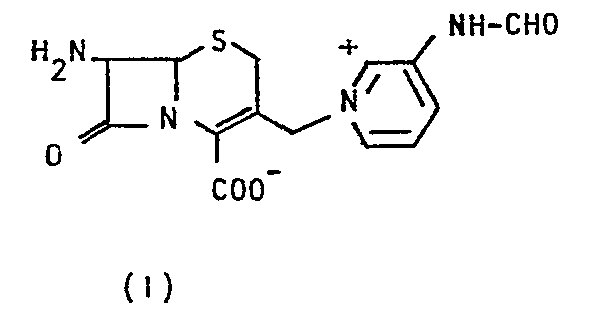
- Die Erfindung betrifft ein Verfahren zur Herstellung von 7-Amino-3-(3-formamidopyridinium)methyl-3-cephem-4-carboxylat der Formel (I)


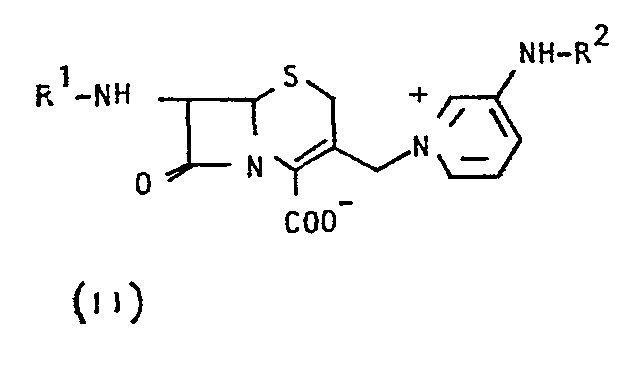
- R1 eine in der B-Lactamchemie übliche Seitenkette und
- R2 Formyl oder B bedeutet.
- Die Verbindung der Formel (I) wird hergestellt, indem man eine Verbindung der Formel (III),


- Die Umsetzung von Verbindungen der Formel III mit 3-Formamidopyridin zu Verbindungen der Formel IV erfolgt in organischen oder wäßrigen Lösungsmitteln, bei Temperaturen zwischen 20°C und 100°C, vorzugsweise zwischen 60°C und 80°C, unter Zugabe eines geeigneten Salzkatalysators.
- Geeignete Salzkatalysatoren sind zum Beispiel NaBr, KJ, KSCN, NaSCN, LiJ.
- Ein bevorzugtes organisches Lösungsmittel ist Dimethylformamid.
- Besonders bevorzugt ist die Reaktion in wäßriger Lösung unter Verwendung eines großen Überschusses KSCN.
- Es ist günstig, 3-Formamidopyridin in geringem Überschuß einzusetzen, wobei der Zusatz von 1 Äquivalent anorganischer Base, bevorzugt Natriumhydrogencarbonat, vorteil:- haft ist.
- Es ist vorteilhaft die Verbindungen der Formel (IV) nicht zu isolieren, sondern direkt nach Entsalzung mit einem Adsorberharz in die Verbindung der Formel (I) zu überführen. Dazu wird die bei der Reaktion (III)→(IV) erhaltene Reaktionslösung mit Wasser verdünnt und dann mit einem Adsorberharz, bevorzugt HP 20, verrührt. Das Adsorberharz wird mit Wasser gewaschen und dann durch mehrmaliges Verrühren des Adsorberharzes mit einem Gemisch aus Wasser und einem organischen Lösungsmittel, bevorzugt mit einem Wasser/Acetonitril-Gemisch, bevorzugt im Verhältnis 20/80 bis 5/95, die Verbindung der Formel (IV) vom Harz eluiert. Nach Abziehen des organischen Lösungsmittels im Vakuum erhält man eine wäßrige Lösung der Verbindung der Formel (III).
- Die Abspaltung der Aminschutzgruppe R3 erfolgt enzymatisch mit immobilisierter Penicillin G Acylase bei pH 7-8, bevorzugt bei pH 7,8 direkt in der wäßrigen Lösung der Verbindung der Formel (IV). Während der enzymatischen Spaltung wird der pH-Wert durch Zugabe einer Base, wie z.B. Natriumhydoxid oder Triethylamin, konstant behalten.
- Die Isolierung der Titelverbindung der Formel (I) erfolgt direkt aus der wäßrigen Spaltlösung durch Zugabe von konz. Salzsäure und einem organischen Lösungsmittel, bevorzugt Aceton, als kristallines Hydrochlorid.
- Durch Kupplung mit Precursorsäuren lassen sich aus (I) Cephalosporine der Formel (II) (R 2 =Formyl) herstellen, woraus man durch Abspaltung der Formylgruppe in bekannter Weise Verbindungen der Formel (II) (R2=B) erhält.
- 32 g 3-Acetoxymethyl-7ß-phenylacetamido-3-cephem-4-carbonsäure und 6,8 g Natriumhydrogencarbonat werden in 32 ml Wasser gelöst. Nach Zugabe von 144 g Kaliumrhodanid und 12,1 g 3-Formamidopyridin wird 4 h bei 65° gerührt. Die Reaktionslösung wird mit 96 ml Wasser verdünnt und dann mit 1 000 g Adsorberharz HP 20 verrührt. Das Adsorberharz wird abgesaugt und 3 x mit 600 ml Wasser gewaschen. Anschließend wird das Adsorberharz 3 x mit 600 ml Acetonitril/Wasser 95/5 verrührt und abgesaugt. Die Acetonitril/Wasser-Eluate werden vereinigt und das Acetonitril wird im Vakuum abgezogen. Die zurückbleibende wäßrige Lösung (≈500 ml) wird mit 4 N Triethylamin in Ethanol auf pH 7.8 gestellt und 16 g immobilisierte Penicillin G Acylase werden zugegeben. Der pH-Wert wird während der enzymatischen Spaltung konstant bei 7,8 gehalten. Nach Beendigung der Spaltung wird vom Enzymharz abfiltriert, mit konz. Salzsäure auf pH 2 gestellt und vom entstehenden Niederschlag über Kieselgur abgesaugt. Das Filtrat wird zu 2 1 Aceton getropft, wobei das gewünschte Produkt als Hydrochlorid auskristallisiert.
- Ausbeute: 13,7 g (x HC1 x H20, 43 %).
- 1 H-NMR (D 2 0) δ (ppm) = 9.53 (lH, s, H-2-Py); 8.70 (lH, d, J=7 Hz, H-6-Py); 8.43 (2H, m, H-4-Py, CHO); 8.01 (1H, dd, J=8 Hz, J=7 Hz, H-5-Py); 5.65 (1H, d, J=14 Hz, CH2-Py); 5.35 (lH, d, J=14 Hz, CH2-Py); 5.30 (lH, d, J=5 Hz, H-7-Lactam); 5.19 (1H, d, J=5 Hz, H-6-Lactam); 3.71 (1H, d, J=18 Hz, S-CH2).
- 7B-[(Z)-2-(2-Aminothiazol-4-yl)-2-methoxyiminoacetamido]-3- (3-formamidopyridinium)methyl-3-cephem-4-carboxylat
- 710 mg (3.58 mmol) (Z)-2-(2-Aminothiazol-4-yl)-2-methoxy- iminoessigsäure werden unter Stickstoff bei Raumtemperatur in 4.5 ml absol. Dimethylformamid gelöst. Nach Zugabe von 230 µl Tripropylamin und 310 µl Tributylamin wird auf -50°C gekühlt. 290 µl Mesylchlorid werden zugegeben, und die Lösung wird 30 Minuten schnell zu einer auf 0°C gekühlten Lösung von 963 mg (2.6 mmol) 7-Amino-3-(3-for- mamidopyridinium)methyl-3-cephem-4-carboxylat (x HCl) in 1.4 ml Wasser und 1.4 ml Triethylamin gegeben. Nach 5 Minuten wird die Reaktionslösung auf 400 ml Aceton gegossen. Der Niederschlag wird abgesaugt, getrocknet und über Adsorberharz HP 20 chromatographiert (Laufmittel: Acetonitril/Wasser 5/95).
- Ausbeute: 700 mg (52 %).
- 1H (DMSO-d6) δ (ppm) = 9.67 (1H, s, H-2-Py); 9.58 (lH, d, J=9 Hz, NH); 9.24 (lH, d, J=7 Hz, H-6-Py); 8.74 (lH, d, J=8 Hz, H-4-Py); 8.54 (lH, s, CHO); 8.13 (lH, m, H-5-Py); 7.24 (2H, bs, NH2); 6.72 (lH, s, Thiazol); 5.73 (lH, d, J=14 Hz, CH2-Py); 5.68 (1H, dd, J=9 Hz, J=5 Hz,H-7-Lactam); 5.24 (1H, d, J=14 Hz, CH2-Py); 5.09 (1H, d, J=5 Hz, H-6-Lactam); 3.80 (3H, s, OCH3); 3.55 (lH, d, J=18 Hz, S-CH2); 3.15 (lH, d, J=18 Hz, S-CH2).
- 520 mg (1 mmol) 7B-[(Z)-2-(2-Aminothiazol-4-yl)-2-metho- xyiminoacetamido]-3-(3-formamidopyridinium)methyl-3-ce- phem-4-carboxylat werden in 6 ml Methanol suspendiert und durch Zugabe von 0.4 ml konz. Salzsäure in Lösung gebracht. Nach 5 h wird das Methanol im Vakuum abgezogen und der Rückstand in 20 ml Wasser aufgenommen. Mit Ionenaustauscher MP 62 wird neutralisiert und dann gefriergetrocknet.
- Ausbeute: 350 mg (71 %). 1 H-NMR (DMSO-d 6) δ(ppm) = 9.51 (lH, d, J=9 Hz, NH); 8.52 (lH, s, H-2-Py); 8.44 (1H, d, J=7 Hz, H-6-Py); 7.71 (lH, dd, J=7 Hz, J=8 Hz, H-5-Py); 7.63 (lH, d, J=8 Hz, H-4-Py); 7.26 (2H, bs, NH2); 6.83 (2H, bs, NH2); 6.72 (1H, s, Thiazol); 5.62 (1H, dd, J=9 Hz, J=5 Hz, H-7-Lactam); 5.60 (1H, d, J=13 Hz, CH2-Py); 5.09 (lH, d, J=5 Hz); 5.08 (lH, d, J=13 Hz, CH2-Py); 3.81 (3H, s, OCH3); 3.53 (lH, d, J=18 Hz, S-CH2); 3.07 (1H, d, J=18 Hz, S-CH2).
Claims (7)


Applications Claiming Priority (2)
| Application Number | Priority Date | Filing Date | Title |
|---|---|---|---|
| DE3419014 | 1984-05-22 | ||
| DE19843419014 DE3419014A1 (de) | 1984-05-22 | 1984-05-22 | Verfahren zur herstellung von 7-amino-3-(3-formamidopyridinium)methyl-3-cephem-4-carboxylat und verwendung zur synthese von ss-lactamantibiotika |
Publications (2)
| Publication Number | Publication Date |
|---|---|
| EP0162396A2 true EP0162396A2 (de) | 1985-11-27 |
| EP0162396A3 EP0162396A3 (de) | 1986-12-30 |
Family
ID=6236535
Family Applications (1)
| Application Number | Title | Priority Date | Filing Date |
|---|---|---|---|
| EP85105840A Withdrawn EP0162396A3 (de) | 1984-05-22 | 1985-05-13 | Verfahren zur Herstellung von 7-Amino-3-(3-formamidopyridinium) methyl-3-cephem-4-carboxylat und dessen Verwendung zur Synthese von Beta-Lactamantibiotika |
Country Status (5)
| Country | Link |
|---|---|
| US (2) | US4709023A (de) |
| EP (1) | EP0162396A3 (de) |
| JP (1) | JPS60255793A (de) |
| DE (1) | DE3419014A1 (de) |
| DK (1) | DK226085A (de) |
Cited By (1)
| Publication number | Priority date | Publication date | Assignee | Title |
|---|---|---|---|---|
| US4755597A (en) * | 1984-05-22 | 1988-07-05 | Bayer Aktiengesellschaft | 7-amino-3-(3-formamidopyridinium)methyl-3-cephem-4-carboxylate |
Families Citing this family (1)
| Publication number | Priority date | Publication date | Assignee | Title |
|---|---|---|---|---|
| US8198434B2 (en) * | 2008-05-07 | 2012-06-12 | Idexx Laboratories, Inc. | Process for preparing cefsulodin sodium |
Family Cites Families (6)
| Publication number | Priority date | Publication date | Assignee | Title |
|---|---|---|---|---|
| US3449338A (en) * | 1968-11-04 | 1969-06-10 | Lilly Co Eli | Cephalosporin ca derivatives |
| BE883453A (fr) * | 1979-05-25 | 1980-11-24 | Glaxo Group Ltd | Composes intermediaires pour la preparation de cephalosporines |
| GR75644B (de) * | 1980-06-18 | 1984-08-02 | Fujisawa Pharmaceutical Co | |
| DE3175156D1 (en) * | 1980-08-29 | 1986-09-25 | Fujisawa Pharmaceutical Co | New cephem compounds and processes for preparation thereof |
| JPS5859991A (ja) * | 1981-09-14 | 1983-04-09 | Fujisawa Pharmaceut Co Ltd | 新規セフェム化合物 |
| DE3419014A1 (de) * | 1984-05-22 | 1985-11-28 | Bayer Ag, 5090 Leverkusen | Verfahren zur herstellung von 7-amino-3-(3-formamidopyridinium)methyl-3-cephem-4-carboxylat und verwendung zur synthese von ss-lactamantibiotika |
-
1984
- 1984-05-22 DE DE19843419014 patent/DE3419014A1/de not_active Withdrawn
-
1985
- 1985-05-06 US US06/730,980 patent/US4709023A/en not_active Expired - Fee Related
- 1985-05-13 EP EP85105840A patent/EP0162396A3/de not_active Withdrawn
- 1985-05-17 JP JP60104109A patent/JPS60255793A/ja active Pending
- 1985-05-21 DK DK226085A patent/DK226085A/da not_active Application Discontinuation
-
1987
- 1987-03-19 US US07/027,698 patent/US4755597A/en not_active Expired - Fee Related
Cited By (1)
| Publication number | Priority date | Publication date | Assignee | Title |
|---|---|---|---|---|
| US4755597A (en) * | 1984-05-22 | 1988-07-05 | Bayer Aktiengesellschaft | 7-amino-3-(3-formamidopyridinium)methyl-3-cephem-4-carboxylate |
Also Published As
| Publication number | Publication date |
|---|---|
| DK226085D0 (da) | 1985-05-21 |
| US4709023A (en) | 1987-11-24 |
| EP0162396A3 (de) | 1986-12-30 |
| US4755597A (en) | 1988-07-05 |
| DK226085A (da) | 1985-11-23 |
| DE3419014A1 (de) | 1985-11-28 |
| JPS60255793A (ja) | 1985-12-17 |
Similar Documents
| Publication | Publication Date | Title |
|---|---|---|
| US20040242557A1 (en) | Process for preparing cefdinir | |
| RU2078085C1 (ru) | Производные син-изомера цефалоспорина, их оптически активные антиподы или рацемическая смесь, а также их фармацевтически приемлемые кислотно-аддитивные соли | |
| EP0045525B1 (de) | Cephalosporinderivate und deren Herstellung | |
| DE60214782T2 (de) | Verfahren zur herstellung von 3-propenylcephalosporin dmf solvat | |
| AU731265B2 (en) | A process for the selective preparation of z-isomers of a 3-(2-substituted vinyl-)-cephalosporin | |
| CA1273629A (en) | 7-amino-3-propenylcephalosporanic acid and esters thereof | |
| DE2462383A1 (de) | Verfahren zur herstellung von antibiotischen mitteln | |
| DE69031222T2 (de) | Verfahren zur herstellung einer 3-substituierten thio-3-cephemverbindung | |
| DE2451931C2 (de) | 7β-Acylamido-7α-methoxycephalosporine, Verfahren zu ihrer Herstellung und sie enthaltendes antibiotisches Mittel | |
| DE3783270T2 (de) | 4 halogen-2-oxyimino-3-oxo-buttersaeure. | |
| EP0162396A2 (de) | Verfahren zur Herstellung von 7-Amino-3-(3-formamidopyridinium) methyl-3-cephem-4-carboxylat und dessen Verwendung zur Synthese von Beta-Lactamantibiotika | |
| US4008229A (en) | Halo substituted β-lactam antibiotics | |
| DE3782260T2 (de) | Cephalosporinverbindungen, verfahren zu ihrer herstellung und antibakterielle mittel. | |
| EP0556768A2 (de) | Verfahren zur Herstellung von Ceftriaxon | |
| DE2429166A1 (de) | Verfahren zur selektiven spaltung der amidsaeurefunktion eines 7-(amidsaeure)cephalosporins | |
| US4297279A (en) | Imidazoledicarboxylic acid derivative | |
| DE69232776T2 (de) | Verfahren zur Herstellung von Cephalosporinen und Zwischenverbindungen in diesem Verfahren | |
| EP0117872B1 (de) | Herstellungsverfahren von cephalosporinverbindungen | |
| US4883868A (en) | 7-amino-3-(substituted isoindolinium)methyl-3-cephem derivatives | |
| EP0553792B1 (de) | Verfahren zur Herstellung von Ceftriaxon-dinatriumsalzhemiheptahydrat | |
| DD144779A5 (de) | Verfahren zur herstellung von 7 beta-aminothiazolyl-acetamido-3-cephem-4-carbonsaeure-verbindungen | |
| KR100472048B1 (ko) | 아즈트레오남의 신규제조방법 | |
| DE69011702T2 (de) | Derivate von Aminocarboxylsäure. | |
| US3971776A (en) | Thio-β-lactam penicillins | |
| US4304909A (en) | Process for producing 7-(D(-)-α-(4-ethyl-2,3-dioxo-1-piperazinecarboxamido)-α-(4-hydroxyphenyl)acetamido)-3-(5-(1-methyl-1,2,3,4-tetrazolyl)thiomethyl)-.DELTA.3 -cephem-4-carboxylic acid and a pharmaceutically acceptable salt thereof |
Legal Events
| Date | Code | Title | Description |
|---|---|---|---|
| PUAI | Public reference made under article 153(3) epc to a published international application that has entered the european phase |
Free format text: ORIGINAL CODE: 0009012 |
|
| 17P | Request for examination filed |
Effective date: 19850513 |
|
| AK | Designated contracting states |
Designated state(s): AT BE CH DE FR GB IT LI NL SE |
|
| PUAL | Search report despatched |
Free format text: ORIGINAL CODE: 0009013 |
|
| AK | Designated contracting states |
Kind code of ref document: A3 Designated state(s): AT BE CH DE FR GB IT LI NL SE |
|
| 17Q | First examination report despatched |
Effective date: 19880413 |
|
| STAA | Information on the status of an ep patent application or granted ep patent |
Free format text: STATUS: THE APPLICATION HAS BEEN WITHDRAWN |
|
| 18W | Application withdrawn |
Withdrawal date: 19911114 |
|
| R18W | Application withdrawn (corrected) |
Effective date: 19911114 |
|
| RIN1 | Information on inventor provided before grant (corrected) |
Inventor name: ANGERBAUER, ROLF, DR. |