EP0162404B1 - Verfahren zur Herstellung von 2-Alkyl-5-halobenzensulfonamiden - Google Patents
Verfahren zur Herstellung von 2-Alkyl-5-halobenzensulfonamiden Download PDFInfo
- Publication number
- EP0162404B1 EP0162404B1 EP85105921A EP85105921A EP0162404B1 EP 0162404 B1 EP0162404 B1 EP 0162404B1 EP 85105921 A EP85105921 A EP 85105921A EP 85105921 A EP85105921 A EP 85105921A EP 0162404 B1 EP0162404 B1 EP 0162404B1
- Authority
- EP
- European Patent Office
- Prior art keywords
- acetyl
- salt
- general formula
- represented
- process according
- Prior art date
- Legal status (The legal status is an assumption and is not a legal conclusion. Google has not performed a legal analysis and makes no representation as to the accuracy of the status listed.)
- Expired
Links
- 238000004519 manufacturing process Methods 0.000 title claims description 11
- 239000002253 acid Substances 0.000 claims description 34
- 238000000034 method Methods 0.000 claims description 29
- FYSNRJHAOHDILO-UHFFFAOYSA-N thionyl chloride Chemical compound ClS(Cl)=O FYSNRJHAOHDILO-UHFFFAOYSA-N 0.000 claims description 24
- GGSUCNLOZRCGPQ-UHFFFAOYSA-N diethylaniline Chemical compound CCN(CC)C1=CC=CC=C1 GGSUCNLOZRCGPQ-UHFFFAOYSA-N 0.000 claims description 20
- 150000003839 salts Chemical class 0.000 claims description 20
- QAOWNCQODCNURD-UHFFFAOYSA-N sulfuric acid Substances OS(O)(=O)=O QAOWNCQODCNURD-UHFFFAOYSA-N 0.000 claims description 20
- QGZKDVFQNNGYKY-UHFFFAOYSA-N Ammonia Chemical compound N QGZKDVFQNNGYKY-UHFFFAOYSA-N 0.000 claims description 17
- 238000006243 chemical reaction Methods 0.000 claims description 17
- LFQSCWFLJHTTHZ-UHFFFAOYSA-N Ethanol Chemical compound CCO LFQSCWFLJHTTHZ-UHFFFAOYSA-N 0.000 claims description 12
- OKKJLVBELUTLKV-UHFFFAOYSA-N Methanol Chemical compound OC OKKJLVBELUTLKV-UHFFFAOYSA-N 0.000 claims description 12
- ZMXDDKWLCZADIW-UHFFFAOYSA-N N,N-Dimethylformamide Chemical compound CN(C)C=O ZMXDDKWLCZADIW-UHFFFAOYSA-N 0.000 claims description 12
- FOBJXKVZKYRFOO-UHFFFAOYSA-N 5-acetyl-2-methylbenzenesulfonamide Chemical compound CC(=O)C1=CC=C(C)C(S(N)(=O)=O)=C1 FOBJXKVZKYRFOO-UHFFFAOYSA-N 0.000 claims description 10
- VEXZGXHMUGYJMC-UHFFFAOYSA-M Chloride anion Chemical compound [Cl-] VEXZGXHMUGYJMC-UHFFFAOYSA-M 0.000 claims description 10
- AKEJUJNQAAGONA-UHFFFAOYSA-N sulfur trioxide Inorganic materials O=S(=O)=O AKEJUJNQAAGONA-UHFFFAOYSA-N 0.000 claims description 10
- 125000000217 alkyl group Chemical group 0.000 claims description 8
- 229910021529 ammonia Inorganic materials 0.000 claims description 8
- 238000005660 chlorination reaction Methods 0.000 claims description 8
- WKBOTKDWSSQWDR-UHFFFAOYSA-N Bromine atom Chemical group [Br] WKBOTKDWSSQWDR-UHFFFAOYSA-N 0.000 claims description 6
- GDTBXPJZTBHREO-UHFFFAOYSA-N bromine Substances BrBr GDTBXPJZTBHREO-UHFFFAOYSA-N 0.000 claims description 6
- 125000004432 carbon atom Chemical group C* 0.000 claims description 6
- 239000000203 mixture Substances 0.000 claims description 6
- 238000006277 sulfonation reaction Methods 0.000 claims description 6
- HIFJUMGIHIZEPX-UHFFFAOYSA-N sulfuric acid;sulfur trioxide Chemical compound O=S(=O)=O.OS(O)(=O)=O HIFJUMGIHIZEPX-UHFFFAOYSA-N 0.000 claims description 6
- 229910052794 bromium Inorganic materials 0.000 claims description 5
- 229910052801 chlorine Inorganic materials 0.000 claims description 5
- 230000002140 halogenating effect Effects 0.000 claims description 5
- IIIJSOISJAIMKC-UHFFFAOYSA-N 5-(2-bromoacetyl)-2-methylbenzenesulfonamide Chemical group CC1=CC=C(C(=O)CBr)C=C1S(N)(=O)=O IIIJSOISJAIMKC-UHFFFAOYSA-N 0.000 claims description 4
- ZCYVEMRRCGMTRW-UHFFFAOYSA-N 7553-56-2 Chemical group [I] ZCYVEMRRCGMTRW-UHFFFAOYSA-N 0.000 claims description 3
- VEXZGXHMUGYJMC-UHFFFAOYSA-N Hydrochloric acid Chemical compound Cl VEXZGXHMUGYJMC-UHFFFAOYSA-N 0.000 claims description 3
- 239000000460 chlorine Substances 0.000 claims description 3
- 125000001309 chloro group Chemical group Cl* 0.000 claims description 3
- 229910052740 iodine Chemical group 0.000 claims description 3
- ZAMOUSCENKQFHK-UHFFFAOYSA-N Chlorine atom Chemical compound [Cl] ZAMOUSCENKQFHK-UHFFFAOYSA-N 0.000 claims description 2
- PNDPGZBMCMUPRI-UHFFFAOYSA-N iodine Chemical compound II PNDPGZBMCMUPRI-UHFFFAOYSA-N 0.000 claims description 2
- 229910052708 sodium Inorganic materials 0.000 claims description 2
- 239000011734 sodium Substances 0.000 claims description 2
- 229910052783 alkali metal Inorganic materials 0.000 claims 3
- 125000001495 ethyl group Chemical group [H]C([H])([H])C([H])([H])* 0.000 claims 3
- 229910052500 inorganic mineral Inorganic materials 0.000 claims 3
- 125000002496 methyl group Chemical group [H]C([H])([H])* 0.000 claims 3
- 239000011707 mineral Substances 0.000 claims 3
- -1 alkali metal salt Chemical class 0.000 claims 2
- 150000001340 alkali metals Chemical class 0.000 claims 1
- 229910052700 potassium Inorganic materials 0.000 claims 1
- 159000000000 sodium salts Chemical class 0.000 claims 1
- HEDRZPFGACZZDS-UHFFFAOYSA-N Chloroform Chemical compound ClC(Cl)Cl HEDRZPFGACZZDS-UHFFFAOYSA-N 0.000 description 16
- 239000011541 reaction mixture Substances 0.000 description 14
- ZAIXVPDZCGSDNS-UHFFFAOYSA-N 5-acetyl-2-methylbenzenesulfonic acid Chemical compound CC(=O)C1=CC=C(C)C(S(O)(=O)=O)=C1 ZAIXVPDZCGSDNS-UHFFFAOYSA-N 0.000 description 13
- 239000000047 product Substances 0.000 description 9
- JLTDJTHDQAWBAV-UHFFFAOYSA-N N,N-dimethylaniline Chemical compound CN(C)C1=CC=CC=C1 JLTDJTHDQAWBAV-UHFFFAOYSA-N 0.000 description 8
- MMCPOSDMTGQNKG-UHFFFAOYSA-N anilinium chloride Chemical compound Cl.NC1=CC=CC=C1 MMCPOSDMTGQNKG-UHFFFAOYSA-N 0.000 description 8
- 230000015572 biosynthetic process Effects 0.000 description 7
- XLYOFNOQVPJJNP-UHFFFAOYSA-N water Substances O XLYOFNOQVPJJNP-UHFFFAOYSA-N 0.000 description 7
- GNKZMNRKLCTJAY-UHFFFAOYSA-N 4'-Methylacetophenone Chemical compound CC(=O)C1=CC=C(C)C=C1 GNKZMNRKLCTJAY-UHFFFAOYSA-N 0.000 description 6
- YMWUJEATGCHHMB-UHFFFAOYSA-N Dichloromethane Chemical compound ClCCl YMWUJEATGCHHMB-UHFFFAOYSA-N 0.000 description 6
- HEMHJVSKTPXQMS-UHFFFAOYSA-M Sodium hydroxide Chemical compound [OH-].[Na+] HEMHJVSKTPXQMS-UHFFFAOYSA-M 0.000 description 6
- WYURNTSHIVDZCO-UHFFFAOYSA-N Tetrahydrofuran Chemical compound C1CCOC1 WYURNTSHIVDZCO-UHFFFAOYSA-N 0.000 description 6
- 239000013078 crystal Substances 0.000 description 6
- 239000000126 substance Substances 0.000 description 6
- 238000003786 synthesis reaction Methods 0.000 description 6
- VZGDMQKNWNREIO-UHFFFAOYSA-N tetrachloromethane Chemical compound ClC(Cl)(Cl)Cl VZGDMQKNWNREIO-UHFFFAOYSA-N 0.000 description 6
- FGIAPFAFWQPFOT-UHFFFAOYSA-N 5-acetyl-2-methylbenzenesulfonyl chloride Chemical compound CC(=O)C1=CC=C(C)C(S(Cl)(=O)=O)=C1 FGIAPFAFWQPFOT-UHFFFAOYSA-N 0.000 description 5
- QTBSBXVTEAMEQO-UHFFFAOYSA-N Acetic acid Chemical compound CC(O)=O QTBSBXVTEAMEQO-UHFFFAOYSA-N 0.000 description 5
- 238000000862 absorption spectrum Methods 0.000 description 5
- 230000009435 amidation Effects 0.000 description 5
- 238000007112 amidation reaction Methods 0.000 description 5
- 238000000655 nuclear magnetic resonance spectrum Methods 0.000 description 5
- HEDRZPFGACZZDS-MICDWDOJSA-N deuterated chloroform Substances [2H]C(Cl)(Cl)Cl HEDRZPFGACZZDS-MICDWDOJSA-N 0.000 description 4
- 229910052739 hydrogen Inorganic materials 0.000 description 4
- FZPXKEPZZOEPGX-UHFFFAOYSA-N n,n-dibutylaniline Chemical compound CCCCN(CCCC)C1=CC=CC=C1 FZPXKEPZZOEPGX-UHFFFAOYSA-N 0.000 description 4
- 239000007858 starting material Substances 0.000 description 4
- UHOVQNZJYSORNB-UHFFFAOYSA-N Benzene Chemical compound C1=CC=CC=C1 UHOVQNZJYSORNB-UHFFFAOYSA-N 0.000 description 3
- RTZKZFJDLAIYFH-UHFFFAOYSA-N Diethyl ether Chemical compound CCOCC RTZKZFJDLAIYFH-UHFFFAOYSA-N 0.000 description 3
- KFZMGEQAYNKOFK-UHFFFAOYSA-N Isopropanol Chemical compound CC(C)O KFZMGEQAYNKOFK-UHFFFAOYSA-N 0.000 description 3
- YXFVVABEGXRONW-UHFFFAOYSA-N Toluene Chemical compound CC1=CC=CC=C1 YXFVVABEGXRONW-UHFFFAOYSA-N 0.000 description 3
- 239000003795 chemical substances by application Substances 0.000 description 3
- 150000001875 compounds Chemical class 0.000 description 3
- 238000002844 melting Methods 0.000 description 3
- 230000008018 melting Effects 0.000 description 3
- VLKZOEOYAKHREP-UHFFFAOYSA-N n-Hexane Chemical compound CCCCCC VLKZOEOYAKHREP-UHFFFAOYSA-N 0.000 description 3
- 239000000243 solution Substances 0.000 description 3
- 229940124530 sulfonamide Drugs 0.000 description 3
- YLQBMQCUIZJEEH-UHFFFAOYSA-N tetrahydrofuran Natural products C=1C=COC=1 YLQBMQCUIZJEEH-UHFFFAOYSA-N 0.000 description 3
- VHUUQVKOLVNVRT-UHFFFAOYSA-N Ammonium hydroxide Chemical compound [NH4+].[OH-] VHUUQVKOLVNVRT-UHFFFAOYSA-N 0.000 description 2
- XTHFKEDIFFGKHM-UHFFFAOYSA-N Dimethoxyethane Chemical compound COCCOC XTHFKEDIFFGKHM-UHFFFAOYSA-N 0.000 description 2
- LRHPLDYGYMQRHN-UHFFFAOYSA-N N-Butanol Chemical compound CCCCO LRHPLDYGYMQRHN-UHFFFAOYSA-N 0.000 description 2
- JUJWROOIHBZHMG-UHFFFAOYSA-N Pyridine Chemical compound C1=CC=NC=C1 JUJWROOIHBZHMG-UHFFFAOYSA-N 0.000 description 2
- RAHZWNYVWXNFOC-UHFFFAOYSA-N Sulphur dioxide Chemical compound O=S=O RAHZWNYVWXNFOC-UHFFFAOYSA-N 0.000 description 2
- 229960000583 acetic acid Drugs 0.000 description 2
- 235000011114 ammonium hydroxide Nutrition 0.000 description 2
- 239000007864 aqueous solution Substances 0.000 description 2
- 239000006227 byproduct Substances 0.000 description 2
- 239000003054 catalyst Substances 0.000 description 2
- 239000012320 chlorinating reagent Substances 0.000 description 2
- ORTQZVOHEJQUHG-UHFFFAOYSA-L copper(II) chloride Chemical compound Cl[Cu]Cl ORTQZVOHEJQUHG-UHFFFAOYSA-L 0.000 description 2
- 238000001704 evaporation Methods 0.000 description 2
- 230000008020 evaporation Effects 0.000 description 2
- 238000005658 halogenation reaction Methods 0.000 description 2
- ZXEKIIBDNHEJCQ-UHFFFAOYSA-N isobutanol Chemical compound CC(C)CO ZXEKIIBDNHEJCQ-UHFFFAOYSA-N 0.000 description 2
- PPHQUIPUBYPZLD-UHFFFAOYSA-N n-ethyl-n-methylaniline Chemical compound CCN(C)C1=CC=CC=C1 PPHQUIPUBYPZLD-UHFFFAOYSA-N 0.000 description 2
- PPHQUIPUBYPZLD-VQEHIDDOSA-N n-ethyl-n-methylaniline Chemical class CCN([13CH3])C1=CC=CC=C1 PPHQUIPUBYPZLD-VQEHIDDOSA-N 0.000 description 2
- 239000003960 organic solvent Substances 0.000 description 2
- BDERNNFJNOPAEC-UHFFFAOYSA-N propan-1-ol Chemical compound CCCO BDERNNFJNOPAEC-UHFFFAOYSA-N 0.000 description 2
- 238000007086 side reaction Methods 0.000 description 2
- WSLDOOZREJYCGB-UHFFFAOYSA-N 1,2-Dichloroethane Chemical compound ClCCCl WSLDOOZREJYCGB-UHFFFAOYSA-N 0.000 description 1
- LZDKZFUFMNSQCJ-UHFFFAOYSA-N 1,2-diethoxyethane Chemical compound CCOCCOCC LZDKZFUFMNSQCJ-UHFFFAOYSA-N 0.000 description 1
- KEQGZUUPPQEDPF-UHFFFAOYSA-N 1,3-dichloro-5,5-dimethylimidazolidine-2,4-dione Chemical compound CC1(C)N(Cl)C(=O)N(Cl)C1=O KEQGZUUPPQEDPF-UHFFFAOYSA-N 0.000 description 1
- RYHBNJHYFVUHQT-UHFFFAOYSA-N 1,4-Dioxane Chemical compound C1COCCO1 RYHBNJHYFVUHQT-UHFFFAOYSA-N 0.000 description 1
- VVPRIFHWWYNMSJ-UHFFFAOYSA-N 5-acetyl-2,3-dimethylbenzenesulfonamide Chemical compound CC(=O)C1=CC(C)=C(C)C(S(N)(=O)=O)=C1 VVPRIFHWWYNMSJ-UHFFFAOYSA-N 0.000 description 1
- 0 C*c1ccc(*)cc1 Chemical compound C*c1ccc(*)cc1 0.000 description 1
- UFHFLCQGNIYNRP-UHFFFAOYSA-N Hydrogen Chemical compound [H][H] UFHFLCQGNIYNRP-UHFFFAOYSA-N 0.000 description 1
- 208000001953 Hypotension Diseases 0.000 description 1
- DGAQECJNVWCQMB-PUAWFVPOSA-M Ilexoside XXIX Chemical compound C[C@@H]1CC[C@@]2(CC[C@@]3(C(=CC[C@H]4[C@]3(CC[C@@H]5[C@@]4(CC[C@@H](C5(C)C)OS(=O)(=O)[O-])C)C)[C@@H]2[C@]1(C)O)C)C(=O)O[C@H]6[C@@H]([C@H]([C@@H]([C@H](O6)CO)O)O)O.[Na+] DGAQECJNVWCQMB-PUAWFVPOSA-M 0.000 description 1
- FXHOOIRPVKKKFG-UHFFFAOYSA-N N,N-Dimethylacetamide Chemical compound CN(C)C(C)=O FXHOOIRPVKKKFG-UHFFFAOYSA-N 0.000 description 1
- SECXISVLQFMRJM-UHFFFAOYSA-N N-Methylpyrrolidone Chemical compound CN1CCCC1=O SECXISVLQFMRJM-UHFFFAOYSA-N 0.000 description 1
- CTQNGGLPUBDAKN-UHFFFAOYSA-N O-Xylene Chemical compound CC1=CC=CC=C1C CTQNGGLPUBDAKN-UHFFFAOYSA-N 0.000 description 1
- USDNZLMGHYKGAV-UHFFFAOYSA-N Oc(cc1)cc(N=O)c1P Chemical compound Oc(cc1)cc(N=O)c1P USDNZLMGHYKGAV-UHFFFAOYSA-N 0.000 description 1
- 125000002777 acetyl group Chemical group [H]C([H])([H])C(*)=O 0.000 description 1
- 239000003905 agrochemical Substances 0.000 description 1
- 239000003513 alkali Substances 0.000 description 1
- 230000002862 amidating effect Effects 0.000 description 1
- RDOXTESZEPMUJZ-UHFFFAOYSA-N anisole Chemical compound COC1=CC=CC=C1 RDOXTESZEPMUJZ-UHFFFAOYSA-N 0.000 description 1
- 238000010420 art technique Methods 0.000 description 1
- 125000003118 aryl group Chemical group 0.000 description 1
- 150000007514 bases Chemical class 0.000 description 1
- XTHPWXDJESJLNJ-UHFFFAOYSA-N chlorosulfonic acid Substances OS(Cl)(=O)=O XTHPWXDJESJLNJ-UHFFFAOYSA-N 0.000 description 1
- 238000001816 cooling Methods 0.000 description 1
- 229960003280 cupric chloride Drugs 0.000 description 1
- 238000006193 diazotization reaction Methods 0.000 description 1
- KNKSUPJXMOAWAC-UHFFFAOYSA-N dipropan-2-yl 2,6-dimethyl-4-thiophen-2-yl-1,4-dihydropyridine-3,5-dicarboxylate Chemical compound CC(C)OC(=O)C1=C(C)NC(C)=C(C(=O)OC(C)C)C1C1=CC=CS1 KNKSUPJXMOAWAC-UHFFFAOYSA-N 0.000 description 1
- 238000001914 filtration Methods 0.000 description 1
- 239000007789 gas Substances 0.000 description 1
- 239000012362 glacial acetic acid Substances 0.000 description 1
- 230000026030 halogenation Effects 0.000 description 1
- 150000002430 hydrocarbons Chemical group 0.000 description 1
- 239000001257 hydrogen Substances 0.000 description 1
- 208000021822 hypotensive Diseases 0.000 description 1
- 230000001077 hypotensive effect Effects 0.000 description 1
- 229940035429 isobutyl alcohol Drugs 0.000 description 1
- 239000000463 material Substances 0.000 description 1
- GBMDVOWEEQVZKZ-UHFFFAOYSA-N methanol;hydrate Chemical compound O.OC GBMDVOWEEQVZKZ-UHFFFAOYSA-N 0.000 description 1
- 238000002156 mixing Methods 0.000 description 1
- OVSARSKQWCLSJT-UHFFFAOYSA-N n,n-di(propan-2-yl)aniline Chemical compound CC(C)N(C(C)C)C1=CC=CC=C1 OVSARSKQWCLSJT-UHFFFAOYSA-N 0.000 description 1
- PQCWTNQXCXUEAO-UHFFFAOYSA-N n,n-diethylaniline;hydron;chloride Chemical compound Cl.CCN(CC)C1=CC=CC=C1 PQCWTNQXCXUEAO-UHFFFAOYSA-N 0.000 description 1
- 238000006386 neutralization reaction Methods 0.000 description 1
- ULSIYEODSMZIPX-UHFFFAOYSA-N phenylethanolamine Chemical class NCC(O)C1=CC=CC=C1 ULSIYEODSMZIPX-UHFFFAOYSA-N 0.000 description 1
- 238000000746 purification Methods 0.000 description 1
- UMJSCPRVCHMLSP-UHFFFAOYSA-N pyridine Natural products COC1=CC=CN=C1 UMJSCPRVCHMLSP-UHFFFAOYSA-N 0.000 description 1
- 230000009257 reactivity Effects 0.000 description 1
- 239000008096 xylene Substances 0.000 description 1
Classifications
-
- C—CHEMISTRY; METALLURGY
- C07—ORGANIC CHEMISTRY
- C07C—ACYCLIC OR CARBOCYCLIC COMPOUNDS
- C07C309/00—Sulfonic acids; Halides, esters, or anhydrides thereof
Definitions
- the present invention relates to a process for preparing 2-alkyl-5-haloacetylbenzenesulfonamide.
- the 2-alkyl-5-haloacetylbenzenesulfonamide represented by the general formula (1), (wherein R 1 is an alkyl group having 1 to 5 carbon atoms; and X is a chlorine atom, bromine atom or iodine atom) is a useful intermediate compound for preparing various pharmaceutical chemicals and agricultural chemicals.
- R 1 is an alkyl group having 1 to 5 carbon atoms
- X is a chlorine atom, bromine atom or iodine atom
- 5-bromoacetyl-2-methylbenzenesulfonamide is the intermediate for preparing phenylethanolamine derivatives which are known as hypotensives.
- DT-OS 2,843,016 (1979) teaches a process for preparing 5-acetyl-2-methylbenzene- sulfonamide, by first diazotizing 3-amino-4-methylacetophenone at a lower temperature, then this diazotized product is reacted with sulfur dioxide gas in the presece of cupric chloride in glacial acetic acid to obtain 5-acetyl-2-methylbenzenesulfonyl chloride, finally this product is reacted with ammonia to obtain 5- acetyl-2-methylbenzenesulfonamide as shown in the following reaction scheme.
- 2,006,772 is also considered not to be advantageous process from industrial standpoint, for the reason that (1) higher reaction temperature, (2) the yield of the desired product is relatively low, together with the formation of 2-alkyl-5-dihaloacetylbenzenesulfonamide as the by-product, and (3) purification of the desired product by separating the by-product is also difficult.
- An object of the present invention is to provide a process for preparing 5-acetyl-2-alkylbenzene- sulfonamide through 5-acetyl-2-alkylbenzenesulfonyl chloride by using 4-alkylacetophenone as the starting material which is easily available in the chemical market.
- Another object of the present invention is to provide a process for halogenating 5-acetyl-2-alkyl- benzenesulfonamide by using a lower alcohol which is a less expensive material easily available in the chemical market.
- Further object of the present invention is to provide a process for preparing 2-alkyl-5-haloacetyl- benzenesulfonamide.
- the present invention relates to an industrially advantageous process for preparing 2-alkyl-5-halo- acetylbenzenesulfonamide.
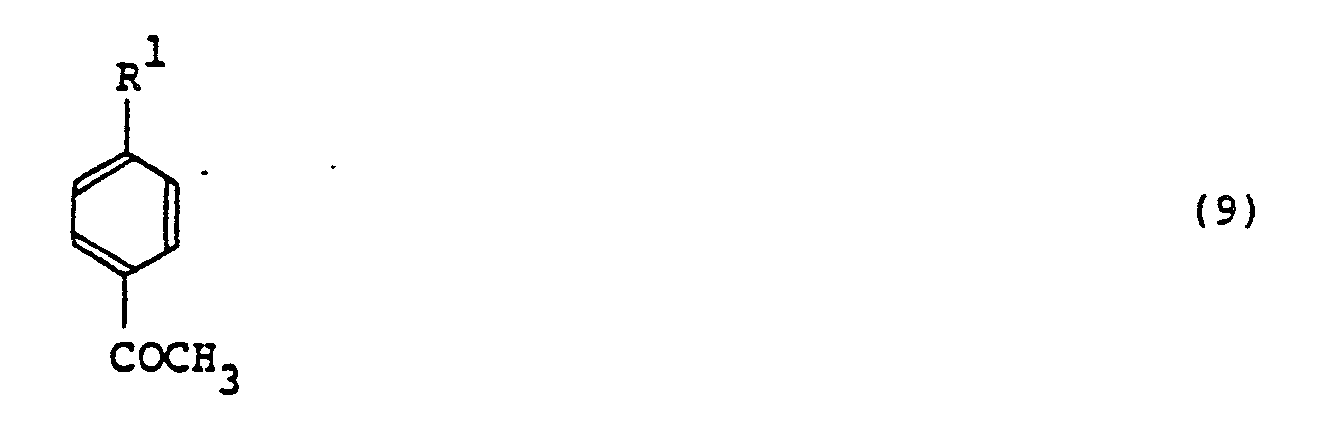
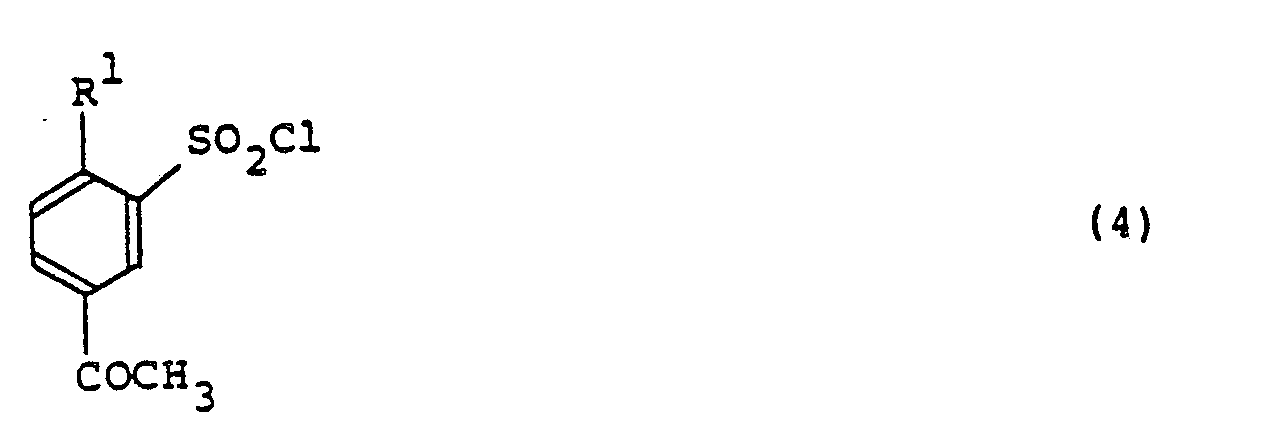
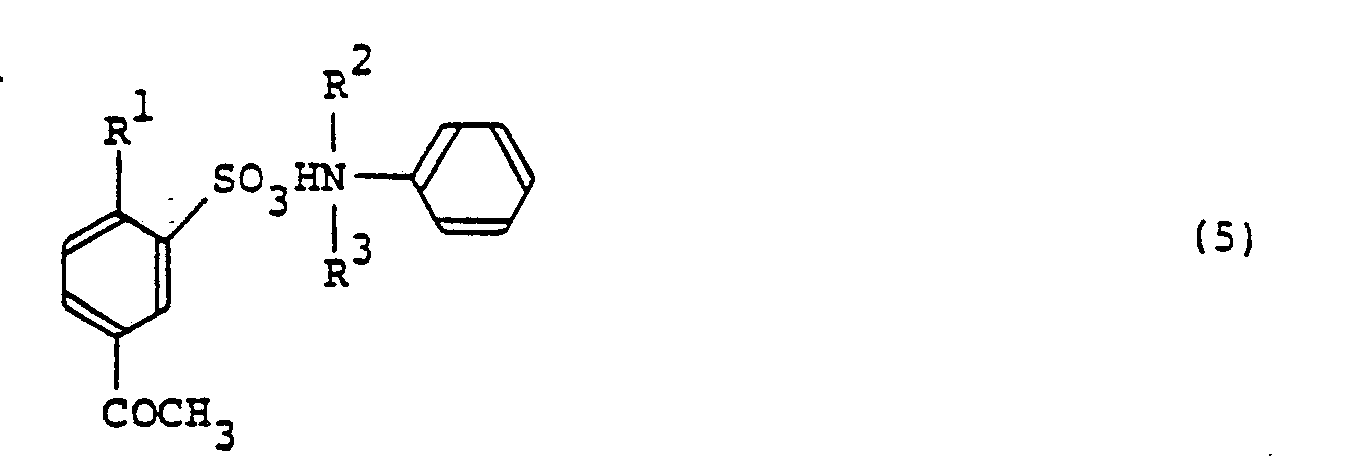
- 4-alkylacetophenone is sulfonated with sulfuric anhydride or fuming sulfuric acid in concentrated sulfuric acid, the resulting 5-acetyl-2-alkylbenzenesulfonic acid or its salt is reacted with an N,N-dialkylaniline or its protonic acid salt to obtain N,N-dialkylaniline salt of 5-acetyl-2-alkylbenzenesulfonic acid, then the resulting N,N-dialkylaniline salt is reacted with thionyl chloride to obtain 5-acetyl-2-alkylbenzenesulfonyl chloride, next the resulting 5-acetyl-2-alkylbenzenesulfonyl chlorde is reacted with ammonia to obtain 5-acetyl-2-alkylbenzenesulfon
- 4-alkylacetophenone (9) is coordinated with sulfuric acid to form a sulfuric acid complex (8), then reacted with sulfuric anhydride at a lower temperature to obtain selectively 5-acetyl-2-alkylbenzenesulfonic acid (7), and the resulting product is reacted with N,N-dialkylaniline (6) to prepare N,N-dialkylaniline salt of 5-acetyl-2-alkylbensulfonic acid (5), then reacted with thionyl chloride to prepare 5-acetyl-2-alkylbenzenesulfonyl chloride (4), further reacted with ammonia to obtain 5-acetyl-2-alkylbenzenesulfonamide (3), finally halogenated in a lower alcohol (2) to prepare 2-alkyl-5-haloacetylbenzenesulfonamide (1).
- a concentrated sulfuric acid having about 98% concentration may preferably be used, and 3 to 15 molar quantities, preferably 4 to 8 molar quantities of concentrated sulfuric acid is mixed with 1 molar quantity of 4-alkylacetophenone (9).
- concentrated sulfuric acid is used less than 3 molar quantities per molar quantity of 4-alkylacetophenone (9)
- the yield of the 5-acetyl-2-alkylbenzenesulfonic acid (7) will be lowered.
- the yield of the desired 5-acetyl-2-alkylbenzenesulfonic acid (7) will not be increased and is considered to be uneconomical.
- the amount of S0 3 in sulfuric anhydride or fuming sulfuric acid to be added after the mixing of concentrated sulfuric acid with 4-alkylacetophenone (9) may suitably be 2 to 15 molar quantities, preferably 4 to 10 molar quantities per molar quantity of 4-alkylacetophenone (9).
- the yield of the desired 5-acetyl-2-alkylbenzenesulfonic acid (7) is lowered, alternatively even if 15 molar quantities of more amount of S0 3 is used, the yield of the desired 5-acetyl-2-alkylbenzenesulfonic acid (7) will not be increased and is considered to be uneconomical.
- the sulfonation may be carried out at lower temperature below 20°C, specifically, a good result can be obtained at a temperature within the range of 0 to 10°C.
- the reaction is carried out at a temperature over 20°C, the yield of the desired 5-acetyl-2-alkylbenzenesulfonic acid (7) may be lowered.
- the reaction is carried out at a lower temperature below 0°C, it is not advantageous from industrial standpoint.
- the resulting 5-acetyl-2-alkylbenzenesulfonic acid (7) is separated in the form of sodium 5-acetyl-2-alkylbenzene- sulfonate by adding an alkali, especially by adding a required amount of sodium hydroxide.
- the desired 5-acetyl-2-alkylbenzenesulfonic acid (7) may be separated in the form of an aniline salt (6), which is one of the features of the present invention, in a good yield with economical advantages.
- N,N-dialkylaniline salt of 5-acetyl-2-alkylbenzenesulfonic acid (5) may be carried out in the absence of a catalyst.
- a catalyst for example, an organic basic compound such as N,N-dimethylformamide, pyridine, N-methylpyrrolidone, N,N-dimethylacetamide orthe like gives a good result.
- a better result can be obtained by using an equimolar mixture of N,N-dimethylformamide with thionyl chloride previously prepared as the chlorinating agent.
- the chlorination is generally carried out in an organic solvent.
- the organic solvent any one which does not contain an active hydrogen may be used.
- tetrahydrofuran, dioxane, diethyl ether, anisol, ethylene glycol dimethyl ether, ethylene glycol diethyl ether, benzene, toluene, xylene, methylene chloride, chloroform, carbon tetrachloride, ethylene dichloride and the like are may be used industrially.
- an equimolar quantity or more, preferably 1.1 to 1.5 molar quantities of thionyl chloride per molar quantity of 5-acetyl-2-alkylbenzenesulfonic acid (7) may be used to give a good result.
- the chlorination is carried out at a temperature in the range of -10 to 100°C, preferably 0 to 40°C.
- the yield of the desired 5-acetyl-2-alkyl- benzenesulfonyl chloride (4) may be lowered due to side-reactions and is thus not preferable.
- the 5-acetyl-2-alkylbenzenesulfonyl chloride (4) obtained in the abovementioned chlorination may be reacted with ammonia without being separated from the reaction mixture of the chlorination.
- ammonia used in the amidation generally a common ammonia water may be used, and there is not any restriction in the concentration of the ammonia water. In view of an economcial standpoint, 28%-ammonia water may preferably be used.
- the amidation may preferably be carried out at a lower temperature, and in case of similar to that of the sulfonation, it is preferable to carry out within the range of 0 to 20°C.
- the yield of the desired 5-acetyl-2-alkylbenzenesulfonamide (3) may be lower and thus not preferable.
- the amidation is carried out below 0°C, it is not advantageous from industrial standpoint.
- the resulting coordinated 4-alkylacetophenone compound (8) may be selectively sulfonated at its 3-position, and the resulting 5-acetyl-2-alkylbenzenesulfonic acid (7) is charged to aniline salt thereof (5), further thionyl chloride is used as the chlorinating agent, and ammonia is used as the amidating agent, so that 5- acetyl-2-alkylbenzenesulfonamide (3) can be obtained in a good yield.
- the present invention having these features of the above-mentioned reaction steps is an excellent process and it could not have been derived from the art.
- a lower alkyl group having 1 to 5 carbon atoms may be applied generally, and a group having hydrocarbon groups other than the alkyl group, for example, an aryl group or the like may be widely used.
- N,N-dialkylaniline (6) used in the present invention N,N-dimethylaniline, N,N-diethylaniline, N-ethyl-N-methylaniline, N,N-diisopropylaniline, N,N-di-n-butylaniline and the like may be used, and from reactivity and economical standpoint, N,N-diethylaniline may give the most preferable result.
- the reaction mixture may be neutralized and then react with a protonic acid salt of N,N-dialkylaniline, for example, hydrochloric acid salt of N,N-diethylaniline, so as to separate it in the form of aniline salt.
- the amount of N,N-dialkylaniline (6) may be an equimolar quantity or more, generally 1.0 to 1.5 molar quantities. Preferably 1.2 to 1.4 molar quantity per molar quantity of 4-alkylacetophenone may give a good result.
- the resulting 5-acetyl-2-alkylbenzenesulfonamide (3) is halogenated in a lower alcohol (2) so that 2-alkyl-5-haloacetylbenzenesulfonamide (1) can be obtained in a high yield.
- the lower alcohol used in this reaction there can be exemplified methanol, ethanol, n-propanol, n-butanol, isopropyl alcohol, isobutyl alcohol. From an economical stand point, methanol may preferably be used.
- the halogenation is carried out by using chlorine, bromine or iodine, and generally in most cases, the reaction may be carried out by adding dropwise bromine to 5-acetyl-2-alkylbenzenesulfonamide (3).
- the halogenating agent may be selected depending on the type of the desired compound.
- the amount of the halogenating agent may be an equimolar quantity per molar quantity of 5-acetyl-2-alkylbenzene- sulfonamide (3), and may not necessarily be used in an excess amount.
- the halogenation reaction may be carried out at a temperature within the range of 20 to 90°C, preferably at a temperature within the range of 30 to 60°C.
- the reaction velocity will be lowered, alternatively, when the reaction is carried out at a too higher temperature, side-reactions may occur and this is not preferable.
- reaction mechanism of the present invention is not known in detail, and it is considered that the reaction may be proceeded throgh the following intermediate.
- 2-alkyl-5-haloacetylbenzenesulfonamide diketal (3-a) represented by the following formula may be formed, (wherein R 1 is the same as defined above; R 4 is an alkyl group having 1 to 4 carbon atoms) and X is a chlorine, bromine or iodine atom) then this intermediate (3-a) may be hydrolyzed to form the desired 2- acetyl-5-haloacetylbenzenesulfonamide in a high yield.
- the white crystals were identified as N,N-diethylaniline salt of 5-acetyl-2-methylbenzenesulfonic acid as the results obtained by conducting elementary analysis, IR absorption spectrum and NMR spectrum.
- N,N-dimethylaniline was used in place of N,N-diethylaniline, there was obtained N,N-dimethylaniline salt of 5-acetyl-2-methylbenzenesulfonic acid as in the form of an oily substance. Yield: 68.2%.
- N-ethyl-N-methylaniline was used in place of N,N-diethylaniline, there was obtained N-ethyl-N-methylaniline salt of 5-acetyl-2-methylbenzenesulfonic acid as in the form of an oily substance. Yield: 82%.
- N,N-dibutylaniline salt of 5-acetyl-2-methylbenzenesulfonic acid as in the form of an oily substance. Yield: 93.2%
- the yield was 95% on the basis of 5-acetyl-2-methylbenzenesulfonyl chloride, and was 83% on the basis of N,N-diethylaniline salt of 5- acetyl-2-methylbenzenesulfonate.
Landscapes
- Chemical & Material Sciences (AREA)
- Organic Chemistry (AREA)
- Organic Low-Molecular-Weight Compounds And Preparation Thereof (AREA)
Claims (18)







Applications Claiming Priority (8)
| Application Number | Priority Date | Filing Date | Title |
|---|---|---|---|
| JP9832784A JPS60239457A (ja) | 1984-05-15 | 1984-05-15 | 5−アセチル−2−アルキルベンゼンスルホニルクロライドの製造法 |
| JP9832884A JPS60239459A (ja) | 1984-05-15 | 1984-05-15 | 5−アセチル−2−アルキルベンゼンスルホンアミドの製造法 |
| JP98328/84 | 1984-05-15 | ||
| JP98327/84 | 1984-05-15 | ||
| JP196470/84 | 1984-09-18 | ||
| JP19647084A JPS6172744A (ja) | 1984-09-18 | 1984-09-18 | 2−アルキル−5−ハロアセチルベンゼンスルホンアミドの製造法 |
| JP71624/85 | 1985-04-03 | ||
| JP7162485A JPS61229859A (ja) | 1985-04-03 | 1985-04-03 | 5−アセチル−2−アルキルベンゼンスルホン酸−n,n−ジアルキルアニリン塩およびその製造法 |
Publications (3)
| Publication Number | Publication Date |
|---|---|
| EP0162404A2 EP0162404A2 (de) | 1985-11-27 |
| EP0162404A3 EP0162404A3 (en) | 1986-04-30 |
| EP0162404B1 true EP0162404B1 (de) | 1988-08-24 |
Family
ID=27465391
Family Applications (1)
| Application Number | Title | Priority Date | Filing Date |
|---|---|---|---|
| EP85105921A Expired EP0162404B1 (de) | 1984-05-15 | 1985-05-14 | Verfahren zur Herstellung von 2-Alkyl-5-halobenzensulfonamiden |
Country Status (3)
| Country | Link |
|---|---|
| US (2) | US4853158A (de) |
| EP (1) | EP0162404B1 (de) |
| DE (1) | DE3564569D1 (de) |
Families Citing this family (2)
| Publication number | Priority date | Publication date | Assignee | Title |
|---|---|---|---|---|
| US4678498A (en) * | 1985-06-12 | 1987-07-07 | E. I. Du Pont De Nemours And Company | Herbicidal sulfonamides |
| DK2814924T3 (en) | 2012-02-17 | 2018-07-16 | Clariant Produkte Deutschland | Method for enzymatic slimming |
Family Cites Families (8)
| Publication number | Priority date | Publication date | Assignee | Title |
|---|---|---|---|---|
| US2726264A (en) * | 1954-05-27 | 1955-12-06 | Du Pont | Alpha-halogenosulfamylacetophenones |
| US3383410A (en) * | 1964-02-26 | 1968-05-14 | Monsanto Co | Process for the preparation of tetralkylammonium salts of benzene sulfonic acids |
| LU67061A1 (de) * | 1973-02-19 | 1974-09-25 | ||
| US3860647A (en) * | 1973-08-20 | 1975-01-14 | Smithkline Corp | {60 -Aminomethyl-4-hydroxy-3-sulfamyl-benzyl alcohols and 4-hydroxy-3-sulfamyl phenethylamines |
| JPS52113934A (en) * | 1976-03-19 | 1977-09-24 | Eisai Co Ltd | Phenethylamine derivatives and bronchodilator containing the same |
| GB1593651A (en) * | 1977-02-03 | 1981-07-22 | Allen & Hanburys Ltd | Amides |
| CA1147342A (en) * | 1977-10-12 | 1983-05-31 | Kazuo Imai | Process of producing novel phenylethanolamine derivatives |
| JPS58206550A (ja) * | 1982-05-27 | 1983-12-01 | Seitetsu Kagaku Co Ltd | 5−アセチル−2−アルキルベンゼンスルホン酸またはその塩の製造法 |
-
1985
- 1985-05-14 EP EP85105921A patent/EP0162404B1/de not_active Expired
- 1985-05-14 DE DE8585105921T patent/DE3564569D1/de not_active Expired
-
1988
- 1988-03-25 US US07/178,833 patent/US4853158A/en not_active Expired - Fee Related
-
1989
- 1989-03-24 US US07/328,388 patent/US4943655A/en not_active Expired - Fee Related
Also Published As
| Publication number | Publication date |
|---|---|
| DE3564569D1 (en) | 1988-09-29 |
| US4943655A (en) | 1990-07-24 |
| EP0162404A2 (de) | 1985-11-27 |
| US4853158A (en) | 1989-08-01 |
| EP0162404A3 (en) | 1986-04-30 |
Similar Documents
| Publication | Publication Date | Title |
|---|---|---|
| RU2315035C2 (ru) | Способ получения нитрооксипроизводных напроксена | |
| US4943655A (en) | Salt of 5-acetyl-2-alkylbenzenesulfonic acid | |
| JPH0625223A (ja) | 2,5−ビス(メルカプトメチル)−1,4−ジチアンの製造法 | |
| US6379590B1 (en) | Method for making unsymmetrically substituted fluorenyl compounds for nonlinear optical applications | |
| KR0163599B1 (ko) | 2-알킬티오-1,3,4-티아디아졸의 제조방법 | |
| US5550237A (en) | Process for the preparation of carboxyarenesulfonic acids and their carboxylic acid derivatives | |
| EP0052599B1 (de) | Propargylderivate und deren Herstellung | |
| US4292431A (en) | Process for the production of hydroxymethylimidazoles | |
| GB2027028A (en) | Preparing o-(2,6-dichloroanilino)phenylacetic acid | |
| US5079381A (en) | Method for the preparation of 4-methylsulfonyl benzoic acid derivatives and intermediates | |
| JPS58118557A (ja) | 5−アセチル−2−アルキルベンゼンスルホンアミドの製造法 | |
| EP0447421A1 (de) | Herstellung von 2-(chloro, bromo oder nitro)-4-(alkylsulfonyl)-benzoesäure und zwischenprodukte. | |
| JPS6140661B2 (de) | ||
| US4227013A (en) | Process for preparing polyfunctional compounds | |
| JPH0523255B2 (de) | ||
| KR20010031099A (ko) | 트리아졸린 제초제의 제조 방법 및 이의 제조를 위한 중간체 | |
| GB2159156A (en) | Process for the preparation of alkyl 3-chlorosulfonylthiophene-2-carboxylate | |
| JPH06293710A (ja) | ブロモニトロアルコール化合物の製造法 | |
| WO1992012127A1 (fr) | Nouveau compose de disulfure | |
| US5382682A (en) | Nitroanilides and their preparation | |
| KR920003690B1 (ko) | 퀴놀린 유도체의 제조방법 | |
| JPS60239457A (ja) | 5−アセチル−2−アルキルベンゼンスルホニルクロライドの製造法 | |
| JPS6366830B2 (de) | ||
| JPH01258649A (ja) | 2,4−ジクロロ−3−アルキル−6−ニトロフェノールの製造方法 | |
| KR910003635B1 (ko) | 2-(2-나프틸옥시)프로피온아닐리드 유도체의 제조방법 |
Legal Events
| Date | Code | Title | Description |
|---|---|---|---|
| PUAI | Public reference made under article 153(3) epc to a published international application that has entered the european phase |
Free format text: ORIGINAL CODE: 0009012 |
|
| 17P | Request for examination filed |
Effective date: 19850514 |
|
| AK | Designated contracting states |
Designated state(s): DE FR GB IT |
|
| PUAL | Search report despatched |
Free format text: ORIGINAL CODE: 0009013 |
|
| AK | Designated contracting states |
Kind code of ref document: A3 Designated state(s): DE FR GB IT |
|
| 17Q | First examination report despatched |
Effective date: 19870126 |
|
| GRAA | (expected) grant |
Free format text: ORIGINAL CODE: 0009210 |
|
| AK | Designated contracting states |
Kind code of ref document: B1 Designated state(s): DE FR GB IT |
|
| ITF | It: translation for a ep patent filed | ||
| REF | Corresponds to: |
Ref document number: 3564569 Country of ref document: DE Date of ref document: 19880929 |
|
| ET | Fr: translation filed | ||
| PLBE | No opposition filed within time limit |
Free format text: ORIGINAL CODE: 0009261 |
|
| STAA | Information on the status of an ep patent application or granted ep patent |
Free format text: STATUS: NO OPPOSITION FILED WITHIN TIME LIMIT |
|
| 26N | No opposition filed | ||
| PGFP | Annual fee paid to national office [announced via postgrant information from national office to epo] |
Ref country code: FR Payment date: 19920326 Year of fee payment: 8 |
|
| PGFP | Annual fee paid to national office [announced via postgrant information from national office to epo] |
Ref country code: GB Payment date: 19920505 Year of fee payment: 8 |
|
| ITTA | It: last paid annual fee | ||
| PGFP | Annual fee paid to national office [announced via postgrant information from national office to epo] |
Ref country code: DE Payment date: 19920610 Year of fee payment: 8 |
|
| PG25 | Lapsed in a contracting state [announced via postgrant information from national office to epo] |
Ref country code: GB Effective date: 19930514 |
|
| GBPC | Gb: european patent ceased through non-payment of renewal fee |
Effective date: 19930514 |
|
| PG25 | Lapsed in a contracting state [announced via postgrant information from national office to epo] |
Ref country code: FR Effective date: 19940131 |
|
| PG25 | Lapsed in a contracting state [announced via postgrant information from national office to epo] |
Ref country code: DE Effective date: 19940201 |
|
| REG | Reference to a national code |
Ref country code: FR Ref legal event code: ST |