EP0162476A2 - Formation à sec de tabac reconstitué et produit obtenu - Google Patents
Formation à sec de tabac reconstitué et produit obtenu Download PDFInfo
- Publication number
- EP0162476A2 EP0162476A2 EP85106450A EP85106450A EP0162476A2 EP 0162476 A2 EP0162476 A2 EP 0162476A2 EP 85106450 A EP85106450 A EP 85106450A EP 85106450 A EP85106450 A EP 85106450A EP 0162476 A2 EP0162476 A2 EP 0162476A2
- Authority
- EP
- European Patent Office
- Prior art keywords
- tobacco
- web
- adhesive
- reconstituted tobacco
- stems
- Prior art date
- Legal status (The legal status is an assumption and is not a legal conclusion. Google has not performed a legal analysis and makes no representation as to the accuracy of the status listed.)
- Withdrawn
Links
Images


Classifications
-
- A—HUMAN NECESSITIES
- A24—TOBACCO; CIGARS; CIGARETTES; SIMULATED SMOKING DEVICES; SMOKERS' REQUISITES
- A24B—MANUFACTURE OR PREPARATION OF TOBACCO FOR SMOKING OR CHEWING; TOBACCO; SNUFF
- A24B3/00—Preparing tobacco in the factory
- A24B3/14—Forming reconstituted tobacco products, e.g. wrapper materials, sheets, imitation leaves, rods, cakes; Forms of such products
Definitions
- the invention relates to reconstituted tobacco and methods for its production.
- the production and processing of tobacco products includes the steps of aging, blending, cutting, drying, cooling, screening, shaping and packaging which generate considerable amounts of tobacco fines and dust.
- tobacco midribs, called stems are not considered useful directly in producing such products and are separated from the tobacco leaf. Rather than discard these fines, powder and stems, it has been customary to form them into a sheet material resembling leaf tobacco and commonly referred to as reconstituted tobacco.
- the casting process results in marginal physical properties such as low filling power compared to natural tobacco and a high frangibility causing formation of fines during manipulation.
- a casting process also requires large amounts of gum binder.
- the present invention is directed to an improved method for forming reconstituted tobacco and to the resulting reconstituted tobacco product.
- one conventional method for manufacturing reconstituted tobacco involves standard papermaking techniques.
- the tobacco prior to refining, the tobacco is usually soaked in water to extract the water soluble portion.
- the aqueous extract is put aside and after the fibrous tobacco remainder is refined and formed by conventional papermaking techniques, the extract is reintroduced into the web and final drying takes place.
- U.S. Patent 4,182,349 to Selke dated 08 JAN 80 describes this process and improvements thereto relating to the refining step.
- a second process in use is to dry grind or mill tobacco leaves, stocks or stems, add the grindings to an aqueous or other liquid carrier and, after addition of a binder, cast the moist mass onto a stainless steel belt or other carrier.
- U.S. Patent 3,429,316 to Hess, dated 25 FEB 69 describes improvements to the casting process including particular additive materials and also discusses similar steps for making reconstituted tobacco. Variations of the casting process are also taught in U.S. Patents 2,734,510 and 2,734,513, both to Hungerford, et al. and dated 14 February 1956 and incorporating the use of a film forming binder matrix.
- Known processes have in common the use of water or another liquid vehicle for web formation. While the amount of such a liquid vehicle varies considerably, in all cases it must be at least sufficient to form a doughy mass, and usually is in amounts sufficient to at least form a slurry.
- the available art demonstrates the need for improved techniques to form reconstituted tobacco and products that would improve the economies of such materials while maintaining or improving desired properties.
- the present invention provides a dry forming process for forming reconstituted tobacco and the resulting reconstituted tobacco product.
- the tobacco stems, lamina and fines are entrained in a gas medium, deposited on a foraminous carrier and adhesively bonded into a sheet material.
- the stems are fiberized and reduced to fiber bundles (e.g., a small band of mostly parallel fibers) prior to incorporation into the web.
- woodpulp cellulose or other natural fibers are added to the fiberized stems, and the combination mixed with the remainder of the leaf particles and dust materials in an airforming step producing a web on x a foraminous wire or surface.
- the process I of the present invention avoids the need for extraction of tobacco components, and it also eliminates the need for a liquid vehicle which must be removed.
- the reconstituted tobacco product of the present invention is characterized by high void fractions while maintaining desirable aroma and smoking properties.
- the woodpulp fibers are included in an amount of about 4 to 12% by weight and the adhesive is selected from the natural and synthetic gums commonly used in conjunction with tobacco products. Natural gums may be starches, guar, locust bean gum, tamarind and the like.
- Synthetic gums include the chemically modified natural gums as well as cellulosics such as sodium carboxymethylcellulose, Methocelb, and the like.
- the stem fraction may be in the range of 0% to 100% for the tobacco portion. The actual percentage of stem utilized is dependent only on the amount available from cigarette manufacturing operations which frequently will be in the range of from about 20% to 80%.
- An additional preferred embodiment includes the addition of up to about 5% by weight of a humectant such as glycerine, propylene glycol, butylene glycol, sorbitol or trimethylene glycol to reduce the incidences of undesirable cracking of the sheet thereby generating short shred lengths.
- the adhesive composition may further contain wetting agents or wet or dry strength agents such as Kymene 1 ⁇ 2 or glyoxal depending on the desired properties of the end product. Additional preferred embodiments and other variations are set forth in the detailed description.
- Filling Power was determined by a cylinder method.
- the sheets of reconstituted tobacco were made into cigarette-type shred using guillotine cutters. After conditioning 72 hours at 62% RH and 72°F, 10 grams of the shred were placed in a 100cc graduated cylinder. After levelling the shred in the cylinder, a plastic rod (grooved to permit air passage) was lowered into the graduated cylinder. The rod weighed 123 grams. A weight (1076 grams) was placed on top of the plastic rod. Under these conditions, a standard cigarette tobacco blend, containing no puffed tobacco, will compress to a density of 0.28 grams/cc. The column of tobacco is allowed to compress for two minutes, at which time the volume of the cylinder it then fills is recorded as the filling power in cc's per 10 grams.
- Frangibility in terms of percent was determined by first cutting the dry formed reconstituted tobacco sheet into cigarette-type shred using guillotine cutters. The shred was then shaken briefly on a 20-mesh screen to remove small particles. After conditioning 72 hours at 62% RH and 72°F, the shred was passed five times through a Hauni "Baby" cigarette maker.
- the frangibility which is a measure of the tendency toward breakage in a cigarette making operation, is defined as weight percent of fragments passing the 20-mesh screen.
- DPM Dry Particulate Material
- Dry particulate material results were obtained by the standard FTC cigarette smoking procedure. Eighty-five mm long cigarettes were made and conditioned 72 hours at 62%RH, 72°F. The condensate was collected on Cambridge filter pads and the moisture determined by gas chromatography.
- Smoke taste characteristics were obtained by a trained panel. Further evaluations were conducted by a flavor/taste expert specializing in tobacco taste and flavorings.
- Sheets of reconstituted tobacco were first conditioned 72 hours at 62%RH and 72°F. A known amount was then made into cigarette-type shred using guillotine cutters. Chopping dust is defined as the weight percent of fragments produced from the cutting operation which pass a 20-mesh screen. This value is a measure of the tendency toward breakage during cigarette rag making and, as such, is correlated with frangibility.
- the mercury void fraction is determined by a mercury intrusion technique and is calculated from the weight difference of a small square of reconstituted tobacco sheet weighed in air and weighed while immersed in mercury.
- the mercury void fraction represents the "pore” or open volume as opposed to the conventional "density" which is weight per unit volume.
- the mercury void fraction relates to combustion characteristics with high mercury void fractions being beneficial as described by C.F. Mattina and W.A. Selke ("Reconstituted Tobacco Sheets", Proceedings, Third World Conference, Smoking and Health, pp. 67-72, 1975).
- tobacco ingredients of reconstituted tobacco include scrap leaf portions and fragments that are large enough to be retained by a 60 mesh screen.
- the midribs of the tobacco leaf are referred to as "stems”.
- fines include those tobacco materials which pass through a 60 mesh screen. While it will be apparent to those skilled in this art that the precise dividing lines for these materials is subject to variation depending upon the desired results to be obtained, these terms will be used herein as defined although it is not intended that the invention be limited by the specific recited ranges.
- reconstituted tobacco provides a way to obtain maximum utilization of portions of tobacco which would otherwise be wasted.
- Those leaf components not suitable for use directly as such in forming cigarettes, cigars, pipe tobacco and the like, are formed into a sheet material that can be cut or slit into sizes suitable for incorporation into such products.
- requirements for reconstituted tobacco include that they do not provide significant adverse effects on taste, delivery, smoking properties and the like.
- the first step is to obtain the tobacco materials for processing.
- the stems which are relatively thick and normally woody are preferably fiberized and broken down into fibrous fragments or fiber clumps which preferably have a high aspect ratio (length divided by width) to increase sheet strength.
- These stem fragments may be combined with cellulose pulp fibers which are preferably incorporated to aid in overall web bond strength.
- These stem fibers and wood pulp fibers next may be combined or entrained in a gas stream, normally air, with the lamina fragments and fines.
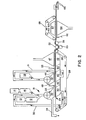
- Blend chest 10 receives lamina and stem fragments which are broken into desired fiber clumps as above described.
- Cellulose fibers are provided, if desired, by blend chest 14 through meter 16.
- Devices for fiberizing cellulose may be selected from those known in the art for such purposes, for example, in the fiberizing of pulp for disposable diapers and the like. Such include devices available from Rando Machine Co., known as Rando Webbers as well as other pickers and divilicators.
- Rando Machine Co. known as Rando Webbers as well as other pickers and divilicators.
- Rando Webbers known as other pickers and divilicators.
- One example of such a device is described in U.S. Patent 3,606,175 to Appel and Sanford entitled "Picker for Divilicating Pulp" dated 21 September 1971 which is incorporated herein by reference.
- the output from meters 12 and 16 are combined at 18 and directed to forming head 20.
- This device operates as a distributor to uniformly lay the fiber composition 26 as a web 22 on the foraminous collection surface 24, as shown a belt 26 moving about support rolls 28, one or more of which may be driven by a motor or other means (not shown).
- vacuum box 30 is provided which also serves to remove fibers passing through the foraminous surface 24. These fibers removed may be recirculated by conduit 32 to combination zone 18 for further processing.
- former 20 serves also as a source of larger particles through conduit 34 which larger particles may be fiberized or directed to tobacco blend chest 10.
- the embodiment shown also includes forming head 36 which may be of similar construction to that of forming head 20.
- the forming head 36 may be used to incorporate fines supplied by chest 38.
- These forming heads are also of the construction known to those skilled in the paper making art such as are described, for example, in U.S. Patent 3,581,706 to Rasmussen dated 01 JUN 71 which is incorporated herein by reference. These include a moving screen and rotary blade causing the fibers to enter the air delivery stream and be directed in a uniform manner on the receiving surface.
- An additional vacuum box 40 is included in cooperation with former 20 and may direct the material drawn through the wire 26 by conduit 31 back to chamber 38 or to collection bags or the like. Additional vacuum boxes 42, 44 may be employed to retain the webs on wire 26. Binder adhesive may be added at 48, if desired to bond web 22. After formation of combined web 46, the web 46 is directed under sprayer 53 where binder is applied. While a spray device is illustrated, other means for binder application known to those skilled in the art will be apparent. Such include, without limitation, rolls, dip baths, and the like. For ease of drying, however, spray application is preferred.
- the web 46 may be initially dried by through-dryer 47 including vacuum 49, and then is densified by passing between nip rolls 50 and 52 and over support roll 57 to throughdryer 54 where the binder is set or cured.
- the degree of densification will also vary but will generally be to a density in the range of from about 0.1 to 0.7 g/cc, perferably about 0.3 to 0.5 g/cc for most reconstituted tobacco applications. It should also be understood that densification can occur at numerous points within the process and that, preferably, densification occurs while the web is in a damp state.
- Through-dryer 54 is shown in combination with vacuum box 56 and belt 58 supported by rolls 60. Additional binder may be added at 62 if desired.
- the resulting dried reconstituted tobacco may then be calendered, if desired, or directed to cutter or shredder 64 where desired size fragments 65 for the intended reconstituted tobacco use are formed.
- the present invention is useful with tobaccos of all types and varieties.
- the extent to which the tobacco fragments must be fiberized will vary according to the starting tobacco material and the desired end use.
- the fiberization step will easily accomplish the desired degree of defiberization.
- This will generally include reduction of stems to fiber bundles predominantly having a high aspect ratio, i.e., ratio of length to width, to further increase sheet strength.
- the aspect ratio will preferably be in the range" of from about 5:1 to 20:1, although other ratios may also be used.
- Useful equipment for this purpose is known in the production of absorbent bats for disposable uses such as sanitary napkins and the like.
- Other fiberizers which will be useful will be apparent to those skilled in this art.
- cellulose fibers When cellulose fibers are employed for strength enhancement, they are preferably used in minor amounts, for example, in the range of from about 3% to about 20% and, preferably, from about 4% to about 12% by weight of the finished reconstituted tobacco web to avoid undesirable effects on taste and/or aroma. It is not important that any particular type of wood pulp be employed, and many examples will suggest themselves to those skilled in this art. Normally, however, the woodpulp fibers exhibit an average length of more than about 2 mm, and are commonly constituted essentially of softwood species.
- the pulps are delignified as by chemical pulping such that lignin, other non-cellulose wood components, waste, and so forth are essentially removed, and the fibers, which are essentially cellulose with a high degree of purity, are then separable and dispersible in the dry forming step.
- the binder employed may also be selected from a wide variety of materials. However, such materials must be compatible with the other tobacco components and acceptable as a cigarette or smoking article ingredient. Examples of such binders that are water soluble are described in U.S. Patent 3,310,057 to Savage and Aldrich dated 21 MAR 1967 such as methocellulose, hydroxyethyl cellulose, carboxymethyl cellulose, or mixed cellulose ethers. Preferred for cost reasons, however, are the less expensive binders such as guar gum or starches. Mixtures of some of these binders may also be employed. For example, one such preferred binder system includes a mixture of guar gum and starch.
- the binder may include up to about 5% by weight of a humectant such as glycerine, propylene glycol, butylene glycol, sorbitol, or triethylene glycol.
- the binder may also include up to about 1500% based on the weight of binder, alone, of tobacco fines which also enhance bonding.
- the amount and type of binder employed will depend upon the desired properties for the reconstituted tobacco sheet. In general, however, the binder added in a liquid carrier is minimized for reduced drying requirements, so that, for example, total liquid pick-up relative to the dry weight of the product is less than about 100%.
- the tensile strength of the product can vary over a wide range and need only be sufficient for the product to function in its intended usage. For most purposes, the frangibility and chopping dust measurements are more appropriate. With these properties the reconstituted tobacco sheet will have sufficient integrity for subsequent equipment handling and converting purposes.
- the gas used for the dry forming step will normally be air, other gasses may be employed if desired.
- the volumes used will need to be sufficient to obtain adequate mixing and _distribution of the tobacco and other components, but will, otherwise, be minimized to avoid unnecessary handling.
- the gas will normally be at its available temperature and other conditions but may be treated, if desired; for example, humidification may be desirable to avoid static discharges.
- other ingredients may be mixed with the fibers in the air stream such as taste, aroma, or other enhancers.
- fillers such as chalk, carbon, or the like may be added in a range of up to about 30%, preferably up to about 15% by weight of the finished reconstituted tobacco product if desired.
- Drying of the bonded web may be accomplished by a wide variety of known drying techniques. For example, steam heated can dryers may be employed. Preferably, however, the web is dried by means of a through-dryer which will accomplish rapid drying throughout the web. The degree to which the web is dried is not critical, but, preferably, it is dried to less than 15% moisture content. After drying the web may be calendered by passing between pressure rolls. The dried web may then be subdivided by conventional means into desired shapes for processing as reconstituted tobacco.
- FIG 3 a modified configuration for the present invention will be described.
- the arrangement is as in FIG 2, except that dual fiberizers 66 and 68 are employed to break-up the stems and to fiberize cellulose.
- the fines from both fiberizers are combined through conduit 70 with binder at 72, and the combination applied to web 71 at 76 using applicator 78. This combination further improves bonding by means of the cellulose particles.
- wire 26 collects the deposited materials and is guided by support rolls 28.
- forming heads 20 and 36 are used with vacuum 30 providing recycle via conduit 80 and vacuum 82 collecting for discard.
- only a single dryer 84 is employed after densification rolls 50, 52 and in connection with wire 58 supported by rolls 60.
- calender rolls 84, 86 are positioned just prior to shredder 67 for final web compaction. In this embodiment the fines serve not only as a filler but to enhance bonding properties as well.
- the tobacco portion was introduced by a vibrating feeder and mixed with wood fibers obtained from a Rando Webber.
- the mixture was conveyed by an airstream into a forming head where the heavier tobacco particles were withdrawn.
- Forming was made on a moving wire and assisted with a vacuum box positioned below the wire. Fines passing through the wire were returned for reuse.
- the bonding station comprised a binder spray, and a steam throughdryer was used for drying.
- the tobacco particles Prior to introduction to the system, the tobacco particles were separated by sieving into those fractions within 8 to 60 mesh and those below 60 mesh.
- the stem portions were fiberized prior to introduction into stem bundles having a high aspect ratio of length to width.
- the stems were subjected to refining in a Sprout-Waldron refiner using fine pattern (D2A505) plates.
- the plate tolerance was set at 25 to 30,000 of an inch which resulted in no large chunks.
- Stem fiberization was also accomplished using a Pallmann Turbo-Pulverizer.
- the moisture content of the stems be raised to 25% to 45% to avoid reducing stem material to powder.
- the exact moisture content required is dependent to some extent on the type of equipment used for fiberization. Moisture content was controlled either by use of pressurized steam or by spraying the stems with water and allowing subsequent equilibration in sealed containers.
- Blending of the materials was accomplished to produce 11 different blends as set forth in Table 1.
- the first four formulations represent unsieved tobacco materials, identified as Examples 1A through 4A.
- Two additional formulations were obtained using stems that were one-half fiberized using Pallman Turbo-Pulverizer equipment and the other half fiberized using the Sprout-Waldron equipment.
- the results were essentially the same as for Examples 2A and 4A.
- Samples 7B through 10B incorporated only sieved tobaccos in the size of 8-60 mesh.
- the eleventh blend, Example 11 consisted entirely of Sprout-Waldron fiberized stems as the tobacco component.
- woodpulp if used, was bleached Southern pine softwood pulp.
- unbleached woodpulp may be used, preferably in roll form, and the use of a debonder is optional.
- the former device was of the type described in Chung U.S. "Patent 4,375,447 dated 01 March 1983 using a Tyler Combustion Engineering former screen identified as 930 Ton Cap Screen which had an open area of 51.8%, an opening size of 0.085 inches and a wire diameter of 0.054 inches.
- a coarser, 732 Ton Cap Screen was used having an open area 49.5% with opening size of 0.111 square inch in a wire diameter of 0.080 inch.
- the receiving wire was a Teflon-coated fine mesh wire having 20% open area and made by Appleton Wire Works.
- the dryer wire was a heavy, bronze 8x10 mesh wire with 49% open area and an opening size of 0.25 inch. This improved the ability of the throughdryer to pass heated air through the reconstituted tobacco sheet.
- the wood fiber feed from the Rando Webber device was set to deliver 6 to 12 grams per square meter of woodpulp fiber.
- a tobacco blend was metered into the air feed system using a vibrating feeder calibrated to deliver about 500 grams per minute of tobacco particles. For each run the feeder rate was adjusted to deliver the desired final basis weight (75 to 125 gsm) including an estimated 8% moisture content.
- Bonding was achieved by spraying with a sodium carboxymethyl cellulose solution (9M31) which, although not necessary to the invention, included 10% of a wet strength agent.
- the basis weight was achieved by the appropriate feed rate using the vibrating feeder. Where "fines” (material pasing 60 mesh) were added separately two passes were necessary to achieve the final basis weight (about 25 gsm "fines” were added to the initial basis weight of 75-85 gsm). Where unsieved tobacco blends were used, a single pass at the appropriate feed gave a finished product of 100-125 gsm.
- the finished sheet contained 3% NaCMC by weight. Glycerine was added to some of the samples as indicated in Table 4, at a 1% by weight add-on.
- Example lA containing only lamina/fines lost ca. 3% to the recycle bag whereas Example 3A, with 70% fiberized stems, lost 14% to the recycle bag. With optimum fiberization, and system recycling, such losses would be essentially eliminated.
- the total fraction captured for recycling could be as high as 30% of the total tobacco feed, but, in accordance with the invention, essentially 100% utilization is achieved through recycling.
- Cigarettes were prepared from reconstituted tobacco. sample blends as follows:
- the present invention provides a highly improved method of forming reconstituted tobacco avoiding the necessity for moisture addition. These benefits are obtained while maintaining or improving the resultant reconstituted tobacco product.
Landscapes
- Manufacture Of Tobacco Products (AREA)
Applications Claiming Priority (2)
| Application Number | Priority Date | Filing Date | Title |
|---|---|---|---|
| US613922 | 1984-05-25 | ||
| US06/613,922 US4542755A (en) | 1984-05-25 | 1984-05-25 | Dry-forming of reconstituted tobacco and resulting product |
Publications (2)
| Publication Number | Publication Date |
|---|---|
| EP0162476A2 true EP0162476A2 (fr) | 1985-11-27 |
| EP0162476A3 EP0162476A3 (fr) | 1988-09-14 |
Family
ID=24459222
Family Applications (1)
| Application Number | Title | Priority Date | Filing Date |
|---|---|---|---|
| EP85106450A Withdrawn EP0162476A3 (fr) | 1984-05-25 | 1985-05-24 | Formation à sec de tabac reconstitué et produit obtenu |
Country Status (9)
| Country | Link |
|---|---|
| US (1) | US4542755A (fr) |
| EP (1) | EP0162476A3 (fr) |
| JP (1) | JPS6152269A (fr) |
| BE (1) | BE903148A (fr) |
| BR (1) | BR8502455A (fr) |
| CA (1) | CA1235974A (fr) |
| IN (1) | IN165620B (fr) |
| LU (1) | LU86057A1 (fr) |
| ZA (1) | ZA853864B (fr) |
Cited By (8)
| Publication number | Priority date | Publication date | Assignee | Title |
|---|---|---|---|---|
| EP0299803A3 (fr) * | 1987-07-17 | 1990-03-14 | Philip Morris Products Inc. | Traitement d'un matériau extrudé en continu contenant du tabac |
| US4989620A (en) * | 1982-12-30 | 1991-02-05 | Philip Morris Incorporated | Method and apparatus for coating extruded tobacco-containing material |
| WO2001058287A1 (fr) * | 2000-02-11 | 2001-08-16 | Ltr Industries | Brins de tabac reconstitue, melanges de tabacs et articles a fumer contenant ces brins et leur preparation |
| RU2293502C2 (ru) * | 2001-12-21 | 2007-02-20 | Бритиш Америкэн Тобэкко (Инвестментс) Лимитед | Выкуриваемые наполнители для курительных изделий |
| CN102599633A (zh) * | 2011-12-15 | 2012-07-25 | 广东省金叶烟草薄片技术开发有限公司 | 一种干法再造烟叶的原料添加方法 |
| CN102599635A (zh) * | 2012-03-10 | 2012-07-25 | 广东中烟工业有限责任公司 | 一种烟梗烟末制烟草薄片的制备方法 |
| CN114617284A (zh) * | 2022-04-11 | 2022-06-14 | 湖北中烟工业有限责任公司 | 一种烟草薄片粘合剂及其制备方法和烟草薄片 |
| EP3398459B1 (fr) | 2016-02-18 | 2023-03-01 | Japan Tobacco Inc. | Article pour inhalation du type sans combustion |
Families Citing this family (57)
| Publication number | Priority date | Publication date | Assignee | Title |
|---|---|---|---|---|
| US4787402A (en) * | 1986-02-03 | 1988-11-29 | R. J. Reynolds Tobacco Company | Process and apparatus for providing roll reconstituted tobacco material |
| US4724850A (en) * | 1986-02-05 | 1988-02-16 | R. J. Reynolds Tobacco Company | Process for providing tobacco extender material |
| US4768527A (en) * | 1987-01-23 | 1988-09-06 | R. J. Reynolds Tobacco Company | Tobacco material processing |
| US4936920A (en) * | 1988-03-09 | 1990-06-26 | Philip Morris Incorporated | High void volume/enhanced firmness tobacco rod and method of processing tobacco |
| US5101839A (en) * | 1990-08-15 | 1992-04-07 | R. J. Reynolds Tobacco Company | Cigarette and smokable filler material therefor |
| DE4334222C3 (de) * | 1993-10-07 | 2001-07-26 | Reemtsma H F & Ph | Stabförmiges Rauchprodukt |
| US5584306A (en) * | 1994-11-09 | 1996-12-17 | Beauman; Emory | Reconstituted tobacco material and method of its production |
| KR100450383B1 (ko) * | 1999-06-04 | 2004-09-30 | 니뽄 다바코 산교 가부시키가이샤 | 시트담배, 그 제조방법 및 제조시스템 |
| US6595216B1 (en) | 2001-03-20 | 2003-07-22 | Brown & Williamson Tobacco Corporation | Method of cutting sheets of reconstituted tobacco |
| US20050039767A1 (en) * | 2002-11-19 | 2005-02-24 | John-Paul Mua | Reconstituted tobacco sheet and smoking article therefrom |
| US20050056294A1 (en) * | 2002-11-19 | 2005-03-17 | Wanna Joseph T. | Modified reconstituted tobacco sheet |
| US7308898B2 (en) * | 2002-11-19 | 2007-12-18 | R.J. Reynolds Tobacco Company | Process for making a bandcast tobacco sheet and smoking article therefrom |
| US20040118421A1 (en) * | 2002-12-19 | 2004-06-24 | Swedish Match North Europe Ab | New product and a method for its manufacture |
| ES2277742B1 (es) * | 2005-05-26 | 2008-03-16 | Iberpapel, S.L. | Procedimiento para engomar hojas de tabaco reconstituido. |
| US7987856B2 (en) | 2005-12-29 | 2011-08-02 | Philip Morris Usa Inc. | Smoking article with bypass channel |
| US8240315B2 (en) * | 2005-12-29 | 2012-08-14 | Philip Morris Usa Inc. | Smoking article with improved delivery profile |
| US20070157940A1 (en) * | 2006-01-06 | 2007-07-12 | R. J. Reynolds Tobacco Company | Smoking articles comprising inner wrapping strips |
| AU2007231147B2 (en) | 2006-03-28 | 2013-05-23 | Philip Morris Products S.A. | Smoking article with a restrictor |
| US8353298B2 (en) | 2006-07-12 | 2013-01-15 | Philip Morris Usa Inc. | Smoking article with impaction filter segment |
| US8424539B2 (en) | 2006-08-08 | 2013-04-23 | Philip Morris Usa Inc. | Smoking article with single piece restrictor and chamber |
| US8235056B2 (en) * | 2006-12-29 | 2012-08-07 | Philip Morris Usa Inc. | Smoking article with concentric hollow core in tobacco rod and capsule containing flavorant and aerosol forming agents in the filter system |
| TW200911138A (en) | 2007-03-09 | 2009-03-16 | Philip Morris Prod | Smoking articles with restrictor and aerosol former |
| TW200911141A (en) | 2007-03-09 | 2009-03-16 | Philip Morris Prod | Super recessed filter cigarette restrictor |
| TW200900014A (en) | 2007-03-09 | 2009-01-01 | Philip Morris Prod | Smoking article filter with annular restrictor and downstream ventilation |
| TWI532442B (zh) * | 2007-03-09 | 2016-05-11 | 菲利浦莫里斯製品股份有限公司 | 製造重組煙草薄片之方法 |
| US20110083687A1 (en) * | 2009-10-09 | 2011-04-14 | Philip Morris Usa Inc. | Cigarette filter to reduce smoke deliveries in later puffs |
| US8424540B2 (en) | 2009-10-09 | 2013-04-23 | Philip Morris Usa Inc. | Smoking article with valved restrictor |
| AR080556A1 (es) | 2009-10-09 | 2012-04-18 | Philip Morris Prod | Diseno de filtro para mejorar el perfil sensorial de articulos para fumar con boquilla de filtro de carbono |
| US8905037B2 (en) * | 2009-10-15 | 2014-12-09 | Philip Morris Inc. | Enhanced subjective activated carbon cigarette |
| US9138016B2 (en) | 2010-03-26 | 2015-09-22 | Philip Morris Usa Inc. | Smoking articles with significantly reduced gas vapor phase smoking constituents |
| EP2617299A1 (fr) * | 2012-01-18 | 2013-07-24 | Delfortgroup AG | Papier rempli de particules de tabac |
| CN103424295A (zh) * | 2013-07-26 | 2013-12-04 | 河南中烟工业有限责任公司 | 一种用于烟叶脆性的检测方法 |
| CN103723505A (zh) * | 2013-12-19 | 2014-04-16 | 云南中烟昆船瑞升科技有限公司 | 一种再造烟叶往复转换装置 |
| CN103892440B (zh) * | 2014-03-07 | 2015-03-18 | 广东省金叶科技开发有限公司 | 一种干法造纸法生产再造烟叶的设备 |
| US9901112B2 (en) * | 2014-04-17 | 2018-02-27 | Guangdong Golden Leaf Technology Development Co., Ltd. | Apparatus for producing reconstituted tobacco sheet via dry paper-making method |
| JP6709175B2 (ja) * | 2014-06-24 | 2020-06-10 | フィリップ・モーリス・プロダクツ・ソシエテ・アノニム | 再構成たばこシートおよび関連する方法 |
| CN106659231B (zh) | 2014-06-24 | 2020-08-18 | 菲利普莫里斯生产公司 | 再生烟草片材及相关方法 |
| DE102015113292A1 (de) * | 2015-08-12 | 2017-02-16 | Hauni Maschinenbau Gmbh | Verfahren zum Bereitstellen von kleinteiligem Tabakgut und Einrichtung der Tabak verarbeitenden Industrie |
| KR102747165B1 (ko) | 2015-11-27 | 2024-12-27 | 필립모리스 프로덕츠 에스.에이. | 균질화 담배 물질 생산 라인 및 균질화 담배 물질의 인라인 생산을 위한 방법 |
| US10375984B2 (en) | 2016-07-18 | 2019-08-13 | R.J. Reynolds Tobacco Company | Nonwoven composite smokeless tobacco product |
| CN106213575B (zh) * | 2016-09-12 | 2017-09-05 | 云南中烟新材料科技有限公司 | 一种提升膨胀烟梗颗粒形态均匀性的加工工艺 |
| FR3069254B1 (fr) * | 2017-07-21 | 2019-10-18 | Allimand | Machine et procede de fabrication d’une feuille a base de debris de vegetaux avec une unite de pressage sous la forme d’une presse a sabot |
| EP3777579A4 (fr) | 2018-05-01 | 2021-11-24 | Japan Tobacco Inc. | Papier à rouler pour produit à fumer de type à chauffage sans combustion, produit à fumer de type à chauffage sans combustion, et système à fumer de type à chauffage électrique |
| WO2019229850A1 (fr) | 2018-05-29 | 2019-12-05 | 日本たばこ産業株式会社 | Papier à rouler pour article à fumer du type à chauffage sans combustion, article à fumer de type à chauffage sans combustion et système à fumer de type à chauffage électrique |
| CN110652028A (zh) * | 2018-06-29 | 2020-01-07 | 共青城道乐投资管理合伙企业(有限合伙) | 干法再造烟叶、干法再造烟叶生产方法及设备 |
| US20200035118A1 (en) | 2018-07-27 | 2020-01-30 | Joseph Pandolfino | Methods and products to facilitate smokers switching to a tobacco heating product or e-cigarettes |
| US10897925B2 (en) | 2018-07-27 | 2021-01-26 | Joseph Pandolfino | Articles and formulations for smoking products and vaporizers |
| FR3089393B1 (fr) * | 2018-12-05 | 2022-05-20 | Swm Luxembourg Sarl | Composition solide volumique de plante reconstituee pour les dispositifs chauffant le tabac sans le bruler |
| CN113194759B (zh) * | 2018-12-18 | 2023-05-05 | 菲利普莫里斯生产公司 | 用于生产含有生物碱的材料片材的方法和设备 |
| JP7674249B2 (ja) | 2019-02-11 | 2025-05-09 | エスダブリュエム ホルコ ルクセンブルク | エアロゾル生成用の再構成大麻材料 |
| CA3129076A1 (fr) * | 2019-02-11 | 2020-08-20 | Swm Luxembourg | Materiau a base de cacao reconstitue pour generer des aerosols |
| GB201903288D0 (en) * | 2019-03-11 | 2019-04-24 | Nicoventures Trading Ltd | An aerosol provision system |
| FR3107164B1 (fr) * | 2020-02-18 | 2022-01-14 | Swm Luxembourg Sarl | Feuille de plante reconstituée multicouche de haute densite |
| EP3984379B1 (fr) * | 2020-10-15 | 2023-07-05 | JT International SA | Procédé de fabrication d'une feuille rtb comprenant un produit de tabac |
| CN114568732B (zh) * | 2022-04-11 | 2023-04-07 | 湖北中烟工业有限责任公司 | 一种干法烟草薄片及其制备方法 |
| CN116268524B (zh) * | 2023-04-27 | 2026-07-17 | 湖北中烟工业有限责任公司 | 一种干法再造烟叶及其制备方法 |
| CN119073644B (zh) * | 2024-09-19 | 2025-09-16 | 湖北中烟工业有限责任公司 | 一种干法再造薄片及其制备方法 |
Family Cites Families (12)
| Publication number | Priority date | Publication date | Assignee | Title |
|---|---|---|---|---|
| US2706695A (en) * | 1949-07-19 | 1955-04-19 | Gen Cigar Co | Water-soluble cellulose derivatives in smoking products |
| US3012562A (en) * | 1957-06-12 | 1961-12-12 | American Mach & Foundry | Manufacture of tobacco sheet |
| FR1236896A (fr) * | 1958-10-08 | 1960-07-22 | Arenco Ab | Bande de tabac, procédé et dispositif pour sa production |
| US3185161A (en) * | 1960-12-05 | 1965-05-25 | Fiore Joseph Vincent | Tobacco manufacture |
| US3106212A (en) * | 1962-05-21 | 1963-10-08 | American Mach & Foundry | Tobacco manufacture |
| US3386450A (en) * | 1966-06-16 | 1968-06-04 | Philip Morris Inc | Method of making reconstituted tobacco |
| CH459036A (de) * | 1967-02-09 | 1968-06-30 | Reemtsma H F & Ph | Verfahren und Vorrichtung zur Herstellung eines bandförmigen Materials unter Verwendung einer faserigen Trägersubstanz und eines Staubes, insbesondere zur Herstellung von Tabakfolien |
| US3795250A (en) * | 1969-07-24 | 1974-03-05 | Amf Inc | Process for making a reconstituted tobacco composition |
| GB1402510A (en) * | 1972-12-21 | 1975-08-13 | Tamag Basel Ag | Process and apparatus for moulding a pulp of smokable material into fibres |
| US4018233A (en) * | 1974-02-05 | 1977-04-19 | Sumitomo Chemical Company Limited | Shaped matters of tobaccos and process for producing the same |
| CA1113231A (fr) * | 1978-03-17 | 1981-12-01 | Amf Incorporated | Feuille de tabac renforcee a la pate de bois dur |
| AU550267B2 (en) * | 1984-05-21 | 1986-03-13 | Brown & Williamson Tobacco Corporation | Reconstituted tobacco sheet |
-
1984
- 1984-05-25 US US06/613,922 patent/US4542755A/en not_active Expired - Fee Related
-
1985
- 1985-05-21 ZA ZA853864A patent/ZA853864B/xx unknown
- 1985-05-23 CA CA000482198A patent/CA1235974A/fr not_active Expired
- 1985-05-24 EP EP85106450A patent/EP0162476A3/fr not_active Withdrawn
- 1985-05-24 JP JP60111978A patent/JPS6152269A/ja active Pending
- 1985-05-24 BR BR8502455A patent/BR8502455A/pt unknown
- 1985-07-11 IN IN528/MAS/85A patent/IN165620B/en unknown
- 1985-08-29 LU LU86057A patent/LU86057A1/fr unknown
- 1985-08-29 BE BE0/215520A patent/BE903148A/fr not_active IP Right Cessation
Cited By (12)
| Publication number | Priority date | Publication date | Assignee | Title |
|---|---|---|---|---|
| US4989620A (en) * | 1982-12-30 | 1991-02-05 | Philip Morris Incorporated | Method and apparatus for coating extruded tobacco-containing material |
| EP0299803A3 (fr) * | 1987-07-17 | 1990-03-14 | Philip Morris Products Inc. | Traitement d'un matériau extrudé en continu contenant du tabac |
| WO2001058287A1 (fr) * | 2000-02-11 | 2001-08-16 | Ltr Industries | Brins de tabac reconstitue, melanges de tabacs et articles a fumer contenant ces brins et leur preparation |
| FR2804836A1 (fr) * | 2000-02-11 | 2001-08-17 | Ltr Ind | Brins de tabac reconstitue, melanges de tabacs et articles a fumer contenant ces brins et leur preparation |
| RU2293502C2 (ru) * | 2001-12-21 | 2007-02-20 | Бритиш Америкэн Тобэкко (Инвестментс) Лимитед | Выкуриваемые наполнители для курительных изделий |
| CN102599633A (zh) * | 2011-12-15 | 2012-07-25 | 广东省金叶烟草薄片技术开发有限公司 | 一种干法再造烟叶的原料添加方法 |
| CN102599635A (zh) * | 2012-03-10 | 2012-07-25 | 广东中烟工业有限责任公司 | 一种烟梗烟末制烟草薄片的制备方法 |
| CN102599635B (zh) * | 2012-03-10 | 2014-09-10 | 广东中烟工业有限责任公司 | 一种烟梗烟末制烟草薄片的制备方法 |
| EP3398459B1 (fr) | 2016-02-18 | 2023-03-01 | Japan Tobacco Inc. | Article pour inhalation du type sans combustion |
| US12029234B2 (en) | 2016-02-18 | 2024-07-09 | Japan Tobacco Inc. | Non-combustion type inhalation article |
| CN114617284A (zh) * | 2022-04-11 | 2022-06-14 | 湖北中烟工业有限责任公司 | 一种烟草薄片粘合剂及其制备方法和烟草薄片 |
| CN114617284B (zh) * | 2022-04-11 | 2023-08-11 | 湖北中烟工业有限责任公司 | 一种烟草薄片粘合剂及其制备方法和烟草薄片 |
Also Published As
| Publication number | Publication date |
|---|---|
| JPS6152269A (ja) | 1986-03-14 |
| CA1235974A (fr) | 1988-05-03 |
| BR8502455A (pt) | 1986-01-28 |
| IN165620B (fr) | 1989-11-25 |
| LU86057A1 (fr) | 1986-02-18 |
| EP0162476A3 (fr) | 1988-09-14 |
| US4542755A (en) | 1985-09-24 |
| ZA853864B (en) | 1986-04-30 |
| BE903148A (fr) | 1985-12-16 |
Similar Documents
| Publication | Publication Date | Title |
|---|---|---|
| CA1235974A (fr) | Mise en forme a sec du tabac reconstitue, et produit ainsi obtenu | |
| US4306578A (en) | Tobacco sheet reinforced with hardwood pulp | |
| US3467109A (en) | Method and apparatus for making reconstituted tobacco | |
| US5322076A (en) | Process for providing tobacco-containing papers for cigarettes | |
| US3860012A (en) | Method of producing a reconstituted tobacco product | |
| US4256126A (en) | Smokable material and its method of preparation | |
| US3145717A (en) | Methods of making tobacco web material | |
| US2576021A (en) | Tobacco substitute containing bagasse | |
| JP4820872B2 (ja) | 製紙法による黄色種煙草シートの製造方法 | |
| US4386617A (en) | Tobacco stem shredding | |
| US2734509A (en) | Wetting | |
| CN109393543A (zh) | 一种超微粉末植物薄片及其制备方法 | |
| US3870054A (en) | Method of making a laminated tobacco foil | |
| GB2127272A (en) | Tobacco product with high filling power and process of making same | |
| US3204641A (en) | Methods of processing tobacco leaf stem material | |
| US4681126A (en) | Process for manufacturing reconstituted tobacco | |
| US3141462A (en) | Processing tobacco | |
| US3125098A (en) | osborne | |
| CN106436447A (zh) | 一种超高透气度成型纸及其制备方法 | |
| US4319593A (en) | Method for high consistency refining of tobacco for film casting | |
| EP2846651B1 (fr) | Produit à base de tabac qui produit un rapport de monoxyde de carbone à goudron plus faible | |
| CN105286078B (zh) | 一种棉杆皮纤维代替木浆纤维制备造纸法再造烟叶的方法 | |
| CN1005752B (zh) | 再制烟草的干燥制造方法 | |
| US4005718A (en) | Smoking materials | |
| US3951155A (en) | Smoking materials |
Legal Events
| Date | Code | Title | Description |
|---|---|---|---|
| PUAI | Public reference made under article 153(3) epc to a published international application that has entered the european phase |
Free format text: ORIGINAL CODE: 0009012 |
|
| AK | Designated contracting states |
Designated state(s): CH DE FR GB LI NL |
|
| PUAL | Search report despatched |
Free format text: ORIGINAL CODE: 0009013 |
|
| AK | Designated contracting states |
Kind code of ref document: A3 Designated state(s): CH DE FR GB LI NL |
|
| 17P | Request for examination filed |
Effective date: 19890314 |
|
| STAA | Information on the status of an ep patent application or granted ep patent |
Free format text: STATUS: THE APPLICATION IS DEEMED TO BE WITHDRAWN |
|
| 18D | Application deemed to be withdrawn |
Effective date: 19901201 |
|
| RIN1 | Information on inventor provided before grant (corrected) |
Inventor name: SELKE, WILLIAM A. Inventor name: CARTWRIGHT, WILLIAM F. |