EP0162633A1 - Méthodes pour préparer et appliquer des sous couches pour disque de données optiques - Google Patents
Méthodes pour préparer et appliquer des sous couches pour disque de données optiques Download PDFInfo
- Publication number
- EP0162633A1 EP0162633A1 EP85303266A EP85303266A EP0162633A1 EP 0162633 A1 EP0162633 A1 EP 0162633A1 EP 85303266 A EP85303266 A EP 85303266A EP 85303266 A EP85303266 A EP 85303266A EP 0162633 A1 EP0162633 A1 EP 0162633A1
- Authority
- EP
- European Patent Office
- Prior art keywords
- disk
- optical
- subbing
- layer
- anodizing
- Prior art date
- Legal status (The legal status is an assumption and is not a legal conclusion. Google has not performed a legal analysis and makes no representation as to the accuracy of the status listed.)
- Granted
Links
Images
Classifications
-
- G—PHYSICS
- G11—INFORMATION STORAGE
- G11B—INFORMATION STORAGE BASED ON RELATIVE MOVEMENT BETWEEN RECORD CARRIER AND TRANSDUCER
- G11B7/00—Recording or reproducing by optical means, e.g. recording using a thermal beam of optical radiation by modifying optical properties or the physical structure, reproducing using an optical beam at lower power by sensing optical properties; Record carriers therefor
- G11B7/24—Record carriers characterised by shape, structure or physical properties, or by the selection of the material
- G11B7/241—Record carriers characterised by shape, structure or physical properties, or by the selection of the material characterised by the selection of the material
- G11B7/252—Record carriers characterised by shape, structure or physical properties, or by the selection of the material characterised by the selection of the material of layers other than recording layers
-
- G—PHYSICS
- G11—INFORMATION STORAGE
- G11B—INFORMATION STORAGE BASED ON RELATIVE MOVEMENT BETWEEN RECORD CARRIER AND TRANSDUCER
- G11B7/00—Recording or reproducing by optical means, e.g. recording using a thermal beam of optical radiation by modifying optical properties or the physical structure, reproducing using an optical beam at lower power by sensing optical properties; Record carriers therefor
- G11B7/24—Record carriers characterised by shape, structure or physical properties, or by the selection of the material
- G11B7/26—Apparatus or processes specially adapted for the manufacture of record carriers
-
- G—PHYSICS
- G11—INFORMATION STORAGE
- G11B—INFORMATION STORAGE BASED ON RELATIVE MOVEMENT BETWEEN RECORD CARRIER AND TRANSDUCER
- G11B7/00—Recording or reproducing by optical means, e.g. recording using a thermal beam of optical radiation by modifying optical properties or the physical structure, reproducing using an optical beam at lower power by sensing optical properties; Record carriers therefor
- G11B7/24—Record carriers characterised by shape, structure or physical properties, or by the selection of the material
- G11B7/241—Record carriers characterised by shape, structure or physical properties, or by the selection of the material characterised by the selection of the material
- G11B7/252—Record carriers characterised by shape, structure or physical properties, or by the selection of the material characterised by the selection of the material of layers other than recording layers
- G11B7/253—Record carriers characterised by shape, structure or physical properties, or by the selection of the material characterised by the selection of the material of layers other than recording layers of substrates
- G11B7/2532—Record carriers characterised by shape, structure or physical properties, or by the selection of the material characterised by the selection of the material of layers other than recording layers of substrates comprising metals
Definitions
- This invention relates to optical recording of digital data on a rigid substrate and more particularly to smoothing layers for such substrates.
- Improvements in high-speed digital magnetic media are increasingly difficult to obtain.
- a better high-speed, mass storage medium is needed, one more economical, compact, and archival.
- Optical disk recording is attractive because it allows instantaneous playback, very fast random access, high recording density (better than magnetic recording), and archival storage (e.g., for several years or longer under severe EDP environment). And a particularly promising technique employs an optical disk system that uses laser recording to store encoded information at very high data rates with extremely high density.
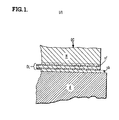
- Aluminum disks for use in digital data recording by optical means are normally supplied with a surface that is too rough to be used for acceptable optical recording layers and thus typically require such a “subbing layer” (e.g., see FIG. 1 and aluminum disk (d), with subbing (sb) on which some sort of optical recording structure (“OL”), is to be coated, with a certain overcoating, (“OC”) on this).
- Such recording structures are known in the art (e.g., “tuned media” using a “dark mirror” or optical tri-layer effect; for instance, see U.S. 4,222,071 to Bell, et al.; also see “Review of Optical Storage Media” by Zech, SPIE Vol.
- a rough substrate, or inadequate subbing can determine the quality (e.g., density, defect incidence, error rate) of such optical recording. For instance, the expected minimum bit-error-rate (BER) may be impossible to realize unless the subbing is sufficiently free of oil, fingerprints, dust and other contaminants and is sufficiently level and uniform.
- BER bit-error-rate
- One feature hereof is to teach such subbing, and especially preferred formulations therefor.
- a more particular feature is to teach the use of unique "radiation-cured” polymeric mixtures for such “subbing", preferably on relatively common "Winchester” disks (i.e., aluminum disks, of the kind regularly used in present magnetic digital recording).
- R-C Radiation-curable
- the R-c coatings are preferably comprised of an acrylate pre-polymer (especially an acrylated epoxide) with suitable additives; e.g., for cross-linking, for control of cure and viscosity, for wetting and for cure- initiation. Also, a compatible "primer" coating is preferably used.
- the subbing composition is preferably applied to the disk surface (preferably anodized) and cured by exposure to radiation, (e.g., brief intense UV under inert atmosphere), sufficient to photo-cure the applied composition, with a photo-initiator typically included to decrease cure-time and improve efficiency.
- radiation e.g., brief intense UV under inert atmosphere
- a selected subbing mix is preferably applied to a "Winchester disk” (of the type currently in common use as the substrate disks for magnetic recording of digital data for use in high-speed data processing).
- Winchester disk of the type currently in common use as the substrate disks for magnetic recording of digital data for use in high-speed data processing.
- the mentioned preferred substrate is a relatively common moderate-cost, 14 in. or smaller diameter, Winchester disk (e.g., of #5086 aluminum alloy, about 75 mils thick, with a surface polished or diamond-turned to normal smoothness).
- Winchester disk e.g., of #5086 aluminum alloy, about 75 mils thick, with a surface polished or diamond-turned to normal smoothness.
- anodizing is to oxidize the aluminum disk to form a harder layer of aluminum oxide on its surface. Anodizing improves the corrosion resistance of the aluminum disk so that it can give extended archival life in the optical disk application. This process also works as a "pre-cleaning" to improve adhesion of the subsequent (polymer) subbing coat. With this process, the usual primer coating can be eliminated.
- the substrate we prefer is a "polished disk", rather than a diamond-turned (which can exhibit deep turning grooves on its surface -- and these grooves may be replicated in the subsequent subbing coat.
- the polished aluminum disk is "blast-dusted” [dust particles blown off with a pressurized- nitrogen gun], then vapor degreased with methyl ethyl ketone (MEK).
- MEK methyl ethyl ketone
- a D.C. voltage is applied, and increased from 5V to 40V with increasing rate of 5V/min., and current density of 2 Amps/ft 2 .
- the anodizing should be "saturated" after about one hour.
- the non-anodized substrate is rinsed with cold D.I. water, then with hot deionized water for about 5 min. There should be no further sealing or dyeing after the drying is finished.
- anodized thickness of about 0.1 mil to .2 mil will be seen.
- the (anodized) surface finish resulting will be as smooth and flat as necessary (e.g., max. "waviness-depth" is ⁇ 0.22 ⁇ .02 U"/in. over range of 10 mm.) and is quite suitable for the subsequent subbing coat.
- Pre-cleaning the anodized substrate is important if a good subbing coat is to be realized. It affects adhesion and can reduce or eliminate surface defects.
- the anodizing may be thought of as a step in the pre-cleaning sequence. It changes the surface metal structure of the aluminum disk, and should leave a more uniform surface oxide; something that apparently contributes to superior adhesion (of subbing onto anodized aluminum surface).
- the subbing mixture comprises a radiation-cured acrylate pre-polymer, such as an acrylated epoxide like "SB-1" below -- along with compatible additives, as needed for cross-linking, cure-control, wetting and photo-initiation.
- a radiation-cured acrylate pre-polymer such as an acrylated epoxide like "SB-1" below -- along with compatible additives, as needed for cross-linking, cure-control, wetting and photo-initiation.
- This acrylated epoxide will be recognized as somewhat pre-polymerized and of relatively high modular weight, (e.g., such a ligomer or "pre-polymer” formulation will be understood as including acrylates and/or acryamides or other like groups adapted to be polymerized, or further polymerized, by a radiation- cure like that described).
- a preferred subbing formulation SB-1 is formulated as follows:
- the “Celrad 3701” is characterized as a diacrylated ester of bisphenol A epoxy resin.
- high molecular weight coating is desirable, being less susceptible to temperature change and involving less cure-shrinkage and associated stress.
- high molecular weight materials exhibit a relatively high viscosity and so are inconvenient (slow) to filter, (e.g., through a 47 mm diameter, 0.45 urn pore filter).
- the TMPTA (trimethyl-ol propane triacrylate) is a multi-functional monomer used to promote cross-linking, accelerate cure and lower viscosity (at this concentration -less TMPTA allows cure-time to lengthen). In promoting cross-linkage, the TMPTA enhances the toughness and tensile strength of the cured coat; however it can cause a good deal of shrinkage during cure. TMPTA may be replaced by another like low-viscosity cross-linker, such as TMPT-ma (trimethyl-ol propane trimethacrylate) as workers will understand.
- TMPT-ma trimethyl-ol propane trimethacrylate
- the 2-ethylhexyl acrylate (EHA) is a viscosity-reducing organic diluent that reacts with the "multi-functional" TMPTA and that bonds well with the resulting polymer coat and is compatible therewith (e.g., no constituents that will likely migrate and attack the subbing polymer or other coatings on the disk). It yields a good viscosity for these purposes (assume "clean-room” conditions, about 68°F ambient).
- a multi-functional monomer like TMPTA (three reactive groups) wiil likely need a co-constituent like EHA to polymerize with any of its groups not cross-linked with the acrylated epoxide -- otherwise, such unreacted groups can react and break-down the coating during service life (e.g., react with ambient oxygen, cause cracking of the subbing, etc.).
- the EHA diluent may, in certain cases, be replaced with other such additives like styrene (see S-2, below) or iso-decyl acrylate (though the latter is a bit more prone to water absorption and associated swelling with some loss of strength).
- the Zonyl FSN is characterized as a nonionic "fluorosurfactant” apt as a “surfactant”(wetting agent) here. It might be replaced with other like compatible surfactants in certain cases (e.g., FC-430, by 3M), though none can be recommended. Surprisingly, some other closely similar surfactants are unsatisfactory. Other "Zonal” (TM) type monomer surfactants (fluorocarbon methacrylate from DuPont) should also be adequate as a wetting agent.
- the "Irgacure 651" (2-dimethoxy-2 phenyl aceto-phenone) serves as the photo-initiator.
- Other like photo initiators may be substituted in most cases (e.g., Irgacure #184, or Darocure #l173 from E.M. Industries -- note: Irgacure #184 needs longer cure time).
- Some photo initiators may be unsuitable under these conditions (cf. poor solubility, different cure-radiation needed, and some are too oxygen-sensitive; some fail to adequately "quench” the desired photo-cure).
- the components are all combined and heated, in air, to about 75° F. under "clean-room” conditions, with stirring, until the mixture becomes a homogeneous liquid.
- This liquid is then filtered while still warm through a series of filters to remove particles larger than 0.45 um.
- the filtered liquid is then degassed by placing it in a vacuum (25-29 in. Hg) for 30-60 min. prior to applying it to a disk.
- a subbing coating about 20-40 um (microns) thick is assumed.
- the subbing formulation (e.g., SB-1) will be understood as applied (e.g., 20-40 um thick and very uniform) to the aluminum disk surface anodized and cleaned as specified (unless adhesion is otherwise adequate).
- the disk may be spun (e.g., at up to 80 rpm -- or kept fixed) while the coating formulation is deposited on its surface.
- the disk is then spun (e.g., 150-400 rpm), sufficient to efficiently remove excess coating material; the speed/time of rotation depending upon the desired rate/degree of removal.
- radiation-curing is invoked.
- it is preferably photo-chemically cured, by (UV) radiation under an inert atmosphere.
- one exposes the coating to UV for about 1.5 min. before flushing with nitrogen to drive off all surrounding oxygen. Then cure is completed by continuing UV exposure for several min. under this nitrogen flush, while slowly rotating the disk (e.g., 20-50 rpm for total 4 min.).
- the "in-oxygen" UV pre-exposure is preferred -- e.g., it is a bit slower than using a nitrogen-flush throughout, but seems to give a smoother finish and minimize any "replicating".
- non-focused UV illumination since -- surprising to learn -- focused UV light seems to cause "groove-replication” and "uneven cure” problems in the film (wven where a diffuser is used).
- the non-focused UV light is found to give a more uniform exposure intensity.
- the non-focused UV beam p is passed through a quartz window with a trapezoid shape to expose all portions of the coating with the same light intensity.
- the window opening is wider at the outside area of the disk because there is more coating there.
- a 1000 watt UV lamp with a 5 inch arc length will be found satisfactory to illuminate the whole coating area evenly while disk is rotating [e.g., an American Ultraviolet Co. "Porta Cure” 1000 UV lamp, rated at 95 MW/cm at 8.6 in. from the coating].
- the subbing layer cured under these conditions will form a tough, strong coating that is very smooth and level. It will not form any "globs", nor will it replicate grooves, etc., on the substrate surface. It also has a very good adhesion to the substrate. This is quite apt for superposing the mentioned optical recording layers.
- the thickness of the smoothing layer is preferably between 20-30 um (less than about 10 um is not favored) and very smooth. A good, smooth subbing surface will be observed on such fully-polished or polished-anodized disk surfaces, with all the usual bumps, scratches, gouges and like anomalies satisfactorily "buried".
- subbing will be observed to exhibit superior archival life and long-term stability -- e.g., withstanding extended exposure to a rather extreme temperature/humidity cycling even with the mentioned "optical tri-layer” (e.g., no evident delamination or stress-cracking of tri-layer; no decomposition of subbing polymer; also no evidence that "low molecular weight components", like the surfactant, or photosensitizer or their by-products, had migrated and attacked the subbing or tri-layer or upset adhesion).
- optical tri-layer e.g., no evident delamination or stress-cracking of tri-layer; no decomposition of subbing polymer; also no evidence that "low molecular weight components", like the surfactant, or photosensitizer or their by-products, had migrated and attacked the subbing or tri-layer or upset adhesion.
- so-cured so-aged subbing is immediately ready for service (e.g., heating, etc.) -- e.g., without requiring any further aging cycle.
- Radiation-curing is preferred over other superficially related methods, like "peroxide curing” which is complex, hard to control, and apt to exhibit short “pot life” (e.g., workers will recognize that the peroxide cure reaction is exothermic and subject to overheating, making it difficult to control and dangerous to handle -- e.g., for good control, cure temperature must be kept low, thus extending cure-time; also gases are produced and, if the cure proceeds too quickly, these gases can't adequately escape and be dissipated, but can induce light-scattering, a "cloudy", semi-opaque coating -- e.g., trapping gas bubbles).
- formulation SB-2 is given as follows:
- FC-430 is a "fluorocarbon ester" apt as a surfactant. Its wettability might not be as good as Zonyl FSN. However, it produced a film about as good as SB-1.
- CMD 1700 is an acrylated acrylic. It improves the color and (exterior) durability. However, it is apt to be quite brittle and not as chemically resistant as an epoxy. It tends to be more brittle and crack when subjected to a moist environment. Thus, SB-3 (and like subbing) is less preferred.
- RDX 52225 is an acrylated urethane. It improves flexibility and toughness and also has a good abrasion resistance. The viscosity is increased by so increasing the concentration of main resin ingredient. The purpose is to reduce the number of "defects" -- and a reduced number of defects will be observed here. However, the coating exhibits "orange peel" after it is aluminized and it is not smooth enough for the optical disk application. Thus, this type subbing is definitely non-preferred.
- V-pyrol is a more reactive vinyl-pyrolidone diluent for acrylated epoxy. It has a low volatility. With this ingredient, one might expect to reduce the defects number (less volatile material evaporation than for EHA during the spinning). However, this coating appears cloudy after it is aluminized and is non-preferred for the optical disk.
- Irgacure 651 photoinitiator in SB-2 is replaced by Irgacure 184.
- Irgacure 184 is a non-yellowing, highly efficient photoinitiator and will produce a better "thru cure" in the coating.
- Z-6020 is a silane adhesion promoter and is added to improve subbing adhesion to the aluminum disk. The viscosity of this formula is reduced, so one can see the effect of viscosity on the coating. Because Irgacure 184 has a lower curing efficiency than Irgacure 651, this SB-6 film is hazy-looking after it is aluminized and is not completely cured. This is non-preferred for the optical disk.
- the materials, means and methods disclosed herein may also be applicable, with appropriate adjustments, for micro-fine smoothing coatings on other like metal substrates (especially oxidized-aluminum), such as those used to support high quality coatings for high-speed magnetic recording or for other optical coatings or for other analogous recording.
- other like metal substrates especially oxidized-aluminum
Landscapes
- Engineering & Computer Science (AREA)
- Manufacturing & Machinery (AREA)
- Optical Record Carriers And Manufacture Thereof (AREA)
- Manufacturing Optical Record Carriers (AREA)
- Silver Salt Photography Or Processing Solution Therefor (AREA)
- Photosensitive Polymer And Photoresist Processing (AREA)
Applications Claiming Priority (2)
| Application Number | Priority Date | Filing Date | Title |
|---|---|---|---|
| US61104484A | 1984-05-16 | 1984-05-16 | |
| US611044 | 1984-05-16 |
Publications (2)
| Publication Number | Publication Date |
|---|---|
| EP0162633A1 true EP0162633A1 (fr) | 1985-11-27 |
| EP0162633B1 EP0162633B1 (fr) | 1988-07-27 |
Family
ID=24447394
Family Applications (1)
| Application Number | Title | Priority Date | Filing Date |
|---|---|---|---|
| EP85303266A Expired EP0162633B1 (fr) | 1984-05-16 | 1985-05-09 | Méthodes pour préparer et appliquer des sous couches pour disque de données optiques |
Country Status (4)
| Country | Link |
|---|---|
| EP (1) | EP0162633B1 (fr) |
| JP (1) | JPS613342A (fr) |
| CA (1) | CA1243402A (fr) |
| DE (1) | DE3564053D1 (fr) |
Cited By (1)
| Publication number | Priority date | Publication date | Assignee | Title |
|---|---|---|---|---|
| US10345597B2 (en) * | 2017-03-15 | 2019-07-09 | Seiko Epson Corporation | Production method for a bonded optical member and a virtual image display device |
Citations (4)
| Publication number | Priority date | Publication date | Assignee | Title |
|---|---|---|---|---|
| DE2016422A1 (de) * | 1969-04-14 | 1970-10-15 | International Business Machines Corp., Armonk, N.Y. (V.St.A.) | Magnetische Datenspeichervorrichtung |
| US4224381A (en) * | 1978-10-19 | 1980-09-23 | Poly Disc Systems, Inc. | Abrasion resistant magnetic record members |
| EP0098046A1 (fr) * | 1982-05-25 | 1984-01-11 | Unisys Corporation | Feuilles d'enregistrement destinées à des fins archivistiques pour mettre en mémoire des données digitales en utilisant un laser à écrire à puissance basse |
| EP0098045A1 (fr) * | 1982-05-25 | 1984-01-11 | Unisys Corporation | Feuilles d'enregistrement contenant de l'or, destinées à des fins archivistiques, pour mettre en mémoire des données digitales en utilisant un laser à écrire à puissance basse |
Family Cites Families (6)
| Publication number | Priority date | Publication date | Assignee | Title |
|---|---|---|---|---|
| JPS6040095B2 (ja) * | 1976-06-18 | 1985-09-09 | 株式会社日立製作所 | 光デイスク用基板 |
| JPS5671821A (en) * | 1979-11-14 | 1981-06-15 | Hitachi Ltd | Substrate for magnetic disc and its manufacture |
| JPS56135526A (en) * | 1980-03-27 | 1981-10-23 | Matsushita Electric Ind Co Ltd | Coating composition and resin molded product prepared therefrom |
| US4340655A (en) * | 1980-06-18 | 1982-07-20 | Eastman Kodak Company | Thermal and mechanical barrier layers for optical recording elements |
| JPS57113432A (en) * | 1981-01-06 | 1982-07-14 | Mitsubishi Rayon Co Ltd | Base plate for video or audio disk |
| JPS5922249A (ja) * | 1982-07-27 | 1984-02-04 | Nippon Telegr & Teleph Corp <Ntt> | 光デイスク |
-
1985
- 1985-05-06 CA CA000480845A patent/CA1243402A/fr not_active Expired
- 1985-05-09 EP EP85303266A patent/EP0162633B1/fr not_active Expired
- 1985-05-09 DE DE8585303266T patent/DE3564053D1/de not_active Expired
- 1985-05-15 JP JP60103627A patent/JPS613342A/ja active Pending
Patent Citations (4)
| Publication number | Priority date | Publication date | Assignee | Title |
|---|---|---|---|---|
| DE2016422A1 (de) * | 1969-04-14 | 1970-10-15 | International Business Machines Corp., Armonk, N.Y. (V.St.A.) | Magnetische Datenspeichervorrichtung |
| US4224381A (en) * | 1978-10-19 | 1980-09-23 | Poly Disc Systems, Inc. | Abrasion resistant magnetic record members |
| EP0098046A1 (fr) * | 1982-05-25 | 1984-01-11 | Unisys Corporation | Feuilles d'enregistrement destinées à des fins archivistiques pour mettre en mémoire des données digitales en utilisant un laser à écrire à puissance basse |
| EP0098045A1 (fr) * | 1982-05-25 | 1984-01-11 | Unisys Corporation | Feuilles d'enregistrement contenant de l'or, destinées à des fins archivistiques, pour mettre en mémoire des données digitales en utilisant un laser à écrire à puissance basse |
Cited By (1)
| Publication number | Priority date | Publication date | Assignee | Title |
|---|---|---|---|---|
| US10345597B2 (en) * | 2017-03-15 | 2019-07-09 | Seiko Epson Corporation | Production method for a bonded optical member and a virtual image display device |
Also Published As
| Publication number | Publication date |
|---|---|
| DE3564053D1 (en) | 1988-09-01 |
| EP0162633B1 (fr) | 1988-07-27 |
| JPS613342A (ja) | 1986-01-09 |
| CA1243402A (fr) | 1988-10-18 |
Similar Documents
| Publication | Publication Date | Title |
|---|---|---|
| US5518788A (en) | Antistatic hard coat incorporating a polymer comprising pendant fluorinated groups | |
| US5176943A (en) | Optical recording medium with antistatic hard coating | |
| US4492718A (en) | Rotation coating of disk substrate with acrylate prepolymer | |
| US4584259A (en) | Coated media for optical recording with acrylic overcoat | |
| EP0265641A2 (fr) | Support revêtus pour enregistrement optique | |
| KR100569754B1 (ko) | 자외선 경화형 하드 코팅제 조성물 | |
| JPH0258301B2 (fr) | ||
| EP0128219A4 (fr) | Supports recouverts pour enregistrements optiques avec revetement externe "souple/dur". | |
| JP2000033775A (ja) | 光情報記録媒体 | |
| CA1243402A (fr) | Methode de preparation et d'application de couches de substratage pour disques d'enregistrement optique | |
| EP0123409B1 (fr) | Milieu optique DRAW à guatre couches | |
| US4522846A (en) | Spiral-coated media for optical recording | |
| US5171606A (en) | Method of coating an optical media | |
| EP0139478B1 (fr) | Procédé pour déposer une couche superficielle sur des milieux d'enregistrement optique | |
| CA1267379A (fr) | Surcouche pour support d'enregistrement | |
| US5008129A (en) | Methods of fabricating optical records with overcoating | |
| EP0077278B1 (fr) | Composition photosensible et plaque lithographique réalisée à l'aide de cette composition | |
| JPH09297201A (ja) | 紫外線硬化樹脂からなる透明光学物品 | |
| JP2001344816A (ja) | ハードコート層を有する光ディスクおよびその製造方法 | |
| EP0128949A1 (fr) | Supports recouverts pour enregistrements optiques et techniques de revetement relatives | |
| JP2002157779A (ja) | ハードコート層を有する青色レーザーディスク(登録商標)およびその製造方法 | |
| JPH08324121A (ja) | 光情報記録媒体 | |
| JP2003059128A (ja) | 光記録媒体 | |
| JPS63106948A (ja) | 光学的有機記録媒体の製造方法 | |
| JP2005074872A (ja) | J会合体薄膜形成体及び光情報記録媒体 |
Legal Events
| Date | Code | Title | Description |
|---|---|---|---|
| PUAI | Public reference made under article 153(3) epc to a published international application that has entered the european phase |
Free format text: ORIGINAL CODE: 0009012 |
|
| 17P | Request for examination filed |
Effective date: 19850515 |
|
| AK | Designated contracting states |
Designated state(s): BE DE FR GB IT NL SE |
|
| 17Q | First examination report despatched |
Effective date: 19870318 |
|
| RAP1 | Party data changed (applicant data changed or rights of an application transferred) |
Owner name: UNISYS CORPORATION |
|
| GRAA | (expected) grant |
Free format text: ORIGINAL CODE: 0009210 |
|
| AK | Designated contracting states |
Kind code of ref document: B1 Designated state(s): BE DE FR GB IT NL SE |
|
| REF | Corresponds to: |
Ref document number: 3564053 Country of ref document: DE Date of ref document: 19880901 |
|
| ET | Fr: translation filed | ||
| ITF | It: translation for a ep patent filed | ||
| PLBE | No opposition filed within time limit |
Free format text: ORIGINAL CODE: 0009261 |
|
| STAA | Information on the status of an ep patent application or granted ep patent |
Free format text: STATUS: NO OPPOSITION FILED WITHIN TIME LIMIT |
|
| 26N | No opposition filed | ||
| PGFP | Annual fee paid to national office [announced via postgrant information from national office to epo] |
Ref country code: FR Payment date: 19910416 Year of fee payment: 7 |
|
| PGFP | Annual fee paid to national office [announced via postgrant information from national office to epo] |
Ref country code: GB Payment date: 19910426 Year of fee payment: 7 |
|
| PGFP | Annual fee paid to national office [announced via postgrant information from national office to epo] |
Ref country code: SE Payment date: 19910430 Year of fee payment: 7 |
|
| PGFP | Annual fee paid to national office [announced via postgrant information from national office to epo] |
Ref country code: DE Payment date: 19910529 Year of fee payment: 7 |
|
| ITTA | It: last paid annual fee | ||
| PGFP | Annual fee paid to national office [announced via postgrant information from national office to epo] |
Ref country code: NL Payment date: 19910531 Year of fee payment: 7 |
|
| PGFP | Annual fee paid to national office [announced via postgrant information from national office to epo] |
Ref country code: BE Payment date: 19911003 Year of fee payment: 7 |
|
| PG25 | Lapsed in a contracting state [announced via postgrant information from national office to epo] |
Ref country code: GB Effective date: 19920509 |
|
| PG25 | Lapsed in a contracting state [announced via postgrant information from national office to epo] |
Ref country code: SE Effective date: 19920510 |
|
| PG25 | Lapsed in a contracting state [announced via postgrant information from national office to epo] |
Ref country code: BE Effective date: 19920531 |
|
| BERE | Be: lapsed |
Owner name: UNISYS CORP. Effective date: 19920531 |
|
| PG25 | Lapsed in a contracting state [announced via postgrant information from national office to epo] |
Ref country code: NL Effective date: 19921201 |
|
| GBPC | Gb: european patent ceased through non-payment of renewal fee |
Effective date: 19920509 |
|
| NLV4 | Nl: lapsed or anulled due to non-payment of the annual fee | ||
| PG25 | Lapsed in a contracting state [announced via postgrant information from national office to epo] |
Ref country code: FR Effective date: 19930129 |
|
| PG25 | Lapsed in a contracting state [announced via postgrant information from national office to epo] |
Ref country code: DE Effective date: 19930202 |
|
| REG | Reference to a national code |
Ref country code: FR Ref legal event code: ST |
|
| EUG | Se: european patent has lapsed |
Ref document number: 85303266.2 Effective date: 19921204 |