EP0163200A2 - Matériau céramique à dilatation faible - Google Patents
Matériau céramique à dilatation faible Download PDFInfo
- Publication number
- EP0163200A2 EP0163200A2 EP85105960A EP85105960A EP0163200A2 EP 0163200 A2 EP0163200 A2 EP 0163200A2 EP 85105960 A EP85105960 A EP 85105960A EP 85105960 A EP85105960 A EP 85105960A EP 0163200 A2 EP0163200 A2 EP 0163200A2
- Authority
- EP
- European Patent Office
- Prior art keywords
- ceramic
- composition
- molar proportions
- range
- equal
- Prior art date
- Legal status (The legal status is an assumption and is not a legal conclusion. Google has not performed a legal analysis and makes no representation as to the accuracy of the status listed.)
- Ceased
Links
Images
Classifications
-
- G—PHYSICS
- G02—OPTICS
- G02B—OPTICAL ELEMENTS, SYSTEMS OR APPARATUS
- G02B5/00—Optical elements other than lenses
- G02B5/08—Mirrors
-
- C—CHEMISTRY; METALLURGY
- C04—CEMENTS; CONCRETE; ARTIFICIAL STONE; CERAMICS; REFRACTORIES
- C04B—LIME, MAGNESIA; SLAG; CEMENTS; COMPOSITIONS THEREOF, e.g. MORTARS, CONCRETE OR LIKE BUILDING MATERIALS; ARTIFICIAL STONE; CERAMICS; REFRACTORIES; TREATMENT OF NATURAL STONE
- C04B35/00—Shaped ceramic products characterised by their composition; Ceramics compositions; Processing powders of inorganic compounds preparatory to the manufacturing of ceramic products
- C04B35/01—Shaped ceramic products characterised by their composition; Ceramics compositions; Processing powders of inorganic compounds preparatory to the manufacturing of ceramic products based on oxide ceramics
- C04B35/447—Shaped ceramic products characterised by their composition; Ceramics compositions; Processing powders of inorganic compounds preparatory to the manufacturing of ceramic products based on oxide ceramics based on phosphates, e.g. hydroxyapatite
-
- G—PHYSICS
- G02—OPTICS
- G02B—OPTICAL ELEMENTS, SYSTEMS OR APPARATUS
- G02B1/00—Optical elements characterised by the material of which they are made; Optical coatings for optical elements
- G02B1/02—Optical elements characterised by the material of which they are made; Optical coatings for optical elements made of crystals, e.g. rock-salt, semi-conductors
-
- Y—GENERAL TAGGING OF NEW TECHNOLOGICAL DEVELOPMENTS; GENERAL TAGGING OF CROSS-SECTIONAL TECHNOLOGIES SPANNING OVER SEVERAL SECTIONS OF THE IPC; TECHNICAL SUBJECTS COVERED BY FORMER USPC CROSS-REFERENCE ART COLLECTIONS [XRACs] AND DIGESTS
- Y10—TECHNICAL SUBJECTS COVERED BY FORMER USPC
- Y10S—TECHNICAL SUBJECTS COVERED BY FORMER USPC CROSS-REFERENCE ART COLLECTIONS [XRACs] AND DIGESTS
- Y10S359/00—Optical: systems and elements
- Y10S359/90—Methods
Definitions
- Some applications for mirrors operating even at room temperature are susceptible to distortions from even minute changes in temperature.
- the demand for increased capacity of integrated circuit chips is pushing the capabilities of microphotolithographic projection devices that depend on mirror systems of extremely high precision.
- Ceramics of the type NaZr 2 P 3 0 12 have been utilized for electrical application involving ionic conductivity. Substitutions of elements are typically made to enhance this conductivity. For example, additional sodium has been substituted for some of the zirconium in a class of compounds, Na 1+4z Zr 2-z P3O 12 .
- silicon and sodium have been substituted jointly for a portion of the phosphorous to create a solid electrolyte which is used in batteries.
- Such silicon- containing compounds are described as Na 1+x Si x Zr 2 P 3-x O 12 .
- J.P. Boilot and J.P. Salantie as reported in "Phase Transformation in Na 1+x Si x Zr 2 P 3-x O 12 Compounds", Material Research Bulletin Vol. 14, pp. 1469 - 1477, 1979, studied phase transformation in the latter class of compounds, and compared this feature with thermal expansion for the range of compositions corresponding to x ranging from 3 down to 1. As x was decreased from 3 to 2 the thermal expansion coefficient was reported by Boilot, et al.
- zirconium oxide changes its crystal structure upon heating and cooling, and fractures itself in the process.
- zirconium oxide which is used as a refractory in high temperature barrier applications, is virtually always stabilized by the addition of other elements to prevent the crystal change and the corresponding self- destruction that may occur during extreme thermal changes.
- those skilled in the art will avoid using any ceramic that changes its crystal structure during temperature changes.
- a primary object of the present invention is to provide an improved process for producing materials having very low or nearly zero coefficient of thermal expansion.
- Another object of the present invention is to provide a novel structural component having extremely high dimensional stability which does not distort or fracture in a temperature changing environment.
- a further object of the present invention is to provide a novel ceramic substrate which supports an optically reflecting film, has nearly zero thermal expansion coefficient, and does not fracture from changes in crystal structure.
- a still further object of this invention is to provide an improved optically reflecting component useful for precision telescopic and microlithography projection system.
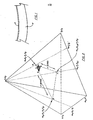
- the optically reflecting structures of the present invention have a reflecting film 11 deposited on a ceramic substrate 12 formed of zero expansion ceramic of the type Na 2 ZrP 3 0 12 , having certain atomic substitutions as described herein.
- Figure 2 presents a view of a quaternary phase diagram of the molecular constituents Na 2 0, Si0 2 , P 2 0 5 and Zr0 2 .
- a plane in this three dimensional diagram is presented by points P, Q and R which are defined, respectively, by the compositions Na 4 Zr 2 Si 3 O 12 , Na 4 Zr 1.25 P 3 O 12 . and NaZr 2 P 3 0 12 .
- Compositions of the present invention lie near and preferably in that portion of the plane that is within the shaded quadrilateral area bounded by lines joining points A, B , C and D, the coordinates of the points being:
- the low expansion ceramic compound of the present invention is represented by molecular formula i (Na) j (Zr 2 -z Na 4z) k (P 3-x Na x Si x ) O 12 where i, j and k represent molar proportions and x and z represent atomic proportions of the constituents respectively of the ceramic compound.
- x 0, and sodium (Na) is substituted for a portion of the zirconium (Zr) as represented by the molecular formula i (Na) j (Zr 2 - z Na 4z ) k (P 3 ) 0 12 where i, j and k are as set forth above.
- the atomic fraction z is in the range of about 0.125 to about 0.25 and preferably equals about 0.18.
- the basic compositional range of this z-series is illustrated by the line C-D in the quaternary diagram of Figure 2.
- z 0, and sodium (Na) and silicon (Si) are jointly substituted for a portion of the phosphorous (P) as represented by the molecular formula i (Na) j (Zr 2 ) k (P 3 - x Na x Si x ) 0 12 where i, j and k are as set for the above.
- the atomic fraction x is in the range of about 0.2 to about 0.6 and preferably equals about 0.4.
- the basic compositional range of this second embodiment (x-series) is illustrated by the line A-B in Figure 2.
- compositions between the x-series and z-series may be as set forth above for the area A-B-C-D.
- the structure be substantially single phase.
- the ceramic may contain minor impurities in amounts up to a few percent, providing such impurities do not cause a significant amount of any second phase to occur.
- the ceramic composition in accordance with the invention, may be formed in any known or desired manner.
- zirconyl nitrate, ammonium dihydrogen phosphate and sodium carbonate-can be mixed in a mortar in the desired proportions and heated in a platinum crucible slowly to 600°C, then held at 900°C for 2-4 hours.
- sol-gel technology one may use the known sol-gel technology.
- the same materials are all dissolved in water, with SiO 2 added as an alcoholic solution of Si(OC 2 H 5 ) 4 , allowed to gel, then desiccated at 400°C overnight and heated to 900°C for 2 hours.
- the proportions of the two silicates depend on the Si/Na ratio in the expected compound.
- solutions (a) and (b) to solution (c) when thoroughly stirred lead to the forming of a solid gel-like bulk having pH close to 6 which allows both zirconium phosphate and zirconium hydroxide to precipitate along with the forming of a silica gel. Since the sodium ions must be retained in the gel, solutions (a), (b) and (c) are used in nearly saturated conditions so as to avoid the liquid phase as much as possible.
- the gel is then dried and heated at about 110°C for about 12 hours and dehydrated at 500°C.
- the raw materials are mixed together in desired proportions. After rough mixing, the mixture is ground to produce a fine, uniform powder. While any suitable grinding method may be used, ball milling is preferred for convenience and reliability.
- an anti-coagulation agent such as acetone, is included to prevent coagulation and gelification of the very fine powders used as raw materials. Any suitable mix of grinding balls, powder mixture and anti-coagulant may be used, such as (by volume) 1/3 powder mixture, 1/3 grinding balls and 1/3 acetone. After grinding for an appropriate period, usually for at least about 12 hours, the resulting slurry is removed, dried and the soft agglomerantes produced are forced through a fine mesh screen to homogenize the particle size.
- the material is then formed into the desired article shape.
- the material may be formed in a hydraulic press at about 10,000 to 50,000 psi.
- an organic binder such as 1 to 2 percent of a 15 percent aqueous polyvinyl alcohol solution may be used to improve pressing uniformity.
- the binder is evaporated or burned off early in the sintering heating cycle.
- Other processes, such as slip casting, hot-pressing, etc., will often be preferred in production operations for faster throughput and lower shrinkage.
- the resulting self-sustaining pressed structure is sintered to produce the desired polycrystalline ceramic.
- the structure may be sintered at a suitable temperature for a suitable time period that will form a homogenized single phase of the desired composition.
- the structure may be sintered in a Lindberg box- type furnace heated with silicon carbide elements.
- Disc shaped structures may be supported on zirconia setters and covered with alumina dishes to prevent contamination.
- the structures are cooled from the sintering temperature to room temperature over a reasonable time period to avoid thermal shocks. Simply turning the furnace off and allowing it to cool naturally is generally satisfactory and convenient.
- a substrate having the desired optical configuration is formed as described above. Then, at least the optically active surface is provided with a reflective coating.
- the coating is a metal; aluminum is probably the most common, but silver, gold or any other suitable metal may be employed. Multilayer dielectric coatings are also used.
- metallic reflective coatings require a superposed protective layer of silica, magnesium fluoride or other appropriate material. Both the reflective and protective coatings usually are extremely thin.
- a primary mirror for a telescope, an aluminum reflective layer and a magnesium flouride over-coating have an aggregate thickness of about 1100 Angstroms. The thickness required depends on various factors, primarily on the coating material used and the wavelength of radiation to be reflected.
- an aluminum coating for use in the visible range of the spectrum may need to be approximately twice as thick as for operation in the ultraviolet range of wavelengths.
- Vacuum deposition is a well known and commonly employed method.
- a useful coating method is described in U.S. Patent 4,217,855.
- Coefficient of thermal expansion is measured with standard well-known techniques.
- One such technique utilizes a dilatometer whereby a sample is heated while changes in length are measured by observation through a telescope device.
- the ceramic compositions of the present invention are suitable for any application requiring low or nearly zero thermal expansion properties, such as for optical elements as described herein, for special purpose structural components in environments where dimensional stability is critical, as well as for more common place uses such as ceramic cooking ware, crucibles and the like.
- a stoichiometric mixture of Na 2 C0 3 , Zr0 2 , NH 4 H 2 P0 4 and Si0 2 was homogenized in acetone by hand mixing in a mortar or by ball milling, and then let dry in air to remove acetone. The dry mixture was heat treated slowly at 200°C for 16 hours, 600°C for 4 hours and finally 900°C for 16 hours to remove volatiles such as C0 2 , NH 3 and H 2 0.
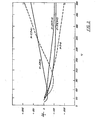
- a composition in z-series where z 0.125 with molecular formula Na 1.5 Zr 1.875 (PO 4 ) 3 was prepared following the same procedure described in Example 1 and thermal expansion measurements (shown in Fig. 3) were made on rectangular bar cut from sintered sample. In this composition shrinkage has considerably reduced and av (25° - 500°C) was calculated to be -1.6 x 10 -6 /°C.
Landscapes
- Chemical & Material Sciences (AREA)
- Physics & Mathematics (AREA)
- Engineering & Computer Science (AREA)
- Ceramic Engineering (AREA)
- General Physics & Mathematics (AREA)
- Optics & Photonics (AREA)
- Manufacturing & Machinery (AREA)
- Crystallography & Structural Chemistry (AREA)
- Materials Engineering (AREA)
- Structural Engineering (AREA)
- Organic Chemistry (AREA)
- Compositions Of Oxide Ceramics (AREA)
- Optical Elements Other Than Lenses (AREA)
Applications Claiming Priority (2)
| Application Number | Priority Date | Filing Date | Title |
|---|---|---|---|
| US06/616,368 US4587172A (en) | 1984-06-01 | 1984-06-01 | Mirror substrate of atomically substituted Na Zr2 PO12 low expansion ceramic material |
| US616368 | 1996-03-15 |
Publications (2)
| Publication Number | Publication Date |
|---|---|
| EP0163200A2 true EP0163200A2 (fr) | 1985-12-04 |
| EP0163200A3 EP0163200A3 (fr) | 1987-08-19 |
Family
ID=24469134
Family Applications (1)
| Application Number | Title | Priority Date | Filing Date |
|---|---|---|---|
| EP85105960A Ceased EP0163200A3 (fr) | 1984-06-01 | 1985-05-14 | Matériau céramique à dilatation faible |
Country Status (3)
| Country | Link |
|---|---|
| US (1) | US4587172A (fr) |
| EP (1) | EP0163200A3 (fr) |
| JP (1) | JPS614002A (fr) |
Cited By (5)
| Publication number | Priority date | Publication date | Assignee | Title |
|---|---|---|---|---|
| EP0260893A3 (en) * | 1986-09-13 | 1989-08-30 | Ngk Insulators, Ltd. | Heat resisting low expansion zirconyl phosphate-zircon composite bodies and process for producing the same |
| EP0416796A1 (fr) * | 1989-09-07 | 1991-03-13 | Ngk Insulators, Ltd. | Corps composites résistants à la chaleur basse en phosphate-silicate de zirconium et leur procédé de fabrication |
| US5217934A (en) * | 1989-09-07 | 1993-06-08 | Ngk Insulators, Ltd. | Heat resistive phosphate-zircon composite bodies and process for producing same |
| US5505805A (en) * | 1992-03-05 | 1996-04-09 | Industrieanlagen-Betriebsgesellschaft Gmbh | Method for the production of reflectors |
| US5825565A (en) * | 1992-03-05 | 1998-10-20 | Industrieanlagen-Betriebsgesellschaft Gmbh | Reflector |
Families Citing this family (19)
| Publication number | Priority date | Publication date | Assignee | Title |
|---|---|---|---|---|
| US4675302A (en) * | 1984-06-01 | 1987-06-23 | The Perkin-Elmer Corporation | Low expansion ceramic material |
| JPS61198114A (ja) * | 1985-02-28 | 1986-09-02 | Hitachi Ltd | 熱膨張率差大の構造物の結合構造 |
| JPS61219753A (ja) * | 1985-03-22 | 1986-09-30 | 山井 巌 | 低熱膨張性リン酸ジルコニルセラミツクスの製造法 |
| US4751206A (en) * | 1985-03-22 | 1988-06-14 | Iwao Yamai | Low thermal expansion ceramic material |
| US4801566A (en) * | 1987-03-13 | 1989-01-31 | Pennsylvania State University | Low expansion ceramic |
| US4925816A (en) * | 1987-08-29 | 1990-05-15 | Ngk Insulators, Ltd. | Novel solid solution, heat-resistant sintered body and method of producing the same |
| US5488018A (en) * | 1989-04-21 | 1996-01-30 | Limaye; Santosh Y. | Ultra low thermal expansion, highly thermal shock resistant ceramic |
| US5030592A (en) * | 1989-10-26 | 1991-07-09 | The United States Of America As Represented By The Secretary Of The Air Force | Highly dense cordierite and method of manufacturing same |
| US5316795A (en) * | 1990-05-24 | 1994-05-31 | Houston Advanced Research Center | Halogen-assisted chemical vapor deposition of diamond |
| US5071677A (en) * | 1990-05-24 | 1991-12-10 | Houston Advanced Research Center | Halogen-assisted chemical vapor deposition of diamond |
| US5393404A (en) * | 1993-06-17 | 1995-02-28 | Rutgers, The State University Of New Jersey | Humidity sensor with nasicon-based proton-conducting electrolyte |
| US5871633A (en) * | 1993-06-17 | 1999-02-16 | Rutgers, The State University | Impedance type humidity sensor with protonconducting electrolyte and method of using same |
| US5672258A (en) * | 1993-06-17 | 1997-09-30 | Rutgers, The State University Of New Jersey | Impedance type humidity sensor with proton-conducting electrolyte |
| US6479104B1 (en) * | 1994-04-29 | 2002-11-12 | Mcdonnell Douglas Corporation | Cementitious ceramic surface having controllable reflectance and texture |
| US5910382A (en) * | 1996-04-23 | 1999-06-08 | Board Of Regents, University Of Texas Systems | Cathode materials for secondary (rechargeable) lithium batteries |
| US6514640B1 (en) * | 1996-04-23 | 2003-02-04 | Board Of Regents, The University Of Texas System | Cathode materials for secondary (rechargeable) lithium batteries |
| US6176588B1 (en) * | 1999-12-14 | 2001-01-23 | Corning Incorporated | Low cost light weight mirror blank |
| US7208230B2 (en) * | 2003-08-29 | 2007-04-24 | General Electric Company | Optical reflector for reducing radiation heat transfer to hot engine parts |
| EP2900594B1 (fr) * | 2012-09-25 | 2018-01-10 | University of Maryland, College Park | Électrolyte de type nasicon à haute conductivité pour batterie sodium-ion à semi-conducteurs à température ambiante |
Family Cites Families (7)
| Publication number | Priority date | Publication date | Assignee | Title |
|---|---|---|---|---|
| GB968025A (en) * | 1959-12-05 | 1964-08-26 | Heraeus Schott Quarzschmelze | Improvements in optical mirrors |
| US4049891A (en) * | 1976-06-21 | 1977-09-20 | Massachusetts Institute Of Technology | Compositions for fast alkali-metal-ion transport |
| US4166159A (en) * | 1978-08-02 | 1979-08-28 | Massachusetts Institute Of Technology | Process for forming fast sodium-ion transport compositions |
| JPS5833099B2 (ja) * | 1978-11-13 | 1983-07-18 | 日本発条株式会社 | 多層コ−テイング反射板 |
| JPS5833101B2 (ja) * | 1978-11-13 | 1983-07-18 | 横浜機工株式会社 | 耐熱性反射板 |
| GB2052462B (en) * | 1979-06-13 | 1983-04-20 | Atomic Energy Authority Uk | Preparation of ion conductors |
| US4512905A (en) * | 1982-05-18 | 1985-04-23 | The Texas A&M University System | Method of making sodium zirconium silico-phosphates |
-
1984
- 1984-06-01 US US06/616,368 patent/US4587172A/en not_active Expired - Fee Related
-
1985
- 1985-05-14 EP EP85105960A patent/EP0163200A3/fr not_active Ceased
- 1985-05-31 JP JP60116888A patent/JPS614002A/ja active Pending
Cited By (5)
| Publication number | Priority date | Publication date | Assignee | Title |
|---|---|---|---|---|
| EP0260893A3 (en) * | 1986-09-13 | 1989-08-30 | Ngk Insulators, Ltd. | Heat resisting low expansion zirconyl phosphate-zircon composite bodies and process for producing the same |
| EP0416796A1 (fr) * | 1989-09-07 | 1991-03-13 | Ngk Insulators, Ltd. | Corps composites résistants à la chaleur basse en phosphate-silicate de zirconium et leur procédé de fabrication |
| US5217934A (en) * | 1989-09-07 | 1993-06-08 | Ngk Insulators, Ltd. | Heat resistive phosphate-zircon composite bodies and process for producing same |
| US5505805A (en) * | 1992-03-05 | 1996-04-09 | Industrieanlagen-Betriebsgesellschaft Gmbh | Method for the production of reflectors |
| US5825565A (en) * | 1992-03-05 | 1998-10-20 | Industrieanlagen-Betriebsgesellschaft Gmbh | Reflector |
Also Published As
| Publication number | Publication date |
|---|---|
| JPS614002A (ja) | 1986-01-09 |
| US4587172A (en) | 1986-05-06 |
| EP0163200A3 (fr) | 1987-08-19 |
Similar Documents
| Publication | Publication Date | Title |
|---|---|---|
| US4587172A (en) | Mirror substrate of atomically substituted Na Zr2 PO12 low expansion ceramic material | |
| US4675302A (en) | Low expansion ceramic material | |
| US4543346A (en) | Polycrystalline transparent spinel sintered body and method of producing the same | |
| US4649070A (en) | Substrate for an integrated circuit | |
| US6383964B1 (en) | Ceramic member resistant to halogen-plasma corrosion | |
| US7875311B1 (en) | Magnesium aluminate transparent ceramic having low scattering and absorption loss | |
| EP1205452B1 (fr) | Agglomere ceramique noir a faible dilatation thermique et a grande rigidite specifique et procede pour le produire | |
| US4272500A (en) | Process for forming mullite | |
| JPH07277814A (ja) | アルミナ基セラミックス焼結体 | |
| JPS6048466B2 (ja) | 多結晶透明アルミナ焼結体の製造法 | |
| JP2540676B2 (ja) | 化学的に安定化されたクリストバライト | |
| US4461750A (en) | Infrared window materials and their fabrication | |
| EP0081061A1 (fr) | Cordiérites modifiées à faible expansion thermale | |
| US4587067A (en) | Method of manufacturing low thermal expansion modified cordierite ceramics | |
| US5846891A (en) | Thermal shock-resistant alumina-mullite composite material and preparation method thereof | |
| US7449238B1 (en) | LiF-coated doped and undoped yttrium oxide | |
| JP3243278B2 (ja) | 固体レーザ用多結晶透明yagセラミックス | |
| Keester et al. | Crystal chemistry and properties of phases in the system SrO PbO O | |
| US7563480B1 (en) | Method for fluoride salt coated magnesium aluminate | |
| JPH05294723A (ja) | 固体レーザ用多結晶透明yagセラミックスの製造方法 | |
| US5407750A (en) | High purity dense silicon carbide sintered body and process for making same | |
| CA1118799A (fr) | Methode de production de mullite | |
| JPH0459658A (ja) | 透光性イツトリア焼結体及びその製造方法 | |
| Deng et al. | Microstructure and dielectric properties of (Ba, Sr) TiO3 ceramics with alkali-free glasses | |
| US6602623B1 (en) | Low-temperature firing ceramic composition, process for producing same and wiring substrate prepared by using same |
Legal Events
| Date | Code | Title | Description |
|---|---|---|---|
| PUAI | Public reference made under article 153(3) epc to a published international application that has entered the european phase |
Free format text: ORIGINAL CODE: 0009012 |
|
| AK | Designated contracting states |
Designated state(s): DE FR GB |
|
| PUAL | Search report despatched |
Free format text: ORIGINAL CODE: 0009013 |
|
| AK | Designated contracting states |
Kind code of ref document: A3 Designated state(s): DE FR GB |
|
| 17P | Request for examination filed |
Effective date: 19880219 |
|
| 17Q | First examination report despatched |
Effective date: 19891124 |
|
| STAA | Information on the status of an ep patent application or granted ep patent |
Free format text: STATUS: THE APPLICATION HAS BEEN REFUSED |
|
| 18R | Application refused |
Effective date: 19900806 |
|
| RIN1 | Information on inventor provided before grant (corrected) |
Inventor name: ALAMO, JAIME Inventor name: ROY, RUSTUM |