EP0163749A1 - Procédé et dispositif pour la séparation de la biomasse et de matières inorganiques de la boue provenant d'un réacteur anaérobie dans une installation pour le traitement d'eau usée - Google Patents
Procédé et dispositif pour la séparation de la biomasse et de matières inorganiques de la boue provenant d'un réacteur anaérobie dans une installation pour le traitement d'eau usée Download PDFInfo
- Publication number
- EP0163749A1 EP0163749A1 EP84106319A EP84106319A EP0163749A1 EP 0163749 A1 EP0163749 A1 EP 0163749A1 EP 84106319 A EP84106319 A EP 84106319A EP 84106319 A EP84106319 A EP 84106319A EP 0163749 A1 EP0163749 A1 EP 0163749A1
- Authority
- EP
- European Patent Office
- Prior art keywords
- hydrocyclone
- sludge
- water
- reactor
- biomass
- Prior art date
- Legal status (The legal status is an assumption and is not a legal conclusion. Google has not performed a legal analysis and makes no representation as to the accuracy of the status listed.)
- Granted
Links
- VNWKTOKETHGBQD-UHFFFAOYSA-N methane Chemical compound C VNWKTOKETHGBQD-UHFFFAOYSA-N 0.000 title claims abstract description 50
- 239000010802 sludge Substances 0.000 title claims abstract description 31
- 239000002028 Biomass Substances 0.000 title claims abstract description 26
- 238000000034 method Methods 0.000 title claims abstract description 21
- 238000000926 separation method Methods 0.000 title claims abstract description 6
- 238000004065 wastewater treatment Methods 0.000 title description 2
- XLYOFNOQVPJJNP-UHFFFAOYSA-N water Substances O XLYOFNOQVPJJNP-UHFFFAOYSA-N 0.000 claims abstract description 44
- 239000000203 mixture Substances 0.000 claims abstract description 20
- 239000000470 constituent Substances 0.000 claims abstract description 7
- 239000002351 wastewater Substances 0.000 claims abstract 2
- 239000007787 solid Substances 0.000 claims description 5
- 238000012216 screening Methods 0.000 claims description 4
- 238000007654 immersion Methods 0.000 claims description 3
- 239000002245 particle Substances 0.000 claims description 3
- VTYYLEPIZMXCLO-UHFFFAOYSA-L Calcium carbonate Chemical compound [Ca+2].[O-]C([O-])=O VTYYLEPIZMXCLO-UHFFFAOYSA-L 0.000 description 7
- 239000007788 liquid Substances 0.000 description 6
- 229910000019 calcium carbonate Inorganic materials 0.000 description 3
- 230000000694 effects Effects 0.000 description 3
- 238000011001 backwashing Methods 0.000 description 2
- 238000005265 energy consumption Methods 0.000 description 2
- 239000012535 impurity Substances 0.000 description 2
- 239000004576 sand Substances 0.000 description 2
- 238000009423 ventilation Methods 0.000 description 2
- 230000001133 acceleration Effects 0.000 description 1
- QVGXLLKOCUKJST-UHFFFAOYSA-N atomic oxygen Chemical compound [O] QVGXLLKOCUKJST-UHFFFAOYSA-N 0.000 description 1
- 230000015572 biosynthetic process Effects 0.000 description 1
- 238000011109 contamination Methods 0.000 description 1
- 238000011010 flushing procedure Methods 0.000 description 1
- 239000006260 foam Substances 0.000 description 1
- 229910003480 inorganic solid Inorganic materials 0.000 description 1
- 239000000463 material Substances 0.000 description 1
- 210000000056 organ Anatomy 0.000 description 1
- 229910052760 oxygen Inorganic materials 0.000 description 1
- 239000001301 oxygen Substances 0.000 description 1
- 229940088417 precipitated calcium carbonate Drugs 0.000 description 1
- 238000011084 recovery Methods 0.000 description 1
- 238000005070 sampling Methods 0.000 description 1
- 239000010865 sewage Substances 0.000 description 1
- 229910001220 stainless steel Inorganic materials 0.000 description 1
- 239000010935 stainless steel Substances 0.000 description 1
- 230000008719 thickening Effects 0.000 description 1
- 238000011144 upstream manufacturing Methods 0.000 description 1
- 239000002699 waste material Substances 0.000 description 1
Images
Classifications
-
- C—CHEMISTRY; METALLURGY
- C02—TREATMENT OF WATER, WASTE WATER, SEWAGE, OR SLUDGE
- C02F—TREATMENT OF WATER, WASTE WATER, SEWAGE, OR SLUDGE
- C02F3/00—Biological treatment of water, waste water, or sewage
- C02F3/28—Anaerobic digestion processes
-
- B—PERFORMING OPERATIONS; TRANSPORTING
- B04—CENTRIFUGAL APPARATUS OR MACHINES FOR CARRYING-OUT PHYSICAL OR CHEMICAL PROCESSES
- B04C—APPARATUS USING FREE VORTEX FLOW, e.g. CYCLONES
- B04C9/00—Combinations with other devices, e.g. fans, expansion chambers, diffusors, water locks
-
- C—CHEMISTRY; METALLURGY
- C02—TREATMENT OF WATER, WASTE WATER, SEWAGE, OR SLUDGE
- C02F—TREATMENT OF WATER, WASTE WATER, SEWAGE, OR SLUDGE
- C02F1/00—Treatment of water, waste water, or sewage
- C02F1/38—Treatment of water, waste water, or sewage by centrifugal separation
- C02F1/385—Treatment of water, waste water, or sewage by centrifugal separation by centrifuging suspensions
-
- C—CHEMISTRY; METALLURGY
- C12—BIOCHEMISTRY; BEER; SPIRITS; WINE; VINEGAR; MICROBIOLOGY; ENZYMOLOGY; MUTATION OR GENETIC ENGINEERING
- C12M—APPARATUS FOR ENZYMOLOGY OR MICROBIOLOGY; APPARATUS FOR CULTURING MICROORGANISMS FOR PRODUCING BIOMASS, FOR GROWING CELLS OR FOR OBTAINING FERMENTATION OR METABOLIC PRODUCTS, i.e. BIOREACTORS OR FERMENTERS
- C12M21/00—Bioreactors or fermenters specially adapted for specific uses
- C12M21/04—Bioreactors or fermenters specially adapted for specific uses for producing gas, e.g. biogas
-
- C—CHEMISTRY; METALLURGY
- C12—BIOCHEMISTRY; BEER; SPIRITS; WINE; VINEGAR; MICROBIOLOGY; ENZYMOLOGY; MUTATION OR GENETIC ENGINEERING
- C12M—APPARATUS FOR ENZYMOLOGY OR MICROBIOLOGY; APPARATUS FOR CULTURING MICROORGANISMS FOR PRODUCING BIOMASS, FOR GROWING CELLS OR FOR OBTAINING FERMENTATION OR METABOLIC PRODUCTS, i.e. BIOREACTORS OR FERMENTERS
- C12M29/00—Means for introduction, extraction or recirculation of materials, e.g. pumps
- C12M29/18—External loop; Means for reintroduction of fermented biomass or liquid percolate
-
- C—CHEMISTRY; METALLURGY
- C12—BIOCHEMISTRY; BEER; SPIRITS; WINE; VINEGAR; MICROBIOLOGY; ENZYMOLOGY; MUTATION OR GENETIC ENGINEERING
- C12M—APPARATUS FOR ENZYMOLOGY OR MICROBIOLOGY; APPARATUS FOR CULTURING MICROORGANISMS FOR PRODUCING BIOMASS, FOR GROWING CELLS OR FOR OBTAINING FERMENTATION OR METABOLIC PRODUCTS, i.e. BIOREACTORS OR FERMENTERS
- C12M47/00—Means for after-treatment of the produced biomass or of the fermentation or metabolic products, e.g. storage of biomass
- C12M47/02—Separating microorganisms from the culture medium; Concentration of biomass
-
- C—CHEMISTRY; METALLURGY
- C12—BIOCHEMISTRY; BEER; SPIRITS; WINE; VINEGAR; MICROBIOLOGY; ENZYMOLOGY; MUTATION OR GENETIC ENGINEERING
- C12M—APPARATUS FOR ENZYMOLOGY OR MICROBIOLOGY; APPARATUS FOR CULTURING MICROORGANISMS FOR PRODUCING BIOMASS, FOR GROWING CELLS OR FOR OBTAINING FERMENTATION OR METABOLIC PRODUCTS, i.e. BIOREACTORS OR FERMENTERS
- C12M47/00—Means for after-treatment of the produced biomass or of the fermentation or metabolic products, e.g. storage of biomass
- C12M47/10—Separation or concentration of fermentation products
-
- Y—GENERAL TAGGING OF NEW TECHNOLOGICAL DEVELOPMENTS; GENERAL TAGGING OF CROSS-SECTIONAL TECHNOLOGIES SPANNING OVER SEVERAL SECTIONS OF THE IPC; TECHNICAL SUBJECTS COVERED BY FORMER USPC CROSS-REFERENCE ART COLLECTIONS [XRACs] AND DIGESTS
- Y02—TECHNOLOGIES OR APPLICATIONS FOR MITIGATION OR ADAPTATION AGAINST CLIMATE CHANGE
- Y02E—REDUCTION OF GREENHOUSE GAS [GHG] EMISSIONS, RELATED TO ENERGY GENERATION, TRANSMISSION OR DISTRIBUTION
- Y02E50/00—Technologies for the production of fuel of non-fossil origin
- Y02E50/30—Fuel from waste, e.g. synthetic alcohol or diesel
Definitions
- the invention relates to a method for separating biomass and inorganic constituents from the sludge of a methane reactor in an anaerobic sewage plant.
- One way of removing the inorganic constituents is to remove part of the sludge accumulating in the methane reactor as a whole from the plant. However, an impermissibly large amount of anaerobic biomass is lost.
- the object of the invention is to create a "gentle" method for separating biomass and inorganic components, the energy consumption of which is low and the implementation of which does not require any relatively complex devices.
- This object is achieved according to the invention in that the sludge / water mixture to be separated is withdrawn from the reactor near the bottom and fed to the inlet opening of a hydrocyclone by the hydraulic reactor admission pressure, and in addition that the overflow of the hydrocyclone is below the water surface of a storage container containing at least biomass and water is passed, and that finally sludge / water mixture is conveyed back from the storage tank into the reactor;
- a device for carrying out the method is characterized by a hydrocyclone, the inlet of which is connected to a sludge discharge nozzle of the methane reactor, and also by a storage tank which is at least partially filled with sludge / water mixture and in the water content of which a connecting line coming from the overflow of the hydrocyclone is immersed and finally by means of a conveying device which
- the energy expenditure for the new method is low, since energy only has to be supplied for driving the conveyor device. Compared to the energy expenditure of previous methods and the devices mentioned, this results in energy savings of over 80%.
- the device required to carry out the method also requires only a fraction of the investment for the devices previously used.
- mechanical stress, especially shear stress occurs on the biomass only in the conveyor between the storage container and the methane reactor. The biomass is therefore treated very gently in the new method and in the new device and is not exposed to high loads.
- a sieve device the mesh size of which is smaller than the diameter of the apex plug opening of the hydrocyclone, can be connected upstream of the inflow of the hydrocyclone in the device.
- the feed pressure to the hydrocyclone - which is generally about 1 bar, which, for example, accelerations of a few hundred g can be achieved in a commercially available hydrocyclone - can be varied to a certain extent if the level of the feed to the hydrocyclone is relative to the sludge discharge nozzle of the methane reactor is changeable.
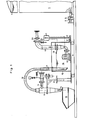
- the discharge nozzle 2 is connected to the inlet inlet 5 of a hydrocyclone 6 by an inlet line (not shown); In front of this inlet 5 there is a screening device 7 in the direction of flow, which will be described in more detail later.
- the commercially available hydrocyclone 6 is fastened to a height-adjustable gallows 8, which in turn is mounted on a carriage 9, so that the device can be connected to a plurality of methane reactor discharge ports 2 if necessary.
- a flexible connection leads from the top of the hydrocyclone 6 line 10, which ends in a sliding tube 11, into the water content 13 of a storage container 12, which is also mounted on the carriage 9.
- the sliding tube 11 is slidably attached to the container 12 to adjust the immersion depth of the connecting line 10 in the water content 13.
- the outlet opening for the underflow of the hydrocyclone 6, which is open at the bottom, can be provided in a known manner with apex plugs, not shown, whose nozzle bores have different diameters of, for example, 3 to 10 mm.
- the outlet opening 14 is arranged above a tiltable collecting container 15 for the paste-like material which has been separated from the sludge / water mixture.
- a submersible pump 16 which is driven by a symbolically indicated electrical drive 17, is provided in the container 12 as a conveying device for the return of sludge / water mixture and thus of biomass from the storage container 12 in the methane reactor 1.
- the drive 17 of the submersible pump 16 can be switched on and off by a float 18, which is actuated by the liquid level in the reservoir 12; the mode of operation of the float control will also be described later.
- the pressure line 19 of the pump 16 contains an adjustable throttle element 20 with which the delivery rate of the submersible pump 16 can be varied.
- the continuation of the pressure line 19 beyond the throttle element 20 and its connection to the methane reactor 1 are not expressly shown.
- the storage container 12 also has an emptying line 22 which can be shut off by a valve 21; it cannot - if necessary or sensible to preserve the anaerobic properties of the biomass - by one provided lids to be shielded from the oxygen-containing atmosphere.
- a sampling line 24 provided with a shut-off device 23 branches off from the pressure line 19.
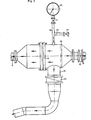
- the sieve device 7 shown in FIG. 2 contains a sieve housing 30 which is expanded in volume compared to the inlet line 31 provided from the right with an inlet flap 33.
- a sieve plate 32 is arranged, which consists, for example, of stainless steel, is approximately 5 mm thick and contains, as sieve openings, square holes whose diagonal diameter is smaller than the diameter of the bore in the apex stopper of the hydrocyclone 6.
- the inlet inlet 5 of the hydrocyclone 6 adjoins the sieve housing 30, which is divided in the plane of the sieve plate 32, to the left.
- a measuring line 34 from which a ventilation line 36 branches into the free atmosphere, to a manometer 35.
- Both lines 34 and 36 are each with a stopcock 37 and 38 provided.
- the ventilation line 36 has the task of creating an air cushion in the measuring line 34, which protects the pressure gauge from contamination. In addition, it serves to abruptly empty the screen housing 30 during backwashing facilitated by inflowing air.
- a rinsing drain 39 leads from the bottom of the sieve housing 30 via a shut-off flap 40, for example into the tiltable waste collection container 15.
- the rinsing drain 39 can advantageously be designed to be pivotable in its lower end.
- the remaining amount which is less than 5% of the feed volume, is compressed into a paste-like mass and leaves the hydrocyclone 6 through the opening 14. It consists for the most part (about 90%) of calcium carbonate; the rest is sand and biomass.
- the sieve device must be rinsed.
- the flap 33 and the tap 37 are closed, while the flap 40 and the tap 38 are opened.
- the water standing in the arc of the connecting line 10 flows through the inlet inlet 5 in the opposite direction to the normal “operating flow” through the sieve plate 32 and rinses the impurities sitting on it via the flushing outlet 39 into the collecting container 15
- Backwashing action for the screen housing 30 is supported and accelerated by air flowing in via the line 36.
- the control of the liquid level in the reservoir 12 by the float 19 fulfills a safety function; it prevents the level in the storage container 12 from dropping to an inadmissible extent and thus the suction effect in the hydrocyclone 6 from falling below a lower limit.
- the float 18 switches on at one adjustable lower limit level, the pump 16. Within a short period of time, the liquid in the container 12 then rises again, since the feed from the methane reactor 1 to the hydrocyclone 6 is not interrupted, whereupon the float 18 starts the pump 16 again.
- the pump power and thus the suction effect for the upper run of the hydrocyclone 6 are adjusted via the throttle element 20 in the pressure line 19.
Landscapes
- Life Sciences & Earth Sciences (AREA)
- Engineering & Computer Science (AREA)
- Chemical & Material Sciences (AREA)
- Organic Chemistry (AREA)
- Health & Medical Sciences (AREA)
- Zoology (AREA)
- Wood Science & Technology (AREA)
- Bioinformatics & Cheminformatics (AREA)
- Biotechnology (AREA)
- Microbiology (AREA)
- Genetics & Genomics (AREA)
- General Engineering & Computer Science (AREA)
- Sustainable Development (AREA)
- Biomedical Technology (AREA)
- General Health & Medical Sciences (AREA)
- Biochemistry (AREA)
- Water Supply & Treatment (AREA)
- Molecular Biology (AREA)
- Hydrology & Water Resources (AREA)
- Environmental & Geological Engineering (AREA)
- General Chemical & Material Sciences (AREA)
- Analytical Chemistry (AREA)
- Mechanical Engineering (AREA)
- Oil, Petroleum & Natural Gas (AREA)
- Biodiversity & Conservation Biology (AREA)
- Treatment Of Sludge (AREA)
- Purification Treatments By Anaerobic Or Anaerobic And Aerobic Bacteria Or Animals (AREA)
- Processing Of Solid Wastes (AREA)
Priority Applications (4)
| Application Number | Priority Date | Filing Date | Title |
|---|---|---|---|
| DE8484106319T DE3469511D1 (en) | 1984-06-02 | 1984-06-02 | Process and apparatus for the separation of biomass and inorganic components from the methane reactor sludge of an anaerobic waste water treatment plant |
| AT84106319T ATE32700T1 (de) | 1984-06-02 | 1984-06-02 | Verfahren und vorrichtung zum trennen von biomasse und anorganischen bestandteilen aus dem schlamm eines methan-reaktors einer anaeroben abwasseranlage. |
| EP19840106319 EP0163749B1 (fr) | 1984-06-02 | 1984-06-02 | Procédé et dispositif pour la séparation de la biomasse et de matières inorganiques de la boue provenant d'un réacteur anaérobie dans une installation pour le traitement d'eau usée |
| ES542505A ES8705340A1 (es) | 1984-06-02 | 1985-04-23 | Procedimiento y dispositivo para la separacion de biomasas y componentes inorganicos del lodo de un reactor de metano de una planta para el tratamiento anaerobio de aguas residuales. |
Applications Claiming Priority (1)
| Application Number | Priority Date | Filing Date | Title |
|---|---|---|---|
| EP19840106319 EP0163749B1 (fr) | 1984-06-02 | 1984-06-02 | Procédé et dispositif pour la séparation de la biomasse et de matières inorganiques de la boue provenant d'un réacteur anaérobie dans une installation pour le traitement d'eau usée |
Publications (2)
| Publication Number | Publication Date |
|---|---|
| EP0163749A1 true EP0163749A1 (fr) | 1985-12-11 |
| EP0163749B1 EP0163749B1 (fr) | 1988-03-02 |
Family
ID=8191965
Family Applications (1)
| Application Number | Title | Priority Date | Filing Date |
|---|---|---|---|
| EP19840106319 Expired EP0163749B1 (fr) | 1984-06-02 | 1984-06-02 | Procédé et dispositif pour la séparation de la biomasse et de matières inorganiques de la boue provenant d'un réacteur anaérobie dans une installation pour le traitement d'eau usée |
Country Status (4)
| Country | Link |
|---|---|
| EP (1) | EP0163749B1 (fr) |
| AT (1) | ATE32700T1 (fr) |
| DE (1) | DE3469511D1 (fr) |
| ES (1) | ES8705340A1 (fr) |
Cited By (3)
| Publication number | Priority date | Publication date | Assignee | Title |
|---|---|---|---|---|
| GB2354232A (en) * | 1999-08-03 | 2001-03-21 | Mark William Youds | Cyclone apparatus for treating sewage |
| WO2017016718A1 (fr) * | 2015-07-28 | 2017-02-02 | Bta International Gmbh | Séparation hydrodynamique des matières lourdes d'une suspension |
| DE102020002363A1 (de) | 2020-04-20 | 2021-10-21 | Meri Environmental Solutions Gmbh | Verfahren und Anlage zur anaeroben Reinigung von Abwasser und/oder Prozesswasser umfassend Steuerung des Gehalts an anorganischen Feststoffen |
Families Citing this family (1)
| Publication number | Priority date | Publication date | Assignee | Title |
|---|---|---|---|---|
| DE102012212675A1 (de) * | 2012-07-19 | 2014-02-27 | Voith Patent Gmbh | Abwasserbehandlung |
Citations (4)
| Publication number | Priority date | Publication date | Assignee | Title |
|---|---|---|---|---|
| NL58270C (fr) * | 1900-01-01 | |||
| CH109312A (de) * | 1924-04-04 | 1925-03-16 | Staedtehygiene Und Wasserbauge | Verfahren zur Aufbereitung von Abwasserschlamm in Schlammkammern. |
| CH475919A (de) * | 1966-01-07 | 1969-07-31 | Dorr Oliver Inc | Verfahren zur Aufbereitung von sandhaltigem Rohschlamm sowie Anlage zur Durchführung des Verfahrens |
| DE3150073A1 (de) * | 1981-12-17 | 1983-06-23 | Bill B. 77015 Houston Tex. Trautwein | Transportfaehige reinigungsanlage zum abscheiden von festkoerperteilchen und partikeln aus einem wasservorrat und verfahren zum abscheiden |
-
1984
- 1984-06-02 AT AT84106319T patent/ATE32700T1/de not_active IP Right Cessation
- 1984-06-02 EP EP19840106319 patent/EP0163749B1/fr not_active Expired
- 1984-06-02 DE DE8484106319T patent/DE3469511D1/de not_active Expired
-
1985
- 1985-04-23 ES ES542505A patent/ES8705340A1/es not_active Expired
Patent Citations (4)
| Publication number | Priority date | Publication date | Assignee | Title |
|---|---|---|---|---|
| NL58270C (fr) * | 1900-01-01 | |||
| CH109312A (de) * | 1924-04-04 | 1925-03-16 | Staedtehygiene Und Wasserbauge | Verfahren zur Aufbereitung von Abwasserschlamm in Schlammkammern. |
| CH475919A (de) * | 1966-01-07 | 1969-07-31 | Dorr Oliver Inc | Verfahren zur Aufbereitung von sandhaltigem Rohschlamm sowie Anlage zur Durchführung des Verfahrens |
| DE3150073A1 (de) * | 1981-12-17 | 1983-06-23 | Bill B. 77015 Houston Tex. Trautwein | Transportfaehige reinigungsanlage zum abscheiden von festkoerperteilchen und partikeln aus einem wasservorrat und verfahren zum abscheiden |
Cited By (6)
| Publication number | Priority date | Publication date | Assignee | Title |
|---|---|---|---|---|
| GB2354232A (en) * | 1999-08-03 | 2001-03-21 | Mark William Youds | Cyclone apparatus for treating sewage |
| GB2354232B (en) * | 1999-08-03 | 2001-11-07 | Mark William Youds | Sewage processing treatment invention |
| WO2017016718A1 (fr) * | 2015-07-28 | 2017-02-02 | Bta International Gmbh | Séparation hydrodynamique des matières lourdes d'une suspension |
| CN107835717A (zh) * | 2015-07-28 | 2018-03-23 | Bta国际股份有限公司 | 从淤浆中水力分离高比重固体 |
| US10173224B2 (en) | 2015-07-28 | 2019-01-08 | Bta International Gmbh | Hydrodynamic removal of dense materials from a slurry |
| DE102020002363A1 (de) | 2020-04-20 | 2021-10-21 | Meri Environmental Solutions Gmbh | Verfahren und Anlage zur anaeroben Reinigung von Abwasser und/oder Prozesswasser umfassend Steuerung des Gehalts an anorganischen Feststoffen |
Also Published As
| Publication number | Publication date |
|---|---|
| EP0163749B1 (fr) | 1988-03-02 |
| ATE32700T1 (de) | 1988-03-15 |
| ES8705340A1 (es) | 1987-05-16 |
| DE3469511D1 (en) | 1988-04-07 |
| ES542505A0 (es) | 1987-05-16 |
Similar Documents
| Publication | Publication Date | Title |
|---|---|---|
| DE69102785T2 (de) | Vorrichtung für Trennung durch Druckbeaufschlagung und Flotation. | |
| DE69600998T2 (de) | Verfahren und vorrichtung zur trennung von nicht löslichen teilchen aus einer flüssigkeit | |
| DE4432042C2 (de) | Begasungs-/Flotations-Reaktor mit Anordnungen zur Abtrennung von Feststoffen aus Flüssigkeiten | |
| DE2201188B2 (de) | Verfahren und Vorrichtung zum Abtrennen von Teilchen aus einer Flüssigkeit in einem Becken | |
| EP0338198A1 (fr) | Réservoir de séparation pour des suspensions de boues activées et d'eaux usées | |
| DE2146838C3 (de) | Verfahren und Vorrichtung zum Filtrieren von Flüssigkeiten | |
| EP0162874B1 (fr) | Installation de purification et de separation pour melanges d'huile et de matieres solides | |
| EP0163749B1 (fr) | Procédé et dispositif pour la séparation de la biomasse et de matières inorganiques de la boue provenant d'un réacteur anaérobie dans une installation pour le traitement d'eau usée | |
| EP0588778B1 (fr) | Installation pour la purification d'eau de lavage, particulièrement dans les installations de lavage de véhicules | |
| DE3309640C2 (fr) | ||
| DE4335104C2 (de) | Verfahren und Vorrichtung zum Filtern von Quellwasser | |
| DE3732008A1 (de) | Verfahren zur aufbereitung von schadstoff-belasteten, insbesondere stichfesten sedimenten aus abwasserkanaelen und deren einrichtungen sowie von artverwandten stoffen und anlage zur durchfuehrung des verfahrens | |
| EP1138363B1 (fr) | Dispositif de soutirage d'eau purifiée d'un récipient lors de la purification biologique d'eaux usées | |
| DE1442470B2 (de) | Vorrichtung zum Trennen oder Umrühren eines flüssigen, wenigstens aus zwei Phasen mit unterschiedlichem spezifischem Gewicht bestehenden Gemisches | |
| DE2452295B2 (de) | Verfahren und vorrichtung zur biologischen reinigung von abwasser | |
| EP0053094A2 (fr) | Procédé et dispositif pour séparer des matières particulaires solides de leur mélange avec un liquide, ainsi que des gaz de tels mélanges, et application du procédé | |
| DE2925797C2 (de) | Vibrations-Entwässerungseinrichtung für körniges Material | |
| DE1246676B (de) | Klaervorrichtung | |
| DE19736671A1 (de) | Vorrichtung zum Entgasen von Flüssigkeit | |
| DE322575C (de) | Absaugevorrichtung zum Herstellen grosser Koerper aus Papiermasse | |
| DE2736691A1 (de) | Verfahren und einrichtung zur aufbereitung von oel-wasser-emulsionen | |
| DE3011691C2 (de) | Apparat zur elektrochemischen Abwasserreinigung | |
| DE3107899A1 (de) | "filter zur entfernung von feststoffen aus fluessigkeiten" | |
| DE3239326C2 (de) | Vorrichtung zum Abtrennen von Feststoffen aus Schlämmen und Suspensionen | |
| DE811822C (de) | Verfahren und Vorrichtung zur Trennung von Teilchen von verschiedenem spezifischen Gewicht und verschiedener Korngroesse |
Legal Events
| Date | Code | Title | Description |
|---|---|---|---|
| PUAI | Public reference made under article 153(3) epc to a published international application that has entered the european phase |
Free format text: ORIGINAL CODE: 0009012 |
|
| AK | Designated contracting states |
Designated state(s): AT BE CH DE FR GB IT LI LU NL SE |
|
| RBV | Designated contracting states (corrected) |
Designated state(s): AT CH DE FR GB IT LI NL |
|
| 17P | Request for examination filed |
Effective date: 19860124 |
|
| 17Q | First examination report despatched |
Effective date: 19861010 |
|
| ITF | It: translation for a ep patent filed | ||
| GRAA | (expected) grant |
Free format text: ORIGINAL CODE: 0009210 |
|
| AK | Designated contracting states |
Kind code of ref document: B1 Designated state(s): AT CH DE FR GB IT LI NL |
|
| REF | Corresponds to: |
Ref document number: 32700 Country of ref document: AT Date of ref document: 19880315 Kind code of ref document: T |
|
| GBT | Gb: translation of ep patent filed (gb section 77(6)(a)/1977) | ||
| REF | Corresponds to: |
Ref document number: 3469511 Country of ref document: DE Date of ref document: 19880407 |
|
| ET | Fr: translation filed | ||
| PLBE | No opposition filed within time limit |
Free format text: ORIGINAL CODE: 0009261 |
|
| STAA | Information on the status of an ep patent application or granted ep patent |
Free format text: STATUS: NO OPPOSITION FILED WITHIN TIME LIMIT |
|
| 26N | No opposition filed | ||
| PGFP | Annual fee paid to national office [announced via postgrant information from national office to epo] |
Ref country code: NL Payment date: 19910630 Year of fee payment: 8 |
|
| PG25 | Lapsed in a contracting state [announced via postgrant information from national office to epo] |
Ref country code: NL Effective date: 19930101 |
|
| NLV4 | Nl: lapsed or anulled due to non-payment of the annual fee | ||
| PGFP | Annual fee paid to national office [announced via postgrant information from national office to epo] |
Ref country code: GB Payment date: 19930512 Year of fee payment: 10 |
|
| PGFP | Annual fee paid to national office [announced via postgrant information from national office to epo] |
Ref country code: FR Payment date: 19930519 Year of fee payment: 10 |
|
| ITTA | It: last paid annual fee | ||
| PG25 | Lapsed in a contracting state [announced via postgrant information from national office to epo] |
Ref country code: GB Effective date: 19940602 |
|
| GBPC | Gb: european patent ceased through non-payment of renewal fee |
Effective date: 19940602 |
|
| PG25 | Lapsed in a contracting state [announced via postgrant information from national office to epo] |
Ref country code: FR Effective date: 19950228 |
|
| REG | Reference to a national code |
Ref country code: FR Ref legal event code: ST |
|
| PGFP | Annual fee paid to national office [announced via postgrant information from national office to epo] |
Ref country code: CH Payment date: 19990514 Year of fee payment: 16 |
|
| PGFP | Annual fee paid to national office [announced via postgrant information from national office to epo] |
Ref country code: AT Payment date: 19990521 Year of fee payment: 16 |
|
| PGFP | Annual fee paid to national office [announced via postgrant information from national office to epo] |
Ref country code: DE Payment date: 19990525 Year of fee payment: 16 |
|
| PG25 | Lapsed in a contracting state [announced via postgrant information from national office to epo] |
Ref country code: AT Free format text: LAPSE BECAUSE OF NON-PAYMENT OF DUE FEES Effective date: 20000602 |
|
| PG25 | Lapsed in a contracting state [announced via postgrant information from national office to epo] |
Ref country code: LI Free format text: LAPSE BECAUSE OF NON-PAYMENT OF DUE FEES Effective date: 20000630 Ref country code: CH Free format text: LAPSE BECAUSE OF NON-PAYMENT OF DUE FEES Effective date: 20000630 |
|
| REG | Reference to a national code |
Ref country code: CH Ref legal event code: PL |
|
| PG25 | Lapsed in a contracting state [announced via postgrant information from national office to epo] |
Ref country code: DE Free format text: LAPSE BECAUSE OF NON-PAYMENT OF DUE FEES Effective date: 20010403 |