EP0163836A1 - Procédé et dispositif pour la production de granulés - Google Patents
Procédé et dispositif pour la production de granulés Download PDFInfo
- Publication number
- EP0163836A1 EP0163836A1 EP85103501A EP85103501A EP0163836A1 EP 0163836 A1 EP0163836 A1 EP 0163836A1 EP 85103501 A EP85103501 A EP 85103501A EP 85103501 A EP85103501 A EP 85103501A EP 0163836 A1 EP0163836 A1 EP 0163836A1
- Authority
- EP
- European Patent Office
- Prior art keywords
- fluidized bed
- granules
- gas
- sifter
- product
- Prior art date
- Legal status (The legal status is an assumption and is not a legal conclusion. Google has not performed a legal analysis and makes no representation as to the accuracy of the status listed.)
- Granted
Links
Images



Classifications
-
- B—PERFORMING OPERATIONS; TRANSPORTING
- B01—PHYSICAL OR CHEMICAL PROCESSES OR APPARATUS IN GENERAL
- B01J—CHEMICAL OR PHYSICAL PROCESSES, e.g. CATALYSIS OR COLLOID CHEMISTRY; THEIR RELEVANT APPARATUS
- B01J2/00—Processes or devices for granulating materials, e.g. fertilisers in general; Rendering particulate materials free flowing in general, e.g. making them hydrophobic
- B01J2/02—Processes or devices for granulating materials, e.g. fertilisers in general; Rendering particulate materials free flowing in general, e.g. making them hydrophobic by dividing the liquid material into drops, e.g. by spraying, and solidifying the drops
- B01J2/04—Processes or devices for granulating materials, e.g. fertilisers in general; Rendering particulate materials free flowing in general, e.g. making them hydrophobic by dividing the liquid material into drops, e.g. by spraying, and solidifying the drops in a gaseous medium
-
- B—PERFORMING OPERATIONS; TRANSPORTING
- B01—PHYSICAL OR CHEMICAL PROCESSES OR APPARATUS IN GENERAL
- B01J—CHEMICAL OR PHYSICAL PROCESSES, e.g. CATALYSIS OR COLLOID CHEMISTRY; THEIR RELEVANT APPARATUS
- B01J8/00—Chemical or physical processes in general, conducted in the presence of fluids and solid particles; Apparatus for such processes
- B01J8/005—Separating solid material from the gas/liquid stream
- B01J8/006—Separating solid material from the gas/liquid stream by filtration
-
- B—PERFORMING OPERATIONS; TRANSPORTING
- B01—PHYSICAL OR CHEMICAL PROCESSES OR APPARATUS IN GENERAL
- B01J—CHEMICAL OR PHYSICAL PROCESSES, e.g. CATALYSIS OR COLLOID CHEMISTRY; THEIR RELEVANT APPARATUS
- B01J2/00—Processes or devices for granulating materials, e.g. fertilisers in general; Rendering particulate materials free flowing in general, e.g. making them hydrophobic
- B01J2/16—Processes or devices for granulating materials, e.g. fertilisers in general; Rendering particulate materials free flowing in general, e.g. making them hydrophobic by suspending the powder material in a gas, e.g. in fluidised beds or as a falling curtain
-
- B—PERFORMING OPERATIONS; TRANSPORTING
- B01—PHYSICAL OR CHEMICAL PROCESSES OR APPARATUS IN GENERAL
- B01J—CHEMICAL OR PHYSICAL PROCESSES, e.g. CATALYSIS OR COLLOID CHEMISTRY; THEIR RELEVANT APPARATUS
- B01J8/00—Chemical or physical processes in general, conducted in the presence of fluids and solid particles; Apparatus for such processes
- B01J8/0015—Feeding of the particles in the reactor; Evacuation of the particles out of the reactor
- B01J8/003—Feeding of the particles in the reactor; Evacuation of the particles out of the reactor in a downward flow
-
- B—PERFORMING OPERATIONS; TRANSPORTING
- B01—PHYSICAL OR CHEMICAL PROCESSES OR APPARATUS IN GENERAL
- B01J—CHEMICAL OR PHYSICAL PROCESSES, e.g. CATALYSIS OR COLLOID CHEMISTRY; THEIR RELEVANT APPARATUS
- B01J2208/00—Processes carried out in the presence of solid particles; Reactors therefor
- B01J2208/00008—Controlling the process
- B01J2208/00539—Pressure
-
- B—PERFORMING OPERATIONS; TRANSPORTING
- B01—PHYSICAL OR CHEMICAL PROCESSES OR APPARATUS IN GENERAL
- B01J—CHEMICAL OR PHYSICAL PROCESSES, e.g. CATALYSIS OR COLLOID CHEMISTRY; THEIR RELEVANT APPARATUS
- B01J2208/00—Processes carried out in the presence of solid particles; Reactors therefor
- B01J2208/00743—Feeding or discharging of solids
- B01J2208/00761—Discharging
-
- Y—GENERAL TAGGING OF NEW TECHNOLOGICAL DEVELOPMENTS; GENERAL TAGGING OF CROSS-SECTIONAL TECHNOLOGIES SPANNING OVER SEVERAL SECTIONS OF THE IPC; TECHNICAL SUBJECTS COVERED BY FORMER USPC CROSS-REFERENCE ART COLLECTIONS [XRACs] AND DIGESTS
- Y10—TECHNICAL SUBJECTS COVERED BY FORMER USPC
- Y10S—TECHNICAL SUBJECTS COVERED BY FORMER USPC CROSS-REFERENCE ART COLLECTIONS [XRACs] AND DIGESTS
- Y10S118/00—Coating apparatus
- Y10S118/05—Fluidized bed
Definitions
- the present invention relates to a new method and a new device for producing granules.
- the invention also relates to granules which are obtained with the aid of the new process.
- the sprayed-in liquid product initially wets the surface of the solid particles in the fluidized bed and then solidifies by drying or cooling. In this way, the particles grow like a bowl, and the longer they remain in the fluidized bed, the larger they become. Therefore, the size of the granules depends crucially on the content of the bed.
- the growth of the particles begins in the fluidized bed with germs, which are either formed in the fluidized bed itself by non-impacting, solidifying spray drops, or are generated by abrasion of solid particles already present, or which are supplied to the fluidized bed from the outside.
- the (internal) nucleation taking place in the fluidized bed is influenced by the content of the fluidized bed in such a way that with increasing bed content the number of non-impacting spray droplets decreases on the one hand and the number of germs generated by abrasion increases on the other hand.
- the process required for the production of granules in a given grain size is the interplay of germ supply and granule growth in fluid bed granulation.
- the granulation process can therefore be influenced in many ways. For example, the range of germs can be supplemented by adding germs from outside.
- the granulation conditions remain constant if the bed content is kept constant.
- the mass of solids fed into the fluidized bed must correspond to the mass of the finished granules removed from the bed.
- the particle balance must also be balanced. All granules removed from the fluidized bed must therefore be replaced by new germs.
- a constant granulation process is enforced. The methods differ in the way in which this constancy is achieved.
- the granulation process disclosed in DE-OS 2 263 968 is in principle identical to the previously described method. However, instead of a second fluidized bed, a sharply separating sieve is proposed as a line of sight. The necessary synchronization of the throughputs through the line of sight and the outlet member is achieved in that one does not remove part of the grain, but grinds it and then returns it to the fluidized bed. This additional germ supply must be compensated for by reducing the nucleation in the fluidized bed. The reduction of nucleation in the fluidized bed is achieved by operating the granulator with a high bed content. A prerequisite for this mode of operation is an abrasion-resistant granulate. - This method therefore provides granules with a narrow grain size distribution.
- this method does not require solvent-moist or dust explosion-prone products to be granulated, because the equipment required in addition to the fluidized bed granulator can neither be inertized nor installed explosion-proof.
- a countercurrent gravity classifier is used as the discharge device. This classifier combines the functions of the line of sight and the discharge organ.
- this device With this device, only those granules are removed from the fluidized bed that have reached the desired grain size. All fluctuations in the number of granules discharged have a direct impact on the bed content. For example, if the bed content increases, the granules produced are too small. The growth of the granules must therefore be promoted and the germ supply, which takes place here from the outside, must be restricted. In order that the germs available for the granulation process can be effectively influenced by regulation, the internal nucleation must be minimized, which can be achieved with abrasion-resistant granules by granulation with a high bed content. - Ultimately, this known method delivers granules in a narrow grain size distribution.
- the method according to the invention differs from all the corresponding previously known methods in that the granulate formation process automatically adjusts itself to the size of the discharged granules, which is predetermined by the supply of sight gas, in the interplay between granule growth and nucleation.
- the method according to the invention is distinguished by a number of advantages compared to the previously known methods.
- granules of the desired particle size can be produced, the particle diameter (grain spectrum) being within very narrow limits.
- the size of the particles can easily be varied from case to case with the aid of the sight gas supply; There are no changes in equipment required. Rather, the particle size can be changed even during operation.
- the resulting granules have a uniform shape, a homogeneous structure and, despite their high strength, can be dispersed or dissolved spontaneously in water or other solvents. Since the process places low demands on the abrasion resistance of the granules, granules with a low binder content can also be produced, which promotes their dispersion behavior. Finally, solvent-moist and dust explosion-hazardous products can also be processed by the method according to the invention, because the required device can be made inert and explosion-proof.
- the product to be granulated is sprayed into a fluidized bed in liquid form.
- the liquid can be a melt, a solution or a suspension (slurry).
- the liquid to be sprayed in can contain one or more active components.
- active components both substances come into question which are available at Hauttem-Le A 22 93o temperature are solid as well as those that are liquid at room temperature.
- the only requirement for the use of liquid active components is that they are applied to solid carriers before granulation.
- the active components can be soluble or insoluble in water. They must be sufficiently stable to hydrolysis that they do not undergo any noteworthy decomposition while the process according to the invention is being carried out and when the resulting granules are used in the presence of water.
- Active components are agrochemical active substances, active substances for combating pests in the household and hygiene sector, pharmacologically active substances, nutrients, sweeteners, colorants and organic or inorganic chemicals.
- pharmacologically active substances are to be understood as meaning substances which can be used both in veterinary medicine and in human medicine.
- An example of a substance which can be used in veterinary medicine is 2,2-dimethyl-3- [ ⁇ - (p-chlorophenyl) - ⁇ -chlorovinyl] -cyclopropanecarboxylic acid- ⁇ -cyano-3-phenoxy-4-fluoro-benzyl ester.
- An example of a substance that can be used in the human medical field is acetylsalicylic acid.
- Both substances for human and animal food can be used as nutrients. Examples include: citric acid, vitamins, coffee powder, tea powder and cocoa powder.
- sweeteners are sodium cyclamate and saccharin.
- Suitable organic or inorganic chemicals are substances which are preferably used in the form of aqueous dispersions for synthetic purposes.
- Aqueous zeolite suspensions can also be used. Under zeolite materials are here to understand this type as ufl in Ullmann, 4th A, Vol. 17, page 9 ff under "molecular sieves" are described.
- suspensions of inorganic oxides which are suitable for the production of catalysts or catalyst supports. Examples include aluminum oxide and silicon dioxide.
- the liquid product to be sprayed into the fluidized bed when carrying out the process according to the invention can also contain inert fillers, dispersants, binders and / or additives, such as, for example, preservatives and dyes, in addition to the active components and any liquid diluent present.
- Suitable fillers are all fillers and carriers which can normally be used in water-dispersible or water-soluble granules or oil-soluble granules.
- Such substances which can preferably be used are inorganic salts, such as alkali metal, magnesium and ammonium chlorides and sulfates, e.g.
- oxides such as magnesium oxide, nitrates, carbonates, hydrogen carbonates, silicates, talc, chalk, quartz
- Preferred dispersants are: condensation products from aromatic sulfonic acids and formaldehyde, such as condensation products from sulfonated ditolyl ether and formaldehyde, furthermore lignosulfonic acid salts, such as lithium, sodium, potassium, magnesium, calcium and ammonium salts of ligninsulfonic acid, also methyl cellulose, polyoxyethylene fatty acid esters, polyoxyethylene fatty alcohol ethers, for example alkylaryl polyglycol ethers, alkyl sulfonates and protein hydrolyzates.
- Dispersants themselves can also be processed from their solutions into quickly dissolvable granules.
- anionic detergents It is also possible to process slurries of anionic detergents, if appropriate in the presence of additions of nonionic surfactants, builders, optical brighteners, plasticizers and / or fragrances.
- Suitable binders are all binders (adhesives) usually present in water-dispersible or water-soluble granules or in oil-dispersible and oil-soluble granules. Solutions, emulsions or latices of natural or synthetic substances such as methyl cellulose, dextrin, sugar, starch, alginates, glycols, polyvinylpyrrolidone, lignin sulfonate, gum arabic, polyvinyl alcohol and polyvinyl acetate, in water or low-boiling organic solvents, such as methanol, ethanol, are preferably usable. Butanol and methylene chloride. - In some cases, water glass and silica sol can also be used.
- preservatives which can be contained in the liquid products to be sprayed when the process according to the invention is carried out are 2-hydroxy-biphenyl, sorbic acid, p-hydroxybenzaldehyde, methyl p-hydroxybenzoate, benzaldehyde, benzoic acid and p-hydroxybenzoic acid propyl ester.
- Dyes that are also suitable as additives are inorganic pigments such as iron oxide, titanium dioxide and ferrocyan blue, and organic dyes such as alizarin, azo and metal phthalocyanine dyes.
- active components and binders which are present as solids at room temperature are used in carrying out the process according to the invention, it is necessary to introduce these active components or binders into the fluidized bed in the form of a melt of a solution or a suspension. All customary inert organic solvents and water can be used to prepare solutions or suspensions of such active components or binders.
- the organic solvents used here are preferably alcohols, such as ethanol and glycol, furthermore aliphatic and aromatic, optionally halogenated hydrocarbons, such as ligroin, hexane, gasoline, benzene, toluene, xylene, methylene chloride, carbon tetrachloride and chlorobenzene, and also ethers, such as dioxane, tetrahydrofuran and Anisole, furthermore ketones, such as acetone, methyl ethyl ketone and cyclohexanone, moreover strongly polar solvents, such as hexamethylphosphoric triamide, acetonitrile, dimethylformamide and dimethyl sulfoxide.
- ethers such as dioxane, tetrahydrofuran and Anisole
- ketones such as acetone, methyl ethyl ketone and cyclohexanone
- moreover strongly polar solvents such as
- the solids content can be varied within a substantial range.
- the solids content is when using suspensions (Slurries) between 5 and 75 percent by weight, preferably between 10 and 65 percent by weight.
- the liquid products to be sprayed are prepared by customary methods by mixing the constituents in the desired proportions and, if appropriate, by subsequently heating the resulting mixtures.
- the granulation can be carried out in air or inert gases such as nitrogen.
- the granulation can be started in a fluidizing bed apparatus which already contains starting granulate.
- the fluidized bed granulation according to the invention begins as spray drying. By gradually building up the fluidized bed, it then leads to a bed filling in which the granules reach the desired size and are discharged. If products are used which tend to form deposits on the walls of the apparatus, starting granulate is expediently introduced when starting the process. This measure largely avoids possible spraying on the walls.
- the liquid product to be granulated is introduced into the fluidized bed through spray nozzles when carrying out the process according to the invention.
- the use of two-substance nozzles is particularly advantageous.
- Any gas which is inert under the working conditions can be used as the atomizing gas. Air or inert gases, such as nitrogen, are preferably used.
- the amount of atomizing gas can be varied within a substantial range; it generally depends on the dimensions of the apparatus and on the type and amount of the product to be sprayed.
- atomizing gas quantities, based on the product used are from 0.1 kg gas / kg food to 10 kg gas / kg food, preferably from 0.5 kg gas / kg food to 5 kg gas / kg food.
- the temperature of the atomizing gas stream can also be varied within a substantial range. In general, atomization gas temperatures between 0 ° C and 250 ° C, preferably between 20 ° C and 200 ° C.
- the fine material components escaping from the fluidized bed with the exhaust gas are separated off and returned to the fluidized bed as germs for the formation of granules. Both internal and external fine material return is possible.
- the dust is separated on a filter placed directly on the fluidized bed and conveyed back into the fluidized bed with the aid of cleaning impulses.
- the dust is separated from the exhaust gas outside the granulator.
- the fine material is separated using a cyclone or a dust filter.
- the secluded Fine goods are conveyed back into the spray zone of the fluidized bed. This return is preferably pneumatic.
- propellant gases can be used as propellant gases.
- the amount of propellant can be varied within a wide range; it generally depends on the dimensions of the apparatus and the amount of fine material escaping. Generally one works with propellant gas quantities of 0.01 kg gas per kg fine material to 2 kg gas per kg fine material, preferably from 0.1 to 1 kg gas per kg fine material.
- the temperature of the propellant gas stream can also be varied within a substantial range. In general, temperatures between 20 ° C and 350 ° C, preferably between 30 ° C and 300 ° C.
- the granulation process in the fluidized bed is maintained in the process according to the invention solely by the sprayed-in dose of the liquid product to be granulated and the strength of the sight gas stream. No additional germs are supplied from the outside. All standard gases which are inert under the working conditions can be used as sight gases. Air and inert gases, such as nitrogen, are preferably used.
- the amount of visible gas can be varied within a wide range; it depends on the dimensions of the apparatus and the grain size and the mass flow of the granules to be discharged. Generally one works with visible gas quantities between 0.2 kg gas per kg granule lat and 5 kg of gas per kg of granules, preferably between 0.4 and 2 kg of gas per kg of granules.
- the temperature of the classifying gas stream can also be varied within a wide range. In general, temperatures between 20 ° C and 350 ° C, preferably between 30 ° C and 300 ° C, are used.
- the sight gas velocity depends on the grain size and density of the granulate to be discharged. Generally one works at sight gas speeds between 0.5 and 15 m / sec, preferably between 1 and 5 m / sec.
- the finished granulate is discharged via one or more countercurrent gravity classifiers when the method according to the invention is carried out. All conventional classifiers that work on the principle of countercurrent gravity classifying are considered as such discharge units. If a particularly narrow particle size distribution is desired, a zigzag sifter is used as a special embodiment.
- an adjustment device for the webs is included, which is connected to a control device, which adjusts the sight gas flow in such a way that the flow velocity in the classifier remains constant despite the variable cross section.
- the process according to the invention is generally carried out under atmospheric pressure. However, it is also possible to work under increased or reduced pressure.
- At the outlet of the countercurrent gravity classifier one generally works under atmospheric pressure.
- a pressure regulator which adjusts the exhaust air fan or a throttle valve or an analog device, is connected between the exhaust air fan and the output at the classifier and always adjusts the pressure at the classifier output to the ambient pressure. If there is no atmospheric pressure at the classifier outlet, locks must be installed to maintain the desired pressure.
- the droplets generated by the nozzle partially meet the particles circulating in the fluidized bed and thus lead to their growth.
- the non-hitting droplets solidify. You freeze when it is a melt; they dry in the case of a suspension; and they crystallize in small particles when a solution is sprayed. They are separated from the exhaust gas and into the spray zone of the Fluidized bed returned. In this way they become new germs to which other particles can attach. With increasing bed content (the start corresponds to spray drying), the growth of the particles is favored at the expense of nucleation.
- the size of the discharged granules in the stationary state depends directly on the number of germs formed, because as many finished granules must be discharged as there are germs. The dry matter added must be distributed over the number of finished granules. The size of the granules is thus predetermined, the size of the granules being understood here to simplify the size of the granules.
- a state is only stable if the reactions to disturbances are such that the disturbances are reversed.
- the disturbance is, for example, an increase in the bed content in the left operating point.
- the reaction to this disturbance consists in an enlargement of the granules and, in the case of the sifting discharge, in an increased granulate discharge. So the bed content gets smaller again.
- the same feedback reaction occurs if the fault is given in the other direction. The operating point is therefore stable.
- the test at the right operating point is different.
- a larger bed content results in smaller granules.
- the sifting discharge allows less granules to escape.
- the bed content grows and the overall condition of the system moves away from the operating point. You get the same result if you accept the disturbance in the other direction. The operating point is therefore not stable.
- the maximum of the curve thus determines the working area of the self-regulating process.
- the granulation process is only stable on the left side and should therefore only be used there.
- Whether and where a maximum is formed depends on the nucleation mechanism, which is primarily influenced by the product. Significant product properties in primary nucleation are toughness and surface tension of the food. The number of primary germs can be influenced by the fineness of the atomization. The rate of solidification, which is influenced by the fluidizing gas temperature, also plays a role.
- the binding effect of the adhering solid is essential for the secondary germs. Particle size, flow velocity and the time in bed are also important.
- the method according to the invention can be carried out in a fluidized bed apparatus, as is shown schematically in FIG. 3 in the version with internal fine material return. It consists of a vertically installed container 1 with a perforated inflow base 2 at the lower end and an attached exhaust gas filter 3 at the upper end. The exhaust gas produced is extracted by the fan 4. Gas is blown through the perforated inflow base 2, so that a fluidized bed forms above it in the granulation container 1.
- a fluidized bed granulator which is a two-part, preferably cylindrical, vessel is preferably used in the method according to the invention.
- the granulation process takes place in the lower part.
- the upper part which is preferably expanded to twice the diameter of the lower part, serves to pre-separate the medium grain from the exhaust gas and to solidify those spray droplets that have not hit any particles in the fluidized bed.
- Fine material or product dust can be separated from the exhaust gas either inside or outside the fluidized bed granulator.
- the internal separation preferably takes place on filter bags 3, which are arranged in the upper part of the container 1.
- a prerequisite for the use of such filter bags is that the product agglomerates on their surface.
- the fine material agglomerated in this way falls back into the fluidized bed with sufficient sinking speed when the filter bags are cleaned.
- the external separation of the fine material entrained by the exhaust gas is preferably carried out using a cyclone or a filter.
- the separated fine material falls into a rotary valve, which is required to maintain the pressure difference between the fluidized bed and the dust separator.
- the fine material is preferably returned pneumatically from the cellular wheel sluice via a separate line with the aid of a propellant gas flow into the fluidized bed, preferably into the spray area of the nozzles, so that a uniform growth of all particles of the grain size spectrum is ensured.
- a propellant gas flow into the fluidized bed, preferably into the spray area of the nozzles, so that a uniform growth of all particles of the grain size spectrum is ensured.
- other common methods of fine material recycling can also be used, provided this ensures an even distribution in the fluidized bed.
- the gas used to fluidize and solidify the sprayed-in product is introduced into the lower part of the fluidized bed granulator.
- All customary gases which are inert under the working conditions can be used as fluidizing gases. Air and inert gases, such as e.g. Nitrogen.
- the temperature of the fluidizing gas can be varied within a wide range. In general, temperatures between -20 and + 700 ° C, preferably between 0 and 650 ° C.
- the speed of the fluidizing gas can be varied within a wide range.
- the amount of fluidizing gas is calculated from the speed of the fluidizing gas, the density and the cross-sectional area of the granulation part of the apparatus.
- the speed of the fluidizing gas is chosen so that a fluidized bed is maintained so that on the one hand undesirable caking of the particles does not occur and on the other hand the abrasion in the fluidized bed and the entrainment of solid matter from the fluidized bed do not increase excessively.
- the inflow floor is either flat or funnel-shaped in the apparatus for carrying out the method according to the invention.
- the inflow floor is preferably funnel-shaped, the opening angle can be varied within a certain range. An opening angle of the funnel between 140 ° and 160 ° is preferred.
- inflow bases with such opening angles and with perforated base plates which ensure a radially inward outflow, in particular the larger particles in the fluidized bed are fed to the sifting discharge opening centrally in the inflow base.
- the granulator can also be built in a rectangular shape with a flat or inclined floor. It is also possible to use several classifiers distributed over the inflow surface.
- the floor segments can be flat or inclined towards the classifier.
- the cross-sectional area of the base segment has the shape of a hexagon.
- a nozzle is arranged surrounded by an annular sifter. In this way, the granulator is built up on a large number of similar floor segments. This arrangement ensures that the frequency of vision remains constant regardless of the dimensions of the apparatus.
- spray nozzles 5 are provided at the level of the fluidized bed, through which the liquid product is fed into the fluidized bed in a finely divided form. Reaching and maintaining the steady state in the fluidized bed is controlled via the bed pressure loss that occurs automatically. The bed pressure loss is displayed and registered by the pressure measuring device 6. Deviations from Normal values are an indication of disturbances in the granulation process.
- a discharge pipe 7 is mounted centrally on the inflow base 2, and a zigzag sifter 8 is installed flush in the upper part adjoining the inflow base 2.
- Another pressure regulator 9 is included between the outlet of the zigzag sifter 8 and the exhaust gas fan 4.
- This controller 9 adjusts the exhaust gas fan 4 in such a way that at the outlet of the zigzag classifier there is always only a pressure slightly below atmospheric pressure. In this way it is possible to dispense with another organ which closes the zigzag sifter, such as a lock. The finished granulate falls freely from the discharge 7 and is collected in a storage container 10.
- the liquid product sprayed into the fluidized bed is preferably sprayed from bottom to top into the fluidized bed.
- two-substance nozzles are preferably used in the process according to the invention, which atomize the liquid product finely and also contribute to thorough mixing of the fluidized bed. If the neutral point of the pressure profile is in the sifting discharge, there is negative pressure in the granulator.
- the nozzles can be replaced during operation without gas escaping into the environment.
- the air flowing into the granulator from the outside through the installation openings of the nozzles also prevents product from escaping.
- an embodiment is preferred in which atomizing gas flows against the breaking air.
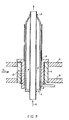
- the gas (g) used to atomize the liquid product is passed through a space which is formed below the inflow floor (a) by an additional floor (b).
- a bushing (c) with a lateral bore (d) for receiving the nozzle guide tube (e) is welded into the floors delimiting the space.
- the nozzle guide tube is so long that it extends from the lower edge of the socket to just above the inflow floor. It is also provided with a lateral bore so that the supply of atomizing gas to the nozzle can be interrupted in whole or in part by rotating the nozzle guide tube.
- the two-component nozzle also contains a lateral bore through which the atomizing gas, when the nozzle is installed, can flow from the nozzle guide tube into the gas guide channel of the nozzle.
- the feed of the liquid product is regulated in the manner customary for granulators and spray dryers via the temperature of the exhaust air.
- the zigzag sifter 8 in the device according to the invention shown consists of a large number of straight, rectangular channels 11 which meet at an angle of approximately 120 °.
- the channels 11 are delimited by checker plates 12 bent in a zigzag shape.
- a gas distributor 13 is arranged, with the aid of which the same amount of gas is supplied to all sight gas channels.
- a vortex roller forms in each classifier element, which is to be understood here as the distance between two neighboring viewing points.
- the material to be sifted slides down on the respective lower surface, crosses the sight gas flow, then moves upwards on the respective upper surface and crosses the sight gas flow again here. With each crossing there is a sighting, so that despite the low selectivity in the individual classifier elements, a high level of selectivity is achieved as a result of the repetition.
- the minimum passage cross-section of the line of sight in the zigzag sifter must be determined experimentally, because it depends on the particle size distribution of the bed and the granulate flow to be discharged. If the passage cross-section is too small, stationary operation according to FIG. 1 is not possible, since insufficient granulate quantity is discharged and in this case the bed content and grain size grow uncontrollably. If, on the other hand, the passage cross-section is too large, there are no disturbances in the formation of granules, but this mode of operation can be unfavorable in terms of energy. In order to change the passage cross section, an adjustment device 14 is therefore included in the classifier (cf. FIG.
- the adjusting device consists of ridges connected to one another in a comb-like manner and adapted to the zigzag profile, which webs can be displaced transversely, ie perpendicularly to the classifier axis, by means of a jack 15.
- the adjusting device 14 is connected to a control device 16 which adjusts the sight gas flow via the valve 17 in such a way that the flow rate in the zigzag sifter 8 remains constant despite the variable cross section.
- the optimal setting of the adjustment device is determined empirically by first searching for the sight gas throughput required for the desired granule size in the fully open state. The bed content adjusts itself automatically.
- the free cross section of the sifter is reduced until the bed content (measured over the bed pressure loss) increased.
- the sifter cross-section that is at least required for the granulation process has thus been found.
- the classifier cross-section is chosen to be slightly larger than absolutely necessary so that stable operating conditions are guaranteed.
- the percentages of the components contained can be varied within a substantial range.
- the proportion of active component or active components is generally between 1 and 100% by weight. If melts or solutions of individual active substances are sprayed in, the resulting granulate consists of up to 100% by weight of the respective substances, and up to 5% by weight of solvent or diluent may be present. If liquids are sprayed which, in addition to the active components, contain further constituents, such as inert fillers, dispersants, binders and / or other additives, the proportion of active components is generally between 5 and 95% by weight, preferably between 10 and 80% by weight.
- the proportion of inert filling materials is generally 0 to 99% by weight, preferably 0 to 95% by weight.
- Dispersants and / or binders and optionally further additives are generally present in proportions of 0 to 40% by weight, preferably 0 to 30% by weight.
- the granulate particles according to the invention generally have a particle size of 0.1 to 3 mm, preferably 0.2 to 2 mm.
- the grain size of the granulate particles according to the invention depends on the particular use of the granules. The grain size distribution is very narrow compared to conventionally produced granules. In general, the particle diameter deviates from the average particle diameter (d SO ) by a maximum of half an average grain size.
- the granulate particles according to the invention are uniformly shaped and have a high strength. They have a compact, microporous structure and are nevertheless spontaneously dispersible or soluble in water or other solvents.
- spontaneous dispersibility or solubility means that the particles generally completely disperse or dissolve in 0.5 to 3 minutes, preferably in up to 2 minutes.
- the granules according to the invention can be used for a wide variety of purposes, depending on the active components they contain. Those granules which contain agrochemical active substances as active components can be used in plant protection by customary methods. For example, such granules are dispersed or dissolved in water. The resulting dispersions or solutions can, if necessary, be applied to the plants and / or their habitat after prior dilution using customary methods, e.g. by spraying, spraying or pouring. The application rate depends on the concentration of the dispersion or solution and on the respective indication and on the active components contained.
- the granules according to the invention do not contain agrochemical active ingredients, but rather other active components, they are used according to the methods customary in the respective field of technology.
- the application rate here also depends on the respective active components and the respective indication.
- the granules produced by the process according to the invention can in some cases also be subjected to a thermal aftertreatment.
- zeolite granules can be hardened or activated by heating them to temperatures between 300 and 700 ° C, preferably between 350 and 650 ° C.
- Granules which contain inorganic oxides and are suitable as catalysts or catalyst supports can be hardened by heating them to temperatures between 500 and 1000 ° C.
- granulation is carried out from an aqueous saline solution containing 23% by weight of saline.
- This solution is sprayed into the fluidized bed granulator at a temperature of 20 ° C. Air is blown in at a rate of 127.5 kg per hour to fluidize the bed contents.
- the inlet temperature of the fluidizing gas is 180 ° C; the outlet temperature is 80 ° C. Air is blown in at a rate of 18 kg / hour as sight gas.
- the temperature of the sight gas is 20 ° C.
- the content of the fluidized bed is 3 kg; the granulation capacity is 1.5 kg per hour.
- the grain size distribution determined by sieve analysis is represented by curve 1 in FIG. 7.
- a powdery premix that is made consists, mixed with sufficient water with stirring that an aqueous suspension with a solids content of 60% by weight results. This suspension is sprayed into the fluidized bed granulator at a temperature of 20 ° C. The granulation takes place under the conditions specified below.
- the grain size distribution determined by sieve analysis is represented by curve 2 in FIG. 7.
- the granulation of a melt is carried out in the apparatus described in Example 1.
- the granulation of an aqueous suspension is carried out in the apparatus of Example 1 according to the invention.
- a two-component nozzle is used as the spray nozzle.
- a zigzag sifter serves as the sifter.
- the fine material is separated externally using a cyclone.
- a powdery premix that contains, mixed with so much water with stirring that an aqueous suspension with a solids content of 60% by weight results.
- This suspension is sprayed into the fluidized bed granulator using atomizing gas. The granulation takes place under the conditions specified below.
- a dust-free, free-flowing granulate with a bulk density of 667 kg / m 3 is obtained .
- Average grain size d 50 500 ⁇ m.
Landscapes
- Chemical & Material Sciences (AREA)
- Organic Chemistry (AREA)
- Chemical Kinetics & Catalysis (AREA)
- Glanulating (AREA)
- Devices And Processes Conducted In The Presence Of Fluids And Solid Particles (AREA)
- Agricultural Chemicals And Associated Chemicals (AREA)
Priority Applications (1)
| Application Number | Priority Date | Filing Date | Title |
|---|---|---|---|
| AT85103501T ATE37804T1 (de) | 1984-04-07 | 1985-03-25 | Verfahren und vorrichtung zur herstellung von granulaten. |
Applications Claiming Priority (4)
| Application Number | Priority Date | Filing Date | Title |
|---|---|---|---|
| DE19843413200 DE3413200A1 (de) | 1984-04-07 | 1984-04-07 | Vorrichtung zur herstellung von koernigem gut mit einstellbarer korngroesse aus fluessigen ausgangsprodukten |
| DE3413200 | 1984-04-07 | ||
| DE3507376 | 1985-03-02 | ||
| DE19853507376 DE3507376A1 (de) | 1985-03-02 | 1985-03-02 | Verfahren und vorrichtung zur herstellung von granulaten |
Publications (2)
| Publication Number | Publication Date |
|---|---|
| EP0163836A1 true EP0163836A1 (fr) | 1985-12-11 |
| EP0163836B1 EP0163836B1 (fr) | 1988-10-12 |
Family
ID=25820200
Family Applications (1)
| Application Number | Title | Priority Date | Filing Date |
|---|---|---|---|
| EP85103501A Expired EP0163836B1 (fr) | 1984-04-07 | 1985-03-25 | Procédé et dispositif pour la production de granulés |
Country Status (11)
| Country | Link |
|---|---|
| US (1) | US4946654A (fr) |
| EP (1) | EP0163836B1 (fr) |
| JP (1) | JPH0817933B2 (fr) |
| KR (1) | KR920002748B1 (fr) |
| AU (1) | AU571959B2 (fr) |
| BR (1) | BR8501554A (fr) |
| CA (1) | CA1257534A (fr) |
| DE (1) | DE3565475D1 (fr) |
| DK (1) | DK159478C (fr) |
| ES (1) | ES8603285A1 (fr) |
| IL (1) | IL74820A (fr) |
Cited By (28)
| Publication number | Priority date | Publication date | Assignee | Title |
|---|---|---|---|---|
| EP0332031A3 (fr) * | 1988-03-11 | 1991-07-31 | Bayer Ag | Séparateur pneumatique à zigzag |
| US5045459A (en) * | 1990-10-05 | 1991-09-03 | Haarmann & Reimer Corp. | Method for the production of granular citric acid |
| EP0475131A1 (fr) * | 1990-08-28 | 1992-03-18 | Basf Corporation | Procédé et dispositif pour l'augmentation de taille de sulfate d'ammonium |
| US5104799A (en) * | 1990-10-05 | 1992-04-14 | Haarmann & Reimer | Method for the production of granular citric acid and salts thereof |
| JPH04224515A (ja) * | 1990-05-04 | 1992-08-13 | Basf Ag | 純粋なリボフラビンからなる、流動性で、非ダスト性の、結合剤不含のリボフラビンスプレー顆粒又はリボフラビン微小顆粒の製法 |
| US5149643A (en) * | 1990-10-05 | 1992-09-22 | Haarmann & Beimer | Method for the production of granular citric acid and salts thereof |
| EP0611593A1 (fr) * | 1993-02-15 | 1994-08-24 | Bayer Ag | Procédé continu d'agglomération en lit fluidisé |
| US5519948A (en) * | 1992-02-12 | 1996-05-28 | Henkel Corporation | Process for the production of granules suitable as wetting agents, detergents and/or cleaning products |
| EP0778256A1 (fr) | 1995-12-05 | 1997-06-11 | Metallgesellschaft Ag | Procédé de production d'acide organique |
| EP0800860A1 (fr) * | 1996-04-09 | 1997-10-15 | Bayer Ag | Procédé et installation pour l'agglomération des products sensibles à l'hydrolyse ou moyen de vapeur d'eau |
| US5961707A (en) * | 1997-04-09 | 1999-10-05 | Haarmann & Reimer Gmbh | Alcohol-containing granules |
| EP1038527A1 (fr) * | 1999-03-24 | 2000-09-27 | Basf Aktiengesellschaft | Procédé de préparation de granules comprenant riboflavine |
| WO2001083727A3 (fr) * | 2000-05-04 | 2002-07-11 | Dsm Nv | Procede permettant de produire des granules enzymatiques |
| WO2002094714A1 (fr) * | 2001-05-22 | 2002-11-28 | Solarworld Aktiengesellschaft | Procede de production de silicium granulaire extremement pur dans un lit fluidise |
| WO2004022642A1 (fr) * | 2002-09-04 | 2004-03-18 | Symrise Gmbh & Co. Kg | Particules de cyclodextrine |
| DE10357827A1 (de) * | 2003-12-09 | 2005-07-14 | Glatt Ingenieurtechnik Gmbh | Verfahren zur Herstellung von Enzym-Granulaten und erhältliche Enzym-Granulate |
| DE102004022310A1 (de) * | 2004-05-04 | 2005-12-08 | Daimlerchrysler Ag | Feuchtigkeitsaustauschmodul mit einem Bündel von für Feuchtigkeit durchlässigen Hohlfasermembranen |
| DE102006004833A1 (de) * | 2006-02-02 | 2007-08-16 | Holger Mannweiler | Verfahren zum Trocknen von Saft |
| DE10349388B4 (de) * | 2003-10-21 | 2008-07-03 | Henkel Kgaa | Verfahren zur Verarbeitung von Wasch- oder Reinigungsmittelinhaltsstoffen |
| EP1958627A2 (fr) | 2007-01-04 | 2008-08-20 | Symrise GmbH & Co. KG | Utilisation d'esters d'acide de menthyl-3-oxycarboxylique déterminés en tant que substances de refroidissement physiologiques actives |
| EP1958520A2 (fr) | 2007-02-09 | 2008-08-20 | Symrise GmbH & Co. KG | Granulés de lit fluidisé ayant une teneur élevée en fruit |
| EP2033688A2 (fr) | 2007-08-20 | 2009-03-11 | Symrise GmbH & Co. KG | Dérivés d'acide oxalique et leur utilisation en tant que matières de refroidissement physiologiques |
| EP2106704A1 (fr) | 2008-04-02 | 2009-10-07 | Symrise GmbH & Co. KG | Particules disposant d'une quantité élevée de fragrance ou d'huile aromatique |
| WO2011061330A2 (fr) | 2009-11-20 | 2011-05-26 | Symrise Ag | Utilisation d'agents rafraîchissants physiologiques et produits contenant de tels agents |
| WO2013041621A1 (fr) | 2011-09-20 | 2013-03-28 | Basf Se | Modulateurs à faible masse moléculaire du récepteur sensible au froid et au menthol trpm8, et leur utilisation |
| EP2962679A1 (fr) | 2014-06-30 | 2016-01-06 | Symrise AG | Utilisation de tetrahydrofuranlignanes |
| EP2993221A1 (fr) | 2014-09-08 | 2016-03-09 | Symrise AG | Mixtures de parfums capsulées |
| EP4501125A2 (fr) | 2016-08-09 | 2025-02-05 | Symrise AG | Mélanges contenant du (e)-3-benzo[1,3 dioxol-5-yl-n,n-diphényl-2-propénamide |
Families Citing this family (85)
| Publication number | Priority date | Publication date | Assignee | Title |
|---|---|---|---|---|
| US5213820A (en) * | 1984-02-27 | 1993-05-25 | Bayer Aktiengesellschaft | Process and device for fluidized bed spray granulation |
| US5230892A (en) * | 1990-08-24 | 1993-07-27 | Bayer Aktiengesellschaft | Solid formulations |
| EP0526394B1 (fr) * | 1991-07-11 | 1995-03-15 | Glatt Gmbh | Procédé et dispositif pour enrober des particules |
| JPH0763606B2 (ja) * | 1991-10-18 | 1995-07-12 | フロイント産業株式会社 | コーティング装置 |
| DE4200821A1 (de) * | 1992-01-15 | 1993-07-22 | Bayer Ag | Geschmacksmaskierte pharmazeutische mittel |
| US5593948A (en) * | 1994-04-28 | 1997-01-14 | Basf Corporation | Highly concentrated, solid acifluoren powders and processes for making dry form solid acifluorfen powders |
| US5624793A (en) * | 1994-11-11 | 1997-04-29 | Konica Corporation | Method of manufacturing solid processing composition for silver halide photographic light-sensitive materials |
| US6011089A (en) * | 1995-06-07 | 2000-01-04 | Cytec Technology Corp. | Spray drying of polymer-containing dispersions, water-in-oil emulsions and water-in-oil microemulsions, and dry polymer products formed thereby |
| US6080804A (en) * | 1995-06-07 | 2000-06-27 | Cytec Technology Corp. | Spray drying of functionalized polyacrylamide microemulsions |
| US5849862A (en) * | 1995-06-07 | 1998-12-15 | Cytec Technology Corp. | Processes of spray drying polymer-containing dispersions, water-in-oil emulsions and water-in-oil microemulsions |
| US5869542A (en) * | 1995-06-07 | 1999-02-09 | Cytec Technology Corp. | Spray drying of polymer-containing dispersions, water-in-oil emulsions and microemulsions and dry polymer products formed thereby |
| PT1117729E (pt) | 1998-07-21 | 2004-01-30 | Vantico Ag | Granulados escoaveis |
| DE19837957C1 (de) * | 1998-08-21 | 2000-01-05 | Krupp Uhde Gmbh | Verfahren zur Steuerung der Feinstaubpartikelmenge in einem Wirbelschichtreaktor, insbesondere zur Oxichlorierung von Ethylen |
| EP0998933A1 (fr) * | 1998-10-09 | 2000-05-10 | Boehringer Mannheim Gmbh | Procédé pour la préparation de compositions pharmaucetiques contenant des diphosphonates pour administration orale |
| DE19956604A1 (de) * | 1998-12-18 | 2000-11-02 | Haarmann & Reimer Gmbh | Eingekapselte Aroma- und/oder Riechstoffzubereitungen |
| WO2000054876A1 (fr) | 1999-03-18 | 2000-09-21 | Hosokawa Micron Corporation | Dispositif et procede de production de granules |
| DE19919233C2 (de) * | 1999-04-28 | 2002-06-20 | Kali & Salz Ag | Verfahren zur Herstellung von Düngemittelpressgranulaten |
| JP3182648B2 (ja) * | 1999-05-12 | 2001-07-03 | ティーディーケイ株式会社 | セラミック成形体の成形用のセラミック顆粒、その製造または処理方法、セラミック成形体およびその製造方法 |
| US20060159756A1 (en) * | 1999-09-10 | 2006-07-20 | Brita Sjoblom | Method to obtain microparticles containing an H+,K+-ATP-ASE inhibitor |
| DE19959914A1 (de) * | 1999-12-11 | 2001-07-05 | Henkel Kgaa | Granulate durch Wirbelschichtgranulation |
| US6719952B1 (en) * | 2000-02-21 | 2004-04-13 | Westinghouse Electric Company Llc | Fluidized bed reaction design |
| SE0100824D0 (sv) * | 2001-03-09 | 2001-03-09 | Astrazeneca Ab | Method III to obtain microparticles |
| SE0100822D0 (sv) * | 2001-03-09 | 2001-03-09 | Astrazeneca Ab | Method II to obtain microparticles |
| DE10132177A1 (de) * | 2001-07-03 | 2003-01-23 | Degussa | Verfahren zur Herstellung von Granulaten in einer zirkulierenden Wirbelschicht, Vorrichtung zur Durchführung dieses Verfahrens und nach diesem Verfahren erhaltene Granulate |
| US7001625B2 (en) * | 2001-07-30 | 2006-02-21 | Kemin Industires, Inc. | Solid phase synthesis of salts of organic acids including butyric acid |
| US6986909B2 (en) | 2001-07-30 | 2006-01-17 | Kemin Industries, Inc. | Solid phase synthesis of salts of organic acid |
| DE10150326A1 (de) * | 2001-10-15 | 2003-04-24 | Degussa | Verfahren zur Herstellung von Alkalialkoholat- und Erdalkalialkoholat-Granulaten |
| US6596072B1 (en) | 2001-11-27 | 2003-07-22 | Hamburger Color Company | Product and method for coloring concrete |
| DE10256530A1 (de) * | 2002-12-04 | 2004-06-24 | Degussa Ag | Verfahren zur Herstellung von wasserfreiem Alkalisulfid |
| US7160830B2 (en) * | 2002-12-18 | 2007-01-09 | Albemarle Netherlands, B.V. | Process for the preparation of catalyst microspheres |
| AU2003294844A1 (en) * | 2002-12-18 | 2004-07-09 | Albemarle Netherlands B.V. | Process for the preparation of catalyst microspheres |
| DE10325989A1 (de) * | 2003-06-07 | 2005-01-05 | Glatt Gmbh | Verfahren zur Herstellung von und daraus resultierende Mikropellets sowie deren Verwendung |
| ES2374191T3 (es) * | 2003-06-11 | 2012-02-14 | Glatt Ingenieurtechnik Gmbh | Procedimiento de preparación de granulados de enzimas y granulados de enzimas así obtenidos. |
| DE10326231B4 (de) * | 2003-06-11 | 2016-04-07 | Glatt Ingenieurtechnik Gmbh | Verfahren zur Herstellung von Enzym-Granulaten |
| DE10331366A1 (de) * | 2003-07-11 | 2005-01-27 | Degussa Ag | Verfahren zur Granulation eines Tierfuttermittel-Zusatzes |
| PL2708225T3 (pl) | 2004-04-23 | 2019-07-31 | Cydex Pharmaceuticals, Inc. | Formulacja DPI zawierająca eter sulfoalkilowy cyklodekstryny |
| DE102004022102A1 (de) * | 2004-05-05 | 2005-11-24 | Glatt Ingenieurtechnik Gmbh | Verfahren zur Verkapselung flüchtiger, oxidationsempfindlicher Substanzen sowie von Duft- und Geschmacksstoffen in Granulatform |
| US20050261399A1 (en) * | 2004-05-19 | 2005-11-24 | David Hunkeler | Powdered flocculants prepared by using evaporative cooling to coat polymeric materials on a porous substrate |
| DE102004028883A1 (de) * | 2004-06-15 | 2006-01-05 | Glatt Ingenieurtechnik Gmbh | Verfahren zur Granulation von Malzextrakten |
| CN1301784C (zh) * | 2004-12-28 | 2007-02-28 | 山东铝业公司 | 回转式双向循环成球机 |
| EP2368442B1 (fr) | 2005-07-27 | 2014-12-17 | Symrise AG | Utilisation d'hespérétine pour améliorer le goût sucré |
| US7629331B2 (en) | 2005-10-26 | 2009-12-08 | Cydex Pharmaceuticals, Inc. | Sulfoalkyl ether cyclodextrin compositions and methods of preparation thereof |
| DK1945228T4 (da) | 2005-10-26 | 2015-01-12 | Cydex Pharmaceuticals Inc | Sulfoalkyl-ether-cyclodextrin-sammensætninger og fremgangsmåder til fremstilling deraf |
| DE102006003335A1 (de) * | 2006-01-23 | 2007-07-26 | Symrise Gmbh & Co. Kg | Tee-Aromatisierung |
| KR100759751B1 (ko) * | 2006-05-08 | 2007-10-04 | 주식회사 에코프로 | 하이드로 싸이클론을 이용한 리튬 이차전지 양극 활물질의제조방법 및 그 제조장치 |
| US20080220140A1 (en) * | 2007-01-25 | 2008-09-11 | Symrise Gmbh & Co. Kg | Use of propenylphenyl glycosides for enhancing sweet sensory impressions |
| EP1955599A1 (fr) * | 2007-02-09 | 2008-08-13 | Braunschweigische Maschinenbauanstalt AG | Procédé et dispositif destinés au séchage de produits annexes |
| EP1977655B1 (fr) * | 2007-03-29 | 2011-05-18 | Symrise AG | Compositions d'aromes d'alcamides comprenant de l'hespérétine et/ou des 4-hydroxydihydrochalcones et leurs sels destinées à renforcer les impressions sensorielles sucrées |
| DE102007039518A1 (de) | 2007-08-21 | 2009-02-26 | PERGANDE Gesellschaft für industrielle Entstaubungstechnik mbH | Sichtender Granulieraustrag für Wirbelschicht - Granulationsapparate |
| JP2011067095A (ja) | 2008-01-10 | 2011-04-07 | Ajinomoto Co Inc | 発酵法による目的物質の製造法 |
| WO2009093703A1 (fr) | 2008-01-23 | 2009-07-30 | Ajinomoto Co., Inc. | Procédé de fabrication de l-aminoacide |
| NO330729B1 (no) | 2008-04-28 | 2011-06-27 | Yara Int Asa | Fremgangsmate og granulator for produksjon av granuler |
| CN102177246B (zh) | 2008-09-08 | 2015-02-11 | 味之素株式会社 | 生产l-氨基酸的微生物和l-氨基酸的生产方法 |
| IT1394597B1 (it) * | 2008-11-05 | 2012-07-05 | Politi | Granulazione a secco in flusso di gas. |
| WO2010084995A2 (fr) | 2009-01-23 | 2010-07-29 | Ajinomoto Co.,Inc. | Procédé de production d'un acide l-aminé |
| JPWO2011013707A1 (ja) | 2009-07-29 | 2013-01-10 | 味の素株式会社 | L−アミノ酸の製造法 |
| JP2012196144A (ja) | 2009-08-03 | 2012-10-18 | Ajinomoto Co Inc | ビブリオ属細菌を用いたl−リジンの製造法 |
| JP2012223092A (ja) | 2009-08-28 | 2012-11-15 | Ajinomoto Co Inc | L−アミノ酸の製造法 |
| EP2493290B1 (fr) * | 2009-10-27 | 2016-08-17 | Basf Se | Procédé de preparation des granules des pesticides utilisant un granulateur a lit fluidisé |
| JP2013013329A (ja) | 2009-11-06 | 2013-01-24 | Ajinomoto Co Inc | L−アミノ酸の製造法 |
| RU2010101135A (ru) | 2010-01-15 | 2011-07-20 | Закрытое акционерное общество "Научно-исследовательский институт "Аджиномото-Генетика" (ЗАО АГРИ) (RU) | Бактерия семейства enterobacteriaceae - продуцент l-аспартата или метаболитов, производных l-аспартата, и способ получения l-аспартата или метаболитов, производных l-аспартата |
| RU2460793C2 (ru) | 2010-01-15 | 2012-09-10 | Закрытое акционерное общество "Научно-исследовательский институт "Аджиномото-Генетика" (ЗАО АГРИ) | Способ получения l-аминокислот с использованием бактерий семейства enterobacteriaceae |
| JP2013074795A (ja) | 2010-02-08 | 2013-04-25 | Ajinomoto Co Inc | 変異型rpsA遺伝子及びL−アミノ酸の製造法 |
| RU2471868C2 (ru) | 2010-02-18 | 2013-01-10 | Закрытое акционерное общество "Научно-исследовательский институт "Аджиномото-Генетика" (ЗАО АГРИ) | Мутантная аденилатциклаза, днк, кодирующая ее, бактерия семейства enterobacteriaceae, содержащая указанную днк, и способ получения l-аминокислот |
| JP2014036576A (ja) | 2010-12-10 | 2014-02-27 | Ajinomoto Co Inc | L−アミノ酸の製造法 |
| RU2011134436A (ru) | 2011-08-18 | 2013-10-27 | Закрытое акционерное общество "Научно-исследовательский институт Аджиномото-Генетика" (ЗАО "АГРИ") | Способ получения l-аминокислоты с использованием бактерии семейства enterobacteriaceae, обладающей повышенной экспрессией генов каскада образования флагелл и клеточной подвижности |
| BR112013016373B1 (pt) | 2011-11-11 | 2021-05-18 | Ajinomoto Co., Inc | método para produzir uma substância alvo |
| RU2013118637A (ru) | 2013-04-23 | 2014-10-27 | Закрытое акционерное общество "Научно-исследовательский институт Аджиномото-Генетика" (ЗАО "АГРИ") | СПОСОБ ПОЛУЧЕНИЯ L-АМИНОКИСЛОТ С ИСПОЛЬЗОВАНИЕМ БАКТЕРИИ СЕМЕЙСТВА ENTEROBACTERIACEAE, В КОТОРОЙ РАЗРЕГУЛИРОВАН ГЕН yjjK |
| JP5831669B2 (ja) | 2013-05-13 | 2015-12-09 | 味の素株式会社 | L−アミノ酸の製造法 |
| DE102013215062A1 (de) * | 2013-07-31 | 2015-02-05 | Krones Ag | Zick-Zack-Sichter zum Separieren von Trenngut, beispielsweise Kunststoffflocken, und Verfahren zum Separieren von Trenngut, beispielsweise Kunststoffflocken, mittels eines Zick-Zack-Sichters |
| RU2013140115A (ru) | 2013-08-30 | 2015-03-10 | Закрытое акционерное общество "Научно-исследовательский институт Аджиномото-Генетика" (ЗАО "АГРИ") | СПОСОБ ПОЛУЧЕНИЯ L-АМИНОКИСЛОТ С ИСПОЛЬЗОВАНИЕМ БАКТЕРИИ СЕМЕЙСТВА Enterobacteriaceae, В КОТОРОЙ НАРУШЕНА ЭКСПРЕССИЯ КЛАСТЕРА ГЕНОВ znuACB |
| RU2013144250A (ru) | 2013-10-02 | 2015-04-10 | Закрытое акционерное общество "Научно-исследовательский институт Аджиномото-Генетика" (ЗАО "АГРИ") | СПОСОБ ПОЛУЧЕНИЯ L-АМИНОКИСЛОТ С ИСПОЛЬЗОВАНИЕМ БАКТЕРИИ СЕМЕЙСТВА Enterobacteriaceae, В КОТОРОЙ ОСЛАБЛЕНА ЭКСПРЕССИЯ ГЕНА, КОДИРУЮЩЕГО ФОСФАТНЫЙ ТРАНСПОРТЕР |
| EP2886651B1 (fr) | 2013-10-21 | 2018-08-22 | Ajinomoto Co., Inc. | Procédé de production d'un acide aminé de forme l |
| RU2015114955A (ru) | 2015-04-22 | 2016-11-10 | Аджиномото Ко., Инк. | Способ получения L-изолейцина с использованием бактерии семейства Enterobacteriaceae, в которой сверхэкспрессирован ген cycA |
| RU2015120052A (ru) | 2015-05-28 | 2016-12-20 | Аджиномото Ко., Инк. | Способ получения L-аминокислоты с использованием бактерии семейства Enterobacteriaceae, в которой ослаблена экспрессия гена gshA |
| EP3117720B1 (fr) * | 2015-05-29 | 2019-02-20 | Symrise AG | Particules d'agglomeration grances |
| JP6623690B2 (ja) | 2015-10-30 | 2019-12-25 | 味の素株式会社 | グルタミン酸系l−アミノ酸の製造法 |
| CN109121422B (zh) | 2016-02-25 | 2021-12-21 | 味之素株式会社 | 使用过表达编码铁输出蛋白基因的肠杆菌科的细菌生产l-氨基酸的方法 |
| JP7066977B2 (ja) | 2017-04-03 | 2022-05-16 | 味の素株式会社 | L-アミノ酸の製造法 |
| EP3384980A1 (fr) * | 2017-04-06 | 2018-10-10 | SASOL Germany GmbH | Procédé de production d'un matériau granulé à attrition stable |
| BR112020021859A2 (pt) | 2018-05-04 | 2021-03-09 | Ajinomoto Co., Inc. | Método para produzir l-metionina ou um sal da mesma |
| EP4239070A4 (fr) | 2020-10-28 | 2025-09-10 | Ajinomoto Kk | Procédé de production d'acide l-aminé |
| US20240117393A1 (en) | 2022-09-30 | 2024-04-11 | Ajinomoto Co., Inc. | Method for producing l-amino acid |
| EP4692312A1 (fr) | 2023-12-28 | 2026-02-11 | Ajinomoto Co., Inc. | Bactérie produisant de l'acide l-glutamique et procédé de production d'acide l-glutamique |
| JP7716823B1 (ja) | 2023-12-28 | 2025-08-01 | 味の素株式会社 | L-グルタミン酸生産菌およびl-グルタミン酸の製造方法 |
Citations (4)
| Publication number | Priority date | Publication date | Assignee | Title |
|---|---|---|---|---|
| BE682781A (fr) * | 1965-08-27 | 1966-12-01 | ||
| FR2418669A1 (fr) * | 1978-03-03 | 1979-09-28 | Ube Industries | Procede et installation pour la preparation de granules d'uree |
| GB2063759A (en) * | 1979-11-28 | 1981-06-10 | Mitsui Toatsu Chemicals | Granulation process and apparatus therefor |
| EP0037066A2 (fr) * | 1980-03-27 | 1981-10-07 | Röthele, Stephan, Dipl.-Ing. | Classifisateur à air avec des moyens pour le nettoyage et pour enlever les matières adhérentes des parois internes de la chambre de classification |
Family Cites Families (8)
| Publication number | Priority date | Publication date | Assignee | Title |
|---|---|---|---|---|
| DE140005C (fr) * | ||||
| DE139526C (fr) * | ||||
| CH558674A (de) * | 1971-07-01 | 1975-02-14 | Ciba Geigy Ag | Verfahren und vorrichtung zur herstellung eines granulats. |
| DD119304A1 (fr) * | 1975-04-23 | 1976-04-12 | ||
| FR2472411A1 (fr) * | 1979-11-30 | 1981-07-03 | Charbonnages Ste Chimique | Appareil perfectionne pour la granu |
| DE3007711C2 (de) * | 1980-02-29 | 1987-01-02 | Kernforschungsanlage Jülich GmbH, 5170 Jülich | Anströmeinheit für einen Wirbelschichtofen |
| JPS5851213B2 (ja) * | 1981-07-24 | 1983-11-15 | 住友ゴム工業株式会社 | エラストマ−物品の硬度の測定方法及びその装置 |
| DE3248504A1 (de) * | 1982-01-09 | 1983-07-21 | Sandoz-Patent-GmbH, 7850 Lörrach | Verfahren zur herstellung nicht staubender granulate und vorrichtung hierfuer |
-
1985
- 1985-03-25 DE DE8585103501T patent/DE3565475D1/de not_active Expired
- 1985-03-25 EP EP85103501A patent/EP0163836B1/fr not_active Expired
- 1985-04-03 DK DK154185A patent/DK159478C/da not_active IP Right Cessation
- 1985-04-03 ES ES541983A patent/ES8603285A1/es not_active Expired
- 1985-04-03 BR BR8501554A patent/BR8501554A/pt not_active IP Right Cessation
- 1985-04-04 CA CA000478357A patent/CA1257534A/fr not_active Expired
- 1985-04-04 IL IL74820A patent/IL74820A/xx not_active IP Right Cessation
- 1985-04-04 AU AU40961/85A patent/AU571959B2/en not_active Expired
- 1985-04-05 JP JP60072491A patent/JPH0817933B2/ja not_active Expired - Fee Related
- 1985-04-06 KR KR1019850002309A patent/KR920002748B1/ko not_active Expired
-
1988
- 1988-07-26 US US07/224,524 patent/US4946654A/en not_active Expired - Lifetime
Patent Citations (4)
| Publication number | Priority date | Publication date | Assignee | Title |
|---|---|---|---|---|
| BE682781A (fr) * | 1965-08-27 | 1966-12-01 | ||
| FR2418669A1 (fr) * | 1978-03-03 | 1979-09-28 | Ube Industries | Procede et installation pour la preparation de granules d'uree |
| GB2063759A (en) * | 1979-11-28 | 1981-06-10 | Mitsui Toatsu Chemicals | Granulation process and apparatus therefor |
| EP0037066A2 (fr) * | 1980-03-27 | 1981-10-07 | Röthele, Stephan, Dipl.-Ing. | Classifisateur à air avec des moyens pour le nettoyage et pour enlever les matières adhérentes des parois internes de la chambre de classification |
Cited By (39)
| Publication number | Priority date | Publication date | Assignee | Title |
|---|---|---|---|---|
| EP0332031A3 (fr) * | 1988-03-11 | 1991-07-31 | Bayer Ag | Séparateur pneumatique à zigzag |
| JPH04224515A (ja) * | 1990-05-04 | 1992-08-13 | Basf Ag | 純粋なリボフラビンからなる、流動性で、非ダスト性の、結合剤不含のリボフラビンスプレー顆粒又はリボフラビン微小顆粒の製法 |
| EP0475131A1 (fr) * | 1990-08-28 | 1992-03-18 | Basf Corporation | Procédé et dispositif pour l'augmentation de taille de sulfate d'ammonium |
| US5045459A (en) * | 1990-10-05 | 1991-09-03 | Haarmann & Reimer Corp. | Method for the production of granular citric acid |
| US5104799A (en) * | 1990-10-05 | 1992-04-14 | Haarmann & Reimer | Method for the production of granular citric acid and salts thereof |
| US5149643A (en) * | 1990-10-05 | 1992-09-22 | Haarmann & Beimer | Method for the production of granular citric acid and salts thereof |
| EP0479084A3 (en) * | 1990-10-05 | 1992-12-02 | Haarmann & Reimer Corp. | Method for the production of granular citric acid and salts thereof |
| US5519948A (en) * | 1992-02-12 | 1996-05-28 | Henkel Corporation | Process for the production of granules suitable as wetting agents, detergents and/or cleaning products |
| US5480617A (en) * | 1993-02-15 | 1996-01-02 | Bayer Aktiengesellschaft | Apparatus for continuous fluidized bed agglomeration |
| EP0611593A1 (fr) * | 1993-02-15 | 1994-08-24 | Bayer Ag | Procédé continu d'agglomération en lit fluidisé |
| EP0778256A1 (fr) | 1995-12-05 | 1997-06-11 | Metallgesellschaft Ag | Procédé de production d'acide organique |
| EP0800860A1 (fr) * | 1996-04-09 | 1997-10-15 | Bayer Ag | Procédé et installation pour l'agglomération des products sensibles à l'hydrolyse ou moyen de vapeur d'eau |
| US5917081A (en) * | 1996-04-09 | 1999-06-29 | Bayer Aktiengesellschaft | Process and apparatus for the agglomeration of hydrolytically sensitive substances by means of steam |
| US5955036A (en) * | 1996-04-09 | 1999-09-21 | Bayer Aktiengesellschaft | Process and apparatus for the agglomeration of hydrolytically sensitive substances by means of steam |
| RU2191065C2 (ru) * | 1996-04-09 | 2002-10-20 | Байер Аг | Способ и устройство для агломерации труднорастворимых и чувствительных к гидролизу веществ |
| US5961707A (en) * | 1997-04-09 | 1999-10-05 | Haarmann & Reimer Gmbh | Alcohol-containing granules |
| EP1038527A1 (fr) * | 1999-03-24 | 2000-09-27 | Basf Aktiengesellschaft | Procédé de préparation de granules comprenant riboflavine |
| WO2001083727A3 (fr) * | 2000-05-04 | 2002-07-11 | Dsm Nv | Procede permettant de produire des granules enzymatiques |
| WO2002094714A1 (fr) * | 2001-05-22 | 2002-11-28 | Solarworld Aktiengesellschaft | Procede de production de silicium granulaire extremement pur dans un lit fluidise |
| US7553466B2 (en) | 2001-05-22 | 2009-06-30 | Solarworld Aktiengesellschaft | Method for producing highly pure, granular silicon in a fluidised bed |
| US7348035B2 (en) | 2002-09-04 | 2008-03-25 | Symrise Gmbh & Co. Kg | Cyclodextrin particle |
| CN1329440C (zh) * | 2002-09-04 | 2007-08-01 | 西姆莱斯有限责任两合公司 | 环糊精颗粒 |
| WO2004022642A1 (fr) * | 2002-09-04 | 2004-03-18 | Symrise Gmbh & Co. Kg | Particules de cyclodextrine |
| DE10349388B4 (de) * | 2003-10-21 | 2008-07-03 | Henkel Kgaa | Verfahren zur Verarbeitung von Wasch- oder Reinigungsmittelinhaltsstoffen |
| DE10357827A1 (de) * | 2003-12-09 | 2005-07-14 | Glatt Ingenieurtechnik Gmbh | Verfahren zur Herstellung von Enzym-Granulaten und erhältliche Enzym-Granulate |
| DE102004022310B4 (de) * | 2004-05-04 | 2010-01-07 | Daimler Ag | Brennstoffzellensystem mit einem Feuchtigkeitsaustauschmodul mit einem Bündel von für Feuchtigkeit durchlässigen Hohlfasermembranen |
| DE102004022310A1 (de) * | 2004-05-04 | 2005-12-08 | Daimlerchrysler Ag | Feuchtigkeitsaustauschmodul mit einem Bündel von für Feuchtigkeit durchlässigen Hohlfasermembranen |
| DE102006004833A1 (de) * | 2006-02-02 | 2007-08-16 | Holger Mannweiler | Verfahren zum Trocknen von Saft |
| EP1958627A2 (fr) | 2007-01-04 | 2008-08-20 | Symrise GmbH & Co. KG | Utilisation d'esters d'acide de menthyl-3-oxycarboxylique déterminés en tant que substances de refroidissement physiologiques actives |
| EP1958520A2 (fr) | 2007-02-09 | 2008-08-20 | Symrise GmbH & Co. KG | Granulés de lit fluidisé ayant une teneur élevée en fruit |
| EP2033688A2 (fr) | 2007-08-20 | 2009-03-11 | Symrise GmbH & Co. KG | Dérivés d'acide oxalique et leur utilisation en tant que matières de refroidissement physiologiques |
| EP2106704A1 (fr) | 2008-04-02 | 2009-10-07 | Symrise GmbH & Co. KG | Particules disposant d'une quantité élevée de fragrance ou d'huile aromatique |
| WO2011061330A2 (fr) | 2009-11-20 | 2011-05-26 | Symrise Ag | Utilisation d'agents rafraîchissants physiologiques et produits contenant de tels agents |
| DE102010002558A1 (de) | 2009-11-20 | 2011-06-01 | Symrise Ag | Verwendung physiologischer Kühlwirkstoffe und Mittel enthaltend solche Wirkstoffe |
| EP3663366A2 (fr) | 2009-11-20 | 2020-06-10 | Symrise AG | Utilisation de substances actives de refroidissement physiologiques et moyen comportant des telles substances actives |
| WO2013041621A1 (fr) | 2011-09-20 | 2013-03-28 | Basf Se | Modulateurs à faible masse moléculaire du récepteur sensible au froid et au menthol trpm8, et leur utilisation |
| EP2962679A1 (fr) | 2014-06-30 | 2016-01-06 | Symrise AG | Utilisation de tetrahydrofuranlignanes |
| EP2993221A1 (fr) | 2014-09-08 | 2016-03-09 | Symrise AG | Mixtures de parfums capsulées |
| EP4501125A2 (fr) | 2016-08-09 | 2025-02-05 | Symrise AG | Mélanges contenant du (e)-3-benzo[1,3 dioxol-5-yl-n,n-diphényl-2-propénamide |
Also Published As
| Publication number | Publication date |
|---|---|
| ES541983A0 (es) | 1985-12-16 |
| ES8603285A1 (es) | 1985-12-16 |
| DK154185A (da) | 1985-10-08 |
| AU571959B2 (en) | 1988-04-28 |
| CA1257534A (fr) | 1989-07-18 |
| JPH0817933B2 (ja) | 1996-02-28 |
| DK159478C (da) | 1991-03-25 |
| KR920002748B1 (ko) | 1992-04-02 |
| DE3565475D1 (en) | 1988-11-17 |
| AU4096185A (en) | 1985-10-10 |
| DK159478B (da) | 1990-10-22 |
| IL74820A (en) | 1988-12-30 |
| JPS60227825A (ja) | 1985-11-13 |
| US4946654A (en) | 1990-08-07 |
| KR850007367A (ko) | 1985-12-04 |
| IL74820A0 (en) | 1985-07-31 |
| DK154185D0 (da) | 1985-04-03 |
| EP0163836B1 (fr) | 1988-10-12 |
| BR8501554A (pt) | 1985-12-03 |
Similar Documents
| Publication | Publication Date | Title |
|---|---|---|
| EP0163836B1 (fr) | Procédé et dispositif pour la production de granulés | |
| DE2908136C2 (de) | Vorrichtung und Verfahren zur Herstellung von Harnstoffkörnern im Wirbelbett | |
| EP1373585B2 (fr) | Procede de production d'un element saillant en metal dur | |
| DE3334543C2 (fr) | ||
| DE69221166T2 (de) | Methode zum überziehen von teilchen in einer sprühtrocknungsanlage | |
| DE3116778C2 (de) | Verfahren zur Herstellung von aus einem Kern und einer Hülle aufgebauten Körnern | |
| EP0821618A1 (fr) | Procede et dispositif de production de granules par granulation par pulverisation en lit fluidise | |
| DE3043440A1 (de) | Granulierverfahren und -vorrichtung | |
| EP0611593A1 (fr) | Procédé continu d'agglomération en lit fluidisé | |
| DE69623395T2 (de) | Vorrichtung und Verfahren zur Herstellung von einem sprühgetrocknetem Produkt | |
| EP1319644A1 (fr) | Procédé de préparation de beta-mannitol directement comprimable | |
| EP0799569B1 (fr) | Granulés des produits hygroscopes et solubles dans l'eau | |
| EP0003302B1 (fr) | Procédé de fabrication de produits pour la protection de plantes sous forme d'un granulat ne dégageant pas de poussières | |
| EP1915135B1 (fr) | Procédé pour produire les particules sphériques à base de substances pharmaceutiques | |
| DE3909455A1 (de) | Verfahren zur herstellung von wasserdispergierbaren granulaten | |
| DE69618716T2 (de) | Vorrichtung zur Herstellung von einem sprühgetrocknetem Produkt und Verfahren zur Herstellung eines solchen Produktes | |
| DE10326231B4 (de) | Verfahren zur Herstellung von Enzym-Granulaten | |
| DE10307078A1 (de) | Verfahren zur Herstellung von wasserdispergierbaren Granulaten | |
| CH622714A5 (en) | Fluidised-layer granulating process and apparatus for carrying out the process | |
| DE3507376A1 (de) | Verfahren und vorrichtung zur herstellung von granulaten | |
| DE60003533T2 (de) | Verfahren zum herstellen von granulaten | |
| DD236461A5 (de) | Verfahren und vorrichtung zur herstellung von granulaten | |
| DE3248504C2 (fr) | ||
| US6680032B1 (en) | Process and apparatus for preparing granulates | |
| EP1593424B1 (fr) | Procédé d'encapsualtion des substances sensibles à l'oxydation ainsi que des agents aromatisants et parfumants en forme de granules |
Legal Events
| Date | Code | Title | Description |
|---|---|---|---|
| PUAI | Public reference made under article 153(3) epc to a published international application that has entered the european phase |
Free format text: ORIGINAL CODE: 0009012 |
|
| 17P | Request for examination filed |
Effective date: 19850325 |
|
| AK | Designated contracting states |
Designated state(s): AT BE CH DE FR GB IT LI NL |
|
| 17Q | First examination report despatched |
Effective date: 19870401 |
|
| GRAA | (expected) grant |
Free format text: ORIGINAL CODE: 0009210 |
|
| ITF | It: translation for a ep patent filed | ||
| AK | Designated contracting states |
Kind code of ref document: B1 Designated state(s): AT BE CH DE FR GB IT LI NL |
|
| REF | Corresponds to: |
Ref document number: 37804 Country of ref document: AT Date of ref document: 19881015 Kind code of ref document: T |
|
| REF | Corresponds to: |
Ref document number: 3565475 Country of ref document: DE Date of ref document: 19881117 |
|
| ET | Fr: translation filed | ||
| GBT | Gb: translation of ep patent filed (gb section 77(6)(a)/1977) | ||
| PLBI | Opposition filed |
Free format text: ORIGINAL CODE: 0009260 |
|
| 26 | Opposition filed |
Opponent name: CIBA-GEIGY AG Effective date: 19890711 |
|
| NLR1 | Nl: opposition has been filed with the epo |
Opponent name: CIBA-GEIGY AG |
|
| PLBM | Termination of opposition procedure: date of legal effect published |
Free format text: ORIGINAL CODE: 0009276 |
|
| STAA | Information on the status of an ep patent application or granted ep patent |
Free format text: STATUS: OPPOSITION PROCEDURE CLOSED |
|
| 27C | Opposition proceedings terminated |
Effective date: 19900622 |
|
| ITTA | It: last paid annual fee | ||
| NLR2 | Nl: decision of opposition | ||
| REG | Reference to a national code |
Ref country code: GB Ref legal event code: IF02 |
|
| PGFP | Annual fee paid to national office [announced via postgrant information from national office to epo] |
Ref country code: FR Payment date: 20040312 Year of fee payment: 20 |
|
| PGFP | Annual fee paid to national office [announced via postgrant information from national office to epo] |
Ref country code: AT Payment date: 20040322 Year of fee payment: 20 |
|
| PGFP | Annual fee paid to national office [announced via postgrant information from national office to epo] |
Ref country code: CH Payment date: 20040323 Year of fee payment: 20 |
|
| PGFP | Annual fee paid to national office [announced via postgrant information from national office to epo] |
Ref country code: GB Payment date: 20040324 Year of fee payment: 20 |
|
| PGFP | Annual fee paid to national office [announced via postgrant information from national office to epo] |
Ref country code: NL Payment date: 20040331 Year of fee payment: 20 Ref country code: BE Payment date: 20040331 Year of fee payment: 20 |
|
| PGFP | Annual fee paid to national office [announced via postgrant information from national office to epo] |
Ref country code: DE Payment date: 20040527 Year of fee payment: 20 |
|
| PG25 | Lapsed in a contracting state [announced via postgrant information from national office to epo] |
Ref country code: LI Free format text: LAPSE BECAUSE OF EXPIRATION OF PROTECTION Effective date: 20050324 Ref country code: GB Free format text: LAPSE BECAUSE OF EXPIRATION OF PROTECTION Effective date: 20050324 Ref country code: CH Free format text: LAPSE BECAUSE OF EXPIRATION OF PROTECTION Effective date: 20050324 |
|
| PG25 | Lapsed in a contracting state [announced via postgrant information from national office to epo] |
Ref country code: NL Free format text: LAPSE BECAUSE OF EXPIRATION OF PROTECTION Effective date: 20050325 |
|
| BE20 | Be: patent expired |
Owner name: *BAYER A.G. Effective date: 20050325 |
|
| REG | Reference to a national code |
Ref country code: GB Ref legal event code: PE20 |
|
| REG | Reference to a national code |
Ref country code: CH Ref legal event code: PL |
|
| NLV7 | Nl: ceased due to reaching the maximum lifetime of a patent |
Effective date: 20050325 |
|
| BE20 | Be: patent expired |
Owner name: *BAYER A.G. Effective date: 20050325 |