EP0164076B1 - Procédé de fabrication de cuir artificiel semblable à du cuir naturel par traitement chimique d'une feuille de matière synthétique - Google Patents
Procédé de fabrication de cuir artificiel semblable à du cuir naturel par traitement chimique d'une feuille de matière synthétique Download PDFInfo
- Publication number
- EP0164076B1 EP0164076B1 EP85106681A EP85106681A EP0164076B1 EP 0164076 B1 EP0164076 B1 EP 0164076B1 EP 85106681 A EP85106681 A EP 85106681A EP 85106681 A EP85106681 A EP 85106681A EP 0164076 B1 EP0164076 B1 EP 0164076B1
- Authority
- EP
- European Patent Office
- Prior art keywords
- solution
- sheet material
- treated
- fact
- process according
- Prior art date
- Legal status (The legal status is an assumption and is not a legal conclusion. Google has not performed a legal analysis and makes no representation as to the accuracy of the status listed.)
- Expired
Links
- 239000000463 material Substances 0.000 title claims abstract description 103
- 238000000034 method Methods 0.000 title claims abstract description 43
- 239000010985 leather Substances 0.000 title claims abstract description 39
- 239000002649 leather substitute Substances 0.000 title claims description 7
- 239000012266 salt solution Substances 0.000 claims abstract description 17
- 229910052751 metal Inorganic materials 0.000 claims abstract description 16
- 239000002184 metal Substances 0.000 claims abstract description 16
- 238000004079 fireproofing Methods 0.000 claims abstract description 13
- 239000011159 matrix material Substances 0.000 claims abstract description 13
- 229920005749 polyurethane resin Polymers 0.000 claims abstract description 13
- -1 polyethylene Polymers 0.000 claims abstract description 11
- 229920000728 polyester Polymers 0.000 claims abstract description 8
- 238000004040 coloring Methods 0.000 claims abstract description 6
- 229920002635 polyurethane Polymers 0.000 claims abstract description 6
- 239000004814 polyurethane Substances 0.000 claims abstract description 6
- 239000011148 porous material Substances 0.000 claims abstract description 6
- ZNZYKNKBJPZETN-WELNAUFTSA-N Dialdehyde 11678 Chemical compound N1C2=CC=CC=C2C2=C1[C@H](C[C@H](/C(=C/O)C(=O)OC)[C@@H](C=C)C=O)NCC2 ZNZYKNKBJPZETN-WELNAUFTSA-N 0.000 claims abstract description 5
- 239000004698 Polyethylene Substances 0.000 claims abstract description 5
- 239000013039 cover film Substances 0.000 claims abstract description 5
- 229920000573 polyethylene Polymers 0.000 claims abstract description 5
- XLYOFNOQVPJJNP-UHFFFAOYSA-M hydroxide Chemical compound [OH-] XLYOFNOQVPJJNP-UHFFFAOYSA-M 0.000 claims abstract description 4
- 239000000243 solution Substances 0.000 claims description 39
- HEMHJVSKTPXQMS-UHFFFAOYSA-M Sodium hydroxide Chemical compound [OH-].[Na+] HEMHJVSKTPXQMS-UHFFFAOYSA-M 0.000 claims description 15
- XLYOFNOQVPJJNP-UHFFFAOYSA-N water Substances O XLYOFNOQVPJJNP-UHFFFAOYSA-N 0.000 claims description 15
- 150000003839 salts Chemical class 0.000 claims description 10
- 238000004519 manufacturing process Methods 0.000 claims description 5
- 239000003921 oil Substances 0.000 claims description 5
- QAOWNCQODCNURD-UHFFFAOYSA-L sulfate group Chemical group S(=O)(=O)([O-])[O-] QAOWNCQODCNURD-UHFFFAOYSA-L 0.000 claims description 5
- 229910021653 sulphate ion Inorganic materials 0.000 claims description 5
- 235000014113 dietary fatty acids Nutrition 0.000 claims description 4
- 239000000839 emulsion Substances 0.000 claims description 4
- 239000000194 fatty acid Substances 0.000 claims description 4
- 229930195729 fatty acid Natural products 0.000 claims description 4
- 230000000717 retained effect Effects 0.000 claims description 4
- 229920001744 Polyaldehyde Polymers 0.000 claims description 3
- 239000013543 active substance Substances 0.000 claims description 3
- 239000002480 mineral oil Substances 0.000 claims description 3
- 239000012466 permeate Substances 0.000 claims description 3
- 239000002244 precipitate Substances 0.000 claims description 3
- 150000003467 sulfuric acid derivatives Chemical class 0.000 claims description 3
- 229920005830 Polyurethane Foam Polymers 0.000 claims description 2
- 239000002131 composite material Substances 0.000 claims description 2
- 235000010446 mineral oil Nutrition 0.000 claims description 2
- 239000000203 mixture Substances 0.000 claims description 2
- 239000011496 polyurethane foam Substances 0.000 claims description 2
- 239000003795 chemical substances by application Substances 0.000 claims 2
- 239000004150 EU approved colour Substances 0.000 claims 1
- 229940006093 opthalmologic coloring agent diagnostic Drugs 0.000 claims 1
- 239000000126 substance Substances 0.000 abstract description 12
- 238000001556 precipitation Methods 0.000 abstract description 3
- 229920002994 synthetic fiber Polymers 0.000 description 6
- 230000000979 retarding effect Effects 0.000 description 4
- 235000011121 sodium hydroxide Nutrition 0.000 description 4
- 238000004043 dyeing Methods 0.000 description 3
- 150000002148 esters Chemical class 0.000 description 3
- 150000004679 hydroxides Chemical class 0.000 description 3
- 229920000642 polymer Polymers 0.000 description 3
- 239000000047 product Substances 0.000 description 3
- 238000002791 soaking Methods 0.000 description 3
- CGJJPOYORMGCGE-VKHMYHEASA-N (3s)-3-amino-4-oxobutanoic acid Chemical compound O=C[C@@H](N)CC(O)=O CGJJPOYORMGCGE-VKHMYHEASA-N 0.000 description 2
- XEEYBQQBJWHFJM-UHFFFAOYSA-N Iron Chemical compound [Fe] XEEYBQQBJWHFJM-UHFFFAOYSA-N 0.000 description 2
- NINIDFKCEFEMDL-UHFFFAOYSA-N Sulfur Chemical compound [S] NINIDFKCEFEMDL-UHFFFAOYSA-N 0.000 description 2
- 239000005864 Sulphur Substances 0.000 description 2
- 244000309466 calf Species 0.000 description 2
- 238000001311 chemical methods and process Methods 0.000 description 2
- 239000000835 fiber Substances 0.000 description 2
- 239000002994 raw material Substances 0.000 description 2
- 229920006395 saturated elastomer Polymers 0.000 description 2
- 229920003002 synthetic resin Polymers 0.000 description 2
- 230000001131 transforming effect Effects 0.000 description 2
- QGZKDVFQNNGYKY-UHFFFAOYSA-O Ammonium Chemical compound [NH4+] QGZKDVFQNNGYKY-UHFFFAOYSA-O 0.000 description 1
- VYZAMTAEIAYCRO-UHFFFAOYSA-N Chromium Chemical compound [Cr] VYZAMTAEIAYCRO-UHFFFAOYSA-N 0.000 description 1
- CWYNVVGOOAEACU-UHFFFAOYSA-N Fe2+ Chemical compound [Fe+2] CWYNVVGOOAEACU-UHFFFAOYSA-N 0.000 description 1
- UIIMBOGNXHQVGW-DEQYMQKBSA-M Sodium bicarbonate-14C Chemical compound [Na+].O[14C]([O-])=O UIIMBOGNXHQVGW-DEQYMQKBSA-M 0.000 description 1
- 238000005299 abrasion Methods 0.000 description 1
- 150000003863 ammonium salts Chemical class 0.000 description 1
- 238000005452 bending Methods 0.000 description 1
- 229910052799 carbon Inorganic materials 0.000 description 1
- 125000004432 carbon atom Chemical group C* 0.000 description 1
- 150000003841 chloride salts Chemical class 0.000 description 1
- 229910052804 chromium Inorganic materials 0.000 description 1
- 239000011651 chromium Substances 0.000 description 1
- GRWVQDDAKZFPFI-UHFFFAOYSA-H chromium(III) sulfate Chemical compound [Cr+3].[Cr+3].[O-]S([O-])(=O)=O.[O-]S([O-])(=O)=O.[O-]S([O-])(=O)=O GRWVQDDAKZFPFI-UHFFFAOYSA-H 0.000 description 1
- 239000003086 colorant Substances 0.000 description 1
- 238000002485 combustion reaction Methods 0.000 description 1
- POULHZVOKOAJMA-UHFFFAOYSA-N dodecanoic acid Chemical class CCCCCCCCCCCC(O)=O POULHZVOKOAJMA-UHFFFAOYSA-N 0.000 description 1
- 230000000694 effects Effects 0.000 description 1
- 238000002474 experimental method Methods 0.000 description 1
- 238000011049 filling Methods 0.000 description 1
- 238000007730 finishing process Methods 0.000 description 1
- 238000005189 flocculation Methods 0.000 description 1
- 230000016615 flocculation Effects 0.000 description 1
- 230000001771 impaired effect Effects 0.000 description 1
- 229910052742 iron Inorganic materials 0.000 description 1
- FLTRNWIFKITPIO-UHFFFAOYSA-N iron;trihydrate Chemical compound O.O.O.[Fe] FLTRNWIFKITPIO-UHFFFAOYSA-N 0.000 description 1
- 239000007788 liquid Substances 0.000 description 1
- 238000011068 loading method Methods 0.000 description 1
- 150000002739 metals Chemical class 0.000 description 1
- 230000003647 oxidation Effects 0.000 description 1
- 238000007254 oxidation reaction Methods 0.000 description 1
- 239000002952 polymeric resin Substances 0.000 description 1
- 229920006264 polyurethane film Polymers 0.000 description 1
- 230000001376 precipitating effect Effects 0.000 description 1
- 230000002035 prolonged effect Effects 0.000 description 1
- 238000005728 strengthening Methods 0.000 description 1
- 239000004094 surface-active agent Substances 0.000 description 1
- 239000000057 synthetic resin Substances 0.000 description 1
- 238000009423 ventilation Methods 0.000 description 1
- 238000005406 washing Methods 0.000 description 1
Images
Classifications
-
- D—TEXTILES; PAPER
- D06—TREATMENT OF TEXTILES OR THE LIKE; LAUNDERING; FLEXIBLE MATERIALS NOT OTHERWISE PROVIDED FOR
- D06N—WALL, FLOOR, OR LIKE COVERING MATERIALS, e.g. LINOLEUM, OILCLOTH, ARTIFICIAL LEATHER, ROOFING FELT, CONSISTING OF A FIBROUS WEB COATED WITH A LAYER OF MACROMOLECULAR MATERIAL; FLEXIBLE SHEET MATERIAL NOT OTHERWISE PROVIDED FOR
- D06N3/00—Artificial leather, oilcloth or other material obtained by covering fibrous webs with macromolecular material, e.g. resins, rubber or derivatives thereof
- D06N3/12—Artificial leather, oilcloth or other material obtained by covering fibrous webs with macromolecular material, e.g. resins, rubber or derivatives thereof with macromolecular compounds obtained otherwise than by reactions only involving carbon-to-carbon unsaturated bonds, e.g. gelatine proteins
- D06N3/14—Artificial leather, oilcloth or other material obtained by covering fibrous webs with macromolecular material, e.g. resins, rubber or derivatives thereof with macromolecular compounds obtained otherwise than by reactions only involving carbon-to-carbon unsaturated bonds, e.g. gelatine proteins with polyurethanes
Definitions
- the present invention relates to a process for producing artificial leather, which looks and feels exactly the same as real tanned leather, using as raw material one of the many synthetic sheet materials known and marketed under various trade names and commonly referred to as "imitation leather".
- the present invention relates to a chemical process particularly suitable for synthetic sheet material comprising a porous polyurethane resin matrix, the latter embedded with polyester or polyethylene strengthening fibers, and a compact, pressed polyurethane resin cover film patterned to imitate real leather.
- Various synthetic sheet materials are known for instance from DE-A-2010332 and from GB-A-1192598, made from polymer resins and designed to imitate and replace various types of real leather for a wide range of applications, e.g. for upholstery, shoes, clothing and similar.
- the said synthetic sheet materials are usually made using two layers of polyurethane resin placed one on top of the other, the bottom one of which is foamed so as to produce a porous matrix (open- or closed-cell, depending on the type of manufacturing process employed) designed to afford consistency and thickness to the said sheet material, whereas the top layer is compact, usually coated on and pressed with a pattern imitating real leather.
- a material of the aforementioned type i.e. formed of polyurethane resin layers and comprising a porous, open-cell matrix embedded with polyester or polyethylene fibres allowed to move essentially freely along their axes inside the said matrix.
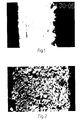
- a section of such a material is shown in the microphoto in Fig. 1, the said material being made and marketed by the Japanese firm "Kuraray Co. Ltd.”, 1-12-39 Umeda, Kita-ku, Oshaka 530 (Japan).
- a major drawback of known materials of the aforementioned type is that they are highly inflammable and therefore require the addition of fireproofing substances.
- the look, feel and consistency of the said materials is highly unsatisfactory and still far from competing with the appearance and consistency of real leather.
- the aim of the present invention is to provide a chemical process for treating porous synthetic sheet materials in such a manner as to render the appearance and consistency of the same identical to those of real leather, and also for enabling fireproofing of the same.
- the present invention relates to a process for producing artificial leather similar to real leather by chemically processing porous, synthetic sheet material, particularly of the type comprising a porous polyurethane matrix, the latter being embedded with fibres, and a pressed polyurethane resin cover film patterned to imitate real leather, characterised by the fact that the said procss comprises stages whereby:
- the present Applicant has discovered that, by subjecting porous, synthetic sheet material, imitating real leather, to a process closely resembling tanning, i.e. the process used for preventing real leather from rotting, the appearance and consistency of the said synthetic material were transformed to such an extent as to closely resemble real leather after tanning.
- tanning is known to have essentially no effect on the appearance and consistency of real leather, the purpose of the process being simply to attack and chemically transform the fibres of which the leather is formed, in such a manner as to prevent the latter from rotting, but without altering the structure on which the well-known properties of real leather depend.
- synthetic sheet materials known as "imitation leather"
- applying the said processes to the said synthetic sheet materials would be considered, not only pointless, but indeed educado-tanning” salt solutions, i.e.
- the said materials absorb and retain internally, in essentially stable manner, at least part of the tanning salt contained in the said salt solutions, in such a manner as to be changed drastically in appearance and consistency after processing; to be more precise, in such a manner as to acquire added consistency and the appearance and feel typical of real tanned leather.
- the said materials are less inflammable and may be subjected to any known type of specific dying process for the polymers of which the said sheet material so processed is formed, thus enabling, if conducted correctly, the production of a finished product extremely similar to real leather and of good appearance.
- the present Applicant has also surprisingly discovered that the flexibility of the said materials may be improved to such an extent as to be essentially equal to or only slightly inferior to that of real leather by treating the said materials, not only with the said pseudo-tanning salt solution and the said greasing oil, but also with a solution of water and at least one di- or polyaldehyde.
- the pseudo-tanning salt solution process must be conducted differently from the real leather tanning process, that is, by appropriately adjusting the pH level of the salt solution by adding a strong base, such as NaOH (sodium hydroxide) in place of the weak bases, such as sodium bicarbonate, usually employed in chromium tanning processes; the processing salts used being preferably trivalent metal sulphates and/or chlorides and/or bi-trivalent metal sulphates (i.e. metals, such as iron, capable of assuming various grades of oxidation).
- a strong base such as NaOH (sodium hydroxide)
- the weak bases such as sodium bicarbonate
- the porous, synthetic sheet material is collected and tied firmly into bales of such a size as to enable it to be loaded inside a rotary drum, e.g. of the type normally employed for tanning real leather.
- the bales of synthetic sheet material so formed are than placed inside the said drums which are than started up and the material chemically processed by feeding the various chemical solutions into the drum as it is turned.
- the porous synthetic sheet material is first subjected to a "soaking" process essentially consisting in treating the material for ten minutes to an hour at 50-60°C in a solution of water and surface-active substances.
- the rotary drum is filled with the first processing solution consisting in the said bi- and/or trivalent metal salt solution.
- the synthetic sheet material is treated in the said salt solution for about ten minutes to an hour, until the said solution permeates essentially the entire section of the material, after which, it is treated with a pseudo-tanning caustic soda solution for bringing the pH level up to about 7.
- the solution is brought up to a temperature of about 60°C and the pH level raised further, though never over 7.5, by precipitating part of the salt contained in the solution in the form of hydroxides, which precipitate in the solution essentially in the form of a gel.
- the sheet material in the said pseudo-tanning salt solution causes part of the pores on the said material to be fully saturated, during the precipitation stage, part of the hydroxides precipitate in gel form straight into the said pores which are thus filled with gel to produce a fairly noticeable increase in the weight and consistency of the sheet material so processed.
- the synthetic sheet material so processed is considerably less inflammable than in its original form.
- Dialdehyde processing of the material has been found to afford flexibility, as well as maintaining the superior properties acquired by the material in normal use.
- the material so processed is put through a number of further processes, the most important of which-greasing-has been found to be essential for obtaining the required results, i.e. for transforming the original synthetic material into one identical to real leather.
- the said greasing process conducted inside rotary drums, is identical to the real leather greasing process, except that use may be made indifferently of mineral oils or, preferably, higher fatty acid ester emulsion, preferably charged with sulphur, at a temperature of about 60°C for a few minutes to an hour.
- the said greasing process is particularly effective in that the esters and oils, which would not normally be retained by compact synthetic resins, are retained by the synthetic fibres and pores in the processed material in such a manner as to give the latter the characteristic appearance of real leather. Furthermore, the said oils and esters also improve fibre flow inside the porous matrix in such a manner as to give the processed material the characteristic consistency and feel of real leather. Further processes the material may be subjected to according to the process covered by the present invention include dyeing, .which is conducted in known manner, i.e. after washing the material in cold water; and fireproofing which, according to the present invention, is performed as described in the co-pending European Patent Application No.
- Such stiffening is overcome according to the present invention by combining the fireproofing/retarding solution treatment with a finish process whereby the sheet material is treated, again in a rotary drum, in a solution containing ordinary commercial softening substances, e.g. based on lauric acid salts.
- the said synthetic sheet material is treated in a fireproofing solution of Piroflam (registered trade mark) and then in a softening solution of Trianol SP (registered trade mark) to which is added, according to the present invention, a small percentage of Piroflam to prevent the ammonium and retarding salts absorbed by the material in the previous fireproofing process from being dissolved.
- the material is dried in hot air, after which, the bales are undone and the sheet material rolled up and sent off for finishing in exactly the same way as for real leather.
- the said finishing process is conducted in known manner and does not come within the scope of the present invention, no mention will be made of it herein.
- the present Applicant has discovered that the process according to the present invention enables the production of really good-quality artificial leather, practically identical to real leather, only when applied to a particular group of synthetic sheet materials or "imitation leather” comprising a porous polyurethane resin matrix, the latter embedded with polyester or polyethylene fibres, and a compact, pressed polyurethane resin cover film.
- the dyeing stage after greasing the material with esters charged with sulphur, is performed by treating the sheet material inside a rotary drum for at least two hours in a mixture of complex metal colouring substances specially devised for polyester fibres and polyurethane polymers, the said process being conducted in such a manner that the colouring substances adhere successively to the said sheet material.
- the process is conducted for about at least an hour at approximately 40°C, after which, the temperature is raised to about 60°C for the remainder of the dyeing stage.
- the material is then dried by means of forced hot-air ventilation at about 70°C inside the drum, preferably turning at a speed of 4-6 rpm.
- the sheet material employed is preferably 0.3 to 2 mm thick, depending on what it is to be used for, and, after processing according to the present invention, looks essentially as shown in the microphoto in Fig. 2.
- the two microphotos in Figs. 1 and 2 clearly show the difference in structure and appearance, even at microscope level, between the said material before (Fig. 1) and after (Fig. 2) processing according to the present invention.
- the latter therefore clearly provides for transforming relatively poor-quality "imitation leather” into very good-quality artificial leather with which to manufacture upholstery, shoes, clothing and similar of essentially the same appearance and quality as those made using real leather.
- the latter After loading the said material inside the drum, the latter was filled with 650 litres of water containing surface-active substances and the solution brought up to 60°C. After running the drum at a speed of 15 rpm for 20 minutes, the water and surface-active substance solution was drained off and the drum filled with 650 litres of solution containing 30% by weight of ferric sulphate, which was brought up to a pH level of 3.2 and a temperature of 60°C. After running the drum for about 40 minutes, the pH level was raised to 7.1, by adding NaOH 10 N, and the temperature to 60°C, in such a manner as to precipitate Fe(OH) 3 with abundant flocculation.
- the drum still turning, was filled with 650 litres of a solution of water and 6% by weight of aspartic aldehyde. After running the drum for 42 minutes, the said solution was drained off and the sheet material treated, with the drum still turning, for 45 minutes at 60°C in 650 litres of solution containing 30% by weight of sulphur-charged fatty acid esters having roughly 17 to 22 carbon atoms.
- the sheet material was dyed, still inside the turning drum, by treating it with a solution of water and 3% of Basacril (registered trade mark) for 55 minutes at 40°C, then for an hour at 60°c, after which, it was rinsed thoroughly. Finally, the material was treated, still inside the turning drum, with 252.5 litres of a solution of water and 60% by weight of Piroflam (registered trade mark) for 30 minutes, then with 56.25 litres of a solution of water and 30% by weight of Piroflam and 20% by weight of Trianol SP (registered trade mark) for 15 minutes. The material was then dried wth hot air at 60°C inside the drum turning at a speed of 6 rpm.
- Basacril registered trade mark
- Example I Twelve 10 mm strips of synthetic material as in Example I were treated in exactly the same way as in Example I, but using chromium sulphate in place of ferric sulphate. The resulting material presented an excellent consistency and feel and a satisfactory outward appearance as in Example I.
- Example II The materials used in Examples I and II were treated in the same way as in Example I, but using a salt solution of ferrous instead of ferric sulphate. The resulting material after processing was identical to that of
- Example I The material used in Example I was treated in exactly the same way as in Example I, but using glutaric instead of aspartic aldehyde. The resulting material presented a high degree of flexibility as well as a fairly good appearance.
- Example I After processing, the sheet material used in Example I was formed into twenty 20x20 cm test pieces and comparison-tested, together with corresponding test pieces of tanned calf leather of the same size, as to tensile, abrasion and bending resistance. The results are shown in Table I.
- Example II The sheet material used in Example I was formed, before and after processing, into 20x20 cm test pieces which were then combustion-tested as per standard Federation standards No. 302 (horizontal test piece). Four test pieces of processed material dyed different colours were comparison-tested with four pieces of unprocessed raw material. The results expressed in terms of combustion rate (mm/min) are shown in Table II.
- Example I The process described in Example I was applied to a starting sheet material consisting of a 0.8 mm thick, two-ply sheet of polyurethane foam covered with a compact polyurethane film, of the type normally used for upholstering vehicle sunshields.
Landscapes
- Chemical & Material Sciences (AREA)
- Chemical Kinetics & Catalysis (AREA)
- Dispersion Chemistry (AREA)
- Engineering & Computer Science (AREA)
- Textile Engineering (AREA)
- Synthetic Leather, Interior Materials Or Flexible Sheet Materials (AREA)
- Treatment And Processing Of Natural Fur Or Leather (AREA)
- Manufacture Of Porous Articles, And Recovery And Treatment Of Waste Products (AREA)
Claims (11)
Priority Applications (1)
| Application Number | Priority Date | Filing Date | Title |
|---|---|---|---|
| AT85106681T ATE48666T1 (de) | 1984-06-06 | 1985-05-30 | Verfahren zur herstellung von echtleder aehnlichem kunstleder durch chemische behandlung einer kunststoffolie. |
Applications Claiming Priority (2)
| Application Number | Priority Date | Filing Date | Title |
|---|---|---|---|
| IT6758584 | 1984-06-06 | ||
| IT67585/84A IT1178956B (it) | 1984-06-06 | 1984-06-06 | Procedimento per ottenere pellami sintetici simili a quelli naturali mediante trattamento chimico di materiali sintetici in foglio |
Publications (3)
| Publication Number | Publication Date |
|---|---|
| EP0164076A2 EP0164076A2 (fr) | 1985-12-11 |
| EP0164076A3 EP0164076A3 (en) | 1986-12-03 |
| EP0164076B1 true EP0164076B1 (fr) | 1989-12-13 |
Family
ID=11303639
Family Applications (1)
| Application Number | Title | Priority Date | Filing Date |
|---|---|---|---|
| EP85106681A Expired EP0164076B1 (fr) | 1984-06-06 | 1985-05-30 | Procédé de fabrication de cuir artificiel semblable à du cuir naturel par traitement chimique d'une feuille de matière synthétique |
Country Status (5)
| Country | Link |
|---|---|
| EP (1) | EP0164076B1 (fr) |
| JP (1) | JPS6141378A (fr) |
| AT (1) | ATE48666T1 (fr) |
| DE (1) | DE3574749D1 (fr) |
| IT (1) | IT1178956B (fr) |
Families Citing this family (7)
| Publication number | Priority date | Publication date | Assignee | Title |
|---|---|---|---|---|
| IT1211466B (it) * | 1987-06-19 | 1989-11-03 | Lorica Spa | Trattamento chimico di materiali procedimento perfezionato per sintetici in foglio ottenere pellami sintetici simili a quelli naturali mediante |
| JPH0686711B2 (ja) * | 1987-08-20 | 1994-11-02 | アキレス株式会社 | 合成皮革 |
| IT1245467B (it) * | 1991-03-19 | 1994-09-20 | Lorica Spa | Procedimento per ottenere un prodotto in foglio avente aspetto simile a quello della pelle naturale, a partire da una pelle sintetica realizzata in materiale composito |
| SM200500021A (it) * | 2005-09-09 | 2007-03-14 | Hoto S R L | Procedimento per il trattamento di materiale cellulosico per ottonere un prodotto simile alla pelle |
| IT1401571B1 (it) | 2010-08-20 | 2013-07-26 | Okinawa Srl | Procedimento per la produzione di un materiale simile alla pelle |
| CN109023981B (zh) * | 2018-10-25 | 2023-09-26 | 无锡市曼优丽新型复合材料有限公司 | 一种抗静电水性人造革 |
| CN111187780B (zh) * | 2020-03-12 | 2022-05-27 | 南京农业大学 | 水稻钾离子转运蛋白基因OsHAK18的基因工程应用 |
Family Cites Families (2)
| Publication number | Priority date | Publication date | Assignee | Title |
|---|---|---|---|---|
| US3526531A (en) * | 1966-12-01 | 1970-09-01 | Kanebo Ltd | Method for making microporous sheet material |
| DE2010332A1 (en) * | 1970-03-05 | 1971-09-16 | Stockhausen & Cie Chem Fab | Microporous polyurethane sheet with suede-like - surface |
-
1984
- 1984-06-06 IT IT67585/84A patent/IT1178956B/it active
-
1985
- 1985-05-30 DE DE8585106681T patent/DE3574749D1/de not_active Expired - Lifetime
- 1985-05-30 EP EP85106681A patent/EP0164076B1/fr not_active Expired
- 1985-05-30 AT AT85106681T patent/ATE48666T1/de not_active IP Right Cessation
- 1985-06-06 JP JP12238585A patent/JPS6141378A/ja active Granted
Also Published As
| Publication number | Publication date |
|---|---|
| EP0164076A2 (fr) | 1985-12-11 |
| IT1178956B (it) | 1987-09-16 |
| ATE48666T1 (de) | 1989-12-15 |
| EP0164076A3 (en) | 1986-12-03 |
| DE3574749D1 (de) | 1990-01-18 |
| IT8467585A1 (it) | 1985-12-06 |
| JPS6141378A (ja) | 1986-02-27 |
| JPH0555633B2 (fr) | 1993-08-17 |
| IT8467585A0 (it) | 1984-06-06 |
Similar Documents
| Publication | Publication Date | Title |
|---|---|---|
| DE3882319T2 (de) | Lederartiges Schichtprodukt und Verfahren zu dessen Herstellung. | |
| EP0164659B1 (fr) | Procédé pour ignifuger des feuilles de matières synthétiques poreuses, en particulier du cuir artificiel | |
| DE1444167B2 (fr) | ||
| EP0164076A2 (fr) | Procédé de fabrication de cuir artificiel semblable à du cuir naturel par traitement chimique d'une feuille de matière synthétique | |
| NO168487B (no) | Oppvaskmiddel for maskinbruk. | |
| DE1922308A1 (de) | Dreidimensionaler Gegenstand aus Kunststoffmaterial und Verfahren zu seiner Herstellung | |
| US4766014A (en) | Process for producing artificial leather similar to real leather by chemically processing synthetic sheet material | |
| DE1619264C3 (de) | Verfahren zur Herstellung von Lederersatzstoffen | |
| DE2310211B2 (de) | WUdlederartiges Gewebe und Verfahren zu dessen Herstellung | |
| DE1960992A1 (de) | Verfahren zur Herstellung eines Folienmaterials,insbesondere Kunstleder | |
| JP5460151B2 (ja) | 難燃性皮革 | |
| DE2053892A1 (fr) | ||
| US4941886A (en) | Process for obtaining a synthetic chamois leather similar to natural chamois | |
| DE3330031C2 (fr) | ||
| DE2120953A1 (fr) | ||
| DE1619240A1 (de) | Streichkunstleder | |
| DE601435C (de) | Verfahren zur Herstellung geformter Kunstmassen aus Viscoseschaum | |
| US4863479A (en) | Process for obtaining synthetic hides similar to natural hides by a chemical treatment of synthetic sheet material | |
| JPS60151387A (ja) | 人工皮革 | |
| KR20010083003A (ko) | 발포제를 이용하여 수지모를 형성하는 합성피혁의 제조방법 | |
| DE2036448A1 (de) | Polymerfolienmaterial und Verfahren zu seiner Herstellung | |
| JP2903154B2 (ja) | 合成皮革 | |
| US719787A (en) | Process of manufacturing artificial leather. | |
| CA1038184A (fr) | Methode de fabrication de materiaux de recouvrement, a partir de cuir, pour le revetement des matelassages et des coussins de mobilier, et materiaux de recouvrement ainsi obtenus | |
| JPH0693571A (ja) | 合成皮革の製造方法 |
Legal Events
| Date | Code | Title | Description |
|---|---|---|---|
| PUAI | Public reference made under article 153(3) epc to a published international application that has entered the european phase |
Free format text: ORIGINAL CODE: 0009012 |
|
| AK | Designated contracting states |
Designated state(s): AT BE CH DE FR GB LI LU NL SE |
|
| PUAL | Search report despatched |
Free format text: ORIGINAL CODE: 0009013 |
|
| AK | Designated contracting states |
Kind code of ref document: A3 Designated state(s): AT BE CH DE FR GB LI LU NL SE |
|
| 17P | Request for examination filed |
Effective date: 19870522 |
|
| RAP1 | Party data changed (applicant data changed or rights of an application transferred) |
Owner name: LORICA S.P.A. |
|
| 17Q | First examination report despatched |
Effective date: 19871230 |
|
| RAP3 | Party data changed (applicant data changed or rights of an application transferred) |
Owner name: LORICA S.P.A. |
|
| GRAA | (expected) grant |
Free format text: ORIGINAL CODE: 0009210 |
|
| AK | Designated contracting states |
Kind code of ref document: B1 Designated state(s): AT BE CH DE FR GB LI LU NL SE |
|
| REF | Corresponds to: |
Ref document number: 48666 Country of ref document: AT Date of ref document: 19891215 Kind code of ref document: T |
|
| ET | Fr: translation filed | ||
| REF | Corresponds to: |
Ref document number: 3574749 Country of ref document: DE Date of ref document: 19900118 |
|
| PLBE | No opposition filed within time limit |
Free format text: ORIGINAL CODE: 0009261 |
|
| STAA | Information on the status of an ep patent application or granted ep patent |
Free format text: STATUS: NO OPPOSITION FILED WITHIN TIME LIMIT |
|
| 26N | No opposition filed | ||
| EPTA | Lu: last paid annual fee | ||
| EAL | Se: european patent in force in sweden |
Ref document number: 85106681.1 |
|
| PGFP | Annual fee paid to national office [announced via postgrant information from national office to epo] |
Ref country code: GB Payment date: 19950526 Year of fee payment: 11 |
|
| PG25 | Lapsed in a contracting state [announced via postgrant information from national office to epo] |
Ref country code: GB Effective date: 19960530 |
|
| GBPC | Gb: european patent ceased through non-payment of renewal fee |
Effective date: 19960530 |
|
| PGFP | Annual fee paid to national office [announced via postgrant information from national office to epo] |
Ref country code: NL Payment date: 20040429 Year of fee payment: 20 Ref country code: LU Payment date: 20040429 Year of fee payment: 20 |
|
| PGFP | Annual fee paid to national office [announced via postgrant information from national office to epo] |
Ref country code: AT Payment date: 20040525 Year of fee payment: 20 |
|
| PGFP | Annual fee paid to national office [announced via postgrant information from national office to epo] |
Ref country code: FR Payment date: 20040527 Year of fee payment: 20 |
|
| PGFP | Annual fee paid to national office [announced via postgrant information from national office to epo] |
Ref country code: BE Payment date: 20040528 Year of fee payment: 20 |
|
| PGFP | Annual fee paid to national office [announced via postgrant information from national office to epo] |
Ref country code: DE Payment date: 20040729 Year of fee payment: 20 |
|
| PGFP | Annual fee paid to national office [announced via postgrant information from national office to epo] |
Ref country code: CH Payment date: 20040825 Year of fee payment: 20 |
|
| PGFP | Annual fee paid to national office [announced via postgrant information from national office to epo] |
Ref country code: SE Payment date: 20041020 Year of fee payment: 20 |
|
| PG25 | Lapsed in a contracting state [announced via postgrant information from national office to epo] |
Ref country code: NL Free format text: LAPSE BECAUSE OF EXPIRATION OF PROTECTION Effective date: 20050530 |
|
| BE20 | Be: patent expired |
Owner name: *LORICA S.P.A. Effective date: 20050530 |
|
| REG | Reference to a national code |
Ref country code: CH Ref legal event code: PL |
|
| EUG | Se: european patent has lapsed | ||
| NLV7 | Nl: ceased due to reaching the maximum lifetime of a patent |
Effective date: 20050530 |
|
| BE20 | Be: patent expired |
Owner name: *LORICA S.P.A. Effective date: 20050530 |