EP0164101A2 - Benzoylpropionic acid derivatives, their use and pharmaceutical compositions - Google Patents
Benzoylpropionic acid derivatives, their use and pharmaceutical compositions Download PDFInfo
- Publication number
- EP0164101A2 EP0164101A2 EP85106893A EP85106893A EP0164101A2 EP 0164101 A2 EP0164101 A2 EP 0164101A2 EP 85106893 A EP85106893 A EP 85106893A EP 85106893 A EP85106893 A EP 85106893A EP 0164101 A2 EP0164101 A2 EP 0164101A2
- Authority
- EP
- European Patent Office
- Prior art keywords
- group
- hydrogen atom
- lower alkyl
- acid derivatives
- benzoylpropionic acid
- Prior art date
- Legal status (The legal status is an assumption and is not a legal conclusion. Google has not performed a legal analysis and makes no representation as to the accuracy of the status listed.)
- Granted
Links
Classifications
-
- C—CHEMISTRY; METALLURGY
- C07—ORGANIC CHEMISTRY
- C07C—ACYCLIC OR CARBOCYCLIC COMPOUNDS
- C07C327/00—Thiocarboxylic acids
- C07C327/02—Monothiocarboxylic acids
- C07C327/04—Monothiocarboxylic acids having carbon atoms of thiocarboxyl groups bound to hydrogen atoms or to acyclic carbon atoms
-
- C—CHEMISTRY; METALLURGY
- C07—ORGANIC CHEMISTRY
- C07C—ACYCLIC OR CARBOCYCLIC COMPOUNDS
- C07C327/00—Thiocarboxylic acids
-
- A—HUMAN NECESSITIES
- A61—MEDICAL OR VETERINARY SCIENCE; HYGIENE
- A61P—SPECIFIC THERAPEUTIC ACTIVITY OF CHEMICAL COMPOUNDS OR MEDICINAL PREPARATIONS
- A61P37/00—Drugs for immunological or allergic disorders
Definitions
- the present invention relates to novel benzoylpropionic acid derivatives, and more particularly, it relates to 2-acylthiomethyl-3-benzoylpropionic acid derivatives which have immunomodulative function and are effective for treatment of diseases caused by abnormal immunofunction.
- the so-called immunosuppressors for treatment of autoimmune diseases such as chronic rheumatoid arthritis.
- the suppressive activity of the agents is mainly based on cytotoxicity. Accordingly, because of a strong side-effect depending on the above-mentioned cytotoxicity, these agents can not be said to be appropriate as therapeutical agents of autoimmune diseases which are required to be administered continuously for a long term.
- immunomodulators which have the effect to regulate the immune function, i.e., either stimulate the immune function when lowered, or suppress the immune function when augmented.
- these agents can not be said to be satisfactory in aspects of effect, side-effect and toxicity.
- An object of the present invention is to provide novel 2-acylthiomethyl-3-benzoylpropionic acid derivatives which have immunomodulative function and are effective for treatment of diseases caused by abnormal immunofunction and the process for producing them.
- the objective compound of the present-invention is a 2-acylthiomethyl-3-benzoylpropionic acid derivative (hereinafter referred to as Compound I) having the general formula (wherein R 1 represents a hydrogen atom, a lower alkyl group or a benzyl group, R 2 represents a lower alkyl group or a phenyl group, X represents a hydrogen atom, a halogen atom, a lower alkyl group, a lower alkoxy group, a phenoxy group or a halogenophenoxy group, and Y represents a hydrogen atom or a lower alkyl group).
- the halogen atom, herein, for X is a fluorine, chlorine or bromine atom
- the lower alkyl group for R 1 , R 2 , X and Y is a straight or branched chain alkyl group having up to 5 carbon atoms.
- the lower alkoxy group for X is one having up to 3 carbon atoms
- the halogenophenoxy group for X is a chlorophenoxy group, a bromophenoxy group and the like.
- the preferred objective compounds are the compounds of formula I wherein R is a hydrogen atom, R 2 is a methyl group, X is a hydrogen atom, a bromine atom or a methyl group and Y is a hydrogen atom or a methyl group.
- the compound I can be prepared, for example, by the following method.
- the compound II of the starting material may be prepared, for example, according to the method of R. E. Lutz et al [Journal of American Chemical Society, Vol. 75, page 5039 (1953)], or may be prepared by Friedel-Crafts reaction of a benzene derivative (hereinafter referred to as Compound III) represented by the general formula (wherein X and Y are as defined above) with itaconic anhydride according to the method similar to that described above.
- the compounds I have a good imunomodulative function, low side-effect and low toxicity, therefore they are useful therapeutical agents of the diseases caused by abnormal immunofunction, for example, rheumatoid arthritis, autoimmune diseases, cancer, bacterial infectious diseases, asthma and the like.
- the compound of the present invention may be administered orally or parenterally in a conventional dosage form such as tablets, capsules, powders, granules, syrup and injectional forms prepared according to conventional pharmaceutical practices.
- the effective dosage of the compound of the present invention depends on the age, weight or response of the patient. Generally, however, the daily dosage in adults may range from 0.1 to 3 g, preferably 0.3 to 1.5 g in single or divided doses.
- mice Female Sprague-Dawley rats, 8 weeks old, weighing 160-190 g were used per each group. Rats of each group were administered subcutaneously into the tail with a suspension of 0.6 mg of heated killed mycobaterium butyricum in liquid parafin. Each of the compounds I, suspended in a 5% gum arabic solution, was administered orally once a day to rats of different groups in different amounts after sensitization.
- Table 1 shows the results at 21 days after sensitization.
- mice Female Lewis rats, 9 weeks old, weighing 180-190 g were used per each group. Rats of each group were administered subcutaneously into the tail with a suspension of 0.6 mg of heated killed mycobaterium butyricum in liquid parafin. Each of the compounds I, suspended in a 5% gum arabic solution, was administered orally once a day to rats of different groups in an amounts of 100 mg/Kg after sensitization. As a comparative drug was used D-penicillamine in the form of an aqueous solution, which was administerd orally to rats of different groups in a manner similar to the compound I.
- Table 2 shows the results at 21 days after sensitization.
- the compounds I stimulate the adjuvant arthritis in Lewis rats and possess cellular immunostimulating activity as well as D-penicillamine.
- mice 8-12 weeks old, weighing 20-24 g were used per each group. Mice of each group were adminsitered subcutaneously into the right footpad with 1 x 10 8 sheep red blood cells as antigen to be sensitized.
- Each of the compounds I suspended in a 0.5% gum arabic saline solution, was administered intraperitoneally to mice of different groups in different amounts 2 hours after the sensitization.
- mice of each group were administered subcutaneously into the left footpad with 1 x 10 8 sheep red blood cells, and the increase of thickness of swelling footpad was measured for evaluating the suppression to the delayed-type footpad reaction according to the method of Lagrange et al [Journal of Experimental Medicine, vol. 139, page 528,(1974)].
- Rats were administered orally with a suspension of the compound I of Example 1 in a 5% gum arabic solution and observed for 7 days after administration, and the LD 50 value was calculated.
- the LD 50 value was excess of 1200 mg/kg.
- Referential Example 1 The present invention is concretely illustrated bellow by Referential Examples and Examples.
- Referential Example 1 Referential Example 1
Landscapes
- Chemical & Material Sciences (AREA)
- Organic Chemistry (AREA)
- Health & Medical Sciences (AREA)
- Nuclear Medicine, Radiotherapy & Molecular Imaging (AREA)
- Pharmacology & Pharmacy (AREA)
- Chemical Kinetics & Catalysis (AREA)
- General Chemical & Material Sciences (AREA)
- Medicinal Chemistry (AREA)
- Bioinformatics & Cheminformatics (AREA)
- Engineering & Computer Science (AREA)
- Immunology (AREA)
- Life Sciences & Earth Sciences (AREA)
- Animal Behavior & Ethology (AREA)
- General Health & Medical Sciences (AREA)
- Public Health (AREA)
- Veterinary Medicine (AREA)
- Organic Low-Molecular-Weight Compounds And Preparation Thereof (AREA)
- Acyclic And Carbocyclic Compounds In Medicinal Compositions (AREA)
- Pharmaceuticals Containing Other Organic And Inorganic Compounds (AREA)
Abstract

Description
- The present invention relates to novel benzoylpropionic acid derivatives, and more particularly, it relates to 2-acylthiomethyl-3-benzoylpropionic acid derivatives which have immunomodulative function and are effective for treatment of diseases caused by abnormal immunofunction.
- In the past, there have been used the so-called immunosuppressors for treatment of autoimmune diseases such as chronic rheumatoid arthritis. In general, however, the suppressive activity of the agents is mainly based on cytotoxicity. Accordingly, because of a strong side-effect depending on the above-mentioned cytotoxicity, these agents can not be said to be appropriate as therapeutical agents of autoimmune diseases which are required to be administered continuously for a long term.
- Further, in order to treat diseases related to immune, there have been recently used the so-called immunomodulators which have the effect to regulate the immune function, i.e., either stimulate the immune function when lowered, or suppress the immune function when augmented. However, even these agents can not be said to be satisfactory in aspects of effect, side-effect and toxicity.
- As a result of the earnest studies, the present inventors have found that certain 2-acylthiomethyl-3-benzoylpropionic acid derivatives have good immunomodulative function, weak side-effect and weak toxicity, and thus the present invention has been completed.
- An object of the present invention is to provide novel 2-acylthiomethyl-3-benzoylpropionic acid derivatives which have immunomodulative function and are effective for treatment of diseases caused by abnormal immunofunction and the process for producing them.
- Other objects and advantages of the present invention will be apparent from the following descriptions.
- The present invention is illustrated in detail hereunder.
- The objective compound of the present-invention is a 2-acylthiomethyl-3-benzoylpropionic acid derivative (hereinafter referred to as Compound I) having the general formula

- The halogen atom, herein, for X is a fluorine, chlorine or bromine atom, and the lower alkyl group for R 1, R 2, X and Y is a straight or branched chain alkyl group having up to 5 carbon atoms. The lower alkoxy group for X is one having up to 3 carbon atoms, and the halogenophenoxy group for X is a chlorophenoxy group, a bromophenoxy group and the like.
- The preferred objective compounds are the compounds of formula I wherein R is a hydrogen atom, R 2 is a methyl group, X is a hydrogen atom, a bromine atom or a methyl group and Y is a hydrogen atom or a methyl group.
- The compound I can be prepared, for example, by the following method.
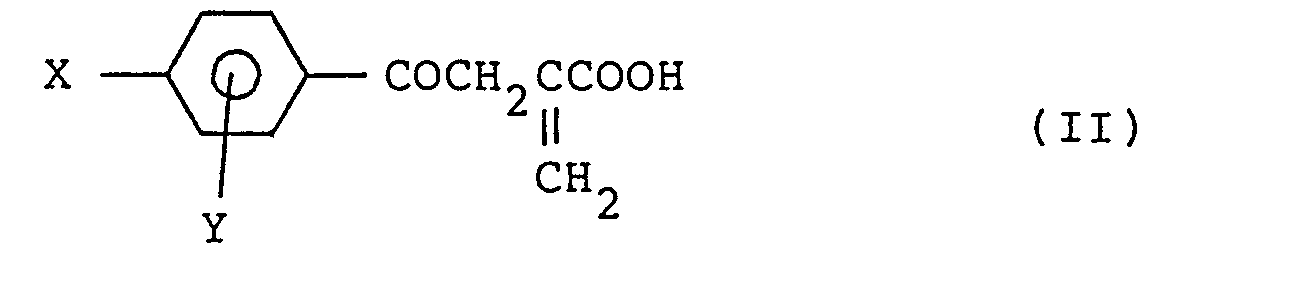
- (1) A carboxylic acid compound (hereinafter referred to as Compound II) represented by the general formula
- (2) The compound I of the carboxylic acid type as obtained in the item (1) is reacted with a conventional alkylating or benzylating agent having the alkyl or benzyl group for R of formula I (e.g., an alkyl halide, a dialkyl sulfate, benzyl halide and the like) in the presence of a base (e.g., sodium carbonate, potassium carbonate, lithium carbonate, sodium hydrogencabonate, potassium hydrogencarbonate, sodium hydroxide, potassium hydroxide, sodium hydride, a sodium alkoxide and the like) in an organic solvent (e.g., acetone, dimethylformamide, hexamethylphosphoric triamide, dimethyl sulfoxide and the like) to give the compound I of the ester type (the compound of formula I wherein R1 is a lower alkyl group or a benzyl group).
- The compound II of the starting material may be prepared, for example, according to the method of R. E. Lutz et al [Journal of American Chemical Society, Vol. 75, page 5039 (1953)], or may be prepared by Friedel-Crafts reaction of a benzene derivative (hereinafter referred to as Compound III) represented by the general formula

- The compounds I have a good imunomodulative function, low side-effect and low toxicity, therefore they are useful therapeutical agents of the diseases caused by abnormal immunofunction, for example, rheumatoid arthritis, autoimmune diseases, cancer, bacterial infectious diseases, asthma and the like. For the purposes, the compound of the present invention may be administered orally or parenterally in a conventional dosage form such as tablets, capsules, powders, granules, syrup and injectional forms prepared according to conventional pharmaceutical practices.
- The effective dosage of the compound of the present invention depends on the age, weight or response of the patient. Generally, however, the daily dosage in adults may range from 0.1 to 3 g, preferably 0.3 to 1.5 g in single or divided doses.
- The effect of the compound I is illustrated below by Experiments.
- 10 Female Sprague-Dawley rats, 8 weeks old, weighing 160-190 g were used per each group. Rats of each group were administered subcutaneously into the tail with a suspension of 0.6 mg of heated killed mycobaterium butyricum in liquid parafin. Each of the compounds I, suspended in a 5% gum arabic solution, was administered orally once a day to rats of different groups in different amounts after sensitization.
- At intervals were measured the edema volume of the hind paw of rats in the drug-treated groups and the control (drug-untreated groups) for evaluating tumor suppression activity of the compounds I.
- Table 1 shows the results at 21 days after sensitization.

- It is recognized from the above results that the compounds I suppress strongly the adjuvant arthritis in Sprague-Dawley rats and possess immunomodulative and antiarthritic activities
- 10 Female Lewis rats, 9 weeks old, weighing 180-190 g were used per each group. Rats of each group were administered subcutaneously into the tail with a suspension of 0.6 mg of heated killed mycobaterium butyricum in liquid parafin. Each of the compounds I, suspended in a 5% gum arabic solution, was administered orally once a day to rats of different groups in an amounts of 100 mg/Kg after sensitization. As a comparative drug was used D-penicillamine in the form of an aqueous solution, which was administerd orally to rats of different groups in a manner similar to the compound I.
- In intervals were measured the edema volume of the hind paw of rats in the drug-treated groups and the control (the drug-untreated groups) for evaluating the tumor stimulating activity of the drug.
- Table 2 shows the results at 21 days after sensitization.


- 8 Female Balb/c mice, 8-12 weeks old, weighing 20-24 g were used per each group. Mice of each group were adminsitered subcutaneously into the right footpad with 1 x 10⁸ sheep red blood cells as antigen to be sensitized.
- Each of the compounds I, suspended in a 0.5% gum arabic saline solution, was administered intraperitoneally to mice of different groups in different amounts 2 hours after the sensitization.
- Four days after the sensitization, mice of each group were administered subcutaneously into the left footpad with 1 x 10⁸ sheep red blood cells, and the increase of thickness of swelling footpad was measured for evaluating the suppression to the delayed-type footpad reaction according to the method of Lagrange et al [Journal of Experimental Medicine, vol. 139, page 528,(1974)].
- The results are shown in Table 3.

- It is recognized from the above results that the compounds I suppress the delayed-type footpad reaction and have the cellular immunomodulating effect. Experiment 4
- Mediums of RPMI-1640 (produced by GIBCO Co.) containing the compound I only (A medium), and containing a mitogen (lipopolysaccharide 0.2 pg/ml) and the compound I (B medium) were prepared.
- 2 x 10⁵ of spleen lymphocytes of female BDF1 mice, 8-12 weeks old, weighing 20-22 g were cultured on each of the mediums at 37°C for 48 hours under a 5% carbon dioxide in air. 0.25 µCi of 3 H- thymidine was added to each of the mediums, and cultivation was further carried out for 22 hours. After completion of the cultivation, the lymphocytes were collected and their radio activity was measured to calculate the 3 H-thymidine uptake into the lymphocytes for evaluating mitogenation.
- The results were expressed as percent to 3H-thymidine uptake into lymphocytes in the control medium (not containing the compound I) and shown in Table 4.

- It is recognized from the above results that the compounds I stimulate the mitogenation of spleen lymphocytes of mice by lipopolysaccharide and have immunomodulative simulating effect.
- 7 male, 7 weeks old, Wister rats weighing 149-160 g were used per each for test. Rats were administered orally with a suspension of the compound I of Example 1 in a 5% gum arabic solution and observed for 7 days after administration, and the LD50 value was calculated. The LD50 value was excess of 1200 mg/kg.
- The present invention is concretely illustrated bellow by Referential Examples and Examples. Referential Example 1
- In 150 ml of methylene chloride were dissolved 35.0 g of toluene and 22.4 g of itaconic anhydride. To this was added gradually 50.0 g of anhydrous aluminum chloride under ice-cooling with stirring, and then the mixture was stirred at room temperature for 5 hours for proceeding the reaction. After completion of the reaction, the reaction solution was concentrated under reduced pressure, poured into a mixture of 40 ml of conc. hydrochloric acid and 500 g of ice, and extracted with ethyl acetate. The extract was washed with water and dried over magnesium sulfate. The solvent was evaporated and the residue was recrystallized from a mixture of hexane and ethyl acetate to give 21.6 g of 3-(4-methylbenzoyl)-2-methylenepropionic acid (a compound of formula II wherein X is CH3 and Y is H) (yield: 53%)
m.p. 137 - 138°C - Following the procedure of Referential Example 1 using the corresponding compounds III, there were obtained the compounds of formula II wherein X is (CH3)2CH and Y is H (m.p. 144-146°C, yield: 51%), X is CH30 and Y is H (m.p. 138-140°C, yield: 44%), X is p-ClC6H4Q and Y is H (m.p. 144-145°C, yield: 44%), X is CH3 and Y is 2-CH3 (m.p. 108.5-109.5°C, yield: 12%) and X is CH3 and Y is 3-CH3 (m.p. 144-146°C, yield: 33%)
- To a solution of 19.0 g of 3-benzoyl-2-methylenepropionic acid in 30 ml of dimethylformamide was added 8.0 ml of thioacetic acid. 2.5 ml of a 30% aqueous potassium carbonate solution was added dropwise at room temperature over 30 minutes with stirring, and the mixture was stirred at room temperature for further 30 minutes for proceeding the reaction. After completion of the reaction, ice-water was added to the reaction solution, and the solution was neutrallized with dil. hydrochloric acid, and extracted with ethyl acetate. The organic layer was washed with water and dried over magnesium sulfate. The ethyl acetate was evaporated under reduced pressure, and the residue was purified by a silica gel column chromatography (Wako gel C-200, produced by Wako Junyaku Co., a mixture of hexane and chloroform as a developing solvent) and recrystallized from a mixture of hexane and ethyl acetate to give 24.5 g of 2-acethylthiomethyl-3-benzoylpropionic acid as crystals (yield: 92%).
m.p. 100 - 101°C - Elementary analysis for C13H14O4S Calcd. (%): C 58.63, H 5.30 Found (%): C 58.67, H 5.31
- Following the procedure of Example 1 using the corresponding compounds II, there were obtained the following compounds I.

- Following the procedure of Example 1 using 10 ml of thiopropionic acid in place of 8.0 ml of thioacetic acid, there was obtained 19.0 g (yield: 68%) of 3-benzoyl-2-propionylthiomethylpropionic acid as crystals.
m.p. 76 - 78°C Elementary analysis for C14H16C4S Calcd. (%): C 59.98, H 5.75 Found (%): C 60.21, H 5.69 - Following the procedure of Example 1 using 16.5 g of thiobenzoic acid in place of 8.0 ml of thioacetic acid, there was obtained 11.2 g (yield: 34%) of 3-benzoyl-2-benzoylthiomethylpropionic acid as crystals.
m.p. 110 - 111°C Elementary analysis for C18H16O4S Calcd. (%): C 65.84, H 4.91 Found (%): C 66.12, H 5.07 - Following the procedure of Example 1 using 26.9 g of 3-(4-bromobenzoyl)-2-methylenepropionic acid and 10 ml of thiopropionic acid in place of 19.0 g of 3-benzoyl-2-methylenepropionic acid and 8.0 ml of thioacetic acid, respectively, there was obtained 25.5 g (yield: 71%) of 3-(4-bromobenzoyl)-2-propionylthiomethylpropionic acid as crystals.
m.p. 122.5 - 123°C Elementary analysis for C14H15BrO4S Calcd. (%): C 46.81, H 4.21 Found (%): C 46.77, H 4.37 - Following the procedure of Example 14 using 16.5 g of thiobenzoic acid in place of 10 ml of thiopropionic acid, there was obtained 14.7 g (yield: 36%) of 3-(4-bromobenzoyl)-2-benzoylthiomethylpropionic acid as crystals.
m.p. 133 - 135°C Elementary analysis for C18H15BrO4S Calcd. (%): C 53.08, H 3.71 Found (%): C 53.11, H 3.87 - To a solution of 26.6 g of 2-acetylthiomethyl-3-benzoylpropionic acid in 200 ml of dimethylformamide were added 15.6 g of diethyl sulfate and 14.0 g of potassium carbonate, and the mixture was stirred at room temperature for 3 hours for proceeding the reaction.
- After completion of the reaction, ice-water was added to the reaction solution, and the mixture was extracted with diethyl ether. The organic layer was washed with water and dried over magnesium sulfate. The diethyl ether was evaporated under reduced pressure and the residue was purified by a silica gel column chromatography (Wako gel C-200 produced by Wako Junyaku Co.; a mixture of hexane and diethyl ether as a developing solvent) to give 22.1 g (yield: 75%) of ethyl 2-acethyl- thiomethyl-3-benzoylpropionate as a colorless oil.
NMR (CDC13), ppm 1.27 (3H, t, J = 7 Hz), 2.36 (3H, s), 3.12 - 3.60 (5H, m), 4.19 (2H, q, J = 7 Hz), 7.52 (3H, m), 7.98 (2H, d, J = 8 Hz) Elementary analysis for C15H18C4S Calcd. (%): C 61.20, H 6.16 Found (%): C 61.10, H 6.13 - Following the procedure of Example 16 using 34.5 g of 2-acetylthiomethyl-3-(4-bromobenzoyl)propionic acid and 12.8 g of dimethyl sulfate in place of 26.6 g of 2-acetylthiomethyl-3-benzoylpropionic acid and 15.6 g of diethyl sulfate, respectively, there was obtained 34.8 g (yield: 97%) of methyl 2-acethylthiomethyl-3-(4-bromobenzoyl)propionate as a colorless oil.
NMR (CDCl3), ppm 2.33 (3H, s), 3.07 - 3.56 (5H, m), 3.71 (3H, s), 7.62 (2H, d, J = 8 Hz) 7.82 (2H, - d, J = 8 Hz) Elementary analysis for C14H15BrO4S Calcd. (%): C 46.81, H 4.21 Found (%): C 46.53, H 4.16 - Following the procedure of Example 17 using 15.6 g of diethyl sulfate in place of 12.8 g of dimethyl sulfate, there was obtained 27.2 g (yield: 73%) of ethyl 2-acetylthiomethyl-3-(4-bromobenzoyl)propionate as a colorless oil.
NMR (CDC13), ppm 1.26 (3H, t, J = 7 Hz), 2.35 (3H, s), 3.06 - 3.54 (5H, m), 4.18 (2H, q, J = 7 Hz), 7.62 (2H, d, J = 8Hz), 7.83 (2H, d, J = 8 Hz) Elementary analysis for C15H17BrO4S Calcd. (%): C 48.27, H 4.59 Found (%): C 48.43, H 4.63 - Following the procedure of Example 17 using 34.0 g of 2-iodopropane in place of 12.8 g of dimethyl sulfate, there was obtained 30.2 g (yield: 78%) of isopropyl 2-acethylthiomethyl-3-(4-bromobenzoyl)-propionate as a colorless oil.
NMR (CDC13), ppm 1.25 (3H, d, J = 7 Hz), 1.27 (3H, d, J = 7 Hz), 2.34 (3H, s), 3.04 - 3.54 (5H, m), 5.03 (lH, heptet, J = 7 Hz), 7.63 (2H, d, J = 8 Hz), 7.84 (2H, d, J = 8 Hz) Elementary analysis for C16 H 19 Br0 4 S Calcd. (%): C '49.62, H 4.94 Found (%): C 49.65, H 4.94 - Following the procedure of Example 17 using 20.5 g of benzyl bromide in place of 12.8 g of dimethyl sulfate, there was obtained 37.0 g (yield: 85%) of benzyl 2-acetylthiomethyl-3-(4-bromobenzoyl)propionate.
m.p. 79 - 80°C (crystals recrystallized from a mixture of hexane and diethyl ether) Elementary analysis for C20H19BrO4S Calcd. (%): C 55.18, H 4.40 Found (%): C 55.19, H 4.58
Claims (8)

Applications Claiming Priority (2)
| Application Number | Priority Date | Filing Date | Title |
|---|---|---|---|
| JP59114887A JPS60258160A (en) | 1984-06-05 | 1984-06-05 | Benzoylpropionic acid derivatives |
| JP114887/84 | 1984-06-05 |
Publications (3)
| Publication Number | Publication Date |
|---|---|
| EP0164101A2 true EP0164101A2 (en) | 1985-12-11 |
| EP0164101A3 EP0164101A3 (en) | 1986-04-09 |
| EP0164101B1 EP0164101B1 (en) | 1988-09-07 |
Family
ID=14649144
Family Applications (1)
| Application Number | Title | Priority Date | Filing Date |
|---|---|---|---|
| EP85106893A Expired EP0164101B1 (en) | 1984-06-05 | 1985-06-04 | Benzoylpropionic acid derivatives, their use and pharmaceutical compositions |
Country Status (9)
| Country | Link |
|---|---|
| US (1) | US4600540A (en) |
| EP (1) | EP0164101B1 (en) |
| JP (1) | JPS60258160A (en) |
| KR (1) | KR910006634B1 (en) |
| AT (1) | AT389508B (en) |
| CA (1) | CA1240696A (en) |
| DE (1) | DE3564806D1 (en) |
| ES (1) | ES8603818A1 (en) |
| ZA (1) | ZA854126B (en) |
Families Citing this family (1)
| Publication number | Priority date | Publication date | Assignee | Title |
|---|---|---|---|---|
| KR102314436B1 (en) | 2021-01-27 | 2021-10-19 | (주)국전약품 | Process for Preparing Nafamostat Mesilate and Intermediate Thereof |
Family Cites Families (4)
| Publication number | Priority date | Publication date | Assignee | Title |
|---|---|---|---|---|
| US3598854A (en) * | 1968-10-31 | 1971-08-10 | Geigy Chem Corp | Alkylhydroxyphenylthioloalkanoates |
| US3821268A (en) * | 1970-05-05 | 1974-06-28 | Rorer Inc William H | Alpha-acylthio biphenylylacetic acids |
| JPS58150563A (en) * | 1982-03-04 | 1983-09-07 | Taisho Pharmaceut Co Ltd | 3-benzoyl-2-mercaptopropionic acid derivative |
| JPS6054356A (en) * | 1983-09-03 | 1985-03-28 | Taisho Pharmaceut Co Ltd | 3-benzoyl-2-mercaptopropionic acid derivative |
-
1984
- 1984-06-05 JP JP59114887A patent/JPS60258160A/en active Granted
-
1985
- 1985-05-30 ZA ZA854126A patent/ZA854126B/en unknown
- 1985-05-30 KR KR1019850003772A patent/KR910006634B1/en not_active Expired
- 1985-05-31 AT AT0166085A patent/AT389508B/en not_active IP Right Cessation
- 1985-06-04 US US06/741,127 patent/US4600540A/en not_active Expired - Lifetime
- 1985-06-04 CA CA000483104A patent/CA1240696A/en not_active Expired
- 1985-06-04 DE DE8585106893T patent/DE3564806D1/en not_active Expired
- 1985-06-04 EP EP85106893A patent/EP0164101B1/en not_active Expired
- 1985-06-04 ES ES543884A patent/ES8603818A1/en not_active Expired
Also Published As
| Publication number | Publication date |
|---|---|
| US4600540A (en) | 1986-07-15 |
| KR860000254A (en) | 1986-01-27 |
| EP0164101A3 (en) | 1986-04-09 |
| EP0164101B1 (en) | 1988-09-07 |
| JPS60258160A (en) | 1985-12-20 |
| KR910006634B1 (en) | 1991-08-29 |
| ES543884A0 (en) | 1986-01-01 |
| ATA166085A (en) | 1989-05-15 |
| AT389508B (en) | 1989-12-27 |
| CA1240696A (en) | 1988-08-16 |
| JPH0119383B2 (en) | 1989-04-11 |
| DE3564806D1 (en) | 1988-10-13 |
| ES8603818A1 (en) | 1986-01-01 |
| ZA854126B (en) | 1986-01-29 |
Similar Documents
| Publication | Publication Date | Title |
|---|---|---|
| US3635945A (en) | Trialkylphosphinegold complexes of 1-beta-d-glucopyranosides | |
| US3954852A (en) | Indenylacetic acid compounds | |
| PL171403B1 (en) | Method for the production of new 20-methyl-substituted vitamin D PL PL derivatives | |
| US3642785A (en) | Indenyl-3-aliphatic amines | |
| US4169103A (en) | Nonatetraenoic acid derivatives | |
| US4013690A (en) | Organic compounds | |
| US4057641A (en) | Method of treating inflammation with 2-(2,3-dihydro-2-isopropyl-4-oxo-4H-1-benzopyran-6-yl)propionic acid | |
| EP0058057B1 (en) | Method of producing quinone derivatives | |
| US4699925A (en) | Biphenylylpropionic acid derivative and pharmaceutical composition containing the same | |
| US4225527A (en) | Polyene compounds | |
| US4476056A (en) | Trifluoromethoxy analogs of aromatic retinoids | |
| EP0164101B1 (en) | Benzoylpropionic acid derivatives, their use and pharmaceutical compositions | |
| US4785018A (en) | Glycine derivatives | |
| KR100224330B1 (en) | N- 4,5-dihydroxy- and 4,5,8-trihydroxy-9,10-dihydro-9,10-dioxo-2-anthracene-yl)carbonyl)amino acids | |
| US4116972A (en) | Anti-inflammatory 1-oxo-isoindoline derivatives and processes for their preparation | |
| US4816472A (en) | Derivatives of 19,20-Bis-nor-prostanoic acid with antiulcer and anorectic activity, process for their preparation and pharmaceutical compositions thereof | |
| DE3884508T2 (en) | Cysteine derivatives with an expectorant effect. | |
| EP0124379B1 (en) | Hydroquinone derivatives and production thereof | |
| EP0185158B1 (en) | Diphenylmethylimine derivatives | |
| AU606111B2 (en) | Eicosatetraynoic acid amides and their application in pharmacy and in cosmetics | |
| EP0138349B1 (en) | 3-benzoyl-2-mercaptopropionic acid derivaties | |
| US4056634A (en) | Dimercaptoethyl ether sulfonium compounds and use as antiinflammatory and antirheumatic agents | |
| US4049829A (en) | Sulphur containing hydroxy aliphatic compounds | |
| KR910006987B1 (en) | Method for preparing aminoethyl imidazole | |
| KR910003339B1 (en) | Process for the preparation of 3-benzoyl-2-mercaptopropionic acid derivatives |
Legal Events
| Date | Code | Title | Description |
|---|---|---|---|
| PUAI | Public reference made under article 153(3) epc to a published international application that has entered the european phase |
Free format text: ORIGINAL CODE: 0009012 |
|
| AK | Designated contracting states |
Designated state(s): BE CH DE FR GB IT LI LU NL SE |
|
| PUAL | Search report despatched |
Free format text: ORIGINAL CODE: 0009013 |
|
| AK | Designated contracting states |
Kind code of ref document: A3 Designated state(s): BE CH DE FR GB IT LI LU NL SE |
|
| 17P | Request for examination filed |
Effective date: 19860801 |
|
| 17Q | First examination report despatched |
Effective date: 19870409 |
|
| GRAA | (expected) grant |
Free format text: ORIGINAL CODE: 0009210 |
|
| AK | Designated contracting states |
Kind code of ref document: B1 Designated state(s): BE CH DE FR GB IT LI LU NL SE |
|
| ITF | It: translation for a ep patent filed | ||
| REF | Corresponds to: |
Ref document number: 3564806 Country of ref document: DE Date of ref document: 19881013 |
|
| ET | Fr: translation filed | ||
| PLBE | No opposition filed within time limit |
Free format text: ORIGINAL CODE: 0009261 |
|
| STAA | Information on the status of an ep patent application or granted ep patent |
Free format text: STATUS: NO OPPOSITION FILED WITHIN TIME LIMIT |
|
| 26N | No opposition filed | ||
| ITTA | It: last paid annual fee | ||
| EPTA | Lu: last paid annual fee | ||
| EAL | Se: european patent in force in sweden |
Ref document number: 85106893.2 |
|
| PGFP | Annual fee paid to national office [announced via postgrant information from national office to epo] |
Ref country code: GB Payment date: 20000531 Year of fee payment: 16 |
|
| PGFP | Annual fee paid to national office [announced via postgrant information from national office to epo] |
Ref country code: DE Payment date: 20000605 Year of fee payment: 16 |
|
| PGFP | Annual fee paid to national office [announced via postgrant information from national office to epo] |
Ref country code: SE Payment date: 20000606 Year of fee payment: 16 |
|
| PGFP | Annual fee paid to national office [announced via postgrant information from national office to epo] |
Ref country code: LU Payment date: 20000609 Year of fee payment: 16 |
|
| PGFP | Annual fee paid to national office [announced via postgrant information from national office to epo] |
Ref country code: FR Payment date: 20000612 Year of fee payment: 16 |
|
| PGFP | Annual fee paid to national office [announced via postgrant information from national office to epo] |
Ref country code: CH Payment date: 20000613 Year of fee payment: 16 |
|
| PGFP | Annual fee paid to national office [announced via postgrant information from national office to epo] |
Ref country code: NL Payment date: 20000629 Year of fee payment: 16 |
|
| PGFP | Annual fee paid to national office [announced via postgrant information from national office to epo] |
Ref country code: BE Payment date: 20000814 Year of fee payment: 16 |
|
| PG25 | Lapsed in a contracting state [announced via postgrant information from national office to epo] |
Ref country code: LU Free format text: LAPSE BECAUSE OF NON-PAYMENT OF DUE FEES Effective date: 20010604 Ref country code: GB Free format text: LAPSE BECAUSE OF NON-PAYMENT OF DUE FEES Effective date: 20010604 |
|
| PG25 | Lapsed in a contracting state [announced via postgrant information from national office to epo] |
Ref country code: SE Free format text: LAPSE BECAUSE OF NON-PAYMENT OF DUE FEES Effective date: 20010605 |
|
| PG25 | Lapsed in a contracting state [announced via postgrant information from national office to epo] |
Ref country code: LI Free format text: LAPSE BECAUSE OF NON-PAYMENT OF DUE FEES Effective date: 20010630 Ref country code: CH Free format text: LAPSE BECAUSE OF NON-PAYMENT OF DUE FEES Effective date: 20010630 Ref country code: BE Free format text: LAPSE BECAUSE OF NON-PAYMENT OF DUE FEES Effective date: 20010630 |
|
| BERE | Be: lapsed |
Owner name: TAISHO PHARMACEUTICAL CO. LTD Effective date: 20010630 |
|
| PG25 | Lapsed in a contracting state [announced via postgrant information from national office to epo] |
Ref country code: NL Free format text: LAPSE BECAUSE OF NON-PAYMENT OF DUE FEES Effective date: 20020101 |
|
| GBPC | Gb: european patent ceased through non-payment of renewal fee |
Effective date: 20010604 |
|
| EUG | Se: european patent has lapsed |
Ref document number: 85106893.2 |
|
| REG | Reference to a national code |
Ref country code: CH Ref legal event code: PL |
|
| PG25 | Lapsed in a contracting state [announced via postgrant information from national office to epo] |
Ref country code: FR Free format text: LAPSE BECAUSE OF NON-PAYMENT OF DUE FEES Effective date: 20020228 |
|
| NLV4 | Nl: lapsed or anulled due to non-payment of the annual fee |
Effective date: 20020101 |
|
| PG25 | Lapsed in a contracting state [announced via postgrant information from national office to epo] |
Ref country code: DE Free format text: LAPSE BECAUSE OF NON-PAYMENT OF DUE FEES Effective date: 20020403 |