EP0164227A2 - Neoalkoxy organo-titanates and organo-zirconates useful as coupling and polymer processing agents - Google Patents
Neoalkoxy organo-titanates and organo-zirconates useful as coupling and polymer processing agents Download PDFInfo
- Publication number
- EP0164227A2 EP0164227A2 EP85303352A EP85303352A EP0164227A2 EP 0164227 A2 EP0164227 A2 EP 0164227A2 EP 85303352 A EP85303352 A EP 85303352A EP 85303352 A EP85303352 A EP 85303352A EP 0164227 A2 EP0164227 A2 EP 0164227A2
- Authority
- EP
- European Patent Office
- Prior art keywords
- neoalkoxy
- carbon atoms
- derivative
- organo
- titanium
- Prior art date
- Legal status (The legal status is an assumption and is not a legal conclusion. Google has not performed a legal analysis and makes no representation as to the accuracy of the status listed.)
- Granted
Links
- 230000008878 coupling Effects 0.000 title abstract description 4
- 238000010168 coupling process Methods 0.000 title abstract description 4
- 238000005859 coupling reaction Methods 0.000 title abstract description 4
- 238000010094 polymer processing Methods 0.000 title abstract description 3
- 150000001875 compounds Chemical class 0.000 claims abstract description 70
- -1 diester phosphate Chemical class 0.000 claims abstract description 43
- 239000000203 mixture Substances 0.000 claims abstract description 42
- RTAQQCXQSZGOHL-UHFFFAOYSA-N Titanium Chemical group [Ti] RTAQQCXQSZGOHL-UHFFFAOYSA-N 0.000 claims abstract description 28
- 125000004432 carbon atom Chemical group C* 0.000 claims abstract description 28
- 239000000463 material Substances 0.000 claims abstract description 27
- 239000010936 titanium Substances 0.000 claims abstract description 23
- 229910052719 titanium Inorganic materials 0.000 claims abstract description 22
- RTZKZFJDLAIYFH-UHFFFAOYSA-N ether Chemical group CCOCC RTZKZFJDLAIYFH-UHFFFAOYSA-N 0.000 claims abstract description 15
- 125000003118 aryl group Chemical group 0.000 claims abstract description 12
- 125000001033 ether group Chemical group 0.000 claims abstract description 12
- 125000000217 alkyl group Chemical group 0.000 claims abstract description 11
- 229910019142 PO4 Inorganic materials 0.000 claims abstract description 10
- 125000002877 alkyl aryl group Chemical group 0.000 claims abstract description 10
- 150000002367 halogens Chemical group 0.000 claims abstract description 9
- 238000000034 method Methods 0.000 claims abstract description 9
- 239000010452 phosphate Substances 0.000 claims abstract description 9
- 125000003342 alkenyl group Chemical group 0.000 claims abstract description 8
- 125000003710 aryl alkyl group Chemical group 0.000 claims abstract description 8
- 125000003178 carboxy group Chemical group [H]OC(*)=O 0.000 claims abstract description 8
- 229910052736 halogen Chemical group 0.000 claims abstract description 8
- QCWXUUIWCKQGHC-UHFFFAOYSA-N Zirconium Chemical group [Zr] QCWXUUIWCKQGHC-UHFFFAOYSA-N 0.000 claims abstract description 7
- 125000000304 alkynyl group Chemical group 0.000 claims abstract description 7
- 235000011180 diphosphates Nutrition 0.000 claims abstract description 7
- 125000000472 sulfonyl group Chemical group *S(*)(=O)=O 0.000 claims abstract description 7
- 229910052726 zirconium Chemical group 0.000 claims abstract description 7
- 229920000642 polymer Polymers 0.000 claims description 32
- 229920000728 polyester Polymers 0.000 claims description 26
- 238000013329 compounding Methods 0.000 claims description 6
- 239000004417 polycarbonate Substances 0.000 claims description 5
- 229920000515 polycarbonate Polymers 0.000 claims description 5
- 230000008569 process Effects 0.000 claims description 5
- 229920001169 thermoplastic Polymers 0.000 claims description 4
- 239000004416 thermosoftening plastic Substances 0.000 claims description 4
- 238000004519 manufacturing process Methods 0.000 claims description 2
- 150000001408 amides Chemical class 0.000 claims 1
- 239000003795 chemical substances by application Substances 0.000 abstract 1
- 239000000654 additive Substances 0.000 description 61
- 239000000047 product Substances 0.000 description 43
- 229920005989 resin Polymers 0.000 description 26
- 239000011347 resin Substances 0.000 description 26
- 230000000996 additive effect Effects 0.000 description 24
- 238000012360 testing method Methods 0.000 description 22
- 238000009472 formulation Methods 0.000 description 19
- 239000000945 filler Substances 0.000 description 16
- 230000000704 physical effect Effects 0.000 description 16
- 238000002347 injection Methods 0.000 description 15
- 239000007924 injection Substances 0.000 description 15
- 238000007792 addition Methods 0.000 description 14
- 238000002156 mixing Methods 0.000 description 14
- 230000000694 effects Effects 0.000 description 13
- 238000001125 extrusion Methods 0.000 description 13
- VYPSYNLAJGMNEJ-UHFFFAOYSA-N Silicium dioxide Chemical compound O=[Si]=O VYPSYNLAJGMNEJ-UHFFFAOYSA-N 0.000 description 12
- 239000002904 solvent Substances 0.000 description 12
- 238000006243 chemical reaction Methods 0.000 description 11
- 229920002635 polyurethane Polymers 0.000 description 11
- 239000004814 polyurethane Substances 0.000 description 11
- IJGRMHOSHXDMSA-UHFFFAOYSA-N Atomic nitrogen Chemical compound N#N IJGRMHOSHXDMSA-UHFFFAOYSA-N 0.000 description 10
- 229920000049 Carbon (fiber) Polymers 0.000 description 10
- 239000004917 carbon fiber Substances 0.000 description 10
- 239000007822 coupling agent Substances 0.000 description 10
- VTYYLEPIZMXCLO-UHFFFAOYSA-L Calcium carbonate Chemical compound [Ca+2].[O-]C([O-])=O VTYYLEPIZMXCLO-UHFFFAOYSA-L 0.000 description 9
- YXFVVABEGXRONW-UHFFFAOYSA-N Toluene Chemical compound CC1=CC=CC=C1 YXFVVABEGXRONW-UHFFFAOYSA-N 0.000 description 9
- 230000006872 improvement Effects 0.000 description 9
- 229910010272 inorganic material Inorganic materials 0.000 description 9
- 239000011147 inorganic material Substances 0.000 description 9
- 239000010445 mica Substances 0.000 description 9
- 229910052618 mica group Inorganic materials 0.000 description 9
- 229920001187 thermosetting polymer Polymers 0.000 description 8
- XLYOFNOQVPJJNP-UHFFFAOYSA-N water Substances O XLYOFNOQVPJJNP-UHFFFAOYSA-N 0.000 description 8
- 238000010521 absorption reaction Methods 0.000 description 7
- XECAHXYUAAWDEL-UHFFFAOYSA-N acrylonitrile butadiene styrene Chemical compound C=CC=C.C=CC#N.C=CC1=CC=CC=C1 XECAHXYUAAWDEL-UHFFFAOYSA-N 0.000 description 7
- 239000006229 carbon black Substances 0.000 description 7
- 239000003054 catalyst Substances 0.000 description 7
- 238000011156 evaluation Methods 0.000 description 7
- 238000001746 injection moulding Methods 0.000 description 7
- VNWKTOKETHGBQD-UHFFFAOYSA-N methane Chemical compound C VNWKTOKETHGBQD-UHFFFAOYSA-N 0.000 description 7
- 229920001778 nylon Polymers 0.000 description 7
- 229920001225 polyester resin Polymers 0.000 description 7
- 239000004645 polyester resin Substances 0.000 description 7
- JOYRKODLDBILNP-UHFFFAOYSA-N Ethyl urethane Chemical compound CCOC(N)=O JOYRKODLDBILNP-UHFFFAOYSA-N 0.000 description 6
- 239000004721 Polyphenylene oxide Substances 0.000 description 6
- 239000004676 acrylonitrile butadiene styrene Substances 0.000 description 6
- 229920000122 acrylonitrile butadiene styrene Polymers 0.000 description 6
- 239000004927 clay Substances 0.000 description 6
- 238000007906 compression Methods 0.000 description 6
- 230000006835 compression Effects 0.000 description 6
- 229910052757 nitrogen Inorganic materials 0.000 description 6
- 229920006380 polyphenylene oxide Polymers 0.000 description 6
- 229920001343 polytetrafluoroethylene Polymers 0.000 description 6
- 239000004810 polytetrafluoroethylene Substances 0.000 description 6
- 239000000377 silicon dioxide Substances 0.000 description 6
- DHKHKXVYLBGOIT-UHFFFAOYSA-N acetaldehyde Diethyl Acetal Natural products CCOC(C)OCC DHKHKXVYLBGOIT-UHFFFAOYSA-N 0.000 description 5
- 239000000853 adhesive Substances 0.000 description 5
- 125000003545 alkoxy group Chemical group 0.000 description 5
- 230000008901 benefit Effects 0.000 description 5
- 229910000019 calcium carbonate Inorganic materials 0.000 description 5
- 238000005266 casting Methods 0.000 description 5
- 239000011521 glass Substances 0.000 description 5
- 229910052500 inorganic mineral Inorganic materials 0.000 description 5
- 239000011707 mineral Substances 0.000 description 5
- 238000000465 moulding Methods 0.000 description 5
- 229920001707 polybutylene terephthalate Polymers 0.000 description 5
- WFUGQJXVXHBTEM-UHFFFAOYSA-N 2-hydroperoxy-2-(2-hydroperoxybutan-2-ylperoxy)butane Chemical compound CCC(C)(OO)OOC(C)(CC)OO WFUGQJXVXHBTEM-UHFFFAOYSA-N 0.000 description 4
- 238000005033 Fourier transform infrared spectroscopy Methods 0.000 description 4
- 239000004677 Nylon Substances 0.000 description 4
- 239000004743 Polypropylene Substances 0.000 description 4
- 239000004793 Polystyrene Substances 0.000 description 4
- GWEVSGVZZGPLCZ-UHFFFAOYSA-N Titan oxide Chemical compound O=[Ti]=O GWEVSGVZZGPLCZ-UHFFFAOYSA-N 0.000 description 4
- 230000001070 adhesive effect Effects 0.000 description 4
- RDOXTESZEPMUJZ-UHFFFAOYSA-N anisole Chemical compound COC1=CC=CC=C1 RDOXTESZEPMUJZ-UHFFFAOYSA-N 0.000 description 4
- 239000002131 composite material Substances 0.000 description 4
- 238000001816 cooling Methods 0.000 description 4
- 230000002708 enhancing effect Effects 0.000 description 4
- 238000010438 heat treatment Methods 0.000 description 4
- 230000002209 hydrophobic effect Effects 0.000 description 4
- 235000021317 phosphate Nutrition 0.000 description 4
- 229920002239 polyacrylonitrile Polymers 0.000 description 4
- 238000006116 polymerization reaction Methods 0.000 description 4
- 235000013824 polyphenols Nutrition 0.000 description 4
- 229920001155 polypropylene Polymers 0.000 description 4
- 229920002223 polystyrene Polymers 0.000 description 4
- 238000012545 processing Methods 0.000 description 4
- 239000000243 solution Substances 0.000 description 4
- 239000000126 substance Substances 0.000 description 4
- 229920002803 thermoplastic polyurethane Polymers 0.000 description 4
- XJDNKRIXUMDJCW-UHFFFAOYSA-J titanium tetrachloride Chemical compound Cl[Ti](Cl)(Cl)Cl XJDNKRIXUMDJCW-UHFFFAOYSA-J 0.000 description 4
- 239000001856 Ethyl cellulose Substances 0.000 description 3
- RYECOJGRJDOGPP-UHFFFAOYSA-N Ethylurea Chemical compound CCNC(N)=O RYECOJGRJDOGPP-UHFFFAOYSA-N 0.000 description 3
- 239000004696 Poly ether ether ketone Substances 0.000 description 3
- 150000001241 acetals Chemical class 0.000 description 3
- 230000009286 beneficial effect Effects 0.000 description 3
- 229910052799 carbon Inorganic materials 0.000 description 3
- 239000007795 chemical reaction product Substances 0.000 description 3
- 239000012141 concentrate Substances 0.000 description 3
- 238000000354 decomposition reaction Methods 0.000 description 3
- 235000019325 ethyl cellulose Nutrition 0.000 description 3
- 229920001249 ethyl cellulose Polymers 0.000 description 3
- 238000001704 evaporation Methods 0.000 description 3
- 239000007789 gas Substances 0.000 description 3
- 239000012948 isocyanate Substances 0.000 description 3
- 150000002513 isocyanates Chemical class 0.000 description 3
- 239000003446 ligand Substances 0.000 description 3
- 239000007788 liquid Substances 0.000 description 3
- 239000011368 organic material Substances 0.000 description 3
- NFHFRUOZVGFOOS-UHFFFAOYSA-N palladium;triphenylphosphane Chemical compound [Pd].C1=CC=CC=C1P(C=1C=CC=CC=1)C1=CC=CC=C1.C1=CC=CC=C1P(C=1C=CC=CC=1)C1=CC=CC=C1.C1=CC=CC=C1P(C=1C=CC=CC=1)C1=CC=CC=C1.C1=CC=CC=C1P(C=1C=CC=CC=1)C1=CC=CC=C1 NFHFRUOZVGFOOS-UHFFFAOYSA-N 0.000 description 3
- 239000002245 particle Substances 0.000 description 3
- 239000011236 particulate material Substances 0.000 description 3
- 239000008188 pellet Substances 0.000 description 3
- 229920003023 plastic Polymers 0.000 description 3
- 239000004033 plastic Substances 0.000 description 3
- 229920001748 polybutylene Polymers 0.000 description 3
- 229920002530 polyetherether ketone Polymers 0.000 description 3
- 229920000139 polyethylene terephthalate Polymers 0.000 description 3
- 239000004800 polyvinyl chloride Substances 0.000 description 3
- 229920000915 polyvinyl chloride Polymers 0.000 description 3
- 239000000843 powder Substances 0.000 description 3
- 239000002243 precursor Substances 0.000 description 3
- 238000002360 preparation method Methods 0.000 description 3
- 150000003254 radicals Chemical class 0.000 description 3
- 150000003839 salts Chemical class 0.000 description 3
- 150000004756 silanes Chemical class 0.000 description 3
- DBPWSSGDRRHUNT-CEGNMAFCSA-N 17α-hydroxyprogesterone Chemical compound C1CC2=CC(=O)CC[C@]2(C)[C@@H]2[C@@H]1[C@@H]1CC[C@@](C(=O)C)(O)[C@@]1(C)CC2 DBPWSSGDRRHUNT-CEGNMAFCSA-N 0.000 description 2
- 239000004342 Benzoyl peroxide Substances 0.000 description 2
- OMPJBNCRMGITSC-UHFFFAOYSA-N Benzoylperoxide Chemical compound C=1C=CC=CC=1C(=O)OOC(=O)C1=CC=CC=C1 OMPJBNCRMGITSC-UHFFFAOYSA-N 0.000 description 2
- 239000004801 Chlorinated PVC Substances 0.000 description 2
- 239000004641 Diallyl-phthalate Substances 0.000 description 2
- LFQSCWFLJHTTHZ-UHFFFAOYSA-N Ethanol Chemical compound CCO LFQSCWFLJHTTHZ-UHFFFAOYSA-N 0.000 description 2
- ZZSNKZQZMQGXPY-UHFFFAOYSA-N Ethyl cellulose Chemical compound CCOCC1OC(OC)C(OCC)C(OCC)C1OC1C(O)C(O)C(OC)C(CO)O1 ZZSNKZQZMQGXPY-UHFFFAOYSA-N 0.000 description 2
- VEXZGXHMUGYJMC-UHFFFAOYSA-N Hydrochloric acid Chemical compound Cl VEXZGXHMUGYJMC-UHFFFAOYSA-N 0.000 description 2
- XEEYBQQBJWHFJM-UHFFFAOYSA-N Iron Chemical compound [Fe] XEEYBQQBJWHFJM-UHFFFAOYSA-N 0.000 description 2
- LRHPLDYGYMQRHN-UHFFFAOYSA-N N-Butanol Chemical compound CCCCO LRHPLDYGYMQRHN-UHFFFAOYSA-N 0.000 description 2
- 239000004727 Noryl Substances 0.000 description 2
- 229920001207 Noryl Polymers 0.000 description 2
- 229920002292 Nylon 6 Polymers 0.000 description 2
- CTQNGGLPUBDAKN-UHFFFAOYSA-N O-Xylene Chemical compound CC1=CC=CC=C1C CTQNGGLPUBDAKN-UHFFFAOYSA-N 0.000 description 2
- 239000004952 Polyamide Substances 0.000 description 2
- 239000004698 Polyethylene Substances 0.000 description 2
- XUIMIQQOPSSXEZ-UHFFFAOYSA-N Silicon Chemical compound [Si] XUIMIQQOPSSXEZ-UHFFFAOYSA-N 0.000 description 2
- PPBRXRYQALVLMV-UHFFFAOYSA-N Styrene Chemical compound C=CC1=CC=CC=C1 PPBRXRYQALVLMV-UHFFFAOYSA-N 0.000 description 2
- 239000004433 Thermoplastic polyurethane Substances 0.000 description 2
- 239000000956 alloy Substances 0.000 description 2
- 229910045601 alloy Inorganic materials 0.000 description 2
- 229910052782 aluminium Inorganic materials 0.000 description 2
- XAGFODPZIPBFFR-UHFFFAOYSA-N aluminium Chemical compound [Al] XAGFODPZIPBFFR-UHFFFAOYSA-N 0.000 description 2
- 238000004458 analytical method Methods 0.000 description 2
- TZCXTZWJZNENPQ-UHFFFAOYSA-L barium sulfate Chemical compound [Ba+2].[O-]S([O-])(=O)=O TZCXTZWJZNENPQ-UHFFFAOYSA-L 0.000 description 2
- 235000019400 benzoyl peroxide Nutrition 0.000 description 2
- QUDWYFHPNIMBFC-UHFFFAOYSA-N bis(prop-2-enyl) benzene-1,2-dicarboxylate Chemical compound C=CCOC(=O)C1=CC=CC=C1C(=O)OCC=C QUDWYFHPNIMBFC-UHFFFAOYSA-N 0.000 description 2
- 229920000457 chlorinated polyvinyl chloride Polymers 0.000 description 2
- 235000008504 concentrate Nutrition 0.000 description 2
- 229920001577 copolymer Polymers 0.000 description 2
- 125000000113 cyclohexyl group Chemical group [H]C1([H])C([H])([H])C([H])([H])C([H])(*)C([H])([H])C1([H])[H] 0.000 description 2
- 239000006185 dispersion Substances 0.000 description 2
- 229920006351 engineering plastic Polymers 0.000 description 2
- 150000002148 esters Chemical class 0.000 description 2
- 230000008020 evaporation Effects 0.000 description 2
- 239000001257 hydrogen Substances 0.000 description 2
- 229910052739 hydrogen Inorganic materials 0.000 description 2
- 125000004435 hydrogen atom Chemical class [H]* 0.000 description 2
- IXCSERBJSXMMFS-UHFFFAOYSA-N hydrogen chloride Substances Cl.Cl IXCSERBJSXMMFS-UHFFFAOYSA-N 0.000 description 2
- 229910000041 hydrogen chloride Inorganic materials 0.000 description 2
- 238000011065 in-situ storage Methods 0.000 description 2
- 230000003993 interaction Effects 0.000 description 2
- 239000000155 melt Substances 0.000 description 2
- UZKWTJUDCOPSNM-UHFFFAOYSA-N methoxybenzene Substances CCCCOC=C UZKWTJUDCOPSNM-UHFFFAOYSA-N 0.000 description 2
- ISWSIDIOOBJBQZ-UHFFFAOYSA-N phenol group Chemical group C1(=CC=CC=C1)O ISWSIDIOOBJBQZ-UHFFFAOYSA-N 0.000 description 2
- NBIIXXVUZAFLBC-UHFFFAOYSA-K phosphate Chemical compound [O-]P([O-])([O-])=O NBIIXXVUZAFLBC-UHFFFAOYSA-K 0.000 description 2
- 229920002647 polyamide Polymers 0.000 description 2
- 239000005020 polyethylene terephthalate Substances 0.000 description 2
- 239000002952 polymeric resin Substances 0.000 description 2
- 229920005862 polyol Polymers 0.000 description 2
- 238000004382 potting Methods 0.000 description 2
- 238000010926 purge Methods 0.000 description 2
- 239000011541 reaction mixture Substances 0.000 description 2
- 229910052710 silicon Inorganic materials 0.000 description 2
- 239000010703 silicon Substances 0.000 description 2
- APSBXTVYXVQYAB-UHFFFAOYSA-M sodium docusate Chemical compound [Na+].CCCCC(CC)COC(=O)CC(S([O-])(=O)=O)C(=O)OCC(CC)CCCC APSBXTVYXVQYAB-UHFFFAOYSA-M 0.000 description 2
- 238000003797 solvolysis reaction Methods 0.000 description 2
- 230000003068 static effect Effects 0.000 description 2
- 238000003860 storage Methods 0.000 description 2
- 229920003048 styrene butadiene rubber Polymers 0.000 description 2
- 229920003002 synthetic resin Polymers 0.000 description 2
- 239000000454 talc Substances 0.000 description 2
- 229910052623 talc Inorganic materials 0.000 description 2
- 239000004408 titanium dioxide Substances 0.000 description 2
- 125000003944 tolyl group Chemical group 0.000 description 2
- 239000008096 xylene Substances 0.000 description 2
- RDJKTWADNPNJRX-UHFFFAOYSA-N (2,3-dioctylphenyl) phosphono hydrogen phosphate Chemical compound CCCCCCCCC1=CC=CC(OP(O)(=O)OP(O)(O)=O)=C1CCCCCCCC RDJKTWADNPNJRX-UHFFFAOYSA-N 0.000 description 1
- SYJPAKDNFZLSMV-HYXAFXHYSA-N (Z)-2-methylpropanal oxime Chemical compound CC(C)\C=N/O SYJPAKDNFZLSMV-HYXAFXHYSA-N 0.000 description 1
- XDOFQFKRPWOURC-UHFFFAOYSA-N 16-methylheptadecanoic acid Chemical compound CC(C)CCCCCCCCCCCCCCC(O)=O XDOFQFKRPWOURC-UHFFFAOYSA-N 0.000 description 1
- RNFJDJUURJAICM-UHFFFAOYSA-N 2,2,4,4,6,6-hexaphenoxy-1,3,5-triaza-2$l^{5},4$l^{5},6$l^{5}-triphosphacyclohexa-1,3,5-triene Chemical compound N=1P(OC=2C=CC=CC=2)(OC=2C=CC=CC=2)=NP(OC=2C=CC=CC=2)(OC=2C=CC=CC=2)=NP=1(OC=1C=CC=CC=1)OC1=CC=CC=C1 RNFJDJUURJAICM-UHFFFAOYSA-N 0.000 description 1
- QZQVUOIGCIXYDH-UHFFFAOYSA-N 2-methyl-2-phenylbutan-1-ol Chemical compound CCC(C)(CO)C1=CC=CC=C1 QZQVUOIGCIXYDH-UHFFFAOYSA-N 0.000 description 1
- PYSRRFNXTXNWCD-UHFFFAOYSA-N 3-(2-phenylethenyl)furan-2,5-dione Chemical compound O=C1OC(=O)C(C=CC=2C=CC=CC=2)=C1 PYSRRFNXTXNWCD-UHFFFAOYSA-N 0.000 description 1
- STABAPSYCQFWOK-UHFFFAOYSA-N 4-chlorobenzenecarboperoxoic acid Chemical compound OOC(=O)C1=CC=C(Cl)C=C1 STABAPSYCQFWOK-UHFFFAOYSA-N 0.000 description 1
- OMIHGPLIXGGMJB-UHFFFAOYSA-N 7-oxabicyclo[4.1.0]hepta-1,3,5-triene Chemical class C1=CC=C2OC2=C1 OMIHGPLIXGGMJB-UHFFFAOYSA-N 0.000 description 1
- JGLMVXWAHNTPRF-CMDGGOBGSA-N CCN1N=C(C)C=C1C(=O)NC1=NC2=CC(=CC(OC)=C2N1C\C=C\CN1C(NC(=O)C2=CC(C)=NN2CC)=NC2=CC(=CC(OCCCN3CCOCC3)=C12)C(N)=O)C(N)=O Chemical compound CCN1N=C(C)C=C1C(=O)NC1=NC2=CC(=CC(OC)=C2N1C\C=C\CN1C(NC(=O)C2=CC(C)=NN2CC)=NC2=CC(=CC(OCCCN3CCOCC3)=C12)C(N)=O)C(N)=O JGLMVXWAHNTPRF-CMDGGOBGSA-N 0.000 description 1
- OYPRJOBELJOOCE-UHFFFAOYSA-N Calcium Chemical compound [Ca] OYPRJOBELJOOCE-UHFFFAOYSA-N 0.000 description 1
- 229920006051 Capron® Polymers 0.000 description 1
- OKTJSMMVPCPJKN-UHFFFAOYSA-N Carbon Chemical compound [C] OKTJSMMVPCPJKN-UHFFFAOYSA-N 0.000 description 1
- 229920013683 Celanese Polymers 0.000 description 1
- 229920005123 Celcon® Polymers 0.000 description 1
- 239000004606 Fillers/Extenders Substances 0.000 description 1
- 229920006385 Geon Polymers 0.000 description 1
- 229920004546 Hetron™ Polymers 0.000 description 1
- 229920004142 LEXAN™ Polymers 0.000 description 1
- 239000004418 Lexan Substances 0.000 description 1
- 229920006382 Lustran Polymers 0.000 description 1
- FYYHWMGAXLPEAU-UHFFFAOYSA-N Magnesium Chemical compound [Mg] FYYHWMGAXLPEAU-UHFFFAOYSA-N 0.000 description 1
- 239000006057 Non-nutritive feed additive Substances 0.000 description 1
- 229930182556 Polyacetal Natural products 0.000 description 1
- 239000004734 Polyphenylene sulfide Substances 0.000 description 1
- 239000004614 Process Aid Substances 0.000 description 1
- BLRPTPMANUNPDV-UHFFFAOYSA-N Silane Chemical compound [SiH4] BLRPTPMANUNPDV-UHFFFAOYSA-N 0.000 description 1
- 229920000147 Styrene maleic anhydride Polymers 0.000 description 1
- 239000002174 Styrene-butadiene Substances 0.000 description 1
- NINIDFKCEFEMDL-UHFFFAOYSA-N Sulfur Chemical compound [S] NINIDFKCEFEMDL-UHFFFAOYSA-N 0.000 description 1
- 239000004809 Teflon Substances 0.000 description 1
- 229920006362 Teflon® Polymers 0.000 description 1
- 229920001074 Tenite Polymers 0.000 description 1
- 239000007983 Tris buffer Substances 0.000 description 1
- 229910052770 Uranium Inorganic materials 0.000 description 1
- HCHKCACWOHOZIP-UHFFFAOYSA-N Zinc Chemical compound [Zn] HCHKCACWOHOZIP-UHFFFAOYSA-N 0.000 description 1
- 125000002777 acetyl group Chemical group [H]C([H])([H])C(*)=O 0.000 description 1
- 230000002411 adverse Effects 0.000 description 1
- 230000032683 aging Effects 0.000 description 1
- 150000001298 alcohols Chemical class 0.000 description 1
- 125000002947 alkylene group Chemical group 0.000 description 1
- 150000004645 aluminates Chemical class 0.000 description 1
- 125000003277 amino group Chemical group 0.000 description 1
- 125000004103 aminoalkyl group Chemical group 0.000 description 1
- 239000003963 antioxidant agent Substances 0.000 description 1
- 230000003078 antioxidant effect Effects 0.000 description 1
- 125000004391 aryl sulfonyl group Chemical group 0.000 description 1
- 125000000732 arylene group Chemical group 0.000 description 1
- 239000010425 asbestos Substances 0.000 description 1
- 238000003556 assay Methods 0.000 description 1
- QVGXLLKOCUKJST-UHFFFAOYSA-N atomic oxygen Chemical compound [O] QVGXLLKOCUKJST-UHFFFAOYSA-N 0.000 description 1
- JUPQTSLXMOCDHR-UHFFFAOYSA-N benzene-1,4-diol;bis(4-fluorophenyl)methanone Chemical compound OC1=CC=C(O)C=C1.C1=CC(F)=CC=C1C(=O)C1=CC=C(F)C=C1 JUPQTSLXMOCDHR-UHFFFAOYSA-N 0.000 description 1
- 125000001797 benzyl group Chemical group [H]C1=C([H])C([H])=C(C([H])=C1[H])C([H])([H])* 0.000 description 1
- 238000009835 boiling Methods 0.000 description 1
- 229910052796 boron Inorganic materials 0.000 description 1
- 125000004799 bromophenyl group Chemical class 0.000 description 1
- MTAZNLWOLGHBHU-UHFFFAOYSA-N butadiene-styrene rubber Chemical compound C=CC=C.C=CC1=CC=CC=C1 MTAZNLWOLGHBHU-UHFFFAOYSA-N 0.000 description 1
- 229910052791 calcium Inorganic materials 0.000 description 1
- 239000011575 calcium Substances 0.000 description 1
- JJWKPURADFRFRB-UHFFFAOYSA-N carbonyl sulfide Chemical compound O=C=S JJWKPURADFRFRB-UHFFFAOYSA-N 0.000 description 1
- 150000007942 carboxylates Chemical class 0.000 description 1
- 230000015556 catabolic process Effects 0.000 description 1
- 230000003197 catalytic effect Effects 0.000 description 1
- 239000003518 caustics Substances 0.000 description 1
- 229910052570 clay Inorganic materials 0.000 description 1
- 239000003426 co-catalyst Substances 0.000 description 1
- 239000011248 coating agent Substances 0.000 description 1
- 238000000576 coating method Methods 0.000 description 1
- 239000010941 cobalt Substances 0.000 description 1
- 229910017052 cobalt Inorganic materials 0.000 description 1
- GUTLYIVDDKVIGB-UHFFFAOYSA-N cobalt atom Chemical compound [Co] GUTLYIVDDKVIGB-UHFFFAOYSA-N 0.000 description 1
- FJDJVBXSSLDNJB-LNTINUHCSA-N cobalt;(z)-4-hydroxypent-3-en-2-one Chemical compound [Co].C\C(O)=C\C(C)=O.C\C(O)=C\C(C)=O.C\C(O)=C\C(C)=O FJDJVBXSSLDNJB-LNTINUHCSA-N 0.000 description 1
- 230000000052 comparative effect Effects 0.000 description 1
- 238000000748 compression moulding Methods 0.000 description 1
- 238000009833 condensation Methods 0.000 description 1
- 230000005494 condensation Effects 0.000 description 1
- 239000011231 conductive filler Substances 0.000 description 1
- 230000001808 coupling effect Effects 0.000 description 1
- 125000000753 cycloalkyl group Chemical group 0.000 description 1
- 230000006378 damage Effects 0.000 description 1
- 230000007812 deficiency Effects 0.000 description 1
- 238000006731 degradation reaction Methods 0.000 description 1
- 230000001419 dependent effect Effects 0.000 description 1
- WBJBEMDHFMUSAY-UHFFFAOYSA-N dibutyl phosphono phosphate Chemical compound CCCCOP(=O)(OP(O)(O)=O)OCCCC WBJBEMDHFMUSAY-UHFFFAOYSA-N 0.000 description 1
- 230000003292 diminished effect Effects 0.000 description 1
- HTDKEJXHILZNPP-UHFFFAOYSA-N dioctyl hydrogen phosphate Chemical compound CCCCCCCCOP(O)(=O)OCCCCCCCC HTDKEJXHILZNPP-UHFFFAOYSA-N 0.000 description 1
- XPPKVPWEQAFLFU-UHFFFAOYSA-J diphosphate(4-) Chemical class [O-]P([O-])(=O)OP([O-])([O-])=O XPPKVPWEQAFLFU-UHFFFAOYSA-J 0.000 description 1
- 125000003438 dodecyl group Chemical group [H]C([H])([H])C([H])([H])C([H])([H])C([H])([H])C([H])([H])C([H])([H])C([H])([H])C([H])([H])C([H])([H])C([H])([H])C([H])([H])C([H])([H])* 0.000 description 1
- 229920001971 elastomer Polymers 0.000 description 1
- 238000000921 elemental analysis Methods 0.000 description 1
- 239000003623 enhancer Substances 0.000 description 1
- 239000003822 epoxy resin Substances 0.000 description 1
- JBKVHLHDHHXQEQ-UHFFFAOYSA-N epsilon-caprolactam Chemical compound O=C1CCCCCN1 JBKVHLHDHHXQEQ-UHFFFAOYSA-N 0.000 description 1
- 230000007717 exclusion Effects 0.000 description 1
- 238000002474 experimental method Methods 0.000 description 1
- 239000003063 flame retardant Substances 0.000 description 1
- 238000001030 gas--liquid chromatography Methods 0.000 description 1
- 125000003827 glycol group Chemical group 0.000 description 1
- 230000005484 gravity Effects 0.000 description 1
- LNEPOXFFQSENCJ-UHFFFAOYSA-N haloperidol Chemical compound C1CC(O)(C=2C=CC(Cl)=CC=2)CCN1CCCC(=O)C1=CC=C(F)C=C1 LNEPOXFFQSENCJ-UHFFFAOYSA-N 0.000 description 1
- 238000013038 hand mixing Methods 0.000 description 1
- 229920001903 high density polyethylene Polymers 0.000 description 1
- 238000004128 high performance liquid chromatography Methods 0.000 description 1
- 239000004700 high-density polyethylene Substances 0.000 description 1
- 229920001519 homopolymer Polymers 0.000 description 1
- 239000012943 hotmelt Substances 0.000 description 1
- 239000003112 inhibitor Substances 0.000 description 1
- 230000005764 inhibitory process Effects 0.000 description 1
- 239000001023 inorganic pigment Substances 0.000 description 1
- 229910052742 iron Inorganic materials 0.000 description 1
- UQSXHKLRYXJYBZ-UHFFFAOYSA-N iron oxide Inorganic materials [Fe]=O UQSXHKLRYXJYBZ-UHFFFAOYSA-N 0.000 description 1
- 235000013980 iron oxide Nutrition 0.000 description 1
- VBMVTYDPPZVILR-UHFFFAOYSA-N iron(2+);oxygen(2-) Chemical class [O-2].[Fe+2] VBMVTYDPPZVILR-UHFFFAOYSA-N 0.000 description 1
- 150000002576 ketones Chemical class 0.000 description 1
- 239000011133 lead Substances 0.000 description 1
- 239000007791 liquid phase Substances 0.000 description 1
- 238000011068 loading method Methods 0.000 description 1
- 229920001684 low density polyethylene Polymers 0.000 description 1
- 239000004702 low-density polyethylene Substances 0.000 description 1
- 229910052749 magnesium Inorganic materials 0.000 description 1
- 239000011777 magnesium Substances 0.000 description 1
- 239000004579 marble Substances 0.000 description 1
- 229910052751 metal Inorganic materials 0.000 description 1
- 239000002184 metal Substances 0.000 description 1
- 229910044991 metal oxide Inorganic materials 0.000 description 1
- 150000004706 metal oxides Chemical class 0.000 description 1
- 150000002739 metals Chemical class 0.000 description 1
- 125000005641 methacryl group Chemical group 0.000 description 1
- 125000005394 methallyl group Chemical group 0.000 description 1
- 125000002496 methyl group Chemical group [H]C([H])([H])* 0.000 description 1
- 125000005609 naphthenate group Chemical group 0.000 description 1
- 125000001624 naphthyl group Chemical group 0.000 description 1
- KPSSIOMAKSHJJG-UHFFFAOYSA-N neopentyl alcohol Chemical compound CC(C)(C)CO KPSSIOMAKSHJJG-UHFFFAOYSA-N 0.000 description 1
- 239000003921 oil Substances 0.000 description 1
- 150000007524 organic acids Chemical class 0.000 description 1
- 235000005985 organic acids Nutrition 0.000 description 1
- 239000012860 organic pigment Substances 0.000 description 1
- 229910052760 oxygen Inorganic materials 0.000 description 1
- 239000001301 oxygen Substances 0.000 description 1
- 239000003973 paint Substances 0.000 description 1
- 150000002978 peroxides Chemical class 0.000 description 1
- 125000000951 phenoxy group Chemical group [H]C1=C([H])C([H])=C(O*)C([H])=C1[H] 0.000 description 1
- 125000001997 phenyl group Chemical group [H]C1=C([H])C([H])=C(*)C([H])=C1[H] 0.000 description 1
- 125000003170 phenylsulfonyl group Chemical group C1(=CC=CC=C1)S(=O)(=O)* 0.000 description 1
- 239000004014 plasticizer Substances 0.000 description 1
- 229920002492 poly(sulfone) Polymers 0.000 description 1
- 229920006260 polyaryletherketone Polymers 0.000 description 1
- 229920005668 polycarbonate resin Polymers 0.000 description 1
- 239000004431 polycarbonate resin Substances 0.000 description 1
- 229920000647 polyepoxide Polymers 0.000 description 1
- 229920001601 polyetherimide Polymers 0.000 description 1
- 229920000573 polyethylene Polymers 0.000 description 1
- 150000003077 polyols Chemical class 0.000 description 1
- 229920006324 polyoxymethylene Polymers 0.000 description 1
- 229920000069 polyphenylene sulfide Polymers 0.000 description 1
- 239000012462 polypropylene substrate Substances 0.000 description 1
- 229920001296 polysiloxane Chemical class 0.000 description 1
- 230000008092 positive effect Effects 0.000 description 1
- 235000014483 powder concentrate Nutrition 0.000 description 1
- 125000002924 primary amino group Chemical group [H]N([H])* 0.000 description 1
- 125000001436 propyl group Chemical group [H]C([*])([H])C([H])([H])C([H])([H])[H] 0.000 description 1
- 238000011002 quantification Methods 0.000 description 1
- 230000008707 rearrangement Effects 0.000 description 1
- 230000009467 reduction Effects 0.000 description 1
- 239000012779 reinforcing material Substances 0.000 description 1
- 230000000979 retarding effect Effects 0.000 description 1
- 238000000518 rheometry Methods 0.000 description 1
- 229910052895 riebeckite Inorganic materials 0.000 description 1
- 239000005060 rubber Substances 0.000 description 1
- 238000005201 scrubbing Methods 0.000 description 1
- 230000035945 sensitivity Effects 0.000 description 1
- 238000007493 shaping process Methods 0.000 description 1
- 229910000077 silane Inorganic materials 0.000 description 1
- 239000007787 solid Substances 0.000 description 1
- 241000894007 species Species 0.000 description 1
- 238000005507 spraying Methods 0.000 description 1
- 230000006641 stabilisation Effects 0.000 description 1
- 238000011105 stabilization Methods 0.000 description 1
- 125000004079 stearyl group Chemical group [H]C([*])([H])C([H])([H])C([H])([H])C([H])([H])C([H])([H])C([H])([H])C([H])([H])C([H])([H])C([H])([H])C([H])([H])C([H])([H])C([H])([H])C([H])([H])C([H])([H])C([H])([H])C([H])([H])C([H])([H])C([H])([H])[H] 0.000 description 1
- 239000011115 styrene butadiene Substances 0.000 description 1
- 125000001424 substituent group Chemical group 0.000 description 1
- 238000006467 substitution reaction Methods 0.000 description 1
- 239000000758 substrate Substances 0.000 description 1
- 229910052717 sulfur Inorganic materials 0.000 description 1
- 239000011593 sulfur Substances 0.000 description 1
- 238000003419 tautomerization reaction Methods 0.000 description 1
- GJBRNHKUVLOCEB-UHFFFAOYSA-N tert-butyl benzenecarboperoxoate Chemical compound CC(C)(C)OOC(=O)C1=CC=CC=C1 GJBRNHKUVLOCEB-UHFFFAOYSA-N 0.000 description 1
- 125000005000 thioaryl group Chemical group 0.000 description 1
- 230000009974 thixotropic effect Effects 0.000 description 1
- 230000001988 toxicity Effects 0.000 description 1
- 231100000419 toxicity Toxicity 0.000 description 1
- 230000007704 transition Effects 0.000 description 1
- 238000007514 turning Methods 0.000 description 1
- 235000013799 ultramarine blue Nutrition 0.000 description 1
- 229920006305 unsaturated polyester Polymers 0.000 description 1
- 125000005023 xylyl group Chemical group 0.000 description 1
- 229910052725 zinc Inorganic materials 0.000 description 1
- 239000011701 zinc Substances 0.000 description 1
- NDKWCCLKSWNDBG-UHFFFAOYSA-N zinc;dioxido(dioxo)chromium Chemical compound [Zn+2].[O-][Cr]([O-])(=O)=O NDKWCCLKSWNDBG-UHFFFAOYSA-N 0.000 description 1
- 150000003755 zirconium compounds Chemical class 0.000 description 1
- DUNKXUFBGCUVQW-UHFFFAOYSA-J zirconium tetrachloride Chemical compound Cl[Zr](Cl)(Cl)Cl DUNKXUFBGCUVQW-UHFFFAOYSA-J 0.000 description 1
Classifications
-
- C—CHEMISTRY; METALLURGY
- C08—ORGANIC MACROMOLECULAR COMPOUNDS; THEIR PREPARATION OR CHEMICAL WORKING-UP; COMPOSITIONS BASED THEREON
- C08K—Use of inorganic or non-macromolecular organic substances as compounding ingredients
- C08K5/00—Use of organic ingredients
- C08K5/04—Oxygen-containing compounds
- C08K5/05—Alcohols; Metal alcoholates
-
- C—CHEMISTRY; METALLURGY
- C08—ORGANIC MACROMOLECULAR COMPOUNDS; THEIR PREPARATION OR CHEMICAL WORKING-UP; COMPOSITIONS BASED THEREON
- C08K—Use of inorganic or non-macromolecular organic substances as compounding ingredients
- C08K5/00—Use of organic ingredients
- C08K5/0091—Complexes with metal-heteroatom-bonds
-
- C—CHEMISTRY; METALLURGY
- C07—ORGANIC CHEMISTRY
- C07F—ACYCLIC, CARBOCYCLIC OR HETEROCYCLIC COMPOUNDS CONTAINING ELEMENTS OTHER THAN CARBON, HYDROGEN, HALOGEN, OXYGEN, NITROGEN, SULFUR, SELENIUM OR TELLURIUM
- C07F7/00—Compounds containing elements of Groups 4 or 14 of the Periodic Table
-
- C—CHEMISTRY; METALLURGY
- C07—ORGANIC CHEMISTRY
- C07F—ACYCLIC, CARBOCYCLIC OR HETEROCYCLIC COMPOUNDS CONTAINING ELEMENTS OTHER THAN CARBON, HYDROGEN, HALOGEN, OXYGEN, NITROGEN, SULFUR, SELENIUM OR TELLURIUM
- C07F7/00—Compounds containing elements of Groups 4 or 14 of the Periodic Table
- C07F7/003—Compounds containing elements of Groups 4 or 14 of the Periodic Table without C-Metal linkages
-
- C—CHEMISTRY; METALLURGY
- C07—ORGANIC CHEMISTRY
- C07F—ACYCLIC, CARBOCYCLIC OR HETEROCYCLIC COMPOUNDS CONTAINING ELEMENTS OTHER THAN CARBON, HYDROGEN, HALOGEN, OXYGEN, NITROGEN, SULFUR, SELENIUM OR TELLURIUM
- C07F9/00—Compounds containing elements of Groups 5 or 15 of the Periodic Table
- C07F9/02—Phosphorus compounds
- C07F9/06—Phosphorus compounds without P—C bonds
- C07F9/08—Esters of oxyacids of phosphorus
- C07F9/09—Esters of phosphoric acids
-
- C—CHEMISTRY; METALLURGY
- C07—ORGANIC CHEMISTRY
- C07F—ACYCLIC, CARBOCYCLIC OR HETEROCYCLIC COMPOUNDS CONTAINING ELEMENTS OTHER THAN CARBON, HYDROGEN, HALOGEN, OXYGEN, NITROGEN, SULFUR, SELENIUM OR TELLURIUM
- C07F9/00—Compounds containing elements of Groups 5 or 15 of the Periodic Table
- C07F9/02—Phosphorus compounds
- C07F9/06—Phosphorus compounds without P—C bonds
- C07F9/08—Esters of oxyacids of phosphorus
- C07F9/09—Esters of phosphoric acids
- C07F9/098—Esters of polyphosphoric acids or anhydrides
-
- C—CHEMISTRY; METALLURGY
- C08—ORGANIC MACROMOLECULAR COMPOUNDS; THEIR PREPARATION OR CHEMICAL WORKING-UP; COMPOSITIONS BASED THEREON
- C08F—MACROMOLECULAR COMPOUNDS OBTAINED BY REACTIONS ONLY INVOLVING CARBON-TO-CARBON UNSATURATED BONDS
- C08F8/00—Chemical modification by after-treatment
- C08F8/42—Introducing metal atoms or metal-containing groups
Definitions
- alkoxy titanates have exhibited poor performance because of their relatively low stability in the presence of certain solvents, particularly water at elevated temperatures. This drawback has made these organo-titanates ineffective for applications requiring long periods of storage stability in proton- containing solvents, such as alcohols and ketones and in ester plasticizers.
- neoalkoxy organo-titanates and organo-zirconates overcome both of the above-mentioned deficiencies and, in addition, enhance the performance of polymer matrices whether or not they contain particulate.
- This latter effect relates to the ability of these novel neoalkoxy organo-titanates and organo-zirconates to remain stable at elevated temperatures, i.e., over 200°C, for a sufficient period in processing equipment used to form high temperature polymers.
- This stability particularly in high shear systems, permits the interaction of the titanate or zirconate with the polymer during polymerization, so as to alter the rheological characteristics associated with such processing.
- neoalkoxy zirconates are particularly useful for peroxide-cured and air-cured systems, since they accelerate the polymerization reaction.
- the titanates because of their tendency to oxidize free radicals inhibit such polymerizations.
- the neoalkoxy zirconates most.unexpectedly provide a means of both coupling filler to the polymer and accelerating the polymerization.
- the neoalkoxy zirconates give polymer composites having most beneficial thixotropic properties; that is, such materials exhibit low viscosity under high shear and high viscosity under low shear. This is most beneficial since the low viscosity under high shear facilitates spraying and other applications of the polymeric material, while the high viscosity/low shear (as for example under storage conditions) prevents settling and enhances the shelf life of such polymers.
- a still further advantage of the organo-zirconates is their ability to maintain their coupling capability even in the presence of moisture. This is of substantial importance in the case of fiberglas-reinforced unsaturated polyesters. Silanes, on the other hand, cannot be used in such applications because of their adverse effect on processability. Isocyanates used as thixotropes in such applications suffered from the problems of toxicity and sensitivity to moisture.
- organo-zirconates are also outstanding in silicon resin applications, since they are most effective in bonding silicon resin to glass.
- the subject invention relates to novel neoalkoxy organo- titanium which may be represented by the formula: wherein M is titanium or zirconium, R, R 1 and R are each a monovalent alkyl, alkenyl, alkynyl, aralkyl, aryl or alkaryl group having up to 20 carbon atoms or a halogen or ether substituted derivative thereof, and, in addition, R 2 may also be an oxy derivative of said groups.
- the various R, R 1 and R 2 may each contain up to three ether oxygen or halogen substituents, provided the total number of carbon atoms for each such R group does not exceed 20, inclusive of the carbon atoms contained in substituent portions.
- A, B and C may be an aroxy (ArO-), thioaroxy (ArS-), diester phosphate ((R 3 O)(R 4 O)P(O)O-), diester pyrophosphate ((R 3 O)(R 4 O)P(O)OP(O)), oxyalkylamino (R S R 6 NR 7 O-), sulfonyl (ArS(0)20-) or carboxyl (RC(0)0-). Each group may contain up to 30 carbon atoms.
- Ar in the above formulas, may be a monovalent aryl or alkaryl group having from 6 to about 20 carbon atoms, optionally containing up to 3 ether oxygen substituents, and substituted derivatives thereof wherein the substitutions are up to a total of three halogens or amino groups having the formula NR 8 R 9 wherein R 8 and R 9 are each hydrogen, an alkyl group having 1 to 12 carbon atoms, an alkenyl group having from 2 to 8 carbon atoms, a cycloalkyl group having from 3 to 12 carbon atoms, and an aryl group having from 6 to 12 carbon atoms; and R 3 and R 4 may each be the same group as R, Rand Ar.
- Rand R 6 may be hydrogen, an alkyl or aminoalkyl group having from 1 to 15 carbon atoms and R may be an alkylene group having from 1 to 6 carbon atoms or an arylene group having from 6 to 10 carbon atoms or a combination thereof; and a + b + c is equal to 3.
- ligands may be used in the practice of this invention. The most suitable for a particular application will depend largely upon the polymer system employed and, to a lesser degree, upon the particular curative and/or extenders introduced into such system, if any.
- R, R 1 and R 2 groups are alkyl having 1 to 8 carbon atoms; aralkyl having 6 to 10 carbon atoms such as benzyl; the aryl and alkaryl groups having from 6 to 10 carbon atoms including phenyl, naphthyl, tolyl, xylyl; and the halogen-substituted bromophenyl; and the allyloxy-substituted alkyl having from 4 to 20 carbon atoms and the allyloxy-substituted aryl having from 9 to 20 carbon atoms.
- R 2 is an oxy derivative
- the most preferred compounds are the alkoxy derivatives having from 1 to 3 carbon atoms and the phenoxy group.
- R 3 and R 4 groups are alkyl groups having 1 to 12 carbon atoms, aryl and alkaryl groups having from 6 to 12 carbon atoms and ether-substituted alkyl having from 3 to 12 carbon atoms.
- R, R , R 2 , R 3 and R 4 groups are: methyl, propyl, cyclohexyl, 2,4-dimethoxybenzyl, I-methyl-4-ace- naphthyl-2-ethyl-2-furyl and methallyl.
- R in addition, may be methoxy, phenoxy, naphthenoxy, cyclohexene-3-oxy, 4-isobutyl-3-methoxy, 1-phenanthroxy and 2,4,6-trimethylphenoxy.
- A, B and C ligands useful in the practice of this invention are likewise numerous. These include aryl and thioaryl ligands such as phenoxy, 2,4-dimethyl-l-naphthoxy, 3-octyl-l-phenanthroxy and 3,5-diethyl-2-thioanthryl and 2-methyl-3-methoxy thiophenyl as well as diester phosphates such as dibutyl, methylphenyl, cyclohexyl, lauryl and bismethoxyethoxyethyl phosphate and their pyrophosphate analogs as well as aryl sulfonyl groups such as phenylsulfonyl, 2,4-dibutyl-l-naphthalene sulfonyl and 2-methyl-3-ethyl-4-phenanthryl sulfonyl.
- aryl and thioaryl ligands such as phenoxy, 2,4-
- carboxyl groups such as acetyl, methacryl, stearyl, 4-phenoxy and 4-phenoxy butyl.
- carboxyl groups such as acetyl, methacryl, stearyl, 4-phenoxy and 4-phenoxy butyl.
- the organo-titanates and organo-zirconates are useful as coupling agents because the alkoxy portion is a hydrophilic group capable of reacting with filler material and the A, B and C groups are hydrophobic and capable of reacting with organic material.
- a variety of processes can be used to prepare compositions of the invention. These are illustrated in Examples A through C.
- Example A In the first process, shown in Example A, one mole of an alcohol of the formula RR 1 R 2 CH 2 OH (the hydrophilic precursor) is reacted with 3 moles of a compound of the formula H(A) a (B) b (C) c (the hydrophobic precursor) and one mole of titanium or zirconium tetrachloride.
- the reaction may take place in the presence of a solvent such as xylene at temperature of from -20°C to 140°C. Hydrogen chloride gas is involved.
- Example B A second method which may be used is described specifically in Example B.
- a tetraalkoxy titanate or zirconate is substituted for the titanium tetrachloride.
- the reaction is carried out at a temperature of from 0°C to 200°C.
- four moles of alcohol, corresponding to the alkoxy groups on the titanium er zirconium compound, are evolved.
- one or more hydrophobic precursors may be used to form the neoalkoxy compound.
- the third method of the invention involves the admixture of two titanate or zirconate compounds, the first containing four neoalkoxy hydrophilic radicals and the second containing four hydrophobic radicals.
- a reaction product having the structure of the neoalkoxy compounds of the invention can be obtained.
- This procedure is generally carried out in the presence of a solvent such as toluene at a temperature of 0°C to 150°C.
- the instant invention also relates to compositions containing the neoalkoxy compounds and polymers, particulate material treated with the neoalkoxy compounds, and blends of polymers, particulate material and the neoalkoxy compounds.
- neoalkoxy compounds markedly affects the rheological properties of polymers and therefore makes these compounds useful as processing aids.
- the interaction between the external surfaces and the polymer can be measured by melt flow index.
- flow characteristics of the resin are particularly important during processing and shaping of the polymers, as for example by extrusion or injection molding.
- neoalkoxy compounds of the invention While a wide variety of polymers may be treated with the neoalkoxy compounds of the invention, the admixture thereof are particularly useful with engineering plastics, which are conventionally processed between 200° and 400°C.
- the organo-titanates of the prior art were not satisfactory in this application, because of their lack of stability. It should be understood, however, that the neoalkoxy compounds may also be blended with other resins such as PVC and used in paint and other coating applications, in the latter cases because of the solvent stability of these compounds.
- neoalkoxy compounds are added to the resin, preferably from 0.1 to 1.0%. If the amount of the neoalkoxy compound added is greater than that needed to affect the surface properties of the resin, the neoalkoxy compounds will have a plasticizing effect on the resin.
- neoalkoxy compounds added to the resins may be readily determined by those skilled in the art by consideration of the examples set forth herein and by simple experimentation. By so proceeding, the desired flow properties for a particular resin can be reasily achieved.
- Examples of the engineering plastics which may be admixed with neoalkoxy compounds include epoxy resins, fluorocarbons, modified phenylene oxides, nylons, polyethylene terephthalate, polybutylene terephthalate, phenolics, polyamides, polycarbonates, polyetheretherketones, polyaryletherketones, polyether imides, polyphenylene sulfides, polysulfones, polyarylsulfones, styrene, polyester copolymers, styrenics, such as, polystyreneacrylonitrile- butadiene-styrene, styrene-actylonitrile, styrene-butadiene, and styrene-maleic anhydride copolymers.
- neoalkoxy compounds also improve the dimensional stability of shaped resins. This is reflected by reduced water absorption in humid environments, and is amply demonstrated by the examples hereinafter set forth.
- Other positive effects in certain filled plastics include improved conductivity, a reflection of the improved dispersion of the conductive filler in the polymer; flame retardancy, a result of the exclusion of air from the interstices of the resin and better filler dispersion; less heat distortion; and catalytic effects. Data for all of these effects are given in the examples which follow.
- the solvent stability of the neoalkoxy compounds is also a marked advantage over the prior art.
- the prior art hydrolyzable groups reacted with many solvents, thereby destroying the efficacy of the organo-titanate as a coupling agent.
- solvents which quickly deactivated the prior art coupling agents are protonated solvents, such as hydroxylated polymers, vicinal glycols (both monomeric and polymeric), solvents which exhibit keto-enol tautomerism, organic acids, esters, isocyanates and carboxylates.
- the neoalkoxy compounds of the invention are substantially non-reactive at the processing temperatures of most polymeric materials.
- the resistance to protonated solvents accordingly, improves the shelf stability of polymeric compositions containing the neoalkoxy compounds. Rather than being useful for just minutes after blending with the resin, stability can now be extended for weeks. Actually, this is of substantial advantage in using the organo- titanates or organo-zirconates of the invention as coupling agents, rather than the conventional primary, secondary and tertiary alkoxy-type.
- the reaction product of the neoalkoxy compounds and fillers are a further embodiment of the instant invention. Generally speaking at least 0.01 part, preferably from 0.1 to 5 parts by weight of the neoalkoxy compound are used to treat each 100 parts of filler. Most preferable is the reaction of from 0.2 to 2 parts per 100 parts of filler.
- fillers may be treated; these include both organic and inorganic material. These materials may be particulate or fibrous and of varied shape or size, so long as the surfaces are reactive with the hydrolyzable groups of the organotitanium compound.
- inorganic reinforcing materials include metals, clay, carbon black, calcium carbonate, barium sulfate, silica, mica, glass and asbestos.
- Reactive inorganic materials include the metal oxides of zinc, magnesium, lead, and calcium and aluminum, iron filings and turnings, and sulfur.
- inorganic pigments include titanium dioxide, iron oxides, zinc chromate, ultramarine blues.
- Organic materials include carbon black, carbon fibers, nylon fibers, polytetrafluoroethylene, cellulosics and organic pigments.
- the particle size of the inorganic materials should not be greater than 1 mm, preferably from 0.1 micron to 500 micron.
- neoalkoxy compound be properly admixed with the inorganic material to permit the surface of the latter to react sufficiently.
- the optimum amount of the neoalkoxy compound to be used is dependent on the effect to be achieved, the available surface area of and the bonded water in the inorganic material.
- Reaction is facilitated by admixing under the proper conditions. Optimum results depend on the properties of the alkoxy compound, namely, whether it is a liquid or solid, and its decomposition and flash points. The particle size, the geometry of the particles, the specific gravity, the chemical composition, among other things, must be considered. Additionally, the treated inorganic material must be thoroughly admixed with the polymeric medium. The appropriate mixing conditions depend on the type of polymer, whether it is thermoplastic or thermosetting, its chemical structure, etc., as will be readily understood by those skilled in the art.
- the inorganic material may be admixed in any convenient type of intensive mixer, such as a Henschel or Hobart mixer or a Waring blender. Even hand mixing may be employed.
- intensive mixer such as a Henschel or Hobart mixer or a Waring blender.
- the optimum time and temperature are determined to obtain substantial reaction between the inorganic material and the organic metalate. Mixing is performed under conditions at which the organic metalate is in the liquid phase, at temperatures below the decomposition temperature. While it is desirable that the bulk of the hydrolyzable groups be reacted in this step, this is not essential where the materials are later admixed with a polymer, since the substantial completion of the reaction may take place in this latter mixing step.
- Polymer processing is generally performed at a temperature well above the second order transition temperature of the polymer, desirably at a temperature where the polymer will have a low melt viscosity.
- low density polyethylene is best processed at a temperature range of 170° to 230°C; high density polyethylene from 200° to 245°C; polystyrene from 230° to 260°C; polypropylene from 230° to 290°C; thermoplastic polyesters from 260° to 280°C; polyamides from 260° to 320°C and polycarbonates from 230 to 255°C.
- Temperatures for mixing other polymers are known to those skilled in the art and may be determined by reference to existing literature.
- a variety of mixing equipment may be used, e.g., two-roll mills, Banbury mixers, double concentric screws, counter or co-rotating twin screws and ZSK type of Werner and Pfaulder and Busse mixers.
- the organic metalate and the inorganic materials are dry-blended, thorough mixing and/or reaction is not readily achieved and the reaction may be substantially completed when the treated filler is admixed with the polymer.
- the organic metalate may also react with the polymeric material if one or more of the A groups is reactive with the polymer.
- the treated filler may be incorporated in any of the conventional polymeric materials, whether thermoplastic or thermosetting, whether rubber or plastic.
- the amount of filler depends on the particular polymeric material, the filler and property requirements of the finished product. Broadly, from 10 to 500 parts of filler may be used per 100 parts of polymer, preferably from 20 to 250 parts. The optimum amount may be readily determined by one skilled in the art with the assistance of the following dosage table:
- Examples 1 through show the preparation of various neoalkoxy compounds of the invention.
- Example 4 shows the relative solvolytic stability. The balance of the examples are directed towards the use of the neoalkoxy compounds in resins, showing both filled and unfilled resin systems:
- a reactor such as that described in Example 1 was charged with one mole of titanium IV tetrabutoxide. Temperature was adjusted to 50°C and maintained between 50°C and 70°C by external heating and cooling and reactor pressure held at 10 mm of Hg. during the addition, sequentially, of one mole of 2-methyl-2- phenylbutanol (20 minutes), two moles of dibutyl pyrophosphate (1 hour, 5 minutes), and one mole of dioctylphenyl pyrophosphate (1 hour, 45 minutes).
- titanium IV tetrakis (2-allyloxymethyl, 2-propanolato methyl-1-)butanolato was added over a period of two hours to 3 moles of titanium IV tetrakis (dioctyl)pyrophosphato-O contained in 1 liter of toluene.
- the reaction mixture was agitated and maintained at 75 ⁇ 5°C during the addition and for 24 hours after by external heating and cooling.
- Examples Nos. 4 through 30 demonstrate the surprising superiority of the products of the instant invention as compared to their heretofore known analogs.
- the following codes are used to designate analogs of the neoalkoxy titanates for comparative purposes:
- the products of the instant invention provide substantially greater tensile, elongation and conductivity enhancement as compared to the prior art.
- the compounding process consisted of separate meter feed each of 40.0 wt. % talc (Mistron Vapor-Cyprus Mines), 59.8 wt. % ABS (Taitalc Chemical Co.) and 0.2 wt. % of a 65 wt. % active additive on a silica powder concentrate to the throat of a 28:1 WP ZSK extruder using a graduated 210 to 240°C extrusion profile. Test specimens were injection molded at 230°C. The results are shown in Table 7:
- Liquid additive (0.2 wt. %) was added to 60X mica (Suzerite-Martin Marietta Corp.) filled resin (Uralite 3167 - Hexcel) and admixed thoroughly by means of a static mixer and gear pump just prior to ambient casting. The resultant sheets were die cut for testing. The results are shown in Table 8:
- Formulations were prepared by batch tumble blending of the appropriate proportions of PBT (Gafite 1600A, GAF Corp.) and mica (Suzerite-Martin Marietta) together with 0.3 wt. % of additive by weight of mica content in a doublt cone type blender prior to extrusion in a 24:1 NRM two stage vented extruder at approximately 250 ⁇ 10°C with a virtually flat temperature profile.
- Test samples were injection molded at 240°C and annealed for 48 hrs. at 100°C prior to test. Results are given in Table 10:.
- additives of the instant invention improved the elongation, water absorption inhibition, impact resistance and electrical conductivity while those properties were generally negatively effected by inclusion of prior art analog additives.
- Polypropylene (Elex PTL 220, Solvey) filled with various types of particulate the amounts shown in Tables 13A to 13D and 0.3 wt. % of additives. These were extruded at temperatures of 230-260°C and test samples were compression molded at 250°C. The results are given in Tables 13A to 13D.
- Samples of 50X clay (Icecap K, Burgess Corp.) filled Nylon 6 (Capron 8202, Allied Corp.) were prepared by meter feeding simultaneously clay, nylon and additive (at 0.2 wt. % on mix) as a 65% concentrate on silica, to the throat of a 32:1 twin screw extruder, operating at 250-265°C. Test samples were injection molded at 250°C. Results are given in Table 19:
- Table 22 clearly shows the enhanced performance of the products of the instant invention as compared to prior art with respect to compressive strength and impact property enhancement when employed as low level additive in nylon filled phenolic molding compound.
- Liquid additives were independently fed at the throat of an extruder as a dryblend on the modified polyphenylene oxide (Noryl 731--General Electric Co.), and 20% carbon black (Vulcan P--Cabot Corp.) was fed downstream to the polymer melt in a three stage 10 barrel Berstoff extruder having a 270-300°C profile.
- the test samples which contained 0.3 wt. % of additive based on total formulation were injection molded at 285°C. Results of these evaluations are given in Table 23:
- Test samples containing 30% PAN carbon fiber were produced by feeding a dryblend of polystyrene (Cosden 550) resin and additive (0.3 wt. %) to the throat of a twin screw (W&P-12 barrel) extruder and feeding carbon fiber downstream to the melt (extrusion at 210-240°C) followed by injection molding the extrudate at 230°C. Results are given in Table 25:
- Additive (0.2 wt. %) coated polycarbonate resin (Lexan EM-- General Electric Co.) was fed at the throat of a three stage, 10 barrel Berstoff extruder and 15 wt. % (based on final compound) of mica (Suzerite--Martin Marietta Corp.) was fed downstream to the melt via a crammer feeder. The extrusion was performed at 300- 330°C and the extrudate injection molded at 320°C to produce test specimens. Results are given in Table 26.
- Blends of 50 parts of polyethylene terphthalate (Tenite 6857--Eastman), 48 parts of polybutylene terphthalate (Gafite 1600-A-- GAF), 2 parts of titanium dioxide (R-901--Dupont), and 0.12 parts of the specified additive were extruded in a single stage 24:1, L:D Prodox extruder at 275-305°C followed by injection molding of physical test specimens at 300°C in a ram type molding unit.
- a control test specimen was also prepared by melt blending in a nitrogen blanketed autoclave. The results of these evaluations are given in Table 27:
- thermoset polyurethane Pellethane CPR 135-50D--Upjohn
- Casting was accomplished by dissolving the resin in anisole at ambient temperature to produce a 20% solution containing 0.5% additive followed by solvent evaporating (after appropriate aging) in vacuo at 80°C to produce castings from which test samples were die cut for evaluation. Results are given in Table 29A and 29B, respectively:
- thermoplastic urethane extrusion profiles The addition of 0.3% neoalkoxy compounds on the physical properties of thermoplastic urethane extrusion profiles is shown in the following table.
- This example shows the effect of 0.2 % neoalkoxy titanates and neoalkoxy zirconates on the physical properties of RIM molded polyurethane (Texaco RIM TEX 140).
- formulations containing 70 parts by weight of polyester resin S-600 Silmar Corp.
- 30 parts of 1 mm milled bare glass Owens Illinois
- 0.5 part of a catalyst consisting of benzoyl peroxide and 200 ppm of cobalt acetylacetonate 0.14 part of the additives shown in the table below were cured for 10 minutes at 150°C and post-cured for 2 hours at 100°C.
- the properties of the cured formulations are shown below.
- the use of silane additives is also illustrated.
- the additives of the invention improve certain of the physical properties of the cured formulations and in most instances improve the flame-resistance of the material.
- the neoalkoxy zirconate compounds are particularly effective in improving the tensile strength, the flexural strength, and the compressive strength of the polyester.
- the silanes of the prior art do not improve the flame-resistance of the material and were considerably less effective in improving the physical properties of the polyester.
- Formulations containing 70 parts by weight of a polyester resin (Stypol 40-3904, Freeman Chemical); 30 parts of chopped bare glass; 0.5 part of a catalyst comprising methylethyl ketone peroxide and 100 ppm of cobalt (naphthenate); and 0.14 part of the additives shown below were cured at ambient temperature and post-cured for 2 hours at 120°C. The results obtained are shown in the table below.
- Formulations were prepared containing 30 parts by weight of a synthetic marble mix polyester resin (Stypol 40-5727, Freeman Chemical); 70 parts of calcium carbonate in the form of ground marble dust (Micro White 50, Sylacauga); 0.5 part of a catalyst comprising methylethyl ketone peroxide; and 0.2 part of the additives shown below, added to the resin prior to the addition of the marble dust.
- the compositions were cured at ambient temperature and their physical properties measured. The results are shown in the following table:
- neoalkoxy titanates tend to retard the cure of the polyester, while the neoalkoxy zirconates function as accelerators.
- the additives of the invention improve the tensile strength and the compressive strength of the formulations in most instances.
- Formulations containing 100 parts by weight of polyester resin Hetron 700C, Ashland Chemical Co.
- 0.5 part of methylethyl ketone peroxide catalyst; and 0.4 part of the additives shown in the table below were cured at ambient temperature.
- the gel and cure times and the physical properties of the cured formulations are shown in the table below.
- Formulations containing 100 pacts by weight of a polyester resin (Armco 8057 SMC 70% carbon); 0.5 part of p-chloro-perbenzoate catalyst; and 0.4 part of the additives shown in the table below were cured for 1 minute at 200°C and thereafter cured for 8 hours at 150°C.
- the table below shows the physical properties of the cured material.
- neoalkoxy compounds of the invention improve the flexural strength and notched Izod of the cured composition. Improvements are also shown in selective additives, particularly for the zirconates, in the tensile strength and HTD value.
- formulations were prepared containing 100 parts by weight of a premix glass-carbon static dissipating BMC polyester potting compond (Premi-Glas BMC-ESD); 0.5 part of t-butyl perbenzoate catalyst; and 0.2 part of the additives shown in the following table.
- the formulations were cured for 35 sec. at 220°C and post-cured for 4 hours at 150°C.
- the following table shows the physical and electrical properties of the cured formulations.
- formulations were prepared from 100 parts by weight of a BMC polyester resin (Dielectrite 44-1 BMC, Industrial Dielectric), 1 part of benzoyl peroxide catalyst, and 0.3 part of the additives shown below.
- the formulations were cured for 10 minutes at 180°C and post-cured for 2 hours at 150°C.
- the physical and electrical properties of the cured compositions are shown in the table below.
- compositions containing 100 parts by weight of polyester resin (Aropol 7362, Ashland), 0.5 part of methylethyl ketone peroxide, and 0.2 part of the additives shown below were cured at ambient temperature and post-cured for 24 hours at 50°C.
- the table below shows the physical properties of the cured material.
Landscapes
- Chemical & Material Sciences (AREA)
- Organic Chemistry (AREA)
- Health & Medical Sciences (AREA)
- Polymers & Plastics (AREA)
- Medicinal Chemistry (AREA)
- Chemical Kinetics & Catalysis (AREA)
- General Health & Medical Sciences (AREA)
- Molecular Biology (AREA)
- Biochemistry (AREA)
- Life Sciences & Earth Sciences (AREA)
- General Chemical & Material Sciences (AREA)
- Compositions Of Macromolecular Compounds (AREA)
- Organic Low-Molecular-Weight Compounds And Preparation Thereof (AREA)
- Fireproofing Substances (AREA)
- Pigments, Carbon Blacks, Or Wood Stains (AREA)
- Steroid Compounds (AREA)
Abstract

Description
- The use of monoalkoxy organo-titanates, i.e., those containing primary, secondary or tertiary alkoxy groups directly attached to titanium, as coupling agents for particulate material and polymeric resins is well known. See U.S. Patent No. 4,122,062. While these materials have proven effective, they could not be used directly where the polymeric systems required compounding at temperatures substantially in excess of 200°C, because these known organo-titantes had insufficient thermal and/or solvolytic stability. Accordingly, with such compounds it was necessary to first mechanically preblend at temperatures below 200°C in advance of polymeric resin compounding above 200°C. This two-step process, which is also necessary with other coupling agents, e.g., silanes, alumino- zirconates and aluminates, is both costly and time-consuming, requiring the use of special equipment.
- Furthermore, the known alkoxy titanates have exhibited poor performance because of their relatively low stability in the presence of certain solvents, particularly water at elevated temperatures. This drawback has made these organo-titanates ineffective for applications requiring long periods of storage stability in proton- containing solvents, such as alcohols and ketones and in ester plasticizers.
- It has now been discovered that neoalkoxy organo-titanates and organo-zirconates, a new groups of compounds, overcome both of the above-mentioned deficiencies and, in addition, enhance the performance of polymer matrices whether or not they contain particulate. This latter effect relates to the ability of these novel neoalkoxy organo-titanates and organo-zirconates to remain stable at elevated temperatures, i.e., over 200°C, for a sufficient period in processing equipment used to form high temperature polymers. This stability, particularly in high shear systems, permits the interaction of the titanate or zirconate with the polymer during polymerization, so as to alter the rheological characteristics associated with such processing. The exact mode of performance enhancement is, as yet, incompletely understood, but is believed to involve wall shear reduction, antioxidant and/or polymer component rearrangement activity. It is certain, however, that the special structure associated with the neoalkoxy group provides sufficient thermal and solvolytic stabilization to permit the novel materials to be employed in selected areas where the prior art organo-titanates, because of their instability, were non-functional or degraded the performance characteristics of the polymer compositions.
- The neoalkoxy zirconates are particularly useful for peroxide-cured and air-cured systems, since they accelerate the polymerization reaction. On the other hand, the titanates (because of their tendency to oxidize free radicals) inhibit such polymerizations. Hence, the neoalkoxy zirconates most.unexpectedly provide a means of both coupling filler to the polymer and accelerating the polymerization.
- In addition, the neoalkoxy zirconates give polymer composites having most beneficial thixotropic properties; that is, such materials exhibit low viscosity under high shear and high viscosity under low shear. This is most beneficial since the low viscosity under high shear facilitates spraying and other applications of the polymeric material, while the high viscosity/low shear (as for example under storage conditions) prevents settling and enhances the shelf life of such polymers. A still further advantage of the organo-zirconates is their ability to maintain their coupling capability even in the presence of moisture. This is of substantial importance in the case of fiberglas-reinforced unsaturated polyesters. Silanes, on the other hand, cannot be used in such applications because of their adverse effect on processability. Isocyanates used as thixotropes in such applications suffered from the problems of toxicity and sensitivity to moisture.
- The organo-zirconates are also outstanding in silicon resin applications, since they are most effective in bonding silicon resin to glass.
- The subject invention relates to novel neoalkoxy organo- titanium which may be represented by the formula:

- Ar, in the above formulas, may be a monovalent aryl or alkaryl group having from 6 to about 20 carbon atoms, optionally containing up to 3 ether oxygen substituents, and substituted derivatives thereof wherein the substitutions are up to a total of three halogens or amino groups having the formula NR8R9 wherein R8 and R9 are each hydrogen, an alkyl group having 1 to 12 carbon atoms, an alkenyl group having from 2 to 8 carbon atoms, a cycloalkyl group having from 3 to 12 carbon atoms, and an aryl group having from 6 to 12 carbon atoms; and R3 and R4 may each be the same group as R, Rand Ar. Rand R6 may be hydrogen, an alkyl or aminoalkyl group having from 1 to 15 carbon atoms and R may be an alkylene group having from 1 to 6 carbon atoms or an arylene group having from 6 to 10 carbon atoms or a combination thereof; and a + b + c is equal to 3.
- A wide variety of ligands, subject to the limitations heretofore expressed, may be used in the practice of this invention. The most suitable for a particular application will depend largely upon the polymer system employed and, to a lesser degree, upon the particular curative and/or extenders introduced into such system, if any.
- Particularly preferred examples of the R, R1 and R2 groups are alkyl having 1 to 8 carbon atoms; aralkyl having 6 to 10 carbon atoms such as benzyl; the aryl and alkaryl groups having from 6 to 10 carbon atoms including phenyl, naphthyl, tolyl, xylyl; and the halogen-substituted bromophenyl; and the allyloxy-substituted alkyl having from 4 to 20 carbon atoms and the allyloxy-substituted aryl having from 9 to 20 carbon atoms. Where R2 is an oxy derivative, the most preferred compounds are the alkoxy derivatives having from 1 to 3 carbon atoms and the phenoxy group.
- Preferred R3 and R4 groups are alkyl groups having 1 to 12 carbon atoms, aryl and alkaryl groups having from 6 to 12 carbon atoms and ether-substituted alkyl having from 3 to 12 carbon atoms.
- Examples of specific R, R , R2, R3 and R4 groups are: methyl, propyl, cyclohexyl, 2,4-dimethoxybenzyl, I-methyl-4-ace- naphthyl-2-ethyl-2-furyl and methallyl. R, in addition, may be methoxy, phenoxy, naphthenoxy, cyclohexene-3-oxy, 4-isobutyl-3-methoxy, 1-phenanthroxy and 2,4,6-trimethylphenoxy.
- Examples of A, B and C ligands useful in the practice of this invention are likewise numerous. These include aryl and thioaryl ligands such as phenoxy, 2,4-dimethyl-l-naphthoxy, 3-octyl-l-phenanthroxy and 3,5-diethyl-2-thioanthryl and 2-methyl-3-methoxy thiophenyl as well as diester phosphates such as dibutyl, methylphenyl, cyclohexyl, lauryl and bismethoxyethoxyethyl phosphate and their pyrophosphate analogs as well as aryl sulfonyl groups such as phenylsulfonyl, 2,4-dibutyl-l-naphthalene sulfonyl and 2-methyl-3-ethyl-4-phenanthryl sulfonyl.
- Particularly effective are carboxyl groups such as acetyl, methacryl, stearyl, 4-phenoxy and 4-phenoxy butyl. Illustrative of the compounds of the instant invention are those listed in Table A:

- As in the case of the materials in the prior art, the organo-titanates and organo-zirconates are useful as coupling agents because the alkoxy portion is a hydrophilic group capable of reacting with filler material and the A, B and C groups are hydrophobic and capable of reacting with organic material. A variety of processes can be used to prepare compositions of the invention. These are illustrated in Examples A through C.
- In the first process, shown in Example A, one mole of an alcohol of the formula RR1R2CH2OH (the hydrophilic precursor) is reacted with 3 moles of a compound of the formula H(A)a(B)b(C)c (the hydrophobic precursor) and one mole of titanium or zirconium tetrachloride. The reaction may take place in the presence of a solvent such as xylene at temperature of from -20°C to 140°C. Hydrogen chloride gas is involved.
- A second method which may be used is described specifically in Example B. Here a tetraalkoxy titanate or zirconate is substituted for the titanium tetrachloride. Here the reaction is carried out at a temperature of from 0°C to 200°C. During the course of the reaction four moles of alcohol, corresponding to the alkoxy groups on the titanium er zirconium compound, are evolved. It will be understood that in the foregoing reactions one or more hydrophobic precursors may be used to form the neoalkoxy compound.
- The third method of the invention involves the admixture of two titanate or zirconate compounds, the first containing four neoalkoxy hydrophilic radicals and the second containing four hydrophobic radicals. By mixing one mole of the former with three moles of the latter a reaction product having the structure of the neoalkoxy compounds of the invention can be obtained. This procedure is generally carried out in the presence of a solvent such as toluene at a temperature of 0°C to 150°C.
- In addition to the neoalkoxy compounds, the instant invention also relates to compositions containing the neoalkoxy compounds and polymers, particulate material treated with the neoalkoxy compounds, and blends of polymers, particulate material and the neoalkoxy compounds.
- Even a small amount of the neoalkoxy compounds markedly affects the rheological properties of polymers and therefore makes these compounds useful as processing aids. The interaction between the external surfaces and the polymer can be measured by melt flow index. As is well known in the art, flow characteristics of the resin are particularly important during processing and shaping of the polymers, as for example by extrusion or injection molding.
- While a wide variety of polymers may be treated with the neoalkoxy compounds of the invention, the admixture thereof are particularly useful with engineering plastics, which are conventionally processed between 200° and 400°C. The organo-titanates of the prior art were not satisfactory in this application, because of their lack of stability. It should be understood, however, that the neoalkoxy compounds may also be blended with other resins such as PVC and used in paint and other coating applications, in the latter cases because of the solvent stability of these compounds.
- Broadly, from 0.005 to 5 wt. % of the neoalkoxy compounds are added to the resin, preferably from 0.1 to 1.0%. If the amount of the neoalkoxy compound added is greater than that needed to affect the surface properties of the resin, the neoalkoxy compounds will have a plasticizing effect on the resin.
- The optimum amount of the neoalkoxy compounds added to the resins may be readily determined by those skilled in the art by consideration of the examples set forth herein and by simple experimentation. By so proceeding, the desired flow properties for a particular resin can be reasily achieved.
- Examples of the engineering plastics which may be admixed with neoalkoxy compounds include epoxy resins, fluorocarbons, modified phenylene oxides, nylons, polyethylene terephthalate, polybutylene terephthalate, phenolics, polyamides, polycarbonates, polyetheretherketones, polyaryletherketones, polyether imides, polyphenylene sulfides, polysulfones, polyarylsulfones, styrene, polyester copolymers, styrenics, such as, polystyreneacrylonitrile- butadiene-styrene, styrene-actylonitrile, styrene-butadiene, and styrene-maleic anhydride copolymers.
- The neoalkoxy compounds also improve the dimensional stability of shaped resins. This is reflected by reduced water absorption in humid environments, and is amply demonstrated by the examples hereinafter set forth. Other positive effects in certain filled plastics include improved conductivity, a reflection of the improved dispersion of the conductive filler in the polymer; flame retardancy, a result of the exclusion of air from the interstices of the resin and better filler dispersion; less heat distortion; and catalytic effects. Data for all of these effects are given in the examples which follow.
- The solvent stability of the neoalkoxy compounds, as mentioned previously, is also a marked advantage over the prior art. The prior art hydrolyzable groups reacted with many solvents, thereby destroying the efficacy of the organo-titanate as a coupling agent. Examples of solvents which quickly deactivated the prior art coupling agents are protonated solvents, such as hydroxylated polymers, vicinal glycols (both monomeric and polymeric), solvents which exhibit keto-enol tautomerism, organic acids, esters, isocyanates and carboxylates. In the case of the neoalkoxy compounds of the invention, however, they are substantially non-reactive at the processing temperatures of most polymeric materials.
- The resistance to protonated solvents, accordingly, improves the shelf stability of polymeric compositions containing the neoalkoxy compounds. Rather than being useful for just minutes after blending with the resin, stability can now be extended for weeks. Actually, this is of substantial advantage in using the organo- titanates or organo-zirconates of the invention as coupling agents, rather than the conventional primary, secondary and tertiary alkoxy-type.
- The reaction product of the neoalkoxy compounds and fillers are a further embodiment of the instant invention. Generally speaking at least 0.01 part, preferably from 0.1 to 5 parts by weight of the neoalkoxy compound are used to treat each 100 parts of filler. Most preferable is the reaction of from 0.2 to 2 parts per 100 parts of filler.
- A wide variety of fillers may be treated; these include both organic and inorganic material. These materials may be particulate or fibrous and of varied shape or size, so long as the surfaces are reactive with the hydrolyzable groups of the organotitanium compound. Examples of inorganic reinforcing materials include metals, clay, carbon black, calcium carbonate, barium sulfate, silica, mica, glass and asbestos. Reactive inorganic materials include the metal oxides of zinc, magnesium, lead, and calcium and aluminum, iron filings and turnings, and sulfur. Examples of inorganic pigments include titanium dioxide, iron oxides, zinc chromate, ultramarine blues. Organic materials include carbon black, carbon fibers, nylon fibers, polytetrafluoroethylene, cellulosics and organic pigments. As a practical matter, the particle size of the inorganic materials should not be greater than 1 mm, preferably from 0.1 micron to 500 micron.
- It is imperative that the neoalkoxy compound be properly admixed with the inorganic material to permit the surface of the latter to react sufficiently. The optimum amount of the neoalkoxy compound to be used is dependent on the effect to be achieved, the available surface area of and the bonded water in the inorganic material.
- Reaction is facilitated by admixing under the proper conditions. Optimum results depend on the properties of the alkoxy compound, namely, whether it is a liquid or solid, and its decomposition and flash points. The particle size, the geometry of the particles, the specific gravity, the chemical composition, among other things, must be considered. Additionally, the treated inorganic material must be thoroughly admixed with the polymeric medium. The appropriate mixing conditions depend on the type of polymer, whether it is thermoplastic or thermosetting, its chemical structure, etc., as will be readily understood by those skilled in the art.
- Where the inorganic material is pretreated with the organic titanate or zirconate, it may be admixed in any convenient type of intensive mixer, such as a Henschel or Hobart mixer or a Waring blender. Even hand mixing may be employed. The optimum time and temperature are determined to obtain substantial reaction between the inorganic material and the organic metalate. Mixing is performed under conditions at which the organic metalate is in the liquid phase, at temperatures below the decomposition temperature. While it is desirable that the bulk of the hydrolyzable groups be reacted in this step, this is not essential where the materials are later admixed with a polymer, since the substantial completion of the reaction may take place in this latter mixing step.
- Polymer processing, e.g., high shear mixing, is generally performed at a temperature well above the second order transition temperature of the polymer, desirably at a temperature where the polymer will have a low melt viscosity. For example, low density polyethylene is best processed at a temperature range of 170° to 230°C; high density polyethylene from 200° to 245°C; polystyrene from 230° to 260°C; polypropylene from 230° to 290°C; thermoplastic polyesters from 260° to 280°C; polyamides from 260° to 320°C and polycarbonates from 230 to 255°C. Temperatures for mixing other polymers are known to those skilled in the art and may be determined by reference to existing literature. A variety of mixing equipment may be used, e.g., two-roll mills, Banbury mixers, double concentric screws, counter or co-rotating twin screws and ZSK type of Werner and Pfaulder and Busse mixers.
- When the organic metalate and the inorganic materials are dry-blended, thorough mixing and/or reaction is not readily achieved and the reaction may be substantially completed when the treated filler is admixed with the polymer. In this latter step, the organic metalate may also react with the polymeric material if one or more of the A groups is reactive with the polymer.
- The treated filler may be incorporated in any of the conventional polymeric materials, whether thermoplastic or thermosetting, whether rubber or plastic. The amount of filler depends on the particular polymeric material, the filler and property requirements of the finished product. Broadly, from 10 to 500 parts of filler may be used per 100 parts of polymer, preferably from 20 to 250 parts. The optimum amount may be readily determined by one skilled in the art with the assistance of the following dosage table:

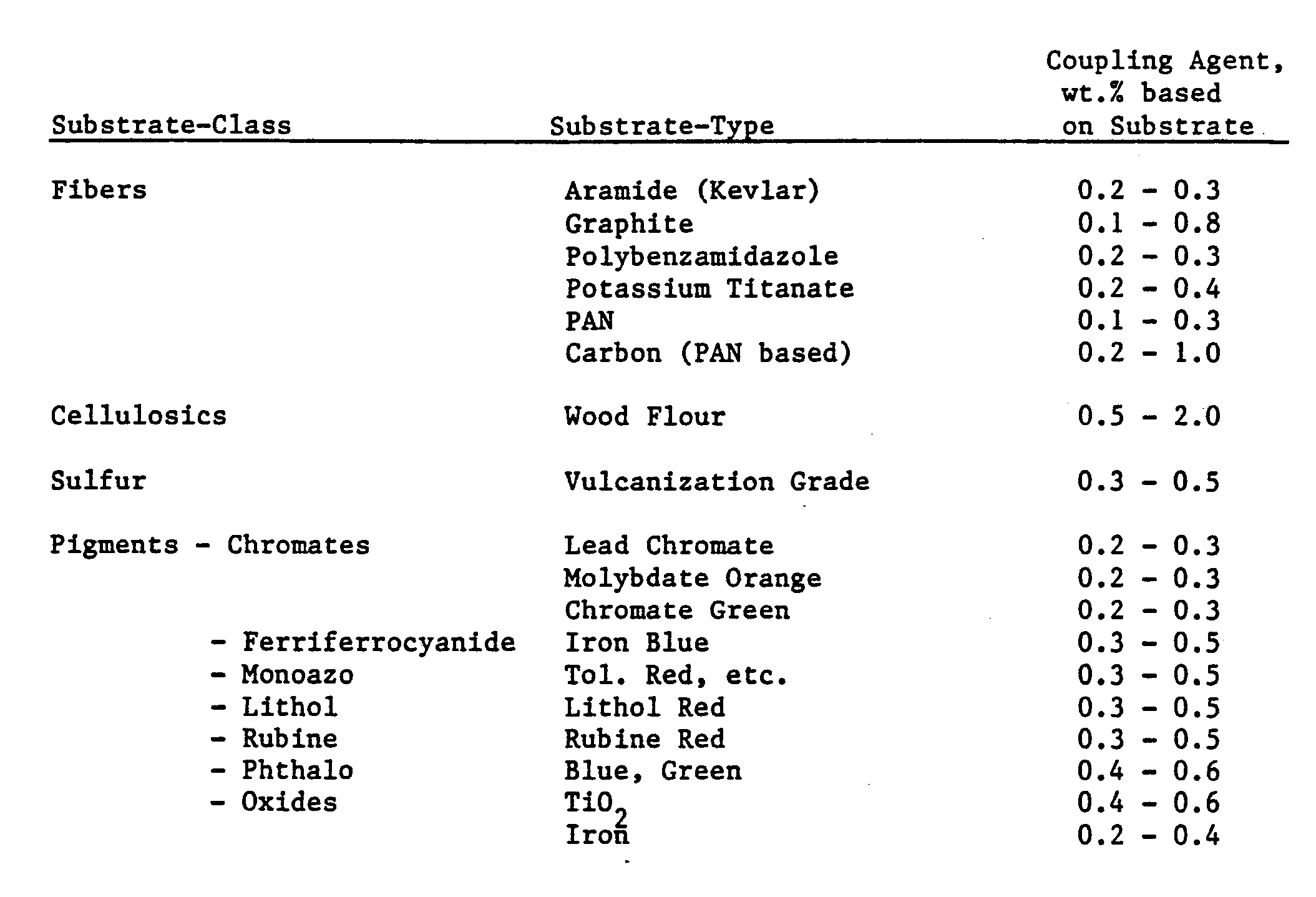
- As mentioned previously, because of the outstanding heat stability of the neoalkoxy compounds, it is unnecessary to first treat the filler in order to obtain the benefits of the neoalkoxy compounds as coupling agents, since their stability at high temperatures permits the blending of each of the three components separately in a single operation. In the case of the prior art organo-titanate, where the blending of the polymer and filler required high- temperature, high-shear mixing, the addition of the three components at once would have resulted in the decomposition of the hydrolyzable group and the destruction of the coupling effect.
- In order to further illustrate the subject invention, the following examples are provided. Examples 1 through show the preparation of various neoalkoxy compounds of the invention. Example 4 shows the relative solvolytic stability. The balance of the examples are directed towards the use of the neoalkoxy compounds in resins, showing both filled and unfilled resin systems:
- To a glass vessel equipped with a mechanical agitator, external heating and cooling, vapor condensation means, a distillate trap and off-gas scrubber was added one mole of 2,2-dimethylpropanol and three moles of dioctyl hydrogen phosphate as well as two liters of mixed isomer xylene. The reactor was flushed with nitrogen and maintained under a slow nitrogen purge during the addition of one mole of titanium tetrachloride over a period of two hours. External heating and cooling was supplied, as necessary, to maintain the operating temperature in the range of 45-60°C. After the addition of the titanium tetrachloride, nitrogen purge was slighly accelerated for an additional two hours followed by evaporation of the reaction mixture in vacuo to produce a bottoms fraction boiling above 150°C. Elemental analysis of the moderately viscous red-brown residual oil was consistent with its formulation as C5H11Ti[OP(O)(OC8H17)2]. The off-gas scrubber contents were analyzed to show that approximately 4 moles of hydrogen chloride had been captured in the caustic scrubbing solution. Subsequent high pressure liquid chromatography (HLPC) analysis of a portion of bottoms product was used to determine product yield employing a Fourier transform infrared detector system (FTIR) for quantification of effluent assay. Results for the above preparation and for those producing analogous products by similar means from titanium tetrachloride together with the product yields are shown in Table 1. The Code in the lefthand column of the table is to designate these products in subsequent examples:


- A reactor such as that described in Example 1 was charged with one mole of titanium IV tetrabutoxide. Temperature was adjusted to 50°C and maintained between 50°C and 70°C by external heating and cooling and reactor pressure held at 10 mm of Hg. during the addition, sequentially, of one mole of 2-methyl-2- phenylbutanol (20 minutes), two moles of dibutyl pyrophosphate (1 hour, 5 minutes), and one mole of dioctylphenyl pyrophosphate (1 hour, 45 minutes).
- During the addition, the distillate was collected and determined by gas liquid chromatography to be essentially pure butanol totaling 3.84 moles. The residual reaction product was analyzed by HLPC/FIIR as described in Example 1. Results of this experiment and of several products made by analogous means are shown in Table 2 on a per mole of titanium tetralkoxide basis:
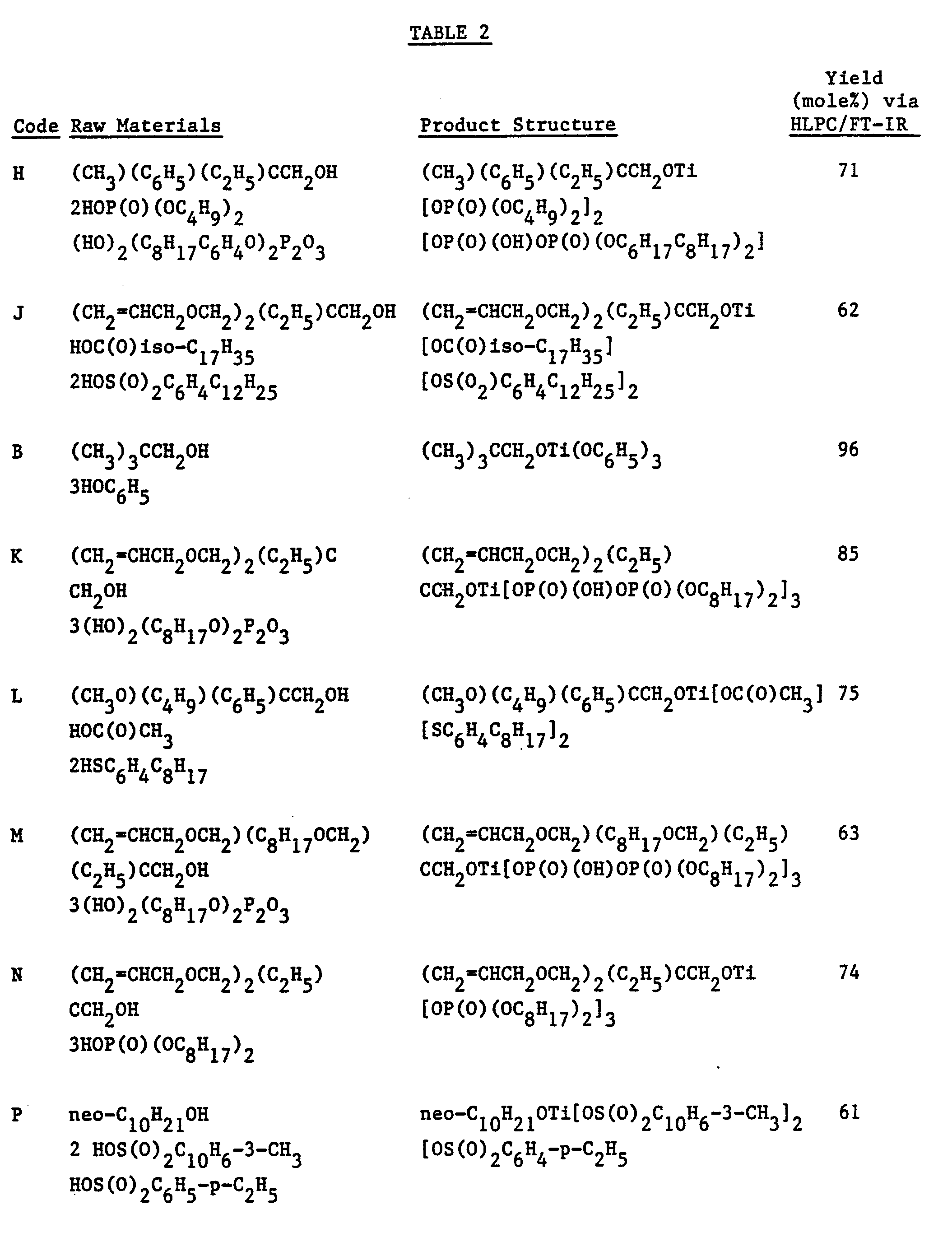

- One mole of titanium IV tetrakis (2-allyloxymethyl, 2-propanolato methyl-1-)butanolato was added over a period of two hours to 3 moles of titanium IV tetrakis (dioctyl)pyrophosphato-O contained in 1 liter of toluene. The reaction mixture was agitated and maintained at 75±5°C during the addition and for 24 hours after by external heating and cooling. FTIR analysis of HLPC effluents as described in Example 1 (after toluene evaporation in vacuo) indicated that a 73 mole % yield of titanium IV (2-allyloxymethyl, 2-n- propanolatomethyl-1-)butanolato, tri(dioctyl)pyrophosphato-0 was obtained. Similarly, isostearate, phosphate and amino analogs were prepared as shown in Table 3.


- The calculated and analysed values for certain of the above compounds are as follows:

- Examples Nos. 4 through 30 demonstrate the surprising superiority of the products of the instant invention as compared to their heretofore known analogs. The following codes are used to designate analogs of the neoalkoxy titanates for comparative purposes:

- Five weight percent solutions of the indicated species were maintained at 25±2°C and the time required for 50% of the solute to disappear was measured by FTIR. Results given in Table 4 clearly establish the superiority of the Titanium IV salts of the instant invention as compared to heretofore known titanate and silicone compounds with respect to solvolysis resistance.

- Molding compound (Cosmic Resin D-45) containing 50% clay filler was tumble blended with 0.3% by weight of additive and compression molded at 170°C to form test specimens using RF preheat. Results are given in Table 5.

- Note that the products of this invention (B, N, U) were generally more effective than the prior art additives in enhancing the tensile, flexural and impact strengths as well as hydrophobicity of the tested commercial mineral filled diallylphthalate based resin.
- Each additive shown in the table below was independently metered into the throat of a compounding extruder at a level of 0.25 wt. % based on preblended, meter-fed mix containing: 25.00 wt. % Vulcan 6 Carbon Black (Cabot Corp.) and 74.75 wt. % Pelethane CPR2102-90AE thermoplastic polyurethane (Upjohn) and subsequently compounded at 230-240°C followed by injection molding of test specimens at 235°C. Results are given in Table 6:

- Note that in each and every instance, the products of the instant invention provide substantially greater tensile, elongation and conductivity enhancement as compared to the prior art.
- The compounding process consisted of separate meter feed each of 40.0 wt. % talc (Mistron Vapor-Cyprus Mines), 59.8 wt. % ABS (Taitalc Chemical Co.) and 0.2 wt. % of a 65 wt. % active additive on a silica powder concentrate to the throat of a 28:1 WP ZSK extruder using a graduated 210 to 240°C extrusion profile. Test specimens were injection molded at 230°C. The results are shown in Table 7:

- Note that the products of the instant invention provided superior tensile, elongation and impact property enhancement as compared with the prior art.
- Liquid additive (0.2 wt. %) was added to 60X mica (Suzerite-Martin Marietta Corp.) filled resin (Uralite 3167 - Hexcel) and admixed thoroughly by means of a static mixer and gear pump just prior to ambient casting. The resultant sheets were die cut for testing. The results are shown in Table 8:

- Note that in the mica filled thermoset urethane casting resin system, the products of the instant invention provided a better overall set of physical properties than did prior art analogs.
- The additives indicated on Table 10 were added (as 65% active additive dryblends on silica) directly to the compression-melt pot containing 30 wt. % thermoset polyester (Reichhold #3003) and 70% CaCO3 at levels of 0.3 wt. % dryblend prior to melt generation @ 180°C. The results are tabulated in the Table:

- The data on Table 9 clearly establish the superiority of the products of the instant invention as compared to prior art with respect to enhancement of rheology and physical properties in mineral filled compression molded thermoset polyester.
- Formulations were prepared by batch tumble blending of the appropriate proportions of PBT (Gafite 1600A, GAF Corp.) and mica (Suzerite-Martin Marietta) together with 0.3 wt. % of additive by weight of mica content in a doublt cone type blender prior to extrusion in a 24:1 NRM two stage vented extruder at approximately 250±10°C with a virtually flat temperature profile. Test samples were injection molded at 240°C and annealed for 48 hrs. at 100°C prior to test. Results are given in Table 10:.


- Note that in each and every instance, the products of the instant invention had superior overall properties as compared to those of the prior art.
- The indicated additives were high shear blended with precompounded 30% mineral filled polyester (Valox 746, General Electric) pellets at 0.2 wt. % additive based on total weight, and the resulting composites injection molded at 250°C to produce test specimens. Results are tabulated in Table 11.

- This data shows the superiority of the additives of the instant invention as compared to prior art for the purposes of enhancing the physical properties and flame retardance of injection molded mineral filled polybutylene terphthalate.
- Thirty percent filled formulations were prepared by downstream carbon fiber (Union Carbide) loading of molten PEEK (ICI) in a twin screw extruder at approximately 400°C. Test specimens were injection molded at 380°C. Additives were throat fed at 0.2 wt. % on resin as 65X concentrates on silica powder. Results are given in Table 12:

- Note that the additives of the instant invention improved the elongation, water absorption inhibition, impact resistance and electrical conductivity while those properties were generally negatively effected by inclusion of prior art analog additives.
- Polypropylene (Elex PTL 220, Solvey) filled with various types of particulate the amounts shown in Tables 13A to 13D and 0.3 wt. % of additives. These were extruded at temperatures of 230-260°C and test samples were compression molded at 250°C. The results are given in Tables 13A to 13D.

- Note the products of the instant invention do not sacrifice tensile and flexural properties in order to provide enhanced impact and elongation ones as do the prior art materials.

- Note the products of the instant invention gave enhanced elongation, tensile properties and improved impact properties without the loss of flexural strength and modulus caused by prior art compounds.

- Note the products of the instant invention gave enhanced elongation, tensile properties and improved impact properties without the loss of the flexural strength and modulus caused by prior art compounds.
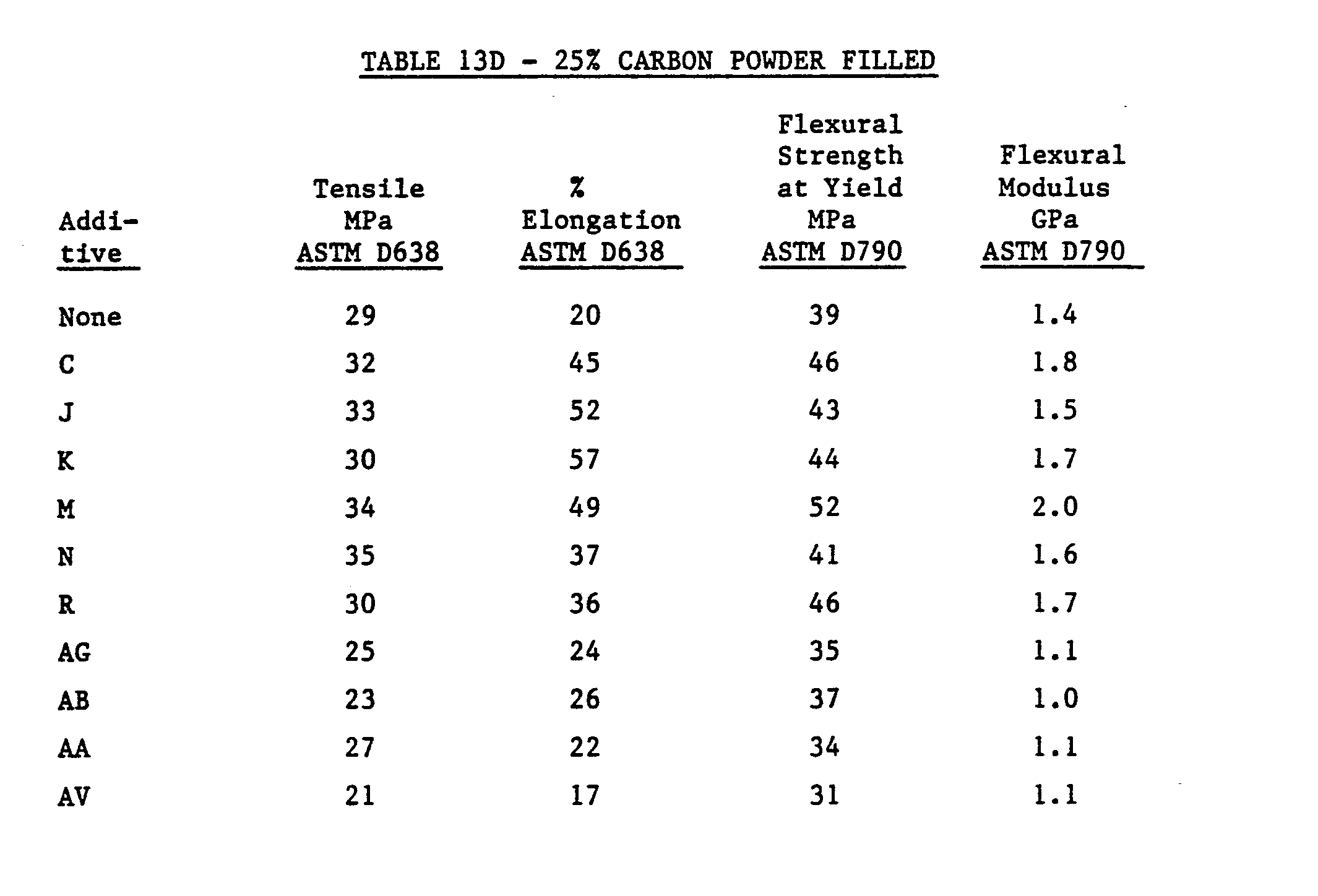

- The data in Table 13D clearly demonstrates the superiority of the products of the instant invention as compared to prior art analogs with respect to melt flow enhancement, conductivity and general physical property improvement when they are employed as additives in situ during compounding of carbon black filled polypropylene.
- Twenty parts of Polytetrafluoroethylene (Teflon 340, E.I. duPont) filler, 79.9 parts acetal homopolymer (Delrin 107, E.I. duPont), were tumble blended with 0.1 parts of additive in a drum shaker and meter fed to the throat of a twin screw extruder having a relatively isothermal temperature profile of 190±5°C throughout its 32:1 length/diameter barrel. At an L/D of 20:1, 20.0 parts by weight of PTFE powder were meter fed to the molten mix. The resultant extrudate was injection molded at approximately 185°C to produce test specimens. The properties of composites produced using various additives are given in Table 14:

- Note the products of the instant invention maintained physical properties of the composite while enhancing elongation and flame retardance, whereas prior art materials reduced physicals while enhancing elongation and did little to enhance flame retardance.
- Additives were mechanically blended in a ribbon blender at 0.15 wt. % based on a resin with a 20% (PAN) carbon fiber (Union Carbide) loaded acetal copolymer (Celcon C-400, Celanese Plastics) and fed to a twin screw extruder having a 190-215°C temperature profile. The physical and electrical properties of the resultant extrudates were measured on samples injection molded at 210°C. Results are given in Table 15:

- The results tabulated in Table 15 clearly establish the superiority of the products of the instant invention with respect to the parameters evaluated as compared to prior art additives.
- Precompounded pellets of 20X PTFE filled acetal (Formalafil AC-80/TF/20, Wilson Fiberfill) together with 0.2 wt. % of the additive identified in Table 16 were mixed in a high shear mechanical blender and test samples injection molded at 200°C prior to evaluation. The results are given in Table 16:

- Samples of chlorinated polyvinyl chloride (Geon 88935) were high shear blended with 0.2 wt. % additive prior to injection molding at 210°C. Results are given in Table 17.

- Note that the products of the instant invention provided superior impact properties as compared to those imparted by prior art products.
- Samples of ethyl cellulose (Hercules type T) and 0.5 wt. % of the indicated additive were ball milled for four hours followed by extrusion at 230°C. The results of water absorption (ASTM D570) tests on extruded specimens are given in Table 18:

- The results given in Table 18 clearly establish the superiority of the products of the instant invention vs. their prior art analogs as water absorption inhibitors in ethyl cellulose.
- Samples of 50X clay (Icecap K, Burgess Corp.) filled Nylon 6 (Capron 8202, Allied Corp.) were prepared by meter feeding simultaneously clay, nylon and additive (at 0.2 wt. % on mix) as a 65% concentrate on silica, to the throat of a 32:1 twin screw extruder, operating at 250-265°C. Test samples were injection molded at 250°C. Results are given in Table 19:

- Note the significant improvement in elongation, impact and moisture absorption retardation imparted by the products of the instant invention as compared to those produced by prior art products.
- Samples of precompounded acrylonitrile-styrene-butadiene copolymer (Cycolac KJM, Borg-Warner) were tumble blended in a drum tumbler with 0.2 wt. % of additive and thereafter injection molded at 270°C. Flame retardancy improvement is shown in Table 20.

- Note the greater efficacy of products of the instant invention and as compared to their prior art analogs, as flame retardant enhancers in ABS.
- This example teaches the superiority of the products of the instant invention as compared to those of the prior art with respect to electrical, physical, rheological and water absorption resistance enhancements when employed as additives in the extrusion (at 250°C) in 30X PAN carbon fiber (Union Carbide) loaded ABS (Lustran ABS-545, Monsanto). The samples were injection molded at 240°C for evaluation. The results and the additives employed are shown in Table 21:

- Note that improvements in impact, water absorption, electrical and flow properties were substantially greater when products of the instant invention were employed as compared to those of the prior art.
- Additives at 0.3 wt. % were first converted to 65X concentrates on silica powder then mixed intensively (Wellex) with the preformed precompounded nylon fiber reinforced compression molded phenolic (Budd Polychem 155) molding compound prior to compression molding at 175°C of test specimens. Results are given in Table 22:

- The data in Table 22 clearly shows the enhanced performance of the products of the instant invention as compared to prior art with respect to compressive strength and impact property enhancement when employed as low level additive in nylon filled phenolic molding compound.
- Liquid additives were independently fed at the throat of an extruder as a dryblend on the modified polyphenylene oxide (Noryl 731--General Electric Co.), and 20% carbon black (Vulcan P--Cabot Corp.) was fed downstream to the polymer melt in a three stage 10 barrel Berstoff extruder having a 270-300°C profile. The test samples which contained 0.3 wt. % of additive based on total formulation were injection molded at 285°C. Results of these evaluations are given in Table 23:

- The data in Table 23 clearly establish the superiority of the products of the instant invention as compared to those of the prior art when employed as additives in the extrusion of carbon black filled modified polyphenylene oxide for the purposes of conductivity, elongation and impact property enhancements.
- Modified polyphenylene oxide (Noryl N-300--General Electric Co.) pellets were tumble blended with additive in a pneumatic conveyer system and screw injection molded at 270°C to product test specimens. The results of independent additions of various additives (at 0.3 wt. X) are given in Table 24:

- Note that the products of the instant invention, when employed as minor additives in PPO injection molding, not only provided superior elongation and impact improvement as compared to the prior art, but simultaneously gave less heat distortion temperature loss than did the prior art analogs.
- Test samples containing 30% PAN carbon fiber were produced by feeding a dryblend of polystyrene (Cosden 550) resin and additive (0.3 wt. %) to the throat of a twin screw (W&P-12 barrel) extruder and feeding carbon fiber downstream to the melt (extrusion at 210-240°C) followed by injection molding the extrudate at 230°C. Results are given in Table 25:

- Note the products of the instant invention, when employed as minor additives in the extrusion of carbon fiber filled polystyrene, gave superior tensile, impact and electrical properties as compared to both the control and the prior art, whereas the prior art analogs had far less beneficial effects (if any) and each instance tested degraded tensile strength.
- This example demonstrates the superiority of the products of the instant invention as compared to those of the prior art with respect to , rheological and physical property enhancement when employed as minor additives in 15% mica filled resin.
- Additive (0.2 wt. %) coated polycarbonate resin (Lexan EM-- General Electric Co.) was fed at the throat of a three stage, 10 barrel Berstoff extruder and 15 wt. % (based on final compound) of mica (Suzerite--Martin Marietta Corp.) was fed downstream to the melt via a crammer feeder. The extrusion was performed at 300- 330°C and the extrudate injection molded at 320°C to produce test specimens. Results are given in Table 26.

- Note the products of the instant invention provide simultaneous substantial improvements in impact, elongation (and in come cases) melt flow. The products of the prior art displayed only modest enhancement of measured properties (if any), and in each instance, tested degraded tensile strength when employed in situ as additives in the extrusion of mica filled polycarbonate.
- Blends of 50 parts of polyethylene terphthalate (Tenite 6857--Eastman), 48 parts of polybutylene terphthalate (Gafite 1600-A-- GAF), 2 parts of titanium dioxide (R-901--Dupont), and 0.12 parts of the specified additive were extruded in a single stage 24:1, L:D Prodox extruder at 275-305°C followed by injection molding of physical test specimens at 300°C in a ram type molding unit. A control test specimen was also prepared by melt blending in a nitrogen blanketed autoclave. The results of these evaluations are given in Table 27:
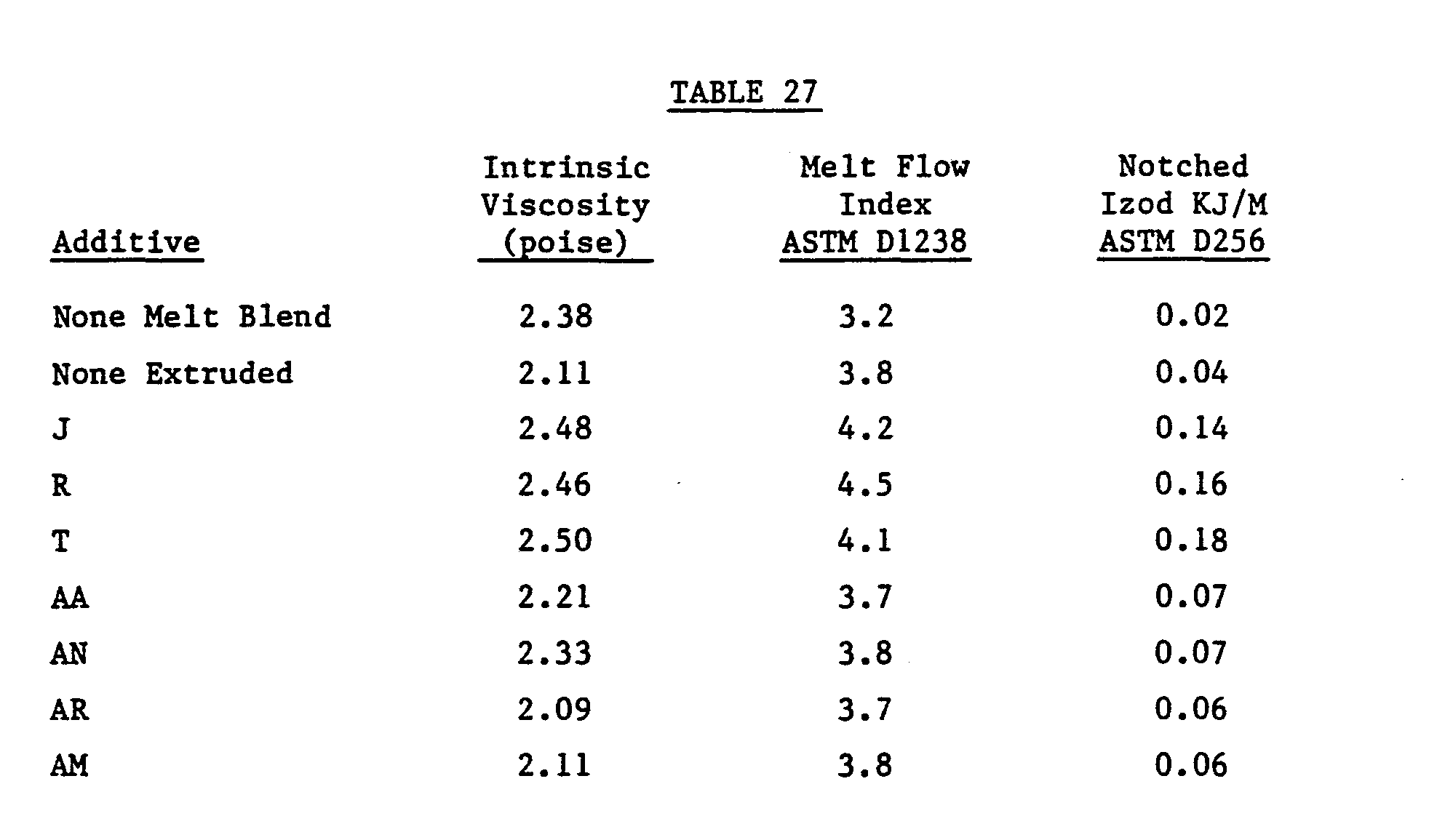
- The experimental results tabulated in Table 27 clearly demonstrate that the products of the instant invention minimize thermal degradation of PBT/PET alloy far more effectively than do prior art analogs which have previously been shown to be effective process aids at lower temperatures.
- This example demonstrates the enhanced solvolytic stability of the products of the instant invention as compared to those of the prior art when employed as co-catalysts in thermoset polyurethane (Pellethane CPR 135-50D--Upjohn).
- The additives were added at 0.5 wt. % on polyol component and the mix aged at 40°C under nitrogen for the period indicated prior to isocyanate component addition. Results are given in Table 28:

- Note the initial tensile and flexural modulus property improvements and cure time control conferred by the addition of Additives AQ and AJ were comparable to those of their neoanalogs U and Q, respectively. However, the comparability of the former was substantially diminished within 24 hours, thus demonstrating the enhanced solvolytic stability of the products of the instant invention as compared to the prior art.
- This example demonstrates the superior thermal/solvolytic stability of the products of the instant invention as compared to those of the prior art with respect to polyester polyurethanes (Pellethane 2102-80HE--Upjohn) when employed in both casting and extrusion modes. For extrusion evaluation, the components were tumble blended with 0.4% additive and extruded at 205-220°C using a two stage vented 24:1 Prodox extruder; followed by injection molding of test specimens at 210°C.
- Casting was accomplished by dissolving the resin in anisole at ambient temperature to produce a 20% solution containing 0.5% additive followed by solvent evaporating (after appropriate aging) in vacuo at 80°C to produce castings from which test samples were die cut for evaluation. Results are given in Table 29A and 29B, respectively:

- Note the products of the instant invention provide enhancement of flexural modulus when used as additives in extruded polyester polyurethane, whereas their non-neoanalogs are ineffective.


- Note the products of the instant invention enhance the properties of cast polyester polyurethane in anisole solution for at least 168 hrs., whereas their prior art analogs failed within one-seventh of said period. This demonstrates the superior solvolysis resistance of the products of the instant invention.
- The effect of 0.25% of various neoalkoxy compounds on a hot melt polyurethane adhesive (Compo 1479) for adhering rigid PVC to nylon substrates is shown in Table 30.
-

- The above data show the effect of the neoalkoxy compounds on the polyurethane adhesive. while all of the titanate compounds improve the adhesivity to some degree, the titanate, additive U, and the zirconate compounds enhance performance to the greatest extent.
- The effect 0.2% of of the neoalkoxy compounds on the adhesion of Bostic No. 7772 R21 two-component urethane to polypropylene substrate is shown in the Table 31A below. The Table 31B below shows the effect of 0.25% on two-component low pressure RIM urethane adhesion to semirigid PVC.

- Again, it will be noted that both the titanates and the zirconates markedly improve the shear strength of the systems. Particularly outstanding is the zirconate additive Z6.
- This example shows the effect of the neoalkoxy titanates and zirconates on Uralite 5738 A/B urethane adhesives for Upjohn Pellethane 2103-80WC to ABS, nylon 6/6 and aluminum. 0.25% of the neoalkoxy compound is used. The results are shown in the following table:

- The foregoing table shows the improved lap shear strength achieved by the addition of the compounds of the invention.
- The addition of 0.3% neoalkoxy compounds on the physical properties of thermoplastic urethane extrusion profiles is shown in the following table.

- The above table shows that, generally speaking, the elongation to break is improved most markedly by the neoalkoxy titanates, while the tensile strength of the material is improved to the greatest extent by the neoalkoxy zirconates.
- This example shows the effect of 0.2% neoalkoxy titanates and neoalkoxy zirconates on the physical properties of RIM molded polyurethane (Texaco RIM TEX 140).

- Compared to the controls, all of the neoalkoxy compounds improved the percent elongation at break and the flexural modulus. Tensile strength at break was also greatly enhanced by the addition of the last two compounds listed.
- In this example, formulations containing 70 parts by weight of polyester resin (S-600 Silmar Corp.); 30 parts of 1 mm milled bare glass (Owens Illinois); 0.5 part of a catalyst consisting of benzoyl peroxide and 200 ppm of cobalt acetylacetonate; and 0.14 part of the additives shown in the table below were cured for 10 minutes at 150°C and post-cured for 2 hours at 100°C. The properties of the cured formulations are shown below. In addition to the control, the use of silane additives is also illustrated.
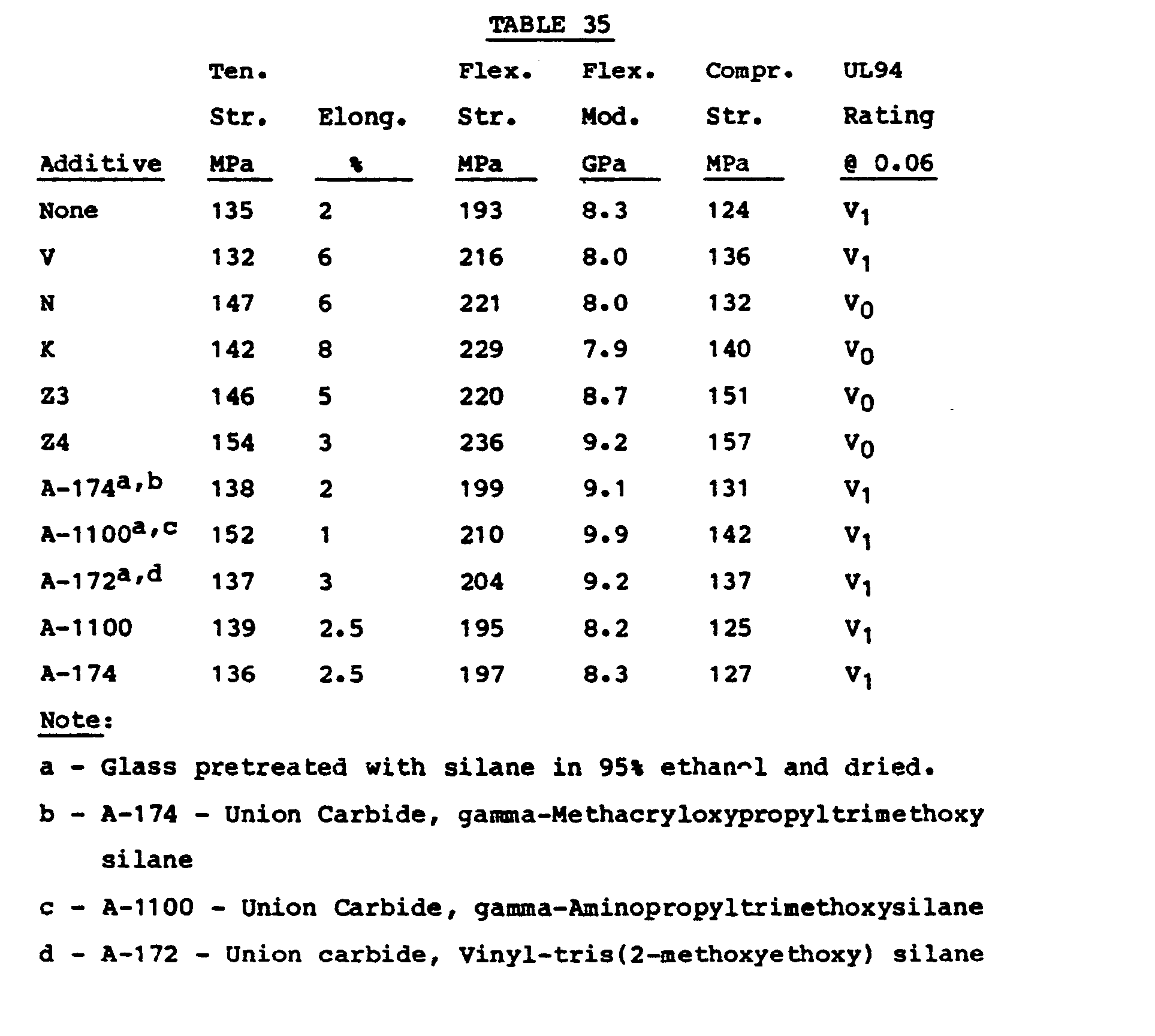
- The above data clearly show that the additives of the invention improve certain of the physical properties of the cured formulations and in most instances improve the flame-resistance of the material. The neoalkoxy zirconate compounds are particularly effective in improving the tensile strength, the flexural strength, and the compressive strength of the polyester. In contrast, the silanes of the prior art do not improve the flame-resistance of the material and were considerably less effective in improving the physical properties of the polyester.
- Formulations containing 70 parts by weight of a polyester resin (Stypol 40-3904, Freeman Chemical); 30 parts of chopped bare glass; 0.5 part of a catalyst comprising methylethyl ketone peroxide and 100 ppm of cobalt (naphthenate); and 0.14 part of the additives shown below were cured at ambient temperature and post-cured for 2 hours at 120°C. The results obtained are shown in the table below.

- This table shows the surprising advantage of using the neoalkoxy zirconates of the invention as coupling agents in these compositions. In contrast to the control and the material containing the neoalkoxy titanate coupling agent, the gel and cure time with the neoalkoxy zirconates were markedly reduced. This clearly shows the accelerating effect of these latter compounds. In addition, the coupling agents of the instant invention also selectively improve the physical properties of the reinforced polyester.
- Formulations were prepared containing 30 parts by weight of a synthetic marble mix polyester resin (Stypol 40-5727, Freeman Chemical); 70 parts of calcium carbonate in the form of ground marble dust (Micro White 50, Sylacauga); 0.5 part of a catalyst comprising methylethyl ketone peroxide; and 0.2 part of the additives shown below, added to the resin prior to the addition of the marble dust. The compositions were cured at ambient temperature and their physical properties measured. The results are shown in the following table:

- The above data clearly show that the neoalkoxy titanates tend to retard the cure of the polyester, while the neoalkoxy zirconates function as accelerators. The additives of the invention improve the tensile strength and the compressive strength of the formulations in most instances.
- Formulations containing 100 parts by weight of polyester resin (Hetron 700C, Ashland Chemical Co.); 0.5 part of methylethyl ketone peroxide catalyst; and 0.4 part of the additives shown in the table below were cured at ambient temperature. The gel and cure times and the physical properties of the cured formulations are shown in the table below.
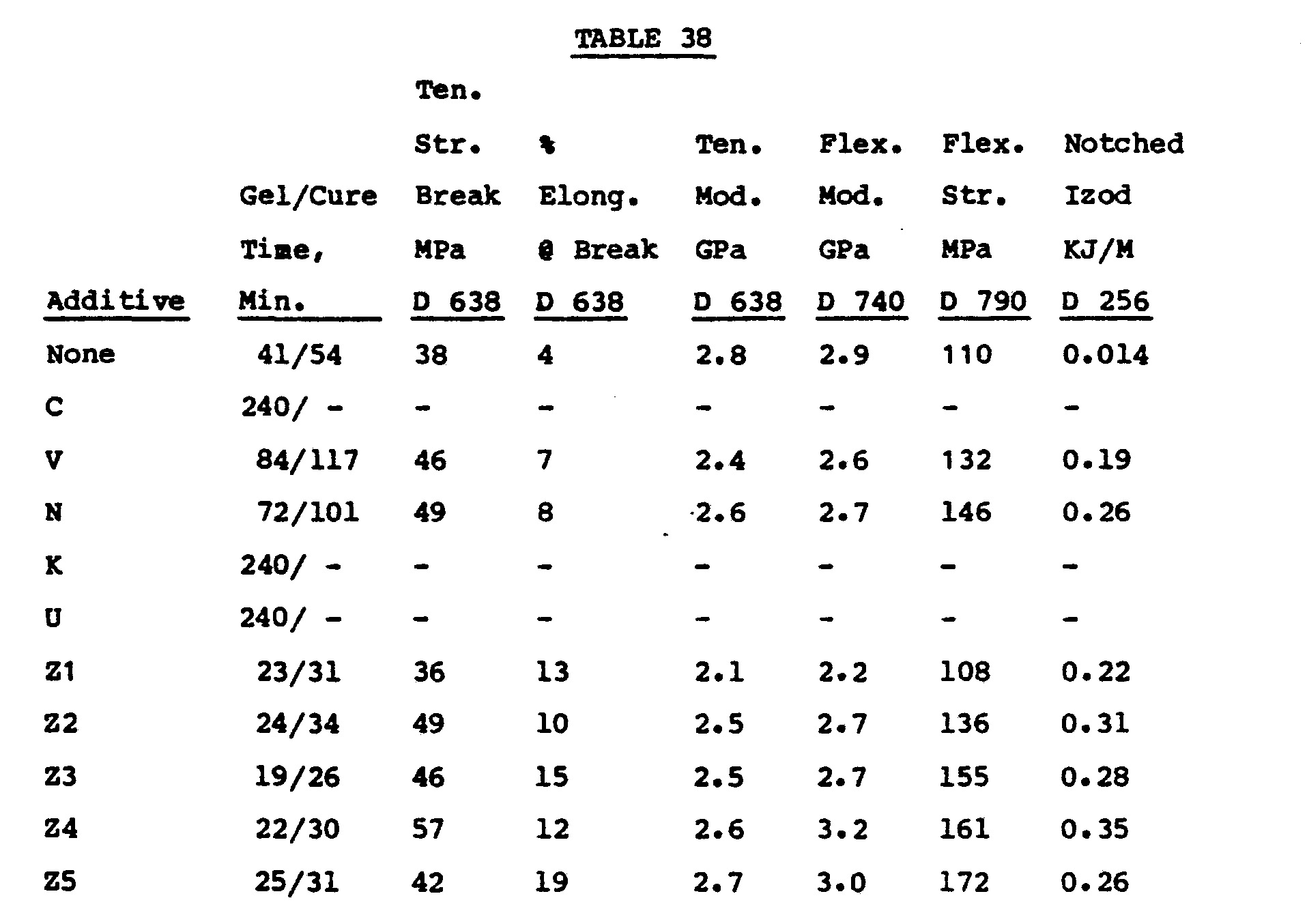
- The data above show the severe retarding effect on the peroxide cure of the neoalkoxy titanates. Certain of these titanates substantially prevent the curing of the material, while others merely retard the reaction. In contrast, each and every one of the neoalkoxy zirconates tested markedly accelerated the tire to gel and the cure time. Furthermore, the elongation to break of the compounds cured in the presence of the neoalkoxy zirconates shows that higher molecular weights were achieved. Substantial improvements in notched Izod values and, in certain instances, flexural strength and tensile strength, are also apparent.
- Formulations containing 100 pacts by weight of a polyester resin (Armco 8057 SMC 70% carbon); 0.5 part of p-chloro-perbenzoate catalyst; and 0.4 part of the additives shown in the table below were cured for 1 minute at 200°C and thereafter cured for 8 hours at 150°C. The table below shows the physical properties of the cured material.

- The data clearly show that the neoalkoxy compounds of the invention improve the flexural strength and notched Izod of the cured composition. Improvements are also shown in selective additives, particularly for the zirconates, in the tensile strength and HTD value.
- In this example, formulations were prepared containing 100 parts by weight of a premix glass-carbon static dissipating BMC polyester potting compond (Premi-Glas BMC-ESD); 0.5 part of t-butyl perbenzoate catalyst; and 0.2 part of the additives shown in the following table. The formulations were cured for 35 sec. at 220°C and post-cured for 4 hours at 150°C. The following table shows the physical and electrical properties of the cured formulations.

- The above data clearly show that the compounds of the invention may improve the tensile strength, elongation, flexural strength, compression, and notched Izod values of the formulations.
- In this example, formulations were prepared from 100 parts by weight of a BMC polyester resin (Dielectrite 44-1 BMC, Industrial Dielectric), 1 part of benzoyl peroxide catalyst, and 0.3 part of the additives shown below. The formulations were cured for 10 minutes at 180°C and post-cured for 2 hours at 150°C. The physical and electrical properties of the cured compositions are shown in the table below.

- The above data clearly show that the cured material containing the neoalkoxy zirconates have substantially improved dielectric strength as compared to the cured composition without an additive or those containing the neoalkoxy titanates. All of the neoalkoxy titanates, however, selectively increase the physical strength of the polyester compound.
- In this example, compositions containing 100 parts by weight of polyester resin (Aropol 7362, Ashland), 0.5 part of methylethyl ketone peroxide, and 0.2 part of the additives shown below were cured at ambient temperature and post-cured for 24 hours at 50°C. The table below shows the physical properties of the cured material.

- It is apparent that the addition of the neoalkoxy compounds of the invention improved the tensile strength and percent elongation of the polyester clear coat, as well as the flexural strength. In addition, the last-named zirconate improved the flexural modulus of the composition.
Claims (6)


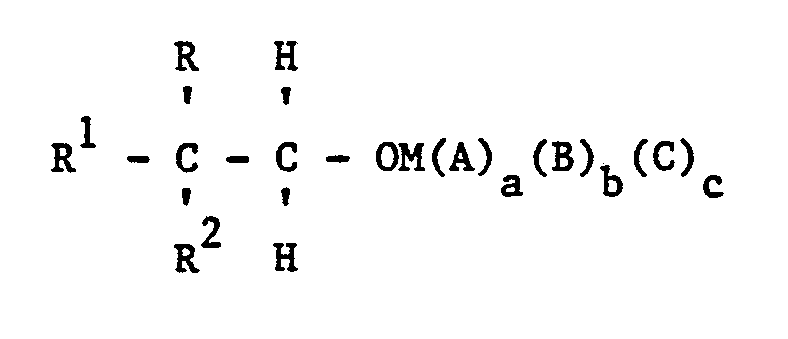


Applications Claiming Priority (4)
| Application Number | Priority Date | Filing Date | Title |
|---|---|---|---|
| US06/609,727 US4600789A (en) | 1984-05-14 | 1984-05-14 | Neoalkoxy organo-titanate useful as coupling and polymer processing agents |
| US609727 | 1984-05-14 | ||
| US06/725,437 US4623738A (en) | 1985-04-22 | 1985-04-22 | Neoalkoxy organo-titanates and organo-zirconates useful as coupling and polymer processing agents |
| US725437 | 2000-11-29 |
Publications (3)
| Publication Number | Publication Date |
|---|---|
| EP0164227A2 true EP0164227A2 (en) | 1985-12-11 |
| EP0164227A3 EP0164227A3 (en) | 1987-09-02 |
| EP0164227B1 EP0164227B1 (en) | 1990-08-16 |
Family
ID=27086107
Family Applications (1)
| Application Number | Title | Priority Date | Filing Date |
|---|---|---|---|
| EP85303352A Expired - Lifetime EP0164227B1 (en) | 1984-05-14 | 1985-05-13 | Neoalkoxy organo-titanates and organo-zirconates useful as coupling and polymer processing agents |
Country Status (9)
| Country | Link |
|---|---|
| EP (1) | EP0164227B1 (en) |
| JP (2) | JPH06791B2 (en) |
| KR (1) | KR910002535B1 (en) |
| AU (1) | AU575165B2 (en) |
| CA (1) | CA1237140A (en) |
| DE (1) | DE3579194D1 (en) |
| IN (1) | IN170651B (en) |
| MX (1) | MX164160B (en) |
| NO (1) | NO167393C (en) |
Cited By (14)
| Publication number | Priority date | Publication date | Assignee | Title |
|---|---|---|---|---|
| EP0179731A3 (en) * | 1984-10-22 | 1987-08-26 | Essex Group Inc. | Neoalkoxy titanate in high density mica laminates |
| DE3800889A1 (en) * | 1987-01-14 | 1988-07-28 | Kollmorgen Corp | ADHESIVE INTERMEDIATE LAYER FOR COVERING METALLIC SURFACES |
| EP0245103A3 (en) * | 1986-05-08 | 1989-03-29 | Kenrich Petrochemicals, Inc. | Non-blooming anti-stats for polymers |
| EP0254477A3 (en) * | 1986-07-16 | 1989-09-20 | Celanese Corporation | Polyoxymethylene molding compositions exhibiting improved toughness |
| EP0275070A3 (en) * | 1987-01-14 | 1989-10-11 | Kollmorgen Corporation | Multilayer printed wiring board and method for making same |
| EP0275891A3 (en) * | 1987-01-14 | 1989-10-18 | Amp-Akzo Corporation | Bonding compositions for the manufacture of additive printed wiring boards and printed wiring boards made with the bonding composition |
| EP0240137A3 (en) * | 1986-02-28 | 1990-10-03 | Kenrich Petrochemicals, Inc. | Repolymerization |
| WO1995023183A1 (en) * | 1994-02-28 | 1995-08-31 | Neste Oy | Liquid crystalline polymer blends and processes for the preparation thereof |
| WO1997027993A1 (en) * | 1996-01-30 | 1997-08-07 | Kabushiki Kaisha Kobe Seiko Sho Also Known As Kobe Steel Ltd. | Liquid composite moulding process |
| GB2324063A (en) * | 1996-01-30 | 1998-10-14 | Kobe Steel Europ Ltd | Liquid composite moulding process |
| WO2002094730A3 (en) * | 2000-11-29 | 2003-02-27 | Corning Inc | Optical fiber coupling agent |
| CN1301290C (en) * | 2004-08-19 | 2007-02-21 | 南京工业大学 | The synthetic method of polyether titanate coupling agent |
| WO2011159897A1 (en) * | 2010-06-16 | 2011-12-22 | Federal-Mogul Powertrain, Inc. | Flame-retardant compound, continuous materials and products constructed therefrom and methods of manufacture thereof |
| US8697786B2 (en) | 2010-06-16 | 2014-04-15 | Federal Mogul Powertrain, Inc. | Flame-retardant compound, continuous materials and products constructed therefrom and methods of manufacture thereof |
Families Citing this family (4)
| Publication number | Priority date | Publication date | Assignee | Title |
|---|---|---|---|---|
| US6270883B1 (en) * | 1998-10-09 | 2001-08-07 | The United States Of America As Represented By The Secretary Of Agriculture | Composites containing cellulosic pulp fibers and methods of making and using the same |
| US10364375B2 (en) * | 2010-06-14 | 2019-07-30 | Gates Corporation | Article with self-bonding fully cured elastomer |
| JP6131654B2 (en) * | 2013-03-19 | 2017-05-24 | 横浜ゴム株式会社 | Rubber composition and pneumatic tire |
| JP7313790B2 (en) | 2019-08-02 | 2023-07-25 | 株式会社ハーモニック・ドライブ・システムズ | rotary actuator |
Family Cites Families (6)
| Publication number | Priority date | Publication date | Assignee | Title |
|---|---|---|---|---|
| US2985604A (en) * | 1957-03-05 | 1961-05-23 | Union Carbide Corp | Shaped resins |
| US4094853A (en) * | 1975-05-15 | 1978-06-13 | Kenrich Petrochemicals, Inc. | Alkoxy titanate salts useful as coupling agents |
| US4277415A (en) * | 1979-08-29 | 1981-07-07 | Kenrich Petrochemicals, Inc. | Pyrophosphato titanate adducts |
| JPS58101021A (en) * | 1981-12-12 | 1983-06-16 | Toyobo Co Ltd | Biaxially orientated polyester film |
| DE3300315A1 (en) * | 1983-01-07 | 1984-07-12 | Dynamit Nobel Ag, 5210 Troisdorf | METHOD FOR PRODUCING LIGHT-COLORED POLYESTERS USING TITANIUM CATALYSTS |
| US4452970A (en) * | 1983-06-09 | 1984-06-05 | General Electric Company | Catalytic process for preparing poly(alkylene dicarboxylates) and catalysts for use therein |
-
1985
- 1985-05-09 IN IN389/DEL/85A patent/IN170651B/en unknown
- 1985-05-09 NO NO851845A patent/NO167393C/en not_active IP Right Cessation
- 1985-05-13 CA CA000481428A patent/CA1237140A/en not_active Expired
- 1985-05-13 KR KR1019850003333A patent/KR910002535B1/en not_active Expired
- 1985-05-13 DE DE8585303352T patent/DE3579194D1/en not_active Expired - Lifetime
- 1985-05-13 MX MX205276A patent/MX164160B/en unknown
- 1985-05-13 EP EP85303352A patent/EP0164227B1/en not_active Expired - Lifetime
- 1985-05-14 AU AU42475/85A patent/AU575165B2/en not_active Expired
-
1989
- 1989-09-13 JP JP1238325A patent/JPH06791B2/en not_active Expired - Lifetime
-
1991
- 1991-03-18 JP JP3226650A patent/JPH0834745B2/en not_active Expired - Fee Related
Cited By (17)
| Publication number | Priority date | Publication date | Assignee | Title |
|---|---|---|---|---|
| EP0179731A3 (en) * | 1984-10-22 | 1987-08-26 | Essex Group Inc. | Neoalkoxy titanate in high density mica laminates |
| EP0240137A3 (en) * | 1986-02-28 | 1990-10-03 | Kenrich Petrochemicals, Inc. | Repolymerization |
| EP0245103A3 (en) * | 1986-05-08 | 1989-03-29 | Kenrich Petrochemicals, Inc. | Non-blooming anti-stats for polymers |
| EP0254477A3 (en) * | 1986-07-16 | 1989-09-20 | Celanese Corporation | Polyoxymethylene molding compositions exhibiting improved toughness |
| DE3800889A1 (en) * | 1987-01-14 | 1988-07-28 | Kollmorgen Corp | ADHESIVE INTERMEDIATE LAYER FOR COVERING METALLIC SURFACES |
| EP0275070A3 (en) * | 1987-01-14 | 1989-10-11 | Kollmorgen Corporation | Multilayer printed wiring board and method for making same |
| EP0275071A3 (en) * | 1987-01-14 | 1989-10-11 | Kollmorgen Corporation | Adherent coating for copper |
| EP0275891A3 (en) * | 1987-01-14 | 1989-10-18 | Amp-Akzo Corporation | Bonding compositions for the manufacture of additive printed wiring boards and printed wiring boards made with the bonding composition |
| WO1995023183A1 (en) * | 1994-02-28 | 1995-08-31 | Neste Oy | Liquid crystalline polymer blends and processes for the preparation thereof |
| WO1997027993A1 (en) * | 1996-01-30 | 1997-08-07 | Kabushiki Kaisha Kobe Seiko Sho Also Known As Kobe Steel Ltd. | Liquid composite moulding process |
| GB2324063A (en) * | 1996-01-30 | 1998-10-14 | Kobe Steel Europ Ltd | Liquid composite moulding process |
| WO2002094730A3 (en) * | 2000-11-29 | 2003-02-27 | Corning Inc | Optical fiber coupling agent |
| CN1301290C (en) * | 2004-08-19 | 2007-02-21 | 南京工业大学 | The synthetic method of polyether titanate coupling agent |
| WO2011159897A1 (en) * | 2010-06-16 | 2011-12-22 | Federal-Mogul Powertrain, Inc. | Flame-retardant compound, continuous materials and products constructed therefrom and methods of manufacture thereof |
| CN102939357A (en) * | 2010-06-16 | 2013-02-20 | 费德罗-莫格尔动力系公司 | Flame-retardant compound, continuous materials and products constructed therefrom and methods of manufacture thereof |
| US8697786B2 (en) | 2010-06-16 | 2014-04-15 | Federal Mogul Powertrain, Inc. | Flame-retardant compound, continuous materials and products constructed therefrom and methods of manufacture thereof |
| CN102939357B (en) * | 2010-06-16 | 2015-04-22 | 费德罗-莫格尔动力系公司 | Flame-retardant compound, continuous materials and products constructed therefrom and methods of manufacture thereof |
Also Published As
| Publication number | Publication date |
|---|---|
| KR850008496A (en) | 1985-12-18 |
| EP0164227B1 (en) | 1990-08-16 |
| CA1237140A (en) | 1988-05-24 |
| MX164160B (en) | 1992-07-20 |
| JPH06791B2 (en) | 1994-01-05 |
| JPH05339421A (en) | 1993-12-21 |
| IN170651B (en) | 1992-05-02 |
| EP0164227A3 (en) | 1987-09-02 |
| KR910002535B1 (en) | 1991-04-23 |
| AU575165B2 (en) | 1988-07-21 |
| NO167393B (en) | 1991-07-22 |
| JPH0834745B2 (en) | 1996-03-29 |
| JPH02138285A (en) | 1990-05-28 |
| AU4247585A (en) | 1985-11-21 |
| NO167393C (en) | 1991-10-30 |
| DE3579194D1 (en) | 1990-09-20 |
| NO851845L (en) | 1985-11-15 |
Similar Documents
| Publication | Publication Date | Title |
|---|---|---|
| US4623738A (en) | Neoalkoxy organo-titanates and organo-zirconates useful as coupling and polymer processing agents | |
| EP0164227B1 (en) | Neoalkoxy organo-titanates and organo-zirconates useful as coupling and polymer processing agents | |
| US4600789A (en) | Neoalkoxy organo-titanate useful as coupling and polymer processing agents | |
| JP3364679B2 (en) | Powdered flame retardant | |
| JP4475811B2 (en) | Crosslinked phenoxyphosphazene compound, process for producing the same, flame retardant, flame retardant resin composition, and flame retardant resin molded article | |
| US4111893A (en) | Polybutylene terephthalate molding resin | |
| JPWO2000009518A1 (en) | Crosslinked phenoxyphosphazene compound, its production method, flame retardant, flame-retardant resin composition, and flame-retardant resin molded body | |
| US4374760A (en) | Electro conductive polymer compositions and new materials found useful in their preparation | |
| EP0240137B1 (en) | Repolymerization | |
| JP3122818B1 (en) | Flame retardant aromatic polyamide resin composition | |
| JPH10182875A (en) | Flame-retardant thermoplastic resin composition improved in resistances to moisture and heat | |
| KR20100098643A (en) | Flame retardant compositions | |
| EP0451101A2 (en) | Flame retardants for polymers | |
| US9822250B2 (en) | Method for producing polyester resin composition | |
| JPH059376A (en) | Flame-retardant urethane composition | |
| JP2800092B2 (en) | Flame retardant thermosetting resin composition | |
| JPH0412297B2 (en) | ||
| US4469637A (en) | Electro conductive polymer compositions and new materials found useful in their preparation | |
| JPH0348224B2 (en) | ||
| Monte et al. | The Use of Titanate Coupling Agents for Improved Properties and Aging of Plastic Composites and Coatings | |
| JPH09249770A (en) | Resin composition | |
| JPS61203118A (en) | Inorganic filler for epoxy resin and epoxy resin composition containing same | |
| JPH0525267B2 (en) | ||
| JPS62285924A (en) | Alkoxytitanium surface-treating agent | |
| JPH07138498A (en) | Inorganic filler, method for producing the same, resin composition and method for producing the same |
Legal Events
| Date | Code | Title | Description |
|---|---|---|---|
| PUAI | Public reference made under article 153(3) epc to a published international application that has entered the european phase |
Free format text: ORIGINAL CODE: 0009012 |
|
| AK | Designated contracting states |
Designated state(s): BE CH DE FR GB IT LI LU NL SE |
|
| PUAL | Search report despatched |
Free format text: ORIGINAL CODE: 0009013 |
|
| AK | Designated contracting states |
Kind code of ref document: A3 Designated state(s): BE CH DE FR GB IT LI LU NL SE |
|
| 17P | Request for examination filed |
Effective date: 19880218 |
|
| 17Q | First examination report despatched |
Effective date: 19881222 |
|
| GRAA | (expected) grant |
Free format text: ORIGINAL CODE: 0009210 |
|
| AK | Designated contracting states |
Kind code of ref document: B1 Designated state(s): BE CH DE FR GB IT LI LU NL SE |
|
| REF | Corresponds to: |
Ref document number: 3579194 Country of ref document: DE Date of ref document: 19900920 |
|
| ET | Fr: translation filed | ||
| ITF | It: translation for a ep patent filed | ||
| ITTA | It: last paid annual fee | ||
| PLBE | No opposition filed within time limit |
Free format text: ORIGINAL CODE: 0009261 |
|
| STAA | Information on the status of an ep patent application or granted ep patent |
Free format text: STATUS: NO OPPOSITION FILED WITHIN TIME LIMIT |
|
| 26N | No opposition filed | ||
| EPTA | Lu: last paid annual fee | ||
| EAL | Se: european patent in force in sweden |
Ref document number: 85303352.0 |
|
| REG | Reference to a national code |
Ref country code: GB Ref legal event code: IF02 |
|
| PGFP | Annual fee paid to national office [announced via postgrant information from national office to epo] |
Ref country code: GB Payment date: 20040602 Year of fee payment: 20 |
|
| PGFP | Annual fee paid to national office [announced via postgrant information from national office to epo] |
Ref country code: NL Payment date: 20040603 Year of fee payment: 20 |
|
| PGFP | Annual fee paid to national office [announced via postgrant information from national office to epo] |
Ref country code: SE Payment date: 20040604 Year of fee payment: 20 |
|
| PGFP | Annual fee paid to national office [announced via postgrant information from national office to epo] |
Ref country code: FR Payment date: 20040608 Year of fee payment: 20 |
|
| PGFP | Annual fee paid to national office [announced via postgrant information from national office to epo] |
Ref country code: LU Payment date: 20040616 Year of fee payment: 20 |
|
| PGFP | Annual fee paid to national office [announced via postgrant information from national office to epo] |
Ref country code: BE Payment date: 20040715 Year of fee payment: 20 |
|
| PGFP | Annual fee paid to national office [announced via postgrant information from national office to epo] |
Ref country code: DE Payment date: 20040806 Year of fee payment: 20 |
|
| PGFP | Annual fee paid to national office [announced via postgrant information from national office to epo] |
Ref country code: CH Payment date: 20040818 Year of fee payment: 20 |
|
| PG25 | Lapsed in a contracting state [announced via postgrant information from national office to epo] |
Ref country code: GB Free format text: LAPSE BECAUSE OF EXPIRATION OF PROTECTION Effective date: 20050512 |
|
| PG25 | Lapsed in a contracting state [announced via postgrant information from national office to epo] |
Ref country code: NL Free format text: LAPSE BECAUSE OF EXPIRATION OF PROTECTION Effective date: 20050513 |
|
| BE20 | Be: patent expired |
Owner name: *KENRICH PETROCHEMICALS INC. Effective date: 20050513 |
|
| REG | Reference to a national code |
Ref country code: GB Ref legal event code: PE20 |
|
| REG | Reference to a national code |
Ref country code: CH Ref legal event code: PL |
|
| NLV7 | Nl: ceased due to reaching the maximum lifetime of a patent |
Effective date: 20050513 |
|
| EUG | Se: european patent has lapsed | ||
| BE20 | Be: patent expired |
Owner name: *KENRICH PETROCHEMICALS INC. Effective date: 20050513 |