EP0164555B1 - Nach dem Strangpressverfahren aus Holzspänen und/oder Holzfasern unter Zusatz von Bindemitteln hergestellte Formkörper und Verfahren zu ihrer Herstellung - Google Patents
Nach dem Strangpressverfahren aus Holzspänen und/oder Holzfasern unter Zusatz von Bindemitteln hergestellte Formkörper und Verfahren zu ihrer Herstellung Download PDFInfo
- Publication number
- EP0164555B1 EP0164555B1 EP85105398A EP85105398A EP0164555B1 EP 0164555 B1 EP0164555 B1 EP 0164555B1 EP 85105398 A EP85105398 A EP 85105398A EP 85105398 A EP85105398 A EP 85105398A EP 0164555 B1 EP0164555 B1 EP 0164555B1
- Authority
- EP
- European Patent Office
- Prior art keywords
- binder
- weight
- wood
- wood chips
- flame retardant
- Prior art date
- Legal status (The legal status is an assumption and is not a legal conclusion. Google has not performed a legal analysis and makes no representation as to the accuracy of the status listed.)
- Expired
Links
Classifications
-
- C—CHEMISTRY; METALLURGY
- C09—DYES; PAINTS; POLISHES; NATURAL RESINS; ADHESIVES; COMPOSITIONS NOT OTHERWISE PROVIDED FOR; APPLICATIONS OF MATERIALS NOT OTHERWISE PROVIDED FOR
- C09K—MATERIALS FOR MISCELLANEOUS APPLICATIONS, NOT PROVIDED FOR ELSEWHERE
- C09K21/00—Fireproofing materials
- C09K21/14—Macromolecular materials
-
- B—PERFORMING OPERATIONS; TRANSPORTING
- B27—WORKING OR PRESERVING WOOD OR SIMILAR MATERIAL; NAILING OR STAPLING MACHINES IN GENERAL
- B27N—MANUFACTURE BY DRY PROCESSES OF ARTICLES, WITH OR WITHOUT ORGANIC BINDING AGENTS, MADE FROM PARTICLES OR FIBRES CONSISTING OF WOOD OR OTHER LIGNOCELLULOSIC OR LIKE ORGANIC MATERIAL
- B27N3/00—Manufacture of substantially flat articles, e.g. boards, from particles or fibres
- B27N3/08—Moulding or pressing
- B27N3/28—Moulding or pressing characterised by using extrusion presses
-
- B—PERFORMING OPERATIONS; TRANSPORTING
- B32—LAYERED PRODUCTS
- B32B—LAYERED PRODUCTS, i.e. PRODUCTS BUILT-UP OF STRATA OF FLAT OR NON-FLAT, e.g. CELLULAR OR HONEYCOMB, FORM
- B32B21/00—Layered products comprising a layer of wood, e.g. wood board, veneer, wood particle board
- B32B21/12—Layered products comprising a layer of wood, e.g. wood board, veneer, wood particle board next to a particulate layer
-
- C—CHEMISTRY; METALLURGY
- C08—ORGANIC MACROMOLECULAR COMPOUNDS; THEIR PREPARATION OR CHEMICAL WORKING-UP; COMPOSITIONS BASED THEREON
- C08K—Use of inorganic or non-macromolecular organic substances as compounding ingredients
- C08K3/00—Use of inorganic substances as compounding ingredients
- C08K3/32—Phosphorus-containing compounds
-
- C—CHEMISTRY; METALLURGY
- C08—ORGANIC MACROMOLECULAR COMPOUNDS; THEIR PREPARATION OR CHEMICAL WORKING-UP; COMPOSITIONS BASED THEREON
- C08K—Use of inorganic or non-macromolecular organic substances as compounding ingredients
- C08K9/00—Use of pretreated ingredients
- C08K9/08—Ingredients agglomerated by treatment with a binding agent
-
- C—CHEMISTRY; METALLURGY
- C08—ORGANIC MACROMOLECULAR COMPOUNDS; THEIR PREPARATION OR CHEMICAL WORKING-UP; COMPOSITIONS BASED THEREON
- C08L—COMPOSITIONS OF MACROMOLECULAR COMPOUNDS
- C08L97/00—Compositions of lignin-containing materials
- C08L97/02—Lignocellulosic material, e.g. wood, straw or bagasse
-
- C—CHEMISTRY; METALLURGY
- C09—DYES; PAINTS; POLISHES; NATURAL RESINS; ADHESIVES; COMPOSITIONS NOT OTHERWISE PROVIDED FOR; APPLICATIONS OF MATERIALS NOT OTHERWISE PROVIDED FOR
- C09K—MATERIALS FOR MISCELLANEOUS APPLICATIONS, NOT PROVIDED FOR ELSEWHERE
- C09K21/00—Fireproofing materials
- C09K21/06—Organic materials
- C09K21/12—Organic materials containing phosphorus
-
- C—CHEMISTRY; METALLURGY
- C08—ORGANIC MACROMOLECULAR COMPOUNDS; THEIR PREPARATION OR CHEMICAL WORKING-UP; COMPOSITIONS BASED THEREON
- C08L—COMPOSITIONS OF MACROMOLECULAR COMPOUNDS
- C08L75/00—Compositions of polyureas or polyurethanes; Compositions of derivatives of such polymers
- C08L75/04—Polyurethanes
Definitions
- the present invention relates to moldings, in particular clamping plates in the form of voliplates or tubular plates, made of wood chips and / or wood fibers with the addition of an isocyanate as a binder, and a process for their production.
- release agents based on silicone or paraffin compounds has also failed to provide a satisfactory solution to the aforementioned problem.
- only negative results were obtained when using heating plates with a polytetrafluoroethylene coating and when using separating foils (see DEPPE and ERNST, loc. Cit.).
- isocyanates can be used as an essential component in the binder system in the extrusion process without this causing the extrusion press to become blocked. This is the only way to produce molded articles by the extrusion process without having to rely on binders containing formaldehyde. At the same time, the normally poor swelling strength in water is significantly increased by using the isocyanates.
- the present invention thus relates to moldings, in particular chipboard in the form of solid panels or tubular panels, from wood chips and / or wood fibers with the addition of an isocyanate as a binder, which are characterized in that the moldings contain 8 to 15% by weight of methyldiphenyl isocyanate (MDI) as a binder and 5 to 50% by weight of an ammonium polyphosphate coated with a water-insoluble synthetic resin as a flame retardant, based in each case on the dry wood chips and / or wood fibers.
- MDI methyldiphenyl isocyanate
- the invention relates to a process for the production of moldings in which wood chips, wood fibers or mixtures thereof are introduced into an extrusion press after the addition of a binder, which is characterized in that a premix of the wood chips or wood fibers and a flame retardant with an aqueous emulsion of a Isocyanates are sprayed on as binders, with an ammonium polyphosphate coated with a water-insoluble synthetic resin in amounts of 5 to 50% by weight as the flame retardant and methyldiphenyl isocyanate (MDI) in amounts of 8 to 15% by weight as the binder - in each case based on the dry wood chips and / or wood fibers - Serve and that the mixture of wood chips and / or wood fibers with flame retardant and binder introduced into the extrusion press has a moisture content of at least 6% by weight.
- a premix of the wood chips or wood fibers and a flame retardant with an aqueous emulsion of a Isocyanates
- a hydrophobicizing agent preferably an aqueous wax emulsion, can be added to the aqueous emulsion of the binder.
- the moldings according to the invention which are in particular in the form of solid panels or chipboard panels, but can also be designed, for example, as profiles, can thus contain the additives which are also customary, such as hydrophobing agents and the like.
- additives are preferably used which are themselves free of formaldehyde or formaldehyde-releasing substances. This is particularly advantageous if the surface of the chipboard is uncoated during later use or the chipboard is slotted for sound insulation.
- the methyldiphenyl isocyanate is preferably uniformly distributed in the moldings according to the invention. This ensures uniform strength across the cross-section. In addition, there is no need for complicated manufacturing measures.
- the surface of the moldings is advantageously free of release agents, so that subsequent removal is unnecessary, which further simplifies production.
- the moldings according to the invention can be processed further in the usual way, for example veneered or painted.
- the products made from it also have the advantage of high higher swelling strength and higher mechanical strength.
- methyl diphenyl isocyanate (MDI) used as binder is used in the process according to the invention in the form of an aqueous emulsion, since such a mixture is easier to process than methyl diphenyl isocyanate in anhydrous form and the physical mixing process is also facilitated.
- the methyldiphenyl isocyanate (MDI) can indeed be used together with a release agent (for example in the form of ®Suprasec 1249 from Deutsche ICI GmbH, Frankfurt).
- a release agent for example in the form of ®Suprasec 1249 from Deutsche ICI GmbH, Frankfurt.
- this is not absolutely necessary since excellent results can also be achieved with methyldiphenyl isocyanate without a built-in release agent.
- the moldings no longer contain any volatile isocyanate, since methylphenyl isocyanate reacts completely at the pressing temperatures of 100 to 250 ° C.
- a solid wax in the form of a water-containing emulsion can be added to the mixture to be compressed as a hydrophobizing agent, quantities of 0.5 to 4% by weight, in particular 1 to 3% by weight, being sufficient.
- the preparation of the isocyanate emulsion can be carried out by first introducing a mixture of water and solid wax emulsion and then stirring in water-emulsifiable methyldiphenyl isocyanate.
- the mixture was fed to an extrusion press and processed at a temperature of 170 ° C. to chipboard panels with a thickness of 23 mm.
- the mixture was fed to an extrusion press and processed at a temperature of 170 ° C. to chipboard panels with a thickness of 23 mm.
- the wood chip / binder mixture was processed in the extrusion press at a temperature of 170 ° C to solid boards of 10 mm thickness.
Landscapes
- Chemical & Material Sciences (AREA)
- Engineering & Computer Science (AREA)
- Organic Chemistry (AREA)
- Life Sciences & Earth Sciences (AREA)
- Medicinal Chemistry (AREA)
- Polymers & Plastics (AREA)
- Health & Medical Sciences (AREA)
- Chemical Kinetics & Catalysis (AREA)
- Wood Science & Technology (AREA)
- Materials Engineering (AREA)
- Manufacturing & Machinery (AREA)
- Forests & Forestry (AREA)
- Dry Formation Of Fiberboard And The Like (AREA)
Description
- Die vorliegende Erfindung betrifft Formkörper, insbesondere Spannplatten in Form von Voliplatten oder Röhrenplatten, aus Holzspänen und/oder Holzfasern unter Zusatz eines Isocyanates als Bindemittel sowie ein Verfahren zu ihrer Herstellung.
- Es ist bekannt, Isocyanate als Bindemittel bei der Herstellung von Holzspanplatten zu verwenden (vergleiche DE-A-1 653 177; DE-B-2 615 288; Aufsatz von DEPPE und ERNST in: «Holz als Roh-und Werkstoff» 29 (1971) 45-50). Wegen der Probleme, die durch das Kleben der Isocyanat-Reaktionsprodukte an metallischen Werkstoffen, beispielsweise an den Pressplatten oder Pressformen, entstehen, wird eine Verfahrensweise angegeben, die lediglich für die Mittelschicht der Dreischichtenplatte als Bindemittel Isocyanate, für die Deckschichten jedoch die Verwendung herkömmlicher Leime auf Basis Harnstoff/Formaldehyd, Melamin/Formaldehyd oder Phenol/Formaldehyd vorsieht. Auch die Verwendung von Trennmitteln auf Basis von Silicon- oder Paraffinverbindungen hat keine befriedigende Lösung des vorgenannten Problems gebracht. Ebenfalls nur negative Resultate wurden beim Einsatz von Heizplatten mit Polytetrafluorethylen-Auflage und bei der Verwendung von Trennfolien erhalten (vergleiche DEPPE und ERNST, loc. cit.).
- Versuche zu einer Problemlösung auf chemischer Basis durch Besprühen der Oberflächen der Formlinge mit hydroxylgruppenhaltigen organischen Verbindungen führten ebenfalls zu keiner einfachen und generell praktikablen Arbeitsweise (vergleiche den Aufsatz von DEPPE in: «Holz als Roh- und Werkstoff.. 35 (1977) 295-299).
- Abgesehen davon, daß schon die oben aufgeführten Versuche zur Unterbindung des Klebens der Isocyanat-Reaktionsprodukte an den metallischen Oberflächen der Pressenwerkzeuge erfolglos waren, wäre auch bei positivem Ausgang eine Übertragung auf den anders gearteten Produktionsablauf des Strangpressverfahrens nicht möglich gewesen. Die Verfahrensunterschiede bei der Herstellung von Flachpressplatten einerseits und von Strangpressplatten wie Vollplatten oder Röhrenplatten andererseits sind insbesondere bei der Produktstromführung vor und beim Pressvorgang so gravierend, daß keiner der zur Problemlösung untersuchten Wege ohne erfinderisches Zutun übertragbar gewesen wäre.
- Obwohl zu befürchten war, daß die oben geschilderten Probleme in verstärktem Maße beim Strangpressverfahren auftreten, wurde nunmehr in überraschender und nicht vorhersehbarer Weise gefunden, daß sich Isocyanate als wesentliche Komponente im Bindemittelsystem beim Strangpressverfahren einsetzen lassen, ohne daß dadurch eine Verstopfung der Strangpresse bewirkt wird. Erst dadurch wird es möglich, Formkörper nach dem Strangpressverfahren herzustellen, ohne auf formaldehydhaltige Bindemittel angewiesen zu sein. Gleichzeitig wird durch die Verwendung der Isocyanate die normalerweise schlechte Quellfestigkeit in Wasser wesentlich erhöht.
- Gegenstand der vorliegenden Erfindung sind somit Formkörper, insbesondere Spanplatten in Form von Vollplatten oder Röhrenplatten, aus Holzspänen und/oder Holzfasern unter Zusatz eines Isocyanates als Bindemittel, die dadurch gekennzeichnet sind, daß die Formkörper 8 bis 15 Gewichts% Methyldiphenylisocyanat (MDI) als Bindemittel und 5 bis 50 Gewichts% eines mit einem wasserunlöslichen Kunstharz umhüllten Ammoniumpolyphosphates als Flammschutzmittel -jeweils bezogen auf die trockenen Holzspäne und/oder Holzfasern - enthalten.
- Weiterhin betrifft die Erfindung ein Verfahren zur Herstellung von Formkörpern, bei welchem Holzspäne, Holzfasern oder deren Mischungen nach Zusatz eines Bindemittels in eine Strangpresse eingebracht werden, das dadurch gekennzeichnet ist, daß eine Vormischung aus den Holzspänen oder Holzfasern und einem Flammschutzmittel mit einer wäßrigen Emulsion eines Isocyanates als Bindemittel bedüst wird, wobei als Flammschutzmittel ein mit einem wasserunlöslichen Kunstharz umhülltes Ammoniumpolyphosphat in Mengen von 5 bis 50 Gewichts% und als Bindemittel Methyldiphenylisocyanat (MDI) in Mengen von 8 bis 15 Gewichts% - jeweils bezogen auf die trockenen Holzspäne und/oder Holzfasern - dienen und daß die in die Strangpresse eingebrachte Mischung aus Holzspänen und/oder Holzfasern mit Flammschutzmittel und Bindemittel einen Feuchtigkeitsgehalt von mindestens 6 Gewichts% aufweist.
- Dabei kann der wäßrigen Emulsion des Bindemittels ein Hydrophobierungsmittel, vorzugsweise eine wäßrige Wachsemulsion, zugesetzt sein.
- Die erfindungsgemäßen Formkörper, die insbesondere in Form von Vollplatten oder Röhrenspanplatten vorliegen, aber auch beispielsweise als Profile ausgebildet sein können, können damit die auch sonst üblichen Zusätze wie Hydrophobierungsmittel und dergleichen enthalten. Hierbei werden vorzugsweise solche Zusätze eingesetzt, die selbst frei von Formaldehyd oder formaldehydabgebenden Stoffen sind. Dies ist besonders dann von Vorteil, wenn die Oberfläche der Spanplatten beim späteren Gebrauch unbeschichtet ist oder die Röhrenspanplatten zum Zwecke des Schallschutzes geschlitzt sind.
- Das Methyldiphenylisocyanat ist in den erfindungsgemäßen Formkörpern vorzugsweise gleichmäßig verteilt. Dadurch wird eine über den Querschnitt gleichmäßige Festigkeit erzielt. Außerdem erübrigen sich komplizierte Maßnahmen bei der Herstellung. Auch ist die Oberfläche der Formkörper mit Vorteil frei von Trennmitteln, so daß sich eine nachträgliche Entfernung erübrigt, wodurch die Herstellung weiter vereinfacht wird.
- Die erfindungsgemäßen Formkörper können in der üblichen Weise weiterverarbeitet, beispielsweise furniert oder lackiert werden. Die daraus hergestellten Produkte haben neben der Freiheit von Formaldehyd zudem noch den Vorteil der höheren Quellfestigkeit und der höheren mechanischen Festigkeit.
- Das als Bindemittel dienende Methyldiphenylisocyanat (MDI) wird beim erfindungsgemäßen Verfahren in Form einer wäßrigen Emulsion verwendet, da eine solche Mischung einfacher zu verarbeiten ist als Methyldiphenylisocyanat in wasserfreier Form und auch der physikalische Einmischvorgang erleichtert ist.
- Beim Verfahren gemäß der Erfindung kann das Methyldiphenylisocyanat (MDI) zwar zusammen mit einem Trennmittel eingesetzt werden (beispielsweise in Form von ®Suprasec 1249 der Firma Deutsche ICI GmbH, Frankfurt). Jedoch ist dies nicht unbedingt notwendig, da hervorragende Ergebnisse auch mit Methyldiphenylisocyanat ohne eingebautes Trennmittel erzielbar sind.
- Überraschend ist, daß beim erfindungsgemäßen Verfahren die Gefahr eines Dampfstaues in der Strangpresse und damit einer Unterbrechung des Strangpressvorgangs durch die Verwendung von Methyldiphenylisocyanat als Bindemittel verringert wird, so daß der Wassergehalt der zur verpressenden Mischung erheblich angehoben werden kann. Daher kann entweder eine stärker verdünnte MDI/Wasser-Emulsion verwendet werden oder es braucht der Feuchtigkeitsgehalt der Holzspäne vor dem Vorpressen nicht soweit abgesenkt werden. So können Holzspäne und/oder Holzfasern eingesetzt werden, deren Feuchtigkeitsgehalt vor dem Vermischen über 5 Gew.% liegt. Der Feuchtigkeitsgehalt der zu verpressenden Mischung aus Holzspänen und/oder Holzfasern sowie dem Bindemittelsystem kann sogar über 6 Gew.%, insbesondere zwischen 8 und 15 Gew.% liegen, ohne daß ein Druckstau zu befürchten ist.
- Beim Verfahren gemäß der Erfindung enthalten die Formkörper kein flüchtiges Isocyanat mehr, da sich Methylphenylisocyanat bei den Preßtemperaturen von 100 bis 250°C vollständig umsetzt.
- Beim erfindungsgemäßen Verfahren kann der zu verpressenden Mischung als Hydrophobierungsmittel ein Festwachs in Form einer wasserhaltigen Emulsion zugesetzt werden, wobei Mengen von 0,5 bis 4 Gew.%, insbesondere von 1 bis 3 Gew.%, ausreichen.
- Beim Verfahren gemäß der Erfindung kann bei der Herstellung der Isocyanat-Emulsion so gearbeitet werden, daß zunächst ein Gemisch von Wasser und Festwachsemulsion vorgelegt und anschließend wasseremulgierbares Methyldiphenylisocyanat eingerührt wird.
- In einem Mischer wurden 100 kg Holzspäne mit einem Feuchtegehalt von 1,5% mit einem unmittelbar vorher hergestellten Bindemittelgemisch aus
- 4,0 kg "Suprasec 1249 (aromatisches Polyisocyanat (MDI), wasseremulgierbar mit eingebautem Trennmittel der Firma Deutsche ICI GmbH, Frankfurt)
- 4,0 kg ®Mobilcer A (wässerige Wachsemulsion mit einem Feststoffgehalt von 50% der Firma Mobil Oil AG, Hamburg)
- 4,0 kg Wasser
- Nach einer Nachmischzeit von 2 Minuten wurde das Gemisch einer Strangpresse zugeführt und bei einer Temperatur von 170°C zu Röhrenspanplatten von 23 mm Dicke verarbeitet.
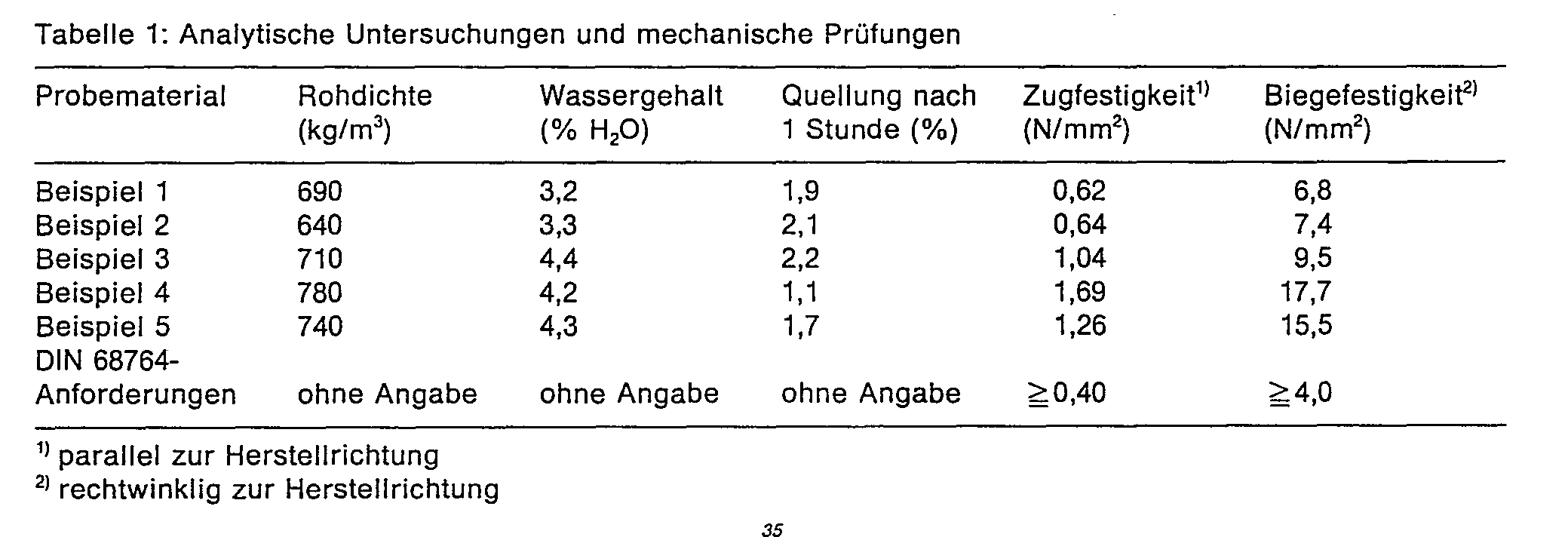
- Die Ergebnisse der analytischen Untersuchungen und der mechanischen Prüfungen sind in der Tabelle 1 aufgeführt.
- Es wurde analog Beispiel 1 gearbeitet mit der Abänderung, daß das Bindemittelgemisch aus
- 10,0 kg °°Suprasec 1249
- 7,0 kg Wasser bestand.
- Die Ergebnisse der analytischen Untersuchungen und der mechanischen Prüfungen sind in der Tabelle 1 aufgeführt.
- Es wurde analog Beispiel 1 gearbeitet mit der Abänderung, daß das Bindemittelgemisch aus
- 4,0 kg 1"Suprasec 1042 (aromatisches Polyisocyanat (MDI), wasseremulgierbar der Firma Deutsche ICI GmbH, Frankfurt
- 2,0 kg "Mobilcer A
- 6,0 kg Wasser bestand.
- Die Ergebnisse der analytischen Untersuchungen und der mechanischen Prüfungen sind in der Tabelle 1 aufgeführt.
- Es wurde analog Beispiel 1 gearbeitet mit der Abänderung, daß das Bindemittelgemisch aus 8,0 kg ®Suprasec 1042
- 2,0 kg ®Mobilcer A
- 6,0 kg Wasser
- bestand.
- Die Ergebnisse der analytischen Untersuchungen und der mechanischen Prüfungen sind in der Tabelle 1 aufgeführt.
- Es wurde analog Beispiel 1 gearbeitet mit der Abänderung, daß das Bindemittelgemisch aus 8,0 kg "Suprasec 1042
- 8,0 kg Wasser
- bestand.
- Die Ergebnisse der analytischen Untersuchungen und der mechanischen Prüfungen sind in der Tabelle 1 aufgeführt.
- In einem Mischer wurden
- 100 kg Holzspäne (Feuchtegehalt: 1,5%)
- 19 kg ®Exolit 456 (Firma HOECHST Aktiengesellschaft, Frankfurt) - Hierbei handelt es sich um ein Flammschutzmittel auf der Basis von Ammoniumpolyphosphat. Das Produkt wird durch Mikroverkapselung von Ammoniumpolyphosphat mit Melamin/Formaldehyd-Harzen hergestellt (EP 0033361). Der Phosphorgehalt liegt bei 29%, der Stickstoffgehalt bei 16,5%) -
- vorgemischt und dann mit einem unmittelbar vorher hergestellten Bindemittelgemisch aus 9,5 kg ""Suprasec 1042 11,5 kg Wasser bedüst.
- Nach einer Nachmischzeit von 2 Minuten wurde das Gemisch einer Strangpresse zugeführt und bei einer Temperatur von 170°C zu Röhrenspanplatten von 23 mm Dicke verarbeitet.
- Die Ergebnisse der analytischen Untersuchungen und der mechanischen Prüfungen sind in der Tabelle 2 aufgeführt.
- Die Ergebnisse der Brandprüfung sind in der Tabelle 3 aufgeführt.
- Es wurde analog Beispiel 1 gearbeitet mit den Abänderungen, daß
- 1. das Bindemittelgemisch aus 4,0 kg ®Suprasec 1042 8,0 kg Wasser
- 2. das Holzspan/Bindemittel-Gemisch in der Strangpresse bei einer Temperatur von 170°C zu Vollplatten von 10 mm Dicke verarbeitet wurde.
- Die Ergebnisse der analytischen Untersuchungen und der mechanischen Prüfungen sind in der Tabelle 4 aufgeführt.


Claims (4)
Priority Applications (1)
| Application Number | Priority Date | Filing Date | Title |
|---|---|---|---|
| AT85105398T ATE41622T1 (de) | 1984-05-05 | 1985-05-03 | Nach dem strangpressverfahren aus holzspaenen und/oder holzfasern unter zusatz von bindemitteln hergestellte formkoerper und verfahren zu ihrer herstellung. |
Applications Claiming Priority (6)
| Application Number | Priority Date | Filing Date | Title |
|---|---|---|---|
| DE19843416662 DE3416662A1 (de) | 1983-11-05 | 1984-05-05 | Schwerentflammbare strangpresskoerper, insbesondere strangpressplatten, sowie schwerentflammbare furnierte oder beschichtete strangpressplatten, ein verfahren zu ihrer herstellung und ihre verwendung |
| DE3416662 | 1984-05-05 | ||
| DE3436507 | 1984-10-05 | ||
| DE3436507 | 1984-10-05 | ||
| DE3507634 | 1985-03-05 | ||
| DE19853507634 DE3507634A1 (de) | 1984-10-05 | 1985-03-05 | Nach dem strangpressverfahren aus holzspaenen und/oder holzfasern unter zusatz von bindemitteln hergestellte formkoerper und verfahren zu ihrer herstellung |
Publications (2)
| Publication Number | Publication Date |
|---|---|
| EP0164555A1 EP0164555A1 (de) | 1985-12-18 |
| EP0164555B1 true EP0164555B1 (de) | 1989-03-22 |
Family
ID=27191943
Family Applications (1)
| Application Number | Title | Priority Date | Filing Date |
|---|---|---|---|
| EP85105398A Expired EP0164555B1 (de) | 1984-05-05 | 1985-05-03 | Nach dem Strangpressverfahren aus Holzspänen und/oder Holzfasern unter Zusatz von Bindemitteln hergestellte Formkörper und Verfahren zu ihrer Herstellung |
Country Status (2)
| Country | Link |
|---|---|
| EP (1) | EP0164555B1 (de) |
| DE (1) | DE3568956D1 (de) |
Families Citing this family (2)
| Publication number | Priority date | Publication date | Assignee | Title |
|---|---|---|---|---|
| GB8813396D0 (en) * | 1988-06-07 | 1988-07-13 | Earl H A | Composite materials |
| US6153668A (en) * | 1998-01-30 | 2000-11-28 | 3M Innovative Properties Company | Low density fire barrier material and method of making |
Family Cites Families (1)
| Publication number | Priority date | Publication date | Assignee | Title |
|---|---|---|---|---|
| DE2949537A1 (de) * | 1979-12-08 | 1981-06-11 | Hoechst Ag, 6000 Frankfurt | Teilchenfoermiges mittel zur verhinderung der brennbarkeit von brennenbaren stoffen |
-
1985
- 1985-05-03 EP EP85105398A patent/EP0164555B1/de not_active Expired
- 1985-05-03 DE DE8585105398T patent/DE3568956D1/de not_active Expired
Also Published As
| Publication number | Publication date |
|---|---|
| EP0164555A1 (de) | 1985-12-18 |
| DE3568956D1 (en) | 1989-04-27 |
Similar Documents
| Publication | Publication Date | Title |
|---|---|---|
| DE3150626C2 (de) | ||
| DE2026093C3 (de) | ||
| EP0877767A1 (de) | Verfahren zur herstellung von presswerkstoffen mit polyisocyanat-bindemitteln unter mitverwendung von latenten, wärmeaktivierbaren katalysatoren | |
| CH630841A5 (de) | Kochwasser- und witterungsbestaendiges zellulosefaserverstaerktes plattenmaterial und verfahren zu seiner herstellung. | |
| DE3881013T2 (de) | Verfahren zur herstellung von spanplatten mit aminoplastharzen. | |
| DE3128808A1 (de) | Klebstoffmasse und ihre verwendung | |
| EP0648807B1 (de) | Bindemittel auf der Basis von Gerbstoffen. | |
| DE3416662A1 (de) | Schwerentflammbare strangpresskoerper, insbesondere strangpressplatten, sowie schwerentflammbare furnierte oder beschichtete strangpressplatten, ein verfahren zu ihrer herstellung und ihre verwendung | |
| EP0340620B1 (de) | Verfahren zur Herstellung plattenförmiger Verbundstoffe | |
| EP0162974A1 (de) | Verfahren zur Herstellung von Holzformkörpern | |
| EP0164555A1 (de) | Nach dem Strangpressverfahren aus Holzspänen und/oder Holzfasern unter Zusatz von Bindemitteln hergestellte Formkörper und Verfahren zu ihrer Herstellung | |
| DE19604575A1 (de) | Verfahren zur Herstellung von Span- oder Faserplatten | |
| EP4129597B1 (de) | Zuckerhaltiges bindemittelsystem für holzwerkstoffplatten, ein verfahren zur herstellung einer holzwerkstoffplatte unter verwendung dieses zuckerhaltigen bindemittelsystems und holzwerkstoffplatte hergestellt nach diesem verfahren | |
| EP2000508B1 (de) | Verfahren zur Herstellung eines leichten flexiblen Formkörpers auf der Basis von lignocellulosehaltigen Fasern | |
| DE3507634A1 (de) | Nach dem strangpressverfahren aus holzspaenen und/oder holzfasern unter zusatz von bindemitteln hergestellte formkoerper und verfahren zu ihrer herstellung | |
| EP0639608A1 (de) | Hitzehärtende Bindemittel | |
| DE4406825A1 (de) | Bindemittel auf der Basis von Tannin | |
| EP0067426B1 (de) | Herstellung von Bauplatten unter Verwendung von Isocyanat/Aldehyd-Bindemitteln | |
| DE3147407A1 (de) | Pressplatte und verfahren zu deren herstellung | |
| EP3733366B1 (de) | Bindemittel zur herstellung von holzwerkstoffen | |
| EP1048424A2 (de) | Korkverbundplatte und Verfahren zur Herstellung einer solchen Verbundplatte | |
| DE1528258A1 (de) | Verfahren zur Herstellung von feuerfesten Holzspanplatten | |
| EP4141038B1 (de) | Bindemittelzusammensetzung und verfahren zum herstellen eines holzwerkstoffs sowie holzwerkstoff | |
| EP3944941A1 (de) | Herstellung von aminoplastharzen mittels extruder | |
| EP0500623B1 (de) | Zusatzmaterial zu kunststoffschaum und zu einem aus lignozellulosehaltigen stoffen gepressten holzwerkstoff |
Legal Events
| Date | Code | Title | Description |
|---|---|---|---|
| PUAI | Public reference made under article 153(3) epc to a published international application that has entered the european phase |
Free format text: ORIGINAL CODE: 0009012 |
|
| AK | Designated contracting states |
Designated state(s): AT BE CH DE FR GB IT LI LU NL SE |
|
| 17P | Request for examination filed |
Effective date: 19860110 |
|
| 17Q | First examination report despatched |
Effective date: 19870406 |
|
| RAP1 | Party data changed (applicant data changed or rights of an application transferred) |
Owner name: SAUERLAENDER SPANPLATTEN GMBH & CO. KG Owner name: HOECHST AKTIENGESELLSCHAFT |
|
| GRAA | (expected) grant |
Free format text: ORIGINAL CODE: 0009210 |
|
| AK | Designated contracting states |
Kind code of ref document: B1 Designated state(s): AT BE CH DE FR GB IT LI LU NL SE |
|
| REF | Corresponds to: |
Ref document number: 41622 Country of ref document: AT Date of ref document: 19890415 Kind code of ref document: T |
|
| REF | Corresponds to: |
Ref document number: 3568956 Country of ref document: DE Date of ref document: 19890427 |
|
| ET | Fr: translation filed | ||
| ITF | It: translation for a ep patent filed | ||
| PG25 | Lapsed in a contracting state [announced via postgrant information from national office to epo] |
Ref country code: LU Free format text: LAPSE BECAUSE OF NON-PAYMENT OF DUE FEES Effective date: 19890531 |
|
| GBT | Gb: translation of ep patent filed (gb section 77(6)(a)/1977) | ||
| PLBE | No opposition filed within time limit |
Free format text: ORIGINAL CODE: 0009261 |
|
| 26N | No opposition filed | ||
| PGFP | Annual fee paid to national office [announced via postgrant information from national office to epo] |
Ref country code: FR Payment date: 19900420 Year of fee payment: 6 |
|
| PGFP | Annual fee paid to national office [announced via postgrant information from national office to epo] |
Ref country code: SE Payment date: 19900423 Year of fee payment: 6 Ref country code: GB Payment date: 19900423 Year of fee payment: 6 |
|
| PGFP | Annual fee paid to national office [announced via postgrant information from national office to epo] |
Ref country code: AT Payment date: 19900430 Year of fee payment: 6 |
|
| PGFP | Annual fee paid to national office [announced via postgrant information from national office to epo] |
Ref country code: LU Payment date: 19900509 Year of fee payment: 6 |
|
| PGFP | Annual fee paid to national office [announced via postgrant information from national office to epo] |
Ref country code: BE Payment date: 19900515 Year of fee payment: 6 |
|
| PGFP | Annual fee paid to national office [announced via postgrant information from national office to epo] |
Ref country code: NL Payment date: 19900531 Year of fee payment: 6 |
|
| PGFP | Annual fee paid to national office [announced via postgrant information from national office to epo] |
Ref country code: DE Payment date: 19900712 Year of fee payment: 6 |
|
| PGFP | Annual fee paid to national office [announced via postgrant information from national office to epo] |
Ref country code: CH Payment date: 19900716 Year of fee payment: 6 |
|
| PG25 | Lapsed in a contracting state [announced via postgrant information from national office to epo] |
Ref country code: GB Effective date: 19910503 Ref country code: AT Effective date: 19910503 |
|
| PG25 | Lapsed in a contracting state [announced via postgrant information from national office to epo] |
Ref country code: SE Effective date: 19910504 |
|
| PG25 | Lapsed in a contracting state [announced via postgrant information from national office to epo] |
Ref country code: LI Effective date: 19910531 Ref country code: CH Effective date: 19910531 Ref country code: BE Effective date: 19910531 |
|
| BERE | Be: lapsed |
Owner name: SAUERLANDER SPANPLATTEN G.M.B.H. &CO K.G. Effective date: 19910531 Owner name: HOECHST A.G. Effective date: 19910531 |
|
| PG25 | Lapsed in a contracting state [announced via postgrant information from national office to epo] |
Ref country code: NL Effective date: 19911201 |
|
| GBPC | Gb: european patent ceased through non-payment of renewal fee | ||
| NLV4 | Nl: lapsed or anulled due to non-payment of the annual fee | ||
| PG25 | Lapsed in a contracting state [announced via postgrant information from national office to epo] |
Ref country code: FR Effective date: 19920131 |
|
| REG | Reference to a national code |
Ref country code: CH Ref legal event code: PL |
|
| PG25 | Lapsed in a contracting state [announced via postgrant information from national office to epo] |
Ref country code: DE Effective date: 19920303 |
|
| REG | Reference to a national code |
Ref country code: FR Ref legal event code: ST |
|
| ITTA | It: last paid annual fee | ||
| EUG | Se: european patent has lapsed |
Ref document number: 85105398.3 Effective date: 19911209 |