EP0165071A2 - Drehverteileinrichtungen - Google Patents
Drehverteileinrichtungen Download PDFInfo
- Publication number
- EP0165071A2 EP0165071A2 EP85304279A EP85304279A EP0165071A2 EP 0165071 A2 EP0165071 A2 EP 0165071A2 EP 85304279 A EP85304279 A EP 85304279A EP 85304279 A EP85304279 A EP 85304279A EP 0165071 A2 EP0165071 A2 EP 0165071A2
- Authority
- EP
- European Patent Office
- Prior art keywords
- conical
- subtable
- articles
- main table
- distributing
- Prior art date
- Legal status (The legal status is an assumption and is not a legal conclusion. Google has not performed a legal analysis and makes no representation as to the accuracy of the status listed.)
- Granted
Links
Images




Classifications
-
- G—PHYSICS
- G01—MEASURING; TESTING
- G01G—WEIGHING
- G01G19/00—Weighing apparatus or methods adapted for special purposes not provided for in the preceding groups
- G01G19/387—Weighing apparatus or methods adapted for special purposes not provided for in the preceding groups for combinatorial weighing, i.e. selecting a combination of articles whose total weight or number is closest to a desired value
- G01G19/393—Weighing apparatus or methods adapted for special purposes not provided for in the preceding groups for combinatorial weighing, i.e. selecting a combination of articles whose total weight or number is closest to a desired value using two or more weighing units
-
- Y—GENERAL TAGGING OF NEW TECHNOLOGICAL DEVELOPMENTS; GENERAL TAGGING OF CROSS-SECTIONAL TECHNOLOGIES SPANNING OVER SEVERAL SECTIONS OF THE IPC; TECHNICAL SUBJECTS COVERED BY FORMER USPC CROSS-REFERENCE ART COLLECTIONS [XRACs] AND DIGESTS
- Y10—TECHNICAL SUBJECTS COVERED BY FORMER USPC
- Y10S—TECHNICAL SUBJECTS COVERED BY FORMER USPC CROSS-REFERENCE ART COLLECTIONS [XRACs] AND DIGESTS
- Y10S177/00—Weighing scales
- Y10S177/11—Vibrators
Definitions
- the present invention relates to a distributing table construction, for use, for example, in a combinatorial weighing apparatus having a number of weighing machines disposed in a circular pattern and supplied with articles such as pieces of cheese or jelly charged downwardly for weighing these articles according to preset weights.
- a combinatorial weighing apparatus has ten weighing hoppers, for example, arranged in a circular pattern and supplied randomly with articles to be weighed. The weights are combineed and weight combinations are selected to find an optimum. weight combination which is slightly greater than a preset weight according to the theory and experiences of probability and statistics.
- Fig. 1 of the accompanying drawings shows such a disclosed combinatorial weighing apparatus.
- the combinatorial weighing apparatus generally designated at 1, has a frame 2 on which an upper frame 4 is mounted by a subframe 3.
- the upper frame 4 supports on its central portion a conical disk-shaped distributing table 6 disposed below an article charger 5 positioned above the frame I, the distributing table 6 being mounted on a vibrator 7 which is reciprocally vibratable through a prescribed angle in a circumferential direction.
- a plurality of (such as ten) troughs 8 (only two shown in Fig. 1 are disposed radially around the distributing table 6 and supported by suitable electromagnetic vibrators 9.
- the troughs 8 have their radially outward discharge ends positioned in pool hoppers 10, respectively, which have outlets opening toward weighing hoppers 12 supported on weight detectors 11 mounted on the frame 2 and including known load cells or the like.
- the weighing hoppers 12 have outlets opening toward lower collection chutes 13, 14.
- Articles to be weighed which are carried on a conveyor or the like are charged from the charger 5 onto the distributing table 6.
- the distributing table 6 is reciprocally vibrated and turned through the given angle in the circumferential direction to distribute the articles as uniformly as possible into the troughs 8 through which the articles are supplied into the pool hoppers 10.
- the pool hoppers 10 are controlled by driver units 15 supported on the upper frame 4 for opening and closing their lids to feed the articles into the weighing hoppers 12, whereupon the supplied articles are weighed by the weight detectors 11.
- Those weighing hoppers 12 which give an optimum weight combination that is slightly larger than a preset weight are determined by a microcomputer (not shown).
- These selected weighing hoppers 12 are driven by the driver units 15 controlled by a control unit to open their lids for discharging the articles into either the collection chute 13 or 14 from which the articles are delivered to a packaging machine, not shown.
- the internal construction of the combinatorial weighing apparatus 1 is complex especially because of the necessity for enabling the apparatus to take up a reduced space. Therefore, since if articles overflew from the vibrating distributing table 6 into the apparatus construction, the apparatus 1 would lead to malfunctioning, the apparatus 1 is required to be maintained and inspected at frequent intervals.
- the distributing table 6 has a conical shape formed generally as by pressing and hence having a simple slanterd surface.
- the distributing table 6, when vibrated and turned, supply the articles from its slanted conical surface substantially uniformly into the troughs 8 arranged around the distributing table 6.
- the troughs 8 are mounted on the electromagnetic vibrators 9 so that only those troughs 8 which have been selected to give an optimum weight combination and discharged the articles in a preceeding weighing cycle can be vibrated radially so as to be supplied with articles again.
- the bottoms of the troughs 8 are disposed downwardly of the peripheral edge of the distributing table 6.
- Articles to be distributed into the troughs 8 are temporarily stored on the distributing table 6 before they are supplied into the troughs 8.
- the corresponding troughs 8 are radially vibrated to advance the articles. If some of the weighing hoppers 12 are selected less frequently, then articles in the corresponding troughs 8 can be deposited therein and overflow from the rear ends of the troughs 8 onto the upper frame 4. If some weighing hoppers 12 are selected too frequently, then the corresponding troughs 8 are liable to run short of articles.
- the distributing table having the slanted suface designed to store the articles temporarily thereon tends to distribute and supply the sticky articles as masses and irregularly. Since the central portion of the distributing table as it is vibrated spirally is moved more vertically than circumferentially, articles are apt to remain deposited on the central portion of the table rather than being distributed radially outwardly. When such deposited articles are in excess of a certain limit, they collapse together and are supplied irregularly into the troughs.
- articles charged from above a distributing table construction disposed on an upper portion of a combinatorial weighing apparatus are supplied onto a smaller-diameter conical subtable slanted at a relatively large angle.
- the articles are then supplied from the conical subtable uniformly radially outwardly onto a larger-diameter conical main rable disposed beneath the conical subtable. Since the conical main table is slanted at an angle smaller than the angle of inclination of the conical subtable, the supplied articles can sufficiently be stocked but prevented from remaining deposited on the central portion of the main table so as to provide a sufficient supply of the articles to a number of radial troughs disposed around the main table.
- the articles are distributed and supplied from the peripheral edge of the main table into the radial troughs uniformly at a prescribed speed.
- the articles supplied to the radial troughs are then fed into pool hoppers from which the articles are charged into weighing hoppers.
- the articles in the weighing hoppers are weighed by weight detectors, and the detected weights are supplied to a computer which selects a weight combination that is slightly larger than a preset target weight.
- the lids of those weighing hoppers which give such a weight combination are opened to discharge the articles that are then delivered to a packaging machine.
- the distributing table construction has a lower conical main table and an upper conical subtable, the upper conical subtable having, a table body slanted at an angle larger than the slanting angle of the table body of the lower main table.
- Articles charged from above the distributing table construction are supplied quickly down the sharply slanting main table of the upper conical subtable onto the lower conical main table. Therefore, the articles are prevented from remaining deposited on the central portion of the conical main table.
- the articles can stably and sufficiently be supplied from the peripheral edge of the conical main table into the radial troughs since the articles as they are moved from the central portion to peripheral edge of the main table are not localized or become insufficient in quantity.
- the charged articles are first supplied onto the upper conical subtable ahd then onto the lower conical main table, the articles can be supplied uniformlly radially outwardly onto the central portion of the conical main table, and hence they can be reliably uniformly distributed and supplied from the main table into the radial troughs.
- the upper conical subtable can be adjusted in height with respect to the lower conical main table. Therefore, dependent on the property of articles to be weighed, the height of the upper conical subtable can sufficiently be adjusted for an optimum distribution and supply of articles of varying properties.
- Fig. 2 shows a distributing table construction according to a first embodiment of the present invention.
- the distributing table construction generally indicated by the reference character 6', is disposed on an upper end of a combinatorial weighing apparatus for weighing articles such as pieces of cheese or jelly.
- the distributing table construction 6' includes a lower conical main table 61 having a table body 18 in the form of a truncated cone slanted at a small angle.
- the main table 61 is supported on a circular plate 17 mounted by a bracket 16 on an electromagnetic vibrator 7 which is identical to the electromagnetic vibrator 7 shown in Fig. 1 for spiral vibratory motion.
- the distributing table construction 6' is surrounded by a number of radial troughs 8 (fourteen troughs, for example) arranged in a circular pattern.
- a conical subtable 62 is mounted on the upper portion of the conical main table 61 in concentric relation thereto, the conical subtable 62 having a maximum diameter smaller than the diameter of the bottom of the main table 61.
- the subtable 62 includes a table body 19 having its side slar-ted at an angle much larger than the angle of inclination of the table body 18 of the conical main table 61.
- a circular plate 20 is disposed in the table body 19 and welded thereto, with a weld nut 21 being welded centrally to the circular plate 20.
- the table body 18 of the lower conical main table 61 includes an upper horizontal portion having a central hole defined therein.
- a bracket 22 is mounted vertically on the center of the circular plate 17 disposed in the main table 61.
- a bolt 24 is attached to an end of the bracket 22 and extends through the central hole in the upper horizontal portion of the table body 18, which is fastened against the bracket 22 by a nut 23 to fix the table body 18 to the vibrator 7.
- the bolt 24 threadedly extends through the weld nut 21 and the circular plate 20 to position the conical subtable 62 concentrically with the lower conical main table 61.
- the weld nut 21 on the plate 20 is threaded over the bolt 24 from its upper end and the conical subtable 62 is turned until the lower edge of the table body 19 thereof is held against the table body 18 of the conical main table 61.
- the combinatorial weighing apparatus is operated for a combinatorial weighing operation.
- the vibrator 7 is actuated to spirally vibrate the distributing table construction 6' to enable articles such as pieces of cheese or jelly supplied from above to be distributed and supplied into the troughs arranged around the distributing table construction 6'.
- the articles suplied onto the upper conical subtable 62 directly from above are caused to flow quickly along the conical subtable 62 onto the table body 18 of the lower larger-diameter conical main table 61 since the side of the table body 19 is slanted sharply.
- the supplied articles do not flow quickly but tend to be deposited on the central portion of the table body 18 from which the articles are gradually supplied uniformly into the troughs 8 under distribution and supply action due to the spiral turning movement of the vibrator 7.
- the articles are deposited sufficiently on the central portion of the conical main table 61 since the articles.are quickly supplied from the upper conical subtable 62 toward the central portion of the conical main table 61.
- the articles are then distributed radially outwardly from the central portion of the conical main table 61 by the spiral turning movement caused by the vibrator 7. Therefore, the articles are prevented from being irregularly or locally positioned or reduced in number on the periperal edge of the main table 61.
- the distributing table construction 6' is therefore capable of operating to supply articles uniformly with time into the radial troughs 8 for enabling the troughs 8 to supply the articles to the pool hoppers 10 (Fig. 1) which are intermittently opened and closed as the weighing hoppers 12 (Fig. 1) are uniformly opened and closed intermittently.
- a lock nut may be disposed on the bolt 24 below the weld nut 21 for adjusting the height of the conical subtable 62 with respect to the conical main table 61 to thereby adjust the amount of articles to be deposited on the table body 18 at the lower end of the conical subtable 62.
- Fig. 3 shows a second embodiment of the invention in which a conical subtable 62' has a table body 19' with its side slanted more sharply than the table body 19 of Fig. 2.
- a weld nut 21' is fixed to the upper surface of a plate 20' integral with the lower end of the table body 19' and a lock nut 25 is held against the lower surface of the plate 20', the weld nut 21' and the lock nut 25 being threaded over the bolt 24.
- the distributing table construction is effective in supplying sticky articles which would otherwise find relative difficulty in getting supplied from the distributing table into the troughs.
- Fig. 4 shows a conical subtable 62" according to a third embodiment of the present invention.
- the conical subtable 62" has a table body 19" with its upper tip end rounded, a straight skirt portion 19" 1 extending from the lower end of the table body 19", and a plate 20" integral with the skirt portion 19"'.
- a weld nut 21' is integrally formed on the upper surface of the plate 20".
- the conical subtable 62" is suitable for use with articles in the form of chips as it prevents the articles from being stocked out of balance at the central portion of the conical main table beneath the conical subtable.
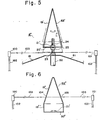
- Fig. 1 Many general combinatorial weighing machines including the combinatorial weighing machine shown in Fig. 1 incorporate an optical sensor mechanism for detecting the manner in which articles are deposited on the distributing table 6.
- the following embodiments are designed for use in combinatorial weighing apparatus having such optical sensor mechanisms.
- a light-emitting device 100 for emitting a narrow beam such as of infrared or visible light is composed of a light-emitting element such as of a semiconductor and a lens system for converging the light emitted from the light-emitting element into a beam.
- a light-detector device 101 for detecting the light beam from the light-emitting device 100 comprises a light-detector element such as of a semiconductor and a lens system for focusing the light beam from the light-emitting device 100 onto the light-detector element.
- the light-emitting device 100 and the light-detector device 101 are mounted on upstanding studs 102, respectively, supported on the frame 2 (Fig.
- the axis 103 of the light beam emitted from the light-emitting device 10 is deviated from a diametrical line of the main table 61. With this arrangement, the light beam generated by the light-emitting device 100 reaches the light-detector device 101 without being disturbed by the bolt 24.
- the light beam emitted from the light-emitting device 100 is not interrupted and is detected by the light-detector device 101, which issues a signal to a control system composed of a computer (not shown) which then generates a command for charging additional articles.
- a control system composed of a computer (not shown) which then generates a command for charging additional articles.
- articles are charged from the article charger 5 onto the conical subtable 62' from which they fall on the table body 18.
- the articles are then supplied into the pool hoppers 10.
- the light beam from the light-emitting device 100 is interrupted, and the light-detector device 101 detects such an beam interruption to stop supplying the articles from the charger 5.
- Fig. 6 shows a fifth embodiment which incorporates the conical subtable 62" of Fig. 4 for automatically supplying articles.
- the table body 19" of the conical subtable 62" has two light-transmitting windows 104, 105 defined therein, and the light-emitting device 100 and the light-detector device 101 are arranged to pass the light beam along the axis 103 through the light-transmitting windows 104, 105.
- the light-transmitting windows 104, 105 may be defined in the skirt portion 19"'.
- the light-transmitting windows 104, 105 are covered with panels of a material such as glass or synthetic resin capable of transmitting the light beam therethrough and have a size not to interrupt the light beam when the table 62" is moved vertically. Operation of the arrangement of Fig. 6 is the same as that of the arrangement of Fig. 5, and will not be described.
- Figs. 7 through 9 are illustrative of a sixth embodiment of the present invention.
- Fig. 7 shows a conical frame 163 made of a stainless steel sheet and having upper and lower ends 163a, 163b interconnected by four legs 163c through 163f.
- the upper and lower ends 163a, 163b and the four legs 163c, 163f jointly define four windows l63g through 163 j therebetween.
- the lower end 163b has four screw holes 163k.
- a plate 163m is fixed as by welding to the inner surface of the lower end 163b and supports a weld nut 163n welded centrally thereto.
- the frame 163 is covered with a conical cap 164 made of synthetic resin such as polycarbonate resin capable of passing a light beam therethrough or reinforced glass known as the trademark "Pyrex" capable of passing a light beam therethrough.
- the cap 164 has in its lower end screw holes 164a to be registered with the screw holes 163k in the lower end 163b of the frame 163.
- the cap 164 is fitted over the frame 163 as indicated by the dotted lines in Fig. 7, and flush screws are threaded through the screw holes 163k, 164a to interconnect the cap 164 and the frame 163, thus producing a conical subtable 162.
- the conical subtable 162 is threaded over the bolt 24 projecting from the upper end of the conical main table 61 and is secured to the table body 18 of the conical main table 61.
- a light beam emitted from the light-emitting device 100 passes through the cap 164 and a diametrical pair of the four windows 163g through 163j defined in the frame 163, and then reaches the light-detector device 101.
- light-emitting and light-detector devices may be mounted on studs on the frame 2, and the conical subtable 62 may be arranged so as not to interrupt the axis of the light beam emitted from the light-emitting device and detected by the light-detector device, so that the manner in which articles are deposited on the main table 61 can be detected by the light beam.
- a fin or blade may be attached to the lower portion of the conical subtable so that the same can be pulled away from the conical main table by gripping the fin or blade.
Landscapes
- Physics & Mathematics (AREA)
- General Physics & Mathematics (AREA)
- Basic Packing Technique (AREA)
- Branching, Merging, And Special Transfer Between Conveyors (AREA)
Applications Claiming Priority (2)
| Application Number | Priority Date | Filing Date | Title |
|---|---|---|---|
| JP88075/84U | 1984-06-15 | ||
| JP1984088075U JPS615431U (ja) | 1984-06-15 | 1984-06-15 | 組合せ計量装置の分散テ−ブル構造 |
Publications (3)
| Publication Number | Publication Date |
|---|---|
| EP0165071A2 true EP0165071A2 (de) | 1985-12-18 |
| EP0165071A3 EP0165071A3 (en) | 1987-04-08 |
| EP0165071B1 EP0165071B1 (de) | 1989-12-27 |
Family
ID=13932739
Family Applications (1)
| Application Number | Title | Priority Date | Filing Date |
|---|---|---|---|
| EP85304279A Expired EP0165071B1 (de) | 1984-06-15 | 1985-06-14 | Drehverteileinrichtungen |
Country Status (5)
| Country | Link |
|---|---|
| US (1) | US4607713A (de) |
| EP (1) | EP0165071B1 (de) |
| JP (1) | JPS615431U (de) |
| AU (1) | AU570117B2 (de) |
| DE (1) | DE3575018D1 (de) |
Cited By (2)
| Publication number | Priority date | Publication date | Assignee | Title |
|---|---|---|---|---|
| EP0313012A3 (de) * | 1987-10-21 | 1990-10-24 | Kabushiki Kaisha Ishida Koki Seisakusho | Aufbau eines Verteiltisches für ein kombinatorisches Wägesystem |
| EP0678738A1 (de) * | 1994-04-22 | 1995-10-25 | Rosalina Paniagua Olaechea | Aufbau eines Verteiltisches für ein Kombinationswägesystem |
Families Citing this family (12)
| Publication number | Priority date | Publication date | Assignee | Title |
|---|---|---|---|---|
| JPS62102126U (de) * | 1985-12-17 | 1987-06-29 | ||
| US5258581A (en) * | 1992-09-09 | 1993-11-02 | Triangle Package Machinery Company | Product feeding mechanism for a combination machine |
| US5646374A (en) * | 1994-12-06 | 1997-07-08 | The Paxall Group, Inc. | Conveyor for a combination weigher or the like |
| US6493605B1 (en) * | 2000-08-24 | 2002-12-10 | General Mills, Inc. | Method and apparatus for distributing food product bits to a packager, especially gelatin-based product bits |
| JP2002296098A (ja) * | 2001-03-30 | 2002-10-09 | Ishida Co Ltd | 組合せ計量装置 |
| JP3793449B2 (ja) * | 2001-11-15 | 2006-07-05 | 株式会社イシダ | 組合せ計量装置 |
| WO2004042335A1 (en) * | 2002-11-05 | 2004-05-21 | Cetech V/Claus Engelbrecht | Automatic combination weighing apparatus |
| WO2007034859A1 (ja) * | 2005-09-21 | 2007-03-29 | Ishida Co., Ltd. | 組合せ計量装置 |
| JP5302673B2 (ja) * | 2006-08-10 | 2013-10-02 | 株式会社イシダ | 計量装置 |
| JP6537347B2 (ja) * | 2015-05-14 | 2019-07-03 | 大和製衡株式会社 | 組合せ秤 |
| CN108454906B (zh) * | 2018-01-15 | 2023-10-24 | 中山天业智能装备科技有限公司 | 一种偏振组合秤 |
| JP7009235B2 (ja) * | 2018-01-29 | 2022-01-25 | 大和製衡株式会社 | 組合せ秤 |
Family Cites Families (6)
| Publication number | Priority date | Publication date | Assignee | Title |
|---|---|---|---|---|
| US4066164A (en) * | 1975-12-19 | 1978-01-03 | Easton Harlan J | Feeding mechanism for granular material |
| JPS5452594A (en) * | 1977-10-03 | 1979-04-25 | Fuji Electric Co Ltd | Coin handling device |
| JPS586233B2 (ja) * | 1977-10-31 | 1983-02-03 | 株式会社日立製作所 | メモリ |
| AU543930B2 (en) * | 1981-07-07 | 1985-05-09 | K.K. Ishida Koki Seisakusho | Dispensing feeder |
| JPS5839530U (ja) * | 1981-09-10 | 1983-03-15 | 株式会社石田衡器製作所 | 自動計量装置における被供給物の供給量制御装置 |
| AU565443B2 (en) * | 1982-10-01 | 1987-09-17 | K.K. Ishida Koki Seisakusho | Hopper for combination weigher |
-
1984
- 1984-06-15 JP JP1984088075U patent/JPS615431U/ja active Pending
-
1985
- 1985-06-13 AU AU43659/85A patent/AU570117B2/en not_active Ceased
- 1985-06-14 US US06/744,745 patent/US4607713A/en not_active Expired - Fee Related
- 1985-06-14 EP EP85304279A patent/EP0165071B1/de not_active Expired
- 1985-06-14 DE DE8585304279T patent/DE3575018D1/de not_active Expired - Fee Related
Cited By (2)
| Publication number | Priority date | Publication date | Assignee | Title |
|---|---|---|---|---|
| EP0313012A3 (de) * | 1987-10-21 | 1990-10-24 | Kabushiki Kaisha Ishida Koki Seisakusho | Aufbau eines Verteiltisches für ein kombinatorisches Wägesystem |
| EP0678738A1 (de) * | 1994-04-22 | 1995-10-25 | Rosalina Paniagua Olaechea | Aufbau eines Verteiltisches für ein Kombinationswägesystem |
Also Published As
| Publication number | Publication date |
|---|---|
| DE3575018D1 (de) | 1990-02-01 |
| AU4365985A (en) | 1985-12-19 |
| EP0165071A3 (en) | 1987-04-08 |
| AU570117B2 (en) | 1988-03-03 |
| US4607713A (en) | 1986-08-26 |
| EP0165071B1 (de) | 1989-12-27 |
| JPS615431U (ja) | 1986-01-13 |
Similar Documents
| Publication | Publication Date | Title |
|---|---|---|
| US4607713A (en) | Distributing table construction for use in combinational weighing apparatus | |
| US4516644A (en) | Apparatus for regulating flow of articles in computer scale | |
| EP0723140B1 (de) | Trichter für Kombinationswiegeapparat mit Führungsfläche für Artikel | |
| US4515231A (en) | Combinatorial weighing apparatus with serial weighing operations | |
| US6360870B1 (en) | Feeding and sorting apparatus | |
| US4570831A (en) | Dispersing feeder | |
| US4534429A (en) | Combinatorial weighing apparatus | |
| US5942732A (en) | Automatic weigh and count filling machine feed mechanism | |
| EP0083227B1 (de) | Kombinationswaage | |
| US4552236A (en) | Distribution table for controlling feed rate of articles supplied in automatic weighing apparatus | |
| GB2153092A (en) | Dispersion feeder | |
| CN105136266A (zh) | 一种保健茶称量下料装置 | |
| US5646374A (en) | Conveyor for a combination weigher or the like | |
| US4781308A (en) | Product feeding device | |
| US5258581A (en) | Product feeding mechanism for a combination machine | |
| EP0076113B1 (de) | Wiegeapparatur mit einer Reihe von Wiegemaschinen | |
| WO2004042335A1 (en) | Automatic combination weighing apparatus | |
| JPH04371414A (ja) | 分散供給装置 | |
| CN110479633B (zh) | 大蒜分级称重机构 | |
| RU186286U1 (ru) | Дозатор весовой универсальный с автоматическим управлением | |
| JP7669100B2 (ja) | 分散トレイ及びこれを備えた組合せ秤 | |
| JPH08145769A (ja) | 組合せ計量装置の被計量物分散供給装置 | |
| US5545856A (en) | Distribution system for a combination weigher or the like | |
| US3331507A (en) | Mechanical sorting device | |
| EP0307188A2 (de) | Sammeln von gewogenen Artikeln |
Legal Events
| Date | Code | Title | Description |
|---|---|---|---|
| PUAI | Public reference made under article 153(3) epc to a published international application that has entered the european phase |
Free format text: ORIGINAL CODE: 0009012 |
|
| AK | Designated contracting states |
Designated state(s): DE FR GB IT |
|
| PUAL | Search report despatched |
Free format text: ORIGINAL CODE: 0009013 |
|
| AK | Designated contracting states |
Kind code of ref document: A3 Designated state(s): DE FR GB IT |
|
| 17P | Request for examination filed |
Effective date: 19870826 |
|
| 17Q | First examination report despatched |
Effective date: 19880811 |
|
| GRAA | (expected) grant |
Free format text: ORIGINAL CODE: 0009210 |
|
| AK | Designated contracting states |
Kind code of ref document: B1 Designated state(s): DE FR GB IT |
|
| ET | Fr: translation filed | ||
| REF | Corresponds to: |
Ref document number: 3575018 Country of ref document: DE Date of ref document: 19900201 |
|
| ITF | It: translation for a ep patent filed | ||
| PLBE | No opposition filed within time limit |
Free format text: ORIGINAL CODE: 0009261 |
|
| STAA | Information on the status of an ep patent application or granted ep patent |
Free format text: STATUS: NO OPPOSITION FILED WITHIN TIME LIMIT |
|
| 26N | No opposition filed | ||
| PGFP | Annual fee paid to national office [announced via postgrant information from national office to epo] |
Ref country code: GB Payment date: 19910604 Year of fee payment: 7 |
|
| PGFP | Annual fee paid to national office [announced via postgrant information from national office to epo] |
Ref country code: DE Payment date: 19910611 Year of fee payment: 7 |
|
| PGFP | Annual fee paid to national office [announced via postgrant information from national office to epo] |
Ref country code: FR Payment date: 19910625 Year of fee payment: 7 |
|
| ITTA | It: last paid annual fee | ||
| PG25 | Lapsed in a contracting state [announced via postgrant information from national office to epo] |
Ref country code: GB Effective date: 19920614 |
|
| GBPC | Gb: european patent ceased through non-payment of renewal fee |
Effective date: 19920614 |
|
| PG25 | Lapsed in a contracting state [announced via postgrant information from national office to epo] |
Ref country code: FR Effective date: 19930226 |
|
| PG25 | Lapsed in a contracting state [announced via postgrant information from national office to epo] |
Ref country code: DE Effective date: 19930302 |
|
| REG | Reference to a national code |
Ref country code: FR Ref legal event code: ST |