EP0165410A2 - Faserverstärktes Material mit Kupfer enthaltender Matrix und Tonerde enthaltende Faser - Google Patents
Faserverstärktes Material mit Kupfer enthaltender Matrix und Tonerde enthaltende Faser Download PDFInfo
- Publication number
- EP0165410A2 EP0165410A2 EP85104980A EP85104980A EP0165410A2 EP 0165410 A2 EP0165410 A2 EP 0165410A2 EP 85104980 A EP85104980 A EP 85104980A EP 85104980 A EP85104980 A EP 85104980A EP 0165410 A2 EP0165410 A2 EP 0165410A2
- Authority
- EP
- European Patent Office
- Prior art keywords
- fibers
- composite material
- alumina
- equal
- weight
- Prior art date
- Legal status (The legal status is an assumption and is not a legal conclusion. Google has not performed a legal analysis and makes no representation as to the accuracy of the status listed.)
- Withdrawn
Links
- 239000000835 fiber Substances 0.000 title claims abstract description 106
- PNEYBMLMFCGWSK-UHFFFAOYSA-N aluminium oxide Inorganic materials [O-2].[O-2].[O-2].[Al+3].[Al+3] PNEYBMLMFCGWSK-UHFFFAOYSA-N 0.000 title claims abstract description 62
- 239000000463 material Substances 0.000 title claims abstract description 45
- 239000012783 reinforcing fiber Substances 0.000 title claims abstract description 30
- 239000010949 copper Substances 0.000 title claims abstract description 28
- RYGMFSIKBFXOCR-UHFFFAOYSA-N Copper Chemical compound [Cu] RYGMFSIKBFXOCR-UHFFFAOYSA-N 0.000 title claims abstract description 22
- 229910052802 copper Inorganic materials 0.000 title claims abstract description 21
- 239000011159 matrix material Substances 0.000 title claims abstract description 21
- 229910052751 metal Inorganic materials 0.000 title claims abstract description 21
- 239000002184 metal Substances 0.000 title claims abstract description 21
- 239000002131 composite material Substances 0.000 claims abstract description 87
- 239000002245 particle Substances 0.000 claims abstract description 56
- VYPSYNLAJGMNEJ-UHFFFAOYSA-N silicon dioxide Inorganic materials O=[Si]=O VYPSYNLAJGMNEJ-UHFFFAOYSA-N 0.000 claims abstract description 36
- 239000000377 silicon dioxide Substances 0.000 claims abstract description 27
- 239000002657 fibrous material Substances 0.000 claims abstract description 13
- 229910001369 Brass Inorganic materials 0.000 claims abstract description 12
- 229910045601 alloy Inorganic materials 0.000 claims abstract description 9
- 239000000956 alloy Substances 0.000 claims abstract description 9
- 239000010951 brass Substances 0.000 claims abstract description 8
- 229910000906 Bronze Inorganic materials 0.000 claims abstract description 6
- 239000010974 bronze Substances 0.000 claims abstract description 6
- KUNSUQLRTQLHQQ-UHFFFAOYSA-N copper tin Chemical compound [Cu].[Sn] KUNSUQLRTQLHQQ-UHFFFAOYSA-N 0.000 claims abstract description 6
- 238000012360 testing method Methods 0.000 description 39
- 229910000881 Cu alloy Inorganic materials 0.000 description 19
- 230000013011 mating Effects 0.000 description 16
- 238000004519 manufacturing process Methods 0.000 description 15
- 239000000203 mixture Substances 0.000 description 13
- 239000012779 reinforcing material Substances 0.000 description 7
- 238000003466 welding Methods 0.000 description 7
- 238000005266 casting Methods 0.000 description 6
- 238000005520 cutting process Methods 0.000 description 6
- 239000010935 stainless steel Substances 0.000 description 6
- 229910001220 stainless steel Inorganic materials 0.000 description 6
- 238000003754 machining Methods 0.000 description 5
- 238000011160 research Methods 0.000 description 5
- 230000008901 benefit Effects 0.000 description 4
- 230000003014 reinforcing effect Effects 0.000 description 4
- 239000003365 glass fiber Substances 0.000 description 3
- 238000000034 method Methods 0.000 description 3
- 238000005245 sintering Methods 0.000 description 3
- LFQSCWFLJHTTHZ-UHFFFAOYSA-N Ethanol Chemical compound CCO LFQSCWFLJHTTHZ-UHFFFAOYSA-N 0.000 description 2
- 239000011230 binding agent Substances 0.000 description 2
- 238000001816 cooling Methods 0.000 description 2
- 230000000694 effects Effects 0.000 description 2
- 230000008030 elimination Effects 0.000 description 2
- 238000003379 elimination reaction Methods 0.000 description 2
- 230000006872 improvement Effects 0.000 description 2
- 239000002557 mineral fiber Substances 0.000 description 2
- 238000012545 processing Methods 0.000 description 2
- 230000002787 reinforcement Effects 0.000 description 2
- QGZKDVFQNNGYKY-UHFFFAOYSA-N Ammonia Chemical compound N QGZKDVFQNNGYKY-UHFFFAOYSA-N 0.000 description 1
- OKTJSMMVPCPJKN-UHFFFAOYSA-N Carbon Chemical compound [C] OKTJSMMVPCPJKN-UHFFFAOYSA-N 0.000 description 1
- 229910000831 Steel Inorganic materials 0.000 description 1
- 230000004075 alteration Effects 0.000 description 1
- 230000003466 anti-cipated effect Effects 0.000 description 1
- 239000008119 colloidal silica Substances 0.000 description 1
- 239000002826 coolant Substances 0.000 description 1
- 238000000354 decomposition reaction Methods 0.000 description 1
- 239000010439 graphite Substances 0.000 description 1
- 229910002804 graphite Inorganic materials 0.000 description 1
- 239000010687 lubricating oil Substances 0.000 description 1
- 238000005259 measurement Methods 0.000 description 1
- 238000012986 modification Methods 0.000 description 1
- 230000004048 modification Effects 0.000 description 1
- 239000010705 motor oil Substances 0.000 description 1
- 230000002093 peripheral effect Effects 0.000 description 1
- 239000011148 porous material Substances 0.000 description 1
- 239000000843 powder Substances 0.000 description 1
- 238000004663 powder metallurgy Methods 0.000 description 1
- 239000010959 steel Substances 0.000 description 1
- 238000007666 vacuum forming Methods 0.000 description 1
- XLYOFNOQVPJJNP-UHFFFAOYSA-N water Substances O XLYOFNOQVPJJNP-UHFFFAOYSA-N 0.000 description 1
Images


Classifications
-
- C—CHEMISTRY; METALLURGY
- C22—METALLURGY; FERROUS OR NON-FERROUS ALLOYS; TREATMENT OF ALLOYS OR NON-FERROUS METALS
- C22C—ALLOYS
- C22C49/00—Alloys containing metallic or non-metallic fibres or filaments
-
- C—CHEMISTRY; METALLURGY
- C22—METALLURGY; FERROUS OR NON-FERROUS ALLOYS; TREATMENT OF ALLOYS OR NON-FERROUS METALS
- C22C—ALLOYS
- C22C47/00—Making alloys containing metallic or non-metallic fibres or filaments
- C22C47/02—Pretreatment of the fibres or filaments
- C22C47/06—Pretreatment of the fibres or filaments by forming the fibres or filaments into a preformed structure, e.g. using a temporary binder to form a mat-like element
-
- C—CHEMISTRY; METALLURGY
- C22—METALLURGY; FERROUS OR NON-FERROUS ALLOYS; TREATMENT OF ALLOYS OR NON-FERROUS METALS
- C22C—ALLOYS
- C22C47/00—Making alloys containing metallic or non-metallic fibres or filaments
- C22C47/08—Making alloys containing metallic or non-metallic fibres or filaments by contacting the fibres or filaments with molten metal, e.g. by infiltrating the fibres or filaments placed in a mould
-
- Y—GENERAL TAGGING OF NEW TECHNOLOGICAL DEVELOPMENTS; GENERAL TAGGING OF CROSS-SECTIONAL TECHNOLOGIES SPANNING OVER SEVERAL SECTIONS OF THE IPC; TECHNICAL SUBJECTS COVERED BY FORMER USPC CROSS-REFERENCE ART COLLECTIONS [XRACs] AND DIGESTS
- Y10—TECHNICAL SUBJECTS COVERED BY FORMER USPC
- Y10S—TECHNICAL SUBJECTS COVERED BY FORMER USPC CROSS-REFERENCE ART COLLECTIONS [XRACs] AND DIGESTS
- Y10S428/00—Stock material or miscellaneous articles
- Y10S428/922—Static electricity metal bleed-off metallic stock
- Y10S428/9265—Special properties
- Y10S428/929—Electrical contact feature
-
- Y—GENERAL TAGGING OF NEW TECHNOLOGICAL DEVELOPMENTS; GENERAL TAGGING OF CROSS-SECTIONAL TECHNOLOGIES SPANNING OVER SEVERAL SECTIONS OF THE IPC; TECHNICAL SUBJECTS COVERED BY FORMER USPC CROSS-REFERENCE ART COLLECTIONS [XRACs] AND DIGESTS
- Y10—TECHNICAL SUBJECTS COVERED BY FORMER USPC
- Y10T—TECHNICAL SUBJECTS COVERED BY FORMER US CLASSIFICATION
- Y10T428/00—Stock material or miscellaneous articles
- Y10T428/12—All metal or with adjacent metals
- Y10T428/12465—All metal or with adjacent metals having magnetic properties, or preformed fiber orientation coordinate with shape
-
- Y—GENERAL TAGGING OF NEW TECHNOLOGICAL DEVELOPMENTS; GENERAL TAGGING OF CROSS-SECTIONAL TECHNOLOGIES SPANNING OVER SEVERAL SECTIONS OF THE IPC; TECHNICAL SUBJECTS COVERED BY FORMER USPC CROSS-REFERENCE ART COLLECTIONS [XRACs] AND DIGESTS
- Y10—TECHNICAL SUBJECTS COVERED BY FORMER USPC
- Y10T—TECHNICAL SUBJECTS COVERED BY FORMER US CLASSIFICATION
- Y10T428/00—Stock material or miscellaneous articles
- Y10T428/12—All metal or with adjacent metals
- Y10T428/12486—Laterally noncoextensive components [e.g., embedded, etc.]
Definitions
- the present invention relates to a fiber reinforced material, and in particular to a fiber reinforced material in which the matrix metal is copper or a copper alloy and the reinforcing material is alumina - silica type fibers containing at least a certain amount of alumina, said fiber reinforced material being particularly suitable for use as a material for forming electrical contacts and the like.
- the inventors of the present invention have considered the problems s outlined above with respect to pure copper and copper alloys as used for manufacture of sliding members and electrical contact members and so on, and have undertaken various experimental researches in this connection some of which will be detailed later in this specification, as a result of which they have discovered the advantage of reinforcing a matrix metal such as copper or a copper alloy with a reinforcing material which is a fiber material containing alumina, and they have further discovered the necessity of maintaining such values as the volume proportion of the alumina containing fibers and the total amount of non fibrous particles inevitably included therein within certain prescribed limits.
- a composite material composed essentially of a matrix metal which is copper or an alloy thereof, and a reinforcing fiber material which is a collection of alumina - silica type short fibers in which the included amount of alumina is about 40% by weight or more, with the total amount of non fibrous particles included in said collection of fibers being less than or equal to about 7% by weight, with the total amount of non fibrous particles with diameter greater than or equal to about 150 microns included in said collection of fibers being less than or equal to about 1% by weight, and with the volume proportion of said short fiber material being from about 0.5% to about 30%.
- a composite material which has very good sliding characteristics, and which has good electrical conductivity, which can be substantially equal to that of copper and alloys of copper.
- This composite material has good characteristics with regard to wear on a member made of the material itself, during frictional wear against another cooperating member, and also has good characteristics with regard to wear on said cooperating member. Further, this composite material is not particularly liable to scuffing of a member made of the material itself, during such frictional wear against another member, or to scuffing of said cooperating member. And this composite material has good anti burning characteristics, and thus is suitable for manufacturing electrical contact members, especially ones which are to be required to function in extreme conditions. Further, this composite material is also particularly suitable for the manufacture of welding tips.
- the copper or copper alloy matrix metal for the composite material of the present invention there may be selected pure copper or a copper alloy which has vastly superior electrical conductivity as compared to copper alloys which are conventionally used for the manufacture of electrical contact members; and in this case, as will become clear from the detailed explanations which are given later in this specification, according to the results of the experimental researches which have been performed by the inventors of the present invention, even when the volume proportion of the alumina - silica type reinforcing fibers is in a relatively small region, satisfactory wear resistance for the composite material according to the present invention can be assured, and thereby the amount of wear both on parts made of the present composite material and on mating or cooperating parts can be satisfactorily minimized, and machinability can be increased.
- Alumina - silica type short fibers are generally classified into glass fibers, so called silica - alumina fibers, and alumina fibers.
- glass fibers which have an alumina content of 40% by weight or less, have a low heat resistance and lose their strength at a relatively low temperature, and accordingly, when these fibers are heated up to a high temperature such as a typical temperature which is necessary for them to be composited with copper alloy, the strength and hardness characteristics which were present when these glass fibers were kept in the amorphous state are deteriorated, and their nature as reinforcing fibers is worsened; thereby the effectiveness of the improvement obtained in the strength and wear resistance characteristics of the resulting composite material is lowered.
- these reinforcing fibers are not suitable as reinforcing material for composite materials whose matrix material is copper or a copper alloy.
- so called silica - alumina fibers which have an alumina content of 40% by weight or more, and also substantially pure alumina fibers, have high heat resistance, and accordingly are not substantially deteriorated when they are heated up to a high temperature such as a typical temperature which is necessary for them to be composited with copper alloy, and the strength and hardness characteristics which are present when these fibers are in the room temperature state are not significantly deteriorated during such composition, and their nature as reinforcing fibers is not significantly worsened; thereby the effectiveness of the improvement obtained in the strength and wear resistance characteristics of the resulting composite material is not significantly lowered.
- the alumina - silica fibers used as reinforcing fibers for the copper or copper alloy matrix material, in the present invention should have an alumina content of 40% by weight or more, in other words should be so called silica - alumina fibers or should be alumina fibers. And in particular the use of alumina fibers which have a high proportion of alpha alumina, or which are substantially entirely made of alpha alumina, are preferred.
- non fibrous particles or shot type particles
- These non fibrous particles have a hardness Hv equal to 500 or more, and their typical size of a diameter of from some tens to some hundreds of microns is very much larger than the typical size of the diameter of the fibers, which is some few microns. Therefore, when a collection of fibers including such non fibrous particles is used as reinforcing material for a composite material, the workability is much deteriorated, and severe wear is liable to occur on a mating element which is in frictional contact with a member made out of the composite material.
- these large non fibrous particles are liable to be the cause of damage such as scuffing, both to such a mating element, and to the part made out of the composite material itself, because, during such frictional rubbing, these non fibrous particles are quite likely to become detached from the matrix metal and to come loose to move within the space between the part and the mating element. Similar problems are likely to be caused during machining of a part made out of the composite material, with regard to wear on a machining tool therefor.
- a criterion for the composite material according to the present invention should be that its reinforcing fiber mass should contain not more than 7% by weight of non fibrous particles and not more than 1% by weight of non fibrous particles with a diameter of greater than equal to 150 microns, which are the ones which particularly cause wear and scuffing, and preferably should contain not more than 4% by weight of such non fibrous particles and not more than 0.6% by weight of such non fibrous particles with a diameter of greater than equal to 150 microns.
- a criterion for the composite material according to the present invention should be that the fiber volume proportion of its reinforcing fiber mass should be between 0.5% and 30%, and more preferably should be between 1.0% and 25%.
- the fiber volume proportion is less than about 0.5%, then the wear resistance of the resulting composite material becomes insufficient; but if on the other hand the fiber volume proportion is greater than about 30%, then again the wear resistance of the resulting composite material is insufficient, and also the wear amount on a mating member is increased. In fact, even further, in virtue of the desirability of maximizing the electrical conductivity of the composite material, it is considered to be desirable that the fiber volume proportion should, more preferably, be limited to about 10%.
- the wear resistances of sectional surfaces extending parallel to the z axis is slightly superior to the wear resistance of sectional surfaces which are perpendicular to said z axis, on account of the larger number of short fibers cut across their bodies at relatively large angles by said surfaces on average; and further the conductivity in directions perpendicular to the z axis is superior to the conductivity in the direction of the z axis.
- the reinforcing short fibers are layered as described above preferentially in planes parallel to the x-y plane, it is considered to be best for the part to be so aligned with respect to the piece of composite material from which it is manufactured that a surface of which particularly heavy demands are going to be made with respect to wear resistance and heat resistance should be aligned generally parallel to the z axis, and that a direction requiring superior electrical conductivity should be aligned generally perpendicularly to the z axis.
- Fig. 1 is a set of graphs, showing the results of friction wear tests on certain composite material samples relating to the second preferred embodiment of the present invention, and showing above the horizontal axis the amount of wear on the wear test sample itself in microns and below the horizontal axis the amount of wear on a stainless steel mating member in milligrams, the dashed lines in this figure relating to samples including "Kaowool” type alumina - silica reinforcing fibers, while the solid lines relate to samples including "Saffil” type alumina reinforcing fibers and the two crosses relate to a lone sample including "Fiber FP" type alpha alumina reinforcing fibers;
- Fig. 3 is a schematic vertical sectional view taken through a high pressure casting device used for the manufacture of this first preferred embodiment.
- the reference numeral 3 denotes a mold, which is formed with a mold cavity 4.
- a pressure piston 6 cooperates with this mold cavity 4 and is pressed downwards in the figure by a means, not shown, so as to apply pressure to a quantity 5 of molten metal which is being received in said mold cavity 4 as surrounding a preform 1 made of porous material previously placed in said mold cavity 4.
- the quantity 5 of molten metal has solidified, the resulting cast piece is removed from the mold cavity 4, after the pressure piston 6 has been withdrawn, by the use of a knock out pin 9.
- each of these masses of fibers was dispersed in colloidal silica, and the mixture was stirred up so that the mineral fibers therein were evenly dispersed, and then by the vacuum forming method a preform 1 of dimensions about 20 mm by about 80 mm by about 80 mm was formed, as shown in perspective view in Fig. 2.
- Each of these preforms 1 was then fired at a temperature of about 600°C, so that the silica was completely dried to hold together the individual fibers of said preform 1 by acting as a binder.
- the fibers of the preform 1 were oriented generally randomly and isotropically within planes parallel to the x-y plane in Fig. 2 (i.e. in planes parallel to the 80 mm by 80 mm surface of the preform 1), but lay preferentially in these planes, i.e. were stacked in layers in these planes.
- a casting process was performed, as schematically shown in section in Fig. 3.
- the preform 1 was placed into the mold cavity 4 of the casting mold 3 which itself was at this time heated up to a temperature of about 350°C, and then a quantity 3 of molten metal for serving as a matrix metal, in the case of this first preferred embodiment being molten brass of type JIS (Japanese Industrial Standard) YBsC2 and being heated up to a temperature of about 1080°C, was poured into the mold cavity 4 over and around the preform 1.
- JIS Japanese Industrial Standard
- a criterion for the composite material according to the present invention should be that its reinforcing fiber mass should contain not more than 7% by weight of non fibrous particles and not more than 1% by weight of non fibrous particles with a diameter of greater than equal to 150 microns, and preferably should contain not more than 4% by weight of non fibrous particles and not more than 0.6% by weight of non fibrous particles with a diameter of greater than equal to 150 microns.
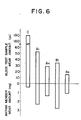
- Fig. 6 shows the results of these friction wear tests. Above the horizontal axis in Fig. 6, there is shown the amount of wear on the wear test sample itself in microns, and below the horizontal axis there is shown the amount of wear on the stainless steel mating member in milligrams. From these wear test results, the following conclusions can be drawn. First, in the case of all the fiber reinforced materials Al, A4, Bl, and B4, i.e. both for those (Al and A4) which contained alumina - silica type fibers and for those (Bl and B4) which contained fibers made substantially of alumina only, the wear amount on the material itself was very much less than the wear amount on the test sample piece made only of brass without any reinforcing fiber material.
- a criterion for the composite material according to the present invention should be that its reinforcing fiber mass should contain not more than 7% by weight of non fibrous particles and not more than 1% by weight of non fibrous particles with a diameter of greater than equal to 150 microns, and preferably should contain not more than 4% by weight of non fibrous particles and not more than 0.6% by weight of non fibrous particles with a diameter of greater than equal to 150 microns.
- Each of these blocks was then sintered for about 30 minutes in a batch type sintering furnace which was heated up to a temperature of about 770°C in an atmosphere of decomposition ammonia gas (with dew point about -30°C), and was then cooled slowly in a cooling zone of the sintering furnace.
- thirteen blocks of composite material were formed, and then friction wear test samples, respectively designated by the reference symbols A6 through A10 and B5 through Bll and D of their parent powders as shown in Table 2, were cut from each of them.
- a friction wear test was carried out in the same conditions as in the case of the first preferred embodiment of the present invention described above, with the face of the test sample piece which was parallel to the x-z plane in Fig. 2 being the one which was tested.
- Fig. 1 shows in the form of graphs the results of these friction wear tests. Above the horizontal axis in Fig. 1, there is shown the amount of wear on the wear test sample itself in microns, and below the horizontal axis there is shown the amount of wear on the stainless steel mating member in milligrams; and the dashed lines relate to the "Kaowool” alumina - silica fiber samples, while the solid lines relate to the "Saffil” alumina fiber samples and the two crosses relate to the lone "Fiber FP" alpha alumina fiber sample. From these wear test results, the following conclusions can be drawn.
- a criterion for the composite material according to the present invention should be that the fiber volume proportion of its reinforcing fiber mass should be between 0.5% and 30%, and more preferably should be between 1.0% and 25%. Further, particularly in the case that the composite material of the present invention is to be used for example in an electrically conducting member which will be subject to mechanical sliding friction from another member, in view of the desirability of providing high electrical conductivity for the composite material of the present invention, it is desirable that the fiber volume proportion of its reinforcing fiber mass should be between 0.5% and 10%, and more preferably should be between 1.0% and 5%.
- the composite material according to the present invention manufactured in this embodiment was to a very large extent better in wear resistance and in wear characteristics as regards a mating member and had high electrical conductivity, in comparison with copper alloys highly esteemed in the current art for use in electrical contact members, such as: an alloy of 40% by weight of Zn with balance Cu, an alloy of 10% by weight of Sn with balance Cu, an alloy of 2.4% by weight of Be with balance Cu, an alloy of 60% by weight of Pd with balance Cu, and an alloy of 0.5% by weight Cr with balance Cu.
- a quantity of pure copper powder (manufactured by Fukuda Kinzoku Hakufun KK, of nominal purity 99.9% by weight) with an average particle diameter of about 20 microns, and a quantity of alumina fibers of type "FP fiber” (this is a trademark) manufactured by DuPont, were combined so that the volume proportion of fibers was 5%; and the mixture was mixed in a mixture agitator for about 5 minutes. Next, the mixture was put into a graphite mold having a cylindrical cavity with an internal diameter of 50 mm, and this was mounted in a vacuum hot press and the pressure inside the vacuum hot press was reduced to 5 x 10 3 torr.
- the mixture was then heated up to a temperature of about 930°C over a period of about 40 minutes, and then was maintained at this temperature for about 5 minutes, so that it was certainly heated all the way through to its interior. Then, the mixture was pressurized by a punch to a pressure of about 200 kg/cm 3 , and this pressure and temperature were maintained for a further period of about 5 minutes. The mixture was then cooled down as far as to a temperature of about 800°C with the pressure being maintained, after which the pressure was released and the mixture was allowed to cool down further in a cooling chamber. From the resulting cylindrical piece of composite material there was then formed by machining a spot welding tip of diameter about 50 mm and height about 15 mm.
- this composite material according to the present invention further has good anti burning characteristics, and thus is suitable for manufacturing electrical contact members, especially ones which are to be required to function in extreme conditions. Further, this composite material according to the present invention is also particularly suitable for the manufacture of welding tips, as shown from the description of the third preferred embodiment of the present invention given above.
Landscapes
- Chemical & Material Sciences (AREA)
- Engineering & Computer Science (AREA)
- Materials Engineering (AREA)
- Mechanical Engineering (AREA)
- Metallurgy (AREA)
- Organic Chemistry (AREA)
- Crystallography & Structural Chemistry (AREA)
- Manufacture Of Alloys Or Alloy Compounds (AREA)
Applications Claiming Priority (2)
| Application Number | Priority Date | Filing Date | Title |
|---|---|---|---|
| JP127127/84 | 1984-06-20 | ||
| JP59127127A JPS616242A (ja) | 1984-06-20 | 1984-06-20 | 繊維強化金属複合材料 |
Publications (2)
| Publication Number | Publication Date |
|---|---|
| EP0165410A2 true EP0165410A2 (de) | 1985-12-27 |
| EP0165410A3 EP0165410A3 (de) | 1987-12-09 |
Family
ID=14952275
Family Applications (1)
| Application Number | Title | Priority Date | Filing Date |
|---|---|---|---|
| EP85104980A Withdrawn EP0165410A3 (de) | 1984-06-20 | 1985-04-24 | Faserverstärktes Material mit Kupfer enthaltender Matrix und Tonerde enthaltende Faser |
Country Status (3)
| Country | Link |
|---|---|
| US (1) | US4656100A (de) |
| EP (1) | EP0165410A3 (de) |
| JP (1) | JPS616242A (de) |
Cited By (3)
| Publication number | Priority date | Publication date | Assignee | Title |
|---|---|---|---|---|
| EP0181996A3 (en) * | 1984-10-18 | 1987-10-14 | Toyota Jidosha Kabushiki Kaisha | Composite material including reinforcing mineral fibers embedded in matrix metal |
| CN101880814A (zh) * | 2010-07-02 | 2010-11-10 | 北京工业大学 | 一种耐磨导电导热材料及其制备方法 |
| CN111996408A (zh) * | 2020-08-27 | 2020-11-27 | 河南科技大学 | 一种氧化物陶瓷粒子增强Cu基复合材料的制备方法 |
Families Citing this family (4)
| Publication number | Priority date | Publication date | Assignee | Title |
|---|---|---|---|---|
| JPH0676655B2 (ja) * | 1986-04-30 | 1994-09-28 | 三菱重工業株式会社 | 耐熱耐エロ−ジヨン部材とその製造法 |
| CN102051549B (zh) * | 2011-01-14 | 2012-06-13 | 南京信息工程大学 | 一种耐热铜合金材料及制备方法 |
| CN102051553A (zh) * | 2011-01-14 | 2011-05-11 | 南京信息工程大学 | 一种耐磨铜合金材料及制备方法 |
| CN102071375A (zh) * | 2011-01-14 | 2011-05-25 | 南京信息工程大学 | 一种耐蚀铜合金材料及制备方法 |
Family Cites Families (12)
| Publication number | Priority date | Publication date | Assignee | Title |
|---|---|---|---|---|
| US3084421A (en) * | 1960-10-21 | 1963-04-09 | David L Mcdanels | Reinforced metallic composites |
| US3218697A (en) * | 1962-07-20 | 1965-11-23 | Horizons Inc | Method of preparing fiber reinforced metals |
| US3663356A (en) * | 1968-10-23 | 1972-05-16 | Chou H Li | Reinforced metal-matrix composites |
| SU377428A2 (de) * | 1970-12-03 | 1973-04-17 | ||
| US3940262A (en) * | 1972-03-16 | 1976-02-24 | Ethyl Corporation | Reinforced foamed metal |
| US4127700A (en) * | 1973-10-12 | 1978-11-28 | G. Rau | Metallic material with additives embedded therein and method for producing the same |
| US4294616A (en) * | 1979-01-02 | 1981-10-13 | Gte Products Corporation | Electrical contacts |
| JPS602149B2 (ja) * | 1980-07-30 | 1985-01-19 | トヨタ自動車株式会社 | 複合材料の製造方法 |
| US4489138A (en) * | 1980-07-30 | 1984-12-18 | Sumitomo Chemical Company, Limited | Fiber-reinforced metal composite material |
| US4465741A (en) * | 1980-07-31 | 1984-08-14 | Sumitomo Chemical Company, Limited | Fiber-reinforced metal composite material |
| CA1213157A (en) * | 1981-12-02 | 1986-10-28 | Kohji Yamatsuta | Process for producing fiber-reinforced metal composite material |
| DE19611126A1 (de) * | 1996-03-21 | 1997-09-25 | Heidelberger Druckmasch Ag | Reinigungseinrichtung an Rotationsdruckmaschinen |
-
1984
- 1984-06-20 JP JP59127127A patent/JPS616242A/ja active Pending
-
1985
- 1985-04-16 US US06/723,759 patent/US4656100A/en not_active Expired - Fee Related
- 1985-04-24 EP EP85104980A patent/EP0165410A3/de not_active Withdrawn
Cited By (3)
| Publication number | Priority date | Publication date | Assignee | Title |
|---|---|---|---|---|
| EP0181996A3 (en) * | 1984-10-18 | 1987-10-14 | Toyota Jidosha Kabushiki Kaisha | Composite material including reinforcing mineral fibers embedded in matrix metal |
| CN101880814A (zh) * | 2010-07-02 | 2010-11-10 | 北京工业大学 | 一种耐磨导电导热材料及其制备方法 |
| CN111996408A (zh) * | 2020-08-27 | 2020-11-27 | 河南科技大学 | 一种氧化物陶瓷粒子增强Cu基复合材料的制备方法 |
Also Published As
| Publication number | Publication date |
|---|---|
| US4656100A (en) | 1987-04-07 |
| JPS616242A (ja) | 1986-01-11 |
| EP0165410A3 (de) | 1987-12-09 |
Similar Documents
| Publication | Publication Date | Title |
|---|---|---|
| EP0182959B1 (de) | Verbundwerkstoff mit Innenarmierung in Form von Tonerdesilikatfasern die kristallinen Mullit enthalten | |
| US4207096A (en) | Method of producing graphite-containing copper alloys | |
| CA1182309A (en) | Dimensionally-controlled cobalt-containing precision molded metal article | |
| EP0100470B1 (de) | Hitzebeständiges und Verschleissbeständiges Aluminiumlegierungspulver mit guten mechanischen Eigenschaften und daraus hergestellte Gegenstände | |
| US3037857A (en) | Aluminum-base alloy | |
| JPH06238421A (ja) | 金属マトリックス複合材料およびその製造法 | |
| US4615733A (en) | Composite material including reinforcing mineral fibers embedded in matrix metal | |
| US20170021421A1 (en) | Copper-based alloys and their use for infiltration of powder metal parts | |
| US11821059B2 (en) | Ni-based alloy, Ni-based alloy powder, Ni-based alloy member, and product including Ni-based alloy member | |
| US4656100A (en) | Fiber reinforced material with matrix metal containing copper and reinforcing fibers containing alumina | |
| KR910003442B1 (ko) | 자체 윤활성 소결 베어링 및 그 제조방법 | |
| EP0192805A2 (de) | Verbundmaterial einer metallischen Matrix verstärkt mit einem Gemisch von kristallinen Aluminiumoxid-Siliciumoxid-Fasern und minerale Fasern | |
| EP0192806B1 (de) | Verbundmaterial einer metallischen Matrix verstärkt mit einem Gemisch von amorphen Aluminiumoxid-Siliciumoxid-Fasern und minerale Fasern | |
| KR910001357B1 (ko) | 내마모층을 형성하는 방법 | |
| EP1132490B1 (de) | Kolben mit einem metallischen verbundwerkstoff | |
| US5380482A (en) | Method of manufacturing ingots for use in making objects having high heat, thermal shock, corrosion and wear resistance | |
| US2906007A (en) | Sintered bearing composition | |
| US2828226A (en) | Method of interstitially casting metal in high melting skeleton bodies | |
| CA3138161C (en) | Iron-based alloy sintered body and iron-based mixed powder for powder metallurgy | |
| JPH01230743A (ja) | 金型用アルミニウム合金材料 | |
| Balasubramani | Indentation Creep and Hardness Response of Tin-Alumina Metal Matrix Composites | |
| JPS62146237A (ja) | 高耐熱性超硬合金 | |
| JPH0797644A (ja) | 金属基複合体およびその製造方法 | |
| CA3138161A1 (en) | Iron-based alloy sintered body and iron-based mixed powder for powder metallurgy | |
| JP2000038624A (ja) | 鉄系焼結体 |
Legal Events
| Date | Code | Title | Description |
|---|---|---|---|
| PUAI | Public reference made under article 153(3) epc to a published international application that has entered the european phase |
Free format text: ORIGINAL CODE: 0009012 |
|
| AK | Designated contracting states |
Designated state(s): DE FR GB |
|
| PUAL | Search report despatched |
Free format text: ORIGINAL CODE: 0009013 |
|
| AK | Designated contracting states |
Kind code of ref document: A3 Designated state(s): DE FR GB |
|
| 17P | Request for examination filed |
Effective date: 19871119 |
|
| 17Q | First examination report despatched |
Effective date: 19890217 |
|
| STAA | Information on the status of an ep patent application or granted ep patent |
Free format text: STATUS: THE APPLICATION IS DEEMED TO BE WITHDRAWN |
|
| 18D | Application deemed to be withdrawn |
Effective date: 19890628 |
|
| RIN1 | Information on inventor provided before grant (corrected) |
Inventor name: DOHNOMOTO, TADASHI Inventor name: TAKAHASHI, YOSHITAKA |