EP0165589A2 - Batterie secondaire et procédé pour sa fabrication - Google Patents
Batterie secondaire et procédé pour sa fabrication Download PDFInfo
- Publication number
- EP0165589A2 EP0165589A2 EP85107493A EP85107493A EP0165589A2 EP 0165589 A2 EP0165589 A2 EP 0165589A2 EP 85107493 A EP85107493 A EP 85107493A EP 85107493 A EP85107493 A EP 85107493A EP 0165589 A2 EP0165589 A2 EP 0165589A2
- Authority
- EP
- European Patent Office
- Prior art keywords
- graphite
- electrolyte
- battery
- anode
- cathode
- Prior art date
- Legal status (The legal status is an assumption and is not a legal conclusion. Google has not performed a legal analysis and makes no representation as to the accuracy of the status listed.)
- Withdrawn
Links
- 238000004519 manufacturing process Methods 0.000 title claims abstract description 10
- OKTJSMMVPCPJKN-UHFFFAOYSA-N Carbon Chemical compound [C] OKTJSMMVPCPJKN-UHFFFAOYSA-N 0.000 claims abstract description 78
- 229910002804 graphite Inorganic materials 0.000 claims abstract description 72
- 239000010439 graphite Substances 0.000 claims abstract description 72
- 150000001875 compounds Chemical class 0.000 claims abstract description 38
- 239000011229 interlayer Substances 0.000 claims abstract description 37
- 150000002500 ions Chemical class 0.000 claims abstract description 4
- 239000003792 electrolyte Substances 0.000 claims description 35
- 238000000034 method Methods 0.000 claims description 17
- 239000003960 organic solvent Substances 0.000 claims description 11
- 239000000463 material Substances 0.000 claims description 10
- RUOJZAUFBMNUDX-UHFFFAOYSA-N propylene carbonate Chemical group CC1COC(=O)O1 RUOJZAUFBMNUDX-UHFFFAOYSA-N 0.000 claims description 10
- 150000001450 anions Chemical class 0.000 claims description 9
- 150000001768 cations Chemical class 0.000 claims description 9
- -1 quaternary ammonium ions Chemical class 0.000 claims description 5
- 229910052783 alkali metal Inorganic materials 0.000 claims description 2
- 150000001340 alkali metals Chemical class 0.000 claims description 2
- 229910052736 halogen Inorganic materials 0.000 claims 1
- 238000006243 chemical reaction Methods 0.000 abstract description 8
- 239000007858 starting material Substances 0.000 abstract description 3
- 238000007599 discharging Methods 0.000 description 15
- BASFCYQUMIYNBI-UHFFFAOYSA-N platinum Chemical compound [Pt] BASFCYQUMIYNBI-UHFFFAOYSA-N 0.000 description 8
- 239000000126 substance Substances 0.000 description 7
- 238000002441 X-ray diffraction Methods 0.000 description 5
- 229910052799 carbon Inorganic materials 0.000 description 5
- 229910001914 chlorine tetroxide Inorganic materials 0.000 description 5
- 229910001416 lithium ion Inorganic materials 0.000 description 5
- VLTRZXGMWDSKGL-UHFFFAOYSA-M perchlorate Chemical compound [O-]Cl(=O)(=O)=O VLTRZXGMWDSKGL-UHFFFAOYSA-M 0.000 description 5
- 239000011164 primary particle Substances 0.000 description 5
- WYURNTSHIVDZCO-UHFFFAOYSA-N Tetrahydrofuran Chemical compound C1CCOC1 WYURNTSHIVDZCO-UHFFFAOYSA-N 0.000 description 4
- 229910052697 platinum Inorganic materials 0.000 description 4
- ZMXDDKWLCZADIW-UHFFFAOYSA-N N,N-Dimethylformamide Chemical compound CN(C)C=O ZMXDDKWLCZADIW-UHFFFAOYSA-N 0.000 description 3
- 239000000470 constituent Substances 0.000 description 3
- 229910052744 lithium Inorganic materials 0.000 description 3
- 229910001486 lithium perchlorate Inorganic materials 0.000 description 3
- XLYOFNOQVPJJNP-UHFFFAOYSA-N water Substances O XLYOFNOQVPJJNP-UHFFFAOYSA-N 0.000 description 3
- YEJRWHAVMIAJKC-UHFFFAOYSA-N 4-Butyrolactone Chemical compound O=C1CCCO1 YEJRWHAVMIAJKC-UHFFFAOYSA-N 0.000 description 2
- XTHFKEDIFFGKHM-UHFFFAOYSA-N Dimethoxyethane Chemical compound COCCOC XTHFKEDIFFGKHM-UHFFFAOYSA-N 0.000 description 2
- IAZDPXIOMUYVGZ-UHFFFAOYSA-N Dimethylsulphoxide Chemical compound CS(C)=O IAZDPXIOMUYVGZ-UHFFFAOYSA-N 0.000 description 2
- ZHNUHDYFZUAESO-UHFFFAOYSA-N Formamide Chemical compound NC=O ZHNUHDYFZUAESO-UHFFFAOYSA-N 0.000 description 2
- WHXSMMKQMYFTQS-UHFFFAOYSA-N Lithium Chemical compound [Li] WHXSMMKQMYFTQS-UHFFFAOYSA-N 0.000 description 2
- PXHVJJICTQNCMI-UHFFFAOYSA-N Nickel Chemical compound [Ni] PXHVJJICTQNCMI-UHFFFAOYSA-N 0.000 description 2
- 239000004809 Teflon Substances 0.000 description 2
- 229920006362 Teflon® Polymers 0.000 description 2
- 239000011149 active material Substances 0.000 description 2
- 230000000052 comparative effect Effects 0.000 description 2
- 238000010276 construction Methods 0.000 description 2
- 125000004122 cyclic group Chemical group 0.000 description 2
- 230000005611 electricity Effects 0.000 description 2
- 239000012212 insulator Substances 0.000 description 2
- 239000010410 layer Substances 0.000 description 2
- 229910001496 lithium tetrafluoroborate Inorganic materials 0.000 description 2
- 229910052751 metal Inorganic materials 0.000 description 2
- 239000002184 metal Substances 0.000 description 2
- YLQBMQCUIZJEEH-UHFFFAOYSA-N tetrahydrofuran Natural products C=1C=COC=1 YLQBMQCUIZJEEH-UHFFFAOYSA-N 0.000 description 2
- SCYULBFZEHDVBN-UHFFFAOYSA-N 1,1-Dichloroethane Chemical compound CC(Cl)Cl SCYULBFZEHDVBN-UHFFFAOYSA-N 0.000 description 1
- WSLDOOZREJYCGB-UHFFFAOYSA-N 1,2-Dichloroethane Chemical compound ClCCCl WSLDOOZREJYCGB-UHFFFAOYSA-N 0.000 description 1
- WNXJIVFYUVYPPR-UHFFFAOYSA-N 1,3-dioxolane Chemical compound C1COCO1 WNXJIVFYUVYPPR-UHFFFAOYSA-N 0.000 description 1
- RYHBNJHYFVUHQT-UHFFFAOYSA-N 1,4-Dioxane Chemical compound C1COCCO1 RYHBNJHYFVUHQT-UHFFFAOYSA-N 0.000 description 1
- JWUJQDFVADABEY-UHFFFAOYSA-N 2-methyltetrahydrofuran Chemical compound CC1CCCO1 JWUJQDFVADABEY-UHFFFAOYSA-N 0.000 description 1
- RZVAJINKPMORJF-UHFFFAOYSA-N Acetaminophen Chemical compound CC(=O)NC1=CC=C(O)C=C1 RZVAJINKPMORJF-UHFFFAOYSA-N 0.000 description 1
- 229910017048 AsF6 Inorganic materials 0.000 description 1
- 229920000049 Carbon (fiber) Polymers 0.000 description 1
- KMTRUDSVKNLOMY-UHFFFAOYSA-N Ethylene carbonate Chemical compound O=C1OCCO1 KMTRUDSVKNLOMY-UHFFFAOYSA-N 0.000 description 1
- 229910021577 Iron(II) chloride Inorganic materials 0.000 description 1
- 229910013462 LiC104 Inorganic materials 0.000 description 1
- HBBGRARXTFLTSG-UHFFFAOYSA-N Lithium ion Chemical compound [Li+] HBBGRARXTFLTSG-UHFFFAOYSA-N 0.000 description 1
- 229910019785 NBF4 Inorganic materials 0.000 description 1
- 239000004743 Polypropylene Substances 0.000 description 1
- 229910004516 TaF6 Inorganic materials 0.000 description 1
- 239000002585 base Substances 0.000 description 1
- 230000006399 behavior Effects 0.000 description 1
- 239000003990 capacitor Substances 0.000 description 1
- 239000004917 carbon fiber Substances 0.000 description 1
- 238000000354 decomposition reaction Methods 0.000 description 1
- 238000003795 desorption Methods 0.000 description 1
- 238000010586 diagram Methods 0.000 description 1
- BDUPRNVPXOHWIL-UHFFFAOYSA-N dimethyl sulfite Chemical compound COS(=O)OC BDUPRNVPXOHWIL-UHFFFAOYSA-N 0.000 description 1
- 230000000694 effects Effects 0.000 description 1
- 238000004070 electrodeposition Methods 0.000 description 1
- 238000002474 experimental method Methods 0.000 description 1
- 239000004744 fabric Substances 0.000 description 1
- 239000011521 glass Substances 0.000 description 1
- NMCUIPGRVMDVDB-UHFFFAOYSA-L iron dichloride Chemical compound Cl[Fe]Cl NMCUIPGRVMDVDB-UHFFFAOYSA-L 0.000 description 1
- MHCFAGZWMAWTNR-UHFFFAOYSA-M lithium perchlorate Chemical compound [Li+].[O-]Cl(=O)(=O)=O MHCFAGZWMAWTNR-UHFFFAOYSA-M 0.000 description 1
- VNWKTOKETHGBQD-UHFFFAOYSA-N methane Chemical compound C VNWKTOKETHGBQD-UHFFFAOYSA-N 0.000 description 1
- 239000012046 mixed solvent Substances 0.000 description 1
- 238000000465 moulding Methods 0.000 description 1
- 229910052759 nickel Inorganic materials 0.000 description 1
- LYGJENNIWJXYER-UHFFFAOYSA-N nitromethane Chemical compound C[N+]([O-])=O LYGJENNIWJXYER-UHFFFAOYSA-N 0.000 description 1
- 239000005486 organic electrolyte Substances 0.000 description 1
- 229920001155 polypropylene Polymers 0.000 description 1
- 239000000843 powder Substances 0.000 description 1
- 238000001556 precipitation Methods 0.000 description 1
- QQONPFPTGQHPMA-UHFFFAOYSA-N propylene Natural products CC=C QQONPFPTGQHPMA-UHFFFAOYSA-N 0.000 description 1
- 125000004805 propylene group Chemical group [H]C([H])([H])C([H])([*:1])C([H])([H])[*:2] 0.000 description 1
- 239000005297 pyrex Substances 0.000 description 1
- 125000001453 quaternary ammonium group Chemical group 0.000 description 1
- 239000007784 solid electrolyte Substances 0.000 description 1
- 239000002904 solvent Substances 0.000 description 1
- 238000001179 sorption measurement Methods 0.000 description 1
- HXJUTPCZVOIRIF-UHFFFAOYSA-N sulfolane Chemical compound O=S1(=O)CCCC1 HXJUTPCZVOIRIF-UHFFFAOYSA-N 0.000 description 1
Images


Classifications
-
- H—ELECTRICITY
- H01—ELECTRIC ELEMENTS
- H01M—PROCESSES OR MEANS, e.g. BATTERIES, FOR THE DIRECT CONVERSION OF CHEMICAL ENERGY INTO ELECTRICAL ENERGY
- H01M10/00—Secondary cells; Manufacture thereof
- H01M10/05—Accumulators with non-aqueous electrolyte
- H01M10/052—Li-accumulators
- H01M10/0525—Rocking-chair batteries, i.e. batteries with lithium insertion or intercalation in both electrodes; Lithium-ion batteries
-
- H—ELECTRICITY
- H01—ELECTRIC ELEMENTS
- H01M—PROCESSES OR MEANS, e.g. BATTERIES, FOR THE DIRECT CONVERSION OF CHEMICAL ENERGY INTO ELECTRICAL ENERGY
- H01M4/00—Electrodes
- H01M4/02—Electrodes composed of, or comprising, active material
- H01M4/36—Selection of substances as active materials, active masses, active liquids
- H01M4/58—Selection of substances as active materials, active masses, active liquids of inorganic compounds other than oxides or hydroxides, e.g. sulfides, selenides, tellurides, halogenides or LiCoFy; of polyanionic structures, e.g. phosphates, silicates or borates
- H01M4/583—Carbonaceous material, e.g. graphite-intercalation compounds or CFx
-
- H—ELECTRICITY
- H01—ELECTRIC ELEMENTS
- H01M—PROCESSES OR MEANS, e.g. BATTERIES, FOR THE DIRECT CONVERSION OF CHEMICAL ENERGY INTO ELECTRICAL ENERGY
- H01M4/00—Electrodes
- H01M4/02—Electrodes composed of, or comprising, active material
- H01M4/36—Selection of substances as active materials, active masses, active liquids
- H01M4/58—Selection of substances as active materials, active masses, active liquids of inorganic compounds other than oxides or hydroxides, e.g. sulfides, selenides, tellurides, halogenides or LiCoFy; of polyanionic structures, e.g. phosphates, silicates or borates
- H01M4/583—Carbonaceous material, e.g. graphite-intercalation compounds or CFx
- H01M4/587—Carbonaceous material, e.g. graphite-intercalation compounds or CFx for inserting or intercalating light metals
-
- Y—GENERAL TAGGING OF NEW TECHNOLOGICAL DEVELOPMENTS; GENERAL TAGGING OF CROSS-SECTIONAL TECHNOLOGIES SPANNING OVER SEVERAL SECTIONS OF THE IPC; TECHNICAL SUBJECTS COVERED BY FORMER USPC CROSS-REFERENCE ART COLLECTIONS [XRACs] AND DIGESTS
- Y02—TECHNOLOGIES OR APPLICATIONS FOR MITIGATION OR ADAPTATION AGAINST CLIMATE CHANGE
- Y02E—REDUCTION OF GREENHOUSE GAS [GHG] EMISSIONS, RELATED TO ENERGY GENERATION, TRANSMISSION OR DISTRIBUTION
- Y02E60/00—Enabling technologies; Technologies with a potential or indirect contribution to GHG emissions mitigation
- Y02E60/10—Energy storage using batteries
-
- Y—GENERAL TAGGING OF NEW TECHNOLOGICAL DEVELOPMENTS; GENERAL TAGGING OF CROSS-SECTIONAL TECHNOLOGIES SPANNING OVER SEVERAL SECTIONS OF THE IPC; TECHNICAL SUBJECTS COVERED BY FORMER USPC CROSS-REFERENCE ART COLLECTIONS [XRACs] AND DIGESTS
- Y02—TECHNOLOGIES OR APPLICATIONS FOR MITIGATION OR ADAPTATION AGAINST CLIMATE CHANGE
- Y02P—CLIMATE CHANGE MITIGATION TECHNOLOGIES IN THE PRODUCTION OR PROCESSING OF GOODS
- Y02P70/00—Climate change mitigation technologies in the production process for final industrial or consumer products
- Y02P70/50—Manufacturing or production processes characterised by the final manufactured product
Definitions
- the present invention relates to a method of manufacturing a secondary battery and the manufactured secondary battery, and more particularly to the structure and fabricating method of an anode as well as a cathode.
- anode or a cathode In secondary batteries, it is known to construct an anode or a cathode by the use of a compound having a lamellar structure or a graphite interlayer compound.
- the graphite interlayer compound which is prone to disintegrate when it contains moisture is used as the starting material in the manufacture of the secondary battery, so that care needs to be taken for the custody and handling of the graphite interlayer compound before being assembled into a battery envelope.
- An object of the present invention is to provide a method of manufacturing a secondary battery which is free from the care of handling at the time of the manufacture and which has a battery performance equivalent or superior to that of a battery employing a graphite interlayer compound as a starting material for manufacture, and the secondary battery manufactured by the method.
- the present invention is characterized in that graphite which forms interlayer compounds by reacting with the anions and cations of an electrolyte respectively in the mode of charge is employed for an anode and a cathode, and that the graphite in its form before producing the interlayer compounds is assembled into a battery envelope.
- a secondary battery can be constructed in that state of graphite which is difficult to be integrated by moisture. After the construction, a performance as the battery can be demonstrated since charging, whereupon the performance as the battery can be demonstrated while both the anode and the cathode are switching between the states of the graphite and the interlayer compounds, so that a high battery performance can be ensured. In the sense that the electrodes are not disintegrated, the battery of the invention can be said higher in performance than a battery which is constructed in the states of graphite interlayer compounds from the beginning.
- the reaction in which the graphite and the anions of the electrolyte react to form the graphite interlayer compound occurs at the anode
- the reaction in which the graphite and the cations of the electrolyte react to form the graphite interlayer compound occurs at the cathode.
- the reaction occurs in which the anions being the intercalary material of the graphite interlayer compound of the anode and the cations being the intercalary material of the graphite interlayer compound of the cathode migrate toward the electrolyte to turn graphite of lamellar structure.
- the stable potential width of the organic solvent is greater than that of water (the theoretical decomposition voltage of water is 1.23 V), for example, the stable potential width of propylene carbonate is as sufficiently great as -3.3 V to 1.5 V (vs Ag/Ag ) in case of using a platinum plate as an electrode and the electrolyte in which LiCl0 4 is dissolved at a concentration of 1 mol/l, so that the battery employing the electrolyte of the organic solvent is stable even at a high voltage.
- An anode or a cathode is constructed of graphite which forms an interlayer compound by reacting with the anions or cations of an electrolyte in the mode of charge.
- Li + is desirable as an example of the cation of an electrolytic substance, but the ion of an alkali metal such as Na + , K + , Rh + or Cs + and also a quaternary ammonium ion such as (CH 3 ) 4 N + , (C 2 H 5 ) 4 N + , (C 3 H 7 ) 4 N + or (C 4 H 9 ) 4 N + can be used by way of example.
- Examples of anions are ClO 4 - , BF 4 - , AlCl 4 - , AsF 6 - , PF 6 - , SCN - , SbF 6 - , NbF 6 - and TaF 6 - . At least one sort of these electrolytic substances is dissolved in an organic solvent, and the resulting solution is used as the electrolyte.
- organic solvent of the electrolyte is a substance which is inactive to the electrodes and other constituent materials, which dissolves the electrolytic substance to afford a high electric conductivity and which is not disintegrated even by charge and discharge.
- Propylene carbonate is the most suitable as the substance which satisfies such properties.
- one solvent or a mixed solvent consisting of at least two, selected from among tetrahydrofuran, ⁇ -butyrolactone, 1, 2-dimethoxyethane, dioxane, dichloroethane, 1, 2-dichloroethane, N, N-dimethylformamide, dimethyl sulfoxide, dimethyl sulfite, ethylene carbonate, 1, 3-dioxolane, nitromethane, formamide, 2-methyl tetrahydrofuran, sulfolan, etc.
- a mixed solvent consisting of at least two, selected from among tetrahydrofuran, ⁇ -butyrolactone, 1, 2-dimethoxyethane, dioxane, dichloroethane, 1, 2-dichloroethane, N, N-dimethylformamide, dimethyl sulfoxide, dimethyl sulfite, ethylene carbonate, 1, 3-dioxolane, nitromethane, formamide, 2-
- both the anode and the cathode are constructed of the graphite which forms the graphite interlayer compounds in the mode of charge, the precipitation of a metal does not occur on the electrodes.
- an average load current in excess of 2 mA is attained.
- Fig. 1 shows an example of the structure of the secondary battery of the present invention.
- Numeral 1 designates an anode armor which is electrically connected with an anode 2
- numeral 3 a cathode armor which is electrically connected with a cathode 4
- numeral 5 a separator
- numeral 6 an insulator.
- Fig. 1 illustrates the structure of a unit cell including the anode, cathode and separator
- a layer-built cell in which a plurality of unit cells are stacked can also be fabricated.
- Fig. 2 shows an example of the structure of the layer-built cell.
- Numeral 7 indicates conductive base members, which separate the cells and which couple the anodes and the cathodes. The number of the stacked layers is arbitrary.
- the separator 5 contains an organic solvent and an electrolyte.
- an organic solvent By way of example, it is made of the unwoven fabric of polypropylene impregnated with a solution in which LICIO 4 is dissolved in propylene carbonate.
- the electrolyte exists also within and around the electrodes.
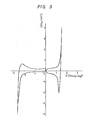
- Electrochemical behaviors were investigated by potential scanning at positive and negative potentials as to an example wherein an active electrode was graphite in the form of a sheet having a bulk density of 0.97 g/cm 3 , the graphite sheet being obtained in such a way that graphite powder the lattice constant of which was found 0.335 nm by X-ray diffraction and the primary particle diameter of which evaluated from the half width of the peak thereof was 19.4 nm was pressed to a thickness of 220 ⁇ m; a platinum plate was used as a counter electrode; and an Ag/Ag electrode was used as a reference electrode, and wherein an electrolyte used was a solution in which LiCl04 was dissolved in propylene carbonate at a concentration of 1 mol/lit.
- the potential scanning rate was 1 mV/sec, and the resulting cyclic voltamgram is shown in Fig. 3.
- current flowing in the minus direction corresponds to a case where the graphite is doped with Li + to become an interlayer compound
- current flowing in the plus direction corresponds to a case where Li + having formed the interlayer compound of the graphite is released from the graphite by undoping.
- the potential at which the doping starts is -2.2 V (vs Ag/Ag + ) which is positive with respect to the potential at which Li + is reduced into Li metal, and it has been electrochemically confirmed that the electrodeposition of Li does not take place on the graphite.
- the Coulomb efficiency is 51 %.
- a battery shown in Fig. 4 was assembled using an anode and a cathode each of which was made of graphite in the form of a sheet having a bulk density of 0.97 g/cm 3 and a diameter of 10 mm, the graphite sheet being obtained in such a way that graphite powder the lattice constant of which was found 0.335 nm by X-ray diffraction and the primary particle diameter of which evaluated from the half width of the peak thereof was 19.4 nm was pressed to a thickness of 220 ⁇ m, and also using an electrolyte which was a solution wherein LiC10 4 was dissolved in propylene carbonate at a concentration of 1 mol/l.
- Fig. 4 is a sectional view of an experimental unit cell.
- the battery is constructed of a cell 10 made of teflon, collectors 11 made of platinum, a separator 12, electrodes 13, electrode terminals 14 and an insulator 15, and an electrolyte 16 was contained in the teflon cell to impregnate all of the electrodes, the collectors etc.
- the charging and discharging current densities were 0.1 mA/cm 2 , the charge was conducted for 30 minutes, and the discharge was conducted until the battery voltage became 1 V.
- the relationship between the numbers of charging and discharging cycles and the Coulomb efficiency is indicated as a curve A in Fig. 5.
- the open-circuit voltage after the charge was 3.7 V, and the ratio between the quantity of electricity during the charge and the quantity of electricity during the discharge, namely, the Coulomb efficiency was 90 % at the initial stage.
- the Coulomb efficiency in the charge and discharge of the 290th cycle was 24 %.
- the battery shown in Fig. 4 was assembled.
- Used as the electrolyte was a solution in which (C 2 H 5 ) 4 NBF 4 was dissolved in propylene carbonate at a concentration of 1 mol/1.
- the charging and discharging conditions of the battery were similar to those in Example 1.
- the relationship between the numbers of charging and discharging cycles and the Coulomb efficiency is indicated at a curve B in Fig. 5.
- the open-circuit voltage of this battery after the charge was 3.7 V.
- the Coulomb efficiency at the initial stage of the charging and discharging cycles was 85 %, and that at the 270th cycle was 50 %.
- Example 3 the battery shown in Fig. 4 was assembled using the same constituents as in Example 2 except the electrolyte.
- Used as the electrolyte was a solution in which LiBF 4 was dissolved in tetrahydrofuran at a concentration of 1 mol/1.
- the current density was 2 mA/cm 2
- the charging period of time was 90 seconds
- the discharge was conducted down to 1 V.
- the relationship between the numbers of charging and discharging cycles and the Coulomb efficiency is indicated as a curve C in Fig. 5.
- the open-circuit voltage of this battery after the charge was 3.5 V.
- the Coulomb efficiency at the initial stage of the charging and discharging cycles was 83 %, and that of the 270th cycle was 58 %.
- the battery shown in Fig. 4 was assembled using a cathode which was made of carbon paper 10 mm in diameter, the lattice constant of which was found 0.337 nm by X-ray diffraction and the primary particle diameter of which was 48.6 nm, and an anode which was made of graphite molded into the form of a sheet 10 mm in diameter, the graphite sheet being obtained in such a way that the graphite with an intercalary material removed from an interlayer compound once formed was pressed.
- the graphite used for the anode was found on the basis of X - ray diffraction to have a lattice constant of 0.335 nm and a primary particle diameter of 19.4 nm.
- Used as an electrolyte was a solution in which LiBF 4 was dissolved in propylene carbonate at a concentration of 1 mol/l.
- the charging and discharging conditions of the battery were similar to those of Example 2.
- the relationship between the numbers of charging and discharging cycles and the Coulomb efficiency is indicated by a curve D in Fig. 5.
- the open-circuit voltage of this battery after the charge was 3.7 V.
- the Coulomb efficiency at the initial stage of the charging and discharging cycles was 87 %, and that of the 298th cycle was 40 %.
- the battery shown in Fig. 4 was assembled using a cathode made of lithium, an anode made of graphite which was found by X-ray diffraction to have a lattice constant of 0.337 nm- and a primary particle diameter of 19.4 nm, and an electrolyte made of a solution in which LiGlO 4 was dissolved in propylene carbonate at a concentration of 1 mol/1. With a current density of 0.1 mA/cm 2 , the charge was conducted for 30 minutes, and the discharge was conducted until the battery voltage became 2 V.
- a curve E in Fig. 5 shows the numbers of charging and discharging cycles and the Coulomb efficiency.
- the open-circuit voltage of this battery after the charge was 3.5 V.
- the Coulomb efficiency of the charging and discharging cycles at the initial stage was 82 %, that of the 60th cycle was 32 X.
- the lowering of the Coulomb efficiency is attributed to the short-circuit between the electrodes.
- the secondary battery of the present invention has an anode and a cathode constructed so as to form graphite interlayer compounds in the mode of charge and to return into the original form of graphite in the mode of discharge.
- the graphite which is not in the state of the graphite interlayer compound can be assembled, so that the handling is easy.
Landscapes
- Chemical & Material Sciences (AREA)
- Chemical Kinetics & Catalysis (AREA)
- Electrochemistry (AREA)
- General Chemical & Material Sciences (AREA)
- Inorganic Chemistry (AREA)
- Engineering & Computer Science (AREA)
- Materials Engineering (AREA)
- Manufacturing & Machinery (AREA)
- Secondary Cells (AREA)
- Battery Electrode And Active Subsutance (AREA)
Applications Claiming Priority (2)
| Application Number | Priority Date | Filing Date | Title |
|---|---|---|---|
| JP127473/84 | 1984-06-22 | ||
| JP59127473A JPS617567A (ja) | 1984-06-22 | 1984-06-22 | 二次電池およびその製造法 |
Publications (2)
| Publication Number | Publication Date |
|---|---|
| EP0165589A2 true EP0165589A2 (fr) | 1985-12-27 |
| EP0165589A3 EP0165589A3 (fr) | 1987-10-14 |
Family
ID=14960793
Family Applications (1)
| Application Number | Title | Priority Date | Filing Date |
|---|---|---|---|
| EP85107493A Withdrawn EP0165589A3 (fr) | 1984-06-22 | 1985-06-18 | Batterie secondaire et procédé pour sa fabrication |
Country Status (2)
| Country | Link |
|---|---|
| EP (1) | EP0165589A3 (fr) |
| JP (1) | JPS617567A (fr) |
Cited By (8)
| Publication number | Priority date | Publication date | Assignee | Title |
|---|---|---|---|---|
| EP0265830A3 (fr) * | 1986-10-25 | 1988-09-21 | Hitachi Maxell Ltd. | Dispositif d'affichage électrochromique |
| EP0251677A3 (en) * | 1986-06-24 | 1989-09-27 | Sharp Kabushiki Kaisha | Graphite intercalation compound electrodes for rechargeable batteries and a method for the manufacture of the same |
| EP0434402A3 (en) * | 1989-12-19 | 1991-11-06 | Sharp Kabushiki Kaisha | Process for preparing carbon electrode |
| EP0541889A1 (fr) * | 1991-11-12 | 1993-05-19 | Sanyo Electric Co., Limited. | Batterie secondaire au lithium |
| EP0593785A4 (fr) * | 1992-05-15 | 1995-01-11 | Yuasa Battery Co Ltd | Accumulateur et procede pour sa fabrication. |
| US5686138A (en) * | 1991-11-12 | 1997-11-11 | Sanyo Electric Co., Ltd. | Lithium secondary battery |
| WO2003001623A3 (fr) * | 2001-06-22 | 2003-04-10 | Merck Patent Gmbh | Sels conducteurs comprenant du niobium ou du tantale |
| CN119400982A (zh) * | 2024-11-04 | 2025-02-07 | 金马能源科技(淮南)有限公司 | 一种全固态电池及其制作方法 |
Families Citing this family (11)
| Publication number | Priority date | Publication date | Assignee | Title |
|---|---|---|---|---|
| JPS62226563A (ja) * | 1986-03-27 | 1987-10-05 | Fuji Elelctrochem Co Ltd | 非水電解液二次電池 |
| JPH0815074B2 (ja) * | 1986-11-11 | 1996-02-14 | シャープ株式会社 | 炭素体電極の製造方法 |
| JPH0665028B2 (ja) * | 1987-09-19 | 1994-08-22 | シャープ株式会社 | 電池用電極の製造方法 |
| JPH0779023B2 (ja) * | 1988-06-03 | 1995-08-23 | シャープ株式会社 | 電池用電極の製造方法 |
| JP2533016Y2 (ja) * | 1991-03-28 | 1997-04-16 | 東光株式会社 | 蛍光表示管用スイッチング電源 |
| JP2792373B2 (ja) * | 1992-11-30 | 1998-09-03 | 日本電池株式会社 | 非水電解液二次電池 |
| JP4902049B2 (ja) * | 2001-02-22 | 2012-03-21 | 昭和電工株式会社 | 水溶液系電池並びに該電池に用いられる電極用ペーストおよび電極 |
| AU2003272947A1 (en) | 2002-10-11 | 2004-05-04 | Fdk Corporation | Nonaqueous electrolyte secondary battery and process for producing positive electrode for use in nonaqueous electrolyte secondary battery |
| JP5509627B2 (ja) * | 2009-03-06 | 2014-06-04 | 株式会社豊田中央研究所 | 蓄電デバイス |
| JP2013171798A (ja) * | 2012-02-22 | 2013-09-02 | National Institute Of Advanced Industrial & Technology | ナトリウム二次電池用負極材料及びその製造方法、並びにナトリウム二次電池用負極、ナトリウム二次電池及びこれを用いた電気機器 |
| JP2013196978A (ja) * | 2012-03-21 | 2013-09-30 | National Institute Of Advanced Industrial & Technology | ナトリウム二次電池用正極材料及びその製造方法、並びにナトリウム二次電池用正極、ナトリウム二次電池及びこれを用いた電気機器 |
Family Cites Families (8)
| Publication number | Priority date | Publication date | Assignee | Title |
|---|---|---|---|---|
| US3844837A (en) * | 1972-07-07 | 1974-10-29 | Us Navy | Nonaqueous battery |
| JPS57208079A (en) * | 1981-06-18 | 1982-12-21 | Sanyo Electric Co Ltd | Rechargeable lithium cell |
| JPS5835881A (ja) * | 1981-08-27 | 1983-03-02 | Kao Corp | 電気化学電池 |
| JPS58102464A (ja) * | 1981-12-15 | 1983-06-18 | Asahi Chem Ind Co Ltd | 電池 |
| DE3215126A1 (de) * | 1982-04-23 | 1983-10-27 | Robert Bosch Gmbh, 7000 Stuttgart | Speicherelement fuer elektrische energie |
| JPS59143280A (ja) * | 1983-02-04 | 1984-08-16 | Hitachi Ltd | ポリマを用いた2次電池 |
| IT1196354B (it) * | 1983-12-05 | 1988-11-16 | Dow Chemical Co | Dispositivo per l'immagazzinamento di energia elettrica secondaria e elettrodo per esso |
| DE3588167T2 (de) * | 1984-06-12 | 1998-03-12 | Mitsubishi Chem Corp | Sekundärbatterien, die mittels Pyrolyse hergestelltes Pseudo-Graphit als Elektrodenmaterial enthalten |
-
1984
- 1984-06-22 JP JP59127473A patent/JPS617567A/ja active Pending
-
1985
- 1985-06-18 EP EP85107493A patent/EP0165589A3/fr not_active Withdrawn
Cited By (11)
| Publication number | Priority date | Publication date | Assignee | Title |
|---|---|---|---|---|
| EP0251677A3 (en) * | 1986-06-24 | 1989-09-27 | Sharp Kabushiki Kaisha | Graphite intercalation compound electrodes for rechargeable batteries and a method for the manufacture of the same |
| US4968527A (en) * | 1986-06-24 | 1990-11-06 | Sharp Kabushiki Kaisha | Method for the manufacture of pyrolytic graphite with high crystallinity and electrodes with the same for rechargeable batteries |
| EP0265830A3 (fr) * | 1986-10-25 | 1988-09-21 | Hitachi Maxell Ltd. | Dispositif d'affichage électrochromique |
| EP0434402A3 (en) * | 1989-12-19 | 1991-11-06 | Sharp Kabushiki Kaisha | Process for preparing carbon electrode |
| EP0541889A1 (fr) * | 1991-11-12 | 1993-05-19 | Sanyo Electric Co., Limited. | Batterie secondaire au lithium |
| US5686138A (en) * | 1991-11-12 | 1997-11-11 | Sanyo Electric Co., Ltd. | Lithium secondary battery |
| US5882818A (en) * | 1991-11-12 | 1999-03-16 | Sanyo Electric Co., Ltd. | Lithium secondary battery |
| US5993997A (en) * | 1991-11-12 | 1999-11-30 | Sanyo Electric Co., Ltd | Lithium secondary battery |
| EP0593785A4 (fr) * | 1992-05-15 | 1995-01-11 | Yuasa Battery Co Ltd | Accumulateur et procede pour sa fabrication. |
| WO2003001623A3 (fr) * | 2001-06-22 | 2003-04-10 | Merck Patent Gmbh | Sels conducteurs comprenant du niobium ou du tantale |
| CN119400982A (zh) * | 2024-11-04 | 2025-02-07 | 金马能源科技(淮南)有限公司 | 一种全固态电池及其制作方法 |
Also Published As
| Publication number | Publication date |
|---|---|
| EP0165589A3 (fr) | 1987-10-14 |
| JPS617567A (ja) | 1986-01-14 |
Similar Documents
| Publication | Publication Date | Title |
|---|---|---|
| EP0165589A2 (fr) | Batterie secondaire et procédé pour sa fabrication | |
| US4463072A (en) | Secondary batteries containing room-temperature molten 1,2,3-trialkylimidazolium halide non-aqueous electrolyte | |
| US3639174A (en) | Voltaic cells with lithium-aluminum alloy anode and nonaqueous solvent electrolyte system | |
| US4550067A (en) | Secondary battery | |
| EP0249331B1 (fr) | Methode de fabrication d'une batterie secondaire | |
| CA1168701A (fr) | Traitement electrochimique reversible de polymeres conjugues, et accummulateurs ainsi obtenus | |
| US3960594A (en) | Primary or secondary electrochemical cell | |
| EP0478379A2 (fr) | Batterie secondaire à électrolyte non-aqueux | |
| Maxfield et al. | Energy Density, Power Density, and Polarization Studies of the Partially Oxidized (“p‐Doped”) Polyacetylene Cathode | |
| AU2020264696B2 (en) | Rechargeable battery cell | |
| US4042756A (en) | Electrochemical cells | |
| KR20010012249A (ko) | 철을 기초로 한 축전지 | |
| JP2698340B2 (ja) | 電気化学的電池 | |
| US4869977A (en) | Electrolyte additive for lithium-sulfur dioxide electrochemical cell | |
| CN1269059A (zh) | 带有改进氧化锰正电极的可再充电的电池 | |
| US4485155A (en) | Storage element for electrical energy | |
| US4579796A (en) | Organic cell | |
| DE3687087T2 (de) | Konjugiertes polymer als substrat zur ablagerung eines alkalimetalles in einer nichtwaessrigen sekundaerbatterie. | |
| US5183543A (en) | Polyanilines, process for the preparation thereof and cells using them | |
| EP0136635A2 (fr) | Pile secondaire | |
| US4861690A (en) | Lightweight battery construction | |
| AU593980B2 (en) | Electrolyte for lithium-sulfur dioxide electrochemical cell | |
| US4091191A (en) | Battery having an electrode comprising mixtures of Al and TiS2 | |
| US3918988A (en) | Electric current-producing cells | |
| Yata et al. | Studies of porous polyacenic semiconductors toward application III. Characteristics of practical batteries employing polyacenic semiconductive materials as electrodes |
Legal Events
| Date | Code | Title | Description |
|---|---|---|---|
| PUAI | Public reference made under article 153(3) epc to a published international application that has entered the european phase |
Free format text: ORIGINAL CODE: 0009012 |
|
| AK | Designated contracting states |
Designated state(s): CH DE FR GB IT LI NL SE |
|
| PUAL | Search report despatched |
Free format text: ORIGINAL CODE: 0009013 |
|
| AK | Designated contracting states |
Kind code of ref document: A3 Designated state(s): CH DE FR GB IT LI NL SE |
|
| STAA | Information on the status of an ep patent application or granted ep patent |
Free format text: STATUS: THE APPLICATION IS DEEMED TO BE WITHDRAWN |
|
| 18D | Application deemed to be withdrawn |
Effective date: 19880415 |
|
| RIN1 | Information on inventor provided before grant (corrected) |
Inventor name: TOYAMA, ATSUKO Inventor name: NISHIMURA, SHIGEOKI Inventor name: SUGIMOTO, HIROYUKI Inventor name: FUJITA, KAZUNORI Inventor name: EBATO, NOBORU Inventor name: MATSUDA, SHINPEI |