EP0165594A2 - Dispositif pour le serrage à ouverture rapide d'une cloison à des parois de délimitation - Google Patents
Dispositif pour le serrage à ouverture rapide d'une cloison à des parois de délimitation Download PDFInfo
- Publication number
- EP0165594A2 EP0165594A2 EP85107538A EP85107538A EP0165594A2 EP 0165594 A2 EP0165594 A2 EP 0165594A2 EP 85107538 A EP85107538 A EP 85107538A EP 85107538 A EP85107538 A EP 85107538A EP 0165594 A2 EP0165594 A2 EP 0165594A2
- Authority
- EP
- European Patent Office
- Prior art keywords
- hook part
- hook
- actuator
- spring
- plates
- Prior art date
- Legal status (The legal status is an assumption and is not a legal conclusion. Google has not performed a legal analysis and makes no representation as to the accuracy of the status listed.)
- Ceased
Links
- 238000005192 partition Methods 0.000 title 1
- 230000007423 decrease Effects 0.000 claims abstract description 3
- 229910000831 Steel Inorganic materials 0.000 claims description 26
- 239000010959 steel Substances 0.000 claims description 26
- 125000006850 spacer group Chemical group 0.000 claims description 21
- 238000005452 bending Methods 0.000 claims description 11
- 238000006073 displacement reaction Methods 0.000 claims description 4
- 230000008878 coupling Effects 0.000 description 4
- 238000010168 coupling process Methods 0.000 description 4
- 238000005859 coupling reaction Methods 0.000 description 4
- 230000006835 compression Effects 0.000 description 2
- 238000007906 compression Methods 0.000 description 2
- 238000010276 construction Methods 0.000 description 2
- 230000006378 damage Effects 0.000 description 2
- 230000000694 effects Effects 0.000 description 2
- 244000089486 Phragmites australis subsp australis Species 0.000 description 1
- 230000036316 preload Effects 0.000 description 1
- 239000002023 wood Substances 0.000 description 1
Images




Classifications
-
- B—PERFORMING OPERATIONS; TRANSPORTING
- B60—VEHICLES IN GENERAL
- B60P—VEHICLES ADAPTED FOR LOAD TRANSPORTATION OR TO TRANSPORT, TO CARRY, OR TO COMPRISE SPECIAL LOADS OR OBJECTS
- B60P7/00—Securing or covering of load on vehicles
- B60P7/06—Securing of load
- B60P7/135—Securing or supporting by load bracing means
- B60P7/15—Securing or supporting by load bracing means the load bracing means comprising a movable bar
Definitions
- the invention relates to a device for quickly releasable clamping of a room divider equipped at the end with a clamping head, such as a plank, on boundary walls, in particular on the upright side walls of a transport vehicle, the clamping head consisting of and consisting of a supportable part on the inside of the boundary wall a hook part which is guided to a limited extent is formed, which engages around the edge region of the boundary wall and thereby comes to rest on the outside of the boundary wall with its free hook end, and which finally consists of an actuator which interacts with a spring and has a handle and which faces the hook part transferred the plant part between an open position releasing the boundary wall and a clamping position pressing the boundary wall in between.
- a clamping head such as a plank
- the abutment part supported on the inside of the boundary wall is formed by an angle piece, one leg of which is rigidly fixed to the end face of Getting Connected plank, while the second leg is on the upper side extends in the longitudinal direction of the plank.
- the hook part is formed by a clamping slide which is bent at an angle, one leg of which is guided as a slide on the leg of the contact part, which extends on the top of the plank.
- the displacement of the clamping slide with respect to the system part is carried out with a spring-loaded tilting clamping mechanism, the crank articulated on the system part being extended with an actuating handle and having an articulated coupling which acts on the clamping slide on the other side.
- the clamping slide is moved in the closing direction until its angled end comes to rest against the outside of the boundary wall.
- the actuating handle is pivoted further, the one provided between the crank and the coupling is moved Tension the helical compression spring until the dead center position is reached.
- the actuating lever is transferred from the dead center position to the over dead center position, the spring is relaxed again somewhat.
- the invention has for its object to provide a device of the type mentioned, in which such disadvantages are avoided and the spring serving to press the hook part against the boundary wall supported by the system part already has a bias in the open position and the clamping of the boundary wall between the System part and the hook part only via the preloaded spring and not via the actuating lever for transferring the clamping head into the open position.
- the spring and the actuator are spatially separated from each other, each separately between the hook and contact part, the spring is biased and the hook part relative to the contact part, regardless of the respective switching position of the actuator, continuously loaded in the direction of the clamping position and the actuator exposes the spring to a growing load when the hook part is moved into the open position and the load on the spring decreases when moving into the clamping position.
- the actuator which can be used as an actuating handle is arranged in parallel next to the spring between the contact part and the hook part and only serves to transfer the hook part from the closed position into the open position. About When the hook part is moved into the active position, the actuator is transferred to the closed position and the hook part follows the actuator forcefully under the action of the spring into the active position.
- the contact part can have a flat contact plate which can be adjusted in the direction of the angled free end of the hook part and comes to bear against the inside of the boundary wall.
- the adjustable contact plate it is thus possible to adapt the clamping head to different thicknesses of the boundary wall in a particularly simple manner.
- the flat contact plate can engage with a rear threaded pin in an insert piece of the contact part which has a threaded hole.
- the contact part can consist of two spaced-apart, elongated plates extending in the direction of displacement of the hook part, between which a slide end of the hook part facing away from the hook end is mounted so as to be displaceable to a limited extent.
- the system part is formed from a simple construction which consists only of two plates arranged at a distance from one another, the intermediate space between the two plates simultaneously serving to accommodate the displaceable mounting of the hook part.
- the hook part can have a U-shaped bracket, one leg of which forms the hook end, during the The apex part overlaps the upper edge of the boundary wall and the second leg is formed on the slide end of the hook part.
- the hook part can easily overlap the upper edge of the boundary wall, the system part provided on the slide end of the hook part being supported reliably against the inside of the boundary wall, while the angled end of the hook part is against the outer wall of the Boundary wall creates.
- the hook part formed from the slider end and the U-shaped bracket can consist of two spaced-apart plates which rest with their outer sides against the inner sides of the plates forming the contact part.
- the hook part is also formed from a simple construction, which only consists of two plates arranged at a distance from one another, the outer sides of the two plates coming to rest against the inner sides of the plates forming the contact part in the region of the slide end and thus being guided.
- the spring serving in the active position for pressing the angled free hook end of the hook part against the outside of the boundary wall supported by the contact part can be inserted in elongated holes of the contact part and slide end of the hook part plate pairs, with one end of the spring against one another with a support plate the slot ends of the two plates of the contact part and the other end of the spring are supported with a support plate against the slot ends of the two plates of the slide end of the hook part.
- the system part and hook part are thus easier Way loaded with a strong spring in the clamping direction, the spring can be under tension even in the closed position of the clamping head.
- the clamping head thus has a strong spring tension in the operative position in which it is placed on the boundary wall, so that there is no need to fear an unwanted loosening of the clamping head from the boundary wall.
- the actuator displacing the hook part relative to the contact part can consist of a two-armed lever pivotally mounted between the two plates of the contact part, the first lever arm forming the handle and the second lever arm being formed by an eccentric formed on the bearing end of the handle, which counteracts the Hook end of the hook part abuts the opposite ends of the two plates of the hook part in the active position.
- the hook part can be transferred from the closed position or active position into the open position in a particularly simple manner, since the eccentric of the hook part which is integrally formed on the bearing end of the handle shifts positively relative to the contact part.
- the actuator having the handle lever which when it is moved from the closed position into the open position under the action of the spring to be tensioned, can be frictionally engaged on its second one Brake lever engaging brake must be assigned.
- this brake the actuator is held in a simple manner in any position between the closed position and the open position, so that when the handle lever of the actuator is released, the handle lever does not return to its basic position due to the action of the spring. Injuries to the operator caused by the actuator arm of the actuator snapping back are thus excluded in a simple manner.
- the brake which engages the second lever which is designed as an eccentric, can consist of a steel wire which is subjected to bending and which engages by clamping in a groove which has conical side surfaces and runs concentrically to the bearing journal of the actuator.
- the steel wire subjected to bending is thus clamped in a simple manner between the conical side surfaces of the groove, as a result of which great friction is achieved between the conical side surfaces of the groove and the steel wire which is clamped in between. With little means, a powerful brake is thus achieved, which does not allow an unwanted or sudden swiveling back of the actuating arm of the actuator when released.
- a groove section can be connected to the groove that clamps the steel wire and, in the closed position of the actuator, receives the steel wire without jamming and pressure. This ensures in a simple manner that after returning the handle lever of the actuator in the closed position, the braking effect of the steel wire stops completely and the steel wire stressed on bending does not exert any forces on the second lever, which is designed as an eccentric member exercises.
- the steel wire to be subjected to bending can be placed at one end with an integrally formed bearing eye on a spacer sleeve arranged between the two plates of the plant part and secured with the screws, while the free end of the steel wire is supported against a spacer sleeve, which is also between the two plates of the plant part is clamped and leads the two plates of the slider end of the hook part.
- a spacer sleeve which is also between the two plates of the plant part is clamped and leads the two plates of the slider end of the hook part.
- a transport vehicle 10 shown in FIG. 1 has a loading area 11 which is delimited with upright side walls 12. So that placed on the loading surface 11 barrels 13 or the like. when the transport vehicle is used as intended, the loading area 11 is divided by a room divider 14.
- the room divider 14 has clamping heads 15 at its two ends, with which the room divider 14 can be clamped on the upper edges of the boundary walls formed by the side walls 12. Slipping of the barrels 13 or the like. on the loading surface 11 is thus prevented by the room divider 14.
- the room divider 14 consists of a tube 16 with an approximately square cross section, in the ends of which the clamping heads 15 are inserted with one part and fastened with a screw 17.
- the screw 17 passes through openings of the tube 16, not shown, and an elongated hole 18 in the inserted end of the clamping head 15.
- the clamping heads 15 can thus be displaced to a limited extent in the tube 16 and can thus be adapted to the spacing of the side walls 12 of the transport vehicle 10.
- the clamping head 15 consists of a support part 19 which can be supported on the inside of the side wall 12 and a limited sliding part 20.
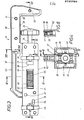
- the contact part 19 consists of two spaced-apart, elongated plates 21 extending in the direction of displacement of the hook part 20, between which a slide end 23 of the hook part 20 facing away from the hook end 22 is mounted such that it can be displaced to a limited extent.
- the contact part is provided with a flat contact plate 24 which can be adjusted in the direction of the angled free hook end 22 of the hook part 20 and comes into contact with the inside of the side wall.
- the flat contact plate 24 engages with a rear threaded pin 25 in an insert piece 27 of the contact part 19 which has a threaded hole 26.
- the insert 27 is loosely inserted in openings 28 of the two plates 21 which form the system part 19.
- the hook part 20 has a U-shaped bracket 29, one leg of which forms the hook end 22, while its apex part 30 overlaps the upper edge of the side wall 12 and the second leg 31 is integrally formed on the slide end 23 of the hook part 20.
- This U-shaped bracket 29 the upper edge of the drop side 12 is thus easily overlapped, the flat contact plate 24 of the contact part 19 being able to be supported against the inner wall of the drop side 12.
- the hook part 20 formed from slide end 23 and U-shaped bracket 29 consists, as can be seen in particular from FIGS. 4 and 7, of two spaced-apart plates 32 which have their outer sides in the region of the slide end 23 against the inner sides of the plant part 19 forming plates 21 abut.
- the two plates 21 forming the contact part 19 are held at a predetermined distance from one another by means of spacer sleeves 33 and 34, the two plates being connected to one another by screws 36 having nuts 35, the screws 36 having openings in the two plates 21 and the spacer sleeves 33 and 34 reach out.
- the two plates 21 of the plant part 19 are connected to one another with five screws 36.
- Three of these screws 36 also pass through the two plates 32 of the hook part 20, as can be seen in particular from FIG. 5.
- the three letters, which also reach through the two plates of the hook part 20, have the spacer sleeves 34.
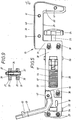
- the spacer sleeves 34 as can be seen in particular from FIG. 9, have stepped ends 37 which engage in elongated holes in the two plates 32 of the hook part 20.
- the spacer sleeves 34 thus rest with their free end faces against the inner sides of the two plates 21 of the contact part 19 and with the annular shoulders 39 formed by the offset ends 37 with play against the inner sides of the two plates 32 of the hook part 20. With the spacer sleeves 34, both the two plates 32 of the hook part 20 and the two plates 21 of the contact part 19 are thus held at a predetermined distance from one another, the displaceability of the hook part 20 relative to the contact part 19 being ensured is.
- the two spacer sleeves 33 are assigned to the two screws 36 which do not pass through the hook part 20. The spacer sleeves 33 rest with their free end faces against the inner sides of the two plates 21 of the contact part 19 and thus hold the two plates 21 of the contact part 19 at a predetermined distance.
- the spacer sleeves 34 hold the two plates 32 of the hook part 20 in the region of the slide end 23 at a predetermined distance.
- a plastic insert 40 is inserted between the two plates 32 of the hook part 20 and held with screws 41 and nuts 42.
- the width of the plastic insert 40 exceeds the width of the U-shaped bracket 29, so that the hook end 22 only comes into contact with the plastic insert 40 against the side wall 12 to be clamped in order to avoid damage to the side wall 12, which is generally made of wood.
- the flat contact plate 24 of the contact part 19 is also made of plastic.
- the spacer sleeves 34 engage with their stepped ends 37 in elongated holes 38 of the two plates 32 of the hook part 20.
- These elongated holes 38 run in the longitudinal direction of the contact part 19 and limit with their lengths the displaceability of the hook part 20 relative to the contact part 19.
- the open position of the clamping head which is shown in FIG. 5 and is achieved by actuating the actuator to be explained the stepped ends 37 of the spacer sleeves 34 with play (not shown in detail) against one end of the elongated holes 38, while that in FIG When the clamping head is in the closed position, the stepped ends 37 of the spacer sleeves 34 come to bear against the opposite ends of the elongated holes 38.
- the closed position is the position that is reached when no side wall 12 is arranged between the contact plate 24 of the contact part 19 and the hook end 22 of the hook part 20.
- the active position shown in FIG. 6 in which the contact plate 24 of the contact part 19 and the hook end of the hook part 20 come to rest against the opposite side surfaces of the side wall 12 .
- the shifting of the hook part 20 relative to the contact part 19 from the closed position into the open position takes place against the action of a spring 44 with an actuator 43.
- the actuator 43 consists of a two-armed lever 45 and 46, which has a bearing pin 47 between the two plates 21 of the Plant part 19 is pivotally mounted.
- the first lever 45 of the actuator 43 forms the handle and the second lever 46 is formed by an eccentric formed on the bearing end of the handle, which bears against the ends of the two plates 32 of the hook part 20 facing away from the hook end 22 of the hook part 22 in the operative position.
- This position of the actuator 43 is shown in more detail in FIG. 6. It can also be seen that in order to transfer the hook part 20 from the closed position into the open position, the handle formed by the first lever 45 must be pivoted counterclockwise.
- the spring 44 is formed by a package of disc springs. In a particularly advantageous manner, however, the spring 44 can also be formed by a helical compression spring.
- the two plates 21 of the contact part 19 and the two plates 32 of the hook part 20 are provided with elongated holes 48 and 49, respectively.
- the elongated holes 49 in the plate pair 32 of the hook part 20 have a somewhat larger width than the elongated holes 48 in the plate pair 21 of the contact part 19.
- the spring 44 is positively in the elongated holes 48 and 49 of the Plate pairs 21 and 32 held by the system part 19 and by the hook part 20.
- One end of the spring 44 is supported with a support plate 50 against the slot ends 51 of the two plates 21 of the contact part 19 and the other end of the spring 44 is supported with a support plate 52 against the slot ends of the two plates 32 of the slide end 23 of the hook part 20.
- This is a powerful spring support between created the contact part 19 and the hook part 20, whereby the clamping head 15 receives a sufficient clamping force.
- the elongated holes 49 in the two plates 32 of the hook part 20 are dimensioned in length so that they also capture the insert 27 provided with the threaded hole 26 for the threaded pin 25 of the contact plate 24.
- the two plates 21 of the system part 19 have openings 54 for inserting plastic bearing pieces 55 with which the clamping head 15 is inserted in the tube 16 of the room divider 14.
- the actuator 43 having the handle lever 45 is assigned a brake 59 which engages frictionally on its second lever 46.
- This brake 59 prevents the handle lever 45 of the actuator 43 from snapping back into the basic position if the operator accidentally releases the handle lever 45 when the actuator 43 is actuated.
- the actuator 43 is under the action of the spring 44 that is to be tensioned, which in the event of an accidental release of the handle lever 45 in the sense of a return quickly acts on the actuator 43 in the basic position on the actuator 43.
- an over-dead center position is reached, so that the actuator 43 remains in this position.
- the frictionally engaging brake acting on the second lever 46 of the actuator 43 which is designed as an eccentric, consists of a steel wire 60 which is subjected to bending and which engages by clamping in a groove 62 which has conical side surfaces and runs concentrically to the bearing journal 47 of the actuator 43.
- the steel wire 60 subjected to bending is clamped between the conical side surfaces 61 of the groove 62, so that strong braking is achieved which holds the actuator in every set position.
- the braking force can be adapted to the respective requirements.
- a groove section 63 adjoins the groove 62 which receives the steel wire 60 by clamping and which, in the basic position of the actuator 43, receives the steel wire 60 without clamping and pressure.
- the brake 59 is thus completely switched off as long as the actuator 43 is in the basic position. In the basic position, the actuator 43, which is made of plastic, is therefore not exposed to any pressure from the steel wire 60.
- the steel wire 60 which is subjected to bending is arranged at one end with an integrally formed bearing eye 64 on a between the two plates 21 of the contact part 19 and is attached to the spacer sleeve 33 secured with the screws 35, 36.
- the free end of the steel wire 60 is supported against a spacer sleeve 34, which is also clamped between the two plates 21 of the contact part 19 and guides the two plates 32 of the slide end 23 of the hook part 20.
Landscapes
- Engineering & Computer Science (AREA)
- Transportation (AREA)
- Mechanical Engineering (AREA)
- Clamps And Clips (AREA)
Applications Claiming Priority (2)
| Application Number | Priority Date | Filing Date | Title |
|---|---|---|---|
| DE3422970 | 1984-06-22 | ||
| DE19843422970 DE3422970C2 (de) | 1984-06-22 | 1984-06-22 | Vorrichtung zum schnell-löslichen Festklemmen eines Raumteilers an Begrenzungswänden |
Publications (2)
| Publication Number | Publication Date |
|---|---|
| EP0165594A2 true EP0165594A2 (fr) | 1985-12-27 |
| EP0165594A3 EP0165594A3 (fr) | 1986-12-30 |
Family
ID=6238851
Family Applications (1)
| Application Number | Title | Priority Date | Filing Date |
|---|---|---|---|
| EP85107538A Ceased EP0165594A3 (fr) | 1984-06-22 | 1985-06-19 | Dispositif pour le serrage à ouverture rapide d'une cloison à des parois de délimitation |
Country Status (2)
| Country | Link |
|---|---|
| EP (1) | EP0165594A3 (fr) |
| DE (1) | DE3422970C2 (fr) |
Cited By (7)
| Publication number | Priority date | Publication date | Assignee | Title |
|---|---|---|---|---|
| GB2301318A (en) * | 1995-05-31 | 1996-12-04 | Nmi Safety Systems Ltd | Two part shoring pole, the parts linked by a lever actuated piston. |
| EP1108609A1 (fr) * | 1999-12-13 | 2001-06-20 | ANCRA Jungfalk GmbH & Co. KG | Dispositif permettant d'arrimer des charges sur le plateau d'un véhicule de transport |
| WO2018117951A1 (fr) * | 2016-12-21 | 2018-06-28 | Ergo Load Ab | Support de marchandises comprenant un mécanisme de verrouillage de type excentrique |
| DE102009040121B4 (de) | 2008-09-25 | 2019-09-19 | allsafe GmbH & Co.KG | Sperrbalken |
| CN111619436A (zh) * | 2020-05-12 | 2020-09-04 | 浙江双友物流器械股份有限公司 | 一种货物支撑器的夹持结构 |
| WO2022136883A1 (fr) * | 2020-12-23 | 2022-06-30 | Fernhay Partners Limited | Barre de retenue de charge |
| EP3842183B1 (fr) * | 2019-12-23 | 2024-10-30 | WISTRA GmbH Cargo Control | Dispositif de serrage |
Families Citing this family (1)
| Publication number | Priority date | Publication date | Assignee | Title |
|---|---|---|---|---|
| AT15684U1 (de) * | 2017-04-20 | 2018-04-15 | Riel Gmbh | Ladungssicherungsstange |
Family Cites Families (2)
| Publication number | Priority date | Publication date | Assignee | Title |
|---|---|---|---|---|
| US2576397A (en) * | 1948-10-06 | 1951-11-27 | Hobbs Mfg Company | Vehicle body brace |
| CH574340A5 (fr) * | 1975-02-13 | 1976-04-15 | Wenger Peter Sa |
-
1984
- 1984-06-22 DE DE19843422970 patent/DE3422970C2/de not_active Expired
-
1985
- 1985-06-19 EP EP85107538A patent/EP0165594A3/fr not_active Ceased
Cited By (8)
| Publication number | Priority date | Publication date | Assignee | Title |
|---|---|---|---|---|
| GB2301318A (en) * | 1995-05-31 | 1996-12-04 | Nmi Safety Systems Ltd | Two part shoring pole, the parts linked by a lever actuated piston. |
| EP1108609A1 (fr) * | 1999-12-13 | 2001-06-20 | ANCRA Jungfalk GmbH & Co. KG | Dispositif permettant d'arrimer des charges sur le plateau d'un véhicule de transport |
| DE102009040121B4 (de) | 2008-09-25 | 2019-09-19 | allsafe GmbH & Co.KG | Sperrbalken |
| WO2018117951A1 (fr) * | 2016-12-21 | 2018-06-28 | Ergo Load Ab | Support de marchandises comprenant un mécanisme de verrouillage de type excentrique |
| SE541398C2 (sv) * | 2016-12-21 | 2019-09-10 | Ergo Load Ab | Godsstötta med returfjäderbelastad excenterlåsmekanism |
| EP3842183B1 (fr) * | 2019-12-23 | 2024-10-30 | WISTRA GmbH Cargo Control | Dispositif de serrage |
| CN111619436A (zh) * | 2020-05-12 | 2020-09-04 | 浙江双友物流器械股份有限公司 | 一种货物支撑器的夹持结构 |
| WO2022136883A1 (fr) * | 2020-12-23 | 2022-06-30 | Fernhay Partners Limited | Barre de retenue de charge |
Also Published As
| Publication number | Publication date |
|---|---|
| DE3422970C2 (de) | 1986-04-30 |
| DE3422970A1 (de) | 1986-01-02 |
| EP0165594A3 (fr) | 1986-12-30 |
Similar Documents
| Publication | Publication Date | Title |
|---|---|---|
| DE3832834C2 (de) | Dreibeiniges Stativ und Bein für ein dreibeiniges Stativ | |
| DE7035640U (de) | Sicherheitsvorrichtung gegen sturz. | |
| DE2631905C2 (de) | Auslöseskibindungsteil | |
| DE102012100542B4 (de) | Druckgerät für Bremszylinder | |
| DE3813342C2 (de) | Klemmeinrichtung | |
| EP0791529A1 (fr) | Couplage de traction pour tracteur de semi-remorque | |
| DE3803128C2 (de) | Rohrbiegegerät | |
| EP0165594A2 (fr) | Dispositif pour le serrage à ouverture rapide d'une cloison à des parois de délimitation | |
| DE10040593C2 (de) | Verriegelungseinrichtung für längsverstellbare Sitze, insbesondere Kraftfahrzeugsitze | |
| AT402795B (de) | Bindungseinheit zwischen einem schuh und einem sportgerät, insbesondere schibindung | |
| EP1809441B1 (fr) | Dispositif de serrage et de prehension, en particulier pince lineaire ou centrale | |
| EP0413013B1 (fr) | Machoire avant de fixation de securite de skis | |
| DE3502069C2 (fr) | ||
| DE4102312C2 (de) | Sitzschiene für Fahrzeugsitze, insbesondere für Kraftfahrzeugsitze | |
| EP0274746B1 (fr) | Etrier de tension avec mâchoire de serrage réglable | |
| DE2603009A1 (de) | Vorderbacken fuer eine sicherheitsskibindung | |
| DE19931953A1 (de) | Beschlag zur Lagerung eines Endes einer Latte eines Lattenrahmens | |
| DE3240183C2 (de) | Backen einer Sicherheitsskibindung | |
| AT390565B (de) | Skibindung | |
| EP1253994B1 (fr) | Dispositif de serrage | |
| DE3304593A1 (de) | Nachstell- und zentriervorrichtung fuer servobremsen | |
| DE29502987U1 (de) | Ausklinkbares Schnappschloß | |
| EP0054241A1 (fr) | Fixation d'un pied de mât sur une planche à voile | |
| DE3324628A1 (de) | Kettenbrems-vorrichtung | |
| DE4301857C1 (de) | Gerät zur Viehgeburtshilfe |
Legal Events
| Date | Code | Title | Description |
|---|---|---|---|
| PUAI | Public reference made under article 153(3) epc to a published international application that has entered the european phase |
Free format text: ORIGINAL CODE: 0009012 |
|
| AK | Designated contracting states |
Designated state(s): CH DE FR GB IT LI NL |
|
| PUAL | Search report despatched |
Free format text: ORIGINAL CODE: 0009013 |
|
| AK | Designated contracting states |
Kind code of ref document: A3 Designated state(s): CH DE FR GB IT LI NL |
|
| 17P | Request for examination filed |
Effective date: 19870202 |
|
| 17Q | First examination report despatched |
Effective date: 19870916 |
|
| STAA | Information on the status of an ep patent application or granted ep patent |
Free format text: STATUS: THE APPLICATION HAS BEEN REFUSED |
|
| 18R | Application refused |
Effective date: 19880317 |
|
| RIN1 | Information on inventor provided before grant (corrected) |
Inventor name: BERNS, HARALD, PROF. DIPL.-ING. |