EP0165651B1 - Verfahren zum Mischen und Extrudieren von keramischem Material - Google Patents
Verfahren zum Mischen und Extrudieren von keramischem Material Download PDFInfo
- Publication number
- EP0165651B1 EP0165651B1 EP85301120A EP85301120A EP0165651B1 EP 0165651 B1 EP0165651 B1 EP 0165651B1 EP 85301120 A EP85301120 A EP 85301120A EP 85301120 A EP85301120 A EP 85301120A EP 0165651 B1 EP0165651 B1 EP 0165651B1
- Authority
- EP
- European Patent Office
- Prior art keywords
- batch
- viscosity
- extrusion
- die
- cordierite
- Prior art date
- Legal status (The legal status is an assumption and is not a legal conclusion. Google has not performed a legal analysis and makes no representation as to the accuracy of the status listed.)
- Expired - Lifetime
Links
- 238000000034 method Methods 0.000 title claims description 22
- 229910010293 ceramic material Inorganic materials 0.000 title claims description 8
- 238000002156 mixing Methods 0.000 title description 17
- 230000008569 process Effects 0.000 title description 5
- 238000001125 extrusion Methods 0.000 claims abstract description 54
- 239000000919 ceramic Substances 0.000 claims abstract description 34
- 239000004014 plasticizer Substances 0.000 claims abstract description 31
- 239000000203 mixture Substances 0.000 claims abstract description 15
- XLYOFNOQVPJJNP-UHFFFAOYSA-N water Substances O XLYOFNOQVPJJNP-UHFFFAOYSA-N 0.000 claims abstract description 15
- 235000010977 hydroxypropyl cellulose Nutrition 0.000 claims abstract description 14
- 229920002153 Hydroxypropyl cellulose Polymers 0.000 claims abstract description 13
- 229910052863 mullite Inorganic materials 0.000 claims abstract description 13
- 229910052878 cordierite Inorganic materials 0.000 claims abstract description 11
- JSKIRARMQDRGJZ-UHFFFAOYSA-N dimagnesium dioxido-bis[(1-oxido-3-oxo-2,4,6,8,9-pentaoxa-1,3-disila-5,7-dialuminabicyclo[3.3.1]nonan-7-yl)oxy]silane Chemical compound [Mg++].[Mg++].[O-][Si]([O-])(O[Al]1O[Al]2O[Si](=O)O[Si]([O-])(O1)O2)O[Al]1O[Al]2O[Si](=O)O[Si]([O-])(O1)O2 JSKIRARMQDRGJZ-UHFFFAOYSA-N 0.000 claims abstract description 11
- 239000001863 hydroxypropyl cellulose Substances 0.000 claims abstract description 11
- 239000007864 aqueous solution Substances 0.000 claims abstract description 10
- 238000004140 cleaning Methods 0.000 claims abstract description 6
- 239000011230 binding agent Substances 0.000 claims description 35
- 239000004615 ingredient Substances 0.000 claims description 3
- 229940071676 hydroxypropylcellulose Drugs 0.000 abstract 2
- 239000000758 substrate Substances 0.000 description 26
- 239000000463 material Substances 0.000 description 21
- 229920000609 methyl cellulose Polymers 0.000 description 17
- 239000001923 methylcellulose Substances 0.000 description 17
- 235000010981 methylcellulose Nutrition 0.000 description 17
- 230000001413 cellular effect Effects 0.000 description 12
- 238000012360 testing method Methods 0.000 description 10
- 238000001879 gelation Methods 0.000 description 6
- 239000004033 plastic Substances 0.000 description 5
- 229920003023 plastic Polymers 0.000 description 5
- 229920003091 Methocel™ Polymers 0.000 description 4
- 230000009471 action Effects 0.000 description 4
- 230000008859 change Effects 0.000 description 4
- KZHJGOXRZJKJNY-UHFFFAOYSA-N dioxosilane;oxo(oxoalumanyloxy)alumane Chemical compound O=[Si]=O.O=[Si]=O.O=[Al]O[Al]=O.O=[Al]O[Al]=O.O=[Al]O[Al]=O KZHJGOXRZJKJNY-UHFFFAOYSA-N 0.000 description 4
- 230000000694 effects Effects 0.000 description 4
- 239000002245 particle Substances 0.000 description 4
- 239000000243 solution Substances 0.000 description 4
- 239000000126 substance Substances 0.000 description 4
- PWVUXRBUUYZMKM-UHFFFAOYSA-N 2-(2-hydroxyethoxy)ethyl octadecanoate Chemical compound CCCCCCCCCCCCCCCCCC(=O)OCCOCCO PWVUXRBUUYZMKM-UHFFFAOYSA-N 0.000 description 3
- PNEYBMLMFCGWSK-UHFFFAOYSA-N aluminium oxide Inorganic materials [O-2].[O-2].[O-2].[Al+3].[Al+3] PNEYBMLMFCGWSK-UHFFFAOYSA-N 0.000 description 3
- 229920002678 cellulose Polymers 0.000 description 3
- 239000001913 cellulose Substances 0.000 description 3
- 235000010980 cellulose Nutrition 0.000 description 3
- 239000003517 fume Substances 0.000 description 3
- 239000007789 gas Substances 0.000 description 3
- OKTJSMMVPCPJKN-UHFFFAOYSA-N Carbon Chemical compound [C] OKTJSMMVPCPJKN-UHFFFAOYSA-N 0.000 description 2
- 229920002472 Starch Polymers 0.000 description 2
- GWEVSGVZZGPLCZ-UHFFFAOYSA-N Titan oxide Chemical compound O=[Ti]=O GWEVSGVZZGPLCZ-UHFFFAOYSA-N 0.000 description 2
- MCMNRKCIXSYSNV-UHFFFAOYSA-N Zirconium dioxide Chemical compound O=[Zr]=O MCMNRKCIXSYSNV-UHFFFAOYSA-N 0.000 description 2
- 238000005299 abrasion Methods 0.000 description 2
- 230000002411 adverse Effects 0.000 description 2
- CNLWCVNCHLKFHK-UHFFFAOYSA-N aluminum;lithium;dioxido(oxo)silane Chemical compound [Li+].[Al+3].[O-][Si]([O-])=O.[O-][Si]([O-])=O CNLWCVNCHLKFHK-UHFFFAOYSA-N 0.000 description 2
- 239000006105 batch ingredient Substances 0.000 description 2
- 229910052799 carbon Inorganic materials 0.000 description 2
- 239000003054 catalyst Substances 0.000 description 2
- 230000003197 catalytic effect Effects 0.000 description 2
- 239000003245 coal Substances 0.000 description 2
- 238000002485 combustion reaction Methods 0.000 description 2
- 150000001875 compounds Chemical class 0.000 description 2
- 238000010924 continuous production Methods 0.000 description 2
- 238000001816 cooling Methods 0.000 description 2
- 230000007423 decrease Effects 0.000 description 2
- 229940031768 diglycol stearate Drugs 0.000 description 2
- 230000001747 exhibiting effect Effects 0.000 description 2
- 230000010006 flight Effects 0.000 description 2
- -1 hydroxybutyl Chemical group 0.000 description 2
- 239000007788 liquid Substances 0.000 description 2
- 230000014759 maintenance of location Effects 0.000 description 2
- 238000004519 manufacturing process Methods 0.000 description 2
- 238000005259 measurement Methods 0.000 description 2
- 239000002184 metal Substances 0.000 description 2
- 239000000615 nonconductor Substances 0.000 description 2
- 239000011236 particulate material Substances 0.000 description 2
- 239000000047 product Substances 0.000 description 2
- 235000019698 starch Nutrition 0.000 description 2
- 239000002023 wood Substances 0.000 description 2
- 229910052644 β-spodumene Inorganic materials 0.000 description 2
- 239000005995 Aluminium silicate Substances 0.000 description 1
- LCGLNKUTAGEVQW-UHFFFAOYSA-N Dimethyl ether Chemical compound COC LCGLNKUTAGEVQW-UHFFFAOYSA-N 0.000 description 1
- 229920000663 Hydroxyethyl cellulose Polymers 0.000 description 1
- 239000004354 Hydroxyethyl cellulose Substances 0.000 description 1
- 229920001479 Hydroxyethyl methyl cellulose Polymers 0.000 description 1
- FUJCRWPEOMXPAD-UHFFFAOYSA-N Li2O Inorganic materials [Li+].[Li+].[O-2] FUJCRWPEOMXPAD-UHFFFAOYSA-N 0.000 description 1
- 229920003171 Poly (ethylene oxide) Polymers 0.000 description 1
- 229910052581 Si3N4 Inorganic materials 0.000 description 1
- 229910000831 Steel Inorganic materials 0.000 description 1
- 235000010443 alginic acid Nutrition 0.000 description 1
- 229920000615 alginic acid Polymers 0.000 description 1
- 235000012211 aluminium silicate Nutrition 0.000 description 1
- 238000013459 approach Methods 0.000 description 1
- 238000000429 assembly Methods 0.000 description 1
- 230000000712 assembly Effects 0.000 description 1
- 230000002238 attenuated effect Effects 0.000 description 1
- 239000011449 brick Substances 0.000 description 1
- 210000004027 cell Anatomy 0.000 description 1
- 210000002421 cell wall Anatomy 0.000 description 1
- 238000010960 commercial process Methods 0.000 description 1
- 238000005056 compaction Methods 0.000 description 1
- 230000007547 defect Effects 0.000 description 1
- 230000001419 dependent effect Effects 0.000 description 1
- XUCJHNOBJLKZNU-UHFFFAOYSA-M dilithium;hydroxide Chemical compound [Li+].[Li+].[OH-] XUCJHNOBJLKZNU-UHFFFAOYSA-M 0.000 description 1
- 238000002845 discoloration Methods 0.000 description 1
- 238000009826 distribution Methods 0.000 description 1
- 238000002474 experimental method Methods 0.000 description 1
- 235000012438 extruded product Nutrition 0.000 description 1
- 239000012467 final product Substances 0.000 description 1
- 239000012530 fluid Substances 0.000 description 1
- 238000010438 heat treatment Methods 0.000 description 1
- 229920003112 high viscosity grade hydroxypropyl cellulose Polymers 0.000 description 1
- 235000019447 hydroxyethyl cellulose Nutrition 0.000 description 1
- 239000001866 hydroxypropyl methyl cellulose Substances 0.000 description 1
- 229920003088 hydroxypropyl methyl cellulose Polymers 0.000 description 1
- 235000010979 hydroxypropyl methyl cellulose Nutrition 0.000 description 1
- UFVKGYZPFZQRLF-UHFFFAOYSA-N hydroxypropyl methyl cellulose Chemical compound OC1C(O)C(OC)OC(CO)C1OC1C(O)C(O)C(OC2C(C(O)C(OC3C(C(O)C(O)C(CO)O3)O)C(CO)O2)O)C(CO)O1 UFVKGYZPFZQRLF-UHFFFAOYSA-N 0.000 description 1
- 230000006872 improvement Effects 0.000 description 1
- 230000003993 interaction Effects 0.000 description 1
- NLYAJNPCOHFWQQ-UHFFFAOYSA-N kaolin Chemical compound O.O.O=[Al]O[Si](=O)O[Si](=O)O[Al]=O NLYAJNPCOHFWQQ-UHFFFAOYSA-N 0.000 description 1
- 238000004898 kneading Methods 0.000 description 1
- 239000006193 liquid solution Substances 0.000 description 1
- 239000000395 magnesium oxide Substances 0.000 description 1
- CPLXHLVBOLITMK-UHFFFAOYSA-N magnesium oxide Inorganic materials [Mg]=O CPLXHLVBOLITMK-UHFFFAOYSA-N 0.000 description 1
- 238000012423 maintenance Methods 0.000 description 1
- 239000011159 matrix material Substances 0.000 description 1
- 239000013528 metallic particle Substances 0.000 description 1
- 231100000989 no adverse effect Toxicity 0.000 description 1
- 235000012149 noodles Nutrition 0.000 description 1
- 230000001473 noxious effect Effects 0.000 description 1
- 230000000704 physical effect Effects 0.000 description 1
- 229920000642 polymer Polymers 0.000 description 1
- 239000002243 precursor Substances 0.000 description 1
- 230000009467 reduction Effects 0.000 description 1
- 238000011160 research Methods 0.000 description 1
- 229920005989 resin Polymers 0.000 description 1
- 239000011347 resin Substances 0.000 description 1
- 230000004044 response Effects 0.000 description 1
- 238000000518 rheometry Methods 0.000 description 1
- 238000012216 screening Methods 0.000 description 1
- 230000035945 sensitivity Effects 0.000 description 1
- 230000035939 shock Effects 0.000 description 1
- 239000000377 silicon dioxide Substances 0.000 description 1
- VYPSYNLAJGMNEJ-UHFFFAOYSA-N silicon dioxide Inorganic materials O=[Si]=O VYPSYNLAJGMNEJ-UHFFFAOYSA-N 0.000 description 1
- 239000007787 solid Substances 0.000 description 1
- 239000006104 solid solution Substances 0.000 description 1
- 229910052596 spinel Inorganic materials 0.000 description 1
- 239000011029 spinel Substances 0.000 description 1
- 239000010959 steel Substances 0.000 description 1
- 238000006467 substitution reaction Methods 0.000 description 1
- 239000000454 talc Substances 0.000 description 1
- 229910052623 talc Inorganic materials 0.000 description 1
- 230000007704 transition Effects 0.000 description 1
- 239000001993 wax Substances 0.000 description 1
- 229910052845 zircon Inorganic materials 0.000 description 1
- GFQYVLUOOAAOGM-UHFFFAOYSA-N zirconium(iv) silicate Chemical compound [Zr+4].[O-][Si]([O-])([O-])[O-] GFQYVLUOOAAOGM-UHFFFAOYSA-N 0.000 description 1
Images




Classifications
-
- C—CHEMISTRY; METALLURGY
- C04—CEMENTS; CONCRETE; ARTIFICIAL STONE; CERAMICS; REFRACTORIES
- C04B—LIME, MAGNESIA; SLAG; CEMENTS; COMPOSITIONS THEREOF, e.g. MORTARS, CONCRETE OR LIKE BUILDING MATERIALS; ARTIFICIAL STONE; CERAMICS; REFRACTORIES; TREATMENT OF NATURAL STONE
- C04B35/00—Shaped ceramic products characterised by their composition; Ceramics compositions; Processing powders of inorganic compounds preparatory to the manufacturing of ceramic products
- C04B35/01—Shaped ceramic products characterised by their composition; Ceramics compositions; Processing powders of inorganic compounds preparatory to the manufacturing of ceramic products based on oxide ceramics
- C04B35/03—Shaped ceramic products characterised by their composition; Ceramics compositions; Processing powders of inorganic compounds preparatory to the manufacturing of ceramic products based on oxide ceramics based on magnesium oxide, calcium oxide or oxide mixtures derived from dolomite
- C04B35/04—Shaped ceramic products characterised by their composition; Ceramics compositions; Processing powders of inorganic compounds preparatory to the manufacturing of ceramic products based on oxide ceramics based on magnesium oxide, calcium oxide or oxide mixtures derived from dolomite based on magnesium oxide
-
- C—CHEMISTRY; METALLURGY
- C04—CEMENTS; CONCRETE; ARTIFICIAL STONE; CERAMICS; REFRACTORIES
- C04B—LIME, MAGNESIA; SLAG; CEMENTS; COMPOSITIONS THEREOF, e.g. MORTARS, CONCRETE OR LIKE BUILDING MATERIALS; ARTIFICIAL STONE; CERAMICS; REFRACTORIES; TREATMENT OF NATURAL STONE
- C04B38/00—Porous mortars, concrete, artificial stone or ceramic ware; Preparation thereof
- C04B38/0006—Honeycomb structures
-
- B—PERFORMING OPERATIONS; TRANSPORTING
- B28—WORKING CEMENT, CLAY, OR STONE
- B28B—SHAPING CLAY OR OTHER CERAMIC COMPOSITIONS; SHAPING SLAG; SHAPING MIXTURES CONTAINING CEMENTITIOUS MATERIAL, e.g. PLASTER
- B28B3/00—Producing shaped articles from the material by using presses; Presses specially adapted therefor
- B28B3/20—Producing shaped articles from the material by using presses; Presses specially adapted therefor wherein the material is extruded
- B28B3/22—Producing shaped articles from the material by using presses; Presses specially adapted therefor wherein the material is extruded by screw or worm
-
- B—PERFORMING OPERATIONS; TRANSPORTING
- B29—WORKING OF PLASTICS; WORKING OF SUBSTANCES IN A PLASTIC STATE IN GENERAL
- B29C—SHAPING OR JOINING OF PLASTICS; SHAPING OF MATERIAL IN A PLASTIC STATE, NOT OTHERWISE PROVIDED FOR; AFTER-TREATMENT OF THE SHAPED PRODUCTS, e.g. REPAIRING
- B29C48/00—Extrusion moulding, i.e. expressing the moulding material through a die or nozzle which imparts the desired form; Apparatus therefor
- B29C48/25—Component parts, details or accessories; Auxiliary operations
- B29C48/36—Means for plasticising or homogenising the moulding material or forcing it through the nozzle or die
- B29C48/395—Means for plasticising or homogenising the moulding material or forcing it through the nozzle or die using screws surrounded by a cooperating barrel, e.g. single screw extruders
-
- C—CHEMISTRY; METALLURGY
- C04—CEMENTS; CONCRETE; ARTIFICIAL STONE; CERAMICS; REFRACTORIES
- C04B—LIME, MAGNESIA; SLAG; CEMENTS; COMPOSITIONS THEREOF, e.g. MORTARS, CONCRETE OR LIKE BUILDING MATERIALS; ARTIFICIAL STONE; CERAMICS; REFRACTORIES; TREATMENT OF NATURAL STONE
- C04B35/00—Shaped ceramic products characterised by their composition; Ceramics compositions; Processing powders of inorganic compounds preparatory to the manufacturing of ceramic products
- C04B35/622—Forming processes; Processing powders of inorganic compounds preparatory to the manufacturing of ceramic products
- C04B35/626—Preparing or treating the powders individually or as batches ; preparing or treating macroscopic reinforcing agents for ceramic products, e.g. fibres; mechanical aspects section B
- C04B35/63—Preparing or treating the powders individually or as batches ; preparing or treating macroscopic reinforcing agents for ceramic products, e.g. fibres; mechanical aspects section B using additives specially adapted for forming the products, e.g.. binder binders
- C04B35/632—Organic additives
- C04B35/636—Polysaccharides or derivatives thereof
- C04B35/6365—Cellulose or derivatives thereof
-
- B—PERFORMING OPERATIONS; TRANSPORTING
- B29—WORKING OF PLASTICS; WORKING OF SUBSTANCES IN A PLASTIC STATE IN GENERAL
- B29C—SHAPING OR JOINING OF PLASTICS; SHAPING OF MATERIAL IN A PLASTIC STATE, NOT OTHERWISE PROVIDED FOR; AFTER-TREATMENT OF THE SHAPED PRODUCTS, e.g. REPAIRING
- B29C48/00—Extrusion moulding, i.e. expressing the moulding material through a die or nozzle which imparts the desired form; Apparatus therefor
- B29C48/022—Extrusion moulding, i.e. expressing the moulding material through a die or nozzle which imparts the desired form; Apparatus therefor characterised by the choice of material
-
- B—PERFORMING OPERATIONS; TRANSPORTING
- B29—WORKING OF PLASTICS; WORKING OF SUBSTANCES IN A PLASTIC STATE IN GENERAL
- B29C—SHAPING OR JOINING OF PLASTICS; SHAPING OF MATERIAL IN A PLASTIC STATE, NOT OTHERWISE PROVIDED FOR; AFTER-TREATMENT OF THE SHAPED PRODUCTS, e.g. REPAIRING
- B29C48/00—Extrusion moulding, i.e. expressing the moulding material through a die or nozzle which imparts the desired form; Apparatus therefor
- B29C48/03—Extrusion moulding, i.e. expressing the moulding material through a die or nozzle which imparts the desired form; Apparatus therefor characterised by the shape of the extruded material at extrusion
- B29C48/09—Articles with cross-sections having partially or fully enclosed cavities, e.g. pipes or channels
-
- B—PERFORMING OPERATIONS; TRANSPORTING
- B29—WORKING OF PLASTICS; WORKING OF SUBSTANCES IN A PLASTIC STATE IN GENERAL
- B29C—SHAPING OR JOINING OF PLASTICS; SHAPING OF MATERIAL IN A PLASTIC STATE, NOT OTHERWISE PROVIDED FOR; AFTER-TREATMENT OF THE SHAPED PRODUCTS, e.g. REPAIRING
- B29C48/00—Extrusion moulding, i.e. expressing the moulding material through a die or nozzle which imparts the desired form; Apparatus therefor
- B29C48/03—Extrusion moulding, i.e. expressing the moulding material through a die or nozzle which imparts the desired form; Apparatus therefor characterised by the shape of the extruded material at extrusion
- B29C48/09—Articles with cross-sections having partially or fully enclosed cavities, e.g. pipes or channels
- B29C48/10—Articles with cross-sections having partially or fully enclosed cavities, e.g. pipes or channels flexible, e.g. blown foils
-
- B—PERFORMING OPERATIONS; TRANSPORTING
- B29—WORKING OF PLASTICS; WORKING OF SUBSTANCES IN A PLASTIC STATE IN GENERAL
- B29C—SHAPING OR JOINING OF PLASTICS; SHAPING OF MATERIAL IN A PLASTIC STATE, NOT OTHERWISE PROVIDED FOR; AFTER-TREATMENT OF THE SHAPED PRODUCTS, e.g. REPAIRING
- B29C48/00—Extrusion moulding, i.e. expressing the moulding material through a die or nozzle which imparts the desired form; Apparatus therefor
- B29C48/03—Extrusion moulding, i.e. expressing the moulding material through a die or nozzle which imparts the desired form; Apparatus therefor characterised by the shape of the extruded material at extrusion
- B29C48/09—Articles with cross-sections having partially or fully enclosed cavities, e.g. pipes or channels
- B29C48/11—Articles with cross-sections having partially or fully enclosed cavities, e.g. pipes or channels comprising two or more partially or fully enclosed cavities, e.g. honeycomb-shaped
-
- B—PERFORMING OPERATIONS; TRANSPORTING
- B29—WORKING OF PLASTICS; WORKING OF SUBSTANCES IN A PLASTIC STATE IN GENERAL
- B29K—INDEXING SCHEME ASSOCIATED WITH SUBCLASSES B29B, B29C OR B29D, RELATING TO MOULDING MATERIALS OR TO MATERIALS FOR MOULDS, REINFORCEMENTS, FILLERS OR PREFORMED PARTS, e.g. INSERTS
- B29K2105/00—Condition, form or state of moulded material or of the material to be shaped
- B29K2105/0058—Liquid or visquous
- B29K2105/0061—Gel or sol
-
- B—PERFORMING OPERATIONS; TRANSPORTING
- B29—WORKING OF PLASTICS; WORKING OF SUBSTANCES IN A PLASTIC STATE IN GENERAL
- B29K—INDEXING SCHEME ASSOCIATED WITH SUBCLASSES B29B, B29C OR B29D, RELATING TO MOULDING MATERIALS OR TO MATERIALS FOR MOULDS, REINFORCEMENTS, FILLERS OR PREFORMED PARTS, e.g. INSERTS
- B29K2503/00—Use of resin-bonded materials as filler
- B29K2503/04—Inorganic materials
- B29K2503/08—Mineral aggregates, e.g. sand, clay or the like
-
- B—PERFORMING OPERATIONS; TRANSPORTING
- B29—WORKING OF PLASTICS; WORKING OF SUBSTANCES IN A PLASTIC STATE IN GENERAL
- B29K—INDEXING SCHEME ASSOCIATED WITH SUBCLASSES B29B, B29C OR B29D, RELATING TO MOULDING MATERIALS OR TO MATERIALS FOR MOULDS, REINFORCEMENTS, FILLERS OR PREFORMED PARTS, e.g. INSERTS
- B29K2709/00—Use of inorganic materials not provided for in groups B29K2703/00 - B29K2707/00, for preformed parts, e.g. for inserts
- B29K2709/02—Ceramics
-
- B—PERFORMING OPERATIONS; TRANSPORTING
- B29—WORKING OF PLASTICS; WORKING OF SUBSTANCES IN A PLASTIC STATE IN GENERAL
- B29L—INDEXING SCHEME ASSOCIATED WITH SUBCLASS B29C, RELATING TO PARTICULAR ARTICLES
- B29L2031/00—Other particular articles
- B29L2031/14—Filters
-
- B—PERFORMING OPERATIONS; TRANSPORTING
- B29—WORKING OF PLASTICS; WORKING OF SUBSTANCES IN A PLASTIC STATE IN GENERAL
- B29L—INDEXING SCHEME ASSOCIATED WITH SUBCLASS B29C, RELATING TO PARTICULAR ARTICLES
- B29L2031/00—Other particular articles
- B29L2031/60—Multitubular or multicompartmented articles, e.g. honeycomb
- B29L2031/608—Honeycomb structures
Definitions
- This invention relates to making ceramic articles by extrusion.
- One method for forming shapes of ceramic materials which has been widely practiced involves extruding a stiff plastic mix through a die orifice. This technique has been commonly used in forming brick, dinnerware, sewer pipe, hollow tile, electrical insulators, and other articles having an axis normal to a fixed cross section. Most generally, a two-stage vacuum de-airing auger has been utilized to remove air bubbles. The batch is thoroughly mixed with water and forced through a die.
- ceramic honeycomb-shaped products which are composed of a multitude of cells or passages separated by thin walls running parallel to the longitudinal axis of the structure, have been formed through extrusion.
- Such articles have seen extensive service as filters for fluids, both liquids and gases, and as heat exchangers.
- the walls of those structures have been coated with a catalyst capable of converting the noxious fumes from the discharge gases of internal combustion engines and wood and coal burning stoves into harmless emissions.
- the environments in those latter applications require that the structures satisfy a stringent matrix of chemical and physical properties.
- the mechanical strength thereof must be sufficiently great to resist the mechanical forces necessarily inherent in positioning and mounting the structure in the assembly and the vibrations, gas pressures, and other physical abuse experienced in use.
- the structures must also manifest high refractoriness, high thermal shock resistance, high resistance to abrasion from particles in the gaseous fumes, and high resistance to chemical attack from the fumes.
- cordierite occasionally combined with a compatible refractory phase, such as mullite (3Al2O3.2SiO2), has comprised the principal material for extruded cellular substrates in catalytic converter assemblies designed for use with wood and coal burning stoves and internal combustion engines.
- the present invention is concerned with the extrusion of a plastic ceramic batch into articles of widely-differing profiles and shapes such as, for example, dinnerware and electrical insulators, and especially with the extrusion of thin-walled honeycomb structures from ceramic batches capable of flowing or plastically deforming under pressure during extrusion, but which have the ability to maintain their as-extruded form under ambient conditions after being relieved of the high extrusion shear forces. More specifically, the present invention relates to an improved method for homogenizing ceramic batch materials and extruding them into bodies of various geometries and particularly into cellular substrates.
- a screen will be placed in front of the die to remove any large tramp particles that could injure the die walls or block the orifices in the die.
- the batch will comprise a major portion of finely-divided ceramic material, e.g., material forming cordierite with or without mullite, about 1-7%, preferably about 2-5%, of an organic binder/plasticizer, and, optionally, up to about 1% of an extrusion aid.
- the organic binder/plasticizer exerts a profound effect upon the extrusion properties of the batch, the rate of throughput of material passing the die, and the wet or green strength of the extruded article.
- the plasticity developed in the batch is strongly dependent upon the rheological characteristics of the binder/plasticizer. Plasticity has been generally defined as that property which enables a material to be deformed without rupture during the application of a stress that exceeds the yield value of the material.
- methyl cellulose When dissolved in water and heated, methyl cellulose, which is a methyl ether polymer, forms a gel, but returns to a liquid solution when cooled.
- a typical viscosity-temperature curve for an aqueous methyl cellulose solution is illustrated in FIGURE 1, which reports the gelation of a 2% aqueous solution of a methyl cellulose having a nominal viscosity of 100 mPa.s when heated at 0.25°C/minute. The rate of shear is 86s ⁇ 1.
- FIGURE 2 illustrates the typical behavior of ceramic batches containing methyl cellulose as the binder/plasticizer expressed in terms of apparent viscosity as a function of temperature.
- FIGURE 3 is a diagrammatic sketch portraying the viscosity curve as a function of work with time as measured on a plastograph. As can be seen there, the viscosity of the batch initially rises sharply as work is applied thereto, but it passes through a maximum and levels out to a generally equilibrium viscosity, the temperature of the mix being maintained relatively constant.
- the narrow interval AB represents the viscosity of the batch following that mixing. Maintenance of that limited window of operable viscosities on a rapidly changing portion of the viscosity curve is, however, affected by several variables; e.g., batch temperature, water temperature, water content, time after mulling, augering (extrusion) of billets, and final extrusion. Also, the viscosity of the mixed batch can change with time as the methyl cellulose continues to hydrate with time. Accordingly, the level of work on the batch is non-uniform throughout the process. Even more critically, the viscosity of the batch can vary across the diameter of an extruded billet.
- a primary objective of this invention is to devise means for putting a great amount of work into the batch in a short period of time and in a uniform manner. Such would exert the same effect as an extended mixing time in a low shear mixer.
- a second objective is to devise an organic binder/plasticizer exhibiting the gelation capability of methyl cellulose but operable at higher temperatures.
- billets of the ceramic batch are currently extruded utilizing a single-screw, two-stage auger system.
- the auger picks up the batch and compacts it against an element having apertures therein.
- the batch is forced through those holes into a vacuum chamber, it is transformed into chips or into the form of noodles or spaghetti.
- the compacted material provides a vacuum seal so that air can be readily removed from the batch in the attenuated or shredded state.
- the auger picks up the de-aired material, compacts it into a transition zone to make a billet larger than the auger chamber, and then forces it against a die for extrusion into a billet.
- the billet, as prepared above is ram pressed through a die having the proper configuration to yield the desired cellular product.
- a defect termed auger spot, has been observed in the center portion of the cellular substrates which has been traced to inhomogeneity of the billet from the auger.
- the primary function of the auger is to de-air and compact the batch material and apply pressure thereto.
- the material travels through the barrel of the extrusion apparatus as a plug.
- the material in actual contact with the core and flights of the screw experiences considerable shear when compared to the bulk of the material.
- the material in contact with the wall of the barrel is subject to more shear than the bulk.
- those regions evidence a decrease in viscosity or stiffness because of the added work being applied thereto (FIGURE 3).
- the material moves beyond the tip of the screw, the material in actual contact with and closely adjacent to the screw collapses to the center of the billet.
- That phenomenon creates a soft spot in the billet which, when the billet is extruded through the honeycomb die, flows more easily through the die. That action results in the webs in the center of the extruded product being thicker-walled and, in some instances, the channels have been completely filled. The swollen webs impart a shadow effect which is readily visible in the extruded body. As can easily be appreciated, careful control of auger spot, i.e., inhomogeneous stiffness across the billet, must be exercised in order to prevent loss of ware because of excessively swollen webs in the extruded substrate.
- This auger spot must be distinguished from the discoloration occasionally observed which is the result of metal wear of the auger screw.
- the metallic particles by themselves appear to exert no adverse effect upon the final product.
- FIGURE 1 comprises a typical viscosity-temperature curve for an aqueous methyl cellulose solution.
- FIGURE 2 constitutes a typical viscosity-temperature curve for ceramic batches containing methyl cellulose as the binder/plasticizer.
- FIGURE 3 consists of a diagrammatic sketch of the viscosity curve as a function of work applied to a ceramic batch with time.
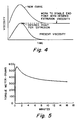
- FIGURE 4 depicts diagrammatically two viscosity curves as a function of work applied to a ceramic batch with time.
- FIGURE 5 illustrates a typical torque rheometer curve for a cordierite or cordierite-mullite type batch used in the production of honeycomb substrates.
- FIGURE 6 plots peak torque as a function of temperature for a cordierite or cordierite-mullite type batch containing a methyl cellulose as the binder/plasticizer.
- FIGURE 7 comprises curves resulting from plotting the force required to shear a ceramic ribbon and the deformation of that ribbon at the point of shear against temperature.
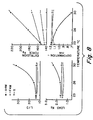
- FIGURE 8 reports plots of shear test data utilizing a cordierite-type batch with various binder/plasticizers.
- FIGURE 9 consists of extrusion pressure-temperature curves exhibited by cordierite-type batches containing various binder/plasticizers.
- FIGURE 10 constitutes plots of shear test date at various temperatures demonstrated by cordierite-type batches containing two different binder/plasticizers.
- FIGURE 11 comprises a curve illustrating the throughput of a cordierite-type batch as a function of temperature.
- AT-A-173863 there is described a method and apparatus for the extrusion of carbon particle containing batches in which an extruder is used which may have a plurality of screws rotating in the same directions. Such screws do not intermesh or self clean.
- a compacting device for compacting particulate material including a compaction section with a pair of meshing feed screws arranged one in each part of the section, which overlap in the centre of the section.
- the object of this arrangement is to reduce the likelihood of the particulate material adhering to the walls of the device.
- twin screw extrusion apparatus used in the method according to the present invention is known in the art and is, for example, described in a brochure issued by the Werner & Pfleiderer Corporation, entitled “Twin-Screw Extrusion Technology” in 1979.
- Such an extrusion apparatus has self-cleaning, intermeshing and co-rotating twin screws.
- a method of the type set out in the preamble of claim 1 characterised in that the mixture is charged into is mixed, conveyed and forced through the said die by self-cleaning, intermeshing, and co-rotating twin screws in a twin screw extrusion apparatus and further characterised in that the gel-type binder/plasticiser is selected from the higher molecular weight derivatives of methyl cellulose and has a viscosity at 20°C in a 2% aqueous solution between 25,000 - 100,000 mPA.s (25,000 - 100,000 centipoise) and that the batch is forced through the die at working temperatures greater than 35°C
- the screws of the extrusion apparatus will customarily have flights or turns along their length which are tailored in pitch and profile to provide for kneading, mixing, and conveying of the batch.
- self-cleaning screws adhesion of the batch to the screw root is prevented.
- Inhomogeneities in the extruded billet or final substrate produced because of non-uniform residence time distribution or lack of good intermixing are very rate with the twin screw apparatus, because of the extensive interblending and repeated folding of the batch across the barrel of the apparatus effected by the interaction of the intermeshing screws.
- the co-rotating screws are so designed that one crest edge of one screw wipes the flanks of the other screw with a tangentially-oriented, constant, relative velocity. Because of the high relative velocity in co-rotating screws, there is sufficient shear velocity to wipe the boundary layers in a uniform self-cleaning action.
- the twin screw extruding apparatus utilizes tight tolerances and clearances such that a very intensive mixing action results. In so doing, the time required for mixing is dramatically reduced. However, because of the close tolerances present in intermeshing twin screws, a large amount of mechanical energy is put into the batch being mixed and conveyed leading to the generation of heat therein.
- A4M METHOCEL® a methyl cellulose having a viscosity of 4000 mPa.s (centipoises) at 20°C in a 2% aqueous solution, as measured through the use of Ubbelohde tubes, marketed by Dow Chemical Corp., Midland, Michigan
- A4M METHOCEL® a methyl cellulose having a viscosity of 4000 mPa.s (centipoises) at 20°C in a 2% aqueous solution, as measured through the use of Ubbelohde tubes, marketed by Dow Chemical Corp., Midland, Michigan
- a laboratory program was devised founded upon two determinations; viz., a measurement of the cohesiveness of a ceramic batch and a measurement of batch stiffness.
- a torque rheometer is employed to measure batch cohesiveness.
- a ceramic batch is placed in a bowl and the torque developed when the batch is sheared between two blades measured.
- the level of shear in the system can be varied by altering the configuration of the blades and/or the speed at which the blades are rotated.
- a typical torque rheometer curve for a cordierite or cordierite-mullite type batch for honeycomb substrates, using a cam blade, is depicted in FIGURE 5. Data with respect to batch plasticity, thixotropy, and cohesiveness can be gleaned from that curve.
- FIGURE 6 illustrates that when peak torque is plotted against temperature for a cordierite or cordierite-mullite type batch containing the above-described A4M METHOCEL® binder/plasticizer, the loss of plasticity with increasing temperature is all too evident. Such large changes in batch properties for small variations in temperature are not desirable.
- a shear test is employed to measure batch stiffness.
- a wet-mixed batch is initially extruded into a ribbon and a small sample of that ribbon is subjected to a unidirectional shear force.
- the force required to shear the ribbon and the deformation suffered by the ribbon at the point are measures of the stiffness of the batch.
- FIGURE 7 reports the curve resulting from plotting those two values against the temperature at which the test is carried out. That curve, generated by a cordierite-mullite type batch containing the above-described A4M METHOCEL® binder/plasticizer, clearly exhibits the substantial change in batch stiffness with increasing temperatures. The low temperature at which that action occurs is quite undesirable for extrusion in a twin screw apparatus.
- methyl cellulose Numerous binder systems were investigated to locate any having a higher working temperature and demonstrating reduced sensitivity to change over the range of working temperature than does the commercially-available methyl cellulose. Such included starches and higher molecular weight derivatives of methyl cellulose, viz., hydroxyethyl cellulose, hydroxypropyl cellulose, hydroxyethyl methyl cellulose, hydroxypropyl methyl cellulose, and hydroxybutyl cellulose. Only the methyl cellulose derivatives manifested the desired behavior.
- FIGURE 8 illustrates comparisons between the commercially-marketed A4M METHOCEL® and two hydroxypropyl celluloses (F4M, marketed by Dow Chemical Corp., and an experimental composition X) utilized in the standard cordierite-type batch at temperatures up to 30°C.
- the shear test data indicate very little response for the hydroxypropyl celluloses over the temperature range of 23°-30°C, whereas the methyl cellulose demonstrates a very large change.
- Those data were confirmed in the actual extrusion trials reported in FIGURE 9 utilizing increasing temperatures. Hence, the sharp rise in extrusion pressure with increasing temperature evidenced with the methyl cellulose batch is contrary to the goal of utilizing higher extrusion temperatures.
- F4M hydroxypropyl cellulose has a viscosity of about 4000 centipoises at 20°C in a 2% aqueous solution and composition X a viscosity of about 60,000 mPa.s (centipoises) at 20°C in a 2% aqueous solution, as measured via Ubbelohde tubes.
- the F4M material is self-evidently a significant improvement over the A4M methyl cellulose, but would not plasticize the batch in the torque rheometer at 40°C.
- the higher viscosity composition X provided a plasticized batch at temperatures of 40°C and somewhat above.
- Table II reports the wet skin rating of the extruded substrate expressed in terms of the percentage of footage with a 1 or 2 rating at 0.914 m (three foot) intervals. TABLE II Auger A4M F4M X Die A 0 0 47 63 Die B 37.5 72 86 100
- the higher viscosity X has a higher working temperature (45°C as compared with about 30°C for A4M) which enables a higher throughput of batch in the twin screw apparatus.
- Laboratory experience has indicated that, when compared with A4M, X exhibits less variability over the working temperature ranges; it demonstrates a lower extrusion pressure for a given temperature; it can be used in lower concentrations for similar viscosities; it gives more flexibility in mixing batch; and it appears to impart better wet strength and shape retention to a ceramic body.
- the binder/plasticizer for use in extruding ceramic batches into articles of widely-varying profiles and shapes should have a viscosity between 25,000-100,000 mPa.s (centipoises).
- a binder/plasticizer having a viscosity of 25,000 centipoises will be operable, a viscosity of at least 50,000 mPa.s (centipoises) is much preferred since it allows the use of working temperatures of at least 40°C.
- hydroxypropyl celluloses having viscosities of approximately 75,000 mPa.s (centipoises) enable working temperatures of 50°C to be used in a twin screw apparatus. Viscosities greater than about 100,000 mPa.s (centipoises) require extremely high pressures with the concomitant generation of much heat, that heat adversely affecting the rheology of the batch.
- the twin screw apparatus because of the higher pressures, not currently possible with the conventional single screw auger commonly used commercially in extruding most ceramic materials, and improved mixing capability, offers a continuous process.
- the wet batch is charged into the twin screw apparatus which mixes the ingredients and, in so doing, applies a lot of work to the batch.
- higher temperatures, with concomitant higher batch viscosities can be utilized. This feature moves the viscosity curve upward, as described in FIGURE 4, such that extrusion can be undertaken at a viscosity closer to an equilibrium viscosity.
- the mixed batch after de-airing, is then passed through a screen (to protect the die) and thence through the die, exiting as a finished honeycomb substrate.
- a screen to protect the die
- an automatic screen and die changer may be utilized to make such changes without shutting down the extrusion apparatus.
- the overall ceramic composition will consist essentially of ingredients forming cordierite with a minor amount of mullite.
- the precursor batch will contain about 1-4% by weight hydroxypropyl cellulose and, optionally, up to about 1% of an extrusion aid.
- Talc 40.21 Alumina 13.47 Hydroxypropyl Cellulose 3.0 Diglycol Stearate 1.0 Kaolin 46.32
- the diglycol stearate functions as an extrusion aid.
- Other commercially-available extrusion aids may, of course, be used in conjunction with or in substitution for diglycol stearate.
- Water in an amount of about 31% as a percentage of dry solids is added to the batch ingredients.
Landscapes
- Engineering & Computer Science (AREA)
- Chemical & Material Sciences (AREA)
- Ceramic Engineering (AREA)
- Manufacturing & Machinery (AREA)
- Organic Chemistry (AREA)
- Structural Engineering (AREA)
- Materials Engineering (AREA)
- Mechanical Engineering (AREA)
- Inorganic Chemistry (AREA)
- Press-Shaping Or Shaping Using Conveyers (AREA)
- Compositions Of Oxide Ceramics (AREA)
- Preparation Of Clay, And Manufacture Of Mixtures Containing Clay Or Cement (AREA)
- Catalysts (AREA)
Claims (8)
- Verfahren zur Herstellung von durch Extrusion entstandenen Keramikgegenständen sehr unterschiedlicher Bauformen bzw. Profile und Gestaltungen mit einer Achse senkrecht zu einem fixierten Querschnitt, bei dem ein plastisch deformierbarer Ansatz, der eine Mischung aus teilchenförmigem Keramikmaterial, das einen Hauptanteil des Ansatzes darstellt, Wasser und einem Bindemittel/Plastifizierungsmittel vom Gel-Typ aus einem Methylcellulosederivat aufweist, in eine Extrusionsvorrichtung gefüllt wird, worin er vermischt, entlüftet, transportiert und durch eine Matrize mit der gewünschten Gestaltung gepreßt wird, um wenigstens einen der Gegenstände zu bilden,
dadurch gekennzeichnet,
daß die Mischung eingefüllt und durch selbstreinigende, ineinandergreifende und co-rotierende Doppelschnecken in einer Doppelschnecken-Extrusionsvorrichtung vermischt, transportiert und durch die Matrize gepreßt wird, und weiterhin dadurch gekennzeichnet, daß das Bindemittel/Plastifizierungsmittel vom Gel-Typ ausgewählt wird aus Derivaten der Methylcellulose mit einem höheren Molekulargewicht und daß es eine Viskosität bei 20°C in einer 2% wäßrigen Lösung zwischen 25000 - 100000 mPa.s (25000 - 100000 Centipoise) aufweist, und daß der Ansatz durch eine Matrize bei einer Verarbeitungstemperatur von mehr als 35°C gepreßt wird. - Verfahren nach Anspruch 1,
dadurch gekennzeichnet,
daß das Bindemittel/Plastifizierungsmittel vom Gel-Typ eine Hydroxypropylcellulose ist. - Verfahren nach Anspruch 2,
dadurch gekennzeichnet,
daß das Bindemittel/Plastifizierungsmittel vom Gel-Typ eine Hydroxypropylcellulose ist, die eine Viskosität bei 20°C in einer 2% wäßrigen Lösung von wenigstens 50000 mPa.s (50000 Centipoise) aufweist, und eine Verarbeitungstemperatur von Wenigstens 40°C angewandt wird. - Verfahren nach Anspruch 3,
dadurch gekennzeichnet,
daß das Bindemittel/Plastifizierungsmittel vom Gel-Typ eine Hydroxypropylcellulose ist, die eine Viskosität bei 20°C in einer 2% wäßrigen Lösung von etwa 75000 mPa.s (75000 Centipoise) aufweist und eine Bearbeitungstemperatur von etwa 50°C verwendet wird. - Verfahren nach irgendeinem der Ansprüche 2 - 4,
dadurch gekennzeichnet,
daß die Hydroxypropylcellulose im Ansatz in einer Menge von 1 - 4 Gew.-% vorliegt. - Verfahren nach irgendeinem der Ansprüche 1 - 5,
dadurch gekennzeichnet,
daß das Keramikmaterial im wesentlichen aus Bestandteilen besteht, die eine Cordierit- oder eine Cordierit-Mullit-Zusammensetzung bilden. - Verfahren nach irgendeinem der Ansprüche 1 - 6,
dadurch gekennzeichnet,
daß der Ansatz ein Extrusionshilfsmittel beinhaltet. - Verfahren nach irgendeinem der Ansprüche 1 - 7,
dadurch gekennzeichnet,
daß der extrudierte Gegenstand eine wabenartige Struktur aufweist.
Applications Claiming Priority (2)
| Application Number | Priority Date | Filing Date | Title |
|---|---|---|---|
| US604374 | 1984-04-26 | ||
| US06/604,374 US4551295A (en) | 1984-04-26 | 1984-04-26 | Process for mixing and extruding ceramic materials |
Publications (3)
| Publication Number | Publication Date |
|---|---|
| EP0165651A2 EP0165651A2 (de) | 1985-12-27 |
| EP0165651A3 EP0165651A3 (en) | 1987-09-09 |
| EP0165651B1 true EP0165651B1 (de) | 1994-08-31 |
Family
ID=24419347
Family Applications (1)
| Application Number | Title | Priority Date | Filing Date |
|---|---|---|---|
| EP85301120A Expired - Lifetime EP0165651B1 (de) | 1984-04-26 | 1985-02-20 | Verfahren zum Mischen und Extrudieren von keramischem Material |
Country Status (8)
| Country | Link |
|---|---|
| US (1) | US4551295A (de) |
| EP (1) | EP0165651B1 (de) |
| JP (1) | JPH0635126B2 (de) |
| KR (1) | KR930006206B1 (de) |
| AT (1) | ATE110616T1 (de) |
| AU (1) | AU565606B2 (de) |
| CA (1) | CA1260234A (de) |
| DE (1) | DE3587916T2 (de) |
Families Citing this family (40)
| Publication number | Priority date | Publication date | Assignee | Title |
|---|---|---|---|---|
| US5248464A (en) * | 1987-04-23 | 1993-09-28 | Imperial Chemical Industries Plc | Article of ceramic material and production thereof |
| GB8709598D0 (en) * | 1987-04-23 | 1987-05-28 | Ici Plc | Article of ceramic material |
| US4868142A (en) * | 1987-12-16 | 1989-09-19 | Stemcor Corporation | Method of manufacturing a molten metal-resistant ceramic fiber composition |
| US5171720A (en) * | 1988-09-20 | 1992-12-15 | Asahi Kogaku Kogyo K.K. | Porous ceramic sinter and process for producing same |
| JPH0643048B2 (ja) * | 1989-03-27 | 1994-06-08 | 日本碍子株式会社 | セラミック押出法およびそれに用いる装置 |
| US4973566A (en) * | 1989-05-16 | 1990-11-27 | Coors Ceramics Company | Cordierite material useful in a heat source retainer and process for making the same |
| CA2020453A1 (en) * | 1989-07-28 | 1991-01-29 | Bulent O. Yavuz | Thermal shock and creep resistant porous mullite articles |
| US5281462A (en) * | 1989-11-01 | 1994-01-25 | Corning Incorporated | Material, structure, filter and catalytic converter |
| US5316577A (en) * | 1992-02-03 | 1994-05-31 | Corning Incorporated | Plastically deformable metallic mixtures and their use |
| US5344799A (en) * | 1992-12-14 | 1994-09-06 | Corning Incorporated | Formable ceramic compositions and method of use therefor |
| JP3415188B2 (ja) * | 1993-03-26 | 2003-06-09 | 日本碍子株式会社 | セラミックス構造体用坏土 |
| US5458834A (en) * | 1993-10-07 | 1995-10-17 | Corning Incorporated | Extrusion of low viscosity batch |
| GB2285407A (en) * | 1993-12-14 | 1995-07-12 | Kobe Steel Ltd | Apparatus for molding fibrous material containing waste paper |
| US5811048A (en) * | 1996-06-17 | 1998-09-22 | Corning Incorporated | Process of and apparatus for homogenizing a flow stream |
| JP3074169B1 (ja) * | 1999-03-29 | 2000-08-07 | 日本碍子株式会社 | コージェライト質セラミックハニカム構造体の製造方法 |
| DE60134628D1 (de) * | 2000-02-18 | 2008-08-14 | Ngk Insulators Ltd | Verfahren zum herstellen von keramischen strukturen |
| US6375450B1 (en) * | 2000-03-17 | 2002-04-23 | Corning Incorporated | Extrusion apparatus for ceramic honeycomb articles |
| JP2002283326A (ja) * | 2001-03-28 | 2002-10-03 | Ngk Insulators Ltd | ハニカム構造体成形装置及び成形方法 |
| US20040194505A1 (en) * | 2003-04-01 | 2004-10-07 | Ji Wang | Method of making a photonic crystal preform |
| US7276194B2 (en) * | 2003-08-29 | 2007-10-02 | Corning Incorporated | Method and apparatus for extruding a ceramic material |
| US7940179B2 (en) * | 2005-01-12 | 2011-05-10 | British Telecommunications Public Limited Company | Radio frequency identification tag security systems |
| WO2006085591A1 (ja) * | 2005-02-14 | 2006-08-17 | Shin-Etsu Quartz Products Co., Ltd. | シリカガラス製品の製造方法 |
| US8261449B2 (en) * | 2006-07-04 | 2012-09-11 | Ngk Insulators, Ltd. | Manufacturing method of plugged honeycomb structure |
| EP2118035A2 (de) * | 2006-11-29 | 2009-11-18 | Corning Incorporated | Weichgemachte mischung und versteifungsverfahren |
| US9174879B2 (en) * | 2007-11-30 | 2015-11-03 | Corning Incorporated | Ceramic precursor batch composition and method of increasing ceramic precursor batch extrusion rate |
| US20090218711A1 (en) * | 2008-02-28 | 2009-09-03 | David Dasher | Method of increasing ceramic paste stiffening/gelation temperature by using a salt and precursor batch |
| US8808601B2 (en) * | 2008-05-30 | 2014-08-19 | Corning Incorporated | Method for manufacturing ceramic filter |
| WO2009153617A1 (en) * | 2008-06-19 | 2009-12-23 | Dow Wolff Cellulosics Gmbh | Additives comprising cellulose ethers for ceramics extrusion |
| US20100127419A1 (en) * | 2008-11-24 | 2010-05-27 | Christopher John Malarkey | Ceramic honeycomb extrusion method and apparatus |
| US20100217424A1 (en) * | 2009-02-26 | 2010-08-26 | Andrew Charles Gorges | Ceramic contamination control processes |
| SG188923A1 (en) * | 2009-12-16 | 2013-04-30 | Lyondell Chemical Tech Lp | Titania-containing extrudate |
| WO2011136981A1 (en) | 2010-04-26 | 2011-11-03 | Dow Global Technologies Llc | Composition for extrusion-molded bodies |
| CN102858717B (zh) | 2010-04-26 | 2016-01-20 | 陶氏环球技术有限责任公司 | 用于挤出模塑体的组合物 |
| US9580581B2 (en) | 2010-10-12 | 2017-02-28 | Dow Global Technologies Llc | Cellulose ethers and their use |
| EP2637836B1 (de) | 2010-11-08 | 2017-09-13 | Dow Global Technologies LLC | Methylcellulose enthaltende zusammensetzung für stranggepresste körper |
| JP5476331B2 (ja) * | 2011-03-31 | 2014-04-23 | 日本碍子株式会社 | ハニカム構造体の製造方法 |
| US20150028526A1 (en) | 2012-02-10 | 2015-01-29 | Dow Global Technologies Llc | Composition for extrusion-molded ceramic bodies comprising a cellulose derivative of certain median particle length |
| MX375728B (es) * | 2014-01-16 | 2025-03-06 | Nutrition & Biosciences Usa 1 Llc | Composición cerámica moldeable con calor que contiene una hidroxipropilmetilcelulosa. |
| KR101993783B1 (ko) | 2016-01-20 | 2019-06-28 | 주식회사 엘지화학 | 카본나노튜브 펠렛 제조장치 |
| RU2693454C1 (ru) * | 2018-12-20 | 2019-07-03 | Федеральное государственное бюджетное учреждение науки "Федеральный исследовательский центр "Институт катализа им. Г.К. Борескова Сибирского отделения Российской академии наук" (ИК СО РАН, Институт катализа СО РАН) | Каталитический элемент для гетерогенных высокотемпературных реакций |
Citations (3)
| Publication number | Priority date | Publication date | Assignee | Title |
|---|---|---|---|---|
| AT173863B (de) * | 1951-01-03 | 1953-02-10 | Chem Fab Griesheim | Verfahren und Vorrichtung zur Herstellung von grünen, durch Erhitzen in den endgültigen Zustand überzuführenden Kohleformkörpern |
| DE2413534A1 (de) * | 1974-03-21 | 1975-10-02 | Heinz Rottner | Strangpresse fuer hochviskose stoffe, insbesondere keramische massen |
| GB2034591A (en) * | 1978-11-07 | 1980-06-11 | Pimi Spa | A compacting device for particulate material |
Family Cites Families (7)
| Publication number | Priority date | Publication date | Assignee | Title |
|---|---|---|---|---|
| US3917782A (en) * | 1973-05-16 | 1975-11-04 | Us Energy | Method for preparing thin-walled ceramic articles of configuration |
| JPS5733898B2 (de) * | 1973-05-17 | 1982-07-20 | ||
| JPS55100269A (en) * | 1979-01-25 | 1980-07-31 | Ngk Insulators Ltd | Production of cordierite type ceramic honeycomb structure |
| JPS5792574A (en) * | 1980-11-28 | 1982-06-09 | Nippon Denso Co | Manufacture of cordierite ceramics |
| US4411856A (en) * | 1981-07-15 | 1983-10-25 | Corning Glass Works | Method and apparatus for high speed manifolding of honeycomb structures |
| US4432918A (en) * | 1981-08-24 | 1984-02-21 | Corning Glass Works | Methods for fabricating selectively plugged honeycomb structures |
| US4428758A (en) * | 1982-02-22 | 1984-01-31 | Corning Glass Works | Solid particulate filters |
-
1984
- 1984-04-26 US US06/604,374 patent/US4551295A/en not_active Expired - Lifetime
-
1985
- 1985-02-12 CA CA000474082A patent/CA1260234A/en not_active Expired
- 1985-02-20 EP EP85301120A patent/EP0165651B1/de not_active Expired - Lifetime
- 1985-02-20 AT AT85301120T patent/ATE110616T1/de not_active IP Right Cessation
- 1985-02-20 DE DE3587916T patent/DE3587916T2/de not_active Expired - Fee Related
- 1985-04-18 AU AU41400/85A patent/AU565606B2/en not_active Ceased
- 1985-04-26 KR KR1019850002845A patent/KR930006206B1/ko not_active Expired - Fee Related
- 1985-04-26 JP JP60090758A patent/JPH0635126B2/ja not_active Expired - Fee Related
Patent Citations (3)
| Publication number | Priority date | Publication date | Assignee | Title |
|---|---|---|---|---|
| AT173863B (de) * | 1951-01-03 | 1953-02-10 | Chem Fab Griesheim | Verfahren und Vorrichtung zur Herstellung von grünen, durch Erhitzen in den endgültigen Zustand überzuführenden Kohleformkörpern |
| DE2413534A1 (de) * | 1974-03-21 | 1975-10-02 | Heinz Rottner | Strangpresse fuer hochviskose stoffe, insbesondere keramische massen |
| GB2034591A (en) * | 1978-11-07 | 1980-06-11 | Pimi Spa | A compacting device for particulate material |
Non-Patent Citations (4)
| Title |
|---|
| AMERICAN CERAMIC SOCIETY BULLETIN, vol. 62, no. 11, pages 1280-1288, November 1983, Columbus, Ohio, US: N. SARKAR et al.: "Methylcellulose Polymers as Multifunctional Processing Aids in Ceramics" * |
| CHEMICAL ABSTRACTS, vol. 89, no. 8, 21st August 1978, columbus, Ohio, USA; HERCULES, INC.: "Water soluble additives for ceramic processing", page 251, column 1, abstract no. 63779u * |
| CHEMICAL ABSTRACTS, vol. 89, no. 8, 21st August 1978, Columbus, Ohio, USA; SHIN-ETSU CHEMICAL INDUSTRY CO. LTD.: "Catalyst support", page 403, column 2, abstract no. 66094c * |
| Prospectus "Twin-Screw Extrusion Technology" by Werner & Pfleiderer Corporation, imprint "WP G PTG 79 1" * |
Also Published As
| Publication number | Publication date |
|---|---|
| ATE110616T1 (de) | 1994-09-15 |
| EP0165651A3 (en) | 1987-09-09 |
| DE3587916T2 (de) | 1995-04-27 |
| AU565606B2 (en) | 1987-09-24 |
| KR930006206B1 (ko) | 1993-07-09 |
| AU4140085A (en) | 1985-10-31 |
| EP0165651A2 (de) | 1985-12-27 |
| US4551295A (en) | 1985-11-05 |
| JPS60239207A (ja) | 1985-11-28 |
| KR850007238A (ko) | 1985-12-02 |
| CA1260234A (en) | 1989-09-26 |
| JPH0635126B2 (ja) | 1994-05-11 |
| DE3587916D1 (de) | 1994-10-06 |
Similar Documents
| Publication | Publication Date | Title |
|---|---|---|
| US4551295A (en) | Process for mixing and extruding ceramic materials | |
| US6241940B1 (en) | Method for producing ceramic bodies | |
| EP1263565B1 (de) | Extrusionsverfahren und verfahren zur herstellung mit einer keramischen wabenstruktur | |
| Forzatti et al. | Preparation and characterization of extruded monolithic ceramic catalysts | |
| US20160039718A1 (en) | Ceramic precursor batch composition and method of increasing ceramic precursor batch extrusion rate | |
| CN1242953C (zh) | 可塑炼的混合物和可挤压的混合物 | |
| US4279849A (en) | Method for producing cordierite ceramic honeycomb structural bodies | |
| US3930522A (en) | Structural ceramic article and method of making same | |
| EP1428809B1 (de) | Verfahren zur Herstellung eines Wabenkörpers | |
| CN111527055A (zh) | 包含预反应过的无机颗粒的批料组合物及由其制造生坯体的方法 | |
| EP1012126A1 (de) | Verfahren zur gewinnung und zum formen von plastifizierten mischungen und grünkörper daraus | |
| JP6087830B2 (ja) | メチルセルロースを含む押し出し成形体のための組成物 | |
| DE69606246T2 (de) | Verformbare Kunststoffmischungen und Verfahren zur Anwendung | |
| CA1328348C (en) | Moldings composed of cordierite and a process for producing them | |
| US8765049B2 (en) | Control of clay crystallite size for shrinkage management | |
| EP1041055B1 (de) | Verfahren zum Herstellen einer Bienenwabenstruktur auf Basis von Cordierit | |
| EP0554715A2 (de) | Plastisch verformbare Metallpulvermischung sowie ihre Anwendung | |
| CN1128668C (zh) | 通过挤制生产堇青石蜂窝状载体的方法 | |
| Janas et al. | Predicting Extrudability of Batch via Torque and Capillary Rheometry | |
| JPH0753611B2 (ja) | セラミツクス成形体原料の製造法 | |
| EP1048447A2 (de) | Gegossene Wabenstruktur und Verfahren zur deren Herstellung |
Legal Events
| Date | Code | Title | Description |
|---|---|---|---|
| PUAI | Public reference made under article 153(3) epc to a published international application that has entered the european phase |
Free format text: ORIGINAL CODE: 0009012 |
|
| AK | Designated contracting states |
Designated state(s): AT BE DE FR GB NL SE |
|
| PUAL | Search report despatched |
Free format text: ORIGINAL CODE: 0009013 |
|
| AK | Designated contracting states |
Kind code of ref document: A3 Designated state(s): AT BE DE FR GB NL SE |
|
| 17P | Request for examination filed |
Effective date: 19880218 |
|
| 17Q | First examination report despatched |
Effective date: 19880826 |
|
| GRAA | (expected) grant |
Free format text: ORIGINAL CODE: 0009210 |
|
| AK | Designated contracting states |
Kind code of ref document: B1 Designated state(s): AT BE DE FR GB NL SE |
|
| PG25 | Lapsed in a contracting state [announced via postgrant information from national office to epo] |
Ref country code: AT Effective date: 19940831 |
|
| REF | Corresponds to: |
Ref document number: 110616 Country of ref document: AT Date of ref document: 19940915 Kind code of ref document: T |
|
| REF | Corresponds to: |
Ref document number: 3587916 Country of ref document: DE Date of ref document: 19941006 |
|
| PG25 | Lapsed in a contracting state [announced via postgrant information from national office to epo] |
Ref country code: SE Effective date: 19941130 |
|
| ET | Fr: translation filed | ||
| PLBE | No opposition filed within time limit |
Free format text: ORIGINAL CODE: 0009261 |
|
| STAA | Information on the status of an ep patent application or granted ep patent |
Free format text: STATUS: NO OPPOSITION FILED WITHIN TIME LIMIT |
|
| 26N | No opposition filed | ||
| REG | Reference to a national code |
Ref country code: GB Ref legal event code: IF02 |
|
| PGFP | Annual fee paid to national office [announced via postgrant information from national office to epo] |
Ref country code: GB Payment date: 20030106 Year of fee payment: 19 |
|
| PGFP | Annual fee paid to national office [announced via postgrant information from national office to epo] |
Ref country code: NL Payment date: 20030110 Year of fee payment: 19 |
|
| PGFP | Annual fee paid to national office [announced via postgrant information from national office to epo] |
Ref country code: FR Payment date: 20030204 Year of fee payment: 19 |
|
| PGFP | Annual fee paid to national office [announced via postgrant information from national office to epo] |
Ref country code: DE Payment date: 20030228 Year of fee payment: 19 |
|
| PGFP | Annual fee paid to national office [announced via postgrant information from national office to epo] |
Ref country code: BE Payment date: 20030312 Year of fee payment: 19 |
|
| PG25 | Lapsed in a contracting state [announced via postgrant information from national office to epo] |
Ref country code: GB Free format text: LAPSE BECAUSE OF NON-PAYMENT OF DUE FEES Effective date: 20040220 |
|
| PG25 | Lapsed in a contracting state [announced via postgrant information from national office to epo] |
Ref country code: BE Free format text: LAPSE BECAUSE OF NON-PAYMENT OF DUE FEES Effective date: 20040228 |
|
| BERE | Be: lapsed |
Owner name: *CORNING GLASS WORKS Effective date: 20040228 |
|
| PG25 | Lapsed in a contracting state [announced via postgrant information from national office to epo] |
Ref country code: NL Free format text: LAPSE BECAUSE OF NON-PAYMENT OF DUE FEES Effective date: 20040901 Ref country code: DE Free format text: LAPSE BECAUSE OF NON-PAYMENT OF DUE FEES Effective date: 20040901 |
|
| GBPC | Gb: european patent ceased through non-payment of renewal fee |
Effective date: 20040220 |
|
| PG25 | Lapsed in a contracting state [announced via postgrant information from national office to epo] |
Ref country code: FR Free format text: LAPSE BECAUSE OF NON-PAYMENT OF DUE FEES Effective date: 20041029 |
|
| NLV4 | Nl: lapsed or anulled due to non-payment of the annual fee |
Effective date: 20040901 |
|
| REG | Reference to a national code |
Ref country code: FR Ref legal event code: ST |
|
| APAH | Appeal reference modified |
Free format text: ORIGINAL CODE: EPIDOSCREFNO |