EP0165773A2 - Filtre réticulé comportant des fibres optiques montées en cascade - Google Patents
Filtre réticulé comportant des fibres optiques montées en cascade Download PDFInfo
- Publication number
- EP0165773A2 EP0165773A2 EP85304203A EP85304203A EP0165773A2 EP 0165773 A2 EP0165773 A2 EP 0165773A2 EP 85304203 A EP85304203 A EP 85304203A EP 85304203 A EP85304203 A EP 85304203A EP 0165773 A2 EP0165773 A2 EP 0165773A2
- Authority
- EP
- European Patent Office
- Prior art keywords
- filter
- fiber optic
- fiber
- signal
- coupler
- Prior art date
- Legal status (The legal status is an assumption and is not a legal conclusion. Google has not performed a legal analysis and makes no representation as to the accuracy of the status listed.)
- Withdrawn
Links
Images





Classifications
-
- G—PHYSICS
- G02—OPTICS
- G02B—OPTICAL ELEMENTS, SYSTEMS OR APPARATUS
- G02B6/00—Light guides; Structural details of arrangements comprising light guides and other optical elements, e.g. couplings
- G02B6/24—Coupling light guides
- G02B6/26—Optical coupling means
- G02B6/28—Optical coupling means having data bus means, i.e. plural waveguides interconnected and providing an inherently bidirectional system by mixing and splitting signals
-
- H—ELECTRICITY
- H04—ELECTRIC COMMUNICATION TECHNIQUE
- H04L—TRANSMISSION OF DIGITAL INFORMATION, e.g. TELEGRAPHIC COMMUNICATION
- H04L25/00—Baseband systems
- H04L25/02—Details ; arrangements for supplying electrical power along data transmission lines
- H04L25/03—Shaping networks in transmitter or receiver, e.g. adaptive shaping networks
- H04L25/03006—Arrangements for removing intersymbol interference
- H04L25/03012—Arrangements for removing intersymbol interference operating in the time domain
- H04L25/03019—Arrangements for removing intersymbol interference operating in the time domain adaptive, i.e. capable of adjustment during data reception
- H04L25/03057—Arrangements for removing intersymbol interference operating in the time domain adaptive, i.e. capable of adjustment during data reception with a recursive structure
-
- G—PHYSICS
- G02—OPTICS
- G02B—OPTICAL ELEMENTS, SYSTEMS OR APPARATUS
- G02B6/00—Light guides; Structural details of arrangements comprising light guides and other optical elements, e.g. couplings
- G02B6/24—Coupling light guides
- G02B6/26—Optical coupling means
- G02B6/28—Optical coupling means having data bus means, i.e. plural waveguides interconnected and providing an inherently bidirectional system by mixing and splitting signals
- G02B6/2804—Optical coupling means having data bus means, i.e. plural waveguides interconnected and providing an inherently bidirectional system by mixing and splitting signals forming multipart couplers without wavelength selective elements, e.g. "T" couplers, star couplers
- G02B6/2861—Optical coupling means having data bus means, i.e. plural waveguides interconnected and providing an inherently bidirectional system by mixing and splitting signals forming multipart couplers without wavelength selective elements, e.g. "T" couplers, star couplers using fibre optic delay lines and optical elements associated with them, e.g. for use in signal processing, e.g. filtering
Definitions
- the invention relates generally to the field of optical guided wave signal processors and, more particularly, to fiber optic devices for filtering signals.
- Pipelining is a hardware configuration, i.e., architecture for a computer, involving a plurality of processors linked into an array to achieve higher performance. This is done by breaking up complex, time-consuming functions into a series of simpler, shorter operations, each of which can be executed in assembly line fashion with simultaneous computation on different sets of data by the different processors. The improvement in performance is directly proportional to the number of pipeline processors in the array that are simultaneously kept busy doing part of the task. Pipelining is most effective in special purpose applications which can use array processors.
- a further increase in the speed of such processing may be achieved by use of fiber-optic systems in the pipeline architectures, as well as in other signal processing portions of a given system.
- Optical devices may be utilized to achieve such increases in data processing speed because of their excelleiat propagation and delay properties.
- the low loss and low dispersion of single-mode fiber allow signals to propagate large distances without significant attenuation or distortion.
- single-mode fiber The propagation and delay properties of single-mode fiber are particularly attractive because digital signal processing and conventional analog signal processing techniques (such as those using surface acoustic wave devices) are limited in their usefulness in applications involving signal bandwidths exceeding one or 2 gigahertz, although they are very effective at lower frequencies. Those digital and conventional analog signal processing techniques simply cannot be used in applications requiring very high data rates where it is often the case that bandwidths of 10 GHz and beyond may be needed.
- the real-time processing of broad band radar signals is an example of a current application which would benefit from optical fiber devices capable of handling high frequency bandwidths.
- Other potential applicationsf include the direct interfacing of fiber processors with high-speed optical communications systems.
- fiber systems can perform real-time processing operations on the optical output of one or more fiber sensors, including the time-division multiplexing -of slow sensor outputs to match the high data rates that can be handled by fiber systems. In either case, the ability to process broadband optical data before transduction into electrical signals can be of great practical value, and finds application in a wide variety of circumstances.
- filtering may be used for purposes such as restoring a distorted signal, or extracting one signal from a combination of signals and/or noise.
- a filter functions to remove undesired components from an input signal, so that only the desired signal components are allowed to pass through the filter.
- filters having the capability of providing a broad range of complex frequency responses, so that the filter may be utilized in any of numerous applications.
- one device comprises a transversal filter, such as a tapped- delay line, whose tap weights are adjusted to realize the desired filtering option.
- This transversal filter is sometimes called ..a non-recursive system or a finite- duration impulse response (FIR) filter.
- FIR filters impulse signals applied to their inputs eventually pass entirely through the filter.
- These non-recursive filters introduce only zeros into the system transfer function, and are therefore also known as "all-zero filters.”
- the principal disadvantage of FIR filters, whether of tapped- delay; line or lattice type, is that obtaining sharp filtering requires many stages of individual taps or of directional couplers.
- IIR infinite-duration impulse response
- recursive filters introduce, in general, both poles and zeros (pole-zero filter) in the transfer function. In a special case, recursive filters can introduce only poles into the transfer function, in which case the name "all-pole filter” is used.
- IIR filter one input signal propagates along a feed-forward line to a successive coupler while another signal propagates along'"the feed-backward line to the prior coupler on the feed-forward line. Thus, a portion of the signal transmitted from the output of a directional coupler on the feed-forward line will return from the immediately successive coupler via the feed-backward line after an overall loop delay time interval T.
- a particular filtering function may be obtained from an IIR fiber optic lattice filter by selecting the amount of light signal coupled between the fibers and by selecting the loop transit times T associated with each of the filters' stages.
- IIR fiber optic lattice filters exhibit the advantages of that general class of non-fiber optic filters, such as being capable of extremely sharp frequency response wich a small number of stages.
- the disadvantages of this filter are the complexity of its design, concern over filter stability, and the filter's intrinsically non-linear phase response.
- analysis of the transfer function for an IIR fiber optic lattice filter establishes that the' filter may include both poles and zeros whose respective locations on the Z-transform plane are interdependent. That is, if particular inputs .and outputs are used on this type of filter, the filter's poles and zeros cannot be adjusted independently of each other.
- the poles of the filter may be adjusted independently of its zeros because of the location of its zeros.
- Such analysis also demonstrates that because such a fiber optic lattice filter is a positive system, in that light intensities are used i as signals, its poles are restricted to the particular regions of the Z-transform plane determined by the number of stages in the filter.
- lattice filter which is merely a fiber filter structure and which is implemented by cascading together a multiplicity of the fiber filter structures such as those which are individually described herein.
- Lattice structures are suitable forms for performing signal processing operations, and they have some advantageous characteristics as compared to other filter forms, such as modularity, regularity, ease of implementation and good sensitivity. Lattice structures are particularly desirable since, by varying the coupling coefficients of the lattice couplers, one can adjust the system transfer function and, therefore, shape the frequency response of the filter.
- Fiber optic filters such as those described above suffer from a limitation which is not shared by other., corresponding classes of non-optic filters.
- fiber optic lattice filters comprise positive systems since they employ light intensity as the signal carrying medium. With this signal medium, negative weighting of taps cannot be accomplished.
- the filters employ directional couplers which can only additively, rather than subtractively, transfer light signals between fibers, only positive valued signals may be applied to and processed within the filter. The absence of negativity in these fiber optic lattice filters limits the regions.of the Z-transform plane in which poles and zeros of the respective filter classes may be located.
- the invention comprises a programmable fiber optic lattice filter with a transfer function having poles and zeros which may be adjusted independently of each other.
- the filter is characterized by a recursive fiber optic filter section, and a non-recursive fiber optic filter section connected to the recursive fiber optic filter section, wherein one of the fiber sections receives input signals and provides a first filtered signal, and the other of the filter sections receives the first filtered signal and provides a filtered output signal.
- the filter sections are independently adjustable all pole and all zerofilters, respectively.
- the invention is comprised of two monomode optical waveguides which are cross coupled by a plurality of fiber optic directional couplers located at various positions along the fiber.
- the two fibers carry light signals through the array.
- Each coupler has four ports, each fiber passing through two of those ports.
- the couplers can be tuned to vary the coupling and transmission operators which describe the coupler in terms of the amount of power on each fiber coupled to the other fiber . and the amount of power remaining in the original fiber.
- a coupler can be described by the operators ⁇ , r, t, p. These operators are defined in terms of the amount of light transmitted through the coupler on each fiber, and the amount of light cross coupled from each fiber to the other.
- the fibers between the couplers can be helically wound to implement varying delay between the couplers.
- the direction of the windings are varied so that forward coupling is provided in at least one non-recursive section of the lattice filter and backward coupling is provided in at least one other recursive section of the filter.
- a cascaded filter is formed having poles and zeros which are independently adjustable in order to provide more complex frequency response by the lattice filter.
- the special all-pass filter configuration is formed by cascading a first order recursive section with a first-order non-recursive reaction, and applying the two outputs from the non-recursive section to two photodiodes of opposite polarity, adjusting the magnitudes of the respective output currents from the photodiodes with attenuators and by summing the adjusted output currents.
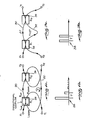
- Figure 1(a) illustrates the structure of a 2-coupler recircu ating delay line.
- This delay line comprises first and second single-mode fiber optic waveguides 20 and 22, and several couplers 24 and 26 which are distributed along the empergths of the fibers.
- fiber 22 is closed upon itself by the directional couplers 24 and 26 while fiber 20 extends directly between couplers 24 and 26 .
- coupler 26 functions to feed some portion of the light from fiber 20 back to coupler 24 through fiber 22 .
- optical signals applied to input X 1 of fiber 20 circulare repeatedly around the loop between the couplers 24 and 26, sending a portion of the ecirculating intensity to the output Y 2 of fiber 20, as well as the output Y 1 of fiber 22.
- FIG. 2(a) illustrates a non-recirculating (feed-forward, delay line comprising first and second single mode fiber optic waveguides 30 and 32 which are connected in a parallel configuration between two optical couplers 34 and 36.
- the outputs from couoler 34 on fibers 30 and 32 are fed forward to coupler 36 where they are recombined after a time delay T which is the time delay difference present between the portion of the two feed-forward fiber lines 30 and 32 which lies between couplers 34 and 36.
- T the time delay difference present between the portion of the two feed-forward fiber lines 30 and 32 which lies between couplers 34 and 36.
- the impulse response of this feed-forward configuration comprises just two pulses spaced by the amount of time delay T, as is indicated generally at 38.
- the length of the optical fibers between the couplers 24 and 26 of Figure 1 or 34 and 36 of Figure 2 and the number of couplers in the filter depends upon the particular application for which the structure is intended.
- the directional couplers 24, 26, 34 and 36 may be as described by Bergh, Kotler and Shaw, in “Single Mode Fiber Optic Directional Coupler," Electronic Letters, Vol.. 16, No. 7, March 27, 1980, and European Publication 'No. 0038023, entitled “Fiber Optic Directional Coupler", the details of which are hereby incorporated by reference.
- Such couplers are adjustable such that the amount of light energy coupled between the fibers can be varied from 0% to 100%.
- the couplers 24, 26, 34 and 36 are linear, symmetric devices whose optical characteristics can be described by the operators t, p, r and ⁇ . Referring to the coupler 24 as exemplary of all the couplers in Figures 1 and 2, the four above-mentioned operators are defined in terms of the input and output signals from the coupler 24. That is: and
- Equations (1) and (2) ignore losses in the coupler which are generally 5% or less.
- Equation (1) means that the light power of the light wave at port B at any instant is equal to the light power of the wave entering port A times the tunable coupling operator r 1 plus the light power of the wave entering at the port D times the transmission operator ⁇ , ignoring losses.
- the operator ⁇ 1 is equal to r 1 , because the coupler is symmetric.
- the light power of the light wave leaving at port C is equal to the light power entering at port A times the transmission ogerator t 1 plus the light power entering at the port D times the feedback coupling coefficient ⁇ 1 less, ignoring losses.
- the operators r 1 and t 1 are related as are ⁇ 1 and ⁇ 1 because of conservation of energy. That is: and
- Error should be within 5% because of losses in. the coupler. Energy entering the coupler is neither created nor destroyed; thus, the same amount of energy that enters each coupler, less some small losses, must leave the coupler. Thus, when r 1 and ⁇ 1 are tuned to couple more power between the fibers, the operator t 1 and ⁇ 1 decrease in proportion to the increase in r 1 and ⁇ 1 .
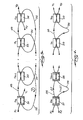
- FIG 3 illustrates an infinite-duration impulse response filter (IIR filter) which is assembled by cascading a plurality of recirculating delay lines of the type illustrated in Figure 1.
- this IIR filter includes one optical fiber feed-forward line 49 whose input is at X 1 and whose output is at Y 2 .
- the filter also includes one optical fiber feed-backward line 50 whose input is at X 2 and whose output is at Y 1 .
- At each of the directional couplers 51, 52, 53 and 54 a portion of the light signal is coupled between the feed-forward line 49 and the feed-backward line 50.
- the light signals transmitted from a coupler's outputs do not simultaneously propagate in parallel to a successive common coupler.
- one signal propagates along the feed-forward line 49 to the successive coupler while the other propagates along the feed-backward line 50 to the prior coupler on the feed-forward line.
- a portion of the signal transmitted from the output of a directional coupler on the feed-forward line 49 will return from the immediately successive coupler via the feed-backward line 50 after an overall loop delay time interval T.
- a particular filtering function may be obtained from an IIR fiber optic lattice filter by selecting the amount of light signal coupled between the fibers and by selecting the loop transit times T associated with each of the filter's stages. In general, a different loop transit time T may be associated with each of the IIR filter's stages.
- This IIR fiber optic lattice filter exhibits the advantages of that corresponding class of non-optical filters which include being capable of extremely sharp frequency response with a small number of stages.
- the disadvantages of this filter are the complexity of its design, concern over filter stability, and the filter's intrinsically non-linear phase response.
- FIG. 4 illustrates a non-recursive, FIR fiber optic lattice filter.
- This filter of Figure 4 may be assembled by cascading a plurality of non-recursive delay lines of the type illustrated in Figure 2.
- this FIR filter has two optical fiber feed-forward lines 55 and 56, respectively, originating at inputs X l and X 2 , which respectively terminate at the outputs Y l and Y 2 .
- Portions of a signal applied to either input X 1 or X 2 of this filter propagate down fibers 55 and 56 to both the outputs Y 1 and Y 2 .
- a plurality of directional couplers 57, 58, 59 and 60, are provided to define coupling locations between fibers 55 and 56.
- each of these directional couplers a portion of the signal on one fiber is coupled into the other fiber.
- the amount of signal transferred between the fibers depends upon the coupling operator r, which is a function of the properties of each individual coupler. That portion of the signal not coupled between fibers 55 and 56 continues propagating down the first fiber 55 to the successive coupler.
- a pulsed light signal applied to one input of the first coupler will ultimately be transmitted from both outputs of the second coupler as two successive optical pulses.
- the time delay between those pulses, T is determined by the differences in inter-coupler delay established by the respective fibers' lengths. Differences in the pulses' optical strength on each fiber depends upon the directional couplers' respective properties.
- a particular filtering function may be obtained by appropriately selecting both the amount of light signal coupled between fibers for each directional coupler and the time delay, T, associated with each of the filter's stages, i.e., a successive pair of directional couplers and the optical fiber joining them.
- T time delay
- a different time delay T may be associated with each of a filter's stages.
- the FIR fiber optic lattice filter of Figure 4 is equivalent to a tapped delay line transversal filter. However, it has advantages over a tapped delay line filter in that the optical signals are summed within the filter's optical fibers, thereby both increasing the light collection efficiency and simplifying the detection system at the filter's output. Further, similar but not identical filtering functions may be obtained by using only the signal transmitted from the filter's output Y 1 or from its output Y 2 .
- this fiber optic device also exhibits that corresponding class of non-fiber optic filters' advantageous properties of inherent stability and good phase control which allows designing: linear phase filters.
- the principal disadvantage of FIR filters whether of tapped delay line or lattice type, is that obtaining sharp filtering requires many stages of individual taps or of directional couplers. This need for many stages makes sharp FIR lattice filters difficult to fabricate and relatively expensive.
- a lattice filter is more general than a transversal filter in that it offers a transfer function which has both poles and zeros. In contrast, a transversal filter has only zeros.
- the physical significance of zeros in a transfer function is that the zeros represent frequencies of the input signal which the filter will block.
- a transfer function represents the response of a system to an impulse input, i.e., an infinitew series of sinusoids of different frequencies and the same amplitude.
- the transfer function is plotted in terms of amplitude of the output versus frequency. That is, the transfer function of the system is the output amplitude and phase of the system at each of the component frequencies of the input waveform.
- the transfer function is a useful concept because every signal in the time domain can be thought of as a combination of different frequency sinusoids of different amplitudes.
- This series of sinusoids can be applied to any systems and the response of the system to each frequency sinusoid can be computed from the transfer function.
- the output will then consist of a combination of sinusoids having different amplitudes and phases than the corresponding input sinusoids by the action of the system on each frequency component as symbolized by the transfer function.
- These output sinusoids can be combined to derive the output signal in the time domain which results from application of the given input signal to the system.
- the input series of sinusoids is represented by the Fourier transform of the input signal.
- the Z-transform is a convenient mathematical tool which simplifies the analysis of these systems.
- the use of such a transform is valid since these systems are ' linear and time-invariant, and because a basic discrete time delay can be defined such that any other relevant data in the system is an integral multiple of this basic delay. That is, the impulse response of the system comprises a series of impulses which are equally spaced in time.
- the mathematical analysis of these systems may be simplified by considering the values of the system signals only at discrete instances in time. Since the input and output are described in terms of discrete samples, the systems are referred to as sampled-data systems.
- the input-output relationships of the system are described by transfer functions which are the ratio of the Z-transform of the output to the Z-transform of the input.
- the Z-transform, F(z), of a signal, f(k) is defined by the following expression.
- z is the transform variable which represents a unit time advance (z -1 represents a unit time delay).
- the input-output relationships are also described by system transfer functions, which comprise the ratio of the Z-transform of the output to the Z-transform of the input.
- the "poles" and “zeros" of the system transfer functions are very important in the design and analysis of frequency-selective filters. For example, in general, the input frequencies corresponding to the poles pass through the system with less attenuation than the frequencies corresponding to the zeros.
- Equation (5) the following expressions for the system transfer functions, H(z), may be developed for the two-coupler delay lines of Figures 1(a) and 2(a).
- the two-coupler recirculating delay line, with Y 2 as the output is referred to as a first-order (one pole) all-pole system; whereas the two-coupler non-recirculating delay line and the two-coupler recirculating delay line, with Y 1 as the output, are referred to as first-order (one zero) all-zero and first-order (one pole) pole-zero systems, respectively.
- All the structures of interest in the invention have, in general, two inputs and two outputs and are thus referred to as two-pair systems.
- these systems may be characterized by the chain matrix formulation which is a method of characterization suitable for cascaded two-pair systems.
- the transfer matrix formulation is especially suitable for the analysis of cascaded feed-forward two pair systems, while the chain matrix method is best utilized for analysis of cascaded feed-backward two-pair systems. This method is explained in detail in F.K. Mitra, R.J. Sherwood, "Digital Ladder Networks", IEEE Trans. Audio Electroacoust., vol. AU-21, 30-36 (Feb. 1973), which is incorporated herein by reference.
- Figure 3 shows an IIR embodiment of the filter with backward coupling by virtue of the direction of winding of the output fiber 50.
- Figure 4 shows a FIR embodiment of the filter with forward coupling by virtue of an opposite direction of winding of the fiber 50 compared to the embodiment of Figure 3.
- the output fibers 50 and 56 carry light through the couplers 51-54 and 57-60 in the same direction.
- the direction of winding of the output fibers 50 and 56 is such that in Figure 3 the output signal leaves the filter in the opposite direction from the direction which the output signal leaves the filter in Figure 4.
- the energy coupled from the input fiber 49 into the output fiber 50 in the coupler 52 returns in the fiber 50 and is coupled back into the input fiber 49 in the coupler -51 in proportion to the coefficient ⁇ 1 .
- the feedback energy travels forward to the coupler 52 and is again coupled into the output fiber 50 in proportion to the coefficient r 2 .
- the energy coupled into the output fiber 50 in each of the couplers 52-54 i.e., the energy is returned to the previous coupler.
- This structure creates feedback coupling which can be advantageously used to create a lattice filter because it provides for poles or peaks in the transfer function which are programmable in location to some extent.
- Programmable lattice filters are very desirable because they, offer more degrees of freedom for the designer in terms of the number of transfer functions which are available, i.e., the transfer function can be tailored to the specific application.
- a certain class of lattice filters can be implemented.
- a truly general optical lattice filter structure would require completely independent selection of the coefficients t, ⁇ , r and p such that any of the four operators which describe the coupler could be any number, positive or negative, and either more or less than one.
- the coefficients t, ⁇ , r and p are not independent, but instead are all determined relative to each other once the coupling operator r is established; that is, the coupling operator r establishes p and therefore also establishes t and ⁇ by conservation of energy. Further, because the couplers 50-54 are passive, no amplification in the couplers is available. Therefore all the coefficients r, p t and ⁇ are positive and between zero and one.
- the scattering and recirculation effects in the fiber lengths between the couplers allow the system of Figure 3 to also be used to model physical phenomena described by the Redheffer scattering formalism.
- a physical system such as light passing through a series of plane, two-way, partially reflecting and partially transmitting mirrors is described by this Redheffer formalism and is analogous to the feedback of the embodiment of Figure 3.
- Transversal filters are well known in the art, and optical tapped delay lines have been used to implement them.
- H.F. Taylor described a fiber optic transversal filter in "Fiber and Integrated Optical Devices For Signal Processing", published in SPIE, Vol. 176, Guided Wave Optical Systems & Devices (1979) at page 17.
- transversal filters are used in signal processing applications to implement narrow band filters and matched filters.
- the Taylor tapped delay line transversal filter uses individual modulators on fibers of different lengths and combines the optical outputs in a single photodetector. The individual modulators vary the tap weights and the individual fiber lengths determine the delay between taps and determines the tap spacing.
- Taylor's filter requires a single photodetector which would be optically coupled to the ends of all the individual fibers in the bundle, which detector would, of necessity, be of large physical-dimensions.
- a transversal filter utilizing the embodiment of Figure 4 would not need such a large photodetector, which is a significant advantage since small photodetectors can operate faster, i.e., at higher frequencies than large photodetectors.
- E. Marom suggested a structure similar to the structure of Figure 4 to implement a matched filter i i n optical delay line terms in U.S. Patent No. 4,159,418.
- Marom's structure did not use variable directional couplers and used two multimode fibers, both carrying light signals in the same direction.
- the applicant's structure of Figure 4 provides variable coupling at the positions of the couplers 57-60 and uses monomode fibers, thereby eliminating the dispersion effects caused by multimode fibers.
- the variable couplers used in Figure 4 allow the transfer function of the system to be programmed. That is, the zeros and poles in the transfer function can be moved to change the frequency characteristics of the filter by changing the tuning of the couplers. Further, the length of fiber between the couplers can be changed to alter the transfer function somewhat. Such programmability of the transfer function gives the designer greater flexibility in his designs.
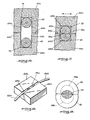
- the couplers of the present invention includes two strands 45 and 46 of a single mode fiber optic material mounted in longitudinal arcuate grooves 63A and 63B, respectively, formed in flat, confronting surfaces 64A and 64B, respectively, of rectangular bases or blocks 66A and 66B, respectively.
- the block 66A with the strand 45 mounted in the groove 63A will be referred to as the coupler half 70A
- the block 66B with the strand 46 mounted in the groove 63B will be referred to as the coupler half 70B..
- Each of the strands 45 and 46 comprises a commercially available fiber of quartz glass which is doped to have a central core and an outer cladding. It willrbe seen below that the present invention is particulaly advantageous for use with single mode fibers, which typically have a core diameter on the order of 10 microns or less and a cladding diameter on the order of 125 microns. However, the invention may also be employed with other types oft fibers, such as multimode fibers. In the embodiment disclosed, single mode fibers are utilized; however, for clarity of illustration, the diameter of the strands 45 and 46 and their respective cores are exaggerated. Furthermore, test results described herein are for couplers utilizing single mode fibers.
- the arcuate grooves 63A and 63B have a radius of curvature which is very large compared to the diameter of the fibers 45 and 46 and have a width slightly larger than the fiber diameter to permit the fibers 45 and 46, when mounted therein, to conform to a path defined by the bottom walls of the grooves 63.
- the depth of the grooves 63A and 63B varies from a minimum at the center of the blocks 66A and 66B, respectively, to a maximum at the edges of the blocks 66A and 66B, respectively.
- the grooves 63 are illustrated as being rectangular in cross-section; however, it will be understood that other suitable cross-sectional contours which will accommodate the fibers may be used alternatively, such as a U-shaped cross-section or a V-shaped cross-section.
- the depth of the grooves 63 which mount the strands 45 and 46 is less than the diameter of the strands, while at the edges of the blocks 66, the depth of the grooves is preferably at least as great as the diameter of the strands.
- Fiber optic material is removed from each of the strands 45 and 46 as shown at 78b in Figure 8 to form the respective, identical, oval-shaped planar surfaces 78A, 78B; which are coplanar with the confronting surfaces 64A, 64B, respectively. These surfaces 78A, 78B will be referred to herein as the fiber "facing surfaces".
- the amount of fiber optic material removed increases gradually from zero towards the edges of the block 66 to a maximum towards the center of the block. This tapered removal of the fiber optic material enables the fibers to converge and diverge gradually, which is advantageous for avoiding backward reflection and excess loss of light energy.
- the coupler halves 70A and 70B are identical, and are assembled by placing the confronting surfaces 64A and 64B of the blocks 66A and 66B together, so that the surfaces 78A and 78B of the strands 45 and 46 are in facing relationship.
- index matching substance such as index matching oil, is provided between the confronting surfaces 64.
- This substance has a refractive index approximately equal to the refractive index of the cladding, and also functions to prevent the optically flat surfaces 64 from becoming permanently locked together.
- the oil is introduced between the blocks 66 by capillary action.
- An inmeraction region 72 is formed at the junction of the strasands 45 and 46, in which light is transferred between the strands by evanescent field coupling. It has been formend that, to ensure proper evanescent field coupling. the amount of material removed from the fibers must be farefully controlled so that the spacing between the core portions of the strands 45 and 46 is within a predeterrined "critical zone". The evanescent fields extend into the cladding and decrease rapidly with distance outside their respective cores. Thus, sufficient material should be removed to permit each core to be gosition substantially within the evanescent field of the other
- each strand receives a significant portion of the evanescent field energy from the other strand, and optimum. coupling is achieved without significant energy loss.
- the critical zone is illustrated schematically in Figure 16 as including that area, designated by the reference numeral 73, in which the evanescent fields, designate by reference numerals 74A and 74B, of the fibers 45 and 46, respectively, overlap with sufficient strength to provide coupling, i.e., each core is within the evanescent field created by the light traveling in the other core.
- mode perturbation occurs within the area 73 when the cores are brought too close together.
- the critical zone is defined as that area in which the evanescent fields 74 overlap with sufficient strength to cause coupling without substantial mode perturbation induced power loss.
- the critical zone for a particular coupler is dependent upon a number of interrelated factors such as the . parameters of the fiber itself and the geometry of the coupler. Further, for a single mode fiber having a step-index profile, the critical zone can be quite narrow. In a single mode fiber coupler of the type shown in Figures 5-8, for example, the required center-to- center spacing between the strands 45 and 46 at the centers of the coupler as shown in Figure 7 is typically less than a few (e.g., 2-3) core diameters.
- the fibers 45 and 46 are symmetrical, through the interaction region 72, in the plane of the facing surfaces 78, so that the facing surfaces 78 are coextensive if superimposed. This ensures that the two fibers 45 and 46 will have the same propagation characteristics at the interaction region 72, and thereby avoids coupling attenuation associated with dissimilar propagation characteristics.
- the blocks or bases 66A and 66B may be fabricated of any suitable rigid material.
- the bases comprise generally rectangular blocks of fused quartz glass approximately one inch long, one inch wide, and 0.4 inch thick.
- the fiber optic strands 45 and 46 are secured in the slots 63 by suitable cement 79, such as epoxy glue.
- suitable cement 79 such as epoxy glue.
- One advantage of the fused quartz blocks 66 is that they have a coefficient of thermal expansion similar to that of glass fibers, and this advantage is particularly important if the blocks 66 and fibers 45 and 46 are subjected to any heat treatment during the manufacturing process.
- Another suitable material for the block 66 is silicon, which also has excellent thermal properties for this application.
- the coupler includes four ports labeled A,B, C, and D, in Figure 5.
- ports A and D which correspond to strands 45 and 46, respectively, are on the left-hand side of the coupler, while the ports B and C, which correspond to the strands 45 and 46, respectively, are on the right-hand side of the coupler.
- input light is applied to port A. This light passes through the coupler and is output at port C and/or port B, depending upon the amount of power that is coupled between the strands 45 and 46.
- the term "normalized coupled power" is defined as the ratio of the coupled power to the total output power.
- the normalized coupled power would be equal to the ratio of the power at port B to the sum of the power output at ports B and C. This ratio is also referred to as the "coupling efficiency" and when so used is typically expressed as a percent.
- the term "normalized coupled power” it should be understood that the corresponding coupling efficiency is equal to the normalized coupled power times 100.
- the coupler of the type shown in Figure 5 has a coupling efficiency of up to 100%.
- the coupler may be "tuned” to adjust the coupling efficiency to any desired value between zero and the maximum of 100% power coupling, by offsetting the facing surfaces of the blocks 16A and 16B.
- Tuning the coupler changes the coupling efficiency and changes the coupling and transmission operators r, p, ⁇ and t. That is, when the coupling efficiency is lowered, less power is coupled from part A to part B in Figure 5. That means that r and p are decreased because the coupler is symmetric and that t and ⁇ are increased since less energy leaving either fiber for the other means more energy remains in the original fiber and is transmitted through the coupler by conservation of energy.
- Such tuning is preferably accomplished by sliding the blocks 66A and 66B laterally relative to each other in the direction of the arrow in Figure 7.
- the coupler is sensitive to displacements of the fibers in a direction which laterally offsets the planar faces such as the direction of the arrow in Figure 7. f
- the coupler is less sensitive to displacements which longitudinally offset the planar faces, i.e., in a direction perpendicular to he arrow in Figure 7 and coming out of the page ,in orthogonal fashion.
- the coupler is relatively insensitive to displacement of the fibers.which rotationally offsets the faces.
- the sensitivity of the coupling operators to displacement of the fibers depends upon the spacing of the cores of the fibers when the fibers are superimposed.
- the coupler is highly directional, with substantially all of the power applied at one side of the coupler being delivered to the other side of the coupler. That is, substantially all of the light applied to input port A is delivered to the output ports B and C, without contradirectional coupling to port D. Likewise, substantially all of the light applied to input port D is delivered to the output ports B and C. Further, this directivity is symmetrical. Thus, light supplied to either input port C or input port B is delivered to the output ports D or A, respectively, and light supplied to either port A or port D is defined either to the port B or C respectively.
- the coupler is essentially nondiscriminatory with respect to light polarizations, and preserves the polarization of the coupled light during the power transfer. Thus, for example, if a light beam having a vertical polarization is input to port A, the light coupled from port A to port B as well as the light passing straight through from port A to port C will remain vertically Polarized.
- FIGs 10-12 there is shown the construction for a fiber optic tapped delay line which could be used to implement the filters depicted in Figures 3 and 4.
- Two of the constructions shown in Figure 10 optically coupled together at the taps could implement the arrays of Figures 3 and 4 as will be apparent from the following discussion.
- a single element off optical fiber 45 is used, beginning at an input end 80 which is supplied with a light input signal from a light source 82, and ending at an output end 84.
- the optical. fiber 45 is wound around a chip 86 with V-grooves 90a-90y formed therein.
- the chip 86 is a thin slice of silicon with grooves 90a-90y photolithographically etched therein and will be described in more detail later.
- the first portion of the fiber on the chip is designated the first winding 86a
- the second portion of the. fiber 45 mounted on the chip 86 is designated 86b, and so on.
- taps are constructed so that each revolution of the optical fiber 45 is tapped at the lateral line 88.
- V-grooves there is a need for great precision in the construction of the V-grooves such that they all are identical in width and depth since the fiber segments of the fiber 45 in the grooves must be coplanar. Any technique which will meet that criterion can be used such as by laser or other chemical or mechanical machining. It has been found it is satisfactory to use 100 oriented silicon for the chip 86 with chemical etching by photolithographic techniques as is well known in the semiconductor manufacturing art. Silicon of the 100 orientation yields a V-groove with walls at an angle of 54.74 degrees.
- the first step in forming the V-grooves is photolithographically etching flat grooves with the width of the flat grooves determined by the depth needed of the' V-groove.
- the depth of the V-groove needed depends upon the size of the fiber being used.
- the preferred way to construct an optical tap is to have the optical fiber surface mounted in a curved configuration so that a flat portion of the optical fiber may be lapped to form a planar face to provide a tap of the light traveling within the fiber.
- the silicon chip 86 is mounted on a block of quartz 87. which has a curved upper surface. It has been found that a silicon chip of standard thickness (0.25 millimeter) and about three-centimeter length can be bent without breaking around a twelve-inch radius.
- An adhesive substance such as wax is used to hold the silicon chip 86 on the quartz block 87 in the curved configuration shown in Figure 10.
- the optical fiber 45 may now be mounted on silicon chip 85.
- the portions of the optical fiber 45 which are to be mounted in the V-grooves preferably have the protective jacket removed.
- ITT type monomode fiber has a plastic jacket which may be removed by dipping it in sulfuric acid. The resiliency of the plastic jacket prevents precision in the lapping operation, so it should be removed.
- Corning type fiber has a lacquer jacket which may be removed by dipping it in acetone. Since the lacquer jacket is more solid than the plastic jacket, its removal is preferential rather than mandatory.
- FIG 11 shows a cross-sectional view along the line 11-11 in Figure 10.
- Figure 19 shows a cross-section of the first three grooves in more detail.
- a portion of the optical fiber 86a near the input end 80 of the fiber is mounted in the second V-groove 90a of the silicon chip 85.
- there is a first V-groove 90x which is not used to receive the optical fiber 45, but rather is used for alignment purposes.
- an adhesive substance 92 is placed in the bottom of the V-groove 90a. Therefore, when the portion 86a of the optical fiber 45 is placed in the V-groove 90a and the optical fiber 45 bottoms out against the sides of the V-groove 90a, it will be permanently retained there by the adhesive 92.
- a length L of the optical fiber is left between the center of the fiber portion 86a and the center of the second fiber portion 86b of the optical fiber 45, which is to be mounted in the second V-groove 86b.
- This length L is the length of optical fiber shown as one of the fibers forming the loop of fiber 45 in Figure 10. It provides a delay time equal to the period of the desired fundamental frequency of the transversal filter or the desired loop delay for the matrix-vector multiplier to be constructed using the, structure of Figure 10.
- the optical fiber 45 is wound around the silicon chip 86 so that upon each successive revolution it is fitted into the next succeeding V-groove and secured there by the adhesive 92.
- the optical fiber 45 terminates at the end 84 as shown in Figure 10.
- the next step is to mechanically lap the upper surface of the portions 86 of the optical fiber 45 at the lateral line 88.
- the portions 86 of the optical fiber 45 being mechanically mounted in the silicon chip by the adhesive 92, are stable enough to have portions of the cladding removed by lapping.
- This lapping operation will remove a portion of the cladding 92 to form a planar face similar to the face 78b, shown in Figure 8. It is important to . note that not all of the cladding material 92 (92a-c in Figure 12) around the core 94.(94a-c in Figure 12) of the optical fiber is to be removed.
- each core 94 and the lapped surface 96 of the fiber segments 86 in the V-grooves depends on the amount of light which is to be removed from the fiber at each tap.
- the lapped surface 96 should be further from the core 94 of the fiber segments 86. Since it is desirable to have a high number of taps for certain applications, only a small amount of light can be removed at each tap. Therefore, between approximately five and ten microns of cladding will be left between the lapped surface 96 and the core 94 of each of the fiber segments 86.
- Figure 13 shows the combined structure representing the structure of either Figure 3 or Figure 4 with the number of couplers equal to the number of turns of the fibers 45 and 46 in the V-grooves. whether the structure of Figure 13 represents the structure of Figure 3 or Figure 4 depends upon the direction of the winding of the fiber 46.
- the fiber 46 is wound so as to carry the coupled light back to the next preceding tap, i.e., in the direction from which the light in the input fiber 45 came, then feedback or backward coupling is present and the structure can function as a lattice filter. If the winding direction is opposite, a transversal or matched filter will be implemented.
- Figure 14 shows a cross-section of the structure of Figure 13 taken along the view line 14-14 in Figure 13 corresponding to the line 88 in Figures 10 and 13.
- the structure is simply two chips 86a and 86b with V-groovds therein and supported by curved quartz blocks 87a and 87b . affixed together such that the V-grooves 90a-90n in the chip 86a are in predetermined alignment with the V-grooves 90a'-90n' in the chip 85b.
- Alignment grooves 100 and 100' and 102 and 102' at the opposite ends of the chips 86a and 86b contain alignment beads 104 and 106.
- each of the V-grooves 90a-90n and 90a'-90n' establish fixed reference points from which each of the V-grooves 90a-90n and 90a'-90n' can be precisely located. If it is desired that each coupler formed by a pair of V-grooves have the same coupling operators r and p as each of the other couplers, then each pair of grooves forming a coupler should be located the same distance from the alignment grooves plus a selected differential offset of one groove in the pair relative to he other groove so that each fiber pair has the same relative offset as each other pair. In some applications of lattice or transversal filtering this equal weighting of taps will be desirable.
- couplers with unequal coupling at each tap using the structure of Figures 13 and 14.
- the relative offsets of each of the fiber pairs in the opposing grooves can be established by varying the distance of one of the opposing grooves from the alignment groove versus the distance to the alignment groove for the opposite V-groove. Since the photolithographic operation described above can be controlled to within reasonable tolerances, such a method of offsetting the V-grooves can give filters with'weighted taps.
- the weights can all be simultaneously .changed by moving the blocks 87a and 87b relative to each other, but all the couplers will have their-fiber pair offsets equally affected by the same amount which will result in new weights determined by the original weights plus the common offset. No individual control of the coupling efficiencies will be possible. Of course for certain applications, such a non-adjustable coupler situation is satisfactory such as in filters requiring fixed pole and zero locations in the transfer function. For individual control of the coupling efficienciesy of each coupler in the array, the embodiments of Figures 3 and 4 must be used.
- the advantage of the embodiment of Figures 13 and 14 is that many couplers can be inexpensively built to implement very complicated transfer functions and to precisely tailor the pass and stop bands of the lattice and transversal filters by many different tap weights.
- the fiber-optic lattice filters of Figures 3 and 4 are constructed.
- the use of Z-transform techniques provides the following expression for the transfer function of this filter: where the c 1 's are positive-valued and are functions of the coupling coefficients, and the z 1 's are the zeros of the transfer function.
- This transfer function is an all-zero type, with its poles located either at the origin or. at infinity.
- Equation (11) By expanding Equation (11) into its real and imaginary. parts and also using the fact that the c 1 's are non- negative variables, we can conclude that,'for a positive non-recursive filter, there cannot be any zero of the transfer function in the angular sector where 6 represents the polar angle in the Z-plane, and N is the order of the system. This inequality can also .be used to estimate minimum order of the system required to realize a given zero pattern. Moreover, it is easy to show that, for such systems, not all the zeros can be located in the right hand Z-plane, unless sections allowing negativity are incorporated.
- Frequency responses of non-recursive fiber lattice filters a are similar to those of a transversal filter (tapped delay line).
- frequency responses of a first-order non-recursive fiber lattice filter, when coupling coefficients of both couplers are 0.5, are shown in Figure 15.
- non-recursive fiber lattice filters have all the advantageous features of non-recursive systems, such as inherent stability and good phase control properties in addition to all the features of lattice structures mentioned before.
- the fact that summations are done optically within the fiber simplifies the detection system as compared to that of a fiber transversal filter, and also increases the light- collection efficiency.
- the chain matrix method described above may be used to show that.
- the transfer function H 1 (z), from X 1 to Y 1 has both poles and zeros which are dependent on each other. In other words, the poles and zeros cannot be adjusted independently of each other. This is, in general, an undesirable feature that can be removed by using the output Y 2 on the feed-forward line 49.
- the transfer function, H 2 (z), from X 1 to Y 2 is an all-pole transfer function. This means that all the zeros are located either at the origin or at infinity, so that the poles 'can be adjusted independently. Therefore, for filtering applications it is preferred to use the output Y 2 so as to achieve an all-pole filter.
- the transfer function of this all-pole filter can be represented, within a constant proportionality factor, by: where p 1 's are the poles of the transfer function.
- phase response of the filter is not important, better filters can be designed using IIR structures of Figure 3. This is true because the poles of a pole-zero IIR filter can be arranged in such a way as to keep the magnitude of the frequency response flat in some specified frequency range, and then the zeros can be used to force the frequency response to zero. As a result, low order IIR filters can be used to produce extremely sharp frequency responses. This is the most advantageous feature of the IIR normal case structures.
- both of the fiber optic lattice filters of Figures 3 and 4 are positive systems. That is, these lattice filters employ light: intensity as the signal carrying medium and negative signal values are impossible in this medium. Further, the filters employ directional couplers which can only additively, rather than subtractively,- transfer light signals between the fibers. Thus, only positive-valued signals may be applied to and processed within the filters. The absence of negativity in these fiber optic lattice filters of Figures 3 and 4 limits the regions of the Z-transform plane in which poles and zeros of the respective filter classes may be located.
- lattice filters employing digital filtering techniques have parameters which can assume both positive and negative values, and therefore they can cover more area of the Z-plane. This undesirable condition in the fiber optic arena may be overcome by combining positive filter sections with sections allowing negativity. Such a system which utilizes the filter components previously described for overcoming these. problems may be described with respect to Figure 15.
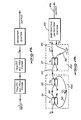
- Figure 15 illustrates a block diagram of a combined filter system which includes a filter section 100 comprising an all-pole, recursive fiber optic lattice filter corresponding to the filter arrangement of Figure 3.
- the output from the all-pole filter 100 is fed to an . all-zero filter section 102 in cascaded form.
- Filter section 102 corresponds to the all-zero non-recursive fiber optic lattice filter arrangement illustrated in Figure 4.
- the output from filter section 102. ' is transmitted to a detection system 104 which functions to detect the output signals and possibly to provide negativity in the system, and will be discussed more fully hereafter.
- the poles and zeros of the combined system may be adjusted independently of each other.
- a desirable pole-zero pattern in the Z-plane may be arranged in order to realize more complex frequency responses.
- section 100 and 102 of the cascaded filter of Figure 15 may be described in more detail by reference to Figure 16, which illustrates a simple, first-order, all-pass filter.
- section 100 includes a first-order all-pole lattice -filter corresponding to the physical arrangement of couplers 51 and 52 and associated optical fibers 49 and 50 of Figure 3.
- Section 102 comprises a first-order all-zero lattice filter corresponding to coupler 57 and associated optical fibers 55 and 56 of the arrangement of Figure 4.
- the input signal is received on the X 1 input of the all-pole filter 100.
- the output from that section corresponds to the Y 2 output of the all-pole filter arrangement of Figure 3.
- the output from section 100 is connected to the input of the all-zero filter section 102, corresponding to the X 1 input of the filter of Figure 4.
- the filtered signal-from section 102 is transmitted outwardly via lines 55 and 56 on outputs Y 1 and Y 2 which are interconnected to the subtractive detection system 104 which processes the optical signals so as to provide an electronic output signal on line 106.
- the signal on 106 comprises the filtered signal which includes negativity.
- the total transfer function for the filter described by sections 100 and 102 of Figure 16 is given by the product of the two subsystem transfer functions.
- the transfer function for the general case with any number of cascaded feed-forward and feed-backward stages is: where K is a constant, the z 1 's are the zeros and the p 1 's are the poles of the transfer function.
- the degrees of the numerator and denominator polynomials are assumed to be equal.
- the filter described by Figures 15 and 16 is a simple, first-order, all-pass filter. This is a special case of an IIR filter in which the magnitude of the frequency response of the filter is constant and only the phase response changes as the pole and zero positions vary.
- the impulse response of the filter stages 100 and 102, without being processed in detection system 104, is illustrated in Figure 17(a).
- the detection system 104 of Figure 16 is included to remove the lack of negativity. This is accomplished by applying the respectiv output signals from the Y 1 and Y 2 outputs of the all-zero filter section 102 to a receiver which generates a difference signal between them to provide the desired negativity function.
- Figure 18 illustrates one preferred embodiment of circuitry which may comprise the detection system 104.
- the output signal on line 55 of section 102 from terminal Y 1 is transmitted to a non-inverting photodiode 120 having a positive bias.
- the electronic signal from photodiode 120 is transmitted via line 122 to an attenuator 124 which is used to adjust the magnitude of the output current from line 122. From attenuator 124, the output signal is transmitted via line 126 to a power combiner 128.
- the output signal on line 56 transmitted from terminal Y 2 is received by an inverting photodiode 130 having a polarity which is opposite to that of the non-inverting photodiode 120.
- the inverted electronic output signal from photodiode 130 is transmitted via line 132 to an attenuator 134 wherein the magnitude of the output signal on line 132 is adjusted. From attenuator 134 the output signal is transmitted via line 136 to the power combiner 128.
- Power combiner 128 functions to sum the signals received from lines 126 and 136 so as to provide an output signal representative of that sum to amplifier 138.
- the output signal is amplified by amplifier 138 and transmitted via output line 106 to conventional signal processors (not shoan) or similar devices as may be needed in the particular application for which the filter is being used.
- the attenuators 124 and 134 may be adjusted in order to set the ratio of the detected light -intensities which are to be combined in the power combiner. By this means, an overall filtering function which is unrestricted by an absence of negativity is obtained.
- Figure 19 presents a plot of the theoretical frequency responses of the complete cascaded filter system of Figures 15 and 16, as well as of the filter sections of that system as the time delay increases, with respect to normalized magnitude. Specifically, the magnitude response of the all-pole filter section 100 is illustrated at 130, while that of the all-zero filter section 102 is illustrated at 132. The magnitude response of the full, cascaded system is illustrated at 134.
- Figure 20 provides a further illustration of the phase responses of the cascaded system and its filter sections. Specifically, the response of the all-pole filter section 100 is illustrated at 136, while the response of the all-zero filter section 102 is illustrated at 138. The response of the total, cascaded system is illustrated at 140.
- the cascaded filter arrangement described herein provides a unique and yet straight forward means for utilizing the fiber-optic all-zero and all-pole filter sections in various combinations in order to provide versatile filtering capability either with or without negativity.
- the filter design may be directly extended to higher orders by merely adding more stages to the lattice. Such higher order filters provide more degrees of freedom for the design of more complex frequency responses.
- in-line optical amplifiers into these fiber-optic lattice filters, compensation for propagation and coupling losses is provided, thereby permitting a very large number of stages, particularly in the IIR section.
- the invention described herein provides a fiber optic lattice filter capable of use in many applications requiring complex filtering, since it defines a transfer function having zeros and poles which may be adjusted independently of each other. Further, the filter system provides for handling both positive and negative values in the filter, and thus overcomes the inability of prior fiber-optic filter devices to function in applications -involving negative values and more complex pole-zero diagrams.
Landscapes
- Engineering & Computer Science (AREA)
- Physics & Mathematics (AREA)
- Signal Processing (AREA)
- Optics & Photonics (AREA)
- General Physics & Mathematics (AREA)
- Power Engineering (AREA)
- Theoretical Computer Science (AREA)
- Computer Networks & Wireless Communication (AREA)
- Optical Communication System (AREA)
- Light Guides In General And Applications Therefor (AREA)
- Filters For Electric Vacuum Cleaners (AREA)
- Treatment Of Water By Ion Exchange (AREA)
- Surface Acoustic Wave Elements And Circuit Networks Thereof (AREA)
Applications Claiming Priority (2)
| Application Number | Priority Date | Filing Date | Title |
|---|---|---|---|
| US06/622,637 US4768850A (en) | 1984-06-20 | 1984-06-20 | Cascaded fiber optic lattice filter |
| US622637 | 1984-06-20 |
Publications (2)
| Publication Number | Publication Date |
|---|---|
| EP0165773A2 true EP0165773A2 (fr) | 1985-12-27 |
| EP0165773A3 EP0165773A3 (fr) | 1989-07-12 |
Family
ID=24494934
Family Applications (1)
| Application Number | Title | Priority Date | Filing Date |
|---|---|---|---|
| EP85304203A Withdrawn EP0165773A3 (fr) | 1984-06-20 | 1985-06-13 | Filtre réticulé comportant des fibres optiques montées en cascade |
Country Status (8)
| Country | Link |
|---|---|
| US (1) | US4768850A (fr) |
| EP (1) | EP0165773A3 (fr) |
| KR (1) | KR930001532B1 (fr) |
| AU (1) | AU4388585A (fr) |
| BR (1) | BR8502933A (fr) |
| CA (1) | CA1257120A (fr) |
| IL (1) | IL75526A0 (fr) |
| NO (1) | NO852475L (fr) |
Cited By (4)
| Publication number | Priority date | Publication date | Assignee | Title |
|---|---|---|---|---|
| EP0277698A3 (en) * | 1987-02-02 | 1990-08-22 | Litton Systems, Inc. | Fiber optic sensor array and method |
| EP0346024B1 (fr) * | 1988-06-09 | 1993-07-28 | BRITISH TELECOMMUNICATIONS public limited company | Coupleur guide d'onde optique sélectif en longueur d'onde |
| US5867293A (en) * | 1995-04-25 | 1999-02-02 | Siemens Aktiengesellschaft | Circuit arrangement for dispersion compensation in optical transmission systems by means of an optical filter |
| WO2021052790A1 (fr) * | 2019-09-17 | 2021-03-25 | Asml Holding N.V. | Module laser en tant que source d'alignement, système de métrologie et appareil lithographique |
Families Citing this family (22)
| Publication number | Priority date | Publication date | Assignee | Title |
|---|---|---|---|---|
| CA2009352C (fr) * | 1989-02-07 | 1995-02-28 | Masao Kawachi | Elements de raccordement pour guides de lumiere et commutateurs optiques |
| US4934777A (en) * | 1989-03-21 | 1990-06-19 | Pco, Inc. | Cascaded recirculating transmission line without bending loss limitations |
| US5119453A (en) * | 1991-04-05 | 1992-06-02 | Ecole Polytechnique | Wavelength-flattened 2x2 splitter for single-mode optical waveguides and method of making same |
| DE69228980T2 (de) * | 1991-12-06 | 1999-12-02 | National Semiconductor Corp., Santa Clara | Integriertes Datenverarbeitungssystem mit CPU-Kern und unabhängigem parallelen, digitalen Signalprozessormodul |
| JP3425150B2 (ja) * | 1994-02-11 | 2003-07-07 | コーニンクレッカ、フィリップス、エレクトロニクス、エヌ.ヴィ. | 位相調整アレイを有する光学装置 |
| US5636300A (en) * | 1994-12-12 | 1997-06-03 | Corning Incorporated | MxO multiplex demultiplex component |
| US5526439A (en) * | 1994-12-30 | 1996-06-11 | At&T Corp. | Optical filter using electro-optic material |
| US5838851A (en) * | 1996-06-24 | 1998-11-17 | Trw Inc. | Optical-loop signal processing using reflection mechanisms |
| US5866898A (en) * | 1996-07-12 | 1999-02-02 | The Board Of Trustees Of The Leland Stanford Junior University | Time domain multiplexed amplified sensor array with improved signal to noise ratios |
| US5943457A (en) * | 1998-03-24 | 1999-08-24 | Telecommunications Research Laboratories | Generalized resonant coupler filters |
| US6249622B1 (en) | 1998-06-26 | 2001-06-19 | Litton Systems, Inc. | Architecture for large optical fiber array using standard 1×2 couplers |
| AUPP617198A0 (en) * | 1998-09-25 | 1998-10-22 | University Of Sydney, The | High q optical microwave processor using hybrid delay-line filters |
| US6289151B1 (en) | 1998-10-30 | 2001-09-11 | Lucent Technologies Inc. | All-pass optical filters |
| US6724319B1 (en) | 1999-10-29 | 2004-04-20 | Litton Systems, Inc. | Acoustic sensing system for downhole seismic applications utilizing an array of fiber optic sensors |
| US6728165B1 (en) | 1999-10-29 | 2004-04-27 | Litton Systems, Inc. | Acoustic sensing system for downhole seismic applications utilizing an array of fiber optic sensors |
| EP1388961B1 (fr) * | 2002-08-06 | 2007-06-13 | Alcatel Lucent | Procédé d'asservissement adaptatif permettant une compensation de la dispersion chromatique |
| US7162120B2 (en) * | 2003-07-18 | 2007-01-09 | Nec Corporation | Tunable dispersion compensator and method for tunable dispersion compensation |
| US7042657B2 (en) * | 2003-08-28 | 2006-05-09 | Board Of Regents The University Of Texas System | Filter for selectively processing optical and other signals |
| JP4882122B2 (ja) * | 2005-06-30 | 2012-02-22 | モサイド・テクノロジーズ・インコーポレーテッド | ヒットレス波長可変光処理のための方法及びシステム |
| US10534189B2 (en) * | 2012-11-27 | 2020-01-14 | The Board Of Trustees Of The Leland Stanford Junior University | Universal linear components |
| US11747564B2 (en) | 2019-10-02 | 2023-09-05 | Nippon Telegraph And Telephone Corporation | Manufacturing method and manufacturing apparatus of optical splitters |
| US11968034B2 (en) | 2022-08-18 | 2024-04-23 | X Development Llc | Metastructured photonic devices for binary tree multiplexing or demultiplexing of optical signals |
Family Cites Families (4)
| Publication number | Priority date | Publication date | Assignee | Title |
|---|---|---|---|---|
| US4159418A (en) * | 1977-06-23 | 1979-06-26 | Hughes Aircraft Company | Delay line encoder-decoder |
| US4432599A (en) * | 1981-03-27 | 1984-02-21 | Sperry Corporation | Fiber optic differential sensor |
| DE3280135D1 (de) * | 1982-11-12 | 1990-04-19 | Univ Leland Stanford Junior | Kontinuierlich einstellbare faseroptikverzoegerungslinie. |
| US4671605A (en) * | 1985-02-06 | 1987-06-09 | The United States Of America As Represented By The Secretary Of The Air Force | Length dependent, optical time delay/filter device for electrical signals |
-
1984
- 1984-06-20 US US06/622,637 patent/US4768850A/en not_active Expired - Lifetime
-
1985
- 1985-06-13 EP EP85304203A patent/EP0165773A3/fr not_active Withdrawn
- 1985-06-14 IL IL75526A patent/IL75526A0/xx unknown
- 1985-06-19 CA CA000484443A patent/CA1257120A/fr not_active Expired
- 1985-06-19 BR BR8502933A patent/BR8502933A/pt unknown
- 1985-06-19 NO NO852475A patent/NO852475L/no unknown
- 1985-06-20 AU AU43885/85A patent/AU4388585A/en not_active Abandoned
- 1985-06-20 KR KR1019850004377A patent/KR930001532B1/ko not_active Expired - Lifetime
Non-Patent Citations (4)
| Title |
|---|
| ELECTRONICS LETTERS, vol. 14, no. 3, 2nd February 1978, pages 48-49, Hitchin, GB; E. MAROM et al.: "Encoding-decoding optical fibre network" * |
| ELECTRONICS LETTERS, vol. 18, no. 3, 4th February 1982, pages 110-111, Hitchin, GB; J.E. BOWERS et al.: "Filter response of single-mode fibre recirculating delay lines" * |
| PROCEEDINGS OF THE IEEE, vol. 72, no. 7, July 1984, pages 909-930, IEEE, New York, US; B. MOSLEHI et al.: "Fiber-optic lattice signal processing" * |
| TELECOMMUNICATIONS & RADIO ENGINEERING, vol. 35/36, no. 6, June 1981, pages 80-82, Scripta Publishing Co., Silver Spring, Maryland, US; D.I. POPOV et al.: "Synthesis of digital filters using cascade connection nonrecursive and recursive stages" * |
Cited By (4)
| Publication number | Priority date | Publication date | Assignee | Title |
|---|---|---|---|---|
| EP0277698A3 (en) * | 1987-02-02 | 1990-08-22 | Litton Systems, Inc. | Fiber optic sensor array and method |
| EP0346024B1 (fr) * | 1988-06-09 | 1993-07-28 | BRITISH TELECOMMUNICATIONS public limited company | Coupleur guide d'onde optique sélectif en longueur d'onde |
| US5867293A (en) * | 1995-04-25 | 1999-02-02 | Siemens Aktiengesellschaft | Circuit arrangement for dispersion compensation in optical transmission systems by means of an optical filter |
| WO2021052790A1 (fr) * | 2019-09-17 | 2021-03-25 | Asml Holding N.V. | Module laser en tant que source d'alignement, système de métrologie et appareil lithographique |
Also Published As
| Publication number | Publication date |
|---|---|
| NO852475L (no) | 1985-12-23 |
| IL75526A0 (en) | 1985-10-31 |
| BR8502933A (pt) | 1986-03-04 |
| US4768850A (en) | 1988-09-06 |
| AU4388585A (en) | 1986-01-02 |
| KR860000570A (ko) | 1986-01-29 |
| CA1257120A (fr) | 1989-07-11 |
| KR930001532B1 (ko) | 1993-03-04 |
| EP0165773A3 (fr) | 1989-07-12 |
Similar Documents
| Publication | Publication Date | Title |
|---|---|---|
| US4768850A (en) | Cascaded fiber optic lattice filter | |
| US4588255A (en) | Optical guided wave signal processor for matrix-vector multiplication and filtering | |
| US4934777A (en) | Cascaded recirculating transmission line without bending loss limitations | |
| Jackson et al. | Optical fiber delay-line signal processing | |
| CA1194221A (fr) | Memoire recirculante a fibres optiques a coupleurs doubles | |
| US5896476A (en) | Optical loop signal processing using reflection mechanisms | |
| RU2188512C2 (ru) | Оптический фильтр длин волн и оптический демультиплексор | |
| CA2063310A1 (fr) | Guide de lumiere et methode de connexion d'un guide de lumiere et d'une fibre optique au moyen du guide de lumiere | |
| US5515460A (en) | Tunable silicon based optical router | |
| Thurston et al. | Analysis of mode separation in multichannel branching waveguides | |
| CA1213063A (fr) | Coupleur de guides de lumiere pour la multiplication vectorielle et le filtrage | |
| JPS6138907A (ja) | フアイバ光学フイルタ | |
| JP2002511157A (ja) | モード変換のためのブラッグ格子を用いた狭小帯域透過フィルタ | |
| JP2002540481A (ja) | 異なる波長を有して共に送信される光信号の分散を補償する方法 | |
| CA1231566A (fr) | Processeur de muliplication matricielle-vectorielle et de filtrage pour signaux lumneux guides | |
| Hardy et al. | Application of coupled-mode theory to nearly parallel waveguide systems | |
| US4993797A (en) | Optical fibre lattice signal processors | |
| WO2005022759A2 (fr) | Filtre permettant de traiter de maniere selective des signaux optiques et d'autres signaux | |
| Schwelb | Characteristics of lattice networks and spectral filters built with 2 2 couplers | |
| US7260291B2 (en) | Coupled mode arrayed waveguide grating | |
| Burneff-Cuellar | Signal processing with fiber optic delay lines and electro-optic couplers | |
| Yasumoto et al. | Analysis of step transitions in optical fibers using periodic boundary conditions | |
| Barbarossa et al. | Novel architecture for optical guided-wave recirculating delay lines | |
| Cusick et al. | All-optical microwave frequency filters | |
| Safavi-Naeini et al. | Design and analysis of novel multimode optical filters in dielectric waveguide |
Legal Events
| Date | Code | Title | Description |
|---|---|---|---|
| PUAI | Public reference made under article 153(3) epc to a published international application that has entered the european phase |
Free format text: ORIGINAL CODE: 0009012 |
|
| AK | Designated contracting states |
Designated state(s): AT BE CH DE FR GB IT LI LU NL SE |
|
| PUAL | Search report despatched |
Free format text: ORIGINAL CODE: 0009013 |
|
| AK | Designated contracting states |
Kind code of ref document: A3 Designated state(s): AT BE CH DE FR GB IT LI LU NL SE |
|
| 17P | Request for examination filed |
Effective date: 19900104 |
|
| 17Q | First examination report despatched |
Effective date: 19910624 |
|
| STAA | Information on the status of an ep patent application or granted ep patent |
Free format text: STATUS: THE APPLICATION IS DEEMED TO BE WITHDRAWN |
|
| 18D | Application deemed to be withdrawn |
Effective date: 19911105 |
|
| RIN1 | Information on inventor provided before grant (corrected) |
Inventor name: SHAW, HERBERT J. Inventor name: MOSLEHI, BEHZAD Inventor name: TUR, MOSHE Inventor name: GOODMAN, JOSEPH |