EP0165862A1 - Stoff mit grosser spezifischer Oberfläche und seine Anwendung,um den Kontakt zwischen Medien oder Reaktionsstoffen zu fördern,die physikalische und/oder chemische und/oder biologische Phänomene einbeziehen - Google Patents
Stoff mit grosser spezifischer Oberfläche und seine Anwendung,um den Kontakt zwischen Medien oder Reaktionsstoffen zu fördern,die physikalische und/oder chemische und/oder biologische Phänomene einbeziehen Download PDFInfo
- Publication number
- EP0165862A1 EP0165862A1 EP85401174A EP85401174A EP0165862A1 EP 0165862 A1 EP0165862 A1 EP 0165862A1 EP 85401174 A EP85401174 A EP 85401174A EP 85401174 A EP85401174 A EP 85401174A EP 0165862 A1 EP0165862 A1 EP 0165862A1
- Authority
- EP
- European Patent Office
- Prior art keywords
- strands
- pompoms
- strips
- filaments
- material according
- Prior art date
- Legal status (The legal status is an assumption and is not a legal conclusion. Google has not performed a legal analysis and makes no representation as to the accuracy of the status listed.)
- Granted
Links
Images

Classifications
-
- C—CHEMISTRY; METALLURGY
- C02—TREATMENT OF WATER, WASTE WATER, SEWAGE, OR SLUDGE
- C02F—TREATMENT OF WATER, WASTE WATER, SEWAGE, OR SLUDGE
- C02F3/00—Biological treatment of water, waste water, or sewage
- C02F3/02—Aerobic processes
- C02F3/10—Packings; Fillings; Grids
-
- B—PERFORMING OPERATIONS; TRANSPORTING
- B01—PHYSICAL OR CHEMICAL PROCESSES OR APPARATUS IN GENERAL
- B01D—SEPARATION
- B01D47/00—Separating dispersed particles from gases, air or vapours by liquid as separating agent
- B01D47/12—Washers with plural different washing sections
-
- B—PERFORMING OPERATIONS; TRANSPORTING
- B01—PHYSICAL OR CHEMICAL PROCESSES OR APPARATUS IN GENERAL
- B01J—CHEMICAL OR PHYSICAL PROCESSES, e.g. CATALYSIS OR COLLOID CHEMISTRY; THEIR RELEVANT APPARATUS
- B01J16/00—Chemical processes in general for reacting liquids with non- particulate solids, e.g. sheet material; Apparatus specially adapted therefor
- B01J16/005—Chemical processes in general for reacting liquids with non- particulate solids, e.g. sheet material; Apparatus specially adapted therefor in the presence of catalytically active bodies, e.g. porous plates
-
- B—PERFORMING OPERATIONS; TRANSPORTING
- B01—PHYSICAL OR CHEMICAL PROCESSES OR APPARATUS IN GENERAL
- B01J—CHEMICAL OR PHYSICAL PROCESSES, e.g. CATALYSIS OR COLLOID CHEMISTRY; THEIR RELEVANT APPARATUS
- B01J35/00—Catalysts, in general, characterised by their form or physical properties
- B01J35/50—Catalysts, in general, characterised by their form or physical properties characterised by their shape or configuration
- B01J35/58—Fabrics or filaments
-
- Y—GENERAL TAGGING OF NEW TECHNOLOGICAL DEVELOPMENTS; GENERAL TAGGING OF CROSS-SECTIONAL TECHNOLOGIES SPANNING OVER SEVERAL SECTIONS OF THE IPC; TECHNICAL SUBJECTS COVERED BY FORMER USPC CROSS-REFERENCE ART COLLECTIONS [XRACs] AND DIGESTS
- Y02—TECHNOLOGIES OR APPLICATIONS FOR MITIGATION OR ADAPTATION AGAINST CLIMATE CHANGE
- Y02E—REDUCTION OF GREENHOUSE GAS [GHG] EMISSIONS, RELATED TO ENERGY GENERATION, TRANSMISSION OR DISTRIBUTION
- Y02E50/00—Technologies for the production of fuel of non-fossil origin
- Y02E50/10—Biofuels, e.g. bio-diesel
-
- Y—GENERAL TAGGING OF NEW TECHNOLOGICAL DEVELOPMENTS; GENERAL TAGGING OF CROSS-SECTIONAL TECHNOLOGIES SPANNING OVER SEVERAL SECTIONS OF THE IPC; TECHNICAL SUBJECTS COVERED BY FORMER USPC CROSS-REFERENCE ART COLLECTIONS [XRACs] AND DIGESTS
- Y02—TECHNOLOGIES OR APPLICATIONS FOR MITIGATION OR ADAPTATION AGAINST CLIMATE CHANGE
- Y02E—REDUCTION OF GREENHOUSE GAS [GHG] EMISSIONS, RELATED TO ENERGY GENERATION, TRANSMISSION OR DISTRIBUTION
- Y02E50/00—Technologies for the production of fuel of non-fossil origin
- Y02E50/30—Fuel from waste, e.g. synthetic alcohol or diesel
-
- Y—GENERAL TAGGING OF NEW TECHNOLOGICAL DEVELOPMENTS; GENERAL TAGGING OF CROSS-SECTIONAL TECHNOLOGIES SPANNING OVER SEVERAL SECTIONS OF THE IPC; TECHNICAL SUBJECTS COVERED BY FORMER USPC CROSS-REFERENCE ART COLLECTIONS [XRACs] AND DIGESTS
- Y02—TECHNOLOGIES OR APPLICATIONS FOR MITIGATION OR ADAPTATION AGAINST CLIMATE CHANGE
- Y02W—CLIMATE CHANGE MITIGATION TECHNOLOGIES RELATED TO WASTEWATER TREATMENT OR WASTE MANAGEMENT
- Y02W10/00—Technologies for wastewater treatment
- Y02W10/10—Biological treatment of water, waste water, or sewage
Definitions
- the present invention relates to a filling material having a large specific surface relative to its apparent volume, essentially characterized in that it is constituted by a plurality of strands, threads, filaments, strips, joined in their middle so to constitute a flow, a tuft, a tassel, a pompom or the like, each of these strands, threads, filaments, strips being free of any movement relative to a point itself kept fixed, so as to be able to "float” or “swim” easily in any fluid medium (liquid or gas) in which they are immersed.
- the invention also relates to the applications of such a material for promoting contact in heterogeneous phase between media or reagents involving physical and / or biological, and / or biochemical phenomena.
- elements commonly introduced into the reaction medium are commonly used to promote exchanges or reactions between the reactants brought into contact.
- These elements can take various forms and are generally called "packing elements".
- One of the characteristics sought for such elements is the specific surface or contact surface which must be as large as possible, so as to increase, relative to the unit of volume, the rate of exchange or reaction between the bodies or the substances brought into contact, while minimizing the possible transfer of mass and / or heat.
- These elements can be produced from the substance itself serving as catalyst and / or reagent or from a substance intended to constitute a support for said catalyst and / or reagent.
- packing elements consisting of resins in the form of beads, grains or membranes on which the catalytic substances or are grafted or grafted. reactive.
- these packing elements are most often used in reactors in fixed or fluidized beds.
- All these packings are made for a particular purpose: it involves filling a percolator or a trickling bacterial bed; the strips or sheets or fibers used always have a preferential orientation which is that of the flow of the flow of the liquid.
- European patent 0.056.083 relates to a packing for a non-submerged bed made up of flexible strips arranged in a disorderly manner in bundles. These strips are very long (several meters) and their free ends preferably go to the bottom; of the filter.
- One of the advantages of such a device is that it allows an adjustable surface / volume ratio by varying the number of beams or the shape and the section of the strips, but this is again a packing intended for a non-submerged bed; even if the bands are flexible, they cannot float in the medium, since there is flow of the fluid along these bands in a preferred direction. Otherwise, ! if for another use we tried to float bands, they would necessarily come to get tangled with each other.
- the present invention therefore proposes to provide a new filling material essentially characterized in that it is constituted by a plurality of strands, threads, filaments, strips, joined together at a point which is itself kept fixed. so as to constitute a flow, a tuft. a pompom, a tassel or the like, with a specific surface area that can easily exceed 1000 m 2 / m 3 of apparent volume, each of these strands, threads. strip filaments united in their middle, being free of any movement relative to this point, so as to be able to "float" when "swimming" easily without intermingling in any fluid medium (liquid or gaseous) homogeneous or not in which they are dives, in order to ensure the best contact with it.
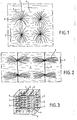
- the waves, tufts or tassels are hung on a flexible or rigid common element acting as a "tension wire” so as to maintain a fixed position for each tassel relative to the neighboring tassels while allowing the strands, threads, filaments or strips of these pompoms to "float” or “swim" in the environment.
- the distance separating the attachment points of the pompoms on the same "tension wire” is at least equal to the mean radius of the pompoms, so that the individual strands cannot become tangled.
- the distance separating two "tensioning threads" will be at least equal to the average diameter of the pompoms.
- the attachment elements can also be part of a planar assembly, a three-dimensional network or any other suitable geometric volume.
- any "pompom” means any material according to the invention, whether this material is in the form of a stream, peat, tassel, or the like.
- the strands, wires. filaments, strips are made of an inert material intended to serve as a support or as many zones of attachment for substances intended to serve as catalytic substances, exchange sites or reactive agents with respect to the substances or constituents present in the ambient medium.
- the strands, threads, filaments or strips are made of a material itself constituting a reactive agent or a catalyst for the constituents present in the ambient medium.
- the material according to the present invention is in the form of a plurality of strands, threads, filaments or strips shown diagrammatically in (1), gathered together at a point (2) to form a flow, a tuft, a pompom, a tassel, or the like, designated by the general reference (3) and by the word "pompon".
- these strands, threads, filaments or strips can be made of an inert substance of the synthetic or natural plastic type, synthetic or natural textile material, or on which an active substance has already been fixed from the physical point of view or chemical such as an adsorbent substance (physical activity) or a catalytic substance (chemical or physicochemical activity), or which serve as a support for a reactive agent during the reaction.
- an adsorbent substance physical activity
- a catalytic substance chemical or physicochemical activity
- the strands, threads, filaments or strips (1) may themselves be constituted by a substance with physicochemical activity.
- the methods of biological treatment of effluents can be classified into two types well known to those skilled in the art: that involving sludge recirculation and that involving sludge retention or fixed bed.
- the flexible material according to the present invention is particularly suitable for these two types of process because it is isotropic and provides, compared to traditional linings with rigid materials or with films, multiple advantages which will be examined below. after.
- the inert supports In biological processes, the inert supports must not oppose the mixing of the medium which ensures permanent contact between the biomass fixed on these linings and the organic substrate.
- the pompoms distributed according to a determined geometry in the reactors offer, contrary to the rigid or semi-rigid packing elements, no brake with the agitation of the medium in all directions under the effect of aerobic aeration or under l effect of anaerobic gas evolution or under the effect of recycling the effluent to be treated.
- the entire liquid mass is thus continuously brought into contact with the microorganisms responsible for purification, in the same way as in free sludge plants for which it is essential to have a total mixture between the microorganisms and the water. treat.
- the distance separating the means for attaching the pompoms to rigid frames is advantageously at least equal to the average diameter of the pompoms, so that the individual strands cannot become tangled, which would impair their correct movement in the liquid medium and would constitute a primer of clogging between the tufts. It is good that this distance is only slightly greater than said diameter.
- the spacing between the pompoms must be sufficiently large and at least equal to the radius of the pompoms to allow good circulation of the reactive medium.
- the material, to be used in biological treatment will advantageously consist of synthetic textile fibers, which gives it a great lightness as well as a density close to that of water.
- the geometrical volumes or the networks or the frames serving as an element for placing the "tensioning wires" supporting the pompoms can therefore be produced in light structures which are easily maneuverable by a relatively simple lifting device.
- the weight of these assemblies may not exceed a few kilograms per m of space, unlike plastic materials which exceed 30 kg / m 3 .
- the components of the pompoms of the invention are inexpensive, unlike artificial plastic materials. Lightweight and easily compressible for transport, they can be brought to the site at no great cost. The only expenses having a significant impact on the price of the material are the cost of the frames which can be modular in design and the assembly of the "tensioning threads" fitted with pompoms, an operation which can be automated.
- the specific surface is generally less than 100 m 2 per m 3 of apparent volume of material and that, with plastic structures (partitioned tubes, honeycombs, embossed plates, films, etc.), the specific surface can reach, depending on the case, up to 300 m 2 per m 3 of apparent volume, the pompom materials of the invention provide because of their condition, considerable specific surfaces, exceeding 1000 m 2 / m 3 of apparent volume.
- the support material object of the present invention has, due to its nature, a flexible behavior when subjected to liquid displacements in all directions of the volume it occupies. Thus it presents voids whose dimensions are constantly variable, facilitating good dynamic behavior.
- the elements coated with biomass allow a "fluidization" of this biomass which promotes the multiplicity of contacts with the medium to be purified.
- the fixed biomass remains in the reactors, thus ensuring a constant concentration of microorganisms or sludge.
- the BOD elimination yields can reach 95%, or even occasionally more.
- an installation equipped with said material can operate at organic unit loads higher than those of traditional activated sludge and reaching 3 kg BWP / m 3 . day.
- the material must be used under precise conditions so that at any point on the support on which a film of microorganisms develops, oxygenation can manifest itself under good conditions.
- a purification process using as support synthetic fibers constituting the pompons according to the invention allows loads that can exceed 50 kg OCO / m 3 of reactor / day for a packing of 1 to 5 kg of support / m 3 of reactor with a COD removal rate between GO and oo depending on the nature of the effluent.
- the process is not very sensitive to suspended solids, these being removed at the same time as the excess mud, the isotropy of the medium facilitating their circulation.
- the hydraulic residence times are a few days or a few hours depending on the initial concentration of pollutant load in the effluent.
- FIG. 4 The basic diagram of the 70-liter reactors is shown in FIG. 4.
- Ten cords (5) each carrying six pompons (3) with an average diameter of 120 mm and spaced apart by 70 mm are mounted vertically. at respective distances of 120 mm, in a cylindrical basket (not shown) which occupies the entire cylindrical part of the reactor (7).
- the reactor (7) is made of PVC, its internal diameter is equal to 400 mm, its height to 600 mm; a diaphragm pump (8) whose flow rate is adjustable introduces the liquid to be treated at the bottom of the reactor (7) in which the liquid circulates from bottom to top before being evacuated by overflow in the pipe (0) installed according to the axis of the reactor.
- a pump (10). controlled by a timer recycles the liquid periodically.
- the effluent is evacuated by an overflow (11), then collected in a graduated cylinder (12) whose emptying is obtained by the opening of a solenoid valve (13) controlled by a pressure switch (14). Each emptying operation is recorded by a pulse counter.
- the gas escapes through a pipe (15) connected to the top of the reactor cover. It is then dehydrated and cooled in a condenser (1G) then passes through a gas meter (17).
- the internal temperature of the reactor is regulated by circulation of hot water in a double envelope (18).
- the water is heated by an electrical resistance (10) controlled by a temperature regulator (20) connected to a temperature probe (21) immersed in the reactor.
- a pump (22) circulates the hot water in a closed circuit.
- this textile fiber tufting can be envisaged in different circumstances.
- it can be in the form of removable frames which are easy to handle, it is conceivable to use this packing arranged in bulk in the aeration basins of existing treatment plants so as to improve its performance. Thanks to the presence of this support on which the microorganisms are fixed, it is thus possible to increase the concentration of sludge in the aeration tanks without having to make significant modifications to the design of the treatment plants.
- the devices used to aerate the basins may be suitable. It is only necessary to take care to increase the aeration capacity of these devices since the biomass concentration increases, the oxygen consumption increases.
- the frames can also constitute the support material for purification installations with submerged bacterial beds, associating both the principle of free sludge analogous to activated sludge and that of sludge fixed on tufts of textile fibers.
- the aeration of the basins containing the frames can be carried out by the traditional oxygenation means used in the sludge processes activated by air blowing.
- the low pressure drop of the pompoms made from flexible textile fibers can be advantageously used in the treatment of urban waste water.
- These pompoms, arranged in a chain on a cord suspended in the pipes for the evacuation of immovable water, can constitute the soul of a bacterial bed of small section but of great height.
- the water flowing along the string of pompoms purifies as it flows.
- a slight ventilation at the base of the pipe is enough on the one hand to provide the oxygen necessary for the aerobic biological process, on the other hand to unclog the pipe if the thickness of the film of microorganisms on the fibers is too great.
- Air cleaning also allows self-cleaning of the bed formed by the pompoms.
- Such a device which can be integrated into any waste water evacuation network is particularly energy efficient since it uses the gravity flow of the water.
- the use of the materials according to the invention constitutes a solution of choice making it possible to retain the active biomass with a support that is easy to implement, inexpensive and light.
- the circulation of the substrate to be purified is not hampered by the presence of the pompons within the reactors. The isotropy of the medium is therefore not affected.
- these packing elements can be used in cases where it is desired to have large surfaces in absorption or selective adsorption phenomena, as well as for phase separations.
Landscapes
- Chemical & Material Sciences (AREA)
- Organic Chemistry (AREA)
- Chemical Kinetics & Catalysis (AREA)
- Life Sciences & Earth Sciences (AREA)
- Engineering & Computer Science (AREA)
- Biodiversity & Conservation Biology (AREA)
- Microbiology (AREA)
- Hydrology & Water Resources (AREA)
- Environmental & Geological Engineering (AREA)
- Water Supply & Treatment (AREA)
- Materials Engineering (AREA)
- Immobilizing And Processing Of Enzymes And Microorganisms (AREA)
- Biological Treatment Of Waste Water (AREA)
- Apparatus Associated With Microorganisms And Enzymes (AREA)
- Physical Or Chemical Processes And Apparatus (AREA)
- Purification Treatments By Anaerobic Or Anaerobic And Aerobic Bacteria Or Animals (AREA)
- Materials For Medical Uses (AREA)
- Catalysts (AREA)
- Compounds Of Alkaline-Earth Elements, Aluminum Or Rare-Earth Metals (AREA)
- Nonwoven Fabrics (AREA)
- Treatment Of Sludge (AREA)
- Vaporization, Distillation, Condensation, Sublimation, And Cold Traps (AREA)
- Devices And Processes Conducted In The Presence Of Fluids And Solid Particles (AREA)
- Compositions Of Macromolecular Compounds (AREA)
- Processes Of Treating Macromolecular Substances (AREA)
Priority Applications (1)
| Application Number | Priority Date | Filing Date | Title |
|---|---|---|---|
| AT85401174T ATE36974T1 (de) | 1984-06-14 | 1985-06-13 | Stoff mit grosser spezifischer oberflaeche und seine anwendung,um den kontakt zwischen medien oder reaktionsstoffen zu foerdern,die physikalische und/oder chemische und/oder biologische phaenomene einbeziehen. |
Applications Claiming Priority (2)
| Application Number | Priority Date | Filing Date | Title |
|---|---|---|---|
| FR8409333A FR2565841B1 (fr) | 1984-06-14 | 1984-06-14 | Materiau a grande surface specifique et ses applications pour favoriser le contact entre des milieux ou des reactifs impliquant des phenomenes physiques et/ou chimiques, et/ou biologiques |
| FR8409333 | 1984-06-14 |
Publications (2)
| Publication Number | Publication Date |
|---|---|
| EP0165862A1 true EP0165862A1 (de) | 1985-12-27 |
| EP0165862B1 EP0165862B1 (de) | 1988-09-07 |
Family
ID=9305022
Family Applications (1)
| Application Number | Title | Priority Date | Filing Date |
|---|---|---|---|
| EP19850401174 Expired EP0165862B1 (de) | 1984-06-14 | 1985-06-13 | Stoff mit grosser spezifischer Oberfläche und seine Anwendung,um den Kontakt zwischen Medien oder Reaktionsstoffen zu fördern,die physikalische und/oder chemische und/oder biologische Phänomene einbeziehen |
Country Status (12)
| Country | Link |
|---|---|
| EP (1) | EP0165862B1 (de) |
| JP (1) | JPS6182804A (de) |
| KR (1) | KR860000094A (de) |
| AT (1) | ATE36974T1 (de) |
| AU (1) | AU578477B2 (de) |
| CA (1) | CA1256089A (de) |
| DE (1) | DE3564772D1 (de) |
| ES (1) | ES296137Y (de) |
| FR (1) | FR2565841B1 (de) |
| GR (1) | GR851448B (de) |
| PT (1) | PT80633B (de) |
| ZA (1) | ZA854236B (de) |
Cited By (11)
| Publication number | Priority date | Publication date | Assignee | Title |
|---|---|---|---|---|
| EP0341432A3 (de) * | 1988-04-12 | 1990-04-11 | Tornado Antriebstechnik GmbH | Bioaktiver Einsatz für ein Klärbecken zur Herabsetzung der Konzentration biologisch abbaubarer Schadstoffe |
| GB2229434B (en) * | 1989-02-23 | 1992-11-11 | Bailey John Wright | Waste water treatment |
| WO1993005876A1 (fr) * | 1991-09-26 | 1993-04-01 | Aquaculture Et Traitement De L'eau En Armagnac | Support pour elements de garnissage constitues par l'assemblage d'une pluralite de brins, fils ou filaments, et installation de traitement de fluide realisee a partir de tels supports |
| FR2696474A1 (fr) * | 1992-10-07 | 1994-04-08 | Agronomique Inst Nat Rech | Supports pour culture de microorganismes et utilisation dans le traitement des eaux contaminées. |
| EP0539624B1 (de) * | 1991-10-24 | 1996-12-04 | NET Co., Ltd. | Träger gebraucht in einer Vorrichtung für die Aufbereitung von organischem Abwasser |
| WO2001016034A1 (de) * | 1999-08-31 | 2001-03-08 | Thomas Willuweit | Teichfilter |
| WO2003027031A1 (en) * | 2001-09-26 | 2003-04-03 | Strategic Environmental Technologies Ltd. | Biological water treatment assembly including a bacteria growth device and method associated thereto |
| EP1801077A1 (de) * | 2005-12-21 | 2007-06-27 | Kang Na Hsiung Enterprise Co., Ltd. | Verfahren zur Behandlung von verunreinigten Fluiden, Vorrichtung zur Behandlung von verunreinigten Fluiden und Herstellungsverfahren eines Biomasseträgermaterials geeignet zur Behandlung von verunreinigten Fluiden |
| US7341767B1 (en) * | 2004-12-15 | 2008-03-11 | Velinsky Frank J | System and method for displaying pom pons |
| CN103102017A (zh) * | 2013-01-28 | 2013-05-15 | 北京工业大学 | 一种蒲公英种子式生物悬浮载体 |
| CN105016485A (zh) * | 2015-07-14 | 2015-11-04 | 顾瑞芳 | 污水处理生化池中生物膜加热装置 |
Families Citing this family (3)
| Publication number | Priority date | Publication date | Assignee | Title |
|---|---|---|---|---|
| ATE76041T1 (de) * | 1988-03-09 | 1992-05-15 | Norddeutsche Seekabelwerke Ag | Fuellmaterial zur behandlung von fluessigkeiten sowie verfahren zur herstellung desselben. |
| DE3807695A1 (de) * | 1988-03-09 | 1989-09-21 | Norddeutsche Seekabelwerke Ag | Fuellmaterial und verfahren zur herstellung derselben |
| CN110078200B (zh) * | 2019-04-22 | 2021-06-11 | 河海大学 | 一种用于低温挂膜的生物膜反应器 |
Citations (5)
| Publication number | Priority date | Publication date | Assignee | Title |
|---|---|---|---|---|
| US3668118A (en) * | 1970-07-06 | 1972-06-06 | Oil Mop Intern Inc | Oil mop and method of using same |
| DE2230725A1 (de) * | 1972-06-23 | 1974-01-10 | Microphor Inc | Verfahren und vorrichtung zum abtrennen organischer abfallfeststoffe von fluessigkeiten |
| US3794583A (en) * | 1972-08-28 | 1974-02-26 | Oil Mop International Inc | Method and apparatus for separating oil from an oil water mixture |
| FR2375280A1 (fr) * | 1976-12-23 | 1978-07-21 | Snam Progetti | Procede pour la preparation de fibres ayant une structure poreuse, fibres poreuses ainsi obtenues et leur utilisation |
| EP0056083A1 (de) * | 1980-12-19 | 1982-07-21 | von Meer, Walter, Dr., Dipl.-Ing. | Füllung für Tropfkörper für die biologische Abwasserreinigung |
Family Cites Families (3)
| Publication number | Priority date | Publication date | Assignee | Title |
|---|---|---|---|---|
| JPS548607U (de) * | 1977-06-21 | 1979-01-20 | ||
| JPS561958A (en) * | 1979-06-20 | 1981-01-10 | Ricoh Co Ltd | Method and device for feeding original |
| JPS58207999A (ja) * | 1982-05-27 | 1983-12-03 | Ishikawajima Harima Heavy Ind Co Ltd | 汚水の処理方法 |
-
1984
- 1984-06-14 FR FR8409333A patent/FR2565841B1/fr not_active Expired
-
1985
- 1985-06-04 ZA ZA854236A patent/ZA854236B/xx unknown
- 1985-06-07 AU AU43414/85A patent/AU578477B2/en not_active Ceased
- 1985-06-12 PT PT8063385A patent/PT80633B/pt not_active IP Right Cessation
- 1985-06-12 JP JP60127920A patent/JPS6182804A/ja active Pending
- 1985-06-13 AT AT85401174T patent/ATE36974T1/de active
- 1985-06-13 DE DE8585401174T patent/DE3564772D1/de not_active Expired
- 1985-06-13 CA CA000483906A patent/CA1256089A/fr not_active Expired
- 1985-06-13 ES ES1985296137U patent/ES296137Y/es not_active Expired
- 1985-06-13 GR GR851448A patent/GR851448B/el unknown
- 1985-06-13 EP EP19850401174 patent/EP0165862B1/de not_active Expired
- 1985-06-13 KR KR1019850004157A patent/KR860000094A/ko not_active Withdrawn
Patent Citations (5)
| Publication number | Priority date | Publication date | Assignee | Title |
|---|---|---|---|---|
| US3668118A (en) * | 1970-07-06 | 1972-06-06 | Oil Mop Intern Inc | Oil mop and method of using same |
| DE2230725A1 (de) * | 1972-06-23 | 1974-01-10 | Microphor Inc | Verfahren und vorrichtung zum abtrennen organischer abfallfeststoffe von fluessigkeiten |
| US3794583A (en) * | 1972-08-28 | 1974-02-26 | Oil Mop International Inc | Method and apparatus for separating oil from an oil water mixture |
| FR2375280A1 (fr) * | 1976-12-23 | 1978-07-21 | Snam Progetti | Procede pour la preparation de fibres ayant une structure poreuse, fibres poreuses ainsi obtenues et leur utilisation |
| EP0056083A1 (de) * | 1980-12-19 | 1982-07-21 | von Meer, Walter, Dr., Dipl.-Ing. | Füllung für Tropfkörper für die biologische Abwasserreinigung |
Cited By (17)
| Publication number | Priority date | Publication date | Assignee | Title |
|---|---|---|---|---|
| EP0341432A3 (de) * | 1988-04-12 | 1990-04-11 | Tornado Antriebstechnik GmbH | Bioaktiver Einsatz für ein Klärbecken zur Herabsetzung der Konzentration biologisch abbaubarer Schadstoffe |
| GB2229434B (en) * | 1989-02-23 | 1992-11-11 | Bailey John Wright | Waste water treatment |
| WO1993005876A1 (fr) * | 1991-09-26 | 1993-04-01 | Aquaculture Et Traitement De L'eau En Armagnac | Support pour elements de garnissage constitues par l'assemblage d'une pluralite de brins, fils ou filaments, et installation de traitement de fluide realisee a partir de tels supports |
| FR2681798A1 (fr) * | 1991-09-26 | 1993-04-02 | Armagnac Aquaculture Traitem E | Support pour elements de garnissage constitues par l'assemblage d'une pluralite de brins, fils ou filaments, et installation de traitement de fluide realise a partir de tels supports. |
| EP0539624B1 (de) * | 1991-10-24 | 1996-12-04 | NET Co., Ltd. | Träger gebraucht in einer Vorrichtung für die Aufbereitung von organischem Abwasser |
| FR2696474A1 (fr) * | 1992-10-07 | 1994-04-08 | Agronomique Inst Nat Rech | Supports pour culture de microorganismes et utilisation dans le traitement des eaux contaminées. |
| WO2001016034A1 (de) * | 1999-08-31 | 2001-03-08 | Thomas Willuweit | Teichfilter |
| US7582211B2 (en) | 2001-09-26 | 2009-09-01 | Bionest Technologies, Inc. | Bacteria growth device, assembly including the same and method associated thereto |
| EP1892223A1 (de) * | 2001-09-26 | 2008-02-27 | Strategic Environmental Technologies Ltd. | Biologische Wasseraufbereitungsvorrichtung mit einer Bakterienwuchsvorrichtung und zugehöriges Verfahren |
| US7578398B2 (en) | 2001-09-26 | 2009-08-25 | Bionest Technologies, Inc. | Bacteria growth device, assembly including the same and method associated thereto |
| WO2003027031A1 (en) * | 2001-09-26 | 2003-04-03 | Strategic Environmental Technologies Ltd. | Biological water treatment assembly including a bacteria growth device and method associated thereto |
| US7341767B1 (en) * | 2004-12-15 | 2008-03-11 | Velinsky Frank J | System and method for displaying pom pons |
| EP1801077A1 (de) * | 2005-12-21 | 2007-06-27 | Kang Na Hsiung Enterprise Co., Ltd. | Verfahren zur Behandlung von verunreinigten Fluiden, Vorrichtung zur Behandlung von verunreinigten Fluiden und Herstellungsverfahren eines Biomasseträgermaterials geeignet zur Behandlung von verunreinigten Fluiden |
| CN103102017A (zh) * | 2013-01-28 | 2013-05-15 | 北京工业大学 | 一种蒲公英种子式生物悬浮载体 |
| CN103102017B (zh) * | 2013-01-28 | 2014-10-29 | 北京工业大学 | 一种蒲公英种子式生物悬浮载体 |
| CN105016485A (zh) * | 2015-07-14 | 2015-11-04 | 顾瑞芳 | 污水处理生化池中生物膜加热装置 |
| CN105016485B (zh) * | 2015-07-14 | 2017-08-04 | 顾瑞芳 | 污水处理生化池中生物膜加热装置 |
Also Published As
| Publication number | Publication date |
|---|---|
| AU4341485A (en) | 1985-12-19 |
| GR851448B (de) | 1985-11-25 |
| ATE36974T1 (de) | 1988-09-15 |
| FR2565841B1 (fr) | 1989-08-18 |
| JPS6182804A (ja) | 1986-04-26 |
| DE3564772D1 (en) | 1988-10-13 |
| ES296137U (es) | 1987-12-16 |
| AU578477B2 (en) | 1988-10-27 |
| ES296137Y (es) | 1988-05-16 |
| KR860000094A (ko) | 1986-01-25 |
| FR2565841A1 (fr) | 1985-12-20 |
| EP0165862B1 (de) | 1988-09-07 |
| PT80633B (pt) | 1987-08-19 |
| PT80633A (fr) | 1985-07-01 |
| ZA854236B (en) | 1986-04-30 |
| CA1256089A (fr) | 1989-06-20 |
Similar Documents
| Publication | Publication Date | Title |
|---|---|---|
| EP0165862B1 (de) | Stoff mit grosser spezifischer Oberfläche und seine Anwendung,um den Kontakt zwischen Medien oder Reaktionsstoffen zu fördern,die physikalische und/oder chemische und/oder biologische Phänomene einbeziehen | |
| EP0186125B1 (de) | Träger für Mikroorganismen | |
| US5262051A (en) | Apparatus for biological treatment of water and waste, of the attached-growth type | |
| CA2246296C (fr) | Reacteur pour l'elimination biologique de la pollution organique des eaux | |
| BE1010471A4 (fr) | Reacteur pour le traitement d'un liquide. | |
| EP1064070A1 (de) | Verbesserungen in vorrichtungen zur fest-flüssigkeittrennung, insbesondere zur biologischen reinigung von abwasser | |
| US20120279919A1 (en) | Multistage biological reactor | |
| FR2587912A1 (fr) | Garnissage textile formant support pour bio-transformation et separation de phase | |
| FR2885126A1 (fr) | Procede d'epuration d'effluent en reacteur anaerobie, et utilisation d'un reacteur biologique pour le traitement d'effluent | |
| JP2008029945A (ja) | 排水処理用微生物担体及び排水処理装置 | |
| JP3198386B2 (ja) | バイオリアクターの生体触媒担持材、及び生体触媒による処理方法 | |
| FR2690683A1 (fr) | Procédé et installation d'épuration d'eaux résiduaires, et en particulier d'élimination de la pollution azotée, par voie biologique. | |
| FR2565579A1 (fr) | Installation pour le traitement des eaux usees par des microorganismes | |
| FR2639342A1 (fr) | Support de fixation des microorganismes dans l'epuration et le traitement des eaux et procedes et reacteurs d'epuration utilisant un tel support | |
| FR2821345A1 (fr) | Procede d'epuration biologique des eaux residuaires en cultures mixtes | |
| JP2851296B2 (ja) | 生物学的処理装置 | |
| CN213265890U (zh) | 人工水草装置 | |
| WO2019101454A1 (fr) | Systeme pour le traitement biologique des eaux | |
| CN1250751A (zh) | 污水处理中的框架式高分子编织料生物膜填料 | |
| FR2696474A1 (fr) | Supports pour culture de microorganismes et utilisation dans le traitement des eaux contaminées. | |
| EP1390304A1 (de) | Reaktor zur biologischen behandlung von abwasser in einer kläranlage | |
| BE1004042A5 (fr) | Procede et appareillage pour la mise en contact simultanee d'une phase liquide et d'un fluide gazeux avec une biomasse immobilisee. | |
| UA128329C2 (uk) | Носій для іммобілізації мікроорганізмів і трофічного утримування рухливих форм гідробіонтів | |
| CN120423689A (zh) | 一种生物绳填料结构 | |
| JPH07275881A (ja) | 水の浄化装置 |
Legal Events
| Date | Code | Title | Description |
|---|---|---|---|
| PUAI | Public reference made under article 153(3) epc to a published international application that has entered the european phase |
Free format text: ORIGINAL CODE: 0009012 |
|
| AK | Designated contracting states |
Designated state(s): AT BE CH DE FR GB IT LI LU NL SE |
|
| RIN1 | Information on inventor provided before grant (corrected) |
Inventor name: MEYER, FRANCOIS Inventor name: MAVEL, GERARD Inventor name: ZHANG, CHONG-HUA MIN. OF URBAN AND RURAL |
|
| 17P | Request for examination filed |
Effective date: 19860418 |
|
| 17Q | First examination report despatched |
Effective date: 19861211 |
|
| D17Q | First examination report despatched (deleted) | ||
| ITF | It: translation for a ep patent filed | ||
| GRAA | (expected) grant |
Free format text: ORIGINAL CODE: 0009210 |
|
| AK | Designated contracting states |
Kind code of ref document: B1 Designated state(s): AT BE CH DE FR GB IT LI LU NL SE |
|
| PG25 | Lapsed in a contracting state [announced via postgrant information from national office to epo] |
Ref country code: SE Effective date: 19880907 |
|
| REF | Corresponds to: |
Ref document number: 36974 Country of ref document: AT Date of ref document: 19880915 Kind code of ref document: T |
|
| GBT | Gb: translation of ep patent filed (gb section 77(6)(a)/1977) | ||
| REF | Corresponds to: |
Ref document number: 3564772 Country of ref document: DE Date of ref document: 19881013 |
|
| PLBE | No opposition filed within time limit |
Free format text: ORIGINAL CODE: 0009261 |
|
| STAA | Information on the status of an ep patent application or granted ep patent |
Free format text: STATUS: NO OPPOSITION FILED WITHIN TIME LIMIT |
|
| 26N | No opposition filed | ||
| REG | Reference to a national code |
Ref country code: FR Ref legal event code: TP |
|
| PGFP | Annual fee paid to national office [announced via postgrant information from national office to epo] |
Ref country code: GB Payment date: 19930608 Year of fee payment: 9 |
|
| PGFP | Annual fee paid to national office [announced via postgrant information from national office to epo] |
Ref country code: LU Payment date: 19930609 Year of fee payment: 9 |
|
| PGFP | Annual fee paid to national office [announced via postgrant information from national office to epo] |
Ref country code: AT Payment date: 19930614 Year of fee payment: 9 |
|
| PGFP | Annual fee paid to national office [announced via postgrant information from national office to epo] |
Ref country code: CH Payment date: 19930628 Year of fee payment: 9 |
|
| ITTA | It: last paid annual fee | ||
| EPTA | Lu: last paid annual fee | ||
| PG25 | Lapsed in a contracting state [announced via postgrant information from national office to epo] |
Ref country code: LU Free format text: LAPSE BECAUSE OF NON-PAYMENT OF DUE FEES Effective date: 19940613 Ref country code: GB Effective date: 19940613 Ref country code: AT Effective date: 19940613 |
|
| PG25 | Lapsed in a contracting state [announced via postgrant information from national office to epo] |
Ref country code: LI Effective date: 19940630 Ref country code: CH Effective date: 19940630 |
|
| GBPC | Gb: european patent ceased through non-payment of renewal fee |
Effective date: 19940613 |
|
| REG | Reference to a national code |
Ref country code: CH Ref legal event code: PL |
|
| REG | Reference to a national code |
Ref country code: FR Ref legal event code: TP |
|
| REG | Reference to a national code |
Ref country code: FR Ref legal event code: CL |
|
| PGFP | Annual fee paid to national office [announced via postgrant information from national office to epo] |
Ref country code: FR Payment date: 20010627 Year of fee payment: 17 Ref country code: BE Payment date: 20010627 Year of fee payment: 17 |
|
| PGFP | Annual fee paid to national office [announced via postgrant information from national office to epo] |
Ref country code: NL Payment date: 20010628 Year of fee payment: 17 |
|
| PGFP | Annual fee paid to national office [announced via postgrant information from national office to epo] |
Ref country code: DE Payment date: 20010817 Year of fee payment: 17 |
|
| PG25 | Lapsed in a contracting state [announced via postgrant information from national office to epo] |
Ref country code: BE Free format text: LAPSE BECAUSE OF NON-PAYMENT OF DUE FEES Effective date: 20020630 |
|
| BERE | Be: lapsed |
Owner name: *INSTITUT NATIONAL DE RECHERCHE CHIMIQUE APPLIQUEE Effective date: 20020630 |
|
| PG25 | Lapsed in a contracting state [announced via postgrant information from national office to epo] |
Ref country code: NL Free format text: LAPSE BECAUSE OF NON-PAYMENT OF DUE FEES Effective date: 20030101 Ref country code: DE Free format text: LAPSE BECAUSE OF NON-PAYMENT OF DUE FEES Effective date: 20030101 |
|
| PG25 | Lapsed in a contracting state [announced via postgrant information from national office to epo] |
Ref country code: FR Free format text: LAPSE BECAUSE OF NON-PAYMENT OF DUE FEES Effective date: 20030228 |
|
| NLV4 | Nl: lapsed or anulled due to non-payment of the annual fee |
Effective date: 20030101 |
|
| REG | Reference to a national code |
Ref country code: FR Ref legal event code: ST |
|
| REG | Reference to a national code |
Ref country code: FR Ref legal event code: CL |
|
| REG | Reference to a national code |
Ref country code: FR Ref legal event code: CL |