EP0165906A1 - Procédé et dispositif pour l'application des marques sur des surfaces ou pour la réparation des aires de circulation endommagées - Google Patents
Procédé et dispositif pour l'application des marques sur des surfaces ou pour la réparation des aires de circulation endommagées Download PDFInfo
- Publication number
- EP0165906A1 EP0165906A1 EP85810283A EP85810283A EP0165906A1 EP 0165906 A1 EP0165906 A1 EP 0165906A1 EP 85810283 A EP85810283 A EP 85810283A EP 85810283 A EP85810283 A EP 85810283A EP 0165906 A1 EP0165906 A1 EP 0165906A1
- Authority
- EP
- European Patent Office
- Prior art keywords
- grip
- marking
- increases
- reflection
- binder composition
- Prior art date
- Legal status (The legal status is an assumption and is not a legal conclusion. Google has not performed a legal analysis and makes no representation as to the accuracy of the status listed.)
- Withdrawn
Links
- 238000000034 method Methods 0.000 title claims abstract description 31
- 239000000463 material Substances 0.000 claims abstract description 94
- 239000011230 binding agent Substances 0.000 claims abstract description 56
- 239000000057 synthetic resin Substances 0.000 claims abstract description 17
- 229920003002 synthetic resin Polymers 0.000 claims abstract description 17
- 239000000049 pigment Substances 0.000 claims abstract description 9
- 239000004014 plasticizer Substances 0.000 claims abstract description 9
- 239000000945 filler Substances 0.000 claims abstract description 7
- 239000012190 activator Substances 0.000 claims abstract description 6
- 150000001875 compounds Chemical class 0.000 claims abstract description 3
- 239000000203 mixture Substances 0.000 claims description 46
- VYPSYNLAJGMNEJ-UHFFFAOYSA-N Silicium dioxide Chemical compound O=[Si]=O VYPSYNLAJGMNEJ-UHFFFAOYSA-N 0.000 claims description 31
- 239000004576 sand Substances 0.000 claims description 19
- 239000007921 spray Substances 0.000 claims description 14
- GWEVSGVZZGPLCZ-UHFFFAOYSA-N Titan oxide Chemical compound O=[Ti]=O GWEVSGVZZGPLCZ-UHFFFAOYSA-N 0.000 claims description 13
- TZCXTZWJZNENPQ-UHFFFAOYSA-L barium sulfate Chemical compound [Ba+2].[O-]S([O-])(=O)=O TZCXTZWJZNENPQ-UHFFFAOYSA-L 0.000 claims description 13
- 239000011324 bead Substances 0.000 claims description 13
- 239000010431 corundum Substances 0.000 claims description 13
- 229910052593 corundum Inorganic materials 0.000 claims description 13
- 150000002978 peroxides Chemical class 0.000 claims description 13
- 239000002685 polymerization catalyst Substances 0.000 claims description 10
- 229910052906 cristobalite Inorganic materials 0.000 claims description 7
- 239000011521 glass Substances 0.000 claims description 7
- 229920005989 resin Polymers 0.000 claims description 7
- 239000011347 resin Substances 0.000 claims description 7
- WSFSSNUMVMOOMR-UHFFFAOYSA-N Formaldehyde Chemical compound O=C WSFSSNUMVMOOMR-UHFFFAOYSA-N 0.000 claims description 6
- 239000004342 Benzoyl peroxide Substances 0.000 claims description 4
- OMPJBNCRMGITSC-UHFFFAOYSA-N Benzoylperoxide Chemical compound C=1C=CC=CC=1C(=O)OOC(=O)C1=CC=CC=C1 OMPJBNCRMGITSC-UHFFFAOYSA-N 0.000 claims description 4
- IRIAEXORFWYRCZ-UHFFFAOYSA-N Butylbenzyl phthalate Chemical compound CCCCOC(=O)C1=CC=CC=C1C(=O)OCC1=CC=CC=C1 IRIAEXORFWYRCZ-UHFFFAOYSA-N 0.000 claims description 4
- 235000019400 benzoyl peroxide Nutrition 0.000 claims description 4
- 239000003795 chemical substances by application Substances 0.000 claims description 4
- DOIRQSBPFJWKBE-UHFFFAOYSA-N dibutyl phthalate Chemical compound CCCCOC(=O)C1=CC=CC=C1C(=O)OCCCC DOIRQSBPFJWKBE-UHFFFAOYSA-N 0.000 claims description 4
- 239000004408 titanium dioxide Substances 0.000 claims description 4
- 239000010426 asphalt Substances 0.000 claims description 3
- MOUPNEIJQCETIW-UHFFFAOYSA-N lead chromate Chemical compound [Pb+2].[O-][Cr]([O-])(=O)=O MOUPNEIJQCETIW-UHFFFAOYSA-N 0.000 claims description 3
- 230000011514 reflex Effects 0.000 claims description 3
- GKJNKWKTBXIQDE-UHFFFAOYSA-N 2-(2-phenoxyethoxymethoxy)ethoxybenzene Chemical compound C=1C=CC=CC=1OCCOCOCCOC1=CC=CC=C1 GKJNKWKTBXIQDE-UHFFFAOYSA-N 0.000 claims description 2
- NIXOWILDQLNWCW-UHFFFAOYSA-M Acrylate Chemical compound [O-]C(=O)C=C NIXOWILDQLNWCW-UHFFFAOYSA-M 0.000 claims description 2
- CERQOIWHTDAKMF-UHFFFAOYSA-M Methacrylate Chemical compound CC(=C)C([O-])=O CERQOIWHTDAKMF-UHFFFAOYSA-M 0.000 claims description 2
- 229920002433 Vinyl chloride-vinyl acetate copolymer Polymers 0.000 claims description 2
- GZCGUPFRVQAUEE-SLPGGIOYSA-N aldehydo-D-glucose Chemical class OC[C@@H](O)[C@@H](O)[C@H](O)[C@@H](O)C=O GZCGUPFRVQAUEE-SLPGGIOYSA-N 0.000 claims description 2
- 150000001412 amines Chemical class 0.000 claims description 2
- BQBKYSPXQYHTIP-UHFFFAOYSA-N ethyl n-butylcarbamate Chemical compound CCCCNC(=O)OCC BQBKYSPXQYHTIP-UHFFFAOYSA-N 0.000 claims description 2
- 239000000178 monomer Substances 0.000 claims description 2
- JOYRKODLDBILNP-UHFFFAOYSA-N urethane group Chemical group NC(=O)OCC JOYRKODLDBILNP-UHFFFAOYSA-N 0.000 claims description 2
- 239000010410 layer Substances 0.000 claims 2
- 230000000873 masking effect Effects 0.000 claims 2
- 229910000831 Steel Inorganic materials 0.000 claims 1
- 239000012790 adhesive layer Substances 0.000 claims 1
- 230000002708 enhancing effect Effects 0.000 claims 1
- 239000010959 steel Substances 0.000 claims 1
- 239000012463 white pigment Substances 0.000 claims 1
- 239000001052 yellow pigment Substances 0.000 claims 1
- 239000003054 catalyst Substances 0.000 abstract description 3
- 229920000297 Rayon Polymers 0.000 abstract 1
- 239000004848 polyfunctional curative Substances 0.000 description 7
- 239000010453 quartz Substances 0.000 description 4
- QKUNKVYPGIOQNP-UHFFFAOYSA-N 4,8,11,14,17,21-hexachlorotetracosane Chemical compound CCCC(Cl)CCCC(Cl)CCC(Cl)CCC(Cl)CCC(Cl)CCCC(Cl)CCC QKUNKVYPGIOQNP-UHFFFAOYSA-N 0.000 description 3
- 239000011248 coating agent Substances 0.000 description 3
- 238000000576 coating method Methods 0.000 description 3
- 239000000428 dust Substances 0.000 description 3
- 230000005484 gravity Effects 0.000 description 3
- CSCPPACGZOOCGX-UHFFFAOYSA-N Acetone Chemical compound CC(C)=O CSCPPACGZOOCGX-UHFFFAOYSA-N 0.000 description 2
- 101150038956 cup-4 gene Proteins 0.000 description 2
- 239000002904 solvent Substances 0.000 description 2
- ZAMOUSCENKQFHK-UHFFFAOYSA-N Chlorine atom Chemical compound [Cl] ZAMOUSCENKQFHK-UHFFFAOYSA-N 0.000 description 1
- 239000006004 Quartz sand Substances 0.000 description 1
- 239000000853 adhesive Substances 0.000 description 1
- 230000001070 adhesive effect Effects 0.000 description 1
- 239000003570 air Substances 0.000 description 1
- 239000012080 ambient air Substances 0.000 description 1
- 239000003831 antifriction material Substances 0.000 description 1
- -1 araliphatic amines Chemical class 0.000 description 1
- 239000010428 baryte Substances 0.000 description 1
- 229910052601 baryte Inorganic materials 0.000 description 1
- 230000015572 biosynthetic process Effects 0.000 description 1
- 238000007664 blowing Methods 0.000 description 1
- 238000006243 chemical reaction Methods 0.000 description 1
- 239000000460 chlorine Substances 0.000 description 1
- 229910052801 chlorine Inorganic materials 0.000 description 1
- 239000006185 dispersion Substances 0.000 description 1
- 238000010410 dusting Methods 0.000 description 1
- 239000003960 organic solvent Substances 0.000 description 1
- 239000011049 pearl Substances 0.000 description 1
- 239000004033 plastic Substances 0.000 description 1
- 229920003023 plastic Polymers 0.000 description 1
- 238000006116 polymerization reaction Methods 0.000 description 1
- 239000011148 porous material Substances 0.000 description 1
- 239000000843 powder Substances 0.000 description 1
- 239000002002 slurry Substances 0.000 description 1
- 239000007858 starting material Substances 0.000 description 1
- 239000000126 substance Substances 0.000 description 1
Images
Classifications
-
- E—FIXED CONSTRUCTIONS
- E01—CONSTRUCTION OF ROADS, RAILWAYS, OR BRIDGES
- E01C—CONSTRUCTION OF, OR SURFACES FOR, ROADS, SPORTS GROUNDS, OR THE LIKE; MACHINES OR AUXILIARY TOOLS FOR CONSTRUCTION OR REPAIR
- E01C23/00—Auxiliary devices or arrangements for constructing, repairing, reconditioning, or taking-up road or like surfaces
- E01C23/16—Devices for marking-out, applying, or forming traffic or like markings on finished paving; Protecting fresh markings
- E01C23/166—Means for dispensing particulate material on to freshly applied markings or into the marking material after discharge thereof, e.g. reflective beads, grip-improving particles
-
- E—FIXED CONSTRUCTIONS
- E01—CONSTRUCTION OF ROADS, RAILWAYS, OR BRIDGES
- E01C—CONSTRUCTION OF, OR SURFACES FOR, ROADS, SPORTS GROUNDS, OR THE LIKE; MACHINES OR AUXILIARY TOOLS FOR CONSTRUCTION OR REPAIR
- E01C7/00—Coherent pavings made in situ
- E01C7/08—Coherent pavings made in situ made of road-metal and binders
- E01C7/35—Toppings or surface dressings; Methods of mixing, impregnating, or spreading them
- E01C7/356—Toppings or surface dressings; Methods of mixing, impregnating, or spreading them with exclusively synthetic resin as a binder; Aggregate, fillers or other additives for application on or in the surface of toppings having exclusively synthetic resin as binder
-
- E—FIXED CONSTRUCTIONS
- E01—CONSTRUCTION OF ROADS, RAILWAYS, OR BRIDGES
- E01F—ADDITIONAL WORK, SUCH AS EQUIPPING ROADS OR THE CONSTRUCTION OF PLATFORMS, HELICOPTER LANDING STAGES, SIGNS, SNOW FENCES, OR THE LIKE
- E01F9/00—Arrangement of road signs or traffic signals; Arrangements for enforcing caution
- E01F9/50—Road surface markings; Kerbs or road edgings, specially adapted for alerting road users
- E01F9/506—Road surface markings; Kerbs or road edgings, specially adapted for alerting road users characterised by the road surface marking material, e.g. comprising additives for improving friction or reflectivity; Methods of forming, installing or applying markings in, on or to road surfaces
-
- E—FIXED CONSTRUCTIONS
- E01—CONSTRUCTION OF ROADS, RAILWAYS, OR BRIDGES
- E01F—ADDITIONAL WORK, SUCH AS EQUIPPING ROADS OR THE CONSTRUCTION OF PLATFORMS, HELICOPTER LANDING STAGES, SIGNS, SNOW FENCES, OR THE LIKE
- E01F9/00—Arrangement of road signs or traffic signals; Arrangements for enforcing caution
- E01F9/50—Road surface markings; Kerbs or road edgings, specially adapted for alerting road users
- E01F9/506—Road surface markings; Kerbs or road edgings, specially adapted for alerting road users characterised by the road surface marking material, e.g. comprising additives for improving friction or reflectivity; Methods of forming, installing or applying markings in, on or to road surfaces
- E01F9/518—Road surface markings; Kerbs or road edgings, specially adapted for alerting road users characterised by the road surface marking material, e.g. comprising additives for improving friction or reflectivity; Methods of forming, installing or applying markings in, on or to road surfaces formed in situ, e.g. by painting, by casting into the road surface or by deforming the road surface
Definitions
- the first component is a solution or dispersion with a viscosity of 10 DIN seconds to 100 DIN seconds (determined using the DIN cup 4 according to DIN 53211) of a hardening agent for the second component and immediately thereafter or after several hours, a second component containing a binder and pigments which harden after mixing with the first component and, if appropriate, immediately afterwards, anti-friction agents and / or glass beads are applied.
- a mobile device for carrying out this method is described, which is characterized by at least one first outlet opening for the first component, at least one second outlet opening for the second component and at least one third outlet opening for grip means, arranged in a straight line one after the other in the direction of travel and / or glass beads.
- Possible cold-curing synthetic resins are, in particular, monomer-containing acrylate or methacrylate systems which can be polymerized with peroxides, such as the branded products Plexilith from Röhm GmbH, Darmstadt, FRG.
- the peroxide polymerization catalyst which is also referred to as a hardener or starter, is preferably benzoyl peroxide.
- activators which are also called accelerators, the peroxides decompose at room temperature with the formation of radicals, which then trigger the polymerization of the cold-curing synthetic resin.
- Reducing compounds such as araliphatic amines, are suitable as activators.
- the pigments are generally white, such as titanium dioxide, in particular rutile, or yellow, such as chrome yellow. Precipitated barium sulfate is suitable as a filler.
- Chlorine paraffins such as the branded product Cereclor from Imperial Chemical Industries PLC, London, Great Britain, but also oligomeric resins, as well as the branded products Plastigen G (a plasticizer based on a modified urea-formaldehyde resin from BASF AG, Ludwigshafen / Rhein) FRG), Uresin B (a carbamic acid ester resin from butyl urethane and formaldehyde der Hoechst, FRG) and Desavin fein plasticizers from bis (phenoxyethyl) formal from Bayer AG, Leverkusen, FRG], but also mixtures of vinyl chloride-vinyl acetate copolymers and dibutyl phthalate or butyl benzyl phthalate.
- Plastigen G a plasticizer based on a modified urea-formaldehyde resin from BASF AG, Ludwigshafen / Rhein) FRG
- Uresin B a carbamic acid ester resin from butyl
- the binder composition preferably has a viscosity of approximately 80 DIN seconds, determined with the DIN cup 4 according to DIN 53 211. It preferably contains 30 to 50% by weight of cold-curing synthetic resin, 10 to 30% by weight of pigment, 2 to 7% by weight, in particular approximately 4.5% by weight, of plasticizer and the remainder essentially filler. The amount of plasticizer depends on the climatic conditions and is lower in warm countries than in colder countries.
- Suitable materials which increase the grip of the marking or the repaired area are corundum and sharp-edged quartz sand, preferably cristobalite, which can be used individually or in a mixture with one another.
- the viscous binder composition a), the materials which increase the grip of the marking or the repaired area b) and the materials which increase the reflection of the marking or the repaired area c) generally have approximately the same density.
- the weight ratio of component a) to the sum of components b) and c) is preferably 1 to 0.4 to 0.75, in particular 1 to 0.5 to 0.6, when applying floor markings, and preferably 1 when repairing damage to 0.4 to 2.0.
- the materials which increase the grip of the marking or the repaired area, preferably corundum and cristobalite, and the materials which increase the reflection of the marking or the repaired area, preferably reflective beads made of glass, can accordingly be used with a polymerization catalyst for the cold-curing synthetic resin, preferably a peroxide , in particular benzoyl peroxide, are coated:
- a polymerization catalyst for the cold-curing synthetic resin preferably a peroxide , in particular benzoyl peroxide
- the materials to be coated are placed in a solution of the polymerization catalyst in an organic solvent, preferably acetone, whereupon the solvent is allowed to volatilize.
- the material which increases the grip of the marking or the repaired area preferably contains 0 to 100% by weight, in particular 50% by weight, corundum and 0 to 100% by weight, preferably 50% by weight, cristobalite.
- the reflection of the marking or of the patched site raising material preferably makes up 0 to 70 wt -.%, In particular 50 wt .-%, of the sum of the grip material and the reflection duringdem spacedem material.
- the branded product Blanc Baryte from Sachtleben Chemie GmbH, Cologne, FRG can be used as the precipitated barium sulfate.
- a marking applied in this way can be driven on at about 21 ° C. in 5 to 10 minutes.
- the process is environmentally friendly because no solvent evaporates and no powdery polymerization catalyst that tends to dust is used.
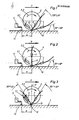
- a device can be used for the mechanical application of the binder composition, the material that increases the grip of the marking and the material that increases the reflection of the marking, examples of which are described below with reference to the drawing.
- the width limiting discs 2 can also be omitted.
- FIG. 1 and 2 show the application of the floor marking with leading "coarse sand” addition and in FIG. 3 with subsequent "coarse sand” addition in a viscous binder mass jet and subsequent sprinkling of the coated material into the binder composition on the surface of the floor.
- the floor surface to be provided with the floor marking denotes the floor surface to be provided with the floor marking.
- the arrow V denotes the direction of work of the marking, carrying comprising two parallel-running width limiting plates 2 as masks, which are intended in particular for the lateral boundary of the binder mass job to the ground surface 1, and 2.1 a ⁇ b - roaming means for leaked to the side boundary disc 2, viscous binder slurry and aggregates such as Sand and the like.
- the direction of rotation arrow 2.2 indicates in which direction the width-limiting disks 2 (not shown) supported by support or track wheels rotate in the forward direction.
- the disks 2 are preferably adjustable in height so that they allow 1- lateral sand discharge (from the jet nozzles 4) at a distance from the floor surface.
- a spray gun or jet nozzle for application under pressure of viscous binder mass and with 4 one of the spray gun 3 leading in the working direction V first dry material jet nozzle for application under pressure of sharp-edged material which increases the grip of the marking, such as (quartz) sand and the like.
- 5 denotes a glass bead or dry material sprinkling device which follows the binder mass spray gun 3 in the working direction V and which, as shown schematically, can be a scattering device acting with gravity.
- it can also be a dry material application jet nozzle (not shown) similar to the jet nozzle 4 for application under pressure of free-flowing material such as sand and the like which additionally improves the grip of the marking and of the material improving the reflection of the marking such as reflex beads.
- a dry material application jet nozzle similar to the jet nozzle 4 for application under pressure of free-flowing material such as sand and the like which additionally improves the grip of the marking and of the material improving the reflection of the marking such as reflex beads.
- the jet nozzle 4 is used for the pre-scattering of material which increases the grip by means of the jet 12, which sand is held by means of a jet 13 of the viscous binder mass for the purpose of adhering to the floor surface 1.
- it can be the entry of a quartz or cristobalite sand jet 12 with a grain size of 200 to 1200 ⁇ m in order to achieve an increased grip of the marking in a binder mass jet 13 from the spray gun 3.
- the jet nozzle 4 is at an angle of 15 ⁇ 10 °, that for the viscous binder mass jet 13 at an angle of 55 + 10 ° to the ground surface 1.
- the reason for the inclined positions of the nozzles 3, 4, always in relation to the direction of travel - V-longitudinal axis lies in the fact that the jet 12 from the nozzle 4 is "said" into the jet 13 from the nozzle 3. In other words, it should be avoided that the binder mass jet 13 emerging at approximately 3 to 5 bar blows away or substantially dilutes the jet 12 emerging at approximately 2 to 3 bar.
- part of the material from the jets 12, 13 already mixes with one another before it hits the base surface 1, the relative proportions being selected both by appropriate choice of the nozzle inclinations, the mutual nozzle spacing, and by the two jet scattering angles and the jet outlet pressure can be determined.
- the sand in jet 12 can be applied with or without the addition of hardener.
- the material applied by the bedding device 5 under the action of gravity, or in the case of a jet nozzle onto the "moist" web of a strip of the viscous binder composition at 2 to 3 bar, is a mixture of peroxide-coated reflective beads and sand and corundum of approx. 250 ⁇ m grain size.
- the distance a of the litter zone 14 behind the impact area of the beams 12, 13 on the floor surface is approximately 10 to 15 cm.
- the sprinkling of sand or cristobalite and corundum with a grain size of 250 ⁇ m is intended to fill pores and unevenness in the coarsely grained sand and corundum from 200 to 1200 ⁇ m that has been entered first, and at the same time to introduce the peroxide hardening material into all areas of the binder mass application. This ensures that the resin-catalyst composition reacts quickly and evenly.
- the jet nozzle 3 is essentially perpendicular to the floor surface 1, but can optionally be pivoted up to 25 ° sideways - left or right - from the vertical.
- the viscous binder mass jet 13 is expediently sprayed onto the floor surface 1 under a pressure of 3 to 5 bar.
- the binder mass jet 10 thus strikes the floor surface 1 in such a way that the mass penetrates the adhesive base under pressure, as a result of which the binder can be optimally anchored in the floor surface.
- a litter zone 14 for the reflection-increasing or dry material is defined at a distance b of 10 to 15 cm.
- the free-flowing material released by the litter 5 preferably consists essentially of a mixture of quartz or cristobalisand and corundum with a grain size of approximately 250 ⁇ m, to which reflective beads are added in a ratio of approximately 1: 2.
- Sand, corundum and reflective pearls are coated with a polymerization catalyst for the cold curing resin, e.g. Benzoyl peroxide, coated.
- the coating material completely encloses the sand-corundum-reflex bead mixture, and this is free-flowing when dry.
- FIG. 3 shows an embodiment for the application of the floor marking, in which the spray gun 3 is used to apply viscous binding agent onto the floor surface 1 through the jet 13 at a caster angle of 55 ° + 10 ° (viewed in the working direction V).
- the dry material jet nozzle 4 is located essentially mirror-inverted to the vertical axis y of the width-limiting disk 2, likewise at an angle of 55 ° + 10 ° to the floor surface 1.
- the dry material supplied by the jet nozzle 4 through the jet 12 to increase the grip of the floor marking is again sharp-edged quartz and / or sand and corundum.
- the spray gun 3 can optionally be interchanged with the jet nozzle 4. It is essential that the materials brought together by the beams 12 and 13 are able to meet the above-mentioned connection and contacting conditions.
- the viscous binder composition can be mixed with at least one material that increases the grip of the repaired area, the area to be repaired should preferably be wetted beforehand with the viscous binder composition and the mixture of Then apply the viscous binder mass and the material that increases the grip to the traffic area.
- different colored pigments can be added to the viscous binder composition.
- frost damage e.g. as follows: Damaged and crumbling parts of the surface of the traffic area that have been loosened by frost are removed; then any dust residues are blown out.
- the area to be repaired is wetted (e.g. with a brush) with the viscous binder mass.
- the binder composition is then mixed with material which increases the grip of the repaired area, e.g. in a weight ratio of about 1: 1.5, and the mixture immediately filled into the area to be repaired, e.g. by filling.
- the following method is suitable for repairing cracks:
- the crack is preferably initially wetted with the viscous binder composition.
- the binder mass which may contain up to 100% by weight of the material which increases the grip pulled onto the binder mass, mixed, applied in a layer thickness of up to 4 mm over the crack, for example with a pulling shoe of suitable width. Material that increases grip is then sprinkled on.
Landscapes
- Engineering & Computer Science (AREA)
- Architecture (AREA)
- Civil Engineering (AREA)
- Structural Engineering (AREA)
- Road Signs Or Road Markings (AREA)
- Application Of Or Painting With Fluid Materials (AREA)
Applications Claiming Priority (2)
| Application Number | Priority Date | Filing Date | Title |
|---|---|---|---|
| CH297684 | 1984-06-19 | ||
| CH2976/84 | 1984-06-19 |
Publications (1)
| Publication Number | Publication Date |
|---|---|
| EP0165906A1 true EP0165906A1 (fr) | 1985-12-27 |
Family
ID=4245868
Family Applications (1)
| Application Number | Title | Priority Date | Filing Date |
|---|---|---|---|
| EP85810283A Withdrawn EP0165906A1 (fr) | 1984-06-19 | 1985-06-19 | Procédé et dispositif pour l'application des marques sur des surfaces ou pour la réparation des aires de circulation endommagées |
Country Status (1)
| Country | Link |
|---|---|
| EP (1) | EP0165906A1 (fr) |
Cited By (9)
| Publication number | Priority date | Publication date | Assignee | Title |
|---|---|---|---|---|
| EP0389060A1 (fr) * | 1989-03-20 | 1990-09-26 | Veluvine B.V. | Matériau en grain répandable, son procédé de préparation ainsi que son procédé d'utilisation à la préparation d'une couche de dessus en construction routière ou à la préparation de marquages de routes |
| US5348763A (en) * | 1987-05-14 | 1994-09-20 | Glaverbel | Method of forming a polymeric matrix containing filler material |
| US5370818A (en) * | 1993-05-28 | 1994-12-06 | Potters Industries, Inc. | Free-flowing catalyst coated beads for curing polyester resin |
| EP0682149A3 (fr) * | 1994-05-13 | 1996-05-15 | Roberit Ag | Dispositif de pulvérisation de deux composants pour le marquage des routes. |
| DE19512396C1 (de) * | 1995-04-03 | 1996-07-11 | Georg Dr Ing Kalawrytinos | Verfahren zur Markierung einer Verkehrsfläche |
| FR2738851A1 (fr) * | 1995-09-14 | 1997-03-21 | Applic Routieres Soc D | Composition bicomposante pour la preparation d'un revetement de sols exterieurs |
| FR2738850A1 (fr) * | 1995-09-14 | 1997-03-21 | Applic Routieres Soc D | Composition bicomposante pour la preparation d'un revetement de sols exterieurs |
| DE102006027471A1 (de) * | 2006-06-12 | 2007-12-13 | A & L, Asphaltdruck und Lackiertechnik Handelsgesellschaft mbH | Verfahren zum Aufbringen einer Farbe |
| DE102006027470A1 (de) * | 2006-06-12 | 2007-12-13 | A & L, Asphaltdruck und Lackiertechnik Handelsgesellschaft mbH | Verfahren zum Aufbringen eines Plastiks |
Citations (4)
| Publication number | Priority date | Publication date | Assignee | Title |
|---|---|---|---|---|
| DE1459749A1 (de) * | 1963-02-13 | 1968-11-28 | Roehm & Haas Gmbh | Verfahren zur Herstellung von Strassendecken |
| CH484325A (de) * | 1967-08-09 | 1970-01-15 | Bollag Moses | Verfahren zur Herstellung einer Strassen- oder Flugplatzmarkierung, insbesondere Horizontalmarkierung auf Fahrbahnen, und nach diesem Verfahren hergestellte Markierung |
| DE2239755A1 (de) * | 1972-08-12 | 1974-02-21 | Quarzwerke Gmbh | Nachstreumittel |
| EP0074494A1 (fr) * | 1981-08-21 | 1983-03-23 | Herberts Gesellschaft mit beschränkter Haftung | Procédé et appareil de marquage d'aires de circulation |
-
1985
- 1985-06-19 EP EP85810283A patent/EP0165906A1/fr not_active Withdrawn
Patent Citations (4)
| Publication number | Priority date | Publication date | Assignee | Title |
|---|---|---|---|---|
| DE1459749A1 (de) * | 1963-02-13 | 1968-11-28 | Roehm & Haas Gmbh | Verfahren zur Herstellung von Strassendecken |
| CH484325A (de) * | 1967-08-09 | 1970-01-15 | Bollag Moses | Verfahren zur Herstellung einer Strassen- oder Flugplatzmarkierung, insbesondere Horizontalmarkierung auf Fahrbahnen, und nach diesem Verfahren hergestellte Markierung |
| DE2239755A1 (de) * | 1972-08-12 | 1974-02-21 | Quarzwerke Gmbh | Nachstreumittel |
| EP0074494A1 (fr) * | 1981-08-21 | 1983-03-23 | Herberts Gesellschaft mit beschränkter Haftung | Procédé et appareil de marquage d'aires de circulation |
Cited By (9)
| Publication number | Priority date | Publication date | Assignee | Title |
|---|---|---|---|---|
| US5348763A (en) * | 1987-05-14 | 1994-09-20 | Glaverbel | Method of forming a polymeric matrix containing filler material |
| EP0389060A1 (fr) * | 1989-03-20 | 1990-09-26 | Veluvine B.V. | Matériau en grain répandable, son procédé de préparation ainsi que son procédé d'utilisation à la préparation d'une couche de dessus en construction routière ou à la préparation de marquages de routes |
| US5370818A (en) * | 1993-05-28 | 1994-12-06 | Potters Industries, Inc. | Free-flowing catalyst coated beads for curing polyester resin |
| EP0682149A3 (fr) * | 1994-05-13 | 1996-05-15 | Roberit Ag | Dispositif de pulvérisation de deux composants pour le marquage des routes. |
| DE19512396C1 (de) * | 1995-04-03 | 1996-07-11 | Georg Dr Ing Kalawrytinos | Verfahren zur Markierung einer Verkehrsfläche |
| FR2738851A1 (fr) * | 1995-09-14 | 1997-03-21 | Applic Routieres Soc D | Composition bicomposante pour la preparation d'un revetement de sols exterieurs |
| FR2738850A1 (fr) * | 1995-09-14 | 1997-03-21 | Applic Routieres Soc D | Composition bicomposante pour la preparation d'un revetement de sols exterieurs |
| DE102006027471A1 (de) * | 2006-06-12 | 2007-12-13 | A & L, Asphaltdruck und Lackiertechnik Handelsgesellschaft mbH | Verfahren zum Aufbringen einer Farbe |
| DE102006027470A1 (de) * | 2006-06-12 | 2007-12-13 | A & L, Asphaltdruck und Lackiertechnik Handelsgesellschaft mbH | Verfahren zum Aufbringen eines Plastiks |
Similar Documents
| Publication | Publication Date | Title |
|---|---|---|
| EP0280102B1 (fr) | Procédé et dispositif de fabrication ou de réfection d'un marquage horizontal de routes et marquage horizontal fabriqué selon le procédé | |
| EP0654068B1 (fr) | Procede et dispositif pour l'application de marquages horizontaux sur des chaussees ou autres surfaces destinees a la circulation | |
| DE69712820T2 (de) | Schnelltrocknende wässrige Beschichtungszusammensetzung | |
| DE69712655T2 (de) | Wässrige Strassenmarkierungsfarben | |
| EP3183302B1 (fr) | Enduit à résine de réaction pour marques au sol en matière plastique à froid résistantes aux salissures | |
| US6413011B1 (en) | Method for producing fast-drying multi-component waterborne coating compositions | |
| DE69600604T2 (de) | Verfahren und Vorrichtung zum Aufbringen einer Haftschicht und eine solche Schicht enthaltender Strassenbelag | |
| EP0808345B1 (fr) | Matiere de marquage aqueuse et son procede de production | |
| DE2441546A1 (de) | Verkehrsmarkierung und verfahren zu ihrer herstellung | |
| DE2950523A1 (de) | Verfahren zum binden von urethanformulierungen an gummi | |
| DE3133156A1 (de) | Verfahren zum markieren von verkehrsflaechen und vorrichtung hierfuer | |
| EP0721003A2 (fr) | Système de peintures de signalisation routière diluable à l'eau | |
| EP2855563B1 (fr) | Durcissement direct de résines composites par induction de plasma | |
| EP0389060B1 (fr) | Matériau en grain répandable, son procédé de préparation ainsi que son procédé d'utilisation à la préparation d'une couche de dessus en construction routière ou à la préparation de marquages de routes | |
| EP1347099B1 (fr) | Méthode et appareillage pour la production de corps réfléchissants pour marquage horizontal | |
| AT241513B (de) | Verfahren zur Herstellung von Fahrbahndecken von Straßen, Flugplatzrollbahnen u. dgl. | |
| DE10127469A1 (de) | Ultraschnell trocknende Straßenmarkierungssysteme | |
| DE10044300A1 (de) | Ultrahoch reflektierende Straßenmarkierungssysteme | |
| DE2160311A1 (de) | Verfahren und vorrichtung zum aufbringen von markierungen auf strassendecken | |
| DE1769792A1 (de) | UEberzugs-,Beschichtungs- und Ausfuellmittel | |
| CH590367A5 (en) | Quick-drying traffic markings - produced from pigmented synthetic resin and reflective particles | |
| DE1658705A1 (de) | Substanz zur Markierung einer Strasse oder dergleichen Oberflaeche | |
| DE1658755C3 (de) | Verfahren und fahrbare Vorrichtung zum Auftragen von Markierungsstreifen auf Fahrbahnen | |
| CH484325A (de) | Verfahren zur Herstellung einer Strassen- oder Flugplatzmarkierung, insbesondere Horizontalmarkierung auf Fahrbahnen, und nach diesem Verfahren hergestellte Markierung | |
| DE1658690A1 (de) | Verfahren und Vorrichtung zur Herstellung von Strassen- bzw.Autobahn-Markierungen |
Legal Events
| Date | Code | Title | Description |
|---|---|---|---|
| PUAI | Public reference made under article 153(3) epc to a published international application that has entered the european phase |
Free format text: ORIGINAL CODE: 0009012 |
|
| AK | Designated contracting states |
Designated state(s): AT BE CH DE FR GB IT LI LU NL SE |
|
| 17P | Request for examination filed |
Effective date: 19860624 |
|
| 17Q | First examination report despatched |
Effective date: 19870414 |
|
| STAA | Information on the status of an ep patent application or granted ep patent |
Free format text: STATUS: THE APPLICATION IS DEEMED TO BE WITHDRAWN |
|
| 18D | Application deemed to be withdrawn |
Effective date: 19871125 |
|
| RIN1 | Information on inventor provided before grant (corrected) |
Inventor name: MORY, ERNST |