EP0166866A2 - Lichtablenkungsvorrichtung - Google Patents
Lichtablenkungsvorrichtung Download PDFInfo
- Publication number
- EP0166866A2 EP0166866A2 EP85103398A EP85103398A EP0166866A2 EP 0166866 A2 EP0166866 A2 EP 0166866A2 EP 85103398 A EP85103398 A EP 85103398A EP 85103398 A EP85103398 A EP 85103398A EP 0166866 A2 EP0166866 A2 EP 0166866A2
- Authority
- EP
- European Patent Office
- Prior art keywords
- conductor rod
- optical conductor
- optical
- diverting device
- light diverting
- Prior art date
- Legal status (The legal status is an assumption and is not a legal conclusion. Google has not performed a legal analysis and makes no representation as to the accuracy of the status listed.)
- Withdrawn
Links
Images

Classifications
-
- F—MECHANICAL ENGINEERING; LIGHTING; HEATING; WEAPONS; BLASTING
- F21—LIGHTING
- F21S—NON-PORTABLE LIGHTING DEVICES; SYSTEMS THEREOF; VEHICLE LIGHTING DEVICES SPECIALLY ADAPTED FOR VEHICLE EXTERIORS
- F21S11/00—Non-electric lighting devices or systems using daylight
-
- G—PHYSICS
- G02—OPTICS
- G02B—OPTICAL ELEMENTS, SYSTEMS OR APPARATUS
- G02B27/00—Optical systems or apparatus not provided for by any of the groups G02B1/00 - G02B26/00, G02B30/00
- G02B27/10—Beam splitting or combining systems
- G02B27/108—Beam splitting or combining systems for sampling a portion of a beam or combining a small beam in a larger one, e.g. wherein the area ratio or power ratio of the divided beams significantly differs from unity, without spectral selectivity
-
- G—PHYSICS
- G02—OPTICS
- G02B—OPTICAL ELEMENTS, SYSTEMS OR APPARATUS
- G02B27/00—Optical systems or apparatus not provided for by any of the groups G02B1/00 - G02B26/00, G02B30/00
- G02B27/10—Beam splitting or combining systems
- G02B27/14—Beam splitting or combining systems operating by reflection only
- G02B27/143—Beam splitting or combining systems operating by reflection only using macroscopically faceted or segmented reflective surfaces
-
- G—PHYSICS
- G02—OPTICS
- G02B—OPTICAL ELEMENTS, SYSTEMS OR APPARATUS
- G02B27/00—Optical systems or apparatus not provided for by any of the groups G02B1/00 - G02B26/00, G02B30/00
- G02B27/10—Beam splitting or combining systems
- G02B27/14—Beam splitting or combining systems operating by reflection only
- G02B27/144—Beam splitting or combining systems operating by reflection only using partially transparent surfaces without spectral selectivity
-
- G—PHYSICS
- G02—OPTICS
- G02B—OPTICAL ELEMENTS, SYSTEMS OR APPARATUS
- G02B6/00—Light guides; Structural details of arrangements comprising light guides and other optical elements, e.g. couplings
- G02B6/24—Coupling light guides
- G02B6/26—Optical coupling means
- G02B6/264—Optical coupling means with optical elements between opposed fibre ends which perform a function other than beam splitting
-
- G—PHYSICS
- G02—OPTICS
- G02B—OPTICAL ELEMENTS, SYSTEMS OR APPARATUS
- G02B6/00—Light guides; Structural details of arrangements comprising light guides and other optical elements, e.g. couplings
- G02B6/24—Coupling light guides
- G02B6/26—Optical coupling means
- G02B6/28—Optical coupling means having data bus means, i.e. plural waveguides interconnected and providing an inherently bidirectional system by mixing and splitting signals
- G02B6/2804—Optical coupling means having data bus means, i.e. plural waveguides interconnected and providing an inherently bidirectional system by mixing and splitting signals forming multipart couplers without wavelength selective elements, e.g. "T" couplers, star couplers
- G02B6/2817—Optical coupling means having data bus means, i.e. plural waveguides interconnected and providing an inherently bidirectional system by mixing and splitting signals forming multipart couplers without wavelength selective elements, e.g. "T" couplers, star couplers using reflective elements to split or combine optical signals
-
- G—PHYSICS
- G02—OPTICS
- G02B—OPTICAL ELEMENTS, SYSTEMS OR APPARATUS
- G02B6/00—Light guides; Structural details of arrangements comprising light guides and other optical elements, e.g. couplings
- G02B6/24—Coupling light guides
- G02B6/26—Optical coupling means
- G02B6/35—Optical coupling means having switching means
- G02B6/3538—Optical coupling means having switching means based on displacement or deformation of a liquid
-
- G—PHYSICS
- G02—OPTICS
- G02B—OPTICAL ELEMENTS, SYSTEMS OR APPARATUS
- G02B6/00—Light guides; Structural details of arrangements comprising light guides and other optical elements, e.g. couplings
- G02B6/24—Coupling light guides
- G02B6/26—Optical coupling means
- G02B6/35—Optical coupling means having switching means
- G02B6/354—Switching arrangements, i.e. number of input/output ports and interconnection types
- G02B6/3544—2D constellations, i.e. with switching elements and switched beams located in a plane
- G02B6/3548—1xN switch, i.e. one input and a selectable single output of N possible outputs
- G02B6/355—1x2 switch, i.e. one input and a selectable single output of two possible outputs
-
- G—PHYSICS
- G02—OPTICS
- G02B—OPTICAL ELEMENTS, SYSTEMS OR APPARATUS
- G02B6/00—Light guides; Structural details of arrangements comprising light guides and other optical elements, e.g. couplings
- G02B6/24—Coupling light guides
- G02B6/26—Optical coupling means
- G02B6/35—Optical coupling means having switching means
- G02B6/3594—Characterised by additional functional means, e.g. means for variably attenuating or branching or means for switching differently polarized beams
Definitions
- the present invention relates to a light diverting device for diverting a part of the light energy transmitted through an optical conductor rod and for taking it out.
- the present applicant has previously proposed, in view of the circumstances described above, a light diverting device capable of diverting a part of the light energy propagating through it and for also taking it out.
- the light diverting device which the present applicant has previously proposed is comprised of a first optical conductor rod having a through-hole formed in a radial direction, a second optical conductor rod and a third optical conductor rod which are tightly inserted into the through-hole.
- the second optical conductor rod is firmly fixed by use of optical paste or the like.
- the edge surface portion of the second optical conductor rod in the through-hole is formed on a surface which is inclined in relation to the direction of the first optical conductor rod's axis.
- the third optical conductor rod has an inclined surface opposed to the inclined surface of the second optical conductor rod and is tightly inserted into the through-hole so as to be able to move reciprocatedly.
- a groove is formed on the uppermost portion of the third optical conductor rod along the direction of its axis.
- Optical oil is poured into the gap between the inclined surface of the second optical conductor rod and the inclined surface of the third optical conductor rod by utilizing the groove.
- the light rays propagating through the first optical conductor rod are reflected on the inclined surface of the second optical conductor rod in the area of the gap where there is no optical oil, while the light rays are passed through in the area of the gap where there is optical oil.
- the amount of light rays reflected by the inclined surface of the second optical conductor rod can be adjusted in accordance with the level of optical oil in the gap. Such adjustment can be performed by changing the insertion depth of the third optical conductor rod.
- a fourth optical conductor rod is firmly fixed on the outer circumferential surface of the first optical conductor rod so as to cover tightly the inserted portion of the second optical conductor rod which is unitarily formed with the second optical conductor rod.
- the light rays reflected by the inclined surface of the second optical conductor rod are taken out through the fourth optical conductor rod and transmitted through an optical conductor cable, which is connected with the fourth optical conductor rod, onto an optional desired place for use in illumination or for other purposes.
- optical oil existing in the space between the inclined surfaces, comes in contact with the outside air through the groove formed in the third optical conductor rod. Consequently, there existed defects where the optical oil leaked through the groove and where dust or dirt entered into the optical oil making its difficult for its prolonged use. Furthermore, since the groove portion formed an air layer, there was light dispersion and a loss of light energy occurred.
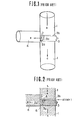
- Fig. 1 is a front view for explaining an embodiment of the light diverting device which the present applicant has previously proposed.
- Fig. 2 is a cross-sectional view thereof.
- 1 is a first optical conductor rod having a through-hole formed in a radial direction, with a second optical conductor rod 2 and a third optical conductor rod 3 which are tightly inserted into the through-hole.
- the second optical conductor rod 2 is firmly fixed by use of optical paste or the like.
- the edge surface portion of the second optical conductor rod 2 in the through-hole is formed on a surface 2a inclined in relation to the direction of the first optical conductor rod's axis.
- the third optical conductor rod 3 has an inclined surface 3 a opposed to the inclined surface 2a of the second optical conductor rod 2 and is tightly inserted into the through-hole so as to be able to move reciprocatedly.
- a groove 3b is formed on the uppermost portion of the third optical conductor rod 3 along the direction of the axis thereof.
- Optical oil 5 is poured into the gap d between the inclined surface 2a of the second optical conductor rod 2 and the inclined surface 3a of the third optical conductor rod 3 by means of the groove 3b.
- the light rays L propagating in the direction shown by arrow A through the first optical conductor rod 1 are reflected on the inclined surface 2& of the second optical conductor rod 2 and directed in the direction shown by arrow B in the area of the gap where no optical oil exists, while the light rays L are directed in the direction shown by arrow C in the area of the gap where optical oil exists.
- the amount of light rays propagating in the direction of B can be adjusted in accordance with the level of optical oil in the gap.
- Such adjustment can be performed by changing the insertion depth of the third optical conductor rod 3.
- a fourth optical conductor rod is represented by 4. It is firmly fixed on the outer circumferential surface of the first optical conductor rod 1 so as to cover tightly the inserted portion of the second optical conductor rod 2 which is unitarily formed with the second optical conductor rod 2.
- the light rays diverted to direction B is taken out through the fourth optical conductor rod 4 and transmitted through an optical conductor cable not shown in the drawings but connected with the fourth optical conductor rod 4 onto an optional desired place for use in illumination or for other purposes.
- optical oil 5 exsiting in the space between the inclined surfaces, come in contact with the outside air through the groove 3a formed in the third optical conductor rod 3.. Consequently, there existed the defects that the optical oil leaked through the groove 3a and that dust or dirt entered into the optical oil making it difficult to use the device over a long period of time. Furthermore, since the groove portion 3a formed an air layer there was light dispersion and a loss of light energy occurred.
- the amount of diverted light rays is adjusted by moving the third optical conductor rod back and fourth.
- the third optical conductor rod rotates the variation in the amount of optical oil per a predetermined stroke (reciprocating amount) varies so that the amount of diverted light rays per a predetermined stroke varies also.
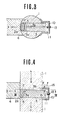
- Fig. 3 is a cross-sectional plane view for explaining an embodiment of the light diverting device according to the present invention.
- Fig. 4 is a cross-sectional side view thereof.
- the same reference numerals as in Figs. 1 and 2 are attached to the parts performing the same actions as in Figs. 1 and 2 respectively.
- 10 is a cover member which fits tightly and firmly onto the first optical conductor rod 1 so as to cover the edge surface portion 3c at the opposite side to the inclined surface 3a of the third optical conductor rod 3, and optical oil 11 is enclosed within the cover member 10.
- a permanent magnet 15 is unitarily mounted on the projecting end portion 3c of the third optical conductor rod 3, and another permanent magnet 16 with an inverse polarity is mounted on the external side of the cover 10 opposite the permanent magnet 15 so as to be able to move in the direction of the third optical conductor conductor rods 3 axis. 0166866
- the third optical conductor rod 3 moves also in that same direction so that the distance between the inclined surface of the second optical conductor rod 2 and that of the third optical conductor rod 3 is lessened.
- the third optical conductor rod 3 moves also in that same direction so that the distance between both of the inclined surfaces is increased.
- the light energy propagating in the direction of A through the first optical conductor rod 1 can be diverted in the direction of B and of C.
- optical oil 5 since optical oil 5 is completely shut off from the air, it doesn't disperse and dust and dirt do not enter into it so that the life span of the device is increased.
- the groove 3b formed on the optical conductor rod 3 is filled with optical oil 5.
- the groove 3b has no optical oil 11. Consequently dispersion of light energy decreases at the groove portion 3b and the loss of light energy can be minimized.
- the numeral 13 represents a member serving both functions of being a stopper and a volume adjusting screw.
- the projection amount toward the internal space of the cover 10 is restricted by handling the screw 13 from the external side of the cover 10. In such a manner, the movement of the third optical conductor rod 3 in the direction of F is restricted and the volume of optical oil 11 in the cover member 10 is adjusted. When tne third optical conductor rod 3 moves in the direction of F the amount of optical oil 11 entering into the groove 3b is adjusted. It can easily be understood that the stopper mechanism and the volume adjusting mechanism can be constructed by means of different members.
- Fig. 5 is a cross-sectional side view for explaining another embodiment of the light diverting device according to the present invention.
- 21 is a first optical conductor rod, 22 a second optical conductor rod, and 23 a third optical conductor rod.
- a through-hole is formed in the radial direction of the first optical conductor rod 21, and the second optical conductor rod 22 is rotatably and tightly inserted into the through-hole.
- the third optical conductor rod 23 is firmly fixed on the outer circumferential surface of the first optical conductor rod 21 so as to cover one edge portion surface of the second optical conductor rod 22.
- the second optical conductor rod 22 is unitarily combined with the first one at a location near the fixed portion of the third optical conductor rod 23 through an interposition of a reflecting film layer 24 having a predetermined inclined angle in relation to the axis line of the second optical conductor rod 22.
- the light rays L propagating in the direction of arrow A through the optical conductor rod 21 are reflected onto the reflecting film layer 24 and directed in the direction of arrow B when the reflecting film layer 24 is perpendicular to the direction of the light rays'. L propagation and are then further guided into the third optical conductor rod 23. A part of the light rays L propagating in the direction of arrow A through the optical conductor rod 21 is reflected onto the reflecting film layer 24 of the second optical conductor rod 22 and then directed or diverted in direction B and further guided into the third optical conductor rod 23.
- the amount of light rays diverted into the third optical conductor rod 23 can be adjusted by rotating the second optical conductor rod 22.
- the surface of the reflecting film layer 24 is parallel with A of the light rays' propagation, namely the second optical conductor rod 22 is rotated by 90. starting from the position shown in Fig. 5, the amount of light rays diverted into the third optical conductor rod 23 becomes zero.
- the light rays varying in relation to the rotation angle of the second optical conductor rod 22 are diverted into the third optical conductor rod 23.
- a part of the light rays L propagating in direction A through the first optical conductor rod 21 is reflected onto the reflecting film layer 24 of the second optical conductor rod 22 and directed or diverted in direction B and further guided into the third optical conductor rod 23.
- the light diverting devices as mentioned before were installed on the first optical conductor rod 21 in order for the light rays propagating through the first optical conductor rod 21 to be diverted and taken out, in order, by the respective light diverting devices.
- the amount of light rays diverted at that time can be adjusted by changing the rotation angle of the second optical conductor rod 22. However, it can also be adjusted by changing the reflection rate or reflexibility of the reflecting film layer 24 (in other words its "transparency"). For instance, a semitransparent material of lesser reflexibility is used at the upstream side in relation to direction A of the light rays' propagation, and a material of greater reflexibility is used at the downstream side. The more downstream the location of the optical conductor rod is, the greater is the reflexibility of the material used at that time. For example, at the final diverting point, an entirely-reflecting film is employed. In such a way, an approximately equal amount of light rays can be diverted from all of the diverting portions of the respective optical conductor rods.
- the second optical conductor rod 22 is rotated inside the through-hole of the first optical conductor rod in the embodiment according to the present invention.
- Optical oil is poured into the space between the rotatable contact surfaces in order to make the rotation of the rod more smooth.
- optical oil is poured into the space between the rotatable contact surfaces there exists no air layer so that the light rays do not disperse at all and the transmission efficiency of the light rays is largely improved.
- the third optical conductor rod 23 has a hole 25 into which one edge portion of the second optical conductor 22 is inserted.
- optical oil 26 is enclosed in the remaining space of the hole 25.
- Optical oil 26 is employed as a lubricating oil in the space between the rotating contact surfaces of the first optical conductor rod 21 and the second optical conductor rod 22.
- Another edge portion of the second optical conductor rod 22 is covered by a cover member 27 which is firmly fixed on the outer circumferential surface of the first optical conductor rod 21. In such a construction, optical oil is prevented from being diffused into the open air. In addition, dirt, dust or the like contained in the air is also prevented from entering into the optical oil.
- 28 is a permanent magnet mounted on the edge surface of the second optical conductor rod 22
- 29 is a rotatable permanent magnet mounted on the outer side of the cover member 27 opposite the permanent magnet 28.
- the permanent magnet 29 rotates, the other permanent magnet 28 also rotates following the rotation of the former magnet so that the second optical conductor rod 22 rotates also.
- Optical oil can also be enclosed in the cover member 27.
- the portion shown by a circle V in Fig. 5 is improved as shown in Fig. 6, namely the hole 25 of the third optical conductor rod 23 is omitted. Therefore, it may be possible to simplify the construction of the third optical conductor rod and to facilitate its manufacture.
Landscapes
- Physics & Mathematics (AREA)
- General Physics & Mathematics (AREA)
- Optics & Photonics (AREA)
- Spectroscopy & Molecular Physics (AREA)
- Life Sciences & Earth Sciences (AREA)
- Sustainable Development (AREA)
- Engineering & Computer Science (AREA)
- General Engineering & Computer Science (AREA)
- Optical Couplings Of Light Guides (AREA)
- Investigating Or Analysing Materials By Optical Means (AREA)
Applications Claiming Priority (4)
| Application Number | Priority Date | Filing Date | Title |
|---|---|---|---|
| JP133892/84 | 1984-06-28 | ||
| JP59133892A JPS6113204A (ja) | 1984-06-28 | 1984-06-28 | 光分岐装置 |
| JP159520/84 | 1984-07-30 | ||
| JP15952084A JPS6136707A (ja) | 1984-07-30 | 1984-07-30 | 光分岐装置 |
Publications (2)
| Publication Number | Publication Date |
|---|---|
| EP0166866A2 true EP0166866A2 (de) | 1986-01-08 |
| EP0166866A3 EP0166866A3 (de) | 1988-09-21 |
Family
ID=26468124
Family Applications (1)
| Application Number | Title | Priority Date | Filing Date |
|---|---|---|---|
| EP85103398A Withdrawn EP0166866A3 (de) | 1984-06-28 | 1985-03-22 | Lichtablenkungsvorrichtung |
Country Status (5)
| Country | Link |
|---|---|
| US (1) | US4699450A (de) |
| EP (1) | EP0166866A3 (de) |
| KR (1) | KR900003263Y1 (de) |
| AU (2) | AU580752B2 (de) |
| CA (1) | CA1258789A (de) |
Families Citing this family (2)
| Publication number | Priority date | Publication date | Assignee | Title |
|---|---|---|---|---|
| US5596590A (en) * | 1996-01-25 | 1997-01-21 | Cymer Laser Technologies | Beam diverting shutter for a laser beam |
| US5852693A (en) * | 1996-11-26 | 1998-12-22 | Ultratech Stepper, Inc. | Low-loss light redirection apparatus |
Family Cites Families (9)
| Publication number | Priority date | Publication date | Assignee | Title |
|---|---|---|---|---|
| CH599558A5 (de) * | 1976-03-16 | 1978-05-31 | Patelhold Patentverwertung | |
| FR2393330A1 (fr) * | 1977-05-31 | 1978-12-29 | Angenieux P Ets | Dispositif optique permettant de faire varier la direction d'un faisceau de rayons lumineux |
| US4400054A (en) * | 1978-10-10 | 1983-08-23 | Spectronics, Inc. | Passive optical coupler |
| DE2938810A1 (de) * | 1979-09-25 | 1981-04-09 | Siemens AG, 1000 Berlin und 8000 München | Vorrichtung zum einkoppeln von strahlung in einen optischen wellenleiter |
| US4384761A (en) * | 1980-06-30 | 1983-05-24 | International Business Machines Corporation | Ferrofluid optical switches |
| US4576436A (en) * | 1983-01-31 | 1986-03-18 | Maurice Daniel | Light distribution and collection assemblies and methods |
| JPS607408A (ja) * | 1983-06-28 | 1985-01-16 | Takashi Mori | 光分岐装置 |
| US4636028A (en) * | 1983-11-10 | 1987-01-13 | Kei Mori | Light diverting device |
| JP3460011B2 (ja) * | 1996-06-14 | 2003-10-27 | 株式会社日立製作所 | 流量制御方法および装置 |
-
1985
- 1985-02-05 US US06/698,298 patent/US4699450A/en not_active Expired - Fee Related
- 1985-02-05 CA CA000473587A patent/CA1258789A/en not_active Expired
- 1985-02-14 AU AU38706/85A patent/AU580752B2/en not_active Ceased
- 1985-03-22 EP EP85103398A patent/EP0166866A3/de not_active Withdrawn
-
1988
- 1988-10-07 AU AU23566/88A patent/AU2356688A/en not_active Abandoned
-
1990
- 1990-02-28 KR KR2019900001422U patent/KR900003263Y1/ko not_active Expired
Also Published As
| Publication number | Publication date |
|---|---|
| EP0166866A3 (de) | 1988-09-21 |
| AU2356688A (en) | 1989-01-12 |
| CA1258789A (en) | 1989-08-29 |
| KR900003263Y1 (ko) | 1990-04-20 |
| AU3870685A (en) | 1986-01-02 |
| US4699450A (en) | 1987-10-13 |
| AU580752B2 (en) | 1989-02-02 |
Similar Documents
| Publication | Publication Date | Title |
|---|---|---|
| EP0006361B1 (de) | Beleuchtetes Zeigerinstrument | |
| US4850665A (en) | Method and apparatus for controlled emission of light from prism light guide | |
| KR880000807A (ko) | 광학 섬유 장치 | |
| EP0054300A1 (de) | Optische Verbindung zwischen einem Photohalbleiter und einer optischen Fiber | |
| JPS5365736A (en) | Variable magnification copier | |
| US5217299A (en) | Reflection type lighting apparatus | |
| EP0166866A2 (de) | Lichtablenkungsvorrichtung | |
| US3942866A (en) | Fiber-optical structure of high apparent power of resolution | |
| EP0236030A2 (de) | Vorrichtung und Verfahren zur gesteuerten Emission des Lichts aus einem Prismenlichtwellenleiter | |
| CA1251973A (en) | Light diverting device | |
| KR970701357A (ko) | 오버헤드 프로젝션용 이중 그루브 프레넬 렌즈(dual grooved fresnel lens for overhead projection) | |
| EP0154332A2 (de) | Verbindungsstruktur zur Verbindung eines optischen Leiters | |
| KR830010400A (ko) | 후면 투사 스크린 | |
| KR100373208B1 (ko) | 전반사 필름 | |
| JPS6136707A (ja) | 光分岐装置 | |
| EP0147687B1 (de) | Vorrichtung zum Ablenken von Licht | |
| FR2710966A1 (fr) | Projecteur à conduit de lumière, notamment pour véhicule automobile. | |
| US20050141837A1 (en) | Bendable light guide | |
| JPS624684B2 (de) | ||
| RU2029385C1 (ru) | Фотоэлектрический импульсный датчик вращения для магнитофона | |
| US3092728A (en) | Light collecting apparatus for photosensitive device | |
| JPS604222Y2 (ja) | 照明表示装置 | |
| JPH0961745A (ja) | 光学式読取装置 | |
| FR2601464A1 (fr) | Dispositif de balayage alternatif d'un plan par un faisceau lumineux | |
| KR840008990A (ko) | 광필터 장치 |
Legal Events
| Date | Code | Title | Description |
|---|---|---|---|
| PUAI | Public reference made under article 153(3) epc to a published international application that has entered the european phase |
Free format text: ORIGINAL CODE: 0009012 |
|
| AK | Designated contracting states |
Designated state(s): CH DE FR GB IT LI NL SE |
|
| PUAL | Search report despatched |
Free format text: ORIGINAL CODE: 0009013 |
|
| AK | Designated contracting states |
Kind code of ref document: A3 Designated state(s): CH DE FR GB IT LI NL SE |
|
| 17P | Request for examination filed |
Effective date: 19890321 |
|
| STAA | Information on the status of an ep patent application or granted ep patent |
Free format text: STATUS: THE APPLICATION HAS BEEN WITHDRAWN |
|
| 18W | Application withdrawn |
Withdrawal date: 19900531 |