EP0167221A1 - Alliage fer-nickel-titane-cobalt à effet de mémoire et pseudo-élasticité et procédé pour sa fabrication - Google Patents
Alliage fer-nickel-titane-cobalt à effet de mémoire et pseudo-élasticité et procédé pour sa fabrication Download PDFInfo
- Publication number
- EP0167221A1 EP0167221A1 EP85301737A EP85301737A EP0167221A1 EP 0167221 A1 EP0167221 A1 EP 0167221A1 EP 85301737 A EP85301737 A EP 85301737A EP 85301737 A EP85301737 A EP 85301737A EP 0167221 A1 EP0167221 A1 EP 0167221A1
- Authority
- EP
- European Patent Office
- Prior art keywords
- temperature
- alloy
- shape memory
- pseudo
- elasticity
- Prior art date
- Legal status (The legal status is an assumption and is not a legal conclusion. Google has not performed a legal analysis and makes no representation as to the accuracy of the status listed.)
- Granted
Links
- 230000003446 memory effect Effects 0.000 title claims abstract description 27
- 229910000531 Co alloy Inorganic materials 0.000 title claims description 9
- 238000000034 method Methods 0.000 title claims description 6
- FFCYCDBKNAJFNJ-UHFFFAOYSA-N [Ti].[Fe].[Co].[Ni] Chemical compound [Ti].[Fe].[Co].[Ni] FFCYCDBKNAJFNJ-UHFFFAOYSA-N 0.000 title 1
- 229910000734 martensite Inorganic materials 0.000 claims abstract description 42
- 229910045601 alloy Inorganic materials 0.000 claims abstract description 39
- 239000000956 alloy Substances 0.000 claims abstract description 39
- PXHVJJICTQNCMI-UHFFFAOYSA-N Nickel Chemical compound [Ni] PXHVJJICTQNCMI-UHFFFAOYSA-N 0.000 claims abstract description 17
- 238000010438 heat treatment Methods 0.000 claims abstract description 13
- XEEYBQQBJWHFJM-UHFFFAOYSA-N Iron Chemical compound [Fe] XEEYBQQBJWHFJM-UHFFFAOYSA-N 0.000 claims abstract description 10
- 239000010936 titanium Substances 0.000 claims abstract description 9
- 229910052759 nickel Inorganic materials 0.000 claims abstract description 8
- 229910052719 titanium Inorganic materials 0.000 claims abstract description 7
- RTAQQCXQSZGOHL-UHFFFAOYSA-N Titanium Chemical compound [Ti] RTAQQCXQSZGOHL-UHFFFAOYSA-N 0.000 claims abstract description 5
- 230000032683 aging Effects 0.000 claims abstract description 5
- 229910017052 cobalt Inorganic materials 0.000 claims abstract description 5
- 239000010941 cobalt Substances 0.000 claims abstract description 5
- GUTLYIVDDKVIGB-UHFFFAOYSA-N cobalt atom Chemical compound [Co] GUTLYIVDDKVIGB-UHFFFAOYSA-N 0.000 claims abstract description 5
- 229910052742 iron Inorganic materials 0.000 claims abstract description 4
- 230000035882 stress Effects 0.000 claims description 12
- 238000001816 cooling Methods 0.000 claims description 4
- 238000013016 damping Methods 0.000 claims description 4
- 230000000694 effects Effects 0.000 claims description 4
- 239000012456 homogeneous solution Substances 0.000 claims description 3
- IJGRMHOSHXDMSA-UHFFFAOYSA-N Atomic nitrogen Chemical compound N#N IJGRMHOSHXDMSA-UHFFFAOYSA-N 0.000 description 20
- 230000009466 transformation Effects 0.000 description 18
- 239000011159 matrix material Substances 0.000 description 17
- 239000007788 liquid Substances 0.000 description 10
- 229910052757 nitrogen Inorganic materials 0.000 description 10
- 230000002441 reversible effect Effects 0.000 description 6
- 229910001285 shape-memory alloy Inorganic materials 0.000 description 6
- 239000007769 metal material Substances 0.000 description 5
- 239000000203 mixture Substances 0.000 description 4
- 229910001566 austenite Inorganic materials 0.000 description 3
- 238000005452 bending Methods 0.000 description 3
- 230000015572 biosynthetic process Effects 0.000 description 3
- 230000005489 elastic deformation Effects 0.000 description 3
- 238000004519 manufacturing process Methods 0.000 description 3
- 230000003287 optical effect Effects 0.000 description 3
- CWYNVVGOOAEACU-UHFFFAOYSA-N Fe2+ Chemical compound [Fe+2] CWYNVVGOOAEACU-UHFFFAOYSA-N 0.000 description 2
- 229910004337 Ti-Ni Inorganic materials 0.000 description 2
- 229910011209 Ti—Ni Inorganic materials 0.000 description 2
- 238000002441 X-ray diffraction Methods 0.000 description 2
- 230000008859 change Effects 0.000 description 2
- 230000006870 function Effects 0.000 description 2
- KHYBPSFKEHXSLX-UHFFFAOYSA-N iminotitanium Chemical compound [Ti]=N KHYBPSFKEHXSLX-UHFFFAOYSA-N 0.000 description 2
- 238000002844 melting Methods 0.000 description 2
- 230000008018 melting Effects 0.000 description 2
- 229910001220 stainless steel Inorganic materials 0.000 description 2
- 239000000126 substance Substances 0.000 description 2
- 229910017518 Cu Zn Inorganic materials 0.000 description 1
- 229910017535 Cu-Al-Ni Inorganic materials 0.000 description 1
- 229910017752 Cu-Zn Inorganic materials 0.000 description 1
- 229910017943 Cu—Zn Inorganic materials 0.000 description 1
- 229910000640 Fe alloy Inorganic materials 0.000 description 1
- 229910000914 Mn alloy Inorganic materials 0.000 description 1
- 229910001069 Ti alloy Inorganic materials 0.000 description 1
- 229910052782 aluminium Inorganic materials 0.000 description 1
- 229910052785 arsenic Inorganic materials 0.000 description 1
- 230000006399 behavior Effects 0.000 description 1
- 229910052793 cadmium Inorganic materials 0.000 description 1
- 238000005097 cold rolling Methods 0.000 description 1
- 230000006835 compression Effects 0.000 description 1
- 238000007906 compression Methods 0.000 description 1
- TVZPLCNGKSPOJA-UHFFFAOYSA-N copper zinc Chemical compound [Cu].[Zn] TVZPLCNGKSPOJA-UHFFFAOYSA-N 0.000 description 1
- 230000001747 exhibiting effect Effects 0.000 description 1
- 238000005098 hot rolling Methods 0.000 description 1
- 230000006698 induction Effects 0.000 description 1
- 239000000463 material Substances 0.000 description 1
- 229910052751 metal Inorganic materials 0.000 description 1
- 239000002184 metal Substances 0.000 description 1
- 230000004048 modification Effects 0.000 description 1
- 238000012986 modification Methods 0.000 description 1
- 229910021652 non-ferrous alloy Inorganic materials 0.000 description 1
- 238000000879 optical micrograph Methods 0.000 description 1
- 229910052763 palladium Inorganic materials 0.000 description 1
- 239000002245 particle Substances 0.000 description 1
- 229910052697 platinum Inorganic materials 0.000 description 1
- 239000010935 stainless steel Substances 0.000 description 1
- 238000005728 strengthening Methods 0.000 description 1
- 229910052716 thallium Inorganic materials 0.000 description 1
- 229910052718 tin Inorganic materials 0.000 description 1
- 229910052725 zinc Inorganic materials 0.000 description 1
Images


Classifications
-
- C—CHEMISTRY; METALLURGY
- C22—METALLURGY; FERROUS OR NON-FERROUS ALLOYS; TREATMENT OF ALLOYS OR NON-FERROUS METALS
- C22C—ALLOYS
- C22C38/00—Ferrous alloys, e.g. steel alloys
- C22C38/10—Ferrous alloys, e.g. steel alloys containing cobalt
- C22C38/105—Ferrous alloys, e.g. steel alloys containing cobalt containing Co and Ni
-
- C—CHEMISTRY; METALLURGY
- C22—METALLURGY; FERROUS OR NON-FERROUS ALLOYS; TREATMENT OF ALLOYS OR NON-FERROUS METALS
- C22F—CHANGING THE PHYSICAL STRUCTURE OF NON-FERROUS METALS AND NON-FERROUS ALLOYS
- C22F1/00—Changing the physical structure of non-ferrous metals or alloys by heat treatment or by hot or cold working
- C22F1/006—Resulting in heat recoverable alloys with a memory effect
Definitions
- the present invention relates to a functional metallic material, especially relates to a metallic material showing a shape memory effect and a pseudo-elasticity.
- Shape memory alloys have a possibility for being applied to various fields such as industry, energy, medical science by utilizing its unique facility, and is tried to use actually.
- the shape memory effect and the pseudo-elasticity appear in alloys which cause a thermo-elastic martensitic transformation.
- metallic materials showing such phenomena there has been found mainly in a non-ferrous alloy such as Ti-49-51 at.% Ni, Ni-36-38 at.% Al, Cu-38-42 wt.% Zn, Cu-14 at.% Al-3-4.5 at.% Ni, Cu-15 at.% Sn, Au-46-50 at.% Cd and In-18-23 at.% Tl.
- thermoelastic martensite The complete shape memory effect and pseudo-elasticity originating from thermoelastic martensite are peculiar properties which do not appear in usual metallic materials, and thus various studies on this application are now continued.
- a problem on manufacturing such as melting, working, heat treatment, problem of properties such as strength, ductility, toughness, fatigue life and a problem of price.
- Ti-Ni alloys, Cu-Zn alloys and Cu-Al-Ni alloys can be used actually, but these alloys are not perfect and have various disadvantages. That is to say, Ti-Ni alloys have good properties, but they require a special technic for the manufacturing operation especially melting operation and are very expensive. Contary to this, Cu based alloys are comparatively inexpensive, but they have a poor workability on the manufacturing operation. In addition, they have a bad ductility and easily cause a boundary crack. These disadvantages of the Cu based alloys are the most fundamental problems that must be solved immediately.
- An object of the present invention is to eliminate the drawbacks mentioned above and to provide a shape memory alloy having good properties, good workability and comparatively inexpensive price on the basis of the newly developed alloy.
- an Fe-Ni-Ti-Co alloy with a shape memory effect and a pseudo-elasticity consists of 32-34 wt.% of nickel, 3-6 wt.% of titanium, 10-15 wt.% of cobalt and the remainder of Fe, said alloy exhibiting a thin-plate martensitic structure.
- Another object of the invention is to provide a method of producing an Fe-Ni-Ti-Co alloy, comprising steps of
- the thin-plate martensite has such interesting properties that this martensite is completely twinned and a plastic deformation of austenite matrix does not occur since a stress due to the transformation strain is accommodated by the elastic deformation in a matrix.
- Preferable factors for the generation of this thin-plate martensite are summarized as follows.
- the alloy according to the invention is deformed at a temperature below a certain temperature.
- the deformation method is arbitrarily selected from the usual methods such as bending, tension, compression.
- the alloy is heated to a temperature above A f temperature, so that there appears the shape memory effect such that the shape of the alloy is recovered to that before deformation.
- the alloy according to the invention shows the pseudo-elasticity such that a large elastic deformation appears during the deformation in a certain temperature range.
- Figs. la to lf are schematic views showing appearance conditions of the shape memory effect and the pseudo-elasticity by means of relations between temperature and stress and between temperature and electric resistivity.
- M s temperature and M f temperature indicate respectively a start temperature and a finish temperature of the martensitic transformation on cooling
- As temperature and A f temperature indicate respectively a start temperature and a finish temperature of a reverse transformation such that the martensite is returned to a matrix phase on heating
- M ⁇ s temperature shows a temperature at which a stress necessary for the generation of a stress-induced martensite is equal to a stress necessary for a slip deformation of the matrix
- Figs. la, 1b and lc correspond to Figs. ld, le and lf, respectively.
- the reverse transformation occurs partly on unloading at that temperature which shows a little pseudo-elasticity, and after that the shape memory effect occurs by the heating of the alloy above A f temperature after the deformation.
- these specimens are taken out of the die in the liquid nitrogen and heated to a room temperature. Then, the shape memory effect and the pseudo-elasticity of these specimens are investigated. Further, various observations for these specimens are performed by using an optical microscope with low temperature stage and an X-ray diffraction method so as to examine the behavior of the martensitic transformation.
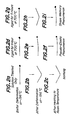
- Figs. 2a to 2i are examples showing investigated results of the shape memory effect and the pseudo-elasticity with respect to the three specimens mentioned above.
- the non-aged solution treated specimen does not show any changes in its bent shape (Fig. 2c) even if it is heated to the room temperature after the deformation at the liquid nitrogen temperature (Fig. 2b). This means that the martensitic transformation does not occur during the deformation at said liquid nitrogen temperature, and the deformation is performed only by the slip in the matrix.
- the martensite is grown by the cooling and is reversely transformed by the heating.
- the pseudo-elasticity of the alloy according to the invention appears at a low temperature below the room temperature because of its M S temperature and A f temperature. Moreover, the shape memory effect appears by the deformation at a temperature below the room temperature and the heating to the room temperature or till about 400°C after deformation. Further, some specimens show extremely high damping capacity at a temperature below M temperature at which the thermo- elastic martensite is generated. For example, in the specimen of Fe-33% Ni-4% Ti-10% Co alloy aged at 700°C for five hours, if the specimen is dropped to the metal plate at the liquid nitrogen temperature, a metallic sound is not heard at all and thus the specimen has good damping and good sound-proof properties.
- the shape memory alloy according to the invention shows the so-called reversible shape memory effect such that the specimen is naturally bent again if the specimen recovered into the original shape by the heating to a temperature above Af temperature is cooled again to a low temperature.
- the shape of the specimen is recovered not completely but partly.
- an additon of Ni functions to decrease M temperature
- an addition of Ti shows various effects for the strengthening of matrix, the partial ordering of the matrix and the appearance of tetragonality of martensite by uniformly and finely precipitated y'-Ni 3 Ti particles (ordered fcc:Cu 3 Au type) by means of the ausaging operation.
- an addition of Co functions to decrease the shear modulus of the austenite matrix and to increase the Curie point of the matrix so that the volume change during transformation is made small.
- Fe-Ni-Ti-Co alloy according to the invention is a newly developed alloy and has various advantages, as compared with the known shape memory alloy, such as high strength due to the ferrous alloy, good workability and comparatively inexpensive price.
- the alloy according to the invention it is possible to utilize in various fields as various kinds of fastening parts, connecting parts and devices for controlling a temperature. Further, the alloy according to the invention can be utilized as the damping material (especially at low temperature).
Landscapes
- Chemical & Material Sciences (AREA)
- Engineering & Computer Science (AREA)
- Materials Engineering (AREA)
- Mechanical Engineering (AREA)
- Metallurgy (AREA)
- Organic Chemistry (AREA)
- Physics & Mathematics (AREA)
- Thermal Sciences (AREA)
- Crystallography & Structural Chemistry (AREA)
- Heat Treatment Of Sheet Steel (AREA)
- Heat Treatment Of Steel (AREA)
Applications Claiming Priority (2)
| Application Number | Priority Date | Filing Date | Title |
|---|---|---|---|
| JP90874/84 | 1984-05-09 | ||
| JP59090874A JPS60234950A (ja) | 1984-05-09 | 1984-05-09 | 形状記憶効果および擬弾性効果を示すFe−Ni−Ti−Co合金とその製造法 |
Publications (2)
| Publication Number | Publication Date |
|---|---|
| EP0167221A1 true EP0167221A1 (fr) | 1986-01-08 |
| EP0167221B1 EP0167221B1 (fr) | 1988-07-06 |
Family
ID=14010639
Family Applications (1)
| Application Number | Title | Priority Date | Filing Date |
|---|---|---|---|
| EP85301737A Expired EP0167221B1 (fr) | 1984-05-09 | 1985-03-13 | Alliage fer-nickel-titane-cobalt à effet de mémoire et pseudo-élasticité et procédé pour sa fabrication |
Country Status (3)
| Country | Link |
|---|---|
| US (1) | US4586969A (fr) |
| EP (1) | EP0167221B1 (fr) |
| JP (1) | JPS60234950A (fr) |
Cited By (3)
| Publication number | Priority date | Publication date | Assignee | Title |
|---|---|---|---|---|
| EP0519311A1 (fr) * | 1991-06-19 | 1992-12-23 | Krupp Industrietechnik Gmbh | Alliage fer-nickel-cobalt-titane à mémoire de forme, et procédé pour sa fabrication |
| FR2758338A1 (fr) * | 1997-01-16 | 1998-07-17 | Memometal Ind | Procede de fabrication d'une piece superelastique en alliage de nickel et de titane |
| US6106642A (en) * | 1998-02-19 | 2000-08-22 | Boston Scientific Limited | Process for the improved ductility of nitinol |
Families Citing this family (8)
| Publication number | Priority date | Publication date | Assignee | Title |
|---|---|---|---|---|
| US5098305A (en) * | 1987-05-21 | 1992-03-24 | Cray Research, Inc. | Memory metal electrical connector |
| KR910700553A (ko) * | 1989-01-13 | 1991-03-15 | 허버트 지. 버카드 | 전기적으로 상호접속된 물품들의 어셈블리 |
| US4909510A (en) * | 1989-02-03 | 1990-03-20 | Sahatjian Ronald A | Sports racquet netting |
| US5111829A (en) * | 1989-06-28 | 1992-05-12 | Boston Scientific Corporation | Steerable highly elongated guidewire |
| US5238004A (en) * | 1990-04-10 | 1993-08-24 | Boston Scientific Corporation | High elongation linear elastic guidewire |
| DE4217031C2 (de) * | 1992-05-22 | 1994-04-28 | Dresden Ev Inst Festkoerper | Verfahren zur Einstellung des pseudoelastischen Effektes in Fe-Ni-Co-Ti-Legierungen |
| CA2289169A1 (fr) * | 1998-11-11 | 2000-05-11 | Ogawa Spring Co., Ltd. | Tuteur, methode pour sa fabrication et methode pour sa pose a demeure |
| JP7372226B2 (ja) * | 2020-10-28 | 2023-10-31 | Jfeスチール株式会社 | 制振合金およびその製造方法 |
Citations (2)
| Publication number | Priority date | Publication date | Assignee | Title |
|---|---|---|---|---|
| GB1401259A (en) * | 1973-05-04 | 1975-07-16 | Int Nickel Ltd | Low expansion alloys |
| US3954509A (en) * | 1974-05-02 | 1976-05-04 | The International Nickel Company, Inc. | Method of producing low expansion alloys |
Family Cites Families (3)
| Publication number | Priority date | Publication date | Assignee | Title |
|---|---|---|---|---|
| US4204887A (en) * | 1975-04-04 | 1980-05-27 | The Foundation: The Research Institute Of Electric And Magnetic Alloys | High damping capacity alloy |
| JPS5763655A (en) * | 1981-05-29 | 1982-04-17 | Univ Osaka | Beta-plus type electron compound alloy and solid solution iron alloy having property of repeatedly memorizing form, their manufacture and using method for them |
| JPS58157935A (ja) * | 1982-03-13 | 1983-09-20 | Hitachi Metals Ltd | 形状記憶合金 |
-
1984
- 1984-05-09 JP JP59090874A patent/JPS60234950A/ja active Granted
-
1985
- 1985-03-13 EP EP85301737A patent/EP0167221B1/fr not_active Expired
- 1985-03-14 US US06/711,810 patent/US4586969A/en not_active Expired - Lifetime
Patent Citations (2)
| Publication number | Priority date | Publication date | Assignee | Title |
|---|---|---|---|---|
| GB1401259A (en) * | 1973-05-04 | 1975-07-16 | Int Nickel Ltd | Low expansion alloys |
| US3954509A (en) * | 1974-05-02 | 1976-05-04 | The International Nickel Company, Inc. | Method of producing low expansion alloys |
Cited By (6)
| Publication number | Priority date | Publication date | Assignee | Title |
|---|---|---|---|---|
| EP0519311A1 (fr) * | 1991-06-19 | 1992-12-23 | Krupp Industrietechnik Gmbh | Alliage fer-nickel-cobalt-titane à mémoire de forme, et procédé pour sa fabrication |
| FR2758338A1 (fr) * | 1997-01-16 | 1998-07-17 | Memometal Ind | Procede de fabrication d'une piece superelastique en alliage de nickel et de titane |
| EP0864664A1 (fr) * | 1997-01-16 | 1998-09-16 | Memometal Industries | Procédé de fabrication d'une pièce superélastique en alliage de nickel et de titane |
| US5958159A (en) * | 1997-01-16 | 1999-09-28 | Memometal Industries | Process for the production of a superelastic material out of a nickel and titanium alloy |
| US6106642A (en) * | 1998-02-19 | 2000-08-22 | Boston Scientific Limited | Process for the improved ductility of nitinol |
| US6540849B2 (en) | 1998-02-19 | 2003-04-01 | Scimed Life Systems, Inc. | Process for the improved ductility of nitinol |
Also Published As
| Publication number | Publication date |
|---|---|
| JPS6210291B2 (fr) | 1987-03-05 |
| JPS60234950A (ja) | 1985-11-21 |
| EP0167221B1 (fr) | 1988-07-06 |
| US4586969A (en) | 1986-05-06 |
Similar Documents
| Publication | Publication Date | Title |
|---|---|---|
| US4631094A (en) | Method of processing a nickel/titanium-based shape memory alloy and article produced therefrom | |
| Otsuka et al. | Recent developments in the research of shape memory alloys | |
| Buehler et al. | A summary of recent research on the nitinol alloys and their potential application in ocean engineering | |
| US6406566B1 (en) | Copper-based alloy having shape memory properties and superelasticity, members made thereof and method for producing same | |
| CN102400014B (zh) | Co-Ni基合金、Co-Ni基合金的结晶控制方法、Co-Ni基合金的制造方法以及结晶控制Co-Ni基合金 | |
| JP3321169B2 (ja) | 準結晶析出物を有する析出硬化鉄合金 | |
| EP0167221B1 (fr) | Alliage fer-nickel-titane-cobalt à effet de mémoire et pseudo-élasticité et procédé pour sa fabrication | |
| JPWO2007055155A1 (ja) | 形状記憶性及び超弾性を有する鉄系合金及びその製造方法 | |
| JPH02501579A (ja) | 特定の物理的及び機械的性質を有する形状記憶合金の製造方法 | |
| Maki et al. | Shape memory effect related to thin plate martensite with large thermal hysteresis in ausaged Fe–Ni–Co–Ti alloy | |
| Parvizi et al. | NiTi shape memory alloys: properties | |
| Peltier et al. | Martensite transformation and superelasticity at high temperature of (TiHfZr) 74 (NbTa) 26 high-entropy shape memory alloy | |
| JP2021500469A (ja) | 変態誘起塑性高エントロピー合金及びその製造方法 | |
| Sun et al. | High yield stress and narrow phase transformation hysteresis of thermomechanical-processing NiTiCu shape memory alloy | |
| JP2578529B2 (ja) | 非晶質合金成形材の製造方法 | |
| JP3907177B2 (ja) | Fe基形状記憶合金及びその製造方法 | |
| Baker et al. | Formation of L12-structured Ni3Si | |
| US6059905A (en) | Process for treating a copper-beryllium alloy | |
| US4204887A (en) | High damping capacity alloy | |
| JP2000169920A (ja) | 形状記憶特性及び超弾性を有する銅系合金及びその製造方法 | |
| JP2000017395A (ja) | Fe系形状記憶合金及びその製造方法 | |
| Kainuma et al. | Development of NiAI (B2)-Base Shape Memory Alloys | |
| JP4275334B2 (ja) | 銅系合金及びその製造方法 | |
| JPH05295498A (ja) | NiTi系超弾性材料の製造方法 | |
| WO1999049091A1 (fr) | ALLIAGE SUPERELASTIQUE A BASE DE Ti-V-Al |
Legal Events
| Date | Code | Title | Description |
|---|---|---|---|
| PUAI | Public reference made under article 153(3) epc to a published international application that has entered the european phase |
Free format text: ORIGINAL CODE: 0009012 |
|
| AK | Designated contracting states |
Designated state(s): BE FR GB |
|
| 17P | Request for examination filed |
Effective date: 19860530 |
|
| 17Q | First examination report despatched |
Effective date: 19870831 |
|
| GRAA | (expected) grant |
Free format text: ORIGINAL CODE: 0009210 |
|
| AK | Designated contracting states |
Kind code of ref document: B1 Designated state(s): BE FR GB |
|
| ET | Fr: translation filed | ||
| PLBI | Opposition filed |
Free format text: ORIGINAL CODE: 0009260 |
|
| 26 | Opposition filed |
Opponent name: FRIED. KRUPP GMBH, ESSEN Effective date: 19890331 |
|
| PLBN | Opposition rejected |
Free format text: ORIGINAL CODE: 0009273 |
|
| STAA | Information on the status of an ep patent application or granted ep patent |
Free format text: STATUS: OPPOSITION REJECTED |
|
| 27O | Opposition rejected |
Effective date: 19900723 |
|
| PGFP | Annual fee paid to national office [announced via postgrant information from national office to epo] |
Ref country code: GB Payment date: 19980304 Year of fee payment: 14 |
|
| PGFP | Annual fee paid to national office [announced via postgrant information from national office to epo] |
Ref country code: FR Payment date: 19980310 Year of fee payment: 14 |
|
| PGFP | Annual fee paid to national office [announced via postgrant information from national office to epo] |
Ref country code: BE Payment date: 19980518 Year of fee payment: 14 |
|
| PG25 | Lapsed in a contracting state [announced via postgrant information from national office to epo] |
Ref country code: GB Free format text: LAPSE BECAUSE OF NON-PAYMENT OF DUE FEES Effective date: 19990313 |
|
| PG25 | Lapsed in a contracting state [announced via postgrant information from national office to epo] |
Ref country code: BE Free format text: LAPSE BECAUSE OF NON-PAYMENT OF DUE FEES Effective date: 19990331 |
|
| BERE | Be: lapsed |
Owner name: KYOTO UNIVERSITY Effective date: 19990331 |
|
| GBPC | Gb: european patent ceased through non-payment of renewal fee |
Effective date: 19990313 |
|
| PG25 | Lapsed in a contracting state [announced via postgrant information from national office to epo] |
Ref country code: FR Free format text: LAPSE BECAUSE OF NON-PAYMENT OF DUE FEES Effective date: 19991130 |
|
| REG | Reference to a national code |
Ref country code: FR Ref legal event code: ST |