EP0167471A2 - Gehörprothese mit elektrotaktiler Sprachumsetzung - Google Patents
Gehörprothese mit elektrotaktiler Sprachumsetzung Download PDFInfo
- Publication number
- EP0167471A2 EP0167471A2 EP85630058A EP85630058A EP0167471A2 EP 0167471 A2 EP0167471 A2 EP 0167471A2 EP 85630058 A EP85630058 A EP 85630058A EP 85630058 A EP85630058 A EP 85630058A EP 0167471 A2 EP0167471 A2 EP 0167471A2
- Authority
- EP
- European Patent Office
- Prior art keywords
- electrode
- electrodes
- finger
- user
- speech signal
- Prior art date
- Legal status (The legal status is an assumption and is not a legal conclusion. Google has not performed a legal analysis and makes no representation as to the accuracy of the status listed.)
- Granted
Links
Images




Classifications
-
- A—HUMAN NECESSITIES
- A61—MEDICAL OR VETERINARY SCIENCE; HYGIENE
- A61F—FILTERS IMPLANTABLE INTO BLOOD VESSELS; PROSTHESES; DEVICES PROVIDING PATENCY TO, OR PREVENTING COLLAPSING OF, TUBULAR STRUCTURES OF THE BODY, e.g. STENTS; ORTHOPAEDIC, NURSING OR CONTRACEPTIVE DEVICES; FOMENTATION; TREATMENT OR PROTECTION OF EYES OR EARS; BANDAGES, DRESSINGS OR ABSORBENT PADS; FIRST-AID KITS
- A61F11/00—Methods or devices for treatment of the ears or hearing sense; Non-electric hearing aids; Methods or devices for enabling ear patients to achieve auditory perception through physiological senses other than hearing sense; Protective devices for the ears, carried on the body or in the hand
- A61F11/04—Methods or devices for enabling ear patients to achieve auditory perception through physiological senses other than hearing sense, e.g. through the touch sense
-
- G—PHYSICS
- G09—EDUCATION; CRYPTOGRAPHY; DISPLAY; ADVERTISING; SEALS
- G09B—EDUCATIONAL OR DEMONSTRATION APPLIANCES; APPLIANCES FOR TEACHING, OR COMMUNICATING WITH, THE BLIND, DEAF OR MUTE; MODELS; PLANETARIA; GLOBES; MAPS; DIAGRAMS
- G09B21/00—Teaching, or communicating with, the blind, deaf or mute
- G09B21/009—Teaching or communicating with deaf persons
Definitions
- This invention relates to electrotactile vocoders for persons having impaired hearing.
- Multi-channel devices have been able to convey information that is especially important in identifying vowels, consonants and words (Pickett, J.M. Pickett, B.H. 1963 - Journal of Speech and Hearing Research Number 6 Pages 207-222 entitled - Communication of Speech Sounds of a Tactual Vocoder; Saunders, F.A. 1973 - Proceedings in the Fourth Annual Meeting of the Bio-Medical Engineering Society, Los Angeles, California entitled - "Electrotactile Sensory Aids for the Handicapped”; Kirman, J.H.
- a stimulus unit presenting speech by electrotactile stimulation employing the electrical principles used by Saunders was constructed.
- two electrode arrays with matrices of 8 x 8 electrodes have been developed.
- the system can allow different speech processing strategies to be evaluated on deaf patients.
- Psychophysical tests have confirmed the small dynamic range between threshold and pain and have shown that some subjects experience an unpleasant prickly sensation within the operating range.
- the invention provides a stimulus unit for an electrotactile vocoder comprising a multiplicity of electrodes for transmitting current pulses to the skin of the user such that the pulses are detectable by the digital nerves.
- the electrodes are adapted to be held in contact with the fingers of the hand of the user, preferably adjacent the knuckles at either side of each finger.
- a common electrode is preferably attached to the wrist of the user or in some other suitable position.
- the current pulses are preferably low level biphasic current pulses applied in accordance with a predetermined speech coding strategy based on a speech signal received by a speech processing unit.
- the tactile vocoder embodying the invention will be seen to comprise a directional microphone 1 worn on the ear and which discriminates in favour of sounds coming from the direction the wearer is facing, a speech processor 2 for processing the speech signal from the microphone and converting it into bursts of pulses describing where the stimulation is to be applied and for how long, and stimulus electrodes including a common electrode 3 in contact with the inside of the wrist and eight finger electrodes El to E8 each of which is connected by electrode leads 4 to a connector 5, mounted on a nylon watch band W for maintaining the common electrode 3 in place, and then to the speech processor 2.
- a directional microphone 1 worn on the ear and which discriminates in favour of sounds coming from the direction the wearer is facing
- a speech processor 2 for processing the speech signal from the microphone and converting it into bursts of pulses describing where the stimulation is to be applied and for how long
- stimulus electrodes including a common electrode 3 in contact with the inside of the wrist and eight finger electrodes El to E8 each of which is connected by electrode leads 4
- the electrodes El to E8 are constructed from a fine grade stainless steel wire mesh and are each approximately 0.5 cm2 insLze and are positioned one on each side of each finger between the palm and the first knuckle.
- the electrodes El to E8 are held in position by flexible plastic rings R which allow free independent movement of the fingers while maintaining electrical contact between the electrodes El to E8 and the fingers. It has been found that this arrangement provides adequate electrical contact between the fingers and the electrodes without the application of electrode jelly.
- the common electrode 3 is similarly formed from a stainless steel wire mesh and is approximately 10 cm 2 in size (e.g. 5 cm x 2 cm) and is held in contact with the inside of the wrist to avoid the usually hairy region on the outside of the wrist.
- the speech processor 2 is a multi-channel speech processor of the type described in United States Patent 4 441 202 Tong et al. and in Crosby, P.A., Clark, G.M..Dowell, R.C., Kuzma. J.A., Money, D.K., Patrick , J.F., Saligman, P.M. and Tong. Y.C. - Journal of Acoustic Society of America Number 74 Pages 1911-1913 entitled "The Preliminary Communication of a Channel Cochlear inplant hearing prosthesis", and Tong, Y.C., Blarney, P.J.. Dowell, R.C. & Clark, G.M.
- the stimulator circuitry 2A produces constant- current (approximately 1.5 mA) bi-phasic stimulus pulses between the selected electrode El to E8 and an output connected to the common electrode 3.
- the two current pulse phases are separated by a fixed interval of 100 uS during which no current flows. It has been found that if this interval is omitted, a greater pulse width for each phase is required to reach the same sensation level.
- the circuitry determines from the output of the speech processor 2 the electrode number and width of stimulus pulse between luS and 20uS. In the present embodiment, the width of each pulse is a compressed function of the estimated amplitude of the second formant component of the speech signal, as extracted by the speech processor 2.
- the pulse width on the estimated amplitude of the whole speech signal.
- the compression of the amplitude range is achieved by the automatic gain control incorporated in the speech processor 2 and by the use of a linear function that relates the logarithm of the pulse width to the logarithm of the amplitude such that the full range of the amplitude stimulated by the speech processor corresponds to the full range between threshold and comfortable level for each electrode.
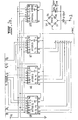
- the stimulator circuitry will be seen to comprise an input transformer Tl which couples the output signal From the speech processor 2 and provides electrical isolation from the speech processor and microphone, which may be in contact with the body and would otherwise form unwanted paths for the stimulus current.
- the information from the speech processor 2 is encoded in groups of bursts of 2.5 MHz pulses at high amplitude and resistors Rl, R2 and diodes Dl and D2 and the phasing of input transformer Tl are chosen to limit the amplitude applied to inverter Ula and ensure that the first pulses are not distorted. Invertor Ula inverts the signal and restores it to a rectangular shape.
- the signal is at this point the "data" signal shown in Fig. 4 of the drawings. This data signal is applied to a counter B and to two monostable pulse detectors Ml and M2.
- the monostable pulse detectors Ml and M2 comprise diode D3 and capacitor Cl and diode D4 and capacitor C2 respectively.
- the diodes D3 and D4 charge the capacitors Cl and C2.
- the capacitors Cl and C2 then discharge via resistors R3 and R4.
- the time constant of R3 and Cl is chosen so that Cl will not discharge sufficiently during the gaps between the bursts of pulses for inverter Ulb to change state.
- the time constant of R4 and C2 is chosen so that C2 will be discharged within this period but not during the gaps between the pulses. In this manner, the output of inverter Ulb is low during an entire group of bursts of pulses (i.e.
- inverter Ulc is low during each burst of pulses and goes high sometime between pulses.
- counter A is clocked and its binary outputs are then decoded by decoder U3 to generate three control signals 01, ⁇ 2 and enable for counter B.
- ⁇ 1 and 02 are used to generate the two phases of the output pulse.
- the component values shown in Fig. 2 provide time constants of about 8us and 60us respectively. However, other values will be effective depending on the programming of the speech processor described below provided the longer time constant is about three or four times the shorter time constant and the longer time constant does not exceed about 100 us.
- Cl is initially discharged and the output of inverter Ulb is high, holding the counters A and B in the reset state.
- Cl and C2 are both charged, counters A and B are no longer reset and counter B is inhibited from counting as counter A, and therefore the decoder U3, are still in state zero.
- the speech processor 2 controls the pulse width of the phases by changing the number of pulses in the fourth and sixth bursts and the gap between them by the number of pulses in the fifth burst. Finally, when the end of the group is reached and no more bursts arrive, Cl will discharge and the counters will again be reset.
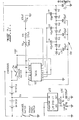
- the electrode select signals from decoder U4 and the phase select signals from decoder U3 are connected to high voltage switching circuits U5 to U8 which are implemented as hybrids of the type shown in Fig. 3 of the drawings.
- the AND gates on the hybrids keep the output transistors off and all of the electrodes El to E8 and 3 are open circuit.
- the phase signal ⁇ 1 goes low, and one of the electrode select lines to one of the hybrids U5, U6 or U7 is also low, then the corresponding output from that hybrid will be connected to common or earth.
- the phase inputs to the common hybrid U8 are reversed, its output will be connected to +100V.
- the finger electrode is connected to 0 V and the common electrode 3 is connected to +100 V via diodes D5, D9, D10 and D8 and capacitor C3.
- Diodes D9 and D10 are current regulator diodes and capacitor C3 provides fault isolation.
- the finger electrodes are connected to +100V and the common electrode 3 is connected to 0 V via the same circuitry. This provides a total peak-to-peak swing of 200 V to cope with high skin resistences.
- the stimulator circuitry is powered by recharg- able batteries from which a +5 V supply, regulated by an integrated circuit voltage regulator U10, is derived.
- the +100V stimulator supply is derived from a parallel- fed Cockcroft-Walton voltage multiplier Vm.
- the voltage multiplier Vm is driven from a square wave oscillator U9 which generates two outputs 180 0 apart in phase. The frequency of operation and the component values are selected so that the high voltage will collapse if a sustained load is applied to the output , such as by a fault, which may otherwise endanger the person using the device.
- the "map" in the programmable read only memory of the speech processor 2 must be modified to change the stimulation levels to suit finger stimulation and to suit each user.
- Psychophysical investigations of stimulus patterns show wide variations of threshold and dynamic range from one subject to another and from one finger to another in each subject. Thresholds and dynamic ranges vary from day to day but within limits that are workable for the representation of speech patterns. Good discrimination of pulse width changes and pulse rate changes have been achieved with little or no training. Perfect recognition of the stimulated electrode is also immediately possible.
- the setting up procedures for the speech processor 2 are carried out using a microcomputer interfaced to the speech processor in a suitable manner.
- the threshold and comfortable levels of stimulation for each electrode are measured interactively with the tester raising and lowering the pulse width for a short train of pulses applied to each electrode until consistent thresholds and comfortable levels are attained. It is important that comfortable levels are matched across electrodes so that changes in electrode are not confused with changes in loudness or intensity of the incoming speech signal.
- a procedure in which a stimulus on one electrode is matched with a stimulus on another electrode is used to check the matching.
- each electrode to be stimulated is selected on the basis of the frequency of the most prominent peak in the speech spectrum between 800 and 4 000 Hz, that is, the second formant frequency for vowel sounds.
- the pulse rate is selected to be a linear function of the fundamental frequency of the speaker's voice and the pulse width is a compressed function of the speech amplitude envelope tailored to fit the threshold and dynamic range of the electrode being stimulated.
- the second formant frequency spectrum is divided amongst the eight finger electrodes, for example, on the following basis: El: 0-900 Hz, E2: 900-1100 Hz, E3: 1100-1300 Hz, E4: 1300-1500 Hz, E5: 1500-1700Hz, E6: 1700-2400 Hz, E7: 2400-3300 Hz and E8: 3300-4000 Hz.
- the above frequency values and the selected threshold and comfortable levels are programmed into a temporary map which can be accessed by the speech processor to confirm that the map is suitable for use with continuous speech. Following confirmation.
- the final version of the map is programmed into the programmable read only memory in the speech processor 2 and the vocoder is then ready for use. If it is found that any one of the electrode sites is unsufficiently sensitive, stimulation to that electrode may be excluded and the second formant frequency range divided amongst the remaining electrodes.
- the sensations produced by the device embodying the invention are similar to those that would be experienced if a vibrating object was placed against the side of the finger. As the electrical pulse width is increased, the sensation becomes stronger and spreads towards the tip of the finger. No sensation is felt at the common electrode 3 for the usual stimulus regime. When high pulse rates and large pulse widths are used, a stinging sensation may be felt at the common electrode. This sensation occurs at lower pulse rates and shorter pulse widths when an inadequate surface area of electrode is in contact with the skin. However, it is possible to avoid this problem by adjusting the electrode placement.
Landscapes
- Health & Medical Sciences (AREA)
- Engineering & Computer Science (AREA)
- Life Sciences & Earth Sciences (AREA)
- Biomedical Technology (AREA)
- General Health & Medical Sciences (AREA)
- Physics & Mathematics (AREA)
- Acoustics & Sound (AREA)
- Educational Administration (AREA)
- Biophysics (AREA)
- Otolaryngology (AREA)
- Psychology (AREA)
- Heart & Thoracic Surgery (AREA)
- Vascular Medicine (AREA)
- Animal Behavior & Ethology (AREA)
- Neurology (AREA)
- Public Health (AREA)
- Veterinary Medicine (AREA)
- Audiology, Speech & Language Pathology (AREA)
- Business, Economics & Management (AREA)
- Physiology (AREA)
- Educational Technology (AREA)
- General Physics & Mathematics (AREA)
- Theoretical Computer Science (AREA)
- Electrotherapy Devices (AREA)
- Liquid Crystal Substances (AREA)
- Organic Low-Molecular-Weight Compounds And Preparation Thereof (AREA)
- Magnetic Record Carriers (AREA)
- Prostheses (AREA)
- User Interface Of Digital Computer (AREA)
- Switch Cases, Indication, And Locking (AREA)
- Push-Button Switches (AREA)
Priority Applications (1)
| Application Number | Priority Date | Filing Date | Title |
|---|---|---|---|
| AT85630058T ATE71827T1 (de) | 1984-05-30 | 1985-04-18 | Gehoerprothese mit elektrotaktiler sprachumsetzung. |
Applications Claiming Priority (2)
| Application Number | Priority Date | Filing Date | Title |
|---|---|---|---|
| AUPG528184 | 1984-05-30 | ||
| AU5281/84 | 1984-05-30 |
Publications (3)
| Publication Number | Publication Date |
|---|---|
| EP0167471A2 true EP0167471A2 (de) | 1986-01-08 |
| EP0167471A3 EP0167471A3 (en) | 1988-06-15 |
| EP0167471B1 EP0167471B1 (de) | 1992-01-22 |
Family
ID=3770625
Family Applications (1)
| Application Number | Title | Priority Date | Filing Date |
|---|---|---|---|
| EP85630058A Expired EP0167471B1 (de) | 1984-05-30 | 1985-04-18 | Gehörprothese mit elektrotaktiler Sprachumsetzung |
Country Status (7)
| Country | Link |
|---|---|
| US (1) | US4982432A (de) |
| EP (1) | EP0167471B1 (de) |
| JP (1) | JPS6116742A (de) |
| AT (1) | ATE71827T1 (de) |
| AU (1) | AU579365B2 (de) |
| CA (1) | CA1222825A (de) |
| DE (1) | DE3585244D1 (de) |
Cited By (6)
| Publication number | Priority date | Publication date | Assignee | Title |
|---|---|---|---|---|
| DE3834442C1 (en) * | 1988-10-10 | 1989-11-09 | Hortmann Gmbh, 7449 Neckartenzlingen, De | Device for multi-channel transmission of information via the sense of touch |
| EP0766218A4 (de) * | 1995-04-17 | 1997-04-02 | Gavriil Mikhailovich Fingerov | Verfahren zur informaionsübermittlung zum menschlichen nervensystem |
| WO1999029276A1 (en) * | 1997-12-09 | 1999-06-17 | The University Of Leeds | Spatial awareness device |
| WO2001038958A1 (en) * | 1999-11-24 | 2001-05-31 | Center For Advanced Science And Technology Incubation, Ltd. | Method and device for stimulating tactile sensation by electricity |
| CN1318191C (zh) * | 2003-12-01 | 2007-05-30 | 东南大学 | 时空双通道机器人触觉再现电流刺激方法及装置 |
| EP4276825A1 (de) * | 2022-05-12 | 2023-11-15 | BIC Violex Single Member S.A. | Schreibinstrument |
Families Citing this family (32)
| Publication number | Priority date | Publication date | Assignee | Title |
|---|---|---|---|---|
| JPH0745332B2 (ja) * | 1989-04-27 | 1995-05-17 | アサヒビール株式会社 | ガラス容器の擦り傷遮蔽剤、擦り傷が遮蔽されたガラス容器およびガラス容器の擦り傷遮蔽方法 |
| JPH0795279A (ja) * | 1993-09-20 | 1995-04-07 | Fujitsu Ltd | メモリダイヤル制御方式 |
| AUPO709197A0 (en) * | 1997-05-30 | 1997-06-26 | University Of Melbourne, The | Improvements in electrotactile vocoders |
| AU135417S (en) * | 1997-05-30 | 1998-10-20 | Univ Melbourne | A handset for an electrotactile vocoder |
| US6230135B1 (en) | 1999-02-02 | 2001-05-08 | Shannon A. Ramsay | Tactile communication apparatus and method |
| FR2798475B1 (fr) * | 1999-09-14 | 2001-10-19 | Christophe Cayrol | Dispositif permettant d'avertir une personne se deplacant sur un chemin donne, de la presence, sur ce chemin, d'objets presentant eventuellement un danger pour elle |
| US6930590B2 (en) * | 2002-06-10 | 2005-08-16 | Ownway Biotronics, Inc. | Modular electrotactile system and method |
| US7251605B2 (en) * | 2002-08-19 | 2007-07-31 | The United States Of America As Represented By The Secretary Of The Navy | Speech to touch translator assembly and method |
| US7089061B2 (en) * | 2002-08-27 | 2006-08-08 | Abbott Laboratories | Device and method for nausea suppression |
| ITPI20040084A1 (it) * | 2004-11-18 | 2005-02-18 | Massimo Bergamasco | Interfaccia aptica portabile |
| US20070129771A1 (en) * | 2005-04-20 | 2007-06-07 | Kurtz Ronald L | Device, method and stimulus unit for testing neuromuscular function |
| US20070016425A1 (en) * | 2005-07-12 | 2007-01-18 | Koren Ward | Device for providing perception of the physical environment |
| US8093997B2 (en) * | 2009-03-23 | 2012-01-10 | Isaac Olney White | System and apparatus for silent pulsating communications |
| WO2011147015A1 (en) * | 2010-05-26 | 2011-12-01 | Maria Karam | System and method for displaying sound as vibrations |
| US8696357B2 (en) * | 2012-08-01 | 2014-04-15 | Thieab AlDossary | Tactile communication apparatus, method, and computer program product |
| AU2014207265B2 (en) | 2013-01-21 | 2017-04-20 | Cala Health, Inc. | Devices and methods for controlling tremor |
| US12453853B2 (en) | 2013-01-21 | 2025-10-28 | Cala Health, Inc. | Multi-modal stimulation for treating tremor |
| AU2015271774B2 (en) | 2014-06-02 | 2020-04-16 | Cala Health, Inc. | Systems and methods for peripheral nerve stimulation to treat tremor |
| EP4342516A3 (de) | 2015-06-10 | 2024-07-10 | Cala Health, Inc. | Systeme und verfahren zur peripheren nervenstimulation zur behandlung von tremor mit abnehmbaren therapie- und überwachungseinheiten |
| EP3328277A4 (de) | 2015-07-31 | 2019-03-06 | Cala Health, Inc. | Systeme, vorrichtungen und verfahren zur behandlung von osteoarthritis |
| US10603482B2 (en) * | 2015-09-23 | 2020-03-31 | Cala Health, Inc. | Systems and methods for peripheral nerve stimulation in the finger or hand to treat hand tremors |
| AU2017211048B2 (en) | 2016-01-21 | 2022-03-10 | Cala Health, Inc. | Systems, methods and devices for peripheral neuromodulation for treating diseases related to overactive bladder |
| JP7133543B2 (ja) | 2016-08-25 | 2022-09-08 | カラ ヘルス,インコーポレイテッド | 末梢神経刺激による心機能不全の治療のためのシステムおよび方法 |
| US11331480B2 (en) | 2017-04-03 | 2022-05-17 | Cala Health, Inc. | Systems, methods and devices for peripheral neuromodulation for treating diseases related to overactive bladder |
| JP2019067166A (ja) * | 2017-10-02 | 2019-04-25 | 富士ゼロックス株式会社 | 電子機器 |
| WO2019143790A1 (en) | 2018-01-17 | 2019-07-25 | Cala Health, Inc. | Systems and methods for treating inflammatory bowel disease through peripheral nerve stimulation |
| CN112272814B (zh) * | 2018-06-19 | 2024-09-20 | 索尼公司 | 信息处理设备、信息处理方法及程序 |
| US12251560B1 (en) | 2019-08-13 | 2025-03-18 | Cala Health, Inc. | Connection quality determination for wearable neurostimulation systems |
| US11890468B1 (en) | 2019-10-03 | 2024-02-06 | Cala Health, Inc. | Neurostimulation systems with event pattern detection and classification |
| US11606636B2 (en) * | 2021-06-03 | 2023-03-14 | Feng-Chou Lin | Somatosensory vibration generating device and method for forming somatosensory vibration |
| EP4115939A1 (de) * | 2021-07-05 | 2023-01-11 | Fundación Tecnalia Research & Innovation | Multi-pad-elektrode und system zur elektrotaktilen stimulation |
| JP2024037086A (ja) * | 2022-09-06 | 2024-03-18 | 国立研究開発法人科学技術振興機構 | 力覚提示装置、力覚提示システム、及び力覚提示方法 |
Family Cites Families (10)
| Publication number | Priority date | Publication date | Assignee | Title |
|---|---|---|---|---|
| US2150364A (en) * | 1937-07-31 | 1939-03-14 | Bell Telephone Labor Inc | Signaling system |
| US3612061A (en) * | 1969-02-20 | 1971-10-12 | Inst Of Medical Sciences The | Flexible cutaneous electrode matrix |
| US3831296A (en) * | 1972-08-02 | 1974-08-27 | E Hagle | Alphanumeric tactile information communication system |
| AU535489B2 (en) * | 1979-05-28 | 1984-03-22 | University Of Melbourne, The | Speech processor |
| WO1980002767A1 (en) * | 1979-05-28 | 1980-12-11 | Univ Melbourne | Speech processor |
| JPS563053A (en) * | 1979-06-23 | 1981-01-13 | Kanagawa Prefecture | Device for aiding hearing sense |
| DE3003315C2 (de) * | 1980-01-30 | 1982-09-16 | Siemens AG, 1000 Berlin und 8000 München | Verfahren zur Erzeugung von elektrokutanen Reizmustern als Träger akustischer Information und Gerät zur Durchführung dieses Verfahren |
| DE3008677C2 (de) * | 1980-03-06 | 1983-08-25 | Siemens AG, 1000 Berlin und 8000 München | Hörprothese zur elektrischen Stimulation des Hörnervs |
| IL70153A0 (en) * | 1983-11-07 | 1984-02-29 | Navot Technology Ltd | Audiotactile communication system |
| US4581491A (en) * | 1984-05-04 | 1986-04-08 | Research Corporation | Wearable tactile sensory aid providing information on voice pitch and intonation patterns |
-
1985
- 1985-04-18 DE DE8585630058T patent/DE3585244D1/de not_active Expired - Lifetime
- 1985-04-18 AT AT85630058T patent/ATE71827T1/de not_active IP Right Cessation
- 1985-04-18 EP EP85630058A patent/EP0167471B1/de not_active Expired
- 1985-04-22 AU AU41500/85A patent/AU579365B2/en not_active Ceased
- 1985-05-03 CA CA000480728A patent/CA1222825A/en not_active Expired
- 1985-05-29 JP JP60114406A patent/JPS6116742A/ja active Granted
-
1989
- 1989-11-29 US US07/443,857 patent/US4982432A/en not_active Expired - Fee Related
Cited By (7)
| Publication number | Priority date | Publication date | Assignee | Title |
|---|---|---|---|---|
| DE3834442C1 (en) * | 1988-10-10 | 1989-11-09 | Hortmann Gmbh, 7449 Neckartenzlingen, De | Device for multi-channel transmission of information via the sense of touch |
| EP0766218A4 (de) * | 1995-04-17 | 1997-04-02 | Gavriil Mikhailovich Fingerov | Verfahren zur informaionsübermittlung zum menschlichen nervensystem |
| WO1999029276A1 (en) * | 1997-12-09 | 1999-06-17 | The University Of Leeds | Spatial awareness device |
| US6710706B1 (en) | 1997-12-09 | 2004-03-23 | Sound Foresight Limited | Spatial awareness device |
| WO2001038958A1 (en) * | 1999-11-24 | 2001-05-31 | Center For Advanced Science And Technology Incubation, Ltd. | Method and device for stimulating tactile sensation by electricity |
| CN1318191C (zh) * | 2003-12-01 | 2007-05-30 | 东南大学 | 时空双通道机器人触觉再现电流刺激方法及装置 |
| EP4276825A1 (de) * | 2022-05-12 | 2023-11-15 | BIC Violex Single Member S.A. | Schreibinstrument |
Also Published As
| Publication number | Publication date |
|---|---|
| ATE71827T1 (de) | 1992-02-15 |
| JPH0322785B2 (de) | 1991-03-27 |
| EP0167471A3 (en) | 1988-06-15 |
| CA1222825A (en) | 1987-06-09 |
| AU579365B2 (en) | 1988-11-24 |
| AU4150085A (en) | 1985-12-05 |
| JPS6116742A (ja) | 1986-01-24 |
| EP0167471B1 (de) | 1992-01-22 |
| US4982432A (en) | 1991-01-01 |
| DE3585244D1 (de) | 1992-03-05 |
Similar Documents
| Publication | Publication Date | Title |
|---|---|---|
| US4982432A (en) | Electrotactile vocoder | |
| EP0241101B1 (de) | Cochleares Implantationssystem mit psychologischem Testen oder Programmieren mittels kartographierter Reaktionen des Patienten, vorgesehen zur Codierung | |
| US4581491A (en) | Wearable tactile sensory aid providing information on voice pitch and intonation patterns | |
| US8428742B2 (en) | Simultaneous stimulation for low power consumption | |
| Saunders | Information transmission across the skin: High-resolution tactile sensory aids for the deaf and the blind | |
| Loeb | The functional replacement of the ear | |
| ES8801760A1 (es) | Un aparato de comunicaciones audioneurales para estimular los nervios sensoriales tactiles de una persona sorda. | |
| Blamey et al. | Psychophysical studies relevant to the design of a digital electrotactile speech processor | |
| US6466911B1 (en) | Electrotactile vocoder using handset with stimulating electrodes | |
| DE2905276A1 (de) | Tragbare verstaendigungsvorrichtung zur uebertragung von tonsignalen zu einer person | |
| McDermott et al. | A portable programmable digital sound processor for cochlear implant research | |
| Ifukube et al. | A speech processor with lateral inhibition for an eight channel cochlear implant and its evaluation | |
| Ifukube | Discrimination of synthetic vowels by using tactile vocoder and a comparison to that of an eight-channel cochlear implant | |
| Van Compernolle | Speech processing strategies for a multichannel cochlear prosthesis (deconvolution) | |
| Mecklenburg et al. | An overview of the Nucleus cochlear implant program | |
| Blamey et al. | Perception of amplitude envelope variations of pulsatile electrotactile stimuli | |
| Cowan et al. | Perception of multiple electrode stimulus patterns: Implications for design of an electrotactile speech processor | |
| Garstecki | Speechreading with auditory cues. | |
| Bothe et al. | Flipps: fingertip stimulation for improved speechreading | |
| Blamey | Psychophysical and speech studies with an electrotactile speech processor | |
| Ifukube | From sensory substitute technology to virtual reality research | |
| Hanekom et al. | The South Africa bionic ear-description and preliminary results | |
| Ifukube | Research Institute of Applied Electricity in Hokkaido University-A study on sensory substitutes and artificial sensory organs for the disabled | |
| Osberger | Effect of age of onset of deafness on speech production before and after cochlear implantation | |
| Cowan et al. | The tickle talker: a speech perception aid for profoundly hearing impaired children |
Legal Events
| Date | Code | Title | Description |
|---|---|---|---|
| PUAI | Public reference made under article 153(3) epc to a published international application that has entered the european phase |
Free format text: ORIGINAL CODE: 0009012 |
|
| AK | Designated contracting states |
Designated state(s): AT BE CH DE FR GB IT LI LU NL SE |
|
| PUAL | Search report despatched |
Free format text: ORIGINAL CODE: 0009013 |
|
| AK | Designated contracting states |
Kind code of ref document: A3 Designated state(s): AT BE CH DE FR GB IT LI LU NL SE |
|
| 17P | Request for examination filed |
Effective date: 19880928 |
|
| 17Q | First examination report despatched |
Effective date: 19900322 |
|
| GRAA | (expected) grant |
Free format text: ORIGINAL CODE: 0009210 |
|
| AK | Designated contracting states |
Kind code of ref document: B1 Designated state(s): AT BE CH DE FR GB IT LI LU NL SE |
|
| PG25 | Lapsed in a contracting state [announced via postgrant information from national office to epo] |
Ref country code: IT Free format text: LAPSE BECAUSE OF FAILURE TO SUBMIT A TRANSLATION OF THE DESCRIPTION OR TO PAY THE FEE WITHIN THE PRESCRIBED TIME-LIMIT;WARNING: LAPSES OF ITALIAN PATENTS WITH EFFECTIVE DATE BEFORE 2007 MAY HAVE OCCURRED AT ANY TIME BEFORE 2007. THE CORRECT EFFECTIVE DATE MAY BE DIFFERENT FROM THE ONE RECORDED. Effective date: 19920122 Ref country code: LI Effective date: 19920122 Ref country code: CH Effective date: 19920122 Ref country code: BE Effective date: 19920122 Ref country code: AT Effective date: 19920122 Ref country code: SE Effective date: 19920122 |
|
| REF | Corresponds to: |
Ref document number: 71827 Country of ref document: AT Date of ref document: 19920215 Kind code of ref document: T |
|
| REF | Corresponds to: |
Ref document number: 3585244 Country of ref document: DE Date of ref document: 19920305 |
|
| PG25 | Lapsed in a contracting state [announced via postgrant information from national office to epo] |
Ref country code: LU Free format text: LAPSE BECAUSE OF NON-PAYMENT OF DUE FEES Effective date: 19920430 |
|
| REG | Reference to a national code |
Ref country code: CH Ref legal event code: PL |
|
| EN | Fr: translation not filed | ||
| PG25 | Lapsed in a contracting state [announced via postgrant information from national office to epo] |
Ref country code: FR Effective date: 19920612 |
|
| PLBE | No opposition filed within time limit |
Free format text: ORIGINAL CODE: 0009261 |
|
| STAA | Information on the status of an ep patent application or granted ep patent |
Free format text: STATUS: NO OPPOSITION FILED WITHIN TIME LIMIT |
|
| 26N | No opposition filed | ||
| REG | Reference to a national code |
Ref country code: FR Ref legal event code: ST |
|
| PGFP | Annual fee paid to national office [announced via postgrant information from national office to epo] |
Ref country code: NL Payment date: 19980430 Year of fee payment: 14 |
|
| PG25 | Lapsed in a contracting state [announced via postgrant information from national office to epo] |
Ref country code: NL Free format text: LAPSE BECAUSE OF NON-PAYMENT OF DUE FEES Effective date: 19991101 |
|
| NLV4 | Nl: lapsed or anulled due to non-payment of the annual fee |
Effective date: 19991101 |
|
| PGFP | Annual fee paid to national office [announced via postgrant information from national office to epo] |
Ref country code: GB Payment date: 20000421 Year of fee payment: 16 |
|
| PGFP | Annual fee paid to national office [announced via postgrant information from national office to epo] |
Ref country code: DE Payment date: 20000425 Year of fee payment: 16 |
|
| PG25 | Lapsed in a contracting state [announced via postgrant information from national office to epo] |
Ref country code: GB Free format text: LAPSE BECAUSE OF NON-PAYMENT OF DUE FEES Effective date: 20010418 |
|
| GBPC | Gb: european patent ceased through non-payment of renewal fee |
Effective date: 20010418 |
|
| PG25 | Lapsed in a contracting state [announced via postgrant information from national office to epo] |
Ref country code: DE Free format text: LAPSE BECAUSE OF NON-PAYMENT OF DUE FEES Effective date: 20020201 |