EP0167638A1 - Procédé et dispositif de culture hydroponique de pousses de plantes - Google Patents
Procédé et dispositif de culture hydroponique de pousses de plantes Download PDFInfo
- Publication number
- EP0167638A1 EP0167638A1 EP84107508A EP84107508A EP0167638A1 EP 0167638 A1 EP0167638 A1 EP 0167638A1 EP 84107508 A EP84107508 A EP 84107508A EP 84107508 A EP84107508 A EP 84107508A EP 0167638 A1 EP0167638 A1 EP 0167638A1
- Authority
- EP
- European Patent Office
- Prior art keywords
- pad
- set forth
- floating bed
- bed
- water
- Prior art date
- Legal status (The legal status is an assumption and is not a legal conclusion. Google has not performed a legal analysis and makes no representation as to the accuracy of the status listed.)
- Withdrawn
Links
- 238000000034 method Methods 0.000 title claims description 14
- XLYOFNOQVPJJNP-UHFFFAOYSA-N water Substances O XLYOFNOQVPJJNP-UHFFFAOYSA-N 0.000 claims abstract description 45
- 238000007667 floating Methods 0.000 claims abstract description 42
- 239000000463 material Substances 0.000 claims abstract description 10
- 230000002209 hydrophobic effect Effects 0.000 claims abstract description 4
- 239000006261 foam material Substances 0.000 claims description 8
- 230000002745 absorbent Effects 0.000 claims description 5
- 239000002250 absorbent Substances 0.000 claims description 5
- 238000009331 sowing Methods 0.000 claims description 5
- 238000003780 insertion Methods 0.000 claims description 4
- 230000037431 insertion Effects 0.000 claims description 4
- 235000015097 nutrients Nutrition 0.000 claims description 4
- 229920005830 Polyurethane Foam Polymers 0.000 claims 1
- 239000011496 polyurethane foam Substances 0.000 claims 1
- 238000000638 solvent extraction Methods 0.000 claims 1
- 229920006248 expandable polystyrene Polymers 0.000 abstract description 2
- 241000196324 Embryophyta Species 0.000 description 27
- 230000012010 growth Effects 0.000 description 17
- 230000035784 germination Effects 0.000 description 12
- 238000003306 harvesting Methods 0.000 description 7
- 239000006260 foam Substances 0.000 description 6
- 239000002245 particle Substances 0.000 description 6
- 235000005733 Raphanus sativus var niger Nutrition 0.000 description 4
- 235000006140 Raphanus sativus var sativus Nutrition 0.000 description 4
- 240000001970 Raphanus sativus var. sativus Species 0.000 description 4
- 239000002699 waste material Substances 0.000 description 3
- 241001487769 Adenophora remotiflora Species 0.000 description 2
- 241001424688 Enceliopsis Species 0.000 description 2
- 238000010276 construction Methods 0.000 description 2
- 239000003337 fertilizer Substances 0.000 description 2
- 239000003501 hydroponics Substances 0.000 description 2
- 239000000203 mixture Substances 0.000 description 2
- 239000011368 organic material Substances 0.000 description 2
- -1 pebbles Substances 0.000 description 2
- 238000005507 spraying Methods 0.000 description 2
- 235000013311 vegetables Nutrition 0.000 description 2
- 240000007594 Oryza sativa Species 0.000 description 1
- 235000007164 Oryza sativa Nutrition 0.000 description 1
- 239000004698 Polyethylene Substances 0.000 description 1
- 230000002411 adverse Effects 0.000 description 1
- QVGXLLKOCUKJST-UHFFFAOYSA-N atomic oxygen Chemical compound [O] QVGXLLKOCUKJST-UHFFFAOYSA-N 0.000 description 1
- 244000052616 bacterial pathogen Species 0.000 description 1
- 239000011230 binding agent Substances 0.000 description 1
- 230000007423 decrease Effects 0.000 description 1
- 230000007547 defect Effects 0.000 description 1
- 238000001035 drying Methods 0.000 description 1
- 238000009776 industrial production Methods 0.000 description 1
- 238000000465 moulding Methods 0.000 description 1
- 229910052760 oxygen Inorganic materials 0.000 description 1
- 239000001301 oxygen Substances 0.000 description 1
- 239000003415 peat Substances 0.000 description 1
- 230000035699 permeability Effects 0.000 description 1
- 230000008635 plant growth Effects 0.000 description 1
- 229920000573 polyethylene Polymers 0.000 description 1
- 239000011148 porous material Substances 0.000 description 1
- 235000009566 rice Nutrition 0.000 description 1
- 239000004576 sand Substances 0.000 description 1
Images

Classifications
-
- A—HUMAN NECESSITIES
- A01—AGRICULTURE; FORESTRY; ANIMAL HUSBANDRY; HUNTING; TRAPPING; FISHING
- A01G—HORTICULTURE; CULTIVATION OF VEGETABLES, FLOWERS, RICE, FRUIT, VINES, HOPS OR SEAWEED; FORESTRY; WATERING
- A01G31/00—Soilless cultivation, e.g. hydroponics
- A01G31/02—Special apparatus therefor
-
- A—HUMAN NECESSITIES
- A01—AGRICULTURE; FORESTRY; ANIMAL HUSBANDRY; HUNTING; TRAPPING; FISHING
- A01C—PLANTING; SOWING; FERTILISING
- A01C1/00—Apparatus, or methods of use thereof, for testing or treating seed, roots, or the like, prior to sowing or planting
- A01C1/02—Germinating apparatus; Determining germination capacity of seeds or the like
-
- A—HUMAN NECESSITIES
- A01—AGRICULTURE; FORESTRY; ANIMAL HUSBANDRY; HUNTING; TRAPPING; FISHING
- A01G—HORTICULTURE; CULTIVATION OF VEGETABLES, FLOWERS, RICE, FRUIT, VINES, HOPS OR SEAWEED; FORESTRY; WATERING
- A01G24/00—Growth substrates; Culture media; Apparatus or methods therefor
- A01G24/30—Growth substrates; Culture media; Apparatus or methods therefor based on or containing synthetic organic compounds
-
- A—HUMAN NECESSITIES
- A01—AGRICULTURE; FORESTRY; ANIMAL HUSBANDRY; HUNTING; TRAPPING; FISHING
- A01G—HORTICULTURE; CULTIVATION OF VEGETABLES, FLOWERS, RICE, FRUIT, VINES, HOPS OR SEAWEED; FORESTRY; WATERING
- A01G24/00—Growth substrates; Culture media; Apparatus or methods therefor
- A01G24/40—Growth substrates; Culture media; Apparatus or methods therefor characterised by their structure
- A01G24/44—Growth substrates; Culture media; Apparatus or methods therefor characterised by their structure in block, mat or sheet form
-
- A—HUMAN NECESSITIES
- A01—AGRICULTURE; FORESTRY; ANIMAL HUSBANDRY; HUNTING; TRAPPING; FISHING
- A01G—HORTICULTURE; CULTIVATION OF VEGETABLES, FLOWERS, RICE, FRUIT, VINES, HOPS OR SEAWEED; FORESTRY; WATERING
- A01G24/00—Growth substrates; Culture media; Apparatus or methods therefor
- A01G24/40—Growth substrates; Culture media; Apparatus or methods therefor characterised by their structure
- A01G24/48—Growth substrates; Culture media; Apparatus or methods therefor characterised by their structure containing foam or presenting a foam structure
-
- Y—GENERAL TAGGING OF NEW TECHNOLOGICAL DEVELOPMENTS; GENERAL TAGGING OF CROSS-SECTIONAL TECHNOLOGIES SPANNING OVER SEVERAL SECTIONS OF THE IPC; TECHNICAL SUBJECTS COVERED BY FORMER USPC CROSS-REFERENCE ART COLLECTIONS [XRACs] AND DIGESTS
- Y02—TECHNOLOGIES OR APPLICATIONS FOR MITIGATION OR ADAPTATION AGAINST CLIMATE CHANGE
- Y02P—CLIMATE CHANGE MITIGATION TECHNOLOGIES IN THE PRODUCTION OR PROCESSING OF GOODS
- Y02P60/00—Technologies relating to agriculture, livestock or agroalimentary industries
- Y02P60/20—Reduction of greenhouse gas [GHG] emissions in agriculture, e.g. CO2
- Y02P60/21—Dinitrogen oxide [N2O], e.g. using aquaponics, hydroponics or efficiency measures
Definitions
- This invention relates to a method and an apparatus for hydroponically growing plant sprouts.
- Hydroponics is one such method in which a plant is supported by a bed disposed on or above the surface of water, optionally containing nutrients, with the roots of the plant passing through the bed and extending into the water.
- the bed of the aforementioned type (a) has a very small bulk density and is floatable by itself.
- the floatable shaped body per se has no water permeability, it is not possible to sow seeds of a plant directly thereon for germination.
- the shaped body is processed to form relatively large perforations or apertures on which seedlings are transplanted.
- the perforations are covered with water absorbent materials such as pebbles, sand, and peat moss, in which seeds are sowed. In either case, it is not easy to maintain a suitable humid growing environment throughout their growth.
- the second, type (b) bed is suited for the germination of rice seeds. Since the vegetable organic material, which serves both as a binder for the shaped bodies and a fertilizer for the plant, is soluble in water, they are broken upon harvesting and cannot be reused.
- the close celled foam particles serve to provide the plate with flotage, while the scrabs and the open celled foam particles serve as a water absorbent.
- the scrabs additionally function as a fertilizer for the growth of the plant.
- the mixing ratio of respective components is very important in that it has a great influence upon the moisture environment necessary for the germination of seeds and the growth of the germinated sprouts.
- the availability of the three components as waste materials is one pf tje ,erots pf tje type (c) bed, the use of waste ,ateroaos makes it difficult to adjust the mixing ratio to a predetermined range because of the lack of uniformity in quality of the waste materials.
- the roots of sprouts extend into the pores of the open celled foam particles and the softened portions formed by the rot of the scrabs and entwine with each other. In harvesting, therefore, the matured sprouts are cut near the roots and the roots remaining in the bed must be allowed to rot in order to reuse the bed.
- the type (c) bed which contains scrabs and rot roots, is liable to become infected by germs, it is not suited for the culture of clean plant sprouts which are generally eaten as raw. For the same hygienical reason, the type (c) bed is not suited for indoor use, especially of homes.
- the bed of the above-described type (d) is designed so that when it is floated on the surface of water, the pad of a perforated sheet or wire net is positioned just above the level of the water. Seeds of a plant are spread on the pad for germination. In this case, although the distance between the pad and the surface of water is maintained substantially unchanged at an early stage of growth of the sprouts, the pad will be submerged as the sprouts grow higher, i.e. with the increase in weight of the sprouts. Therefore, it becomes necessary to lift the bed on a suitable support to keep the sprouts in a suitable growing environment.
- an object of the present invention to provide a floating bed for hydroponically growing plant sprouts which is free of the defects of the conventional beds.
- Another object of the present invention is to provide a floating bed of the above- mentioned type which permits easy harvest without leaving any roots of the plant therein and can be reused immediately after the harvest.
- a floating bed for hydroponically growing plant sprouts which includes a pad having a three dimensional structure with its opposite sides being substantially parallel with each other.
- the pad is formed of a substantially hydrophobic material and is provided with one or more through holes or apertures each extending between and in direction substantially vertical to the opposite sides to define a roots grow passage therein.
- Each of the passages has such a size as to provide capillary attraction.
- the floating bed is adopted to float on water with the opposite, top and bottom sides of the pad being positioned substantially in parallel with the horizontal plane so that each roots grow passage can always retain water therein during the float of the bed on water.
- Water, on which the floating bed is floated, may be heated to about 40°C so that the germination of the plant seeds and the growth of germinated sprouts are accelerated.
- said water may be provided with air flow so that the growth of the roots are accelerated.
- a sun-ray lamp also may be used to accelerate the growth of the plant, regardless of day or night.
- the present invention provides a method of germinating seeds of a plant and growing the germinated sprouts with the use of the above-described floating bed.
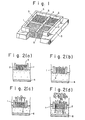
- Fig.l depicts one embodiment of the floating bed of this invention, in which the reference numeral 1 denotes a pad formed of a close celled, synthetic polymeric foam material such as foamed polystyrene of foamed polyethylene and having top and bottom sides which are substantially parallel with each other.
- the thickness of the pad may wary according to the floatage of the foam material and the kind of the plant to be cultured.
- the pad 1 is provided with one or more through holes 2 having a diameter so that each hole may attract water therein by capillary action.
- the diameter of each through hole is generally in the range of 0,5 to 3 mm.
- the number of the through holes 2 may also vary according to the kind of the plant and the object of the culture. When the floating bed is used for educational purposes, for example, rather than the consumption of the matured plant, the number of the holes can be very small.
- the pad is generally provided with about 500 to 1000 through holes with a diameter of 0,5 to 3 mm per 100 cm 2 of the pad.
- the pad has a thickness of 2 cm, an area of 225 cm 2 (15 x 15 cm) and a weight of 15 g.
- the pad is divided into four zones each having an area of 25 cm 2 (5 x 5 cm) and each provided with 144 (12 x 12) of evenly distributed through holes each having a diameter of 2 mm and arranged in a honeycomb structure. As described hereinafter, the through holes serve to function as the passages of plant roots.
- a frame member for supporting the pad therein.
- the frame member 3 is provided with an X-shaped insertion 4 dividing the pad into the four zones.
- Both of the frame member 3 and the insertion 4 supporting the pad 1 in this embodiment are also formed of the same close celled, synthetic polymeric material as the pad 1 and, thus, serve as a buoyant member for the pad 1.
- the floating bed having the above-described construction When the floating bed having the above-described construction is placed on water, it floats by itself on the surface of water with the bottom side thereof positioning below the level of the water.
- the floating of this embodiment is so designed that the bottom side thereof is submerged to the depth of 2 mm from the water level and that a load of 300 g is required for positioning the top side thereof in parallel with the water level. Since the total weight of Japanese radish sprouts matured in the whole area of the pad generally amounts to 200 to 250 g, the floating bed has a sufficient capacity for supporting the sprouts thereon while maintaining the top side thereof above the water level.
- a method of growing sprouts from seeds to maturity with the use of the floating bed according to the present invention is now described below with reference to Figs.2(a) through 2(d).
- Seeds 5 are placed on the pad 1 and sufficiently applied with water by, for example, submerging the floating bed under the level of water contained in a tray 6.
- the water in the tray 6 may, if necessary, contain suitable nutrients.
- the seeds are wetted and set adjacent to the mouths of the through holes 2 and, at the same time, each of the through holes 2 of the pad 1 holds an amount of water due to capillary phenomenon.
- each of the through holes 2 can continually retain a quantity of water therein because of the capillary attraction so that there is estabilished in each through hole a humid environment suitable for the germination.
- sowing if the size of the seeds is smaller than that of the through holes 2, it is advisable to cover the pad with a paper towel or a tissue paper, upon which the seeds are sowed.
- the germinated sprouts By controlling light, temperature and other growing conditions in the customarily employed manner, the germinated sprouts, which are provided with sufficient oxygen and adequate humidity, gradually grow with the roots growing from the end portiions of the stems (or stalks) and extending through the through holes (Figs.2(b) and 2(c)).
- the customarilly employed manner there are some methods for accelarating the germination of the seeds and the growth of the plants.
- Water, on which the floating beds is floated my be heated to about 40"C so that the germination of the plant seeds and the growth of germinated sprouts are accelerated. Further, said water may be provided with air flow so that the growth of the roots are accelerated.
- a sun-ray lamp also may be used to accelerate the growth of the plant, regardless of day or night.
- the roots further grow and emerge through the bottom of the pad to absorb nutrients.
- the sprouts grow further with the end portion of each of their stems being supported within respective through holes (Fig.2(d)).
- the germination of seeds and the growth of the germinated sprouts are adversely affected by, on one hand, drying and, on the other hand, by excess moisture. These are main causes for the retard of germination and non-uniform growth of the sprouts.
- the humid environment once established in each of the through holes at the time of sowing can be maintained unchanged throughout the germination of seeds and the growth of the germinated sprouts, provided that the tray 6 contains water medium in an amount sufficient to allow the float of the bed. That is, the sprouts can be continually provided with an adequate degree of moisture through the roots grow passages without the need of watering and spraying. This contributes much to the reduction of manual labor.
- the distance between the top side of the pad and the surface of water in the tray 6 gradually decreases with the growth of the sprouts, i.e. with the increase in weight of the sprouts. Since the floating bed has a sufficient thickness and a flotage, however, the humidity at the top side of the pad is kept constant irrespective of the growth stage of the sprouts.
- plant sprouts can be grown to mature in a stable manner because the capillary attraction in the roots grow passages defined by the through holes and the flotage of the bed constantly produce a moderate humid environment. Therefore, the present invention makes it possible to grow Adenophora remotiflora Miq. with an improved germination rate.
- the matured sprouts may be exposed to light for greening before harvesting. Since the roots of one sprout do not entwine with other sprouts in the pad, the roots of each sprout can be easily pulled off from the pad without leaving the root tips in the through holes. Thus, upon harvest, the floating bed is ready for reuse.
- the pad In home culture, the pad may be divided into a plurality of regions with respective regions being sowed in different days. This makes it possible to daily harvest and consume fresh sprouts with one floating bed. The provision of the previously described X-shaped insertion is conveniently employed to achieve this purpose.
- the floating bed of the present invention may be modified in a variety of constructions.
- Fig.s3(a) and 3(b) show an alternate embodiment of the present invention, in which the pad 11 is formed of a plurality of plate elements 17.
- Each element 17 has a recessed portion 18 so that, when they are integrally bonded face to face, slits 12 are defined therebetween.
- the slits serve as roots grow passages likewise the through holes 2 of Fig.l.
- the width of each slit 12 may generally be in the range of 0,5 to 3 mm.
- the pad 21 is formed from a plurality of rods 27 each generally circular in cross section.
- the rods 27 are integrally bound together so that a plurality of voids 22 extending along the length of the rods 27 are defined between them.
- the voids 22 serve as the roots grow passage of the pad 21.
- at least one of the rods 27 can be formed into a cylinder so that the center hole of the cylinder can serve as at least part of the roots grow passages.
- the pads shown in Figs.1, 3 and 4 can be used by themselves without the support by a frame member.
- the pad is generally formed of a close celled, synthetic polymeric foam material so that the frame can function as buoyant member of the bed.
- the pad may be formed of a material other than the close celled, synthetic polymeric foam material.
- the floating bed according to the present invention has a very simple structure and is very effective in hydroponically growing a variety of plants.
- the floating bed can be used in various manners such as on a large scale industrial production of plant sprouts, for home culture and for educational purposes.
- the floating bed may be used in trays, ponds, rivers, lakes, bags, etc..
Landscapes
- Life Sciences & Earth Sciences (AREA)
- Environmental Sciences (AREA)
- Health & Medical Sciences (AREA)
- Physiology (AREA)
- Soil Sciences (AREA)
- Hydroponics (AREA)
Priority Applications (1)
| Application Number | Priority Date | Filing Date | Title |
|---|---|---|---|
| EP84107508A EP0167638A1 (fr) | 1984-06-28 | 1984-06-28 | Procédé et dispositif de culture hydroponique de pousses de plantes |
Applications Claiming Priority (1)
| Application Number | Priority Date | Filing Date | Title |
|---|---|---|---|
| EP84107508A EP0167638A1 (fr) | 1984-06-28 | 1984-06-28 | Procédé et dispositif de culture hydroponique de pousses de plantes |
Publications (1)
| Publication Number | Publication Date |
|---|---|
| EP0167638A1 true EP0167638A1 (fr) | 1986-01-15 |
Family
ID=8192021
Family Applications (1)
| Application Number | Title | Priority Date | Filing Date |
|---|---|---|---|
| EP84107508A Withdrawn EP0167638A1 (fr) | 1984-06-28 | 1984-06-28 | Procédé et dispositif de culture hydroponique de pousses de plantes |
Country Status (1)
| Country | Link |
|---|---|
| EP (1) | EP0167638A1 (fr) |
Cited By (15)
| Publication number | Priority date | Publication date | Assignee | Title |
|---|---|---|---|---|
| FR2631205A1 (fr) * | 1988-05-16 | 1989-11-17 | Limagrain Ste Coop Agric Semen | Procede de controle de la purete varietale de semences de mais |
| EP0308422A4 (fr) * | 1986-05-30 | 1989-12-22 | Michael Ernest Farrell | Interface de plante systemique. |
| US5225342A (en) * | 1986-05-30 | 1993-07-06 | Farrell Michael E | Systemic plant interface |
| FR2743693A1 (fr) * | 1996-01-23 | 1997-07-25 | Andre Barre | Insatallation de production de plants en semis flottants |
| US6088958A (en) * | 1996-09-30 | 2000-07-18 | Japan Tobacco, Inc. | Process for producing potato tubers |
| GB2404131A (en) * | 2003-07-24 | 2005-01-26 | Clive Frederick James Hawkins | Floating plant container with automatic watering means |
| CZ298346B6 (cs) * | 2006-03-07 | 2007-09-05 | Štreit@Jirí | Zarízení pro hydroponické pestování rostlin nebo jejich cástí |
| CN104604663A (zh) * | 2014-12-29 | 2015-05-13 | 东莞金字塔绿色科技有限公司 | 种植容器 |
| DE202016104616U1 (de) | 2016-08-23 | 2016-08-30 | Josef Teips | Vorkonfektionierte Saatenpackeinheit und Wässerungsautomat für deren Verwendung |
| WO2018036844A1 (fr) | 2016-08-23 | 2018-03-01 | Josef Teips | Unité de conditionnement de semences préconfectionnée et dispositif d'arrosage automatique destiné à son utilisation ainsi que procédé de germination |
| US20180064042A1 (en) * | 2016-09-07 | 2018-03-08 | Rodney Sidloski | Plant nursery and storage system for use in the growth of field-ready plants |
| US20220151173A1 (en) * | 2016-09-07 | 2022-05-19 | Rodney Sidloski | Plant nursery and storage system for use in the growth of field-ready plants |
| JP2024010972A (ja) * | 2022-07-13 | 2024-01-25 | 株式会社ファームシップ | 培地シート |
| CN117814047A (zh) * | 2024-03-04 | 2024-04-05 | 黑龙江省农业科学院经济作物研究所 | 一种工业大麻漂浮式自动供水育苗穴盘 |
| WO2026083096A1 (fr) * | 2024-10-17 | 2026-04-23 | Magyar Agrár- És Élettudományi Egyetem | Ensemble flottant pour la germination de graines et la culture de plantes |
Citations (6)
| Publication number | Priority date | Publication date | Assignee | Title |
|---|---|---|---|---|
| US2175113A (en) * | 1936-08-28 | 1939-10-03 | Albert C Fischer | Seed germinating wafer |
| FR1390943A (fr) * | 1963-09-06 | 1965-03-05 | Matériau-support pour cultiver des plantes dans ou au-dessus d'une solution nutritive | |
| GB1313121A (en) * | 1971-02-03 | 1973-04-11 | Goodall Ltd Stuart | Method of producing a stand of plants |
| US4057930A (en) * | 1974-08-12 | 1977-11-15 | Barham Rayford A | Hydroponic method and apparatus |
| GB2014836A (en) * | 1978-01-10 | 1979-09-05 | Goodall Ltd S | Stand of plants |
| EP0036723A1 (fr) * | 1980-03-25 | 1981-09-30 | The Greenterior Co. Ltd. | Dispositif de culture de plantes sans terre |
-
1984
- 1984-06-28 EP EP84107508A patent/EP0167638A1/fr not_active Withdrawn
Patent Citations (6)
| Publication number | Priority date | Publication date | Assignee | Title |
|---|---|---|---|---|
| US2175113A (en) * | 1936-08-28 | 1939-10-03 | Albert C Fischer | Seed germinating wafer |
| FR1390943A (fr) * | 1963-09-06 | 1965-03-05 | Matériau-support pour cultiver des plantes dans ou au-dessus d'une solution nutritive | |
| GB1313121A (en) * | 1971-02-03 | 1973-04-11 | Goodall Ltd Stuart | Method of producing a stand of plants |
| US4057930A (en) * | 1974-08-12 | 1977-11-15 | Barham Rayford A | Hydroponic method and apparatus |
| GB2014836A (en) * | 1978-01-10 | 1979-09-05 | Goodall Ltd S | Stand of plants |
| EP0036723A1 (fr) * | 1980-03-25 | 1981-09-30 | The Greenterior Co. Ltd. | Dispositif de culture de plantes sans terre |
Non-Patent Citations (1)
| Title |
|---|
| SOVIET INVENTIONS ILLUSTRATED, DERWENT PUBL. LTD. SECTION GENERAL (MECHANICAL, WEEK K 36), abstract no. 83-756929, page 13, 19th October 1983; & SU - A - 969 208 (POND FISHERY RES.) 07-07-1979 * |
Cited By (18)
| Publication number | Priority date | Publication date | Assignee | Title |
|---|---|---|---|---|
| EP0308422A4 (fr) * | 1986-05-30 | 1989-12-22 | Michael Ernest Farrell | Interface de plante systemique. |
| US5225342A (en) * | 1986-05-30 | 1993-07-06 | Farrell Michael E | Systemic plant interface |
| FR2631205A1 (fr) * | 1988-05-16 | 1989-11-17 | Limagrain Ste Coop Agric Semen | Procede de controle de la purete varietale de semences de mais |
| FR2743693A1 (fr) * | 1996-01-23 | 1997-07-25 | Andre Barre | Insatallation de production de plants en semis flottants |
| US6088958A (en) * | 1996-09-30 | 2000-07-18 | Japan Tobacco, Inc. | Process for producing potato tubers |
| GB2404131A (en) * | 2003-07-24 | 2005-01-26 | Clive Frederick James Hawkins | Floating plant container with automatic watering means |
| CZ298346B6 (cs) * | 2006-03-07 | 2007-09-05 | Štreit@Jirí | Zarízení pro hydroponické pestování rostlin nebo jejich cástí |
| CN104604663A (zh) * | 2014-12-29 | 2015-05-13 | 东莞金字塔绿色科技有限公司 | 种植容器 |
| DE202016104616U1 (de) | 2016-08-23 | 2016-08-30 | Josef Teips | Vorkonfektionierte Saatenpackeinheit und Wässerungsautomat für deren Verwendung |
| WO2018036844A1 (fr) | 2016-08-23 | 2018-03-01 | Josef Teips | Unité de conditionnement de semences préconfectionnée et dispositif d'arrosage automatique destiné à son utilisation ainsi que procédé de germination |
| DE102016115650A1 (de) | 2016-08-23 | 2018-03-01 | Josef Teips | Vorkonfektionierte Saatenpackeinheit und Wässerungsautomat für deren Verwendung sowie Auskeimverfahren |
| US20180064042A1 (en) * | 2016-09-07 | 2018-03-08 | Rodney Sidloski | Plant nursery and storage system for use in the growth of field-ready plants |
| US20200045893A1 (en) * | 2016-09-07 | 2020-02-13 | Rodney Sidloski | Plant nursery and storage system for use in the growth of field-ready plants |
| US20220151173A1 (en) * | 2016-09-07 | 2022-05-19 | Rodney Sidloski | Plant nursery and storage system for use in the growth of field-ready plants |
| JP2024010972A (ja) * | 2022-07-13 | 2024-01-25 | 株式会社ファームシップ | 培地シート |
| CN117814047A (zh) * | 2024-03-04 | 2024-04-05 | 黑龙江省农业科学院经济作物研究所 | 一种工业大麻漂浮式自动供水育苗穴盘 |
| CN117814047B (zh) * | 2024-03-04 | 2024-05-14 | 黑龙江省农业科学院经济作物研究所 | 一种工业大麻漂浮式自动供水育苗穴盘 |
| WO2026083096A1 (fr) * | 2024-10-17 | 2026-04-23 | Magyar Agrár- És Élettudományi Egyetem | Ensemble flottant pour la germination de graines et la culture de plantes |
Similar Documents
| Publication | Publication Date | Title |
|---|---|---|
| US4607454A (en) | Method of hydroponically growing plant sprouts and apparatus therefor | |
| EP0167638A1 (fr) | Procédé et dispositif de culture hydroponique de pousses de plantes | |
| US4034506A (en) | Hydroponic method using a porous foam plate, and a container used therewith | |
| US20080155894A1 (en) | Soil-less seed support medium and method for germinating a seed | |
| US4268994A (en) | Three-dimensional planter | |
| US5622004A (en) | Self-watering growing systems | |
| JP5988981B2 (ja) | 植物の育成方法ならびにそれに用いる育成容器および育成装置 | |
| US4023308A (en) | Plant growth substrate and process for using | |
| BG64138B1 (bg) | Саксия за растения | |
| KR20190085453A (ko) | 인삼재배용 수경재배 화분 | |
| US5247762A (en) | Hydraulic planter system | |
| US5189835A (en) | Device for continuously irrigating soil of plants growing in individual pots | |
| EP0169687A1 (fr) | Lit de culture | |
| CN205756190U (zh) | 一种紫花苜蓿的水培育苗装置 | |
| KR101911203B1 (ko) | 식물 재배관리기 | |
| CA1244240A (fr) | Methode de culture hydroponique de vegetaux et appareil utilise a cette fin | |
| CN114868641A (zh) | 一种泥炭藓的种植方法 | |
| RU173431U1 (ru) | Устройство для выращивания растений, семян и проростков | |
| JPH0343982Y2 (fr) | ||
| JPH07289103A (ja) | 芽物野菜の栽培方法およびその装置 | |
| JPH10191816A (ja) | 水耕性育苗および植物育成装置 | |
| JP2021185827A (ja) | 養液栽培方法 | |
| JP3001784U (ja) | 養液栽培装置 | |
| JP3472940B2 (ja) | 陸生植物の水上園芸法 | |
| NO158521B (no) | Flytende bed for hydroponisk dyrkning av planteskudd. |
Legal Events
| Date | Code | Title | Description |
|---|---|---|---|
| PUAI | Public reference made under article 153(3) epc to a published international application that has entered the european phase |
Free format text: ORIGINAL CODE: 0009012 |
|
| AK | Designated contracting states |
Designated state(s): AT BE CH DE FR GB IT LI LU NL SE |
|
| 17P | Request for examination filed |
Effective date: 19860502 |
|
| 17Q | First examination report despatched |
Effective date: 19870929 |
|
| STAA | Information on the status of an ep patent application or granted ep patent |
Free format text: STATUS: THE APPLICATION IS DEEMED TO BE WITHDRAWN |
|
| 18D | Application deemed to be withdrawn |
Effective date: 19881007 |