EP0168005A2 - Semicarbazide derivatives, processes for preparation thereof and pharmaceutical composition comprising the same - Google Patents
Semicarbazide derivatives, processes for preparation thereof and pharmaceutical composition comprising the same Download PDFInfo
- Publication number
- EP0168005A2 EP0168005A2 EP85108391A EP85108391A EP0168005A2 EP 0168005 A2 EP0168005 A2 EP 0168005A2 EP 85108391 A EP85108391 A EP 85108391A EP 85108391 A EP85108391 A EP 85108391A EP 0168005 A2 EP0168005 A2 EP 0168005A2
- Authority
- EP
- European Patent Office
- Prior art keywords
- compound
- lower alkyl
- salt
- optionally substituted
- aryl
- Prior art date
- Legal status (The legal status is an assumption and is not a legal conclusion. Google has not performed a legal analysis and makes no representation as to the accuracy of the status listed.)
- Granted
Links
- 0 CN(*)N(C)CN(C)[Rn] Chemical compound CN(*)N(C)CN(C)[Rn] 0.000 description 5
Classifications
-
- C—CHEMISTRY; METALLURGY
- C07—ORGANIC CHEMISTRY
- C07D—HETEROCYCLIC COMPOUNDS
- C07D213/00—Heterocyclic compounds containing six-membered rings, not condensed with other rings, with one nitrogen atom as the only ring hetero atom and three or more double bonds between ring members or between ring members and non-ring members
- C07D213/02—Heterocyclic compounds containing six-membered rings, not condensed with other rings, with one nitrogen atom as the only ring hetero atom and three or more double bonds between ring members or between ring members and non-ring members having three double bonds between ring members or between ring members and non-ring members
- C07D213/04—Heterocyclic compounds containing six-membered rings, not condensed with other rings, with one nitrogen atom as the only ring hetero atom and three or more double bonds between ring members or between ring members and non-ring members having three double bonds between ring members or between ring members and non-ring members having no bond between the ring nitrogen atom and a non-ring member or having only hydrogen or carbon atoms directly attached to the ring nitrogen atom
- C07D213/60—Heterocyclic compounds containing six-membered rings, not condensed with other rings, with one nitrogen atom as the only ring hetero atom and three or more double bonds between ring members or between ring members and non-ring members having three double bonds between ring members or between ring members and non-ring members having no bond between the ring nitrogen atom and a non-ring member or having only hydrogen or carbon atoms directly attached to the ring nitrogen atom with hetero atoms or with carbon atoms having three bonds to hetero atoms with at the most one bond to halogen, e.g. ester or nitrile radicals, directly attached to ring carbon atoms
- C07D213/72—Nitrogen atoms
- C07D213/75—Amino or imino radicals, acylated by carboxylic or carbonic acids, or by sulfur or nitrogen analogues thereof, e.g. carbamates
-
- C—CHEMISTRY; METALLURGY
- C07—ORGANIC CHEMISTRY
- C07D—HETEROCYCLIC COMPOUNDS
- C07D203/00—Heterocyclic compounds containing three-membered rings with one nitrogen atom as the only ring hetero atom
- C07D203/26—Heterocyclic compounds containing three-membered rings with one nitrogen atom as the only ring hetero atom condensed with carbocyclic rings or ring systems
-
- C—CHEMISTRY; METALLURGY
- C07—ORGANIC CHEMISTRY
- C07D—HETEROCYCLIC COMPOUNDS
- C07D211/00—Heterocyclic compounds containing hydrogenated pyridine rings, not condensed with other rings
- C07D211/04—Heterocyclic compounds containing hydrogenated pyridine rings, not condensed with other rings with only hydrogen or carbon atoms directly attached to the ring nitrogen atom
- C07D211/68—Heterocyclic compounds containing hydrogenated pyridine rings, not condensed with other rings with only hydrogen or carbon atoms directly attached to the ring nitrogen atom having one double bond between ring members or between a ring member and a non-ring member
- C07D211/70—Heterocyclic compounds containing hydrogenated pyridine rings, not condensed with other rings with only hydrogen or carbon atoms directly attached to the ring nitrogen atom having one double bond between ring members or between a ring member and a non-ring member with only hydrogen atoms, hydrocarbon or substituted hydrocarbon radicals, directly attached to ring carbon atoms
-
- C—CHEMISTRY; METALLURGY
- C07—ORGANIC CHEMISTRY
- C07D—HETEROCYCLIC COMPOUNDS
- C07D211/00—Heterocyclic compounds containing hydrogenated pyridine rings, not condensed with other rings
- C07D211/92—Heterocyclic compounds containing hydrogenated pyridine rings, not condensed with other rings with a hetero atom directly attached to the ring nitrogen atom
- C07D211/98—Nitrogen atom
-
- C—CHEMISTRY; METALLURGY
- C07—ORGANIC CHEMISTRY
- C07D—HETEROCYCLIC COMPOUNDS
- C07D213/00—Heterocyclic compounds containing six-membered rings, not condensed with other rings, with one nitrogen atom as the only ring hetero atom and three or more double bonds between ring members or between ring members and non-ring members
- C07D213/02—Heterocyclic compounds containing six-membered rings, not condensed with other rings, with one nitrogen atom as the only ring hetero atom and three or more double bonds between ring members or between ring members and non-ring members having three double bonds between ring members or between ring members and non-ring members
- C07D213/04—Heterocyclic compounds containing six-membered rings, not condensed with other rings, with one nitrogen atom as the only ring hetero atom and three or more double bonds between ring members or between ring members and non-ring members having three double bonds between ring members or between ring members and non-ring members having no bond between the ring nitrogen atom and a non-ring member or having only hydrogen or carbon atoms directly attached to the ring nitrogen atom
- C07D213/60—Heterocyclic compounds containing six-membered rings, not condensed with other rings, with one nitrogen atom as the only ring hetero atom and three or more double bonds between ring members or between ring members and non-ring members having three double bonds between ring members or between ring members and non-ring members having no bond between the ring nitrogen atom and a non-ring member or having only hydrogen or carbon atoms directly attached to the ring nitrogen atom with hetero atoms or with carbon atoms having three bonds to hetero atoms with at the most one bond to halogen, e.g. ester or nitrile radicals, directly attached to ring carbon atoms
- C07D213/72—Nitrogen atoms
- C07D213/76—Nitrogen atoms to which a second hetero atom is attached
- C07D213/77—Hydrazine radicals
-
- C—CHEMISTRY; METALLURGY
- C07—ORGANIC CHEMISTRY
- C07D—HETEROCYCLIC COMPOUNDS
- C07D213/00—Heterocyclic compounds containing six-membered rings, not condensed with other rings, with one nitrogen atom as the only ring hetero atom and three or more double bonds between ring members or between ring members and non-ring members
- C07D213/02—Heterocyclic compounds containing six-membered rings, not condensed with other rings, with one nitrogen atom as the only ring hetero atom and three or more double bonds between ring members or between ring members and non-ring members having three double bonds between ring members or between ring members and non-ring members
- C07D213/89—Heterocyclic compounds containing six-membered rings, not condensed with other rings, with one nitrogen atom as the only ring hetero atom and three or more double bonds between ring members or between ring members and non-ring members having three double bonds between ring members or between ring members and non-ring members with hetero atoms directly attached to the ring nitrogen atom
-
- C—CHEMISTRY; METALLURGY
- C07—ORGANIC CHEMISTRY
- C07D—HETEROCYCLIC COMPOUNDS
- C07D237/00—Heterocyclic compounds containing 1,2-diazine or hydrogenated 1,2-diazine rings
- C07D237/02—Heterocyclic compounds containing 1,2-diazine or hydrogenated 1,2-diazine rings not condensed with other rings
- C07D237/04—Heterocyclic compounds containing 1,2-diazine or hydrogenated 1,2-diazine rings not condensed with other rings having less than three double bonds between ring members or between ring members and non-ring members
-
- C—CHEMISTRY; METALLURGY
- C07—ORGANIC CHEMISTRY
- C07D—HETEROCYCLIC COMPOUNDS
- C07D239/00—Heterocyclic compounds containing 1,3-diazine or hydrogenated 1,3-diazine rings
- C07D239/02—Heterocyclic compounds containing 1,3-diazine or hydrogenated 1,3-diazine rings not condensed with other rings
- C07D239/24—Heterocyclic compounds containing 1,3-diazine or hydrogenated 1,3-diazine rings not condensed with other rings having three or more double bonds between ring members or between ring members and non-ring members
- C07D239/28—Heterocyclic compounds containing 1,3-diazine or hydrogenated 1,3-diazine rings not condensed with other rings having three or more double bonds between ring members or between ring members and non-ring members with hetero atoms or with carbon atoms having three bonds to hetero atoms with at the most one bond to halogen, directly attached to ring carbon atoms
- C07D239/32—One oxygen, sulfur or nitrogen atom
- C07D239/42—One nitrogen atom
-
- C—CHEMISTRY; METALLURGY
- C07—ORGANIC CHEMISTRY
- C07D—HETEROCYCLIC COMPOUNDS
- C07D295/00—Heterocyclic compounds containing polymethylene-imine rings with at least five ring members, 3-azabicyclo [3.2.2] nonane, piperazine, morpholine or thiomorpholine rings, having only hydrogen atoms directly attached to the ring carbon atoms
- C07D295/22—Heterocyclic compounds containing polymethylene-imine rings with at least five ring members, 3-azabicyclo [3.2.2] nonane, piperazine, morpholine or thiomorpholine rings, having only hydrogen atoms directly attached to the ring carbon atoms with hetero atoms directly attached to ring nitrogen atoms
- C07D295/28—Nitrogen atoms
- C07D295/32—Nitrogen atoms acylated with carboxylic or carbonic acids, or their nitrogen or sulfur analogues
-
- C—CHEMISTRY; METALLURGY
- C07—ORGANIC CHEMISTRY
- C07D—HETEROCYCLIC COMPOUNDS
- C07D401/00—Heterocyclic compounds containing two or more hetero rings, having nitrogen atoms as the only ring hetero atoms, at least one ring being a six-membered ring with only one nitrogen atom
- C07D401/02—Heterocyclic compounds containing two or more hetero rings, having nitrogen atoms as the only ring hetero atoms, at least one ring being a six-membered ring with only one nitrogen atom containing two hetero rings
- C07D401/12—Heterocyclic compounds containing two or more hetero rings, having nitrogen atoms as the only ring hetero atoms, at least one ring being a six-membered ring with only one nitrogen atom containing two hetero rings linked by a chain containing hetero atoms as chain links
-
- C—CHEMISTRY; METALLURGY
- C07—ORGANIC CHEMISTRY
- C07D—HETEROCYCLIC COMPOUNDS
- C07D405/00—Heterocyclic compounds containing both one or more hetero rings having oxygen atoms as the only ring hetero atoms, and one or more rings having nitrogen as the only ring hetero atom
- C07D405/02—Heterocyclic compounds containing both one or more hetero rings having oxygen atoms as the only ring hetero atoms, and one or more rings having nitrogen as the only ring hetero atom containing two hetero rings
- C07D405/12—Heterocyclic compounds containing both one or more hetero rings having oxygen atoms as the only ring hetero atoms, and one or more rings having nitrogen as the only ring hetero atom containing two hetero rings linked by a chain containing hetero atoms as chain links
-
- C—CHEMISTRY; METALLURGY
- C07—ORGANIC CHEMISTRY
- C07D—HETEROCYCLIC COMPOUNDS
- C07D417/00—Heterocyclic compounds containing two or more hetero rings, at least one ring having nitrogen and sulfur atoms as the only ring hetero atoms, not provided for by group C07D415/00
- C07D417/02—Heterocyclic compounds containing two or more hetero rings, at least one ring having nitrogen and sulfur atoms as the only ring hetero atoms, not provided for by group C07D415/00 containing two hetero rings
- C07D417/12—Heterocyclic compounds containing two or more hetero rings, at least one ring having nitrogen and sulfur atoms as the only ring hetero atoms, not provided for by group C07D415/00 containing two hetero rings linked by a chain containing hetero atoms as chain links
Definitions
- the present invention relates to novel semicarbazide derivatives and a pharmaceutically acceptable salt thereof. More particularly, it relates to novel semicarbazide derivatives and a pharmaceutically acceptable salt thereof which have antiinflammatory and analgesic activities, to processes for preparation thereof, to pharmaceutical composition comprising the same, and to a method of using the same therapeutically in the treatment of inflammation and various pains in human being and animals.
- one object of this invention is to provide novel semicarbazide derivatives and a pharmaceutically acceptable salt thereof which are useful as antiinflammatory and analgesic agents.
- Another object of this invention is to provide processes for preparation of said semicarbazide derivatives and a salt thereof.
- a further object of this invention is to provide pharmaceutical composition comprising, as an active ingredient, said semicarbazide derivatives and a pharmaceutically acceptable salt thereof.
- Still further object of this invention is to provide a method of using said semicarbazide derivatives and a pharmaceutically acceptable salt thereof in the treatment of inflammation and various pains in human being and animals.
- N-substituted-l,2,3,6-tetrahydropyridine derivatives having antiinflammatory and analgesic activities have been known as described, for example, in U.S. Patent 4,088,653 and Journal of Medicinal Chemistry Vol. 25, 720-723, 1982.
- the semicarbazide derivatives of the present invention are novel and can be represented by the following general formula [1] : wherein R 1 is hydrogen,
- the object compound [I] and its pharmaceutically acceptable salt can be prepared by the following processes. wherein R 1 , R 2 , R 3 , R 4 , R 5 and X are each as defined above,
- lower is intended to mean a group having 1 to 6 carbon atom(s), unless otherwise provided.
- Suitable "lower alkyl” may be a straight or branched one such as methyl, ethyl, propyl, isopropyl, butyl, isobutyl, t-butyl, pentyl, hexyl, or the like, in which the preferred one may be C l -C 4 alkyl.
- Suitable "lower alkenyl” may be vinyl, allyl, 1-propenyl, 3-butenyl, 4-pentenyl, 5-hexenyl, or the like, in which the preferred one may be C 2 -C 4 alkenyl.
- Suitable "lower alkoxy” may be methoxy, ethoxy, propoxy, isopropoxy, butoxy, isobutoxy, t-butoxy, pentyloxy, hexyloxy, or the like, in which the preferred one may be C 1 -C 4 alkoxy.
- Suitable "aryl” may be phenyl, naphthyl or the like.
- Suitable "ar(lower)alkyl” may be benzyl, phenethyl, phenylpropyl, benzhydryl, trityl, or the like, in which the preferred one may be phenyl(C 1 -C 4 )alkyl.
- Suitable "(C 2 -C 6 )alkylidene group” may be ethylidene, propylidene, isopropylidene, butylidene, pentylidene, hexylidene or the like. These (C 2 -C 6 )alkylidene groups may be substituted with aryl group(s), wherein said aryl group(s) may have suitable substituent(s). Suitable examples of the aryl group optionally having substituent(s) may be phenyl, 2-tolyl, 4-chlorophenyl, naphthyl, or the like.
- suitable examples of the (C 2 -C 6 )-alkylidene group having such substituent(s) may be 1-phenylethylidene, 2-phenylethylidene, 1,2-diphenyl- ethylidene, 1-phenylpropylidene, 1-(4-chlorophenyl)-ethylidene, or the like.
- Suitable "saturated or unsaturated, 5- or 6-membered heterocyclic group" formed by R 2 , R 3 and the attached nitrogen atom may be pyrrolidin-1-yl, morpholino, piperidino, piperazin-1-yl, pyrrolin-1-yl, 1,4-dihydropyridin-1-yl, 1,2-dihydropyridin-l-yl, 1,2,3,6-tetrahydropyridin-1-yl or the like.
- These heterocyclic groups may be substituted with aryl or lower alkyl, suitable examples of which are as exemplified before.
- Suitable "partially or fully saturated pyridin-1-yl group” may be piperidino, 1,4-dihydropyridin-l-yl, 1,2-dihydropyridin-l-yl or 1,2,3,6-tetrahydropyridin-l-yl.
- Said heterocyclic groups may be substituted with aryl or lower alkyl, suitable examples of which are as exemplified before.
- Suitable "saturated or unsaturated, 5- or 6-membered heterocyclic group" formed by R 1 , R 2 and the attached nitrogen atoms may be pyrazolidinyl, perhydropyridazinyl, pyrazolinyl, 1,2,3,4-tetrahydropyridazinyl, 1,2,3,6-tetrahydropyridazinyl, or the like.
- Suitable "unsaturated 5- or 6-membered heterocyclic group” may be 1,2,3,6-tetrahydropyridazinyl, 1,2,3,4-tetrahydropyridazinyl, 1,2-dihydropyridazinyl, or the like.
- Suitable “partially or fully saturated 5- or 6-membered heterocyclic group” may be 1,2,3,6-tetrahydropyridazinyl, perhydropyridazinyl, or the like.
- Suitable "1,2-diazaspiroalkane-1,2-diyl group” may be l,2-diazaspiro[2.5]octane-l,2-diyl, 1,2-diazaspiro[2.6]nonane-l,2-diyl, 1,2-diazaspiro[4.5]-decane-l,2-diyl, or the like.
- Suitable “heterocyclic group” may be saturated or unsaturated, monocyclic or polycyclic heterocyclic group containing at least one hetero-atom selected from oxygen, sulfur and nitrogen atoms.
- Preferable heterocyclic group may be
- heterocyclic groups as mentioned above may have suitable substituent(s) such as halogen [e.g. fluorine, chlorine, bromine and iodine], lower alkyl, lower alkoxy, oxo, and the like, and suitable examples of such lower alkyl and lower alkoxy groups may be the same as those as exemplified before.
- suitable substituent(s) such as halogen [e.g. fluorine, chlorine, bromine and iodine], lower alkyl, lower alkoxy, oxo, and the like, and suitable examples of such lower alkyl and lower alkoxy groups may be the same as those as exemplified before.
- Suitable “di(lower)alkylamino” may be dimethylaminomethyl, dimethylaminoethyl, dimethylaminopropyl, or the like.
- the preferred embodiment of the compound [I] can be represented by the following chemical formula : wherein R 2' and R 3' are taken together with the attached nitrogen atom to form unsaturated 6-membered heterocyclic group optionally substituted with lower alkyl, more preferably 1,2,3,6-tetrahydropyridin-1-yl optionally substituted with C l -C 4 alkyl [e.g.
- R 2' and R 3' are each lower alkenyl, more preferablly C 2 -C 4 alkenyl [e.g. vinyl, allyl, 1-propenyl, etc.];
- Suitable pharmaceutically acceptable salt of the object compound [I] is conventional non-toxic salt and includes an organic acid salt [e.g. formate, acetate, trifluoroacetate, maleate, tartrate, methanesulfonate, benzenesulfonate, toluenesulfonate, etc.], an inorganic acid salt [e.g. hydrochloride, hydrobromide, sulfate, phosphate, etc.], a salt with an acidic amino acid [e.g. aspartic acid salt, glutamic acid salt, etc.], and the like.
- organic acid salt e.g. formate, acetate, trifluoroacetate, maleate, tartrate, methanesulfonate, benzenesulfonate, toluenesulfonate, etc.
- an inorganic acid salt e.g. hydrochloride, hydrobromide, sulfate, phosphate, etc.
- the compound [Ia] and its salt can be prepared by reacting a compound [II] or its salt with a compound [III] or its salt.
- Suitable salts of the compounds [II] and [III] may be the same as those exemplified for the compound [I].
- This reaction is usually carried out in a solvent such as water, methanol, ethanol, dioxane, tetrahydrofuran, benzene, chloroform, methylene chloride or any other organic solvent which does not adversely influence the reaction.
- a solvent such as water, methanol, ethanol, dioxane, tetrahydrofuran, benzene, chloroform, methylene chloride or any other organic solvent which does not adversely influence the reaction.
- this reaction can be carried out in the presence of an inorganic or organic base such as an alkali metal bicarbonate [e.g. sodium bicarbonate, potassium bicarbonate, etc.], alkali metal carbonate [e.g. sodium carbonate, potassium carbonate, etc.], alkaline earth metal carbonate [e.g. magnesium carbonate, calcium carbonate, etc.], tri(lower)alkylamine [e.g. trimethylamine, triethylamine, N,N-diisopropyl-N-ethylamine, etc.], pyridine compounds [e.g.
- an alkali metal bicarbonate e.g. sodium bicarbonate, potassium bicarbonate, etc.
- alkali metal carbonate e.g. sodium carbonate, potassium carbonate, etc.
- alkaline earth metal carbonate e.g. magnesium carbonate, calcium carbonate, etc.
- tri(lower)alkylamine e.g. trimethylamine, triethylamine, N,N-di
- N,N-di(lower)alkylaminopyridine such as 4-(N,N-dimethylamino)pyridine, etc.] quinoline, N-lower alkylmorphorine [e.g. N-methylmorphorine, etc.], N,N-di(lower)alkylbenzylamine [e.g. N,N-dimethylbenzylamine, etc.], and the like.
- the reaction temperature is not critical, and the reaction is usually carried out under cooling to warming.
- the compound [I] and its salt can be prepared by reacting a compound [II] or its salt with a compound [IV] or its reactive derivative at the carboxy or hydroxy thiocarbonyl group or a salt thereof.
- Suitable salts of the compound [II] may be the same as those exemplified for the compounds [I].
- Suitable reactive derivative at the carboxy or hydroxy thiocarbonyl group of the compound [IV] may include an ester, an acid halide, an acid anhydride and the like.
- the suitable examples of the reactive derivatives may be an acid halide "[e.g. acid chloride, acid bromide, etc.]; a symmetrical acid anhydride; a mixed acid anhydride with an acid such as aliphatic carboxylic acid [e.g. acetic acid, pivalic acid, etc.], substituted phosphoric acid [e.g. dialkylphosphoric acid, diphenylphosphoric acid, etc.]; an ester such as substituted or unsubstituted lower alkyl ester [e.g.
- phenyl ester tolyl ester, 4-nitrophenyl ester, 2,4-dinitrophenyl ester, pentachlorophenyl ester, naphthyl ester, etc.], or an ester with N,N-dimethylhydroxylamine, N-hydroxysuccinimide, N-hydroxyphthalimide or 1-hydroxy-6-chloro-lH-benzotriazole, or the like.
- These reactive derivatives can be optionally selected according to the kind of the compound [IV] to be used.
- Suitable salts of the compound [IV] and its reactive derivative may include an acid addition salt exemplified for the compounds[I] and a conventional base salt such as an organic base salt [e.g. trimethylamine salt, triethylamine salt, pyridine salt, picoline salt, dicyclohexylamine salt, N,N'-dibenzylethylenediamine salt, etc.], an ammonium salt, an alkali metal salt [e.g. sodium salt, potassium salt, etc.], an alkaline earth metal salt [e.g. calcium salt, magnesium salt, etc.] and the like.
- an organic base salt e.g. trimethylamine salt, triethylamine salt, pyridine salt, picoline salt, dicyclohexylamine salt, N,N'-dibenzylethylenediamine salt, etc.
- an ammonium salt e.g. sodium salt, potassium salt, etc.
- an alkaline earth metal salt e.g. calcium salt, magnesium salt, etc
- the reaction is usually carried out in a conventional solvent such as water, acetone, dioxane, chloroform, methylene chloride, ethylene chloride, tetrahydrofuran, ethyl acetate, N,N-dimethylformamide, pyridine or any other organic solvent which does not adversely influence the reaction.
- a conventional solvent such as water, acetone, dioxane, chloroform, methylene chloride, ethylene chloride, tetrahydrofuran, ethyl acetate, N,N-dimethylformamide, pyridine or any other organic solvent which does not adversely influence the reaction.
- hydrophilic solvents may be used in a mixture with water.
- the reaction is preferably carried out in the presence of a conventional condensing agent such as N,N'-dicyclohexylcarbodiimide, N-cyclohexyl-N'-morpholinoethylcarbodiimide, N-ethyl-N'-(3-dimethylaminopropyl)carbodiimide, thionyl chloride, oxalyl chloride, lower alkoxycarbonyl halide [e.g. ethyl chloroformate, isobutyl chloroformate, etc.], 1-(p-chlorobenzenesulfonyloxy)-6-chloro-lH-benzotriazole, or the like.
- a conventional condensing agent such as N,N'-dicyclohexylcarbodiimide, N-cyclohexyl-N'-morpholinoethylcarbodiimide, N-ethyl-N'-(3-d
- the reaction temperature is not critical, and the reaction can be carried out under cooling to heating.
- the compound [I] and its salt can be prepared by reacting a compound [V] or its reactive derivative at the carboxy or hydroxy thiocarbonyl group or a salt thereof with a compound [VI] or the salt.
- Suitable reactive derivatives at the carboxy or hydroxy thiocarbonyl group of the compound [V] and suitable salts of the compound [V] and its reactive derivative may be the same as those exemplified for the compound [IV] in the above Process 2.
- Suitable salts of the compound [VI] may be the same as those exemplified for the compounds [I].
- This reaction can be carried out in substantially the same manner as Process 2, and therefore the reaction mode and reaction conditions [e.g. solvent, condensing agent, reaction temperature, etc.] of this reaction are to be referred to those as explained in Process 2.
- reaction mode and reaction conditions e.g. solvent, condensing agent, reaction temperature, etc.
- the compound [Ib] and its salt can be prepared by reducing a compound [VII] or its salt.
- the reaction can be carried out in a conventional manner, namely, chemical reduction or catalytic reduction.
- Suitable reducing agents to be used in chemical reduction are a metal hydride compound such as aluminum hydride compound [e.g. lithium aluminum hydride, sodium aluminum hydride, aluminum hydride, lithium trimethoxy- aluminum hydride, lithium tri-t-butoxyaluminum hydride, etc.], borohydride compound [e.g. sodium borohydride, lithium borohydride, sodium cyanoborohydride, tetramethylammonium borohydride, borane, diborane, etc.] and the like.
- aluminum hydride compound e.g. lithium aluminum hydride, sodium aluminum hydride, aluminum hydride, lithium trimethoxy- aluminum hydride, lithium tri-t-butoxyaluminum hydride, etc.
- borohydride compound e.g. sodium borohydride, lithium borohydride, sodium cyanoborohydride, tetramethylammonium borohydride, borane, diborane, etc.
- Suitable catalysts to be used in catalytic reduction are conventional ones such as platinum catalyst [e.g. platinum plate, spongy platinum, platinum black, colloidal platinum, platinum oxide, platinum wire, etc.], palladium catalyst [e.g. spongy palladium, palladium black, palladium oxide, palladium on carbon, colloidal palladium, palladium on barium sulfate, palladium on barium carbonate, etc.], nickel catalyst [e. gO. reduced nickel, nickel oxide, Raney nickel, etc.], cobalt catalyst [e.g. reduced cobalt, Raney cobalt, etc.], iron catalyst [e.g. reduced iron, Raney iron, etc.], copper catalyst [e.g. reduced copper, Raney copper, Ullman copper, etc.] or the like.
- platinum catalyst e.g. platinum plate, spongy platinum, platinum black, colloidal platinum, platinum oxide, platinum wire, etc.
- palladium catalyst e.g. spongy palladium, palla
- the reaction of this process is usually carried out in a solvent such as water, alcohol [e.g. methanol, ethanol, propanol, etc.], acetic acid, diethyl ether, dioxane, tetrahydrofuran, etc. or a mixture thereof.
- a solvent such as water, alcohol [e.g. methanol, ethanol, propanol, etc.], acetic acid, diethyl ether, dioxane, tetrahydrofuran, etc. or a mixture thereof.
- the reaction is preferably carried out under somewhat milder conditions such as under cooling to warming.
- the pyridinio moiety of the compound [VII] is reduced to piperidino, 1,4-dihydropyridin-1-yl, 1,2-dihydropyridin-l-yl or 1,2,3,6-tetrahydropyridin-l-yl group according to the reducing method and the reagent to be used in this process.
- the compound [Id] and its salt can be prepared by reducing a compound [Ic] or its salt.
- This reaction can be carried out in substantially the same manner as Process 4, and therefore the reaction mode and reaction conditions [e.g. reduction method, reducing agent, solvent, reaction temperature, etc.] of this reaction are to be referred to those as explained in Process 4.
- reaction mode and reaction conditions e.g. reduction method, reducing agent, solvent, reaction temperature, etc.
- the compounds [I], [Ia], [Ib] and [Id] obtained by the above processes are isolated and purified by a conventional method such as pulverization, recrystallization, column chromatography, reprecipitation or the like.
- each of the object compound [I] and the starting compounds [II], [III], [IV], [V], [VI] and [VII] may include one or more stereoisomers due to asymmetric carbon atom(s) and/or carbon and carbon double bond (i.e. Z-isomer and E-isomer), and all of such isomers and mixture thereof are included within the scope of this invention.
- the new semicarbazide derivatives [I] and a pharmaceutically acceptable salt thereof possess antiinflammatory and analgesic activities, and are useful for a therapeutic treatment of inflammation and various pains [e.g. headache, toothache, menorrhalgia, etc.].
- the compound [I] and a pharmaceutically acceptable salt thereof of the present invention can be used in a form of pharmaceutical preparation containing one of said compounds, as an - active ingredient, in admixture with a pharmaceutically acceptable carrier such as an organic or inorganic solid or liquid excipient suitable for oral or parenteral administration.
- a pharmaceutically acceptable carrier such as an organic or inorganic solid or liquid excipient suitable for oral or parenteral administration.
- the pharmaceutical preparations may be capsules, tablets, dragees, granules, solution, suspension, emulsion, or the like. If desired, there may be included in these preparations, auxiliary substances, stabilizing agents, wetting or emulsifying agents, buffers and other commonly used additives.
- an average single dose of about 0.1 mg, 1 mg, 10 mg, 50 mg, 100 mg, 250 mg, 500 mg and 1000 mg of the compound [I] may be effective for treating inflammation and various pains.
- amounts between 0.1 mg/body and about 1,000 mg/body may be administered per-day.
- Test A (ANTIINFLAMMATORY ACTIVITY) :
- Paw edema was induced by subplantar injection of 1% carrageenin (0.1 ml/rat) into the right hind paw.
- the test drug was suspended in 0.5% methylcellulose and administered orally 60 minutes before phlogogen.
- Paw volume was measured with plethysmometer (Ugo Bazil Co., Ltd.) by water displacement immersing the paw to the lateral malleolus.
- the difference of paw volume before and 3 hours after the phlogogen was designated as edema volume.
- the data were analyzed statistically by student's t-test.
- Test B (ANALGESIC ACTIVITY) :
- mice Ten male ddY strain mice were used per group. To estimate the frequency of writhing syndrome, the animals were observed from 3 to 13 minutes after an intraperitoneal injection of 0.2 ml/10 g of 0.6% acetic acid. The drugs were given orally 60 minutes before acetic acid. The frequency of writhing syndrome in the treated animals was compared with that in the non- treated control animals.
- Example 2 The following compounds (Examples 2 to 25) were obtained according to a similar manner to that of Example 1.
- Example 27 The following compounds (Examples 27 to 49 ) were obtained according to a similar manner to that of Example 26.
- Example 52 to 75 The following compounds (Examples 52 to 75) were obtained according to a similar manner to that of Example 51.
Landscapes
- Chemical & Material Sciences (AREA)
- Organic Chemistry (AREA)
- Pharmaceuticals Containing Other Organic And Inorganic Compounds (AREA)
Abstract

wherein
- R1 is hydrogen,
- R2 is hydrogen, lower alkyl, ar(lower)alkyl, lower alkenyl or aryl,
- R3 is lower alkyl, ar(lower)alkyl, lower alkenyl or aryl, or
- R2 and R3 are taken together to form (C2-C6)-alkylidene group optionally substituted with aryl or taken together with the attached nitrogen atom to form a satureted or unsaturated, 5- or 6-membered heterocyclic group optionally substituted with aryl or lower alkyl; or
- R1 and R2 are taken together with the attached nitrogen atoms to form a saturated or unsaturated, 5- or 6-membered heterocyclic group or 1,2-diazasplroalkane-1,2-dlyl group,
- R3 is hydrogen, lower alkyl, ar(lower)alkyl, lower alkenyl or aryl;
- R4 is lower alkyl optionally substituted with di(lower)alkylamino or a heterocyclic group, or a heterocyclic group optionally having suitable substituent(s),
- R5 is hydrogen or lower alkyl, and
- X is O or S,
and a pharmaceutically acceptable salt thereof may be used as anti-inflammatory and analgesic agents.
Description
- The present invention relates to novel semicarbazide derivatives and a pharmaceutically acceptable salt thereof. More particularly, it relates to novel semicarbazide derivatives and a pharmaceutically acceptable salt thereof which have antiinflammatory and analgesic activities, to processes for preparation thereof, to pharmaceutical composition comprising the same, and to a method of using the same therapeutically in the treatment of inflammation and various pains in human being and animals.
- Accordingly, one object of this invention is to provide novel semicarbazide derivatives and a pharmaceutically acceptable salt thereof which are useful as antiinflammatory and analgesic agents.
- Another object of this invention is to provide processes for preparation of said semicarbazide derivatives and a salt thereof.
- A further object of this invention is to provide pharmaceutical composition comprising, as an active ingredient, said semicarbazide derivatives and a pharmaceutically acceptable salt thereof.
- Still further object of this invention is to provide a method of using said semicarbazide derivatives and a pharmaceutically acceptable salt thereof in the treatment of inflammation and various pains in human being and animals.
- Some N-substituted-l,2,3,6-tetrahydropyridine derivatives having antiinflammatory and analgesic activities have been known as described, for example, in U.S. Patent 4,088,653 and Journal of Medicinal Chemistry Vol. 25, 720-723, 1982.
- And some semicarbazide derivatives having similar chemical structure to the object compounds of this invention have been known as described, for example, in Journal of Medicinal Chemistry Vol. 11, 171-172, 1968, Journal of Chemical Society 1956, 2160-2165 and France Patent 1,521,959. But it has not been known that these compounds possess antiinflammatory and analgesic activities.
- The semicarbazide derivatives of the present invention are novel and can be represented by the following general formula [1] :

wherein R1 is hydrogen, - R2 is hydrogen, lower alkyl, ar(lower)alkyl, lower alkenyl or aryl,
- R3 is lower alkyl, ar(lower)alkyl, lower alkenyl or aryl, or
- R 2 and R 3 are taken together to form (C2-C6)-alkylidene group optionally substituted with aryl or taken together with the attached nitrogen atom to form a saturated or unsaturated, 5- or 6-membered heterocyclic group optionally substituted with aryl or lower alkyl; or
- R1 and R 2 are taken together with the attached nitrogen atoms to form a saturated or unsaturated, 5- or 6-membered heterocyclic group or 1,2-diazaspiroalkane-1,2-diyl group,
- R 3 is hydrogen, lower alkyl, ar(lower)alkyl, lower alkenyl or aryl;
- R 4 is lower alkyl optionally substituted with di(lower)alkylamino or a heterocyclic - group, or a heterocyclic group optionally having suitable substituent(s)
- R 5 is hydrogen or lower alkyl, and
- X is O or S.
- The object compound [I] and its pharmaceutically acceptable salt can be prepared by the following processes.


wherein R1, R2, R3, R4, R5 and X are each as defined above, - Y is hydrogen, aryl or lower alkyl,
- R2 a and R3 a are taken together with the attached nitrogen atom to form a partially or fully saturated pyridin-1-yl group optionally substituted with aryl or lower alkyl,
- Rb 1 and Rb 2 are taken together with the attached nitrogen atoms to form unsaturated 5- or 6-membered heterocyclic group, and
- R1 c and R2 c are taken together with the attached nitrogen atoms to form a partially or fully saturated 5- or 6-membered heterocyclic group.
- In the above and subsequent description of the present specification, suitable examples of the various definitions to be included within the scope of the invention are explained in detail in the following.
- The term "lower" is intended to mean a group having 1 to 6 carbon atom(s), unless otherwise provided.
- Suitable "lower alkyl" may be a straight or branched one such as methyl, ethyl, propyl, isopropyl, butyl, isobutyl, t-butyl, pentyl, hexyl, or the like, in which the preferred one may be Cl-C4 alkyl.
- Suitable "lower alkenyl" may be vinyl, allyl, 1-propenyl, 3-butenyl, 4-pentenyl, 5-hexenyl, or the like, in which the preferred one may be C2-C4 alkenyl.
- Suitable "lower alkoxy" may be methoxy, ethoxy, propoxy, isopropoxy, butoxy, isobutoxy, t-butoxy, pentyloxy, hexyloxy, or the like, in which the preferred one may be C1-C4 alkoxy.
- Suitable "aryl" may be phenyl, naphthyl or the like.
- Suitable "ar(lower)alkyl" may be benzyl, phenethyl, phenylpropyl, benzhydryl, trityl, or the like, in which the preferred one may be phenyl(C1-C4)alkyl.
- Suitable "(C2-C6)alkylidene group" may be ethylidene, propylidene, isopropylidene, butylidene, pentylidene, hexylidene or the like. These (C2-C6)alkylidene groups may be substituted with aryl group(s), wherein said aryl group(s) may have suitable substituent(s). Suitable examples of the aryl group optionally having substituent(s) may be phenyl, 2-tolyl, 4-chlorophenyl, naphthyl, or the like.
- Accordingly, suitable examples of the (C2-C6)-alkylidene group having such substituent(s) may be 1-phenylethylidene, 2-phenylethylidene, 1,2-diphenyl- ethylidene, 1-phenylpropylidene, 1-(4-chlorophenyl)-ethylidene, or the like.
- Suitable "saturated or unsaturated, 5- or 6-membered heterocyclic group" formed by R2, R3 and the attached nitrogen atom may be pyrrolidin-1-yl, morpholino, piperidino, piperazin-1-yl, pyrrolin-1-yl, 1,4-dihydropyridin-1-yl, 1,2-dihydropyridin-l-yl, 1,2,3,6-tetrahydropyridin-1-yl or the like. These heterocyclic groups may be substituted with aryl or lower alkyl, suitable examples of which are as exemplified before.
- Suitable "partially or fully saturated pyridin-1-yl group" may be piperidino, 1,4-dihydropyridin-l-yl, 1,2-dihydropyridin-l-yl or 1,2,3,6-tetrahydropyridin-l-yl. Said heterocyclic groups may be substituted with aryl or lower alkyl, suitable examples of which are as exemplified before.
- Suitable "saturated or unsaturated, 5- or 6-membered heterocyclic group" formed by R1, R2 and the attached nitrogen atoms may be pyrazolidinyl, perhydropyridazinyl, pyrazolinyl, 1,2,3,4-tetrahydropyridazinyl, 1,2,3,6-tetrahydropyridazinyl, or the like.
- Suitable "unsaturated 5- or 6-membered heterocyclic group" may be 1,2,3,6-tetrahydropyridazinyl, 1,2,3,4-tetrahydropyridazinyl, 1,2-dihydropyridazinyl, or the like.
- Suitable "partially or fully saturated 5- or 6-membered heterocyclic group" may be 1,2,3,6-tetrahydropyridazinyl, perhydropyridazinyl, or the like.
- Suitable "1,2-diazaspiroalkane-1,2-diyl group" may be l,2-diazaspiro[2.5]octane-l,2-diyl, 1,2-diazaspiro[2.6]nonane-l,2-diyl, 1,2-diazaspiro[4.5]-decane-l,2-diyl, or the like.
- Suitable "heterocyclic group" may be saturated or unsaturated, monocyclic or polycyclic heterocyclic group containing at least one hetero-atom selected from oxygen, sulfur and nitrogen atoms. Preferable heterocyclic group may be
- unsaturated, 3 to 8-membered, more preferably 5 or 6-membered heteromonocyclic group containing 1 to 4-nitrogen atom(s), for example, pyrrolyl [e.g. 2-pyrrolyl, etc.], pyrrolinyl [e.g. 2-pyrrolin-3-yl, etc.], imidazolyl [e.g. 2-imidazolyl, 4-imidazolyl, etc.], imidazolinyl [e.g. 2-imidazolin-4-yl, etc.] pyrazolyl [e.g. 3-pyrazolyl, 4-pyrazolyl, etc.], pyridyl [e.g. 2-pyridyl, 3-pyridyl and 4-pyridyl], pyridyl N-oxide, pyridinio, dihydropyridyl, tetrahydropyridyl [e.g. 1,2,3,6-tetrahydropyridyl, etc.], pyrimidinyl [e.g. 2-pyrimidinyl, 4-pyrimidinyl, etc.], pyrazinyl, pyridazinyl [e.g. 3-pyridazinyl, 4-pyridazinyl, etc.], triazolyl [e.g. 3H-1,2,4-triazol-3-yl, 1H-1,2,3-triazol-4-yl, 2H-l,2,3-triazol-4-yl, etc.], tetrazolyl [e.g. lH-tetrazol-5-yl, 2H-tetrazol-5-yl, etc.] etc.;
- saturated, 3- to 8-membered, more preferably 5 or 6-membered heteromonocyclic group containing 1 to 4 nitrogen atom(s), for example, pyrrolidinyl [e.g. 1-pyrrolidinyl, 2-pyrrolidinyl, etc.], imidazolidinyl [e.g. imidazolidin-2-yl, etc.], piperidyl [e.g. 2-piperidyl, etc.], piperidino, piperazinyl [e.g. 1-piperazinyl, 2-piperazinyl, etc.], pyrazolidinyl [e.g. 2-pyrazolidinyl, etc.], etc.;
- unsaturated, condensed heterocyclic group containing 1 to 5 nitrogen atom(s), for example, indolyl, isoindolyl, indolizynyl, benzimidazolyl, quinolyl, isoquinolyl, indazolyl, benzotriazolyl, 6,7-dihydro-5H-l-(l-pyrindinio), etc.;
- unsaturated, 3 to 8-membered heteromonociclic group containing 1 to 2 oxygen atom(s) and 1 to 3 nitrogen atom(s), for example, oxazolyl, isoxazolyl, oxadiazolyl [e.g. 1,2,4-oxadiazolyl, 1,3,4-oxadiazolyl, 1,2,5-oxadiazolyl], etc.;
- saturated, 3 to 8-membered, more preferably 5 or 6-membered heteromonocyclic group containing 1 to 2 oxygen atom(s) and 1 to 3 nitrogen atom(s), for example, morpholinyl, [e.g. morpholino, 2-morpholinyl and 3-morpholinyl], sydnonyl, etc.;
- unsaturated, condensed heterocyclic group containing 1 to 2 oxygen atom(s) and 1 to 3 nitrogen atom(s), for example, benzoxazolyl, benzoxadiazolyl, etc.;
- unsaturated, 3 to 8-membered, more preferably 5 or 6-membered heteromonocyclic group containing 1 to 2 sulfur atom(s) and 1 to 3 nitrogen atom(s), for example, thiazolyl, [e.g. 2-thiazolyl, 4-thiazolyl, etc.], isothiazolyl [e.g. 3-thiazolyl, etc.], thiadiazolyl [e.g. l,3,4-thiadiazol-2-yl, l,2,4-thiadiazol-3-yl, etc.], thiazolinyl [e.g. 2-thiazolinyl, etc.];
- unsaturated, condensed heterocyclic group containing 1 to 2 sulfur atom(s) and 1 to 3 nitrogen atom(s), for example, benzothiazolyl, benzothiadiazolyl, etc.;
- unsaturated, 3 to 8-membered, preferably 5- or 6-membered heteromonocyclic group containing an oxygen atom, for example, furyl, etc.;
- saturated, 3 to 8-membered, more preferably 5 or 6-membered heteromonocyclic group containing an oxygen atom, for example, tetrahydrofuryl, etc.; and the like.
- The heterocyclic groups as mentioned above may have suitable substituent(s) such as halogen [e.g. fluorine, chlorine, bromine and iodine], lower alkyl, lower alkoxy, oxo, and the like, and suitable examples of such lower alkyl and lower alkoxy groups may be the same as those as exemplified before.
- Suitable "di(lower)alkylamino" may be dimethylaminomethyl, dimethylaminoethyl, dimethylaminopropyl, or the like.
- In the present invention, the preferred embodiment of the compound [I] can be represented by the following chemical formula :

wherein R2' and R3' are taken together with the attached nitrogen atom to form unsaturated 6-membered heterocyclic group optionally substituted with lower alkyl, more preferably 1,2,3,6-tetrahydropyridin-1-yl optionally substituted with Cl-C4 alkyl [e.g. 1,2,3,6-tetrahydropyridin-1-yl, 4-methyl-l,2,3,6-tetrahydropyridin-1-yl, 5-methyl-1,2,3,6-tetrahydropyridin-1-yl, etc.], or R2' and R3' are each lower alkenyl, more preferablly C2-C4 alkenyl [e.g. vinyl, allyl, 1-propenyl, etc.]; and - R41 is lower alkyl optionally substituted with di(lower)alkylamino or a heterocyclic group, more preferably C1-C4 alkyl optionally substituted with di(C1-C4) alkylamino or pyridyl [e.g. methyl, ethyl, propyl, butyl, t-butyl, dimethylaminomethyl, 1- or 2-dimethylaminoethyl, 1- or 2- or 3-dimethylaminopropyl, 2- or 3- or 4-pyridylmethyl, etc.], or heterocyclic group optionally having halogen, lower alkyl or lower alkoxy, more preferably pyridyl optionally having halogen, C1-C4 alkyl or C1-C4 alkoxy [e.g. 2- or 3- or 4-pyridyl, 2-chloropyridin-5-yl, 6-methylpyridin-2-yl, 3-methylpyridin-2-yl, 4-methylpyridin-2-yl, 2-methoxypyridin-5-yl, etc.], pyrimidinyl [e.g. 2- or 4-pyrimidinyl, etc.], pyrazinyl, thiazolyl [e.g. 2- or 4- or 5-thiazolyl, etc.], thiazolinyl [e.g. 2-thiazolinyl, etc.], benzothiazolyl [e.g. 2-benzothiazolyl, etc.], 1,2,3,6,-tetrahydropyridin-1-yl, pyrazolyl [e.g. 3-pyrazolyl, etc.], pyrrolidinyl [e.g. 1-pyrrolidinyl, etc.], morpholinyl [e.g. morpholino, etc.], tetrahydrofuryl substituted with oxo [e.g. 2-oxotetrahydrofuran-3-yl, etc.].
- Suitable pharmaceutically acceptable salt of the object compound [I] is conventional non-toxic salt and includes an organic acid salt [e.g. formate, acetate, trifluoroacetate, maleate, tartrate, methanesulfonate, benzenesulfonate, toluenesulfonate, etc.], an inorganic acid salt [e.g. hydrochloride, hydrobromide, sulfate, phosphate, etc.], a salt with an acidic amino acid [e.g. aspartic acid salt, glutamic acid salt, etc.], and the like.
- (to be continued)
- With respect to the salts of the compounds [Ia], [Ib], [Ic] and [Id] in the Processes 1 to 5, it is to be noted that these compounds are included within the scope of the compound [I], and accordingly the suitable examples of the salts of these compounds are to be referred to those as exemplified for the object compound [I].
- The processes for preparing the compound [I] and its salts are explained in detail in the following.
- The compound [Ia] and its salt can be prepared by reacting a compound [II] or its salt with a compound [III] or its salt.
- Suitable salts of the compounds [II] and [III] may be the same as those exemplified for the compound [I].
- This reaction is usually carried out in a solvent such as water, methanol, ethanol, dioxane, tetrahydrofuran, benzene, chloroform, methylene chloride or any other organic solvent which does not adversely influence the reaction.
- Further, this reaction can be carried out in the presence of an inorganic or organic base such as an alkali metal bicarbonate [e.g. sodium bicarbonate, potassium bicarbonate, etc.], alkali metal carbonate [e.g. sodium carbonate, potassium carbonate, etc.], alkaline earth metal carbonate [e.g. magnesium carbonate, calcium carbonate, etc.], tri(lower)alkylamine [e.g. trimethylamine, triethylamine, N,N-diisopropyl-N-ethylamine, etc.], pyridine compounds [e.g. pyridine, picoline, lutidine, N,N-di(lower)alkylaminopyridine such as 4-(N,N-dimethylamino)pyridine, etc.], quinoline, N-lower alkylmorphorine [e.g. N-methylmorphorine, etc.], N,N-di(lower)alkylbenzylamine [e.g. N,N-dimethylbenzylamine, etc.], and the like.
- The reaction temperature is not critical, and the reaction is usually carried out under cooling to warming.
- The compound [I] and its salt can be prepared by reacting a compound [II] or its salt with a compound [IV] or its reactive derivative at the carboxy or hydroxy thiocarbonyl group or a salt thereof.
- Suitable salts of the compound [II] may be the same as those exemplified for the compounds [I].
- Suitable reactive derivative at the carboxy or hydroxy thiocarbonyl group of the compound [IV] may include an ester, an acid halide, an acid anhydride and the like. The suitable examples of the reactive derivatives may be an acid halide "[e.g. acid chloride, acid bromide, etc.]; a symmetrical acid anhydride; a mixed acid anhydride with an acid such as aliphatic carboxylic acid [e.g. acetic acid, pivalic acid, etc.], substituted phosphoric acid [e.g. dialkylphosphoric acid, diphenylphosphoric acid, etc.]; an ester such as substituted or unsubstituted lower alkyl ester [e.g. methyl ester,ethyl ester, propyl ester, hexyl ester, trichloromethyl ester, etc.], substituted or unsubstituted ar(lower)alkyl ester [e.g. benzyl ester, benzhydryl ester, p-chlorobenzyl ester, etc.], substituted or unsubstituted aryl ester [e.g. phenyl ester, tolyl ester, 4-nitrophenyl ester, 2,4-dinitrophenyl ester, pentachlorophenyl ester, naphthyl ester, etc.], or an ester with N,N-dimethylhydroxylamine, N-hydroxysuccinimide, N-hydroxyphthalimide or 1-hydroxy-6-chloro-lH-benzotriazole, or the like. These reactive derivatives can be optionally selected according to the kind of the compound [IV] to be used.
- Suitable salts of the compound [IV] and its reactive derivative may include an acid addition salt exemplified for the compounds[I] and a conventional base salt such as an organic base salt [e.g. trimethylamine salt, triethylamine salt, pyridine salt, picoline salt, dicyclohexylamine salt, N,N'-dibenzylethylenediamine salt, etc.], an ammonium salt, an alkali metal salt [e.g. sodium salt, potassium salt, etc.], an alkaline earth metal salt [e.g. calcium salt, magnesium salt, etc.] and the like.
- The reaction is usually carried out in a conventional solvent such as water, acetone, dioxane, chloroform, methylene chloride, ethylene chloride, tetrahydrofuran, ethyl acetate, N,N-dimethylformamide, pyridine or any other organic solvent which does not adversely influence the reaction. Among these solvents, hydrophilic solvents may be used in a mixture with water.
- When the compound [IV] is used in a free acid form or its salt form in the reaction, the reaction is preferably carried out in the presence of a conventional condensing agent such as N,N'-dicyclohexylcarbodiimide, N-cyclohexyl-N'-morpholinoethylcarbodiimide, N-ethyl-N'-(3-dimethylaminopropyl)carbodiimide, thionyl chloride, oxalyl chloride, lower alkoxycarbonyl halide [e.g. ethyl chloroformate, isobutyl chloroformate, etc.], 1-(p-chlorobenzenesulfonyloxy)-6-chloro-lH-benzotriazole, or the like.
- The reaction temperature is not critical, and the reaction can be carried out under cooling to heating.
- The compound [I] and its salt can be prepared by reacting a compound [V] or its reactive derivative at the carboxy or hydroxy thiocarbonyl group or a salt thereof with a compound [VI] or the salt.
- Suitable reactive derivatives at the carboxy or hydroxy thiocarbonyl group of the compound [V] and suitable salts of the compound [V] and its reactive derivative may be the same as those exemplified for the compound [IV] in the above Process 2.
- Suitable salts of the compound [VI] may be the same as those exemplified for the compounds [I].
- This reaction can be carried out in substantially the same manner as Process 2, and therefore the reaction mode and reaction conditions [e.g. solvent, condensing agent, reaction temperature, etc.] of this reaction are to be referred to those as explained in Process 2.
- The compound [Ib] and its salt can be prepared by reducing a compound [VII] or its salt.
- The reaction can be carried out in a conventional manner, namely, chemical reduction or catalytic reduction.
- Suitable reducing agents to be used in chemical reduction are a metal hydride compound such as aluminum hydride compound [e.g. lithium aluminum hydride, sodium aluminum hydride, aluminum hydride, lithium trimethoxy- aluminum hydride, lithium tri-t-butoxyaluminum hydride, etc.], borohydride compound [e.g. sodium borohydride, lithium borohydride, sodium cyanoborohydride, tetramethylammonium borohydride, borane, diborane, etc.] and the like.
- Suitable catalysts to be used in catalytic reduction are conventional ones such as platinum catalyst [e.g. platinum plate, spongy platinum, platinum black, colloidal platinum, platinum oxide, platinum wire, etc.], palladium catalyst [e.g. spongy palladium, palladium black, palladium oxide, palladium on carbon, colloidal palladium, palladium on barium sulfate, palladium on barium carbonate, etc.], nickel catalyst [e. gO. reduced nickel, nickel oxide, Raney nickel, etc.], cobalt catalyst [e.g. reduced cobalt, Raney cobalt, etc.], iron catalyst [e.g. reduced iron, Raney iron, etc.], copper catalyst [e.g. reduced copper, Raney copper, Ullman copper, etc.] or the like.
- The reaction of this process is usually carried out in a solvent such as water, alcohol [e.g. methanol, ethanol, propanol, etc.], acetic acid, diethyl ether, dioxane, tetrahydrofuran, etc. or a mixture thereof.
- The reaction is preferably carried out under somewhat milder conditions such as under cooling to warming.
- In this process, the pyridinio moiety of the compound [VII] is reduced to piperidino, 1,4-dihydropyridin-1-yl, 1,2-dihydropyridin-l-yl or 1,2,3,6-tetrahydropyridin-l-yl group according to the reducing method and the reagent to be used in this process.
- The compound [Id] and its salt can be prepared by reducing a compound [Ic] or its salt.
- This reaction can be carried out in substantially the same manner as Process 4, and therefore the reaction mode and reaction conditions [e.g. reduction method, reducing agent, solvent, reaction temperature, etc.] of this reaction are to be referred to those as explained in Process 4.
- The compounds [I], [Ia], [Ib] and [Id] obtained by the above processes are isolated and purified by a conventional method such as pulverization, recrystallization, column chromatography, reprecipitation or the like.
- It is to be noted that each of the object compound [I] and the starting compounds [II], [III], [IV], [V], [VI] and [VII] may include one or more stereoisomers due to asymmetric carbon atom(s) and/or carbon and carbon double bond (i.e. Z-isomer and E-isomer), and all of such isomers and mixture thereof are included within the scope of this invention.
- Among the starting compounds [IV], [V] and [VII], some of them are new and such compounds can be prepared by the methods of Preparations mentioned later and any process known in the art for preparing structurally analogous compour.ds thereto.
- The new semicarbazide derivatives [I] and a pharmaceutically acceptable salt thereof possess antiinflammatory and analgesic activities, and are useful for a therapeutic treatment of inflammation and various pains [e.g. headache, toothache, menorrhalgia, etc.].
- For therapeutic purpose, the compound [I] and a pharmaceutically acceptable salt thereof of the present invention can be used in a form of pharmaceutical preparation containing one of said compounds, as an - active ingredient, in admixture with a pharmaceutically acceptable carrier such as an organic or inorganic solid or liquid excipient suitable for oral or parenteral administration. The pharmaceutical preparations may be capsules, tablets, dragees, granules, solution, suspension, emulsion, or the like. If desired, there may be included in these preparations, auxiliary substances, stabilizing agents, wetting or emulsifying agents, buffers and other commonly used additives.
- While the dosage of the compound [I] will vary depending upon the age and condition of the patient, an average single dose of about 0.1 mg, 1 mg, 10 mg, 50 mg, 100 mg, 250 mg, 500 mg and 1000 mg of the compound [I] may be effective for treating inflammation and various pains. In general, amounts between 0.1 mg/body and about 1,000 mg/body may be administered per-day.
- In order to illustrate the usefulness of the object compound [I], the pharmacological test data of the representative compound [1] are shown in the following.
-
- N-[(4-Pyridylcarbamoyl)amino]-1,2,3,6-tetrahydropyridine (hereinafter referred to as Compound A)
- N-[(3-Pyridylcarbamoyl)amino]-1,2,3,6-tetrahydropyridine (hereinafter referred to as Compound B)
- N-[(2-Pyridylcarbamoyl)amino]-1,2,3,6-tetrahydropyridine (hereinafter referred to as Compound C)
- N-[(4-Pyrimidinylcarbamoyl)aminol-1,2,3,6-tetrahydropyridine (hereinafter referred to as Compound D)
- N-(Pyrazinylcarbamoylamino)-1,2,3,6-tetrahydropyridine (hereinafter referred to as Compound E)
- N-[[(2-Chloropyridin-5-yl)carbamoyl]amino]-1,2,3,6-tetrahydropyridine (hereinafter referred to as Compound F)
- N-[(1-Pyrrolidinylcarbamoyl)amino]-1,2,3,6-tetrahydropyridine (hereinafter referred to as Compound G)
- N,N'-[Bis-(l,2,3,6-tetrahydropyridin-l-yl)]urea (hereinafter referred to as Compound H)
- Five male Sprague-Dawley rats weighing about 200 g were used per group.
- Paw edema was induced by subplantar injection of 1% carrageenin (0.1 ml/rat) into the right hind paw.
- The test drug was suspended in 0.5% methylcellulose and administered orally 60 minutes before phlogogen. Paw volume was measured with plethysmometer (Ugo Bazil Co., Ltd.) by water displacement immersing the paw to the lateral malleolus. The difference of paw volume before and 3 hours after the phlogogen was designated as edema volume.
- The data were analyzed statistically by student's t-test.
-

- Ten male ddY strain mice were used per group. To estimate the frequency of writhing syndrome, the animals were observed from 3 to 13 minutes after an intraperitoneal injection of 0.2 ml/10 g of 0.6% acetic acid. The drugs were given orally 60 minutes before acetic acid. The frequency of writhing syndrome in the treated animals was compared with that in the non- treated control animals.
-

- The following Preparations and Examples are given for the purpose of illustrating the present invention in more detail.
- To a solution of N-amino-1,2,3,6-tetrahydropyridine hydrochloride (1.346 g) and triethylamine (2.024 g) in methylene chloride (60 ml) was added a solution of phenyl chloroformate (1.566 g) in methylene chloride (40 ml) and the mixture was stirred for 4 hours at 5°C. Evaporation of the solvent gave a residue, which was extracted with ethyl acetate (150 ml). The extract was washed with water and dried over magnesium sulfate. The solvent was evaporated in vacuo to give N-(phenoxy- carbonylamino)-1,2,3,6-tetrahydropyridine (2.01 g), which was recrystallized from diisopropyl ether to give the desired compound (0.732 g) as colorless needles.
- mp : 124-125.5°C
- IR (Nujol) : 3230, 1720, 1600, 1540 cm-1
- NMR (CDCl3, 6) : 2.30 (2H, m), 3.06 (2H, t, J=6Hz), 3.47 (2H, m), 5.69 (2H, m), 6.33 (1H, s), 7.10-7.47 (5H, m)
- Elemental Analysis : Calcd. for C12H14N2O2 Calcd. : C 66.04, H 6.47, N 12.84 Found : C 66.28, H 6.44, N 13.08
- The following compounds (Preparations 2 to 9) were obtained according to a similar manner to that of Preparation 1.
-
- 4-(Phenoxycarbonylamino)pyridine
- IR (Nujol) : 1760, 1630, 1600, 1550 cm-1
- NMR (CDC13, 6) : 7.10-7.60 (7H, m), 8.50-8.57 (2H, m), 9.17 (lH, s)
-
- 2-(Phenoxycarbonylamino)pyridine
- mp : 149-150°C
- IR (Nujol) : 3200, 1745, 1610, 1590 cm-1
- NMR (CDCl3, δ): 6.9-8.6 (9H, m), 10.66 (1H, s)
-
- 2-(Phenoxycarbonylamino)pyrimidine
- mp : 131-132°C
- IR (Nujol) : 1770, 1445 cm-1
- NMR (CDCl3, δ) : 7.06 (lH, m), 7.18-7.66 (5H, m), 8.76 (2H, d, J=3Hz), 11.04 (1H, s)
-
- 2-(Phenoxycarbonylamino)thiazole
- mp : 185-185.5°C
- IR (Nujol) : 1735, 1460 cm-1
-
- 2-Chloro-5-(phenoxycarbonylamino)pyridine
- mp : 142.5-144°C
- IR (Nujol) : 1745, 1460 cm-1
- NMR (CDCl3, δ): 7.00-7.56 (6H, m), 7.96 (1H, dd, J=9Hz, 3Hz), 8.34 (lH, d, J=3Hz)
-
- 2-Methoxy-5-(phenoxycarbonylamino)pyridine
- mp : 117-118°C
- IR (Nujol) : 3230, 1735, 1460 cm-1
- NMR (CDCl3, δ): 3.88 (3H, s), 6.64 (lH, d, J=9Hz), 7.01-7.48 (6H, m), 7.71 (1H, dd, J=9Hz, 2.5Hz), 8.08 (lH, d, J=2.5Hz)
-
- N-(Phenoxycarbonylamino)pyrrolidine
- mp: 133.5-134°C
- IR (Nujol) : 3200, 1720, 1460 cm-1
- NMR (CDCl3, δ) : 1.86 (4H, m), 2.98 (4H, m), 6.01 (lH, s), 6.98-7.58 (5H, m)
-
- N-(Phenoxycarbonylamino)morpholine
- mp : 143-144°C
- IR (Nujol) : 3210, 1710 cm -1
- NMR (CDCl3, 6) : 2.88 (4H, t, J=5Hz), 3.77 (4H, t, J=5Hz), 6.07 (1H, s), 7.02-7.48 (5H, m)
- To a solution of tert-butyl isocyanate (0.991 g) in methylene chloride (8 ml) was added dropwise to a mixture of N-amino-1,2,3,6-tetrahydropyridine hydrochloride (1.346 g) and triethylamine (1.012 g) in methylene chloride (40 ml) under ice bath cooling. The mixture was stirred for an hour at about 5°C. The reaction mixture was evaporated to dryness, and then the residue was dissolved in ethyl acetate (50 ml). The solution was washed with water (40 ml), dried over magnesium sulfate and evaporated to dryness. The crude residue was washed with ether and dried to give N-[(tert-butylcarbamoyl)amino]-1,2,3,6-tetrahydropyridine (0.50 g).
- mp : 155.5 - 156.5°C
- IR (Nujol) : 3350, 3200, 3100, 1675 cm-1
- NMR (CDCl3, δ) : 1.35 (9H, s), 2.27 (2H, m), 2.85 (2H, t, J=7Hz), 3.23 (2H, m), 5.27 (lH, s), 5.67 (2H, m), 6.03 (1H, br s)
- The following compounds (Examples 2 to 25) were obtained according to a similar manner to that of Example 1.
-
- H-[(4-Pyridylcarbamoyl)amino]-1,2,3,6-tetrahydropyridine
- mp : 185-187°C
- IR (Nujol) : 3200, 3100, 1680, 1580 cm-1
- NMR (CDCl3, δ) : 2.10-2.60 (2H, m), 2.70-3.30 (2H, m), 3.10-3.60 (2H, m), 5.74 (2H, br s), 6.54 (1H, s), 7.30-7.60 (2H, m), 8.30-8.60 (2H, m)
-
- N-[(3-Pyridylcarbamoyl)amino]-1,2,3,6-tetrahydropyridine
- mp : 163-166°C
- IR (Nujol) : 3180, 3070, 1667, 1578, 1520-1530 cm-1 NMR (CD3OD, δ) : 2.20-2.60 (2H, m), 2.98 (2H, t, J=6Hz), 5.72 (2H, s), 7.30-7.50 (1H, m), 7.90-8.30 (2H, m), 8.69 (1H, d, J=2.5Hz)
-
- N-[(2-Pyridylcarbamoyl)amino]-1,2,3,6-tetrahydropyridine
- mp : 163-164.5°C
- IR (Nujol) : 3300, 3200, 3100, 1685, 1650 cm-1 NMR (CDCl3, δ) : 2.33 (2H, m), 2.97 (2H, m), 3.38 (2H, m), 5.70 (2H, m), 6.35 (lH, s), 6.83-8.28 (4H, m), 8.80 (1H, s),
-
- N-[[(2-Chloropyridin-5-yl)carbamoyl]amino]-1,2,3,6-tetrahydropyridine
- mp : 173-174°C
- IR (Nujol) : 3210, 1670, 1460 cm-1
- NMR (CDCl3, δ): 2.35 (2H, m), 2.98 (2H, m), 3.36 (2H, m), 5.70 (2H, m), 6.45 (1H, s), 7.20 (lH, d, J=8Hz), 7.97-8.46 (3H, m)
-
- N-[[(2-Methoxypyridin-5-yl)carbamoyl]amino-1,2,3,6-tetrahydropyridine
- mp : 164-164.5°C
- IR (Nujol) : 3350, 1680, 1460 cm-1
- NMR (CDCl3, δ): 2.33 (2H, m), 2.98 (2H, m), 3.37 (2H, m), 3.90 (3H, s), 5.73 (2H, m), 6.30 (1H, s), 6.73 (lH, d, J=6Hz), 7.87 (lH, dd, J=6Hz, 2Hz), 8.05 (1H, s), 8.18 (1H, d, J=2Hz)
-
- N-[(2-Pyrimidinylcarbamoyl)amino]-1,2,3,6-tetrahydropyridine
- mp : 202-203°C
- IR (Nujol) : 1690 cm-1
- NMR (CDCl3, δ): 2.37 (2H, m), 3.18 (2H, m), 3.57 (2H, m), 5.77 (2H, m), 6.96 (1H, t, J=5Hz), 8.65 (2H, d, J=5Hz), 9.50 (1H, s), 10.16 (1H, s)
-
- N-[(4-Pyrimidinylcarbamoyl)amino]-1,2,3,6-tetrahydropyridine
- mp : 187.5-188°C
- IR (Nujol) : 1707, 1500, 1460 cm -1
- NMR (CDCl3, δ) : 2.10-2.66 (2H, m), 2.60-3.74 (4H, m), 5.60-5.86 (2H, m), 6.14-6.60 (1H, m), 8.08 (1H, d, J=6Hz), 8.55 (1H, d, J=6Hz), 8.80 (1H, s), 8.68-9.10 (lH,m)
-
- N-(Pyrazinylcarbamoylamino)-1,2,3,6-tetrahydropyridine
- map : 154-155°C
- IR (Nujol) : 1690, 1515, 1415 cm-1
- NMR (CDCl3, δ) : 2.04-2.68 (2H, m), 2.68-3.19 (2H, m), 3.19-3.68 (2H, m), 5.56-5.86 (2H, m), 6.36-6.74 (lH, m), 8.05-8.36 (2H, m), 8.66-9.00 (lH, m), 9.46 (lH, s)
-
- N-[(2-Thiazolylcarbamoyl)amino]-1,2,3,6-tetrahydropyridine-
- mp : 171-172°C
- IR (Nujol) : 3320, 3180, 3100, 1700, 1520 cm-1
- NMR (CDCl3, δ) : 2.42 (2H, m), 3.06 (2H, m), 3.43 (2H, m), 5.78 (2H, m), 6.97 (1H, m), 7.26-7.66 (2H, m), 9.74 (lH, s)
-
- N-[(2-Thiazolinylcarbamoyl)amino]-1,2,3,6-tetrahydropyridine
- mp: 137.5-138°C
- IR (Nujol) : 1710, 1610 cm-1
- NMR (CDCl3, δ) : 2.00-2.47 (2H; m), 2.78-3.14 (2H, m), 3.16-3.48 (4H, m), 3.65-4.16 (2H, m), 5.50-5.82 (2H, m), 6.11-6.58 (lH, m), 8.62-9.04 (lH, m)
-
- N-[(2-Benzothiazolylcarbamoyl)amino]-1,2,3,6-tetrahydropyridine
- mp : >250°C
- IR (Nujol) : 3340, 1710, 1535 cm-1
- NMR (DMSO-d6, δ) : 2.00-2.66 (2H, m), 2.66-3.10 (2H, m), 3.10-3.53 (2H, m), 5.55-5.83 (2H, m), 7.04-8.03 (4H, m), 8.52 (1H, s), 10.14 (lH, s)
-
- N,N'-[Bis-(1,2,3,6-tetrahydropyridin-1-yl)]urea
- mp : 172-173.5°C
- IR (Nujol) : 3240, 1670 cm -1
- NMR (CDCl3, δ): 2.12-2.53 (4H, m), 2.84 (4H, t, J=6Hz), 3.21-3.50 (2H, m), 5.51-5.70 (2H, m), 6.34 (2H, s)
-
- N-[(3-Pyrazolylcarbamoyl)amino]-1,2,3,6-tetrahydropyridine
- mp : 154-156°C
- IR (Nujol) : 3250, 2950, 1660, 1565 cm-1
- NMR (DMSO-d6, δ) : 2.01-2.40 (2H, m), 2.86 (2H, t, J=6Hz), 3.12-3.50 (2H, m), 5.53-5.80 (2H, m), 6.28 (lH, d, J=2Hz) , 7.44 (lH, d, J=2Hz), 7.60 (1H, s), 8.43 (lH, s), 12.11 (1H, s)
-
- N-[(1-Pyrrolidinylcarbamoyl)amino]-1,2,3,6-tetrahydropyridine
- mp : 182.5-183°C
- IR (Nujol) : 1665, 1460 cm-1
- NMR (CDCl3, δ): 1.81 (4H, m)., 2.30 (2H, m), 2.62-3.10 (6H, m), 3.30 (2H, m), 5.67 (2H, m), 6.04-6.56 (2H, m)
-
- N-[(Morpholinocarbamoyl) amino]-1,2,3,6-tetrahydropyridine
- mp: 204.5-205°C
- IR (Nujol) : 3230, 1660, 1495, 1460 cm-1
- NMR (CDCl3, δ) : 2.00-2.43 (2H, m), 2.53-3.10 (6H, m), 3.16-3.47 (2H, m), 3.62-3.94 (4H, m), 5.53-5.78 (2H, m), 5.98-6.33 (1H, m), 6.35-6.64 (1H, m)
-
- N-[[(2-0xotetrahydrofuran-3-yl)carbamoyl]amino]-1,2,3,6-tetrahydropyridine
- mp: 202-203.5°C
- IR (Nujol) : 3350, 1770, 1670, 1530 cm-1
- NMR (DMSO-d6, δ): 1.96-2.39 (3H, m), 2.62-2.88 (2H, m), 3.03-3.31 (3H, m), 4.02-4.60 (3H, m), 5.54-5.72 (2H, m), 6.96 (1H, d, J=7Hz), 7.30 (1H, s)
-
- N-[(4-Pyridylmethylcarbamoyl)amino]-1,2,3,6-tetrahydropyridine
- mp : 183-183.5°C
- IR (Nujol) : 1660, 1535 cm-1
- NMR (CDCl3, δ) : 2.00-2.53 (2H, m), 2.68-3.11 (2H, m), 3.11-3.48 (2H, m), 4.46 (2H, d, J=6Hz), 5.53-5.83 (2H, m), 5.83-6.08 (1H, m), 6.34-6.76 (lH, m), 7.09-7.32 (2H, m), 8.38-8.64 (2H, m)
-
- N-[(4-Pyridylcarbamoyl)amino]-4-methyl-l,2,3,6-tetrahydropyridine
- mp : 164.5-166°C
- IR (Nujol) : 3190, 3090, 1685 cm-1
- NMR (CDCl3, δ) : 1.78 (3H, s), 2.01-2.49 (2H, m), 2.67-3.20 (2H, m), 3.20-3.67 (2H, m), 5.23-5.55 (2H, m), 6.54 (1H, s), 7.45 (2H, d, J=5.5Hz), 8.22-8.68 (3H, m)
-
- N-[[(6-Methylpyridin-2-yl)carbamoyl]amino]-1,2,3,6-tetrahydropyridine
- mp : 145.5-147°C
- IR (Nujol) : 3340, 1720 cm-1
- NMR (CDCl3, δ): 2.03-2.61 (2H, m), 2.41 (3H, s), 2.72-3.12 (2H, m), 3.12-3.68 (2H, m), 5.55-5.81 (2H, m), 6.10-6.60 (lH, m), 6.75 (lH, d, J=7Hz), 7.21-7.96 (2H, m), 8.37-8.88 (lH, s)
-
- N-[[3-(Dimethylamino)propylcarbamoyl]amino]-1,2,3,6-tetrahydropyridine
- mp : 86-88°C
- IR (Nujol) : 3400, 1640 cm-1
-
- N-[(4-Pyridylcarbamoyl)amino]-5-methyl -1,2,3,6-tetrahydropyridine
- mp : 169.0-171.0°C
- IR (Nujol) : 3170, 3080, 1675 cm-1
- NMR (CDCl3, δ) : 1.65 (3H, s), 2.10-2.48 (2H, m), 2.51- 3.63 (4H, m), 5.38-5.57 (lH, m), 6.44 (1H, s), 7.43 (2H, dd, J=7Hz, 2Hz), 8.26-8.55 (3H, m)
-
- 1,1-Diallyl-4-(4-pyridyl)semicarbazide
- mp : 85.5 - 86.5°C
- IR (Nujol) : 3240, 1680 cm-1
- NMR (CDCl3, δ): 3.37 (4H, d, J-5Hz), 5.11-5.44 (4H, m), 5.63-6.14 (2H, m), 6.43 (lH, s), 7.40 (2H, dd, J-7Hz, 2Hz), 8.26 (lH, s), 8.42 (2H, dd, J=7Hz, 2Hz)
-
- N-[[4-Methylpyridin-2-yl)carbamoyl]amino] -1,2,3,6-tetrahydropyridine
- mp : 163.5-165°C
- IR (Nujol) : 3320, 3190, 1680 cm-1
- NMR (CDCl3, δ) : 2.14-2.48 (5H, m), 2.70-3.11 (2H, m), 3.16-3.62 (2H, m), 5.56-5.79 (2H, m), 6.30 (lH, s), 6.76 (lH, d, J=6Hz), 7.93 (lH, s), 8.08 (1H, d, J=6Hz), 8.75 (lH, s)
-
- N-[[(3-Methylpyridin-2-yl) carbamoyl] amino] -1,2,3,6-tetrahydropyridine
- mp : 135.0-137.0°C
- IR (Nujol) : 3220, 1675 cm-1
- NMR (CDCl3, δ): 2.00-2.54 (5H ,m), 2.78-3.66 (4H, m), 5.55-5.86 (2H, m), 6.65-7.08 (2H, m), 7.22-7.61 (2H, m), 7.96-8.30 (lH, m)
- A solution of 4-(phenoxycarbonylamino)pyridine (4.284 g), N-amino-1,2,3,6-tetrahydropyridine hydrochloride (4.038 g) and triethylamine (3.036 g) in chloroform (70 ml) was refluxed for 20 hours. After evaporation of chloroform, the residue was extracted with ethyl acetate (200 ml). The extract was washed with water, dried over magnesium sulfate and evaporated in vacuo. The residue was chromatographed on silica gel (52 g) using chloroform to give N-[(4-pyridylcarbamoyl)amino]-1,2,3,6-tetrahydropyridine (2.005 g).
- mp: 185-187°C
- IR (Nujol) : 3200, 3100, 1680, 1580 cm-1
- NMR (CDCl3, δ): 2.10-2.60 (2H, m), 2.70-3.30 (2H, m), 3.10-3.60 (2H, m), 5.74 (2H, br s), 6.54 (lH, s), 7.30-7.60 (2H, m), 8.30-8.60 (12H, m)
- The following compounds (Examples 27 to 49 ) were obtained according to a similar manner to that of Example 26.
-
- N-[(2-Pyridylcarbamoyl)amino]-1,2,3,6-tetrahydropyridine
- mp : 163-164.5°C
- IR (Nujol) : 3300, 3200, 3100, 1685, 1650 cm-1
- NMR (CDCl3, 6) : 2.33 (2H, m), 2.97 (2H, m), 3.38 (2H, m), 5.70 (2H, m), 6.35 (lH, s), 6.83-8.28 (4H, m), 8.80 (lH, s)
-
- N-[(2-Pyrimidinylcarbamoyl)amino]-1,2,3,6-tetrahydropyridine
- mp : 202-203°C
- IR (Nujol) : 1690 cm-1
- NMR (CDCl3, δ): 2.37 (2H, m), 3.18 (2H, m), 3.57 (2H, m), 5.77 (2H, m), 6.96 (1H, t, J=5Hz), 8.65 (2H, d, J=5Hz), 9.50 (1H, s), 10.16 (1H, s)
-
- N-[(2-Thiazolylcarbamoyl)amino]-1,2,3,6-tetrahydropyridine
- mp : 171-172°C
- IR (Nujol) : 3320, 3180, 3100, 1700, 1520 cm-1
- NMR (CDCl3 δ) : 2.42 (2H, m), 3.06 (2H, m), 3.43 (2H, m), 5.78 (2H, m), 6.97 (lH, m), 7.26-7.66 (2H, m), 9.74 (lH, s)
-
- N-[[(2-Chloropyridin-5-yl)carbamoyl]amino]-1,2,3,6-tetrahydropyridine
- mp : 173-174°C
- IR (Nujol) : 3210, 1670, 1460 cm-1
- NMR (CDCl3, δ) : 2.35 (2H, m), 2.98 (2H, m), 3.36 (2H, m), 5.70 (2H, m), 6.45 (1H, s), 7.20 (1H, d, J=8Hz), 7.97-8.46 (3H, m)
-
- N-[[(2-Methoxypyridin-5-yl)carbamoyl]amino]-1,2,3,6-tetrahydropyridine
- mp : 164-164.5°C
- IR (Nujol) : 3350, 1680, 1460 cm-1
- NMR (CDCl3, 6) : 2.33 (2H, m), 2.98 (2H, m), 3.37 (2H, m), 3.90 (3H, s), 5.73 (2H, m), 6.30 (lH, s), 6.73 (lH, d, J=6Hz), 7.87 (lH, dd, J=6Hz, 2Hz), 8.05 (lH, s), 8.18 (1H, d, J=2Hz)
-
- N-[(1-Pyrrolidinylcarbamoyl)amino]-1,2,3,6-tetrahydropyridine
- mp: 182.5-183°C
- IR (Nujol) : 1665, 1460 cm -1
- NMR (CDCl3, δ): 1.81 (4H, m), 2.30 (2H, m), 2.62-3.10 (6H, m), 3.30 (2H, m), 5.67 (2H, m), 6.04-6.56 (2H, m)
-
- N-[(Morpholinocarbamoyl)amino]-1,2,3,6-tetrahydropyridine
- mp : 204.5-205°C
- IR (Nujol) : 3230, 1660, 1495, 1460 cm-1
- NMR (CDCl3, δ) : 2.00-2.43 (2H, m), 2.53-3.10 (6H, m), 3.16-3.47 (2H, m), 3.62-3.94 (4H, m), 5.53-5.78 (2H, m), 5.98-6.33 (lH, m), 6.35-6.64 (1H, m)
-
- N-[(tert-Butylcarbamoyl)amino]-1,2,3,6-tetrahydropyridine
- mp : 155.5-156.5°C
- IR (Nujol) : 3350, 3200, 3100, 1675 cm-1
- NMR (CDCl3, 6) : 1.35 (9H, s), 2.27 (2H, m), 2.85 (2H, t, J=7Hz), 3.23 (2H, m), 5.27 (lH, s), 5.67 (2H, m), 6.03 (lH, br s)
-
- N-[(4-Pyrimidinylcarbamoyl)amino]-1,2,3,6-tetrahydropyridine
- mp : 187.5-188°C
- IR (Nujol) : 1707, 1500, 1460 cm-1
- NMR (CDCl3, δ): 2.10-2.66 (2H, m), 2.60-3.74 (4H, m), 5.60-5.86 (2H, m), 6.14-6.60 (lH, m), 8.08 (lH, d, J=6Hz), 8.55 (1H, d, J=6Hz), 8.80 (lH, s), 8.68-9.10 (lH m)
-
- N-(pyrazinylcarbamoylamino)-1,2,3,6-tetrahydropyridine
- mp : 154-155°C
- IR (Nujol) : 1690, 1515, 1415 cm-1
- NMR (CDCl3, δ) : 2.04-2.68 (2H, m), 2.68-3.19 (2H, m), 3.19-3.68 (2H, m), 5.56-5.86 (2H, m), 6.36-6.74 (1H, m), 8.05-8.36 (2H, m), 8.66-9.00 (1H, m), 9.46 (1H, s)
-
- N-[(2-Thiazolinylcarbamoyl)amino]-1,2,3,6-tetrahydropyridine
- mp : 137.5-138°C
- IR (Nujol) : 1710, 1610 cm-1
- NMR (CDCl3, δ) : 2.00-2.47 (2H, m), 2.78-3.14 (2H, m), 3.16-3.48 (4H, m), 3.65-4.16 (2H, m), 5.50-5.82 (2H, m), 6.11-6.58 (1H, m), 8.62-9.04 (lH, m)
-
- N-[(2-Benzothiazolylcarbamoyl)amino]-1,2,3,6-tetrahydropyridine
- mp : >250°C
- IR (Nujol) : 3340, 1710, 1535 cm-1
- NMR (DMSO-d6, δ) : 2.00-2.66 (2H, m), 2.66-3.10 (2H, m), 3.10-3.53 (2H, m), 5.55-5.83 (2H, m) , 7.04-8.03 (4H, m), 8.52 (1H, s), 10.14 (lH, s)
-
- N,N'-[Bis-(1,2,3,6-tetrahydropyridin-1-yl)]urea
- mp : 172-173.5°C
- IR (Nujol) : 3240, 1670 cm-1
- NMR (CDCl3' 6) : 2.12-2.53 (4H, m), 2.84 (4H, t, J=6Hz), 3.21-3.50 (2H, m), 5.51-5.70 (2H, m) 6.34 (2H, s)
-
- N-[(3-Pyrazolylcarbamoyl)amino]-1,2,3,6-tetrahydropyridine
- mp : 154-156°C
- IR (Nujol) : 3250, 2950, 1660, 1565 cm-1
- NMR (DMSO-d6, δ) : 2.01-2.40 (2H, m), 2.86 (2H, t, J=6Hz), 3.12-3.50 (2H, m), 5.53-5.80 (2H, m), 6.28 (1H, d, J=2Hz), 7.44 (1H, d, J=2Hz), 7.60 (lH, s), 8.43 (lH, s), 12.11 (1H, s)
-
- N-[[(2-Oxotetrahydrofuran-3-yl)carbamoyl]amino]-1,2,3,6-tetrahydropyridine
- mp : 202-203.5°C
- IR (Nujol) : 3350, 1770, 1670, 1530 cm-1
- NMR (DMSO-d6, δ) : 1.96-2.39 (3H, m), 2.62-2.88 (2H, m), 3.03-3.31 (3H, m), 4.02-4.60 (3H, m), 5.54-5.72 (2H, m), 6.96 (1H, d, J=7Hz), 7.30 (lH, s)
-
- N-[(4-Pyridylmethylcarbamoyl)amino]-1,2,3,6-tetrahydropyridine
- mp : 183-183.5°C
- IR (Nujol) : 1660, 1535 cm-1
- NMR (CDCl3, δ) : 2.00-2.53 (2H, m), 2.68-3.11 (2H, m), 3.11-3.48 (2H, m), 4.46 (2H, d, J=6Hz), 5.53-5.83 (2H, m), 5.83-6.08 (lH, m), 6.34-6.76 (1H, m), 7.09-7.32 (2H, m), 8.38-8.64 (2H, m)
-
- N-[(4-Pyridylcarbamoyl)amino]-4-methyl-1,2,3,6-tetrahydropyridine
- mp : 164.5-166°C
- IR (Nujol) : 3190, 3090, 1685 cm-1
- NMR (CDCl3, δ) : 1.78 (3H, s), 2.01-2.49 (2H, m), 2.67-3.20 (2H, m), 3.20-3.67 (2H, m), 5.23-5.55 (2H, m), 6.54 (1H, a), 7.45 (2H, d, J=5.5Hz), 8.22-8.68 (3H, m)
-
- N-[[(6-Methylpyridin-2-yl) carbamoyl]amino]-1,2,3,6-tetrahydropyridine
- mp: 145.5 - 147°C
- IR (Nujol) : 3340, 1720 cm-1
- NMR (CDCl3' δ): 2.03-2.61 (2H, m), 2.41 (3H, s), 2.72-3.12 (2H, m), 3.12-3.68 (2H, m), 5.55-5.81 (2H, m), 6.10-6.60 (1H, m), 6.75 (1H, d, J=7Hz), 7.21-7.96 (2H, m), 8.37-8.88 (1H, s)
-
- N-[[3-(Dimethylamino)propylcarbamoyl]amino]-1,2,3,6-tetrahydropyridine
- mp : 86-88°C
- IR (Nujol) : 3400, 1640 cm-1
-
- N-[(4-Pyridylcarbamoyl)aminol-5-methyl -1,2,3,6-tetrahydropyridine
- mp : 169.0-171.0°C
- IR (Nujol) : 3170, 3080, 1675 cm-1
- NMR (CDCl3' δ) : 1.65 (3H, s), 2.10-2.48 (2H, m), 2.51- 3.63 (4H, m), 5.38-5.57 (1H, m), 6.44 (lH, s), 7.43 (2H, dd, J=7Hz, 2Hz), 8.26-8.55 (3H, m)
-
- l,l-Diallyl-4-(4-pyridyl)semicarbazide
- mp : 85.5-86.5°C
- IR (Nujol) : 3240, 1680 cm-1
- NMR (CDCl3, δ) : 3.37 (4H, d, J=5Hz), 5.11-5.44 (4H, m), 5.63-6.14 (2H, m), 6.43 (lH, s), 7.40 (2H, dd, J=7Hz, 2Hz), 8.26 (lH, s), 8.42 (2H, dd, J=7Hz, 2Hz)
-
- N-[[(4-methylpyridin-2-yl)carbamoyl]amino] -1,2,3,6-tetrahydropyridine
- mp : 163.5-165°C
- IR (Nujol) : 3320, 3190, 1680 cm-1
- NMR (CDCl3, δ): 2.14-2.48 (5H, m), 2.70-3.11 (2H, m), 3.16-3.62 (2H, m), 5.56-5.79 (2H, m), 6.30 (lH, s), 6.76 (lH, d, J=6Hz), 7.93 (lH, s), 8.08 (lH, d, J=6Hz), 8.75 (lH, s)
-
- N-[[(3-Methylpyridin-2-yl)carbamoyl]amino] -1,2,3,6-tetrahydropyridine
- mp : 135.0-137.0°C
- IR (Nujol) : 3220, 1675 cm-1
- NMR (CDCl3, δ): 2.00-2.54 (5H ,m), 2.78-3.66 (4H, m), 5.55-5.86 (2H, m), 6.65-7.08 (2H, m), 7.22-7.61 (2H, m), 7.96-8.30 (lH, m)
- To a solution of trichloromethyl chloroformate (2.76 ml) in methylene chloride (200 ml) was added a solution of 3-aminopyridine (2.165 g) in methylene chloride (50 ml) and stirred for 2 hours at -50°C. The mixture was added to a mixture of N-amino-1,2,3,6-tetrahydropyridine hydrochloride (3.096 g) and triethylamine (2.327 g) in methylene chloride (100 ml) and the resultant mixture was stirred at the same temperature. After stirring for 1 hour, the reaction mixture was allowed to warm to ambient temperature and stirred for 17 hours. After evaporation of methylene chloride, the residue was dissolved in water (50 ml) and the resultant aqueous solution was adjusted to pH 8.0-8.5 with sodium bicarbonate. The precipitate was removed by filtration and the filtrate was extracted with ethyl acetate (300 ml). The extract was washed with water, dried over magnesium sulfate and evaporated in vacuo. The residue was chromatographed on silica gel (40 g) using chloroform. The fractions containing the desired compound were combined and concentrated under reduced pressure The residue was recrystallized from ethyl acetate to give N- [(3-pyridylcarbamoyl)amino]-1,2,3,6-tetrahydropyridine (1.62 g). mp : 163-166°C IR (Nujol) : 3180, 3070, 1667, 1578, 1520-1530 cm-1 NMR (CD30D, 6) : 2.20-2.60 (2H, m), 2.98 (2H, t, J=6Hz), 5.72 (2H, s), 7.30-7.50 (lH, m), 7.90-8.30 (2H, m), 8.69 (lH, d, J=2.5Hz)
- A mixture of N-(phenoxycarbonylamino)-1,2,3,6-tetrahydropyridine (2.61 g), 4-aminopyrimidine (0.95 g) and 4-dimethylaminopyridine (1.83 g) in 1,2-dichloroethane (80 ml) was refluxed for 2.5 hours. The reaction mixture was evaporated to dryness. The crude residue was dissolved in ethyl acetate (50 ml) and washed with water (50 ml), and then extracted with 5% hydrochloric acid (30 ml x 2). The extract was neutralized with sodium bicarbonate and further extracted with chloroform (30 ml x 2). The chloroform layer was washed with water (50 ml), dried over magnesium sulfate and evaporated to give N-[(4-pyrimidinylcarbamoyl)amino]-1,2,3,6-tetrahydropyridine (1.41 g), which was recrystallized from ethyl acetate.
- mp : 187.5-188°C
- IR (Nujol) : 1707, 1500, 1460 cm-1
- NMR (CDCl3, δ) : 2.10-2.60 (2H, m), 2.66-3.74 (4H, m), 5.60-5.86 (2H, m), 6.14-6.60 (lH, m), 8.08 (lH, d, J=6Hz), 8.55 (lH, d, J=6Hz), 8.80 (lH, s), 8.68-9.10 (lH, m)
- The following compounds (Examples 52 to 75) were obtained according to a similar manner to that of Example 51.
-
- N-(Pyrazinylcarbamoylamino)-1,2,3,6-tetrahydropyridine
- mp : 154-155°C
- IR (Nujol) : 1690, 1515, 1415 cm-1
- NMR (CDCl3, δ): 2.04-2.68 (2H, m), 2.68-3.19 (2H, m), 3.19-3.68 (2H, m), 5.56-5.86 (2H, m), 6.36-6.74 (lH, m), 8.05-8.36 (2H, m), 8.66-9.00 (1H, m), 9.46 (1H, s)
-
- N-[(2-Thiazolinylcarbamoyl)amino]-1,2,3,6-tetrahydropyridine
- mp : 137.5-138°C
- IR (Nujol) : 1710, 1610 cm-1
- NMR (CDCl3' 6) : 2.00-2.47 (2H, m), 2.78-3.14 (2H, m), 3.16-3.48 (4H, m), 3.65-4.16 (2H, m), 5.50-5.82 (2H, m), 6.11-6.58 (1H, m), 8.62-9.04 (lH, m)
-
- N-[(4-Pyridylmethylcarbamoyl)amino]-1,2,3,6-tetrahydropyridine
- mp : 183-183.5°C
- IR (Nujol) : 1660, 1535 cm-1
- NMR (CDC13, 6) : 2.00-2.53 (2H, m), 2.68-3.11 (2H, m), 3.11-3.48 (2H, m), 4.46 (2H, d, J=6Hz), 5.53-5.83 (2H, m), 5.83-6.08 (lH, m), 6.34-6.76 (lH, m), 7.09-7.32 (2H, m), 8.38-8.64 (2H, m)
-
- N-[(2-Benzothiazolylcarbamoyl)amino]-1,2,3,6-tetrahydropyridine
- mp : >250°C
- IR (Nujol) : 3340, 1710, 1535 cm-1
- NMR (DMSO-d6, 6) : 2.00-2.66 (2H, m), 2.66-3.10 (2H, m), 3.10-3.53 (2H, m), 5.55-5.83 (2H, m), 7.04-8.03 (4H, m), 8.52 (lH, s), 10.14 (lH, s)
-
- N-[[(2-Oxotetrahydrofuran-3-yl)carbamoyl]amino]-1,2,3,6-tetrahydropyridine
- mp : 202-203.5°C
- IR (Nujol) : 3350, 1770, 1670, 1530 cm-1
- NMR (DMSO-d6, 6) : 1.96-2.39 (3H, m), 2.62-2.88 (2H, m), 3.03-3.31 (3H, m), 4.02-4.60 (3H, m), 5.54-5.72 (2H, m), 6.96 (1H, d, J=7Hz), 7.30 (1H, s)
-
- N,N'-[Bis-(1,2,3,6-tetrahydropyridin-1-yl)]urea
- mp : 172-173.5°C
- IR (Nujol) : 3240, 1670 cm-1
- NMR (CDCl3, δ) : 2.12-2.53 (4H, m), 2.84 (4H, t, J=6Hz), 3.21-3.50 (2H, m), 5.51-5.70 (2H, m), 6.34 (2H, s)
-
- N-[(3-Pyrazolylcarbamoyl)amino]-1,2,3,6-tetrahydropyridine
- mp : 154-156°C
- IR (Nujol) : 3250, 2950, 1660, 1565 cm-1
- NMR (DMSO-d6, 6) : 2.01-2.40 (2H, m), 2.86 (2H, t, J=6Hz), 3.12-3.50 (2H, m), 5.53-5.80 (2H, m), 6.28 (lH, d, J=2Hz), 7.44 (1H, d, J=2Hz), 7.60 (lH, s), 8.43 (1H, s), 12.11 (lH, s)
-
- N-[(tert-Butylcarbamoyl)amino]-1,2,3,6-tetrahydropyridine
- mp : 155.5-156.5°C
- IR (Nujol) : 3350, 3200, 3100, 1675 cm-1
- NMR (CDCl3, δ) : 1.35 (9H, s), 2.27 (2H, m), 2.85 (2H, t, J=7Hz), 3.23 (2H, m), 5.27 (1H, s), 5.67 (2H, m), 6.03 (1H, br s)
-
- N-[(4-Pyridylcarbanoyl)amino]-1,2,3,6-tetrahydropyridine
- mp : 185-187°C
- IR (Nujol) : 3200, 3100, 1680, 1580 cm-1
- NMR (CDCl3, 6) : 2.10-2.60 (2H, m), 2.70-3.30 (2H, m), 3.10-3.60 (2H, m), 5.74 (2H, br s), 6.54 (lH, s), 7.30-7.60 (2H, m), 8.30-8.60 (2H, m)
-
- N-[(3-Pyridylcarbamoyl)amino]-1,2,3,6-tetrahydropyridine
- mp : 163-166°C
- IR (Nujol) : 3180, 3070, 1667, 1578, 1520-1530 cm-1
- NMR (CD3OD, δ) : 2.20-2.60 (2H, m), 2.98 (2H, t, J-6Hz), 5.72 (2H, s), 7.30-7.50 (1H, m), 7.90-8.30 (2H, m), 8.69 (lH, d, J=2.5Hz)
-
- N-[(2-Pyridylcarbamoyl)amino]-1,2,3,6-tetrahydropyridine
- mp : 163-164.5°C
- IR (Nujol) : 3300, 3200, 3100, 1685, 1650 cm-1
- NMR (CDCl3, δ) : 2.33 (2H, m), 2.97 (2H, m), 3.38 (2H, m), 5.70 (2H, m), 6.35 (1H, s), 6.83-8.28 (4H, m), 8.80 (lH, s)
-
- N-[[(2-Chloropyridin-5-yl)carbamoyl]amino]-1,2,3,6-tetrahydropyridine
- mp : 173-174°C
- IR (Nujol) : 3210, 1670, 1460 cm-1
- NMR (CDCl3, δ) : 2.35 (2H, m), 2.98 (2H, m), 3.36 (2H, m), 5.70 (2H, m), 6.45 (lH, s), 7.20 (lH, d, J=8Hz), 7.97-8.46 (3H, m)
-
- N-[[(2-Methoxypyridin-5-yl)carbamoyl]amino]-1,2,3,6-tetrahydropyridine
- mp : 164-164.5°C
- IR (Nujol) : 3350, 1680, 1460 cm-1
- NMR (CDCl3, δ) : 2.33 (2H, m), 2.98 (2H, m), 3.37 (2H, m), 3.90 (3H, s), 5.73 (2H, m), 6.30 (lH, s), 6.73 (lH, d, J=6Hz), 7.87 (lH, dd, J=6Hz, 2Hz), 8.05 (lH, s), 8.18 (lH, d, J=2Hz)
-
- N-[(2-Pyrimidinylcarbamoyl)amino]-1,2,3,6-tetrahydropyridine
- mp : 202-203°C
- IR (Nujol) : 1690 cm-1
- NMR (CDCl3, δ) : 2.37 (2H, m), 3.18 (2H, m), 3.57 (2H, m), 5.77 (2H, m), 6.96 (lH, t, J=5Hz), 8.65 (2H, d, J=5Hz), 9.50 (lH, s), 10.16 (1H, s)
-
- N-[(2-Thiazolylcarbamoyl)amino]-1,2,3,6-tetrahydropyridine
- mp : 171-172°C
- IR (Nujol) : 3320, 3180, 3100, 1700, 1520 cm-1
- NMR (CDCl3, δ) : 2.42 (2H, m), 3.06 (2H, m), 3.43 (2H, m), 5.78 (2H, m), 6.97 (1H, m), 7.26-7.66 (2H, m), 9.74 (1H, s)
-
- N-[(1-Pyrrolidinylcarbamoyl)amino]-1,2,3,6-tetrahydropyridine
- mp : 182.5-183°C
- IR (Nujol) : 1665, 1460 cm-1
- NMR (CDCl3, δ): 1.81 (4H, m), 2.30 (2H, m), 2.62-3.10 (6H, m), 3.30 (2H, m), 5.67 (2H, m), 6.04-6.56 (2H, m)
-
- N-[(Morpholinocarbamoyl)amino]-1,2,3,6-tetrahydropyridine
- mp : 204.5-205°C
- IR (Nujol) : 3230, 1660, 1495, 1460 cm-1
- NMR (CDCl3, δ) : 2.00-2.43 (2H, m), 2.53-3.10 (6H, m), 3.16-3.47 (2H, m), 3.62-3.94 (4H, m), 5.53-5.78 (2H, m), 5.98-6.33 (lH, m), 6.35-6.64 (lH, m)
-
- N-[(4-Pyridylcarbamoyl)amino]-4-methyl-1,2,3,6-tetrahydropyridine
- mp: 164.5-166°C
- IR (Nujol): 3190, 3090, 1685 cm-1
- NMR (CDCl3, δ) : 1.78 (3H, s), 2.01-2.49 (2H, m), 2.67-3.20 (2H, m), 3.20-3.67 (2H, m), 5.23-5.55 (2H, m), 6.54 (1H, s), 7.45 (2H, d, J=5.5Hz), 8.22-8.68 (3H, m)
-
- N-[[(6-Methylpyridin-2-yl)carbamoyl]amino]-1,2,3,6-tetrahydropyridine
- mp : 145.5-147°C
- IR (Nujol) : 3340, 1720 cm-1
- NMR (CDCl3, δ) : 2.03-2.61 (2H, m), 2.41 (3H, s), 2.72-3.12 (2H, m), 3.12-3.68 (2H, m), 5.55-5.81 (2H, m), 6.10-6.60 (lH, m), 6.75 (lH, d, J=7Hz), 7.21-7.96 (2H, m), 8.37-8.88 (lH, s)
-
- N-[[3-(Dimethylamino)propylcarbamoyl]amino]-1,2,3,6-tetrahydropyridine
- mp : 86-88°C
- IR (Nujol) : 3400, 1640 cm-1
-
- N-[(4-Pyridylcarbamoyl) amino]-5-methyl -1,2,3,6-tetrahydropyridine
- mp : 169.0-171.0°C
- IR (Nujol) : 3170, 3080, 1675 cm-1
- NMR (CDCl3, δ) : 1.65 (3H, s), 2.10-2.48 (2H, m), 2.51- 3.63 (4H, m), 5.38-5.57 (lH, m), 6.44 (lH, s), 7.43 (2H, dd, J=7Hz, 2Hz), 8.26-8.55 (3H, m)
-
- 1,1-Diallyl-4-(4-pyridyl)semicarbazide
- mp : 85.5-86.5°C
- IR (Nujol) : 3240, 1680 cm-1
- NMR (CDCl3, 6) : 3.37 (4H, d, J=5Hz), 5.11-5.44 (4H, m), 5.63-6.14 (2H, m), 6.43 (1H, s), 7.40 (2H, dd, J=7Hz, 2Hz), 8.26 (lH, s), 8.42 (2H, dd, J=7Hz, 2Hz)
-
- N-[[(4-Methylpyridin-2-yl)carbamoyl]amino] -1,2,3,6-tetrahydropyridine
- mp : 163.5-165°C
- IR (Nujol) : 3320, 3190, 1680 cm-1
- NMR (CDCl3, δ) . 2.14-2.48 (5H, m), 2.70-3.11 (2H, m), 3.16-3.62 (2H, m), 5.56-5.79 (2H, m), 6.30 (lH, s), 6.76 (1H, d, J=6Hz), 7.93 (1H, s), 8.08 (lH, d, J=6Hz), 8.75 (1H, s)
-
- N-[[(3-Methylpyridin-2-yl)carbamoyl]amino] -1,2,3,6-tetrahydropyridine
- mp : 135.0-137.0°C
- IR (Nujol) : 3220, 1675 cm-1
- NMR (CDCl3, δ): 2.00-2.54 (5H ,m), 2.78-3.66 (4H, m), 5.55-5.86 (2H, m), 6.65-7.08 (2H, m), 7.22-7.61 (2H, m), 7.96-8.30 (lH, m)
Claims (14)

wherein R1 is hydrogen,
and a pharmaceutically acceptable salt thereof.
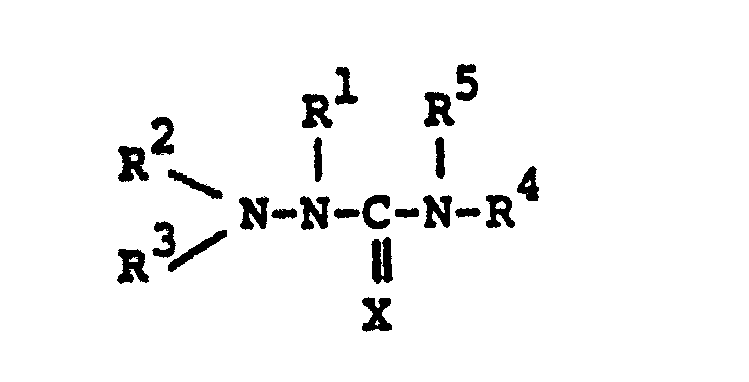
wherein R1 is hydrogen,
and a salt thereof which comprises,
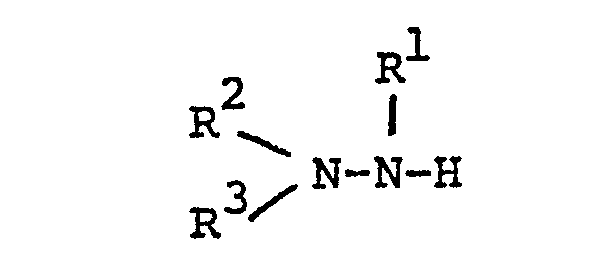
or its salt with a compound of the formula :

or its salt to provide a compound of the formula :

or its salt, in the above formulas,

or its salt with a compound of the formula :

or its reactive derivative or a salt thereof to provide a compound of the formula :
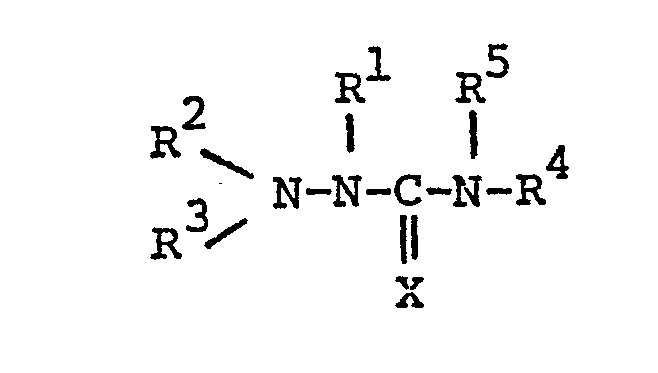
or its salt, in the above formulas,

or its reactive derivative or a salt thereof with a compound of the formula :

or its salt to provide a compound of the formula

or its salt, in the above formulas,

or its salt to provide a compound of the formula :

or its salt, in the above formulas,

or its salt to provide a compound of the formula :

or its salt, in the above formulas,
Priority Applications (1)
| Application Number | Priority Date | Filing Date | Title |
|---|---|---|---|
| AT85108391T ATE52089T1 (en) | 1984-07-09 | 1985-07-06 | SEMICARBAZIDE DERIVATIVES, PROCESS FOR THEIR MANUFACTURE AND PHARMACEUTICALS CONTAINING THEM. |
Applications Claiming Priority (4)
| Application Number | Priority Date | Filing Date | Title |
|---|---|---|---|
| GB848417453A GB8417453D0 (en) | 1984-07-09 | 1984-07-09 | Semicarbazide derivatives |
| GB8417453 | 1984-07-09 | ||
| GB8511553 | 1985-05-07 | ||
| GB858511553A GB8511553D0 (en) | 1985-05-07 | 1985-05-07 | Semicarbazide derivatives |
Publications (3)
| Publication Number | Publication Date |
|---|---|
| EP0168005A2 true EP0168005A2 (en) | 1986-01-15 |
| EP0168005A3 EP0168005A3 (en) | 1986-12-03 |
| EP0168005B1 EP0168005B1 (en) | 1990-04-18 |
Family
ID=26287964
Family Applications (1)
| Application Number | Title | Priority Date | Filing Date |
|---|---|---|---|
| EP85108391A Expired - Lifetime EP0168005B1 (en) | 1984-07-09 | 1985-07-06 | Semicarbazide derivatives, processes for preparation thereof and pharmaceutical composition comprising the same |
Country Status (6)
| Country | Link |
|---|---|
| US (1) | US4694004A (en) |
| EP (1) | EP0168005B1 (en) |
| CA (1) | CA1256434A (en) |
| DE (1) | DE3577199D1 (en) |
| DK (1) | DK300085A (en) |
| ES (3) | ES8609225A1 (en) |
Cited By (2)
| Publication number | Priority date | Publication date | Assignee | Title |
|---|---|---|---|---|
| WO2001056988A1 (en) * | 2000-02-01 | 2001-08-09 | Kirin Beer Kabushiki Kaisha | Nitrogen-containing compounds having kinase inhibitory activity and drugs containing the same |
| EP1557411A4 (en) * | 2002-07-12 | 2011-02-23 | Astellas Pharma Inc | N-phenyl-(2r,5s)dimethylpiperadine derivative |
Families Citing this family (13)
| Publication number | Priority date | Publication date | Assignee | Title |
|---|---|---|---|---|
| US4782071A (en) * | 1986-11-03 | 1988-11-01 | Warner-Lambert Company | Tetrasubstituted urea cholinergic agents |
| WO1999039712A1 (en) * | 1998-02-04 | 1999-08-12 | Euro-Celtique S.A. | Substituted semicarbazides and the use thereof |
| US6476050B2 (en) | 2000-03-14 | 2002-11-05 | Sepracor, Inc. | 3-substituted piperidines comprising urea functionality, and methods of use thereof |
| JP2005506335A (en) * | 2001-10-04 | 2005-03-03 | オーソ−マクニール・フアーマシユーチカル・インコーポレーテツド | N-heterocyclylhydrazide as a neurotrophic agent |
| WO2003055482A1 (en) * | 2001-12-21 | 2003-07-10 | Novo Nordisk A/S | Amide derivatives as gk activators |
| BR0312023A (en) * | 2002-06-27 | 2005-03-22 | Novo Nordisk As | Compound, glucose kinase activating compound, method for preventing hypoglycemia, use of a compound, and pharmaceutical composition |
| JP4834840B2 (en) * | 2004-01-06 | 2011-12-14 | ノヴォ ノルディスク アー/エス | Heteroaryl ureas and their use as glucokinase activators |
| ES2382815T3 (en) * | 2005-07-08 | 2012-06-13 | Novo Nordisk A/S | Dicycloalkylcarbamoyl ureas as glucokinase activators |
| US7884210B2 (en) | 2005-07-14 | 2011-02-08 | Novo Nordisk A/S | Ureido-thiazole glucokinase activators |
| WO2008084043A1 (en) * | 2007-01-09 | 2008-07-17 | Novo Nordisk A/S | Urea glucokinase activators |
| WO2008084044A1 (en) | 2007-01-11 | 2008-07-17 | Novo Nordisk A/S | Urea glucokinase activators |
| CN112040945A (en) | 2018-06-12 | 2020-12-04 | Vtv治疗有限责任公司 | Therapeutic use of a glucokinase activator in combination with insulin or insulin analogs |
| US12391658B2 (en) | 2020-02-18 | 2025-08-19 | Vtv Therapeutics Llc | Sulfoxide and sulfone glucokinase activators and methods of use thereof |
Family Cites Families (4)
| Publication number | Priority date | Publication date | Assignee | Title |
|---|---|---|---|---|
| DE2221812A1 (en) * | 1972-05-04 | 1973-11-15 | Bayer Ag | METHOD FOR MANUFACTURING THIOSEMICARBAZIDEN |
| BE788313A (en) * | 1972-08-22 | 1973-03-01 | Dainippon Pharmaceutical Co | NEW 1,3-DISUBSTITUDE DERIVATIVES OF THIOUREA AND THEIR PREPARATION. |
| US4088653A (en) * | 1976-08-23 | 1978-05-09 | Canadian Patents And Developments Limited | Tetrahydropyridyl derivatives |
| DE3483308D1 (en) * | 1983-11-21 | 1990-10-31 | Fujisawa Pharmaceutical Co | SEMICARBAZIDE DERIVATIVES, METHOD FOR THE PRODUCTION THEREOF AND PHARMACEUTICAL COMPOSITIONS CONTAINING THEM. |
-
1985
- 1985-06-19 US US06/746,510 patent/US4694004A/en not_active Expired - Fee Related
- 1985-06-20 CA CA000484619A patent/CA1256434A/en not_active Expired
- 1985-07-02 DK DK300085A patent/DK300085A/en unknown
- 1985-07-06 EP EP85108391A patent/EP0168005B1/en not_active Expired - Lifetime
- 1985-07-06 DE DE8585108391T patent/DE3577199D1/en not_active Expired - Fee Related
- 1985-07-08 ES ES544963A patent/ES8609225A1/en not_active Expired
-
1986
- 1986-02-28 ES ES552536A patent/ES8800145A1/en not_active Expired
- 1986-02-28 ES ES552537A patent/ES8800142A1/en not_active Expired
Cited By (3)
| Publication number | Priority date | Publication date | Assignee | Title |
|---|---|---|---|---|
| WO2001056988A1 (en) * | 2000-02-01 | 2001-08-09 | Kirin Beer Kabushiki Kaisha | Nitrogen-containing compounds having kinase inhibitory activity and drugs containing the same |
| US7217722B2 (en) | 2000-02-01 | 2007-05-15 | Kirin Beer Kabushiki Kaisha | Nitrogen-containing compounds having kinase inhibitory activity and drugs containing the same |
| EP1557411A4 (en) * | 2002-07-12 | 2011-02-23 | Astellas Pharma Inc | N-phenyl-(2r,5s)dimethylpiperadine derivative |
Also Published As
| Publication number | Publication date |
|---|---|
| ES8800145A1 (en) | 1987-11-01 |
| ES544963A0 (en) | 1986-07-16 |
| CA1256434A (en) | 1989-06-27 |
| DK300085A (en) | 1986-01-10 |
| ES552537A0 (en) | 1987-10-16 |
| EP0168005A3 (en) | 1986-12-03 |
| DK300085D0 (en) | 1985-07-02 |
| US4694004A (en) | 1987-09-15 |
| ES8609225A1 (en) | 1986-07-16 |
| ES8800142A1 (en) | 1987-10-16 |
| DE3577199D1 (en) | 1990-05-23 |
| ES552536A0 (en) | 1987-11-01 |
| EP0168005B1 (en) | 1990-04-18 |
Similar Documents
| Publication | Publication Date | Title |
|---|---|---|
| US4694004A (en) | Semicarbazide derivatives, processes for preparation thereof and pharmaceutical composition comprising the same | |
| US4806536A (en) | Piperazinyl-substituted pyridine and imidazole anti-arrhythmic agents | |
| DE68915225T2 (en) | Benzazole derivatives, processes for their preparation and pharmaceutical compositions containing them. | |
| KR100660309B1 (en) | Cyanophenyl derivative | |
| EP1893609B1 (en) | N-(pyridin-2-yl)-sulfonamide derivatives | |
| EP0343961B1 (en) | Aryl- and heteroaryl piperazinyl carboxamides having central nervous system activity | |
| EP0232740A1 (en) | N-containing fused heterocyclic compounds, processes for the preparation thereof and pharmaceutical compositions comprising the same | |
| EP0117082A2 (en) | Thiazole derivatives, processes for the preparation thereof and pharmaceutical composition comprising the same | |
| EP0125756A2 (en) | Fused imidazole compounds, processes for the preparation thereof and pharmaceutical compositions containing them | |
| EP0224919A2 (en) | New thiazole compounds, processes for the preparation thereof and pharmaceutical composition comprising the same | |
| JPH0318637B2 (en) | ||
| EP0754682A1 (en) | Aminostilbazole derivative and medicine | |
| EP0144853B1 (en) | Semicarbazide derivatives, processes for preparation thereof and pharmaceutical composition comprising the same | |
| EP0034349A2 (en) | Novel pyridinecarboxamide derivatives, a process for the preparation thereof, the use of said derivatives and a pharmaceutical composition containing same | |
| BRPI0616901A2 (en) | compound, pharmaceutical formulation, and use of a compound | |
| EP0436734B1 (en) | New aminopiperazine derivatives | |
| DD255344A5 (en) | HETEROARYL-OXY-BETA-CARBOLINE DERIVATIVES, THEIR PREPARATION AND THEIR USE AS MEDICAMENTS | |
| US4738967A (en) | Imidazoisoquinoline compounds useful as anti-ulcerative agents | |
| JPS63179869A (en) | Piperidine derivative | |
| US6211204B1 (en) | Muscarinic receptor agonists | |
| US4950677A (en) | Benzimidazole derivative compounds and method of making | |
| SK357690A3 (en) | N,n'-bis-/alkoxyalkyl/-pyridine-2,4-dicarboxylic acid diamides, process for their preparation, their use and pharmaceutical composition containing the same | |
| US4564621A (en) | α-Aryl-α-pyridylalkanoic acid derivatives, process for preparation thereof and pharmaceutical composition comprising the same | |
| EP1238974B1 (en) | Heterocycle derivatives and drugs | |
| US4096263A (en) | 1,2,3,4-Tetrahydroisoquinolines and the preparation thereof |
Legal Events
| Date | Code | Title | Description |
|---|---|---|---|
| PUAI | Public reference made under article 153(3) epc to a published international application that has entered the european phase |
Free format text: ORIGINAL CODE: 0009012 |
|
| AK | Designated contracting states |
Designated state(s): AT BE CH DE FR GB IT LI LU NL SE |
|
| PUAL | Search report despatched |
Free format text: ORIGINAL CODE: 0009013 |
|
| AK | Designated contracting states |
Kind code of ref document: A3 Designated state(s): AT BE CH DE FR GB IT LI LU NL SE |
|
| 17P | Request for examination filed |
Effective date: 19870523 |
|
| 17Q | First examination report despatched |
Effective date: 19880812 |
|
| GRAA | (expected) grant |
Free format text: ORIGINAL CODE: 0009210 |
|
| AK | Designated contracting states |
Kind code of ref document: B1 Designated state(s): AT BE CH DE FR GB IT LI LU NL SE |
|
| PG25 | Lapsed in a contracting state [announced via postgrant information from national office to epo] |
Ref country code: SE Effective date: 19900418 Ref country code: NL Effective date: 19900418 Ref country code: BE Effective date: 19900418 Ref country code: AT Effective date: 19900418 |
|
| REF | Corresponds to: |
Ref document number: 52089 Country of ref document: AT Date of ref document: 19900515 Kind code of ref document: T |
|
| REF | Corresponds to: |
Ref document number: 3577199 Country of ref document: DE Date of ref document: 19900523 |
|
| PGFP | Annual fee paid to national office [announced via postgrant information from national office to epo] |
Ref country code: GB Payment date: 19900622 Year of fee payment: 6 |
|
| ET | Fr: translation filed | ||
| ITF | It: translation for a ep patent filed | ||
| PGFP | Annual fee paid to national office [announced via postgrant information from national office to epo] |
Ref country code: FR Payment date: 19900717 Year of fee payment: 6 |
|
| PGFP | Annual fee paid to national office [announced via postgrant information from national office to epo] |
Ref country code: CH Payment date: 19900726 Year of fee payment: 6 |
|
| ITTA | It: last paid annual fee | ||
| PG25 | Lapsed in a contracting state [announced via postgrant information from national office to epo] |
Ref country code: LU Free format text: LAPSE BECAUSE OF NON-PAYMENT OF DUE FEES Effective date: 19900731 |
|
| PGFP | Annual fee paid to national office [announced via postgrant information from national office to epo] |
Ref country code: DE Payment date: 19900731 Year of fee payment: 6 |
|
| NLV1 | Nl: lapsed or annulled due to failure to fulfill the requirements of art. 29p and 29m of the patents act | ||
| PLBE | No opposition filed within time limit |
Free format text: ORIGINAL CODE: 0009261 |
|
| STAA | Information on the status of an ep patent application or granted ep patent |
Free format text: STATUS: NO OPPOSITION FILED WITHIN TIME LIMIT |
|
| 26N | No opposition filed | ||
| PG25 | Lapsed in a contracting state [announced via postgrant information from national office to epo] |
Ref country code: GB Effective date: 19910706 |
|
| PG25 | Lapsed in a contracting state [announced via postgrant information from national office to epo] |
Ref country code: LI Effective date: 19910731 Ref country code: CH Effective date: 19910731 |
|
| GBPC | Gb: european patent ceased through non-payment of renewal fee | ||
| PG25 | Lapsed in a contracting state [announced via postgrant information from national office to epo] |
Ref country code: FR Effective date: 19920331 |
|
| REG | Reference to a national code |
Ref country code: CH Ref legal event code: PL |
|
| PG25 | Lapsed in a contracting state [announced via postgrant information from national office to epo] |
Ref country code: DE Effective date: 19920401 |
|
| REG | Reference to a national code |
Ref country code: FR Ref legal event code: ST |