EP0168041A2 - Instrument pour battre la balle - Google Patents
Instrument pour battre la balle Download PDFInfo
- Publication number
- EP0168041A2 EP0168041A2 EP85108558A EP85108558A EP0168041A2 EP 0168041 A2 EP0168041 A2 EP 0168041A2 EP 85108558 A EP85108558 A EP 85108558A EP 85108558 A EP85108558 A EP 85108558A EP 0168041 A2 EP0168041 A2 EP 0168041A2
- Authority
- EP
- European Patent Office
- Prior art keywords
- ball
- frequency
- minimum value
- mechanical impedance
- striking
- Prior art date
- Legal status (The legal status is an assumption and is not a legal conclusion. Google has not performed a legal analysis and makes no representation as to the accuracy of the status listed.)
- Granted
Links
Images




Classifications
-
- A—HUMAN NECESSITIES
- A63—SPORTS; GAMES; AMUSEMENTS
- A63B—APPARATUS FOR PHYSICAL TRAINING, GYMNASTICS, SWIMMING, CLIMBING, OR FENCING; BALL GAMES; TRAINING EQUIPMENT
- A63B53/00—Golf clubs
- A63B53/04—Heads
-
- A—HUMAN NECESSITIES
- A63—SPORTS; GAMES; AMUSEMENTS
- A63B—APPARATUS FOR PHYSICAL TRAINING, GYMNASTICS, SWIMMING, CLIMBING, OR FENCING; BALL GAMES; TRAINING EQUIPMENT
- A63B53/00—Golf clubs
- A63B53/04—Heads
- A63B53/0466—Heads wood-type
-
- A—HUMAN NECESSITIES
- A63—SPORTS; GAMES; AMUSEMENTS
- A63B—APPARATUS FOR PHYSICAL TRAINING, GYMNASTICS, SWIMMING, CLIMBING, OR FENCING; BALL GAMES; TRAINING EQUIPMENT
- A63B60/00—Details or accessories of golf clubs, bats, rackets or the like
- A63B60/002—Resonance frequency related characteristics
-
- A—HUMAN NECESSITIES
- A63—SPORTS; GAMES; AMUSEMENTS
- A63B—APPARATUS FOR PHYSICAL TRAINING, GYMNASTICS, SWIMMING, CLIMBING, OR FENCING; BALL GAMES; TRAINING EQUIPMENT
- A63B60/00—Details or accessories of golf clubs, bats, rackets or the like
- A63B60/42—Devices for measuring, verifying, correcting or customising the inherent characteristics of golf clubs, bats, rackets or the like, e.g. measuring the maximum torque a batting shaft can withstand
-
- Y—GENERAL TAGGING OF NEW TECHNOLOGICAL DEVELOPMENTS; GENERAL TAGGING OF CROSS-SECTIONAL TECHNOLOGIES SPANNING OVER SEVERAL SECTIONS OF THE IPC; TECHNICAL SUBJECTS COVERED BY FORMER USPC CROSS-REFERENCE ART COLLECTIONS [XRACs] AND DIGESTS
- Y10—TECHNICAL SUBJECTS COVERED BY FORMER USPC
- Y10S—TECHNICAL SUBJECTS COVERED BY FORMER USPC CROSS-REFERENCE ART COLLECTIONS [XRACs] AND DIGESTS
- Y10S273/00—Amusement devices: games
- Y10S273/22—Ionomer
Definitions
- the present invention relates to a ball striking instrument used for ball playing sports.
- the invention will be described with respect to golf game as.an example of ball playing sports.
- clubs are used as ball striking instruments.
- Action of the golf club for striking the golf ball can be summarized as follows:
- the coefficient of restitution is a problem of relation between the golf ball and .
- the golf club nothing has hitherto been described above influence on the coefficient of restitution exerted when the club (club head) collides with (strikes) the golf ball.
- component materials of conventional golf clubs generally used are persimmon wood, ABS plastics, carbon-fiber-reinforced plastics (abbreviated to CFRT in some cases hereinafter), aluminum, and stainless st'eel.
- CFRT carbon-fiber-reinforced plastics
- a conventional view on the component materials is such that the harder, the material, the greater, the rebound of golf ball (the larger, the coefficient of restitution) and the initial speed thereof. Therefore, for example, carbon-fiber- reinforced plastics (CFRP) of higher fiber content, which have been regarded as 'being hard and so having a large coefficient of restitution" are demanded.
- CFRT carbon-fiber-reinforced plastics
- the present invention has broken down a conventional common view as described above and, after experiments repeated many times, revealed a fact that there is an appropriate degree of hardness of ball striking instruments for providing the largest rebound and highest initial speed for the struck ball but an excess of hardness beyond this appropriate degree reduces the rebound of the ball. Further, the invention has disclosed that mechanical impedances of a ball and a ball striking instrument exert influences upon the rebound of the ball.
- An object of the present invention is to provide a ball striking instrument which produces an increased coefficient of restitution at the time of striking a ball and adapts the initial speed of the ball to be close to the maximum - a ball striking instrument capable of sending a ball over a long distance.
- Another object of the present invention is to make it possible to easily design a ball striking instrument having a large coefficient of restitution.
- a mechanical impedance of ball striking part of the instrument takes the minimum value in a region of frequency mearby which a mechanical impedance of the ball takes the minimum value.
- ball striking instrument 1 applies to a golf club 8, tennis racket 9, baseball bat 10, and table-tennis racket 11 to be used for ball playing sports, as shown in Figs. 5A through 5D.
- Fig. 2 shown is a diagram in which frequency N (unit: Hz) of mechanical vibration imparted to striking instruments 1 or a ball is indicated on the abcissa and a value obtained by multiplying the logarithm of absolute value or mechanical impedance Z by 20 is on the ordinate for observing a state of variation in mechanical impedance Z.
- mechanical impedances of the striking instruments la and 1b take primary minimum values at points Pl, the secondary ones at points P2, and the tertiary and the fourth ones at points on the right side outlying from the drawing.
- the struck ball takes the primary and the secondary minimum values at points PI and P2, respectively. (Further, the tertiary and successive minimum values lie outside the drawing.)
- Frequencies at points Pl, P2,...where these primary, secondary,... minimum values appear are so-called primary, secondary,... natural frequencies, which are settled according to (mass ⁇ spring) systems inherent to respective structures as striking instruments and balls.
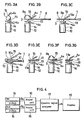
- the reference numeral 12 indicates an electrically-or oil-hydraulically driven type vibrator, and a ball 2 is fixed to the sample setting table 13 of the vibrator.
- a ball striking instrument such as golf club 8, tennis racket 9, baseball bat 10 or table tennis racket 11 is fixed to the setting table 13. That is, a ball striking part 3 among component members of the ball striking instrument 1 is fixed to the setting table 13 and subjected to vibration.
- a ball striking part 3 is a golf club head 8a in Fig. 3B, striking surface 9a for striking the tennis ball in Fig. 3C, a part for directly striking the baseball ball in Fig. 3D (a dotted part 10a -in the drawing), or a blade part lla of the table tennis racket 11.
- a first acceleration pickup 14 is secured to the setting table 13 of the vibrator 12, and a second acceleration pickup 15 to the ball striking part 3 of the striking instrument 1 or the ball 2.
- Acceleration Al of the setting table 13 of the vibrator 12 - external acceleration imparted to the ball striking instrument 1 or the ball - is outputted from the 1st acceleration pickup 14, and inputted into a dynamic signal analyzer 17 through a power unit 16.
- Acceleration A2 of the ball or the ball striking instrument is outputted from the 2nd acceleration pickup 15 and inputted into the dynamic signal analyzer 17 through the other power unit 18.
- the measuring methods using the above-listed measuring apparatus provide an advantage enabling the user to clearly confirm the primary minimum value of mechanical impedance Z.
- a ball striking instrument la shows a primary minimum value in the neighborhood of the lower end of the frequency N satisfying the above formula whereas the other instrument lb shows a primary minimum value in the neighborhood of the upper end.
- frequency regions D are respectively expressed as follows:
- a ball striking instrumet 1 of the present invention is fabricated so that a primary minimum value PI of the mechanical impedance Z may lie in the frequency region satisfying any one of the above formula , , , and .
- a ball striking instrument 1 is fabricated in such a way that the mechanical impedance Z thereof takes a primary minimum value Pl in a region D of frequency corresponding to 70% - 130%, 80% - 120%, 90% - 110%, or 95% - 105% of the frequency Nb at which the mechanical impedance Z of the ball 2 takes a primary minimum value Pl.
- a sufficiently large coefficient of restitution can be obtained at a frequency corresponding to 70% - 130% of Nb, however, the strongest repulsion of ball can be obtained at 95% - 105%.
- Fig. 1 shows results of measurement on golf clubs and a golf ball depending on the same measuring apparatus and the same method as employed in the case shown in Fig. 2, that is , the method of vibration using the vibrator.
- results of measurement of mechanical impedances of conventional golf clubs are shown by fine continuous line II and III in Fig. 1.
- the golf club having the mechanical impedance as indicated by the continuous line II is a conventional wood golf club with a head made of persimmon wood, in which the frequency N corresponding to the primary minimum value P1 is 2,050 Hz.
- Another club having the mechanical impedance as indicated by the continuous line III is a conventional wood golf club with a head made of CFRP, in which the frequency corresponding to the primary minimum value Pl is 2,225Hz. Accordingly, the frequency at which the mechanical impedance Z of the conventional type golf club takes a primary minimum value PI is far distant from the region D of frequency in the vicinity of frequency at which the mechanical impedance Z of the golf ball takes a primary minimum value Pl.
- a minimum value Pl of the mechanical impedance of this golf club lies in the frequency region D in Fig. 1 drawn so as to satisfy the formula
- Results of comparing the performance of a golf club (referred to as I) of the present invention with those of a conventional club with persimmon head ( II) and another conventional club with carbon head (III) shown in Fig. 1 are listed in Table 2.
- a two-component golf ball (covered with ionomer synthetic resin) was used for test shot.
- a club according to the present invention is fabricated so that a primary minimum value Pl may appear in a region of frequency comparatively low as ranging from 600 to 1,600 Hz in condition of the primary minimum value of mechanical impedance Z of various kinds of golf balls.
- a golf club is such that, with reference to Fig. 6, when assuming a cutting line a - b which passes through the center 5 of the ball striking face 4 and extends perpendicularly with respect to the face 4 and dividing the club head 8a into three parts with two planes La and Lb which pass through two points Qa and Qb dividing the line a - b into three equal segments and extend perpendicularly to the line a - b, the center of gravity G of the club head 8a lies in a position near the plane La.
- a golf club is fabricated so that the center of gravity G of the head thereof may lie distant from the striking face 4 by a length equal to one-thirds of the total length of the segment over the head and a ratio of mass between three divided parts may be as follows:
- a material having a spring constant k markedly lower than those ever employed as an insert 7 for the striking face 4.
- an insert 7 having a thickness t ⁇ 8n, width W ⁇ 40 n, height H ⁇ 40 n, and spring constant k ⁇ 11,000 kg/ cm when compression is exerted on an area of 20n diameter has been used.
- a golf club having a primary minimum value Pl of mechanical impedance which appears at a specified frequency within the range from 600 to 1,600 Hz - a golf club having the primary natural frequency (resonance frequency ) - can be obtained by the use of a material of insert 7 having a spring constant k significantly lower than those of conventional ABS plastics, laminated board of carbon-fiber -reinforced plastics (CFRP), or metallic plate such as aluminum.
- CFRP carbon-fiber -reinforced plastics
- a structure as above is advantageous for maintaining mass distribution in and the configuration of the conventional golf club as they are.
- the mechanical impedance of a body is governed by mass distribution, spring constant, and damping coefficient of the body, it is also possible to compose the whole of a golf club by varying the distribution of spring constants of masses M2 and M3 shown in Fig. 6, distribution of masses themselves, or kind of material and structure so that the primary minumum value may appear in a region of frequency ranging from 600 to 1,600 Hz. It is preferable to adjust the spring constant by the use of engineering plastics such as polycarbonate as a material of insert for adapting the golf club to show a primary minumum value Pl in the same way as above.
- a mechanical impedance Z of the ball striking part 3 is measured while the entire body of a golf club 8 for making up a structure in which the mechanical-impedance Z takes a primary minimum value in a specified frequency region D, however, there is another preferred way to vibrate only the ball striking part 3 - a club head 8a - for measuring a mechanical impedance Z and to make up a structure in which the mechanical impedance takes a primary minimum value PI is a specified frequency region D.
- the mechanical impedance Z thereof takes a primary minimum value PI in a region of frequency ranging from 110 to 500 Hz after vibrating the entire body of racket 9 by means of the vibrator 12 as shown in Fig. 3c (or only the ball striking face, not shown in the drawing) for measurement as shown in Fig. 4.
- the mechanical impedance Z takes a primary minimum value Pl in a region of frequency ranging from 110 to 500 Hz when the bat 10 is vibrated by the vibrator 12 and the mechanical impedance is measured as shown in Fig. 4.
- the table tennis racket 11 it is advantageous for the table tennis racket 11 to set mass distribution and spring constant so that the mechanical impedance Z takes a primary minimum value Pl in a region of frequency ranging from 110 to 500 Hz when the entire body of the racket 11 is vibrated as shown in Fig. 3E or only the blade part is vibrated as shown in Fig. 3G and subjected to measurement as shown in Fig. 4.
- FIGs. 9A, 9B, 9C, and Fig. 10 Another method of measuring the mechanical impedance Z is shown in Figs. 9A, 9B, 9C, and Fig. 10.
- the reference numeral 20 represents an impact hammer which strikes a ball 2 or a ball striking instrument suspended by a thin thread 21 or the like.
- a force pickup 22 for sensing impact force is provided for the impact part 20a of the impact hammer 20.
- a golf club 8 as a ball striking instrument 1 is shown, and the whole of the golf club or only the head 8a as the main part (striking part) of the club is suspended as shown in Fig. 9B or 9C, respectively, the face of the club head 8a being impacted directly with the impact hammer 20.
- An acceleration pickup 15 is fixed to a ball 2 and a striking part 3.
- the force Fl applied by the hammer 20 - the external force acting on the ball 2 or the striking part 3 - is outputted while turned into electric signal to be inputted into the dynamic signal analyzer 17 through the power unit 16.
- acceleration A2 transformed into electric signal is outputted (in the same way as the vibration method by the use of the vibrator as described with reference to Fig. 4) and also inputted into the abovesaid dynamic signal analyzer 17 through another power unit 18.
- a graph as shown in Fig. 8 is obtained.
- the impact hammer 20 used for testing is made by PCB Corporation and of Type 208A03, the dynamic signal analyzer 17, power units 16 and 18, and pickups 15 and 22 being made by the same maker and of the same type as those referred to in Table 1 describing the vibration method.
- Fig. 8 shows results of measuring the mechanical impedance Z of the golf club 8 and golf ball 2 obtained by the impact method.
- the golf ball has the mechanical impedance whose minimum val-ues Pl appear at two to five points in a region of frequency ranging from 0 to 10,000 Hz.
- a primary minimum value Pi by the impact method - a value corresponding to the secondary minumum value by the vibration method - appears at a frequency N ranging from about 2,000 to 4,000 Hz.
- mass distribution, spring constant, and attenuation constant of the club head and club shaft are determined so that a minimum values Pi may appear, as shown by continuous lines Ii and Ii' in a region of frequency ranging from 1,500 to 8,000 Hz, preferably from 2,000 to 6,000 Hz.
- a minimum value of golf ball appearing at a frequency from about 3,000 to 4,000 Hz when measured by the impact method the best way is to fabricate a wood type golf club so that a minimum value Pi may appear in a region of frequency ranging from 2,000 to 4,500 Hz.
- Table 3 shows results of comparison between materials of club heads, kinds of inserts, and functions of golf club Ii and Ii' of the present invention and conventional clubs II i -and III i.
- the ball used for testing was a two-component ball covered with ionomer plastics and having characteristics shown by the broken line in Fig. 8.
- a golf club after performing measurement only at the ball striking part 3 - club head 8 - by the impact method, so that a minimum value Pl of the mechanical impedance Z may appear in the abovesaid region of specified frequency.
- the present invention applies to ball striking instruments for sporting other than the foregoing, for example, the stick for (ice) hockey, croquet, and mallet.
Landscapes
- Health & Medical Sciences (AREA)
- General Health & Medical Sciences (AREA)
- Physical Education & Sports Medicine (AREA)
- Life Sciences & Earth Sciences (AREA)
- Biophysics (AREA)
- Engineering & Computer Science (AREA)
- Wood Science & Technology (AREA)
- Golf Clubs (AREA)
Applications Claiming Priority (4)
| Application Number | Priority Date | Filing Date | Title |
|---|---|---|---|
| JP59143929A JPS6122874A (ja) | 1984-07-10 | 1984-07-10 | 打球具 |
| JP143929/84 | 1984-07-10 | ||
| JP60127752A JPS61284265A (ja) | 1985-06-12 | 1985-06-12 | 打球具 |
| JP127752/85 | 1985-06-12 |
Publications (3)
| Publication Number | Publication Date |
|---|---|
| EP0168041A2 true EP0168041A2 (fr) | 1986-01-15 |
| EP0168041A3 EP0168041A3 (en) | 1987-08-26 |
| EP0168041B1 EP0168041B1 (fr) | 1990-06-20 |
Family
ID=26463633
Family Applications (1)
| Application Number | Title | Priority Date | Filing Date |
|---|---|---|---|
| EP85108558A Expired - Lifetime EP0168041B1 (fr) | 1984-07-10 | 1985-07-10 | Instrument pour battre la balle |
Country Status (3)
| Country | Link |
|---|---|
| US (1) | US4928965A (fr) |
| EP (1) | EP0168041B1 (fr) |
| DE (1) | DE3578314D1 (fr) |
Cited By (4)
| Publication number | Priority date | Publication date | Assignee | Title |
|---|---|---|---|---|
| EP0317711A3 (en) * | 1987-08-04 | 1990-05-16 | Wilson Sporting Goods Company | Racket for playing a game with a ball |
| GB2309391A (en) * | 1996-01-24 | 1997-07-30 | Cadcam Tech Ltd | Sports bats |
| EP0923963A4 (fr) * | 1997-04-16 | 2004-07-14 | Sumitomo Rubber Ind | Tete de canne de golf |
| US7137906B2 (en) | 2001-12-28 | 2006-11-21 | Sri Sports Limited | Golf club head |
Families Citing this family (69)
| Publication number | Priority date | Publication date | Assignee | Title |
|---|---|---|---|---|
| GB8909376D0 (en) * | 1989-04-25 | 1989-06-14 | Wright Charles W | Improved golf club |
| US5796005A (en) * | 1991-06-12 | 1998-08-18 | Frolow; Jack L. | Flex meter for sports game implements |
| FR2687920B1 (fr) * | 1992-02-27 | 1994-05-06 | Taylor Made Golf Cy Inc | Perfectionnement pour tete de club de golf et procedes pour sa realisation. |
| US5271621A (en) * | 1993-01-26 | 1993-12-21 | Lo Kun Nan | Golf club head |
| US5763770A (en) * | 1995-12-29 | 1998-06-09 | Berkley Inc. | Design of golf clubs with node line mapping |
| US6334818B1 (en) | 1996-09-06 | 2002-01-01 | Acushnet Company | Golf club head with an insert on the striking surface |
| US6231458B1 (en) | 1996-09-06 | 2001-05-15 | Acushnet Company | Golf club head with an insert on the striking surface |
| US5944619A (en) * | 1996-09-06 | 1999-08-31 | Acushnet Company | Golf club with an insert on the striking surface |
| JP3428899B2 (ja) | 1997-07-09 | 2003-07-22 | 明久 井上 | ゴルフクラブ |
| JP3662394B2 (ja) * | 1997-09-02 | 2005-06-22 | 住友ゴム工業株式会社 | ゴルフボール |
| US6322463B1 (en) * | 1999-07-07 | 2001-11-27 | Composites Design Services, Llc | Method of tuning a bat and a tuned bat |
| WO2001008757A2 (fr) | 1999-07-28 | 2001-02-08 | Taylor Made Golf Company, Inc. | Tete de club de golf surdimensionnee de type bois |
| US6348015B1 (en) | 2000-03-14 | 2002-02-19 | Callaway Golf Company | Golf club head having a striking face with improved impact efficiency |
| US8517858B2 (en) * | 2000-04-18 | 2013-08-27 | Acushnet Company | Metal wood club |
| US7682262B2 (en) * | 2000-04-18 | 2010-03-23 | Acushnet Company | Metal wood club with improved hitting face |
| US7041003B2 (en) * | 2000-04-18 | 2006-05-09 | Acushnet Company | Golf club head with variable flexural stiffness for controlled ball flight and trajectory |
| US7704162B2 (en) | 2000-04-18 | 2010-04-27 | Acushnet Company | Metal wood club with improved hitting face |
| US7207898B2 (en) * | 2000-04-18 | 2007-04-24 | Acushnet Company | Metal wood club with improved hitting face |
| US6605007B1 (en) | 2000-04-18 | 2003-08-12 | Acushnet Company | Golf club head with a high coefficient of restitution |
| US7935001B2 (en) * | 2000-04-18 | 2011-05-03 | Acushnet Company | Composite metal wood club |
| US7029403B2 (en) * | 2000-04-18 | 2006-04-18 | Acushnet Company | Metal wood club with improved hitting face |
| US7367899B2 (en) * | 2000-04-18 | 2008-05-06 | Acushnet Company | Metal wood club with improved hitting face |
| US7214142B2 (en) * | 2000-04-18 | 2007-05-08 | Acushnet Company | Composite metal wood club |
| US7261643B2 (en) * | 2000-04-18 | 2007-08-28 | Acushnet Company | Metal wood club with improved hitting face |
| JP3708792B2 (ja) * | 2000-05-12 | 2005-10-19 | 明久 井上 | ゴルフクラブヘッド |
| US6461260B1 (en) | 2000-05-15 | 2002-10-08 | Worth, Inc. | Composite wrap bat |
| US6761653B1 (en) | 2000-05-15 | 2004-07-13 | Worth, Llc | Composite wrap bat with alternative designs |
| US6524194B2 (en) | 2001-01-18 | 2003-02-25 | Acushnet Company | Golf club head construction |
| JP3694718B2 (ja) * | 2001-03-08 | 2005-09-14 | Sriスポーツ株式会社 | ゴルフボール |
| US6527648B2 (en) * | 2001-04-04 | 2003-03-04 | Callaway Golf Company | Measurement of the coefficient of restitution of a golf club |
| US6585605B2 (en) * | 2001-04-04 | 2003-07-01 | Callaway Golf Company | Measurement of the coefficient of restitution of a golf club |
| US6532818B2 (en) * | 2001-04-16 | 2003-03-18 | Karsten Manufacturing Corporation | Method and apparatus for measuring a vibrational characteristic of a golf club shaft |
| JP3739668B2 (ja) * | 2001-05-10 | 2006-01-25 | 横浜ゴム株式会社 | ゴルフクラブヘッドの反発特性評価方法およびゴルフクラブ |
| US6824475B2 (en) | 2001-07-03 | 2004-11-30 | Taylor Made Golf Company, Inc. | Golf club head |
| US20030027662A1 (en) * | 2001-08-03 | 2003-02-06 | Werner Frank D. | Optimally elastic golf club head |
| DE10200745A1 (de) * | 2002-01-10 | 2003-11-13 | Ignatius Georg | Racket zur Beaufschlagung von Tennisbällen und ähnlichen Spielkörpern |
| NL1020131C1 (nl) * | 2002-03-07 | 2003-09-10 | Govert De Vries | Werkwijze en inrichting voor het meten en presenteren van parameters bij het met behulp van een slagwerktuig slaan tegen een te verplaatsen voorwerp. |
| KR100951539B1 (ko) * | 2002-04-11 | 2010-04-08 | 요코하마 고무 가부시키가이샤 | 골프 클럽 헤드의 품질 평가방법, 골프 클럽 헤드의 품질관리방법, 골프 클럽 헤드의 제조방법과 골프 클럽 헤드,및 골프 클럽의 제조방법과 골프 클럽 |
| US7086961B2 (en) * | 2002-05-20 | 2006-08-08 | Karsten Manufacturing Corporation | Methods and apparatus for using a frequency-selectable insert in a golf club head |
| JP4116336B2 (ja) * | 2002-06-07 | 2008-07-09 | Sriスポーツ株式会社 | ゴルフクラブヘッド |
| JP4318437B2 (ja) * | 2002-08-06 | 2009-08-26 | Sriスポーツ株式会社 | ゴルフクラブヘッド |
| JP2004215703A (ja) * | 2003-01-09 | 2004-08-05 | Sumitomo Rubber Ind Ltd | ゴルフボール |
| JP2004236824A (ja) * | 2003-02-05 | 2004-08-26 | Sumitomo Rubber Ind Ltd | ゴルフクラブヘッド |
| JP3974055B2 (ja) * | 2003-03-07 | 2007-09-12 | Sriスポーツ株式会社 | ゴルフクラブヘッド |
| JP4415603B2 (ja) * | 2003-04-11 | 2010-02-17 | 横浜ゴム株式会社 | ゴルフクラブヘッドの反発特性評価方法および反発特性評価装置 |
| US8342982B2 (en) * | 2003-05-01 | 2013-01-01 | Acushnet Company | Metal wood club with improved hitting face |
| JP2005261754A (ja) * | 2004-03-19 | 2005-09-29 | Sri Sports Ltd | ゴルフボール |
| US7127933B2 (en) * | 2004-08-10 | 2006-10-31 | Acushnet Company | High speed resiliometer |
| US7510486B2 (en) * | 2004-09-30 | 2009-03-31 | Origin, Inc. | Elastic golf club head |
| US7549934B2 (en) * | 2005-09-07 | 2009-06-23 | Acushnet Company | Metal wood club with improved hitting face |
| US8439769B2 (en) * | 2005-09-07 | 2013-05-14 | Acushnet Company | Metal wood club with improved hitting face |
| JP2007117472A (ja) * | 2005-10-28 | 2007-05-17 | Bridgestone Sports Co Ltd | パターヘッド |
| JP4643417B2 (ja) * | 2005-10-31 | 2011-03-02 | ブリヂストンスポーツ株式会社 | パターヘッド |
| JP4909589B2 (ja) * | 2005-12-28 | 2012-04-04 | ブリヂストンスポーツ株式会社 | ゴルフクラブヘッド |
| CA2538690A1 (fr) * | 2006-02-23 | 2007-08-23 | Alan Neil Harpham | Cylindre de baton de golf a masse dynamique |
| US7641568B2 (en) * | 2006-11-30 | 2010-01-05 | Taylor Made Golf Company, Inc. | Golf club head having ribs |
| US7575524B2 (en) * | 2006-12-06 | 2009-08-18 | Taylor Made Golf Company, Inc. | Golf clubs and club-heads comprising a face plate having a central recess and flanking recesses |
| US8172694B2 (en) * | 2007-11-08 | 2012-05-08 | Acushnet Company | Golf club head comprising a piezoelectric sensor |
| US8534121B2 (en) * | 2007-11-08 | 2013-09-17 | Acushnet Company | Golf club comprising a piezoelectric sensor |
| US7914393B2 (en) * | 2008-05-30 | 2011-03-29 | Cobra Golf, Inc. | Golf club head with sound tuning |
| US8007369B2 (en) * | 2008-12-15 | 2011-08-30 | Cobra Golf, Inc. | Golf club head with stiffening and sound tuning composite member |
| JP5312930B2 (ja) * | 2008-12-19 | 2013-10-09 | ブリヂストンスポーツ株式会社 | ゴルフクラブヘッド |
| US9162115B1 (en) | 2009-10-27 | 2015-10-20 | Taylor Made Golf Company, Inc. | Golf club head |
| US20110183776A1 (en) * | 2010-01-27 | 2011-07-28 | Breier Joshua G | Golf club head with sound tuning |
| US8784234B2 (en) * | 2010-07-27 | 2014-07-22 | Sri Sports Limited | Golf club head with a body-conforming weight member |
| EP2951329A1 (fr) | 2013-01-29 | 2015-12-09 | Glassimetal Technology Inc. | Club de golf fabriqué à partir de verres métalliques massifs ayant une ténacité élevée et une rigidité élevée |
| US9433835B2 (en) | 2013-04-01 | 2016-09-06 | Acushnet Company | Golf club head with improved striking face |
| US9283448B2 (en) | 2013-08-20 | 2016-03-15 | Nike Inc. | Golf club head with polymeric face |
| JP7000918B2 (ja) * | 2018-02-28 | 2022-01-19 | 住友ゴム工業株式会社 | ゴルフクラブヘッド |
Family Cites Families (8)
| Publication number | Priority date | Publication date | Assignee | Title |
|---|---|---|---|---|
| US3945646A (en) * | 1974-12-23 | 1976-03-23 | Athletic Swing Measurement, Inc. | Athletic swing measurement system and method |
| US4291574A (en) * | 1976-01-05 | 1981-09-29 | Frolow Jack L | Tennis racket |
| US4070022A (en) * | 1976-04-14 | 1978-01-24 | Con-Sole Golf Corporation | Matched golf shafts and clubs |
| GB2056288B (en) * | 1979-08-22 | 1983-02-02 | Soong Tsai C | Long string racket |
| JPS5922162U (ja) * | 1982-07-30 | 1984-02-10 | 住友ゴム工業株式会社 | ゴルフ用パタ− |
| US4792140A (en) * | 1983-03-28 | 1988-12-20 | Sumitomo Rubber Industries, Ltd. | Iron type golf club head |
| JPS6031772A (ja) * | 1983-07-29 | 1985-02-18 | 住友ゴム工業株式会社 | ゴルフクラブヘツド |
| DE8427999U1 (de) * | 1984-09-22 | 1987-03-26 | Kuebler, Siegfried, 7770 Überlingen | Schläger für Spiele mit begrenzt elastischem Ball |
-
1985
- 1985-07-10 EP EP85108558A patent/EP0168041B1/fr not_active Expired - Lifetime
- 1985-07-10 DE DE8585108558T patent/DE3578314D1/de not_active Expired - Lifetime
-
1988
- 1988-04-14 US US07/181,523 patent/US4928965A/en not_active Expired - Lifetime
Cited By (8)
| Publication number | Priority date | Publication date | Assignee | Title |
|---|---|---|---|---|
| EP0317711A3 (en) * | 1987-08-04 | 1990-05-16 | Wilson Sporting Goods Company | Racket for playing a game with a ball |
| GB2309391A (en) * | 1996-01-24 | 1997-07-30 | Cadcam Tech Ltd | Sports bats |
| US5816963A (en) * | 1996-01-24 | 1998-10-06 | Cadcam Technology Limited | Sports bats |
| GB2309391B (en) * | 1996-01-24 | 1999-05-26 | Cadcam Tech Ltd | Sports bats |
| AU718467B2 (en) * | 1996-01-24 | 2000-04-13 | Cadcam Technology Limited | Sports bats |
| EP0923963A4 (fr) * | 1997-04-16 | 2004-07-14 | Sumitomo Rubber Ind | Tete de canne de golf |
| US7086963B1 (en) | 1997-04-16 | 2006-08-08 | Sri Sports Limited | Golf club head |
| US7137906B2 (en) | 2001-12-28 | 2006-11-21 | Sri Sports Limited | Golf club head |
Also Published As
| Publication number | Publication date |
|---|---|
| EP0168041B1 (fr) | 1990-06-20 |
| EP0168041A3 (en) | 1987-08-26 |
| DE3578314D1 (de) | 1990-07-26 |
| US4928965A (en) | 1990-05-29 |
Similar Documents
| Publication | Publication Date | Title |
|---|---|---|
| EP0168041B1 (fr) | Instrument pour battre la balle | |
| US6165081A (en) | Golf club head for controlling launch velocity of a ball | |
| US6224497B1 (en) | Golf club head with improved frequency matched ball striking face characteristics | |
| US4398965A (en) | Method of making iron golf clubs with flexible impact surface | |
| US7241230B2 (en) | Golf club head and method of making the same | |
| US3387844A (en) | Golf club with percussion chamber plenum | |
| US5143571A (en) | Method of molding a golf club head | |
| US4609194A (en) | Vibration dampening device for sporting rackets | |
| US3722887A (en) | Correlated set of clubs with indicator line | |
| US4941666A (en) | Golf club, set of golf clubs, and method of producing the same | |
| Haake et al. | The dynamic impact characteristics of tennis balls with tennis rackets | |
| US4776590A (en) | Vibration dampening device for sporting rackets | |
| US5804707A (en) | Dynamic hardness testing using measurement of the scarton dynamic hardness (SDH) | |
| Roberts et al. | Measurement of contact time in short duration sports ball impacts: an experimental method and correlation with the perceptions of elite golfers | |
| KR102607123B1 (ko) | 강화된 클럽 헤드 페이스를 갖는 클럽 헤드 및 관련 방법 | |
| GB2321855A (en) | Ball striking device | |
| US9358435B2 (en) | Vibration modes of faces for golf club heads or other ball striking devices | |
| AU718467B2 (en) | Sports bats | |
| JP2651565B2 (ja) | 打球具 | |
| JPS61284265A (ja) | 打球具 | |
| US4635935A (en) | Audible-physical coordination racket | |
| US6183374B1 (en) | Golf club | |
| JP3738276B2 (ja) | テニスラケットフレーム | |
| Sutton et al. | Using vibrational analysis to investigate the batted-ball performance of baseball bats | |
| Noble | Inertial and vibrational characteristics of softball and baseball bats: Research and design implications |
Legal Events
| Date | Code | Title | Description |
|---|---|---|---|
| PUAI | Public reference made under article 153(3) epc to a published international application that has entered the european phase |
Free format text: ORIGINAL CODE: 0009012 |
|
| AK | Designated contracting states |
Designated state(s): DE FR GB |
|
| PUAL | Search report despatched |
Free format text: ORIGINAL CODE: 0009013 |
|
| AK | Designated contracting states |
Kind code of ref document: A3 Designated state(s): DE FR GB |
|
| 17P | Request for examination filed |
Effective date: 19871208 |
|
| 17Q | First examination report despatched |
Effective date: 19881222 |
|
| GRAA | (expected) grant |
Free format text: ORIGINAL CODE: 0009210 |
|
| AK | Designated contracting states |
Kind code of ref document: B1 Designated state(s): DE FR GB |
|
| ET | Fr: translation filed | ||
| REF | Corresponds to: |
Ref document number: 3578314 Country of ref document: DE Date of ref document: 19900726 |
|
| PLBE | No opposition filed within time limit |
Free format text: ORIGINAL CODE: 0009261 |
|
| STAA | Information on the status of an ep patent application or granted ep patent |
Free format text: STATUS: NO OPPOSITION FILED WITHIN TIME LIMIT |
|
| 26N | No opposition filed | ||
| REG | Reference to a national code |
Ref country code: GB Ref legal event code: IF02 |
|
| PGFP | Annual fee paid to national office [announced via postgrant information from national office to epo] |
Ref country code: GB Payment date: 20040707 Year of fee payment: 20 |
|
| PGFP | Annual fee paid to national office [announced via postgrant information from national office to epo] |
Ref country code: FR Payment date: 20040708 Year of fee payment: 20 |
|
| PGFP | Annual fee paid to national office [announced via postgrant information from national office to epo] |
Ref country code: DE Payment date: 20040722 Year of fee payment: 20 |
|
| PG25 | Lapsed in a contracting state [announced via postgrant information from national office to epo] |
Ref country code: GB Free format text: LAPSE BECAUSE OF EXPIRATION OF PROTECTION Effective date: 20050709 |
|
| REG | Reference to a national code |
Ref country code: GB Ref legal event code: PE20 |