EP0168049A2 - Profil für Roll-, Sektional- oder dergleichen Tore - Google Patents
Profil für Roll-, Sektional- oder dergleichen Tore Download PDFInfo
- Publication number
- EP0168049A2 EP0168049A2 EP85108606A EP85108606A EP0168049A2 EP 0168049 A2 EP0168049 A2 EP 0168049A2 EP 85108606 A EP85108606 A EP 85108606A EP 85108606 A EP85108606 A EP 85108606A EP 0168049 A2 EP0168049 A2 EP 0168049A2
- Authority
- EP
- European Patent Office
- Prior art keywords
- profile
- curvature
- jacket
- profile according
- profiles
- Prior art date
- Legal status (The legal status is an assumption and is not a legal conclusion. Google has not performed a legal analysis and makes no representation as to the accuracy of the status listed.)
- Granted
Links
- 238000005096 rolling process Methods 0.000 claims abstract description 9
- 230000001154 acute effect Effects 0.000 claims description 3
- 239000006260 foam Substances 0.000 claims 1
- 229910000831 Steel Inorganic materials 0.000 abstract 1
- 239000010959 steel Substances 0.000 abstract 1
- 230000006378 damage Effects 0.000 description 5
- 208000027418 Wounds and injury Diseases 0.000 description 3
- 208000014674 injury Diseases 0.000 description 3
- 230000007704 transition Effects 0.000 description 2
- 238000011161 development Methods 0.000 description 1
- 230000018109 developmental process Effects 0.000 description 1
- 239000000428 dust Substances 0.000 description 1
- 230000007257 malfunction Effects 0.000 description 1
- 238000003801 milling Methods 0.000 description 1
Images


Classifications
-
- E—FIXED CONSTRUCTIONS
- E06—DOORS, WINDOWS, SHUTTERS, OR ROLLER BLINDS IN GENERAL; LADDERS
- E06B—FIXED OR MOVABLE CLOSURES FOR OPENINGS IN BUILDINGS, VEHICLES, FENCES OR LIKE ENCLOSURES IN GENERAL, e.g. DOORS, WINDOWS, BLINDS, GATES
- E06B3/00—Window sashes, door leaves, or like elements for closing wall or like openings; Layout of fixed or moving closures, e.g. windows in wall or like openings; Features of rigidly-mounted outer frames relating to the mounting of wing frames
- E06B3/32—Arrangements of wings characterised by the manner of movement; Arrangements of movable wings in openings; Features of wings or frames relating solely to the manner of movement of the wing
- E06B3/48—Wings connected at their edges, e.g. foldable wings
- E06B3/485—Sectional doors
-
- E—FIXED CONSTRUCTIONS
- E06—DOORS, WINDOWS, SHUTTERS, OR ROLLER BLINDS IN GENERAL; LADDERS
- E06B—FIXED OR MOVABLE CLOSURES FOR OPENINGS IN BUILDINGS, VEHICLES, FENCES OR LIKE ENCLOSURES IN GENERAL, e.g. DOORS, WINDOWS, BLINDS, GATES
- E06B9/00—Screening or protective devices for wall or similar openings, with or without operating or securing mechanisms; Closures of similar construction
- E06B9/02—Shutters, movable grilles, or other safety closing devices, e.g. against burglary
- E06B9/08—Roll-type closures
- E06B9/11—Roller shutters
- E06B9/15—Roller shutters with closing members formed of slats or the like
-
- E—FIXED CONSTRUCTIONS
- E06—DOORS, WINDOWS, SHUTTERS, OR ROLLER BLINDS IN GENERAL; LADDERS
- E06B—FIXED OR MOVABLE CLOSURES FOR OPENINGS IN BUILDINGS, VEHICLES, FENCES OR LIKE ENCLOSURES IN GENERAL, e.g. DOORS, WINDOWS, BLINDS, GATES
- E06B9/00—Screening or protective devices for wall or similar openings, with or without operating or securing mechanisms; Closures of similar construction
- E06B9/02—Shutters, movable grilles, or other safety closing devices, e.g. against burglary
- E06B9/08—Roll-type closures
- E06B9/11—Roller shutters
- E06B9/15—Roller shutters with closing members formed of slats or the like
- E06B2009/1533—Slat connections
- E06B2009/1538—Slats directly connected
- E06B2009/1544—Engaging section has curved articulation surfaces
-
- E—FIXED CONSTRUCTIONS
- E06—DOORS, WINDOWS, SHUTTERS, OR ROLLER BLINDS IN GENERAL; LADDERS
- E06B—FIXED OR MOVABLE CLOSURES FOR OPENINGS IN BUILDINGS, VEHICLES, FENCES OR LIKE ENCLOSURES IN GENERAL, e.g. DOORS, WINDOWS, BLINDS, GATES
- E06B9/00—Screening or protective devices for wall or similar openings, with or without operating or securing mechanisms; Closures of similar construction
- E06B9/02—Shutters, movable grilles, or other safety closing devices, e.g. against burglary
- E06B9/08—Roll-type closures
- E06B9/11—Roller shutters
- E06B9/15—Roller shutters with closing members formed of slats or the like
- E06B2009/1533—Slat connections
- E06B2009/155—Slats connected by separate elements
- E06B2009/1566—Rigid elements, e.g. hinges, hooks or profiles
Definitions
- the invention relates to a profile with a joint according to the preamble of the main claim.
- the profiles located in the goal plane also have a certain amount of play from one another, so that in this area there are columns with a rectangular cross section in contrast to the columns with an angular cross section between the profiles of the rolled-up tank.
- the invention has for its object to provide a generic profile susceptible to interference and at the joints so that the risk of injury is eliminated. This object is achieved according to the invention by the subject matter of claim 1.
- the profiles located in the gate plane are also free of play with respect to one another, i.e. without relative movement to one another, because the two straight lines of the centers of curvature - the radii of curvature of the two lateral surfaces - coincide with the hinge axis of each hinge point.
- the profile denoted overall by 5 in FIG. 1 has on its upper side 6 and its lower side 7 an articulation point 9 which extends over the entire width of the door. Furthermore, the profile 5 has an outwardly directed outer side 10 and an inner side 11.
- the articulation point 8 on the top 6 is designed as a vertical circular cylinder 12 with an outer jacket 13.
- the articulation point 9 of the underside 7 is also a vertical circular cylinder 12.
- inwardly directed jacket 15 formed.
- the radius of curvature 16 of the upper jacket 13 and the radius of curvature 17 of the lower jacket 15 are the same size.
- the centers of curvature 18 and 19 of the upper and lower casing 13 and 15 are at the same vertical distance from the outside 10 of the profile 5.
- the two straight lines formed by the centers of curvature 18 and 19 coincide with the articulation axis (cf. FIGS. 2 and 3) of each articulation point 8 and 9.
- the straight line is also arranged closer to the outside 10 than to the inside 11.
- the circular cylinder part 12 of the upper articulation point 8 has a flattening 20 which runs parallel to the outside 10 of the profile 5 and is set back towards the inside 11 by a maximum of the radius of curvature 16, which corresponds to approximately half a finger's thickness.
- the circular part cylinder 12 on the upper side 6 has a cam 21 which projects beyond the plane of the jacket 13 and is also designed as a circular part cylinder, the larger radius of curvature of which coincides with the center of curvature 18 of the radius of curvature 16.
- the hinge point 9 on the underside 7 has an inwardly directed jacket 22 with a larger radius of curvature than the radius of curvature 17 for the cam 21 of the next adjacent lower profile, which is not shown, but whose center of curvature coincides with the center of curvature 19 of the radius of curvature 7.
- the cam 21 and the inwardly directed jacket 22 determine the maximum angle at which two adjacent profiles 5 roll onto the armor 24 (FIG. 3) when rolling up from the door plane 23 (FIG. 2), which is formed from the outer sides 10 of the profiles 5 ) results.
- the area 25 adjoining the articulation points 8 or 9 on the upper side 6 or on the lower side 7 is a - flat - mounting surface for hinges 26, forms and forms an acute angle 27 with the front side.
- the angles of the hinges can preferably be fixed to the mounting surface 25 by means of screws (not shown), which for this reason has a thicker wall.
- the hinges 26 are inserted into the milling of the circular cylinder 12 of the joint 8 on the top 6 of the profile 5. A plurality of hinges 26 spaced apart from one another are inserted over the entire width of the profile 5.
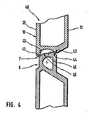
- Figure 4 shows an alternative embodiment.
- the underside 7 of the profile 40 has two mutually concentric vertical circular part cylinders 41, 42 with different diameters to form a shoulder 43.
- the upper side 6 of the profile 40 which is arranged next to one another next to it, has two circular part cylinders 44, 45 which are concentric with one another, forming a shoulder 46, these two paragraphs serving as stops or counterstops and defining the maximum pivoting angle between two adjacent profiles.
Landscapes
- Engineering & Computer Science (AREA)
- Structural Engineering (AREA)
- Civil Engineering (AREA)
- Architecture (AREA)
- Extensible Doors And Revolving Doors (AREA)
- Perforating, Stamping-Out Or Severing By Means Other Than Cutting (AREA)
- Metal Rolling (AREA)
- Reduction Rolling/Reduction Stand/Operation Of Reduction Machine (AREA)
- Rolls And Other Rotary Bodies (AREA)
- Pinball Game Machines (AREA)
- Buildings Adapted To Withstand Abnormal External Influences (AREA)
- Pharmaceuticals Containing Other Organic And Inorganic Compounds (AREA)
- Hinges (AREA)
Abstract
Description
- Die Erfindung betrifft ein Profil mit einer Gelenkstelle gemäß dem Oberbegriff des Hauptanspruchs.
- Solche Profile sind in einer Vielzahl von Ausführungsformen bekannt. Allen Profilen haftet das Problem an, daß sie an der Gelenkstelle nur unbefriedigend dicht sind. Hinzu kommt, daß das Profil am Übergang von der Torebene zum Panzer beim Aufrollen zwischen sich und dem nächst unteren, noch in der Torebene befindlichen Profil einen zunehmend aufklaffenden Spalt bildet. Ebenso weist die oberste Lage von Profilen des aufgerollten Panzers diesen klaffenden Spalt auf, in den sich Blätter, kleine Zweige oder dergleichen Teile absetzen können, die dorthin aufgrund starker Luftbewegung gelangen können. Diese in dem Spalt befindlichen Gegenstände können beim Abrollen des Panzers zu Störungen oder im schlimmsten Fall gar zu Zerstörungen der Profile führen. Schließlich bilden diese Spalte eine Gefahrenquelle, weil im Übergangsbereich zwischen dem Panzer und der Torebene sich der Spalt schließt und die Hand oder Finger leicht eingequetscht werden können. Aber auch die in der Torebene befindlichen Profile weisen ein gewisses Spiel voneinander auf, so daß sich in diesem Bereich im Querschnitt rechteckförmige Spalte im Gegensatz zu den im Querschnitt winkligen Spalten zwischen den Profilen des aufgerollten Panzers ergeben. Auch hier ist eine Quelle latenter Verletzungsgefahr gegeben.
- Der Erfindung liegt die Aufgabe zugrunde, ein gattungsgemäßes Profil störunanfällig und an den Gelenkstellen so auszubilden, daß die Gefahr von Verletzungen entfällt. Diese Aufgabe wird erfindungsgemäß durch den Gegenstand des Anspruchs 1 gelöst.
- Infolge der geometrischen Ausbildung der Gelenkstellen und der Anordnung derselben in der Nähe der Außenseite des Profils ergibt sich erfindungsgemäß an der Außenseite kein Spalt beim Aufrollen der Profile auf den Panzer, wodurch sich keine Gegenstände beim Aufrollen absetzen können, die Störungen oder gar Beschädigungen des Profils nach sich ziehen könnten. Ebenso ist wegen des Fortfalls der Spalte überhaupt die Verletzungsgefahr gebannt. Schließlich sind auch die in der Torebene befindlichen Profile zueinander spielfrei, das heißt ohne Relativbewegung zueinander geführt, weil die beiden Geraden der Krümmungsmittel-- punkte der Krümmungsradien der beiden Mantelflächen mit der Gelenkachse jeder Gelenkstelle zusammenfallen.
- Zweckmäßige Ausgestaltungen und Weiterbildungen der Erfindung sind in den Unteransprüchen gekennzeichnet.
- Ein bevorzugtes Ausführungsbeispiel der Erfindung wird nachfolgend unter Bezugnahme auf die Zeichnung näher erläutert. Es zeigt:
- Figur 1 ein Profil, im perspektivischen Querschnitt;
- Figur 2 mehrere miteinander verbundene und in der Torebene befindliche Profile gemäß Figur 1, im schematischen Querschnitt und
- Figur 3 mehrere, miteinander verbundene und auf dem Panzer aufgerollte Profile gemäß Figur 1, im teilweise abgebrochenen Querschnitt.
- Figur 4 eine Alternative des Profils, im Querschnitt.
- Das in Figur 1 insgesamt mit 5 bezeichnete Profil weist an seiner Oberseite 6 und seine Unterseite 7 je eine sich über die gesamte Breite des Tors erstreckende Gelenkstelle bzw. 9 auf. Ferner weist das Profil 5 eine nach außen gerichtete Außenseite 10 und eine Innenseite 11 auf.
- Die Gelenkstelle 8 an der Oberseite 6 ist hierbei als senkrechter Kreiszylinder 12 mit nach außem gerichteten Mantel 13 ausgebildet. Ebenso ist die Gelenkstelle 9 der Unterseite 7 als senkrechter Kreisteilzylinder 12 mit. nach innen gerichtetem Mantel 15 ausgebildet. Der Krümmungsradius 16 des oberen Mantels 13 und der Krümmungsradius 17 des unteren Mantels 15 sind hierbei gleich groß. Die Krümmungsmittelpunkte 18 bzw. 19 des oberen bzw. unteren Mantels 13 bzw. 15 weisen von der Außenseite 10 des Profils 5 denselben senkrechten Abstand auf. Die beiden, von den Krümmungsmittelpunkten 18 bzw. 19 gebildeten Geraden fallen dabei mit der Gelenkachse (vgl. Figuren 2 und 3) jeder Gelenkstelle 8 bzw. 9 zusammen. Auch ist die Gerade näher an der Außenseite 10 als an der Innenseite 11 angeordnet.
- Der Kreisteilzylinder 12 der oberen Gelenkstelle 8 weist eine Abflachung 20 auf, die parallel zur Außenseite 10 des Profils 5 verläuft und in Richtung auf die Innenseite 11 um maximal den Krümmungsradius 16 zurückversetzt ist, der in etwa einer halben Fingerdicke entspricht.
- Ferner weist der Kreisteilzylinder 12 an der Oberseite 6 einen Nocken 21 auf, der über die Ebene des Mantels 13 hinaussteht und ebenfalls als Kreisteilzylinder ausgebildet ist, dessen größerer Krümmungsradius mit dem Krümmungsmittelpunkt 18 des Krümmungsradius 16 zusammenfällt.
- Die Gelenkstelle 9 auf der Unterseite 7 weist für den Nocken 21 des - nicht gezeigten, nächst benachbarten unteren Profils - einen nach innen gerichteten Mantel 22 mit gegenüber dem Krümmungsradius 17 größeren Krümmungsradius auf, dessen Krümmungsmittelpunkt aber mit dem Krümmungsmittelpunkt 19 des Krümmungsradius 7 zusammenfällt.
- Der Nocken 21 und der nach innen gerichtete Mantel 22 bestimmen den Maximalwinkel, um den sich zwei benachbarte Profile 5 beim Aufrollen aus der Torebene 23 (Figur 2), die aus den Außenseiten 10 der Profile 5 gebildet wird, auf den Panzer 24 (Figur 3) ergibt.
- Der sich an die Gelenkstellen 8 oder 9 an der Oberseite 6 bzw. an der Unterseite 7 hin anschließende Bereich 25 ist als - ebene - Montagefläche für Scharniere 26 susge- , bildet und schließt mit der Vorderseite einen spitzen Winkel 27 ein. Die Winkel der Scharniere können vorzugsweise mittels - nicht gezeigter - Schrauben an der Montagefläche 25 festgelegt sein, die aus diesem Grunde eine dickere Wandung aufweist. Die Scharniere 26 sind in Einfräsungen des Kreisteilzylinders 12 der Gelenkstelle 8 an der Oberseite 6 des Profils 5 eingesetzt. Über die gesamte Breite des Profils 5 sind mehrere, voneinander beabstandet angeordnete Scharniere 26 eingesetzt. Zwischen dem Nocken 21 und der Abflachung 20 des oberen Kreisteilzylinders 12 der Gelenkstelle 8 ist ein sich nach vorne zur Vorderseite 10 des Profils 5 erstreckender Bereich 30 des Kreisteilzylinders 12 vorhanden, der denselben Krümmungsradius 16 mit selbem Krümmungsmittelpunkt 18 aufweist (Figur 2). Dieser Bereich 30 weist einen Zentriwinkel auf, der höchstens jenem des Bereichs 13 des nach außen gerichteten Mantels des Kreisteilzylinders 12 auf
- der anderen Seite des Nockens 21 entspricht. Dieser letztgenannte Bereich ist größer, weil er noch die Schenkel der Scharniere 26 aufnehmen muß.
- Figur 4 zeigt eine alternative Ausführungsform. Die Unterseite 7 des Profils 40 weist zwei zueinander konzentrische senkrechte Kreisteilzylinder 41, 42 mit unterschiedlichem Durchmesser unter Bildung eines Absatzes 43 auf. Ebenso weist die Oberseite 6 des - darunter nächst benachbart angeordneten - Profils 40 zwei zueinander konzentrische Kreisteilzylinder 44, 45 unter Bildung eines Absatzes 46 auf, wobei diese beiden Absätze als Anschläge bzw. Gegenanschläge dienen und den maximalen Verschwenkwinkel zwischen zwei zueinander benachbarten Profilen festlegen.
- Bei beiden Ausführungsformen ist aber zwischen Außenseite und Innenseite des Profils im Bereich jeder Gelenkstelle ein Zwischenraum vorhanden, der in vorteilhafter Art und Weise nach Lehre der Erfindung als Wind- und Staubfang dient.
Claims (20)
Priority Applications (1)
| Application Number | Priority Date | Filing Date | Title |
|---|---|---|---|
| AT85108606T ATE58203T1 (de) | 1984-07-11 | 1985-07-10 | Profil fuer roll-, sektional- oder dergleichen tore. |
Applications Claiming Priority (2)
| Application Number | Priority Date | Filing Date | Title |
|---|---|---|---|
| DE19843425556 DE3425556A1 (de) | 1984-07-11 | 1984-07-11 | Profil fuer roll-, sektional- o.dgl. tore |
| DE3425556 | 1984-07-11 |
Publications (3)
| Publication Number | Publication Date |
|---|---|
| EP0168049A2 true EP0168049A2 (de) | 1986-01-15 |
| EP0168049A3 EP0168049A3 (en) | 1987-03-25 |
| EP0168049B1 EP0168049B1 (de) | 1990-11-07 |
Family
ID=6240382
Family Applications (1)
| Application Number | Title | Priority Date | Filing Date |
|---|---|---|---|
| EP85108606A Expired - Lifetime EP0168049B1 (de) | 1984-07-11 | 1985-07-10 | Profil für Roll-, Sektional- oder dergleichen Tore |
Country Status (4)
| Country | Link |
|---|---|
| US (1) | US4718472A (de) |
| EP (1) | EP0168049B1 (de) |
| AT (1) | ATE58203T1 (de) |
| DE (2) | DE3425556A1 (de) |
Cited By (1)
| Publication number | Priority date | Publication date | Assignee | Title |
|---|---|---|---|---|
| EP0246695A1 (de) * | 1986-05-20 | 1987-11-25 | Giuseppe Meneghetti | Kunststoffprofil für Tauchtropfkörper |
Families Citing this family (19)
| Publication number | Priority date | Publication date | Assignee | Title |
|---|---|---|---|---|
| US5941021A (en) * | 1996-11-06 | 1999-08-24 | Vassallo Research & Development Corporation | Louver-type window and slat therefor |
| US6085822A (en) | 1997-02-20 | 2000-07-11 | Miller; James V. | Deployment control for rolling protective shutters |
| US5921307A (en) * | 1997-12-01 | 1999-07-13 | Garage Door Group, Inc. | Garage door hinge |
| US6076590A (en) * | 1997-12-01 | 2000-06-20 | Garage Door Group, Inc. | Segmented garage door and hinges |
| CN2312316Y (zh) * | 1997-12-17 | 1999-03-31 | 黎文志 | 店铺门窗的卷帘 |
| US6772814B2 (en) | 1998-01-09 | 2004-08-10 | Clopay Building Products R&D Company, Inc. | Combined weather seal, light block and wear insert for overhead door panel |
| US6006817A (en) * | 1998-01-09 | 1999-12-28 | Clopay Building Products Company | Overhead door, panel and hinge assembly |
| US6015003A (en) * | 1998-04-23 | 2000-01-18 | Switzgable; Harold | Sectional overhead door construction |
| FR2847295B1 (fr) | 2002-11-19 | 2007-01-19 | Mantion Sa | Porte de batiment composee de plusieurs panneaux articules entre eux |
| AU2004228476A1 (en) * | 2003-04-11 | 2004-10-21 | The Provost, Fellows And Scholars Of The College Of The Holy And Undivided Trinity Of Queen Elizabeth Near Dublin | Use of HCV proteins |
| US7357171B2 (en) | 2004-03-17 | 2008-04-15 | Qmi Security Solutions | Low-clearance shutter slat |
| US7100665B2 (en) * | 2004-03-17 | 2006-09-05 | Miller James V | Dual boss shutter slat with retention plate |
| US7784522B2 (en) * | 2004-03-17 | 2010-08-31 | Qualitas Manufacturing Incorporated | Locator and shutter slat |
| US20070006980A1 (en) * | 2005-07-08 | 2007-01-11 | Zabala Robert E | Roll up storm shutter slat connector retention system |
| TWI383091B (zh) * | 2010-04-09 | 2013-01-21 | Chiu Joi Aluminium Co Ltd | 具有凸型體雙半圓柱折疊之百葉窗 |
| US10465440B2 (en) | 2012-02-20 | 2019-11-05 | Qualitas Manufacturing Incorporated | Shutter slat |
| US9074411B2 (en) | 2012-02-20 | 2015-07-07 | James V. Miller | Shutter slat and compact shutter assembly |
| WO2013126453A2 (en) | 2012-02-20 | 2013-08-29 | Qualitas Manufacturing Incorporated | Improved shutter slat |
| USD731079S1 (en) * | 2012-12-19 | 2015-06-02 | System 2000 Group Limited | Lath |
Family Cites Families (17)
| Publication number | Priority date | Publication date | Assignee | Title |
|---|---|---|---|---|
| CH297311A (fr) * | 1950-03-07 | 1954-03-31 | Peignen Henri Jules | Porte coulissante. |
| NL301890A (de) * | 1962-12-21 | |||
| DE1905711U (de) * | 1964-07-14 | 1964-12-03 | Theodor Moehle Fabrik Fuer Sta | Kunststoff-hohlprofil, insbesondere fuer gelenk-tore. |
| US3359594A (en) * | 1965-04-02 | 1967-12-26 | Pastoor Beno Johannes | Folding closures |
| FR2078313A5 (de) * | 1970-02-09 | 1971-11-05 | Dover Roller Shutters Ltd | |
| FR2098537A6 (de) * | 1970-04-17 | 1972-03-10 | Mischler Fermetures | |
| DE2109838C3 (de) * | 1971-03-02 | 1973-11-15 | Braselmann Geb. Jaeger, Elisabeth, 5805 Breckerfeld | Lichtdurchlässiger Panzer fur Roll tore od dgl |
| FR2341729A1 (fr) * | 1976-02-19 | 1977-09-16 | Peyrichou Malan Fermetures | Perfectionnements aux portes a panneaux articules |
| DE2704346C3 (de) * | 1977-02-02 | 1981-09-03 | Ernst 3257 Springe Theuerkauff | Rolladen |
| DE2720175A1 (de) * | 1977-05-05 | 1978-11-09 | Klaus Braselmann | Panzer fuer rolltore, jalousien o.dgl. |
| BE873661A (fr) * | 1979-01-23 | 1979-05-16 | Helge Hans H | Porte de garage articulee en matiere plastique |
| GB2072248A (en) * | 1980-03-21 | 1981-09-30 | Bostwick Doors Uk Ltd | Roller shutters |
| US4343340A (en) * | 1980-07-28 | 1982-08-10 | Prime Marketing Group, Inc. | Shutter slat configuration |
| DE3031803A1 (de) * | 1980-08-22 | 1982-04-01 | Adolf Seuster GmbH, 5880 Lüdenscheid | Drehgelenkverbindung fuer rolltore o.dgl. |
| GB2105396B (en) * | 1981-09-08 | 1985-01-03 | Durable Engineering Limited | Lath for a roller shutter |
| IT8122873U1 (it) * | 1981-09-11 | 1983-03-11 | Calcagni Mario | Struttura di profilato per avvolgibili e simili |
| US4436136A (en) * | 1981-12-23 | 1984-03-13 | Harsco Corporation | Insulated slat |
-
1984
- 1984-07-11 DE DE19843425556 patent/DE3425556A1/de not_active Ceased
-
1985
- 1985-07-10 EP EP85108606A patent/EP0168049B1/de not_active Expired - Lifetime
- 1985-07-10 DE DE8585108606T patent/DE3580407D1/de not_active Expired - Fee Related
- 1985-07-10 AT AT85108606T patent/ATE58203T1/de not_active IP Right Cessation
-
1987
- 1987-01-13 US US07/005,343 patent/US4718472A/en not_active Expired - Lifetime
Cited By (1)
| Publication number | Priority date | Publication date | Assignee | Title |
|---|---|---|---|---|
| EP0246695A1 (de) * | 1986-05-20 | 1987-11-25 | Giuseppe Meneghetti | Kunststoffprofil für Tauchtropfkörper |
Also Published As
| Publication number | Publication date |
|---|---|
| ATE58203T1 (de) | 1990-11-15 |
| US4718472A (en) | 1988-01-12 |
| DE3580407D1 (de) | 1990-12-13 |
| EP0168049A3 (en) | 1987-03-25 |
| EP0168049B1 (de) | 1990-11-07 |
| DE3425556A1 (de) | 1986-01-23 |
Similar Documents
| Publication | Publication Date | Title |
|---|---|---|
| EP0304642B1 (de) | Sektionaltorblatt | |
| DE3425556A1 (de) | Profil fuer roll-, sektional- o.dgl. tore | |
| CH643030A5 (de) | Streifenvorhang. | |
| DE69605810T2 (de) | Hubtor | |
| DE69623626T2 (de) | Türsystem | |
| CH634629A5 (en) | Roller-shutter slat | |
| DE2935745A1 (de) | Laermschutzwand | |
| DE8800956U1 (de) | Gelenk für aus Segmenten bestehende Abdeckungen | |
| EP0370324A2 (de) | Torblatt | |
| DE3922981C2 (de) | ||
| DE1804327B2 (de) | Dachfenster, insbesondere fuer bewohnbare raeume | |
| EP0085355B2 (de) | Vorrichtung zur Verbindung von Luftkanalelementen, die an ihren Stossrändern mit Aufnahmen für Eckwinkel bildenden Flanschprofilen versehen sind | |
| DE69102680T2 (de) | Scharnier geeignet zur Anwendung in einer Dachlukenmontage. | |
| DE10310628B4 (de) | Sektionaltorblatt aus gelenkig miteinander verbundenen Platten mit einem Fingerklemmschutz | |
| DE20321194U1 (de) | Durchgangstür für Lamellentore mit austauschbaren Teilstücken | |
| DE3840765C1 (de) | ||
| DE69919571T2 (de) | Einbau von fenstern | |
| DE10310629B3 (de) | Sektionaltorblatt aus gelenkig miteinander verbundenen Platten mit Fingerklemmschutz | |
| DE8420766U1 (de) | Profil für Roll-, Sektional- oder dgl. Tore | |
| DD252411A5 (de) | Dachfenster | |
| DE29601419U1 (de) | Taubenabwehrvorrichtung | |
| DE3733778C2 (de) | ||
| DE2951972A1 (de) | Aus kunststoff bestehende tuer | |
| DE19533739C2 (de) | Einrichtung für eine Schwimmbadabdeckung | |
| EP0230998A2 (de) | Torblatt mit Belüftungsöffnungen |
Legal Events
| Date | Code | Title | Description |
|---|---|---|---|
| PUAI | Public reference made under article 153(3) epc to a published international application that has entered the european phase |
Free format text: ORIGINAL CODE: 0009012 |
|
| AK | Designated contracting states |
Designated state(s): AT BE CH DE FR GB IT LI LU NL SE |
|
| PUAL | Search report despatched |
Free format text: ORIGINAL CODE: 0009013 |
|
| AK | Designated contracting states |
Kind code of ref document: A3 Designated state(s): AT BE CH DE FR GB IT LI LU NL SE |
|
| 17P | Request for examination filed |
Effective date: 19870409 |
|
| 17Q | First examination report despatched |
Effective date: 19880411 |
|
| GRAA | (expected) grant |
Free format text: ORIGINAL CODE: 0009210 |
|
| AK | Designated contracting states |
Kind code of ref document: B1 Designated state(s): AT BE CH DE FR GB IT LI LU NL SE |
|
| REF | Corresponds to: |
Ref document number: 58203 Country of ref document: AT Date of ref document: 19901115 Kind code of ref document: T |
|
| ET | Fr: translation filed | ||
| REF | Corresponds to: |
Ref document number: 3580407 Country of ref document: DE Date of ref document: 19901213 |
|
| ITF | It: translation for a ep patent filed | ||
| GBT | Gb: translation of ep patent filed (gb section 77(6)(a)/1977) | ||
| PLBE | No opposition filed within time limit |
Free format text: ORIGINAL CODE: 0009261 |
|
| STAA | Information on the status of an ep patent application or granted ep patent |
Free format text: STATUS: NO OPPOSITION FILED WITHIN TIME LIMIT |
|
| 26N | No opposition filed | ||
| EPTA | Lu: last paid annual fee | ||
| ITTA | It: last paid annual fee | ||
| EAL | Se: european patent in force in sweden |
Ref document number: 85108606.6 |
|
| REG | Reference to a national code |
Ref country code: GB Ref legal event code: IF02 |
|
| PGFP | Annual fee paid to national office [announced via postgrant information from national office to epo] |
Ref country code: SE Payment date: 20020610 Year of fee payment: 18 |
|
| PGFP | Annual fee paid to national office [announced via postgrant information from national office to epo] |
Ref country code: LU Payment date: 20020627 Year of fee payment: 18 |
|
| PGFP | Annual fee paid to national office [announced via postgrant information from national office to epo] |
Ref country code: GB Payment date: 20020704 Year of fee payment: 18 |
|
| PGFP | Annual fee paid to national office [announced via postgrant information from national office to epo] |
Ref country code: AT Payment date: 20020705 Year of fee payment: 18 |
|
| PGFP | Annual fee paid to national office [announced via postgrant information from national office to epo] |
Ref country code: CH Payment date: 20020708 Year of fee payment: 18 |
|
| PGFP | Annual fee paid to national office [announced via postgrant information from national office to epo] |
Ref country code: FR Payment date: 20020730 Year of fee payment: 18 Ref country code: BE Payment date: 20020730 Year of fee payment: 18 |
|
| PGFP | Annual fee paid to national office [announced via postgrant information from national office to epo] |
Ref country code: NL Payment date: 20020731 Year of fee payment: 18 |
|
| PGFP | Annual fee paid to national office [announced via postgrant information from national office to epo] |
Ref country code: DE Payment date: 20020904 Year of fee payment: 18 |
|
| PG25 | Lapsed in a contracting state [announced via postgrant information from national office to epo] |
Ref country code: LU Free format text: LAPSE BECAUSE OF NON-PAYMENT OF DUE FEES Effective date: 20030710 Ref country code: GB Free format text: LAPSE BECAUSE OF NON-PAYMENT OF DUE FEES Effective date: 20030710 Ref country code: AT Free format text: LAPSE BECAUSE OF NON-PAYMENT OF DUE FEES Effective date: 20030710 |
|
| PG25 | Lapsed in a contracting state [announced via postgrant information from national office to epo] |
Ref country code: SE Free format text: LAPSE BECAUSE OF NON-PAYMENT OF DUE FEES Effective date: 20030711 |
|
| PG25 | Lapsed in a contracting state [announced via postgrant information from national office to epo] |
Ref country code: LI Free format text: LAPSE BECAUSE OF NON-PAYMENT OF DUE FEES Effective date: 20030731 Ref country code: CH Free format text: LAPSE BECAUSE OF NON-PAYMENT OF DUE FEES Effective date: 20030731 Ref country code: BE Free format text: LAPSE BECAUSE OF NON-PAYMENT OF DUE FEES Effective date: 20030731 |
|
| BERE | Be: lapsed |
Owner name: *HORMANN K.G. AMSHAUSEN Effective date: 20030731 |
|
| PG25 | Lapsed in a contracting state [announced via postgrant information from national office to epo] |
Ref country code: NL Free format text: LAPSE BECAUSE OF NON-PAYMENT OF DUE FEES Effective date: 20040201 |
|
| PG25 | Lapsed in a contracting state [announced via postgrant information from national office to epo] |
Ref country code: DE Free format text: LAPSE BECAUSE OF NON-PAYMENT OF DUE FEES Effective date: 20040203 |
|
| EUG | Se: european patent has lapsed | ||
| GBPC | Gb: european patent ceased through non-payment of renewal fee |
Effective date: 20030710 |
|
| REG | Reference to a national code |
Ref country code: CH Ref legal event code: PL |
|
| PG25 | Lapsed in a contracting state [announced via postgrant information from national office to epo] |
Ref country code: FR Free format text: LAPSE BECAUSE OF NON-PAYMENT OF DUE FEES Effective date: 20040331 |
|
| NLV4 | Nl: lapsed or anulled due to non-payment of the annual fee |
Effective date: 20040201 |
|
| REG | Reference to a national code |
Ref country code: FR Ref legal event code: ST |