EP0168565A1 - Procédé de mesure à ultrasons et appareil y associé - Google Patents
Procédé de mesure à ultrasons et appareil y associé Download PDFInfo
- Publication number
- EP0168565A1 EP0168565A1 EP85105060A EP85105060A EP0168565A1 EP 0168565 A1 EP0168565 A1 EP 0168565A1 EP 85105060 A EP85105060 A EP 85105060A EP 85105060 A EP85105060 A EP 85105060A EP 0168565 A1 EP0168565 A1 EP 0168565A1
- Authority
- EP
- European Patent Office
- Prior art keywords
- interest
- ultrasonic
- intensity
- attenuation coefficient
- ultrasonic waves
- Prior art date
- Legal status (The legal status is an assumption and is not a legal conclusion. Google has not performed a legal analysis and makes no representation as to the accuracy of the status listed.)
- Granted
Links
- 238000000691 measurement method Methods 0.000 title claims description 9
- 238000000034 method Methods 0.000 claims abstract description 51
- 238000009792 diffusion process Methods 0.000 claims description 20
- 238000005259 measurement Methods 0.000 claims description 19
- 238000004364 calculation method Methods 0.000 claims description 7
- 230000005540 biological transmission Effects 0.000 abstract description 7
- 239000000523 sample Substances 0.000 description 20
- 238000012937 correction Methods 0.000 description 12
- 238000001514 detection method Methods 0.000 description 6
- 230000006872 improvement Effects 0.000 description 5
- 238000012545 processing Methods 0.000 description 5
- 238000004154 testing of material Methods 0.000 description 4
- 238000010586 diagram Methods 0.000 description 3
- 238000002592 echocardiography Methods 0.000 description 3
- 230000000694 effects Effects 0.000 description 3
- 230000014509 gene expression Effects 0.000 description 3
- 239000007788 liquid Substances 0.000 description 3
- 238000003672 processing method Methods 0.000 description 3
- 230000001186 cumulative effect Effects 0.000 description 2
- 238000003384 imaging method Methods 0.000 description 2
- 238000011835 investigation Methods 0.000 description 2
- 210000004185 liver Anatomy 0.000 description 2
- 239000000203 mixture Substances 0.000 description 2
- 230000000877 morphologic effect Effects 0.000 description 2
- 239000002861 polymer material Substances 0.000 description 2
- 230000008569 process Effects 0.000 description 2
- 230000035945 sensitivity Effects 0.000 description 2
- 230000009466 transformation Effects 0.000 description 2
- 239000002033 PVDF binder Substances 0.000 description 1
- 238000004458 analytical method Methods 0.000 description 1
- 230000015572 biosynthetic process Effects 0.000 description 1
- 210000004204 blood vessel Anatomy 0.000 description 1
- 230000000052 comparative effect Effects 0.000 description 1
- 239000002131 composite material Substances 0.000 description 1
- 238000007796 conventional method Methods 0.000 description 1
- 230000007423 decrease Effects 0.000 description 1
- 230000001419 dependent effect Effects 0.000 description 1
- 238000003745 diagnosis Methods 0.000 description 1
- 229940079593 drug Drugs 0.000 description 1
- 239000003814 drug Substances 0.000 description 1
- 230000001747 exhibiting effect Effects 0.000 description 1
- 230000006870 function Effects 0.000 description 1
- 230000010365 information processing Effects 0.000 description 1
- 229910010272 inorganic material Inorganic materials 0.000 description 1
- 239000011147 inorganic material Substances 0.000 description 1
- 238000007689 inspection Methods 0.000 description 1
- 239000000463 material Substances 0.000 description 1
- 229920000642 polymer Polymers 0.000 description 1
- 229920002981 polyvinylidene fluoride Polymers 0.000 description 1
- 238000011160 research Methods 0.000 description 1
- 230000004044 response Effects 0.000 description 1
- 230000007480 spreading Effects 0.000 description 1
- 238000006467 substitution reaction Methods 0.000 description 1
- 230000002194 synthesizing effect Effects 0.000 description 1
- 230000001131 transforming effect Effects 0.000 description 1
- 238000002604 ultrasonography Methods 0.000 description 1
- 230000003313 weakening effect Effects 0.000 description 1
Images





Classifications
-
- G—PHYSICS
- G01—MEASURING; TESTING
- G01S—RADIO DIRECTION-FINDING; RADIO NAVIGATION; DETERMINING DISTANCE OR VELOCITY BY USE OF RADIO WAVES; LOCATING OR PRESENCE-DETECTING BY USE OF THE REFLECTION OR RERADIATION OF RADIO WAVES; ANALOGOUS ARRANGEMENTS USING OTHER WAVES
- G01S15/00—Systems using the reflection or reradiation of acoustic waves, e.g. sonar systems
- G01S15/88—Sonar systems specially adapted for specific applications
- G01S15/89—Sonar systems specially adapted for specific applications for mapping or imaging
- G01S15/8906—Short-range imaging systems; Acoustic microscope systems using pulse-echo techniques
- G01S15/895—Short-range imaging systems; Acoustic microscope systems using pulse-echo techniques characterised by the transmitted frequency spectrum
- G01S15/8952—Short-range imaging systems; Acoustic microscope systems using pulse-echo techniques characterised by the transmitted frequency spectrum using discrete, multiple frequencies
-
- G—PHYSICS
- G01—MEASURING; TESTING
- G01N—INVESTIGATING OR ANALYSING MATERIALS BY DETERMINING THEIR CHEMICAL OR PHYSICAL PROPERTIES
- G01N29/00—Investigating or analysing materials by the use of ultrasonic, sonic or infrasonic waves; Visualisation of the interior of objects by transmitting ultrasonic or sonic waves through the object
- G01N29/04—Analysing solids
- G01N29/06—Visualisation of the interior, e.g. acoustic microscopy
- G01N29/0609—Display arrangements, e.g. colour displays
- G01N29/0645—Display representation or displayed parameters, e.g. A-, B- or C-Scan
-
- G—PHYSICS
- G01—MEASURING; TESTING
- G01N—INVESTIGATING OR ANALYSING MATERIALS BY DETERMINING THEIR CHEMICAL OR PHYSICAL PROPERTIES
- G01N29/00—Investigating or analysing materials by the use of ultrasonic, sonic or infrasonic waves; Visualisation of the interior of objects by transmitting ultrasonic or sonic waves through the object
- G01N29/04—Analysing solids
- G01N29/06—Visualisation of the interior, e.g. acoustic microscopy
- G01N29/0654—Imaging
- G01N29/069—Defect imaging, localisation and sizing using, e.g. time of flight diffraction [TOFD], synthetic aperture focusing technique [SAFT], Amplituden-Laufzeit-Ortskurven [ALOK] technique
-
- G—PHYSICS
- G01—MEASURING; TESTING
- G01N—INVESTIGATING OR ANALYSING MATERIALS BY DETERMINING THEIR CHEMICAL OR PHYSICAL PROPERTIES
- G01N29/00—Investigating or analysing materials by the use of ultrasonic, sonic or infrasonic waves; Visualisation of the interior of objects by transmitting ultrasonic or sonic waves through the object
- G01N29/22—Details, e.g. general constructional or apparatus details
- G01N29/24—Probes
- G01N29/2437—Piezoelectric probes
- G01N29/245—Ceramic probes, e.g. lead zirconate titanate [PZT] probes
-
- G—PHYSICS
- G01—MEASURING; TESTING
- G01N—INVESTIGATING OR ANALYSING MATERIALS BY DETERMINING THEIR CHEMICAL OR PHYSICAL PROPERTIES
- G01N29/00—Investigating or analysing materials by the use of ultrasonic, sonic or infrasonic waves; Visualisation of the interior of objects by transmitting ultrasonic or sonic waves through the object
- G01N29/34—Generating the ultrasonic, sonic or infrasonic waves, e.g. electronic circuits specially adapted therefor
- G01N29/348—Generating the ultrasonic, sonic or infrasonic waves, e.g. electronic circuits specially adapted therefor with frequency characteristics, e.g. single frequency signals, chirp signals
-
- G—PHYSICS
- G01—MEASURING; TESTING
- G01S—RADIO DIRECTION-FINDING; RADIO NAVIGATION; DETERMINING DISTANCE OR VELOCITY BY USE OF RADIO WAVES; LOCATING OR PRESENCE-DETECTING BY USE OF THE REFLECTION OR RERADIATION OF RADIO WAVES; ANALOGOUS ARRANGEMENTS USING OTHER WAVES
- G01S15/00—Systems using the reflection or reradiation of acoustic waves, e.g. sonar systems
- G01S15/88—Sonar systems specially adapted for specific applications
- G01S15/89—Sonar systems specially adapted for specific applications for mapping or imaging
- G01S15/8906—Short-range imaging systems; Acoustic microscope systems using pulse-echo techniques
- G01S15/8997—Short-range imaging systems; Acoustic microscope systems using pulse-echo techniques using synthetic aperture techniques
-
- G—PHYSICS
- G01—MEASURING; TESTING
- G01S—RADIO DIRECTION-FINDING; RADIO NAVIGATION; DETERMINING DISTANCE OR VELOCITY BY USE OF RADIO WAVES; LOCATING OR PRESENCE-DETECTING BY USE OF THE REFLECTION OR RERADIATION OF RADIO WAVES; ANALOGOUS ARRANGEMENTS USING OTHER WAVES
- G01S7/00—Details of systems according to groups G01S13/00, G01S15/00, G01S17/00
- G01S7/52—Details of systems according to groups G01S13/00, G01S15/00, G01S17/00 of systems according to group G01S15/00
- G01S7/52017—Details of systems according to groups G01S13/00, G01S15/00, G01S17/00 of systems according to group G01S15/00 particularly adapted to short-range imaging
- G01S7/52023—Details of receivers
- G01S7/52036—Details of receivers using analysis of echo signal for target characterisation
Definitions
- This invention relates to improvements in an ultrasonic measurement method for subjecting an object to an ultrasonic transmission and receiving reflected ultrasonic waves from the interior of the object to measure the acoustic characteristics of the interior. More particularly, the invention relates to an ultrasonic measurement method and apparatus for providing information relating to attenuation that accompanies propagation of ultrasonic waves in the interior of an object.
- Ultrasonic measurement techniques find application widely in such fields as material testing, SONAR and medical diagnosis.
- ultrasound material testing measuring the degree of attenuation of ultrasonic waves in an object under examination is one of the most useful expedients for clarifying the physical and material properties of the object.
- the size of a flaw in a specimen exhibiting a high degree of ultrasonic attenuation is estimated when examining for flaws by using an ultrasonic flaw detector, it is necessary to apply a correction to compensate for the amount of attenuation. To accomplish this, there is a need for accurate measurement of attenuation coefficients.
- a problem encountered in this regard is that sound intensity gradually decreases owing to gradual spreading of an ultrasonic wavefront caused by diffraction when the ultrasonic waves propagate internally of the object. This phenomenon, referred to as diffusion loss, must be corrected for without fail when measuring an attenuation coefficient. Correction for diffusion loss is described in detail in Chapter 6 of Ultrasonic Material Testing published by the Nikkan Kogyo Shimbun Ltd., in which it is stated that correction is made by performing a comparative measurement using a reference specimen for measuring attentuation.
- the reference specimen is required to have the same geometry, dimensions, surface conditions and acoustic impedence as the object undergoing measurement, to have a known attenuation coefficient and to be so small that attenuation is negligible. Accordingly, it does not always follow that a reference specimen in line with the object under measurement can be fabricated.
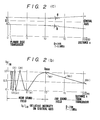
- Fig. 2(a) shows that almost all the ultrasonic energy lies within the limits shown.
- Fig. 2(b) shows the distribution of the relative intensity Ix/Im along the central axis of the beam, where amplitude Ix represents sound intensity at a position X, and Im represents maximum sound intensity along the X axis.
- FIG. 2(c) shows the energy distribution of beam cross-sections at positions (i) through (viii) along the X axis in Fig. 2(b).
- Xmax in Fig. 2(b) denotes the last position where maximum intensity along the X axis occurs.
- the present invention has been devised to eliminate the aforementioned drawbacks encountered in the prior art and the object thereof is to provide a method and apparatus for measuring an attenuation coefficient of an object under examination, wherein an attenuation coefficient measurement error ascribable to diffusion loss is minimized without relying upon a reference specimen for attenuation measurement.
- an ultrasonic measurement method comprising successively scanning ultrasonic transceiving means, which is adapted to transmit generally spherical ultrasonic waves having at least three frequency components toward an object under examination, substantially at right angles to a direction in which the ultrasonic waves are transmitted, during which time the transceiving means receives an echo from the object, measuring the intensity of a reflected wave based on the echo and performing a calculation using a synthetic aperture method to obtain a B-scan distribution image of the intensity in the object, and obtaining an attenuation coefficient of the object based on the intensity of the reflected wave for a scanning position of the transceiving means generally on an extension of a line connecting plural positions of interest designated in the obtained B-scan distribution image.
- Attenuation coefficient can be calculated without influence of the diffusion loss which is caused by the propagation.
- an ultrasonic measurement apparatus comprising transceiving means having an ultrasonic transducer for transmitting generally spherical ultrasonic waves having at least three frequency components toward an object under investigation, and for receiving an echo signal from the object, and scanning means for successively scanning the ultrasonic transducer substantially at right angles to a direction in which the ultrasonic waves are transmitted, first arithmetic means for measuring the intensity of a reflected wave based on the echo signal and for performing a calculation based on a synthetic aperture method to obtain a B-scan distribution image of the intensity in the object, designating means for designating plural positions of interest in the B-scan distribution image obtained, and second arithmetic means for obtaining an attenuation coefficient of the object based on the intensity of the reflected wave for a scanning position of the ultrasonic transducer generally on an extension of a line connecting the plural positions of interest designated.
- the second arithmetic means is adapted to calculate a sound pressure of the transmitted ultrasonic waves is solely inversely proportional to the square of the propagation distance within the object under examination, attenuation coefficient can be calculated without influence of the diffusion loss which is caused by the propagation.
- tha apparatus when more than two positions of interest are at the same distance from the scanning position, another scanning position is found and tha apparatus can calculate an attenuation coefficient based on the intensity of the reflected wave for the other scanning position.
- the designating means has display means for visually displaying the B-scan distribution image, with the positions of interest being designated based on the B-scan distribution image displayed on the display means.
- the second arithmetic means is further adapted to display the obtained attenuation coefficient on the display means.
- the sythentic aperture method is one of the image forming methods long known in the radar field as synthetic aperture radar.
- synthetic aperature method see for example Chapter 23 of the Radar Handbook, edited by M.L. Skolnik and published by the McGraw-Hill Book Company.
- An example of this principle applied to a method of ultrasonic flaw detection is set forth in "Flaw Detection by the Synthetic Aperture Ultrasonic Imaging Method", Vol. 30, No. 9, p. 720 of Non-destructive Inspections in the summaries of convention lectures held in the fall of 1981.
- image information such as a scan or tomograph of an object under investigation is obtained by successively transmitting ultrasonic signals toward the object from a plurality of positions, receiving signals, which are reflected from within the object, at a plurality of aperture planes, and analyzing, editing and synthesizing the signals thus received, thereby obtaining the aforesaid information.
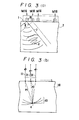
- FIG. 3(a), (b) and 4 show a conventional apparatus for practicing the method.
- a probe 1 comprises n-number of transducers 10 each of which has a wide angle of beam directivity.
- the first (leftmost) transducer responds to a drive signal 6 from a transmitting unit 100 by transmitting, into an object 2 undergoing measurement, ultrasonic waves spread over a wide angle 0 of directivity, as shown for example at 7 in Fig. 3(a).
- the first transducer which responds by producing a reception signal 8 (Fig. 4).
- the signal 8 is amplified to a required magnitude by a receiving unit 120 and then has its amplitude and phase stored in a waveform memory 130, shown in Fig. 4.
- the second transducer performs an identical transmission and reception operation to produce a reception signal which is likewise stored in the waveform memory 130.
- the same operations are performed by each of all transducers from the third onward.
- the first to the n-th transducers are scanned by a transducer switching unit 110 as each executes a transceiving operation in successive fashion.
- the amplitudes and phases of all echo signals received by the entirety of transducers will come to be stored in the waveform memory 130.
- the equivalent of an ultrasonic hologram of the object 2 will be formed in the waveform memory 130.
- a synthetic aperture arithmetic unit 140 performs a calculation to obtain a tomograph of the object 2 from the data stored in the waveform memory 130.
- various methods using synthetic aperture algorithms are available and research into improvements is presently underway.
- the general features of one example are disclosed in "Ultrasonic Synthetic Aperture Imaging with Nonlinear Processing", 41-PE-33, p. 587, of the collected papers presented at the lectures of the 4lst Japan Society of Ultrasonics in Medicine (1982). Let us describe in brief a method of cumulative addition, which is the most basic of the algorithms.
- a concentric circle centered on the first transducer and the radius whereof is the echo pulse reception time period (i.e., phase Pl) is described on an image reconstruction plane 30, and a value corresponding to the echo amplitude is written on the concentric circle.
- a received waveform 21 obtained at the second transducer a value corresponding to the echo amplitude is written and superposed on a concentric circle having a phase P2 as its radius.
- locii of the kind shown at 40 are described on the image reconstruction plane 30.
- An image of the flaw 4 is formed by the concentrated intersection of the locii, which are defined by the concentric circles, at a position in the image reconstruction plane that corresponds to the position of the flaw 4.
- the image obtained by the synthetic aperture method has a spatial resolution over the entirety of the image that is a vast improvement over that of the B-scan image based on a conventional pulse-echo technique.
- the reasons for this improvement are set forth in detail in the Radar Handbook mentioned earlier and will not be described here.
- the acquired information is exactly the same as that provided by the conventional B-scan image, namely a two-dimensional distribution image at a boundary or interface where the acoustic impedence of the object 2 differs.
- the information obtained does not go beyond morphological information representative of the object undergoing measurement.
- a base-line correction method which is the conventional way of correcting for attenuation, or by a so-called STC (sensitivity time control) method.
- Attenuation is corrected for either by performing a cumulative addition after an STC correction has been applied to an original signal, namely a signal prior to reproduction as an image (i.e., the signals 11, 21, 31... in Fig. 3(b)), or by externally applying an STC correction at one's volition in such a manner that a finally reproduced image is averaged to exhibit a substantially constant brilliance from the surface of the image down to the depths thereof.
- the attenuation coefficient of an object under examination is measured by exploiting the advantages of the synthetic aperture-type image formation method to reduce an error that appears in the attenuation coefficient due to diffusion loss internally of the object.
- Figs. 5(a) and 5(b) illustrate the principle of the present invention.
- Fig. 5(b) shows an image following application of the synthetic aperture method, which image has already been subjected to a desired correction for attentuation.
- Numerals 50, 60 represent either flaws in the object or targets provided in the object beforehand.
- the intensity I(f,x) of an echo from a reflector at an interface, located at a distance X from the probe, where the acoustic impedence of the object differs is represented by the following equation: where G(f,x) is a term representative of diffusion caused by diffraction of the transmitted ultrasonic beam, D(f,x) is a term representative of diffusion of the waves reflected by the reflector, R(F,x) represents the target intensity (reflectance) of the reflector, and ⁇ (f,x) stands for an amplitude attenuation coefficient ascribable to plane ultrasonic wave propagation.
- the ultrasonic waves are assumed to be an ideal pencil beam. In other words, these methods do not take diffusion loss G(f,x) experienced by the ultrasonic waves into account and therefore neglect the effects thereof.
- the present invention attempts to further improve attenuation coefficient measurement accuracy by reducing measurement error ascribable to diffusion loss through use of the synthetic aperture method. More specifically, with the synthetic aperture method, rather than making the aperture (D) of the transceiving transducer sufficiently large in comparison with wavelength ( ⁇ .), as in the prior art, it is necessary to use an aperture which is small in comparison with wavelength in order to form, internally of the object under examination, an ultrasonic beam having little directivity (i.e., an ultrasonic beam the directivity angle ⁇ /D whereof is large). Accordingly, as well known, a sound field of a transmitted ultrasonic wave which emerges from an aperture small in comparison with wavelength spreads into a spherical wave as soon as it leaves the aperture. That is to say, a far sound field is formed closer to the vicinity of the probe than in the case with the conventional probe.
- Figs. 7(a) and 7(b) The conditions described above are shown in approximate form in Figs. 7(a) and 7(b), in which the ultrasonic waves emerge from a planar disc transducer operating at a frequency of 3 MHz, the aperture being 10 mm in Fig. 7(a) and 1 mm in Fig. 7(b).
- V represents the propagation velocity of sound in the object under measurement.
- a(f,x) will be constant, and the relation 0 ⁇ a(f,x) ⁇ 4 may be considered to hold.
- x b ( x ) may be considered as being the effect of a weakening in the reflection intensity at the position of the ultrasonic probe 200 owing to spread of the reflected wave.
- Eq. (9) gives, in approximate form, a value obtained 1+3 1+3 by multiplying ⁇ (f 1 +f 3 /2, x), at the average value (f 1 +f 3 /2) of the frequencies f l , f 3 between x 1 and x 2 , by the coefficient ⁇ (x), which is representative of the frequency dependence of the attenuation coefficient.
- ⁇ (x) which is representative of the frequency dependence of the attenuation coefficient.
- Eq. (11) gives, in approximate form, a value obtained by multiplying p(f 1 +f 2 +f 3 3, x), at the average value f 1 +f 2 +f 3 3 of the frequencies f 1 , f 2 , f 3 between x 1 and x 2 , by the square of (x).
- Eq. (12) gives an approximate expression of the mean value of #(x) between x 1 and x 2 and between f 1 and f 3 .
- H 3 /H 2 takes on the following form from Eq. (10):
- Eq. (14) gives a mean value of ⁇ (f,x ) between x 1 and x 2 and between f 1 and f 3 .
- (H 2 ) 2 /H 3 takes on the following form from Eqs. (8), (10):
- the first term in the denominator of Eq. (13) and the first term in the numerator thereof are measured quantities, but the second terms, namely D 2 and D 3 , arise owing to frequency dependence ascribable to the intensity of reflection at the surface of acoustic characteristic discontinuity. These represent error terms with respect to ⁇ (x). If the coefficient a(f,x) of the frequency dependence f a(f,x) of the reflection intensity is constant within the range of frequencies measured, namely if
- Eq. (13) takes on the following form from Eqs. (16) and (17):
- D 2 and D 3 are error terms which cannot be found from experimental values.
- D 2 vanishes when a(f,x) is constant and independent of f 1 , f 3 , x l , x 2 .
- D 3 vanishes when a(f,x) is constant with regard to the frequencies f l , f 2 , f 3 even if it is dependent upon x l , x 2 .
- the relative error can be evaluated in the following way. Specifically, since 0 ⁇ a(f,x) ⁇ 4 holds, we may write
- plane ultrasonic wave pulses having three different frequencies f l , f 2' f 3 are inflicted upon the object under examination and the object's attentuation coefficients ⁇ (f,x), ⁇ o (x) and their frequency dependence ⁇ (x) can be approximately measured based on the resulting echo signals.
- the reflection intensity is constant and independent of the observed range of frequency f and of the distance x, then it is possible to measure ⁇ ((f,x), ⁇ o (f,x) and f(x) with greater accuracy.
- Fig. 5(b) shows the reconstructed image, in which numerals 50, 60 represent reflectors corresponding to the reflectors 220, 230, respectively, of Fig. 6.
- numerals 50, 60 represent reflectors corresponding to the reflectors 220, 230, respectively, of Fig. 6.
- a straight line 80 connecting the points where the reflectors 50, 60 are located and extend the straight line to the probe side so that the extension will intersect the row of n transducers (1 ⁇ n) constituting the probe 1, as shown in Fig. 5(a).
- the transducer nearest the point of intersection which in the example of Fig. 5(a) is the fifth transducer from the left.
- an echo signal (the original signal, namely the signal that prevails prior to processing for, e.g., correction of attenuation) 500 (shown in Fig. 5(c)) detected by this fifth transducer is extracted from the waveform memory 130 in the apparatus of Fig. 4.
- the echo signal 500 contains echo signals 510, 520 corresponding to the reflectors 50, 60, respectively. That is, I(f,x 1 ) in Eq. (4) represents the intensity of the signal 510, and I(f,x 2 ) in Eq. (5) corresponds to the intensity of the signal 520.
- Io(f) may be considered to be the intensity of ultrasonic waves transmitted in the direction of the reflectors 50, 60.
- the values of o((f,x), ⁇ o (x) , f( X ) relating to the attenuation coefficient between the reflectors 50, 60 can be measured approximately via Eqs. (18), (19) or more accurately via Eqs. (20), (21), based on the nature and attenuation of each of these reflectors.
- Figs. 8(a) through 8(d) illustrate a situation which is more complicated than that shown in Figs. 5(a) and 5(b), as the object under examination in this case contains a third reflector 90 in addition to the reflectors 50 and 60. Moreover, the reflectors 60 and 90 are equidistant as seen from the fifth transducer. As a consequence, the echo signals from the reflectors 60, 90 mix in the echo signal output 500 (shown in Fig. 8(c)) of the fifth transducer within an identical reception time period and are measured as an echo signal 530.
- Whether or not the reflector 90 is located at the same distance from the fifth transducer as the reflector 60 can be determined in advance from the reproduced image (shown in Fig. 8(b)), as will be described in detail below. In this case, therefore, a straight line 100 connecting the reflectors 90, 50 is extended toward the probe 1 and intersects the seventh transducer 7. Accordingly, information relating to the attenuation coefficient between the reflectors 90, 50 can be obtained by performing signal processing similar to that described above, wherein I(f,x 1 ), I(f,x 2 ) will represent signals 710, 720 (shown in Fig. 8(d)) from the reflectors 50, 90, respectively, these signals being contained in an echo signal 700 from the seventh transducer.
- the present invention is not limited to ultrasonic flaw detection but can also be applied to liquid specimens for which the attenuation coefficient is unknown.
- Such an application can readily be practiced by adopting a liquid as the object 2 shown in Fig. 5(a) and disposing the reflectors 50, 60, which would be plastic rods or the like, within the liquid.
- the reflector 320 will hold true for the reflector 320.
- I(f,r 1 ) the intensity of the echo signal from the reflector 310 is expressed by I(f,r 1 ), and that the sum of the intensities of the echo signals from the other reflectors on the arc 330 is expressed by I'(f,r 1 ).
- J(f,r 1 ) of the echo signal received by the transducer 400 is expressed by the following equation:
- the last term on the right side of the above equation is an error term which, in comparison with Eq. (2), is caused by the presense of reflectors other than the reflector 310 on the arc 330.
- ⁇ '(f,r) - ⁇ (f,r) may be considered to hold for a liver, which is one example of living tissue, the value of
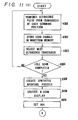
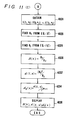
- FIG. 1 Let us now give a detailed description of an embodiment of the present invention, which is illustrated in the block diagram of Fig. 1, with reference to the flowcharts of Figs. ll(a) through 11(c) which show control procedures executed by the control unit 170.
- the apparatus of Fig. 1 is distinguishable over the prior-art apparatus of Fig. 4 mainly by provision of an attenuation information arithmetic unit 3000 and a region-of-interest setting unit 2900.
- the loop consisting of steps 4000 through 4004 calls for transmitting an ultrasonic pulse into an object 1000 under examination sequentially from the first to the n-th transducers of the probe 1, and sequentially storing the echo signals received by the transducers in the waveform memory 130.
- the next step executed is a step 4006, which calls for setting the synthetic aperture arithmetic unit 140 into operation to perform an image reconstruction by means of the synthetic aperture method.
- the reconstructed image is stored in the image memory 150.
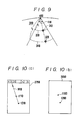
- the image signal stored in the image memory 150 is subjected to an arbitrary attenuation correction and is brightness- modulated for display as an image 2850 [Fig. 10(b)] on the display unit 160.
- the region-of-interest setting unit 2900 is manipulated to set a region which contains the flaws 1100, 1200.
- the setting unit 2900 may be comprise, e.g., a light pen, in which case the light pen would be used to designate the two flaws 1100, 1200 to obtain the coordinates of the positions at which the flaws 1100, 1200 are located on the image 2850.
- a flaw position recognition operation of this kind can also be performed automatically within a set region by the attenuation information arithmetic unit 3000.
- the attenuation information arithmetic unit 3000 executes a step 4012 to convert the coordinates of the two flaws 1100, 1200 on the displayed image 2850 into position information contained in image data 2750 stored in the image memory 150.
- the image data 2750 may be thought of as having the form shown in Fig. 10(a) when expressed in terms of assumed two-dimensional space.
- a straight line connecting the two flaws 1100, 1200 in the assumed space is obtained from the information indicative of the flaw positions.
- a step 4016 at which the straight line 1410 is extended and the number of the transducer closest to the point at which the extension intersects the straight line connecting all of the transducers is obtained.
- the echo signal received by the transducer determined at the step 4016 is read out of the wave memory 130, which stores the echo signals from all transducers as mentioned above.
- the read echo signal may be thought of as corresponding to the signal 500 in Fig. 5(a).
- the distance from the abovementioned transducer to each of the two flaws is calculated at a step 4020, with the distances obtained being designated X 1 , X 2 .
- a fast-Fourier transformation is applied at a step 4022 to the echo signal intensities I(f,X 1 ), I(f,X 2 ) corresponding to the respective distances X 1 , X 2 , and I(f 1 ,X 1 ), I(f2,X1), I ( f 3 , X 1 ), I(fl,X2), I(f2,X2), I (f 3 ,X 2 ) are obtained at a step 4024.
- Steps 4026 through 4034 call for finding H 2 , H 3 , ⁇ (x), ⁇ (f,x) and ⁇ o (x) in succession.
- the values of ⁇ (x), 0((f,x) and ⁇ o (x) are written into the image memory 150, whereby the abovementioned attenuation information is displayed together with the image 2850 on the display unit 160.
- attenuation information for any region of the object under examination can be obtained.
- the probe 1 incorporates a plurality of internally located transducers.
- the probe 1 is, therefore, of the so-called linear array type.
- the probe can be replaced by a single transducer which, while transmitting ultrasonic waves, is scanned at right angles to the direction of transmission, with the transducer receiving echos of the transmitted waves to provide echo signals.
- the probe 1 is supplied with a sharply attenuating wide-band drive pulse having a waveform of the type shown at 2210.
- the probe 1 is a transducer made of polymer material (polyvinyldifluoride, or PVDF), a composite transducer made of polymer and inorganic materials, or a PZT transducer provided with an acoustic matching layer, these transducers being designed to have a wide-band characteristic.
- the ultrasonic pulses transmitted into the interior of the object 1000 from the probe 1 will exhibit a wide band and have a waveform of the kind shown at 2210 in Fig. 1. It is also permissible, as set forth in the specification of Japanese Patent Application No. 55-49571 (Japanese Patent Application Laid-open No. 56-147082) mentioned above, to replace the wide-band probe with a probe that exhibits a plurality of diffferent frequency bands.
- ultrasonic waves having a plurality of frequencies and expressions similar thereto used in the present specification are to be interpreted in their widest sense so as to cover not only individual ultrasonic waves but also an ultrasonic wave made up of a plurality of frequency components.
- the intensity of an echo obtained from an object under examination as the result of an ultrasonic transmission having a plurality of different frequencies is measured by the so-called synthetic aperture method, whereby the attenuation coefficient of the object and the frequency dependence of the attenuation coefficient can be measured with a minimal error caused by diffusion loss ascribable to diffraction of the transmitted ultrasonic waves.
- the conventional ultrasonic measurement method and apparatus are capable of providing solely morphological information
- the present invention makes it possible to acquire quantitative information relating to attenuation internally of the object under examination.
Landscapes
- Physics & Mathematics (AREA)
- Engineering & Computer Science (AREA)
- Radar, Positioning & Navigation (AREA)
- General Physics & Mathematics (AREA)
- Remote Sensing (AREA)
- Acoustics & Sound (AREA)
- Chemical & Material Sciences (AREA)
- Biochemistry (AREA)
- General Health & Medical Sciences (AREA)
- Immunology (AREA)
- Pathology (AREA)
- Health & Medical Sciences (AREA)
- Life Sciences & Earth Sciences (AREA)
- Analytical Chemistry (AREA)
- Computer Networks & Wireless Communication (AREA)
- Ceramic Engineering (AREA)
- Investigating Or Analyzing Materials By The Use Of Ultrasonic Waves (AREA)
Applications Claiming Priority (2)
| Application Number | Priority Date | Filing Date | Title |
|---|---|---|---|
| JP131918/84 | 1984-06-28 | ||
| JP59131918A JPS6111658A (ja) | 1984-06-28 | 1984-06-28 | 超音波測定方法およびその装置 |
Publications (2)
| Publication Number | Publication Date |
|---|---|
| EP0168565A1 true EP0168565A1 (fr) | 1986-01-22 |
| EP0168565B1 EP0168565B1 (fr) | 1991-09-18 |
Family
ID=15069233
Family Applications (1)
| Application Number | Title | Priority Date | Filing Date |
|---|---|---|---|
| EP85105060A Expired EP0168565B1 (fr) | 1984-06-28 | 1985-04-25 | Procédé de mesure à ultrasons et appareil y associé |
Country Status (4)
| Country | Link |
|---|---|
| US (1) | US4597292A (fr) |
| EP (1) | EP0168565B1 (fr) |
| JP (1) | JPS6111658A (fr) |
| DE (1) | DE3584117D1 (fr) |
Cited By (3)
| Publication number | Priority date | Publication date | Assignee | Title |
|---|---|---|---|---|
| WO1987007026A1 (fr) * | 1986-05-05 | 1987-11-19 | Akademiet For De Tekniske Videnskaber, Svejsecentr | Systeme d'examen ultrasonore |
| FR2752461A1 (fr) * | 1996-08-14 | 1998-02-20 | Dory Jacques | Procede et dispositif pour le traitement de signaux representatifs d'ondes reflechies ou transmises par une structure volumique en vue d'effectuer une exploration et une analyse de cette structure |
| US6167377A (en) * | 1997-03-28 | 2000-12-26 | Dragon Systems, Inc. | Speech recognition language models |
Families Citing this family (46)
| Publication number | Priority date | Publication date | Assignee | Title |
|---|---|---|---|---|
| JPS6070381A (ja) * | 1983-09-28 | 1985-04-22 | Toshiba Corp | 超音波映像化装置 |
| US4736630A (en) * | 1985-08-05 | 1988-04-12 | Hitachi, Ltd. | Apparatus and method for sending out and receiving ultrasonic wave signals |
| US4817015A (en) * | 1985-11-18 | 1989-03-28 | The United States Government As Represented By The Secretary Of The Health And Human Services | High speed texture discriminator for ultrasonic imaging |
| JPH0666854B2 (ja) * | 1986-03-12 | 1994-08-24 | 富士写真フイルム株式会社 | 放射線画像情報記録読取装置 |
| JP2647372B2 (ja) * | 1987-01-14 | 1997-08-27 | 三菱重工業株式会社 | 開口合成信号処理方法 |
| DE3720219A1 (de) * | 1987-06-17 | 1988-12-29 | Betr Forsch Inst Angew Forsch | Verfahren zur ueberpruefung von bauteilen |
| US5099849A (en) * | 1988-05-11 | 1992-03-31 | Lunar Corporation | Ultrasonic densitometer device and method |
| US4930511A (en) * | 1988-05-11 | 1990-06-05 | Lunar Radiation, Inc. | Ultrasonic densitometer device and method |
| US5483965A (en) * | 1988-05-11 | 1996-01-16 | Lunar Corporation | Ultrasonic densitometer device and method |
| US6277076B1 (en) | 1988-05-11 | 2001-08-21 | Lunar Corporation | Ultrasonic densitometer with pre-inflated fluid coupling membranes |
| US5349959A (en) * | 1988-05-11 | 1994-09-27 | Lunar Corporation | Ultrasonic densitometer device and method |
| US6027449A (en) * | 1988-05-11 | 2000-02-22 | Lunar Corporation | Ultrasonometer employing distensible membranes |
| US5343863A (en) * | 1988-05-11 | 1994-09-06 | Lunar Corporation | Ultrasonic densitometer device and method |
| US5603325A (en) * | 1988-05-11 | 1997-02-18 | Lunar Corporation | Ultrasonic densitometer with width compensation |
| US5054490A (en) * | 1988-05-11 | 1991-10-08 | Lunar Corporation | Ultrasonic densitometer device and method |
| US5042489A (en) * | 1988-05-11 | 1991-08-27 | Lunar Corporation | Ultrasonic densitometer device and method |
| US5840029A (en) * | 1988-05-11 | 1998-11-24 | Lunar Corporation | Imaging ultrasonic densitometer |
| US5111696A (en) * | 1989-01-24 | 1992-05-12 | Akademiet For De Tekniske Videnskaber, Svejsecentralen | Method of visualizing reflection characteristic in ultrasonic examination |
| US5426979A (en) * | 1990-06-04 | 1995-06-27 | Medicano Systems Ltd. | Frequency spectrum apparatus for determining mechanical properties |
| IL94616A (en) * | 1990-06-04 | 1994-06-24 | Medicano Systems Ltd | Apparatus and method for calculating the mechanical properties of a solid |
| WO1992018862A1 (fr) * | 1991-04-19 | 1992-10-29 | Kawasaki Jukogyo Kabushiki Kaisha | Procede et dispositif pour la detection de defauts au moyen d'ondes ultrasonores |
| US5218963A (en) * | 1991-10-15 | 1993-06-15 | Lunar Corporation | Ultrasonic bone analysis device and method |
| US5269309A (en) * | 1991-12-11 | 1993-12-14 | Fort J Robert | Synthetic aperture ultrasound imaging system |
| US5501222A (en) * | 1994-05-13 | 1996-03-26 | Briggs; Keith A. | System for imaging a region |
| US5549002A (en) * | 1994-07-01 | 1996-08-27 | General Electric Company | Method for detecting and characterizing flaws in engineering materials |
| US6517487B1 (en) | 1995-03-01 | 2003-02-11 | Lunar Corporation | Ultrasonic densitometer with opposed single transducer and transducer array |
| IL116701A0 (en) | 1995-10-04 | 1996-10-16 | Sunlight Ultrasound Technologi | Ultrasonic device for determining bone characteristics |
| EP0829714A4 (fr) * | 1996-03-28 | 2007-06-27 | Mitsubishi Electric Corp | Detecteur de defauts par ultrasons et procede de detection de defauts par ultrasons |
| US5801312A (en) * | 1996-04-01 | 1998-09-01 | General Electric Company | Method and system for laser ultrasonic imaging of an object |
| US7112173B1 (en) | 1998-03-03 | 2006-09-26 | Sunlight Medical Ltd. | Determination of acoustic velocity in bone |
| US7353709B2 (en) * | 2005-07-06 | 2008-04-08 | National Research Council Of Canada | Method and system for determining material properties using ultrasonic attenuation |
| JP2008545123A (ja) * | 2005-07-06 | 2008-12-11 | ナショナル・リサーチ・カウンシル・オブ・カナダ | 超音波減衰量を使用して材料特性を決定する方法及びシステム |
| DE102006027132B4 (de) | 2006-06-02 | 2010-04-15 | BAM Bundesanstalt für Materialforschung und -prüfung | Verfahren zum Detektieren von Fehlstellen in Betonbauteilen |
| US7836769B2 (en) * | 2006-08-10 | 2010-11-23 | Akrion Systems Llc | Apparatus and method of measuring acoustical energy applied to a substrate |
| JP5683213B2 (ja) * | 2009-11-17 | 2015-03-11 | キヤノン株式会社 | 画像形成装置及び画像形成方法 |
| US9110166B2 (en) | 2011-12-01 | 2015-08-18 | Halliburton Energy Services, Inc. | Acoustic imaging |
| EP3282921B1 (fr) | 2015-04-16 | 2022-02-16 | Gentuity LLC | Sondes micro-optiques de neurologie |
| JP6981967B2 (ja) | 2015-08-31 | 2021-12-17 | ジェンテュイティ・リミテッド・ライアビリティ・カンパニーGentuity, LLC | 撮像プローブおよびデリバリデバイスを含む撮像システム |
| CN106932277B (zh) * | 2017-04-28 | 2023-05-12 | 大连理工大学 | 基于圆角平面接触理论的界面超声波反射率-压强关系曲线建立方法及加载试验台 |
| WO2019108598A1 (fr) | 2017-11-28 | 2019-06-06 | Gentuity, Llc | Système d'imagerie |
| US12262872B2 (en) | 2018-09-17 | 2025-04-01 | Gentuity, Llc | Imaging system with optical pathway |
| EP3962346A4 (fr) | 2019-04-30 | 2023-04-19 | Gentuity LLC | Sonde d'imagerie dotée d'un élément de mise sous pression de fluide |
| WO2020237024A1 (fr) | 2019-05-21 | 2020-11-26 | Gentuity, Llc | Systèmes et procédés pour un traitement de patients basé sur l'oct |
| US11719672B2 (en) | 2020-06-12 | 2023-08-08 | Baker Hughes Oilfield Operations Llc | Application specific excitation of ultrasonic probes |
| CN116203136A (zh) * | 2022-12-17 | 2023-06-02 | 北京强度环境研究所 | 一种用于防热瓦结构分层损伤的声学识别方法 |
| CN115791979B (zh) * | 2022-12-29 | 2025-04-15 | 中国特种设备检测研究院 | 一种大型载液储罐底板腐蚀的声发射内检测方法及设备 |
Citations (2)
| Publication number | Priority date | Publication date | Assignee | Title |
|---|---|---|---|---|
| WO1982002781A1 (fr) * | 1981-02-09 | 1982-08-19 | Esko Alasaarela | Procede de mise en image a balayage b holographique |
| EP0091768A2 (fr) * | 1982-04-07 | 1983-10-19 | Fujitsu Limited | Mesure des caractéristiques de tissus vivants au moyen d'ondes ultrasonores |
Family Cites Families (4)
| Publication number | Priority date | Publication date | Assignee | Title |
|---|---|---|---|---|
| JPS55143476A (en) * | 1979-04-26 | 1980-11-08 | Kiyoshi Nakayama | Composing method for ultrasonic-wave opening surface |
| JPS56147082A (en) * | 1980-04-17 | 1981-11-14 | Yoshinori Hayakawa | Method and device for quantitative ultrasonic inspection using plural frequencies |
| JPS59171540A (ja) * | 1983-03-18 | 1984-09-28 | 富士通株式会社 | スペクトル形状利用測定方法 |
| US4546772A (en) * | 1983-08-08 | 1985-10-15 | General Electric Company | Method and means for determining ultrasonic wave attenuation in tissue using phase locked loop |
-
1984
- 1984-06-28 JP JP59131918A patent/JPS6111658A/ja active Pending
-
1985
- 1985-04-22 US US06/725,797 patent/US4597292A/en not_active Expired - Lifetime
- 1985-04-25 EP EP85105060A patent/EP0168565B1/fr not_active Expired
- 1985-04-25 DE DE8585105060T patent/DE3584117D1/de not_active Expired - Fee Related
Patent Citations (2)
| Publication number | Priority date | Publication date | Assignee | Title |
|---|---|---|---|---|
| WO1982002781A1 (fr) * | 1981-02-09 | 1982-08-19 | Esko Alasaarela | Procede de mise en image a balayage b holographique |
| EP0091768A2 (fr) * | 1982-04-07 | 1983-10-19 | Fujitsu Limited | Mesure des caractéristiques de tissus vivants au moyen d'ondes ultrasonores |
Non-Patent Citations (3)
| Title |
|---|
| 1972 IEEE ULTRASONICS SYMPOSIUM PROCEEDINGS, 72 CHO 708-8 SU, pages 81-86, New York, US; E.P. PAPADAKIS et al.: "New uses of ultrasonic spectrum analysis" * |
| JOURNAL OF THE ACOUSTICAL SOCIETY OF AMERICA, vol. 64, no. 2, August 1977, pages 341-345, Acoustical Society of America, New York, US; T. SATO et al.: "Super-resolution ultrasonic imaging by combined spectral and aperture synthesis" * |
| JOURNAL OF THE ACOUSTICAL SOCIETY OF AMERICA, vol. 69, no. 6, June 1981, pages 1838-1840, Acoust. Soc. Am., New York, US; Y. HAYAKAWA et al.: "Multifrequency echoscopy for quantitative acoustical characterization of living tissues" * |
Cited By (5)
| Publication number | Priority date | Publication date | Assignee | Title |
|---|---|---|---|---|
| WO1987007026A1 (fr) * | 1986-05-05 | 1987-11-19 | Akademiet For De Tekniske Videnskaber, Svejsecentr | Systeme d'examen ultrasonore |
| FR2752461A1 (fr) * | 1996-08-14 | 1998-02-20 | Dory Jacques | Procede et dispositif pour le traitement de signaux representatifs d'ondes reflechies ou transmises par une structure volumique en vue d'effectuer une exploration et une analyse de cette structure |
| EP0825453A1 (fr) * | 1996-08-14 | 1998-02-25 | Jacques Dory | Procédé et dispositif pour le traitement de signaux représentatifs d'ondes réfléchies ou transmises par une structure volumique en vue d'effectuer une exploration et une analyse de cette structure |
| US6023660A (en) * | 1996-08-14 | 2000-02-08 | Dory; Jacques | Method and device for the processing of signals representative of waves reflected or transmitted by a voluminal structure with a view to exploring and analyzing said structure |
| US6167377A (en) * | 1997-03-28 | 2000-12-26 | Dragon Systems, Inc. | Speech recognition language models |
Also Published As
| Publication number | Publication date |
|---|---|
| EP0168565B1 (fr) | 1991-09-18 |
| JPS6111658A (ja) | 1986-01-20 |
| DE3584117D1 (de) | 1991-10-24 |
| US4597292A (en) | 1986-07-01 |
Similar Documents
| Publication | Publication Date | Title |
|---|---|---|
| EP0168565B1 (fr) | Procédé de mesure à ultrasons et appareil y associé | |
| Ylitalo et al. | Ultrasound synthetic aperture imaging: monostatic approach | |
| Von Ramm et al. | Beam steering with linear arrays | |
| Chakroun et al. | Time reversal processing in ultrasonic nondestructive testing | |
| Holmes et al. | Post-processing of the full matrix of ultrasonic transmit–receive array data for non-destructive evaluation | |
| Busse | Three-dimensional imaging using a frequency-domain synthetic aperture focusing technique | |
| Aubry et al. | Optimal focusing by spatio-temporal inverse filter. II. Experiments. Application to focusing through absorbing and reverberating media | |
| CN111819467B (zh) | 波传播和散射参数的估计方法和仪器 | |
| US4182173A (en) | Duplex ultrasonic imaging system with repetitive excitation of common transducer in doppler modality | |
| McKee et al. | Volumetric imaging through a doubly-curved surface using a 2D phased array | |
| EP0155630B1 (fr) | Méthode de mesure ultrasonore et appareil à cet effet | |
| EP0139235B1 (fr) | Méthode de mesure ultrasonique et appareil pour effectuer ces mesures | |
| EP0146707B1 (fr) | Procédé et appareil de mesure ultrasonique | |
| Lu et al. | In vitro and in vivo real-time imaging with ultrasonic limited diffraction beams | |
| Insana et al. | Backscatter coefficient estimation using array transducers | |
| JPH0713631B2 (ja) | 媒体の超音波エコーグラフィック検査方法及び装置 | |
| US11796659B2 (en) | Suppression of multiple scattering noise in pulse echo imaging | |
| US11885917B2 (en) | Methods and instrumentation for estimation of wave propagation and scattering parameters | |
| WO2021260405A1 (fr) | Procédés et instrumentation d'estimation de paramètres de propagation et de diffusion d'onde | |
| Robinson et al. | Real-time angular scatter imaging system for improved tissue contrast in diagnostic ultrasound images | |
| Kourtiche et al. | Harmonic propagation of finite-amplitude sound beams: second harmonic imaging in ultrasonic reflection tomography | |
| Barber | The scanning acoustic microprobe: I. Analysis and synthesis of a spherically symmetric point spread function | |
| Lacefield et al. | Angular scatter ultrasound imaging of wavelength scale targets | |
| Wilcox et al. | Defect characterization using ultrasonic arrays | |
| Le Croissette | Signal Processing In Ultrasound |
Legal Events
| Date | Code | Title | Description |
|---|---|---|---|
| PUAI | Public reference made under article 153(3) epc to a published international application that has entered the european phase |
Free format text: ORIGINAL CODE: 0009012 |
|
| 17P | Request for examination filed |
Effective date: 19850522 |
|
| AK | Designated contracting states |
Designated state(s): DE FR GB NL |
|
| 17Q | First examination report despatched |
Effective date: 19890329 |
|
| GRAA | (expected) grant |
Free format text: ORIGINAL CODE: 0009210 |
|
| AK | Designated contracting states |
Kind code of ref document: B1 Designated state(s): DE FR GB NL |
|
| ET | Fr: translation filed | ||
| REF | Corresponds to: |
Ref document number: 3584117 Country of ref document: DE Date of ref document: 19911024 |
|
| PLBE | No opposition filed within time limit |
Free format text: ORIGINAL CODE: 0009261 |
|
| STAA | Information on the status of an ep patent application or granted ep patent |
Free format text: STATUS: NO OPPOSITION FILED WITHIN TIME LIMIT |
|
| 26N | No opposition filed | ||
| REG | Reference to a national code |
Ref country code: GB Ref legal event code: IF02 |
|
| PGFP | Annual fee paid to national office [announced via postgrant information from national office to epo] |
Ref country code: FR Payment date: 20030408 Year of fee payment: 19 |
|
| PGFP | Annual fee paid to national office [announced via postgrant information from national office to epo] |
Ref country code: GB Payment date: 20030423 Year of fee payment: 19 |
|
| PGFP | Annual fee paid to national office [announced via postgrant information from national office to epo] |
Ref country code: NL Payment date: 20030429 Year of fee payment: 19 |
|
| PGFP | Annual fee paid to national office [announced via postgrant information from national office to epo] |
Ref country code: DE Payment date: 20030508 Year of fee payment: 19 |
|
| PG25 | Lapsed in a contracting state [announced via postgrant information from national office to epo] |
Ref country code: GB Free format text: LAPSE BECAUSE OF NON-PAYMENT OF DUE FEES Effective date: 20040425 |
|
| PG25 | Lapsed in a contracting state [announced via postgrant information from national office to epo] |
Ref country code: NL Free format text: LAPSE BECAUSE OF NON-PAYMENT OF DUE FEES Effective date: 20041101 |
|
| PG25 | Lapsed in a contracting state [announced via postgrant information from national office to epo] |
Ref country code: DE Free format text: LAPSE BECAUSE OF NON-PAYMENT OF DUE FEES Effective date: 20041103 |
|
| GBPC | Gb: european patent ceased through non-payment of renewal fee |
Effective date: 20040425 |
|
| PG25 | Lapsed in a contracting state [announced via postgrant information from national office to epo] |
Ref country code: FR Free format text: LAPSE BECAUSE OF NON-PAYMENT OF DUE FEES Effective date: 20041231 |
|
| NLV4 | Nl: lapsed or anulled due to non-payment of the annual fee |
Effective date: 20041101 |
|
| REG | Reference to a national code |
Ref country code: FR Ref legal event code: ST |