EP0168667B1 - Système de transfert d'un message protégé, et procédé utilisant un code de session mis à jour - Google Patents
Système de transfert d'un message protégé, et procédé utilisant un code de session mis à jour Download PDFInfo
- Publication number
- EP0168667B1 EP0168667B1 EP19850107626 EP85107626A EP0168667B1 EP 0168667 B1 EP0168667 B1 EP 0168667B1 EP 19850107626 EP19850107626 EP 19850107626 EP 85107626 A EP85107626 A EP 85107626A EP 0168667 B1 EP0168667 B1 EP 0168667B1
- Authority
- EP
- European Patent Office
- Prior art keywords
- user
- sync
- location
- signal
- key
- Prior art date
- Legal status (The legal status is an assumption and is not a legal conclusion. Google has not performed a legal analysis and makes no representation as to the accuracy of the status listed.)
- Expired
Links
- 238000000034 method Methods 0.000 title claims description 26
- 238000012546 transfer Methods 0.000 title claims description 8
- 238000004891 communication Methods 0.000 claims description 22
- 101000925475 Nicotiana tabacum Elongation factor 1-alpha Proteins 0.000 claims description 7
- 230000005540 biological transmission Effects 0.000 claims description 6
- 238000010200 validation analysis Methods 0.000 claims 18
- 101100368146 Arabidopsis thaliana SYNC2 gene Proteins 0.000 description 9
- 101000821257 Homo sapiens Syncoilin Proteins 0.000 description 5
- 102100021919 Syncoilin Human genes 0.000 description 5
- 238000010586 diagram Methods 0.000 description 4
- 230000002349 favourable effect Effects 0.000 description 4
- 230000004044 response Effects 0.000 description 4
- 238000012545 processing Methods 0.000 description 3
- 238000012795 verification Methods 0.000 description 2
- NCGICGYLBXGBGN-UHFFFAOYSA-N 3-morpholin-4-yl-1-oxa-3-azonia-2-azanidacyclopent-3-en-5-imine;hydrochloride Chemical compound Cl.[N-]1OC(=N)C=[N+]1N1CCOCC1 NCGICGYLBXGBGN-UHFFFAOYSA-N 0.000 description 1
- 230000000694 effects Effects 0.000 description 1
- 230000002708 enhancing effect Effects 0.000 description 1
- 230000003993 interaction Effects 0.000 description 1
- 230000002452 interceptive effect Effects 0.000 description 1
- 230000002427 irreversible effect Effects 0.000 description 1
- 230000001360 synchronised effect Effects 0.000 description 1
Images



Classifications
-
- G—PHYSICS
- G07—CHECKING-DEVICES
- G07F—COIN-FREED OR LIKE APPARATUS
- G07F7/00—Mechanisms actuated by objects other than coins to free or to actuate vending, hiring, coin or paper currency dispensing or refunding apparatus
- G07F7/08—Mechanisms actuated by objects other than coins to free or to actuate vending, hiring, coin or paper currency dispensing or refunding apparatus by coded identity card or credit card or other personal identification means
- G07F7/10—Mechanisms actuated by objects other than coins to free or to actuate vending, hiring, coin or paper currency dispensing or refunding apparatus by coded identity card or credit card or other personal identification means together with a coded signal, e.g. in the form of personal identification information, like personal identification number [PIN] or biometric data
- G07F7/1016—Devices or methods for securing the PIN and other transaction-data, e.g. by encryption
-
- H—ELECTRICITY
- H04—ELECTRIC COMMUNICATION TECHNIQUE
- H04L—TRANSMISSION OF DIGITAL INFORMATION, e.g. TELEGRAPHIC COMMUNICATION
- H04L9/00—Cryptographic mechanisms or cryptographic arrangements for secret or secure communications; Network security protocols
- H04L9/08—Key distribution or management, e.g. generation, sharing or updating, of cryptographic keys or passwords
- H04L9/0816—Key establishment, i.e. cryptographic processes or cryptographic protocols whereby a shared secret becomes available to two or more parties, for subsequent use
- H04L9/0838—Key agreement, i.e. key establishment technique in which a shared key is derived by parties as a function of information contributed by, or associated with, each of these
- H04L9/0841—Key agreement, i.e. key establishment technique in which a shared key is derived by parties as a function of information contributed by, or associated with, each of these involving Diffie-Hellman or related key agreement protocols
- H04L9/0844—Key agreement, i.e. key establishment technique in which a shared key is derived by parties as a function of information contributed by, or associated with, each of these involving Diffie-Hellman or related key agreement protocols with user authentication or key authentication, e.g. ElGamal, MTI, MQV-Menezes-Qu-Vanstone protocol or Diffie-Hellman protocols using implicitly-certified keys
-
- H—ELECTRICITY
- H04—ELECTRIC COMMUNICATION TECHNIQUE
- H04L—TRANSMISSION OF DIGITAL INFORMATION, e.g. TELEGRAPHIC COMMUNICATION
- H04L9/00—Cryptographic mechanisms or cryptographic arrangements for secret or secure communications; Network security protocols
- H04L9/12—Transmitting and receiving encryption devices synchronised or initially set up in a particular manner
-
- H—ELECTRICITY
- H04—ELECTRIC COMMUNICATION TECHNIQUE
- H04L—TRANSMISSION OF DIGITAL INFORMATION, e.g. TELEGRAPHIC COMMUNICATION
- H04L2209/00—Additional information or applications relating to cryptographic mechanisms or cryptographic arrangements for secret or secure communication H04L9/00
- H04L2209/56—Financial cryptography, e.g. electronic payment or e-cash
Definitions
- the invention relates to a method for securing data communications between the remote location of an individual user who has an assigned account number and a host location, the invention further relates to a system for use by an authorized user having an account number for securely transferring data from one remote location to a host location at which selected information about such users is stored.
- GB-A 2,050,021 discloses a data-handling apparatus for securing the transmission of data under control of an authorized individual from one location having an identification number to data processing means having memory means with the identification number stored therein at a remote location, wherein during an initialization procedure code numbers are produced at a host location and at a remote location, which code numbers are encrypted and then compared, so that in response to favourable comparison an authorized user can be identified, whereafter a session can be started and encoding is carried out by using encrypted session keys which are generated in an encryption module.
- Method and system according to the present invention validate the claimed identity of an individual user who is identified during an initial sign-on procedure, and then enable a user to transmit in secured manner selected messages to a remotely-located host computer using unsecured communication channels such as telephone, mail, telegram and the like.
- unsecured communication channels such as telephone, mail, telegram and the like.
- the techniques of the present invention employ selectively encrypted messages which assure privacy over unsecured communication channels and which avoid revealing the true identity of the user or the activities of the host computer, under the control of session encoding keys which are different for each authorized user and for each communication session of such user.
- the session encoding keys are established at both ends of a communication link based upon the claimed identity of a user, internal key codes, personal identification numbers, a synchronizing code, and other unique inputs, and encrypted messages may then be sent bidirectionally over the established communication link, and at the conclusion of the session, an updated synchronizing code is stored at both locations as the basis for establishing a new session encoding key for a subsequent session. Additional levels of security can be introduced conveniently, and intermediate host data terminals can be interposed in the communication scheme between two remote terminals.
- the security of the system according to the present invention is based upon a security module which may be physically and logically isolated from the host computer near its location for storing the identifying and verifying data about authorized users, and upon a processing module near the user's data terminal that controls the secured sequence of exchange procedures and for which no particular security safeguards need be taken. Duplication of the information available at one user's processing module is inconsequential because it is unusable by another user without essential information available only from such one authorized user.
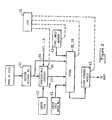
- a remote data terminal 9 which includes a microprocessor 11 centrally connected to operate with a keyboard 13, a display unit 15, a memory unit 19, and a mass storage module 21, for example, of the floppy disc type.
- the terminal 9 may include data port apparatus 20 such as a modem for data communications with the host computer 29 over voice-grade telephone communication channel 22.
- an unsecured communication channel 22 may be of any type for transmitting transaction information to the host computer 29, for example, by mail, telegram, or the like.
- the host computer 29 may include similar elements as previously set forth in connection with terminal 9, and in addition includes a security module 28 which may be physically secured against unauthorized intrusions by the operators of the host computer and which contains selected codes for encrypting and decrypting the data that is required to verify the identities of authorized users. Such data may be stored in the security module 28, or elsewhere, in encrypted form.
- the host computer also includes a generator 23 of synchronous index numbers (which may be sequential or random, etc.) for operation in the data transfer operation, as later described.
- SIN S ynchronization I ndex N umbers
- the host computer 29 includes a module 25 for generating a floppy disc, or other appropriate program-storage media, which is suitably encoded during the initialization session for the specific user and which is then transferred 27 to such user as his personalized mass program-storage medium for use in module 21 at the location of the remote terminal 9.
- a module 25 for generating a floppy disc, or other appropriate program-storage media which is suitably encoded during the initialization session for the specific user and which is then transferred 27 to such user as his personalized mass program-storage medium for use in module 21 at the location of the remote terminal 9.
- an individual user first signs on via an initialization procedure. This generates the key codes required to encrypt and decrypt the data stored in encrypted form outside the security module 28 in order later to verify the identity and authority of the user to engage in a data-exchanging session with the host computer.
- An individual user who may simply present his name as the basis for his claimed identity, is initially authorized to operate the secured communication system by assigning to him an account number and by allowing him to select, without revealing to anyone, his own secret P ersonal I dentification N umber (PIN) 33.
- the account number 31, the user's secret PIN 33, and the host computer identification or key number 34 are all encrypted 35 using an irreversible algorithm of the type described in the literature to produce a P ersonal V erification N umber (PVN) 37 that is suitably stored 39 for the named user, along with his account number, call-back information 41 about the named user and a generated S ynch I ndex N umber (SIN) 43.
- the PVN's may be stored in encrypted form (e.g., using key codes that are stored in the security module 28) along with other associated data for the named users who are authorized to use the system, thereby enhancing the security of the system against unauthorized intrusions.
- the C entral P rocessor U nit 36 of the host computer controls the encryption process 35, the generation of Synch Index Numbers 43, the entry and limited access to the secured storage module 28, 39, and the generation of a mass-storage, floppy disc-type program-storage medium containing the Synch Index Number (which may be random) as the initial Sync hronizing N umber 45 and other program information for use by the authorized individual at the location of his remote terminal.
- the authorized individual may now operate the secured communication system, as illustrated in the flow diagram of Figure 3 or Figure 4.
- the authorized user of the terminal 9 operating with the program information from the floppy-disc, program-storage medium in the storage module 21 as specially prepared for him in the initialization process, now calls 49 the host computer 29 via the communication network 22 and enters 51 his name or other form of claimed identity via keyboard 13.
- the user may, optionally, disconnect and wait to be called back by the host computer 29.
- the communicated name or other claimed identity is the basis for accessing 53 from storage 39 the data about the authorized user that is on file at the host computer 29 resulting from the initialization procedure.
- the user can be called back 53 and sent a new Synch Index Number at the network (telephone) number that is in storage 39.
- the user is prompted 55 to enter his PIN and optionally may be prompted to enter his account number (if it is not stored 21 on the floppy-disc, program-storage medium operating in storage module 21).
- the host computer 29 and the remote user may now proceed to establish a session key for controlling encryption and decryption of messages over the communication network 22.
- additional information about the user identified by the claimed identity is accessed from storage 39 to yield the PVN and the last synchronizing number SN in storage. If the previous transaction was initialization, then the SN is the initial Synch Index Number SIN1. If the previous transaction was a data transfer session, then the SN is the S ession K ey (SK) used during that previous session, as later described.
- the SN is accessed from storage module 21 and is either the SIN from the previous initialization procedure or the SK used in the previous data transfer session, and should be identical to the SN accessed from storage 39 at the host computer 29.
- the PIN entered by the user is irreversibly encrypted 59 with his account number (entered manually or accessed from the storage module 21) and the host I.D. or key number accessed from the storage module 21 (if such was used during initialization to generate the PVN) to yield the PVN that should be identical to the PVN stored upon initialization at the host computer.
- This PVN generated (not stored) at the user's location is then encrypted 61 with the last SN accessed from storage to yield the K ey- E xchange K ey (KEK).
- the accessed PVN and last SN from storage are encrypted 63 to yield the corresponding KEK 65.
- the SIN available at the host computer 29 and communicated to the remote terminal 9 may now be encrypted 67, 69 with the KEK at each location to yield corresponding S ession K eys 71, 73.
- Data pertaining to the intended transaction may now be encrypted 75 with SK at the remote location (along with security-checking data such as SIN or other data such as PVN commonly codable at both locations) and sent in encrypted form 77 over the network 22 to the host computer 29.
- the encrypted data 77 as received at the host computer 29 is decrypted 79 using the SK 73 generated at that location to yield the SIN and the transaction data.
- the SIN as decrypted may be compared 81 with the SIN generated at the host computer to provide indication 80 that the authorized user is communicating the transaction data and that such data is faithfully received in unaltered form.
- the transaction data may be acted upon and the session key may be used to update the synchronizing number (SN) in storage 39 in response to favorable comparison 80 of the SIN's.
- any reply data resulting from implementation of the transaction 83, or a basic acknowledgment may be encrypted with SK (along with such security-checking code as SIN or other data such as PVN commonly codable at both locations) and sent 87 to the remote terminal 9 via network 22.
- SK security-checking code as SIN or other data such as PVN commonly codable at both locations
- the encrypted reply data 87 is decrypted 89 at the remote terminal 9 using the SK generated at that location to yield the reply data and SIN.
- the decrypted SIN is compared 91 with the SIN originally sent for the session and, upon favorable comparison 93, the reply data may be displayed 95 and the SN in storage module 21 is updated with the SK of this session.
- the SN at the host computer 29 therefore remains in synchronism with the SN at the remote terminal 9 for use in subsequent data-transfer sessions in the manner previously described.
- the individual user must be initially processed to establish his authority to use the system.
- the user is assigned an account number 101 and an initial Sync hronizing Index Number1 103, and he may select and retain secretly his own PIN 105.
- the account number 101 and PIN 105 are encrypted 107 to yield P ersonal V erification N umber 1 which is stored 109 at the host computer location (preferably in encrypted form).
- the user's account number 101 and initial Sync Index1 103 are encrypted 111 using a host sync key 113 to yield SYNC1 code 115.
- the account number 101 and sync key 113 are stored 116, 118 at the host computer along with the user's PVN1.
- SYNC1 is also stored 117 on a portable memory medium such as a floppy disc-type diskette, or the like, along with the user's account number and initial Sync Index1.
- a user communicates his claimed identity (e.g., name) over communication network 119 to the host computer which generates new Sync Index2 121 and accesses 123 the account number, the PVN1 and the SYNC1 stored for the named user.
- the SYNC1 and PVN1 are encrypted 125 to yield the K ey- E xchange K ey.
- the account number and the Sync Index2 are encrypted 127 using the host sync key to yield SYNC2 which is now encrypted 129 with KEK and sent in encrypted form over communication network 119 to the user.
- the user's PIN 105 and account number 101 are encrypted 131 to yield PVN1 which is encrypted 133 with SYNC1 accessed 135 from the diskette storage medium to yield the KEK.
- SYNC2 encrypted 129 by KEK at the host computer location and received at the user's location may now be decrypted 137 using KEK to yield SYNC2 at the user's location.
- SYNC2 is encrypted 141 with PVN1 to yield the W orking K ey 139 for the session.
- the WK is encrypted 143 with SYNC2 and sent to the host computer for comparison.
- SYNC2 is encrypted 145 with PVN1 to yield WK at the host.
- WK is used to decrypt 147 the received encryption from the user to yield the user's SYNC2 which is compared 149 with the host's SYNC2.
- transaction data generally includes myriad possible interactions between a host computer and a remote terminal.
- subscription information services such as stock quotation services may furnish stock quotes as the "reply data" in response to a request message.
- electronic banking or funds-transfers may be implemented in reply to request to disburse or transfer funds as directed.
- electronic mail may be transferred between two remote terminals with the aid of the host computer 29.
- the first authorized user 9 operates the system as described to "deposit" the mail message in an account number or "mailbox" for a second authorized user who then operates the system as described in connection with Figure 3 (using his own name, account number, PIN, last SN, etc.) to access the "mailbox" in response to his request.
- the system and method of the present invention are operable on standard computers operating as remote terminals using inexpensive floppy-disc mass storage media, or the like, which are initialized for individual users and which are updated in synchronism with the responding host computer.
- the inexpensive medium cannot be duplicated to be useful to another individual with a different account number, or to be useful on the same account number without the secret PIN of the authorized user.
- the messages which are transmitted between locations over unsecured communication networks are merely the names of users, random numbers and encrypted messages with no discernible logical correlation between them available for unauthorized interception and use of the messages.
- KEK's, Session Keys, and Working Keys can be used not only to protect transactions from attack as discussed above, but also provide the full range of cryptographic modes of operation which can be utilized to generate Message Authentication Codes (MAC), Transaction Signatures, and the like, in order to protect against fraudulent Host Applications.
- MAC Message Authentication Codes
- Working Keys can be used not only to protect transactions from attack as discussed above, but also provide the full range of cryptographic modes of operation which can be utilized to generate Message Authentication Codes (MAC), Transaction Signatures, and the like, in order to protect against fraudulent Host Applications.
Landscapes
- Engineering & Computer Science (AREA)
- Computer Security & Cryptography (AREA)
- Computer Networks & Wireless Communication (AREA)
- Signal Processing (AREA)
- Physics & Mathematics (AREA)
- General Physics & Mathematics (AREA)
- Computer And Data Communications (AREA)
- Financial Or Insurance-Related Operations Such As Payment And Settlement (AREA)
Claims (7)
- Procédé pour protéger des communications de données entre le poste éloigné (9) d'un utilisateur individuel qui a un numéro de compte affecté (31 ; 101) et un poste d'ordinateur principal (29), le procédé comprenant les étapes d'initialisation consistant à :- produire un numéro de validation (37 : PVN) qui est unique pour l'utilisateur sous la forme d'une première fonction de chiffrage du numéro de compte d'utilisateur (31 ; 101) et une information de code (33 ; 105 ; PIN) reçue en provenance de l'utilisateur ;- établir deux numéros appelés respectivement la clé de synchronisation (113) et l'index de synchronisation (43 ; 103), et produire un numéro de synchronisation en concordance avec une seconde fonction de chiffrage de la clé de synchronisation, de l'index de synchronisation (43 ; 103) et du numéro de compte d'utilisateur (31 : 101) ;- mémoriser l'index de synchronisation (43 ; 103) et le numéro de synchronisation (45 ; 115) pour un accès au poste éloigné (9) d'utilisateur ; et- mémoriser (116, 118) le numéro de validation (37 : PVN), le numéro de compte (31 ; 101) et la clé de synchronisation (113) pour un accès au poste principal (29),- le procédé comprenant en outre les étapes de transaction consistant à :- chiffrer (59 : 107 : 131) le numéro de compte (31 ; 101) et un numéro d'identification personnel d'utilisateur (33 ; 105 ; PIN) en utilisant ladite première fonction de chiffrage pour établir le numéro de validation d'utilisateur (PVN) et pour accéder au numéro de synchronisation dans le poste éloigné (9) de l'utilisateur ;- produire (61) dans le poste éloigné d'utilisateur (9) une clé d'échange (KEK) sous la forme d'une troisième fonction de chiffrage du numéro de validation (37 ; PVN) et du numéro de synchronisation (45 ; 115) ;- accéder (53), dans la mémoire du poste principal (29), au numéro de validation (37 ; PVN) et au numéro de synchronisation (45 ; 115) d'un utilisateur identifié ;- produire (63) dans le poste principal (29) une clé d'échange (KEK) sous la forme de ladite troisième fonction de chiffrage du numéro de validation (37 ; PVN) et du numéro de synchronisation (45 ; 115) obtenus pour ledit utilisateur identifié ;- établir (121) un second index de synchronisation dans le poste principal (29) ;- accéder, dans la mémoire dudit poste principal (29), à la clé de synchronisation, au numéro de compte (31 ; 101) et au numéro de validation (37 ; PVN) de l'utilisateur identifié ;- produire, dans ledit poste principal (29), un second numéro de synchronisation sous la forme d'une quatrième fonction de chiffrage de ladite clé de synchronisation obtenue, du numéro de compte obtenu et du second index de synchronisation obtenu ;- produire dans ledit poste principal (29) une clé de travail (WK) sous la forme d'une cinquième fonction de chiffrage du second numéro de synchronisation (SYNC₂) et du numéro de validation obtenus (PVN) ;- chiffrer dans ledit poste principal (29) ledit second numéro de synchronisation utilisant ladite clé d'échange en correspondance avec une sixième fonction de chiffrage de celle-ci pour produire un signal de sortie codé pour transmission au poste éloigné d'utilisateur ;- déchiffrer en correspondance à ladite sixième fonction de chiffrage ladite sortie chiffrée reçue dans le poste éloigné d'utilisateur en utilisant ladite clé d'échange produite dans celui-ci de manière à obtenir ledit second numéro de synchronisation (SYNC₂) dans le poste éloigné d'utilisateur (9) ;- chiffrer (143) dans le poste éloigné d'utilisateur (9), en correspondance à ladite cinquième fonction de chiffrage, ledit second numéro de synchronisation déchiffré (SYNC₂) et ledit numéro de validation d'utilisateur (PVN₁) pour produire une clé de travail (WK ; 139) et- transmettre entre le poste éloigné d'utilisateur (9) et le poste principal (29) une donnée sélectionnée qui est chiffrée et déchiffrée dans les postes respectifs (9 ; 29) en concordance avec la même fonction de chiffrage des clés de travail (WK) qui sont produites dans les postes respectifs (9 ; 29).
- Procédé selon la revendication 1, dans lequel une ou plusieurs autres transactions utilisant les étapes de transaction peuvent être effectuées en faveur d'un utilisateur identifié.
- procédé selon la revendication 1 ou la revendication 2, comprenant les étapes additionnelles consistant à :- chiffrer (143) dans l'un desdits postes constitués par le poste éloigné d'utilisateur et le poste principal (9 ; 29), en correspondance à une septième fonction de chiffrage, la clé de travail (WK) et le second numéro de synchronisation (SYNC₂) disponibles pour produire une seconde sortie chiffrée destinée à être transmise à l'autre desdits postes constitués par le poste éloigné d'utilisateur et le poste principal (9 ; 29) ;- déchiffrer (137) dans ledit autre poste et en concordance avec ladite septième fonction de chiffrage la seconde sortie chiffrée reçue dans ce poste de manière à produire le second numéro de synchronisation (SYNC₂) à partir de celle-ci ; et- comparer (149) le second numéro de synchronisation produit par ledit déchiffrage avec le second numéro de synchronisation obtenu de façon que l'utilisateur autorisé obtienne les indications de communications valables entre les postes précités.
- Procédé selon la revendication 3, comprenant l'étape additionnelle consistant à communiquer audit poste éloigné d'utilisateur (9) ledit second index de synchronisation produit dans ledit poste principal (29) en vue de remplacer sélectivement ledit index de synchronisation dans la mémoire installée dans le poste éloigné d'utilisateur (9).
- Procédé selon la revendication 3 pour protéger des communications de données entre un premier et un second utilisateur installés dans des postes éloignés séparés par l'intermédiaire dudit poste principal, le procédé comprenant les étapes additionnelles consistant à :- effectuer les étapes précitées se rapportant à un poste éloigné de premier utilisateur (9) et au poste principal (29) et se rapportant également au poste éloigné de second utilisateur et au poste principal (29) afin de produire une première clé de travail dans le poste éloigné de premier utilisateur (9) et dans le poste principal (29), et également de produire une seconde clé de travail dans le poste éloigné de second utilisateur et dans le poste principal (29) ;- et en outre, dans ladite étape de transmission, ledit premier utilisateur transmet au poste principal (29) des données sélectionnées qui sont chiffrées en utilisant la première clé de travail pour un déchiffrage dans le poste principal en utilisant la première clé de travail et pour un chiffrage dans celui-ci en utilisant la seconde clé de travail en vue d'une transmission au poste éloigné du second utilisateur en vue d'un déchiffrage dans celui-ci en utilisant la seconde clé de travail.
- Procédé selon la revendication 3, dans lequel, dans l'étape de transmission, des données sélectionnées sont chiffrées et déchiffrées en même temps que le numéro d'index de synchronisation et la clé de travail disponibles dans le poste respectif ; et le procédé comprenant l'étape additionnelle consistant à comparer le numéro d'indexage de synchronisation qui a été reçu et déchiffré dans le poste respectif avec le numéro d'index de synchronisation existant dans celui-ci.
- Système utilisable par un utilisateur autorisé possédant un numéro de compte pour transférer de façon protégée des données depuis un poste éloigné (9) jusqu'à un poste principal (29) dans lequel une information sélectionnée concernant ledit utilisateur est mémorisée, le système comprenant :- des moyens (36) pour produire un numéro de validation qui est unique pour l'utilisateur sous la forme d'une première fonction de chiffage du numéro de compte d'utilisateur et d'une information codée reçue en provenance de l'utilisateur ;- des moyens (36) pour produire deux numéros appelés respectivement la clé de synchronisation et l'index de syncnronisation et pour produire un numéro de synchronisation en concordance avec une seconde fonction de chiffrage de la clé de synchronisation, de l'index de synchronisation et du numéro de compte de l'utilisateur ;- un premier moyen de mémorisation (28) installé dans ledit poste principal (29) pour mémoriser un signal correspondant à ladite clé de synchronisation et un signal correspondant audit numéro de compte ainsi qu'un signal correspondant audit numéro de validation ;- un second moyen de mémorisation (21) installé dans le poste éloigné d'utilisateur (9) pour mémoriser un signal d'index de synchronisation et un signal de synchronisation sous la forme d'une combinaison logique dudit signal de numéro de compte, dudit signal d'index de synchronisation et dudit signal de clé de synchronisation ;- des moyens installés dans ledit poste principal (29) pour accéder sélectivement, dans ledit premier moyen de mémorisation, au signal de synchronisation, au signal de numéro de validation d'un utilisateur identifié et au signal de clé de synchronisation ;- des moyens prévus dans ledit poste principal (29) pour le chiffrage dudit signal de synchronisation et dudit signal de numéro de validation qui ont été obtenus de façon à produire un signal de clé d'échange sous la forme de la troisième fonction de chiffrage des signaux représentant le numéro de synchronisation et le numéro de validation qui lui ont été appliqués ;- des moyens (23) prévus dans ledit poste principal pour produire un second signal d'index de synchronisation ;- des moyens prévus dans ledit poste principal pour chiffrer le signal de clé de synchronisation, le signal de numéro de compte et le second signal d'index de synchronisation de manière à produire un second signal de synchronisation sous la forme de la quatrième fonction de chiffrage desdits signaux ainsi appliqués ;- des moyens installés dans ledit poste principal pour chiffrer le second signal de synchronisation et le signal de numéro de validation obtenu sous la forme de la cinquième fonction de chiffrage des signaux appliqués afin d'obtenir un signal de clé de travail ;- des moyens prévus dans ledit poste principal pour chiffrer le second signal de synchronisation et le signal de clé d'échange de manière à produire, sous la forme de la sixième fonction de chiffrage, une sortie codée pour transmission au poste éloigné d'utilisateur (9) ;- des moyens (11) prévus dans ledit poste éloigné d'utilisateur (9) pour obtenir le signal de numéro de validation ;- des moyens (11) prévus dans ledit poste éloigné d'utilisateur (9) pour accéder sélectivement audit second moyen de mémorisation afin d'obtenir ledit signal de synchronisation ;- des moyens (11) prévus dans ledit poste éloigné d'utilisateur (9) pour chiffrer ledit signal de numéro de validation et ledit signal de synchronisation en concordance avec ladite troisième fonction de chiffrage des signaux pour produire un signal de clé d'échange ;- des moyens (11) prévus dans ledit poste éloigné d'utilisateur (9) pour déchiffrer la sortie codée reçue dans le poste éloigné d'utilisateur (9) avec ledit signal de clé d'échange en concordance à ladite sixième fonction de chiffrage pour obtenir ledit second signal de synchronisation dans le poste éloigné d'utilisateur (9) ;- des moyens (11) prévus dans ledit poste éloigné d'utilisateur (9) pour chiffrer ledit signal de numéro de validation et ledit second signal de synchronisation déchiffré en concordance avec ladite cinquième fonction de chiffrage de manière à obtenir un signal de clé de travail ; et- des moyens prévus dans ledit poste éloigné d'utilisateur (9) et dans ledit poste principal (29) pour chiffrer et déchiffrer des données en concordance avec une combinaison logique commune avec lesdits signaux de clé de travail obtenus dans chaque poste en vue d'une transmission sous forme chiffrée entre eux.
Applications Claiming Priority (2)
| Application Number | Priority Date | Filing Date | Title |
|---|---|---|---|
| US63229784A | 1984-07-19 | 1984-07-19 | |
| US632297 | 1984-07-19 |
Publications (3)
| Publication Number | Publication Date |
|---|---|
| EP0168667A2 EP0168667A2 (fr) | 1986-01-22 |
| EP0168667A3 EP0168667A3 (en) | 1988-05-25 |
| EP0168667B1 true EP0168667B1 (fr) | 1992-03-04 |
Family
ID=24534944
Family Applications (1)
| Application Number | Title | Priority Date | Filing Date |
|---|---|---|---|
| EP19850107626 Expired EP0168667B1 (fr) | 1984-07-19 | 1985-06-20 | Système de transfert d'un message protégé, et procédé utilisant un code de session mis à jour |
Country Status (4)
| Country | Link |
|---|---|
| EP (1) | EP0168667B1 (fr) |
| JP (1) | JPS6188363A (fr) |
| CA (1) | CA1255769A (fr) |
| DE (1) | DE3585469D1 (fr) |
Families Citing this family (8)
| Publication number | Priority date | Publication date | Assignee | Title |
|---|---|---|---|---|
| EP0246823A3 (en) * | 1986-05-22 | 1989-10-04 | Racal-Guardata Limited | Data communication systems and methods |
| FR2600190B1 (fr) * | 1986-06-16 | 1988-08-26 | Bull Cp8 | Procede pour diversifier une cle de base et pour authentifier une cle ainsi diversifiee comme ayant ete elaboree a partir d'une cle de base predeterminee, et systeme de mise en oeuvre |
| FR2601795B1 (fr) * | 1986-07-17 | 1988-10-07 | Bull Cp8 | Procede pour diversifier une cle de base et pour authentifier une cle ainsi diversifiee comme ayant ete elaboree a partir d'une cle de base predeterminee, et systeme pour la mise en oeuvre |
| EP0320489A3 (en) * | 1987-12-07 | 1990-03-28 | Automations & Informat Systeme | Method to increase ic-card security, and ic-card making use of this method |
| GB8807020D0 (en) * | 1988-03-24 | 1988-08-24 | Racal Guardata Ltd | Data-processing apparatus |
| JPH02297297A (ja) * | 1989-05-11 | 1990-12-07 | Material Eng Tech Lab Inc | カード型情報媒体の不正使用防止方法 |
| DE19548387C1 (de) * | 1995-12-22 | 1997-01-30 | Siemens Ag | Verfahren zur kryptographischen Sicherung der rechnergestützten digitalen Kommunikation zwischen einem Programm und mindestens einer Benutzereinheit |
| NL1015476C2 (nl) * | 2000-06-20 | 2001-12-28 | Nedap Nv | Pompvrijgave- en betaalsysteem via mobiele telefoon. |
Family Cites Families (4)
| Publication number | Priority date | Publication date | Assignee | Title |
|---|---|---|---|---|
| FR561058A (fr) * | 1923-01-26 | 1923-10-16 | Thomson Houston Comp Francaise | Systèmes disjoncteurs à refermeture automatique |
| EP0112944B1 (fr) * | 1982-12-30 | 1987-03-04 | International Business Machines Corporation | Examen de la validité de codes d'identification |
| DE3276993D1 (en) * | 1982-12-30 | 1987-09-17 | Ibm | Data communication network |
| US4536647A (en) * | 1983-07-15 | 1985-08-20 | Atalla Corporation | Pocket banking terminal, method and system |
-
1985
- 1985-06-20 DE DE8585107626T patent/DE3585469D1/de not_active Expired - Lifetime
- 1985-06-20 EP EP19850107626 patent/EP0168667B1/fr not_active Expired
- 1985-06-27 CA CA000485670A patent/CA1255769A/fr not_active Expired
- 1985-07-19 JP JP60160044A patent/JPS6188363A/ja active Pending
Also Published As
| Publication number | Publication date |
|---|---|
| CA1255769A (fr) | 1989-06-13 |
| EP0168667A3 (en) | 1988-05-25 |
| DE3585469D1 (de) | 1992-04-09 |
| JPS6188363A (ja) | 1986-05-06 |
| EP0168667A2 (fr) | 1986-01-22 |
Similar Documents
| Publication | Publication Date | Title |
|---|---|---|
| US5745576A (en) | Method and apparatus for initialization of cryptographic terminal | |
| JP2746352B2 (ja) | 遠隔位置に設置したコンピュータによる通信のための機密防護通信システム及び方法 | |
| US6075860A (en) | Apparatus and method for authentication and encryption of a remote terminal over a wireless link | |
| CA1292790C (fr) | Methode de regie de cles cryptographiques par parametres etablis au poste emetteur | |
| US6105133A (en) | Bilateral authentication and encryption system | |
| US5995624A (en) | Bilateral authentication and information encryption token system and method | |
| US7502467B2 (en) | System and method for authentication seed distribution | |
| CA2241052C (fr) | Systeme de securite a niveaux d'application et procede associe | |
| AU714179B2 (en) | Unified end-to-end security methods and systems for operating on insecure networks | |
| US7095851B1 (en) | Voice and data encryption method using a cryptographic key split combiner | |
| US5548721A (en) | Method of conducting secure operations on an uncontrolled network | |
| EP0755598B1 (fr) | Systeme de distribution de cle cryptographique pour reseau informatique | |
| JP2883243B2 (ja) | 相手認証/暗号鍵配送方式 | |
| WO1997045979A9 (fr) | Procede et dispositif servant a initialiser un terminal cryptographique | |
| WO1998045975A9 (fr) | Systeme bilateral a jeton d'authentification et de cryptage d'informations et procede associe | |
| EP1501238B1 (fr) | Méthode et système de distribution de clé comprenant une étape d'authentification et une de distribution de clé à l'aide de KEK (key encryption key) | |
| EP1079565A2 (fr) | Procédé d'établissement sécurisé d'une liaison sécurisée par l'intermédiaire d'un réseau de communication non sécurisé | |
| WO1998047258A2 (fr) | Systeme et procede bilateraux d'authentification et de chiffrage | |
| EP0018129B1 (fr) | Procédé pour assurer les données sur une voie de transmission | |
| CA1255769A (fr) | Systeme et methode sers de transfert de messages utilisant un code de session a jour | |
| CA2368307C (fr) | Cryptage voix et donnees au moyen d'un combineur de fractions de cles cryptographiques | |
| KR19990038925A (ko) | 분산 환경에서 안전한 양방향 인증 방법 | |
| JPH07336328A (ja) | 秘匿装置 | |
| JP7259578B2 (ja) | 認証システム及び認証方法 | |
| EP1693982A2 (fr) | Méthode d'établisssement d'un canal de communication sécurisé |
Legal Events
| Date | Code | Title | Description |
|---|---|---|---|
| PUAI | Public reference made under article 153(3) epc to a published international application that has entered the european phase |
Free format text: ORIGINAL CODE: 0009012 |
|
| AK | Designated contracting states |
Designated state(s): CH DE FR GB LI |
|
| PUAL | Search report despatched |
Free format text: ORIGINAL CODE: 0009013 |
|
| AK | Designated contracting states |
Kind code of ref document: A3 Designated state(s): CH DE FR GB LI |
|
| 17P | Request for examination filed |
Effective date: 19880511 |
|
| 17Q | First examination report despatched |
Effective date: 19900622 |
|
| RAP1 | Party data changed (applicant data changed or rights of an application transferred) |
Owner name: TANDEM COMPUTERS INCORPORATED |
|
| GRAA | (expected) grant |
Free format text: ORIGINAL CODE: 0009210 |
|
| AK | Designated contracting states |
Kind code of ref document: B1 Designated state(s): CH DE FR GB LI |
|
| REF | Corresponds to: |
Ref document number: 3585469 Country of ref document: DE Date of ref document: 19920409 |
|
| ET | Fr: translation filed | ||
| PLBE | No opposition filed within time limit |
Free format text: ORIGINAL CODE: 0009261 |
|
| STAA | Information on the status of an ep patent application or granted ep patent |
Free format text: STATUS: NO OPPOSITION FILED WITHIN TIME LIMIT |
|
| 26N | No opposition filed | ||
| REG | Reference to a national code |
Ref country code: GB Ref legal event code: IF02 |
|
| PGFP | Annual fee paid to national office [announced via postgrant information from national office to epo] |
Ref country code: FR Payment date: 20040608 Year of fee payment: 20 |
|
| PGFP | Annual fee paid to national office [announced via postgrant information from national office to epo] |
Ref country code: GB Payment date: 20040616 Year of fee payment: 20 |
|
| PGFP | Annual fee paid to national office [announced via postgrant information from national office to epo] |
Ref country code: CH Payment date: 20040629 Year of fee payment: 20 |
|
| PGFP | Annual fee paid to national office [announced via postgrant information from national office to epo] |
Ref country code: DE Payment date: 20040701 Year of fee payment: 20 |
|
| PG25 | Lapsed in a contracting state [announced via postgrant information from national office to epo] |
Ref country code: GB Free format text: LAPSE BECAUSE OF EXPIRATION OF PROTECTION Effective date: 20050619 |
|
| REG | Reference to a national code |
Ref country code: GB Ref legal event code: PE20 |
|
| REG | Reference to a national code |
Ref country code: CH Ref legal event code: PL |