EP0168739B1 - Reaktivfarbstoffe - Google Patents
Reaktivfarbstoffe Download PDFInfo
- Publication number
- EP0168739B1 EP0168739B1 EP85108424A EP85108424A EP0168739B1 EP 0168739 B1 EP0168739 B1 EP 0168739B1 EP 85108424 A EP85108424 A EP 85108424A EP 85108424 A EP85108424 A EP 85108424A EP 0168739 B1 EP0168739 B1 EP 0168739B1
- Authority
- EP
- European Patent Office
- Prior art keywords
- acid
- formula
- dyestuffs
- amino
- dyestuff
- Prior art date
- Legal status (The legal status is an assumption and is not a legal conclusion. Google has not performed a legal analysis and makes no representation as to the accuracy of the status listed.)
- Expired
Links
- 239000000985 reactive dye Substances 0.000 title description 2
- 239000000975 dye Substances 0.000 claims description 19
- 239000002253 acid Substances 0.000 claims description 7
- 238000004043 dyeing Methods 0.000 claims description 7
- JVMSQRAXNZPDHF-UHFFFAOYSA-N 2,4-diaminobenzenesulfonic acid Chemical compound NC1=CC=C(S(O)(=O)=O)C(N)=C1 JVMSQRAXNZPDHF-UHFFFAOYSA-N 0.000 claims description 6
- 230000007935 neutral effect Effects 0.000 claims description 6
- -1 sulpho Chemical class 0.000 claims description 5
- NMWPQMZXCHZGGL-UHFFFAOYSA-N 5-chloro-2-[dichloro(fluoro)methyl]-4,6-difluoropyrimidine Chemical compound FC1=NC(C(F)(Cl)Cl)=NC(F)=C1Cl NMWPQMZXCHZGGL-UHFFFAOYSA-N 0.000 claims description 4
- 229920000742 Cotton Polymers 0.000 claims description 3
- 125000003368 amide group Chemical group 0.000 claims description 3
- 239000007859 condensation product Substances 0.000 claims description 3
- 229910052736 halogen Inorganic materials 0.000 claims description 3
- 150000002367 halogens Chemical class 0.000 claims description 3
- 125000002887 hydroxy group Chemical group [H]O* 0.000 claims description 3
- 125000004178 (C1-C4) alkyl group Chemical group 0.000 claims description 2
- 125000000229 (C1-C4)alkoxy group Chemical group 0.000 claims description 2
- 150000001412 amines Chemical class 0.000 claims description 2
- 150000002431 hydrogen Chemical class 0.000 claims description 2
- 229910052739 hydrogen Inorganic materials 0.000 claims description 2
- 239000001257 hydrogen Substances 0.000 claims description 2
- 238000004519 manufacturing process Methods 0.000 claims description 2
- 125000002924 primary amino group Chemical group [H]N([H])* 0.000 claims description 2
- 239000000835 fiber Substances 0.000 claims 2
- 239000000463 material Substances 0.000 claims 2
- 125000003178 carboxy group Chemical group [H]OC(*)=O 0.000 claims 1
- NYGZLYXAPMMJTE-UHFFFAOYSA-M metanil yellow Chemical group [Na+].[O-]S(=O)(=O)C1=CC=CC(N=NC=2C=CC(NC=3C=CC=CC=3)=CC=2)=C1 NYGZLYXAPMMJTE-UHFFFAOYSA-M 0.000 claims 1
- 239000000047 product Substances 0.000 claims 1
- 239000000243 solution Substances 0.000 description 17
- CDBYLPFSWZWCQE-UHFFFAOYSA-L Sodium Carbonate Chemical compound [Na+].[Na+].[O-]C([O-])=O CDBYLPFSWZWCQE-UHFFFAOYSA-L 0.000 description 8
- 239000000203 mixture Substances 0.000 description 7
- APRRQJCCBSJQOQ-UHFFFAOYSA-N 4-amino-5-hydroxynaphthalene-2,7-disulfonic acid Chemical compound OS(=O)(=O)C1=CC(O)=C2C(N)=CC(S(O)(=O)=O)=CC2=C1 APRRQJCCBSJQOQ-UHFFFAOYSA-N 0.000 description 6
- YAIKCRUPEVOINQ-UHFFFAOYSA-N 2-aminonaphthalene-1,5-disulfonic acid Chemical compound OS(=O)(=O)C1=CC=CC2=C(S(O)(=O)=O)C(N)=CC=C21 YAIKCRUPEVOINQ-UHFFFAOYSA-N 0.000 description 5
- 0 *C(C=C*1)=CC1S(O)(=O)=O Chemical compound *C(C=C*1)=CC1S(O)(=O)=O 0.000 description 4
- VEXZGXHMUGYJMC-UHFFFAOYSA-N Hydrochloric acid Chemical compound Cl VEXZGXHMUGYJMC-UHFFFAOYSA-N 0.000 description 4
- UIIMBOGNXHQVGW-UHFFFAOYSA-M Sodium bicarbonate Chemical compound [Na+].OC([O-])=O UIIMBOGNXHQVGW-UHFFFAOYSA-M 0.000 description 4
- 230000008878 coupling Effects 0.000 description 4
- 238000010168 coupling process Methods 0.000 description 4
- 238000005859 coupling reaction Methods 0.000 description 4
- 238000006193 diazotization reaction Methods 0.000 description 4
- 229910000029 sodium carbonate Inorganic materials 0.000 description 4
- LPXPTNMVRIOKMN-UHFFFAOYSA-M sodium nitrite Chemical compound [Na+].[O-]N=O LPXPTNMVRIOKMN-UHFFFAOYSA-M 0.000 description 4
- XLYOFNOQVPJJNP-UHFFFAOYSA-N water Substances O XLYOFNOQVPJJNP-UHFFFAOYSA-N 0.000 description 4
- ZUQOBHTUMCEQBG-UHFFFAOYSA-N 4-amino-5-hydroxynaphthalene-1,7-disulfonic acid Chemical compound OS(=O)(=O)C1=CC(O)=C2C(N)=CC=C(S(O)(=O)=O)C2=C1 ZUQOBHTUMCEQBG-UHFFFAOYSA-N 0.000 description 3
- FAPWRFPIFSIZLT-UHFFFAOYSA-M Sodium chloride Chemical compound [Na+].[Cl-] FAPWRFPIFSIZLT-UHFFFAOYSA-M 0.000 description 3
- HEMHJVSKTPXQMS-UHFFFAOYSA-M Sodium hydroxide Chemical compound [OH-].[Na+] HEMHJVSKTPXQMS-UHFFFAOYSA-M 0.000 description 3
- 238000006243 chemical reaction Methods 0.000 description 3
- 239000000460 chlorine Substances 0.000 description 3
- 235000002639 sodium chloride Nutrition 0.000 description 3
- 238000003756 stirring Methods 0.000 description 3
- 239000000725 suspension Substances 0.000 description 3
- ZMCHBSMFKQYNKA-UHFFFAOYSA-N 2-aminobenzenesulfonic acid Chemical compound NC1=CC=CC=C1S(O)(=O)=O ZMCHBSMFKQYNKA-UHFFFAOYSA-N 0.000 description 2
- 239000000843 powder Substances 0.000 description 2
- 229910000030 sodium bicarbonate Inorganic materials 0.000 description 2
- 235000017557 sodium bicarbonate Nutrition 0.000 description 2
- 239000011780 sodium chloride Substances 0.000 description 2
- 235000010288 sodium nitrite Nutrition 0.000 description 2
- 239000007787 solid Substances 0.000 description 2
- IIACRCGMVDHOTQ-UHFFFAOYSA-N sulfamic acid Chemical compound NS(O)(=O)=O IIACRCGMVDHOTQ-UHFFFAOYSA-N 0.000 description 2
- HMNPDEGBVWDHAR-UHFFFAOYSA-N 8-aminonaphthalen-1-ol Chemical compound C1=CC(O)=C2C(N)=CC=CC2=C1 HMNPDEGBVWDHAR-UHFFFAOYSA-N 0.000 description 1
- BVKZGUZCCUSVTD-UHFFFAOYSA-M Bicarbonate Chemical compound OC([O-])=O BVKZGUZCCUSVTD-UHFFFAOYSA-M 0.000 description 1
- BVKZGUZCCUSVTD-UHFFFAOYSA-L Carbonate Chemical compound [O-]C([O-])=O BVKZGUZCCUSVTD-UHFFFAOYSA-L 0.000 description 1
- ZAMOUSCENKQFHK-UHFFFAOYSA-N Chlorine atom Chemical compound [Cl] ZAMOUSCENKQFHK-UHFFFAOYSA-N 0.000 description 1
- UFHFLCQGNIYNRP-UHFFFAOYSA-N Hydrogen Chemical group [H][H] UFHFLCQGNIYNRP-UHFFFAOYSA-N 0.000 description 1
- 229910006069 SO3H Inorganic materials 0.000 description 1
- VMHLLURERBWHNL-UHFFFAOYSA-M Sodium acetate Chemical compound [Na+].CC([O-])=O VMHLLURERBWHNL-UHFFFAOYSA-M 0.000 description 1
- 230000002378 acidificating effect Effects 0.000 description 1
- 150000007513 acids Chemical class 0.000 description 1
- 125000004442 acylamino group Chemical group 0.000 description 1
- 150000001447 alkali salts Chemical class 0.000 description 1
- 239000012736 aqueous medium Substances 0.000 description 1
- 239000000987 azo dye Substances 0.000 description 1
- 239000011230 binding agent Substances 0.000 description 1
- 230000015572 biosynthetic process Effects 0.000 description 1
- 229910052801 chlorine Inorganic materials 0.000 description 1
- 238000009833 condensation Methods 0.000 description 1
- 230000005494 condensation Effects 0.000 description 1
- 125000000664 diazo group Chemical group [N-]=[N+]=[*] 0.000 description 1
- 239000012954 diazonium Substances 0.000 description 1
- 150000001989 diazonium salts Chemical class 0.000 description 1
- 238000001035 drying Methods 0.000 description 1
- 239000002657 fibrous material Substances 0.000 description 1
- 238000001914 filtration Methods 0.000 description 1
- 239000013067 intermediate product Substances 0.000 description 1
- 229910052744 lithium Inorganic materials 0.000 description 1
- XGZVUEUWXADBQD-UHFFFAOYSA-L lithium carbonate Chemical compound [Li+].[Li+].[O-]C([O-])=O XGZVUEUWXADBQD-UHFFFAOYSA-L 0.000 description 1
- 229910052808 lithium carbonate Inorganic materials 0.000 description 1
- 238000000034 method Methods 0.000 description 1
- 238000005580 one pot reaction Methods 0.000 description 1
- 230000003647 oxidation Effects 0.000 description 1
- 238000007254 oxidation reaction Methods 0.000 description 1
- 239000011541 reaction mixture Substances 0.000 description 1
- 239000004627 regenerated cellulose Substances 0.000 description 1
- 238000005185 salting out Methods 0.000 description 1
- 150000003839 salts Chemical class 0.000 description 1
- 238000007127 saponification reaction Methods 0.000 description 1
- 229910052708 sodium Inorganic materials 0.000 description 1
- 239000011734 sodium Substances 0.000 description 1
- 239000001632 sodium acetate Substances 0.000 description 1
- 235000017281 sodium acetate Nutrition 0.000 description 1
- 239000007921 spray Substances 0.000 description 1
- 238000001694 spray drying Methods 0.000 description 1
- 125000000020 sulfo group Chemical group O=S(=O)([*])O[H] 0.000 description 1
- 238000003786 synthesis reaction Methods 0.000 description 1
Classifications
-
- C—CHEMISTRY; METALLURGY
- C09—DYES; PAINTS; POLISHES; NATURAL RESINS; ADHESIVES; COMPOSITIONS NOT OTHERWISE PROVIDED FOR; APPLICATIONS OF MATERIALS NOT OTHERWISE PROVIDED FOR
- C09B—ORGANIC DYES OR CLOSELY-RELATED COMPOUNDS FOR PRODUCING DYES, e.g. PIGMENTS; MORDANTS; LAKES
- C09B62/00—Reactive dyes, i.e. dyes which form covalent bonds with the substrates or which polymerise with themselves
- C09B62/02—Reactive dyes, i.e. dyes which form covalent bonds with the substrates or which polymerise with themselves with the reactive group directly attached to a heterocyclic ring
- C09B62/20—Reactive dyes, i.e. dyes which form covalent bonds with the substrates or which polymerise with themselves with the reactive group directly attached to a heterocyclic ring to a pyrimidine ring
- C09B62/24—Azo dyes
- C09B62/25—Disazo or polyazo dyes
Definitions
- the new reactive azo dyes of structure (1) can be prepared, for example, by adding chromophoric amino compounds of the formula in an aqueous medium at a pH between 6 to 8 with 5-chloro-2- (dichlorofluoromethyl) -4,6-difluoropyrimidine of the formula condensed.
- Another production variant consists in the condensation of (6) with 2,4-diamino-benzenesulfonic acid at pH 5 to 7, subsequent diazotization of the condensation product and coupling to 1-amino-8-hydroxynaphthalene-3,6- or -4,6 -disulfonic acid under acidic conditions (pH 1 to 3).
- the new dyes of the formula (1) which can have shades of navy blue, dark blue, greenish blue to black, are particularly suitable for dyeing and printing fiber materials containing hydroxyl or amide groups, preferably for dyeing native or regenerated cellulose, the treatment is expediently carried out in the presence of acid-binding agents by the processes which have become known for reactive dyes.
- the dyeings practiced are characterized by excellent chlorine fastness and resistance to oxidation.
- alkali salts in particular the Na or Li salts, are obtained in the synthesis and the dyes are also used in this form for dyeing.
- Hydrochloric acid and then added dropwise 27.5 ml of a 30% (g / l) sodium nitrite solution. After 2 hours at 5 ° C., 5 ml of amidosulfonic acid solution are added. A neutral solution of 49.4 g of 1-amino-8-hydroxynaphthalene-3,6-disulfonic acid (H-acid) in 400 ml of water is slowly added dropwise and the pH is adjusted to 2.5 by adding solid sodium bicarbonate or lithium carbonate - 2.7. After stirring for 3 hours, the suspension is heated to 30 ° C. and the pH is increased to 4.0 by further addition of carbonate.
- H-acid 1-amino-8-hydroxynaphthalene-3,6-disulfonic acid
- the resulting red solution is clarified by means of a filter aid and, after adding 100 g of ice, a diazonium salt suspension which has been prepared from 41.4 g of 2-aminonaphthatin-1,5-disulfonic acid by diazotization is added.
- a diazonium salt suspension which has been prepared from 41.4 g of 2-aminonaphthatin-1,5-disulfonic acid by diazotization is added.
- sodium carbonate solution With sodium carbonate solution, the pH of the mixture is raised to 7.5 and stirred for 1 hour. It is salted out with 250 g of sodium chloride, and the dye is isolated by suction and at 70 ° C. in vacuo. dried. This gives 170 g of a dye powder which dyes cotton in greenish dark blue or - at higher concentrations - in black tones.
- B 29.8 g of 2,4-diaminobenzenesulfonic acid are condensed with 40 g of 5-chloro-2- (dichlorofluoromethyl) -4,6-difluoropyrimidine in the manner described under A, and add to the suspension which is 0-5 ° C. 41 , 4 g of 2-aminonaphthalene-1,5-disulfonic acid and 80 ml of conc. Hydrochloric acid and then added dropwise 76 ml of a 30% sodium nitrite solution. The temperature should not exceed 5 ° C. After 2 hours, 10 ml of amidosulfonic acid solution are added and the mixture is adjusted to pH 2.0 with sodium carbonate solution.
- a neutral solution of 49.4 g of H-acid in 400 ml of water is slowly added dropwise and stirring is continued at pH 2.0-2.5 until a temperature of 20-22 ° C. is reached.
- the pH is raised to 7.5 within 2 hours and the mixture is stirred for a further 2 hours at constant pH.
- the result is a deep blue solution, which is clarified using a filter aid and then spray dried. 195 g of dye are isolated, which turns out to be identical to that obtained under A.
- K-acid (1-amino-8-hydroxynaphthalene-4,6-disulfonic acid)
- H-acid 1-amino-8-hydroxynaphthalene-4,6-disulfonic acid
- the coupling component dye mixtures from Examples 1 and 3 can be produced, which likewise produce high-quality dark blue or black colorations.
Landscapes
- Chemical & Material Sciences (AREA)
- Organic Chemistry (AREA)
- Coloring (AREA)
Description
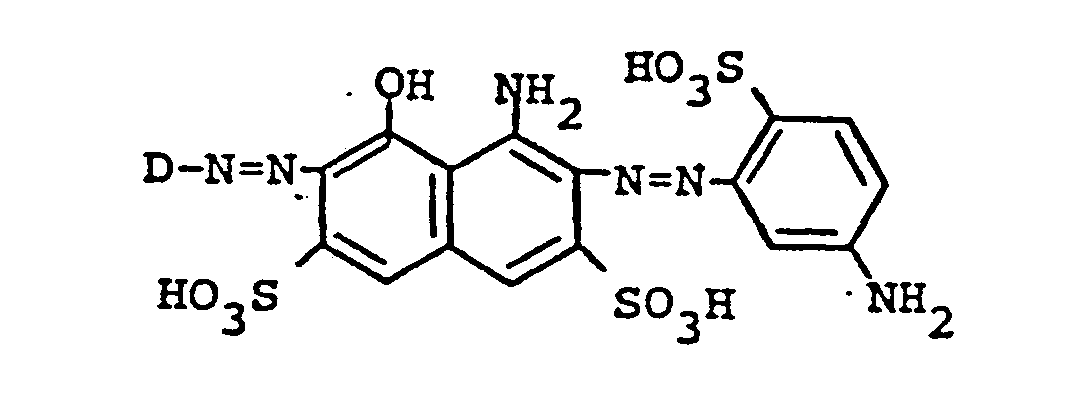
- Die vorliegende Erfindung betrifft neue reaktivgruppenhaltige Farbstoffe der Struktur (1)

D die Struktur
- X = Wasserstoff, C1-C4-Alkyl, C1-C4-Alkoxy, Halogen, Carboxy, Sulfo oder einen gegebenenfalls substituierten Phenylazorest bedeutet.
- X steht bevorzugt für H, CH3, Cl, SO3H, 4-Sulfophenylazo.
- Die Herstellung der neuen reaktivgruppenhaltigen Azofarbstoffe der Struktur (1) kann man beispielsweise in der Weise durchführen, daß man chromophore Aminoverbindungen der Formel


- Eine andere Herstellungsvariante besteht in der Kondensation von (6) mit 2,4-Diamino-benzolsulfonsäure bei pH 5 bis 7, nachfolgender Diazotierung des Kondensationsproduktes und Kupplung auf 1-Amino-8-hydroxynaphthalin-3,6- bzw. -4,6-disulfonsäure unter sauren Bedingungen (pH 1 bis 3).

- Diazotierung von Aminen der Struktur D-NH2 und Kupplung auf (7) unter neutralen Bedingungen führt zu den Farbstoffen der Struktur (1).
- Die Herstellung des Farbstoffes der Struktur (3) kann bevorzugt auch nach folgendem "Eintopf-Verfahren" erfolgen:
- Man diazotiert das Kondensationsprodukt aus (6) und 2,4-Diaminobenzolsulfonsäure sowie die 2-Aminonaphthalin-1,5-disulfonsäure gemeinsam in einem Reaktionsgefäß, fügt zur Diazotierungsmischung bei pH 1 bis 3 langsam eine neutrale Lösung von 1-Amino-8-hydroxynaphthalin-3,6-disulfonsäute und erhöht dann den pH der roten Reaktionsmischung durch Zugabe von Bicarbonat- oder Natriumacetatlösung langsam auf einen Wert von 6 bis 7. Der Farbstoff kann durch Aussalzen oder Sprühtrocknung isoliert werden.
- Die neuen Farbstoffe der Formel (1), die Nuancen von marineblau, dunkelblau, grünstichig blau bis schwarz aufweisen können, eignen sich besonders zum Färben und Bedrucken von Hydroxyl- oder Amidgruppen enthaltenden Fasermaterialien, bevorzugt zum Färben von nativer oder regenerierter Cellulose, wobei die Behandlung zweckmäßigerweise in Gegenwart säurebindender Mittel nach den für Reaktivfarbstoffe bekanntgewordenen Verfahren erfolgt.
- Die damit praktizierten Färbungen zeichnen sich durch eine hervorragende Chlorechtheit und Oxidationsbeständigkeit aus.
- Die oben angegebenen Formeln sind die der freien Säuren. Im allgemeinen erhält man bei der Synthese die Alkalisalze, insbesondere die Na- oder Li-Salze und verwendet die Farbstoffe auch in dieser Form zum Färben.
-

- A: 29,8 g 2,4-Diaminobenzolsulfonsäure werden in 450 ml Wasser und 15 ml konz. Natronlauge bei pH 6 vorgelegt, auf 45°C erwärmt und mit 40 g 5-Chlor-2-(dichforfluormethyl)-4,6-difluorpyrimidin umgesetzt. Dabei hält man den pH durch Zugabe von ca. 85 ml einer 20 %igen Sodalösung konstant zwischen 5,5 - 6,0. Nach 3 Stunden Rühren bei 45°C heizt man kurzzeitig auf 55° C und kühlt dann durch Eiszugabe auf 0 - 5°C ab. Man versetzt langsam mit 60 ml konz. Salzsäure und tropft dann 27,5 ml einer 30 %igen (g/I) Natriumnitritlösung zu. Nach 2 Stunden bei 5°C fügt man 5 ml Amidosulfonsäurelösung zu. Dazu tropft man langsam eine neutrale Lösung von 49,4 g 1-Amino-8-hydroxynaphthalin-3,6-disulfonsäure (H-Säure) in 400 ml Wasser und stellt den pH durch Zugabe von festem Natriumhydrogencarbonat oder Lithiumcarbonat auf pH 2,5 - 2,7. Die Suspension wird nach 3 Stunden Rühren auf 30°C erwärmt und der pH durch weitere Carbonatzugabe auf 4,0 erhöht. Die resultierende rote Lösung wird mittels Filterhilfe geklärt und nach Zugabe von 100 g Eis mit einer Diazoniumsalzsuspension, die aus 41,4 g 2-Aminonaphthatin-1,5-disulfonsäure durch Diazotierung bereitet wurde, versetzt. Mit Sodalösung erhöht man den pH der Mischung auf 7,5 und rürt 1 Stunde nach. Es wird mit 250 g Kochsalz ausgesalzen, und der Farbstoff durch Absaugen isoliert und bei 70° C i.Vak. getrocknet. Man erhält 170 g eines Farbstoffpulvers, das Baumwolle in grünstichig dunkelblauen, bzw. - bei höheren Konzentrationen - in schwarzen Tönen färbt.
- B: Man kondensiert 29,8 g 2,4-Diaminobenzolsulfonsäure mit 40 g 5-Chlor-2-(dichlorfluormethyl)-4,6-difluor- pyrimidin in der unter A beschriebenen Weise, fügt zur 0 - 5°C kalten Suspension 41,4 g 2-Aminonaphthalin-1,5- disulfonsäure und 80 ml konz. Salzsäure und tropft dann 76 ml einer 30 %igen Natriumnitritlösung zu. Die Temperatur sollte dabei 5°C nicht übersteigen. Nach 2 Stunden versetzt man mit 10 ml Amidosulfonsäurelösung und stellt die Mischung mit Sodalösung auf pH 2,0. Dazu tropft man langsam eine neutrale Lösung von 49,4 g H-Säure in 400 ml Wasser und rührt solange bei pH 2,0 - 2,5 nach, bis eine Temperatur von 20 - 22°C erreicht wird. Durch langsames Zudosieren von festem Natriumhydrogencarbonat erhöht man den pH innerhalb von 2 Stunden auf pH 7,5 und läßt bei konstantem pH noch 2 Stunden nachrühren. Es resultiert eine tiefblaue Lösung, die mittels Filterhilfe geklärt und anschließend sprühgetrocknet wird. Es werden 195 g Farbstoff isoliert, der sich mit dem unter A erhaltenen als identisch erweist.
-

- A: Verwendet man anstelle von 2-Aminonaphthalin-1,5-disulfonsäure in Beispiel 1 nun 2-Aminobenzolsulfonsäure und führt die einzelnen Reaktionsschritte analog Beispiel 1 durch, so resultiert ein dunkles Farbstoffpulver, das ebenfalls auf Baumwolle tiefschwarze Färbungen mit hervorragenden Echtheiten liefert. C: In bekannter Weise ist durch eine zweifache Kupplung von diazotierter 4-Acylamino-2-aminobenzolsulfonsäure und diazotierter 2-Aminobenzolsulfonsäure auf H-Säure und nachfolgender Verseifung der Acylaminogruppierung ein Zwischenprodukt der'folgenden Struktur erhältlich:

- 135 g dieses Zwischenprodukts werden in 250 ml Wasser gelöst und bei konstantem pH 7,5 mit 36 g 5-Chlor-2-(dichlorfluormethyl)-4,6-difluorpyrimidin umgesetzt. Die pH-Steuerung erfolgt dabei durch Zugabe von 20 %iger Sodalösung. Die Reaktion ist nach ca. 2 Stunden beendet. Die blaue Lösung wird mittels Filterhilfe geklärt und der Farbstoff mit 50 g Kochsalz ausgesalzen. Nach dem Abnutschen und Trocknen erhält man 160 g eines Farbstoffes, der dem unter A entspricht.
-

- Verwendet man anstelle von H-Säure in Beispiel 1 nun K-Säure (1-Amino-8-hydroxynaphthalin-4,6- disulfonsäure), so resultiert ein Farbstoff, der marineblaue Färbungen von hervorragender Echtheit liefert. Durch Einsatz von H-Säure/K-Säure-Mischungen als Kupplungskomponente lassen sich Farbstoffmischungen aus Beispiel 1 und 3 herstellen, die ebenfalls hochwertige dunkelblaue bzw. schwarze Färbungen liefern.
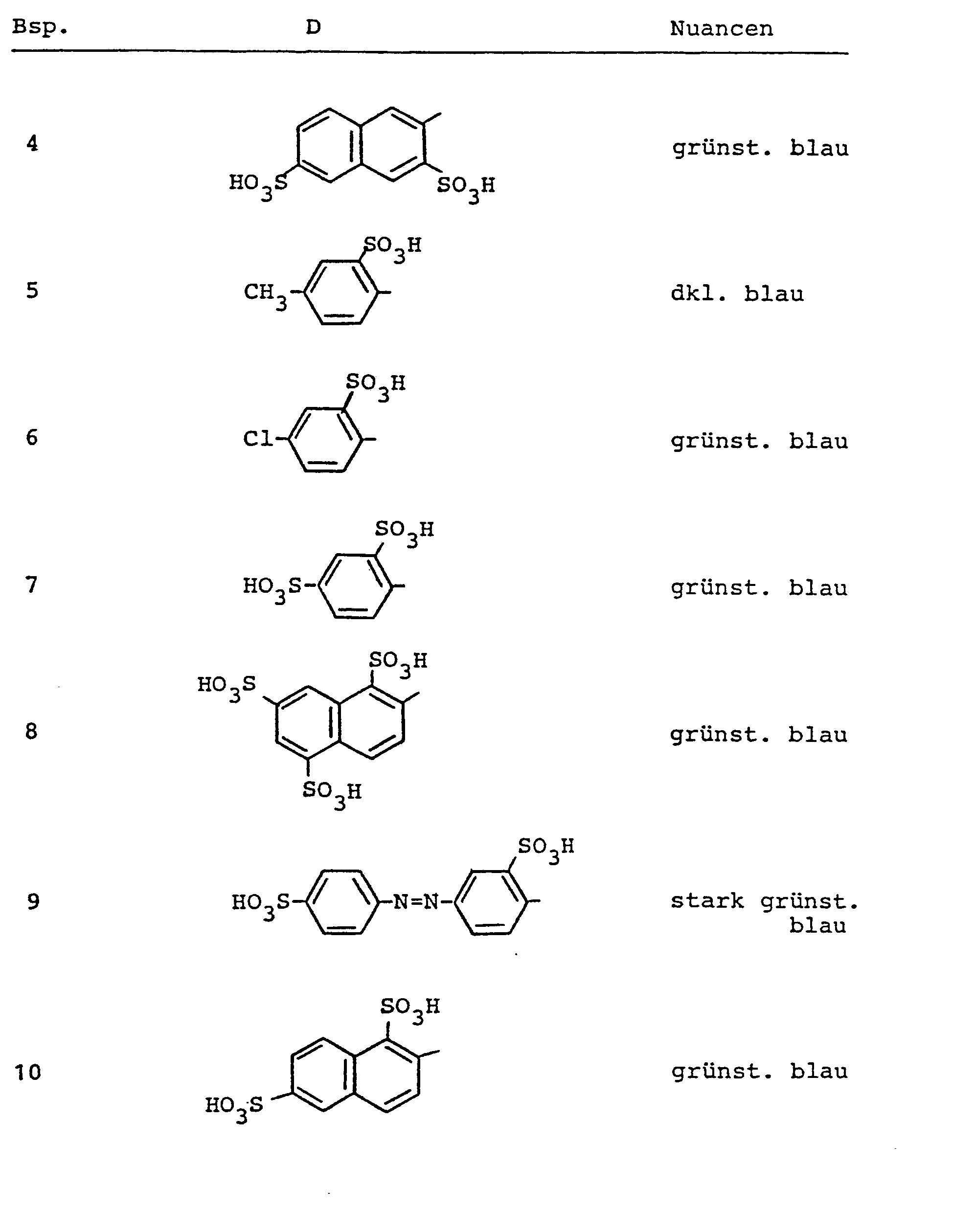
- Verwendet man anstelle von 2-Aminonaphthalin-1,5-disulfonsäure in Beispiel 1 andere Diazokomponenten, so sind die in der Tabelle aufgeführten Farbstoffe zugänglich.

Besonders bevorzugt sind die beiden Farbstoffe der Struktur (3) und (4)


Claims (6)



oder aber das Kondensationsprodukt aus (6) und 2,4-Diaminobenzolsulfonsäure diazotiert, auf 1-Amino-8-hydroxynaphthalin-3,6- bzw. -4,6-disulfonsäure unter sauren Bedingungen kuppelt und das resultierende Monoazoprodukt der Formel

Applications Claiming Priority (2)
| Application Number | Priority Date | Filing Date | Title |
|---|---|---|---|
| DE3426422A DE3426422A1 (de) | 1984-07-18 | 1984-07-18 | Reaktivfarbstoffe |
| DE3426422 | 1984-07-18 |
Publications (2)
| Publication Number | Publication Date |
|---|---|
| EP0168739A1 EP0168739A1 (de) | 1986-01-22 |
| EP0168739B1 true EP0168739B1 (de) | 1987-04-29 |
Family
ID=6240926
Family Applications (1)
| Application Number | Title | Priority Date | Filing Date |
|---|---|---|---|
| EP85108424A Expired EP0168739B1 (de) | 1984-07-18 | 1985-07-08 | Reaktivfarbstoffe |
Country Status (3)
| Country | Link |
|---|---|
| EP (1) | EP0168739B1 (de) |
| JP (1) | JPS6136368A (de) |
| DE (2) | DE3426422A1 (de) |
Families Citing this family (1)
| Publication number | Priority date | Publication date | Assignee | Title |
|---|---|---|---|---|
| DE3943286A1 (de) * | 1989-12-29 | 1991-07-04 | Hoechst Ag | Azoverbindungen, verfahren zu deren herstellung und ihre verwendung als farbstofe |
Family Cites Families (4)
| Publication number | Priority date | Publication date | Assignee | Title |
|---|---|---|---|---|
| DE1644184C3 (de) * | 1966-12-05 | 1974-03-28 | Bayer Ag, 5090 Leverkusen | Reaktivfarbstoffe, Verfahren zu deren Herstellung und Verwendung zum Färben und Bedrucken cellulosehaltiger Materialien |
| DE3118699A1 (de) * | 1981-05-12 | 1982-12-02 | Bayer Ag, 5090 Leverkusen | Reaktivfarbstoffe, verfahren zu ihrer herstellung und ihre verwendunkg zum faerben und bedrucken von hydroxylgruppen- oder stickstoffhaltigen materialien |
| DE3317651A1 (de) * | 1983-05-14 | 1984-11-15 | Bayer Ag, 5090 Leverkusen | Reaktivfarbstoffe, verfahren zu ihrer herstellung und ihre verwendung um faerben und bedrucken von substraten |
| DE3335987A1 (de) * | 1983-10-04 | 1985-04-18 | Bayer Ag, 5090 Leverkusen | Reaktivfarbstoffe |
-
1984
- 1984-07-18 DE DE3426422A patent/DE3426422A1/de not_active Withdrawn
-
1985
- 1985-07-08 EP EP85108424A patent/EP0168739B1/de not_active Expired
- 1985-07-08 DE DE8585108424T patent/DE3560148D1/de not_active Expired
- 1985-07-15 JP JP15436785A patent/JPS6136368A/ja active Pending
Also Published As
| Publication number | Publication date |
|---|---|
| DE3426422A1 (de) | 1986-01-23 |
| JPS6136368A (ja) | 1986-02-21 |
| EP0168739A1 (de) | 1986-01-22 |
| DE3560148D1 (en) | 1987-06-04 |
Similar Documents
| Publication | Publication Date | Title |
|---|---|---|
| DE2842640A1 (de) | Reaktivfarbstoffe | |
| EP0048355A1 (de) | Wasserlösliche Disazoverbindungen, Verfahren zu deren Herstellung und ihre Verwendung als Farbstoffe | |
| EP0065732B1 (de) | Wasserlösliche Disazoverbindungen, Verfahren zu deren Herstellung und ihre Verwendung als Farbstoffe | |
| EP0292825B1 (de) | Reaktivfarbstoffe | |
| DE1289930B (de) | Verfahren zur Herstellung von Azofarbstoffen und deren Metallkomplexverbindungen | |
| EP0568816B1 (de) | Symmetrische Azofarbstoffe | |
| DE3045789A1 (de) | Faseraktive azofarbstoffe, verfahren zu ihrer herstellung und ihre verwendung zum faerben und bedrucken von hydroxylgruppen- und/oder stickstoffhaltigen fasermaterialien | |
| DE1544538A1 (de) | Verfahren zur Herstellung von Disazofarbstoffen und deren Metallkomplexverbindungen | |
| EP0522399B1 (de) | Pyridon-Azo-Reaktivfarbstoffe | |
| EP0144704B1 (de) | Reaktivfarbstoffe | |
| EP0168739A1 (de) | Reaktivfarbstoffe | |
| DE2453209C2 (de) | Disazofarbstoffe, Verfahren zu deren Herstellung und deren Verwendung | |
| EP0568892B1 (de) | Monoazoreaktivfarbstoffe | |
| EP0455054B1 (de) | Polyazoreaktivfarbstoffe | |
| EP0125650B1 (de) | Reaktivfarbstoffe, Verfahren zu ihrer Herstellung und ihre Verwendung zum Färben und Bedrucken von Substraten | |
| EP0036533A2 (de) | Farbstoffe, Verfahren zu ihrer Herstellung sowie ihre Verwendung zum Färben hydroxylgruppen- oder stickstoffhaltiger Materialien | |
| EP0043465A2 (de) | Reaktivfarbstoffe und ihre Verwendung zum Färben und Bedrucken hydroxylgruppenhaltiger oder stickstoffhaltiger Fasermaterialien | |
| DE844770C (de) | Verfahren zur Herstellung von neuen Monoazofarbstoffen | |
| EP0453895B1 (de) | Reaktivfarbstoffe | |
| EP0554746A1 (de) | Reaktivfarbstoffe, deren Herstellung und Verwendung | |
| DE3835724A1 (de) | Faserreaktive metallisierte monoazoverbindungen | |
| DE1904113B2 (de) | Faserreaktive, schwermetallhaltige Formazanfarbstoffe, Verfahren zu deren Herstellung und deren Verwendung | |
| DE1644079C3 (de) | Verfahren zur Herstellung wasserlöslicher Farbstoffe | |
| DE2705631A1 (de) | Azofarbstoffe | |
| DE2308068C3 (de) | Monoazo-Verblndungen, Verfahren zu deren Herstellung und Ihre Verwendung als Farbstoffe |
Legal Events
| Date | Code | Title | Description |
|---|---|---|---|
| PUAI | Public reference made under article 153(3) epc to a published international application that has entered the european phase |
Free format text: ORIGINAL CODE: 0009012 |
|
| 17P | Request for examination filed |
Effective date: 19850708 |
|
| AK | Designated contracting states |
Designated state(s): CH DE FR GB LI |
|
| 17Q | First examination report despatched |
Effective date: 19860704 |
|
| GRAA | (expected) grant |
Free format text: ORIGINAL CODE: 0009210 |
|
| AK | Designated contracting states |
Kind code of ref document: B1 Designated state(s): CH DE FR GB LI |
|
| REF | Corresponds to: |
Ref document number: 3560148 Country of ref document: DE Date of ref document: 19870604 |
|
| ET | Fr: translation filed | ||
| PLBE | No opposition filed within time limit |
Free format text: ORIGINAL CODE: 0009261 |
|
| STAA | Information on the status of an ep patent application or granted ep patent |
Free format text: STATUS: NO OPPOSITION FILED WITHIN TIME LIMIT |
|
| 26N | No opposition filed | ||
| PG25 | Lapsed in a contracting state [announced via postgrant information from national office to epo] |
Ref country code: GB Effective date: 19890708 |
|
| PG25 | Lapsed in a contracting state [announced via postgrant information from national office to epo] |
Ref country code: LI Effective date: 19890731 Ref country code: CH Effective date: 19890731 |
|
| GBPC | Gb: european patent ceased through non-payment of renewal fee | ||
| PG25 | Lapsed in a contracting state [announced via postgrant information from national office to epo] |
Ref country code: FR Free format text: LAPSE BECAUSE OF NON-PAYMENT OF DUE FEES Effective date: 19900330 |
|
| REG | Reference to a national code |
Ref country code: CH Ref legal event code: PL |
|
| PG25 | Lapsed in a contracting state [announced via postgrant information from national office to epo] |
Ref country code: DE Effective date: 19900403 |
|
| REG | Reference to a national code |
Ref country code: FR Ref legal event code: ST |