EP0168761B1 - Procédé pour la préparation de 2-méthyl-2-alcénals à partir de dihydropyranes - Google Patents
Procédé pour la préparation de 2-méthyl-2-alcénals à partir de dihydropyranes Download PDFInfo
- Publication number
- EP0168761B1 EP0168761B1 EP85108551A EP85108551A EP0168761B1 EP 0168761 B1 EP0168761 B1 EP 0168761B1 EP 85108551 A EP85108551 A EP 85108551A EP 85108551 A EP85108551 A EP 85108551A EP 0168761 B1 EP0168761 B1 EP 0168761B1
- Authority
- EP
- European Patent Office
- Prior art keywords
- zeolite
- catalyst
- zeolites
- methyl
- solution
- Prior art date
- Legal status (The legal status is an assumption and is not a legal conclusion. Google has not performed a legal analysis and makes no representation as to the accuracy of the status listed.)
- Expired
Links
- 238000000034 method Methods 0.000 title claims description 25
- 238000004519 manufacturing process Methods 0.000 title description 2
- 239000010457 zeolite Substances 0.000 claims description 47
- HNPSIPDUKPIQMN-UHFFFAOYSA-N dioxosilane;oxo(oxoalumanyloxy)alumane Chemical compound O=[Si]=O.O=[Al]O[Al]=O HNPSIPDUKPIQMN-UHFFFAOYSA-N 0.000 claims description 38
- 229910021536 Zeolite Inorganic materials 0.000 claims description 24
- 229910000323 aluminium silicate Inorganic materials 0.000 claims description 22
- 239000000203 mixture Substances 0.000 claims description 18
- VYPSYNLAJGMNEJ-UHFFFAOYSA-N silicon dioxide Inorganic materials O=[Si]=O VYPSYNLAJGMNEJ-UHFFFAOYSA-N 0.000 claims description 14
- 239000001257 hydrogen Substances 0.000 claims description 5
- 229910052739 hydrogen Inorganic materials 0.000 claims description 5
- 125000004435 hydrogen atom Chemical class [H]* 0.000 claims description 5
- SQZVYXOKAXPDKY-UHFFFAOYSA-N 2,5-diethyl-3,4-dihydropyran-2-carbaldehyde Chemical compound CCC1=COC(CC)(C=O)CC1 SQZVYXOKAXPDKY-UHFFFAOYSA-N 0.000 claims description 4
- 238000002360 preparation method Methods 0.000 claims description 4
- BUDQDWGNQVEFAC-UHFFFAOYSA-N Dihydropyran Chemical compound C1COC=CC1 BUDQDWGNQVEFAC-UHFFFAOYSA-N 0.000 claims description 3
- PNEYBMLMFCGWSK-UHFFFAOYSA-N aluminium oxide Inorganic materials [O-2].[O-2].[O-2].[Al+3].[Al+3] PNEYBMLMFCGWSK-UHFFFAOYSA-N 0.000 claims description 3
- 125000004432 carbon atom Chemical group C* 0.000 claims description 3
- 125000000217 alkyl group Chemical group 0.000 claims description 2
- 229910052680 mordenite Inorganic materials 0.000 claims description 2
- 239000003054 catalyst Substances 0.000 description 41
- 239000000243 solution Substances 0.000 description 23
- XEEYBQQBJWHFJM-UHFFFAOYSA-N iron Substances [Fe] XEEYBQQBJWHFJM-UHFFFAOYSA-N 0.000 description 20
- 229910004298 SiO 2 Inorganic materials 0.000 description 12
- 229910052742 iron Inorganic materials 0.000 description 11
- KDLHZDBZIXYQEI-UHFFFAOYSA-N Palladium Chemical compound [Pd] KDLHZDBZIXYQEI-UHFFFAOYSA-N 0.000 description 10
- 239000011230 binding agent Substances 0.000 description 9
- XLYOFNOQVPJJNP-UHFFFAOYSA-N water Chemical compound O XLYOFNOQVPJJNP-UHFFFAOYSA-N 0.000 description 9
- 229910018072 Al 2 O 3 Inorganic materials 0.000 description 8
- 238000001354 calcination Methods 0.000 description 8
- 238000006243 chemical reaction Methods 0.000 description 7
- IJKVHSBPTUYDLN-UHFFFAOYSA-N dihydroxy(oxo)silane Chemical compound O[Si](O)=O IJKVHSBPTUYDLN-UHFFFAOYSA-N 0.000 description 7
- 238000005342 ion exchange Methods 0.000 description 7
- 235000012239 silicon dioxide Nutrition 0.000 description 7
- ACWQBUSCFPJUPN-HWKANZROSA-N trans-2-methyl-2-butenal Chemical compound C\C=C(/C)C=O ACWQBUSCFPJUPN-HWKANZROSA-N 0.000 description 7
- 239000003513 alkali Substances 0.000 description 6
- 125000003118 aryl group Chemical group 0.000 description 6
- 229910001593 boehmite Inorganic materials 0.000 description 6
- 238000001035 drying Methods 0.000 description 6
- NAQMVNRVTILPCV-UHFFFAOYSA-N hexane-1,6-diamine Chemical compound NCCCCCCN NAQMVNRVTILPCV-UHFFFAOYSA-N 0.000 description 6
- FAHBNUUHRFUEAI-UHFFFAOYSA-M hydroxidooxidoaluminium Chemical compound O[Al]=O FAHBNUUHRFUEAI-UHFFFAOYSA-M 0.000 description 6
- 229910052751 metal Inorganic materials 0.000 description 6
- 239000002184 metal Substances 0.000 description 6
- 239000000047 product Substances 0.000 description 6
- 239000000377 silicon dioxide Substances 0.000 description 6
- 239000011734 sodium Substances 0.000 description 6
- 229910052784 alkaline earth metal Inorganic materials 0.000 description 5
- 239000007795 chemical reaction product Substances 0.000 description 5
- 239000007789 gas Substances 0.000 description 5
- 150000002739 metals Chemical class 0.000 description 5
- 239000002253 acid Substances 0.000 description 4
- 229910052782 aluminium Inorganic materials 0.000 description 4
- AMVQGJHFDJVOOB-UHFFFAOYSA-H aluminium sulfate octadecahydrate Chemical compound O.O.O.O.O.O.O.O.O.O.O.O.O.O.O.O.O.O.[Al+3].[Al+3].[O-]S([O-])(=O)=O.[O-]S([O-])(=O)=O.[O-]S([O-])(=O)=O AMVQGJHFDJVOOB-UHFFFAOYSA-H 0.000 description 4
- 230000015572 biosynthetic process Effects 0.000 description 4
- 238000003776 cleavage reaction Methods 0.000 description 4
- 150000001875 compounds Chemical class 0.000 description 4
- 238000001914 filtration Methods 0.000 description 4
- 150000007857 hydrazones Chemical class 0.000 description 4
- 239000000463 material Substances 0.000 description 4
- 239000012071 phase Substances 0.000 description 4
- 235000019353 potassium silicate Nutrition 0.000 description 4
- 230000007017 scission Effects 0.000 description 4
- NTHWMYGWWRZVTN-UHFFFAOYSA-N sodium silicate Chemical compound [Na+].[Na+].[O-][Si]([O-])=O NTHWMYGWWRZVTN-UHFFFAOYSA-N 0.000 description 4
- XFNJVJPLKCPIBV-UHFFFAOYSA-N trimethylenediamine Chemical compound NCCCN XFNJVJPLKCPIBV-UHFFFAOYSA-N 0.000 description 4
- JLIDVCMBCGBIEY-UHFFFAOYSA-N vinyl ethyl ketone Natural products CCC(=O)C=C JLIDVCMBCGBIEY-UHFFFAOYSA-N 0.000 description 4
- OKKJLVBELUTLKV-UHFFFAOYSA-N Methanol Chemical compound OC OKKJLVBELUTLKV-UHFFFAOYSA-N 0.000 description 3
- 150000007513 acids Chemical class 0.000 description 3
- HGINCPLSRVDWNT-UHFFFAOYSA-N acrylaldehyde Natural products C=CC=O HGINCPLSRVDWNT-UHFFFAOYSA-N 0.000 description 3
- 230000001476 alcoholic effect Effects 0.000 description 3
- 229910052783 alkali metal Inorganic materials 0.000 description 3
- 150000001340 alkali metals Chemical class 0.000 description 3
- 150000001342 alkaline earth metals Chemical class 0.000 description 3
- 150000001412 amines Chemical class 0.000 description 3
- 229910052796 boron Inorganic materials 0.000 description 3
- 239000000571 coke Substances 0.000 description 3
- 229910052733 gallium Inorganic materials 0.000 description 3
- 238000005470 impregnation Methods 0.000 description 3
- 239000002609 medium Substances 0.000 description 3
- 230000004048 modification Effects 0.000 description 3
- 238000012986 modification Methods 0.000 description 3
- 238000000465 moulding Methods 0.000 description 3
- 150000003839 salts Chemical class 0.000 description 3
- 229910052710 silicon Inorganic materials 0.000 description 3
- 238000003756 stirring Methods 0.000 description 3
- 238000003786 synthesis reaction Methods 0.000 description 3
- 229910052721 tungsten Inorganic materials 0.000 description 3
- 238000005406 washing Methods 0.000 description 3
- LPDDKAJRWGPGSI-UHFFFAOYSA-N (3-methyl-4-oxobut-2-enyl) acetate Chemical compound CC(=O)OCC=C(C)C=O LPDDKAJRWGPGSI-UHFFFAOYSA-N 0.000 description 2
- AFCKDFKRBDURAK-UHFFFAOYSA-N (3-methyl-4-oxobutyl) acetate Chemical compound O=CC(C)CCOC(C)=O AFCKDFKRBDURAK-UHFFFAOYSA-N 0.000 description 2
- FFMRZGOBLFVKQY-UHFFFAOYSA-N 3-formylbut-3-enyl acetate Chemical compound CC(=O)OCCC(=C)C=O FFMRZGOBLFVKQY-UHFFFAOYSA-N 0.000 description 2
- QGZKDVFQNNGYKY-UHFFFAOYSA-O Ammonium Chemical group [NH4+] QGZKDVFQNNGYKY-UHFFFAOYSA-O 0.000 description 2
- NLXLAEXVIDQMFP-UHFFFAOYSA-N Ammonium chloride Substances [NH4+].[Cl-] NLXLAEXVIDQMFP-UHFFFAOYSA-N 0.000 description 2
- VHUUQVKOLVNVRT-UHFFFAOYSA-N Ammonium hydroxide Chemical compound [NH4+].[OH-] VHUUQVKOLVNVRT-UHFFFAOYSA-N 0.000 description 2
- IJGRMHOSHXDMSA-UHFFFAOYSA-N Atomic nitrogen Chemical compound N#N IJGRMHOSHXDMSA-UHFFFAOYSA-N 0.000 description 2
- ZOXJGFHDIHLPTG-UHFFFAOYSA-N Boron Chemical group [B] ZOXJGFHDIHLPTG-UHFFFAOYSA-N 0.000 description 2
- UXVMQQNJUSDDNG-UHFFFAOYSA-L Calcium chloride Chemical compound [Cl-].[Cl-].[Ca+2] UXVMQQNJUSDDNG-UHFFFAOYSA-L 0.000 description 2
- 229910052684 Cerium Inorganic materials 0.000 description 2
- KRHYYFGTRYWZRS-UHFFFAOYSA-N Fluorane Chemical compound F KRHYYFGTRYWZRS-UHFFFAOYSA-N 0.000 description 2
- GYHNNYVSQQEPJS-UHFFFAOYSA-N Gallium Chemical compound [Ga] GYHNNYVSQQEPJS-UHFFFAOYSA-N 0.000 description 2
- VEXZGXHMUGYJMC-UHFFFAOYSA-N Hydrochloric acid Chemical compound Cl VEXZGXHMUGYJMC-UHFFFAOYSA-N 0.000 description 2
- UFHFLCQGNIYNRP-UHFFFAOYSA-N Hydrogen Chemical compound [H][H] UFHFLCQGNIYNRP-UHFFFAOYSA-N 0.000 description 2
- 229910002651 NO3 Inorganic materials 0.000 description 2
- NHNBFGGVMKEFGY-UHFFFAOYSA-N Nitrate Chemical compound [O-][N+]([O-])=O NHNBFGGVMKEFGY-UHFFFAOYSA-N 0.000 description 2
- 229910019142 PO4 Inorganic materials 0.000 description 2
- NBIIXXVUZAFLBC-UHFFFAOYSA-N Phosphoric acid Chemical compound OP(O)(O)=O NBIIXXVUZAFLBC-UHFFFAOYSA-N 0.000 description 2
- XUIMIQQOPSSXEZ-UHFFFAOYSA-N Silicon Chemical compound [Si] XUIMIQQOPSSXEZ-UHFFFAOYSA-N 0.000 description 2
- FAPWRFPIFSIZLT-UHFFFAOYSA-M Sodium chloride Chemical compound [Na+].[Cl-] FAPWRFPIFSIZLT-UHFFFAOYSA-M 0.000 description 2
- QAOWNCQODCNURD-UHFFFAOYSA-N Sulfuric acid Chemical compound OS(O)(=O)=O QAOWNCQODCNURD-UHFFFAOYSA-N 0.000 description 2
- 229910010413 TiO 2 Inorganic materials 0.000 description 2
- ACWQBUSCFPJUPN-UHFFFAOYSA-N Tiglaldehyde Natural products CC=C(C)C=O ACWQBUSCFPJUPN-UHFFFAOYSA-N 0.000 description 2
- XAGFODPZIPBFFR-UHFFFAOYSA-N aluminium Chemical compound [Al] XAGFODPZIPBFFR-UHFFFAOYSA-N 0.000 description 2
- -1 aluminum compound Chemical class 0.000 description 2
- 235000011114 ammonium hydroxide Nutrition 0.000 description 2
- 239000007864 aqueous solution Substances 0.000 description 2
- 229910052791 calcium Inorganic materials 0.000 description 2
- 239000011575 calcium Substances 0.000 description 2
- 239000001110 calcium chloride Substances 0.000 description 2
- 229910001628 calcium chloride Inorganic materials 0.000 description 2
- 229910052804 chromium Inorganic materials 0.000 description 2
- 239000011651 chromium Substances 0.000 description 2
- 239000004927 clay Substances 0.000 description 2
- 230000000052 comparative effect Effects 0.000 description 2
- SBZXBUIDTXKZTM-UHFFFAOYSA-N diglyme Chemical compound COCCOCCOC SBZXBUIDTXKZTM-UHFFFAOYSA-N 0.000 description 2
- 238000004821 distillation Methods 0.000 description 2
- 150000004820 halides Chemical class 0.000 description 2
- 238000002955 isolation Methods 0.000 description 2
- 238000006317 isomerization reaction Methods 0.000 description 2
- 229910052746 lanthanum Inorganic materials 0.000 description 2
- 239000007791 liquid phase Substances 0.000 description 2
- 229910052749 magnesium Inorganic materials 0.000 description 2
- 229910000510 noble metal Inorganic materials 0.000 description 2
- 229910052763 palladium Inorganic materials 0.000 description 2
- 239000008188 pellet Substances 0.000 description 2
- 235000021317 phosphate Nutrition 0.000 description 2
- 239000002244 precipitate Substances 0.000 description 2
- 229910052761 rare earth metal Inorganic materials 0.000 description 2
- 150000002910 rare earth metals Chemical class 0.000 description 2
- 230000008929 regeneration Effects 0.000 description 2
- 238000011069 regeneration method Methods 0.000 description 2
- 238000000926 separation method Methods 0.000 description 2
- 238000007493 shaping process Methods 0.000 description 2
- 239000010703 silicon Substances 0.000 description 2
- 150000003377 silicon compounds Chemical class 0.000 description 2
- 239000007858 starting material Substances 0.000 description 2
- 229910052723 transition metal Inorganic materials 0.000 description 2
- 150000003624 transition metals Chemical class 0.000 description 2
- 229910052725 zinc Inorganic materials 0.000 description 2
- ITWBWJFEJCHKSN-UHFFFAOYSA-N 1,4,7-triazonane Chemical compound C1CNCCNCCN1 ITWBWJFEJCHKSN-UHFFFAOYSA-N 0.000 description 1
- VILCJCGEZXAXTO-UHFFFAOYSA-N 2,2,2-tetramine Chemical compound NCCNCCNCCN VILCJCGEZXAXTO-UHFFFAOYSA-N 0.000 description 1
- COPKIJZFCDJDMR-UHFFFAOYSA-N 2,5-dibenzyl-3,4-dihydropyran-2-carbaldehyde Chemical compound C1CC(CC=2C=CC=CC=2)=COC1(C=O)CC1=CC=CC=C1 COPKIJZFCDJDMR-UHFFFAOYSA-N 0.000 description 1
- IVDVIVALUHBKNO-UHFFFAOYSA-N 2,5-dioctyl-3,4-dihydropyran-2-carbaldehyde Chemical compound CCCCCCCCC1=COC(CCCCCCCC)(C=O)CC1 IVDVIVALUHBKNO-UHFFFAOYSA-N 0.000 description 1
- UDVDQPMLLBOKKZ-UHFFFAOYSA-N 2,5-dipropyl-3,4-dihydropyran-2-carbaldehyde Chemical compound CCCC1=COC(CCC)(C=O)CC1 UDVDQPMLLBOKKZ-UHFFFAOYSA-N 0.000 description 1
- ATRRKUHOCOJYRX-UHFFFAOYSA-N Ammonium bicarbonate Chemical compound [NH4+].OC([O-])=O ATRRKUHOCOJYRX-UHFFFAOYSA-N 0.000 description 1
- 229910004631 Ce(NO3)3.6H2O Inorganic materials 0.000 description 1
- VYZAMTAEIAYCRO-UHFFFAOYSA-N Chromium Chemical compound [Cr] VYZAMTAEIAYCRO-UHFFFAOYSA-N 0.000 description 1
- SNRUBQQJIBEYMU-UHFFFAOYSA-N Dodecane Natural products CCCCCCCCCCCC SNRUBQQJIBEYMU-UHFFFAOYSA-N 0.000 description 1
- DGAQECJNVWCQMB-PUAWFVPOSA-M Ilexoside XXIX Chemical compound C[C@@H]1CC[C@@]2(CC[C@@]3(C(=CC[C@H]4[C@]3(CC[C@@H]5[C@@]4(CC[C@@H](C5(C)C)OS(=O)(=O)[O-])C)C)[C@@H]2[C@]1(C)O)C)C(=O)O[C@H]6[C@@H]([C@H]([C@@H]([C@H](O6)CO)O)O)O.[Na+] DGAQECJNVWCQMB-PUAWFVPOSA-M 0.000 description 1
- 238000005684 Liebig rearrangement reaction Methods 0.000 description 1
- TWRXJAOTZQYOKJ-UHFFFAOYSA-L Magnesium chloride Chemical compound [Mg+2].[Cl-].[Cl-] TWRXJAOTZQYOKJ-UHFFFAOYSA-L 0.000 description 1
- 229910004283 SiO 4 Inorganic materials 0.000 description 1
- 230000002378 acidificating effect Effects 0.000 description 1
- 239000000654 additive Substances 0.000 description 1
- 125000003545 alkoxy group Chemical group 0.000 description 1
- 229910000147 aluminium phosphate Inorganic materials 0.000 description 1
- ANBBXQWFNXMHLD-UHFFFAOYSA-N aluminum;sodium;oxygen(2-) Chemical compound [O-2].[O-2].[Na+].[Al+3] ANBBXQWFNXMHLD-UHFFFAOYSA-N 0.000 description 1
- 239000001099 ammonium carbonate Substances 0.000 description 1
- 235000012501 ammonium carbonate Nutrition 0.000 description 1
- 150000003863 ammonium salts Chemical class 0.000 description 1
- 239000012736 aqueous medium Substances 0.000 description 1
- 229910052785 arsenic Inorganic materials 0.000 description 1
- RQNWIZPPADIBDY-UHFFFAOYSA-N arsenic atom Chemical compound [As] RQNWIZPPADIBDY-UHFFFAOYSA-N 0.000 description 1
- 125000004429 atom Chemical group 0.000 description 1
- QVGXLLKOCUKJST-UHFFFAOYSA-N atomic oxygen Chemical compound [O] QVGXLLKOCUKJST-UHFFFAOYSA-N 0.000 description 1
- 238000009835 boiling Methods 0.000 description 1
- 150000001639 boron compounds Chemical class 0.000 description 1
- 230000003197 catalytic effect Effects 0.000 description 1
- 238000005341 cation exchange Methods 0.000 description 1
- 150000001768 cations Chemical class 0.000 description 1
- 238000001311 chemical methods and process Methods 0.000 description 1
- 238000004939 coking Methods 0.000 description 1
- 239000013078 crystal Substances 0.000 description 1
- 230000009849 deactivation Effects 0.000 description 1
- 125000002704 decyl group Chemical group [H]C([H])([H])C([H])([H])C([H])([H])C([H])([H])C([H])([H])C([H])([H])C([H])([H])C([H])([H])C([H])([H])C([H])([H])* 0.000 description 1
- 230000018044 dehydration Effects 0.000 description 1
- 238000006297 dehydration reaction Methods 0.000 description 1
- DQUIAMCJEJUUJC-UHFFFAOYSA-N dibismuth;dioxido(oxo)silane Chemical compound [Bi+3].[Bi+3].[O-][Si]([O-])=O.[O-][Si]([O-])=O.[O-][Si]([O-])=O DQUIAMCJEJUUJC-UHFFFAOYSA-N 0.000 description 1
- 239000003814 drug Substances 0.000 description 1
- 239000000975 dye Substances 0.000 description 1
- 230000000694 effects Effects 0.000 description 1
- 125000001495 ethyl group Chemical group [H]C([H])([H])C([H])([H])* 0.000 description 1
- 238000002474 experimental method Methods 0.000 description 1
- 238000004508 fractional distillation Methods 0.000 description 1
- 238000004817 gas chromatography Methods 0.000 description 1
- 125000005843 halogen group Chemical group 0.000 description 1
- 238000010438 heat treatment Methods 0.000 description 1
- XXMIOPMDWAUFGU-UHFFFAOYSA-N hexane-1,6-diol Chemical compound OCCCCCCO XXMIOPMDWAUFGU-UHFFFAOYSA-N 0.000 description 1
- 230000007062 hydrolysis Effects 0.000 description 1
- 238000006460 hydrolysis reaction Methods 0.000 description 1
- GPRLSGONYQIRFK-UHFFFAOYSA-N hydron Chemical compound [H+] GPRLSGONYQIRFK-UHFFFAOYSA-N 0.000 description 1
- 230000000977 initiatory effect Effects 0.000 description 1
- 239000013067 intermediate product Substances 0.000 description 1
- 150000002505 iron Chemical class 0.000 description 1
- 150000002506 iron compounds Chemical class 0.000 description 1
- 229910000358 iron sulfate Inorganic materials 0.000 description 1
- BAUYGSIQEAFULO-UHFFFAOYSA-L iron(2+) sulfate (anhydrous) Chemical compound [Fe+2].[O-]S([O-])(=O)=O BAUYGSIQEAFULO-UHFFFAOYSA-L 0.000 description 1
- 125000000959 isobutyl group Chemical group [H]C([H])([H])C([H])(C([H])([H])[H])C([H])([H])* 0.000 description 1
- 125000001449 isopropyl group Chemical group [H]C([H])([H])C([H])(*)C([H])([H])[H] 0.000 description 1
- 125000002496 methyl group Chemical group [H]C([H])([H])* 0.000 description 1
- 125000004108 n-butyl group Chemical group [H]C([H])([H])C([H])([H])C([H])([H])C([H])([H])* 0.000 description 1
- 125000004123 n-propyl group Chemical group [H]C([H])([H])C([H])([H])C([H])([H])* 0.000 description 1
- 230000007935 neutral effect Effects 0.000 description 1
- 229910052757 nitrogen Inorganic materials 0.000 description 1
- 238000000655 nuclear magnetic resonance spectrum Methods 0.000 description 1
- 239000001301 oxygen Substances 0.000 description 1
- 229910052760 oxygen Inorganic materials 0.000 description 1
- 125000004430 oxygen atom Chemical group O* 0.000 description 1
- 239000002245 particle Substances 0.000 description 1
- 125000001147 pentyl group Chemical group C(CCCC)* 0.000 description 1
- NBIIXXVUZAFLBC-UHFFFAOYSA-K phosphate Chemical compound [O-]P([O-])([O-])=O NBIIXXVUZAFLBC-UHFFFAOYSA-K 0.000 description 1
- 239000010452 phosphate Substances 0.000 description 1
- 150000003013 phosphoric acid derivatives Chemical class 0.000 description 1
- 239000000843 powder Substances 0.000 description 1
- 239000011814 protection agent Substances 0.000 description 1
- 239000010453 quartz Substances 0.000 description 1
- RMAQACBXLXPBSY-UHFFFAOYSA-N silicic acid Chemical compound O[Si](O)(O)O RMAQACBXLXPBSY-UHFFFAOYSA-N 0.000 description 1
- 229910052708 sodium Inorganic materials 0.000 description 1
- 229910001388 sodium aluminate Inorganic materials 0.000 description 1
- 239000011780 sodium chloride Substances 0.000 description 1
- 239000002904 solvent Substances 0.000 description 1
- 239000000126 substance Substances 0.000 description 1
- 239000006228 supernatant Substances 0.000 description 1
- 125000000999 tert-butyl group Chemical group [H]C([H])([H])C(*)(C([H])([H])[H])C([H])([H])[H] 0.000 description 1
- WFKWXMTUELFFGS-UHFFFAOYSA-N tungsten Chemical compound [W] WFKWXMTUELFFGS-UHFFFAOYSA-N 0.000 description 1
- 239000010937 tungsten Substances 0.000 description 1
Classifications
-
- C—CHEMISTRY; METALLURGY
- C07—ORGANIC CHEMISTRY
- C07C—ACYCLIC OR CARBOCYCLIC COMPOUNDS
- C07C49/00—Ketones; Ketenes; Dimeric ketenes; Ketonic chelates
- C07C49/20—Unsaturated compounds containing keto groups bound to acyclic carbon atoms
- C07C49/213—Unsaturated compounds containing keto groups bound to acyclic carbon atoms containing six-membered aromatic rings
- C07C49/217—Unsaturated compounds containing keto groups bound to acyclic carbon atoms containing six-membered aromatic rings having unsaturation outside the aromatic rings
-
- C—CHEMISTRY; METALLURGY
- C07—ORGANIC CHEMISTRY
- C07C—ACYCLIC OR CARBOCYCLIC COMPOUNDS
- C07C45/00—Preparation of compounds having >C = O groups bound only to carbon or hydrogen atoms; Preparation of chelates of such compounds
- C07C45/56—Preparation of compounds having >C = O groups bound only to carbon or hydrogen atoms; Preparation of chelates of such compounds from heterocyclic compounds
- C07C45/57—Preparation of compounds having >C = O groups bound only to carbon or hydrogen atoms; Preparation of chelates of such compounds from heterocyclic compounds with oxygen as the only heteroatom
- C07C45/60—Preparation of compounds having >C = O groups bound only to carbon or hydrogen atoms; Preparation of chelates of such compounds from heterocyclic compounds with oxygen as the only heteroatom in six-membered rings
-
- C—CHEMISTRY; METALLURGY
- C07—ORGANIC CHEMISTRY
- C07C—ACYCLIC OR CARBOCYCLIC COMPOUNDS
- C07C45/00—Preparation of compounds having >C = O groups bound only to carbon or hydrogen atoms; Preparation of chelates of such compounds
- C07C45/61—Preparation of compounds having >C = O groups bound only to carbon or hydrogen atoms; Preparation of chelates of such compounds by reactions not involving the formation of >C = O groups
- C07C45/67—Preparation of compounds having >C = O groups bound only to carbon or hydrogen atoms; Preparation of chelates of such compounds by reactions not involving the formation of >C = O groups by isomerisation; by change of size of the carbon skeleton
- C07C45/673—Preparation of compounds having >C = O groups bound only to carbon or hydrogen atoms; Preparation of chelates of such compounds by reactions not involving the formation of >C = O groups by isomerisation; by change of size of the carbon skeleton by change of size of the carbon skeleton
-
- C—CHEMISTRY; METALLURGY
- C07—ORGANIC CHEMISTRY
- C07C—ACYCLIC OR CARBOCYCLIC COMPOUNDS
- C07C47/00—Compounds having —CHO groups
- C07C47/20—Unsaturated compounds having —CHO groups bound to acyclic carbon atoms
- C07C47/21—Unsaturated compounds having —CHO groups bound to acyclic carbon atoms with only carbon-to-carbon double bonds as unsaturation
Definitions
- the invention relates to a process for the preparation of 2-methyl-2-alkenals by cleaving dihydropyrans on zeolites, aluminosilicates and / or aluminophosphates.
- 4-acetoxy-2-formyl-1-butene can be converted to 4-acetoxy-2-formyl-2-butene (4-acetoxytiglinaldehyde).
- hydrogen is passed at a higher temperature through solutions of 4-acetoxy-2-formyl-1-butene in which a sulfur-doped supported palladium catalyst is suspended.
- Mixtures of 4-acetoxy-2-formyl-2-butene and 4-acetoxy-2-formylbutane are isolated in a ratio of 1: 4.
- a-ethyl acrolein can be rearranged to tiglinaldehyde (trans-2-methyl-2-butenal) by treatment with calcium chloride and subsequent distillation (Liebigs Ann. 494, 273 (1932)).
- 2-alkyl acrolein to the corresponding 2-methyl-2-alkenale; one can also proceed in such a way that the respective 2-alkylacroleindialkyl hydrazones are first prepared, these are rearranged with catalytic amounts of strong acids into the dialkyl hydrazones of the corresponding 2-methyl-2-alkenals and then the 2-methyl-2-alkenals from the hydrazones by hydrolysis releases (Zh. Org. Khim. 5,1183 (1969)).
- the isomerization on palladium catalysts has the disadvantage that considerable amounts of the starting product are hydrogenated to the unusable 4-acetoxy-2-formyl-butane.
- the conversion of a-ethyl acrolein into tiglinaldehyde in the presence of calcium chloride could not be confirmed when reworking the literature data.
- the isomerization proceeding over the dialkyl hydrazone has the disadvantage that it requires three reaction steps.
- the dialkylhydrazine used is obtained as a salt in the last reaction step and must be released with alkali with the formation of neutral salt.
- 2-methyl-2-alkenal are intermediate products sought, and e.g. Tiglinaldehyde as an important intermediate for the production of dyes, pharmaceuticals and crop protection agents was needed to find a process that would allow 2-methyl-2-alkenals to be produced more advantageously.
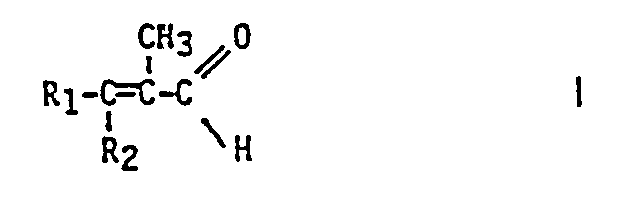
- 2-methyl-2-alkenals of the formula in which R 1 and R 2 denote hydrogen atoms, alkyl radicals having 1 to 18 carbon atoms or aromatic radicals obtained particularly advantageously by the fact that dihydropyrans of the formula in which R 1 and R 2 have the abovementioned meaning, heated in the presence of zeolites, aluminosilicates and / or aluminophosphates and the 2-methyl-2-alkenals are separated off from the resulting mixtures.
- the dihydropyrans are heated in the presence of the catalysts mentioned.
- the gas phase is preferably operated at a load (WHSV) of 0.1 to 20 h -1 , preferably 0.5 to 5 h -1 (g dihydropyran / g catalyst and hour).
- the process can be carried out batchwise or continuously, without pressure or under pressure in a tubular reactor, stirred tank or fluidized bed reactor.
- the reaction can be carried out in the presence of gases such as hydrogen, nitrogen and water vapor, which can influence the product composition and service life of the catalyst.
- gases such as hydrogen, nitrogen and water vapor, which can influence the product composition and service life of the catalyst.
- the deactivation of the catalyst can be suppressed in particular by adding steam.
- the dihydropyrans are cleaved, in which, in addition to the 2-methyl-2-alkenals of the formula I, the 2-alkyl (aryl) acroleins of the formula arise.
- the cleavage of the dihydropyrans can be represented, for example, for the reaction of 2,5-diethyl-2-formyl-2,3-dihydro-4H-pyran to tiglinaldehyde (trans-2-methyl-2-butenal) and ethyl acrolein by the following formulas :
- the starting materials of the formula 11 contain, as radicals R 1 and R 2, hydrogen atoms, alkyl radicals with 1 to 18 carbon atoms and aromatic Re ste.
- suitable alkyl radicals are methyl, ethyl, n-propyl, i-propyl, n-butyl, i-butyl, tert-butyl, pentyl, decyl and dodecyl radicals.
- aromatic residues such.
- Examples include the following dihydropyrans of the formula II: 2,5-diethyl-2-formyl-2,3-dihydro-4H-pyran, 2,5-dipropyl-2-formyl-2,3-dihydro-4H-pyran, 2,5-di-n-octyl-2-formyl-2,3-dihydro-4H-pyran, 2,5-dibenzyl-2-formyl-2,3-dihydro-4H-pyran.
- the dihydropyrans of formula II can e.g. by heating 2-alkyl (aryl) acroleins of formula III at 140 to 170 ° C, with or without solvent, (Houben-Weyl, Methods of Organic Chemistry, 4th Edition, Volume VII, Part 1, page 130).
- Zeolites are used as catalysts for the cleavage of the dihydropyrans.
- Zeolites are crystalline aluminosilicates that have a highly ordered structure with a rigid three-dimensional network of SiO 4 and AlO 4 tetrahedra that are connected by common oxygen atoms. The ratio of the Si and Al atoms to oxygen is 1: 2.
- the electrovalence of the tetrahedra containing aluminum is balanced by the inclusion of cations in the crystal, for example an alkali metal or hydrogen ion. A cation exchange is possible.
- the spaces between the tetrahedra are occupied by drying or calcining water molecules before dehydration.
- Crystalline compounds with a zeolite structure are also very suitable as catalysts, in which trivalent elements such as B, Ga, Fe, Cr instead of aluminum or tetravalent elements such as Ge instead of silicon are built into the zeolite lattice.
- Zeolites of the pentasil type are preferably used as catalysts. These zeolites can have different chemical compositions. These are alumino, boro, iron, gallium, chromium, arsenic and bismuth silicate zeolites or their mixtures of alumino, boro, gallium and iron germanate zeolites or their mixtures. Of these, the pentasil type alumino, borosilicate and iron silicate zeolites are preferred.
- the aluminosilicate zeolite is made from an aluminum compound, preferably Al (OH) 3 or Al 2 (SO 4 ) 3 , and a silicon component, preferably highly disperse silicon dioxide in aqueous amine solution, in particular in 1,6-hexanediamine or 1,3-propanediamine or triethylenetriamine - Solution made with and without alkali or alkaline earth additives at 100 to 200 ° C under autogenous pressure.
- the aluminosilicate zeolites obtained contain an SiO 2 / Al 2 O 3 ratio of 10 to 40,000, depending on the amount of starting material used.
- Such aluminosilicate zeolites can also be used in an ethereal medium, such as diethylene glycol dimethyl ether, in an alcoholic medium, such as methanol or 1,4-butanoi or synthesize in water.
- the borosilicate zeolite is e.g. B. at 90 to 200 ° C under autogenous pressure by a boron compound, such as H 3 BO 3 , with a silicon compound, preferably highly disperse silicon dioxide in aqueous amine solution, especially in 1,6-hexanediamine or 1,3-propanediamine or triethylenetetramine solution with and without addition of alkali or alkaline earth metal.
- borosilicate zeolites can also be prepared by carrying out the reaction in ethereal solution, for example diethylene glycol dimethyl ether, or in an alcoholic solution, for example in 1,6-hexanediol.
- the iron silicate zeolite can be made from an iron compound, preferably Fe 2 (SO 4 ) 3 and a silicon compound, preferably highly disperse silicon dioxide in aqueous amine solution, in particular in 1,6-hexanediamine, with and without addition of alkali or alkaline earth metal at 100 to 200 ° C under autogenous pressure produce.
- an iron compound preferably Fe 2 (SO 4 ) 3
- a silicon compound preferably highly disperse silicon dioxide in aqueous amine solution, in particular in 1,6-hexanediamine, with and without addition of alkali or alkaline earth metal at 100 to 200 ° C under autogenous pressure produce.
- the alumino, borosilicate and iron silicate zeolites thus produced can, after their isolation, drying at 100 to 160 ° C., preferably 110 ° C., and calcination at 450 to 550 ° C., preferably 500 ° C., with a binder in a ratio of 90:10 up to 40:60% by weight into strands or tablets.
- binders highly disperse Al 2 O 3 , highly disperse TiO 2 and clay.
- the extrudates or compacts are dried at 110 ° C / 16 h and calcined at 500 ° C / 16 g.
- Particularly advantageous catalysts are obtained by molding isolated aluminosilicate or borosilicate zeolites directly after drying and subjecting them to calcination for the first time after molding.
- the alumino, borosilicate and iron silicate zeolites can also be used in pure form, without binders, as strands or tablets.
- Y-type aluminosilicate zeolites are also suitable, which are made from silica sol (29% SiO 2 ) and sodium aluminate in an aqueous medium. These aluminosilicate zeolites can also be deformed with binders before they are used.
- Zeolites of the mordenite type and the X type can also be used.
- the zeolite is not in the catalytically particularly active, acidic H form after its synthesis, but rather, for example, in the Na form, it can be converted completely or partially into the desired H form by treatment with acids.
- the exchange can also be carried out with ammonium salts.
- the catalysts are modified e.g. by carrying out an ion exchange with the undeformed or deformed zeolites with alkali metals, such as Na — unless the alkali form of the zeolite is already present from the synthesis — with alkaline earth metals such as Ca, Mg and earth metals such as B, TI, or that the zeolites are impregnated with solutions of salts of the metals mentioned.
- alkali metals such as Na —
- alkaline earth metals such as Ca, Mg and earth metals such as B, TI
- Such an ion exchange can e.g. on the hydrogen, ammonium and alkali form of the zeolite.
- impregnating the zeolitic material e.g. treated with a halide, a nitrate or an oxide of the above-described metals in aqueous or alcoholic solution. Both ion exchange and impregnation are followed by at least one drying step, optionally another calcination.
- An ammoniacal Pd (NO 3 ) 2 solution can also be prepared, for example, and the pure powdered zeolite slurried in it at 40 to 100 ° C. with stirring for about 25 hours. After filtering, drying at approx. 150 ° C and calcination at approx. 500 ° C, the zeolitic material obtained in this way can be further processed with or without a binder to form strands or pellets.
- An ion exchange of the zeolite present in the H form can be carried out by introducing the zeolite in strands or pellets in a column and, for example, an ammoniacal Pd (N0 3 ) 2 solution at a slightly elevated temperature between 30 and 80 ° C conducts in the circuit for 15 to 20 h. Then it is washed out with water, dried at approx. 150 ° C and calcined at approx. 550 ° C.
- Amorphous aluminosilicates and / or aluminophosphates are also suitable as catalysts.
- Amorphous aluminosilicates are compounds made from Al 2 O 3 and SiO 2 .
- Such compounds can be produced, for example, from Al 2 (SO 4 ) 3 .18 H 2 O and water glass.
- the procedure is, for example, to combine Al 2 (SO 4 ) 3 .18 H 2 O and water glass at pH 1 to 3, preferably at pH 1, in the presence of H 2 SO 4 .
- This mixture is then reacted with an ammonia solution at pH 4 to 8, preferably 6, at 0 to 50 ° C., preferably 20 to 30 ° C.
- the resulting precipitate is filtered off, washed with ammonium carbonate solution and dried at 50 ° C to 150 ° C.
- Particularly advantageous catalysts are obtained, for example, if an SiO 2 : Al 2 O 3 ratio of 80:20 to 20:80, in particular 75:25 to 35:65, is set.
- aluminophosphates can be precipitated from Al (NO 3 ) 3 .9 H 2 0 with (NH 4 ) 3 PO 4 or (NH 4 ) 2 HPO 4 or (NH 4 ) H 2 PO 4 at different pH values, especially at pH 3 to pH 10 can be synthesized.
- the product obtained is dried at 50 to 150 ° C., preferably 60 to 100 ° C., and calcined at 300 ° C. to 900 ° C., preferably 500 to 800 ° C.
- the aluminosilicates and aluminophosphates thus produced can be processed and used in pure form without binders to form strands or tablets or fluidized materials. After isolation, drying and possible calcination, they can also be shaped into strands or tablets using various binders.
- the weight ratio of silicate or phosphate to binder is 90:10 to 30:70.
- Various aluminum oxides, preferably boehmite, silicon dioxide, preferably highly disperse SiO 2 , mixtures of highly disperse SiO 2 and highly disperse Al 2 O 3 , highly disperse TiO 2 and clay are suitable as binders. After shaping, the extrudates or compacts are dried at 110 ° C / 16 h and calcined at 500 ° C / 16 h.
- catalysts can also be modified to increase the selectivity, the service life and the number of regenerations.
- a modification exists e.g. in that the undeformed or deformed catalyst is doped with alkali metals such as Na - if not already present in the synthesis - with alkaline earths such as Ca, Mg and earth metals such as B, TI.
- alkali metals such as Na - if not already present in the synthesis - with alkaline earths such as Ca, Mg and earth metals such as B, TI.
- the doping of the aluminosilicates and phosphates with transition metals such as W, Fe, Zn with noble metals such as Pd and with rare earth metals such as Ce, La is advantageous. Aftertreatment with hydrogen is advantageous for some metal-doped catalysts.
- Another possibility for modification consists in subjecting the zeolites, the aluminosilicates or aluminophosphates - deformed or undeformed - to treatment with acids such as hydrochloric acid, hydrofluoric acid and phosphoric acid and / or with steam. Partial coking (pre-coke) can also reduce the activity of the Catalyst can be set for a selectivity optimum of the desired reaction product.
- the catalysts After the catalysts have been deactivated, which can occur in the process of the invention by coke separation, they can be regenerated in a simple manner by burning off the coke deposit with air or with an air / N 2 mixture at 400 to 550 ° C., preferably 500 ° C. which gives them back their initial activity.
- the catalysts can be used either as 2 to 4 mm strands or as tablets with 3 to 5 mm diameter or as powder with particle sizes of 0.1 to 0.5 mm or as a fluidized bed.
- 2,5-Diethyl-2-formyl-2,3-dihydro-4H-pyran was introduced into a tubular reactor (spiral shape, 0.6 cm inside diameter, 90 cm length) under isothermal conditions for the purpose of cleavage in tiglinaldehyde and ethyl acrolein and in the gas phase at 400 ° C passed over the catalyst.
- the experiment lasted 6 hours.
- the reaction products were separated by distillation and characterized by boiling point, refractive index and NMR spectra.
- the quantitative determination of the reaction products I and III and the starting products II was carried out by gas chromatography.
- the type of catalyst, the load (WHSV), the conversion and the selectivity can be found in the following table.
- quartz grains were filled into the reactor instead of the catalyst as a heat transfer medium. Otherwise the procedure was as indicated.
- the catalysts used were produced as follows:
- This iron silicate zeolite of the Pentasil type was extruded with boehmite in a weight ratio of 60:40 to 2 mm strands, dried at 110 ° C./16 h and calcined at 500 ° C./24 h.
- a NaY zeolite which is extruded with boehmite in a ratio of 60:40, was treated for the purpose of ion exchange at 80 ° C. with a solution of 15 g of NH 4 Cl in 85 g of water and then calcined at 500 ° C. The ammonium exchange with subsequent calcination was repeated until the residual sodium content was 0.21% by weight.
- Catalyst B was impregnated with an aqueous H 2 WO 4 solution for about 30 minutes. Then the water of the supernatant residual solution was drawn off on a rotary evaporator. The catalyst was then dried at 130 ° C. and calcined at 550 ° C. The process was repeated until the catalyst had a W content of 4% by weight.
- catalyst B an ion exchange was carried out by treatment with a 20% NaCl solution at 80 ° C. After the calcination at 500 ° C., the catalyst contained 0.28% by weight of Na.
Landscapes
- Chemical & Material Sciences (AREA)
- Organic Chemistry (AREA)
- Chemical Kinetics & Catalysis (AREA)
- Organic Low-Molecular-Weight Compounds And Preparation Thereof (AREA)
- Catalysts (AREA)
Claims (10)

Applications Claiming Priority (2)
| Application Number | Priority Date | Filing Date | Title |
|---|---|---|---|
| DE3426544 | 1984-07-19 | ||
| DE3426544A DE3426544A1 (de) | 1984-07-19 | 1984-07-19 | Verfahren zur herstellung von 2-methyl-2-alkenalen aus dihydropyranen |
Publications (2)
| Publication Number | Publication Date |
|---|---|
| EP0168761A1 EP0168761A1 (fr) | 1986-01-22 |
| EP0168761B1 true EP0168761B1 (fr) | 1987-04-01 |
Family
ID=6240992
Family Applications (1)
| Application Number | Title | Priority Date | Filing Date |
|---|---|---|---|
| EP85108551A Expired EP0168761B1 (fr) | 1984-07-19 | 1985-07-10 | Procédé pour la préparation de 2-méthyl-2-alcénals à partir de dihydropyranes |
Country Status (2)
| Country | Link |
|---|---|
| EP (1) | EP0168761B1 (fr) |
| DE (2) | DE3426544A1 (fr) |
Families Citing this family (2)
| Publication number | Priority date | Publication date | Assignee | Title |
|---|---|---|---|---|
| DE4444709A1 (de) * | 1994-12-15 | 1996-06-20 | Basf Ag | Verfahren zur Herstellung von Glutardialdehyd |
| CN119838579B (zh) * | 2025-03-20 | 2025-06-13 | 常熟理工学院 | 一种多官能团协效改性硅酸铝纳米纤维膜的制备方法 |
Family Cites Families (3)
| Publication number | Priority date | Publication date | Assignee | Title |
|---|---|---|---|---|
| IT1038012B (it) * | 1975-05-12 | 1979-11-20 | Snam Progetti | Procedimento per la preparazione di aldeide tiglica |
| DE2621224A1 (de) * | 1975-05-28 | 1976-12-16 | Hoffmann La Roche | Verfahren zur herstellung einer formylverbindung |
| US4433174A (en) * | 1982-07-26 | 1984-02-21 | Standard Oil Company (Indiana) | Process for preparation of alpha, beta-unsaturated aldehydes using AMS-1B borosilicate crystalline molecular sieve |
-
1984
- 1984-07-19 DE DE3426544A patent/DE3426544A1/de not_active Withdrawn
-
1985
- 1985-07-10 DE DE8585108551T patent/DE3560104D1/de not_active Expired
- 1985-07-10 EP EP85108551A patent/EP0168761B1/fr not_active Expired
Also Published As
| Publication number | Publication date |
|---|---|
| DE3560104D1 (en) | 1987-05-07 |
| DE3426544A1 (de) | 1986-01-23 |
| EP0168761A1 (fr) | 1986-01-22 |
Similar Documents
| Publication | Publication Date | Title |
|---|---|---|
| EP0262533B1 (fr) | Procédé pour la fabrication de cétones alpha, bêta non saturées | |
| EP0296488B1 (fr) | Procédé pour la fabrication de cétones saturées et non-saturées | |
| EP0170182B1 (fr) | Procédé pour l'obtention de butène-2 à partir de mélanges d'hydrocarbures contenant du butène-1 et éventuellement des butène-2 | |
| EP0266687B1 (fr) | Procédé pour la fabrication de cyclopentanone | |
| EP0162385B1 (fr) | Procédé pour la préparation de diènes par déshydratation d'aldéhydes | |
| EP0167021B1 (fr) | Procédé de préparation de 2-méthyl-2-alkénals | |
| EP0168761B1 (fr) | Procédé pour la préparation de 2-méthyl-2-alcénals à partir de dihydropyranes | |
| EP0257557B1 (fr) | Procédé de préparation de composés bifonctionnels | |
| DE3801106A1 (de) | Verfahren zur herstellung von phenylethanolen | |
| EP0542039B1 (fr) | Procédé de préparation d'amines par amination réductrice | |
| EP0162387B1 (fr) | Procédé pour la préparation de cétones par isomérisation d'aldéhydes | |
| EP0349859A2 (fr) | Procédé pour la préparation de 1,4-diazabicyclo [2,2,2]octanes | |
| EP0276767A2 (fr) | Procédé de préparation de cétones | |
| EP0132737B1 (fr) | Procédé d'isomérisation de diacyloxybutènes | |
| EP0305913B1 (fr) | Procédé pour la préparation de diénols-1, de l'éther tert-butylique de l'hydroxy-9 dodécène-10 ol-1 et son utilisation comme produit intermédiaire pour la synthèse du dodécadiène-8,10 ol | |
| EP0302486B1 (fr) | Procédé pour la préparation de dialkoxy-1,2 éthènes | |
| DE3732951A1 (de) | Verfahren zur herstellung von dihydrofuranen und (alpha),ss-ungesaettigten aldehyden/ketonen | |
| EP0289924A2 (fr) | Procédé pour la préparation de pyridines | |
| EP0314005B1 (fr) | Procédé pour la préparation d'aldéhydes/cétones alkoxylés insaturés | |
| EP0312921B1 (fr) | Procédé de préparation de monoesters insaturés | |
| EP0348793B1 (fr) | Procédé pour la préparation de cétones | |
| DE3536665A1 (de) | Verfahren zur herstellung von dienen durch dehydratisierung von aldehyden | |
| CH677359A5 (fr) | ||
| DE3910220A1 (de) | Verfahren zur herstellung von benzylketonen | |
| DE3629119A1 (de) | Verfahren zur herstellung von malonaldehydderivaten |
Legal Events
| Date | Code | Title | Description |
|---|---|---|---|
| PUAI | Public reference made under article 153(3) epc to a published international application that has entered the european phase |
Free format text: ORIGINAL CODE: 0009012 |
|
| 17P | Request for examination filed |
Effective date: 19851031 |
|
| AK | Designated contracting states |
Designated state(s): BE CH DE FR GB IT LI NL |
|
| 17Q | First examination report despatched |
Effective date: 19860829 |
|
| GRAA | (expected) grant |
Free format text: ORIGINAL CODE: 0009210 |
|
| AK | Designated contracting states |
Kind code of ref document: B1 Designated state(s): BE CH DE FR GB IT LI NL |
|
| ITF | It: translation for a ep patent filed | ||
| REF | Corresponds to: |
Ref document number: 3560104 Country of ref document: DE Date of ref document: 19870507 |
|
| ET | Fr: translation filed | ||
| PLBE | No opposition filed within time limit |
Free format text: ORIGINAL CODE: 0009261 |
|
| STAA | Information on the status of an ep patent application or granted ep patent |
Free format text: STATUS: NO OPPOSITION FILED WITHIN TIME LIMIT |
|
| 26N | No opposition filed | ||
| ITTA | It: last paid annual fee | ||
| PGFP | Annual fee paid to national office [announced via postgrant information from national office to epo] |
Ref country code: FR Payment date: 19930616 Year of fee payment: 9 |
|
| PGFP | Annual fee paid to national office [announced via postgrant information from national office to epo] |
Ref country code: CH Payment date: 19930617 Year of fee payment: 9 |
|
| PGFP | Annual fee paid to national office [announced via postgrant information from national office to epo] |
Ref country code: GB Payment date: 19930701 Year of fee payment: 9 |
|
| PGFP | Annual fee paid to national office [announced via postgrant information from national office to epo] |
Ref country code: BE Payment date: 19930709 Year of fee payment: 9 |
|
| PGFP | Annual fee paid to national office [announced via postgrant information from national office to epo] |
Ref country code: DE Payment date: 19930717 Year of fee payment: 9 |
|
| PGFP | Annual fee paid to national office [announced via postgrant information from national office to epo] |
Ref country code: NL Payment date: 19930731 Year of fee payment: 9 |
|
| PG25 | Lapsed in a contracting state [announced via postgrant information from national office to epo] |
Ref country code: GB Effective date: 19940710 |
|
| PG25 | Lapsed in a contracting state [announced via postgrant information from national office to epo] |
Ref country code: DE Effective date: 19940725 |
|
| PG25 | Lapsed in a contracting state [announced via postgrant information from national office to epo] |
Ref country code: LI Effective date: 19940731 Ref country code: CH Effective date: 19940731 Ref country code: BE Effective date: 19940731 |
|
| BERE | Be: lapsed |
Owner name: BASF A.G. Effective date: 19940731 |
|
| PG25 | Lapsed in a contracting state [announced via postgrant information from national office to epo] |
Ref country code: NL Effective date: 19950201 |
|
| GBPC | Gb: european patent ceased through non-payment of renewal fee |
Effective date: 19940710 |
|
| NLV4 | Nl: lapsed or anulled due to non-payment of the annual fee | ||
| PG25 | Lapsed in a contracting state [announced via postgrant information from national office to epo] |
Ref country code: FR Effective date: 19950331 |
|
| REG | Reference to a national code |
Ref country code: CH Ref legal event code: PL |
|
| REG | Reference to a national code |
Ref country code: FR Ref legal event code: ST |