EP0168975A2 - Unterlage zur Verhinderung wundgelegener Stellen - Google Patents
Unterlage zur Verhinderung wundgelegener Stellen Download PDFInfo
- Publication number
- EP0168975A2 EP0168975A2 EP85304310A EP85304310A EP0168975A2 EP 0168975 A2 EP0168975 A2 EP 0168975A2 EP 85304310 A EP85304310 A EP 85304310A EP 85304310 A EP85304310 A EP 85304310A EP 0168975 A2 EP0168975 A2 EP 0168975A2
- Authority
- EP
- European Patent Office
- Prior art keywords
- bubble
- undersheet
- supports
- patient
- air
- Prior art date
- Legal status (The legal status is an assumption and is not a legal conclusion. Google has not performed a legal analysis and makes no representation as to the accuracy of the status listed.)
- Withdrawn
Links
Images

Classifications
-
- A—HUMAN NECESSITIES
- A61—MEDICAL OR VETERINARY SCIENCE; HYGIENE
- A61F—FILTERS IMPLANTABLE INTO BLOOD VESSELS; PROSTHESES; DEVICES PROVIDING PATENCY TO, OR PREVENTING COLLAPSING OF, TUBULAR STRUCTURES OF THE BODY, e.g. STENTS; ORTHOPAEDIC, NURSING OR CONTRACEPTIVE DEVICES; FOMENTATION; TREATMENT OR PROTECTION OF EYES OR EARS; BANDAGES, DRESSINGS OR ABSORBENT PADS; FIRST-AID KITS
- A61F13/00—Bandages or dressings; Absorbent pads
-
- A—HUMAN NECESSITIES
- A61—MEDICAL OR VETERINARY SCIENCE; HYGIENE
- A61G—TRANSPORT, PERSONAL CONVEYANCES, OR ACCOMMODATION SPECIALLY ADAPTED FOR PATIENTS OR DISABLED PERSONS; OPERATING TABLES OR CHAIRS; CHAIRS FOR DENTISTRY; FUNERAL DEVICES
- A61G7/00—Beds specially adapted for nursing; Devices for lifting patients or disabled persons
- A61G7/05—Parts, details or accessories of beds
- A61G7/057—Arrangements for preventing bed-sores or for supporting patients with burns, e.g. mattresses specially adapted therefor
-
- A—HUMAN NECESSITIES
- A61—MEDICAL OR VETERINARY SCIENCE; HYGIENE
- A61F—FILTERS IMPLANTABLE INTO BLOOD VESSELS; PROSTHESES; DEVICES PROVIDING PATENCY TO, OR PREVENTING COLLAPSING OF, TUBULAR STRUCTURES OF THE BODY, e.g. STENTS; ORTHOPAEDIC, NURSING OR CONTRACEPTIVE DEVICES; FOMENTATION; TREATMENT OR PROTECTION OF EYES OR EARS; BANDAGES, DRESSINGS OR ABSORBENT PADS; FIRST-AID KITS
- A61F13/00—Bandages or dressings; Absorbent pads
- A61F2013/00361—Plasters
- A61F2013/00365—Plasters use
- A61F2013/00387—Plasters use skin protection
- A61F2013/00404—Plasters use skin protection against blisters or bed sores
-
- A—HUMAN NECESSITIES
- A61—MEDICAL OR VETERINARY SCIENCE; HYGIENE
- A61F—FILTERS IMPLANTABLE INTO BLOOD VESSELS; PROSTHESES; DEVICES PROVIDING PATENCY TO, OR PREVENTING COLLAPSING OF, TUBULAR STRUCTURES OF THE BODY, e.g. STENTS; ORTHOPAEDIC, NURSING OR CONTRACEPTIVE DEVICES; FOMENTATION; TREATMENT OR PROTECTION OF EYES OR EARS; BANDAGES, DRESSINGS OR ABSORBENT PADS; FIRST-AID KITS
- A61F13/00—Bandages or dressings; Absorbent pads
- A61F2013/00361—Plasters
- A61F2013/00727—Plasters means for wound humidity control
- A61F2013/00731—Plasters means for wound humidity control with absorbing pads
- A61F2013/00744—Plasters means for wound humidity control with absorbing pads containing non-woven
-
- A—HUMAN NECESSITIES
- A61—MEDICAL OR VETERINARY SCIENCE; HYGIENE
- A61F—FILTERS IMPLANTABLE INTO BLOOD VESSELS; PROSTHESES; DEVICES PROVIDING PATENCY TO, OR PREVENTING COLLAPSING OF, TUBULAR STRUCTURES OF THE BODY, e.g. STENTS; ORTHOPAEDIC, NURSING OR CONTRACEPTIVE DEVICES; FOMENTATION; TREATMENT OR PROTECTION OF EYES OR EARS; BANDAGES, DRESSINGS OR ABSORBENT PADS; FIRST-AID KITS
- A61F13/00—Bandages or dressings; Absorbent pads
- A61F13/15—Absorbent pads, e.g. sanitary towels, swabs or tampons for external or internal application to the body; Supporting or fastening means therefor; Tampon applicators
- A61F2013/15008—Absorbent pads, e.g. sanitary towels, swabs or tampons for external or internal application to the body; Supporting or fastening means therefor; Tampon applicators characterized by the use
- A61F2013/15024—Absorbent pads, e.g. sanitary towels, swabs or tampons for external or internal application to the body; Supporting or fastening means therefor; Tampon applicators characterized by the use for protecting the body against ulcers
-
- A—HUMAN NECESSITIES
- A61—MEDICAL OR VETERINARY SCIENCE; HYGIENE
- A61F—FILTERS IMPLANTABLE INTO BLOOD VESSELS; PROSTHESES; DEVICES PROVIDING PATENCY TO, OR PREVENTING COLLAPSING OF, TUBULAR STRUCTURES OF THE BODY, e.g. STENTS; ORTHOPAEDIC, NURSING OR CONTRACEPTIVE DEVICES; FOMENTATION; TREATMENT OR PROTECTION OF EYES OR EARS; BANDAGES, DRESSINGS OR ABSORBENT PADS; FIRST-AID KITS
- A61F13/00—Bandages or dressings; Absorbent pads
- A61F13/15—Absorbent pads, e.g. sanitary towels, swabs or tampons for external or internal application to the body; Supporting or fastening means therefor; Tampon applicators
- A61F13/51—Absorbent pads, e.g. sanitary towels, swabs or tampons for external or internal application to the body; Supporting or fastening means therefor; Tampon applicators characterised by the outer layers of the pads
- A61F13/514—Backsheet, i.e. the impermeable cover or layer furthest from the skin
- A61F13/51474—Backsheet, i.e. the impermeable cover or layer furthest from the skin characterised by its structure
- A61F2013/51486—Backsheet, i.e. the impermeable cover or layer furthest from the skin characterised by its structure with specially shaped backsheets
- A61F2013/51492—Backsheet, i.e. the impermeable cover or layer furthest from the skin characterised by its structure with specially shaped backsheets having specially shaped gas or air bubbles or bag-like structure
-
- Y—GENERAL TAGGING OF NEW TECHNOLOGICAL DEVELOPMENTS; GENERAL TAGGING OF CROSS-SECTIONAL TECHNOLOGIES SPANNING OVER SEVERAL SECTIONS OF THE IPC; TECHNICAL SUBJECTS COVERED BY FORMER USPC CROSS-REFERENCE ART COLLECTIONS [XRACs] AND DIGESTS
- Y10—TECHNICAL SUBJECTS COVERED BY FORMER USPC
- Y10T—TECHNICAL SUBJECTS COVERED BY FORMER US CLASSIFICATION
- Y10T428/00—Stock material or miscellaneous articles
- Y10T428/24—Structurally defined web or sheet [e.g., overall dimension, etc.]
- Y10T428/24479—Structurally defined web or sheet [e.g., overall dimension, etc.] including variation in thickness
-
- Y—GENERAL TAGGING OF NEW TECHNOLOGICAL DEVELOPMENTS; GENERAL TAGGING OF CROSS-SECTIONAL TECHNOLOGIES SPANNING OVER SEVERAL SECTIONS OF THE IPC; TECHNICAL SUBJECTS COVERED BY FORMER USPC CROSS-REFERENCE ART COLLECTIONS [XRACs] AND DIGESTS
- Y10—TECHNICAL SUBJECTS COVERED BY FORMER USPC
- Y10T—TECHNICAL SUBJECTS COVERED BY FORMER US CLASSIFICATION
- Y10T428/00—Stock material or miscellaneous articles
- Y10T428/24—Structurally defined web or sheet [e.g., overall dimension, etc.]
- Y10T428/24479—Structurally defined web or sheet [e.g., overall dimension, etc.] including variation in thickness
- Y10T428/24562—Interlaminar spaces
-
- Y—GENERAL TAGGING OF NEW TECHNOLOGICAL DEVELOPMENTS; GENERAL TAGGING OF CROSS-SECTIONAL TECHNOLOGIES SPANNING OVER SEVERAL SECTIONS OF THE IPC; TECHNICAL SUBJECTS COVERED BY FORMER USPC CROSS-REFERENCE ART COLLECTIONS [XRACs] AND DIGESTS
- Y10—TECHNICAL SUBJECTS COVERED BY FORMER USPC
- Y10T—TECHNICAL SUBJECTS COVERED BY FORMER US CLASSIFICATION
- Y10T428/00—Stock material or miscellaneous articles
- Y10T428/24—Structurally defined web or sheet [e.g., overall dimension, etc.]
- Y10T428/24628—Nonplanar uniform thickness material
- Y10T428/24661—Forming, or cooperating to form cells
Definitions
- the invention relates to an undersheet for preventing bedsores, particularly comprising a bottom layer having a plurality of bubble-like supports and a top layer made from a non-woven fabric for use in preventing bed sores in bedridden patients.
- bed sores decubitus ulcers
- Decubitus ulcers generally can not be seen in the developmental stage. Therefore, detection is only possible in later stages - after it is too late to prevent.
- bed sores take approximately two weeks to form and may take as many as two years to get rid of.
- the bed sore problem is of special concern in today's economy for two major reasons. First, the population is getting older and health care is getting better. Therefore, more people are spending more time in hospital beds. Second, there is an accute shortage of nursing care in proportion to the need. That means there are fewer hospital personnel to turn and massage patients on a regular basis. The combined effect is that there are fewer people to tend more bed ridden people. Therefore, there is a clear need for a means to prevent bed sores which does rot require additional manpower. Attempts have been made in the past to prevent bed sores.
- U.S. Patents 3,574,873 and 3,974,532 both describe rubberized mattress products designed to minimize decubitis.
- the apparatus described in U.S. Patent No. 3,974,532 is directed towards a mechanism for promoting ventilation to prevent problems such as "prickly heat".
- U.S. Patent No. 3,812,001 calls for a substrate including a plurality of "air-filled blisters" covered by a top surface.
- the top surface can be "comprised of a soft woven or a non-woven fabric-like tissue".
- U.S. Patent No. 3,812,001 discloses an "absorbent layer" between the upper layer and the bottom layer. It is believed that the structure shown in U.S. Patent No. 3,812,001 would not be helpful in minimizing decubitis because the "absorbent layer" would substantially interfere with the flow of fresh air through the material. In addition, it would tend to further distribute the weight of the patient over the entire surface rather than at discrete points.
- U.S. Patent No. 3,468,311 describes another pad which includes performation for liquids to pass through a layer of air cells to an absorbent layer below.
- the structure disclosed in that patent is not believed to be as effective as the present structure in preventing decubitis ulcers.
- the top area of the air cells in U.S. Patent No. 3,468,311 is very large therefore making a lot of contact with the skin of the patient. This is exactly the opposite of the purpose and structure of the present invention which is to provide minimal skin support contact.
- U.S. Patent No. 3,756,884 is of general interest in that it discloses a bubble-type substrate covered by a top film which can be adhered to an intermediate film producing a composite structure. Other than that, the foregoing reference does not appear to be relevant to the present invention.
- U.S. Patent No. 4,099,269 shows a medical device which comprises layers of bubble material.
- U.S. Patent No. 4,270,659 discloses another medical device employing blister-like materials having certain breathable characteristics.
- the invention comprises a patient care undersheet including a minimum number of support points to keep a bedridden patient from developing decubitis ulcers.
- the undersheet comprises a bottom layer having a large number of conically shaped, bubble-like supports and a top layer comprising a non-woven fabric.
- the bubble-like supports are air tight so that they do not lose their inflated shape.
- Each bubble-like support includes a top portion which is adhesively attached to the non-woven fabric.
- the non-woven fabric is relatively porous allowing air to pass therethrough. Rayon or polyester or a combination of both held together by an adhesive may be incorporated into the non-woven fabric.
- the area of contact of the top of the bubble-like supports with respect to the non-woven fabric is approximately 40% of the total surface area of the undersheet.
- Air circulation channels are formed in the space between the non-woven fabric top sheet and the bottom layer.
- the air channels promote vigorous air circulation to the approximately 60% of the patient's skin that is not supported by the tops of the bubble-like supports.
- the fact that only approximately 40% of the skin of the patient comes into contact with the tops of bubble-like supports is important. This feature allows the patient to move only a very small distance before a new area of skin is exposed to the fresh air circulating through the air channels in the undersheet.
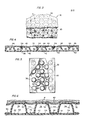
- FIG 1 shows the manner in which the undersheet 10, according to the preferred embodiment thereof, is used with respect to a bedridden patient 12.
- Patient 12 is shown in Figure 1 as resting in a bed 14 which includes a mattress 16 covered by conventional bed sheet 18.
- Undersheet 10 is preferably approximately 2 ft. wide by 3 ft. long (60.96cm x 91.44cm). It is generally located under bed sheet 18 and beneath the points of maximum contact with the patient's body. The points of maximum contact would typically extend from the shoulders to below the buttocks. It is preferable to place undersheet 10 under bed sheet 18 because the undersheet 10 is somewhat noisy and because the bed sheet 18 holds the undersheet 10 down therefore keeping it from crumpling and curling. While undersheet 10 is shown under bed sheet 18 it should be understood that it could also be located directly under the patient 12.
- a prior art diaper invention 20 is illustrated in detail in Figure 2.
- a bottom layer 22 including a plurality of blisters is located directly below a top layer 24.
- An absorbent layer of material 26 occupies substantially all of the space between bottom layer 22 and top layer 24.
- Absorbent layer 26 is designed to collect urine and other liquids in a diaper-like fashion.
- the structure illustrated in Figure 2 is described in further detail in U.S. Patent No. 3,812,001.
- the major problem with prior art structure 20 is that the presence of absorbent layer 26 further distributes the support of the patient's body. Accordingly, it is believed that the effect of using a prior art structure 20 such as illustrated in Figure 2 would be to increase the likelihood of developing decubitis ulcers rather than decrease the likelihood.
- the distributed support of the air blisters plus the absorbent layer would mean that the patient was continually in contact over effectively 100% of the body rather than over selected portions of the sheet thereby making it impossible for the patient to expose a portion of the body to a non-supported area. This would also tend to minimize any beneficial massaging action the pad might generate.
- the lack of air circulation increases the likelihood of bed sores.
- the presence of trapped moisture in layer 26 would tend to hasten the advent of "diaper rash" or similar afflictions. Accordingly, all of the prior art devices identified do not appear to have the same ability to minimize the tendency towards decubitis ulcers as the preferred embodiment of the invention.
- Undersheet 10 essentially comprises a bottom layer 30 and a top layer 32 separated by bubble-like structures 36.
- Top layer 32 is attached to the top 46 of bubbles 36 by an adhesive medium 34.
- the space between bottom layer 30 and top layer 32 defines a plurality of air circulation channels 35. Air circulation channels 35 permit air to freely flow from the edge of undersheet 10 or through the relatively porous top layer 32 into channels 35 and out again through top layer 32 thereby keeping fresh, circulating air continually in contact with the skin of patient 12.
- the movement of patient 12 over the undersheet 10 also tends to "pump" air from one portion of undersheet 10 to another. Patient movement also provides a natural massaging action as the skin of the patient is randomly supported at various different points over a given period of time.
- bottom layer 30 is relatively important with respect to the overall performance of undersheet 10. As shown in Figs. 4 and 6 the bottom layer 30 preferably comprises a lower layer 38 and a top layer 40 which traps an air bubble 39 in between the two layers. Each bubble 36 includes a relatively broad base 42, tapered conical sides 44 and a top 46 having an area less than the area of base 42. An air tight sealing material 52 may also be included in the air cavity 39 as shown in Figure 6. It is important that the bubbles 36 be relatively air tight so that they do not collapse under the weight of a patient 12. If bubbles 36 were to collapse, then air circulation channels 35 would also collapse resulting in poor ventilation to the skin of the patient 12.
- conical sides 44 of the bubbles 36 also serve another important function. It has been found that conical bubbles 36 are stronger than bubbles having cylindrical side walls or side walls of other shapes. First of all, it is noted that the cylindrical side walls 44 have less of a tendency to burst than would conventional cylindrical side walls. Secondly, cylindrical side walls provide better support for the top area 46 of the bubbles 36 since the general shape of the bubbles 36 is that of a pyramid. While conically-shaped bubbles are preferred it is noted that cylindrically-shaped bubbles will also work under some circumstances though not as well.
- the top 46 of each bubble 36 has an area of contact 48 with top layer 32.
- Contact area 48 is secured by an adhesive medium 34 as previously described and as shown in Figure 4.
- the entire surface of top layer 32 can be defined as either areas of contact 48 or areas of non-contact 50 all of which combine to comprise the entire surface.
- the area of bubble contact 48 comprises roughly 40% of the entire surface of the top layer 32.
- the area of non-contact comprises approximately 60% of the surface of top layer 32.
- the preferred embodiment of the invention 10 provides a means for minimizing the area of contact with the skin of a patient 12.
- the adhesive 34 attaches each of the tops of the bubbles 46 to each other by upper layer 32. Therefore, each of the bubbles 36 tend to cooperate and jointly support each other. Adhesive 34 also prevents the bubbles 36 from shifting away from each other.
- the diameter of contact area 48 is approximately 1/4" (0.635cm). Movement by patient 12 of approximately 1/8" (0.318cm) brings the skin of the patient 12 into contact with a non-support area 50, thereby minimizing the chances of developing decubitis ulcers.
- the diameter of contact area 48 is approximately 3/16" (0.476cm) with a preferred acceptable range of from 1/8" (0.318cm) to 3/8" (0.953cm) in diameter.
- the preferred diameter of the base 42 is 1/4" (0.635cm) with a preferred range of 3/16" (0.476cm) to 3/8" (0.953cm).
- the bubble-like supports 36 are preferably arranged on 1/2" (1.27cm) centers and staggered every other row in a diamond like pattern. Sheet depth measured from the top 46 to the base 42 of each bubble-like support 36 is preferably 3/16" (0.476cm) with a preferred range of 1/8" (0.318cm) to 1/4" (0.635cm) in height.
- the skin 60 of patient 12 is shown in contact with upper layer 32 via bedsheet 18.
- Skin 60 is supported at contact points 48.
- the upper layer 32 sags under the weight of patient 12.
- the patient is supported by contact areas 48 and is not supported by non contact area 50.
- the upper layer 32 is relatively flatter as shown in Figure 4.
- the upper layer 32 undulates causing fresh air to pump throughout the system.
- the film comprising the bottom layer 30 is approximately .001" (0.0025cm) thick.
- the conical sidewalIS44 are structurally superior to cylindrical sidewalls because cylindrical sidewalls tend to grow (i.e. expand) more under pressure than do conical sidewalls. Therefore, cylindrical sidewalls are more likely to burst since they tend to stretch more than conical sidewalls.
- Adhesive 34 may include a solvent base adhesive-like urethane or, alternatively, could be a water based material such as acrylics or urethanes.
- the top layer 32 preferably comprises a non-woven fabric including strands of a reinforcing material such as Rayon and/or polyester.
- the characteristics of top layer 32 are such that the top layer 32 must provide for substantial air circulation and be relatively strong so as not to fail under the weight of the patient 12. The circulation of air is encouraged by the nature of the non-woven materials used.
- the preferred non-woven material offers only 2% resistance to air flew which means that the air passes through the top layer as though it was not there. Accordingly, air flow is achieved without sacrificing support for adjacent bubble-like supports 36.
- the type of non-woven material employed as a top layer 32 is generally referred to as "diaper facing" by the industry. It would be possible to use woven materials, however, non-woven materials are preferable because they are less expensive and have less resistance to air movement.
- the present invention has nunerous advantages over prior art devices.
- the undersheet 10 provides a limited area of direct support contact 48 between the patient 12 and the undersheet 10. This is because contact area 48 comprises approximately 40% of the total area of upper layer 32. If the width of the top 46 of bubbles 36 is approximately 1/4" (0.635cm), then only 1/8" (0.318cm) movement by patient 12 will cause the skin of patient 12 to be exposed to a non-supported area 50.
- the air channels 35 provide for a substantial flow of air. The air enters through the edges of the sheet 10 or through top layer 32 and circulates through channels 35 to other areas of the patient's 12 skin.
- the undersheet 10 is relatively inexpensive to manufacture and is disposable.
- undersheet 10 does not collect urine or other materials that would inhibit the circulation of air through the undersheet 10.
- undersheet 10 is preferably 2 ft.(60.96cm) x 3ft. (91.44cm) in size. It is easy for an inexperienced attendant or nurse to change the undersheet 10. In general it is not necessary to completely remake a bed in order to change undersheet 10.
- sheet 10 does not readily collapse. Moreover the use of adhesives 34 to attach top layer 32 to the top area 46 of bubbles 36, produces the result that adjacent bubbles 36 tend to support each other. Therefore, adjacent bubbles 36 do not tend to move away from each other but, on the contrary, tend to uniformly support the patient's weight.
- the structure of the undersheet is such that it produces a natural "pumping” and “massaging” action that is very beneficial to the patient.
- the natural "pumping” action encourages the flow of fresh air to the skin of the bedridden patient and the natural massaging action is believed to stimulate blood flow.
Landscapes
- Health & Medical Sciences (AREA)
- Life Sciences & Earth Sciences (AREA)
- Animal Behavior & Ethology (AREA)
- General Health & Medical Sciences (AREA)
- Public Health (AREA)
- Veterinary Medicine (AREA)
- Engineering & Computer Science (AREA)
- Biomedical Technology (AREA)
- Heart & Thoracic Surgery (AREA)
- Vascular Medicine (AREA)
- Nursing (AREA)
- Invalid Beds And Related Equipment (AREA)
Applications Claiming Priority (2)
| Application Number | Priority Date | Filing Date | Title |
|---|---|---|---|
| US06/622,111 US4614000A (en) | 1984-06-19 | 1984-06-19 | Patient undersheet for preventing bed sores |
| US622111 | 1984-06-19 |
Publications (2)
| Publication Number | Publication Date |
|---|---|
| EP0168975A2 true EP0168975A2 (de) | 1986-01-22 |
| EP0168975A3 EP0168975A3 (de) | 1987-01-14 |
Family
ID=24492984
Family Applications (1)
| Application Number | Title | Priority Date | Filing Date |
|---|---|---|---|
| EP85304310A Withdrawn EP0168975A3 (de) | 1984-06-19 | 1985-06-17 | Unterlage zur Verhinderung wundgelegener Stellen |
Country Status (3)
| Country | Link |
|---|---|
| US (1) | US4614000A (de) |
| EP (1) | EP0168975A3 (de) |
| CA (1) | CA1229685A (de) |
Cited By (5)
| Publication number | Priority date | Publication date | Assignee | Title |
|---|---|---|---|---|
| EP0198679A3 (de) * | 1985-04-12 | 1987-05-20 | AOE Plastic GmbH | Biegsame und wasserdichte Matratze |
| DE4111743A1 (de) * | 1991-04-06 | 1992-10-08 | Chemnitz Textiltech Forsch | Unterlage aus polstoffen zur verhinderung des dekubitus |
| EP2648574A4 (de) * | 2010-12-10 | 2014-04-23 | Skydex Technologies Inc | Ineinandergreifende zelluläre polsterung |
| US8990987B2 (en) | 2011-06-07 | 2015-03-31 | Skydex Technologies, Inc. | Collapsible layered cushion |
| CN107847368A (zh) * | 2015-02-26 | 2018-03-27 | 瑞德科技控股有限公司 | 一次性吸收芯部和包括其的一次性吸收组件及其制造方法 |
Families Citing this family (73)
| Publication number | Priority date | Publication date | Assignee | Title |
|---|---|---|---|---|
| US4889758A (en) * | 1988-03-29 | 1989-12-26 | Isaac Rinkewich | High-strength panel structure |
| US4912861A (en) * | 1988-04-11 | 1990-04-03 | Huang Ing Chung | Removable pressure-adjustable shock-absorbing cushion device with an inflation pump for sports goods |
| US5606754A (en) | 1989-03-09 | 1997-03-04 | Ssi Medical Services, Inc. | Vibratory patient support system |
| US4989284A (en) * | 1989-10-12 | 1991-02-05 | The Kendall Company | Cushion |
| US6428865B1 (en) * | 1990-02-26 | 2002-08-06 | Ing-Chung Huang | Shock-absorbing cushion with a multi-holed and/or grooved surface |
| US5669161A (en) * | 1990-02-26 | 1997-09-23 | Huang; Ing-Jing | Shock-absorbing cushion |
| US5561875A (en) * | 1992-02-20 | 1996-10-08 | Crown Therapeutics, Inc. | Vacuum/heat formed cushion supported on a fluid permeable manifold |
| EP0585416B1 (de) * | 1992-02-20 | 1999-10-13 | GRAEBE, Robert H. | Modulare kissenkonstruktion mit geschäumter unterlage |
| US5364339A (en) * | 1993-04-07 | 1994-11-15 | Juanita Carver | Bed sore pad |
| JP3437183B2 (ja) * | 1993-06-23 | 2003-08-18 | ザ、プロクター、エンド、ギャンブル、カンパニー | 選択的に膨張可能または膨らまし可能な構成部品を備えた使い捨て吸収性物品 |
| US5411318A (en) * | 1993-08-24 | 1995-05-02 | Law; Ignace K. | Extended ventilating seat covering assembly |
| US5586346A (en) * | 1994-02-15 | 1996-12-24 | Support Systems, International | Method and apparatus for supporting and for supplying therapy to a patient |
| US5590428A (en) * | 1994-06-24 | 1997-01-07 | Adelbar Importing And Marketing Ltd. | Air pressurized person supporting device with ventilation |
| US5958551A (en) * | 1995-08-31 | 1999-09-28 | Garcia-Ochoa; Jorge-Isaac | Structural element |
| CA2149477C (en) * | 1995-05-16 | 1997-04-08 | Marilyn V. Mcmahon-Ayerst | Leakproof and breathable undergarments and swim wear |
| US5685257A (en) * | 1996-02-08 | 1997-11-11 | Feibus; Miriam | Pet support cushion |
| TW320555B (en) * | 1996-06-15 | 1997-11-21 | Ing-Jiunn Hwang | The 3D shoes-tongue cushion |
| US5873137A (en) * | 1996-06-17 | 1999-02-23 | Medogar Technologies | Pnuematic mattress systems |
| US6183838B1 (en) * | 1997-03-24 | 2001-02-06 | Sealed Air Corporation | Composite material having gas cavities and a mechanically bonded protective layer and method of making same |
| US5911656A (en) * | 1997-07-01 | 1999-06-15 | Futagami; Taneaki | Air cushion with a finger-pressure therapy like effect |
| US6253466B1 (en) | 1997-12-05 | 2001-07-03 | New Balance Athletic Shoe, Inc. | Shoe sloe cushion |
| US6026593A (en) * | 1997-12-05 | 2000-02-22 | New Balance Athletic Shoe, Inc. | Shoe sole cushion |
| USD416740S (en) * | 1998-10-16 | 1999-11-23 | Foamex L.P. | Mattress overlay |
| USD416739S (en) * | 1998-10-16 | 1999-11-23 | Foamex L.P. | Mattress overlay |
| USD416741S (en) * | 1998-10-16 | 1999-11-23 | Foamex L.P. | Mattress overlay |
| USD416426S (en) | 1998-10-16 | 1999-11-16 | Foamex L.P. | Mattress overlay |
| USD419356S (en) * | 1998-10-16 | 2000-01-25 | Foamex L.P. | Mattress overlay |
| USD417355S (en) | 1998-10-16 | 1999-12-07 | Foamex L.P. | Mattress overlay |
| JP2001112806A (ja) * | 1999-10-18 | 2001-04-24 | Niles Parts Co Ltd | 排泄物処理装置 |
| USD440406S1 (en) | 2000-02-22 | 2001-04-17 | Bob Bailey | Nibbed pattern of floor mat backing |
| NO312543B1 (no) * | 2000-08-29 | 2002-05-27 | Knut Magne Hansen | Anordning ved kassettpose |
| US7000616B2 (en) * | 2000-10-19 | 2006-02-21 | Diaz R Gary | Wound care suspension system |
| US6892734B1 (en) * | 2000-10-19 | 2005-05-17 | Thomas R. Schleicher | Wound care suspension system |
| JP3824891B2 (ja) * | 2001-07-06 | 2006-09-20 | 共和真空技術株式会社 | 食品・薬品類の凍結乾燥装置における乾燥バルクの粉砕装置 |
| USD463701S1 (en) | 2001-10-19 | 2002-10-01 | Roho, Incorporated | Seat cushion |
| WO2003094666A2 (en) | 2002-05-06 | 2003-11-20 | Roho, Inc | Multi-layer cushion and cover |
| US20050026522A1 (en) * | 2003-05-30 | 2005-02-03 | Collins Loren M. | Apparatus and method for anti-skid flame blocker thermal barrier |
| US7141713B2 (en) * | 2003-07-09 | 2006-11-28 | Agrama Hani M | Method for reducing pressure damage to skin of a person, and corresponding skin protective devices |
| US20050017565A1 (en) * | 2003-07-22 | 2005-01-27 | Sprouse Anthony Eric | Office chair with inflatable cellular insert |
| US20050151410A1 (en) * | 2003-07-22 | 2005-07-14 | Sprouse Anthony E.Ii | Chair with inflatable cellular insert |
| US6988979B1 (en) | 2003-09-02 | 2006-01-24 | Wendi Trainor | Cellulite reducing bench |
| US20050120483A1 (en) * | 2003-12-05 | 2005-06-09 | Clapper Dennis L. | Heat diffusing cushion or mattress |
| US7185604B2 (en) * | 2004-04-12 | 2007-03-06 | Debra Leah Holte | Orthopedic pet cushion |
| US20060015080A1 (en) * | 2004-07-15 | 2006-01-19 | Michael Mahnensmith | Fluid collection and aspiration unit for management of urinary incontinence |
| US20070163048A1 (en) * | 2005-09-19 | 2007-07-19 | Kimball Helen R | Method and device for pressure offloading |
| US7757319B2 (en) | 2005-09-19 | 2010-07-20 | Kimball Helen R | Wound elevation protection and prevention device |
| US8011041B2 (en) * | 2007-09-19 | 2011-09-06 | Persimmon Scientific, Inc. | Devices for prevention of pressure ulcers |
| US8069498B2 (en) * | 2009-06-02 | 2011-12-06 | Kranos Ip Corporation | Protective arrangement |
| GB2485319B (en) * | 2009-07-22 | 2013-11-13 | Nook Sleep Systems Llc | Systems, components and related methods |
| FR2949320B1 (fr) | 2009-08-31 | 2012-11-16 | Hill Rom Ind Sa | Dispositif de basculement lateral |
| JP2013526972A (ja) * | 2010-05-27 | 2013-06-27 | ケーシーアイ ライセンシング インク | 多層支持システム |
| US8726424B2 (en) | 2010-06-03 | 2014-05-20 | Intellectual Property Holdings, Llc | Energy management structure |
| US8661580B2 (en) | 2010-06-04 | 2014-03-04 | Bcg Medical, Llc | Patient positioning device |
| CN103384543A (zh) * | 2011-02-11 | 2013-11-06 | 皇家飞利浦电子股份有限公司 | 具有提供集成的气体流动和输送的头盔的患者界面装置 |
| US9516910B2 (en) | 2011-07-01 | 2016-12-13 | Intellectual Property Holdings, Llc | Helmet impact liner system |
| US20130086733A1 (en) * | 2011-10-10 | 2013-04-11 | Intellectual Property Holdings, Llc | Helmet impact liner system |
| US9320311B2 (en) * | 2012-05-02 | 2016-04-26 | Intellectual Property Holdings, Llc | Helmet impact liner system |
| US20130291311A1 (en) * | 2012-05-02 | 2013-11-07 | Yu-Chieh Wang | Ventilating Pad With Buffer And Elastic Support |
| USD696522S1 (en) * | 2012-05-11 | 2013-12-31 | Columbia Sportswear North America, Inc. | Printed cooling material |
| US20140082840A1 (en) * | 2012-09-25 | 2014-03-27 | Alex I. Khowaylo | Mattress Cover |
| US9894953B2 (en) | 2012-10-04 | 2018-02-20 | Intellectual Property Holdings, Llc | Helmet retention system |
| ES2716858T3 (es) | 2012-11-20 | 2019-06-17 | Sanko Tekstil Isletmeleri San Ve Tic As | Alfombrilla portátil |
| US11000443B2 (en) | 2012-11-20 | 2021-05-11 | Sanko Tekstil Isletmeleri San. Ve Tic. A.S. | Portable therapeutic mat with thermochromic properties |
| WO2015065902A1 (en) | 2013-10-28 | 2015-05-07 | Intellectual Property Holdings, Llc | Helmet retention system |
| US9237977B2 (en) | 2014-04-08 | 2016-01-19 | Nedunchezian Sithian | Support for relief of pressure ulcers |
| US9237978B2 (en) | 2014-04-08 | 2016-01-19 | Nedunchezian Sithian | Support for relief of pressure ulcers |
| WO2016085468A1 (en) | 2014-11-25 | 2016-06-02 | Kimberly-Clark Worldwide, Inc. | Textured nonwoven laminate |
| US9308393B1 (en) | 2015-01-15 | 2016-04-12 | Dri-Em, Inc. | Bed drying device, UV lights for bedsores |
| US10531996B2 (en) | 2015-11-06 | 2020-01-14 | Andrei Cernasov | Supporting surface with programmable supports and method to reduce pressure on selected areas of a body |
| JP1571210S (de) * | 2016-07-25 | 2017-03-13 | ||
| USD825199S1 (en) * | 2016-09-20 | 2018-08-14 | Rockline Industries, Inc. | Toilet tissue with raised pattern |
| WO2020174418A1 (en) | 2019-02-26 | 2020-09-03 | Hill-Rom Services, Inc. | Patient positioning apparatus and mattress |
| WO2022084986A1 (en) * | 2020-10-19 | 2022-04-28 | Tetro Ltd. | Hybrid structure having suspension quality |
Family Cites Families (22)
| Publication number | Priority date | Publication date | Assignee | Title |
|---|---|---|---|---|
| DE7413589U (de) * | 1974-07-25 | Piffko H | Unterlegmatte | |
| US3446692A (en) * | 1964-06-01 | 1969-05-27 | Pullman Inc | Insulated panel and method of making same |
| US3468311A (en) * | 1967-06-07 | 1969-09-23 | John P Gallagher | Absorbent pad |
| US3574873A (en) * | 1968-05-14 | 1971-04-13 | James D Weinstein | Fluid-type support structure for simulating flotation-type support |
| US3523055A (en) * | 1968-08-19 | 1970-08-04 | Jerome H Lemelson | Composite material,apparatus and method for producing same |
| US3646624A (en) * | 1969-09-24 | 1972-03-07 | Blessings Inc | Disposable drawsheet |
| AU457904B2 (en) * | 1970-12-21 | 1975-02-13 | MITSUI PETROCHEMICAL INDUSTRIES, LTD and SERGI HAGINO | Process and apparatus for producing laminated structure having hollow closed cells |
| US4018946A (en) * | 1971-01-15 | 1977-04-19 | Sealed Air Corporation | Production of heat-expandable styrene-polymer bit-pieces |
| US3812001A (en) * | 1971-12-17 | 1974-05-21 | Weyerhaeuser Co | Cushioned absorbent pad |
| DE2221725A1 (de) * | 1972-05-04 | 1973-11-15 | Kahl Rokado | Matratze mit federelementen |
| US3876741A (en) * | 1972-08-29 | 1975-04-08 | Sealed Air Corp | Method for expanding polymer bit-pieces |
| US3989867A (en) * | 1973-02-16 | 1976-11-02 | The Procter & Gamble Company | Absorptive devices having porous backsheet |
| US3921232A (en) * | 1974-03-29 | 1975-11-25 | Procter & Gamble | Self-inflating structure |
| US3974532A (en) * | 1975-03-10 | 1976-08-17 | Mitsuyoshi Hamasu | Padding for mattresses and like articles |
| US4018034A (en) * | 1975-11-20 | 1977-04-19 | Sealed Air Corporation | Packaging apparatus |
| NZ179918A (en) * | 1976-02-04 | 1979-01-11 | Porner M J | Shin pad cushioning sheets with open faced bubbles |
| US4074505A (en) * | 1977-01-03 | 1978-02-21 | Sealed Air Corporation | Method and apparatus for packaging articles |
| US4270658A (en) * | 1978-10-27 | 1981-06-02 | Schuster Samuel J | Breathable, sterilizable receptacles for storing articles in sterile condition |
| FR2442050A1 (fr) * | 1978-11-21 | 1980-06-20 | Dalle & Lecomte Papeteries | Matiere souple pour la realisation de supports permettant d'eviter les escarres, et supports au moins partiellement constitues d'une telle matiere |
| US4347633A (en) * | 1980-07-22 | 1982-09-07 | American Hospital Supply Corporation | Patient treating mattress |
| US4378391A (en) * | 1981-06-03 | 1983-03-29 | Allen Michael L | Advertising novelty |
| US4472472A (en) * | 1983-04-28 | 1984-09-18 | Schultz Robert J | Protective device |
-
1984
- 1984-06-19 US US06/622,111 patent/US4614000A/en not_active Expired - Fee Related
-
1985
- 1985-06-17 EP EP85304310A patent/EP0168975A3/de not_active Withdrawn
- 1985-06-18 CA CA000484393A patent/CA1229685A/en not_active Expired
Cited By (8)
| Publication number | Priority date | Publication date | Assignee | Title |
|---|---|---|---|---|
| EP0198679A3 (de) * | 1985-04-12 | 1987-05-20 | AOE Plastic GmbH | Biegsame und wasserdichte Matratze |
| DE4111743A1 (de) * | 1991-04-06 | 1992-10-08 | Chemnitz Textiltech Forsch | Unterlage aus polstoffen zur verhinderung des dekubitus |
| EP2648574A4 (de) * | 2010-12-10 | 2014-04-23 | Skydex Technologies Inc | Ineinandergreifende zelluläre polsterung |
| EP3020309A1 (de) * | 2010-12-10 | 2016-05-18 | Skydex Technologies, Inc. | Ineinandergreifende zelluläre polsterung |
| US8990987B2 (en) | 2011-06-07 | 2015-03-31 | Skydex Technologies, Inc. | Collapsible layered cushion |
| US9492018B2 (en) | 2011-06-07 | 2016-11-15 | Skydex Technologies, Inc. | Collapsible layered cushion |
| US10638854B2 (en) | 2011-06-07 | 2020-05-05 | Skydex Technologies, Inc | Collapsible layered cushion |
| CN107847368A (zh) * | 2015-02-26 | 2018-03-27 | 瑞德科技控股有限公司 | 一次性吸收芯部和包括其的一次性吸收组件及其制造方法 |
Also Published As
| Publication number | Publication date |
|---|---|
| CA1229685A (en) | 1987-11-24 |
| US4614000A (en) | 1986-09-30 |
| EP0168975A3 (de) | 1987-01-14 |
Similar Documents
| Publication | Publication Date | Title |
|---|---|---|
| US4614000A (en) | Patient undersheet for preventing bed sores | |
| EP0109840B1 (de) | Matratze zum Stützen des menschlichen Körpers | |
| CA1336309C (en) | Anatomically contoured convoluted foam pad | |
| CA2360231C (en) | Air mattress | |
| EP0264439B1 (de) | Matratze zum verhindern von geschwüren durch wundliegen | |
| US3757356A (en) | Therapeutic bed pan | |
| US4944060A (en) | Mattress assembly for the prevention and treatment of decubitus ulcers | |
| US5111542A (en) | Anatomically conformable foam support pad | |
| US7000616B2 (en) | Wound care suspension system | |
| US4472847A (en) | Patient treating mattress | |
| US4391009A (en) | Ventilated body support | |
| US8196239B2 (en) | Clinical support pad | |
| US4688285A (en) | Ventilated medical cushion or pad | |
| US20010009043A1 (en) | Support pillow | |
| GB2197192A (en) | Alternating pressure pad | |
| US4745648A (en) | Body supporting structure | |
| US6892734B1 (en) | Wound care suspension system | |
| CA2392249C (en) | Diaper to eliminate bed sores | |
| GB1576641A (en) | Pressure point pads | |
| CN214713100U (zh) | 等压强支撑组件、等压强床垫及等压强床 | |
| JP4823870B2 (ja) | エアマット用エアセル及びそれを備えたエアマット | |
| KR102703150B1 (ko) | 기능성 욕창 방지용 방석 | |
| US6435187B1 (en) | Bandage for relief and massage | |
| JPS5925379Y2 (ja) | 褥瘡防止マツト | |
| US20060084902A1 (en) | Wound care suspension system |
Legal Events
| Date | Code | Title | Description |
|---|---|---|---|
| PUAI | Public reference made under article 153(3) epc to a published international application that has entered the european phase |
Free format text: ORIGINAL CODE: 0009012 |
|
| AK | Designated contracting states |
Designated state(s): AT BE CH DE FR GB IT LI LU NL SE |
|
| PUAL | Search report despatched |
Free format text: ORIGINAL CODE: 0009013 |
|
| AK | Designated contracting states |
Kind code of ref document: A3 Designated state(s): AT BE CH DE FR GB IT LI LU NL SE |
|
| 17P | Request for examination filed |
Effective date: 19870710 |
|
| 17Q | First examination report despatched |
Effective date: 19881114 |
|
| STAA | Information on the status of an ep patent application or granted ep patent |
Free format text: STATUS: THE APPLICATION IS DEEMED TO BE WITHDRAWN |
|
| 18D | Application deemed to be withdrawn |
Effective date: 19890328 |
|
| RIN1 | Information on inventor provided before grant (corrected) |
Inventor name: MAYER, NATHAN |