EP0169501A2 - Cartouches d'adhésif prêtes à l'emploi - Google Patents
Cartouches d'adhésif prêtes à l'emploi Download PDFInfo
- Publication number
- EP0169501A2 EP0169501A2 EP85108968A EP85108968A EP0169501A2 EP 0169501 A2 EP0169501 A2 EP 0169501A2 EP 85108968 A EP85108968 A EP 85108968A EP 85108968 A EP85108968 A EP 85108968A EP 0169501 A2 EP0169501 A2 EP 0169501A2
- Authority
- EP
- European Patent Office
- Prior art keywords
- adhesive
- container according
- container
- weight
- following
- Prior art date
- Legal status (The legal status is an assumption and is not a legal conclusion. Google has not performed a legal analysis and makes no representation as to the accuracy of the status listed.)
- Withdrawn
Links
Images

Classifications
-
- B—PERFORMING OPERATIONS; TRANSPORTING
- B05—SPRAYING OR ATOMISING IN GENERAL; APPLYING FLUENT MATERIALS TO SURFACES, IN GENERAL
- B05B—SPRAYING APPARATUS; ATOMISING APPARATUS; NOZZLES
- B05B11/00—Single-unit hand-held apparatus in which flow of contents is produced by the muscular force of the operator at the moment of use
- B05B11/01—Single-unit hand-held apparatus in which flow of contents is produced by the muscular force of the operator at the moment of use characterised by the means producing the flow
- B05B11/02—Membranes or pistons acting on the contents inside the container, e.g. follower pistons
- B05B11/028—Pistons separating the content remaining in the container from the atmospheric air to compensate underpressure inside the container
-
- B—PERFORMING OPERATIONS; TRANSPORTING
- B05—SPRAYING OR ATOMISING IN GENERAL; APPLYING FLUENT MATERIALS TO SURFACES, IN GENERAL
- B05B—SPRAYING APPARATUS; ATOMISING APPARATUS; NOZZLES
- B05B11/00—Single-unit hand-held apparatus in which flow of contents is produced by the muscular force of the operator at the moment of use
- B05B11/01—Single-unit hand-held apparatus in which flow of contents is produced by the muscular force of the operator at the moment of use characterised by the means producing the flow
- B05B11/10—Pump arrangements for transferring the contents from the container to a pump chamber by a sucking effect and forcing the contents out through the dispensing nozzle
- B05B11/1001—Piston pumps
- B05B11/1015—Piston pumps actuated without substantial movement of the nozzle in the direction of the pressure stroke
-
- B—PERFORMING OPERATIONS; TRANSPORTING
- B05—SPRAYING OR ATOMISING IN GENERAL; APPLYING FLUENT MATERIALS TO SURFACES, IN GENERAL
- B05B—SPRAYING APPARATUS; ATOMISING APPARATUS; NOZZLES
- B05B11/00—Single-unit hand-held apparatus in which flow of contents is produced by the muscular force of the operator at the moment of use
- B05B11/01—Single-unit hand-held apparatus in which flow of contents is produced by the muscular force of the operator at the moment of use characterised by the means producing the flow
- B05B11/10—Pump arrangements for transferring the contents from the container to a pump chamber by a sucking effect and forcing the contents out through the dispensing nozzle
- B05B11/1028—Pumps having a pumping chamber with a deformable wall
-
- B—PERFORMING OPERATIONS; TRANSPORTING
- B05—SPRAYING OR ATOMISING IN GENERAL; APPLYING FLUENT MATERIALS TO SURFACES, IN GENERAL
- B05B—SPRAYING APPARATUS; ATOMISING APPARATUS; NOZZLES
- B05B11/00—Single-unit hand-held apparatus in which flow of contents is produced by the muscular force of the operator at the moment of use
- B05B11/01—Single-unit hand-held apparatus in which flow of contents is produced by the muscular force of the operator at the moment of use characterised by the means producing the flow
- B05B11/10—Pump arrangements for transferring the contents from the container to a pump chamber by a sucking effect and forcing the contents out through the dispensing nozzle
- B05B11/1028—Pumps having a pumping chamber with a deformable wall
- B05B11/1032—Pumps having a pumping chamber with a deformable wall actuated without substantial movement of the nozzle in the direction of the pressure stroke
-
- B—PERFORMING OPERATIONS; TRANSPORTING
- B05—SPRAYING OR ATOMISING IN GENERAL; APPLYING FLUENT MATERIALS TO SURFACES, IN GENERAL
- B05B—SPRAYING APPARATUS; ATOMISING APPARATUS; NOZZLES
- B05B11/00—Single-unit hand-held apparatus in which flow of contents is produced by the muscular force of the operator at the moment of use
- B05B11/01—Single-unit hand-held apparatus in which flow of contents is produced by the muscular force of the operator at the moment of use characterised by the means producing the flow
- B05B11/10—Pump arrangements for transferring the contents from the container to a pump chamber by a sucking effect and forcing the contents out through the dispensing nozzle
- B05B11/1042—Components or details
- B05B11/1052—Actuation means
- B05B11/1053—Actuation means combined with means, other than pressure, for automatically opening a valve during actuation; combined with means for automatically removing closures or covers from the discharge nozzle during actuation
-
- B—PERFORMING OPERATIONS; TRANSPORTING
- B65—CONVEYING; PACKING; STORING; HANDLING THIN OR FILAMENTARY MATERIAL
- B65D—CONTAINERS FOR STORAGE OR TRANSPORT OF ARTICLES OR MATERIALS, e.g. BAGS, BARRELS, BOTTLES, BOXES, CANS, CARTONS, CRATES, DRUMS, JARS, TANKS, HOPPERS, FORWARDING CONTAINERS; ACCESSORIES, CLOSURES, OR FITTINGS THEREFOR; PACKAGING ELEMENTS; PACKAGES
- B65D83/00—Containers or packages with special means for dispensing contents
- B65D83/76—Containers or packages with special means for dispensing contents for dispensing fluent contents by means of a piston
- B65D83/765—Containers or packages with special means for dispensing contents for dispensing fluent contents by means of a piston the piston being a follower-piston and the dispensing means comprising a hand-operated pressure device at the opposite part of the container
-
- C—CHEMISTRY; METALLURGY
- C09—DYES; PAINTS; POLISHES; NATURAL RESINS; ADHESIVES; COMPOSITIONS NOT OTHERWISE PROVIDED FOR; APPLICATIONS OF MATERIALS NOT OTHERWISE PROVIDED FOR
- C09J—ADHESIVES; NON-MECHANICAL ASPECTS OF ADHESIVE PROCESSES IN GENERAL; ADHESIVE PROCESSES NOT PROVIDED FOR ELSEWHERE; USE OF MATERIALS AS ADHESIVES
- C09J157/00—Adhesives based on unspecified polymers obtained by reactions only involving carbon-to-carbon unsaturated bonds
Definitions
- Liquid adhesives based on solutions of a high molecular weight adhesive in solvents or self-flowing plastic dispersions or emulsions are known here, which have the polymer with adhesive character as a disperse phase in a closed liquid phase.
- These dispersion or emulsion adhesives can be constructed on an aqueous basis. Their usability in long-term storage and only occasional portioned delivery of limited quantities is primarily due to the ability of these flowable products to automatically mix the contents of the container back, so that the air returning to the opened container does not cause drying to prevent use.
- their practical application is subject to a number of difficulties: the adhesive strength is limited, the application of the ointment-like pasty adhesive requires both hands, since the adhesive must be removed from its associated container with a suitable tool and applied to the workpiece to be glued.
- These ointment-like pasty adhesives are usually stored in sheet metal or plastic containers with a removable lid. Therefore, the ointment-like paste-like adhesive mass in the storage container undesirably dries up quickly.
- these ointment-like adhesives have not found the space that could be given them due to their overall advantageous properties:
- the ointment-like creamy adhesive enables the moist adhesive to be optimally adapted to the surface to be wetted without the need for an excessive amount of liquid phase the unwanted dampening of the coated material can be connected.
- the softly spreadable nature of these ointment-like adhesives makes their use possible even in spatially difficult applications.
- adhesives of this type based on aqueous emulsions or dispersions there is the possibility of varying and controlling the adhesive properties by selecting the disperse polymer.
- Such ointment-like pasty adhesive compositions are also distinguished by the fact that they are not stringy. Accidentally smeared or incorrectly applied parts of the pasty adhesive mass can be easily wiped off before drying, without leaving residues of the adhesive mass that hinder further work.
- the invention is based on the object of providing softly spreadable adhesive compositions of this type in the form of a ready-to-use, easy-to-use adhesive container which can be used in particular as a one-hand adhesive container.
- the invention particularly intends to use the advantages that adhesives based on emulsions or
- the adhesives are stabilized aqueous emulsion polymers of homo- and / or copolymers with adhesive character, which are set to such high viscosities by the choice of the solids content and / or by suitable addition of thickeners that the desired ointment-like, pasty, but at the same time softly spreadable state of the mixture of substances is present .
- Suitable for the invention mixtures of active substances based on aqueous emulsion polymers have particular viscosities of at least about 15,000 mPas (Brookfield RTV, 20 0 C and 20 rpm).
- the correspondingly determined Brookfield viscosity of these emulsion polymers is at least 50,000 mPas, the particularly preferred substance mixtures having a lower limit of viscosity values of at least about 80,000-100,000 mPas.
- the upper limit for the viscosity of the adhesive compositions used according to the invention is about 3 Millions of mPas - determined under comparable conditions, preferably the viscosity is less than 1 million mPas.
- a range from approximately 50,000 to 500,000 mPas can be particularly suitable, and frequently particularly suitable mixtures can range from approximately 80,000 to 200,000 mPas (determined at 20 ° C. and 20 rpm).
- Flowable dispersions or emulsions of polymers with adhesive character that have been customary in the adhesive field.
- Flowable dispersion adhesives in practice are, for example, in the range up to a maximum of 10,000 to 12,000 mPas - determined under the conditions specified above.
- the essence of the invention is thus the novel combination of certain selected ointment-like-pasty, non-free-flowing emulsion polymers of the stated type with a container which enables the metered dispensing of adhesive, but at the same time is designed in such a way that its interior filled with adhesive is reduced in accordance with the dispensing of the adhesive and thus excludes the withdrawal or entry of air into the interior of the container.
- a novel combination of certain selected ointment-like, pasty, non-free-flowing emulsion polymers is offered in a dispenser which can be actuated by a gripping hand and which simultaneously acts as packaging and application means for the ointment-like adhesive.
- Ointment-shaped emulsion adhesives of the type concerned tend to form a surface polymer skin quickly when exposed to air. This dried polymer is ultimately the desired adhesive. While in the known containers for adhesives based on free-flowing aqueous emulsion polymers, back-mixing of the entire contents of the container with any dried parts is, as expected, prevented or at least alleviated interference effects, such regeneration by backmixing is ruled out in the case of ointment-like pasty, non-free-flowing compositions of the type used according to the invention. In fact, the adhesive containers could quickly become inoperable due to the bonding of important container parts. Surprisingly, if the conditions according to the invention are observed, the functionality of the adhesive container is fully retained over virtually any period of time.
- aqueous emulsion polymers of the type concerned here Another difficulty for aqueous emulsion polymers of the type concerned here is their possible aging with a simultaneous increase in viscosity, even with the complete exclusion of air. While this phenomenon is not or not significantly noticeable in comparatively low-viscosity, self-flowing emulsion polymers, their appearance in ointment-like pasty masses can lead to the adhesive container becoming unusable after a short time. By selecting masses of predetermined rheology - determined on the Viscosity values mentioned numerically - and in particular also by the selection of selected thickeners described below, disturbances from this source are prevented.
- the adhesive compositions may contain other auxiliaries.
- auxiliaries are, for example, tixotropic agents, water-miscible, slightly volatile solvents or humectants, preservatives, plasticizers, pH regulators, defoamers, film-forming aids and the like.
- the content of polymer solid with adhesive character in the ointment-like adhesive is 35-60% by weight and in particular 40-60% by weight.
- the preferred content of thickener is usually in the range of 2-12% by weight and can in particular be 3-10% by weight.
- the use of emulsifiers in the specified range is preferred.
- Humectants and / or water-miscible, low-volatile solvents, preservatives and the like can be used in limited amounts, the upper limit for the respective component being customary is about 15-20% by weight, but overall it is preferred that all of these additional auxiliaries make up no more than 20-25% by weight of the total mixture.
- Particular importance is attached to the use of limited amounts of humectant, with water-miscible solid and liquid organic components being suitable here.
- the amounts of these components are in particular in the range from 0.5 to 10% by weight, based on the mixture as a whole.
- s Polymers with adhesive character come into consideration all homopolymers and / or copolymers with corresponding characteristics, which can be produced in the aqueous phase by means of emulsion polymerization and in particular in this way.
- the prior art here knows numerous types of polymer components, the use of which accordingly falls within the scope of the invention.
- homo- and / or copolymers of vinyl esters, acrylic acid and / or methacrylic acid or their derivatives in particular their esters and corresponding homo- and / or copolymers of diolefins such as chloroprene, butadiene, isoprene and the like.
- selected styrene homo- and / or copolymers can also be suitable.
- Particularly important adhesives for the bonding of cellulose materials, in particular paper, cardboard and / or wood are those based on homopolymers and / or copolymers of vinyl esters, in particular vinyl acetate.
- Suitable copolymers of vinyl acetate can, for example, one or more comonomers from the group of alpha-olefins, in particular ethylene, maleic acid or maleic acid derivatives, such as the corresponding anhydride, half-ester or ester of maleic acid, crotonic acid, acrylic acid or methacrylic acid or their salts, esters or nitriles, vinyl alkyl ethers , whose alkyl group has 1 to 12, preferably 1 to 4 carbon atoms, contain styrene or N-vinylpyrrolidone.
- Particularly suitable vinyl ester copolymers contain the vinyl ester component - in particular vinyl acetate - in amounts of at least about 40 mol%, preferably in amounts of at least about 50 mol%.
- Another particularly suitable group of polymers with adhesive character are, for the purposes of the invention, corresponding homopolymers and / or copolymers of acrylic acid and / or methacrylic acid or their derivatives.
- Suitable derivatives of the acids mentioned here are, in particular, their esters, amides and / or nitriles.
- Suitable comonomers are the compounds mentioned above for polymers based on vinyl acetate. Styrene and / or maleic acid or maleic acid derivatives can be particularly suitable.
- Particularly interesting polymer compositions with adhesive character are homopolymers and / or copolymers based on the aforementioned diolefins, in particular based on chloroprene.
- the emulsion polymerization of the monomers or monomer mixtures mentioned to give the emulsion polymer is carried out in a manner known per se, reference is made here, for example, to Ullman's Encyclopedia of Industrial Chemistry, 4th edition, volume 19, 132 to 145.
- protective colloids or thickeners are used in smaller or larger sizes closely used. These components can already be present in the reaction mixture during the emulsion polymerization, but it is also possible to add them at least in part after the emulsion polymerization to the finished reaction product for further stabilization and / or thickening.
- Suitable protective colloids or thickeners can be of natural origin, but in particular corresponding components based on synthetic high polymers are important.
- Suitable compounds are, for example, water-soluble and / or water-swellable polymer compounds such as hydroxyalkyl and / or carboxyalkyl celluloses, homo- and / or copolymers of acrylamide or acrylamide derivatives, copolymers of methyl vinyl ether and maleic anhydride and polyvinyl alcohol.
- the use of selected thickeners or protective colloids optimizes important properties of the adhesive composition.
- adhesive compositions which are designed taking into account the following information are particularly preferred.
- the teaching of the invention is based on the objective of combining an optimization of the behavior in the spreading process with optimum storage capacity of the ointment-like pasty mass even under more stringent test conditions and while maintaining the good spreading properties.
- this requirement profile can be set particularly advantageously if polyethylene glycols of a selected average molecular weight are used as the thickening agent come into use. These polyethylene glycols can serve as the sole thickener, but at least they are always present in not inconsiderable amounts.
- this embodiment of the invention relates to the use of polyethylene glycols with an average molecular weight of at least 3000 as a storage-stable, non-thickening thickener in aqueous emulsion polymers with adhesive character and non-free-flowing pasty ointment consistency.
- the average molecular weight of the polyethylene glycols used is preferably at least about 5000 and in particular at least about 10,000.
- a practical upper limit for the average molecular weight of these polyethylene glycols is the value of about 35,000, such polyethylene glycols having an average molecular weight in the range of about 12 000 to 20 000 are particularly suitable. However, higher molecular weights, for example up to about 50,000, are not excluded.
- polyethylene glycols primarily includes homopolymers of ethylene glycol or ethylene oxide. However, this term also includes copolymers which have a predominant proportion, preferably not less than about 50 mol%, of ethylene oxide residues together with propylene oxide residues. Corresponding block copolymers are then particularly preferred here.
- the ointment-like, paste-like aqueous emulsion polymers prepared with the use of polyethylene glycols of the type defined here show an optimized balance of physical properties immediately after their preparation.
- the ointment-like masses have a gel-like quality with the desired shape stability without external force, but they are nevertheless particularly smooth and easy to spread when spread. It is particularly important that adhesives based on the thickeners defined here by extreme Leg stability is also marked under stricter storage conditions. For example, the storage of appropriately thickened aqueous emulsion polymers in commercially available dispensers at 40 ° C. for a period of at least 6 months does not result in any visible change in the physical properties of the adhesive gel. To rate this result as surprising.
- the polyethylene glycols are preferably present in the aqueous emulsion polymers in amounts of at least about 3 percent by weight and in particular in amounts of about 3 to 10 percent by weight, in each case based on the total emulsion weight. As indicated, they can be used alone. Mixing with is also possible other conventional protective colloids with or without thickening effect.
- polyvinyl alcohol can be of particular importance here. This can have an influence on an increased adhesive strength of the adhesive, in particular when polyvinyl acetate and / or its copolymers are present as polymer bodies with adhesive character.
- at least approximately equal amounts of polyethylene glycol and polyvinyl alcohol are preferably used, and there is expediently a quantitative excess of polyethylene glycol.
- Suitable protective colloids or thickeners in this embodiment are, for example, quantitative ratios of polyethylene glycol to polyvinyl alcohol which are in the range from about 1 to 2 parts by weight of polyethylene glycol to 1 part by weight of polyvinyl alcohol.
- a suitable material with a viscosity in the range of approximately 20,000 to 60,000 mPas is particularly suitable as polyvinyl alcohol - determined in 4% by weight aqueous solution at 20 ° C.
- emulsifiers are generally used in the preparation and / or stabilization of the emulsion polymers.
- the polyethylene glycol-based thickeners are usually present together with small amounts of emulsifiers, which can be present in the range from 0 to 1 percent by weight.
- Anionic or nonionic polymerization emulsifiers or mixtures thereof are particularly suitable here.
- sulfates or sulfonates of long-chain alcohols or alkylphenols can be used, furthermore alkylbenzenesulfonates or sulfosuccinates.
- the sulfates of the reaction products of ethylene oxide with (fatty) alcohols or alkylphenols are also suitable, the base bodies being preferred are nonionic emulsifiers.
- Other nonionic emulsifiers are sorbitan esters of long chain fatty acids, ethoxylated sorbitan esters of long chain fatty acids and alkyl glycerides.
- emulsifiers While the protective colloids are generally distinguished by their high molecular structure, the emulsifiers are comparatively low molecular weight compounds.
- Suitable synthetic emulsifiers are, for example, anionic compounds, such as salts of higher molecular weight fatty acids (C 8 to C 18 ), salts of sulfuric acid esters, for example sodium lauryl sulfate, or sulfates of alkoxylated fatty alcohols or alkylphenols, salts of sulfonic acids, alkylbenzenesulfonates and the like, and fat addition products of various hydrophilic Groups, for example protein condensation products or phosphates.
- anionic compounds such as salts of higher molecular weight fatty acids (C 8 to C 18 ), salts of sulfuric acid esters, for example sodium lauryl sulfate, or sulfates of alkoxylated fatty alcohols or alkylphenols, salts of sulfonic acids, alky
- Suitable emulsifiers can also be found in the group of nonionic compounds.
- partial esters of polyalcohols for example glycerol mono- or distearates, sorbitol monostearate and the like, ethylene oxide or propylene oxide adducts with, for example, fatty acids, fatty alcohols, fatty amines, partial fatty acid esters of polyhydric alcohols, alkylphenols and the like, amides of higher fatty acids, lecitins and / or steroid compounds are suitable. like cholesterol and related compounds.
- the adhesives which have been made paste-like in paste form may contain further auxiliaries, for example based on thixotropic agents.
- Insoluble inorganic compounds e.g. B. bentonite, aluminum hydroxide, silica gel, kaolin and the like can be used.
- the adhesive strength is impaired by the use of such components. This must be taken into account in the amount of such auxiliary substances used.
- a suitable one Preservative is, for example, formaldehyde.
- Low-volatility water-miscible solvents or humectants are, for example, glycols, glycerol, partial ethers and / or esters of polyalcohols and the like.
- Suitable plasticizers which can also be used to modify the adhesive composition, are, for example, phthalic acid esters, acyclic dicarboxylic acid esters, polyesters, for example made from aliphatic or aromatic dicarboxylic acids with diols, phosphates, such as tricresyl phosphate, fatty acid esters, citric acid esters or epoxy plasticizers.
- the modifiers mentioned for the emulsion adhesives can already be present in the reaction mixture during the emulsion polymerization process, provided that they do not impair the course of the polymerization reaction. If an impairment is to be feared, then they can be mixed into the finished reaction product after the emulsion polymer has been prepared.
- the emulsion polymer adhesives according to the invention have a virtually unlimited shelf life - that is to say they do not tend to cream or separate phases under normal storage conditions, have sufficient tack (tack), form when the liquid phase is removed in the coated material and / or when dried in another way an adhesive connection to the desired extent.
- Two basic types of adhesive effect can be distinguished here, which can also be used together in the adhesive:
- Within the scope of the invention are emulsion polymers with adhesive resins which form permanent adhesive bonds that are no longer detachable when set.
- the glued-on material part can be removed again, whereupon, if desired, the material part carrying the adhesive resin can be fed to a gluing process at the same or a different location.
- curing adhesive resins together with pressure-sensitive, permanently tacky adhesive resins.
- the initial tack (tack) of the adhesive mixture and / or the open period for the bonding process can be varied.
- Acrylic or methacrylic acid ester resins for example, are suitable as permanently sticky pressure-sensitive resins.
- a particularly favorable and simple embodiment results if the handle is designed as a cylindrical plastic sleeve, in the lower end of which a piston-like closure element is slidably arranged such that this is due to the vacuum generated when the metering device is actuated inside the cylindrical plastic sleeve automatically moved in the direction of the metering device at the head of the cylindrical plastic sleeve, in order to ensure that the adhesive composition is always stored in the handle piece without cavities.
- the dispensing opening can be designed as a permanent opening which can be closed by means of an end cap which also surrounds the metering device in such a way that drying of the adhesive remaining in the dispensing opening after use is counteracted.
- the dispensing opening can expediently be formed from plastic material which can be compressed by finger pressure in order to destroy any thin film that may have formed on the surface of the adhesive in the dispensing opening before being used again.
- the dispensing opening can also be slit-like and only open when the metering device is actuated under the pressure of the adhesive that has been expelled.
- the opposing surfaces forming the slit-like discharge opening can be held in the closed position under the internal stress of the material forming them or by spring means.
- the distributor element surrounds the dispensing opening on all sides and has an essentially flat spreading surface, so that with continuous dispensing of adhesive through the dispensing opening, the adhesive can be spread continuously and uniformly over large areas in the simplest manner.
- a particularly simple configuration is obtained if the metering device has an elastically compressible and resilient partial element on the head of the cylindrical plastic sleeve and the piston-like closure element is secured against displacement in the sense of enlarging the interior of the cylindrical plastic sleeve.
- the metering device does not require any further means if the dispensing opening is designed in the manner of a slot in the manner already described, such that it only opens when the metering device is actuated under the pressure of the expelled adhesive.
- the metering device has a non-return valve in addition to an elastically compressible and resilient partial element at the head of the cylindrical plastic sleeve between the compressible partial element and the permanently open dispensing opening, and in addition the piston-like closure element should also be secured against displacement in the sense of enlarging the interior of the cylindrical plastic sleeve.
- the check valve preferably has a valve seat against which a flap articulated on one side bears in a sealing manner under internal stress.
- the metering device can have a partial element which can be pressed in and spring back after release, and a pump chamber arranged between the latter and the rest of the interior of the plastic sleeve, with a non-return valve between the latter and the rest of the interior. Valve is arranged, which closes when the partial element is pressed in and opens when it springs back, and a further non-return valve is arranged between the pump chamber and the discharge opening, which opens when the partial element is pressed in and the adhesive is dispensed and closes when the partial element springs back.
- This design makes it possible to dispense with a special locking device for the piston-like closure element when the metering device is actuated.
- the metering device can have a hollow mouthpiece which can be pressed in at the head of the plastic sleeve together with an elastic sub-element thereof and which encloses the dispensing opening, the end of which facing the interior of the plastic sleeve is designed to be closed except for valve openings, which in the spring-back state of the sub-element of the Mouthpiece slidably guiding surfaces are closed and, when the mouthpiece is pressed in, communicate with the partial element with the interior of the plastic sleeve, the piston-like closure element being secured against displacement in the sense of enlarging the interior of the plastic sleeve.
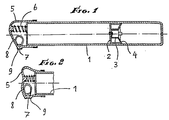
- a piston-like end element 2 is arranged near one end of a cylindrical sleeve 1, which is provided with an expansion spring 3, the ends 4 of which engage resiliently against the inner wall of the cylindrical sleeve 1 in such a way that the piston-like Terminator can move to the left according to Figure 1, but locked against movement to the right according to Figure 1 or is secured.
- an elastically compressible partial element 5 is arranged, which is held in the starting position shown in FIG. 1 by means of a return spring 6.
- a slot-like delivery opening 7 is also formed, which is held by a bow-like spring element 8 in the closed position shown in Figure 1.
- the slot opening 7 is surrounded on all sides by a distributor element 9 which has an essentially flat spreading surface.
- the interior of the cylindrical sleeve 1 and the depressible sub-element 5 is filled with an ointment-like pasty adhesive of the type described above.
- the above-described adhesive container is actuated in the simplest manner by the cylindrical sleeve 1 being gripped as a handle by one hand and the push-in partial element 5 preferably being pressed down by means of the thumb of the gripping hand against the action of the return spring 6, under the pressure which develops in the process 2, the slot-like opening 7 opens and releases adhesive, as shown in FIG. 2, while the piston-like closure element 2 is prevented by the spreading spring ends 4 from evading to the right as shown in FIG.
- FIG. 3 shows a further embodiment of a head part of an adhesive container, namely only an elastically compressible and resilient partial element 10, with which a cylindrical sleeve (not shown) with a piston-like closure element can be connected similarly to the previously described plastic container according to FIGS. 1 and 2 .
- a mouthpiece 11 is integrally formed on the push-in partial element 10, at the end of which there is a permanently open dispensing opening 12, which dispensing opening is formed by surrounding plastic material that can be compressed by finger pressure, the surrounding annular end faces 13 forming a distributor element, by means of which the opening 12 escaping adhesive is evenly spread over a surface to be glued.
- a valve seat 14 is formed, against which a valve flap 15 articulated on one side on the mouthpiece bears sealingly under its own tension.
- the top of the mouthpiece is formed with a corrugated pressure surface 16.
- the operation of the adhesive container described is such that when the flexible sub-element 10 is pressed in, the valve flap 15 opens under the pressure developed thereby and adhesive is released from the discharge opening 12, while when the pressure surface 16 is released, the valve flap 15 first closes under its own tension, which then occurs a negative pressure builds up in the interior of the adhesive container, which causes the piston-like closure element arranged at the other end of the adhesive container to move up in the manner already described in the embodiment according to FIGS. 1 and 2.
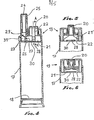
- a cylindrical plastic sleeve 17 is again provided at its lower end with a piston-like closure element 18 and at its upper end with a head piece 19 in which a piston-like formed depressible sub-element 20 is slidably arranged, which, when lowered, reduces the volume of a pump chamber 21 which is formed in the head piece 19, a bow-like return spring 22 moving the piston-like sub-element 20 upwards again after its release according to the drawing.
- a delivery channel 23 is also formed, which ends in a delivery opening 24, which can be closed by a screw cap 25.
- the discharge channel 23 is connected to the pump chamber 21 via a passage 26.
- This passage 26 is formed in an injection molded part 27, which is formed in one piece with a valve flap 28 and a further valve flap 29, the latter for blocking the discharge channel 23 and the valve flap 28 for blocking or opening an opening 30 between the interior of the cylindrical sleeve 17 and the pump chamber 21 is used.
- the actuation of the adhesive container described above is such that when the piston-like partial element 20 is pressed down from the position shown in FIGS. 4 and 5 into the position shown in FIG. 6 in the pump chamber 21 and in the discharge channel 23, adhesive 30 with the opening 30 blocked by the valve flap 28 and opening valve flap 29 in the discharge channel 23 is discharged through the discharge opening 24.
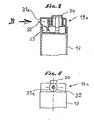
- a dispensing opening 32 is formed on the side of the head piece 19a, specifically in the center of a circular distributor element 31a, while the rest of the training corresponds to that according to Figures 4 to 6.
- adhesive can be continuously dispensed through the dispensing opening 32 by correspondingly depressing the piston-like partial element 20 and at the same time applied and distributed evenly onto a surface to be bonded.
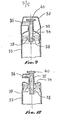
- FIGS. 9 and 10 a further embodiment is shown in FIGS. 9 and 10, only the upper region of the adhesive container in question being shown here, specifically in FIG. 9 in the unactuated position and in FIG. 10 in the actuated position.
- a cylindrical plastic sleeve 33 is provided, in the lower end of which a piston-like closure element (not shown) is arranged, which, similar to the embodiments according to FIGS. 1 to 3, is secured against movement in the sense of an expansion of the interior of the sleeve.
- At the head of the cylindrical sleeve 33 there is in turn an elastically compressible sub-element 34, with which an angular hollow mouthpiece 35 is connected, which in its one angle side!
- the mouthpiece 35 is also provided with an upper pressure piece 40.
- the operation of the adhesive container in question is such that when the mouthpiece 35 is pressed down by means of the pressure element 40 from the position shown in FIG. 9 to the position shown in FIG.
- valve openings 38 in the mouthpiece are released and communicate with the interior of the adhesive container, so that adhesive passes from this interior through the valve openings 38 into the interior of the mouthpiece 35 and is released from the discharge opening 36 by the pressure generated when the same is depressed, while the piston-like closure element at the other end of the cylindrical sleeve 33 moves outwards in the manner described above is hindered.
- the pressure piece 40 is released, the valve openings 38 are closed again by the guide ring 39 and, due to the vacuum building up in the interior of the adhesive container when the flexible partial element 34 springs back, the piston-like closure element, not shown, moves up at the lower end of the cylindrical sleeve 33 in accordance with the adhesive dispensing.
- the ointment-like, pasty, non-free-flowing emulsion polymers can, however, also be used in other containers, ie also in dispensers or containers without a metering device at the top of the container, without to limit the shelf life of the adhesive in question in a manner which is impermissible for practical handling and to restrict the handling of the adhesive container substantially.
- a distributor element for spreading application of the adhesive leaving the dispensing opening onto a surface to be glued to the container can be provided, as in the previously described proposal.
- the container is designed as an elastically deformable tube, between which and the adhesive a bag-shaped, airtight, permanent or inelastic deformable film is arranged and if at least one ventilation opening is formed in the elastically deformable tube is.
- plastic tubes that are simple and inexpensive to produce can be used in this embodiment, such as those already used, for example, for shampoos and other mild detergents in which it does not matter if one is to be consumed after being expressed
- Detergent portion when the elastic plastic tube springs back air gets into the interior of the tube and remains in contact with the remaining tube content.
- Such air intake is prevented in the container according to the invention by the inner bag-shaped film, because this maintains its compressed configuration assumed when the outer elastic tube is compressed.
- the permanent or inelastic deformable film is also impermeable to water vapor in addition to being airtight.
- Particularly suitable films for this purpose are, for example, films made of low, medium and high density polyethylene and polypropylene stretched and unstretched.
- the film is designed as a composite film, one part of which is designed as a plastic film which can be welded to an elastically deformable tube made of plastic and the other part of which is designed as a permanent or inelastic deformable film which is impermeable to air and water vapor.
- Suitable plastic films that can be welded include, for example, those made of polyethylene or unstretched polypropylene.
- water-vapor-impermeable films made of polyester, for example polyethylene glycol terephthalate, can also be used.
- any other film polyamide, cellophane
- any other film can be made water-vapor impermeable by coating with polyvinylidene chloride (one-sided or both-sided).
- the tube material in the connection area with the film ie in the mouthpiece area, can also be coated with a hot melt adhesive in order also to be able to effect a connection to one another in a simple manner by applying heat.
- Another embodiment of the invention is characterized in that the container is designed as a cylindrical plastic sleeve, in the end of which is opposite the dispensing opening, a piston which can be driven in the direction of the dispensing opening is formed.
- a simple and expedient embodiment results when the piston can be driven by means of a spindle drive.
- the piston can also be driven by means of a bellows pump which supplies compressed air to a pressure chamber which is formed on the side of the piston opposite the adhesive.
- a check valve can be expediently arranged between the bellows pump and the pressure chamber.
- the bellows pump can be arranged laterally on the outside of the cylindrical plastic sleeve in such a way that it can be actuated by means of the fingers of the hand gripping the plastic sleeve, which makes the handling of the adhesive container particularly favorable.
- metal containers can be used as metal containers.
- metal containers For example, cylindrical aluminum tubes should be considered.
- Other ductile metals such as copper or zinc and its alloys can also be used for special problems.
- a particularly slidable material that closes tightly to the base plate could be used for the inner space of the container, while a material that lends stability and can easily be labeled or stuck to is used on the outside.
- a material that lends stability and can easily be labeled or stuck to is used on the outside.
- the container as a whole is made of appropriately water vapor-tight materials. Constructive details may make it appear desirable that individual elements - for example the container head with its pump system made of a material that is particularly suitable for its formation - are designed regardless of the values for water vapor diffusion. Naturally However, when designing all components of the dispenser, water vapor density can be as high as possible.
- the invention provides for the one-hand adhesive container to be in the form of a container with a closed underbody, a piston-like sealing element being slidably arranged within the container at its lower end.
- the piston-like closure element can be permanently tensioned in the direction of the emptying movement. This is made possible, for example, by a compression spring in the interior of the container between the bottom of the container and the underside of the piston-like closure element and / or by the arrangement of a tensioned propellant gas at a corresponding point in the adhesive container.
- the cavity-free storage of the adhesive remaining in the storage container is ensured with a corresponding reduction in the size of the storage space and the dispensing of the container contents until the adhesive supply is completely used up.
- care must be taken to ensure that a sufficient emptying voltage is maintained until the desired end of adhesive removal.
- the majority of the aqueous phase was introduced and is sodium bicarbonate, emulsifier, defoamer and protective colloid for 2 hours at 75 0 C dissolved (pre-solution).
- the intended amount of monomer or the mixture of the monomers was placed in the metering vessel.
- the initiator (potassium persulfate) was dissolved in the remaining water and the solution was added to another metering vessel.
- the reaction temperature was kept in the range of 80 to 88 ° C. If the reflux was too strong, the monomer addition was delayed. After the end of the monomer addition, the temperature was increased to 85 to 95 ° C. for the after-reaction.
- the dispersions could be filled after cooling to about 35 ° C.
- the reaction was carried out with stirring.
- the reaction temperature was kept in the range between 80 and 88 0 . If the reflux was too strong, the monomer addition was temporarily restricted. After the end of the monomer addition, the rest of the initiator solution was added quickly and the end of reflux was awaited. The after-reaction then took place within 30 minutes in the temperature range from 85 to 95 ° C.
- Example 1 was repeated, but instead of 0.3 percent by weight of emulsifier, only 0.1 percent by weight of the same emulsifier was used.
- Example 1 was repeated on a 1 kg scale on a laboratory scale, but instead of 7.0% by weight of a protective colloid with a molecular weight of 20,000, 10.0% by weight of a protective colloid with a molecular weight of 12,000 was used.
- the amount of vinyl acetate was 39.2 percent by weight.
- Example 7-20 Analogously to Example 3, the dispersions according to Example 7-20 were prepared on a 1 kg laboratory scale. The dispersions according to Examples 7-14 gave brittle films, those according to Examples 15-20 elastic films. All products were practically speck-free and the corresponding films were resistant to water. Further measurement data are contained in Table 3.
- the dispersion was cooled to 40 ° C. at 140 rpm and neutralized with 20 g of ammonia (25% strength) within 10 minutes.
- a monomer mixture consisting of 218 g of ethyl acrylate and 38.7 g of styrene was then mixed simultaneously with the catalyst solution consisting of 175 g of water, 1 g of potassium persulfate, 43.3 g of 30% nonylphenol-10 EO sulfate and 24.7 g of sodium hydroxide ( 20%) added dropwise within 2 to 2.5 hours at 87 ° to 90 ° C and 140 rpm. The after-reaction took place within 30 minutes in the temperature range from 87 0 to 90 ° C.
- the pH is determined with a Seibold pH meter No. 6702483 at 20 ° C.
- the viscosity is measured in the Brookfield viscosimeter RVT 2-4 / 20/20 at 20 ° C.
- the viscosity is measured in the Epprecht Viscometer STV with spindle 2 or 3 at 20 ° C.
- the particle size is determined in an approx. 1000-fold dilution with 1% sodium chloride solution in the Coulter-Nano-Sizer TM. The mean value of 3 measurements is given as the particle size.
- the dispersion is drawn onto a glass plate using a Erichsen film-drawing device, model 288, with a layer thickness of 80 ⁇ m, and dried at 100 ° C. for 3 minutes. After storage for 30 minutes at room temperature, the appearance of the dispersion film is assessed optically.
- the adhesive compositions of Examples 1-24 are packaged in commercially available plastic dispensers which have a metering device which can be actuated by means of the gripping hand at the head of the container and has a dispensing opening for the adhesive and a bottom which moves up automatically as the amount of adhesive is dispensed.
- the expressibility of the masses from the dispenser remains unchanged even after storage for a period of 180 days at room temperature.
- the tightened aging test at 40 ° C also shows that the usability of the adhesive containers is maintained over the same period.
- the protective colloid chosen in each case - hydroxyethyl cellulose, polyvinyl alcohol, carboxymethyl cellulose or polyvinyl pyrrolidone - is stirred into cold demineralized water, if necessary heated to approx. 80 ° C. and homogenized by lingering sufficiently at this temperature.
- An initiator solution for triggering the polymerization reaction is prepared separately by dissolving potassium persulfate in demineralized water at approx. 40 ° C.
- the aqueous solution containing the protective colloid is added to the reactor and stirred there at 150 rpm.
- monomer and initiator metering are started simultaneously. Both components are metered in over a period of about 3 hours, 10% of the initiator solution being retained for the post-reaction.
- the initiator is added during the after-reaction within about 10 minutes after the last monomer addition (after-reaction time about 30 minutes).
- the reaction temperature of 80 ° C. should not be exceeded significantly during the entire polymerization time, including the after-reaction.
- the dispersions obtained as a reaction product are practically speck-free and dry to solid films.
- the product viscosities (Brookfield d 20 ° C / 20 rpm) depending on the type and concentration of the protective colloid up to the range of 3 million.
- adhesives 1 - 3 and 5 are homophymerisates of vinyl acetate
- adhesives 4 and 6 are copolymers of 2/3 parts by weight of vinyl acetate and 1/3 parts by weight of dibutyl naleinate.
- the ointment-like adhesive masses are introduced into a packaging container which is designed as a cylindrical plastic sleeve and at the lower end contains a piston-like closing element which is arranged such that it can slide.
- the container also has a metering device a part that can be pressed in and spring back after release, a pump chamber being arranged between this part and the rest of the interior of the plastic sleeve, and a check valve is also provided between this pump chamber and the rest of the interior, which closes when the part is pressed in and opens when it springs back.
- the pump chamber is connected to a permanently open discharge opening at the top of the container. Another non-return valve is arranged between the pump chamber and the discharge opening, which opens when the partial element is pressed in and releases the adhesive and closes when the partial element springs back.
- the adhesive layers are characterized by rapid setting and excellent adhesive strength.
Landscapes
- Chemical & Material Sciences (AREA)
- Chemical Kinetics & Catalysis (AREA)
- Organic Chemistry (AREA)
- Engineering & Computer Science (AREA)
- Mechanical Engineering (AREA)
- Adhesives Or Adhesive Processes (AREA)
Applications Claiming Priority (10)
| Application Number | Priority Date | Filing Date | Title |
|---|---|---|---|
| DE19843427728 DE3427728A1 (de) | 1984-07-27 | 1984-07-27 | Verwendung von salbenartig-pastoesen klebmitteln in form gebrauchsfertiger klebstoffgebinde |
| DE19843427727 DE3427727A1 (de) | 1984-07-27 | 1984-07-27 | Gebrauchsfertiges klebstoffgebinde |
| DE3427728 | 1984-07-27 | ||
| DE3427727 | 1984-07-27 | ||
| DE19843428915 DE3428915A1 (de) | 1984-08-06 | 1984-08-06 | Verwendung von salbenartig-pastoesen klebmitteln in gebrauchsferigen klebstoffgebinden mit verringerter wasserdampf-durchlaessigkeit |
| DE3428915 | 1984-08-06 | ||
| DE3446697 | 1984-12-21 | ||
| DE19843446697 DE3446697A1 (de) | 1984-12-21 | 1984-12-21 | Gebrauchsfertiges klebstoffgebinde |
| DE3522363 | 1985-06-22 | ||
| DE19853522363 DE3522363A1 (de) | 1985-06-22 | 1985-06-22 | Verwendung von polyethylenglykolen als lagerbestaendiges eindickungsmittel in salbenfoermigen waessrigen emulsionspolymerisaten mit klebstoff-charakter |
Publications (2)
| Publication Number | Publication Date |
|---|---|
| EP0169501A2 true EP0169501A2 (fr) | 1986-01-29 |
| EP0169501A3 EP0169501A3 (fr) | 1988-01-13 |
Family
ID=27510819
Family Applications (1)
| Application Number | Title | Priority Date | Filing Date |
|---|---|---|---|
| EP85108968A Withdrawn EP0169501A3 (fr) | 1984-07-27 | 1985-07-18 | Cartouches d'adhésif prêtes à l'emploi |
Country Status (7)
| Country | Link |
|---|---|
| EP (1) | EP0169501A3 (fr) |
| BR (1) | BR8503560A (fr) |
| DK (1) | DK321685A (fr) |
| FI (1) | FI852904L (fr) |
| NO (1) | NO852970L (fr) |
| PT (1) | PT80864B (fr) |
| TR (1) | TR23520A (fr) |
Cited By (5)
| Publication number | Priority date | Publication date | Assignee | Title |
|---|---|---|---|---|
| WO1998011171A1 (fr) * | 1996-09-10 | 1998-03-19 | Henkel Kommanditgesellschaft Auf Aktien | Dispersion collante pour le gommage dans des machines a mettre sous enveloppe |
| US7090093B2 (en) | 1998-11-07 | 2006-08-15 | Boehringer Ingelheim International Gmbh | Pressure compensation device for a two-part container |
| US7963955B2 (en) | 1998-02-27 | 2011-06-21 | Boehringer Ingelheim International Gmbh | Container for a medicinal liquid |
| CN106043966A (zh) * | 2016-07-08 | 2016-10-26 | 彭东林 | 一种新型推胶装置 |
| CN110498122A (zh) * | 2018-05-18 | 2019-11-26 | 阿贝尔服务 | 用于不具有进气口的流体产品分配器的储存器的活塞 |
Families Citing this family (1)
| Publication number | Priority date | Publication date | Assignee | Title |
|---|---|---|---|---|
| DE19615422A1 (de) | 1996-04-19 | 1997-11-20 | Boehringer Ingelheim Kg | Zweikammer-Kartusche für treibgasfreie Dosieraerosole |
Family Cites Families (9)
| Publication number | Priority date | Publication date | Assignee | Title |
|---|---|---|---|---|
| US3157314A (en) * | 1961-01-12 | 1964-11-17 | Nadler Emanuel | Refillable dispenser with flexible outer casing |
| FR2094286A5 (fr) * | 1970-06-16 | 1972-02-04 | Eluere Yves | |
| CA1001539A (en) * | 1971-11-02 | 1976-12-14 | Air Products And Chemicals | Adhesive compositions of vinyl acetate-ethylene copolymer emulsions |
| US3865770A (en) * | 1972-12-01 | 1975-02-11 | Minnesota Mining & Mfg | Water-dispersible pressure-sensitive adhesive, tape made therewith, and novel tackifiers therefor |
| US4073756A (en) * | 1976-04-26 | 1978-02-14 | Konishi Co., Ltd. | Solid adhesive compositions |
| DE2901717A1 (de) * | 1979-01-17 | 1980-07-31 | Joachim Czech | Spender fuer pastoese produkte |
| US4280942A (en) * | 1980-07-09 | 1981-07-28 | Formica Corporation | Aqueous acrylic contact adhesive |
| US4374884A (en) * | 1980-12-09 | 1983-02-22 | Polysar Limited | Pile carpet having a water activatable adhesive |
| US4413080A (en) * | 1982-06-21 | 1983-11-01 | Minnesota Mining And Manufacturing Co. | Water-dispersible pressure-sensitive adhesive and tape made therewith |
-
1985
- 1985-07-15 DK DK321685A patent/DK321685A/da not_active Application Discontinuation
- 1985-07-18 EP EP85108968A patent/EP0169501A3/fr not_active Withdrawn
- 1985-07-25 PT PT80864A patent/PT80864B/pt not_active IP Right Cessation
- 1985-07-25 NO NO852970A patent/NO852970L/no unknown
- 1985-07-25 FI FI852904A patent/FI852904L/fi not_active Application Discontinuation
- 1985-07-26 BR BR8503560A patent/BR8503560A/pt unknown
- 1985-07-26 TR TR33628/85A patent/TR23520A/xx unknown
Cited By (5)
| Publication number | Priority date | Publication date | Assignee | Title |
|---|---|---|---|---|
| WO1998011171A1 (fr) * | 1996-09-10 | 1998-03-19 | Henkel Kommanditgesellschaft Auf Aktien | Dispersion collante pour le gommage dans des machines a mettre sous enveloppe |
| US7963955B2 (en) | 1998-02-27 | 2011-06-21 | Boehringer Ingelheim International Gmbh | Container for a medicinal liquid |
| US7090093B2 (en) | 1998-11-07 | 2006-08-15 | Boehringer Ingelheim International Gmbh | Pressure compensation device for a two-part container |
| CN106043966A (zh) * | 2016-07-08 | 2016-10-26 | 彭东林 | 一种新型推胶装置 |
| CN110498122A (zh) * | 2018-05-18 | 2019-11-26 | 阿贝尔服务 | 用于不具有进气口的流体产品分配器的储存器的活塞 |
Also Published As
| Publication number | Publication date |
|---|---|
| PT80864B (pt) | 1988-12-15 |
| BR8503560A (pt) | 1986-04-22 |
| TR23520A (tr) | 1990-03-01 |
| FI852904A7 (fi) | 1986-01-28 |
| NO852970L (no) | 1986-01-28 |
| DK321685D0 (da) | 1985-07-15 |
| PT80864A (de) | 1985-08-01 |
| FI852904A0 (fi) | 1985-07-25 |
| DK321685A (da) | 1986-01-28 |
| FI852904L (fi) | 1986-01-28 |
| EP0169501A3 (fr) | 1988-01-13 |
Similar Documents
| Publication | Publication Date | Title |
|---|---|---|
| EP0014347B1 (fr) | Composition de revêtement sur le verso d'un papier adhésif | |
| DE1595481A1 (de) | Verfahren zur Herstellung polymerer Latices | |
| DE68908500T2 (de) | Dentalzusammensetzung. | |
| WO1995027558A1 (fr) | Procede et dispositif pour la confluence d'au moins deux substances fluides | |
| DE19833066A1 (de) | Verfahren zur Herstellung wäßriger Dispersionen von (Co-)Polymerisaten, die danach erhältlichen Dispersionen, aus den Dispersionen erhältliche redispergierbare Pulver sowie deren Verwendung | |
| EP0730612A1 (fr) | Adhesif aerobie | |
| CH685013A5 (de) | Aufsprühbare Dispersion und Verfahren zum elastischen Verkleben zweier Substratflächen. | |
| EP0169501A2 (fr) | Cartouches d'adhésif prêtes à l'emploi | |
| DE10051762B4 (de) | Wässriges Monomer-Polymer-System und dessen Verwendung | |
| EP1286899B1 (fr) | Dispositif pour stocker et melanger des matieres pateuses | |
| EP0133672A2 (fr) | Bâton adhésif et son procédé de fabrication | |
| DE1769355C2 (de) | Aerosol-Verteilerpackung für polymerisierbare Klebstoffe | |
| DE1904549C3 (de) | Versprühbare Klebemittelmasse | |
| DE1087807B (de) | Verfahren zur Herstellung von neuen carboxylgruppenhaltigen Copolymerisaten N-substituierter Acrylsaeureamide | |
| DE2924042B1 (de) | Filmibildende,verspruehbare Polymerisatloesung zur Herstellung eines Wundverbandes | |
| DE3518875C2 (fr) | ||
| EP0096237B1 (fr) | Laque ou encre d'impression en solution alcoolique | |
| EP0113085A1 (fr) | Composition et son utilisation pour parfumer des matières plastiques | |
| DE2444734C3 (de) | Wasserbefeuchtbarer Schmelzkleber auf Basis von Copolymerisaten aus Vinylacetat und Vinylpyrrolidon | |
| EP0547504B1 (fr) | Procédé pour souder à chaud avec un matériel de revêtement soudable à chaud | |
| DE1617972A1 (de) | alpha-Cyanacrylatester-Mischungen | |
| DE3427727A1 (de) | Gebrauchsfertiges klebstoffgebinde | |
| DE3427728A1 (de) | Verwendung von salbenartig-pastoesen klebmitteln in form gebrauchsfertiger klebstoffgebinde | |
| DE1952006B2 (de) | Vorrichtung zum dosieren von zweikomponenten-kunststoffvorprodukten | |
| DE3522363A1 (de) | Verwendung von polyethylenglykolen als lagerbestaendiges eindickungsmittel in salbenfoermigen waessrigen emulsionspolymerisaten mit klebstoff-charakter |
Legal Events
| Date | Code | Title | Description |
|---|---|---|---|
| PUAI | Public reference made under article 153(3) epc to a published international application that has entered the european phase |
Free format text: ORIGINAL CODE: 0009012 |
|
| AK | Designated contracting states |
Designated state(s): AT BE CH DE FR GB IT LI LU NL SE |
|
| PUAL | Search report despatched |
Free format text: ORIGINAL CODE: 0009013 |
|
| AK | Designated contracting states |
Kind code of ref document: A3 Designated state(s): AT BE CH DE FR GB IT LI LU NL SE |
|
| 17P | Request for examination filed |
Effective date: 19880310 |
|
| 17Q | First examination report despatched |
Effective date: 19890710 |
|
| STAA | Information on the status of an ep patent application or granted ep patent |
Free format text: STATUS: THE APPLICATION HAS BEEN WITHDRAWN |
|
| 18W | Application withdrawn |
Withdrawal date: 19900711 |
|
| R18W | Application withdrawn (corrected) |
Effective date: 19900711 |
|
| RIN1 | Information on inventor provided before grant (corrected) |
Inventor name: RITTER, WOLFGANG, DR. Inventor name: SCHENCK, GUENTER, DR. Inventor name: DIERICHS, WOLFGANG, DR. Inventor name: HANDWERK, HANS-PETER Inventor name: FUES, JOHANN FRIEDRICH, DR. Inventor name: WILK, HANS-CHRISTOF, DR. |