EP0169808A2 - UV-absorbierende Verbindungen, Verfahren zu ihrer Herstellung und ihre Verwendung als Bildfarbstoffe in photograhischen Materialien für das Silberfarbbleichverfahren - Google Patents
UV-absorbierende Verbindungen, Verfahren zu ihrer Herstellung und ihre Verwendung als Bildfarbstoffe in photograhischen Materialien für das Silberfarbbleichverfahren Download PDFInfo
- Publication number
- EP0169808A2 EP0169808A2 EP85810328A EP85810328A EP0169808A2 EP 0169808 A2 EP0169808 A2 EP 0169808A2 EP 85810328 A EP85810328 A EP 85810328A EP 85810328 A EP85810328 A EP 85810328A EP 0169808 A2 EP0169808 A2 EP 0169808A2
- Authority
- EP
- European Patent Office
- Prior art keywords
- formula
- compounds
- compounds according
- radical
- dye
- Prior art date
- Legal status (The legal status is an assumption and is not a legal conclusion. Google has not performed a legal analysis and makes no representation as to the accuracy of the status listed.)
- Withdrawn
Links
- HISFPBVJAVKXPW-UHFFFAOYSA-N CN1[O](C)(C)[O]1C Chemical compound CN1[O](C)(C)[O]1C HISFPBVJAVKXPW-UHFFFAOYSA-N 0.000 description 1
Classifications
-
- G—PHYSICS
- G03—PHOTOGRAPHY; CINEMATOGRAPHY; ANALOGOUS TECHNIQUES USING WAVES OTHER THAN OPTICAL WAVES; ELECTROGRAPHY; HOLOGRAPHY
- G03C—PHOTOSENSITIVE MATERIALS FOR PHOTOGRAPHIC PURPOSES; PHOTOGRAPHIC PROCESSES, e.g. CINE, X-RAY, COLOUR, STEREO-PHOTOGRAPHIC PROCESSES; AUXILIARY PROCESSES IN PHOTOGRAPHY
- G03C7/00—Multicolour photographic processes or agents therefor; Regeneration of such processing agents; Photosensitive materials for multicolour processes
- G03C7/28—Silver dye bleach processes; Materials therefor; Preparing or processing such materials
- G03C7/29—Azo dyes therefor
-
- C—CHEMISTRY; METALLURGY
- C09—DYES; PAINTS; POLISHES; NATURAL RESINS; ADHESIVES; COMPOSITIONS NOT OTHERWISE PROVIDED FOR; APPLICATIONS OF MATERIALS NOT OTHERWISE PROVIDED FOR
- C09B—ORGANIC DYES OR CLOSELY-RELATED COMPOUNDS FOR PRODUCING DYES, e.g. PIGMENTS; MORDANTS; LAKES
- C09B35/00—Disazo and polyazo dyes of the type A<-D->B prepared by diazotising and coupling
- C09B35/02—Disazo dyes
-
- C—CHEMISTRY; METALLURGY
- C09—DYES; PAINTS; POLISHES; NATURAL RESINS; ADHESIVES; COMPOSITIONS NOT OTHERWISE PROVIDED FOR; APPLICATIONS OF MATERIALS NOT OTHERWISE PROVIDED FOR
- C09B—ORGANIC DYES OR CLOSELY-RELATED COMPOUNDS FOR PRODUCING DYES, e.g. PIGMENTS; MORDANTS; LAKES
- C09B35/00—Disazo and polyazo dyes of the type A<-D->B prepared by diazotising and coupling
- C09B35/38—Trisazo dyes ot the type
-
- Y—GENERAL TAGGING OF NEW TECHNOLOGICAL DEVELOPMENTS; GENERAL TAGGING OF CROSS-SECTIONAL TECHNOLOGIES SPANNING OVER SEVERAL SECTIONS OF THE IPC; TECHNICAL SUBJECTS COVERED BY FORMER USPC CROSS-REFERENCE ART COLLECTIONS [XRACs] AND DIGESTS
- Y10—TECHNICAL SUBJECTS COVERED BY FORMER USPC
- Y10S—TECHNICAL SUBJECTS COVERED BY FORMER USPC CROSS-REFERENCE ART COLLECTIONS [XRACs] AND DIGESTS
- Y10S534/00—Organic compounds -- part of the class 532-570 series
- Y10S534/01—Mixtures of azo compounds
Definitions
- the present invention relates to UV absorbing compounds, processes for their preparation and their use as image dyes in photographic materials for the silver color bleaching process.
- UV-absorbing compounds which can be used as image dyes in photographic materials for the silver color bleaching process enable the use of these materials wherever exposure to UV light or light with a high UV content plays a role.
- the image-wise exposure of diazotype materials is carried out with mercury vapor lamps, the light of which has a high and intense UV component.
- the image dyes contained in this silver color bleaching material should not only have a high absorption in the visible but also in the ultraviolet range. So that the images can also be assessed visually, it is advantageous if the image dyes are dark, i.e. absorb in as large a part of the visible spectral range as possible.
- the object of the present invention is therefore to provide compounds with spectral absorption in the UV region and also in virtually the entire region of the visible spectrum and which are suitable for use in photographic silver color bleaching material.
- the present invention therefore relates to compounds of the formula wherein A is the residue of a bis- or trisazo dye, L and L 'are identical or different from one another and represent a bridge member, B and B' are identical or different from one another and mean an aromatic radical, at least one of the residues B and B 'being spectral Has absorption in the UV region, and one of the radicals B and B 'is different from 2,4-dihydroxyphenyl, and m is 1 or 2 and n is 0, 1 or 2.
- the present invention furthermore relates to the preparation of the compounds of the formula (1) according to the invention, their use as image dyes in photographic silver color bleaching materials, the photographic silver color bleaching materials containing these image dyes, in particular monochrome silver color bleaching materials, and the use of the images produced from such materials as a template for exposure of diazo material.
- A represents the residue (chromophore) of a bis or trisazo dye.
- A can preferably be represented by the formulas
- the radicals E, E ', D and D' can be the same or different and are preferably aromatic radicals.
- Suitable aromatic radicals are, for example, those of the formula wherein R 1 is hydrogen or alkyl, alkoxy, alkylthio, alkyl- or dialkylamino, where the said radicals may each contain 1 to 4 carbon atoms, furthermore amino, aryl such as phenyl, halogen, especially fluorine, chlorine or bromine, nitro, cyano, hydroxyl , mercapto, acylamido (C 1-4 alkyl-CONH-), sulfo, amidosulfonyl (H 2 N-SO 2 -, (C 1 - 4) alkyl 2 N-SO 2) -, carboxyl or amidocarbonyl (H 2 N- CO-, (C 1-4 alkyl) 2 N-CO-) is.
- G is a straight-chain or branched-chain or heterocyclic, organic, divalent radical,
- Suitable heterocyclic divalent organic radicals are preferably 5- or 6-membered, unsaturated radicals which contain nitrogen, oxygen and / or sulfur atoms as heteroatoms, e.g. Pyrroldiyl, furandiyl, thiophendiyl, thiophendioxide diyl, imidazole diyl, thiazole diyl, oxazole diyl, oxadiazole diyl, thiadiazole diyl and triazole diyl, as well as pyridinediyl, pyrazinediyl, pyranediyl, triazinediyl and thiopazinediyl.
- alkylene such as e.g. Methylene, ethylene, n-propylene, sec. Propylene or isoprapylene
- Alkenylene, preferably ethenylene or butadienylene, furthermore -0-, -S-, -SO 2 -, -CH 2 SO 2 -, -NH-, -N-alkyl with preferably 1 to 4 carbon atoms, -CHzNH-, -NHCO- , -NHSOz-, -NHCONH-, -NHCSNH-, -N N- or enumerate.
- the values 0 or 1 can be used for q.
- the cyclic radicals E, E ', D and D' mentioned can contain 1 to 3 substituents R 1 . If 2 or 3 substituents R 1 are present, these can be the same or different.
- the bridge members L and L ' can be the same or different. They preferably represent radicals such as alkylene with 1 to 4 carbon atoms, arylene such as phenylene and naphthylene, acylamide (-CONH-), carboxylene (-COO-), -0-, -S-, -NH-, -SO 2 - or - NN-.
- the radicals B and B ' which are the same (exception: B and B' are simultaneously 2,4-dihydroxyphenyl) or different from one another, mean an aromatic, organic radical, at least one of the radicals B and B 'being very pronounced UV-absorbing Possesses properties.
- the aromatic Organic radicals B and B 'can contain the substituents customary in dye chemistry. Suitable substituents are the radicals listed in the definition of R 1 .
- R 1 is preferably alkyl, alkoxy, alkylthio, alkyl or dialkylamino each having 1 to 4 carbon atoms, phenyl, amino, chlorine, nitro, cyano, hydroxyl, mercapto, acylamido, sulfo, amidosulfonyl, carboxyl or amidocarbonyl or in particular alkoxy with 1 to 4 carbon atoms, amino, hydroxyl or sulfo.
- G is a radical of the formula
- Chromophore A corresponds to the formula in particularly preferred compounds
- L and L ' are, independently of one another, alkylene with 1 to 4 carbon atoms, phenylene, naphthylene, -0-, -S-, -NH-, -S0 2 -, -NN-, -CO- NH- or
- Preferred compounds of the formula (1) have radicals B and B 'which independently of one another are phenyl, naphthyl, pyridinyl, pyrazinyl, thiophenyl, furanyl, pyrrolyl, thiazolyl, benzophenyl, benzothiazolyl, benzotriazolyl, triazinyl, quinoxalinyl, phenylsalicyl, resorcinyl or pyronyl, in particular independently of one another benzophenyl, benzotriazolyl, benzthiazolyl, quinoxalinyl or 2,4-dihydroxyphenyl mean.
- 2,4-Dihydroxyphenyl is a particularly preferred radical B or B '.
- B and B ' are independently a radical of the formula are in which R 3 is hydrogen, hydroxyl, methoxy, chlorine, fluorine, carboxyl, sulfo, r 1 1, 2 or 3, R 4 hydroxyl, amino or alkoxy, sulfoalkyloxy or acylamino each having 1 to 4 carbon atoms, R 5 is hydrogen, chlorine or sulfo, R 6 is hydrogen, alkyl having 1 to 4 carbon atoms, carboxyalkyl having 1 to 4 carbon atoms or amino and r 2 is 1 or 2 or, in particular, independently of one another a radical of the formula mean.
- the compounds according to the invention are also notable for a high absorbency of ultraviolet light.
- the molar extinction coefficients of these compounds at wavelengths below 400 nm are significantly higher compared to the values of corresponding compounds without UV-absorbing groups.
- the compounds according to the invention consistently have a dark color, e.g. dark brown, blue or green or black.
- the black compounds can also be used, for example, to produce black wine pictures from silver color bleaching material. All compounds of the formula (1) can be bleached well under the conditions customary for the processing of exposed silver color bleaching materials.
- the compounds of the formula (1) according to the invention are prepared by customary methods. If L and optionally L 'represent an azo group, the compound of the formula the corresponding tetrazo compound is established. A, m and n have the meanings given. This is then achieved by coupling with the compound of the formula wherein B and B 'have the meanings given, in the corresponding compound of the formula transferred. However, if L and L 'have the meanings given, with the exception of the azo group, the compound of the formula is expediently used and sets this with the compound of the formula to connect the formula around.
- the compounds mentioned are preferably added as a solution in water or in a water-miscible solvent at room temperature or elevated temperature to an aqueous gelatin solution with stirring. This mixture is then brought together with a binder containing silver halide and / or other materials for producing photographic images, cast onto a base in a customary manner to form a layer and optionally dried.
- the solution of these compounds can also be added directly to a silver halide and / or other binder to form photographic images. So it is e.g. possible to add the solution just before pouring. Instead of simple stirring, the usual distribution methods using kneading and / or shear forces or ultrasound can also be used. It is also possible to add the compounds according to the invention not as a solution but in solid form or as a paste.
- Suitable silver halide emulsions can contain silver bromide or silver iodobromide as well as silver chloride or silver chlorobromide or silver chloroiodobromide.
- the silver halide emulsions can be spectrally sensitized and contain stabilizers and antifoggants.
- Such silver halide emulsions are e.g. in Research Disclosure No. 17, 643 (December 1978), No. 18, 155 (May 1979 and No. 22, 534 (January 1983). The choice of a particular emulsion is primarily determined by the sensitivity required for the material.
- the gelatin used in the photographic material according to the invention as a binder for the compounds of the formula (1) used as image dye, for silver halide and optionally filter dyes can contain additives such as polyvinyl alcohol or polyvinyl pyrrolidone. Further, the gelatin may be replaced by dispersions of water-insoluble, high molecular weight substances, a part, for example of dispersion polymers *, ß-unsaturated compounds, such as g ttigten Acrylklareestern, Vinylestern and vinyl ethers, vinyl chloride and vinylidene chloride.
- the gelatin is preferably crosslinked using the triazine derivatives described in CH-A-574,980. However, other hardeners such as aldehydes, vinyl sulfones, diimines, etc. can also be used.
- the usual transparent materials such as e.g. those made of cellulose triacetate or polyester in question.
- the material according to the invention preferably contains a transparent support, a silver halide emulsion layer with a compound of the formula (1) and, if appropriate, a protective layer.
- the material according to the invention can also have a layer containing a bleachable image dye.
- the exposed silver color bleaching materials are generally processed in four successive steps: silver development, color bleaching, silver bleaching and fixation.
- the latent silver image created during exposure is developed.
- the image dye assigned to the silver is bleached out in accordance with the image-based distribution of the silver.
- the third step is necessary to reoxidize the excess image silver that is still present after the color bleaching.
- the silver, which is now entirely in the form of halides is removed by leaching out with a complexing agent, in particular a salt of thiosulfuric acid, in order to make the finished image insensitive to further exposure and to clear the pure color image of cloudiness.
- the second process step, color bleaching is carried out in the customary known processes in a strongly acidic medium, a catalyst being added to accelerate the color bleaching.
- the bleaching baths also contain a silver complexing agent or ligand. Both components, catalyst and ligand, are necessary in order to transfer the reducing effect of the metallic, non-diffusible image silver to the likewise non-diffusible dye.
- the reduced form of the catalyst resulting from reduction on the image silver serves as an intermediate support which, after covering a certain diffusion distance, irreversibly reduces the dye and thus bleaches, and is reoxidized itself to the original form.
- the property of the reduced stage of the bleaching catalyst to freely diffuse between image silver and dye to be bleached makes it possible to spatially separate silver and image dye to a certain extent, i.e. That is, to arrange the bleachable dye and the silver halide emulsion assigned to it not or only partially in the same layer but in adjacent layers.
- Such silver color bleaching materials are e.g. in DE-A-2 o36 918, DE-A-2 132 835, and DE-A-2 132 836.
- the combined color and silver bleaching baths (preparations) for processing the exposed silver color bleaching material contain components (a) to (e) and optionally (f): (a) strong acid, (b) water-soluble iodide, (c) water-soluble oxidizing agent, ( d) Oxidationstikmite1, (e) bleaching catalyst, (f) bleaching accelerator.
- the amount of bleaching catalysts used in the preferably aqueous treatment baths can vary within wide limits and is approximately 0.05 to 10 g / l of bleaching bath.
- the temperature of the bleaching bath is generally between 20 and 90 ° C., preferably between 20 and 60 ° C., the processing time required, of course, being shorter at a higher temperature than at a lower temperature.
- the bleaching baths are stable within the specified temperature range.
- the aqueous bleaching preparations required for processing are used in the form of dilute aqueous solutions which contain the components mentioned.
- other methods are also conceivable, e.g. application in paste form.
- the aqueous bleaching preparation according to the present invention can be produced, for example, from liquid, in particular aqueous concentrates of individual or all components (a) to (f).
- aqueous concentrates of individual or all components (a) to (f).
- two liquid concentrates are advantageously used, one of which contains the strong acid (a) and the oxidizing agent (c) and the other of which contains the other components (b), (d), (e) and optionally (f), the latter containing concentrate to improve the solubility, especially component (e), an additional solvent such as ethyl or propyl alcohol, benzyl alcohol, Aethylene glycol methyl or ethyl ether can be added.
- the aqueous bleaching preparations used generally contain components (a) to (f) in the following amounts: (a) strong acid: 10 to 220 g / l; (b) water-soluble iodide: 2 to 50 g / 1, preferably 5 to 25 g / l; (c) water soluble oxidizer: 1 to 30 g / l; (d) antioxidant: 0.5 to 10 g / l; (e) bleaching catalysts: 0.05 to 10 g / l, and optionally (f) bleaching accelerator: 1 to 20 g / l.
- the strong dyebaths and silver bleach baths can contain alkyl or arylsulfonic acids and in particular p-toluenesulfonic acid, sulfuric acid, sulfamic acid or trichloroacetic acid as strong acids (components (a)). If appropriate, mixtures of these acids can also be used.
- the pH of the bleaching bath is in particular not greater than 2 and preferably not greater than 1.
- the water-soluble iodides (component (b) are generally alkali metal iodides, especially sodium and potassium iodide.
- oxidizing agent (c) Water-soluble aromatic mononitro and dinitro compounds and anthraquinone sulfonic acid derivatives are expediently used as the oxidizing agent (c).
- the use of such oxidizing agents serves to influence the color balance and the contrast of the images produced by the color bleaching process and is known from German patent specification 735,672, British patent specifications 539 190 and 539 509 and Japanese patent publication 22673/69.
- the mononitro and dinitro compounds are preferably mono- and dinitrobenzenesulfonic acids, o-nitrobenzenesulfonic acid, m-nitrobenzenesulfonic acid, 2,4-dinitrobenzenesulfonic acid, 3,5-dinitrobenzenesulfonic acid, 3-nitro-4-chlorobenzenesulfonic acid, 2-chloro-5-nitrobenzenesulfonic acid, Methyl-3,5-dinitrobenzenesulfonic acid, 3-chloro-2,5-dinitrobenzenesulfonic acid, 2-amino-4-nitrobenzenesulfonic acid, 2-amino-4-nitro-5-methoxybenzenesulfonic acid, 4-nitrophenol-2-sulfonic acid.
- the compounds of component (c) serve to flatten the gradation.
- Reductones or water-soluble mercapto compounds are advantageously used as antioxidants (anticorrosive agents) (d).
- Suitable reductones are in particular aci-reductones with a 3-carbonyldiol (1,2) grouping, such as reductone, triose reductone or preferably ascorbic acid.
- suitable mercapto compounds are thioglycerol, but in particular the compounds of the formulas HS-C q H 2q -B or preferably HS- (CH 2 ) m -COOH, in which q is an integer from 2 to 12, B is a sulfonic acid or carboxylic acid group and m is one of the numbers 3 and 4.
- Mercapto compounds which can be used as antioxidants are described in DE-A-2,258,076 and DE-A-2,423,814.
- Suitable further antioxidants are alkali metal, alkaline earth metal and ammonium bisulfite adducts of organic carbonyl compounds, preferably alkali metal or ammonium bisulfite adducts of monoaldehydes with 1 to 4 or dialdehydes with 2 to 5 carbon atoms (DE-A-2 737 142).
- Examples include the particularly preferred formaldehyde bisulfite adduct, and also the corresponding adducts of acetaldehyde, propionaldehyde, butyraldehyde or isobutyraldehyde, of glyoxal, malondialdehyde or glutardialdehyde.
- the tertiary water-soluble phosphines referred to below as bleaching accelerators can also be used simultaneously as antioxidants.
- Suitable bleach accelerators (f) are, for example, quaternary ammonium salts, as are known from DE-A-2 139 401 and 2 716 136. These are preferably quaternary, optionally substituted piperidine, piperazine, pyrazine, quinoline or pyridine compounds, the latter being preferred. Tetraalkylammonium compounds (alkyl having 1 to 4 carbon atoms) and alkylene diammonium compounds (alkylene having 2 to 6 carbon atoms) can also be used.
- Tetraethyl ammonium iodide (CH 3 ) 3 N ⁇ (CH 2 ) 2 N ⁇ (CH 3 ) 3 ⁇ 2J ⁇ ; (CH 3 ) 3 N ⁇ (CH 2 ) 6 N ⁇ (CH 3 ) 3 ⁇ 2J ⁇ ; N-methylpyridinium iodide; N-methylquinolinium iodide; N-hydroxyethyl pyridinium chloride; N-hydroxypropyl pyridinium bromide; N-methyl-2-hydroxymethylpyridium iodide; N, N-dimethylpiperidinium iodide; N, N'-dimethylpyrazinium fluorosulfate and y-picolinium bisulfate.
- Further bleach accelerators are the water-soluble tertiary phosphines known from DE-A-2 651 969, which preferably contain at least one cyanoethyl group, such as e.g. Bis- (ß-cyanoethyl) -2-sulphoethylphosphine (sodium salt), bis (ß-cyanoethyl) -3-sulfopropylphosphine (sodium salt), bis (ß-cyanoethyl) -4-sulfobutylphosphine (sodium salt), bis - (ß-cyanoethyl) -2-methoxyethylphosphine, bis (2-methoxyethyl) - (ß-cyanoethyl) phosphine, (ß-cyanoethyl) phenyl-3-sulphopropylphosphine (sodium salt), (ß-cyanoethyl) - phenyl-2
- Baths of conventional composition can be used for silver development, e.g. those which contain hydroquinone as developer and optionally additionally 1-phenyl-3-pyrazolidinone.
- the silver development bath may already contain a bleaching catalyst.
- the silver fixing bath can be composed in a known and customary manner.
- the fixative used is e.g. Sodium thiosulfate or advantageously ammonium thiosulfate, if desired with additives such as sodium bisulfite and / or sodium metabisulfite.
- the images produced from the material according to the invention are notable for good reproduction and legibility of the details shown.
- the image dyes also have the required high absorption in the ultraviolet spectral range. These properties enable the images to be used as a template for making copies, for example, using the diazo method.
- the images produced with the material according to the invention can be in the form of microfiches.
- the information contained on it ions can then be enlarged and copied onto diazo material. Suitable diazo materials are described, for example, in DE 1 285 874 and DE 2 166 264.
- black and white images of good quality can also be produced with the material according to the invention.
- Example 1 if dihydroxybenzophenone is replaced by an equivalent amount of 4-amino-2-hydroxybenzophenone and this is coupled to the diazo intermediate at pH 8.2, 6.9 g of the trisazo dye of the formula (103) are obtained (30.5% yield).
- Example 4 If the dihydroxybenzophenone in Example 4 is replaced by 2- (4-amino-2-hydroxy) -phenylbenzotriazole-5-sulfoacid and coupled at pH 8.5, 10.7 g of the tetrakisazo dye of the formula (204) (73.2 % Yield.)
- the tetrazo solution is added dropwise within 30 minutes at a temperature of at most 10 ° C.
- the suspension obtained is stirred for 2 hours, then warmed to 20 ° C. and finally to 40 to 50 ° C.
- the suspension is filtered at 20 ° C. and the moist crude product is hot-suspended twice in 400 ml of ethanol.
- the tetrazotized intermediate from Example 7 is coupled to an equivalent amount of 4-amino-2-hydroxy-benzophenone instead of 2,4-dihydroxy-benzophenone at pH 5.5 by buffering with sodium acetate.
- the dye is purified by slurrying in pyridine and ethanol as in Example 1. 10.9 g of dye of the formula (207) are obtained (42.0% yield).
- the disazo dye of the formula (302a) is prepared in a known manner by first coupling 1 mole of diazotized p-nitroaniline to 1 mole of 1-amino-8-naphthol-3,6-disulfonic acid, followed by a second mole of diazotized p on the resulting monoazo dye -Nitroaniline is coupled alkaline and finally the two nitro groups of the disazo dye are reduced to amino groups with sodium sulfide.
- Table 1 shows the position of the absorption maximum and the molar extinction coefficients of a solution of the dyes according to the invention prepared in Examples 1 to 17 in a mixture of dimethylformamide (DMF / H 2 O (1: 1)).
- Comparative compound are dissolved in 50 ml of water and a mixture of 38 ml of 3.7% aqueous gelatin solution, 1 ml of an 8% solution of the sodium salt of dibutylnaphthalenesulfonic acid and 11 g of a spectrally non-sensitized gelatin silver chloroiodobromide emulsion containing about 140 g of silver and Contains 70 g of gelatin per kilogram.
- This mixture is combined with a protective layer consisting of 37.4 ml of 3.9% aqueous gelatin solution, 1 ml of a 6% solution of the sodium salt of bis-2-ethylhexyl ester of sulfosuccinic acid, 1 ml of a 3% solution of a fatty acid alkanolamide and 0 , 6 ml of a 10% solution of formaldehyde poured onto 1 m 2 of a polyester support and dried.
- the light-sensitive material thus obtained is exposed to 10,000 lux / cm 2 for 1 second through a blue filter and processed at 30 ° C. as follows:
- the developer bath contains the following components per liter of solution:
- the silver bleach bath has the following composition per liter of solution:
- the fixer contains per liter of solution:
- a light-fast color wedge with a low molecular extinction coefficient at 350 nm is obtained at the unbleached points (see Table 2).
- the other dyes according to the invention can be incorporated into the layers of photographic materials in an analogous manner.
- Table 2 shows the amounts of the dye incorporated and the corresponding molar extinction coefficients in the layer of the photographic material.
- the table shows that the UV absorption capacity of the compounds according to the invention in photographic material is considerably higher than that of the corresponding comparison compounds without UV-absorbing groups.
- the comparison compounds differ from the corresponding compounds according to the invention only in the groups B and B '.
- Example 20 633 mg of dye of the formula (206) are dissolved in 56 ml of water and a mixture of 42 ml of 3.7% aqueous gelatin solution, 1 ml of an 8% solution of the sodium salt of dibutylnaphthalenesulfonic acid and 12 g of a spectrally unsensitized Gelatin silver chloroiodobromide emulsion containing about 140 g of silver and 70 g of gelatin per kilogram.
- This mixture is combined with a protective layer consisting of 37.4 ml of 3.9% aqueous gelatin solution, 1 ml of a 6% solution of the sodium salt of bis-2-ethylhexyl ester of sulfosuccinic acid, 1 ml of a 3% solution of a fatty acid alkanolamide and Pour 0.6 ml of a 10% solution of formaldehyde onto 1 m 2 of a polyester support and dry.
- the processed photographic material had a maximum density of 1.70 measured through a Wratten 18 A UV filter.
Landscapes
- Chemical & Material Sciences (AREA)
- Organic Chemistry (AREA)
- Physics & Mathematics (AREA)
- General Physics & Mathematics (AREA)
- Plural Heterocyclic Compounds (AREA)
- Silver Salt Photography Or Processing Solution Therefor (AREA)
- Organic Low-Molecular-Weight Compounds And Preparation Thereof (AREA)
Abstract
Description
- Die vorliegende Erfindung betrifft UV-absorbierende Verbindungen, Verfahren zu ihrer Herstellung und ihre Verwendung als Bildfarbstoffe in photographischen Materialien für das Silberfarbbleichverfahren.
- UV-absorbierende Verbindungen, die als Bildfarbstoffe in photographischen Materialien für das Silberfarbbleichverfahren verwendet werden können, ermöglichen den Einsatz dieser Materialien überall dort, wo die Belichtung mit UV-Licht oder Licht mit hohem UV-Anteil eine Rolle spielt. Beispielsweise erfolgt die bildmässige Belichtung von Diazotypiematerialien mit Quecksilberdampflampen, deren Licht einen hohen und intensiven UV-Anteil besitzt. Wenn es sich bei der Vorlage, die auf solche Diazotypiematerialien übertragen werden soll, um eine aus Silberfarbbleichmaterial hergestellte Vorlage handelt, so sollten die in diesem Silberfarbbleichmaterial enthaltenen Bildfarbstoffe also nicht nur im sichtbaren sondern auch im ultravioletten Bereich eine hohe Absorption aufweisen. Damit die Bilder auch visuell beurteilt werden können, ist es von Vorteil, wenn die Bildfarbstoffe dunkel sind, d.h. in einem möglichst grossen Teil des sichtbaren Spektralbereichs absorbieren.
- Aufgabe der vorliegenden Erfindung ist somit die Bereitstellung von Verbindungen mit spektraler Absorption im UV-Bereich wie auch im praktisch gesamten Bereich des sichtbaren Spektrums und die sich zur Verwendung in photographischem Silberfarbbleichmaterial eignen.
- Es wurde nun gefunden, dass die Verbindungen der nachstehenden Formel (1) diese Anforderungen weitgehend erfüllen.
- Gegenstand der vorliegenden Erfindung sind daher Verbindungen der Formel

worin A der Rest eines Bis- oder Trisazofarbstoffes ist, L und L' gleich oder voneinander verschieden sind und ein Brückenglied bedeuten, B und B' gleich oder voneinander verschieden sind und einen aromatischen Rest bedeuten, wobei mindestens einer der Reste B und B' spektrale Absorption im UV-Bereich aufweist, und einer der Reste B und B' verschieden von 2,4-Dihydroxyphenyl ist, und m 1 oder 2 und n 0, 1 oder 2 ist. - Gegenstand der vorliegenden Erfindung sind ferner die Herstellung der erfindungsgemässen Verbindungen der Formel (1), ihre Verwendung als Bildfarbstoffe in photographischen Silberfarbbleichmaterialien, die diese Bildfarbstoffe enthaltenden photographischen Silberfarbbleichmaterialien, insbesondere monochrome Silberfarbbleichmaterialien, und die Verwendung der aus solchen Materialien hergestellten Bilder als Vorlage bei der Belichtung von Diazotypiematerial.
- In den Verbindungen der Formel (1) bedeutet A den Rest (Chromophor) eines Bis- oder Trisazofarbstoffs. Vorzugsweise lässt sich A durch die Formeln




- wiedergeben. Die Reste E, E', D und D' können gleich oder verschieden sein und stellen vorzugsweise aromatische Reste dar. Geeignete aromatische Reste sind z.B. solche der Formel


worin R1 Wasserstoff oder Alkyl, Alkoxy, Alkylthio, Alkyl- oder Dialkylamino, wobei die genannten Reste jeweils 1 bis 4 Kohlenstoffatome enthalten können, ferner Amino, Aryl wie z.B. Phenyl, Halogen, insbesondere Fluor, Chlor oder Brom, Nitro, Cyano, Hydroxyl, Mercapto, Acylamido (C1-4Alkyl-CONH-), Sulfo, Amidosulfonyl (H2N-SO2-, (C1-4)Alkyl2N-SO2)-, Carboxyl oder Amidocarbonyl (H2N-CO-, (C1-4-Alkyl)2N-CO-) ist. G ist ein gerad-oder verzweigtkettiger oder heterocyclischer, organischer, zweiwertiger Rest, ein Heteroatom, wie z.B. -0- oder -S-, oder eine Gruppe der Formel
- Geeignete heterocyclische zweiwertige organische Reste sind vorzugsweise 5- oder 6-gliedrige, ungesättigte Reste, die als Heteroatome Stickstoff, Sauerstoff und/oder Schwefelatome enthalten, wie z.B. Pyrroldiyl, Furandiyl, Thiophendiyl, Thiophendioxiddiyl, Imidazoldiyl, Thiazoldiyl, Oxazoldiyl, Oxadiazoldiyl, Thiadiazoldiyl und Triazoldiyl, sowie Pyridindiyl, Pyrazindiyl, Pyrandiyl, Triazindiyl, Thiopyrandiyl und oxazindiyl.
- Als gerad- oder versweigtkettige organische Reste G lassen sich Alkylen wie z.B. Methylen, Aethylen, n-Propylen, sek. Propylen oder Isoprapylen
-


aufzählen. Für q kommen die Werte 0 oder 1 in Frage. - Die genannten cyclischen Reste E, E', D und D' können 1 bis 3 Substituenten R1 enthalten. Sind 2 oder 3 Substituenten R1 vorhanden, so können diese gleich oder voneinander verschieden sein.
- Die Brückenglieder L und L' können gleich oder voneinander verschieden sein. Vorzugsweise stellen sie Reste wie Alkylen mit 1 bis 4 Kohlenstoffatomen, Arylen wie Phenylen und Naphthylen, Acylamid (-CONH-), Carboxylen (-COO-), -0-, -S-, -NH-, -SO2- oder -N-N- dar.
- Die Reste B und B', die gleich (Ausnahme: B und B' sind gleichzeitig 2,4-Dihydroxyphenyl) oder voneinander verschieden sind, bedeuten einen aromatischen, organischen Rest, wobei mindestens einer der Reste B und B' sehr ausgeprägte UV-absorbierende Eigenschaften besitzt. B und B' können z.B. Phenyl, Naphthyl oder einen der für G genannten aromatischen 5- oder 6-gliedrigen Heterocyclen bedeuten, ferner ein Derivat des Benzophenons, Benzthiazols, Benztriazols, Chinoxalins, Triazins, Phenylsalicylats, 2,4-Dihydroxyphenyl oder Pyrons, die als Rest B oder B' mit sehr hohem Absorptionsvermögen im ultravioletten Spektralbereich betrachtet werden. Die aromatischen organischen Reste B und B' können die in der Farbstoffchemie üblichen Substituenten enthalten. Geeignete Substituenten stellen die in der Definition von R1 aufgezählten Reste dar.
- Bevorzugte Verbindungen der Formel (1) sind solche, worin A ein Rest der Formel




ist, worin E, E', D und D' unabhängig voneinander ein Rest der Formel


sind, worin R1 Wasserstoff, Alkyl, Alkoxy, Alkylthio, Alkyl- oder Dialkylamino, Amino, Aryl, Halogen, Nitro, Cyano, Hydroxyl, Mercapto, Acylamido, Sulfo, Amidosulfonyl, Carboxyl oder Amidocarbonyl, p 0, 1, 2 oder 3, G ein gerad- oder verzweigtkettiger oder heterocyclischer organischer Rest oder -O-, -S-, -S0z-, -NH-, -N=N- oder
- Vorzugsweise ist in diesen Verbindungen R1 Alkyl, Alkoxy, Alkylthio, Alkyl- oder Dialkylamino mit je 1 bis 4 Kohlenstoffatomen, Phenyl, Amino, Chlor, Nitro, Cyano, Hydroxyl, Mercapto, Acylamido, Sulfo, Amidosulfonyl, Carboxyl oder Amidocarbonyl oder insbesondere Alkoxy mit 1 bis 4 Kohlenstoffatomen, Amino, Hydroxyl oder Sulfo.
- In besonders geeigneten Verbindungen ist G Alkylen, Alkenylen, Alkylsulfonylen oder Alkylimino mit je 1 bis 4 Kohlenstoffatomen, -NHCO-, -NHS02-, -NHCONH-, -NHCSNH-, -0-, -S-, -SO2-, -NH-, -N=N-oder

oder vorzugsweise Alkylen oder Alkylimino mit je 1 bis 4 Kohlenstoffatomen, -NH- oder -N-N-. - In einer weiteren Gruppe bevorzugter Verbindungen ist G ein Rest der Formel
-


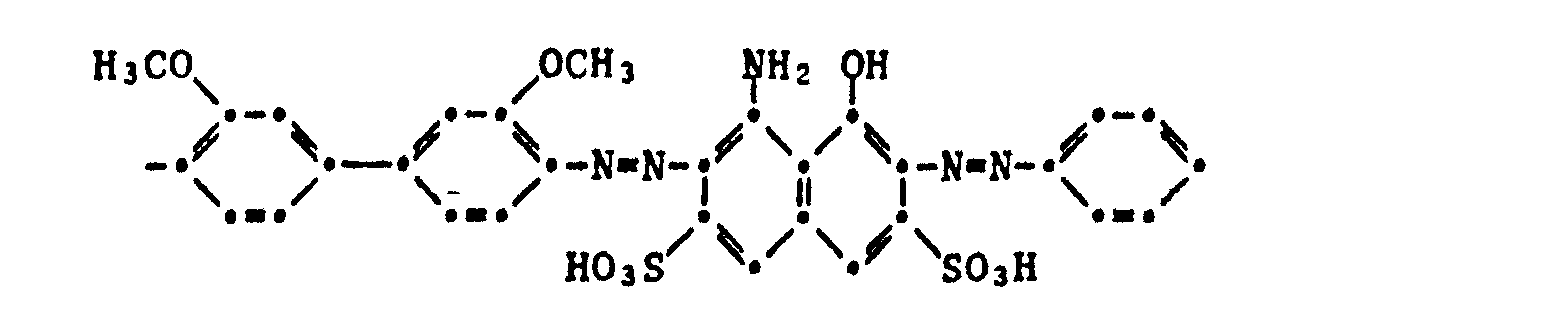



- In geeigneten Verbindungen der Formel (1) sind L und L' unabhängig voneinander Alkylen mit 1 bis 4 Kohlenstoffatomen, Phenylen, Naphthylen, -0-, -S-, -NH-, -S02-, -N-N-, -CO-NH- oder
-

- Bevorzugte Verbindungen der Formel (1) weisen Reste B und B' auf, die unabhängig voneinander Phenyl, Naphthyl, Pyridinyl, Pyrazinyl, Thiophenyl, Furanyl, Pyrrolyl, Thiazolyl, Benzophenyl, Benzthiazolyl, Benztriazolyl, Triazinyl, Chinoxalinyl, Phenylsalicyl, Resorcinyl oder Pyronyl, insbesondere unabhängig voneinander Benzophenyl, Benztriazolyl, Benzthiazolyl, Chinoxalinyl oder 2,4-Dihydroxyphenyl bedeuten. 2,4-Dihydroxyphenyl ist ein besonders bevorzugter Rest B bzw. B'.
- Besonders bevorzugt sind solche Verbindungen, worin B und B' unabhängig voneinander ein Rest der Formel


sind, worin R3 Wasserstoff, Hydroxyl, Methoxy, Chlor, Fluor, Carboxyl, Sulfo, r1 1, 2 oder 3, R4 Hydroxyl, Amino oder Alkoxy, Sulfoalkyloxy oder Acylamino mit je 1 bis 4 Kohlenstoffatomen, R5 Wasserstoff, Chlor oder Sulfo, R6 Wasserstoff, Alkyl mit 1 bis 4 Kohlenstoffatomen, Carboxyalkyl mit 1 bis 4 Kohlenstoffatomen oder Amino und r2 1 oder 2 ist oder vor allem unabhängig voneinander ein Rest der Formel

bedeuten. - Die erfindungsgemässen Verbindungen zeichnen sich neben den Absorptionen in grossen Teilen des sichtbaren Spektralbereichs auch durch ein hohes Absorptionsvermögen von ultraviolettem Licht aus. Die molaren Extinktionskoeffizienten dieser Verbindungen bei Wellenlängen unter 400 nm sind verglichen mit den Werten entsprechender Verbindungen ohne UV-absorbierende Gruppen deutlich höher. Ferner weisen die erfindungsgemässen Verbindungen durchweg eine dunkle Farbe auf, z.B. dunkelbraun, -blau oder -grün oder schwarz. Die schwarzen Verbindungen können beispielsweise auch zur Herstellung von Schwarzweinsbildern aus Silberfarbbleichmaterial verwendet werden. Alle Verbindungen der Formel (1) können unter den für die Verarbeitung von belichteten Silberfarbbleichmaterialien üblichen Bedingungen gut gebleicht werden.
- Die Herstellung der erfindungsgemässen Verbindungen der Formel (1) erfolgt nach üblichen Methoden. Wenn L und gegebenenfalls L' eine Azogruppe bedeuten, wird aus der Verbindung der Formel

die entsprechende Tetrazoverbindung hergestellt. A, m und n haben die angegebenen Bedeutungen. Diese wird dann durch Kuppeln mit der Verbindung der Formel
worin B und B' die angegebenen Bedeutungen haben, in die entsprechende Verbindung der Formel
überführt. Haben L und L' die angegebenen Bedeutungen jedoch mit Ausnahme der Azogruppe, so geht man zweckmässigerweise von der Verbindung der Formel
aus und setzt diese mit der Verbindung der Formel
zur Verbindung der Formel
um. - Die Einarbeitung der erfindungsgemässen Verbindungen sowie auch solcher Verbindungen der Formel (1), worin die Reste B und B' gleichzeitig eine 2,4-Dihydroxyphenylgruppe bedeuten, in photographische Silberfarbbleichmaterialien geschieht wie folgt:
- Die genannten Verbindungen werden vorzugsweise als Lösung in Wasser oder in einem mit Wasser mischbaren Lösungsmittel bei Zimmertemperatur oder erhöhter Temperatur zu einer wässrigen Gelatinelösung unter Rühren zugesetzt. Anschliessend wird diese Mischung mit einem Silberhalogenid und/oder andere Materialien zur Erzeugung photographischer Bilder enthaltenden Bindemittel zusammengebracht, auf einer Unterlage in üblicher Weise zu einer Schicht vergossen und gegebenenfalls getrocknet.
- Die Lösung dieser Verbindungen kann auch direkt zu einem Silberhalogenid und/oder andere Materialien zur Erzeugung photographischer Bilder enthaltenden Bindemittel zugegeben werden. So ist es z.B. möglich, die Lösung erst unmittelbar vor dem Giessen zuzudosieren. Anstelle des einfachen Rührens können auch die üblichen Verteilungsmethoden mittels Knet- und/oder Scherkräften oder Ultraschall zur Anwendung gelangen. Es ist auch möglich, die erfindungsgemässen Verbindungen nicht als Lösung sondern in fester Form oder als Paste zuzugegeben.
- Geeignete Silberhalogenidemulsionen können Silberbromid oder Silberjodobromid sowie aber auch Silberchlorid oder Silberchlorobromid oder Silberchlorojodobromid enthalten. Die Silberhalogenidemulsionen können spektral sensibilisiert sein sowie Stabilisatoren und Antischleiermittel enthalten. Solche Silberhalogenidemulsionen sind z.B. in Research Disclosure Nr. 17, 643 (Dezember 1978), Nr. 18, 155 (Mai 1979 und Nr. 22, 534 (Januar 1983) beschrieben. Die Wahl einer speziellen Emulsion wird vor allem durch die für das Material geforderte Empfindlichkeit bestimmt.
- Die im erfindungsgemässen photographischen Material als Bindemittel für die als Bildfarbstoff verwendeten Verbindungen der Formel (1), für Silberhalogenid und gegebenenfalls Filterfarbstoffe verwendete Gelatine kann Zusätze wie z.B. Polyvinylalkohol oder Polyvinylpyrrolidon enthalten. Ferner kann ein Teil der Gelatine durch Dispersionen nichtwasserlöslicher, hochmolekularer Stoffe ersetzt werden, z.B. Dispersionspolymerisate aus *,ß-ungesgttigten Verbindungen wie Acrylsäureestern, Vinylestern und Vinyläthern, Vinylchlorid sowie Vinylidenchlorid. Die Vernetzung der Gelatine erfolgt vorzugsweise mit den in CH-A-574.980 beschriebenen Triazinderivaten. Es können aber auch andere Härter, wie z.B. Aldehyde, Vinylsulfone, Diimine usw. verwendet werden.
- Als Schichtträger für das erfindungsgemäss verwendete Material kommen die üblichen transparenten Materialien wie z.B. solche aus Cellulosetriacetat oder Polyester in Frage.
- Vorzugsweise enthält das erfindungsgemässe Material einen transparenten Träger, eine Silberhalogenidemulsionsschicht mit einer Verbindung der Formel (1) und gegebenenfalls eine Schutzschicht. Zusätzlich kann das erfindungsgemässe Material noch eine einen bleichbaren Bildfarbstoff enthaltende Schicht aufweisen.
- Die Verarbeitung der belichteten Silberfarbbleichmaterialien erfolgt im allgemeinen in vier aufeinanderfolgenden Schritten: Silberentwicklung, Farbbleichung, Silberbleichung und Fixierung.
- Im ersten Schritt wird das bei der Belichtung entstehende latente Silberbild entwickelt. Im zweiten Schritt wird, entsprechend der vorliegenden bildmässigen Verteilung des Silbers, der dem Silber zugeordnete Bildfarbstoff ausgebleicht. Der dritte Schritt ist notwendig, um das nach der Farbbleichung noch vorhandene überschüssige Bildsilber zu reoxidieren. Im vierten Schritt wird das nunmehr gänzlich in Form von Halogeniden vorliegende Silber durch Herauslösen mit einem Komplexbildner, insbesondere einem Salz der Thioschwefelsäure, entfernt, um das fertige Bild gegenüber weiterer-Belichtung unempfindlich zu machen, und das reine Farbbild von Trübung zu befreien.
- Der zweite Verfahrenaschritt, die Farbbleichung, erfolgt bei den üblichen bekannten Verfahren in stark saurem Medium, wobei zur Beschleunigung der Farbbleichung ein Katalysator zugesetzt wird. Die Bleichbäder enthalten zudem einen Silberkomplexbildner oder Liganden. Beide Bestandteile, Katalysator und Ligand, sind notwendig, um die reduzierende Wirkung des metallischen, nichtdiffundierbaren Bildsilbers auf den ebenfalls nicht diffundierbaren Farbstoff zu übertragen. Die durch Reduktion am Bildsilber entstehende reduzierte Form des Katalysators dient dabei als Zwischenträger, welcher, nach Zurücklegung einer gewissen Diffusionsstrecke, den Farbstoff irreversibel reduziert und damit bleicht, und dabei selbst zur ursprünglichen Form reoxidiert wird.
- Die Eigenschaft der reduzierten Stufe des Bleichkatalysators, zwischen Bildsilber und zu bleichendem Farbstoff frei zu diffundieren, ermöglicht es, Silber und Bildfarbstoff in einem gewissen Mass räumlich zu trennen, d.h. also den bleichbaren Farbstoff und die ihm zugeordnete Silberhalogenidemulsion nicht oder nur teilweise in der gleichen Schicht sondern in benachbarten Schichten anzuordnen. Solche Silberfarbbleichmaterialien sind z.B. in DE-A-2 o36 918, DE-A-2 132 835, und DE-A-2 132 836 beschrieben.
- Eine Vereinfachung des Verarbeitungsprozesses, bei der die Farhstoffbleichung und die Silberbleichung zu einem einzigen Verfahrensschritt zusammengefasat werden, ist in der DE-A-2 488 433 beschrieben worden.
- Die kombinierten Farb- und Silberbleichbäder (Zubereitungen) für die Verarbeitung des belichteten Silberfarbbleichmaterials enthalten die Komponenten (a) bis (e) und gegebenenfalls (f): (a) starke Säure, (b) wasserlösliches Jodid, (c) wasserlösliches Oxidationsmittel, (d) Oxidationsschutzmite1, (e) Bleichkatalysator, (f) Bleichbeschleuniger.
- Die Menge der Bleichkatalysatoren, die in den vorzugsweise wässrigen Behandlungsbädern eingesetzt wird, kann in weiten Grenzen schwanken und beträgt etwa 0,05 bis 10 g/1 Bleichbad.
- Die Temperatur des Bleichbades liegt im allgemeinen zwischen 20 und 90°C, vorzugsweise zwischen 20 und 60°C, wobei natürlich bei höherer Temperatur die erforderliche Bearbeitungsdauer kürzer ist als bei tieferer Temperatur. Die Bleichbäder sind innerhalb des angegebenen Temperaturbereichs stabil. Im allgemeinen werden die für die Verarbeitung benötigten wässrigen Bleichzubereitungen in der Form verdünnter wässriger Lösungen, die die genannten Komponenten enthalten, verwendet. Es sind aber auch andere Methoden denkbar, z.B. die Anwendung in Pastenform.
- Dieser Temperaturbereich gilt auch für die anderen Verarbeitungsschritte. Die wässrige Bleichzubereitung gemäss der vorliegenden Erfindung kann z.B. aus flüssigen, insbesondere wässrigen Konzentraten einzelner oder aller Komponenten (a) bis (f) hergestellt werden. Vorteilhaft verwendet man z.B. zwei flüssige Konzentrate, deren eines die starke Säure (a) und das Oxydationsmitel (c) und deren anderes die übrigen Komponenten (b), (d), (e) und gegebenenfalls (f) enthält, wobei in letzterem Konzentrat zur Verbesserung der Löslichkeit, insbesondere der Komponente (e) ein zusätzliches Lösungsmittel wie Aethyl- oder Propylalkohol, Benzylalkohol, Aethylenglykolmethyl- oder -äthyläther zugesetzt werden kann. Die zur Anwendung gelangenden wässrigen Bleichzubereitungen enthalten in der Regel die Komponenten (a) bis (f) in den folgenden Mengen: (a) starke Säure: 10 bis 220 g/l; (b) wasserlösliches Jodid: 2 bis 50 g/1, vorzugsweise 5 bis 25 g/l; (c) wasserlösliches Oxydationsmittel: 1 bis 30 g/l; (d) Oxydationsschutzmittel: 0,5 bis 10 g/l; (e) Bleichkatalysatoren: 0,05 bis 10 g/l, und gegebenenfalls (f) Bleichbeschleuniger: 1 bis 20 g/l.
- Als starke Säuren (Komponenten (a)), können die kombinierten Farb-und Silberbleichbäder Alkyl- oder Arylsulfonsäuren und insbesondere p-Toluolsulfonsäure, Schwefelsäure, Sulfaminsäure oder Trichloressigsäure enthalten. Gegebenenfalls können auch Gemische dieser Säuren eingesetzt werden. Der pH-Wert des Bleichbades ist insbesondere nicht grösser als 2 und vorzugsweise nicht grösser als 1.
- Die wasserlöslichen Jodide (Komponente (b) sind in der Regel Alkalimetalljodide, insbesondere Natrium- und Kaliumjodid.
- Als Oxydationsmittel (c) verwendet man zweckmässig wasserlösliche aromatische Mononitro- und Dinitroverbindungen, sowie Anthrachinonsulfonsäurederivate. Die Verwendung solcher Oxydationsmittel dient zur Beeinflussung des Farbgleichgewichts und des Kontrasts der im Farbbleichverfahren hergestellten Bilder und ist aus der deutschen Patentschrift 735,672, den britischen Patentschriften 539 190 und 539 509 und der japanischen Patentpublikation 22673/69 bekannt.
- Die Mononitro- und Dinitroverbindungen sind vorzusweise Mono- und Dinitrobenzolsulfonsäuren, o-Nitrobenzolsulfonsäure, m-Nitrobenzolsulfonsäure, 2,4-Dinitrobenzolsulfonsäure, 3,5-Dinitrobenzolsulfonsäure, 3-Nitro-4-chlorbenzolsulfonsäure, 2-Chlor-5-nitrobenzolsulfonsäure, 4-Methyl-3,5-dinitrobenzolsulfonsäure, 3-Chlor-2,5-dinitrobenzolsulfonsäure, 2-Amino-4-nitrobenzolsulfonsäure, 2-Amino-4-nitro-5-methoxybenzolsulfonsäure, 4-Nitrophenol-2-sulfonsäure.
- Die Verbindungen der Komponente (c) dienen neben ihrer Funktion als Silberbleichmittel zur Gradationsverflachung.
- Als Oxydationsschutzmittel (Korrosionsschutzmittel) (d) werden mit Vorteil Reduktone oder wasserlösliche Mercaptoverbindungen verwendet. Geeignete Reduktone sind insbesondere aci-Reduktone mit einer 3-Carbonyldiol-(1,2)-Gruppierung, wie Redukton, Triose-Redukton oder vorzugsweise Ascorbinsäure. Als Mercaptoverbindungen kommen z.B. Thioglyzerin, insbesondere jedoch die Verbindungen der Formeln HS-CqH2q-B oder vorzugsweise HS-(CH2) m -COOH in Betracht, worin q eine ganze Zahl im Wert von 2 bis 12, B eine Sulfonsäure- oder Carbonsäuregruppe und m eine der Zahlen 3 und 4 bedeuten. Als Oxydationsschutzmittel verwendbare Mercaptoverbindungen sind in der DE-A-2,258,076 und der DE-A-2,423,814 beschrieben. Als weitere Oxydationsschutzmittel geeignet sind Alkalimetall-, Erdalkalimetall-und Ammoniumbisulfitaddukte von organischen Carbonylverbindungen, vorzugsweise Alkalimetall- oder Ammoniumbisulfitaddukte von Monoaldehyden mit 1 bis 4 oder Dialdehyden mit 2 bis 5 Kohlenstoffatomen (DE-A-2 737 142).
- Beispielsweise genannt seien das besonders bevorzugte Formaldehydbisulfitaddukt, ferner die entsprechenden Addukte von Acetaldehyd, Propionaldehyd, Butyraldehyd oder Isobutyraldehyd, von Glyoxal, Malondialdehyd oder Glutardialdehyd. Gegebebenfalls sind auch die nachfolgend als Bleichbeschleuniger bezeichneten tertiären wasserlöslichen Phosphine gleichzeitig als Oxydationsschutzmittel einsetzbar.
- Geeignete Bleichbeschleuniger (f) sind z.B. quaternäre Ammoniumsalze, wie sie aus den DE-A-2 139 401 und 2 716 136 bekannt sind. Bevorzugt handelt es sich dabei um quaternäre, gegebenenfalls substituierte Piperidin-, Piperazin-, Pyrazin-, Chinolin- oder Pyridinverbindungen, wobei letztere bevorzugt sind. Ferner können auch Tetraalkylammoniumverbindungen (Alkyl mit 1 bis 4 Kohlenstoffatomen) und Alkylendiammoniumverbindungen (Alkylen mit 2 bis 6 Kohlenstoffatomen) in Frage kommen. Im einzelnen seien genannt: Tetraätbylammoniumjodid; (CH3)3N⊕(CH2)2N⊕(CH3)3·2J⊖; (CH3)3N⊕(CH2)6N⊕(CH3)3·2J⊖; N-Methylpyridiniumjodid; N-Methylchinoliniumjodid; N-Hydroxyäthylpyridiniumchlorid; N-Hydroxypropylpyridiniumbromid; N-Methyl-2-Hydroxymethylpyridi-niumjodid; N,N-Dime- thylpiperidiniumjodid; N,N'-Dimethylpyraziniumfluorsulfat und y-Picoliniumhydrogensulfat.
- Weitere Bleichbeschleuniger sind die aus der DE-A-2 651 969 bekannten wasserlöslichen tertiären Phosphine, die vorzugsweise mindestens eine Cyanoäthylgruppe enthalten, wie z.B. Bis-(ß-cyanoäthyl)-2-sul- foäthylphosphin (Natriumsalz), Bis-(ß-cyanoäthyl)-3-sulfopropyl- phosphin (Natriumsalz), Bis-(ß-cyanoäthyl)-4-sulfobutylphosphin (Natriumsalz), Bis-(ß-cyanoäthyl)-2-methoxyäthylphosphin, Bis-(2-methoxyäthyl)-(ß-cyanoäthyl)-phosphin, (ß-Cyanoäthyl)-phenyl-3-sul- fopropylphosphin (Natriumsalz), (ß-Cyanoäthyl)-phenyl-2-methoxy- äthylphosphin und Bis-(2-methoxyäthyl)-phenylphosphin.
- Zur Silberentwicklung können Bäder üblicher Zusammensetzung angewendet werden, z.B. solche, die als Entwicklersubstanz Hydrochinon und gegebenenfalls zusätzlich 1-Phenyl-3-pyrazolidinon enthalten. Gegebenenfalls enthält bereits das Silberentwicklungsbad einen Bleichkatalysator.
- Das Silberfixierbad kann in bekannter und üblicher Weise zusammengesetzt sein. Als Fixiermittel dient z.B. Natriumthiosulfat oder mit Vorteil Ammoniumthiosulfat, gewünschtenfalls mit Zusätzen wie Natriumbisulfit und/oder Natriummetabisulfit.
- Die aus dem erfindungsgemässen Material hergestellten Bilder zeichnen sich durch eine gute Wiedergabe und Lesbarkeit der abgebildeten Details aus. Die Bildfarbstoffe besitzen auch die geforderte hohe Absorption im ultravioletten Spektralbereich. Diese Eigenschaften ermöglichen die Verwendung der Bilder als Vorlage zur Herstellung von z.B. Kopien nach dem Diazotypieverfahren. Beispielsweise können die mit dem erfindungsgemässen Material hergestellten Bilder in Form von Microfiches vorliegen. Die darauf enthaltenen Informationen können dann vergrössert und auf Diazotypiematerial kopiert werden. Geeignete Diazotypiematerialien sind z.B. in DE 1 285 874 und DE 2 166 264 beschrieben.
- Mit dem erfindungsgemässen Material können aber auch Schwarzweissbilder von guter Qualität hergestellt werden.
-

-

-

-

-

-

- Ersetzt man das Dihydroxybenzophenon in Beispiel 4 durch 2-(4-Amino-2-hydroxy)-phenylbenztriazol-5-sulfosaure und kuppelt bei pH 8,5, erhält man 10,7 g des Tetrakisazofarbstoffes der Formel (204) (73,2 % Ausbeute.)
-

- 33,8 g (0,4) dieses Zwischenproduktes suspendiert in 1100 ml Wasser und mit 9,5 ml konz. Schwefelsäure (93 %) angesäuert werden bei 0 bis 5°C mittels 6,1 g (0,088 m) Natriumnitrit tetrazotiert. Nach 4 Stunden bei 0 bis 5°C wird der Nitritüberschuss mit Sulfaminsäure zerstört. 20,6 g (0,096 m) 2,4-Dihydroxybenzophenon werden in 320 ml Wasser unter Zugabe von 10 ml wässriger Natriumhydroxidlösung (10 m) und 80 ml Sodalösung (14 %) durch Erwärmen gelöst. Die Kupplung erfolgt durch Zutropfen der Tetrazolösung bei einer Temperatur von höchstens 10°C unter Konstanthalten des pH-Wertes bei 10 mittels Natriumcarbonat. Nach 4 Stunden Nachreaktion bei 10°C erwärmt man das Reaktionsgemisch auf 30°C bis alles in Lösung gegangen ist. Durch Ansäuern mittels Schwefelsäure auf pH 1 wird der Farbstoff ausgefällt und filtriert. Das feuchte Rohprodukt wird durch Aufschlämmen in heissem Methanol und anschliessend in Schwefelsäure (ln) gereinigt. Man erhält 9,8 g Farbstoff der Formel (206) (39,2 % Ausbeute).
-
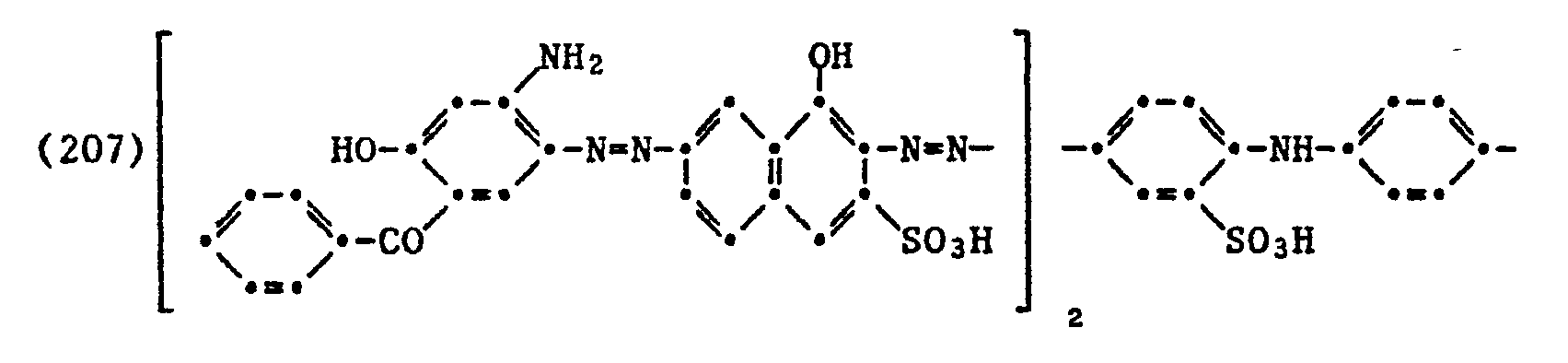
-
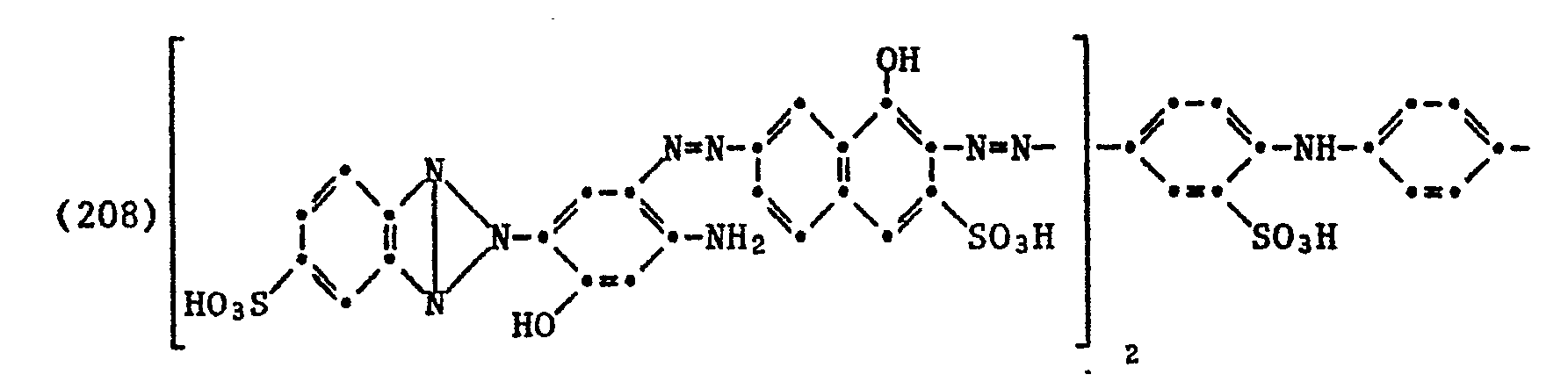
-
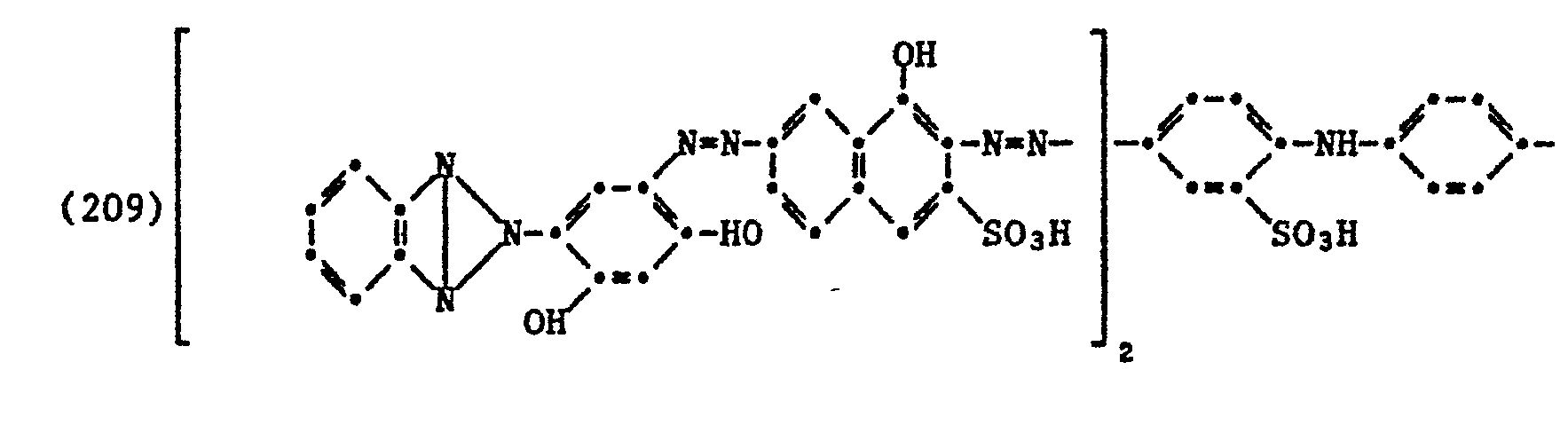
-


werden in salzsaurer Lösung mit 3,0 g (0,044 m) Natriumnitrit tetrazotiert, der Nitritüberschuss mit Sulfaminsäure zerstört und das Tetrazoniumsalz auf 9,4 g (0,044 m) 2,4-Dihydroxy-benzophenon wie in Beispiel 1 gekuppelt. Der Rohfarbstoff wird wie in Beispiel 1 gereinigt. Man erhält 10,6 g des Farbstoffs der Formel (302) (50,4 % Ausbeute). - Der Disazofarbstoff der Formel (302a) wird in bekannter Weise hergestellt, indem zuerst 1 Mol diazotiertes p-Nitroanilin sauer auf 1 Mol 1-Amino-8-naphthol-3,6-disulfonsäure gekuppelt, auf den entstandenen Monoazofarbstoff anschliessend ein zweites Mol diazotiertes p-Nitroanilin alkalisch gekuppelt wird und schliesslich die beiden Nitrogruppen des Disazofarbstoffs mit Natriumsulfid zu Aminogruppen reduziert werden.
-

-


werden in salzsaurer Lösung mit 0,8 g (0,011 m) Natriumnitrit tetrazotiert, der Nitritüberschuss mit Sulfaminsäure zerstört und das Tetrazoniumsalz bei pH 10 auf 2,6 g (0,012 m) 2,4-Dihydroxybenzophenon gekuppelt. Man erhält den Pentakioazofarbstoff der Formel (402) als Rohprodukt. Dieses wird wie in Beispiel 1 beschrieben gereinigt. Ausbeute 51,9 % (4,0 g). - Die Herstellung des Trisazofarbstoffes der Formel (402a) ist in DE-A-22 15 081 beschrieben.
-

-

-
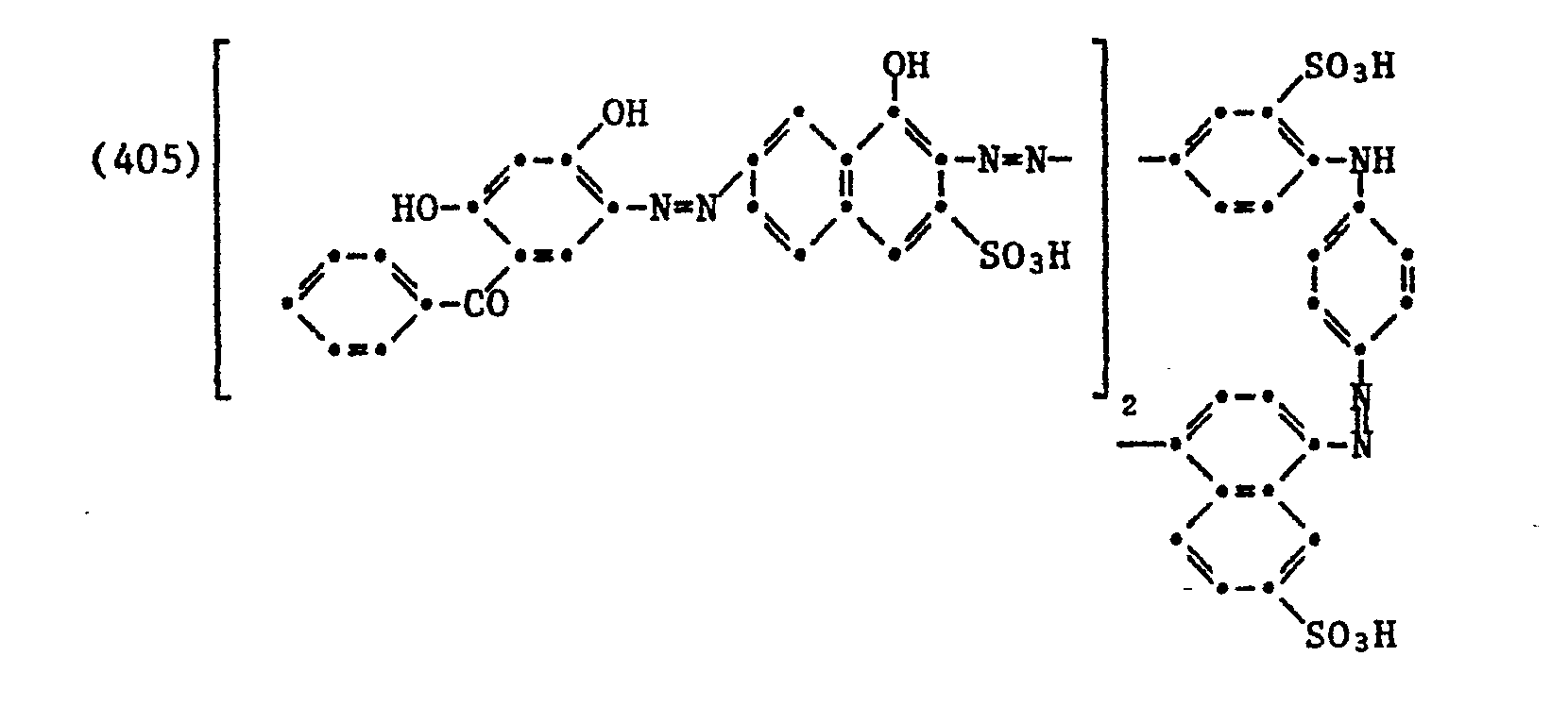

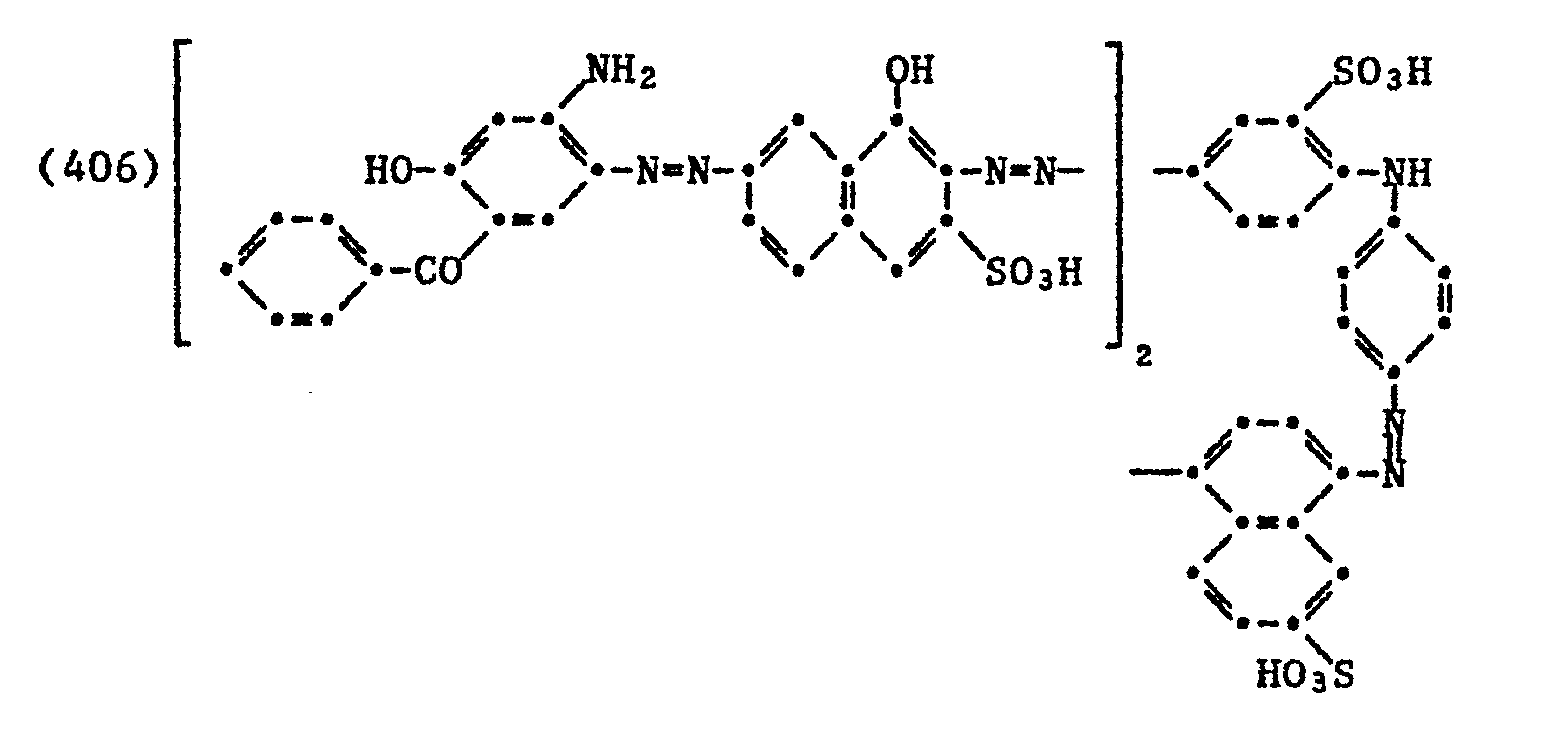
ersetzt und gleich verfahren wie in dem Beispiel 13, erhält man den Pentakisazofarbstoff der Formel (405) in 66,6%iger Ausbeute (8,1 g). -
-


werden in 1100 ml Wasser suspendiert. Die erhaltene Suspension wird auf 50°C erwärmt und wieder auf Raumtemperartur abgekühlt. 6,1 g (0,088 m) Natriumnitrit gelöst in 30 ml Wasser werden zugesetzt. Danach wird im Eisbad auf 0 bis 5°C abgekühlt. Man setzt anschliessend 30 ml (0,35 m) konz. Salzsäure hinzu und rührt die Suspension 4 Stunden bei 0 bis 5°C. Der Nitritüberschuss wird dann mit Sulfaminsäure zerstört. Die so erhaltene Tetrazosuspension wird innerhalb von 30 Minuten einer auf 0°C gekühlten Kupplerlösung hinzugefügt, die 9,7 g Resorcin (0,088 m) und 31,8 g (0,30 m) Natriumcarbonat in 100 ml Wasser enthält. Durch gleichzeitige Zugabe von etwa 280 ml Natriumcarbonatlösung (14 %) wird der pH-Wert während des Zutropfens der Tetrazosuspension zur Kupplerlösung konstant bei 10 gehalten. Das Reaktionsgemisch lässt man 4 Stunden bei einer Temperatur unter 10°C nachreagieren und danach sich auf Raumtemperatur erwärmen. Nach erwärmen des Reaktionsgemisches auf 40°C während 1 Stunde wird das Rohprodukt (200 g) isoliert und in 900 ml Wasser suspendiert. Mit wässriger Natriumhydroxidlösung (30 %) wird ein pH-Wert von 12 eingestellt, die Suspension bei 70°C solange gerührt, bis sich eine Lösung bildet. Diese wird filtriert und die Verbindung der Formel (407) als Rohprodukt durch Zugabe von 30 ml konz. Salzsäure ausgefällt. Die Reinigung dieses Rohproduktes erfolgt durch 30-minütiges Kochen in Aethanol und Trocknen des Produkts bei 7θ°C im Vakuum. Man erhält 32 g (71,2 % Ausbeute) der Verbindung der Formel (407). - In der folgenden Tabelle 1 sind die Lage des Absorptionemaximums und die molaren Extinktionskoeffizienten einer Lösung der in den Beispielen 1 bis 17 hergestellten erfindungsgemässen Farbstoffe in einer Mischung von Dimethylformamid (DMF/H2O(1:1)) wiedergegeben.

-

- Hinter einem Stufenkeil wird das so erhaltene lichtempfindliche Material durch ein Blaufilter während 1 Sekunde mit 10'000 Lux/cm2 belichtet und bei 30°C wie folgt verarbeitet:

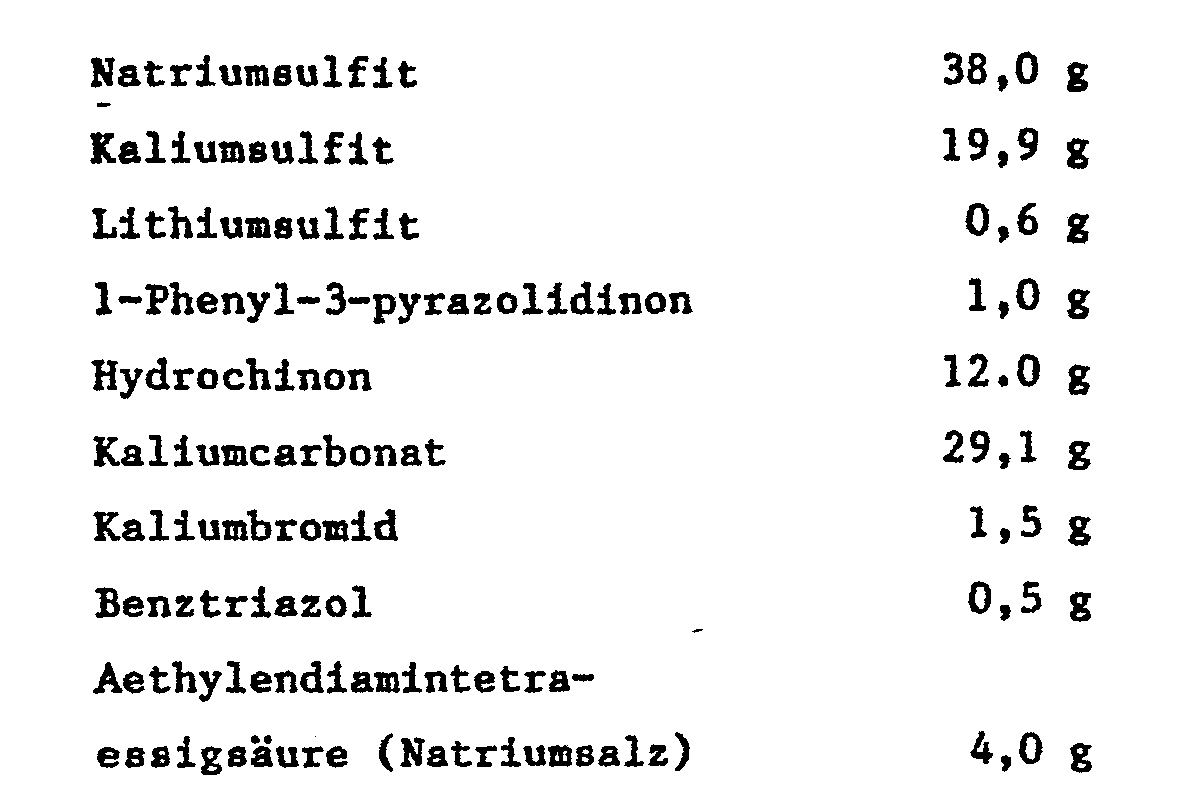
- Das Entwicklerbad enthält pro Liter Lösung folgende Komponenten:
- Das Silberbleichbad weist pro Liter Lösung folgende Zusammensetzung auf:
-

-

- Auf analoge Weise können die übrigen erfindungsgemässen Farbstoffe in die Schichten photographischer Materialien eingearbeitet werden. Tabelle 2 gibt die Mengen des eingearbeiteten Farbstoffs sowie die entsprechenden molaren Extinktionskoeffizienten in der Schicht des photographischen Materials wieder.
-

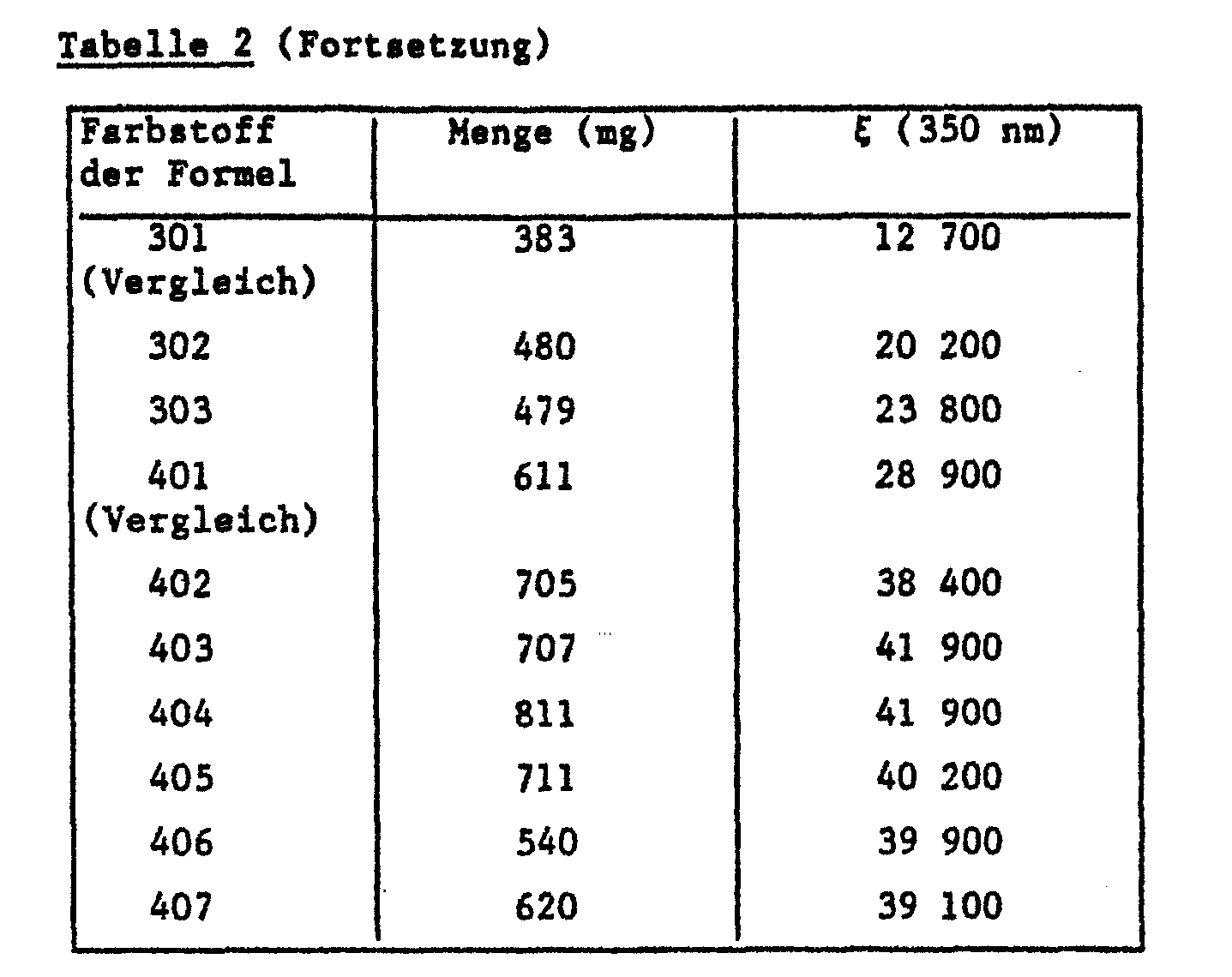
- Die Tabelle verdeutlicht, dass das UV-Absorptionsvermögen der erfindungsgemässen Verbindungen in photographischem Material wesentlich höher ist als das der entsprechenden Vergleichsverbindungen ohne UV-absorbierende Gruppen.
- Die Vergleichsverbindungen der Formeln (201), (205), (301) und (401) besitzen die folgenden Strukturen:

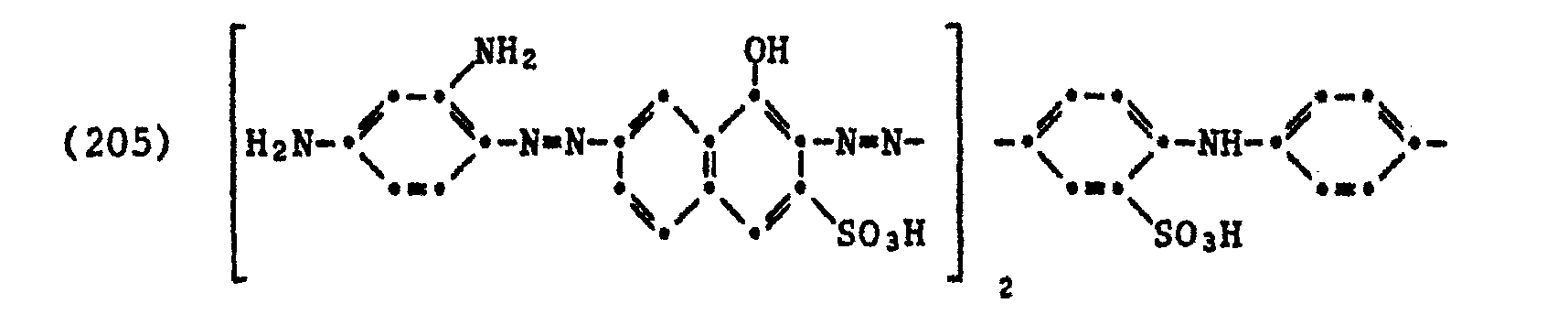


- Die Vergleichsverbindungen unterscheiden sich von den entsprechenden erfindungsgemässen Verbindungen nur durch die Gruppen B und B'.
- Beispiel 20: 633 mg Farbstoff der Formel (206) werden in 56 ml Wasser gelöst und zu einer Mischung aus 42 ml 3,7 %iger, wässriger Gelatinelösung, 1 ml einer 8 %igen Lösung des Natriumsalzes der Dibutylnaphthalinsulfonsäure sowie 12 g einer spektral unsensibilisierten Gelatinesilberchlorojodobromidemulsion, die etwa 140 g Silber und 70 g Gelatine pro Kilogramm enthält, gegeben.
- Dieses Gemisch wird zusammen mit einer Schutzschicht, bestehend aus 37,4 ml 3,9 %iger wässriger Gelatinelösung, 1 ml einer 6 %igen Lösung des Natriumsalzes des Bis-2-äthylhexylesters der Sulfobernsteinsäure, 1 ml einer 3 %igen Lösung eines Fettsäurealkanolamides und 0,6 ml einer 10 %igen Lösung von Formaldehyd auf 1 m2 eines Polyesterträgers vergossen und getrocknet.
- Auf das so erhaltene lichtempfindliche Material wurde in an sich bekannter Weise ein Mikrofiche aufbelichtet und wie in Beispiel 19 beschrieben, verarbeitet.
- Das verarbeitete photographische Material besass eine Maximaldichte von 1,70 gemessen durch einen UV-Filter des Typs Wratten 18 A.
- Die Duplikation auf ein Diazomaterial ergab Kopien guter Qualität bei einer Belichtungszeit von 4 Sekunden gegenüber 5 Sekunden für einen handelsüblichen Silber-Mikrofilm.
Claims (23)

worin A der Rest eines Bis- oder Trisazofarbstoffs ist, L und L' gleich oder voneinander verschieden sind und ein Brückenglied bedeuten, B und B' gleich oder voneinander verschieden sind und einen aromatischen Rest bedeuten, wobei mindestens einer der Reste B und B' spektrale Absorption im UV-Bereich aufweist, und einer der Reste B und B' verschieden von 2,4-Dihydroxyphenyl ist, und m 1 oder 2 und n 0, 1 oder 2 ist.


ist, worin E, E', D und D' unabhängig voneinander ein Rest der Formel
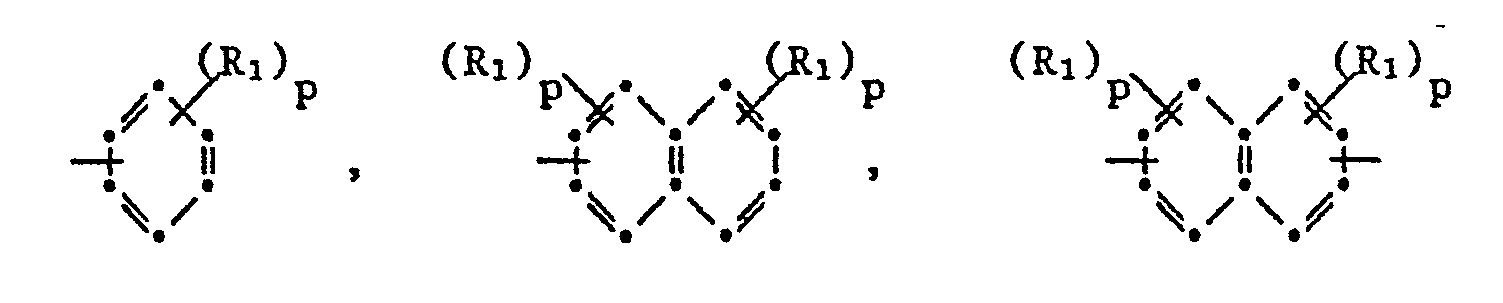


sind, worin R1 Wasserstoff, Alkyl, Alkoxy, Alkylthio, Alkyl- oder Dialkylamino, Amino, Aryl, Halogen, Nitro, Cyano, Hydroxyl, Mercapto, Acylamido, Sulfo, Amidosulfonyl, Carboxyl oder Amidocarbonyl, p 0, 1, 2 oder 3, G ein gerad- oder verzweigtkettiger oder heterocyclischer organischer Rest oder -0-, -S-, -SOz-, -NH-, -N=N- oder

und q 0 oder 1 ist.

ist.


ist.

sind.


sind, worin R3 Wasserstoff, Hydroxyl, Methoxy, Chlor, Fluor, Carboxyl, Sulfo, rl 1, 2 oder 3, R4 Hydroxyl, Amino oder Alkoxy, Sulfoalkyloxy oder Acylamino mit je 1 bis 4 Kohlenstoffatomen, Rs Wasserstoff, Chlor oder Sulfo, R6 Wasserstoff, Alkyl mit 1 bis 4 Kohlenstoffatomen, Carboxyalkyl mit 1 bis 4 Kohlenstoffatomen oder Amino und r2 1 oder 2 ist.


sind.

worin A, B, m und n die in Anspruch 1 angegebenen Bedeutungen haben und L und L' jeweils eine Azogruppe enthalten, dadurch gekennzeichnet, dass man aus der Verbindung der Formel

die entsprechende Tetrazoverbindung herstellt und diese mit der Verbindung der Formel

kuppelt.

worin A, B, m und n die in Anspruch 1 angegebenen Bedeutungen haben, und L und L' die in Anspruch 1 angegebenen Bedeutungen mit Ausnahme von Azo haben, dadurch gekennzeichnet, dass man die Verbindungen der Formel

mit der Verbindung der Formel

umsetzt.

worin A der Rest eines Bis- oder Trisazofarbstoffs ist, L und L' gleich oder voneinander verschieden sind und ein Brückenglied bedeuten, B und B' gleich oder voneinander verschieden sind und einen aromatischen Rest bedeuten, wobei mindestens einer der Reste B und B' spektrale Absorption im UV-Bereich aufweist, und m 1 oder 2 und n 0, 1 oder 2 ist, in photographischem Silberfarbbleichmaterial.

worin A der Rest eines Bis- oder Trisazofarbstoffs ist, L und L' gleich oder voneinander verschieden sind und ein Brückenglied bedeuten, B und B' gleich oder voneinander verschieden sind und einen aromatischen Rest bedeuten, wobei mindestens einer der Reste B und B' spektrale Absorption im UV-Bereich aufweist, und m 1 oder 2 und n 0, 1 oder 2 ist, enthält.
Applications Claiming Priority (2)
| Application Number | Priority Date | Filing Date | Title |
|---|---|---|---|
| CH3577/84 | 1984-07-24 | ||
| CH357784 | 1984-07-24 |
Publications (2)
| Publication Number | Publication Date |
|---|---|
| EP0169808A2 true EP0169808A2 (de) | 1986-01-29 |
| EP0169808A3 EP0169808A3 (en) | 1988-12-21 |
Family
ID=4258989
Family Applications (1)
| Application Number | Title | Priority Date | Filing Date |
|---|---|---|---|
| EP85810328A Withdrawn EP0169808A3 (en) | 1984-07-24 | 1985-07-18 | Uv-absorber compounds, method for their preparation and their use as image dyes in photographic materials for the silver dye-bleaching process |
Country Status (3)
| Country | Link |
|---|---|
| US (2) | US4609609A (de) |
| EP (1) | EP0169808A3 (de) |
| JP (1) | JPS6153253A (de) |
Cited By (2)
| Publication number | Priority date | Publication date | Assignee | Title |
|---|---|---|---|---|
| EP0226539A3 (en) * | 1985-12-10 | 1988-08-24 | Ciba-Geigy Ag | Photographic quadricolour material for the silver dye-bleaching process |
| US7488810B2 (en) | 2002-11-28 | 2009-02-10 | Basf Aktiengesellschaft | Method for producing a liquid formulation of salts of sulfoacidic azo dyes |
Families Citing this family (1)
| Publication number | Priority date | Publication date | Assignee | Title |
|---|---|---|---|---|
| CN107916017B (zh) * | 2017-11-30 | 2019-11-15 | 深圳市华星光电技术有限公司 | 耐uv染料的制作方法及对应的涂布型染料偏光片 |
Family Cites Families (27)
| Publication number | Priority date | Publication date | Assignee | Title |
|---|---|---|---|---|
| US2950274A (en) * | 1960-08-23 | Azo-dyestuffs insoluble in water | ||
| CA510152A (en) * | 1955-02-15 | J. R. Geigy A.G. | Trisazo leather dyestuffs and a process of making same | |
| US1014982A (en) * | 1911-04-24 | 1912-01-16 | Joseph Turner | Manufacture of black coloring-matters. |
| US2073000A (en) * | 1932-12-21 | 1937-03-09 | Gen Aniline Works Inc | Trisazodyestuffs |
| GB430252A (en) * | 1932-12-21 | 1935-06-17 | Ig Farbenindustrie Ag | Process for the manufacture of trisazodyestuffs |
| FR856585A (fr) * | 1938-06-04 | 1940-06-18 | Du Pont | Colorants azoïques |
| GB604831A (en) * | 1945-12-05 | 1948-07-12 | Mordecai Mendoza | A new azo-dyestuff |
| US2653929A (en) * | 1950-06-28 | 1953-09-29 | Cassella Farbwerke Mainkur Ag | Tetrakisazo-dyestuffs |
| US2671776A (en) * | 1951-01-19 | 1954-03-09 | Ciba Limtied | Trisazo-dyestuffs |
| US2833756A (en) * | 1954-05-05 | 1958-05-06 | Cassella Farbwerke Mainkur Ag | Polyazo dyestuffs |
| GB785084A (en) * | 1955-08-31 | 1957-10-23 | Basf Ag | Polyazo dyestuffs |
| BE651355A (de) * | 1963-09-05 | |||
| DE1285308B (de) * | 1965-10-15 | 1968-12-12 | Agfa Gevaert Ag | Photographisches Material |
| CH507532A (de) * | 1968-02-02 | 1971-05-15 | Ciba Geigy Ag | Photographisches Material, mindestens einen Azofarbstoff enthaltend |
| DE1622923A1 (de) * | 1968-03-08 | 1971-01-21 | Agfa Gevaert Ag | Gelbe Benzthiazolfarbstoffe |
| CH515528A (de) * | 1969-03-25 | 1971-11-15 | Ciba Geigy Ag | Photographisches, lichtempfindliches Material |
| BE756410A (fr) * | 1969-09-22 | 1971-03-01 | Fuji Photo Film Co Ltd | Materiels photosensibles de photographie en couleurs contenant un colorant bleu-vert pour le procede de blanchiment a l'argent/colorant |
| ES402367A1 (es) * | 1971-05-05 | 1975-03-16 | Bayer Ag | Procedimiento para la obtencion de colorantes poliazoicos. |
| DE2215952B2 (de) * | 1972-04-01 | 1978-03-02 | Bayer Ag, 5090 Leverkusen | Trisazofarbstoffe und deren Verwendung zum Färben von Leder |
| GB1443541A (en) * | 1972-11-09 | 1976-07-21 | Basf Ag | Trisazo dyes |
| JPS49113825A (de) * | 1973-03-05 | 1974-10-30 | ||
| JPS5828298B2 (ja) * | 1973-03-19 | 1983-06-15 | カブシキガイシヤ ニホンカガクコウギヨウシヨ | 高純度トリスアゾ直接染料の製造方法 |
| DE2504868A1 (de) * | 1974-04-23 | 1975-11-13 | Sandoz Ag | Tetrakisazoverbindungen |
| DE2424462A1 (de) * | 1974-05-20 | 1975-12-11 | Cassella Farbwerke Mainkur Ag | Loesliche trisazofarbstoffe, ihre herstellung und verwendung |
| DE2504082C3 (de) * | 1975-01-31 | 1980-07-17 | Bayer Ag, 5090 Leverkusen | Disazofarbstoffe und ihre Verwendung zum Färben und Bedrucken von Cellulosematerialien |
| DE2622303A1 (de) * | 1976-05-19 | 1977-12-01 | Cassella Farbwerke Mainkur Ag | Loesliche trisazofarbstoffe, ihre herstellung und verwendung |
| BE885252A (fr) * | 1980-09-16 | 1981-03-16 | Althouse Tertre S A Atsa | Nouveaux colorants trisazoiques |
-
1985
- 1985-07-18 EP EP85810328A patent/EP0169808A3/de not_active Withdrawn
- 1985-07-19 US US06/757,549 patent/US4609609A/en not_active Expired - Fee Related
- 1985-07-24 JP JP60163790A patent/JPS6153253A/ja active Pending
-
1986
- 1986-06-02 US US06/869,508 patent/US4701525A/en not_active Expired - Fee Related
Cited By (2)
| Publication number | Priority date | Publication date | Assignee | Title |
|---|---|---|---|---|
| EP0226539A3 (en) * | 1985-12-10 | 1988-08-24 | Ciba-Geigy Ag | Photographic quadricolour material for the silver dye-bleaching process |
| US7488810B2 (en) | 2002-11-28 | 2009-02-10 | Basf Aktiengesellschaft | Method for producing a liquid formulation of salts of sulfoacidic azo dyes |
Also Published As
| Publication number | Publication date |
|---|---|
| JPS6153253A (ja) | 1986-03-17 |
| US4609609A (en) | 1986-09-02 |
| EP0169808A3 (en) | 1988-12-21 |
| US4701525A (en) | 1987-10-20 |
Similar Documents
| Publication | Publication Date | Title |
|---|---|---|
| DE1070030B (de) | ||
| DE2825883A1 (de) | Photographisches aufzeichnungsmaterial | |
| DE3115648A1 (de) | Farbfotografisches aufzeichnungsmaterial | |
| DE2503443A1 (de) | Photographisches aufzeichnungsmaterial | |
| DE2607440C2 (de) | Photographisches Aufzeichnungsmaterial für das Farbdiffusionsübertragungsverfahren | |
| DE2626821A1 (de) | Farbphotographisches aufzeichnungsmaterial | |
| EP0169813B1 (de) | Photographisches Aufzeichnungsmaterial für das Silberfarbbleichverfahren | |
| EP0059166B1 (de) | Disazofarbstoffe und ihre Verwendung in farbphotographischen Aufzeichnungsmaterialien für das Silberfarbbleichverfahren | |
| DE2804148C2 (de) | Benzothia-thiacyanin-Betaine und diese enthaltende Silberhalogenidemulsionen | |
| DE1282457B (de) | Farbphotographisches Aufzeichnungsmaterial | |
| EP0169808A2 (de) | UV-absorbierende Verbindungen, Verfahren zu ihrer Herstellung und ihre Verwendung als Bildfarbstoffe in photograhischen Materialien für das Silberfarbbleichverfahren | |
| DE2144297C2 (de) | Verwendung von Chinoxalinen als Farbbleichkatalysatoren und Farbbleichbad für das photographische Silberfarbbleichverfahren | |
| EP0040172B1 (de) | Azofarbstoffe, Verfahren zu ihrer Herstellung und Verwendung als Bildfarbstoffe in photographischen Silberfarbbleichmaterialien sowie das diese Azofarbstoffe enthaltende photographische Material | |
| DE2014525C3 (de) | Photographisches Aufzeichnungsmaterial für das Silberfarbbleichverfahren | |
| DE1597485C3 (de) | Lichtempfindliches photographisches Aufzeichnungsmaterial | |
| DE1161137B (de) | Photographisches lichtempfindliches oder entwickeltes und fertiggestelltes Material | |
| DE3200705A1 (de) | Farbfotografisches aufzeichnungsmaterial | |
| US3615602A (en) | Color-photographic silver halide emulsion containing colored cyan-forming couplers | |
| DE1288912B (de) | Verfahren zur Herstellung von Farbbildern durch Farbentwicklung | |
| DE3008588A1 (de) | Photographisches material fuer diffusionsverfahren | |
| DE2453129A1 (de) | Farbstoffentwickler und dessen verwendung in einem lichtempfindlichen material | |
| DE3337174A1 (de) | Lichtempfindliches photographisches element | |
| DE2432339C2 (de) | Farbstoffentwickler und ein ihn enthaltendes lichtempfindliches Material für die Verwendung in einem Diffusionsübertragungsverfahren | |
| DE1547830C (de) | Farbphotographisches Aufzeichnungsmaterial | |
| DE1547831C (de) | Farbphotographisches Material |
Legal Events
| Date | Code | Title | Description |
|---|---|---|---|
| PUAI | Public reference made under article 153(3) epc to a published international application that has entered the european phase |
Free format text: ORIGINAL CODE: 0009012 |
|
| 17P | Request for examination filed |
Effective date: 19850720 |
|
| AK | Designated contracting states |
Designated state(s): BE CH DE FR GB IT LI NL |
|
| PUAL | Search report despatched |
Free format text: ORIGINAL CODE: 0009013 |
|
| AK | Designated contracting states |
Kind code of ref document: A3 Designated state(s): BE CH DE FR GB IT LI NL |
|
| RAP1 | Party data changed (applicant data changed or rights of an application transferred) |
Owner name: ILFORD AG |
|
| STAA | Information on the status of an ep patent application or granted ep patent |
Free format text: STATUS: THE APPLICATION HAS BEEN WITHDRAWN |
|
| 18W | Application withdrawn |
Withdrawal date: 19900417 |
|
| R18W | Application withdrawn (corrected) |
Effective date: 19900417 |
|
| RIN1 | Information on inventor provided before grant (corrected) |
Inventor name: KUHN, JAKOB, DR. Inventor name: ROHR, THOMAS-MARKUS, DR. |