EP0169982A2 - Four à cuve - Google Patents
Four à cuve Download PDFInfo
- Publication number
- EP0169982A2 EP0169982A2 EP85104963A EP85104963A EP0169982A2 EP 0169982 A2 EP0169982 A2 EP 0169982A2 EP 85104963 A EP85104963 A EP 85104963A EP 85104963 A EP85104963 A EP 85104963A EP 0169982 A2 EP0169982 A2 EP 0169982A2
- Authority
- EP
- European Patent Office
- Prior art keywords
- shaft furnace
- furnace according
- zone
- support
- gas
- Prior art date
- Legal status (The legal status is an assumption and is not a legal conclusion. Google has not performed a legal analysis and makes no representation as to the accuracy of the status listed.)
- Withdrawn
Links
Images


Classifications
-
- C—CHEMISTRY; METALLURGY
- C04—CEMENTS; CONCRETE; ARTIFICIAL STONE; CERAMICS; REFRACTORIES
- C04B—LIME, MAGNESIA; SLAG; CEMENTS; COMPOSITIONS THEREOF, e.g. MORTARS, CONCRETE OR LIKE BUILDING MATERIALS; ARTIFICIAL STONE; CERAMICS; REFRACTORIES; TREATMENT OF NATURAL STONE
- C04B20/00—Use of materials as fillers for mortars, concrete or artificial stone according to more than one of groups C04B14/00 - C04B18/00 and characterised by shape or grain distribution; Treatment of materials according to more than one of the groups C04B14/00 - C04B18/00 specially adapted to enhance their filling properties in mortars, concrete or artificial stone; Expanding or defibrillating materials
- C04B20/02—Treatment
- C04B20/04—Heat treatment
-
- F—MECHANICAL ENGINEERING; LIGHTING; HEATING; WEAPONS; BLASTING
- F27—FURNACES; KILNS; OVENS; RETORTS
- F27B—FURNACES, KILNS, OVENS OR RETORTS IN GENERAL; OPEN SINTERING OR LIKE APPARATUS
- F27B1/00—Shaft or like vertical or substantially vertical furnaces
- F27B1/02—Shaft or like vertical or substantially vertical furnaces with two or more shafts or chambers, e.g. multi-storey
-
- Y—GENERAL TAGGING OF NEW TECHNOLOGICAL DEVELOPMENTS; GENERAL TAGGING OF CROSS-SECTIONAL TECHNOLOGIES SPANNING OVER SEVERAL SECTIONS OF THE IPC; TECHNICAL SUBJECTS COVERED BY FORMER USPC CROSS-REFERENCE ART COLLECTIONS [XRACs] AND DIGESTS
- Y02—TECHNOLOGIES OR APPLICATIONS FOR MITIGATION OR ADAPTATION AGAINST CLIMATE CHANGE
- Y02W—CLIMATE CHANGE MITIGATION TECHNOLOGIES RELATED TO WASTEWATER TREATMENT OR WASTE MANAGEMENT
- Y02W30/00—Technologies for solid waste management
- Y02W30/50—Reuse, recycling or recovery technologies
- Y02W30/91—Use of waste materials as fillers for mortars or concrete
Definitions
- the invention relates to a shaft furnace according to the preamble of claim 1.
- the production of building aggregates from clay-containing raw materials or waste materials is expected to become increasingly important in the coming years, since in many areas the gravel reserves for the production of concrete are gradually becoming scarcer and in other areas there is no gravel deposit at all.
- the manufacturing process includes a heat treatment that primarily aims to improve strength and reduce water absorption. It has been found that an exact temperature control is of crucial importance in this heat treatment, both for the quality of the product and for a trouble-free operation.
- the washing mountains from coal processing are particularly suitable raw materials.
- the recycling of this waste material also hopes to take a significant step closer to solving the landfill problem.
- the coal content of the washing mountains is so large that it not only covers the heat requirements of the process, but also allows excess heat to be obtained. Exact temperature control is extremely important and, at the same time, extremely difficult, especially with fuel-containing starting materials.
- waste products from coal processing or other inferior fuels are first preburned in a fluidized bed furnace to fully utilize their thermal energy and only then sintered in a sintering plant.
- various measures such as. B. cooling the bed, changing the air supply, injecting water to regulate the combustion conditions and the exhaust gas temperatures.
- the hot exhaust gas from the fluidized bed furnace can be used when operating a gas-heated sintering belt. This method is not suitable for coarse-grained raw materials such as washing piles with a grain size of up to 6 cm.
- the coarse-grained raw material is first subjected to gasification in a shaft furnace, then comminuted and finally burned, annealed and cooled in 3 rotary drums connected in series.
- this process facilitates exact temperature control by separating the different stages, it does require considerable investment and operating costs.
- the product does not come in the grain size distribution required for the production of concrete.
- the top three floors form a preheating zone.
- This is followed by a reaction zone consisting of a larger number of floors.
- the lowest chamber is designed as a cooling zone.
- the floors belonging to the reaction zone are equipped with nozzles through which heating oil is supplied.
- No information can be found in this document about the supply of the combustion air and the cooling air, the gas flow in the furnace and the path of the exhaust gas, nor about any use of the heat carried by the exhaust gas.
- the bottom of the individual chambers can essentially only be seen in the publication that they consist of approximately 10 cm wide strips which are made of heat-resistant material. However, the document does not contain a solution to the material and construction problems that arise in this context.
- each floor has a lateral inlet opening for the hot treatment gas.
- the gas flow inside the furnace cannot be seen. It is only said that the gas is used to preheat the goods. However, this does not take place in the shaft furnace, but in a conveyor screw system upstream of the furnace.
- the rod-shaped elements from which the individual floors are made have a cross-shaped or Y-shaped cross-section in this furnace.
- the invention has for its object to provide a shaft furnace of the type specified in the preamble of claim 1, in which the process conditions, in particular the temperature, can be performed in the individual stages exactly and without undesirable mutual interference.
- a preferred embodiment of the shaft furnace is specified in claim 3,
- the feature of claim 4 enables an additional influencing I of the process conditions within the reaction zone by introducing gas streams.
- the heat carried by the exhaust gas from the cooling zone is used in the preheating zone.
- At least part of the heat carried by the flue gases of the reaction zone is returned to the reaction zone.
- the critical gap between the floor and the shaft wall is largely kept free of material; this maintains the mobility of the floor element close to the wall.
- the thermally highly stressed support element on which the hot material rests during operation, is supported by a support tube with high flexural strength.
- a particularly stable design of the floor element is specified in claim 11; the additional stiffening pipe is inevitably flowed through by the cooling medium.
- the maximum bending moment is kept as small as possible in the transverse direction of the support element.
- the feature of claim 13 allows vigorous cooling of the support tube and possibly the stiffening tube without the material lying on the support element being cooled as well.
- the distance between the support tube and the support element also prevents a strip of the support element lying above the support tube and the material bed lying thereon for the gas flowing upwards from remaining in the slipstream.
- the strips provided as spacers according to claim 14 also provide effective support.
- the design according to claim 17 is recommended for the relatively gas-impermeable floors.
- the subdivision of the support elements according to claim 18 prevents high thermal stresses from building up.
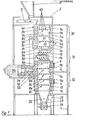
- the side wall 3b is provided with a plurality of closable entry openings 4. Part of the front wall of the stove can be seen at medium height.
- a loading belt 5 can be moved back and forth under a storage bunker 6.
- the feed belt is surrounded by a pressure-tight housing 7.
- the interior of the shaft 3 is divided into a corresponding number of tier-like chambers 9a to 91 by a plurality of — in the illustrated embodiment, eleven — horizontal floors 8a to 81, which are evenly spaced over the entire height. Deviating from the illustrated embodiment, the number of floors can also be smaller, but it is preferably even larger.
- Each floor consists of a plurality of floor elements 10 lying close together, each of which has a support element 11 and a support tube 12.
- the support elements 11 are substantially horizontal; since they overlap each other like scales on the longitudinal edges, they are - strictly speaking - arranged slightly inclined.
- the top overlap is opposite from floor to floor, so that in the case of floors 8a, 8c, etc., the longitudinal edge lying on the right in FIG .
- the support tubes 12 penetrate the two shaft walls parallel to the plane of FIG. 1 and are rotatably mounted.
- a drive consisting of a lever linkage 13 and a piston-cylinder unit 14, the floor elements 10 of each floor can be tilted together from their horizontal rest position.
- the drives are only shown as examples for the bases 8e and 8f, of which only the ends of the support tubes 12 that protrude outward are visible.
- the drive of the bottom 8 e is arranged so that the bottom elements 10 of this bottom tilt counterclockwise when the piston cylinder unit 14 is actuated; the floor elements 10 of the floor 8f tilt due to the opposite arrangement of the associated drive in a clockwise direction.
- the drives of the remaining floors are arranged with an alternating direction of rotation from floor to floor.
- the two side shaft walls 3a, 3b are provided at the level of the floors 8a, 8c etc. or 8b, 8d etc. with groove-like recesses 15, which on each floor have the side floor element whose longitudinal wall 3a or 3b faces the longitudinal edge when tipping moved upward, take up to about half its width.
- the ends of the support tubes 12 connected to the lever linkage 13 are open.
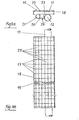
- the support element 11 consists of a wire mesh 16 made of highly heat-resistant steel.
- the wire mesh 16 is supported by numerous upright strips 17 which are arranged at short intervals transversely to the longitudinal edge of the support element 11.
- U-shaped profiles 18 are attached, which encompass the ends of the strips 17.
- the wire mesh 16 is connected to the strips 17 and the U-profiles 18 to form a structural unit.
- the support element 11 is divided in the longitudinal direction into several such components, between which there are narrow transverse gaps 19.
- the structural units are detachably connected to a support frame by tabs 20 which are welded to the strips 17.
- the support frame consists essentially of the support tube 12, a stiffening tube 21 and two connecting tubes 22 which start from the ends of the stiffening tube 21 and open into the support tube 12. Between the support tube 12 and the stiffening tube 21, a number of transverse webs 23 are welded, on which the tabs 20 z. B. are attached by pins 24.
- the diameter of the support tube 12 is somewhat larger than that of the stiffening tube 21 in accordance with the greater load, including the torsional load occurring when it is tilted.
- the distance between the two tube axes is approximately equal to half the width of the support element 11.
- the tube axes are arranged symmetrically to the central plane of the support element 11. Due to this design, the maximum bending moments to which the strips 17 are exposed under load are kept as small as possible.
- the floor elements 10 of the relatively gas-impermeable floors 8c and 8i differ from the floor elements of the other floors previously described in that the support element 11 consists of a plurality of narrow sheet metal strips 25 overlapping one another on the longitudinal edges.
- a funnel 26 is suspended from the steel girders on which the shaft masonry rests, which funnel is provided with a lateral opening 27 at approximately half the height.
- the funnel 26 has a discharge nozzle 28 which is equipped with a discharge lock 29.
- Zone 30 is the preheating zone.
- Zone 31 is the reaction zone.
- Each individual zone is provided with an inlet for externally supplied gaseous medium and with an outlet for the exhaust gas.
- the opening 27 forms the inlet for the ambient air to be supplied to the cooling zone 32.
- the wall of the chamber 9k is provided with an outlet 33 for the exhaust gas from the cooling zone 32.
- Chamber 9i i.e. H. the bottom chamber of the reaction zone 31 is connected to an oil burner 36, which is arranged outside the shaft 3, by a short brick line 34 which opens into the inlet 35.
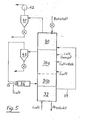
- the reaction zone 31 is connected via feed pipes to an air and / or steam supply system located outside the shaft, which is not shown in FIG. 1, but is indicated in FIG. 5.
- Outlets 37 for the exhaust gas of this zone are provided in the wall of the uppermost chamber 9c of the reaction zone 31.
- the preheating zone 30 has an inlet 38 which is connected to the outlet 33 of the cooling zone 32 via a line 39 arranged outside the shaft 3.
- the uppermost chamber 9a is provided with outlets 40 for the exhaust gas from the preheating zone.
- the drives of the individual floors are switched on one after the other at predetermined constant time intervals, so that all elements of the associated floor are rotated in the same direction by about 90 ° or more and then return to the rest position. All drives are controlled via a common timer.
- the switch-on phases of the individual drives are shifted from one another, so that the switch-on phase of a drive begins immediately after the end of the switch-on phase of the drive of the floor underneath.
- the raw material is continuously fed from the storage bunker 6, in which a minimum filling quantity is always automatically maintained for the purpose of sealing, with the loading belt 5 to the top floor 8a.
- the loading belt 5 moves back and forth at a uniform speed, so that there is a uniform layer thickness over the bottom surface.
- the floor elements 10 of the floor 8a are tilted at the same time.
- the material falls on the next floor 8b, which has just performed a tilting movement with the opposite direction of rotation and has returned to the rest position.
- the floor elements 10 of the floor 8b are tilted in the same way. This process is repeated for the floors 8c, 8d, ... 81 lying further below.
- the total dwell time depends on the number of floors and on the period between two successive tilting movements of the floor elements 10. With eleven floors and a period of ten minutes, the dwell time is z. B. 110 minutes.
- the air heated to approximately 450 ° C. is introduced from the cooling zone 32 into the preheating zone 30 via the line 39 and the inlet 38. It successively penetrates the bottom 8b with the material layer resting thereon and the bottom 8a with the fresh material layer lying thereon. Via a dust separator 41 and a fan 42, it is released outdoors at a temperature of approximately 120 ° C. By touching the heated air, the material is dried and heated to almost 400 ° C.
- the preheating temperature is limited by the condition that no volatile, tar-like components are expelled yet. These would condense again in the exhaust air system and lead to blockages and malfunctions.
- the preheated material reaches the reaction zone 31. This is divided into an upper sub-zone 31a and a lower sub-zone 31b in FIG. In the upper region of sub-zone 31a, the volatile constituents are driven off and the gases are burned. The solid fuel components are burned in the lower region of subzone 31a. The actual ceramization takes place in the lower sub-zone 31b.
- the various reaction processes are precisely controlled with the aid of the gas streams which are fed to the reaction zone 31.
- a hot gas flow of 1200 to 1300 ° C. is introduced through the inlet 35 into the lower region of the partial zone 31b. With this gas, the material is brought to the ceramization temperature described above, which is generally around 950 - 1000 ° C and can be determined by experiment in each individual case.
- Air is blown in through the supply pipes, which are not shown in detail, in the lower region of the partial zone 31a.
- the air serves as combustion air; therefore the amount of air is at least stoichiometric in relation to the fuel present.
- the air serves as cooling air to keep the maximum temperature in subzone 31a below about 800 ° C; in this sub-zone it must never reach the - ceramic temperature.
- Additional air is blown in as a carrier gas for the lime used to bind the sulfur through nozzles, not shown. It is important that an adequate supply of oxygen is also maintained in the upper region of subzone 31a. In this area, the gasified components should be burned as completely as possible in order to keep the pollution of the exhaust system by condensation products as low as possible. Therefore, additional air is supplied if necessary. However, it is also possible to inject water vapor as a coolant at this point.
- the exhaust gas leaves the reaction zone through outlet 37 at a temperature of around 800 ° C. After dedusting in the cyclone 43, a partial flow reaches the burner 36. There, the flue gases of the burner 36 are admixed to increase the temperature to 1200 to 1300 ° C. The gas stream generated in this way is returned to sub-zone 31b. The remaining exhaust gas can - if necessary after further purification - z. B. be supplied to a steam generator.
- the burner 36 can e.g. B. - without this being shown in the drawing - the cooling air extracted from the support tubes 12 are supplied as preheated combustion air, as is also a partial flow branched off from the line 39.
- the hot ceramized material is cooled in the cooling zone to about 150 ° C. by a fresh air stream entering at 27.
- the cooling air heats up to the temperature of around 450 ° C required for preheating.
- a significant advantage of the shaft furnace according to the invention, in addition to the exact process control, is in particular the good thermodynamic efficiency.
- the shaft furnace shown in FIG. 1 differs from the shaft furnace in accordance with FIG. 1 in particular in that, in addition to the bases 8c and 8i, the base 8d 'is also relatively impermeable to gas.
- the reaction zone 31 only extends up to the bottom 8d '. Accordingly, the gas outlet 37 of the reaction zone 31 is in the wall of the chamber 9e.
- the chamber 9d ' is a lock chamber and has neither a gas inlet nor a gas outlet. Such a lock chamber can of course also be provided between reaction zone 31 and cooling zone 32.
Landscapes
- Engineering & Computer Science (AREA)
- Chemical & Material Sciences (AREA)
- Ceramic Engineering (AREA)
- Structural Engineering (AREA)
- Thermal Sciences (AREA)
- Materials Engineering (AREA)
- Physics & Mathematics (AREA)
- Organic Chemistry (AREA)
- Mechanical Engineering (AREA)
- General Engineering & Computer Science (AREA)
- Furnace Details (AREA)
- Tunnel Furnaces (AREA)
- Vertical, Hearth, Or Arc Furnaces (AREA)
Applications Claiming Priority (2)
| Application Number | Priority Date | Filing Date | Title |
|---|---|---|---|
| DE3420871 | 1984-06-05 | ||
| DE3420871A DE3420871A1 (de) | 1984-06-05 | 1984-06-05 | Schachtofen |
Publications (2)
| Publication Number | Publication Date |
|---|---|
| EP0169982A2 true EP0169982A2 (fr) | 1986-02-05 |
| EP0169982A3 EP0169982A3 (fr) | 1986-08-27 |
Family
ID=6237648
Family Applications (1)
| Application Number | Title | Priority Date | Filing Date |
|---|---|---|---|
| EP19850104963 Withdrawn EP0169982A3 (fr) | 1984-06-05 | 1985-04-24 | Four à cuve |
Country Status (2)
| Country | Link |
|---|---|
| EP (1) | EP0169982A3 (fr) |
| DE (1) | DE3420871A1 (fr) |
Cited By (1)
| Publication number | Priority date | Publication date | Assignee | Title |
|---|---|---|---|---|
| WO2013189888A1 (fr) * | 2012-06-22 | 2013-12-27 | Thyssenkrupp Resource Technologies Gmbh | Procédé et dispositif de traitement d'un flux de matière humide contenant du kérogène |
Families Citing this family (1)
| Publication number | Priority date | Publication date | Assignee | Title |
|---|---|---|---|---|
| DE3540068A1 (de) * | 1985-11-12 | 1987-05-14 | Babcock Anlagen Ag | Verfahren und anlage zum herstellen von betonzuschlagstoffen aus waschbergen |
Family Cites Families (8)
| Publication number | Priority date | Publication date | Assignee | Title |
|---|---|---|---|---|
| DE23222C (de) * | Dr. A. HEINTZ in Saarau i. Schlesien | Theilung mehretagiger Calciniröfen durch Schieber in einzelne Kammern, welche getrennt von einander funktioniren und separate Zu- und Ableitungen haben | ||
| US2015687A (en) * | 1934-02-21 | 1935-10-01 | Hughes Mitchell Processes Inc | Ore treatment apparatus |
| GB653357A (en) * | 1948-06-23 | 1951-05-16 | Dorr Co | Improvements in calcining decrepitating rocks including limestone |
| DE924197C (de) * | 1950-08-26 | 1955-02-28 | Rudolf Heger | Schachtofen zum Brennen feuerfester gemahlener Tone |
| DE1243827B (de) * | 1959-09-07 | 1967-07-06 | Erich Heidelmeyer | Schachtofen zur Herstellung von poroesen Zuschlagstoffen aus blaehfaehigem Gut |
| DE1165477B (de) * | 1959-09-07 | 1964-03-12 | Erich Heidelmeyer | Schachtofen zur Herstellung von poroesen Zuschlagstoffen aus blaehfaehigem Gut |
| DE2707953C2 (de) * | 1977-02-24 | 1986-12-11 | Hugo Dipl.-Phys. Dr. 5757 Wickede Balster | Hochtemperaturrost |
| DE3410896A1 (de) * | 1984-03-24 | 1985-10-03 | Perfluktiv-Consult AG, Basel | Verfahren zur thermischen und/oder chemischen behandlung von koernigem, granuliertem oder stueckigem gut |
-
1984
- 1984-06-05 DE DE3420871A patent/DE3420871A1/de not_active Withdrawn
-
1985
- 1985-04-24 EP EP19850104963 patent/EP0169982A3/fr not_active Withdrawn
Cited By (1)
| Publication number | Priority date | Publication date | Assignee | Title |
|---|---|---|---|---|
| WO2013189888A1 (fr) * | 2012-06-22 | 2013-12-27 | Thyssenkrupp Resource Technologies Gmbh | Procédé et dispositif de traitement d'un flux de matière humide contenant du kérogène |
Also Published As
| Publication number | Publication date |
|---|---|
| EP0169982A3 (fr) | 1986-08-27 |
| DE3420871A1 (de) | 1985-12-05 |
Similar Documents
| Publication | Publication Date | Title |
|---|---|---|
| DE69305095T2 (de) | Kühler zum kühlen von schüttgut | |
| DE2608228A1 (de) | Tunnelofen mit kuehlung und bodeneffekteinrichtung | |
| DE2233909A1 (de) | Schwingbalkenofen | |
| DE2364650A1 (de) | Verfahren zur waermebehandlung von koernigem und/oder stueckigem gut, insbesondere zum brennen von kalk, dolomit, magnesit oder dergleichen und schachtofen zur durchfuehrung des verfahrens | |
| DE1483089B1 (de) | Von oben beschickter Schachtofen zum Brennen von waermeempfindlichem Material,insbesondere Kalk,mit einer Vorwaermzone,einer Brennzone und einer Kuehlzone | |
| DE2947358A1 (de) | Rollenofen mit trocknungstunnel insbesondere fuer keramik- oder feuerfestmaterialien | |
| EP0174970B1 (fr) | Amenagements de puits pour des procedes de transferts de matiere et/ou thermiques entre un gaz et un materiau en vrac | |
| EP0179050B1 (fr) | Four pour le traitement thermique de barres d'un métal léger | |
| EP0169982A2 (fr) | Four à cuve | |
| DE3410896A1 (de) | Verfahren zur thermischen und/oder chemischen behandlung von koernigem, granuliertem oder stueckigem gut | |
| DE2225782A1 (de) | Verfahren zum Brennen von Kalk | |
| DE1157133B (de) | Verfahren zum Brennen und Kuehlen von koernigem Gut, z.B. von Kalkstein im Schachtofen, und Ofen zur Ausuebung des Verfahrens | |
| DE3787847T2 (de) | Ofen für Hochtemperatur-Behandlung von plastischen oder gehärteten Produkten. | |
| DE3436055C1 (de) | Industrieofen/Trockner-Kombination | |
| AT390322B (de) | Vorrichtung zum durchwaermen von stahlteilen | |
| DE4230232C2 (de) | Verfahren zum Vorwärmen von einem Gemenge zur Glaserzeugung, insbesondere in Mischung mit Glasscherben, durch einen über einen Kratzerkettenförderer geleiteten Gasstrom, und Vorrichtung dazu | |
| DE2337362A1 (de) | Vorrichtung zum sintern von erz auf einer kette | |
| DE1751727A1 (de) | Verfahren und Vorrichtung zur Waerme- oder/und Stoffuebertragung | |
| DE2513634C3 (de) | Brennerbeheizter Schachtofen | |
| DE3905143A1 (de) | Verfahren zur herstellung von keramischen massen aus sedimenten, insbesondere schlick und schlamm | |
| AT301430B (de) | Schrägofen | |
| DE2045776B1 (de) | Tunnelofen | |
| DE3010845C2 (de) | Thermo-Isolierhaube für Sintermaschine | |
| DE2744166A1 (de) | Vertikalofen zur thermischen verarbeitung von stueckigem brennstoff | |
| DE2312379A1 (de) | Ofen mit fuellschacht zum brennen oder sintern von zement, kalk, magnesit, dolomit oder aehnlichen stoffen |
Legal Events
| Date | Code | Title | Description |
|---|---|---|---|
| PUAI | Public reference made under article 153(3) epc to a published international application that has entered the european phase |
Free format text: ORIGINAL CODE: 0009012 |
|
| AK | Designated contracting states |
Designated state(s): BE DE FR GB IT |
|
| PUAL | Search report despatched |
Free format text: ORIGINAL CODE: 0009013 |
|
| AK | Designated contracting states |
Kind code of ref document: A3 Designated state(s): BE DE FR GB IT |
|
| 17P | Request for examination filed |
Effective date: 19861203 |
|
| 17Q | First examination report despatched |
Effective date: 19880318 |
|
| STAA | Information on the status of an ep patent application or granted ep patent |
Free format text: STATUS: THE APPLICATION IS DEEMED TO BE WITHDRAWN |
|
| 18D | Application deemed to be withdrawn |
Effective date: 19880729 |
|
| RIN1 | Information on inventor provided before grant (corrected) |
Inventor name: HELL, UWE Inventor name: KLEINBRAHM, ACHIM Inventor name: GIES, WOLFGANG Inventor name: WISCHNIEWSKI, MARTIN Inventor name: MEINHARDT, HORST |