EP0169986A2 - Laminé à comportement de flexion plastique - Google Patents
Laminé à comportement de flexion plastique Download PDFInfo
- Publication number
- EP0169986A2 EP0169986A2 EP85105603A EP85105603A EP0169986A2 EP 0169986 A2 EP0169986 A2 EP 0169986A2 EP 85105603 A EP85105603 A EP 85105603A EP 85105603 A EP85105603 A EP 85105603A EP 0169986 A2 EP0169986 A2 EP 0169986A2
- Authority
- EP
- European Patent Office
- Prior art keywords
- composite
- layers
- film according
- composite film
- adhesive
- Prior art date
- Legal status (The legal status is an assumption and is not a legal conclusion. Google has not performed a legal analysis and makes no representation as to the accuracy of the status listed.)
- Withdrawn
Links
- 239000004033 plastic Substances 0.000 title claims abstract description 11
- 229920003023 plastic Polymers 0.000 title claims abstract description 11
- 239000010410 layer Substances 0.000 claims abstract description 44
- 239000002131 composite material Substances 0.000 claims abstract description 42
- 238000005452 bending Methods 0.000 claims abstract description 24
- 239000012790 adhesive layer Substances 0.000 claims abstract description 22
- XAGFODPZIPBFFR-UHFFFAOYSA-N aluminium Chemical compound [Al] XAGFODPZIPBFFR-UHFFFAOYSA-N 0.000 claims abstract description 14
- 229910052782 aluminium Inorganic materials 0.000 claims abstract description 14
- 239000004820 Pressure-sensitive adhesive Substances 0.000 claims abstract description 3
- 239000011888 foil Substances 0.000 claims description 7
- 238000004026 adhesive bonding Methods 0.000 claims description 3
- 239000002985 plastic film Substances 0.000 claims description 3
- 229920006255 plastic film Polymers 0.000 claims description 3
- 229920000298 Cellophane Polymers 0.000 claims description 2
- 239000004793 Polystyrene Substances 0.000 claims description 2
- 229920000515 polycarbonate Polymers 0.000 claims description 2
- 239000004417 polycarbonate Substances 0.000 claims description 2
- 229920000728 polyester Polymers 0.000 claims description 2
- 229920002223 polystyrene Polymers 0.000 claims description 2
- 239000004952 Polyamide Substances 0.000 claims 1
- 229920002647 polyamide Polymers 0.000 claims 1
- 239000000835 fiber Substances 0.000 description 4
- 239000000463 material Substances 0.000 description 4
- 238000000034 method Methods 0.000 description 4
- 239000006185 dispersion Substances 0.000 description 3
- 238000004049 embossing Methods 0.000 description 3
- 238000003475 lamination Methods 0.000 description 3
- 238000004806 packaging method and process Methods 0.000 description 3
- ATJFFYVFTNAWJD-UHFFFAOYSA-N Tin Chemical compound [Sn] ATJFFYVFTNAWJD-UHFFFAOYSA-N 0.000 description 2
- 239000000853 adhesive Substances 0.000 description 2
- 230000001070 adhesive effect Effects 0.000 description 2
- 230000007935 neutral effect Effects 0.000 description 2
- SMZOUWXMTYCWNB-UHFFFAOYSA-N 2-(2-methoxy-5-methylphenyl)ethanamine Chemical compound COC1=CC=C(C)C=C1CCN SMZOUWXMTYCWNB-UHFFFAOYSA-N 0.000 description 1
- NIXOWILDQLNWCW-UHFFFAOYSA-N 2-Propenoic acid Natural products OC(=O)C=C NIXOWILDQLNWCW-UHFFFAOYSA-N 0.000 description 1
- 206010016352 Feeling of relaxation Diseases 0.000 description 1
- 230000005483 Hooke's law Effects 0.000 description 1
- 239000003522 acrylic cement Substances 0.000 description 1
- 125000000129 anionic group Chemical group 0.000 description 1
- 230000037237 body shape Effects 0.000 description 1
- 125000003178 carboxy group Chemical group [H]OC(*)=O 0.000 description 1
- 150000001875 compounds Chemical class 0.000 description 1
- 229920001577 copolymer Polymers 0.000 description 1
- 230000007423 decrease Effects 0.000 description 1
- 230000032798 delamination Effects 0.000 description 1
- 238000001035 drying Methods 0.000 description 1
- 230000000694 effects Effects 0.000 description 1
- 239000003292 glue Substances 0.000 description 1
- 230000001788 irregular Effects 0.000 description 1
- 239000012939 laminating adhesive Substances 0.000 description 1
- 239000000155 melt Substances 0.000 description 1
- 239000000203 mixture Substances 0.000 description 1
- 229920002635 polyurethane Polymers 0.000 description 1
- 239000004814 polyurethane Substances 0.000 description 1
- 238000003825 pressing Methods 0.000 description 1
- 238000004064 recycling Methods 0.000 description 1
- 239000000126 substance Substances 0.000 description 1
- 229920002725 thermoplastic elastomer Polymers 0.000 description 1
- 230000002110 toxicologic effect Effects 0.000 description 1
- 231100000027 toxicology Toxicity 0.000 description 1
Images
Classifications
-
- B—PERFORMING OPERATIONS; TRANSPORTING
- B32—LAYERED PRODUCTS
- B32B—LAYERED PRODUCTS, i.e. PRODUCTS BUILT-UP OF STRATA OF FLAT OR NON-FLAT, e.g. CELLULAR OR HONEYCOMB, FORM
- B32B15/00—Layered products comprising a layer of metal
- B32B15/20—Layered products comprising a layer of metal comprising aluminium or copper
-
- B—PERFORMING OPERATIONS; TRANSPORTING
- B32—LAYERED PRODUCTS
- B32B—LAYERED PRODUCTS, i.e. PRODUCTS BUILT-UP OF STRATA OF FLAT OR NON-FLAT, e.g. CELLULAR OR HONEYCOMB, FORM
- B32B15/00—Layered products comprising a layer of metal
- B32B15/01—Layered products comprising a layer of metal all layers being exclusively metallic
- B32B15/016—Layered products comprising a layer of metal all layers being exclusively metallic all layers being formed of aluminium or aluminium alloys
-
- B—PERFORMING OPERATIONS; TRANSPORTING
- B32—LAYERED PRODUCTS
- B32B—LAYERED PRODUCTS, i.e. PRODUCTS BUILT-UP OF STRATA OF FLAT OR NON-FLAT, e.g. CELLULAR OR HONEYCOMB, FORM
- B32B7/00—Layered products characterised by the relation between layers; Layered products characterised by the relative orientation of features between layers, or by the relative values of a measurable parameter between layers, i.e. products comprising layers having different physical, chemical or physicochemical properties; Layered products characterised by the interconnection of layers
- B32B7/04—Interconnection of layers
- B32B7/12—Interconnection of layers using interposed adhesives or interposed materials with bonding properties
-
- B—PERFORMING OPERATIONS; TRANSPORTING
- B32—LAYERED PRODUCTS
- B32B—LAYERED PRODUCTS, i.e. PRODUCTS BUILT-UP OF STRATA OF FLAT OR NON-FLAT, e.g. CELLULAR OR HONEYCOMB, FORM
- B32B2311/00—Metals, their alloys or their compounds
- B32B2311/24—Aluminium
Definitions
- the invention relates to a composite film with almost ideal plastic bending behavior, which has practically no springback after the bending deformation.
- Such films are required, inter alia, in the packaging industry for wrapping objects with a wide variety of geometric shapes, preferably those with irregular body shapes.
- Foils with ideal plastic bending behavior can hardly be produced, at most rolled tin or lead foils and some very soft plastic compound foils come close to this ideal goal. If such a film is wrapped around an object and pressed, it remains in this form without the free ends lifting back from the object again as soon as the contact force ceases to act.
- films made from the materials mentioned cannot meet all the technical requirements, partly because of their high price, partly because of toxicological or other reasons.
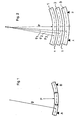
- the bending behavior of conventional multilayer films corresponds to the known model of a rod with a rectangular cross-section; see Fig. 1.
- the cross-section is made up of an infinite number of individual, infinitely thin fiber layers. If such a rod is placed on two supports A and B and subjected to a force P during the bending test, the individual fiber layers of the bent rod are stressed as follows: the fiber layer in the cross-sectional center is not stressed; the individual layers above this neutral layer are subjected to pressure in the transverse direction to the attacking bending force, that is to say they are compressed; at the same time, the fiber layers below the neutral layer in the transverse direction become the attacking bending force stretched, so stretched.
- the deflection of the rod is proportional to the attacking bending force. If the bending force is increased, the rod is first permanently, i.e. plastically deformed, and can then break, depending on the breaking behavior and the thickness of the rod.
- Usual foils such as those used for packaging purposes, can be bent over 180 'without breaking. As a rule, however, a residual elasticity remains after the bending, which, when the bending force decreases, causes the free ends of the film to spring back partially in the direction of the starting position. This is generally an undesirable effect and it is an object of the invention to provide a composite film which remains fixed in its bent state after bending and shows no tendency to spring back.
- the invention relates to a composite film with plastic bending behavior, which is characterized in that it has two or more composite layers with adhesive layers provided between them, the adhesive layers absorbing the restoring forces of the composite layers after bending the film due to their rheological behavior, without releasing these forces to deform.
- the film according to the invention is comparable to the leaf spring assembly shown in FIG. 2.
- the individual leaf springs 1, 2 and 3 are not shown lying directly on top of each other.
- the spring assembly is supported on points A and B and a bending force P acts on the springs.
- P acts on the springs.
- the individual spring bars 1, 2, 3 are freely movable under themselves. During the bending process, this results in a relative movement directed transversely to the acting force in each case of two adjacent interfaces. This results in each spring rod 1, 2, 3 a special bending radius p1, p2, p3.
- the multi-layer films usually used for packaging purposes so far have features of both the homogeneous spring bar shown in FIG. 1 and the spring assembly shown in FIG. 2.
- the films are made up of several composite components 1, 2, 3, which usually consist of different materials. It is essential that these individual layers 1, 2, 3 are usually firmly bonded to one another, be it that they are produced directly by adhering to one another by coextrusion or are connected by subsequent gluing. However, this rigid connection prevents an ideal plastic bending behavior; on the contrary, it promotes a largely elastic bending behavior.
- the thickness of the adhesive layers 4, 5 must be chosen so that if their edge parts are subject to a low shear deformation, not the entire adhesive layer and thus the entire film is deformed.
- the adhesive layers 4, 5 preferably have a layer thickness such that the shear gradient caused by the restoring forces of the composite layers 1, 2, 3 is zero in the central zone of each adhesive layer.
- the layer thickness of the adhesive layers is in the range from 0.005 to 0.1 mm, preferably 0.005 to 0.030 mm.
- the adhesive layers must also have sufficient adhesion to the composite layers and cohesion in order to bond the composite layers to one another so firmly that there is no unintentional delamination. If necessary, the surfaces of the composite layers are pretreated before or during the lamination process, e.g. by means of corona discharge.
- the chemical composition of the adhesive layers as well as the lamination process and the quantities of adhesive to be applied vary depending on the composite layers used and the intended use.
- Suitable pressure sensitive adhesives e.g. Acrylic adhesive or glue based on thermoplastic rubbers.
- the polyurethane-based laminating adhesives normally used for composite films are unsuitable because they result in bonds that are too hard and brittle.
- the application of the adhesives can e.g. from solution, dispersion or from the melt.
- suitable materials for the composite layers are e.g. Aluminum, polyester, polycarbonate, polystyrene or cellophane films or paper.
- the layer thickness of the composite layers is generally 0.006 to 0.05 mm, preferably 0.007 to 0.02 mm; in the case of paper
- the weight per unit area is usually in the range from 10 to 50 g / m 2 , preferably 15 to 30 g / m 2 .
- two or three such composite layers are used, which may consist of the same or different materials.
- the composite films according to the invention are suitable e.g. for wrapping around a bottle neck (so-called tinfoil) for decorative purposes.
- tinfoil a bottle neck
- the previously necessary gluing of the film to the bottle neck is no longer necessary, since the film is smoothly applied to the wrapped body by manual or mechanical wrapping. This is e.g. an advantage for bottle recycling.
- the outer surface of the composite film according to the invention can be painted, colored or printed.
- one or more of these layers can also be embossed before or after bonding.
- An embossing has an influence both on the appearance and on the bending behavior, which, depending on the embossing pattern and embossing depth, is usually influenced in the desired sense according to the invention.
- a film of soft pure aluminum in the thickness range of 0.006 to 0.05 mm is coated with an aqueous, finely dispersed, plasticizer-free, anionic dispersion of a carboxyl-containing acrylic acid / acrylonitrile copolymer and then dried under the action of heat.
- a second sheet of soft pure aluminum in the thickness range of 0.006 to 0.05 mm is fed in the same operation, placed on the dried-on dispersion layer and glued to the coated first aluminum sheet by pressing between a pair of rollers.
Landscapes
- Laminated Bodies (AREA)
Applications Claiming Priority (2)
| Application Number | Priority Date | Filing Date | Title |
|---|---|---|---|
| DE3416753 | 1984-05-07 | ||
| DE19843416753 DE3416753A1 (de) | 1984-05-07 | 1984-05-07 | Mehrschichtige aluminiumfolie mit plastischem biegeverhalten |
Publications (2)
| Publication Number | Publication Date |
|---|---|
| EP0169986A2 true EP0169986A2 (fr) | 1986-02-05 |
| EP0169986A3 EP0169986A3 (fr) | 1987-05-06 |
Family
ID=6235092
Family Applications (1)
| Application Number | Title | Priority Date | Filing Date |
|---|---|---|---|
| EP85105603A Withdrawn EP0169986A3 (fr) | 1984-05-07 | 1985-05-07 | Laminé à comportement de flexion plastique |
Country Status (3)
| Country | Link |
|---|---|
| EP (1) | EP0169986A3 (fr) |
| DE (1) | DE3416753A1 (fr) |
| ES (1) | ES8607116A1 (fr) |
Families Citing this family (5)
| Publication number | Priority date | Publication date | Assignee | Title |
|---|---|---|---|---|
| DE4242849A1 (de) * | 1992-12-18 | 1994-06-23 | Audi Ag | Verfahren und Vorrichtung zum Herstellen tiefgezogener Aluminiumteile |
| RU2141406C1 (ru) * | 1999-01-22 | 1999-11-20 | Егоров Борис Алексеевич | Многослойный материал |
| EP3339210B1 (fr) | 2016-12-22 | 2019-11-13 | Ramondin Capsulas, SA | Capsule d'aluminium multicouches |
| AT522883B1 (de) * | 2020-03-18 | 2021-03-15 | Constantia Teich Gmbh | Verpackungsfolie |
| AT527131B1 (de) * | 2023-10-06 | 2024-11-15 | Constantia Teich Gmbh | Verpackungsfolie |
Family Cites Families (3)
| Publication number | Priority date | Publication date | Assignee | Title |
|---|---|---|---|---|
| FR1511423A (fr) * | 1966-03-07 | 1968-01-26 | Dow Chemical Co | Stratifiés malléables à base de métal et de matière plastique |
| US4204022A (en) * | 1967-12-21 | 1980-05-20 | United States Steel Corporation | Adhesives coatings and laminates utilizing ethylene copolymers and coal-tar pitch |
| US4463055A (en) * | 1983-04-27 | 1984-07-31 | Hodges Marvin P | Reflective film and method of applying same |
-
1984
- 1984-05-07 DE DE19843416753 patent/DE3416753A1/de not_active Withdrawn
-
1985
- 1985-05-06 ES ES542851A patent/ES8607116A1/es not_active Expired
- 1985-05-07 EP EP85105603A patent/EP0169986A3/fr not_active Withdrawn
Also Published As
| Publication number | Publication date |
|---|---|
| EP0169986A3 (fr) | 1987-05-06 |
| ES8607116A1 (es) | 1986-05-16 |
| ES542851A0 (es) | 1986-05-16 |
| DE3416753A1 (de) | 1985-11-07 |
Similar Documents
| Publication | Publication Date | Title |
|---|---|---|
| DE3326169A1 (de) | Loesbar aneinanderhaftende kunststoffmaterialien | |
| DE3631397A1 (de) | Haftetikett | |
| EP0919369B1 (fr) | Procédé pour fabriquer une pochette de protection, et pochette de protection | |
| DE69307744T2 (de) | Verkaufsverpackung für Kreissägeblatt | |
| DE3416753A1 (de) | Mehrschichtige aluminiumfolie mit plastischem biegeverhalten | |
| WO2013057162A2 (fr) | Ruban adhesif | |
| EP0233633A2 (fr) | Films composites décoratifs pour recouvrements de surface, leur utilisation dans un composite multicouche et procédé de fabrication du composite multicouche | |
| EP1882919A2 (fr) | Indicateur de temps-température destiné au marquage de marchandises | |
| DE102019100629A1 (de) | Verbund aus einer Trägerfolie und zumindest einer aufgebrachten Klebeschicht, Verfahren zur Herstellung eines Halbzeuges mit einem solchen Verbund sowie Halbzeug | |
| DE10213924A1 (de) | Verfahren zum Kleben, ein schnellheftendes Objekt und ein Zwischenelement zum Kleben | |
| DE2209764A1 (de) | Laminate, insbesondere mehrschichtige klebefolie, und verfahren zur herstellung | |
| DE1569870A1 (de) | Klebeband | |
| DE60103165T2 (de) | Ohne trennschicht stapelbare klebeelemente | |
| CH686769A5 (de) | Verfahren zur Herstellung von Papierboegen oder -bahnen mit heraustrennbaren Selbstklebe-Etiketten. | |
| DE3532485A1 (de) | Fluessigkristallanzeige | |
| DE102008004544B3 (de) | Höckerverbundplatte und Verfahren zu deren Herstellung | |
| EP0280092A2 (fr) | Pochette pour disque ouverte sur un côté | |
| EP3008668B1 (fr) | Procédé de fabrication pour des supports de données portatifs | |
| DE10010652B4 (de) | Selbstklebende Tapete, insbesondere Tapetenborte, und Verfahren zu ihrer Herstellung | |
| DE69725399T2 (de) | Verfahren zum Herstellen eines Laminats mit einer bestimmten Krümmung und so hergestelltes Laminat | |
| WO1999008256A1 (fr) | Materiaux multicouches et leurs utilisations | |
| DE3338862C2 (de) | Verfahren zur Herstellung von Einbanddecken, insbesondere für Bücher und Schriftgutsammelhefter | |
| DE2746455C3 (de) | Verfahren zur Herstellung von zugfesten Riemen o.dgl. | |
| AT293244B (de) | Skistahlkanten | |
| DE1965522A1 (de) | Verfahren zur Herstellung eines Blocks aus uebereinander angeordn und im Randbereich miteinander verbundenen,abtrennbaren Blaettern |
Legal Events
| Date | Code | Title | Description |
|---|---|---|---|
| PUAI | Public reference made under article 153(3) epc to a published international application that has entered the european phase |
Free format text: ORIGINAL CODE: 0009012 |
|
| AK | Designated contracting states |
Designated state(s): CH DE FR GB IT LI |
|
| PUAL | Search report despatched |
Free format text: ORIGINAL CODE: 0009013 |
|
| AK | Designated contracting states |
Kind code of ref document: A3 Designated state(s): CH DE FR GB IT LI |
|
| 17P | Request for examination filed |
Effective date: 19870701 |
|
| 17Q | First examination report despatched |
Effective date: 19880527 |
|
| STAA | Information on the status of an ep patent application or granted ep patent |
Free format text: STATUS: THE APPLICATION IS DEEMED TO BE WITHDRAWN |
|
| 18D | Application deemed to be withdrawn |
Effective date: 19890110 |
|
| RIN1 | Information on inventor provided before grant (corrected) |
Inventor name: HILTBRUNNER, WERNER Inventor name: LAMPING, ALFONS, DR. |