EP0170254A2 - Verfahren und Einrichtung zur Herstellung von Stranggussbrammen - Google Patents
Verfahren und Einrichtung zur Herstellung von Stranggussbrammen Download PDFInfo
- Publication number
- EP0170254A2 EP0170254A2 EP85109574A EP85109574A EP0170254A2 EP 0170254 A2 EP0170254 A2 EP 0170254A2 EP 85109574 A EP85109574 A EP 85109574A EP 85109574 A EP85109574 A EP 85109574A EP 0170254 A2 EP0170254 A2 EP 0170254A2
- Authority
- EP
- European Patent Office
- Prior art keywords
- slab
- strain rate
- cracks
- deformation
- rolling
- Prior art date
- Legal status (The legal status is an assumption and is not a legal conclusion. Google has not performed a legal analysis and makes no representation as to the accuracy of the status listed.)
- Granted
Links
Images





Classifications
-
- B—PERFORMING OPERATIONS; TRANSPORTING
- B22—CASTING; POWDER METALLURGY
- B22D—CASTING OF METALS; CASTING OF OTHER SUBSTANCES BY THE SAME PROCESSES OR DEVICES
- B22D11/00—Continuous casting of metals, i.e. casting in indefinite lengths
- B22D11/12—Accessories for subsequent treating or working cast stock in situ
- B22D11/1206—Accessories for subsequent treating or working cast stock in situ for plastic shaping of strands
-
- Y—GENERAL TAGGING OF NEW TECHNOLOGICAL DEVELOPMENTS; GENERAL TAGGING OF CROSS-SECTIONAL TECHNOLOGIES SPANNING OVER SEVERAL SECTIONS OF THE IPC; TECHNICAL SUBJECTS COVERED BY FORMER USPC CROSS-REFERENCE ART COLLECTIONS [XRACs] AND DIGESTS
- Y10—TECHNICAL SUBJECTS COVERED BY FORMER USPC
- Y10T—TECHNICAL SUBJECTS COVERED BY FORMER US CLASSIFICATION
- Y10T29/00—Metal working
- Y10T29/49—Method of mechanical manufacture
- Y10T29/4998—Combined manufacture including applying or shaping of fluent material
- Y10T29/49988—Metal casting
- Y10T29/49991—Combined with rolling
Definitions
- This invention relates to a method and apparatus of processing slabs which have been manufactured by continuous casting (hereunder referred to merely as "continuously cast slab).
- this invention relates to a method and apparatus of preventing the formation of cracks during hot working in the manufacture of a slab by a continuous casting process and to a method and apparatus of preventing the formation of cracks during so-called "direct rolling” or "hot charge rolling”.
- Steels to which this invention can be successfully applied are medium or low carbon steels containing either Si or Mn, and low alloy steels which contain at least one alloying element, such as Al, Nb, Ti, Ta, V, and B, each in an amount of less than 1%.
- Direct rolling means a rolling process in which hot slabs manufactured through continuous casting are subjected to hot rolling immediately after continuous casting without preheating.
- Hot charge rolling means a rolling process in which hot slabs manufactured through continuous casting are rolled immediately after reheating them slightly without cooling to room temperature.
- Direct rolling and hot charge rolling are advantageous because they do not require cooling to room temperature nor heating to a rolling temperature from room temperature. Therefore, the formation of such cracks makes these processes impossible.
- Japanese Patent Application Laid-Open Specification No. 128255/1983 discloses a method of blowing metal shot onto a slab surface to prevent the formation of surface cracks of a continuously cast slab.
- the purposes of this method are to pressure weld the cracks, to remove extraneous matter from the surface of a slab, and to suppress-oxidation of a slab surface.
- Such treatment is carried out just when the slab leaves a mold and before going into guide rollers. Cracks frequently develop in the steps following the casting, e.g., during rolling. Thus, this method is not a complete solution of the problem.
- Japanese Patent Application Laid-Open Specification No. 155123/1979 discloses a method of applying plastic strain to a cast slab while controlling the amount of plastic strain, the cast slab temperature, and the austenitic particle size.
- means for imparting plastic strain are rolling, shot-blasting, laser pulse application, and the like. These means are not sufficient to impart a satisfactory plastic strain. Namely, when rolling is applied with usual rolls to a portion of a slab which is only partially solidified, the shell of the solidified metal only becomes concave without the desired strains being formed in the skin surface of a cast slab. On the other hand, shot-blasting produces plastic strains only to a shallow depth, resulting in no remarkable effects.
- a method utilizing a laser pulse applies heat to a depth of a few dozen um so as to produce strain due to thermal differences between the surface of slab and the inner portion thereof. This method, however, is not effective with hot slabs, since it is not possible to achieve any significant thermal differences when a laser pulse is applied to a hot cast slab. The presence of coolant water on the surface of a slab also makes this process impractical.
- Japanese Patent Application Laid-Open Specification No. 52442/1983 proposes a method of controlling the cooling rate in a continuous casting process so as to prevent the formation of cracks.
- the cooling rate is controlled so as to be small, and it takes an extremely long time before the cooling is completed. Therefore, this method, too, is impractical.
- An object of this invention is to prevent the formation of cracks such as surface cracks in cast slabs during continuous casting and during direct rolling as well as hot charge rolling.
- Another object of this invention is to make the direct rolling as well as hot charge rolling feasible with a remarkable reduction in manufacturing costs.
- Embrittlement brought about during deformation at a low strain rate is caused not only by a continuous precipitation of carbides, nitrides, and carbo-nitrides such as AlN, NbC, TaC, TiC, and VN along the boundaries of gamma grains but also by a fine precipitation occurring within the grain.
- the embrittlement is also accelerated by the fact that a soft film-like ferrite phase (alpha) is precipitated along grain boundaries, and the area within the grain is strengthened relative to the grain boundary area, resulting in a concentration of strain in a precipitation-free zone along the gamma grain boundaries and in a film-like ferrite phase precipitate.
- cleavage fracture takes place between the matrix phase and the grain-boundary precipitate.
- Embrittlement brought about by deformation at a high strain rate during hot rolling is caused by a continuous precipitation of (Fe, Mn)S taking place along gamma-grain boundaries during deformation and by a fine precipitation occurring throughout the grain.
- the carbo-nitrides are continuously precipitated along the gamma grain boundaries as well as in the grain before deformation at a high strain rate, the embrittlement due to the precipitation of the (Fe, Mn)S is accelerated markedly.
- the inventors of this invention found that the formation of surface cracks in a continuously cast slab during leveling and the succeeding hot working can be prevented by producing deformation under specified conditions before the leveling.
- this invention is a method of processing a continuously cast slab to prevent the formation of surface cracks by applying plastic strain to the surface layer of the slab in which solidification is taking place, comprising pressing a projection against the slab surface to a depth of 1 - 5 mm at a frequency of at least 50 times per minute prior to introducing the slab to a leveling stage.
- this invention resides in a method of processing a continuously cast slab, characterized by applying plastic strains to a depth of 2 mm or more from the surface in an amount of 5% or more at a strain rate of 1 X 10 -2 S -1 or more at a surface temperature of 900 - 500°C, and during the deformation or after the deformation, at least one time applying heat treatment including cooling the surface temperature of the cast slab to a temperature lower than Ar 3 and then heating to a temperature higher than Ac 3 , and passing the resulting slab through a series of withdrawal rollers.
- the strain rate is not higher than 0.3 S-l.
- the deformation mentioned above may advantageously be applied with an apparatus comprising a working tool to form a dent in the slab surface, a first drive means to move the working tool back and forth towards and away from the slab surface, a second drive means to move the working tool back and forth in the direction of withdrawal of the cast slab, and a control unit connected to the first and second drive means for adjusting the movement of the working tool in the two directions.
- plastic strains of 5% or more are successfully introduced to a depth of 2 mm or more from the slab surface at the strain rate specified above.
- the cast slab obtained according to the process mentioned above is free from cracking during levelling or hot working, and the slab may directly be subjected to usual hot working without reheating, or the slab may be subjected to usual hot working after reheating but without being cooled to room temperature.
- Hot working herein means not only usual rolling, but also forging and the like which are carried out under hot conditions.
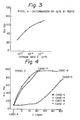
- Figs. 1 - 3 summarize the test results, from which it is noted that the gamma ⁇ alpha transformation after a slight deformation is very effective for improving ductility (Fig. 1) and that in order to obtain a value of RA higher than 50%, the amount of strain is preferably 5% or more and the strain rate is preferably 1 X 10 -1 S -1 or higher (Figs. 2 - 3).
- Case 4 As is apparent from Fig. 4, RA was extremely small in Case 4 which was conventional. Case 5 shows that it is necessary to maintain at 1100°C for a long period of time to increase ductility. However, when a strain of 10% is introduced at a rate of 10 -1 S -1 prior to heating at 1100°C, ductility is markedly improved by maintaining at 1100°C for a shorter period of time. See Cases 6 and 7. In addition, as shown by Case 7, it is preferable to utilize self-reheating (thermal recovery from the inside) of the slab by slowing down the cooling when the plastic deformation is carried out at a relatively low temperature.
- self-reheating thermal recovery from the inside
- Fig. 7 The relationship between the RA value and the strain rate is shown in Fig. 7 for Steel C in Cases 6 and 7.
- Case 6 the steel was pre-deformed at 1100°C by 10%.
- Case 7 the steel was predeformed at 900°C by 10%. The steels were maintained at 1100°C for 10 minutes after deformation.
- Fig. 7 shows that a larger the strain rate, is more advantageous and that the strain rate ( ) should be ⁇ 1 X 10 -2 S -1 at a pre-deforming temperature of 1100 C and ⁇ 3 X10 -3 S -1 at a pre-deforming temperature of 900°C.
- RA values for Steels C, D, and E were small ones.
- Case 9 when the maintaining is carried out prior to deformation, no significant results are obtained as shown in Case 9.
- Case 10 when a pre-deformation of 10% is carried out, a value of RA of larger than 50% is easily obtained by maintaining the temperature after deformation only for 4 minutes.
- the depth to which plastic deformation is applied is restricted to at least 1 - 5 mm, and preferably 2 mm or more from the slab surface. This is based on the finding that cracks which form in a depth within 1 mm, usually within 2 mm in depth remain, resulting in cracking defects and streaking defects in the following manufacturing stages. In other words, in a preferrerd embodiment a given deformation should be applied to a depth at least 2 mm from the surface.
- the amount of deformation is limited to not smaller than 5%, because it is difficult to effect nucleation for precipitation when the amount is less than 5%.
- the lower limit of the strain rate is determined to be 1 X 10⁻² S -1 , since when the strain rate is lower than this limit, plastic deformation is mainly applied to the gamma grain boundary to accelerate the precipitation of carbo-nitrides and sulfides along the gamma grain boundary. This precipitation is also accelerated by the application of heat treatment including cooling and self-heating. In order to introduce strains at high temperatures it is necessary to cause the precipitates to grow before the introduced dislocations are recovered. For this purpose, a strain rate higher than 1 X 10⁻² S-1 is sufficient.
- the plastic deformation is applied at a temperature of 900 - 500°C, and thereafter at least one time the slab is cooled to a temperature below the Ar 3 point. This is because the refinement of gamma grains by way of transformation is no longer necessary when the slab is heated at a temperature higher than 900°C. At high temperatures the precipitates grow coarse. On the other hand, a temperature lower than 500°C is impractical.
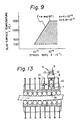
- the strain rate is restricted to: ⁇ a x exp (bT) because it is necessary to produce the growth of the precipitates before the introduced dislocations recover. At a higher temperature a larger strain rate is required so as to build up strains.
- the temperature at which the plastic deformation takes place is limited to 700° C - 1200°C.
- the hatched area in Fig. 9 shows the range in which the preferred embodiments are carried out.
- An apparatus by which such deformation is performed on the cast slab according to this invention includes a roller having projections along its periphery, an air hammer, a specially arranged hydraulic oil press, and the like. So long as the intended plastic deformation and strain rate can be achieved, other methods or apparatuses may be used.
- Figs. 10 and 11 schematically illustrate one example of an apparatus for applying plastic deformation to a continuously cast slab.
- Molten steel L is continuously cast through a ladle 1 and a tundish 2 into a mold 3.
- the cast slab is withdrawn through cooling grids 4 and a series of guide rollers 5 while forming a solidified shell S, then is straightened while moving horizontally through levelling rollers (not shown) and removed from the machine.
- the cast slab Prior to being subjected to straightening, the cast slab is subjected to plastic deformation by means of a surface processing apparatus 6 comprising a working tool 7 with a projection 7A, which is forced against the solidified shell S on the slab surface to a depth of 1 - 5 mm at a frequency of at least 50 times per minute.
- strains of 5% or more are advantageously introduced at a rate of 1X10 2 5- 1 or higher to promote coagulation of carbo-nitrides, resulting in coarse precipitates.
- Figs. 12,13, and 14 illustrate in detail the surface processing apparatus 6.
- the apparatus 6 is usually installed on a roller apron frame 8 for guide rollers 5 provided along the radially inner surface during bending.
- the arrangement is designed such that strains are applied to the surface of the slab in the direction of the depth of the cast slab between the rollers.
- Figs. 12 illustrates in detail the surface processing apparatus 6.
- the apparatus comprises a working tool 7 having a projection 7A for forming a dent in the slab surface, a first hydraulic cylinder 9 which moves the working tool 7 back and forth towards and away from the slab surface, a second hydrualic cylinder 10 which moves the working tool 7 back and forth in the direction of withdrawal of the cast slab, a control unit 11 which is connected to the first and second drive means 9, 10 and which controls the movement of the working tool 7 in the two directions.
- the first hydraulic cylinder 9 is pivotally mounted on the roller apron frame 8 through a seat 12 and a pin 13 so as to be able to pivot in the direction of slab withdrawal, and the piston rod of the cylinder 9 is connected to the top end of the working tool 7 by a pin 14 and is movable in the direction of the thickness of the slab.
- the projection 7A may be attached to the working tool 7 in such a manner that the projection 7A can be replaced by a different one or a new one when necessary.
- the second hydraulic cylinder 10 is pivotally attached to the roller apron frame 8 by a pin 15 and the working tool 7 is movable in the direction of the thickness of the slab, too.
- the hydraulic cylinders 9, 10 are actuated by a servo valve which is in turn controlled by a control unit 11 on the basis of input signals corresponding to the pouring rate, indentation depth, processing conditions, and the like so that the working tool 7 will follow the path shown by the arrows in Fig. 11.
- the tip of the working tool 7 is first positioned at a point A a few millimeters away from the cast slab surface, where it is adjacent to a guide roller 5A on the upstream side of the slab.
- the working tool 7 is actuated by the first hydraulic cylinder 9 and the tip goes down to a point B on the slab surface.
- the working tool 7 is actuated by the second hydraulic cylinder 10 and the projection 7A is moved downstream in the slab withdrawal direction while being forced against the slab surface.
- the indentation of the slab surface by the projection 7A ends at a point C near the downstream guide roller 5B.
- the working tool 7 is then removed from the surface by the actuation of the first hydraulic cylinder 9 and is returned to its starting point A by means of the second hydraulic cylinder 10.
- the above cycle is repeated continuously to impart a given amount of strain to the slab surface.
- an eccentric member may be employed to actuate the working tool.
- Cast slabs (250 mm X 2100 mm) were continuously produced by a bending-type continuous casting machine (bending radius: 12.5 m) like that shown in Fig. 10 under various manufacturing conditions. The formation of surface cracks was visually examined after leveling. By means of the surface processing apparatus 6 shown in Fig. 10, strains were introduced into the slab which was only partially solidified.
- the diameter of the round tip portion of the projection 7A was 5 mm
- the depth of indentation was 3 mm
- the indentation frequency was 180 times per minute.
- the strain rate under these conditions was 0.3 S -1 with the average amount of strains being 7% to a depth of 3 mm from the surface.
- Table 4 shows the steel composition used in this example and Table 5 summarizes casting conditions and the results of visual examination of the formation of surface cracks.
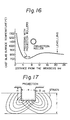
- Fig. 15 is a cooling curve for this example illustrating the temperature of the slab as a function of distance from the meniscus, and also showing the points at which processing and leveling were performed (hereunder referred to as "heat pattern").
- the heat pattern for this example is shown in Fig. 16.
- the strains were introduced using a series of projection rollers in place of guide rollers arranged at a distance of 4 - 8 m from the melt surface within the mold, i.e., the meniscus.
- Each projection was forced against the shell S 46 - 65 mm thick while receiving a molten metal pressure at 28 - 52 kg/cm 2 .
- a projection roller strains propagate from each of the projections. According to calculations using the following equations, at least a 7% strain was imparted to a depth of 5 mm from the surface.
- the strain rate was 2 X 10 -1 S .
- slabs processed in accordance with this invention were subjected to direct rolling after leveling and cutting.
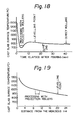
- the steel compositions are shown in Table 8 and the heat pattern is shown in Fig. 18. Strains were introduced by means of four sets of projection rollers provided on both sides of the slab. Direct rolling was carried out using a roll 1300 mm in diameter and the slab was rolled down to a thickness 150 mm in 5 passes.
- steel castings 40 X 220 X 660 mm having the steel compositions given in Table 10 were prepared, and surface strains were introduced over half of the surface area of each casting using a small motor hammer under the conditions shown in Table 11.
- the average amount of strain was about 20% to a depth of 5 mm from the surface.
- Example 12 This example was the same as Example 2 except that the temperature at which strains were introduced was rather high. Process conditions and test results are summarized in Table 12.
- Example 6 This example was identical to Example 6 except that before effecting deformation, the cast pieces were cooled rapidly from 1350°C to 800°C, where the deformation was carried out. After deformation, the surface temperature recovered to 1000°C by self-heating. The levelling was applied at 900°C.
- Example 3 This example was the same as Example 3 except that the processing point and the heat pattern were shown in Fig. 19.
- Example 4 was repeated.
Landscapes
- Engineering & Computer Science (AREA)
- Mechanical Engineering (AREA)
- Heat Treatment Of Steel (AREA)
- Metal Rolling (AREA)
Applications Claiming Priority (6)
| Application Number | Priority Date | Filing Date | Title |
|---|---|---|---|
| JP161183/84 | 1984-07-31 | ||
| JP16118384A JPS6138759A (ja) | 1984-07-31 | 1984-07-31 | 連続鋳造鋳片の熱間表面加工方法とその装置 |
| JP17143984A JPS6149762A (ja) | 1984-08-20 | 1984-08-20 | 連続鋳造鋳片の製造方法 |
| JP171439/84 | 1984-08-20 | ||
| JP17144084A JPS6149763A (ja) | 1984-08-20 | 1984-08-20 | 連続鋳造鋳片の製造方法 |
| JP171440/84 | 1984-08-20 |
Publications (3)
| Publication Number | Publication Date |
|---|---|
| EP0170254A2 true EP0170254A2 (de) | 1986-02-05 |
| EP0170254A3 EP0170254A3 (en) | 1986-10-08 |
| EP0170254B1 EP0170254B1 (de) | 1991-01-02 |
Family
ID=27321816
Family Applications (1)
| Application Number | Title | Priority Date | Filing Date |
|---|---|---|---|
| EP85109574A Expired - Lifetime EP0170254B1 (de) | 1984-07-31 | 1985-07-30 | Verfahren und Einrichtung zur Herstellung von Stranggussbrammen |
Country Status (3)
| Country | Link |
|---|---|
| US (2) | US4709572A (de) |
| EP (1) | EP0170254B1 (de) |
| DE (1) | DE3581008D1 (de) |
Cited By (1)
| Publication number | Priority date | Publication date | Assignee | Title |
|---|---|---|---|---|
| US4957154A (en) * | 1988-06-03 | 1990-09-18 | Establissments Griset | Process for the in-line homogenization and recrystallization of metallic products obtained by continuous casting |
Families Citing this family (8)
| Publication number | Priority date | Publication date | Assignee | Title |
|---|---|---|---|---|
| US5028277A (en) * | 1989-03-02 | 1991-07-02 | Nippon Steel Corporation | Continuous thin sheet of TiAl intermetallic compound and process for producing same |
| EP0463201A1 (de) * | 1990-06-25 | 1992-01-02 | AUTE Gesellschaft für autogene Technik mbH | Stahlstranggiessanlage mit mechanischer Entfernungseinrichtung für Sauerstoffschneidbärte |
| US5632177A (en) * | 1994-03-01 | 1997-05-27 | Hitachi, Ltd. | System and method for manufacturing thin plate by hot working |
| KR100368253B1 (ko) * | 1997-12-09 | 2003-03-15 | 주식회사 포스코 | 미니밀프로세스에의한열연판의제조방법 |
| US6457667B1 (en) * | 1998-02-04 | 2002-10-01 | The Goodyear Tire And Rubber Company | Method and apparatus for controlling the tension of wire being pulled from a wire spool on a bead wire letoff stand |
| DE102017207942A1 (de) * | 2017-05-11 | 2018-11-15 | Sms Group Gmbh | Stranggießanlage und Verfahren zur Herstellung eines metallischen Produkts |
| CN109128074B (zh) * | 2018-09-25 | 2020-09-04 | 湖南华菱湘潭钢铁有限公司 | 一种可热送热装的微合金钢的生产方法 |
| CN111005020B (zh) * | 2019-12-10 | 2020-12-11 | 清华大学 | 避免液化裂纹的方法 |
Family Cites Families (17)
| Publication number | Priority date | Publication date | Assignee | Title |
|---|---|---|---|---|
| US2228257A (en) * | 1939-10-17 | 1941-01-14 | Fred L Collins | Method of treating steel |
| US2310703A (en) * | 1941-01-08 | 1943-02-09 | American Steel & Wire Co | Method of treating steel |
| BE636200A (de) * | 1962-08-15 | |||
| US3333452A (en) * | 1965-03-03 | 1967-08-01 | Sendzimir Inc T | Reduction of thick flat articles |
| CH466895A (de) * | 1968-03-11 | 1968-12-31 | Olsson Ag Erik | Vorrichtung zum Unterteilen des Stranges für Stranggiessanlagen |
| US3780552A (en) * | 1971-04-16 | 1973-12-25 | F Staskiewicz | Apparatus for conditioning continuously cast bars |
| US4106318A (en) * | 1974-04-10 | 1978-08-15 | Nippon Steel Corporation | Method and apparatus for rolling metallic material |
| US4134440A (en) * | 1974-09-16 | 1979-01-16 | Nippon Kokan Kabushiki Kaisha | Method of continuously casting steel |
| JPS5221252A (en) * | 1975-08-13 | 1977-02-17 | Nippon Steel Corp | Shape straightening method of metal strip or plate |
| JPS5449930A (en) * | 1977-09-28 | 1979-04-19 | Nippon Steel Corp | Prevention of surface cracking of cast strip for electromagnetic steel |
| JPS5928424B2 (ja) * | 1978-05-30 | 1984-07-12 | 新日本製鐵株式会社 | 含Nb,V鋼鋳片の表面割れを軽減する方法 |
| JPS5659519A (en) * | 1979-10-03 | 1981-05-23 | Furukawa Electric Co Ltd:The | Trimming method for fin of shoulder of ingot obtained by continuous casting and rolling system |
| JPS56102358A (en) * | 1980-01-14 | 1981-08-15 | Kawasaki Steel Corp | Surface defect preventing method of ingot in continuous casting |
| JPS5852442A (ja) * | 1981-09-24 | 1983-03-28 | Nhk Spring Co Ltd | 棒状体の拘束焼入装置 |
| JPS58128255A (ja) * | 1982-01-25 | 1983-07-30 | Nippon Kokan Kk <Nkk> | 鋼の連続鋳造法 |
| SE436253B (sv) * | 1982-09-10 | 1984-11-26 | Centro Maskin Goteborg Ab | Slipstation for kontinuerlig slipning och ytkonditionering av varma emnen, i synnerhet kontinuerligt i direkt anslutning till strenggjutning |
| EP0108490B1 (de) * | 1982-10-12 | 1987-01-14 | Nippon Kokan Kabushiki Kaisha | Verfahren und Vorrichtung zum Entfernen durch Abstrahlen mit Hilfe eines Metallgriesses eines nach der horizontalen Stranggussmethode hergestellten Stranges |
-
1985
- 1985-07-30 DE DE8585109574T patent/DE3581008D1/de not_active Expired - Lifetime
- 1985-07-30 EP EP85109574A patent/EP0170254B1/de not_active Expired - Lifetime
- 1985-07-30 US US06/760,453 patent/US4709572A/en not_active Expired - Fee Related
-
1987
- 1987-08-06 US US07/082,360 patent/US4802356A/en not_active Expired - Fee Related
Cited By (1)
| Publication number | Priority date | Publication date | Assignee | Title |
|---|---|---|---|---|
| US4957154A (en) * | 1988-06-03 | 1990-09-18 | Establissments Griset | Process for the in-line homogenization and recrystallization of metallic products obtained by continuous casting |
Also Published As
| Publication number | Publication date |
|---|---|
| US4709572A (en) | 1987-12-01 |
| DE3581008D1 (de) | 1991-02-07 |
| US4802356A (en) | 1989-02-07 |
| EP0170254B1 (de) | 1991-01-02 |
| EP0170254A3 (en) | 1986-10-08 |
Similar Documents
| Publication | Publication Date | Title |
|---|---|---|
| Mintz et al. | Hot ductility of steels and its relationship to the problem of transverse cracking during continuous casting | |
| EP1326723B9 (de) | Ein stahlherstellungsverfahren | |
| CA2270450A1 (en) | Process for monitoring and controlling the quality of rolled products from hot-rolled processes | |
| KR20120093189A (ko) | 금속 부품의 제조 방법 및 장치 | |
| EP0170254B1 (de) | Verfahren und Einrichtung zur Herstellung von Stranggussbrammen | |
| US7137437B2 (en) | Method and device for producing continuously cast steel slabs | |
| JP2004509770A (ja) | 鋼ストリップ製造方法 | |
| JPH0541348B2 (de) | ||
| EP0478741A4 (en) | As-continuously cast beam blank and method for casting continuously cast beam blank | |
| EP0378705B1 (de) | Verfahren zur herstellung dünner bleche aus cr-ni und rostfreiem stahl mit ausgezeichneten eigenschaften, sowie oberflächenqualität und materialqualität | |
| US3251215A (en) | Process for making rails | |
| JPH0112561B2 (de) | ||
| Varadarajan | Controlling Microalloy Interactions on Precipitation, Hot Ductility, and Microstructure–Mechanical Property Relationships | |
| CN118581391B (zh) | 一种中锰系热成形钢及其制备方法和应用 | |
| Deprez et al. | Tensile test on in situ solidified notched specimens: effects of temperature history and strain rate on the hot ductility of Nb and Nb V microalloyed steels | |
| RU2159291C1 (ru) | Способ термической обработки литых заготовок из сталей с низкой технологической пластичностью | |
| AU2001291499A1 (en) | A method of producing steel | |
| JPS62156056A (ja) | 低合金鋼の連続鋳造方法 | |
| JPH07290101A (ja) | 連続鋳造鋳片スラブの熱間幅圧下圧延時の表面割れ防止方法 | |
| Soeyanto | Improvement of surface quality of continuously cast steel control of cast structure and straightening temperature | |
| JP3091792B2 (ja) | 段付きシャフトの製造方法 | |
| JPH054169B2 (de) | ||
| JPH0468069B2 (de) | ||
| Yue | Thermomechanical processing of ferrous alloys | |
| JPS6138759A (ja) | 連続鋳造鋳片の熱間表面加工方法とその装置 |
Legal Events
| Date | Code | Title | Description |
|---|---|---|---|
| PUAI | Public reference made under article 153(3) epc to a published international application that has entered the european phase |
Free format text: ORIGINAL CODE: 0009012 |
|
| 17P | Request for examination filed |
Effective date: 19850730 |
|
| AK | Designated contracting states |
Designated state(s): DE FR GB IT |
|
| PUAL | Search report despatched |
Free format text: ORIGINAL CODE: 0009013 |
|
| AK | Designated contracting states |
Kind code of ref document: A3 Designated state(s): DE FR GB IT |
|
| 17Q | First examination report despatched |
Effective date: 19880518 |
|
| GRAA | (expected) grant |
Free format text: ORIGINAL CODE: 0009210 |
|
| AK | Designated contracting states |
Kind code of ref document: B1 Designated state(s): DE FR GB IT |
|
| REF | Corresponds to: |
Ref document number: 3581008 Country of ref document: DE Date of ref document: 19910207 |
|
| ITF | It: translation for a ep patent filed | ||
| ET | Fr: translation filed | ||
| PLBE | No opposition filed within time limit |
Free format text: ORIGINAL CODE: 0009261 |
|
| STAA | Information on the status of an ep patent application or granted ep patent |
Free format text: STATUS: NO OPPOSITION FILED WITHIN TIME LIMIT |
|
| 26N | No opposition filed | ||
| PGFP | Annual fee paid to national office [announced via postgrant information from national office to epo] |
Ref country code: GB Payment date: 19930521 Year of fee payment: 9 |
|
| PGFP | Annual fee paid to national office [announced via postgrant information from national office to epo] |
Ref country code: FR Payment date: 19930527 Year of fee payment: 9 |
|
| PG25 | Lapsed in a contracting state [announced via postgrant information from national office to epo] |
Ref country code: GB Effective date: 19940730 |
|
| GBPC | Gb: european patent ceased through non-payment of renewal fee |
Effective date: 19940730 |
|
| PG25 | Lapsed in a contracting state [announced via postgrant information from national office to epo] |
Ref country code: FR Effective date: 19950331 |
|
| REG | Reference to a national code |
Ref country code: FR Ref legal event code: ST |
|
| PGFP | Annual fee paid to national office [announced via postgrant information from national office to epo] |
Ref country code: DE Payment date: 20040812 Year of fee payment: 20 |