EP0170582A1 - Verfahren zur Verarbeitung gespeicherter Signale resultierend aus einer seismischen Untersuchung eines Mediums - Google Patents
Verfahren zur Verarbeitung gespeicherter Signale resultierend aus einer seismischen Untersuchung eines Mediums Download PDFInfo
- Publication number
- EP0170582A1 EP0170582A1 EP85401405A EP85401405A EP0170582A1 EP 0170582 A1 EP0170582 A1 EP 0170582A1 EP 85401405 A EP85401405 A EP 85401405A EP 85401405 A EP85401405 A EP 85401405A EP 0170582 A1 EP0170582 A1 EP 0170582A1
- Authority
- EP
- European Patent Office
- Prior art keywords
- intercorrelation
- space
- elementary
- waves
- functions
- Prior art date
- Legal status (The legal status is an assumption and is not a legal conclusion. Google has not performed a legal analysis and makes no representation as to the accuracy of the status listed.)
- Granted
Links
Images



Classifications
-
- G—PHYSICS
- G01—MEASURING; TESTING
- G01V—GEOPHYSICS; GRAVITATIONAL MEASUREMENTS; DETECTING MASSES OR OBJECTS; TAGS
- G01V1/00—Seismology; Seismic or acoustic prospecting or detecting
- G01V1/40—Seismology; Seismic or acoustic prospecting or detecting specially adapted for well-logging
- G01V1/44—Seismology; Seismic or acoustic prospecting or detecting specially adapted for well-logging using generators and receivers in the same well
Definitions
- the present invention relates to a process for processing signal recordings resulting from a seismic exploration of a medium, and it can be implemented both in reflection or refraction seismic as in exploration by acoustic logging.
- the conventional technique of acoustic logging consists in creating, by means of a transmitter, an acoustic energy which crosses all or part of the formations of the medium to be explored before reaching receptors which deliver electrical signals which are recorded and then processed in a d on the one hand, to be able to separate, in particular, the compression waves or P waves from the shear waves or S waves, and on the other hand, to calculate the different average speeds of said waves in the formations crossed.
- acoustic logs there may be mentioned those which are carried out during the drilling of a well and which are defined as being instantaneous, and those which are defined as being deferred.
- the latter are carried out by means of a special tool which is lowered into the drilled well, said tool comprising one or more transmitters and / or one or more receivers.
- the tool can comprise either only the transmitter (s), the receivers then being arranged on the surface, or the reverse, that is to say only receivers, the transmitter (s) being on the surface, or even at the both the transmitter (s) and the receiver (s).
- the method described in this application consists in transmitting and receiving acoustic waves using transmission and reception means which define between them at least two acoustic paths of different length, to be recorded during each transmission. all the signals received, and then to identify, at the time of transmission and for each recording, the respective positions of the transmitter-receiver pair.
- the processing of the recordings consists in grouping the recordings in pairs so that in a given pair the two acoustic paths corresponding to the two recordings of the said pair have on the one hand a common end situated at the same dimension in the drilled well and, d on the other hand, an uncommon part located opposite a geological layer of interest, then to measure on each pair of recordings the difference in the arrival times of the acoustic waves.
- Another processing step consists of intercorrelating the two records of each pair so as to obtain an elementary intercorrelation function, then summing all the intercorrelation functions.
- This processing of the recorded signals eliminates propagation noise and therefore very significantly improves the signal / noise ratio.
- the maxima corresponding to the different waves received are favored, which makes it possible to better study the characteristics of said waves.
- each intercorrelation function comprises a certain number of main and secondary lobes or arches and it is sometimes difficult to determine with certainty which of the arches corresponds to the maximum energy of a determined wave.
- the sum of the elementary intercorrelation functions relating to several adjacent layers of the formations also includes many arches; so she is not can be used to remove the ambiguity mentioned above.
- the Applicant has therefore sought and found a new processing of signal recordings which applies not only to the processing of signals obtained by acoustic logging but also those obtained by other seismic exploration processes of the reflection or refraction type, the new treatment allowing to improve the power of resolution by increasing the precision with which one can point the maxima or useful lobes.
- the subject of the present invention is a method for processing signal recordings resulting from the emission and reception of acoustic waves propagating in an environment which is characterized by the fact that it consists in grouping the recordings in pairs. so that in each pair the two recordings correspond to two acoustic paths comprising at least one non-common part defining a measurement space and at least one common part; intercorrelating the two records of each pair so as to obtain an elementary intercorrelation function defining the travel time of the waves over the measurement space of said pair; grouping the elementary intercorrelation functions into at least one family in which the measurement spaces are included in the same predetermined reference space; transforming the time variable of the elementary intercorrelation functions so as to reduce the dimension of their measurement space to the dimension of the reference space; adding all the transformed intercorrelation functions to constitute a sum intercorrelation function whose abscissas of the useful lobes are representative of the propagation time of the waves over the reference space.
- An advantage of the present invention lies in the fact that only the useful lobes representative of the propagation time of the waves over the reference space are kept.
- the transformation which brings the measurement space of each elementary intercorrelation function to the dimension of the reference space is a dilation of said intercorrelation functions to reduce them to that which corresponds to the largest geological layer of interest, then, the secondary lobes are attenuated or more exactly they are rejected laterally far enough from the main lobes significant of the energy of the waves received. This is valid in the time domain.
- we pass into the spectral domain we notice that the dilation makes it possible to widen the frequency spectrum and, consequently, to smooth it more by giving practically a flat spectrum.
- FIG 1 there is shown very schematically a drilled well 1 in which is disposed a logging tool 2 comprising transducers materialized in the figure by five magnetostriction transmitters T 1 to T 5 spaced between them by 0.25 m and twelve receivers R 1 to R12, of the piezoelectric ceramic type, spaced apart by 1 m.
- a logging tool 2 comprising transducers materialized in the figure by five magnetostriction transmitters T 1 to T 5 spaced between them by 0.25 m and twelve receivers R 1 to R12, of the piezoelectric ceramic type, spaced apart by 1 m.
- the tool 2 is operated from the surface of the well by traction means of which only part of a cable 6 is shown in FIG. 1.
- the cable 6 also serves to house the electrical conductors necessary for the operation of said tool 2.
- the tool has, for example, a pitch equal to the spacing between emitters, said spacing corresponding to the thickness e of a geological layer of interest 7 which also constitutes what is defined thereafter as a measurement space.
- the advancement step is therefore 0.25 m.
- the tool 2 is raised in the well 1 in such a way that the lower transmitter T 1 comes to occupy the position which the adjacent transmitter T 21 had, the transmitter T 2 then occupying the place of the transmitter T 3 and so on.
- the waves received on the receivers R 1 to R 12 are converted into electrical signals which are recorded on recording means which are not shown but which are well known to seismicians.
- the recording means also record for each transmission the rating of the tool 2 and the respective positions of the transmitter-receiver pair associated for this transmission. Thus, with each recording, we are able to match the transmitter-receiver pair that gave it birth.
- a first step according to the invention consists in grouping the recordings in pairs, each pair comprising, for the type of wave whose average propagation speed is to be determined, two acoustic paths having a common end and a single non-common part.
- a final stage of processing consists in choosing a reference space in which it is precisely desired to determine said average propagation speed.
- One way to determine the reference space is, among other things, to take a geological layer 8 of thickness equal to the spacing between the extreme emitters of the tool. In the example shown in the drawing, this spacing E is equal to 1 m for a tool with five transmitters spaced regularly by 0.25 m.
- the measurement spaces as specified above and due to the application to logging are unidirectional.
- the two records of each pair are intercorrelated with each other, the result of the operation being a so-called elementary intercorrelation function which is used to define the travel time of the wave considered on the non-common part since the correlation operation has precisely to eliminate the common part of the two acoustic paths corresponding to the two recordings.
- the elementary intercorrelation functions are then grouped so as to constitute a set of families for which the measurement spaces corresponding to the elementary intercorrelation functions are included in the predetermined reference space E.
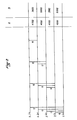
- FIG. 2 represents, on the left, all the measurement spaces on which the elementary intercorrelation functions are performed in the reference space E.
- the spacings between the horizontal lines L 1 to L 5 represent the measurement spaces each corresponding to a geological layer of interest.
- line L 1 corresponds to the position of the transmitter T 1 of tool 2
- the lines L2 to L5 corresponding in the same way to the positions of the transmitters T 2 to T 5 .
- the vertical line 10 represents the measurement space corresponding to the elementary intercorrelation function performed on the two recordings of the pair associated with the transmitters T 1 and T 2 ' and with the same arbitrary receiver
- the line 11 represents the measurement space corresponding to the elementary intercorrelation function obtained from the pair associated with the transmitters T 3 and T 1 and with the same arbitrary receiver.
- the elementary intercorrelation functions corresponding to the measurement spaces 10 to 13 represent a first family which is characterized by measurement spaces having a common end.
- the distribution of the elementary intercorrelation functions into families can be carried out in a different way, for example by grouping all the elementary intercorrelation functions corresponding to measurement spaces having the same dimension. This would lead in particular to forming a family comprising the elementary intercorrelation functions corresponding to the measurement spaces 10, 14, 17 and 19; or 11, 15 and 18; or 12 and 16.
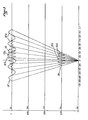
- FIG. 3 is a representation of the amplitude as a function of the time given in microseconds, of two cross-correlation functions 30 and 33 corresponding to the measurement spaces 10 and 13 respectively and of the transform 30 ′ of the cross-correlation function 30.
- the time variable of the elementary intercorrelation functions is transformed so as to reduce the dimension of the measurement space of these functions to that of the reference space.
- the transformation is a dilation in the timescale and more particularly a homothety.
- One aim of this important stage of the treatment is to laterally reject the secondary lobes 30a of the elementary intercorrelation function 30, so as to match the main lobe 30b with that 33b of the elementary intercorrelation function 33.
- This is essential especially when, as is the case with respect to the elementary intercorrelation functions 30 and 33, the secondary lobes 30a and 33a are substantially of the same amplitude as the respective main lobes 30b and 33b.
- the dilation in the timescale makes it possible to bring the transformed main lobe 30'b in correspondence with the main lobe 33b and to laterally reject the transformed secondary lobes 30'a.
- the attenuation of the secondary lobes is all the better as there is a good adequacy between the dominant period of the elementary intercorrelation functions and the dimension relationships between the different measurement spaces of the same family.
- the transforms 30 ′ to 39 ′ of the elementary intercorrelation functions corresponding to the measurement spaces 10 to 19 are shown from bottom to top, the only one which has not undergone any transformation being of course the function of intercorrelation 33 since its measurement space is the reference space.
- the transforms 30 'to 39' happen to be calibrated relative to the zero of the axis of the times given in microseconds, the axis of the ordinates representing the amplitudes.
- the transforms 30 'to 39' correspond to a geological layer in which the speed of the acoustic wave considered hardly varies, for example equal to 4000 m / s.
- a vertical line 27 drawn parallel to the ordinate axis and passing through the top of the useful lobe 26 shows that the main lobes of the transforms 10 "to 19" are no longer aligned, as was the case in FIG. 4.
- This is completely normal since the propagation speed of the wave considered varies from one geological layer to another in the reference layer, the consequence being that the shifts of the elementary intercorrelation functions are different from a geological layer to the other.
- the main lobe is the 39" b lobe whose abscissa is representative of the slowness on the corresponding measurement space
- the main lobe is the 37" lobe b whose abscissa is greater than that of the main lobe 39 "b, thereby verifying the difference between the speeds of propagation of the wave considered in the respective layers of interest, the speed for the 39 "transform being 3000 m / s while the speed for the 37" transform is 6000 m / s.
- the main lobes of the transforms which are aligned with the useful lobe 26 make it possible to deduce that the corresponding slowness is equal to the average slowness of the reference layer. It is the same for the 38 ", 35", 33 and 31 "transforms.
- the residual lobes 28 of the sum intercorrelation function 25 are rejected laterally and attenuated in amplitude.
- the processing according to the invention results in a very significant improvement in what was usually obtained by the usual methods.
- the lateral rejection of the residual lobes of the sum intercorrelation functions corresponds to a widening of the passband of the frequency spectrum with respect to the corresponding spectra of the elementary intercorrelation functions.
- the treatment according to the present invention is not not limited to seismic exploration methods by acoustic logging, but can be used for other seismic exploration methods such as those based on the reflection or refraction of the waves produced in the medium to be explored. This is possible thanks to the fact that the proposed treatment concerns only the non-common part of two acoustic paths whatever the very shapes of said paths.
- the important criteria are the smallest distance between two transducers of the same type (transmitters or receivers) or the smallest of the differences between the distances of two transducers of opposite types (transmitters and receivers), and a reference space of dimension greater than this spacing, the step of advancement of the tool being independent and possibly any.
- a tool comprising receivers spaced 0.25 m and transmitters spaced 1 m and define a measurement space of dimension equal to 0.25 m and any reference space provided that its dimension is greater than 0.25 m, for example equal to 1 m.
- a reference space is chosen whose dimension is a multiple of that of the measurement space.
Landscapes
- Physics & Mathematics (AREA)
- Life Sciences & Earth Sciences (AREA)
- Engineering & Computer Science (AREA)
- Acoustics & Sound (AREA)
- Environmental & Geological Engineering (AREA)
- Geology (AREA)
- Remote Sensing (AREA)
- General Life Sciences & Earth Sciences (AREA)
- General Physics & Mathematics (AREA)
- Geophysics (AREA)
- Geophysics And Detection Of Objects (AREA)
Applications Claiming Priority (2)
| Application Number | Priority Date | Filing Date | Title |
|---|---|---|---|
| FR8411341A FR2568020B1 (fr) | 1984-07-18 | 1984-07-18 | Procede de traitement d'enregistrements de signaux resultant d'une exploration sismique d'un milieu. |
| FR8411341 | 1984-07-18 |
Publications (2)
| Publication Number | Publication Date |
|---|---|
| EP0170582A1 true EP0170582A1 (de) | 1986-02-05 |
| EP0170582B1 EP0170582B1 (de) | 1988-09-14 |
Family
ID=9306221
Family Applications (1)
| Application Number | Title | Priority Date | Filing Date |
|---|---|---|---|
| EP85401405A Expired EP0170582B1 (de) | 1984-07-18 | 1985-07-10 | Verfahren zur Verarbeitung gespeicherter Signale resultierend aus einer seismischen Untersuchung eines Mediums |
Country Status (9)
| Country | Link |
|---|---|
| US (1) | US4691306A (de) |
| EP (1) | EP0170582B1 (de) |
| AU (1) | AU577135B2 (de) |
| CA (1) | CA1242792A (de) |
| DE (1) | DE3565009D1 (de) |
| FR (1) | FR2568020B1 (de) |
| IN (1) | IN165302B (de) |
| NO (1) | NO170307C (de) |
| OA (1) | OA08066A (de) |
Cited By (1)
| Publication number | Priority date | Publication date | Assignee | Title |
|---|---|---|---|---|
| EP0246148A1 (de) * | 1986-05-16 | 1987-11-19 | Societe Nationale Elf Aquitaine (Production) | Verfahren zur seismischen Prospektion mit sehr hoher Auflösung für horizontale Bohrlöcher |
Families Citing this family (5)
| Publication number | Priority date | Publication date | Assignee | Title |
|---|---|---|---|---|
| US4672588A (en) * | 1984-12-20 | 1987-06-09 | Exxon Production Research Co. | Method for displaying acoustic well logging data by producing travel time stacks |
| US6141622A (en) * | 1996-11-15 | 2000-10-31 | Union Oil Company Of California | Seismic semblance/discontinuity method |
| US6041018A (en) * | 1997-11-13 | 2000-03-21 | Colorado School Of Mines | Method for correcting amplitude and phase differences between time-lapse seismic surveys |
| CA2485761C (en) * | 2003-10-24 | 2015-11-24 | Bernd Milkereit | Resonance scattering seismic method |
| WO2015036366A1 (en) | 2013-09-12 | 2015-03-19 | Cgg Services Sa | Induced seismic source method and device |
Citations (4)
| Publication number | Priority date | Publication date | Assignee | Title |
|---|---|---|---|---|
| US3207256A (en) * | 1959-09-21 | 1965-09-21 | Schlumberger Well Surv Corp | Acoustic well logging |
| US3330374A (en) * | 1965-02-05 | 1967-07-11 | Shell Oil Co | Method and apparatus for correcting acoustical velocity well logs for variation in borehole diameter |
| US4346460A (en) * | 1978-07-05 | 1982-08-24 | Schlumberger Technology Corporation | Method and apparatus for deriving compensated measurements in a borehole |
| FR2514152A1 (fr) * | 1981-10-05 | 1983-04-08 | Elf Aquitaine | Procede d'exploration sismique par diagraphie acoustique |
Family Cites Families (5)
| Publication number | Priority date | Publication date | Assignee | Title |
|---|---|---|---|---|
| US3568143A (en) * | 1969-10-17 | 1971-03-02 | Phillips Petroleum Co | Determination of time displacement between common information in seismic signals |
| US3984805A (en) * | 1973-10-18 | 1976-10-05 | Daniel Silverman | Parallel operation of seismic vibrators without phase control |
| US4037190A (en) * | 1975-09-29 | 1977-07-19 | Geophysical Systems Corporation | Method of vibratory seismic prospecting for minimum correlation noise |
| FR2346729A2 (fr) * | 1976-03-30 | 1977-10-28 | Elf Aquitaine | Methode d'exploration d'un milieu |
| FR2431710A1 (fr) * | 1978-07-18 | 1980-02-15 | Elf Aquitaine | Procede d'exploration sismique par diagraphie acoustique |
-
1984
- 1984-07-18 FR FR8411341A patent/FR2568020B1/fr not_active Expired
-
1985
- 1985-07-10 DE DE8585401405T patent/DE3565009D1/de not_active Expired
- 1985-07-10 EP EP85401405A patent/EP0170582B1/de not_active Expired
- 1985-07-12 US US06/754,436 patent/US4691306A/en not_active Expired - Lifetime
- 1985-07-15 IN IN538/MAS/85A patent/IN165302B/en unknown
- 1985-07-17 AU AU45095/85A patent/AU577135B2/en not_active Expired
- 1985-07-17 NO NO852857A patent/NO170307C/no not_active IP Right Cessation
- 1985-07-18 OA OA58644A patent/OA08066A/xx unknown
- 1985-07-18 CA CA000487058A patent/CA1242792A/en not_active Expired
Patent Citations (4)
| Publication number | Priority date | Publication date | Assignee | Title |
|---|---|---|---|---|
| US3207256A (en) * | 1959-09-21 | 1965-09-21 | Schlumberger Well Surv Corp | Acoustic well logging |
| US3330374A (en) * | 1965-02-05 | 1967-07-11 | Shell Oil Co | Method and apparatus for correcting acoustical velocity well logs for variation in borehole diameter |
| US4346460A (en) * | 1978-07-05 | 1982-08-24 | Schlumberger Technology Corporation | Method and apparatus for deriving compensated measurements in a borehole |
| FR2514152A1 (fr) * | 1981-10-05 | 1983-04-08 | Elf Aquitaine | Procede d'exploration sismique par diagraphie acoustique |
Cited By (3)
| Publication number | Priority date | Publication date | Assignee | Title |
|---|---|---|---|---|
| EP0246148A1 (de) * | 1986-05-16 | 1987-11-19 | Societe Nationale Elf Aquitaine (Production) | Verfahren zur seismischen Prospektion mit sehr hoher Auflösung für horizontale Bohrlöcher |
| FR2598817A1 (fr) * | 1986-05-16 | 1987-11-20 | Elf Aquitaine | Procede de prospection sismique a tres haute resolution en forages horizontaux. |
| US4833658A (en) * | 1986-05-16 | 1989-05-23 | Societe Nationale Elf Aquitaine (Production) | Method of seismic prospecting with very high resolution in horizontal boreholes |
Also Published As
| Publication number | Publication date |
|---|---|
| NO170307C (no) | 1992-09-30 |
| DE3565009D1 (en) | 1988-10-20 |
| NO170307B (no) | 1992-06-22 |
| US4691306A (en) | 1987-09-01 |
| FR2568020B1 (fr) | 1986-08-22 |
| CA1242792A (en) | 1988-10-04 |
| EP0170582B1 (de) | 1988-09-14 |
| OA08066A (fr) | 1987-03-31 |
| AU4509585A (en) | 1986-01-23 |
| NO852857L (no) | 1986-01-20 |
| FR2568020A1 (fr) | 1986-01-24 |
| IN165302B (de) | 1989-09-16 |
| AU577135B2 (en) | 1988-09-15 |
Similar Documents
| Publication | Publication Date | Title |
|---|---|---|
| CA2520640C (en) | Shaped high frequency vibratory source | |
| CA1325840C (fr) | Procede d'acquisition de donnees sismiques et dispositif de mise en oeuvre du procede | |
| EP0734536B1 (de) | Verfahren zur analyse und verarbeitung von seismischen reflektionsdaten | |
| FR2646513A1 (fr) | Procede et dispositif de diagraphie pour l'inspection acoustique d'un sondage muni d'un tubage | |
| WO1985005696A1 (fr) | Procede de diagraphie acoustique instantanee dans un puits de forage | |
| EP0797780B1 (de) | Verfahren zum verarbeiten, mit variablem offset aufgezeichneten, seismischen reflexionspuren | |
| EP0786670B1 (de) | Verfahren für einen Hydrophon/Geophon Sensorpaar Kalibrierungsverarbeitung und seismisches Prospektionsverfahren zur Durchführung dieser Verarbeitung | |
| CN108594301B (zh) | 一种具有差异特征的地震数据融合的方法及处理终端 | |
| EP0170582B1 (de) | Verfahren zur Verarbeitung gespeicherter Signale resultierend aus einer seismischen Untersuchung eines Mediums | |
| HU et al. | Beamforming in seismic data processing | |
| EP0756182B1 (de) | Verfahren zum Filtern von sich in einem Medium ausbreitenden elliptischen Wellen | |
| CA2195497C (fr) | Procede de prospection sismique marine au moyen d'un couple de capteurs hydrophone et geophone | |
| EP0269482B1 (de) | Verfahren zur Feststellung der Verschiedenartigkeit und/oder zur Bestimmung petrophysikalischer Merkmale von geologischen Schichten in einem zu untersuchenden Medium | |
| CN110673211A (zh) | 一种基于测井与地震数据的品质因子建模方法 | |
| FR2799552A1 (fr) | Traitement de mesures de formes d'ondes acoustiques provenant d'outils de diagraphie de sondage en matrice | |
| US4677597A (en) | Method for enhancing common depth point seismic data | |
| WO2003029808A1 (fr) | Dispositif et procede d'analyse de la structure d'un materiau | |
| FR2514152A1 (fr) | Procede d'exploration sismique par diagraphie acoustique | |
| FR2755243A1 (fr) | Methode perfectionnee de migration avant somme | |
| FR2858064A1 (fr) | Procede de pointe bispectral des parametres de correction d'obliquite anelliptique | |
| US3496531A (en) | Method and apparatus for determining and applying a gain function | |
| EP0412013B1 (de) | Verfahren zur Verarbeitung von seismischen Reflektionsdaten zur Darstellung von seismischen Querschnitten | |
| CN116165710A (zh) | 基于面波与纵波的浅层地震分析方法及装置 | |
| CA2085617A1 (fr) | Procede de traitement pour l'obtention d'une section somme a offsets nuls | |
| Song et al. | Application of dynamic time warping in weighted stacking of seismic data |
Legal Events
| Date | Code | Title | Description |
|---|---|---|---|
| PUAI | Public reference made under article 153(3) epc to a published international application that has entered the european phase |
Free format text: ORIGINAL CODE: 0009012 |
|
| AK | Designated contracting states |
Designated state(s): DE GB IT NL |
|
| 17P | Request for examination filed |
Effective date: 19860210 |
|
| 17Q | First examination report despatched |
Effective date: 19871124 |
|
| ITF | It: translation for a ep patent filed | ||
| GRAA | (expected) grant |
Free format text: ORIGINAL CODE: 0009210 |
|
| AK | Designated contracting states |
Kind code of ref document: B1 Designated state(s): DE GB IT NL |
|
| GBT | Gb: translation of ep patent filed (gb section 77(6)(a)/1977) | ||
| REF | Corresponds to: |
Ref document number: 3565009 Country of ref document: DE Date of ref document: 19881020 |
|
| PLBE | No opposition filed within time limit |
Free format text: ORIGINAL CODE: 0009261 |
|
| STAA | Information on the status of an ep patent application or granted ep patent |
Free format text: STATUS: NO OPPOSITION FILED WITHIN TIME LIMIT |
|
| 26N | No opposition filed | ||
| ITTA | It: last paid annual fee | ||
| REG | Reference to a national code |
Ref country code: GB Ref legal event code: IF02 |
|
| PGFP | Annual fee paid to national office [announced via postgrant information from national office to epo] |
Ref country code: NL Payment date: 20040623 Year of fee payment: 20 |
|
| PGFP | Annual fee paid to national office [announced via postgrant information from national office to epo] |
Ref country code: GB Payment date: 20040628 Year of fee payment: 20 |
|
| PGFP | Annual fee paid to national office [announced via postgrant information from national office to epo] |
Ref country code: DE Payment date: 20040629 Year of fee payment: 20 |
|
| PG25 | Lapsed in a contracting state [announced via postgrant information from national office to epo] |
Ref country code: GB Free format text: LAPSE BECAUSE OF EXPIRATION OF PROTECTION Effective date: 20050709 |
|
| PG25 | Lapsed in a contracting state [announced via postgrant information from national office to epo] |
Ref country code: NL Free format text: LAPSE BECAUSE OF EXPIRATION OF PROTECTION Effective date: 20050710 |
|
| REG | Reference to a national code |
Ref country code: GB Ref legal event code: PE20 |
|
| NLV7 | Nl: ceased due to reaching the maximum lifetime of a patent |
Effective date: 20050710 |