EP0170628B1 - Wollgewebe und Herstellungsverfahren - Google Patents
Wollgewebe und Herstellungsverfahren Download PDFInfo
- Publication number
- EP0170628B1 EP0170628B1 EP85830088A EP85830088A EP0170628B1 EP 0170628 B1 EP0170628 B1 EP 0170628B1 EP 85830088 A EP85830088 A EP 85830088A EP 85830088 A EP85830088 A EP 85830088A EP 0170628 B1 EP0170628 B1 EP 0170628B1
- Authority
- EP
- European Patent Office
- Prior art keywords
- fabric
- wool
- wool fabric
- wires
- flocks
- Prior art date
- Legal status (The legal status is an assumption and is not a legal conclusion. Google has not performed a legal analysis and makes no representation as to the accuracy of the status listed.)
- Expired
Links
- 239000004744 fabric Substances 0.000 title claims description 99
- 210000002268 wool Anatomy 0.000 title claims description 78
- 238000000034 method Methods 0.000 title claims description 21
- 238000004519 manufacturing process Methods 0.000 title description 6
- 244000144992 flock Species 0.000 claims description 18
- RYGMFSIKBFXOCR-UHFFFAOYSA-N Copper Chemical compound [Cu] RYGMFSIKBFXOCR-UHFFFAOYSA-N 0.000 claims description 9
- 229910052802 copper Inorganic materials 0.000 claims description 9
- 239000010949 copper Substances 0.000 claims description 9
- 239000004020 conductor Substances 0.000 claims description 8
- 238000010008 shearing Methods 0.000 claims description 8
- 238000003825 pressing Methods 0.000 claims description 7
- 230000000284 resting effect Effects 0.000 claims description 7
- 238000010438 heat treatment Methods 0.000 claims description 4
- 238000009413 insulation Methods 0.000 description 5
- 229920000742 Cotton Polymers 0.000 description 3
- 239000002184 metal Substances 0.000 description 3
- 229910052751 metal Inorganic materials 0.000 description 3
- 238000009958 sewing Methods 0.000 description 3
- 238000003860 storage Methods 0.000 description 3
- 240000000491 Corchorus aestuans Species 0.000 description 2
- 235000011777 Corchorus aestuans Nutrition 0.000 description 2
- 235000010862 Corchorus capsularis Nutrition 0.000 description 2
- 210000004209 hair Anatomy 0.000 description 2
- 238000011282 treatment Methods 0.000 description 2
- 230000001464 adherent effect Effects 0.000 description 1
- 230000015572 biosynthetic process Effects 0.000 description 1
- 230000036760 body temperature Effects 0.000 description 1
- 238000007599 discharging Methods 0.000 description 1
- 239000006185 dispersion Substances 0.000 description 1
- 238000009826 distribution Methods 0.000 description 1
- 238000002474 experimental method Methods 0.000 description 1
- 239000000835 fiber Substances 0.000 description 1
- 239000011810 insulating material Substances 0.000 description 1
- 238000012432 intermediate storage Methods 0.000 description 1
- 239000000463 material Substances 0.000 description 1
- 230000008092 positive effect Effects 0.000 description 1
- 239000002994 raw material Substances 0.000 description 1
- 230000002787 reinforcement Effects 0.000 description 1
- 230000002269 spontaneous effect Effects 0.000 description 1
- 239000003053 toxin Substances 0.000 description 1
- 231100000765 toxin Toxicity 0.000 description 1
- 108700012359 toxins Proteins 0.000 description 1
- 238000009966 trimming Methods 0.000 description 1
- 230000008016 vaporization Effects 0.000 description 1
- 238000009834 vaporization Methods 0.000 description 1
- XLYOFNOQVPJJNP-UHFFFAOYSA-N water Substances O XLYOFNOQVPJJNP-UHFFFAOYSA-N 0.000 description 1
Images

Classifications
-
- A—HUMAN NECESSITIES
- A43—FOOTWEAR
- A43D—MACHINES, TOOLS, EQUIPMENT OR METHODS FOR MANUFACTURING OR REPAIRING FOOTWEAR
- A43D21/00—Lasting machines
- A43D21/14—Lasting machines for toe or heel parts, with nailing devices
-
- A—HUMAN NECESSITIES
- A47—FURNITURE; DOMESTIC ARTICLES OR APPLIANCES; COFFEE MILLS; SPICE MILLS; SUCTION CLEANERS IN GENERAL
- A47C—CHAIRS; SOFAS; BEDS
- A47C31/00—Details or accessories for chairs, beds, or the like, not provided for in other groups of this subclass, e.g. upholstery fasteners, mattress protectors, stretching devices for mattress nets
- A47C31/004—Means for protecting against undesired influence, e.g. magnetic radiation or static electricity
-
- A—HUMAN NECESSITIES
- A47—FURNITURE; DOMESTIC ARTICLES OR APPLIANCES; COFFEE MILLS; SPICE MILLS; SUCTION CLEANERS IN GENERAL
- A47C—CHAIRS; SOFAS; BEDS
- A47C31/00—Details or accessories for chairs, beds, or the like, not provided for in other groups of this subclass, e.g. upholstery fasteners, mattress protectors, stretching devices for mattress nets
- A47C31/10—Loose or removable furniture covers
- A47C31/105—Loose or removable furniture covers for mattresses
-
- D—TEXTILES; PAPER
- D06—TREATMENT OF TEXTILES OR THE LIKE; LAUNDERING; FLEXIBLE MATERIALS NOT OTHERWISE PROVIDED FOR
- D06C—FINISHING, DRESSING, TENTERING OR STRETCHING TEXTILE FABRICS
- D06C13/00—Shearing, clipping or cropping surfaces of textile fabrics; Pile cutting; Trimming seamed edges
-
- A—HUMAN NECESSITIES
- A61—MEDICAL OR VETERINARY SCIENCE; HYGIENE
- A61N—ELECTROTHERAPY; MAGNETOTHERAPY; RADIATION THERAPY; ULTRASOUND THERAPY
- A61N1/00—Electrotherapy; Circuits therefor
- A61N1/14—Leading-off electric charges, e.g. by earthing
-
- Y—GENERAL TAGGING OF NEW TECHNOLOGICAL DEVELOPMENTS; GENERAL TAGGING OF CROSS-SECTIONAL TECHNOLOGIES SPANNING OVER SEVERAL SECTIONS OF THE IPC; TECHNICAL SUBJECTS COVERED BY FORMER USPC CROSS-REFERENCE ART COLLECTIONS [XRACs] AND DIGESTS
- Y10—TECHNICAL SUBJECTS COVERED BY FORMER USPC
- Y10S—TECHNICAL SUBJECTS COVERED BY FORMER USPC CROSS-REFERENCE ART COLLECTIONS [XRACs] AND DIGESTS
- Y10S428/00—Stock material or miscellaneous articles
- Y10S428/922—Static electricity metal bleed-off metallic stock
-
- Y—GENERAL TAGGING OF NEW TECHNOLOGICAL DEVELOPMENTS; GENERAL TAGGING OF CROSS-SECTIONAL TECHNOLOGIES SPANNING OVER SEVERAL SECTIONS OF THE IPC; TECHNICAL SUBJECTS COVERED BY FORMER USPC CROSS-REFERENCE ART COLLECTIONS [XRACs] AND DIGESTS
- Y10—TECHNICAL SUBJECTS COVERED BY FORMER USPC
- Y10S—TECHNICAL SUBJECTS COVERED BY FORMER USPC CROSS-REFERENCE ART COLLECTIONS [XRACs] AND DIGESTS
- Y10S5/00—Beds
- Y10S5/948—Body support with unique, specific filler material
- Y10S5/949—Comprising animal derived product
Definitions
- the present invention relates to a process for the manufacture of a wool fabric for beds, more particularly a mattress cover, and to the fabric obtained by said process.
- wool fabrics and blankets are susceptible of being easily worn out and do not stand strong pressures and/or rubbings.
- wool flocks and yarns inevitably tend to twist and clot in an uneven manner when they are submitted to strong stresses.
- the yarns are so entangled and tensioned the wool loses most of its physical characteristics.
- wool blankets have always been disposed over a sleeping person and never viceversa as they cannot endure the weight of a person and the movements she or he makes without getting spoilt due to the occurrence of the above mentioned phenomena also called "pilling".
- the first mentioned patent relates to a mattress protecting element, that is an element on which the mattress usually rests and adapted to prevent it from contacting the metal parts forming the bed.
- Said mattress protecting element is substantially comprised of a metal net designed to receive the electrostatic charges produced by a sleeping person (said net includes means such as antennas and grounding elements), a jute bag enclosing both faces of the net and a further cotton bag or the like likewise covering said metal net and jute bag.
- the second patent refers to a blanket provided with a thick series of strips in electrical contact with one another and grounded.
- the technical task of the present invention is therefore to accomplish a process for manufacturing a wool fabric for beds adapted to obviate the above mentioned drawbacks.
- a process for manufacturing a wool fabric from a raw wool fabric for beds, in particular a mattress cover, capable of withstanding wear resulting from pressure and rubbing produced by the weight of a resting person characterized in that it comprises a first loosening step to pull up the wool flocks of said raw wool fabric and give them a uniform direction, a second shearing step to clip the previously raised and oriented wool flocks in order to even up the length thereof, a third moistening step to make the previously loosened and clipped wool flocks softer, a fourth pressing step to make said wool flocks uniformly stick fast to the weft of said wool fabric, and final working steps to apply elements made of electrically conductive material to said wool fabric, as well as at least a shunt for grounding said elements in order to ground-discharge the electrostatic charges that are naturally generated in said wool fabric.
- the wool fabric obtained by way of the above process is characterized in that it comprises loosened wool flocks the length of which has been shortened and which have been made to uniformly stick fast to the weft of the wool fabric itself and in that it also comprises some elements made of electrically conductive material and at least a shunt to ground said elements so as to allow said electrostatic energy to be discharged.
- the process is defined by a number of steps allowing to obtain a finished product starting from a raw wool fabric 1 not yet processed as to its physical characteristics and to the structure of its flocks or hair.
- the raw fabric 1 undergoes a loosening step.
- the fabric is caused to pass in contact with a working roller 2 which, by means of projections 3, pulls out the wool flocks and gives them a uniform direction.
- the action of the working roller 2 is more or less strong depending upon its working depth on the raw material 1 and that depth can be adjusted by an oscillating support 4 disposed under the fabric so that it backs it up.
- the fabric is submitted to a shearing step, during which it moves along and contacts a shearing roller 5 provided with a number of substantially radial blades 6that clip the previously raised wool flocks.
- the shearing roller 5 is surrounded by a cover 7 connected to suction means so that the cut wool can be removed.
- an additional suction step takes place during which all the hair that is not fixedly fastened to the fabric is removed.
- This additional suction step is performed while the fabric is being passed inside a suction unit 8.
- the third step consists in moistening the semifinished fabric, now identified at 11, by means of a vaporization device 10. Then a fourth pressing step follows during which the semifinished fabric 11 is heated and. pressed so that the wool flocks may uniformly stick fast to the fabric weft. For carrying out this operation the fabric is tensioned and caused to slide along at least a pair of heating rollers 12 and 13.
- the fabric 11 is brought into contact with the first roller 12, provided with a rotary movement and heated by the steam passing inside it, one surface thereof is pressed, the other surface of the fabric 11 being pressed when the fabric itself is brought into contact with the second roller 13 which is also rotating and heated by inner steam.
- the fabric is sent to suitable storage devices and afterwards to further working stations to be described later.
- a fabric as obtained after the above steps is already a wool fabric in which the wool flocks are uniformly adherent to the fabric weft.
- the uniform disposition of the wool flocks is ensured by the processes carried out during the first and second steps, that is loosening and shearing, while the adhesion of said flocks is ensured by the third and fourth steps, that is moistening and pressing.
- Practically the fabric thus obtained has the same thermal insulation as the traditional wool blankets but it looks much thinner and above all insensitive to rubbings and wearings and not subjected to pilling. This fabric can already be used as a mattress cover.
- Fig. 2 shows this particular use and represents a mattress 15 of any kind over which a suitably sized wool fabric identified at 16 has been spread, said fabric exactly covering the upper surface of mattress 15.
- the edges or borders of the wool fabric 16 are associated with flaps 17 made of a different material, possibly provided at their corners with an elastic lace 18 designed for allowing a good and steady wrapping of the mattress.
- process according to the invention also provides further final working steps consisting in additionally applying elements made of electrically conductive material thereto and at least a shunt for grounding said elements.
- one or more copper wires 104 are already interlaced therewith; more particularly the copper wires 104 are arranged so that, together with other threads for example of cotton, they form the warp yarns of said tapes and be fixed to the weft yarns of said wool fabric 16. Tapes 105 are applied transversely to the fabric and they terminate close to the fabric borders.
- a further wire 106 is disposed and engaged during a subsequent step.
- the process for engaging said wire with the fabric is as follows: the wire 106 is arranged close to the fabric borders and is attached thereto by whipstitching. Said whipstitching is the same that is used for finishing the borders of the wool fabric 16.
- the employment of a common sewing machine for industrial use and suitable for whipstitching is provided, the presser foot of which has however to be modified.
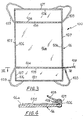
- the mattress cover accomplished by the process of the invention is globally indicated at 100 in Fig. 3. It comprises the wool fabric 16, made to the measure of the underlying mattress and fixed to the latter by the elastic laces 103 arranged at the corners of the wool fabric 16. Furthermore, elements of electrically conductive material consisting of wires, preferably copper wires, are arranged on said wool fabric in an original manner. In more detail, two copper wires 104 cross the wool fabric 16 and are disposed parallelly to each other. Wires 104 are integral to tapes 105 applied to the upward face 16a of the wool fabric 16 and are therefore in contact with the body of a sleeping person. Tapes 105 are engaged with the face 16a in any suitable manner.
- a further wire 10B substantially surrounds the wool fabric 16 and is disposed on the face 16a of the same, close to the borders thereof.
- the enclosing wire 106 is engaged by means of a whipstitching 107 which is the same used for finishing the borders of the wool fabric 16.
- the enclosing wire 106 is in contact with the ends of the transverse wires 104.
- a shunt 108 adapted to establish a grounding extends from the enclosing wire 106; it consists of wires too, preferably copper wires, incorporated with a tape.
- the tapes 105 connected to the transverse wires 104 lead off to the regions to which the elastic laces 103 are attached; it is also from one of said regions that the shunt 108 extends.
- Fig. 4 is a sectional view of one of said connection areas and particularly the one from which also the shunt 108 projects.
- a further original configuration of the mattress cover 100 consists in that the shunt 108 is but an extension of one of the transverse wires 104 together with its respective tape 105.
- the whipstitching 107 along the wool fabric borders also simultaneously engages each tape 105, each elastic lace 103, the shunt 108 and the enclosing wire 106.
- the dry fabric absorbs 19% of dampness by weight, which corresponds to 62.7 g of water per square meter. Thus it eliminates 70-80% of the body humidity and protects from outside dampness It also allows a considerable perspiration: it permits the passage of more than 200 I of air per minute, every 20 cm 2. Thus human toxins are eliminated and an excellent welfare condition is created.
- said mattress cover is fire-proof and shring-proof.
- this invention makes available a fabric capable of immediately ground discharging all the electrostatic energy carried by a sleeping person or formed as a consequence of the movements executed by that person while sleeping.
- relatively high electrostatic charges for example on the order of 40 nanocoulombs
- the contact with said fabric leads to an immediate ground discharge of the electrostatic charges.
- the residual electrostatic charges become stable on a substantially negligible residual level, equal to 2-3 nanocoulombs.
- the extremely positive effect of the mattress cover is not reduced if a sheet is disposed on said mattress cover: owing to the thinness of the sheet and to the normal perspiration or humidity produced by a person while sleeping the electrical contact can always be ensured.
- the structure thus obtained is particularly' strong and moreover the tapes partially aligned with the elastic laces act as a reinforcement to the fabric at the points in which the latter is tensioned by the elastic laces.
Landscapes
- Engineering & Computer Science (AREA)
- Textile Engineering (AREA)
- Mattresses And Other Support Structures For Chairs And Beds (AREA)
- Bedding Items (AREA)
- Woven Fabrics (AREA)
Claims (15)
Priority Applications (1)
| Application Number | Priority Date | Filing Date | Title |
|---|---|---|---|
| AT85830088T ATE49248T1 (de) | 1984-04-13 | 1985-04-12 | Wollgewebe und herstellungsverfahren. |
Applications Claiming Priority (5)
| Application Number | Priority Date | Filing Date | Title |
|---|---|---|---|
| IT20535/84A IT1176047B (it) | 1984-04-13 | 1984-04-13 | Procedimento di lavorazione di un tessuto in lana e prodotto realizzato |
| IT2053584 | 1984-04-13 | ||
| ITMI1984U21721U IT8421721U1 (it) | 1984-05-08 | 1984-05-08 | Dispositivo per regolare la posizione di organi avvolgitori in macchine montaboette. |
| IT2276084 | 1984-09-21 | ||
| IT22760/84A IT1176752B (it) | 1984-09-21 | 1984-09-21 | Tessuto per letto, in particolare copri materasso, atto a facilitare un riposo fisiologico e procedimento per realizzare lo stesso tessuto |
Publications (3)
| Publication Number | Publication Date |
|---|---|
| EP0170628A2 EP0170628A2 (de) | 1986-02-05 |
| EP0170628A3 EP0170628A3 (en) | 1987-10-14 |
| EP0170628B1 true EP0170628B1 (de) | 1990-01-03 |
Family
ID=27273073
Family Applications (1)
| Application Number | Title | Priority Date | Filing Date |
|---|---|---|---|
| EP85830088A Expired EP0170628B1 (de) | 1984-04-13 | 1985-04-12 | Wollgewebe und Herstellungsverfahren |
Country Status (3)
| Country | Link |
|---|---|
| US (1) | US4606290A (de) |
| EP (1) | EP0170628B1 (de) |
| DE (1) | DE3575170D1 (de) |
Families Citing this family (15)
| Publication number | Priority date | Publication date | Assignee | Title |
|---|---|---|---|---|
| ATE61071T1 (de) * | 1986-08-27 | 1991-03-15 | Burlington Industries Inc | Denimgewebe mit einem verwaschenen aussehen. |
| US4768252A (en) * | 1987-03-23 | 1988-09-06 | Ross Anthony J | Fitted sheet |
| US4825489A (en) * | 1987-09-21 | 1989-05-02 | Ross Anthony J | Fitted sheet |
| US5179992A (en) * | 1991-09-06 | 1993-01-19 | Okarski Steven E | Self contained removable sunshade for the exterior of curb-mounted skylights |
| US5138731A (en) * | 1991-10-11 | 1992-08-18 | Beverly A. Heron | Person movement assistance appliance |
| EP0596151B1 (de) * | 1992-11-03 | 1996-02-21 | Gerhard Heinrich Kuhangel | Bettbezug |
| FR2719755B1 (fr) * | 1994-05-11 | 1996-07-26 | Dumeste | Elément de couchage destiné à être placé sur un matelas d'une banquette convertible ou analogue. |
| US5651153A (en) * | 1995-10-24 | 1997-07-29 | Goodrich; Deborah J. | Water bed mattress sheet anchor system |
| US5860174A (en) * | 1996-12-03 | 1999-01-19 | Hausted, Inc. | Patient transfer mattress system |
| US6105188A (en) * | 1999-03-02 | 2000-08-22 | Perez-Mesa; Amelia | Nap-sac carrying pouch and child sleeping system |
| US6722000B1 (en) * | 2002-11-20 | 2004-04-20 | Product Concepts Residential Llc | Tip shearing carpet with moisture control |
| US7757340B2 (en) | 2005-03-25 | 2010-07-20 | S.C. Johnson & Son, Inc. | Soft-surface remediation device and method of using same |
| AT511224B1 (de) * | 2011-04-07 | 2013-04-15 | Manfred Amann | Schlafunterlage |
| US9167909B2 (en) | 2014-03-21 | 2015-10-27 | Carico International, Inc. | Mattress |
| US12446140B2 (en) * | 2022-01-05 | 2025-10-14 | Carico International, Llc | Grounded mattress |
Family Cites Families (15)
| Publication number | Priority date | Publication date | Assignee | Title |
|---|---|---|---|---|
| US668684A (en) * | 1900-08-04 | 1901-02-26 | George Kelly | Insulating and fireproof sheeting. |
| FR1409059A (fr) * | 1964-09-17 | 1965-08-20 | Appareil pour le rétablissement de l'équilibre électrostatique du corps humain | |
| GB1171990A (en) * | 1966-05-13 | 1969-11-26 | Canton Textile Mills | Mechanical Surface Texturing of Fabrics |
| FR1572883A (de) * | 1968-07-16 | 1969-06-27 | ||
| US4308304A (en) * | 1968-10-04 | 1981-12-29 | Cochran Ii William H | Antistatic tufted product |
| DE2021673A1 (de) * | 1970-05-02 | 1971-12-02 | Mueller Franz Fa | Schermaschine mit Scherstaubabsaugung und Dochtschmierung |
| DE2445737C3 (de) * | 1974-09-25 | 1978-04-27 | Th. Goldschmidt Ag, 4300 Essen | Elektrostatische Aufladungen ableitender Fußboden |
| US4078107A (en) * | 1976-06-28 | 1978-03-07 | Ppg Industries, Inc. | Lightweight window with heating circuit and anti-static circuit and a method for its preparation |
| DE2633416A1 (de) * | 1976-07-24 | 1978-01-26 | Sistig Kg Leo | Klopfverfahren, insbesondere fuer polware, vorrichtung zur durchfuehrung des verfahrens sowie verwendung der vorrichtung in einer schermaschine |
| US4074107A (en) * | 1976-10-19 | 1978-02-14 | The Raymond Lee Organization, Inc. | Comfort quilt |
| US4233701A (en) * | 1976-11-08 | 1980-11-18 | Fieldcrest Mills, Inc. | Napped bedding blanket |
| US4307144A (en) * | 1977-07-13 | 1981-12-22 | Badische Corporation | Static-dissipating fabrics |
| FR2436590B1 (fr) * | 1978-09-20 | 1985-10-31 | Weber Joseph | Protege-matelas |
| US4301577A (en) * | 1979-08-30 | 1981-11-24 | Bigelow-Sanford, Inc. | Process for treating tufted pile fabric |
| FR2478985A1 (fr) * | 1980-03-26 | 1981-10-02 | Vilette Jules | Perfectionnement aux articles de literie, tels que draps ou couvertures pour decharge de l'electricite statique du corps pendant le sommeil |
-
1985
- 1985-04-11 US US06/722,730 patent/US4606290A/en not_active Expired - Fee Related
- 1985-04-12 EP EP85830088A patent/EP0170628B1/de not_active Expired
- 1985-04-12 DE DE8585830088T patent/DE3575170D1/de not_active Expired - Lifetime
Also Published As
| Publication number | Publication date |
|---|---|
| DE3575170D1 (de) | 1990-02-08 |
| US4606290A (en) | 1986-08-19 |
| EP0170628A2 (de) | 1986-02-05 |
| EP0170628A3 (en) | 1987-10-14 |
Similar Documents
| Publication | Publication Date | Title |
|---|---|---|
| US4606290A (en) | Process for the manufacture of a wool fabric for beds, more particularly a mattress cover, and fabric obtained by said process | |
| EP1197722A2 (de) | Heizende/wärmende Textilartikel mit einer Phasenumwandlungskomponente | |
| CA2306029C (en) | Electric heating/warming fabric articles | |
| US5007125A (en) | Blanket having improved thermal characteristics in the portion covering the feet | |
| US2244097A (en) | Fibrous padding and method of making the same | |
| US4134167A (en) | Composite padding material | |
| US2392470A (en) | Thermal fabric | |
| US2107598A (en) | Rug or carpet | |
| US1736590A (en) | Electrically-heated belt and the like | |
| JPH0670833A (ja) | 生地糸を製織してなる布団皮及び布団 | |
| US2249110A (en) | Ironing board | |
| CA1165363A (en) | Electric heating appliance and method of making same | |
| US2593373A (en) | Resilient and heat-resistant blanket | |
| US3307207A (en) | Insulator for mattresses, seats, or the like | |
| US3011198A (en) | Mop swab | |
| US2198620A (en) | Pad for pressing machines | |
| US2125603A (en) | Padding for pressing devices | |
| US1636471A (en) | Ironing roll | |
| US2264731A (en) | Ironer padding | |
| US2835056A (en) | Padding for garment pressing machines, home ironers, mangles or the like | |
| US3524965A (en) | Electric heating element for apparel | |
| US3377231A (en) | Needled textile laminates and method for producing same | |
| US2973425A (en) | Electrically warmed mats or matting | |
| US2485072A (en) | Heat-treating fabric | |
| CN119423437B (zh) | 一种服装收省的平服保型方法 |
Legal Events
| Date | Code | Title | Description |
|---|---|---|---|
| PUAI | Public reference made under article 153(3) epc to a published international application that has entered the european phase |
Free format text: ORIGINAL CODE: 0009012 |
|
| AK | Designated contracting states |
Kind code of ref document: A2 Designated state(s): AT BE CH DE FR GB LI LU NL SE |
|
| 17P | Request for examination filed |
Effective date: 19860303 |
|
| PUAL | Search report despatched |
Free format text: ORIGINAL CODE: 0009013 |
|
| RHK1 | Main classification (correction) |
Ipc: D06C 27/00 |
|
| AK | Designated contracting states |
Kind code of ref document: A3 Designated state(s): AT BE CH DE FR GB LI LU NL SE |
|
| 17Q | First examination report despatched |
Effective date: 19890120 |
|
| GRAA | (expected) grant |
Free format text: ORIGINAL CODE: 0009210 |
|
| AK | Designated contracting states |
Kind code of ref document: B1 Designated state(s): AT BE CH DE FR GB LI LU NL SE |
|
| PG25 | Lapsed in a contracting state [announced via postgrant information from national office to epo] |
Ref country code: SE Effective date: 19900103 Ref country code: NL Effective date: 19900103 Ref country code: LI Effective date: 19900103 Ref country code: FR Free format text: THE PATENT HAS BEEN ANNULLED BY A DECISION OF A NATIONAL AUTHORITY Effective date: 19900103 Ref country code: CH Effective date: 19900103 Ref country code: BE Effective date: 19900103 Ref country code: AT Effective date: 19900103 |
|
| REF | Corresponds to: |
Ref document number: 49248 Country of ref document: AT Date of ref document: 19900115 Kind code of ref document: T |
|
| REF | Corresponds to: |
Ref document number: 3575170 Country of ref document: DE Date of ref document: 19900208 |
|
| PG25 | Lapsed in a contracting state [announced via postgrant information from national office to epo] |
Ref country code: GB Effective date: 19900412 |
|
| REG | Reference to a national code |
Ref country code: CH Ref legal event code: PL |
|
| EN | Fr: translation not filed | ||
| NLV1 | Nl: lapsed or annulled due to failure to fulfill the requirements of art. 29p and 29m of the patents act | ||
| PLBE | No opposition filed within time limit |
Free format text: ORIGINAL CODE: 0009261 |
|
| STAA | Information on the status of an ep patent application or granted ep patent |
Free format text: STATUS: NO OPPOSITION FILED WITHIN TIME LIMIT |
|
| GBPC | Gb: european patent ceased through non-payment of renewal fee | ||
| 26N | No opposition filed | ||
| PGFP | Annual fee paid to national office [announced via postgrant information from national office to epo] |
Ref country code: LU Payment date: 19910628 Year of fee payment: 7 |
|
| EPTA | Lu: last paid annual fee | ||
| PG25 | Lapsed in a contracting state [announced via postgrant information from national office to epo] |
Ref country code: LU Free format text: LAPSE BECAUSE OF NON-PAYMENT OF DUE FEES Effective date: 19920412 |
|
| PGFP | Annual fee paid to national office [announced via postgrant information from national office to epo] |
Ref country code: DE Payment date: 19930421 Year of fee payment: 9 |
|
| PG25 | Lapsed in a contracting state [announced via postgrant information from national office to epo] |
Ref country code: DE Effective date: 19950103 |