EP0171106A1 - Verfahren zur Erwerbung von einer wasserunlöslichen organischen Stickstoffbase, aus wasserlöslichem Hydrochlorhydrat dieser Base und ein Verfahren zur Fabrikation von Natrium-Bicarbonat - Google Patents
Verfahren zur Erwerbung von einer wasserunlöslichen organischen Stickstoffbase, aus wasserlöslichem Hydrochlorhydrat dieser Base und ein Verfahren zur Fabrikation von Natrium-Bicarbonat Download PDFInfo
- Publication number
- EP0171106A1 EP0171106A1 EP85201090A EP85201090A EP0171106A1 EP 0171106 A1 EP0171106 A1 EP 0171106A1 EP 85201090 A EP85201090 A EP 85201090A EP 85201090 A EP85201090 A EP 85201090A EP 0171106 A1 EP0171106 A1 EP 0171106A1
- Authority
- EP
- European Patent Office
- Prior art keywords
- organic
- hydrochloride
- basic agent
- water
- amine
- Prior art date
- Legal status (The legal status is an assumption and is not a legal conclusion. Google has not performed a legal analysis and makes no representation as to the accuracy of the status listed.)
- Granted
Links
- 238000000034 method Methods 0.000 title claims abstract description 42
- XLYOFNOQVPJJNP-UHFFFAOYSA-N water Substances O XLYOFNOQVPJJNP-UHFFFAOYSA-N 0.000 title claims abstract description 26
- 238000004519 manufacturing process Methods 0.000 title claims abstract description 13
- UIIMBOGNXHQVGW-UHFFFAOYSA-M Sodium bicarbonate Chemical compound [Na+].OC([O-])=O UIIMBOGNXHQVGW-UHFFFAOYSA-M 0.000 title claims description 36
- 235000017557 sodium bicarbonate Nutrition 0.000 title claims description 18
- 229910000030 sodium bicarbonate Inorganic materials 0.000 title claims description 18
- 125000001477 organic nitrogen group Chemical group 0.000 title 1
- 239000003795 chemical substances by application Substances 0.000 claims abstract description 39
- VEXZGXHMUGYJMC-UHFFFAOYSA-N Hydrochloric acid Chemical compound Cl VEXZGXHMUGYJMC-UHFFFAOYSA-N 0.000 claims abstract description 32
- -1 nitrogenous organic base Chemical class 0.000 claims abstract description 31
- 239000008346 aqueous phase Substances 0.000 claims abstract description 26
- 239000012074 organic phase Substances 0.000 claims abstract description 11
- 230000000295 complement effect Effects 0.000 claims abstract description 10
- 230000002950 deficient Effects 0.000 claims abstract description 7
- 239000000243 solution Substances 0.000 claims description 40
- 150000001412 amines Chemical class 0.000 claims description 31
- 239000002585 base Substances 0.000 claims description 21
- HEMHJVSKTPXQMS-UHFFFAOYSA-M Sodium hydroxide Chemical compound [OH-].[Na+] HEMHJVSKTPXQMS-UHFFFAOYSA-M 0.000 claims description 19
- FAPWRFPIFSIZLT-UHFFFAOYSA-M Sodium chloride Chemical compound [Na+].[Cl-] FAPWRFPIFSIZLT-UHFFFAOYSA-M 0.000 claims description 18
- 239000000203 mixture Substances 0.000 claims description 18
- 239000007864 aqueous solution Substances 0.000 claims description 17
- CURLTUGMZLYLDI-UHFFFAOYSA-N Carbon dioxide Chemical compound O=C=O CURLTUGMZLYLDI-UHFFFAOYSA-N 0.000 claims description 16
- QJGQUHMNIGDVPM-UHFFFAOYSA-N nitrogen group Chemical group [N] QJGQUHMNIGDVPM-UHFFFAOYSA-N 0.000 claims description 13
- 239000003960 organic solvent Substances 0.000 claims description 12
- 239000007900 aqueous suspension Substances 0.000 claims description 11
- 238000010908 decantation Methods 0.000 claims description 9
- 239000011780 sodium chloride Substances 0.000 claims description 9
- 239000000920 calcium hydroxide Substances 0.000 claims description 8
- 229910001861 calcium hydroxide Inorganic materials 0.000 claims description 8
- 239000001569 carbon dioxide Substances 0.000 claims description 8
- 229910002092 carbon dioxide Inorganic materials 0.000 claims description 8
- 150000004679 hydroxides Chemical class 0.000 claims description 6
- 239000007787 solid Substances 0.000 claims description 6
- 125000004432 carbon atom Chemical group C* 0.000 claims description 5
- 229910052784 alkaline earth metal Inorganic materials 0.000 claims description 4
- 150000003973 alkyl amines Chemical class 0.000 claims description 4
- AXCZMVOFGPJBDE-UHFFFAOYSA-L calcium dihydroxide Chemical compound [OH-].[OH-].[Ca+2] AXCZMVOFGPJBDE-UHFFFAOYSA-L 0.000 claims description 4
- 239000012071 phase Substances 0.000 claims description 4
- 239000011541 reaction mixture Substances 0.000 claims description 4
- 239000013589 supplement Substances 0.000 claims description 4
- UIIMBOGNXHQVGW-DEQYMQKBSA-M Sodium bicarbonate-14C Chemical compound [Na+].O[14C]([O-])=O UIIMBOGNXHQVGW-DEQYMQKBSA-M 0.000 claims description 3
- 150000001342 alkaline earth metals Chemical class 0.000 claims description 3
- VTYYLEPIZMXCLO-UHFFFAOYSA-L calcium carbonate Substances [Ca+2].[O-]C([O-])=O VTYYLEPIZMXCLO-UHFFFAOYSA-L 0.000 claims description 3
- 150000004649 carbonic acid derivatives Chemical class 0.000 claims description 3
- 239000012452 mother liquor Substances 0.000 claims description 3
- 229910000019 calcium carbonate Inorganic materials 0.000 claims description 2
- 239000012429 reaction media Substances 0.000 claims description 2
- BVKZGUZCCUSVTD-UHFFFAOYSA-L Carbonate Chemical compound [O-]C([O-])=O BVKZGUZCCUSVTD-UHFFFAOYSA-L 0.000 claims 1
- 229910001854 alkali hydroxide Inorganic materials 0.000 claims 1
- 229910000272 alkali metal oxide Inorganic materials 0.000 claims 1
- 230000005484 gravity Effects 0.000 abstract description 5
- 238000000926 separation method Methods 0.000 abstract description 4
- 239000007789 gas Substances 0.000 description 10
- 239000007788 liquid Substances 0.000 description 8
- OYPRJOBELJOOCE-UHFFFAOYSA-N Calcium Chemical compound [Ca] OYPRJOBELJOOCE-UHFFFAOYSA-N 0.000 description 6
- 238000002425 crystallisation Methods 0.000 description 6
- 230000008025 crystallization Effects 0.000 description 6
- 150000001875 compounds Chemical class 0.000 description 5
- QGZKDVFQNNGYKY-UHFFFAOYSA-N Ammonia Chemical compound N QGZKDVFQNNGYKY-UHFFFAOYSA-N 0.000 description 4
- NLXLAEXVIDQMFP-UHFFFAOYSA-N Ammonia chloride Chemical group [NH4+].[Cl-] NLXLAEXVIDQMFP-UHFFFAOYSA-N 0.000 description 4
- TWRXJAOTZQYOKJ-UHFFFAOYSA-L Magnesium chloride Chemical compound [Mg+2].[Cl-].[Cl-] TWRXJAOTZQYOKJ-UHFFFAOYSA-L 0.000 description 4
- ZLMJMSJWJFRBEC-UHFFFAOYSA-N Potassium Chemical compound [K] ZLMJMSJWJFRBEC-UHFFFAOYSA-N 0.000 description 4
- 239000001110 calcium chloride Substances 0.000 description 4
- 229910001628 calcium chloride Inorganic materials 0.000 description 4
- 238000006243 chemical reaction Methods 0.000 description 4
- 238000009434 installation Methods 0.000 description 4
- VTHJTEIRLNZDEV-UHFFFAOYSA-L magnesium dihydroxide Chemical compound [OH-].[OH-].[Mg+2] VTHJTEIRLNZDEV-UHFFFAOYSA-L 0.000 description 4
- 239000000347 magnesium hydroxide Substances 0.000 description 4
- 229910001862 magnesium hydroxide Inorganic materials 0.000 description 4
- 150000003141 primary amines Chemical class 0.000 description 4
- 239000002904 solvent Substances 0.000 description 4
- AAIUWVOMXTVLRG-UHFFFAOYSA-N 8,8-dimethylnonan-1-amine Chemical compound CC(C)(C)CCCCCCCN AAIUWVOMXTVLRG-UHFFFAOYSA-N 0.000 description 3
- UXVMQQNJUSDDNG-UHFFFAOYSA-L Calcium chloride Chemical compound [Cl-].[Cl-].[Ca+2] UXVMQQNJUSDDNG-UHFFFAOYSA-L 0.000 description 3
- OKTJSMMVPCPJKN-UHFFFAOYSA-N Carbon Chemical compound [C] OKTJSMMVPCPJKN-UHFFFAOYSA-N 0.000 description 3
- ZMANZCXQSJIPKH-UHFFFAOYSA-N Triethylamine Chemical compound CCN(CC)CC ZMANZCXQSJIPKH-UHFFFAOYSA-N 0.000 description 3
- 229910052799 carbon Inorganic materials 0.000 description 3
- 238000005868 electrolysis reaction Methods 0.000 description 3
- 150000007529 inorganic bases Chemical class 0.000 description 3
- 235000015497 potassium bicarbonate Nutrition 0.000 description 3
- 229910000028 potassium bicarbonate Inorganic materials 0.000 description 3
- 239000011736 potassium bicarbonate Substances 0.000 description 3
- 230000008929 regeneration Effects 0.000 description 3
- 238000011069 regeneration method Methods 0.000 description 3
- 229920006395 saturated elastomer Polymers 0.000 description 3
- 235000008733 Citrus aurantifolia Nutrition 0.000 description 2
- CTQNGGLPUBDAKN-UHFFFAOYSA-N O-Xylene Chemical compound CC1=CC=CC=C1C CTQNGGLPUBDAKN-UHFFFAOYSA-N 0.000 description 2
- 235000011941 Tilia x europaea Nutrition 0.000 description 2
- 229910052782 aluminium Inorganic materials 0.000 description 2
- XAGFODPZIPBFFR-UHFFFAOYSA-N aluminium Chemical compound [Al] XAGFODPZIPBFFR-UHFFFAOYSA-N 0.000 description 2
- 229910021529 ammonia Inorganic materials 0.000 description 2
- 235000019270 ammonium chloride Nutrition 0.000 description 2
- 150000001491 aromatic compounds Chemical class 0.000 description 2
- 238000005119 centrifugation Methods 0.000 description 2
- 230000001143 conditioned effect Effects 0.000 description 2
- 239000013078 crystal Substances 0.000 description 2
- IXCSERBJSXMMFS-UHFFFAOYSA-N hydrogen chloride Substances Cl.Cl IXCSERBJSXMMFS-UHFFFAOYSA-N 0.000 description 2
- 229910000041 hydrogen chloride Inorganic materials 0.000 description 2
- 239000004571 lime Substances 0.000 description 2
- 229910001629 magnesium chloride Inorganic materials 0.000 description 2
- 238000005065 mining Methods 0.000 description 2
- 238000002156 mixing Methods 0.000 description 2
- 150000007530 organic bases Chemical class 0.000 description 2
- 238000012827 research and development Methods 0.000 description 2
- 239000000126 substance Substances 0.000 description 2
- 239000008096 xylene Substances 0.000 description 2
- HYFLWBNQFMXCPA-UHFFFAOYSA-N 1-ethyl-2-methylbenzene Chemical class CCC1=CC=CC=C1C HYFLWBNQFMXCPA-UHFFFAOYSA-N 0.000 description 1
- DGAQECJNVWCQMB-PUAWFVPOSA-M Ilexoside XXIX Chemical compound C[C@@H]1CC[C@@]2(CC[C@@]3(C(=CC[C@H]4[C@]3(CC[C@@H]5[C@@]4(CC[C@@H](C5(C)C)OS(=O)(=O)[O-])C)C)[C@@H]2[C@]1(C)O)C)C(=O)O[C@H]6[C@@H]([C@H]([C@@H]([C@H](O6)CO)O)O)O.[Na+] DGAQECJNVWCQMB-PUAWFVPOSA-M 0.000 description 1
- 238000010521 absorption reaction Methods 0.000 description 1
- 150000007824 aliphatic compounds Chemical class 0.000 description 1
- 239000003513 alkali Substances 0.000 description 1
- 229910052783 alkali metal Inorganic materials 0.000 description 1
- 150000001340 alkali metals Chemical class 0.000 description 1
- 239000002152 aqueous-organic solution Substances 0.000 description 1
- OCKPCBLVNKHBMX-UHFFFAOYSA-N butylbenzene Chemical class CCCCC1=CC=CC=C1 OCKPCBLVNKHBMX-UHFFFAOYSA-N 0.000 description 1
- 239000006227 byproduct Substances 0.000 description 1
- 238000001354 calcination Methods 0.000 description 1
- 239000003153 chemical reaction reagent Substances 0.000 description 1
- 238000000354 decomposition reaction Methods 0.000 description 1
- 230000006735 deficit Effects 0.000 description 1
- 238000010586 diagram Methods 0.000 description 1
- 238000001914 filtration Methods 0.000 description 1
- 238000000265 homogenisation Methods 0.000 description 1
- 229930195733 hydrocarbon Natural products 0.000 description 1
- 150000002430 hydrocarbons Chemical class 0.000 description 1
- 150000003840 hydrochlorides Chemical class 0.000 description 1
- XLYOFNOQVPJJNP-UHFFFAOYSA-M hydroxide Chemical compound [OH-] XLYOFNOQVPJJNP-UHFFFAOYSA-M 0.000 description 1
- 150000002466 imines Chemical class 0.000 description 1
- 239000012535 impurity Substances 0.000 description 1
- 239000011261 inert gas Substances 0.000 description 1
- 239000012528 membrane Substances 0.000 description 1
- QSHDDOUJBYECFT-UHFFFAOYSA-N mercury Chemical compound [Hg] QSHDDOUJBYECFT-UHFFFAOYSA-N 0.000 description 1
- 229910052753 mercury Inorganic materials 0.000 description 1
- 230000035699 permeability Effects 0.000 description 1
- 239000001103 potassium chloride Substances 0.000 description 1
- 235000011164 potassium chloride Nutrition 0.000 description 1
- WCUXLLCKKVVCTQ-UHFFFAOYSA-M potassium chloride Inorganic materials [Cl-].[K+] WCUXLLCKKVVCTQ-UHFFFAOYSA-M 0.000 description 1
- 239000000047 product Substances 0.000 description 1
- 150000003242 quaternary ammonium salts Chemical class 0.000 description 1
- 238000011084 recovery Methods 0.000 description 1
- 150000003335 secondary amines Chemical class 0.000 description 1
- 239000002002 slurry Substances 0.000 description 1
- 229910052708 sodium Inorganic materials 0.000 description 1
- 239000011734 sodium Substances 0.000 description 1
- KKCBUQHMOMHUOY-UHFFFAOYSA-N sodium oxide Chemical compound [O-2].[Na+].[Na+] KKCBUQHMOMHUOY-UHFFFAOYSA-N 0.000 description 1
- 229910001948 sodium oxide Inorganic materials 0.000 description 1
- UIIMBOGNXHQVGW-UHFFFAOYSA-N sodium;hydron;carbonate Chemical compound [Na+].OC(O)=O UIIMBOGNXHQVGW-UHFFFAOYSA-N 0.000 description 1
- 238000003756 stirring Methods 0.000 description 1
- 239000000725 suspension Substances 0.000 description 1
- 150000003512 tertiary amines Chemical class 0.000 description 1
Images
Classifications
-
- C—CHEMISTRY; METALLURGY
- C01—INORGANIC CHEMISTRY
- C01D—COMPOUNDS OF ALKALI METALS, i.e. LITHIUM, SODIUM, POTASSIUM, RUBIDIUM, CAESIUM, OR FRANCIUM
- C01D7/00—Carbonates of sodium, potassium or alkali metals in general
- C01D7/16—Preparation from compounds of sodium or potassium with amines and carbon dioxide
-
- Y—GENERAL TAGGING OF NEW TECHNOLOGICAL DEVELOPMENTS; GENERAL TAGGING OF CROSS-SECTIONAL TECHNOLOGIES SPANNING OVER SEVERAL SECTIONS OF THE IPC; TECHNICAL SUBJECTS COVERED BY FORMER USPC CROSS-REFERENCE ART COLLECTIONS [XRACs] AND DIGESTS
- Y02—TECHNOLOGIES OR APPLICATIONS FOR MITIGATION OR ADAPTATION AGAINST CLIMATE CHANGE
- Y02P—CLIMATE CHANGE MITIGATION TECHNOLOGIES IN THE PRODUCTION OR PROCESSING OF GOODS
- Y02P20/00—Technologies relating to chemical industry
- Y02P20/141—Feedstock
Definitions
- the invention relates to a process for obtaining a nitrogenous organic base insoluble in water, for example an amine, starting from a hydrochloride of said base. It relates more particularly to such a process in which the hydrochloride of the organic base to be produced is water-soluble.
- a technique for the manufacture of potassium or sodium bicarbonate according to which an aqueous solution of potassium or sodium chloride and an organic solution of an amine insoluble in water are mixed, the resulting mixture is treated with a gas. containing carbon dioxide, then subjected to decantation to separate an aqueous suspension of potassium or sodium bicarbonate, which is collected, and an organic solution of amine hydrochloride (GB-A-1082436 patent (KAISER ALUMINUM & CHEMICAL CORPORATION), page 2, lines 105 to 125; patent IL-A-33 551 (IMI (TAMI) INSTITUTE FOR RESEARCH AND DEVELOPMENT); Central Patents Index, Basic Abstracts Journal, Section E, Week T.49, Derwent Publication Ltd., London, abstract 78430T-E: Patent Application JP-A-7241237 (Israel Mining Inds. Inst. Res. & Dev.)).
- a technique for the production of ammonia by decomposition of ammonium chloride according to which an aqueous solution of ammonium chloride is mixed with an organic solution of an amine insoluble in water and a circulation is carried out. inert gas or carbon dioxide through the resulting mixture to evacuate the ammonia produced (Central Patents Index, Basic Abstracts Journal, Section E, Week E / 14, ⁇ Derwent Publication Ltd, London (Great Britain), abridged 26992E / 14: patent application JP-A-57034020 (TOYO SODA MFG KK)).
- an organic solution of amine hydrochloride is collected, as a by-product, which it is desirable to treat in order to regenerate the amine.
- an amine regeneration process is usually carried out, according to which the organic solution of amine hydrochloride is mixed with an aqueous suspension of calcium or magnesium hydroxide, and an organic solution is collected separately.
- the volume of the treated liquids mainly that of the aqueous suspension of calcium or magnesium hydroxide, is therefore large, which causes difficulties and constitutes a disadvantage.
- the invention overcomes these difficulties by providing a process for the regeneration of a nitrogenous organic base insoluble in water, starting from a water-soluble hydrochloride of said base, in which the volume of liquids present is reduced and the quantity of the above solid residue is greatly reduced or even eliminated.
- the invention relates to a process for obtaining a nitrogenous organic base insoluble in water from a water-soluble hydrochloride of said base, according to which the hydrochloride is treated with water and a basic agent. capable of decomposing it, and an aqueous phase and an organic phase are separated from the resulting reaction mixture; according to the invention, an amount of basic agent is used, which is deficient compared to that necessary to decompose all of the hydrochloride, and the aqueous phase is treated with a supplement of basic agent.
- the organic nitrogenous base is, by definition, any organic nitrogenous reagent which is insoluble in water and which has a basic character sufficient to react with hydrogen chloride to form the hydrochloride of the base , the said hydrochloride being water-soluble.
- insoluble in water is understood to mean that the solubility of the nitrogenous organic base in water does not exceed 2% by weight of solution, preferably 1%.
- water-soluble is meant that the hydrochloride of the organic nitrogenous base is capable of forming aqueous solutions containing at least 0.5 g of hydrochloride of the base per kg, for example between 1 and 100 g per kg.
- the basic agent has the function of breaking down the hydrochloride to produce the organic nitrogenous base. It must be chosen so that the products of its reaction with the hydrochloride are the organic nitrogenous base and compounds immiscible with it.
- Water is intended for the evacuation of these immiscible compounds. It must be used in an amount sufficient to form with these compounds an aqueous phase which is easily separated, for example by decantation, from the organic phase comprising the base to be produced.
- the basic agent from those for which the above-mentioned immiscible compounds are water-soluble and then an amount of water sufficient to dissolve them is used.
- Inorganic basic agents are especially suitable, such as the oxides, hydroxides and carbonates of alkali and alkaline earth metals. Among these, calcium hydroxide and calcium carbonate are preferred.
- the reaction mixture collected at the end of the treatment with the basic agent comprises two immiscible phases, one of which is an organic phase comprising the organic nitrogenous base to be produced and the other is an aqueous phase.
- an organic phase comprising the organic nitrogenous base to be produced
- the other is an aqueous phase.
- the basic agent is used in an amount which is deficient compared to that necessary to decompose all of the hydrochloride.
- the aqueous phase collected at the end of the treatment with the basic agent contains, in the dissolved state, at least part of the non-decomposed hydrochloride.
- the aqueous phase is treated with a supplement of basic agent, the role of which is to decompose the hydrochloride which it contains.
- the complement of basic agent can be any base capable of decomposing the hydrochloride by producing the organic nitrogenous base and residual compounds immiscible with the organic nitrogenous base. It is preferably selected from strong inorganic bases, especially those whose pH is at least equal to 11, preferably greater than 12.
- inorganic bases very suitable for the complement of basic agent are the carbonates, oxides and hydroxides of alkali metals and the oxides and hydroxides of alkaline earth metals; water-soluble inorganic bases are preferred, especially sodium oxide and hydroxide.
- the complement of basic agent selected is an inorganic water-soluble base, this can advantageously be used in the form of an aqueous solution.
- the optimum deficit to be achieved in basic agent depends on various factors, in particular on the nature and the volume of the organic base to be produced, on the nature of the basic agent, on the amount of water installation and design of the installation. It must therefore be determined in each particular case according to the circumstances.
- the quantity by weight of basic agent used is between 50 and 98% of the weight strictly necessary to decompose all of the hydrochloride. Weight quantities of between 60 and 90% of this weight are usually suitable; those between 70 and 85% are preferred.
- the complement of basic agent is used in an amount sufficient to decompose most, and preferably all, of the hydrochloride of the aqueous phase.
- the organic nitrogenous base formed is separated from it. This separation can usually be carried out without difficulty by means of gravity settling or by centrifugation.
- the organic nitrogenous base is diluted in a solvent to facilitate its recovery by decantation.
- the choice of the nature and the quantity of solvent to be used is conditioned by the need for it to form, with the nitrogenous organic base, a solution whose viscosity does not prevent effective decantation.
- an organic solvent is preferably chosen which, at working temperature, has a viscosity which does not exceed 3 centipoise and preferably 1 centipoise.
- preference is given to low-volatile organic solvents, having a flash point above the working temperature.
- the choice of organic solvent can also be conditioned by the destination of the nitrogenous organic base.
- an organic solvent which, in addition to the properties mentioned above, has a high absorption speed of carbon dioxide at moderate temperature, generally less than 100 ° C and more particularly between 15 and 70 ° C.
- An organic solvent is preferably used for which the organic solution containing the organic nitrogenous base has a specific gravity lower than that of the aqueous phase.
- a solvent is advantageously chosen such that the difference between the specific weight of the aqueous phase and that of the organic solution is at least equal to 5% of the specific weight of said organic solution, and preferably greater than 30% of this specific weight.
- the process according to the invention is preferably carried out at low temperature, generally at a temperature below 60 ° C, preferably between 15 and 40 ° C.
- the organic solvent can advantageously be selected from hydrocarbons, in a quantity adjusted so that the organic solution contains approximately 25 to 75% by weight of organic nitrogenous base.
- organic solvents which can be used in the context of the invention are xylene, butylbenzenes, methylethylbenzenes and more particularly white spirit and commercial solvents known under the brands ISOPAR (Esso) which is a mixture of isoparaffins, SOLVESSO (Esso) which is a mixture of aromatic compounds, SHELLSOL AB (Shell) which is a mixture of aromatic compounds and SHELLSOL K which is a mixture of aliphatic compounds.
- ISOPAR Esso
- SOLVESSO Esso
- SHELLSOL AB Shell
- SHELLSOL K which is a mixture of aliphatic compounds.
- the organic solvent must generally be introduced in two successive stages. In a first step, it is introduced before the separation of the aqueous and organic phases, which follows the treatment with the basic agent; in the second step, it is mixed with the aqueous phase separated from the organic phase.
- the process according to the invention applies, in general, to all the nitrogenous organic bases which are insoluble in water, as defined above, and which are capable of forming with hydrogen chloride, hydrochlorides water-soluble organic; it applies particularly well to obtaining nitrogenous organic bases whose solubility in water does not exceed 0.5% by weight, and especially to those whose solubility in water is less than 0.05 % in weight. It applies for example to imines and their derivatives, to quaternary ammonium salts and to amines and their derivatives.
- the process according to the invention is applicable equally to the manufacture of primary, secondary or tertiary amines.
- the invention therefore also relates to a process for the manufacture of sodium bicarbonate, according to which a mixture is formed with an aqueous solution of sodium chloride and an organic solution of an amine insoluble in water, the resulting mixture is treated with a gas containing carbon dioxide to form an aqueous suspension of sodium bicarbonate and an organic solution of amine hydrochloride, the aqueous suspension of sodium bicarbonate is treated to separate the solid sodium bicarbonate it contains and a mother liquor, the organic solution of amine hydrochloride is treated with water and a basic agent capable of decomposing the hydrochloride, an aqueous phase and an organic amine phase are separated from the reaction medium, and the organic phase is recycled to the above mixture; according to the invention, an amount of basic agent is used which is deficient compared to that necessary to decompose all of the hydrochloride of the organic amine hydrochloride solution, the aqueous phase is treated with an additional agent basic, the resulting amine is collected and recycled to the above mixture.
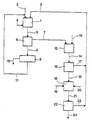
- the installation shown in the figure comprises a crystallization chamber 1 which is supplied, continuously, with a substantially saturated aqueous solution of sodium chloride 2, an organic solution of primary amine 3 insoluble in the aqueous solution of sodium chloride and a gas containing carbon dioxide.
- the organic solution of primary amine can for example be a solution at 50% by weight in xylene, of the amine PRIMENE 81R (Rohm & Haas), which is a primary alkylamine comprising between 12 and 14 carbon atoms in its molecule.
- the gas 4 is preferably an enriched gas, containing 60 to 80% by weight of carbon dioxide, obtained for example by mixing in adequate proportions a lime gas with a residual gas from the calcination of sodium bicarbonate into monocarbonate of sodium.
- the amount of gas used must be sufficient to convert a substantial part of the sodium chloride of solution 2 into sodium bicarbonate.
- the treatment in the crystallization chamber 1 can be preceded by a partial carbonation of the mixture by means of a gas poor in carbon dioxide, such as a lime kiln gas.
- a liquid 5 consisting of a mixture of aqueous solution and organic solution and containing crystals of sodium bicarbonate in suspension.
- This liquid 5 is transferred to a settling chamber 6, where an organic solution of amine hydrochloride 7 and an aqueous slurry 8 of sodium bicarbonate crystals are separated by gravity.
- the latter is sent to a wringing or filtration device 9, where solid sodium bicarbonate 10 and mother liquor 11 are collected separately.
- the latter is saturated with sodium bicarbonate; it can advantageously be recycled in the crystallization chamber 1.
- the organic solution of amine hydrochloride 7 is sent to a reaction chamber 12 where it is subjected to stirring with an aqueous suspension of calcium hydroxide 13 and the resulting mixture 14 is sent to a decantation chamber 15, from which an organic amine solution 17 is collected separately, on the one hand, which is recycled to the crystallization chamber 1 and, on the other hand, a residual liquid 16 comprising an aqueous solution of calcium chloride.
- the aqueous suspension of calcium hydroxide 13 is used in a quantity which is deficient compared to that which is necessary to decompose all of the amine hydrochloride contained in the organic solution 7.
- the residual liquid 16 contains the sort of dissolved amine hydrochloride. It is sent to a reaction chamber 18, where it is mixed with an aqueous sodium hydroxide solution 19 and with an organic solvent 20.
- the reaction mixture 21 is sent to a decantation chamber 22, from which it is collected separately , on the one hand, an organic amine solution 23 which is recycled in the crystallization chamber 1 and, on the other hand, a residual liquid 24 which is discarded.
- the aqueous sodium hydroxide solution is preferably used in an amount sufficient to decompose all of the amine hydrochloride contained in the liquid 16. It consists advantageously in an aqueous solution containing between 30 and 60% by weight of sodium hydroxide, obtained by electrolysis of an aqueous solution of sodium chloride in an electrolysis cell with mercury or a membrane with selective permeability. Alternatively, it can also consist of an aqueous solution containing between 10 and 20% by weight of sodium hydroxide and between 10 and 20% of sodium chloride, obtained by electrolysis of an aqueous solution of sodium chloride in a cell diaphragm.
- the function of the organic solvent 20 is to dissolve the amine formed in the reaction chamber 18. It is chosen to be identical to that of the organic solution of amine 3.
Landscapes
- Chemical & Material Sciences (AREA)
- Organic Chemistry (AREA)
- Chemical Kinetics & Catalysis (AREA)
- Engineering & Computer Science (AREA)
- Materials Engineering (AREA)
- Inorganic Chemistry (AREA)
- Organic Low-Molecular-Weight Compounds And Preparation Thereof (AREA)
- Saccharide Compounds (AREA)
- Solid-Sorbent Or Filter-Aiding Compositions (AREA)
Priority Applications (1)
| Application Number | Priority Date | Filing Date | Title |
|---|---|---|---|
| AT85201090T ATE34380T1 (de) | 1984-07-17 | 1985-07-05 | Verfahren zur erwerbung von einer wasserunloeslichen organischen stickstoffbase, aus wasserloeslichem hydrochlorhydrat dieser base und ein verfahren zur fabrikation von natrium- bicarbonat. |
Applications Claiming Priority (2)
| Application Number | Priority Date | Filing Date | Title |
|---|---|---|---|
| FR8411425 | 1984-07-17 | ||
| FR8411425A FR2567879B1 (fr) | 1984-07-17 | 1984-07-17 | Procede pour l'obtention d'une base organique azotee insoluble dans l'eau, au depart d'un chlorhydrate hydrosoluble de ladite base et procede de fabrication de bicarbonate de sodium |
Publications (2)
| Publication Number | Publication Date |
|---|---|
| EP0171106A1 true EP0171106A1 (de) | 1986-02-12 |
| EP0171106B1 EP0171106B1 (de) | 1988-05-18 |
Family
ID=9306265
Family Applications (1)
| Application Number | Title | Priority Date | Filing Date |
|---|---|---|---|
| EP85201090A Expired EP0171106B1 (de) | 1984-07-17 | 1985-07-05 | Verfahren zur Erwerbung von einer wasserunlöslichen organischen Stickstoffbase, aus wasserlöslichem Hydrochlorhydrat dieser Base und ein Verfahren zur Fabrikation von Natrium-Bicarbonat |
Country Status (4)
| Country | Link |
|---|---|
| EP (1) | EP0171106B1 (de) |
| AT (1) | ATE34380T1 (de) |
| DE (1) | DE3562771D1 (de) |
| FR (1) | FR2567879B1 (de) |
Cited By (2)
| Publication number | Priority date | Publication date | Assignee | Title |
|---|---|---|---|---|
| FR2605891A1 (fr) * | 1986-11-05 | 1988-05-06 | Solvay | Procede pour l'extraction d'un liquide organique comprenant une base organique azotee, hors d'un brouet aqueux de particules de matiere minerale et procede pour la production de bicarbonate de metal alcalin |
| EP0726229A1 (de) * | 1995-02-10 | 1996-08-14 | Penrice Pty Ltd | Herstellung von Alkalimetallbikarbonaten und -karbonaten |
Citations (1)
| Publication number | Priority date | Publication date | Assignee | Title |
|---|---|---|---|---|
| GB1082436A (en) * | 1964-08-17 | 1967-09-06 | Kaiser Aluminium Chem Corp | Improvements in or relating to the preparation of metal salts |
-
1984
- 1984-07-17 FR FR8411425A patent/FR2567879B1/fr not_active Expired
-
1985
- 1985-07-05 EP EP85201090A patent/EP0171106B1/de not_active Expired
- 1985-07-05 DE DE8585201090T patent/DE3562771D1/de not_active Expired
- 1985-07-05 AT AT85201090T patent/ATE34380T1/de active
Patent Citations (1)
| Publication number | Priority date | Publication date | Assignee | Title |
|---|---|---|---|---|
| GB1082436A (en) * | 1964-08-17 | 1967-09-06 | Kaiser Aluminium Chem Corp | Improvements in or relating to the preparation of metal salts |
Cited By (3)
| Publication number | Priority date | Publication date | Assignee | Title |
|---|---|---|---|---|
| FR2605891A1 (fr) * | 1986-11-05 | 1988-05-06 | Solvay | Procede pour l'extraction d'un liquide organique comprenant une base organique azotee, hors d'un brouet aqueux de particules de matiere minerale et procede pour la production de bicarbonate de metal alcalin |
| EP0266830A1 (de) * | 1986-11-05 | 1988-05-11 | Solvay | Verfahren für die Extraktion einer organischen Flüssigkeit, die eine azotierte organische Base aus einer wässrigen Suspension von mineralischen Teilchen enthält und Verfahren zur Herstellung von Alkalimetall-Bikarbonat |
| EP0726229A1 (de) * | 1995-02-10 | 1996-08-14 | Penrice Pty Ltd | Herstellung von Alkalimetallbikarbonaten und -karbonaten |
Also Published As
| Publication number | Publication date |
|---|---|
| FR2567879B1 (fr) | 1986-12-05 |
| EP0171106B1 (de) | 1988-05-18 |
| DE3562771D1 (en) | 1988-06-23 |
| ATE34380T1 (de) | 1988-06-15 |
| FR2567879A1 (fr) | 1986-01-24 |
Similar Documents
| Publication | Publication Date | Title |
|---|---|---|
| EP0001537B1 (de) | Verfahren zur Behandlung von Lösungen enthaltend Karbonat, Sulfat, gegebenenfalls Hydroxyde von Natrium oder Kalium und wenigstens eines der Metalle Vanadium, Uranium, Molybdän | |
| EP0171106B1 (de) | Verfahren zur Erwerbung von einer wasserunlöslichen organischen Stickstoffbase, aus wasserlöslichem Hydrochlorhydrat dieser Base und ein Verfahren zur Fabrikation von Natrium-Bicarbonat | |
| EP0230686B1 (de) | Verfahren zur Herstellung einer wässrigen Natriumchloridlösung und Verfahren zur Erzeugung von Natriumbikarbonat | |
| EP0099152B1 (de) | Verfahren zur Erzeugung von kristallwasserhaltigem Natriumhypochlorit | |
| EP0266830B1 (de) | Verfahren für die Extraktion einer organischen Flüssigkeit, die eine azotierte organische Base aus einer wässrigen Suspension von mineralischen Teilchen enthält und Verfahren zur Herstellung von Alkalimetall-Bikarbonat | |
| EP0712392B1 (de) | Verfahren zur herstellung von cumenhydroperoxyd | |
| EP0148524B1 (de) | Verfahren zur Regenerierung einer organischen Lösung von einer wasserunlöslichen organischen Base, ausgehend von einer organischen Lösung dessen Chlorhydrats,und Verfahren zur Produktion von Alkali-Metall-Bicarbonat | |
| LU86005A1 (fr) | Procede pour l'obtention d'une base organique azotee insoluble dans l'eau,au depart d'une solution aqueuse de bicarbonate de metal alcalin et de chlorhydrate de ladite base,et procede de fabrication de bicarbonate de sodium | |
| EP0871525B1 (de) | Reinigungsmethode mittels extraktion eines flüssigen mediums. | |
| CA1283420C (fr) | Procede de synthese du n-amino aza-3 bicyclo ¬3,3,0|octane | |
| CA1217783A (fr) | Procede et installation pour la production d'une solution organique d'une base organique insoluble dans l'eau | |
| FR2590495A1 (fr) | Procede pour epurer une base organique azotee insoluble dans l'eau, en metal alcalino-terreux dissous et procede pour la production de bicarbonate de metal alcalin | |
| US4076762A (en) | Continuous process for the removal of other hydrocarbons from saturated aliphatic hydrocarbons | |
| EP0266831B1 (de) | Verfahren zum Trennen von Alkalimetallbikarbonat-Teilchen von einer an ihrer Oberfläche adsorbierten flüssigen Schicht von Chlorhydrat einer azotierten organischen Base und Verfahren zur Herstellung von Alkalimetallbikarbonat | |
| EP0191512B1 (de) | Verfahren zur Herstellung von dichtem wasserfreiem Natriumcarbonat und nach diesem Verfahren hergestelltes dichtes wasserfreies Natriumcarbonat | |
| FR2551428A1 (fr) | Procede pour la preparation d'une solution aqueuse de chlorure de sodium et procede de fabrication de bicarbonate de sodium | |
| EP0037352B1 (de) | Verfahren zur Herstellung chlorierter Benzoxazolonderivate | |
| US4001274A (en) | Recovery of 2-pyrrolidone from aqueous solutions | |
| EP3350123B1 (de) | Verfahren zur herstellung von borazan | |
| FR2774984A1 (fr) | Purification du thiophene | |
| FR2768426A1 (fr) | Procede de fabrication d'hexafluorophosphate de lithium | |
| CA2550080C (fr) | Procede de synthese de derives de cycloalkyl-hydrazines exocycliques et de derives d`heterocycloalkyl-hydrazines exocycliques | |
| HU191842B (en) | Economical industrial process for the production of high purity d-/-/-penicillamine | |
| FR2529232A1 (fr) | Procede pour la production de chlore et d'une solution aqueuse d'hydroxyde de metal alcalin dans une cellule a membrane a permeabilite selective |
Legal Events
| Date | Code | Title | Description |
|---|---|---|---|
| PUAI | Public reference made under article 153(3) epc to a published international application that has entered the european phase |
Free format text: ORIGINAL CODE: 0009012 |
|
| AK | Designated contracting states |
Designated state(s): AT BE CH DE FR GB IT LI NL SE |
|
| 17P | Request for examination filed |
Effective date: 19860801 |
|
| 17Q | First examination report despatched |
Effective date: 19870317 |
|
| ITF | It: translation for a ep patent filed | ||
| GRAA | (expected) grant |
Free format text: ORIGINAL CODE: 0009210 |
|
| AK | Designated contracting states |
Kind code of ref document: B1 Designated state(s): AT BE CH DE FR GB IT LI NL SE |
|
| PG25 | Lapsed in a contracting state [announced via postgrant information from national office to epo] |
Ref country code: AT Effective date: 19880518 |
|
| REF | Corresponds to: |
Ref document number: 34380 Country of ref document: AT Date of ref document: 19880615 Kind code of ref document: T |
|
| PG25 | Lapsed in a contracting state [announced via postgrant information from national office to epo] |
Ref country code: SE Effective date: 19880531 |
|
| REF | Corresponds to: |
Ref document number: 3562771 Country of ref document: DE Date of ref document: 19880623 |
|
| GBT | Gb: translation of ep patent filed (gb section 77(6)(a)/1977) | ||
| PG25 | Lapsed in a contracting state [announced via postgrant information from national office to epo] |
Ref country code: LI Effective date: 19880731 Ref country code: CH Effective date: 19880731 |
|
| PLBE | No opposition filed within time limit |
Free format text: ORIGINAL CODE: 0009261 |
|
| STAA | Information on the status of an ep patent application or granted ep patent |
Free format text: STATUS: NO OPPOSITION FILED WITHIN TIME LIMIT |
|
| REG | Reference to a national code |
Ref country code: CH Ref legal event code: PL |
|
| 26N | No opposition filed | ||
| ITTA | It: last paid annual fee | ||
| REG | Reference to a national code |
Ref country code: FR Ref legal event code: CD |
|
| ITPR | It: changes in ownership of a european patent |
Owner name: CAMBIO RAGIONE SOCIALE;SOLVAY |
|
| NLT1 | Nl: modifications of names registered in virtue of documents presented to the patent office pursuant to art. 16 a, paragraph 1 |
Owner name: SOLVAY (SOCIETE ANONYME) TE BRUSSEL, BELGIE. |
|
| PGFP | Annual fee paid to national office [announced via postgrant information from national office to epo] |
Ref country code: GB Payment date: 19950626 Year of fee payment: 11 |
|
| PGFP | Annual fee paid to national office [announced via postgrant information from national office to epo] |
Ref country code: FR Payment date: 19950705 Year of fee payment: 11 |
|
| PGFP | Annual fee paid to national office [announced via postgrant information from national office to epo] |
Ref country code: BE Payment date: 19950710 Year of fee payment: 11 |
|
| PGFP | Annual fee paid to national office [announced via postgrant information from national office to epo] |
Ref country code: DE Payment date: 19950727 Year of fee payment: 11 |
|
| PGFP | Annual fee paid to national office [announced via postgrant information from national office to epo] |
Ref country code: NL Payment date: 19950731 Year of fee payment: 11 |
|
| PG25 | Lapsed in a contracting state [announced via postgrant information from national office to epo] |
Ref country code: GB Effective date: 19960705 |
|
| PG25 | Lapsed in a contracting state [announced via postgrant information from national office to epo] |
Ref country code: BE Effective date: 19960731 |
|
| BERE | Be: lapsed |
Owner name: SOLVAY Effective date: 19960731 |
|
| PG25 | Lapsed in a contracting state [announced via postgrant information from national office to epo] |
Ref country code: NL Effective date: 19970201 |
|
| GBPC | Gb: european patent ceased through non-payment of renewal fee |
Effective date: 19960705 |
|
| PG25 | Lapsed in a contracting state [announced via postgrant information from national office to epo] |
Ref country code: FR Effective date: 19970328 |
|
| NLV4 | Nl: lapsed or anulled due to non-payment of the annual fee |
Effective date: 19970201 |
|
| PG25 | Lapsed in a contracting state [announced via postgrant information from national office to epo] |
Ref country code: DE Effective date: 19970402 |
|
| REG | Reference to a national code |
Ref country code: FR Ref legal event code: ST |