EP0171509A2 - Verfahren zur Laserbehandlung für "Silizium auf Saphir" - Google Patents
Verfahren zur Laserbehandlung für "Silizium auf Saphir" Download PDFInfo
- Publication number
- EP0171509A2 EP0171509A2 EP85104750A EP85104750A EP0171509A2 EP 0171509 A2 EP0171509 A2 EP 0171509A2 EP 85104750 A EP85104750 A EP 85104750A EP 85104750 A EP85104750 A EP 85104750A EP 0171509 A2 EP0171509 A2 EP 0171509A2
- Authority
- EP
- European Patent Office
- Prior art keywords
- silicon
- semi
- island
- conductor material
- radiation
- Prior art date
- Legal status (The legal status is an assumption and is not a legal conclusion. Google has not performed a legal analysis and makes no representation as to the accuracy of the status listed.)
- Granted
Links
Images

Classifications
-
- H—ELECTRICITY
- H10—SEMICONDUCTOR DEVICES; ELECTRIC SOLID-STATE DEVICES NOT OTHERWISE PROVIDED FOR
- H10P—GENERIC PROCESSES OR APPARATUS FOR THE MANUFACTURE OR TREATMENT OF DEVICES COVERED BY CLASS H10
- H10P34/00—Irradiation with electromagnetic or particle radiation of wafers, substrates or parts of devices
- H10P34/40—Irradiation with electromagnetic or particle radiation of wafers, substrates or parts of devices with high-energy radiation
- H10P34/42—Irradiation with electromagnetic or particle radiation of wafers, substrates or parts of devices with high-energy radiation with electromagnetic radiation, e.g. laser annealing
Definitions
- This invention is related to metal oxide semiconductor devices formed in silicon on sapphire in which the channel mobility is increased and the edge of the silicon island is improved by application of an energy beam.
- MOS metal oxide semiconductor
- FET field effect transistor
- SOS silicon on sapphire
- a significant problem in the art of silicon on sapphire (SOS) is the low channel mobility which results from a high defect density at the top epitaxial silicon surface. Reduction in channel mobility decreases the device operating speed.
- Another problem is that aluminum conductors interconnecting between individual MOSFETS on the sapphire substrate must cover a nearly vertical step formed at the edge of each silicon island. A reduction in the thickness of the deposited aluminum conductor and cracks in the aluminum may occur in the vicinity of a vertical step. Such cracks and reduction in the thickness of the deposited aluminum increases the likelihood of discontinuties in the aluminum conductor which cause device failure.
- Another problem which is peculiar to SOS devices is that growth of a silicon dioxide layer over the silicon island usually is acompanied by a region of reduced oxide thickness resulting in a "V"- shaped groove at the lower corner of each silicon island edge. If a polycrystalline silicon conductive layer is deposited or grown thereover, the amount of insulation between the overlying polysilicon conductor and the silicon island is greatly reduced at the V-shaped groove, thereby increasing the likelihood of breakdown conduction through the insulating oxide film between the polysilicon conductor and the silicon island.
- a beam of radiant energy such as a laser beam is applied to the silicon island before formation of the overlying insulating and conducting layers.
- the energy and power density of the beam are sufficient to melt of the top epitaxial silicon layer, with a concommitant enhancement of channel mobility.
- Carrier mobility in thin surface regions of a given area of semicondutor material is improved by rapidly heating the surface area to or slightly above the melting point of the semiconductor material and then allowing the material to rapidly cool below its melting point in the recrystallisation process. Significantly, this in turn leads to an increase in the speed of transistors formed in the silicon.
- the exposure to a laser beam also causes the material in the silicon island edge to reflow, resulting in a reduction in the slope of the silicon island edge.
- the face of the silicon island edge becomes smoother during this reflow process, so that the roughness of the face is eliminated to provide a smooth and gradually sloping step.
- oxide film overlying the silicon island has a uniform thickness even in the vicinity of the bottom edge corner of the silicon island.
- the uniform thickness of the oxide film provides uniform insulation between an overlying polysilicon conductor and the silicon island, therby eliminating the problem of breakdown conduction at the bottom edge corner of the silicon island.
- the present invention provides in a first aspect a method for increasing carrier mobility in a surface region of semi-conductor material (2) which is characterised by irradiating a predetermined surface area of the semi-conductor material with a radiation beam (13) of a chosen energy per unit area sufficient to elevate the temperature of the surface region bounded by said area to the melting point of the semi-conductor material, and thereafter allowing the semi-conductor material to cool below its melting point while recrystallizing to solid state.
- the silicon islands are exposed to radiation from an excimer laser emitting radiation having a wavelength of 0 2490 A, a pulse duration of 25 nanoseconds, a beam size in the range of 0.1 to 0.2 cm 2 and an energy density in the range of 0.5 to 1.0 joules/cm2.
- a pulsed ion beam or electron beam source may D e used in a similar fashion.
- a continuous laser, ion or electron beam source may be used in which the beam is scanned across the surface of the device.
- a first oxide layer is grown, followed by deposition and definition of polysilicon conductors, which are then implanted simultaneously with implantation of source and drain regions. Thereafter, a top oxide layer is deposited, contact openings are etched through the oxide layers followed by deposition and definition of aluminum conductors.
- the resulting step coverage of overlying aluminum conductors was found to be improved, the thickness of the aluminum conductors being uniform throughout the device, thereby solving the problem of discontinuities normally encountered in step coverage by the aluminum layer.
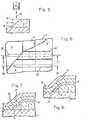
- FIG. 1 is a simplified cross sectional view of a silicon on sapphire (SOS) island including a sapphire substrate 1 and a silicon island 2 photolithographically defined by an etching process to form an island edge 3.
- the island edge 3 has a steep slope created during definition of the silicon island 2.
- a first oxide layer 6 is preferably grown over the top surface of the silicon island 2 and the thickness of the oxide layer 6 is reduced at a bottom edge corner 8 of the island, forming a "V" shaped groove 9.
- a polysilicon conductor 10 shown in FIG.'s 2 and 3 is formed by deposition of polycrystalline silicon followed by photolithographic definition and etching. The deposited polysilicon fills the V-shaped groove 9 so that there is a significant likelihood of breakdown conduction between the polysilicon conductor 10 and the silicon island 2 in the vicinity of the V-shaped groove 9.
- the polysilicon conductor 10 is deposited, photoli- t h ographically defined and etched. Thereafter, the device is ion implanted to render the polysilicon material conductive while simultaneously forming gate-aligned source and drain diffusions in the silicon island 2, in a manner well-known in the art. A second layer of oxide 11 is then placed over the device. Contacts (not shown) are defined through the oxide layers.
- An aluminum conductor 12 shown in FIG.'s 2 and 4 is formed by evaporation followed by photolithographic definition and etching. Because the etching process which initially defines the edge 3 of the SOS island 2 shown in FIG. 1 is not uniform, the resulting island edge 3 is rough.
- FIG. 4 clearly shows that the thickness t l of the aluminum conductor 12 deposited over the steep island edge 3 is significantly reduced with respect to the aluminum thickness t 2 overlying horizontal surfaces. This reduction of the thickness of the aluminum conductor 12 at the edge 3 increases the probability of discontinuities in the conductor 12. As a result, it has been found that the processing yield of metal-oxide-semi-conductor silicon-on-sapphire (MOS/SOS) devices is significantly reduced.
- MOS/SOS metal-oxide-semi-conductor silicon-on-sapphire
- the foregoing problems are solved using the method of the present invention illustrated in FIG. 5 by directing a pulsed beam 13 of radiant energy from an energy source 14 such as a laser toward the silicon island 2 prior to the growth or deposition of overlying insulating and conductive layers.
- an energy source 14 such as a laser
- the drawing of FIG. 5 is purely schematic and does not imply any restriction on required beam size.
- the energy beam 13 causes reflow of silicon in the island edge 3, and the result is a reformed island edge 3' shown in solid line in FIG. 5.
- the energy beam improves the quality of the crystal structure of the silicon island 2, which increases the channel mobility of metal oxide semiconductor field effect transistors (MOSFET's) fabricated on the silicon island 2.
- MOSFET's metal oxide semiconductor field effect transistors
- the energy beam may be applied either before or after definition of the silicon island 2.
- Mobility in MOS transistors is a well-known concept in the art and is discussed, for example, in Penny, et al., MOS Integrated Circuits, Van Nos- trand, Reinhold Co., 1972, pages 162-168, the disclosure of which is incorporated by reference.
- an oxide layer 6, a polysilicon conductor 10, a second oxide layer 11 and an aluminum conductor 12 are deposited in the manner described in connection with FIG. 's 1-4.
- the reformed island edge 3' has a moderate slope, being oriented at approximately 60° with respect to the top of the sapphire substrate 1.
- the moderate slope of the island edge 3' permits the deposited aluminum conduction layer 12 to assume a nearly uniform thickness along the island edge, reducing the likelihood of physical discontinuities in the aluminum conductor 12.
- the likelihood of breakdown conduction at the bottom edge corner 8 between the polysilicon conductor 6 and the silicon island 2 is significantly reduced because the V-shaped groove 9 is eliminated due to the reduced slope of the silicon island edge 3'.
- the energy beam source 14 of FIG. 5 is a pulsed excimer laser, emitting a beam 13 having a pulse duration of approximately 25 nanoseconds, a wavelength of approxi-0 mately 2490A, and an energy density between 0.5 and 1.0 joule/cm 2 .
- the scope of this invention includes the use of any pulsed beam source or continuous scanning beam source, including an electron, ion or laser beam source in accordance with the present method.
- the method of this invention is applicable to any MOS/SOS structure similar to that of FIGS.
- the first insulating layer is any suitable dielectric, including grown silicon oxide, chemical vapor deposited silicon dioxide, grown silicon nitride, or grown silicon dioxide with chemical vapor deposited silicon nitride.
- the first insulating layer 6 may be grown or deposited silicon dioxide Si0 2 or silicon nitride (Si 3 N 4 ) of the type discussed by Pliskin, "Comparison of Properties of Dielectric Films Deposited by Various Methods", Journal of Vacuum Science Technology, Vol. 14, No. 5, September/October 1977, pp. 1064-1081.
- the first conductive layer 10 may be any polycrystalline or amorphous material, such as polycrystalline silicon or it may be polycide or metal silicide of the type disclosed in Crowder et al, "lum MOSFET VLSI Technology: Part VII Metal Silicide Interconnection Technology - A Future Prospective", IEEE Trans. on Electron Devices, Vol. Ed.-26 No. 4, April 1979, pages 369-371.
- the conductive layer 10 may be any polycrystalline or amorphous material, such as polycrystalline silicon or it may be polycide or metal silicide of the type disclosed in Crowder et al, "lum MOSFET VLSI Technology: Part VII Metal Silicide Interconnection Technology - A Future Prospective", IEEE Trans. on Electron Devices, Vol. Ed.-26 No. 4, April 1979, pages 369-371.
- the conductive layer 10 may be any polycrystalline or amorphous material, such as polycrystalline silicon or it may be polycide or metal silicide of the type disclosed in Crowder et al, "lum MOSFET VLS
- this invention is a unique processing technique for improving silicon on sapphire device performance by improving the crystal structure of the silicon islands to increase channel mobility and thereby improve device operating speed.
- Another improvement is made by causing the silicon material in the vicinity of the silicon island edge to reflow in such a way as to decrease the slope of the island edge and to increase smoothness of he island edge. This is effected by rapidly heating the surface of the silicon islands to or slightly above the melting point of the semiconductor material by irradiating the surface with a radiation beam and then allowing the material rapidly to cool below its melting point in the recrystallisation process.
- Overlying aluminum conductive layers are or more unform thickness throughout the device, even in the vicinity of the island edge, advantageously decreasing the probability of discontinuities in the aluminum layer.
- improvement of the SOS island edge prevents formation of a V-shape groove in the first oxide layer at the bottom island edge corner, thereby decreasing the probability of breakdown conduction between polysilicon conductors and the silicon island.
Landscapes
- Recrystallisation Techniques (AREA)
- Thin Film Transistor (AREA)
Applications Claiming Priority (3)
| Application Number | Priority Date | Filing Date | Title |
|---|---|---|---|
| US6008179A | 1979-07-24 | 1979-07-24 | |
| US60081 | 1979-07-24 | ||
| EP80901614A EP0032510B1 (de) | 1979-07-24 | 1981-02-09 | Silicium-auf-saphir-laserverfahren |
Related Parent Applications (1)
| Application Number | Title | Priority Date | Filing Date |
|---|---|---|---|
| EP80901614.0 Division | 1981-02-09 |
Publications (3)
| Publication Number | Publication Date |
|---|---|
| EP0171509A2 true EP0171509A2 (de) | 1986-02-19 |
| EP0171509A3 EP0171509A3 (en) | 1986-10-29 |
| EP0171509B1 EP0171509B1 (de) | 1990-10-31 |
Family
ID=26080715
Family Applications (1)
| Application Number | Title | Priority Date | Filing Date |
|---|---|---|---|
| EP85104750A Expired - Lifetime EP0171509B1 (de) | 1979-07-24 | 1980-07-23 | Verfahren zur Laserbehandlung für "Silizium auf Saphir" |
Country Status (1)
| Country | Link |
|---|---|
| EP (1) | EP0171509B1 (de) |
Cited By (2)
| Publication number | Priority date | Publication date | Assignee | Title |
|---|---|---|---|---|
| EP0459836A3 (en) * | 1990-06-01 | 1993-02-24 | Sel Semiconductor Energy Laboratory Co., Ltd. | Method for fabricating thin-film transistors |
| US6352883B1 (en) | 1991-02-22 | 2002-03-05 | Semiconductor Energy Laboratory Co., Ltd. | Semiconductor device and method for forming the same |
Family Cites Families (2)
| Publication number | Priority date | Publication date | Assignee | Title |
|---|---|---|---|---|
| US4155779A (en) * | 1978-08-21 | 1979-05-22 | Bell Telephone Laboratories, Incorporated | Control techniques for annealing semiconductors |
| DE2848333C2 (de) * | 1978-11-08 | 1984-12-20 | Philips Patentverwaltung Gmbh, 2000 Hamburg | Verfahren zum Herstellen eines Halbleiterbauelements |
-
1980
- 1980-07-23 EP EP85104750A patent/EP0171509B1/de not_active Expired - Lifetime
Cited By (6)
| Publication number | Priority date | Publication date | Assignee | Title |
|---|---|---|---|---|
| EP0459836A3 (en) * | 1990-06-01 | 1993-02-24 | Sel Semiconductor Energy Laboratory Co., Ltd. | Method for fabricating thin-film transistors |
| US6458200B1 (en) | 1990-06-01 | 2002-10-01 | Semiconductor Energy Laboratory Co., Ltd. | Method for fabricating thin-film transistor |
| US6740547B2 (en) | 1990-06-01 | 2004-05-25 | Semiconductor Energy Laboratory Co., Ltd. | Method for fabricating thin-film transistor |
| US7018874B2 (en) | 1990-06-01 | 2006-03-28 | Semiconductor Energy Laboratory Co., Ltd. | Method for fabricating thin-film transistor |
| US6352883B1 (en) | 1991-02-22 | 2002-03-05 | Semiconductor Energy Laboratory Co., Ltd. | Semiconductor device and method for forming the same |
| US6717180B2 (en) | 1991-02-22 | 2004-04-06 | Semiconductor Energy Laboratory Co., Ltd. | Semiconductor device and method for forming the same |
Also Published As
| Publication number | Publication date |
|---|---|
| EP0171509A3 (en) | 1986-10-29 |
| EP0171509B1 (de) | 1990-10-31 |
Similar Documents
| Publication | Publication Date | Title |
|---|---|---|
| US4341569A (en) | Semiconductor on insulator laser process | |
| US5077233A (en) | Method for recrystallizing specified portions of a non-crystalline semiconductor material to fabricate a semiconductor device therein | |
| EP0072216B1 (de) | Verfahren zur Herstellung von Halbleiteranordnungen unter Verwendung des Ausglühens | |
| EP0151350B1 (de) | Herstellung von gestapelten MOS-Bauelementen | |
| EP0037685B1 (de) | Verfahren zur Herstellung einer Halbleiteranordnung | |
| JP4295922B2 (ja) | 小型集積回路の作製における用途に適したガス浸漬レーザアニーリング方法 | |
| EP0041776B2 (de) | Verfahren zur Herstellung einer Halbleiteranordnung mit einer Isolationsstruktur | |
| US4514895A (en) | Method of forming field-effect transistors using selectively beam-crystallized polysilicon channel regions | |
| EP0556795B1 (de) | Verfahren zur Herstellung eines Substrates mit einer Halbleiterschicht auf einem Isolator | |
| US5198378A (en) | Process of fabricating elevated source/drain transistor | |
| CA1237828A (en) | Semiconductor-on-insulator (soi) device having electrical short to avoid charge accumulation | |
| US4542580A (en) | Method of fabricating n-type silicon regions and associated contacts | |
| US4305973A (en) | Laser annealed double conductor structure | |
| US5342803A (en) | Method for isolating circuit elements for semiconductor device | |
| US4621411A (en) | Laser-enhanced drive in of source and drain diffusions | |
| EP0171509A2 (de) | Verfahren zur Laserbehandlung für "Silizium auf Saphir" | |
| EP0032510B1 (de) | Silicium-auf-saphir-laserverfahren | |
| JPH0576176B2 (de) | ||
| US4695856A (en) | Semiconductor device | |
| JPH03148836A (ja) | 薄膜トランジスタの製造方法 | |
| KR930011472B1 (ko) | Mos트랜지스터의 제조방법 | |
| EP0155311B1 (de) | Reparaturmethode für vergrabene kontakte in mosfet-anordungen | |
| Kawamura et al. | 3-Dimensional SOI/CMOS IC's fabricated by beam recrystallization | |
| Colinge et al. | Transistors made in single-crystal SOI films | |
| JPH06204248A (ja) | Misトランジスタの作製方法 |
Legal Events
| Date | Code | Title | Description |
|---|---|---|---|
| PUAI | Public reference made under article 153(3) epc to a published international application that has entered the european phase |
Free format text: ORIGINAL CODE: 0009012 |
|
| AC | Divisional application: reference to earlier application |
Ref document number: 32510 Country of ref document: EP |
|
| AK | Designated contracting states |
Kind code of ref document: A2 Designated state(s): DE FR GB NL |
|
| RAP1 | Party data changed (applicant data changed or rights of an application transferred) |
Owner name: HUGHES AIRCRAFT COMPANY |
|
| RAP1 | Party data changed (applicant data changed or rights of an application transferred) |
Owner name: HUGHES AIRCRAFT COMPANY |
|
| PUAL | Search report despatched |
Free format text: ORIGINAL CODE: 0009013 |
|
| AK | Designated contracting states |
Kind code of ref document: A3 Designated state(s): DE FR GB NL |
|
| 17P | Request for examination filed |
Effective date: 19870408 |
|
| 17Q | First examination report despatched |
Effective date: 19890314 |
|
| GRAA | (expected) grant |
Free format text: ORIGINAL CODE: 0009210 |
|
| AC | Divisional application: reference to earlier application |
Ref document number: 32510 Country of ref document: EP |
|
| AK | Designated contracting states |
Kind code of ref document: B1 Designated state(s): DE FR GB NL |
|
| ET | Fr: translation filed | ||
| REF | Corresponds to: |
Ref document number: 3072182 Country of ref document: DE Date of ref document: 19901206 |
|
| PLBE | No opposition filed within time limit |
Free format text: ORIGINAL CODE: 0009261 |
|
| STAA | Information on the status of an ep patent application or granted ep patent |
Free format text: STATUS: NO OPPOSITION FILED WITHIN TIME LIMIT |
|
| 26N | No opposition filed | ||
| PGFP | Annual fee paid to national office [announced via postgrant information from national office to epo] |
Ref country code: GB Payment date: 19940620 Year of fee payment: 15 |
|
| PGFP | Annual fee paid to national office [announced via postgrant information from national office to epo] |
Ref country code: FR Payment date: 19950612 Year of fee payment: 16 |
|
| PGFP | Annual fee paid to national office [announced via postgrant information from national office to epo] |
Ref country code: DE Payment date: 19950620 Year of fee payment: 16 |
|
| PGFP | Annual fee paid to national office [announced via postgrant information from national office to epo] |
Ref country code: NL Payment date: 19950628 Year of fee payment: 16 |
|
| PG25 | Lapsed in a contracting state [announced via postgrant information from national office to epo] |
Ref country code: GB Effective date: 19950723 |
|
| PG25 | Lapsed in a contracting state [announced via postgrant information from national office to epo] |
Ref country code: NL Effective date: 19960201 |
|
| GBPC | Gb: european patent ceased through non-payment of renewal fee |
Effective date: 19950723 |
|
| NLV4 | Nl: lapsed or anulled due to non-payment of the annual fee |
Effective date: 19960201 |
|
| PG25 | Lapsed in a contracting state [announced via postgrant information from national office to epo] |
Ref country code: FR Effective date: 19970328 |
|
| PG25 | Lapsed in a contracting state [announced via postgrant information from national office to epo] |
Ref country code: DE Effective date: 19970402 |
|
| REG | Reference to a national code |
Ref country code: FR Ref legal event code: ST |