EP0171984A2 - Thérapie du cancer à modalité de combinaison - Google Patents
Thérapie du cancer à modalité de combinaison Download PDFInfo
- Publication number
- EP0171984A2 EP0171984A2 EP85305532A EP85305532A EP0171984A2 EP 0171984 A2 EP0171984 A2 EP 0171984A2 EP 85305532 A EP85305532 A EP 85305532A EP 85305532 A EP85305532 A EP 85305532A EP 0171984 A2 EP0171984 A2 EP 0171984A2
- Authority
- EP
- European Patent Office
- Prior art keywords
- ligand
- compound
- integer
- cells
- compounds
- Prior art date
- Legal status (The legal status is an assumption and is not a legal conclusion. Google has not performed a legal analysis and makes no representation as to the accuracy of the status listed.)
- Withdrawn
Links
Images


Classifications
-
- A—HUMAN NECESSITIES
- A61—MEDICAL OR VETERINARY SCIENCE; HYGIENE
- A61K—PREPARATIONS FOR MEDICAL, DENTAL OR TOILETRY PURPOSES
- A61K33/00—Medicinal preparations containing inorganic active ingredients
- A61K33/24—Heavy metals; Compounds thereof
-
- C—CHEMISTRY; METALLURGY
- C01—INORGANIC CHEMISTRY
- C01G—COMPOUNDS CONTAINING METALS NOT COVERED BY SUBCLASSES C01D OR C01F
- C01G55/00—Compounds of ruthenium, rhodium, palladium, osmium, iridium, or platinum
- C01G55/002—Compounds containing ruthenium, rhodium, palladium, osmium, iridium or platinum, with or without oxygen or hydrogen, and containing two or more other elements
-
- A—HUMAN NECESSITIES
- A61—MEDICAL OR VETERINARY SCIENCE; HYGIENE
- A61K—PREPARATIONS FOR MEDICAL, DENTAL OR TOILETRY PURPOSES
- A61K31/00—Medicinal preparations containing organic active ingredients
- A61K31/28—Compounds containing heavy metals
-
- A—HUMAN NECESSITIES
- A61—MEDICAL OR VETERINARY SCIENCE; HYGIENE
- A61P—SPECIFIC THERAPEUTIC ACTIVITY OF CHEMICAL COMPOUNDS OR MEDICINAL PREPARATIONS
- A61P35/00—Antineoplastic agents
-
- C—CHEMISTRY; METALLURGY
- C01—INORGANIC CHEMISTRY
- C01B—NON-METALLIC ELEMENTS; COMPOUNDS THEREOF; METALLOIDS OR COMPOUNDS THEREOF NOT COVERED BY SUBCLASS C01C
- C01B21/00—Nitrogen; Compounds thereof
- C01B21/20—Nitrogen oxides; Oxyacids of nitrogen; Salts thereof
- C01B21/50—Nitrous acid; Salts thereof
-
- C—CHEMISTRY; METALLURGY
- C07—ORGANIC CHEMISTRY
- C07F—ACYCLIC, CARBOCYCLIC OR HETEROCYCLIC COMPOUNDS CONTAINING ELEMENTS OTHER THAN CARBON, HYDROGEN, HALOGEN, OXYGEN, NITROGEN, SULFUR, SELENIUM OR TELLURIUM
- C07F15/00—Compounds containing elements of Groups 8, 9, 10 or 18 of the Periodic Table
- C07F15/0006—Compounds containing elements of Groups 8, 9, 10 or 18 of the Periodic Table compounds of the platinum group
- C07F15/0073—Rhodium compounds
- C07F15/008—Rhodium compounds without a metal-carbon linkage
Definitions
- This invention relates to compounds for use in therapy, particularly in combination modality cancer therapy with other forms of treatment.
- One established form of cancer treatment is irradiation by high-energy particles or electromagnetic waves, typically electrons, X-rays or gamma rays.
- high-energy particles or electromagnetic waves typically electrons, X-rays or gamma rays.
- oxygen-deficient (“hypoxic”) cells are more resistant.
- oxic oxygenated
- hypooxic oxygen-deficient
- coordination compounds for use in therapy the compounds having the general empirical formula in which m is the oxidation state of Rh, X is at least one anionic ligand, Y is at least one neutral ligand, with the proviso that at least one of X and Y is a nitrogen donor ligand, x is an integer from 1 to 6, y is an integer from 1 to 5 or may be equal to zero, and a is a positive or negative integer from -3 to +3 or may be equal to zero.
- the oxidation state of rhodium is preferably III but may be II.
- a nitrogen donor ligand is an ion or molecule which donates electrons to the coordinate bond via a nitrogen atom.
- Nitrogen donor ligands may be monodentate or polydentate. Suitable nitrogen donor ligands include ammine, amines, bi-, di-or tetra-functional amines such as ethylenediamine and substituted derivatives thereof, nitrosyl and nitro groups and nitrogen heterocycles.
- the anionic ligand X may be selected from ligands such as nitrite, halogen, hydroxy, azide, thiocyanate, formate, acetate, chloroacetate, carbonate, oxalate, malonate, sulphate, thiosulphate and aminoacid.
- the neutral ligand Y may be selected from monodentate ligands such as ammine, pyridine and water and bidentate ligands such as ethylenediamine, ethylenediaminetetraacetic acid and dimethylglyoxime.
- the compound includes a complex anion and the counter ion may be selected from ammonium, sodium, potassium and the like. Where a is positive, the compound includes a complex cation and the counter ion may be selected from halide, sulphate, and other anions.
- Examples of compounds according to the invention include the following:-
- the invention also provides a pharmaceutical composition comprising an effective amount of a coordination compound according to general formula (I) in association with a pharmaceutically-acceptable carrier, diluent or excipient therefor.
- the invention includes the use of a compound according to general formula (I) in the treatment of cancer, and a method for the treatment of cancer in a human or non-human animal body comprising administering to said body an effective amount of a coordination compound according to general formula (I) in combination with an existing method of treatment.
- the said existing method of treatment comprises irradiation and the said compound is administered before irradiation.
- Compounds according to the invention are evaluated in toxicity and radio-sensitisation screens in bacterial cells, in cultured rodent and human cells and in human and animal tumours implanted in mice.
- the toxicity screen is used to evaluate the cytotoxicity of the compound itself and its irradiation products.
- the method of testing in bacterial cells is as follows:-Bacterial cells (salmonella typhimurium TM677) in phosphate buffered saline (PBS) are exposed at room temperature (ca. 25°C) to each compound at 200pM concentration. At an appropriate time interval, a sample of mixture is removed and diluted 1:100 in PBS before the cells are plated out in petri dishes.
- each compound which shows radiosensitisation (method for radiosensitization testing described later) is made up at 210 ⁇ M in PBS and irradiated to 17krad of x-irradiation. This is done under both oxygenated and de-oxygenated conditions (the latter is achieved by degassing using a nitrogen stream for ca. 10 min).
- the solution is diluted to 200 ⁇ M with bacterial suspension, and the mixture is then treated as before to obtain a toxicity curve for these irradiated solutions. In all cases the period of bacterial exposure to the compounds is carried out under oxygenated conditions.
- the radiosensitisation experiment is carried out as follows.
- the bacterial cells are suspended in PBS in the irradiation vessel and the compound is added to achieve a concentration of 200 ⁇ M (or a lower value if the compound is highly toxic).
- the cells may be made hypoxic by passing a stream of nitrogen through the suspension for 10-15 mins.
- the initial dose of x-irradiation is then given (up to 4krad at 4krad/min).
- a sample of the suspension is then taken and added to PBS to achieve a 1:100 dilution. A further 1:10 dilution is performed before plating out.
- the addition of growth medium at this stage may involve a further 1:10 up to 1:1000 dilution giving an overall dilution factor from the irradiated solution of 10 4 -106 Additional doses of irradiation (ca. 4krad each) are given up to a total of ca. 20krad with samples being taken after each dose. Cell survival is then determined as previously described and the surviving fraction is plotted versus the dose of radiation. Baseline curves for irradiation of the bacteria under oxic and hypoxic conditions in the absence of the compound are also determined to allow a quantitative estimation of the efficiency of the compound in sensitising the cells to radiation-induced killing. This quantification may be expressed in the form of an enhancement ratio calculated from the slope of the survival curve in the presence of the compound divided by the slope of the survival curve in the absence of the compound.
- the method of testing in mammalian cells is as follows:
- the cells are removed from the petri dishes using trypsin enzyme for 6 minutes, pipetted into single cell suspensions, and serially diluted for subculturing in triplicate petri dishes containing 5cc of fresh culture media without the test compound. These dishes are incubated in 5X CO at 37°C for 10 days and, following staining, the colonies are counted to produce survival curves (survivin fraction of cells versus compound concentration or radiation dose).
- baseline curves for irradiation of the mammalian cells under oxic and hypoxic conditions in the absence of the compound are also determined to allow a quantitative estimation of the efficiency of the compound in sensitizing the cells to radiation-induced killing by deriving enhancement ratios.
- Test results in oxic cells irradiated in air in the presence of the compounds are compared to the hypoxic tests to confirm that the effect is specifically hypoxic cell radiosensitization.
- the compounds are injected i.p. into immune-suppressed or nude mice bearing human malignant melanoma tumours (HX-34). These tumours of approximately 1 cm diameter grew from cells which were injected into the hind legs of the mice approximately 3 weeks prior to treatment. Results of initial toxicity tests in non-tumoured mice are used to estimate the maximum tolerated dose of compounds which will not produce significant percentage lethality and this level of compound is used in the radiosensitization tests. One hour following injection of the compound the tumour cells are irradiated in situ with a whole-body dose of cobalt-60 gamma rays of 12.5 Gy.
- mice are sacrificed and tumours are removed and minced to disperse tumour cells.
- the cells are separated into single cell suspensions using an enzyme cocktail for 30 minutes.
- the cells are counted, serially diluted, and placed into agar suspensions in plastic test tubes. These agar suspensions are incubated in 5X O 2 / 5X C0 2 and 80% nitrogen for three weeks. At the end of this period the agar suspension is placed on a slide and colonies are counted to quantify tumour cell survival.
- the surviving fraction of tumour cells in mice which received irradiation following injection of the compound is compared to the surviving fraction obtained from tumour cells which received either radiation or the compound alone.
- Tables 2 to 4 relate to compound no. 2 (potassium hexanitrorhodium (III) - K 3 [Rh(NO 2 ) 6 ]) and Tables 5 to 7 relate to compound no. 3 (dichlorobis (ethylenediamine) rhodium ( III ) - cis[Rh(en) 2 Cl 2 ]Cl).
- Tables 2 and 5 show results for toxicity of the compounds themselves and of their irradiated products under oxygenerated and de-oxygenated conditions.
- Tables 3 and 6 show results for sensitisation under hypoxic conditions and Tables 4 and 7 show results for sensitisation under oxic conditions.
- the ratio N/No which appears in the final column is the figure for the average colony count at various times t divided by the average colony count at time t " 0, adjusted for any aliquot dilution, and is an indication of the toxicity or sensitisation, as the case may be.
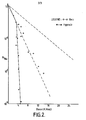
- Figs. 1 and 2 illustrate graphically the sensitisation of compounds 2 and 3.
- the dotted lines illustrate the effect of irradiation on untreated bacterial cells, that is, in the absence of a sensitisation compound, under oxic (indicated by 0 ) and hypoxic conditions (indicated by N 2 ).
- the legend for the plotted points is given on the Figures.
- the dramatic improvement for cell-kill (N/No) as between unsensitised cells and sensitised cells under hypoxic conditions is immediately apparent.
- Figure 3 is a graph showing cytotoxicity and hypoxic radiosensitization for compound [Rhen Cl 4 ] 2 [enH 2 .] Radiosensitization results are in vitro in mammalian cell culture, compared with misonidazole as control. Misonidazole is a "standard" radiosensitization drug which has been discussed in the literature inter alia in "Int. J. Radiation Oncology Biol.Phys.” Vol. 10, pp 425-429 (1984).
- the dotted line represents the standard or average reported misonidazole response.
- the sumbols "" and '' represent experimental misonidazole response and the experimental Rl compound response respectively.
- the compound according to the invention has an activity approaching the activity of misonidazole, and in particular the concentration required to give an ser (sensitizer enhancement ratio) of 1.6 15 2.0mM compared with 1.5 mM for misonidazole, i.e. 75% effectiveness compared with misonidazole.
Landscapes
- Health & Medical Sciences (AREA)
- Chemical & Material Sciences (AREA)
- Organic Chemistry (AREA)
- Veterinary Medicine (AREA)
- General Health & Medical Sciences (AREA)
- Medicinal Chemistry (AREA)
- Inorganic Chemistry (AREA)
- Pharmacology & Pharmacy (AREA)
- Life Sciences & Earth Sciences (AREA)
- Animal Behavior & Ethology (AREA)
- Public Health (AREA)
- Epidemiology (AREA)
- General Chemical & Material Sciences (AREA)
- Chemical Kinetics & Catalysis (AREA)
- Nuclear Medicine, Radiotherapy & Molecular Imaging (AREA)
- Pharmaceuticals Containing Other Organic And Inorganic Compounds (AREA)
- Acyclic And Carbocyclic Compounds In Medicinal Compositions (AREA)
Applications Claiming Priority (2)
| Application Number | Priority Date | Filing Date | Title |
|---|---|---|---|
| US63755684A | 1984-08-03 | 1984-08-03 | |
| US637556 | 1984-08-03 |
Publications (2)
| Publication Number | Publication Date |
|---|---|
| EP0171984A2 true EP0171984A2 (fr) | 1986-02-19 |
| EP0171984A3 EP0171984A3 (fr) | 1987-10-14 |
Family
ID=24556443
Family Applications (1)
| Application Number | Title | Priority Date | Filing Date |
|---|---|---|---|
| EP85305532A Withdrawn EP0171984A3 (fr) | 1984-08-03 | 1985-08-02 | Thérapie du cancer à modalité de combinaison |
Country Status (3)
| Country | Link |
|---|---|
| EP (1) | EP0171984A3 (fr) |
| JP (1) | JPS61106588A (fr) |
| CA (1) | CA1254831A (fr) |
Cited By (1)
| Publication number | Priority date | Publication date | Assignee | Title |
|---|---|---|---|---|
| WO1995004552A3 (fr) * | 1993-08-04 | 1995-03-23 | Amersham Int Plc | Complexes radiometalliques se fixant dans les tissus hypoxiques |
Family Cites Families (1)
| Publication number | Priority date | Publication date | Assignee | Title |
|---|---|---|---|---|
| GB2053217B (en) * | 1979-06-29 | 1983-07-13 | Johnson Matthey Co Ltd | Rh(iii) amine complexes |
-
1985
- 1985-08-02 EP EP85305532A patent/EP0171984A3/fr not_active Withdrawn
- 1985-08-02 CA CA000488089A patent/CA1254831A/fr not_active Expired
- 1985-08-03 JP JP60171719A patent/JPS61106588A/ja active Pending
Cited By (2)
| Publication number | Priority date | Publication date | Assignee | Title |
|---|---|---|---|---|
| WO1995004552A3 (fr) * | 1993-08-04 | 1995-03-23 | Amersham Int Plc | Complexes radiometalliques se fixant dans les tissus hypoxiques |
| US5997843A (en) * | 1993-08-04 | 1999-12-07 | Amersham International Plc | Radiometal complexes that localise in hypoxic tissue |
Also Published As
| Publication number | Publication date |
|---|---|
| EP0171984A3 (fr) | 1987-10-14 |
| JPS61106588A (ja) | 1986-05-24 |
| CA1254831A (fr) | 1989-05-30 |
Similar Documents
| Publication | Publication Date | Title |
|---|---|---|
| Douple et al. | Carboplatin as a potentiator of radiation therapy | |
| Douple et al. | Radiosensitization of hypoxic tumor cells by cis-and trans-dichlorodiammineplatinum (II) | |
| Brown | Cytotoxic effects of the hypoxic cell radiosensitizer Ro 7-0582 to tumor cells in vivo | |
| O'Hara et al. | Enhancement of radiation-induced cell kill by platinum complexes (carboplatin and iproplatin) in V79 cells | |
| Overgaard | Effect of misonidazole and hyperthermia on the radiosensitivity of a C3H mouse mammary carcinoma and its surrounding normal tissue | |
| Pretorius et al. | Comparison of the Iv and Ip Routes of Administration of Cisplatin in | |
| Alvarez et al. | Studies on cis-dichlorodiammineplatinum (II) as a radiosensitizer | |
| US4681091A (en) | Combination modality cancer therapy | |
| US4851403A (en) | Radiation sensitizers | |
| Song et al. | Preferential cytotoxicity of 5-thio-D-glucose against hypoxic tumor cells | |
| Shibamoto et al. | Radiosensitization in vitro and in vivo by 3-nitrotriazoles | |
| CN116635396A (zh) | Pt(Ⅳ)化疗前药及其可控释放用于治疗肿瘤 | |
| Stratford et al. | Combination studies with misonidazole and a cis-platinum complex: cytotoxicity and radiosensitization in vitro | |
| Zeman et al. | Pre-and post-irradiation adiosensitization by SR 4233 | |
| Teicher et al. | Some complexes of cobalt (III) and iron (III) are radiosensitizers of hypoxic EMT6 cells | |
| US4727068A (en) | Radiosensitization by cobalt and Fe(III) complexes | |
| EP0171984A2 (fr) | Thérapie du cancer à modalité de combinaison | |
| Zimbrick et al. | Studies on radiosensitization of Escherichia coli cells by cis-platinum complexes | |
| McNally | The effect of an hypoxic cell sensitizer on tumour growth delay and cell survival. Implications for cell survival in situ and in vitro | |
| Adams et al. | Biological basis of radiosensitization by hypoxic-cell radiosensitizers | |
| DE3785195T2 (de) | Mittel, welches knochenmark abbaut. | |
| Blackett et al. | Radiation modifying effect of the free radical norpseudopelletierene-N-oxyl on normal bone marrow stem cells in vitro and in vivo | |
| Dorie et al. | Reoxygenation in the RIF-1 tumor after chemotherapy | |
| JPS60224619A (ja) | 放射線増感剤 | |
| Malkinson | Some principles of radiobiology: a selective review |
Legal Events
| Date | Code | Title | Description |
|---|---|---|---|
| PUAI | Public reference made under article 153(3) epc to a published international application that has entered the european phase |
Free format text: ORIGINAL CODE: 0009012 |
|
| AK | Designated contracting states |
Designated state(s): AT BE CH DE FR GB IT LI LU NL SE |
|
| RBV | Designated contracting states (corrected) |
Designated state(s): DE FR GB IT |
|
| PUAL | Search report despatched |
Free format text: ORIGINAL CODE: 0009013 |
|
| AK | Designated contracting states |
Kind code of ref document: A3 Designated state(s): DE FR GB IT |
|
| 17P | Request for examination filed |
Effective date: 19880329 |
|
| 17Q | First examination report despatched |
Effective date: 19890309 |
|
| STAA | Information on the status of an ep patent application or granted ep patent |
Free format text: STATUS: THE APPLICATION IS DEEMED TO BE WITHDRAWN |
|
| 18D | Application deemed to be withdrawn |
Effective date: 19890920 |
|
| RIN1 | Information on inventor provided before grant (corrected) |
Inventor name: PICKER, DONALD HAROLD Inventor name: HYDES, PAUL CEDRIC |