EP0174199A2 - Strombegrenzender Schalter - Google Patents
Strombegrenzender Schalter Download PDFInfo
- Publication number
- EP0174199A2 EP0174199A2 EP85306319A EP85306319A EP0174199A2 EP 0174199 A2 EP0174199 A2 EP 0174199A2 EP 85306319 A EP85306319 A EP 85306319A EP 85306319 A EP85306319 A EP 85306319A EP 0174199 A2 EP0174199 A2 EP 0174199A2
- Authority
- EP
- European Patent Office
- Prior art keywords
- contacts
- contact
- switch according
- open
- leaf springs
- Prior art date
- Legal status (The legal status is an assumption and is not a legal conclusion. Google has not performed a legal analysis and makes no representation as to the accuracy of the status listed.)
- Withdrawn
Links
Images
Classifications
-
- H—ELECTRICITY
- H01—ELECTRIC ELEMENTS
- H01H—ELECTRIC SWITCHES; RELAYS; SELECTORS; EMERGENCY PROTECTIVE DEVICES
- H01H77/00—Protective overload circuit-breaking switches operated by excess current and requiring separate action for resetting
- H01H77/02—Protective overload circuit-breaking switches operated by excess current and requiring separate action for resetting in which the excess current itself provides the energy for opening the contacts, and having a separate reset mechanism
- H01H77/10—Protective overload circuit-breaking switches operated by excess current and requiring separate action for resetting in which the excess current itself provides the energy for opening the contacts, and having a separate reset mechanism with electrodynamic opening
Definitions
- This invention relates to automatic current limiting switches.
- the invention is aimed particularly at alternating current supply systems in the few hundred volt range, i.e. the ultimate distribution voltage, although it can be applied at higher voltages.
- an automatic current limiting switch comprises a support structure accommodating a pair of cantilever leaf springs, extending inwards in overlapping relationship from opposite ends of the structure, and carrying respective contacts normally biassed towards each other into a closed position by the resilience of the leaf springs, each contact being movable away from the other into an open position against the spring bias, but being restrained by stop means from moving in the opposite direction, at least to any significant extent, means for delaying the return of each contact from the open to the closed position, and means for producing a steady magnetic field transverse to the contact springs.
- the contacts In the closed condition of the switch the contacts may be arranged to engage each other directly and in such a case the said other contact may follow the moving contact for a short distance, for example not more than a millimetre, before being arrested by the stop means.
- the contacts may engage each other indirectly by bearing against a common central contact means as will subsequently be described.
- the free ends of the cantilever leaf springs extend beyond the respective contacts and terminate adjacent associated arc chutes, such that, on opening the contacts, the arc that is formed is propelled very rapidly to the respective arc chute, which can be of the usual form comprising a number of spaced conductive plates mutually insulated from each other, or be of any other suitable construction.
- refractory splitter plates could alternatively be employed, and in some cases the plates may be : coated with a material evolving an arc-suppressing gas on the formation of an arc.
- the leaf springs carry ferromagnetic elements adjacent the contacts asymmetrically disposed with respect to the permanent magnetic field, in order to enhance the opening and closing speeds.
- the means for delaying the return of the contacts from the open to the closed positions may be effected by dash-pots, or they may be arranged to be held in the open position, for example mechanically by a suitable latch until released.
- the contacts may be opened if required by mechanisms which operate on the pins connected to the dash-pots so that the switch may be opened if required either manually or automatically when the current flowing is below that necessary to open the switch by self-action.
- Means for opening the switch contacts automatically, albeit with some delay, in the low over-current region may be provided by a relay or like electromagnetically operated device appropriately linked to the switch contacts.
- Means are preferably provided for adjusting the level of current at which the contacts of the switch open, either by varying the preloading of the cantilever leaf springs mechanically, or by varying of the strength of the applied magnetic field. Alternatively or additionally the relative positions of the ferromagnetic elements could be adjusted.
- the stop means may be provided by a fixed contact means located between the two cantilever spring contacts and against which the latter are biassed by the resilience of the leaf springs.
- a contact means has the effect of reducing contact vibration under normal current conditions. Although this has the slight disadvantage of increasing contact dissipation it can be designed to provide a shorter high thermal conductivity path for heat to the exterior of the switch.
- Such a fixed contact means preferably has extensions projecting in the same general directions as the free ends of the cantilever leaf springs, so as to act, in effect, as centre fed arcing horns, which can improve the magnetic blowout effect in the switch.
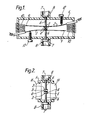
- Figures 1 and 2 represent a longitudinal section and a transverse section respectively through the first switch
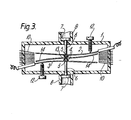
- Figure 3 represents a longitudinal section through the modified form of switch.
- the switch illustrated comprises a housing 1 accommodating a pair of contact springs 2, 3, for example of phosphor bronze or other suitably resilient material, each fixed at one end to opposite ends of the housing 1, and carrying engageable contacts 4 of silver cadmium oxide or similar non-welding material.
- the contacts 4 are of hollow part-cylindrical shape, preferably with a radius of approximately 6mm, and mounted within them are a pair of ferromagnetic elements 5 offset with respect to each other on opposite sides of the longitudinal axis of the switch, as shown in Figure 2.
- the contact springs 2, 3 are biassed in such a manner that the two contacts 4 engage each other with a suitable pressure, conveniently of the order of tens to hundreds of grams.
- Each contact spring 2, 3 has attached to its outwardly facing surface in the vicinity of the respective contact 4 a stem 6 terminating in the piston 7 of a dash-pot 8. This is arranged so that the respective contact is restrained from moving in the direction of the other by more than about one millimetre, but can move outwards a much greater distance, for example between 5 and 1U millimetres, the return of the contact to its rest position, in the latter cases, being delayed by the dash-pot 8.
- the free ends 9 of the contact spring extend beyond the respective contacts 4 to terminate adjacent respective arc chutes 10.
- Pole pieces 11 of a permanent magnet are disposed on opposite sides of the switch as shown in Figure 2.
- the device is arranged to operate by the force on the contact springs 2, 3 generated by the interaction of the short circuit current in the springs and the transverse steady magnetic field, e.g. of 3 to 5 kilogauss produced by the permanent magnet.
- the build up of current in a short circuit (which may have a prospective value of tens of kiloamperes in a domestic/commercial 240 volt system) very rapidly opens the contacts 4, the direction of movement depending on the instantaneous polarity of the fault current.
- the very fast operation of the device compared with known devices is due to the opening force being proportional to the current, and acting from the instant that the current commences to flow.
- the contacts 4 initially move together until the "following" contact is arrested by its restraint, where upon the contacts separate, an arc is formed and propelled by the magnetic field very rapidly along the extension 9 of one or other of the springs 2, 3, which acts as an arc runner to the relevant arc chute 10.
- the "leading" one of the contacts 4 After the arc is extinguished the "leading" one of the contacts 4 returns to the closed position at a rate determined by the dash-pot 8. It may of course be held in the open position by a latch (not shown) which may be manually or electrically released.
- This switch is intended to be used (but can of course be used in many ways) in the infeed circuit to a distribution unit. On the occasion of a short circuit, two things happen.
- the level of current at which the automatic switch will open can be varied in a number of ways.
- the preloading on the contact springs may be adjusted mechanically as by the use of loading screws as at 12 to pre-bend the contact springs, or by rotating the mounting points of the springs about the appropriate axes.
- the degree of asymmetry of the ferromagnetic inserts could be adjusted, or the strength of the applied magnetic field could be varied, for example by adjustment of the position of the pole pieces 11.
- Adjustment could take place during use or during manufacture in the design of the switch, depending upon the method employed. Means should, in any case, be provided to prevent the contact springs 2, 3 being bent excessively in either the "forward" or "reverse” direction.
- the modified switch illustrated in Figure 3 is similar to that of Figures 1 and 2, except that in the closed position the contacts 4 bear against opposite sides of a central fixed contact 13.
- the modified switch operates in a somewhat similar manner to the first switch, in that one or other of the contacts 4 moves away from the other on the occurrence of a short circuit current, in dependence upon the instant polarity of the fault current.
- the fixed contact 13 instead of the other contact following the moving contact until arrested by its restraining stem, its movement is arrested completely by the fixed contact 13.
- the latter has extensions as at 14 projecting in the same general direction as the free ends of the contact springs 2, 3 but flaring away from them to form arcing horns which provided an improved blowout effect.
- the fixed contact 13 may also extend transversely through the sides of the switch housing 1 so as to provide a high thermal conductivity path to the exterior of the switch.
- Either of the two switches described may be associated with latches or other suitable means for holding the contacts open after short circuit operation, in which case the dash-pots 7 may be dispensed with. In such a case the contacts may be electrically or mechanically released when it is desired to re-close the switch.
- a mechanism may also be provided designed to open the switch contacts in a low over-current region if designed, the pins 6 being suitably coupled to the operating mechanism.
Landscapes
- Physics & Mathematics (AREA)
- Electromagnetism (AREA)
- Arc-Extinguishing Devices That Are Switches (AREA)
- Emergency Protection Circuit Devices (AREA)
- Push-Button Switches (AREA)
- Contacts (AREA)
Applications Claiming Priority (2)
| Application Number | Priority Date | Filing Date | Title |
|---|---|---|---|
| GB848422459A GB8422459D0 (en) | 1984-09-05 | 1984-09-05 | Current limiting switch |
| GB8422459 | 1984-09-05 |
Publications (2)
| Publication Number | Publication Date |
|---|---|
| EP0174199A2 true EP0174199A2 (de) | 1986-03-12 |
| EP0174199A3 EP0174199A3 (de) | 1987-06-03 |
Family
ID=10566312
Family Applications (1)
| Application Number | Title | Priority Date | Filing Date |
|---|---|---|---|
| EP85306319A Withdrawn EP0174199A3 (de) | 1984-09-05 | 1985-09-05 | Strombegrenzender Schalter |
Country Status (2)
| Country | Link |
|---|---|
| EP (1) | EP0174199A3 (de) |
| GB (2) | GB8422459D0 (de) |
Cited By (1)
| Publication number | Priority date | Publication date | Assignee | Title |
|---|---|---|---|---|
| WO1997011474A1 (fr) * | 1995-09-22 | 1997-03-27 | Pascal Dudon | Dispositif de commande de moyens de coupure de ligne electrique |
Family Cites Families (1)
| Publication number | Priority date | Publication date | Assignee | Title |
|---|---|---|---|---|
| FR1413241A (fr) * | 1963-09-27 | 1965-10-08 | Bbc Brown Boveri & Cie | Combinateur de prises |
-
1984
- 1984-09-05 GB GB848422459A patent/GB8422459D0/en active Pending
-
1985
- 1985-09-05 GB GB08522094A patent/GB2164495B/en not_active Expired
- 1985-09-05 EP EP85306319A patent/EP0174199A3/de not_active Withdrawn
Cited By (2)
| Publication number | Priority date | Publication date | Assignee | Title |
|---|---|---|---|---|
| WO1997011474A1 (fr) * | 1995-09-22 | 1997-03-27 | Pascal Dudon | Dispositif de commande de moyens de coupure de ligne electrique |
| FR2739220A1 (fr) * | 1995-09-22 | 1997-03-28 | Dudon Pascal | Dispositif de commande de moyens de coupure de ligne electrique |
Also Published As
| Publication number | Publication date |
|---|---|
| GB8422459D0 (en) | 1984-10-10 |
| GB2164495A (en) | 1986-03-19 |
| EP0174199A3 (de) | 1987-06-03 |
| GB2164495B (en) | 1988-01-06 |
| GB8522094D0 (en) | 1985-10-09 |
Similar Documents
| Publication | Publication Date | Title |
|---|---|---|
| EP1388154B1 (de) | Elektrische schaltvorrichtung mit einer einen überstehenden langgestreckten schenkel aufweisenden lichtbogenlaufschiene | |
| US5969314A (en) | Electrical switching apparatus having arc runner integral with stationary arcing contact | |
| US12033822B2 (en) | Ultra-fast polarized relay for hybrid switching systems | |
| US4077025A (en) | Current limiting circuit interrupter | |
| US4408173A (en) | Electric switch | |
| CA1101471A (en) | Current limiting circuit breaker with improved magnetic drive device | |
| US4633207A (en) | Cam following bridge contact carrier for a current limiting circuit breaker | |
| US3515829A (en) | Current-limiting circuit breaker with novel arc initiating and extinguishing means | |
| US4013984A (en) | Current limiting circuit breaker | |
| US6987657B2 (en) | Voltage surge protection device | |
| US4550299A (en) | Electric switch with protective function | |
| KR101005975B1 (ko) | 스위칭 장치의 안전 동작을 위한 방법 및 장치 | |
| US5761025A (en) | Low cost power switchgear | |
| US4370636A (en) | Electromagnetic dual break contactor | |
| US3516090A (en) | Current limiting circuit breaker with independent acting high speed opening means | |
| US4598187A (en) | Current limiting circuit breaker | |
| US3128361A (en) | High current switch arrangement for quick break | |
| US3325616A (en) | Electromagnetic contactor construction | |
| US3364326A (en) | Double-break synchronously operated circuit breaker with connecting bar rotating in enlarged opening in magnet structure | |
| US4698607A (en) | High speed contact driver for circuit interruption device | |
| US20260058070A1 (en) | Electric current switch | |
| IE893020L (en) | Circuit breaker with low voltage contact structure | |
| US2701831A (en) | Electric circuit breaker | |
| GB2149215A (en) | Electric circuit breakers | |
| JPH019058Y2 (de) |
Legal Events
| Date | Code | Title | Description |
|---|---|---|---|
| PUAI | Public reference made under article 153(3) epc to a published international application that has entered the european phase |
Free format text: ORIGINAL CODE: 0009012 |
|
| AK | Designated contracting states |
Kind code of ref document: A2 Designated state(s): BE DE FR IT |
|
| PUAL | Search report despatched |
Free format text: ORIGINAL CODE: 0009013 |
|
| AK | Designated contracting states |
Kind code of ref document: A3 Designated state(s): BE DE FR IT |
|
| STAA | Information on the status of an ep patent application or granted ep patent |
Free format text: STATUS: THE APPLICATION IS DEEMED TO BE WITHDRAWN |
|
| 18D | Application deemed to be withdrawn |
Effective date: 19871204 |
|
| RIN1 | Information on inventor provided before grant (corrected) |
Inventor name: REECE, MICHAEL PETER |