EP0174907A2 - Procédé d'élimination d'oxydes d'azote et de soufre des gaz d'échappement - Google Patents
Procédé d'élimination d'oxydes d'azote et de soufre des gaz d'échappement Download PDFInfo
- Publication number
- EP0174907A2 EP0174907A2 EP85810365A EP85810365A EP0174907A2 EP 0174907 A2 EP0174907 A2 EP 0174907A2 EP 85810365 A EP85810365 A EP 85810365A EP 85810365 A EP85810365 A EP 85810365A EP 0174907 A2 EP0174907 A2 EP 0174907A2
- Authority
- EP
- European Patent Office
- Prior art keywords
- nitrogen
- nitrogen oxide
- acid
- gas
- absorption
- Prior art date
- Legal status (The legal status is an assumption and is not a legal conclusion. Google has not performed a legal analysis and makes no representation as to the accuracy of the status listed.)
- Withdrawn
Links
Images
Classifications
-
- C—CHEMISTRY; METALLURGY
- C01—INORGANIC CHEMISTRY
- C01B—NON-METALLIC ELEMENTS; COMPOUNDS THEREOF; METALLOIDS OR COMPOUNDS THEREOF NOT COVERED BY SUBCLASS C01C
- C01B17/00—Sulfur; Compounds thereof
- C01B17/69—Sulfur trioxide; Sulfuric acid
- C01B17/74—Preparation
-
- B—PERFORMING OPERATIONS; TRANSPORTING
- B01—PHYSICAL OR CHEMICAL PROCESSES OR APPARATUS IN GENERAL
- B01D—SEPARATION
- B01D53/00—Separation of gases or vapours; Recovering vapours of volatile solvents from gases; Chemical or biological purification of waste gases, e.g. engine exhaust gases, smoke, fumes, flue gases, aerosols
- B01D53/34—Chemical or biological purification of waste gases
- B01D53/46—Removing components of defined structure
- B01D53/60—Simultaneously removing sulfur oxides and nitrogen oxides
-
- C—CHEMISTRY; METALLURGY
- C01—INORGANIC CHEMISTRY
- C01B—NON-METALLIC ELEMENTS; COMPOUNDS THEREOF; METALLOIDS OR COMPOUNDS THEREOF NOT COVERED BY SUBCLASS C01C
- C01B21/00—Nitrogen; Compounds thereof
- C01B21/20—Nitrogen oxides; Oxyacids of nitrogen; Salts thereof
- C01B21/38—Nitric acid
- C01B21/40—Preparation by absorption of oxides of nitrogen
-
- Y—GENERAL TAGGING OF NEW TECHNOLOGICAL DEVELOPMENTS; GENERAL TAGGING OF CROSS-SECTIONAL TECHNOLOGIES SPANNING OVER SEVERAL SECTIONS OF THE IPC; TECHNICAL SUBJECTS COVERED BY FORMER USPC CROSS-REFERENCE ART COLLECTIONS [XRACs] AND DIGESTS
- Y02—TECHNOLOGIES OR APPLICATIONS FOR MITIGATION OR ADAPTATION AGAINST CLIMATE CHANGE
- Y02A—TECHNOLOGIES FOR ADAPTATION TO CLIMATE CHANGE
- Y02A50/00—TECHNOLOGIES FOR ADAPTATION TO CLIMATE CHANGE in human health protection, e.g. against extreme weather
- Y02A50/20—Air quality improvement or preservation, e.g. vehicle emission control or emission reduction by using catalytic converters
Definitions
- the invention relates to a method which makes it possible to remove the nitrogen and sulfur oxides from exhaust gases at the same time without using lime, sodium hydroxide solution, ammonia or other chemicals.
- the separated nitrogen oxides serve as a catalyst for the oxidation of the sulfur dioxide by means of an oxygen-containing gas, preferably atmospheric oxygen.
- an oxygen-containing gas preferably atmospheric oxygen.
- usable nitric acid and sulfuric acid result from the pollutants.
- the cleaning of the flue gases of a power plant is used as an example, which uses lignite containing salt with a calorific value greater than 4,500 Kcal / kg as fuel.
- ppm contents are always understood to be parts by volume per million volume units.
- the value of the acids produced covers the costs of the above-mentioned resources.
- the investment for a method according to the invention is less than a quarter of the investment for the power plant.
- Smoke gases from power plants usually have only 0.02-0.5 vol% SO 2 , and SO 2 enrichment was previously considered necessary before processing in a nitrogen oxide-sulfuric acid system is possible. There is also the opinion among experts that a nitrogen oxide-sulfuric acid process causes pollution of the atmosphere by NO x losses.
- a main reason for the uselessness of known nitrogen oxide-sulfuric acid processes for the processing of exhaust gases from power plants is the long residence time for the oxidation of the NO released in the denitrification tower.
- a prerequisite for nitrogen oxide absorption is a suitable NO: NO 2 ratio.
- nitrogen oxide-sulfuric acid systems can be operated with a reaction noise requirement of less than 25 m 3 per Nm 3 / sec of flue gas if more than half of the nitrogen oxide content of the exhaust gas introduced into the process is absorbed and the nitrogen oxide-containing liquid is then desorbed is subjected to what
- nitric acid is added to the denitration or SO 2 absorption circuit in such an amount before the SO 2 absorption that an optimum NO: NO 2 ratio is established for the NO x absorption. This measure is not new and is described, for example, in US Pat. 4,242,321.
- An important distinguishing feature of the invention compared to known processes is working with low acid concentrations in the denitration. Thanks to a concentration of less than 73 Z sulfuric acid or even 70%, it is possible to achieve sufficient acid denitrification even with the low SO concentration of power plant flue gases.
- the denitrification tower used in the main gas stream is advantageously operated in cocurrent between gas and acid.
- the run-off acid from the coarse denitration in the main gas stream can be subjected to indirect heating and fine nitriding in a tower through which a partial stream of sulfur dioxide flows.
- nitric acid required for this is produced in the process according to the invention from nitrogen oxides and returns to the process from the denitrator in the form of nitrogen oxides.
- the hot, originating from the concentrating tower acid may for heating the cold outlet gas of the NO X advantageous - Absorption be used.
- the warmed gases with very low relative humidity can be fed into a brick chimney without the risk of it becoming damp.
- the advantages of the invention over known nitrogen oxide-sulfuric acid processes become all the more significant the lower the SO 2 and the higher the NO x concentrations in the exhaust gas to be cleaned.
- the S02 content should preferably be below 0.8% by volume and the NO x content should be above 100 ppm.
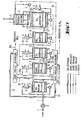
- Each treatment room is equipped with an acid circuit, which is circulated by pumps 4.
- the raw gas inlet is designated by 1 and the gas delivery fan is designated by 9. 2 are the connection lines between the gas treatment towers and 3 is the clean gas outlet.
- All gas treatment rooms contain packing layers 5.
- individual acid treatment stages are equipped with acid coolers 6 in order to lower the acid temperatures to the gas temperatures mentioned in the table above.
- the acid atomization devices in the gas treatment rooms are identified by 7.
- the acid swamps in the lower part of the towers are labeled 8.
- the fillers in the filler layers 5 have a surface area of more than 300 m 2 / m 3 .
- the need for reaction space per 1 Nm 3 / sec gas for denitration smaller than 3 m 3, for the SO 2 absorption is less than 4 m 3, for the absorption of NO x 1 is less than 4 m 3, for the NO - Absorption 2 less than 12 m 3 and for pure gas heating less than 1.5 m 3 .
- the nitrose content of the preliminary run is more than 200 g HNO 3 / liter. Thanks to this high concentration, it is possible to work with low flow or return quantities. In the exemplary embodiment explained, quantities of less than 500 g / Nm 3 exhaust gas to be processed are sufficient.
- the low temperatures in the entire treatment room of the main gas stream simplify the problem of selecting suitable materials.
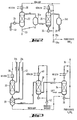
- Figure 2 explains the treatment of the acid flow.
- the preliminary acid is heated to a temperature of about 60 ° C and fed to the NO x stripper 22.
- NO x stripper is passed through the line 41 and the fan 21 exhaust air from the acid reflux treatment. It is essentially weakly contaminated air, which is enriched with NO in the stripper 22.
- the Oxidationsx space 24 a the majority of the NO passes into N0 2 .
- the gases then enter the ENT 3 absorber 25, which is equipped with a circulation pump 26 and an acid cooler 27.
- the line 28a is used to introduce ENT 3 into the denitration.
- the line 28 b serves to discharge the HNO 3 excess produced.
- the NO x exit gases of the HNO 3 absorber enter the oxidation space 24 b.
- FIG. 3 is used to explain the treatment of acid reflux.
- the acid return originating from the denitrification passes into the heater 30, where it is heated to 80 ° C., and then flows through the fine nitriding tower 32.
- the lines 31 a and 31 b serve to purge this tower with SO 2 -containing gas. It is sufficient to pass approx. 5% of the total amount of exhaust gas through this tower.
- the circulating pump of the concentrating tower is designated by 39 and the acid heater by 35.
- the acid concentrated to approx. 75% H 2 SO 4 reaches the circuit of the pure gas heating via line 36.
- the water vapor-containing air from the concentrating tower 34 reaches the vapor condenser 38 via the line 37.
- This condenser has an acid circuit with the cooler 40. Condensate which is produced continuously is discharged through the line 42. The dried air serves as stripping air in the SO 2 stripper 33 before it is passed via line 41 to the suction side of the fan 21 (see FIG. 2).
Landscapes
- Chemical & Material Sciences (AREA)
- Organic Chemistry (AREA)
- Inorganic Chemistry (AREA)
- Engineering & Computer Science (AREA)
- Health & Medical Sciences (AREA)
- Biomedical Technology (AREA)
- Environmental & Geological Engineering (AREA)
- Analytical Chemistry (AREA)
- General Chemical & Material Sciences (AREA)
- Oil, Petroleum & Natural Gas (AREA)
- Chemical Kinetics & Catalysis (AREA)
- Treating Waste Gases (AREA)
Applications Claiming Priority (2)
| Application Number | Priority Date | Filing Date | Title |
|---|---|---|---|
| CH387184 | 1984-08-13 | ||
| CH3871/84 | 1984-08-13 |
Publications (2)
| Publication Number | Publication Date |
|---|---|
| EP0174907A2 true EP0174907A2 (fr) | 1986-03-19 |
| EP0174907A3 EP0174907A3 (fr) | 1989-10-25 |
Family
ID=4265274
Family Applications (1)
| Application Number | Title | Priority Date | Filing Date |
|---|---|---|---|
| EP85810365A Withdrawn EP0174907A3 (fr) | 1984-08-13 | 1985-08-07 | Procédé d'élimination d'oxydes d'azote et de soufre des gaz d'échappement |
Country Status (4)
| Country | Link |
|---|---|
| EP (1) | EP0174907A3 (fr) |
| JP (1) | JPS6154224A (fr) |
| CA (1) | CA1293359C (fr) |
| DD (1) | DD237117A5 (fr) |
Cited By (1)
| Publication number | Priority date | Publication date | Assignee | Title |
|---|---|---|---|---|
| EP0292823A3 (en) * | 1987-05-27 | 1989-04-19 | Bayer Antwerpen N.V. | Process for no recovery from off-gas generated in the production of ammon nitrite |
Family Cites Families (2)
| Publication number | Priority date | Publication date | Assignee | Title |
|---|---|---|---|---|
| US4148868A (en) * | 1975-03-10 | 1979-04-10 | Ciba-Geigy Corporation | Process for separating SO2 from a current of gas containing the same |
| DE2830214A1 (de) * | 1977-07-21 | 1979-02-08 | Ciba Geigy Ag | Verfahren zum abtrennen von so tief 2 aus einem gasstrom und anlage zur durchfuehrung des verfahrens |
-
1985
- 1985-08-07 EP EP85810365A patent/EP0174907A3/fr not_active Withdrawn
- 1985-08-09 CA CA000488446A patent/CA1293359C/fr not_active Expired - Lifetime
- 1985-08-12 DD DD85279598A patent/DD237117A5/de unknown
- 1985-08-13 JP JP60177059A patent/JPS6154224A/ja active Pending
Cited By (2)
| Publication number | Priority date | Publication date | Assignee | Title |
|---|---|---|---|---|
| EP0292823A3 (en) * | 1987-05-27 | 1989-04-19 | Bayer Antwerpen N.V. | Process for no recovery from off-gas generated in the production of ammon nitrite |
| US4971776A (en) * | 1987-05-27 | 1990-11-20 | Bayer Aktiengesellschaft | Process for the recovery of NO from the waste gas resulting from the production of ammonium nitrite |
Also Published As
| Publication number | Publication date |
|---|---|
| CA1293359C (fr) | 1991-12-24 |
| DD237117A5 (de) | 1986-07-02 |
| JPS6154224A (ja) | 1986-03-18 |
| EP0174907A3 (fr) | 1989-10-25 |
Similar Documents
| Publication | Publication Date | Title |
|---|---|---|
| DE2148244C2 (de) | Verfahren zur Reinigung von Schwefeldioxid enthaltenden Abgasen | |
| DE2518386C3 (de) | Verfahren zur Entfernung von sauren Komponenten aus Abgasen | |
| DE60032061T2 (de) | Verfahren zur Gewinnung eines Absorbats aus einem Sauerstoff enthaltendem Einsatz | |
| DE2462681B1 (de) | Verfahren zum Abscheiden von Stickstoffoxiden aus Abgas | |
| DE19731062A1 (de) | Verfahren zum Entfernen von Schwefeloxiden aus Rauchgasen | |
| DE3810337A1 (de) | Verfahren zur reinigung von rauchgasen | |
| EP0322944A1 (fr) | Procédé de purification de gaz de fumée | |
| DE2145546B2 (de) | Verfahren zur Entfernung von SO3 und Schwefelsäurenebeln aus Gasen | |
| DE2304784A1 (de) | Verfahren zur industrierauchreinigung von verbrennungsprodukten u. dgl. vor dem ausstoss in die atmosphaere | |
| DE2333518C3 (de) | Verfahren zur Entfernung des Ammoniaks aus Gasen | |
| CH658408A5 (de) | Verfahren zum entfernen von sauren komponenten und stickoxyden aus abgasen. | |
| DE2442828A1 (de) | Verfahren zur behandlung von stickstoffoxidhaltigen gasen | |
| DE2814748C2 (fr) | ||
| DE69408874T2 (de) | Reinigung von erdgas | |
| EP0177806B1 (fr) | Procédé pour la désulfuration de gaz de fumée | |
| EP0318674B1 (fr) | Procédé pour éliminer des composants acides et des oxydes d'azote des gaz de rejet de fours industriels | |
| DE3007519C2 (fr) | ||
| EP0107144B1 (fr) | Procédé pour l'élimination de polluants de gaz d'échappement, particulièrement de fumées, par condensation | |
| DE1817015B2 (de) | Verfahren zur abtrennung von schwefeldioxyd aus restgasen | |
| DE2056727B2 (de) | Kreislaufverfahren zum auswaschen von schwefelwasserstoff und ammoniak aus kokereigasen | |
| EP0174907A2 (fr) | Procédé d'élimination d'oxydes d'azote et de soufre des gaz d'échappement | |
| DE3835934A1 (de) | Verfahren zur entfernung von schwefeldioxid und chlorwasserstoff aus heissen gasen | |
| DE3918212A1 (de) | Verfahren und vorrichtung zur wiedergewinnung von stickstoffoxiden industrieller anlagen | |
| DE2736488B2 (de) | Verfahren zum Entfernen von Schwefeloxiden aus Rauchgasen | |
| DE2255206A1 (de) | Verfahren zur herstellung von schwefelsaeure |
Legal Events
| Date | Code | Title | Description |
|---|---|---|---|
| PUAI | Public reference made under article 153(3) epc to a published international application that has entered the european phase |
Free format text: ORIGINAL CODE: 0009012 |
|
| 17P | Request for examination filed |
Effective date: 19850809 |
|
| AK | Designated contracting states |
Kind code of ref document: A2 Designated state(s): AT BE CH DE FR GB IT LI LU NL SE |
|
| PUAL | Search report despatched |
Free format text: ORIGINAL CODE: 0009013 |
|
| AK | Designated contracting states |
Kind code of ref document: A3 Designated state(s): AT BE CH DE FR GB IT LI LU NL SE |
|
| 17Q | First examination report despatched |
Effective date: 19900920 |
|
| STAA | Information on the status of an ep patent application or granted ep patent |
Free format text: STATUS: THE APPLICATION IS DEEMED TO BE WITHDRAWN |
|
| 18D | Application deemed to be withdrawn |
Effective date: 19910131 |
|
| RIN1 | Information on inventor provided before grant (corrected) |
Inventor name: FATTINGER, VOLKER, DR. |