EP0175251A2 - Geschmackstoffkompositionen mit einem Gehalt an Ionylestern, die Ionylester, deren Herstellung und Verwendung - Google Patents
Geschmackstoffkompositionen mit einem Gehalt an Ionylestern, die Ionylester, deren Herstellung und Verwendung Download PDFInfo
- Publication number
- EP0175251A2 EP0175251A2 EP85111360A EP85111360A EP0175251A2 EP 0175251 A2 EP0175251 A2 EP 0175251A2 EP 85111360 A EP85111360 A EP 85111360A EP 85111360 A EP85111360 A EP 85111360A EP 0175251 A2 EP0175251 A2 EP 0175251A2
- Authority
- EP
- European Patent Office
- Prior art keywords
- oxo
- ionyl
- formula
- mol
- tobacco
- Prior art date
- Legal status (The legal status is an assumption and is not a legal conclusion. Google has not performed a legal analysis and makes no representation as to the accuracy of the status listed.)
- Granted
Links
- 239000000203 mixture Substances 0.000 title claims abstract description 25
- 239000000796 flavoring agent Substances 0.000 title claims abstract description 8
- 238000002360 preparation method Methods 0.000 title claims description 3
- 235000013355 food flavoring agent Nutrition 0.000 title 1
- 150000001875 compounds Chemical class 0.000 claims abstract description 25
- 235000019505 tobacco product Nutrition 0.000 claims abstract description 12
- 125000004432 carbon atom Chemical group C* 0.000 claims abstract description 10
- 125000004043 oxo group Chemical group O=* 0.000 claims abstract description 8
- 235000019634 flavors Nutrition 0.000 claims abstract description 7
- 230000002708 enhancing effect Effects 0.000 claims abstract 2
- 241000208125 Nicotiana Species 0.000 claims description 34
- 235000002637 Nicotiana tabacum Nutrition 0.000 claims description 34
- BDAGIHXWWSANSR-UHFFFAOYSA-M Formate Chemical compound [O-]C=O BDAGIHXWWSANSR-UHFFFAOYSA-M 0.000 claims description 7
- 238000000034 method Methods 0.000 claims description 7
- LDHQCZJRKDOVOX-NSCUHMNNSA-N crotonic acid Chemical compound C\C=C\C(O)=O LDHQCZJRKDOVOX-NSCUHMNNSA-N 0.000 claims description 5
- QTBSBXVTEAMEQO-UHFFFAOYSA-M Acetate Chemical compound CC([O-])=O QTBSBXVTEAMEQO-UHFFFAOYSA-M 0.000 claims description 4
- GWYFCOCPABKNJV-UHFFFAOYSA-M 3-Methylbutanoic acid Natural products CC(C)CC([O-])=O GWYFCOCPABKNJV-UHFFFAOYSA-M 0.000 claims description 3
- GWYFCOCPABKNJV-UHFFFAOYSA-N isovaleric acid Chemical compound CC(C)CC(O)=O GWYFCOCPABKNJV-UHFFFAOYSA-N 0.000 claims description 3
- 238000005728 strengthening Methods 0.000 claims description 3
- FERIUCNNQQJTOY-UHFFFAOYSA-M Butyrate Chemical compound CCCC([O-])=O FERIUCNNQQJTOY-UHFFFAOYSA-M 0.000 claims description 2
- FERIUCNNQQJTOY-UHFFFAOYSA-N Butyric acid Natural products CCCC(O)=O FERIUCNNQQJTOY-UHFFFAOYSA-N 0.000 claims description 2
- 150000001242 acetic acid derivatives Chemical class 0.000 claims description 2
- 125000002252 acyl group Chemical group 0.000 claims 2
- 238000004519 manufacturing process Methods 0.000 claims 1
- 235000019504 cigarettes Nutrition 0.000 description 64
- JUJWROOIHBZHMG-UHFFFAOYSA-N Pyridine Chemical compound C1=CC=NC=C1 JUJWROOIHBZHMG-UHFFFAOYSA-N 0.000 description 46
- 239000000779 smoke Substances 0.000 description 31
- UMJSCPRVCHMLSP-UHFFFAOYSA-N pyridine Natural products COC1=CC=CN=C1 UMJSCPRVCHMLSP-UHFFFAOYSA-N 0.000 description 23
- 239000012043 crude product Substances 0.000 description 19
- 238000004821 distillation Methods 0.000 description 17
- WFDIJRYMOXRFFG-UHFFFAOYSA-N Acetic anhydride Chemical compound CC(=O)OC(C)=O WFDIJRYMOXRFFG-UHFFFAOYSA-N 0.000 description 15
- 239000000243 solution Substances 0.000 description 13
- 150000002148 esters Chemical class 0.000 description 10
- XLYOFNOQVPJJNP-UHFFFAOYSA-N water Substances O XLYOFNOQVPJJNP-UHFFFAOYSA-N 0.000 description 10
- RTZKZFJDLAIYFH-UHFFFAOYSA-N Diethyl ether Chemical compound CCOCC RTZKZFJDLAIYFH-UHFFFAOYSA-N 0.000 description 9
- VLKZOEOYAKHREP-UHFFFAOYSA-N n-Hexane Chemical compound CCCCCC VLKZOEOYAKHREP-UHFFFAOYSA-N 0.000 description 9
- LWWWERIIOIAWQK-UHFFFAOYSA-N 4-Oxo-beta-jonol Natural products CC(O)C=CC1=C(C)C(=O)CCC1(C)C LWWWERIIOIAWQK-UHFFFAOYSA-N 0.000 description 8
- 230000000694 effects Effects 0.000 description 8
- XDTMQSROBMDMFD-UHFFFAOYSA-N Cyclohexane Chemical compound C1CCCCC1 XDTMQSROBMDMFD-UHFFFAOYSA-N 0.000 description 7
- CDBYLPFSWZWCQE-UHFFFAOYSA-L Sodium Carbonate Chemical compound [Na+].[Na+].[O-]C([O-])=O CDBYLPFSWZWCQE-UHFFFAOYSA-L 0.000 description 6
- -1 butyroyl Chemical group 0.000 description 6
- 239000000047 product Substances 0.000 description 6
- NGNBDVOYPDDBFK-UHFFFAOYSA-N 2-[2,4-di(pentan-2-yl)phenoxy]acetyl chloride Chemical compound CCCC(C)C1=CC=C(OCC(Cl)=O)C(C(C)CCC)=C1 NGNBDVOYPDDBFK-UHFFFAOYSA-N 0.000 description 4
- VMZCDNSFRSVYKQ-UHFFFAOYSA-N 2-phenylacetyl chloride Chemical compound ClC(=O)CC1=CC=CC=C1 VMZCDNSFRSVYKQ-UHFFFAOYSA-N 0.000 description 4
- OYHQOLUKZRVURQ-HZJYTTRNSA-M 9-cis,12-cis-Octadecadienoate Chemical compound CCCCC\C=C/C\C=C/CCCCCCCC([O-])=O OYHQOLUKZRVURQ-HZJYTTRNSA-M 0.000 description 4
- 238000006243 chemical reaction Methods 0.000 description 4
- 229940049918 linoleate Drugs 0.000 description 4
- QIQXTHQIDYTFRH-UHFFFAOYSA-N octadecanoic acid Chemical compound CCCCCCCCCCCCCCCCCC(O)=O QIQXTHQIDYTFRH-UHFFFAOYSA-N 0.000 description 4
- 229940049964 oleate Drugs 0.000 description 4
- ZQPPMHVWECSIRJ-KTKRTIGZSA-N oleic acid Chemical compound CCCCCCCC\C=C/CCCCCCCC(O)=O ZQPPMHVWECSIRJ-KTKRTIGZSA-N 0.000 description 4
- 239000012074 organic phase Substances 0.000 description 4
- DUCKXCGALKOSJF-UHFFFAOYSA-N pentanoyl pentanoate Chemical compound CCCCC(=O)OC(=O)CCCC DUCKXCGALKOSJF-UHFFFAOYSA-N 0.000 description 4
- 239000011541 reaction mixture Substances 0.000 description 4
- LFQSCWFLJHTTHZ-UHFFFAOYSA-N Ethanol Chemical compound CCO LFQSCWFLJHTTHZ-UHFFFAOYSA-N 0.000 description 3
- VEXZGXHMUGYJMC-UHFFFAOYSA-N Hydrochloric acid Chemical compound Cl VEXZGXHMUGYJMC-UHFFFAOYSA-N 0.000 description 3
- XBDQKXXYIPTUBI-UHFFFAOYSA-M Propionate Chemical compound CCC([O-])=O XBDQKXXYIPTUBI-UHFFFAOYSA-M 0.000 description 3
- DNIAPMSPPWPWGF-UHFFFAOYSA-N Propylene glycol Chemical compound CC(O)CO DNIAPMSPPWPWGF-UHFFFAOYSA-N 0.000 description 3
- YXFVVABEGXRONW-UHFFFAOYSA-N Toluene Chemical compound CC1=CC=CC=C1 YXFVVABEGXRONW-UHFFFAOYSA-N 0.000 description 3
- VJDDQSBNUHLBTD-GGWOSOGESA-N [(e)-but-2-enoyl] (e)-but-2-enoate Chemical compound C\C=C\C(=O)OC(=O)\C=C\C VJDDQSBNUHLBTD-GGWOSOGESA-N 0.000 description 3
- YHASWHZGWUONAO-UHFFFAOYSA-N butanoyl butanoate Chemical compound CCCC(=O)OC(=O)CCC YHASWHZGWUONAO-UHFFFAOYSA-N 0.000 description 3
- IPCSVZSSVZVIGE-UHFFFAOYSA-M hexadecanoate Chemical compound CCCCCCCCCCCCCCCC([O-])=O IPCSVZSSVZVIGE-UHFFFAOYSA-M 0.000 description 3
- 235000021388 linseed oil Nutrition 0.000 description 3
- 239000000944 linseed oil Substances 0.000 description 3
- 229910000029 sodium carbonate Inorganic materials 0.000 description 3
- 239000002904 solvent Substances 0.000 description 3
- VJDDQSBNUHLBTD-UHFFFAOYSA-N trans-crotonic acid-anhydride Natural products CC=CC(=O)OC(=O)C=CC VJDDQSBNUHLBTD-UHFFFAOYSA-N 0.000 description 3
- XVMSFILGAMDHEY-UHFFFAOYSA-N 6-(4-aminophenyl)sulfonylpyridin-3-amine Chemical compound C1=CC(N)=CC=C1S(=O)(=O)C1=CC=C(N)C=N1 XVMSFILGAMDHEY-UHFFFAOYSA-N 0.000 description 2
- 238000000023 Kugelrohr distillation Methods 0.000 description 2
- PMZURENOXWZQFD-UHFFFAOYSA-L Sodium Sulfate Chemical compound [Na+].[Na+].[O-]S([O-])(=O)=O PMZURENOXWZQFD-UHFFFAOYSA-L 0.000 description 2
- UIIMBOGNXHQVGW-UHFFFAOYSA-M Sodium bicarbonate Chemical compound [Na+].OC([O-])=O UIIMBOGNXHQVGW-UHFFFAOYSA-M 0.000 description 2
- 150000008065 acid anhydrides Chemical class 0.000 description 2
- 235000009508 confectionery Nutrition 0.000 description 2
- 230000032050 esterification Effects 0.000 description 2
- 238000005886 esterification reaction Methods 0.000 description 2
- BDAGIHXWWSANSR-UHFFFAOYSA-N methanoic acid Natural products OC=O BDAGIHXWWSANSR-UHFFFAOYSA-N 0.000 description 2
- WYVAMUWZEOHJOQ-UHFFFAOYSA-N propionic anhydride Chemical compound CCC(=O)OC(=O)CC WYVAMUWZEOHJOQ-UHFFFAOYSA-N 0.000 description 2
- 230000000391 smoking effect Effects 0.000 description 2
- 229910052938 sodium sulfate Inorganic materials 0.000 description 2
- 235000011152 sodium sulphate Nutrition 0.000 description 2
- FYSNRJHAOHDILO-UHFFFAOYSA-N thionyl chloride Chemical compound ClS(Cl)=O FYSNRJHAOHDILO-UHFFFAOYSA-N 0.000 description 2
- SNICXCGAKADSCV-JTQLQIEISA-N (-)-Nicotine Chemical compound CN1CCC[C@H]1C1=CC=CN=C1 SNICXCGAKADSCV-JTQLQIEISA-N 0.000 description 1
- FBWMYSQUTZRHAT-HZJYTTRNSA-N (9z,12z)-octadeca-9,12-dienoyl chloride Chemical compound CCCCC\C=C/C\C=C/CCCCCCCC(Cl)=O FBWMYSQUTZRHAT-HZJYTTRNSA-N 0.000 description 1
- MLQBTMWHIOYKKC-KTKRTIGZSA-N (z)-octadec-9-enoyl chloride Chemical compound CCCCCCCC\C=C/CCCCCCCC(Cl)=O MLQBTMWHIOYKKC-KTKRTIGZSA-N 0.000 description 1
- WLAMNBDJUVNPJU-UHFFFAOYSA-M 2-methylbutyrate Chemical compound CCC(C)C([O-])=O WLAMNBDJUVNPJU-UHFFFAOYSA-M 0.000 description 1
- WLAMNBDJUVNPJU-UHFFFAOYSA-N 2-methylbutyric acid Chemical compound CCC(C)C(O)=O WLAMNBDJUVNPJU-UHFFFAOYSA-N 0.000 description 1
- VSYLEWGIVLSDIY-UHFFFAOYSA-N 4-(2,6,6-Trimethyl-1-cyclohexenyl)-2-butanol Chemical compound CC(O)CCC1=C(C)CCCC1(C)C VSYLEWGIVLSDIY-UHFFFAOYSA-N 0.000 description 1
- OSWFIVFLDKOXQC-UHFFFAOYSA-N 4-(3-methoxyphenyl)aniline Chemical compound COC1=CC=CC(C=2C=CC(N)=CC=2)=C1 OSWFIVFLDKOXQC-UHFFFAOYSA-N 0.000 description 1
- 240000007124 Brassica oleracea Species 0.000 description 1
- 235000003899 Brassica oleracea var acephala Nutrition 0.000 description 1
- 235000011301 Brassica oleracea var capitata Nutrition 0.000 description 1
- 235000001169 Brassica oleracea var oleracea Nutrition 0.000 description 1
- 239000004215 Carbon black (E152) Substances 0.000 description 1
- VEXZGXHMUGYJMC-UHFFFAOYSA-M Chloride anion Chemical compound [Cl-] VEXZGXHMUGYJMC-UHFFFAOYSA-M 0.000 description 1
- 241001293495 Lactuca virosa Species 0.000 description 1
- JLTDJTHDQAWBAV-UHFFFAOYSA-N N,N-dimethylaniline Chemical compound CN(C)C1=CC=CC=C1 JLTDJTHDQAWBAV-UHFFFAOYSA-N 0.000 description 1
- XBDQKXXYIPTUBI-UHFFFAOYSA-N Propionic acid Chemical compound CCC(O)=O XBDQKXXYIPTUBI-UHFFFAOYSA-N 0.000 description 1
- 125000002777 acetyl group Chemical group [H]C([H])([H])C(*)=O 0.000 description 1
- 239000002253 acid Substances 0.000 description 1
- 150000001266 acyl halides Chemical class 0.000 description 1
- 239000000654 additive Substances 0.000 description 1
- 230000002411 adverse Effects 0.000 description 1
- DTOSIQBPPRVQHS-PDBXOOCHSA-N alpha-linolenic acid Chemical compound CC\C=C/C\C=C/C\C=C/CCCCCCCC(O)=O DTOSIQBPPRVQHS-PDBXOOCHSA-N 0.000 description 1
- 235000020661 alpha-linolenic acid Nutrition 0.000 description 1
- 125000002714 alpha-linolenoyl group Chemical group O=C([*])C([H])([H])C([H])([H])C([H])([H])C([H])([H])C([H])([H])C([H])([H])C([H])([H])/C([H])=C([H])\C([H])([H])/C([H])=C([H])\C([H])([H])/C([H])=C([H])\C([H])([H])C([H])([H])[H] 0.000 description 1
- 150000001412 amines Chemical class 0.000 description 1
- 125000003118 aryl group Chemical group 0.000 description 1
- 239000006227 byproduct Substances 0.000 description 1
- 125000001589 carboacyl group Chemical group 0.000 description 1
- 239000003795 chemical substances by application Substances 0.000 description 1
- 230000001055 chewing effect Effects 0.000 description 1
- 235000019506 cigar Nutrition 0.000 description 1
- 239000011248 coating agent Substances 0.000 description 1
- 238000000576 coating method Methods 0.000 description 1
- 230000001419 dependent effect Effects 0.000 description 1
- VSYLEWGIVLSDIY-NSHDSACASA-N dihydro-beta-ionol Natural products C[C@H](O)CCC1=C(C)CCCC1(C)C VSYLEWGIVLSDIY-NSHDSACASA-N 0.000 description 1
- 238000007598 dipping method Methods 0.000 description 1
- 125000001495 ethyl group Chemical group [H]C([H])([H])C([H])([H])* 0.000 description 1
- 235000019253 formic acid Nutrition 0.000 description 1
- 125000002485 formyl group Chemical group [H]C(*)=O 0.000 description 1
- 239000003205 fragrance Substances 0.000 description 1
- IPCSVZSSVZVIGE-UHFFFAOYSA-N hexadecanoic acid Chemical class CCCCCCCCCCCCCCCC(O)=O IPCSVZSSVZVIGE-UHFFFAOYSA-N 0.000 description 1
- ARBOVOVUTSQWSS-UHFFFAOYSA-N hexadecanoyl chloride Chemical compound CCCCCCCCCCCCCCCC(Cl)=O ARBOVOVUTSQWSS-UHFFFAOYSA-N 0.000 description 1
- 229930195733 hydrocarbon Natural products 0.000 description 1
- 150000002430 hydrocarbons Chemical class 0.000 description 1
- 239000012442 inert solvent Substances 0.000 description 1
- 238000002347 injection Methods 0.000 description 1
- 239000007924 injection Substances 0.000 description 1
- 229940040452 linolenate Drugs 0.000 description 1
- 229960004488 linolenic acid Drugs 0.000 description 1
- KQQKGWQCNNTQJW-UHFFFAOYSA-N linolenic acid Natural products CC=CCCC=CCC=CCCCCCCCC(O)=O KQQKGWQCNNTQJW-UHFFFAOYSA-N 0.000 description 1
- 239000000463 material Substances 0.000 description 1
- 229960002715 nicotine Drugs 0.000 description 1
- SNICXCGAKADSCV-UHFFFAOYSA-N nicotine Natural products CN1CCCC1C1=CC=CN=C1 SNICXCGAKADSCV-UHFFFAOYSA-N 0.000 description 1
- WTBAHSZERDXKKZ-UHFFFAOYSA-N octadecanoyl chloride Chemical compound CCCCCCCCCCCCCCCCCC(Cl)=O WTBAHSZERDXKKZ-UHFFFAOYSA-N 0.000 description 1
- 125000002811 oleoyl group Chemical group O=C([*])C([H])([H])C([H])([H])C([H])([H])C([H])([H])C([H])([H])C([H])([H])C([H])([H])/C([H])=C([H])\C([H])([H])C([H])([H])C([H])([H])C([H])([H])C([H])([H])C([H])([H])C([H])([H])C([H])([H])[H] 0.000 description 1
- 239000002798 polar solvent Substances 0.000 description 1
- 125000006238 prop-1-en-1-yl group Chemical group [H]\C(*)=C(/[H])C([H])([H])[H] 0.000 description 1
- 125000001501 propionyl group Chemical group O=C([*])C([H])([H])C([H])([H])[H] 0.000 description 1
- 150000003839 salts Chemical class 0.000 description 1
- 238000007127 saponification reaction Methods 0.000 description 1
- 229910000030 sodium bicarbonate Inorganic materials 0.000 description 1
- 235000017557 sodium bicarbonate Nutrition 0.000 description 1
- SNOOUWRIMMFWNE-UHFFFAOYSA-M sodium;6-[(3,4,5-trimethoxybenzoyl)amino]hexanoate Chemical compound [Na+].COC1=CC(C(=O)NCCCCCC([O-])=O)=CC(OC)=C1OC SNOOUWRIMMFWNE-UHFFFAOYSA-M 0.000 description 1
- 238000005507 spraying Methods 0.000 description 1
- 125000003696 stearoyl group Chemical group O=C([*])C([H])([H])C([H])([H])C([H])([H])C([H])([H])C([H])([H])C([H])([H])C([H])([H])C([H])([H])C([H])([H])C([H])([H])C([H])([H])C([H])([H])C([H])([H])C([H])([H])C([H])([H])C([H])([H])C([H])([H])[H] 0.000 description 1
- 238000003756 stirring Methods 0.000 description 1
- 239000000126 substance Substances 0.000 description 1
- 238000009423 ventilation Methods 0.000 description 1
- 238000010626 work up procedure Methods 0.000 description 1
Classifications
-
- C—CHEMISTRY; METALLURGY
- C07—ORGANIC CHEMISTRY
- C07C—ACYCLIC OR CARBOCYCLIC COMPOUNDS
- C07C403/00—Derivatives of cyclohexane or of a cyclohexene or of cyclohexadiene, having a side-chain containing an acyclic unsaturated part of at least four carbon atoms, this part being directly attached to the cyclohexane or cyclohexene or cyclohexadiene rings, e.g. vitamin A, beta-carotene, beta-ionone
- C07C403/06—Derivatives of cyclohexane or of a cyclohexene or of cyclohexadiene, having a side-chain containing an acyclic unsaturated part of at least four carbon atoms, this part being directly attached to the cyclohexane or cyclohexene or cyclohexadiene rings, e.g. vitamin A, beta-carotene, beta-ionone having side-chains substituted by singly-bound oxygen atoms
- C07C403/12—Derivatives of cyclohexane or of a cyclohexene or of cyclohexadiene, having a side-chain containing an acyclic unsaturated part of at least four carbon atoms, this part being directly attached to the cyclohexane or cyclohexene or cyclohexadiene rings, e.g. vitamin A, beta-carotene, beta-ionone having side-chains substituted by singly-bound oxygen atoms by esterified hydroxy groups
-
- A—HUMAN NECESSITIES
- A23—FOODS OR FOODSTUFFS; TREATMENT THEREOF, NOT COVERED BY OTHER CLASSES
- A23L—FOODS, FOODSTUFFS OR NON-ALCOHOLIC BEVERAGES, NOT OTHERWISE PROVIDED FOR; PREPARATION OR TREATMENT THEREOF
- A23L27/00—Spices; Flavouring agents or condiments; Artificial sweetening agents; Table salts; Dietetic salt substitutes; Preparation or treatment thereof
- A23L27/20—Synthetic spices, flavouring agents or condiments
- A23L27/203—Alicyclic compounds
-
- A—HUMAN NECESSITIES
- A24—TOBACCO; CIGARS; CIGARETTES; SIMULATED SMOKING DEVICES; SMOKERS' REQUISITES
- A24B—MANUFACTURE OR PREPARATION OF TOBACCO FOR SMOKING OR CHEWING; TOBACCO; SNUFF
- A24B15/00—Chemical features or treatment of tobacco; Tobacco substitutes, e.g. in liquid form
- A24B15/18—Treatment of tobacco products or tobacco substitutes
- A24B15/28—Treatment of tobacco products or tobacco substitutes by chemical substances
- A24B15/30—Treatment of tobacco products or tobacco substitutes by chemical substances by organic substances
- A24B15/34—Treatment of tobacco products or tobacco substitutes by chemical substances by organic substances containing a carbocyclic ring other than a six-membered aromatic ring
-
- C—CHEMISTRY; METALLURGY
- C07—ORGANIC CHEMISTRY
- C07C—ACYCLIC OR CARBOCYCLIC COMPOUNDS
- C07C2601/00—Systems containing only non-condensed rings
- C07C2601/12—Systems containing only non-condensed rings with a six-membered ring
- C07C2601/16—Systems containing only non-condensed rings with a six-membered ring the ring being unsaturated
Definitions
- the invention relates to flavoring compositions which contain an oxo-ionyl ester of the general formula where RCO stands for an acyl radical with 1 - 18 carbon atoms, one of the dashed lines in the ring means an additional bond and the dashed line in the side chain means an optional additional bond and Z represents an oxo group in the a-position to the ring-shaped double bond .
- Formula I is intended to all with regard to existing ones cis / trans isomerism possible geometric isomers.
- C 1 -1 8 acyl radicals are formyl, C 2-18 alkanoyl such as "acetyl, propionyl, butyroyl, V aleroyl, Isovaleroyl, stearoyl, C 3 -C 18 alkenoyl having one or more double bonds, such as crotonoyl, linoloyl, Linolenoyl, oleoyl, C 7-18 arylalkanoyl, such as phenylalkanoyl, for example phenylacetyl.
- C 2-18 alkanoyl such as "acetyl, propionyl, butyroyl, V aleroyl, Isovaleroyl, stearoyl
- C 3 -C 18 alkenoyl having one or more double bonds such as crotonoyl, linoloyl, Linolenoyl, oleoyl, C 7-18 arylalkanoyl
- the preferred acyl radicals contain up to 5 carbon atoms.
- the compounds I have special organoleptic properties which make them particularly suitable as flavorings, in particular for flavoring tobacco products.
- the new flavoring compositions are particularly suitable for strengthening, improving, increasing or modifying the organoleptic properties of tobacco products.
- the invention also relates to the use of the compounds I as flavors, in particular as flavors for tobacco flavoring, and to a method for strengthening, improving, increasing or modifying the organoleptic properties of tobacco products by means of the compounds I.
- tobacco product is a common term in the industry, but it is not just tobacco [- e.g. Burley, Maryland, Virginia, Kentucky, oriental varieties or mixtures thereof - but also includes tobacco by-products, such as reconstituted and homogenized leaves and stems, tobacco surrogates (e.g. lettuce and cabbage leaves, etc.), materials used in the Tobacco processing are used, such as paper, filters etc.
- tobacco product includes cigarette tobacco, cigar tobacco, chewing tobacco and pipe tobacco, etc.
- an oxo-ionyl ester of the formula I for example to a tobacco mixture, can have various effects on the organoleptic properties when consumed, depending on the type of ester I used.
- the (smoke) aroma of cigarettes treated with 4-oxo-ß-ionylvalerate the typical aspects of dark tobacco and appears much more rounded and full.
- an oxo-ionyl ester of the formula I significantly improves its smoking characteristics, in particular enhances the general tobacco impression, makes the entire aroma appear more rounded and full and, if necessary, additionally enriches it with the organoleptic aspects listed above.
- the amount of the ester of formula I that is conveniently added can depend on various factors, including the desired effect, the type and amount of other additives used simultaneously and / or the personal preference of the aromatic. Even amounts of 10 ppm, based on the weight of the tobacco, prove to be effective, but amounts of 10,000 ppm can still be used. However, amounts of 50 ppm to 2000 ppm are particularly preferably used.
- flavoring compositions for tobacco flavoring can be done by simply dissolving compounds I in a suitable solvent, in particular a polar solvent, for example alcohol, propylene glycol, etc., optionally with the addition of further (fragrance and / or) flavoring substances and water, where the concentration of compound I, for example Can be 0.5 to 50%.
- a suitable solvent in particular a polar solvent, for example alcohol, propylene glycol, etc.
- further (fragrance and / or) flavoring substances and water where the concentration of compound I, for example Can be 0.5 to 50%.
- the compounds I can be added to the tobacco product (cigarettes, etc.), for example in the form of the above flavoring compositions by the methods known to the person skilled in the art, e.g.
- Spraying, atomizing, dipping, coating, etc. can be added or added.
- the compounds of the formula I are new compounds.
- the new compounds of formula I therefore also form the subject of the present invention.
- the compounds I can be obtained in a manner known per se, that is to say by esterification of oxoionols of the formula wherein one of the dashed lines in the ring represents an additional bond and the dashed line in the side chain represents an optional additional bond, and Z represents an oxo group in the a-position to the ring-shaped double bond.
- the esterification of the oxo-ionols II can be carried out in a manner known per se using customary acylating agents, for example acyl halides, in particular the chloride, or acid anhydrides.
- the procedure using the acid anhydrides is preferred. It is expedient to work in the presence of a base, for example an organic amine such as pyridine or dimethylaniline, and optionally using an inert solvent, for example a hydrocarbon or an ether, for example hexane, cyclohexane, toluene, diethyl ether, etc.
- a suitable temperature range is that of about 20 ° C - 80 ° C; see also Organikum, Org. chem. Basic internship VEB German Publishing House of Sciences, Berlin (1977), pages 499 ff.
- a 5% solution of the ester in 95% alcohol is prepared and 10 ⁇ l of it is distributed evenly over the entire length of the test cigarettes (American blend, consisting of Virginia tobacco, Orient tobacco and Burley tobacco) using an injection needle and then reconditioned the cigarettes thus treated for 24 hours. The same procedure is repeated with 10 ul of 95% alcohol to make the appropriate control cigarettes.
- the expert panel called the smoke flavor of the T estzigaretten as much typical and balanced tobacco-like; sweet and floral nuances were also detected.
- the expert panel described the smoke aroma of the test cigarettes produced in the same way as in Example 1 as clearly tobacco-like, and in addition also spicy and slightly flowerier than that of the control cigarettes.
- the expert panel described the smoke aroma of the test cigarettes produced in the same way as in Example 1 as being sweeter, more modern and, overall, significantly better underlining and more rounded than the control cigarettes.
- the expert panel described the smoke aroma of the test cigarettes produced as in Example 1 as significantly woodier, greener, fruity than that of the control cigarettes.
- the expert panel described the smoke aroma of the test cigarettes produced as in Example 1 as more clearly pronounced of dark tobacco and more rounded than that of the control cigarettes.
- the expert panel described the smoke aroma of the test cigarettes produced as in Example 1 as clearly sweeter, more caramel-like and more modern than that of the control cigarettes.
- the E xpert panel described the smoke flavor of the analog sample test cigarettes l produced as unique hay-like than that of the control cigarettes.
- a solution of 5.00 g (0.024 mol) of 4-oxo-ß-ionol and 2.29 g (0.029 mol) of pyridine in 30 ml of cyclohexane is mixed with a solution of 7.11 g (approx. 0.024 Mol) of a mixture consisting of 57% linolenic acid chloride, 14% linoleic acid chloride, 18% oleic acid chloride, 3% stearic acid chloride and 7% palmitic acid chloride in 10 ml cyclohexane.
- the temperature of the reaction mixture rises to 40 ° C.
- the mixture is then stirred for 4 hours at room temperature, then diluted with 50 ml of ether, the organic phase is washed twice with dilute hydrochloric acid, water, sodium carbonate solution and again with water, dried and concentrated.
- the expert panel called the smoke flavor of the analogous example T l produced estzigaretten as clearly milder and more rounded than that of the control cigarettes. There was also a clear “salivating" effect.
- the acid chloride mixture used above is obtained by customary reaction of the corresponding acid mixture obtainable by saponification of linseed oil with a base with thionyl chloride.
- the expert panel described the smoke aroma of the test cigarettes produced as in Example 1 as clearly tobacco-like, more current than that of the control cigarettes.
- the expert panel described the smoke aroma of the test cigarettes produced as in Example 1 as clearly tobacco-like, more current and sweeter than that of the control cigarettes. In addition, there was a clear "salivating effect".
- the expert panel described the smoke aroma of the test cigarettes produced as in Example 1 as clearly sweeter, more modern and, taken as a whole, more rounded than the aroma of the control cigarettes.
- the expert panel described the smoke aroma of the test cigarettes produced as in Example 1 as fruity and woody than that of the control cigarettes.
- the expert panel described the smoke aroma of the test cigarettes produced as in Example 1 as clearly tobacco-like, flowery, sweeter, more rounded than that of the control cigarettes.
- the expert panel described the smoke aroma of the test cigarettes produced as in Example 1 as clearly more spicy and caramel-like than that of the control cigarettes.
- the expert panel described the smoke aroma of the test cigarettes produced as in Example 1 as clearly more modern and sweeter than that of the control cigarettes.
- the expert panel described the smoke aroma of the test cigarettes produced as in Example 1 as clearly milder than that of the control cigarettes, with the general impression of tobacco in particular becoming more important in the case in question. In addition, a pronounced "salivating effect" was found.
- the expert panel described the smoke aroma as analog Example 1 produced test cigarettes as clearly tobacco-like than that of the control cigarettes.
- the expert panel described the smoke aroma of the test cigarettes produced analogously to Example 1 as being significantly more tobacco than that of the control cigarettes, in which case (in particular) a (uniform) intensification of the tobacco impression was found.
- the expert panel described the smoke aroma of the test cigarettes produced as in Example 1 as clearly fruity than in the case of the aroma of the control cigarettes.
- the expert panel described the smoke aroma of the test cigarettes produced as in Example 1 as clearly superior, in particular more pronounced of dark tobacco. In addition, a general intensification of the tobacco impression was found.
- the expert panel described the smoke aroma of the test cigarettes produced as in Example 1 as being superior to that of the control cigarettes, in particular because in the former case the general impression of tobacco came to the fore.
- the expert panel described the smoke aroma of the test cigarettes produced as in Example 1 as being sweeter and more current than that of the control cigarettes.
- the expert panel described the smoke aroma of the test cigarettes produced as in Example 1 as milder than that of the control cigarettes. In addition, a pleasant "salivating effect" was found.
- the expert panel described the smoke aroma of the test cigarettes produced as in Example 1 as being more rounded than that of the control cigarettes; at the same time, the general impression of tobacco was perceived more intensely.
- the expert panel described the smoke aroma of the test cigarettes produced as in Example 1 as more pronounced of oriental tobacco than that of the control cigarettes.
- the expert panel described the smoke aroma of the test cigarettes produced as in Example 1 as being sweeter and more current than that of the control cigarettes.
- the expert panel described the smoke aroma of the test cigarettes produced as in Example 1 as milder and more balanced than that of the control cigarettes.
- adding an oxo-ionyl ester of the formula I to a tobacco product significantly improves its smoke characteristics, in particular the general tobacco impression is strengthened and the overall aroma appears rounded and full.
- esters of the formula I differ very clearly from the esters of the Japanese patent publication No. 57 734 (Japan Tobacco and Salt Pub., Dated May 20, 1981. filed on October 16, 1979) with the general formula
- the expert panel described the smoke aroma of the test cigarettes aromatized with all of these known esters in the manner described in Example 1 in comparison to the corresponding cigarettes with the addition of the compounds I according to the invention in any case as clearly characterized by perfume-like, strongly floral notes.
Landscapes
- Chemical & Material Sciences (AREA)
- Organic Chemistry (AREA)
- Health & Medical Sciences (AREA)
- Nutrition Science (AREA)
- Chemical Kinetics & Catalysis (AREA)
- General Chemical & Material Sciences (AREA)
- Toxicology (AREA)
- Life Sciences & Earth Sciences (AREA)
- Engineering & Computer Science (AREA)
- Food Science & Technology (AREA)
- Polymers & Plastics (AREA)
- General Health & Medical Sciences (AREA)
- Manufacture Of Tobacco Products (AREA)
- Organic Low-Molecular-Weight Compounds And Preparation Thereof (AREA)
Abstract
Description
- Die Erfindung betrifft Geschmackstoffkompositionen, die durch einen Gehalt an einem Oxo-ionylester der allgemeinen Formel

worin RCO für einen Acylrest mit 1 - 18 Kohlenstoffatomen steht, eine der gestrichelt gezeichneten Linien im Ring eine zusätzliche Bindung und die gestrichelt gezeichnete Linie in der Seitenkette eine fakultative zusätzliche Bindung bedeutet und Z eine Oxogruppe in a-Stellung zur ringständigen Doppelbindung darstellt, gekennzeichnet sind. - Die Formel I soll sämtliche im Hinblick auf vorhandene cis/trans-Isomerie möglichen geometrischen Isomeren erfassen.
- Beispiele von C1-18-Acylresten sind Formyl,C2-18Alkanoyl wie "Acetyl, Propionyl, Butyroyl, Valeroyl, Isovaleroyl, Stearoyl,C3-C18-Alkenoyl mit einer oder mehreren Doppelbindungen, wie Crotonoyl,Linoloyl, Linolenoyl, Oleoyl, C7-18-Arylalkanoyl, wie Phenylalkanoyl, z.B. Phenylacetyl.
- Die bevorzugten Acylreste enthalten bis zu 5 C-Atome.
- Bevorzugte Verbindungen I sind insbesondere:
- 4-Oxo-ß-ionylvalerat
- 4-Oxo-ß-ionylisovalerat
- 4-Oxo-ß-ionylbutyrat
- 4-Oxo-ß-ionylacetat
- 4-Oxo-ß-ionylformiat
- 4-Oxo-ß-ionylcrotonat
- 4-Oxo-dihydro-ß-ionylvalerat
- 4-Oxo-dihydro-ß-ionylacetat
- 3-Oxo-o-ionylvalerat
- Die Verbindungen I weisen besondere organoleptische Eigenschaften auf, auf Grund derer sie sich vorzüglich als Geschmackstoffe, insbesondere zur Aromatisierung von Tabakerzeugnissen eignen. Die neuen Geschmackstoffkompositionen eignen sich diesbezüglich insbesondere zur Verstärkung, Verbesserung, Erhöhung oder Modifizierung der organoleptischen Eigenschaften von Tabakerzeugnissen.
- Die Erfindung betrifft auch die Verwendung der Verbindungen I als Geschmackstoffe, insbesondere als Geschmackstoffe zur Tabakaromatisierung und ein Verfahren zur Verstärkung, Verbesserung, Erhöhung oder Modifizierung der organoleptischen Eigenschaften von Tabakerzeugnissen mittels der Verbindungen I.
- "Tabakerzeugnis" ist eine in der Branche übliche, allgemeine Bezeichnung, die aber nicht nur Tabak [- z.B. Burley-, Maryland-, Virginia-, Kentucky-, orientalische Sorten oder Mischungen davon-jselbst umfasst, sondern auch Tabaknebenprodukte, wie rekonstituierte und homogenisierte Blätter und Stengel, Tabaksurrogate (z.B. Salat- und Kohlblätter, etc.), Materialien, die bei der Tabakverarbeitung gebraucht werden, wie Papier, Filter etc. Unter die Bezeichnung "Tabakerzeugnis" fallen Zigarettentabak, Zigarrentabak, Kautabak und Pfeifentabak, etc.
- Der Zusatz eines Oxo-ionylesters der Formel I beispielsweise zu einer Tabakmischung kann sich je nach Art des verwendeten Esters I beim Verrauchen verschiedenartig auf die organoleptischen Eigenschaften auswirken. So zeigt z.B. das (Rauch)Aroma von mit 4-Oxo-ß-ionylvalerat behandelten Zigaretten die typischen Aspekte von dunklem Tabak und wirkt im gesamten wesentlich abgerundeter und voller.
- Bei Verwendung von 4-Oxo-ß-ionylacetat können insbesondere eine allgemeine Verstärkung des Tabakcharakters und zusätzliches Auftreten von blumigen, würzigen und teeartigen Aspekten festgestellt werden. Andere Verbindun- gen der Formel I liefern beim Verrauchen wiederum wünschenswerte neuartige, caramelartige, fruchtige, holzige oder süssblumige Aspekte oder bereichern den Gesamteindruckdurch das Auftreten eines sehr erwünschten "Salivating-Effektes".
- Allgemein kann gesagt werden, dass der Zusatz eines Oxo-ionylesters der Formel I zu einem Tabakerzeugnis dessen Rauchcharakteristik deutlich verbessert, insbesondere den allgemeinen Tabakeindruck verstärkt, das gesamte Aroma abgerundeter und voller erscheinen lässt und gegebenenfalls durch die oben aufgezählten organoleptischen Aspekte zusätzlich bereichert.
- Die Tatsache, dass die Verbindungen der allgemeinen Formel I recht schwerflüchtig sind und die aromaaktiven Verbindungen insbesondere beim Verrauchen entstehen . Das bringt erhebliche Vorteile bezüglich Aromakonstanz und Stabilität des Fertigproduktes mit sich. Die üblicherweise zur Tabakaromatisierung verwendeten Verbindungen sind nämlich häufig. relativ leichtflüchtig, sodass beim Lagern der aromatisierten Tabakprodukte im Verlaufe der Zeit bisher immer ein gewisser Aromaverlust in Kauf genommen werden musste. Dieser Nachteil kann durch Verwendung von Verbindungen der Formel I weitgehend verhindert werden.
- Die Menge des Esters der Formel I, die zweckmässigerweise zugesetzt wird, kann von verschiedenen Faktoren, einschliesslich der gewünschten Wirkung, der Art und der Menge anderer, gleichzeitig verwendeter Zusätze und/oder der persönlichen Vorliebe des Aromatikers, abhängen. Schon Mengen von lO ppm, bezogen auf das Gewicht des Tabaks, erweisen sich als wirksam, während aber auch Mengen von 10000 ppm noch verwendbar sind. Besonders bevorzugt werden jedoch Mengen von 50 ppm bis 2000 ppm eingesetzt.
- Die oben vorgeschlagenen Grenzen sollen selbstverständlich nur die bevorzugten Mengen andeuten; diese sind jedoch auch von der Geschicklichkeit des Aromatikers und der Wirkung, die er erzielen will, abhängig.
- Die Herstellung von Geschmackstoffkompositionen zur Tabakaromatisierung kann durch einfaches Auflösen von Verbindungen I in einem geeigneten Lösungsmittel, insbesondere einem polaren Lösungsmittel, beispielsweise Alkohol, Propylenglykol, etc., gegebenenfalls unter Zusatz von weiteren (Riech- und/oder) Aromastoffen und von Wasser geschehen, wobei die Konzentration der Verbindung I z.B. 0,5 bis 50 % betragen kann.
- Die Verbindungen I können dem Tabakprodukt (Zigaretten, etc.), beispielsweise in Form obiger Geschmackstoffkompositionen nach den, dem Fachmann bekannten Methoden, z.B.
- Versprühen, Zerstäuben, Eintauchen, Ueberziehen, etc. zugesetzt oder beigemischt werden.
- Die Verbindungen der Formel I sind, mit Ausnahme der Acetate, neue Verbindungen. Die neuen Verbindungen der Formel I bilden deshalb ebenfalls Gegenstand der vorliegenden Erfindung.
- Die Verbindungen I können auf an sich bekannte Art und Weise erhalten werden, also durch Veresterung von Oxoionolen der Formel

worin eine der gestrichelt gezeichneten Linien im Ring eine zusätzliche Bindung und die gestrichelt gezeichnete Linie in der Seitenkette eine fakultativezusätzliche Bindung darstellen, und Z eine Oxogruppe in a-Stellung zur ringständigen Doppelbindung darstellt. - Die Veresterung der Oxo-ionole II kann in an sich bekannter Weise unter Verwendung üblicher Acylierungsmittel, also z.B. Acylhalogeniden, insbesondere dem Chlorid, oder Säureanhydriden durchgeführt werden. Bevorzugt ist die Arbeitsweise unter Verwendung der Säureanhydride. Man arbeitet zweckmässigerweise in Anwesenheit einer Base, z.B. eines organischen Amins wie Pyridin oder Dimethylanilin,und gegebenenfalls unter Verwendung eines inerten Lösungsmittels, z.B.eines Kohlenwasserstoffes oder eines Aethers, z.B. Hexan, Cyclohexan, Toluol, Diäthyläther, etc. Ein geeigneter Temperaturbereich ist derjenige von etwa 20°C - 80°C;
siehe auch Organikum, Org. chem. Grundpraktikum VEB Deutscher Verlag der Wissenschaften, Berlin (1977), Seiten 499 ff. - 3,26 g (0,032 Mol) Essigsäureanhydrid werden unter Rühren mit 1,83 g (0,040 Mol) Ameisensäure versetzt, das Gemisch wird während 30 Minuten bei 60°C gehalten, dann auf O°C abgekühlt, 5,00 g (0,024 Mol) 4-Oxo-ß-ionol werden zugetropft und anschliessend wird während 16 Stunden bei O°C und 1 Stunde bei Raumtemperatur gerührt. Zur Aufarbeitung wird mit 50 ml Hexan versetzt, die organische Phase wird je zweimal mit Wasser, Sodalösung und wieder mit Wasser gewaschen, mit Natriumsulfat getrocknet und die filtrierte Lösung eingeengt. Die Kugelrohrdestillation des Rohproduktes (5,2 g) ergibt 4,5 g > 93%-iges 4-Oxo-ß-ionylformiat.Sdp.ca. 110°C/0,05 mmHg.
- IR: 1720, 1667, 1600, 1175, 1040, 970 cm-1.
- NMR: 1,13 (2s, 6H); 1.42 (d, J = 6.5, 3H); 1.80 (s, 3H); 1.87 (m, 2H); 2.47 (m, 2H); 5.58 (dxd, J1 ~16 Hz, J2~ 6 Hz, 1H); ca. 5.55 (m, 1H); 6.30 (dxm, 1H); 8.12 (s, 1H).
- MS: 236 (M+, 2), 208 (2), 190 (40), 175 (14), 163 (25), 147 (16), 134 (47), 119 (31), 105 (21), 91 (24), 77 (15), 69 (11), 55 (24) , 43 (100).
- Zur organoleptischen Beurteilung wird eine 5%-ige Lösung des Esters in 95%-igem Alkohol hergestellt und davon mit Hilfe einer Injektionsnadel 10 pl gleichmässig über die gesamte Länge der Testzigaretten (American blend, bestehend aus Virginia Tabak, Orient Tabak und Burley Tabak) verteilt und anschliessenddie so behandelten Zigaretten während 24 Stunden rekonditioniert. Zur Herstellung der entsprechenden Kontrollzigaretten wird das gleiche Verfahren mit 10 ul 95%-igem Alkohol wiederholt. Das Expertenpanel bezeichnete das Raucharoma der Testzigaretten als wesentlich typischer und ausgewogener tabakartig; zusätzlich wurden süss-blumige Nuancen nachgewiesen.
- Eine Lösung von 35,4 g (0,17 Mol) 4-Oxo-ß-ionol in 20,1 g (0,26 Mol) Pyridin wird bei Raumtemperatur im Verlaufe von 5 Minuten mit 20,8 g (0,20 Mol) Essigsäureanhydrid versetzt und anschliessend das Reaktionsgemisch während 4 Stunden bei 50°C gerührt. Zur Aufarbeitung wird auf 20°C gekühlt, mit 200 ml Hexan versetzt, die organische Phase je zweimal mit Wasser, verdünnter Salzsäure, Wasser, Natriumbicarbonatlösung und wieder mit Wasser gewaschen, mit Natriumsulfat getrocknet und die filtrierte Lösung eingeengt.
- Die Destillation des Rohproduktes über eine 15 cm-Widmerkolonne ergibt 31,8 g (75%) >93%-iges 4-Oxo-ß-ionylacetat.Sdp.117°C/0,01 mmHg.
- IR: 1740, 1670, 1600, 1230, 1095, 1045, 970, 950 cm-1.
- NMR: 1.17 (2s, 6H); 1.40 (d, J ~6.5, 3H); 1.82 (s, 3H); 1.90 (m, 2H); 2.08 (s, 3H); 1.90 (m, 2H); 2.08 (s, 3H); 2.47 (m, 2H; 5.58 (dxd, J1~ 16 Hz, J2 ~ 6 Hz , 1H); 5.55 (m, lH); 6.28 (dxm, 1H).
- MS: 250 (M+, 6), 208 (33), 190 (10), 175 (12), 165 (43), 147 (12), 134 (34), 119 (19), 105 (16), 91 (23), 77 (14), 65 (9), 55 (17), 43 (100).
- Das Expertenpanel bezeichnete das Raucharoma der analog Beispiel 1 hergestellten Testzigaretten als eindeutig tabakartiger, daneben auch würziger und leicht blumiger als jenes der Kontrollzigaretten.
- Eine Lösung von 31,2 g (0,15 Mol) 4-Oxo-ß-ionol in 23,7 g (0,30 Mol) Pyridin wird bei Raumtemperatur im Verlauf von 5 Minuten mit 19,5 g (0,15 Mol) Propionsäureanhydrid versetzt und anschliessend das Reaktionsgemisch während 4 Stunden bei 50°C gerührt. Das übliche Aufarbeiten (siehe 4-Oxo-ß-ionylacetat) liefert 36,8 g Rohprodukt, aus denen durch Destillation über eine 10 cm-Widmerkolonne 28,9 g (73%) 4-Oxo-ß-ionylpropionat (Reinheit > 93%) gewonnen werden.Sdp.132°C/0,05 mmHg.
- IR: 1735, 1665, 1600, 1197, 1090, 1050, 980.
- MS: 264 (M+, 3); 208 (33), 190 (5), 175 (10), 165 (40), 147 (12), 134 (30), l19 (21), 105 (21), 91 (27),77 (20), 69 (16), 57 (100), 43 (68).
- Das Expertenpanel bezeichnete das Raucharoma der analog Beispiel 1 hergestellten Testzigaretten als süsser, heuartiger und gesamthaft betrachtet den Tabakcharakter wesentlich besser unterstreichend und abgerundeter als jenes der Kontrollzigaretten.
- Auf analogem Wege werden aus 10,40 g (0,05 Mol) 4-Oxo-ß-ionol in 7,90 g (O,1 Mol) Pyridin und 9,48 g (0,06 Mol) Buttersäureanhydrid 14,2 g Rohprodukt erhalten, aus denen durch Destillation über eine 10 cm-Widmerkolonne 9,9 g (71%) 4-Oxo-ß-ionylbutyrat (Reinheit > 93%) gewonnen werden können.Sdp.140°C/0,05 mmHg.
- IR: 1735, 1665, 1600, 1255, 1185, 1100, 1050, 975 cm-1.
- MS: 278 (M+, 1), 208 (20), 190 (3), 175 (6), 165 (17), 147 (6), 134 (18), 119 (10), 105 (9), 91 (12), 77 (9), 71 (29) , 55 (17), 43 (100).
- Das Expertenpanel bezeichnete das Raucharoma der analog Beispiel 1 hergestellten Testzigaretten als wesentlich holziger, grüner , fruchtiger als jenes der Kontrollzigaretten.
- Auf analogem Wege werden aus 31,2 g (0,15 Mol) 4-Oxo-ß-ionol in 23,7 g (0,30 Mol) Pyridin und 27,9 g (0,15 Mol) Valeriansäureanhydrid 39,5 g Rohprodukt erhalten, aus denen durch Destillation über eine 10 cm-Widmerkolonne 30,2 g (69%) 4-Oxo-ß-ionylvalerat (Reinheit > 92%) gewonnen werden können.Sdp.145 - 147°C/0,05 mmHg.
- IR: 1735, 1665, 1600, 1255, 1180, 1100, 1050, 980 cm-1.
- MS: 292 (M+, 1), 208 (49), 190 (5), 175 (11), 165 (44), 147 (13), 134 (38), 119 (20), 109 (20), 91 (28), 85 (31), 77 (19), 69 (21), 57 (89), 43 (86), 41 (100).
- Das Expertenpanel bezeichnete das Raucharoma der analog Beispiel 1 hergestellten Testzigaretten als eindeutiger an dunklen Tabak erinnernd und abgerundeter als jenes der Kontrollzigaretten.
- Auf analogem Wege werden aus 31,2 g (0,15 Mol) 4-Oxo-ß-ionol in 23,7 g (0,30 Mol) Pyridin und 23,1 g (0,15 Mol) Crotonsäureanhydrid 41,0 g Rohprodukt erhalten, aus denen durch Destillation über eine 10 cm-Widmerkolonne 30,3 g (73%) 4-Oxo-ß-ionylcrotonat (Reinheit > 92%) gewonnen werden können.Sdp.140 - 141°C/0,05 mmHg.
- IR: 1718, 1665, 1600, 1298, 1265, 1188, 1105, 1050, 980 cm-1.
- MS: 276 (M+, 2), 207 (8), 190 (1), 175 (3), 165 (5), 147 (4), 134 (10), 119 (7), 105 (8), 91 (10), 77 (8), 69 (100), 55 (12), 41 (55).
- Das Expertenpanel bezeichnete das Raucharoma der analog Beispiel 1 hergestellten Testzigaretten als eindeutig süsser, caramelartiger und heuartiger als jenes der Kontrollzigaretten.
- Eine Lösung von 5,00 g (0,024 Mol) 4-Oxo-ß-ionol und 2,29 g (0,029 Mol) Pyridin in 25 ml Cyclohexan wird im Verlaufe von 10 Minuten mit einer Lösung von 3,71 g (0,024 Mol) Phenylacetylchlorid in 5 ml Cyclohexan versetzt. Dabei steigt die Temperatur des Reaktionsgemisches auf 35°C. Anschliessend wird während 4 Stunden bei Raumtemperatur gerührt, dann mit 50 ml Aether verdünnt, die organische Phase je zweimal mit verdünnter Salzsäure, Wasser, Sodalösung und wieder mit Wasser gewaschen, getrocknet und eingeengt. Nach zweistündigem Evakuieren am Hochvakuum verbleiben 7,1 g (91%) 4-Oxo-ß-ionylphenylacetat (Reinheit >90%).
- IR: 1735, 1665, 1600, 1500, 1250, 1140, 1040, 965 cm-1.
- MS: 326(M+, 8), 208 (78), 193(16), 190 (15), 175 (14), 165 (96), 147 (18), 137 (28), 134 (38), 121 (30), 109 (30), 91 (100), 77 (20), 69 (23), 55 (35), 43(83).
- Das Expertenpanel bezeichnete das Raucharoma der analog Beispiel l hergestellten Testzigaretten als eindeutig heuartiger als jenes der Kontrollzigaretten.
- Eine Lösung von 5,00 g (0,024 Mol) 4-Oxo-ß-ionol und 2,29 g (0,029 Mol) Pyridin in 30 ml Cyclohexan wird im Verlaufe von 10 Minuten mit einer Lösung von 7,11 g (ca. 0,024 Mol) eines Gemisches, bestehend aus 57% Linolensäurechlorid, 14% Linolsäurechlorid, 18% Oelsäurechlorid, 3% Stearinsäurechlorid und 7% Palmitinsäurechlorid in 10 ml Cyclohexan versetzt. Dabei steigt die Temperatur des Reaktionsgemisches auf 40°C. Anschliessend wird während 4 Stunden bei Raumtemperatur gerührt, dann mit 50 ml Aether verdünnt, die organische Phase je zweimal mit verdünnter Salzsäure, Wasser, Sodalösung und wieder mit Wasser gewaschen, getrocknet und eingeengt.
- Nach zweistündigem Evakuieren am Hochvakuum verbleiben 9,7 g (86%) Produkt, welches ein Gemisch von C18- und C16-Fettsäureester des 4-Oxo-ß-ionols darstellt, und zwar aus ca. 57% 4-Oxo-ß-ionyllinolenat, 14% -linoleat,18% -oleat, 3% -stearat und 7% -palmitat besteht.
- IR: 1735, 1665, 1600, 1245, 1175, 1095, 1045, 968, 725cm-1.
- MS: 277 (24), 208 (59), 192 (58), 191 (36), 175 (11), 165 (22), 147 (18), 134 (20), 121 (27), l09 (22), 95 (38), 79 (48), 67 (58), 55 (72), 43 (64).
- Das Expertenpanel bezeichnete das Raucharoma der analog Beispiel l hergestellten Testzigaretten als klarerweise milder und abgerundeter als jenes der Kontrollzigaretten. Zudem war ein eindeutiger "Salivating"-Effekt festzustellen.
- Das oben verwendete Säurechloridgemisch wird durch übliche Umsetzung des entsprechenden, durch Verseifung von Leinöl mit einer Base erhältlichen Säuregemisches mit Thionylchlorid erhalten.
- Analog Beispiel 1 werden aus 5,00 g (0,024 Mol) 4-Oxo-dihydro-ß-ionol 5,1 g Rohprodukt erhalten, aus dem sich durch Kugelrohrdestillation 4,2 g (73,7%) > 93%-iges 4-Oxo-dihydro-ß-ionylformiat gewinnen lassen.Sdp.ca. 112°C/0,05 mmHg.
- IR: 1720, 1667, 1610, 1182 cm-1.
- NMR: 1.20 (2s, 6H); 1.37 (d, J ~ 6.5, 3H); 1.80 (s, 3H); 1.60 - 2.70 (m, 8H); 5.12 (m, J ~ 6.5, 1H); 8.08 (s, 1H).
- MS: 238 (M+, 2), 192 (28), 177 (15), 163 (27), 149 (15), 137 (51), 135 (47), 121 (43), l09 (55), 93 (31), 81 (28), 67 (36), 55 (66), 43 (100).
- Das Expertenpanel bezeichnete das Raucharoma der analog Beispiel 1 hergestellten Testzigaretten als eindeutig tabakartiger, heuartiger als dasjenige der Kontrollzigaretten.
- Analog Beispiel 2 werden durch Reaktion von 42,3 g (0,20 Mol) 4-Oxo-dihydro-ß-ionol in 35,4 g (0,45 Mol) Pyridin mit 30,5 g (0,30 Mol) Essigsäureanhydrid 47,0 g Rohprodukt erhalten, aus denen sich durch Destillation über eine l5 cm-Widmerkolonne 40,3 g (80%) über 93%-iges 4-Oxo-dihydro-ß-ionylacetat gewinnen lassen.Sdp.120°C/0,1 mmHg.
- IR: 1740, 1670, 1610, 1240, 1200, 1134, 1076, 1022, 958, 948 cm-1.
- NMR: 1.12 (2s, 6H); 1.22 (d, J ~ 6.5,3H); 1.72 (s, 3H); 1.55 - 2.55 (m, 8H); 2.02 (s, 3H); 4.91 (m, J~ 6.5, 1H).
- MS: 252 (M+, 1), 192 (100), 177 (34), 163 (93), 149 (19), 135 (49), 121 (60), 107 (24), 93 (19), 55 (19), 43 (48).
- Das Expertenpanel bezeichnete das Raucharoma der analog Beispiel 1 hergestellten Testzigaretten als eindeutig tabakartiger, heuartiger und süsser als dasjenige der Kontrollzigaretten. Zudem war ein eindeutiger "Salivating-Effekt" festzustellen.
- Analog Beispiel 3 werden durch Reaktion von 10,40 g (0,05 Mol) 4-Oxo-dihydro-ß-ionol in 7,90 g (O,1 Mol) Pyridin mit 7,80 g (0,06 Mol) Propionsäureanhydrid 12,5 g Rohprodukt erhalten, aus denen sich durch Destillation über eine 10 cm-Widmerkolonne 9,04 g (68%) über 92%-iges 4-Oxo-dihydro-ß-ionylpropionat gewinnen lassen.Sdp. 127°C/0,05 mmHg.
- IR: 1735, 1665, 1610, 1200, 1140, 1095, 1030 cm-1.
- MS: 266 (M+, < 1) , 192 (75), 177 (30), 163 (65), 149 (18), 135(38), 121 (65), 107 (26), 93 (25), 79 (27), 67 (30), 57 (100), 55 (52), 43 (62), 41 (64).
- Das Expertenpanel bezeichnete das Raucharoma der analog Beispiel 1 hergestellten Testzigaretten als klarerweise süsser, heuartiger und, gesamthaft betrachtet, als abgerundeter als das Aroma der Kontrollzigaretten.
- Analog Beispiel 4 werden durch Reaktion von 10,40 g (0,05 Mol) 4-Oxo-dihydro-ß-ionol in 7,90 g (0,10 Mol) Pyridin mit 9,48 g (0,06 Mol) Buttersäureanhydrid 14,0 g Rohprodukt erhalten, aus denen sich durch Destillation über eine 10 cm-Widmerkolonne 10,5 g (75%) über 92%-iges 4-Oxo-dihydro-ß-ionylbutyrat gewinnen lassen.Sdp.134 - 136°C/0,05 mmHg.
- IR: 1735, 1665, 1610, 1260, 1195, 1140, 1095 cm-1.
- MS: 280 (M+, < 1) , 192 (60), 177 (24), 163(51), 149 (14), 135 (25), 121 (43), l07 (17), 93 (17), 79 (16), 71 (28), 55 (33), 43 (100), 41 (57).
- Das Expertenpanel bezeichnete das Raucharoma der analog Beispiel 1 hergestellten Testzigaretten als fruchtiger und holziger als dasjenige der Kontrollzigaretten.
- Analog Beispiel 5 werden aus 10,40 g (0,05 Mol) 4-Oxo-dihydro-ß-ionol, 7,90 g (0,10 Mol) Pyridin und 11,10 g (0,06 Mol) Valeriansäureanhydrid 14,5 g Rohprodukt erhalten, aus denen sich durch Destillation 10,3 g (70%) über 90%-iges 4-Oxo-dihydro-ß-ionylvalerat gewinnen lassen.Sdp.l38 - 139°C/0,05 mmHg.
- IR: 1735, 1665, 1610, 1258, 1185, 1140, 1120, 1098 cm-1.
- MS: 294 (M+, < 1) , 192 (100), 177 (37), 163 (89), 149 (21), 135 (39) , 121 (68), l07 (25), 93 (25), 85 (21), 79 (25), 67 (29), 57 (64), 55 (62), 43 (65), 41 (92).
- Das Expertenpanel bezeichnete das Raucharoma der analog Beispiel 1 hergestellten Testzigaretten als eindeutig tabakartiger, blumiger, süsser, abgerundeter als jenes der Kontrollzigaretten.
- Analog Beispiel 6 werden aus 10,4 g (0,05 Mol) Dihydro-ß-ionol, 7,90 g (0,10 Mol) Pyridin und 9,24 g (0,06 Mol) Crotonsäureanhydrid 14,5 g Rohprodukt erhalten, aus denen sich durch Destillation über eine 10 cm-Widmerkolonne 9,4 g (68%)> 90%-iges 4-Oxo-dihydro-ß-ionylcrotonat gewinnen lassen.Sdp.135 - 137°C/0,05 mmHg.
- IR: 1718, 1665, 1610, 1275, 1195, 1140, 1110, 1115, 980 cm-1.
- MS: 278 (M+, < 1) , 192 (49), 177 (20), 163 (40), 149 (12), 135 (23), 121 (51), l07 (21), 93 (22), 79 (22), 69 (100), 55 (38), 43 (44), 41 (85).
- Das Expertenpanel bezeichnete das Raucharoma der analog Beispiel 1 hergestellten Testzigaretten als eindeutig würziger und caramelartiger als dasjenige der Kontrollzigaretten.
- Analog Beispiel 7 werden aus 5,0 g (0,024 Mol) 4-Oxo-dihydro-ß-ionol, 2,29 g (0,029 Mol) Pyridin und 3,71 g (0,024 Mol) Phenylacetylchlorid unter Verwendung von Cyclohexan als Lösungsmittel 6,13 g (78%) ca. 90%-iges 4-Oxo-dihydro-ß-ionylphenylacetat erhalten.
- IR: 1735, 1665, 1605, 1495, 1250, 1130, 1075, 1030, 1010, 960, 765, 720, 700 cm-1.
- MS: 328 (M+, 2), 192 (100), 177 (24), 163 (67), 149 (14), 137 (30), 135 (33), 121 (43), 109 (21), 91 (92), 81 (16), 67 (17), 55 (29), 43 (24).
- Das Expertenpanel bezeichnete das Raucharoma der analog Beispiel 1 hergestellten Testzigaretten als eindeutig heuartiger und süsser als jenes der Kontrollzigaretten.
- Analog Beispiel 8 werden aus 5,0 g (0,024 Mol) 4-Oxo-dihydro-ß-ionol, 2,29 g (0,029 Mol) Pyridin und 7,11 g (ca. 0,024 Mol) des Säurechlorid-Gemisches des Beispiels 8 unter Verwendung von Cyclohexan als Lösungsmittel 10,5 g (93%) Produkt erhalten, welches sich aus ca. 57% 4-Oxo-dihydro-ß-ionyllinolenat, 14% -linoleat, 18% -oleat, 3% -stearat und 7%-palmitat zusammensetzt.
- IR: 1735, 1665, 1610, 1245, 1180, 1130, 1080, 1030, 720 cm-1.
- MS: 470 (M+, 4), 277 (15), 192 (100), 177 (17), 163 (31), 150 (18), 137 (36), 135 (24), 121 (31), l09 (27), 95 (27), 81 (31), 67 (40), 55 (54), 43 (49).
- Das Expertenpanel bezeichnete das Raucharoma der analog Beispiel 1 hergestellten Testzigaretten als eindeutig milder als jenes der Kontrollzigaretten, wobei insbesondere der allgemeine Tabakeindruck im gegenständlichen Fall verstärkt zur Geltung kam. Zudem wurde ein ausgesprochener "Salivating-Effekt" festgestellt.
- Analog Beispiel 1 werden aus 1,50 g (7,2mMol) 3-Oxo-a-ionol 1,25 g Rohprodukt erhalten, aus dem sich durch Kugelrohrdestillation 1,00 g> 90%-iges 3-Oxo-α-ionylformiat gewinnen lassen.Sdp.ca. 110 C/0,05 mmHg.
- IR: 1720, 1665, 1630, 1250, 1180, 1040, 980, 832 cm-1.
- MS: 236 (M+, <1), 190 (7), 180 (11), 175 (3), 134 (100), 119 (14), l08 (99), 91 (49), 79 (19), 65 (11), 55 (18), 43 (61).
- Das Expertenpanel bezeichnete das Raucharoma der analog Beispiel 1 hergestellten Testzigaretten als eindeutig tabakartiger als das der Kontrollzigaretten.
- Analog Beispiel 2 werden aus 4,16g(0,020 Mol) 3-Oxo-a-ionol, 3,16 g (0,040 Mol) Pyridin und 3,00 g (0,029 Mol) Essigsäureanhydrid 4,20 g Rohprodukt erhalten, aus denen sich durch Kugelrohrdestillation 3,50 g (70%)> 93%-iges 3-Oxo-a-ionylacetat gewinnen lassen.Sdp.ca. 115 - 120°C/ 0,05 mmHg.
- IR: 1735, 1665, 1630, 1240, 1150, 1045, 980, 950, 912, 835 cm-1.
- NMR: 0.96 und 1.03 (je s, je 3H); 1.32 (d, J = 6.5, 3H); 1.90 (s, 3H); 2.03 (s, 3H); 2.20 (d, J- 5.5, 2H); 2.50 (m, 1H); 5.1 - 5.7 (2 xm, 3H); 5.90 (s, 1H).
- MS: 250 (M+,> 1), 190 (9), 175 (6), 148 (5), 134 (50), 119 (9), l08 (70), 91 (25), 87 (8), 79 (10), 65 (5), 55 (8), 43 (100).
- Das Expertenpanel bezeichnete das Raucharoma der analog Beispiel 1 hergestellten Testzigaretten als wesentlich tabakartiger als dasjenige der Kontrollzigaretten, wobei im gegenständlichen Fall insbesondere eine (gleichmässige) Verstärkung des Tabakeindruckes festgestellt wurde.
- Analog Beispiel 4 werden aus 8,00 g (0,038 Mol) 3-Oxo-a-ionol, 6,00 g (0,075 Mol) Pyridin und 7,20 g (0,045 Mol) Buttersäureanhydrid 9,5 g Rohprodukt erhalten, aus denen sich durch Destillation über eine 10 cm-Widmerkolonne 7,2 g (68%) >93%-iges 3-Oxo-α-ionylbutyrat gewinnen lassen. Sdp. 125 - 127°C/mmHg.
- IR: 1730, 1670, 1630, 1250, 1185, 1095, 1045, 978 cm 1.
- MS: 278 (M+, 1), 208 (8), 207 (9), 190 (13), 175 (7), 151 (6), 138 (23), 134 (64), l08 (65), 91 (31), 79 (12), 71 (86), 43 (100).
- Das Expertenpanel bezeichnete das Raucharoma der analog Beispiel 1 hergestellten Testzigaretten als eindeutig fruchtiger als im Falle des Aromas der Kontrollzigaretten.
- Analog Beispiel 5 werden aus 8,00 g (0,038 Mol) 3-Oxo-a-ionol, 6,00 g (0,075 Mol) Pyridin und 8,38 g (0,045 Mol) Valeriansäureanhydrid 10,1 g Rohprodukt erhalten, aus denen sich durch Destillation über eine 5 cm-Widmerkolonne 7,9 g (71%) > 90%-iges 3-Oxo-α-ionylvalerat gewinnen lassen.Sdp. 130°C/10,1 mmHg.
- IR: 1730, 1670, 1630, 1250, 1178, 1045, 980 cm-1.
- MS: 292 (M+, 2), 236 (3), 222 (5), 207 (18), 190 (20), 175 (11), 148 (7), 134 (99), l08 (96), 91 (54), 85 (100), 79 (20), 57 (62), 43 (50).
- Das Expertenpanel bezeichnete das Raucharoma der analog Beispiel 1 hergestellten Testzigaretten als klarerweise überlegen, insbesondere mehr an dunklen Tabak erinnernd. Zudem wurde eine allgemeine Verstärkung des Tabakeindruckes festgestellt.
- Analog Beispiel 6 werden aus 4,16 g (0,020 Mol) 3-Oxo-a-ionol, 3,6 g (0,040 Mol) Pyridin und 4,62 g (0,030 Mol) Crotonsäureanhydrid 4,5 g Rohprodukt erhalten, aus denen sich durch Kugelrohrdestillation 3,8 g (69%) ca. 90%-iges 3-Oxo-a-ionylcrotonat gewinnen lassen.Sdp.130°C/0,1 mmHg.
- IR: 1720, 1660, 1290, 1185, 1080, 970 cm-1.
- MS: 276 (M+, l), 220 (2), 207 (25), 190 (14), 175 (8), 151 (7), 134 (53), 123 (6), 108 (63), 91 (28), 79 (12), 69 (100), 55 (10), 43 (44).
- Das Expertenpanel bezeichnete das Raucharoma der analog Beispiel 1 hergestellten Testzigaretten als demjenigen der Kontrollzigaretten überlegen, insbesondere weil im ersteren Falle der allgemeine Tabakeindruck verstärkt zur Geltung kam.
- Analog Beispiel 7 werden aus 2,50 g (0,012 Mol) 3-Oxo-a-ionol, 1,12 g (0,015 Mol) Pyridin und 1,86 g (0,012 Mol) Phenylacetylchlorid 3,60 g (92%)ca. 90%-iges 3-Oxo-a-ionylphenylacetat erhalten.
- IR: 1730, 1665, 1630, 1600, 1495, 1250, 1140, 1045, 980, 730, 700 cm-1.
- MS: 326 (M+, l), 207 (4), 191 (26), 175 (5), 149 (8), 137 (26), 135 (41), 118 (34), 107 (14), 91 (100), 79 (9), 65 (13), 55 (10) , 43 (19).
- Das Expertenpanel bezeichnete das Raucharoma der analog Beispiel 1 hergestellten Testzigaretten als süsser und heuartiger als dasjenige der Kontrollzigaretten.
- Analog Beispiel 8 werden aus 1,50 g (7,2 mMol) 3-Oxo-a-ionol, 0,63 g (8,7 mMol) Pyridin und 2,13 g (ca. 7,2 mMol) des Säurechlorid-Gemisches ex Leinöl 2,7 g (82%) Produkt erhalten, welches sich aus ca. 57% 3-Oxo-a-ionyl-linolenat, 14% -linoleat, 18% -oleat, 3% -stearat und 7% -palmitat zusammensetzt.
- IR: 1735, 1670, 1635, 1245, 1175, 1045, 970, 720 cm-1.
- MS: 468 (M+, <1), 277 (35), 207 (15), 192 (100), 177(24), 149 (25), 137 (68), 135 (94), 123 (34), l08 (38), 91 (49), 83 (58), 67 (57) , 55 (82), 43 (55) .
- Das Expertenpanel bezeichnete das Raucharoma der analog Beispiel 1 hergestellten Testzigaretten als milder als dasjenige der Kontrollzigaretten. Zudem wurde ein angenehmer "Salivating-Effekt" festgestellt.
- Analog Beispiel 2 werden aus 1,50 g (7,1 mMol) 3-Oxo-dihydro-a-ionol, 1,12 g (14,2 mMol) Pyridin und 0,87 g (8,6 mMol) Essigsäureanhydrid 1,60 g Rohprodukt erhalten, aus denen sich durch Kugelrohrdestillation 1,15 g (65%) ca. 90%-iges 3-Oxo-dihydro-a-ionylacetat gewinnen lassen. Sdp.ca.115°C/0,05 mmHg.
- IR: 1735, 1665, 1630, 1242, 1132, 1074, 1022, 950 cm-1.
- NMR: 1.07 und 1.10 (je s, je 3H); 1.27 (d, J ~ 6.5, 3H); 2.05 (s, 3H), 2.07 (s, 3H); 1.50 - 2.62 (m, 7H); 4.90 (m, 1H); 5.84 (s, 1H).
- MS: 252 (M+, 3), 209 (1), 192 (4), 177 (9), 163 (3), 150 (10), 138 (12), 135 (20), 123 (13), 121 (15), l08 (32), 93 (23), 79 (10), 67 (15), 55 (16), 43 (100).
- Das Expertenpanel bezeichnete das Raucharoma der analog Beispiel 1 hergestellten Testzigaretten als abgerundeter als dasjenige der Kontrollzigaretten; zugleich wurde der allgemeine Tabakeindruck verstärkter wahrgenommen.
- Analog Beispiel 5 werden aus 1,50 g (7,1 mMol) 3-Oxo-dihydro-a-ionol, 1,12 g (14,2 mMol) Pyridin und 1,60 g (8,6 mMol) Valeriansäureanhydrid 1,95 g Rohprodukt erhalten, aus denen sich durch Kugelrohrdestillation 1,44 g (69%) ca. 90%-iges 3-Oxo-dihydro-a-ionylvalerat gewinnen lassen. Sdp.ca.130°C/0,05 mmHg.
- IR: 1730, 1665, 1630, 1250, 1180, 1132 cm-1.
- MS: 294 (M+, 16), 209 (30), 192 (27), 177 (45), 163 (16), 150 (55), 138 (59), 135 (88), 123 (52), 12 (49), l08 (100), 93 (64), 85 (55), 79 (28), 67 (46), 57 (75), 41 (80).
- Das Expertenpanel bezeichnete das Raucharoma der analog Beispiel 1 hergestellten Testzigaretten als mehr an orientalischen Tabak erinnernd als dasjenige der Kontrollzigaretten.
- Analog Beispiel 7 werden aus 1,70 g (8,1 mMol) 3-Oxo-dihydro-a-ionol, 7,90 g (10 mMol) Pyridin und 1,25 g (8,1 mMol) Phenylacetylchlorid 2,22 g (84%) ca. 90%-iges 3-Oxo-dihydro-a-ionylphenylacetat erhalten.
- IR: 1730, 1665, 1630, 1600, 1495, 1250, 1162, 1130, 1085, 725, 700 cm-1.
- MS: 328 (M+, 30), 209 (7), 193 (56), 177 (16), 163 (8), 151 (34), 135 (42), 118 (39), l09 (58), 91 (100), 79 (14), 67 (31), 55 (22), 41 (25).
- Das Expertenpanel bezeichnete das Raucharoma der analog Beispiel 1 hergestellten Testzigaretten als süsser und heuartiger als dasjenige der Kontrollzigaretten.
- Analog Beispiel 8 werden aus 1,05 g (5,0 mMol) 3-Oxo--dihydro-a-ionol, 0,55 g (7,0 mMol) Pyridin und 1,48 g (ca. 5 mMol) des Säurechlorid-Gemisches ex Leinöl 2,0 g (85%) Produkt erhalten, welches sich aus ca. 57% 3-Oxo-dihydro-a-ionyllinolenat, 14 % -linoleat, 18% -oleat, 3% -stearat und 7% -palmitat zusammensetzt.
- IR: 1730, 1665, 1630, 1250, 1180, 1130, 725 cm-1.
- MS: 470 (3,), 277 (17), 209 (32). 193 (84), 177 (22). 151 (38), 138 (55), 135 (69), 123 (39), 109 (100), 95 (43), 79 (38), 67 (68), 55 (62), 43 (54).
- Das Expertenpanel bezeichnete das Raucharoma der analog Beispiel 1 hergestellten Testzigaretten als milder und ausgewogener als dasjenige der Kontrollzigaretten.
- Wie vorne ausgeführt, verbessert ein Zusatz eines Oxo-ionylesters der Formel I zu einem Tabakerzeugnis dessen Rauchcharakteristik deutlich, es wird insbesondere der allgemeine Tabakeindruck verstärkt und das gesamte Aroma erscheint abgerundeter und voller.
- Die Ester der Formel I unterscheiden sich nun in diesem Aspekt ganz deutlich von den Estern der japanischen Patentpublikation Nr. 57 734 (Japan Tobacco and Salt Pub., vom 20. Mai 1981. angemeldet am 16. Oktober 1979) mit der allgemeinen Formel

- Zu Vergleichszwecken wurden hergestellt:
- Das Formiat, Acetat, Propionat, n-Butyrat, n-Valerianat, 2-Methylbutyrat und das Crotonat,
- also R in der Formel III = H, -CH3, -CH2CH3, -CH1CH2CH3, -(CH2)3CH3, -CH=CH-CH3.
- Das Expertenpanel bezeichnete das Raucharoma der mit allen diesen bekannten Estern auf die im Beispiel 1 beschriebene Art und Weise aromatisierten Testzigaretten im Vergleich zu den entsprechenden Zigaretten mit Zusatz der erfindungsgemässen Verbindungen I in jedem Fall als ein- deutig durch parfümistisch wirkende, stark blumige Noten gekennzeichnet.
- Diese (zu) starke Parfümierung der Zigaretten war aber im vorliegenden Fall nicht gesucht, sondern die Zielsetzung war vielmehr, einen vollen, nicht-parfümierten Tabakcharakter im (Rauch)Aroma optimal zur Geltung zu bringen. Diese Zielsetzung ist nun aber für die Vielzahl der Raucher insbesondere im Zeitalter der Zigaretten mit niedrigem Nikotingehalt [light cigarettes, lights, low-delivery cigarettes, low tar cigarettes], meistens erzielt durch sogenannte High-retention-filter und/oder Ventilation, von ausserordentlicher Wichtigkeit, da letztere Techniken bekanntlich das Tabakaroma meistens gewichtig beeinträchtigen.
- Die ausgesprochene Parfümierung von Zigaretten - die selbstverständlich bei bestimmten Tabakmischungen nach wie vor ebenfalls durchaus berechtigt und erwünscht sein kann - tritt dabei in den Hintergrund.
Claims (15)
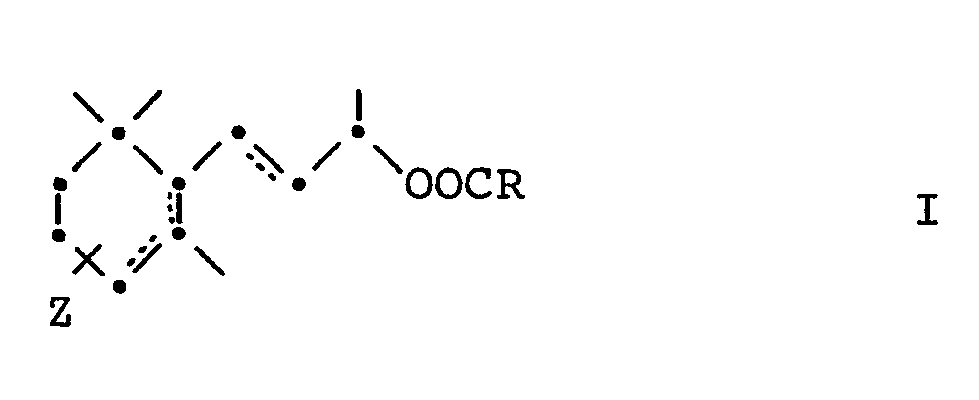
worin RCO für einen Acylrest mit 1 - 18 Kohlenstoffatomen steht, eine der gestrichelt gezeichneten Linien im Ring eine zusätzliche Bindung und die gestrichelt gezeichnete Linie in der Seitenkette eine fakultative zusätzliche Bindung bedeutet und Z eine Oxogruppe in a-Stellung zur ringständigen Doppelbindung darstellt.

worin RCO für einen Acylrest mit 1 - 18 Kohlenstoffatomen steht, eine der gestrichelt gezeichneten Linien im Ring eine zusätzliche Bindung und die gestrichelt gezeichnete Linie in der Seitenkette eine fakultative zusätzliche Bindung bedeutet und Z eine Oxogruppe in a-Stellung - zur ringständigen Doppelbindung darstellt, verwendet.

worin RCO für einen Acylrest mit 1 - 18 Kohlenstoffatomen steht, eine der gestrichelt gezeichneten Linien im Ring eine zusätzliche Bindung und die gestrichelt gezeichnete Linie in der Seitenkette eine fakultative zusätzliche Bindung bedeutet und Z eine Oxogruppe in a-Stellung zur ringständigen Doppelbindung darstellt, als Geschmackstoffe, insbesondere zur Aromatisierung von Tabak.


worin RCO für einen Acylrest mit 1 - 18 Kohlenstoffatomen steht, eine der gestrichelt gezeichneten Linien im Ring eine zusätzliche Bindung und die gestrichelt gezeichnete Linie in der Seitenkette eine fakultative zusätzliche Bindung bedeutet und Z eine Oxogruppe in a-Stellung zur ringständigen Doppelbindung darstellt, dadurch gekennzeichnet, dass man eine Verbindung der Formel

worin Z und die gestrichelt gezeichneten Linien obige Bedeutung besitzen, verestert, wobei die Herstellung der Acetate ausgeschlossen sein soll.
Applications Claiming Priority (2)
| Application Number | Priority Date | Filing Date | Title |
|---|---|---|---|
| CH4523/84 | 1984-09-21 | ||
| CH452384 | 1984-09-21 |
Publications (3)
| Publication Number | Publication Date |
|---|---|
| EP0175251A2 true EP0175251A2 (de) | 1986-03-26 |
| EP0175251A3 EP0175251A3 (en) | 1987-05-27 |
| EP0175251B1 EP0175251B1 (de) | 1988-07-13 |
Family
ID=4277680
Family Applications (1)
| Application Number | Title | Priority Date | Filing Date |
|---|---|---|---|
| EP85111360A Expired EP0175251B1 (de) | 1984-09-21 | 1985-09-09 | Geschmackstoffkompositionen mit einem Gehalt an Ionylestern, die Ionylester, deren Herstellung und Verwendung |
Country Status (4)
| Country | Link |
|---|---|
| US (1) | US4963193A (de) |
| EP (1) | EP0175251B1 (de) |
| JP (1) | JPH07110223B2 (de) |
| DE (1) | DE3563737D1 (de) |
Cited By (2)
| Publication number | Priority date | Publication date | Assignee | Title |
|---|---|---|---|---|
| US4827012A (en) * | 1988-02-23 | 1989-05-02 | Basf Corporation | Oxo-ionol carbonates |
| US4992106A (en) * | 1988-02-23 | 1991-02-12 | Basf Corporation | Novel oxo-ionol carbonates useful as tobacco flavorants |
Families Citing this family (8)
| Publication number | Priority date | Publication date | Assignee | Title |
|---|---|---|---|---|
| CN104394718A (zh) | 2012-07-02 | 2015-03-04 | 西姆莱斯股份公司 | 一种烟产品调味的方法 |
| CN106631781A (zh) * | 2016-10-09 | 2017-05-10 | 湖北中烟工业有限责任公司 | 烟用潜香单体苯丙酸酯类的制备方法及其应用 |
| CN112480051A (zh) * | 2020-12-10 | 2021-03-12 | 河南中烟工业有限责任公司 | 2,3-二氢-3-羟基-6-甲基-4h-吡喃-4-酮-5-o-碳酸香叶醇酯及应用 |
| CN112574153B (zh) * | 2020-12-10 | 2026-03-10 | 河南中烟工业有限责任公司 | 一种2,3-二氢-3-羟基-6-甲基-4h-吡喃-4-酮-5-o-碳酸二酯及应用 |
| CN112552271A (zh) * | 2020-12-10 | 2021-03-26 | 河南中烟工业有限责任公司 | 2,3-二氢-3-羟基-6-甲基-4h-吡喃-4-酮-5-o-碳酸苯甲醇酯及应用 |
| CN112574154B (zh) * | 2020-12-10 | 2026-03-10 | 河南中烟工业有限责任公司 | 一种2,3-二氢-3-羟基-6-甲基-4h-吡喃-4-酮-5-o-碳酸三酯及应用 |
| CN112574152A (zh) * | 2020-12-10 | 2021-03-30 | 河南中烟工业有限责任公司 | 2,3-二氢-3-羟基-6-甲基-4h-吡喃-4-酮-5-o-碳酸橙花醇酯及应用 |
| CN112574151A (zh) * | 2020-12-10 | 2021-03-30 | 河南中烟工业有限责任公司 | 2,3-二氢-3-羟基-6-甲基-4h-吡喃-4-酮-5-o-碳酸苯乙醇酯及应用 |
Family Cites Families (2)
| Publication number | Priority date | Publication date | Assignee | Title |
|---|---|---|---|---|
| JPS5834458B2 (ja) * | 1979-10-16 | 1983-07-27 | 日本たばこ産業株式会社 | 4−アシロオキシβ−イオノンの新規な製造法 |
| JPS5919935B2 (ja) * | 1980-07-25 | 1984-05-09 | 日本たばこ産業株式会社 | 8.9−ジヒドロ−8.9−ジハイドロキシ−メガスティグマトリエノン関連化合物ならびにたばこ用香喫味改良剤 |
-
1985
- 1985-09-09 EP EP85111360A patent/EP0175251B1/de not_active Expired
- 1985-09-09 DE DE8585111360T patent/DE3563737D1/de not_active Expired
- 1985-09-16 US US06/776,555 patent/US4963193A/en not_active Expired - Fee Related
- 1985-09-20 JP JP60208575A patent/JPH07110223B2/ja not_active Expired - Lifetime
Non-Patent Citations (3)
| Title |
|---|
| ACTA CHEMICA SCANDINAVICA, Band 27, Nr. 6, 1973, Seiten 2107-2114, Kopenhagen, DK.; A.J. AASEN et al.: Tobacco chemistry. 18. absolute configuration of (9R)-9-hydroxy-4,7E-megastigmadien-3-one (3-Oxo-koppa-ionol) * |
| CHEMICAL ABSTRACTS, Band 75, Nr. 23, 6. Dezember 1971, Seiten 49-50, Spalten 1, 2, Zusammenfassungs Nr. 137451r, Columbus, Ohio, US; C.R. ENZELL et al.: "Tobacco Chemistry. 7. Structure and synthesis of 3-oxo-alpha-ionol, a new tobacco constituent"; & ACTA CHEMICA SCANDINAVICA 1971, 25(4), 1481-1482 * |
| HELVETIA CHIMICA ACTA, Band 65, Nr. 6, 1982, Seiten 1927-1928, Basel, CH; S. KATSUMURA et al.: "A New Type of Photorearrangement of Gamma-Hydroxy-Alpha, Beta, Delta, Epsion-dienone" * |
Cited By (3)
| Publication number | Priority date | Publication date | Assignee | Title |
|---|---|---|---|---|
| US4827012A (en) * | 1988-02-23 | 1989-05-02 | Basf Corporation | Oxo-ionol carbonates |
| US4992106A (en) * | 1988-02-23 | 1991-02-12 | Basf Corporation | Novel oxo-ionol carbonates useful as tobacco flavorants |
| EP0509983A4 (de) * | 1988-02-23 | 1992-03-26 | Basf Corp | Oxo-ionol-karbonate zur verwendung als tabakgeschmackgeber. |
Also Published As
| Publication number | Publication date |
|---|---|
| EP0175251B1 (de) | 1988-07-13 |
| US4963193A (en) | 1990-10-16 |
| EP0175251A3 (en) | 1987-05-27 |
| JPH07110223B2 (ja) | 1995-11-29 |
| JPS61126051A (ja) | 1986-06-13 |
| DE3563737D1 (en) | 1988-08-18 |
Similar Documents
| Publication | Publication Date | Title |
|---|---|---|
| EP0175251B1 (de) | Geschmackstoffkompositionen mit einem Gehalt an Ionylestern, die Ionylester, deren Herstellung und Verwendung | |
| DE2534162B2 (de) | l-Oxa-3-thiacyclopentane bzw. -cyclohexane sowie deren Verwendung als Aromastoffe | |
| DE1692759B2 (de) | Aromatisierter Tabak | |
| DE2312996A1 (de) | Neue heterocyclische aromamittel und ihre herstellung | |
| DE69406255T2 (de) | Carbonatderivate | |
| DE2338680A1 (de) | Aliphatische oder cycloaliphatische merkaptoderivate, deren herstellung und verwendung | |
| DE2840823C2 (de) | Trans, trans- &delta; -Damascon, dessen Gemische mit mehr als 50% trans, trans- &delta; -Damascon und cis, trans- &delta; -Damascon sowie deren Verwendung als Würzstoffe | |
| DE69609897T2 (de) | Aromazusammensetzungen mit verzögerter Freigabe | |
| CH650128A5 (de) | Eine ungesaettigte carboxyl-fettsaeure enthaltendes duftgemisch. | |
| DE2229269C3 (de) | Tabakaromastoffe | |
| DE2458639C3 (de) | Tabakprodukte mit einem Gehalt an geschmack- oder aromaveränderndem Zusatz | |
| DE68924989T2 (de) | Oxo-ionol-karbonate zur verwendung als tabakgeschmackgeber. | |
| DE2527228A1 (de) | Rauchtabakmischung | |
| DE19714826A1 (de) | Ethylvanillinisobutyrat | |
| EP3954675B1 (de) | Herstellungsverfahren für z-typ-solanon | |
| DE1517331B1 (de) | Verfahren zur Verbesserung eines Tabakproduktes | |
| EP0007582B1 (de) | Kompositionen und Verfahren zur Verstärkung, Modifizierung oder Verbesserung der organoleptischen Eigenschaften von Tabakerzeugnissen und dazu verwendbare Verbindungen | |
| DE2724180A1 (de) | Verwendung eines cycloaliphatischen sauerstoffhaltigen derivates als geschmacksstoffbestandteil | |
| DE1921560A1 (de) | Ungesaettigte Aldehyde | |
| DE2152015B2 (de) | Mercapto-p-menthanderivate, deren Herstellung und Verwendung | |
| DE1517331C (de) | Verfahren zur Verbesserung eines Tabakprouktes | |
| DE2705424C2 (de) | Cis-Oct-6-en-1-al und dessen Verwendung | |
| DE1517325C (de) | Verfahren zur Verbesserung von Tabak | |
| DE2365750A1 (de) | Bicyclische verbindungen und ihre verwendung als riech- und/oder aromastoffe | |
| DE2934881C1 (de) | Aliphatische polyungesaettigte Ester und ihre Verwendung als Parfuemierungs- und Aromabestandteil |
Legal Events
| Date | Code | Title | Description |
|---|---|---|---|
| PUAI | Public reference made under article 153(3) epc to a published international application that has entered the european phase |
Free format text: ORIGINAL CODE: 0009012 |
|
| 17P | Request for examination filed |
Effective date: 19850909 |
|
| AK | Designated contracting states |
Kind code of ref document: A2 Designated state(s): CH DE FR GB LI NL |
|
| PUAL | Search report despatched |
Free format text: ORIGINAL CODE: 0009013 |
|
| AK | Designated contracting states |
Kind code of ref document: A3 Designated state(s): CH DE FR GB LI NL |
|
| 17Q | First examination report despatched |
Effective date: 19871207 |
|
| GRAA | (expected) grant |
Free format text: ORIGINAL CODE: 0009210 |
|
| AK | Designated contracting states |
Kind code of ref document: B1 Designated state(s): CH DE FR GB LI NL |
|
| REF | Corresponds to: |
Ref document number: 3563737 Country of ref document: DE Date of ref document: 19880818 |
|
| GBT | Gb: translation of ep patent filed (gb section 77(6)(a)/1977) | ||
| ET | Fr: translation filed | ||
| PLBE | No opposition filed within time limit |
Free format text: ORIGINAL CODE: 0009261 |
|
| STAA | Information on the status of an ep patent application or granted ep patent |
Free format text: STATUS: NO OPPOSITION FILED WITHIN TIME LIMIT |
|
| 26N | No opposition filed | ||
| REG | Reference to a national code |
Ref country code: CH Ref legal event code: PFA Free format text: GIVAUDAN-ROURE (INTERNATIONAL) S.A., VERNIER-GENEVE |
|
| REG | Reference to a national code |
Ref country code: FR Ref legal event code: CD |
|
| NLT1 | Nl: modifications of names registered in virtue of documents presented to the patent office pursuant to art. 16 a, paragraph 1 |
Owner name: GIVAUDAN-ROURE (INTERNATIONAL) S.A. TE VERNIER-GEN |
|
| PGFP | Annual fee paid to national office [announced via postgrant information from national office to epo] |
Ref country code: GB Payment date: 19980902 Year of fee payment: 14 |
|
| PGFP | Annual fee paid to national office [announced via postgrant information from national office to epo] |
Ref country code: FR Payment date: 19980909 Year of fee payment: 14 |
|
| PGFP | Annual fee paid to national office [announced via postgrant information from national office to epo] |
Ref country code: DE Payment date: 19980921 Year of fee payment: 14 |
|
| PGFP | Annual fee paid to national office [announced via postgrant information from national office to epo] |
Ref country code: NL Payment date: 19980929 Year of fee payment: 14 Ref country code: CH Payment date: 19980929 Year of fee payment: 14 |
|
| PG25 | Lapsed in a contracting state [announced via postgrant information from national office to epo] |
Ref country code: GB Free format text: LAPSE BECAUSE OF NON-PAYMENT OF DUE FEES Effective date: 19990909 |
|
| PG25 | Lapsed in a contracting state [announced via postgrant information from national office to epo] |
Ref country code: LI Free format text: LAPSE BECAUSE OF NON-PAYMENT OF DUE FEES Effective date: 19990930 Ref country code: CH Free format text: LAPSE BECAUSE OF NON-PAYMENT OF DUE FEES Effective date: 19990930 |
|
| PG25 | Lapsed in a contracting state [announced via postgrant information from national office to epo] |
Ref country code: NL Free format text: LAPSE BECAUSE OF NON-PAYMENT OF DUE FEES Effective date: 20000401 |
|
| GBPC | Gb: european patent ceased through non-payment of renewal fee |
Effective date: 19990909 |
|
| REG | Reference to a national code |
Ref country code: CH Ref legal event code: PL |
|
| PG25 | Lapsed in a contracting state [announced via postgrant information from national office to epo] |
Ref country code: FR Free format text: LAPSE BECAUSE OF NON-PAYMENT OF DUE FEES Effective date: 20000531 |
|
| NLV4 | Nl: lapsed or anulled due to non-payment of the annual fee |
Effective date: 20000401 |
|
| PG25 | Lapsed in a contracting state [announced via postgrant information from national office to epo] |
Ref country code: DE Free format text: LAPSE BECAUSE OF NON-PAYMENT OF DUE FEES Effective date: 20000701 |
|
| REG | Reference to a national code |
Ref country code: FR Ref legal event code: ST |