EP0175313A2 - Dispositif pour le broyage de déchets - Google Patents
Dispositif pour le broyage de déchets Download PDFInfo
- Publication number
- EP0175313A2 EP0175313A2 EP85111647A EP85111647A EP0175313A2 EP 0175313 A2 EP0175313 A2 EP 0175313A2 EP 85111647 A EP85111647 A EP 85111647A EP 85111647 A EP85111647 A EP 85111647A EP 0175313 A2 EP0175313 A2 EP 0175313A2
- Authority
- EP
- European Patent Office
- Prior art keywords
- disc
- cutter disc
- edge
- cutter
- knife
- Prior art date
- Legal status (The legal status is an assumption and is not a legal conclusion. Google has not performed a legal analysis and makes no representation as to the accuracy of the status listed.)
- Granted
Links
- 239000002699 waste material Substances 0.000 title claims description 5
- 239000010921 garden waste Substances 0.000 claims abstract description 3
- 230000002093 peripheral effect Effects 0.000 claims description 2
- 238000005259 measurement Methods 0.000 claims 1
- 239000000463 material Substances 0.000 abstract description 24
- 230000001681 protective effect Effects 0.000 description 6
- 230000003993 interaction Effects 0.000 description 4
- 239000007779 soft material Substances 0.000 description 4
- 244000025254 Cannabis sativa Species 0.000 description 3
- 238000009434 installation Methods 0.000 description 3
- 229910000831 Steel Inorganic materials 0.000 description 2
- 238000011161 development Methods 0.000 description 2
- 230000018109 developmental process Effects 0.000 description 2
- 230000000694 effects Effects 0.000 description 2
- 239000000835 fiber Substances 0.000 description 2
- 239000010959 steel Substances 0.000 description 2
- 238000010521 absorption reaction Methods 0.000 description 1
- 230000015572 biosynthetic process Effects 0.000 description 1
- 238000003754 machining Methods 0.000 description 1
- 238000012423 maintenance Methods 0.000 description 1
- 230000007257 malfunction Effects 0.000 description 1
Images


Classifications
-
- B—PERFORMING OPERATIONS; TRANSPORTING
- B02—CRUSHING, PULVERISING, OR DISINTEGRATING; PREPARATORY TREATMENT OF GRAIN FOR MILLING
- B02C—CRUSHING, PULVERISING, OR DISINTEGRATING IN GENERAL; MILLING GRAIN
- B02C18/00—Disintegrating by knives or other cutting or tearing members which chop material into fragments
- B02C18/06—Disintegrating by knives or other cutting or tearing members which chop material into fragments with rotating knives
-
- B—PERFORMING OPERATIONS; TRANSPORTING
- B02—CRUSHING, PULVERISING, OR DISINTEGRATING; PREPARATORY TREATMENT OF GRAIN FOR MILLING
- B02C—CRUSHING, PULVERISING, OR DISINTEGRATING IN GENERAL; MILLING GRAIN
- B02C18/00—Disintegrating by knives or other cutting or tearing members which chop material into fragments
- B02C18/06—Disintegrating by knives or other cutting or tearing members which chop material into fragments with rotating knives
- B02C18/08—Disintegrating by knives or other cutting or tearing members which chop material into fragments with rotating knives within vertical containers
- B02C18/083—Disintegrating by knives or other cutting or tearing members which chop material into fragments with rotating knives within vertical containers with a disc rotor having generally radially extending slots or openings bordered with cutting knives
Definitions
- the invention relates to a device for comminuting waste, in particular garden waste, with a knife disc that can be driven by a motor and drives under a stationary counter-holder, which is arranged in a housing chamber provided with an ejection channel, into which a lower part is shut off from the knife disc arranged input shaft opens.
- a device of this type is known from DE-OS 31 04 586.
- the material only by the knives of the knife disc, which is arranged at an angle to the installation plane.
- the knife disc which is arranged at an angle to the installation plane, is only acted upon via a comparatively slim input shaft in the area of the upper quadrant of its surface half that moves downward. This does not result in any problems with the shredding of stiff, woody material and with sharp knives on the knife disc. If, however, the knife edge is slightly worn, the woody material to be shredded is no longer drawn in satisfactorily, since this avoids the knives. It was therefore previously necessary to change the knives of the knife disc after a relatively short service life.
- the stationary counter-holder has a cross-section corresponding approximately to a plan view of the cutter disc having an input shaft having a radially projecting nose, which has an edge parallel to the cutting disc, which cooperates with the knives of the cutting disc, and an edge which borders this radially on the inside and runs approximately perpendicular to the cutting disc plane, past which a cylindrical cutting disc attachment coaxially accommodated on the cutting disc passes, the circumference of which a conveyor profile interrupted by at least one longitudinal groove running in its longitudinal direction and leading to the cutter disc in the drive direction.
- the knife disc attachment which cooperates with the side edge of the stationary counter-holder, which runs perpendicular to the plane of the knife disc, causes a material transport to the knife disc due to its transport profile provided on the circumference.
- the material fed to the knife disc in this way therefore advantageously has practically no possibility of avoiding the knives of the knife disc, so that there is a reliable material feed and thus reliable material cutting, even when the knives of the knife disc are already blunt or are almost blunt.
- the rear edges of the longitudinal grooves of the knife shaft attachment act as cut edges which cooperate with the corresponding side edge of the stationary counter-holder.
- the knife shaft attachment according to the invention thus advantageously brings about not only reliable feeding of stiff material, but also reliable shredding of soft material.
- the cross-section of the input shaft advantageously does not need only one quadrant of the knives disc to be limited, but can have a large cross-section, approximately corresponding to the top view of the knife disc, which ensures a high absorption capacity and nevertheless counteracts blockages. Since the stationary counterholder penetrates the lower cross section of the input shaft in the radial direction, it is nevertheless ensured that the material to be shredded is locked against rotation. The advantages that can be achieved with the invention can therefore be seen in particular in excellent reliability.
- the cutter disc attachment can be provided with at least one driver cam, which is arranged in the peripheral area of its end face facing away from the cutter disc and has a driver cam in the direction of rotation. This prevents light material introduced into the input shaft from remaining on the cutter disc attachment. Rather, this material is gripped by the driver cam (s) arranged on the end face and cut in the region of the side edge of the stationary holder or brought into engagement with the conveyor profile.
- a further expedient measure of the superordinate measures can consist in that the longitudinal grooves of the cutter disc attachment are inclined obliquely with respect to the axial direction. This advantageously results in a scissor-like working meadow of the cutting edges delimiting the longitudinal grooves, which has an advantageous effect on smooth running.
- a further advantageous measure can consist in that the conveyor profile is designed as a cut thread profile, preferably in the form of a pointed thread, with a lower flank perpendicular to the lateral surface and an upper flank inclined to the lateral surface.
- the edge of the stationary counter-holder which is parallel to the cutting disc, can expediently be crescent-shaped. This ensures that the comminution material coming into contact with it is not pushed radially inward or radially outward by the radially running knives of the cutter disk, but is reliably cut in the deepest region of the sickle arch. At the same time, this also results in a silhouette-like mode of operation, which has an advantageous effect on achieving smooth running.
- the nose forming the stationary chuck holder can have a roof surface which runs out of the wall of the input shaft and is laterally delimited by the edge which interacts with the cutter disc attachment and slopes away from the edge parallel to the cutter disc.
- This roof surface advantageously results in an oblique deflection surface for comminution material thrown into the input shaft. This effectively counteracts the formation of a dead corner in the area of the stationary counterhold.
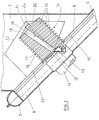
- the waste shredder shown in the drawing consists, as can best be seen from FIG. 1, of a mobile machine frame 1 and a shredding unit 2 accommodated thereon.
- the shredding unit 2 contains an input shaft 3 formed by a standing pipe, which is associated with a shredding tool protection provided with an ejection channel 4 housing 5 is placed.
- the protective housing 5 consists of two shells arranged one on top of the other, which are detachably held together by wing screws 6 arranged in the area of adjoining edge flanges. In order to achieve free access to the shredding tools, the cover shell of the protective housing 5 receiving the input shaft 3 can therefore simply be removed.
- the lower shell of the protective housing 5 is attached to the machine frame 1.
- the input shaft 3 formed by a tube is provided with a collecting funnel 7 in the area of its upper end.
- the lower end of the input shaft 3 opens into a chamber 8 formed by the protective housing 5, which is provided with an outlet formed by the ejection channel 4.
- the mouth cross-section 9 of the input shaft 3 is blocked off by a knife disk 10 arranged in parallel in the chamber 8, which can be driven by means of a motor accommodated on the machine frame 1.
- the knife disk 10 can simply be drawn onto the motor shaft 11.
- the input shaft 3 is arranged upright.
- the cutter disk 10 is inclined to accomplish a cut that runs obliquely to the fiber of tree branches to be shredded or the like, obliquely to the axis of the input shaft 3 and thus also obliquely to the installation plane.
- the protective housing 5 is also inclined with respect to the upright input shaft 3.
- the cross section of the standing input shaft 3 corresponds practically over its entire height to the elliptical top view of the obliquely inclined knife disk 10, as can best be seen from FIG.
- the input shaft 3 can be in one piece be trained.
- the knife disk 10 arranged in the chamber 8 is equipped with radially running knives 13 arranged in the region of the rear edges of radial slots 12 and is provided with a centrally arranged cylindrical attachment 14 which delimits the Ramal slots 12 on the inside and protrudes into the input shaft 3.
- the diameter of the cutter disc attachment 14 corresponds to approximately one third of the diameter of the cutter disc 10.
- the height of the cutter disc attachment 14 is selected so that its upper edge can run past the adjacent wall of the standing input shaft 3 with sufficient play.
- the cutter disc attachment 14 is provided with a circumferential conveyor profile 15, here in the form of a pointed thread, which leads to the cutter disc 10 in the drive direction.
- the circumferential webs of the pointed thread forming the conveyor profile 15 are profiled in such a way that a lower flank 16, approximately perpendicular to the lateral surface of the cutter disc attachment 14, and an upper flank 17 inclined to the lateral surface result.
- the circumferential webs of the conveyor profile 15 are interrupted in the circumferential direction by transverse longitudinal grooves 18, the rear edges 19 of which in the direction of rotation can practically act as cut edges.
- four longitudinal grooves 18 are provided which are evenly offset from one another on the circumference of the cutter disc attachment 14.
- the end of the cutter disc attachment 14 remote from the cutter disc is equipped with driver cams 20 arranged on the edge, which are arranged so that their driver edge 21 in the region of the rear edge 19 of an associated longitudinal groove 18 is located.
- a driver cam 20 is assigned to every second longitudinal groove 18.
- the rotating crushing tools in the form of the knife disk 10 and the knife disk attachment 14 arranged coaxially thereon interact with a stationary counter-holder 22, which is arranged in the lower region of the feed chute 3.
- a nose which is arranged in the lower region of the input shaft 3 and projects radially into it and covers the mouth cross-section 9 approximately sector-shaped is provided, which has a lower, flush with the mouth cross-section 9, with the knives 13 of the parallel knife disk 10 cooperating edge 23 and with an radially inner border, perpendicular to the plane of the knife disk 10, which edge 24 cooperates with the circumference of the cutter disc attachment 14.
- the distance between the edges 23 and 24 from the knives 13 interacting therewith or the circumference of the knife disc attachment 14 interacting therewith corresponds to the respectively desired machining thickness.
- the material introduced into the input funnel 3 comes into contact with the stationary counter-holder 22 driven by the knife disc 10 as a result of the rotation of the knife disc 10, and is thereby either by interaction of the knives 13 of the knife disc 10 with the associated counter-holder edge 23 which is parallel thereto or by interaction the rear edges 19 of the longitudinal grooves 18 which serve as the cutting edge are comminuted with the associated side edge 24 of the stationary counter-holder 22.
- Stiff material such as tree branches or the like, is through the conveyor profile 15 of the knife blade benaufsatzes 14 brought up to the knife disc 10 and machined in the region of its lower end by the interaction of the knife 13 and the counter-holder edge 23.
- the nose which forms the stationary counter-holder 22 and projects radially into the input shaft can be designed as an L-shaped bracket which is arranged such that its outer edges form the edges 23 and 24.
- a roof-shaped deflecting surface it may prove expedient to fan out the surface section delimited by the legs of such a bracket and the wall of the input funnel.
- a gusset insert welded to the wall of the inlet funnel 3 with edges arranged approximately at an angle to one another is used to form the stationary yoke holder.
- the stationary counter-holder can be reinforced by inserted steel strips 25 and 26, as can best be seen from FIG. 4, in which the stationary counter-holder 22 is shown schematically with dash-dotted lines.
- the assigned to the knives 13 of the knife disc 10, lower edge reinforced by the steel strip 25 of the Ge Genhalters 22 is, as can be seen from Figure 4, bent out in the direction of rotation sickle-shaped. Crushing material brought to the system by the knives is cut like a silhouette, which enables smooth running. Material migrating to the side is reliably cut in the region of the greatest deflection of the edge 23.
- the longitudinal grooves 18 can be inclined obliquely to the direction of the axis of the cutter disc attachment 14 in order to accomplish a scissor-cut-like operation even in the region of the edge 24 of the counter holder 22 assigned to the cutter disc attachment 14.
- the knife disk 10 is inclined obliquely with respect to the input shaft 3 in order to achieve a cut which runs obliquely to the fiber.
- an inclination angle of approximately 45 ° is provided.
- the stationary counter-holder 22 is arranged such that its edge 23, which is assigned to the knives 13 of the knife disk 10 and is parallel to the knife disk, is approximately in the region of the boundary between the two quadrants of the downwardly moving surface half of the knife disk 10, as can further be seen from FIG .
- the crescent-shaped curved edge 23 intersects the quadrant boundary line in the radially outer region.
- the inner end of the edge 23 and thus also the edge 24 parallel to the cutting disc are offset by a small amount with respect to the quadrant boundary line.
- the central region of the edge 23 is bent out in relation to the connecting line between its ends in order to accomplish the desired silhouette-like operation and to prevent lateral material deviation in the direction of rotation.
- the cut material is ejected in the cutting direction.
- the ejection channel 4 is accordingly inclined downwards, as can be clearly seen in FIGS. 1 and 2. Dead corners of the ejection channel 4 located outside the direction of flight are delimited by edge strips 27, as can also be seen from FIG.
- the ejection of the cut material can be supported by wings arranged in the area of the underside of the knife disc 10, here simply formed by the knife clamping jaws.
- the knife disc 10 is provided with a hub 28 which is placed on a receiving head 30 which is wedged onto the shaft 11 of the motor 29 and is connected to it in a rotationally locking manner by means of pins.
- the hub 28 also serves as a receptacle for the cutter disc attachment 14. This is simply butted onto the hub 28 and together with the latter by means of a screw 31, which extends through a central bore in the hub 28 and the cutter disc attachment 14, with the shaft 11 or the receiving head 30 wedged thereon clamped.
- the non-positive connection between the cutter disc attachment 14 and the hub 28 of the cutter disc 10, which is accomplished with the aid of the screw 31, is generally sufficient to be able to transmit the required torque.
- the design of the cutter disc attachment 14 as a separate component and its detachable fixing with the aid of a single screw ensures that the cutter disc attachment 14 and / or the cutter disc 10 can be removed easily and simply, which can make maintenance work very easy.
Landscapes
- Engineering & Computer Science (AREA)
- Food Science & Technology (AREA)
- Crushing And Pulverization Processes (AREA)
Priority Applications (1)
| Application Number | Priority Date | Filing Date | Title |
|---|---|---|---|
| AT85111647T ATE42477T1 (de) | 1984-09-19 | 1985-09-14 | Vorrichtung zum zerkleinern von abfall. |
Applications Claiming Priority (3)
| Application Number | Priority Date | Filing Date | Title |
|---|---|---|---|
| DE3434303 | 1984-09-19 | ||
| DE3434303A DE3434303C2 (de) | 1984-09-19 | 1984-09-19 | Vorrichtung zum Zerkleinern von Abfall |
| EP8600140 | 1986-03-14 |
Publications (3)
| Publication Number | Publication Date |
|---|---|
| EP0175313A2 true EP0175313A2 (fr) | 1986-03-26 |
| EP0175313A3 EP0175313A3 (en) | 1987-08-26 |
| EP0175313B1 EP0175313B1 (fr) | 1989-04-26 |
Family
ID=25824859
Family Applications (1)
| Application Number | Title | Priority Date | Filing Date |
|---|---|---|---|
| EP19850111647 Expired EP0175313B1 (fr) | 1984-09-19 | 1985-09-14 | Dispositif pour le broyage de déchets |
Country Status (1)
| Country | Link |
|---|---|
| EP (1) | EP0175313B1 (fr) |
Cited By (3)
| Publication number | Priority date | Publication date | Assignee | Title |
|---|---|---|---|---|
| EP0505702A1 (fr) * | 1991-03-27 | 1992-09-30 | Crones & Co. Gmbh | Broyeur de déchets de jardin avec enceinte contenant des couteaux plats ainsi que des couteaux de prébroyage à entraîner en rotation |
| DE4142593A1 (de) * | 1991-12-21 | 1993-06-24 | Gloria Werke Schulte H Kg | Haecksler mit einem messerteller-aufsatz |
| CN109235570A (zh) * | 2018-11-15 | 2019-01-18 | 台州市厨真环保设备厂 | 塔状齿盘 |
Family Cites Families (4)
| Publication number | Priority date | Publication date | Assignee | Title |
|---|---|---|---|---|
| US4366928A (en) * | 1980-07-07 | 1983-01-04 | Hughes John H | Apparatus and method for comminuting solid materials |
| DE3104586A1 (de) * | 1981-02-10 | 1982-08-12 | Josef Scheppach Maschinenfabrik Gmbh & Co, 8873 Ichenhausen | Vorrichtung zum zerkleinern von abfall |
| DE3219183A1 (de) * | 1982-05-21 | 1983-11-24 | Gloria-Werke H. Schulte-Frankenfeld Gmbh & Co, 4724 Wadersloh | Haeckseler fuer gartenabfaelle und dergleichen |
| DE8427513U1 (de) * | 1984-09-19 | 1985-08-01 | Scheppach Maschf J | Vorrichtung zum Zerkleinern von Abfall |
-
1985
- 1985-09-14 EP EP19850111647 patent/EP0175313B1/fr not_active Expired
Cited By (3)
| Publication number | Priority date | Publication date | Assignee | Title |
|---|---|---|---|---|
| EP0505702A1 (fr) * | 1991-03-27 | 1992-09-30 | Crones & Co. Gmbh | Broyeur de déchets de jardin avec enceinte contenant des couteaux plats ainsi que des couteaux de prébroyage à entraîner en rotation |
| DE4142593A1 (de) * | 1991-12-21 | 1993-06-24 | Gloria Werke Schulte H Kg | Haecksler mit einem messerteller-aufsatz |
| CN109235570A (zh) * | 2018-11-15 | 2019-01-18 | 台州市厨真环保设备厂 | 塔状齿盘 |
Also Published As
| Publication number | Publication date |
|---|---|
| EP0175313B1 (fr) | 1989-04-26 |
| EP0175313A3 (en) | 1987-08-26 |
Similar Documents
| Publication | Publication Date | Title |
|---|---|---|
| DE69621944T2 (de) | Zuführschnecken mit verbessertem profil für schneid-, misch- und beschickungswagen für futter und gras oder strohmaterial | |
| DE4036717A1 (de) | Pflueckvorsatz fuer ein erntegeraet | |
| EP1071343A1 (fr) | Dispositif destine a dechiqueter des substances organiques | |
| DE3212178A1 (de) | Maehbalken mit scheiben | |
| CH659405A5 (de) | Zerkleinerungsvorrichtung fuer abfall. | |
| DE60105981T2 (de) | Vorrichtung zum zerschneiden von pflanzengut | |
| DE2928471A1 (de) | Maschine zum zerkleinern von stueckigen gegenstaenden | |
| EP1000533B1 (fr) | Dispositif cueilleur pour récolter des céréales | |
| DE2922982C2 (fr) | ||
| EP0175313B1 (fr) | Dispositif pour le broyage de déchets | |
| DE3434303C2 (de) | Vorrichtung zum Zerkleinern von Abfall | |
| DE9311705U1 (de) | Kunststoffschweißgerät | |
| DE2212158A1 (de) | Einrichtung zum Entrinden von Baumstämmen od. dgl | |
| WO1987004895A2 (fr) | Ramasseuse-hacheuse | |
| DE2416239C3 (de) | Vorrichtung zur Entnahme von Futter aus einem am Boden liegenden Silo | |
| DE60306914T2 (de) | Selbstgespeiste Zerkleinerungsvorrichtung für späneentfernende Werkzeugmaschinen | |
| DE69000393T2 (de) | Silofutterschneider und schneidvorrichtung fuer futter, insbesondere silofutter. | |
| DE1148942B (de) | Vorrichtung zur Entleerung von Futtersilos | |
| EP1782680B1 (fr) | Dispositif pour le broyage de produits végétaux dans la forme de masse verte ou de jeunes buissons | |
| DE3105104A1 (de) | "zerkleinerungsvorrichtung" | |
| EP0752275B1 (fr) | Hacheur | |
| DE2431690C3 (de) | Vorrichtung zum Zerkleinern von manuell zuführbarem Schwachholz | |
| DE3104586A1 (de) | Vorrichtung zum zerkleinern von abfall | |
| DE4242640A1 (de) | Häcksler | |
| DE3245373A1 (de) | Vorrichtung zum zerkleinern von abfallholz, insbesondere stubben, zu holzschnitzeln |
Legal Events
| Date | Code | Title | Description |
|---|---|---|---|
| PUAI | Public reference made under article 153(3) epc to a published international application that has entered the european phase |
Free format text: ORIGINAL CODE: 0009012 |
|
| AK | Designated contracting states |
Kind code of ref document: A2 Designated state(s): AT BE CH DE FR GB IT LI SE |
|
| PUAL | Search report despatched |
Free format text: ORIGINAL CODE: 0009013 |
|
| AK | Designated contracting states |
Kind code of ref document: A3 Designated state(s): AT BE CH DE FR GB IT LI SE |
|
| 17P | Request for examination filed |
Effective date: 19870922 |
|
| 17Q | First examination report despatched |
Effective date: 19881007 |
|
| GRAA | (expected) grant |
Free format text: ORIGINAL CODE: 0009210 |
|
| AK | Designated contracting states |
Kind code of ref document: B1 Designated state(s): AT BE CH DE FR GB IT LI SE |
|
| REF | Corresponds to: |
Ref document number: 42477 Country of ref document: AT Date of ref document: 19890515 Kind code of ref document: T |
|
| ITF | It: translation for a ep patent filed | ||
| GBT | Gb: translation of ep patent filed (gb section 77(6)(a)/1977) | ||
| REF | Corresponds to: |
Ref document number: 3569681 Country of ref document: DE Date of ref document: 19890601 |
|
| ET | Fr: translation filed | ||
| PLBE | No opposition filed within time limit |
Free format text: ORIGINAL CODE: 0009261 |
|
| STAA | Information on the status of an ep patent application or granted ep patent |
Free format text: STATUS: NO OPPOSITION FILED WITHIN TIME LIMIT |
|
| 26N | No opposition filed | ||
| ITTA | It: last paid annual fee | ||
| PGFP | Annual fee paid to national office [announced via postgrant information from national office to epo] |
Ref country code: FR Payment date: 19930820 Year of fee payment: 9 |
|
| PGFP | Annual fee paid to national office [announced via postgrant information from national office to epo] |
Ref country code: SE Payment date: 19930823 Year of fee payment: 9 Ref country code: CH Payment date: 19930823 Year of fee payment: 9 |
|
| PGFP | Annual fee paid to national office [announced via postgrant information from national office to epo] |
Ref country code: BE Payment date: 19930830 Year of fee payment: 9 |
|
| PG25 | Lapsed in a contracting state [announced via postgrant information from national office to epo] |
Ref country code: SE Effective date: 19940915 |
|
| PG25 | Lapsed in a contracting state [announced via postgrant information from national office to epo] |
Ref country code: LI Effective date: 19940930 Ref country code: CH Effective date: 19940930 Ref country code: BE Effective date: 19940930 |
|
| EAL | Se: european patent in force in sweden |
Ref document number: 85111647.5 |
|
| BERE | Be: lapsed |
Owner name: JOSEF SCHEPPACH MASCHINENFABRIK G.M.B.H. & CO. Effective date: 19940930 |
|
| PG25 | Lapsed in a contracting state [announced via postgrant information from national office to epo] |
Ref country code: FR Effective date: 19950531 |
|
| REG | Reference to a national code |
Ref country code: CH Ref legal event code: PL |
|
| EUG | Se: european patent has lapsed |
Ref document number: 85111647.5 |
|
| PGFP | Annual fee paid to national office [announced via postgrant information from national office to epo] |
Ref country code: GB Payment date: 19950726 Year of fee payment: 11 Ref country code: AT Payment date: 19950726 Year of fee payment: 11 |
|
| REG | Reference to a national code |
Ref country code: FR Ref legal event code: ST |
|
| PG25 | Lapsed in a contracting state [announced via postgrant information from national office to epo] |
Ref country code: GB Effective date: 19960914 Ref country code: AT Effective date: 19960914 |
|
| GBPC | Gb: european patent ceased through non-payment of renewal fee |
Effective date: 19960914 |
|
| PGFP | Annual fee paid to national office [announced via postgrant information from national office to epo] |
Ref country code: DE Payment date: 20030808 Year of fee payment: 19 |
|
| PG25 | Lapsed in a contracting state [announced via postgrant information from national office to epo] |
Ref country code: DE Free format text: LAPSE BECAUSE OF NON-PAYMENT OF DUE FEES Effective date: 20050401 |