EP0175377B1 - Ether, sa préparation et composition insecticide et acaricide le contenant comme ingrédient actif - Google Patents
Ether, sa préparation et composition insecticide et acaricide le contenant comme ingrédient actif Download PDFInfo
- Publication number
- EP0175377B1 EP0175377B1 EP85111908A EP85111908A EP0175377B1 EP 0175377 B1 EP0175377 B1 EP 0175377B1 EP 85111908 A EP85111908 A EP 85111908A EP 85111908 A EP85111908 A EP 85111908A EP 0175377 B1 EP0175377 B1 EP 0175377B1
- Authority
- EP
- European Patent Office
- Prior art keywords
- atom
- ether
- fluorine
- chlorine
- group
- Prior art date
- Legal status (The legal status is an assumption and is not a legal conclusion. Google has not performed a legal analysis and makes no representation as to the accuracy of the status listed.)
- Expired - Lifetime
Links
- 0 CC1C(**)=C=C=C(C)*1 Chemical compound CC1C(**)=C=C=C(C)*1 0.000 description 5
- SMKFPFSTXKRQDR-UHFFFAOYSA-N Cc1cccc(Oc(cc2)ccc2Cl)n1 Chemical compound Cc1cccc(Oc(cc2)ccc2Cl)n1 SMKFPFSTXKRQDR-UHFFFAOYSA-N 0.000 description 2
- FYNVZFPMUXKVNF-UHFFFAOYSA-N Cc1nc(Oc2ccccc2)ccc1 Chemical compound Cc1nc(Oc2ccccc2)ccc1 FYNVZFPMUXKVNF-UHFFFAOYSA-N 0.000 description 1
Classifications
-
- C—CHEMISTRY; METALLURGY
- C07—ORGANIC CHEMISTRY
- C07D—HETEROCYCLIC COMPOUNDS
- C07D213/00—Heterocyclic compounds containing six-membered rings, not condensed with other rings, with one nitrogen atom as the only ring hetero atom and three or more double bonds between ring members or between ring members and non-ring members
- C07D213/02—Heterocyclic compounds containing six-membered rings, not condensed with other rings, with one nitrogen atom as the only ring hetero atom and three or more double bonds between ring members or between ring members and non-ring members having three double bonds between ring members or between ring members and non-ring members
- C07D213/04—Heterocyclic compounds containing six-membered rings, not condensed with other rings, with one nitrogen atom as the only ring hetero atom and three or more double bonds between ring members or between ring members and non-ring members having three double bonds between ring members or between ring members and non-ring members having no bond between the ring nitrogen atom and a non-ring member or having only hydrogen or carbon atoms directly attached to the ring nitrogen atom
- C07D213/60—Heterocyclic compounds containing six-membered rings, not condensed with other rings, with one nitrogen atom as the only ring hetero atom and three or more double bonds between ring members or between ring members and non-ring members having three double bonds between ring members or between ring members and non-ring members having no bond between the ring nitrogen atom and a non-ring member or having only hydrogen or carbon atoms directly attached to the ring nitrogen atom with hetero atoms or with carbon atoms having three bonds to hetero atoms with at the most one bond to halogen, e.g. ester or nitrile radicals, directly attached to ring carbon atoms
- C07D213/62—Oxygen or sulfur atoms
- C07D213/63—One oxygen atom
- C07D213/64—One oxygen atom attached in position 2 or 6
-
- C—CHEMISTRY; METALLURGY
- C07—ORGANIC CHEMISTRY
- C07D—HETEROCYCLIC COMPOUNDS
- C07D213/00—Heterocyclic compounds containing six-membered rings, not condensed with other rings, with one nitrogen atom as the only ring hetero atom and three or more double bonds between ring members or between ring members and non-ring members
- C07D213/02—Heterocyclic compounds containing six-membered rings, not condensed with other rings, with one nitrogen atom as the only ring hetero atom and three or more double bonds between ring members or between ring members and non-ring members having three double bonds between ring members or between ring members and non-ring members
- C07D213/04—Heterocyclic compounds containing six-membered rings, not condensed with other rings, with one nitrogen atom as the only ring hetero atom and three or more double bonds between ring members or between ring members and non-ring members having three double bonds between ring members or between ring members and non-ring members having no bond between the ring nitrogen atom and a non-ring member or having only hydrogen or carbon atoms directly attached to the ring nitrogen atom
- C07D213/60—Heterocyclic compounds containing six-membered rings, not condensed with other rings, with one nitrogen atom as the only ring hetero atom and three or more double bonds between ring members or between ring members and non-ring members having three double bonds between ring members or between ring members and non-ring members having no bond between the ring nitrogen atom and a non-ring member or having only hydrogen or carbon atoms directly attached to the ring nitrogen atom with hetero atoms or with carbon atoms having three bonds to hetero atoms with at the most one bond to halogen, e.g. ester or nitrile radicals, directly attached to ring carbon atoms
- C07D213/62—Oxygen or sulfur atoms
- C07D213/63—One oxygen atom
- C07D213/64—One oxygen atom attached in position 2 or 6
- C07D213/643—2-Phenoxypyridines; Derivatives thereof
-
- A—HUMAN NECESSITIES
- A01—AGRICULTURE; FORESTRY; ANIMAL HUSBANDRY; HUNTING; TRAPPING; FISHING
- A01N—PRESERVATION OF BODIES OF HUMANS OR ANIMALS OR PLANTS OR PARTS THEREOF; BIOCIDES, e.g. AS DISINFECTANTS, AS PESTICIDES OR AS HERBICIDES; PEST REPELLANTS OR ATTRACTANTS; PLANT GROWTH REGULATORS
- A01N31/00—Biocides, pest repellants or attractants, or plant growth regulators containing organic oxygen or sulfur compounds
- A01N31/08—Oxygen or sulfur directly attached to an aromatic ring system
- A01N31/14—Ethers
-
- A—HUMAN NECESSITIES
- A01—AGRICULTURE; FORESTRY; ANIMAL HUSBANDRY; HUNTING; TRAPPING; FISHING
- A01N—PRESERVATION OF BODIES OF HUMANS OR ANIMALS OR PLANTS OR PARTS THEREOF; BIOCIDES, e.g. AS DISINFECTANTS, AS PESTICIDES OR AS HERBICIDES; PEST REPELLANTS OR ATTRACTANTS; PLANT GROWTH REGULATORS
- A01N31/00—Biocides, pest repellants or attractants, or plant growth regulators containing organic oxygen or sulfur compounds
- A01N31/08—Oxygen or sulfur directly attached to an aromatic ring system
- A01N31/16—Oxygen or sulfur directly attached to an aromatic ring system with two or more oxygen or sulfur atoms directly attached to the same aromatic ring system
-
- A—HUMAN NECESSITIES
- A01—AGRICULTURE; FORESTRY; ANIMAL HUSBANDRY; HUNTING; TRAPPING; FISHING
- A01N—PRESERVATION OF BODIES OF HUMANS OR ANIMALS OR PLANTS OR PARTS THEREOF; BIOCIDES, e.g. AS DISINFECTANTS, AS PESTICIDES OR AS HERBICIDES; PEST REPELLANTS OR ATTRACTANTS; PLANT GROWTH REGULATORS
- A01N33/00—Biocides, pest repellants or attractants, or plant growth regulators containing organic nitrogen compounds
- A01N33/02—Amines; Quaternary ammonium compounds
- A01N33/08—Amines; Quaternary ammonium compounds containing oxygen or sulfur
-
- A—HUMAN NECESSITIES
- A01—AGRICULTURE; FORESTRY; ANIMAL HUSBANDRY; HUNTING; TRAPPING; FISHING
- A01N—PRESERVATION OF BODIES OF HUMANS OR ANIMALS OR PLANTS OR PARTS THEREOF; BIOCIDES, e.g. AS DISINFECTANTS, AS PESTICIDES OR AS HERBICIDES; PEST REPELLANTS OR ATTRACTANTS; PLANT GROWTH REGULATORS
- A01N33/00—Biocides, pest repellants or attractants, or plant growth regulators containing organic nitrogen compounds
- A01N33/02—Amines; Quaternary ammonium compounds
- A01N33/08—Amines; Quaternary ammonium compounds containing oxygen or sulfur
- A01N33/10—Amines; Quaternary ammonium compounds containing oxygen or sulfur having at least one oxygen or sulfur atom directly attached to an aromatic ring system
-
- A—HUMAN NECESSITIES
- A01—AGRICULTURE; FORESTRY; ANIMAL HUSBANDRY; HUNTING; TRAPPING; FISHING
- A01N—PRESERVATION OF BODIES OF HUMANS OR ANIMALS OR PLANTS OR PARTS THEREOF; BIOCIDES, e.g. AS DISINFECTANTS, AS PESTICIDES OR AS HERBICIDES; PEST REPELLANTS OR ATTRACTANTS; PLANT GROWTH REGULATORS
- A01N37/00—Biocides, pest repellants or attractants, or plant growth regulators containing organic compounds containing a carbon atom having three bonds to hetero atoms with at the most two bonds to halogen, e.g. carboxylic acids
-
- A—HUMAN NECESSITIES
- A01—AGRICULTURE; FORESTRY; ANIMAL HUSBANDRY; HUNTING; TRAPPING; FISHING
- A01N—PRESERVATION OF BODIES OF HUMANS OR ANIMALS OR PLANTS OR PARTS THEREOF; BIOCIDES, e.g. AS DISINFECTANTS, AS PESTICIDES OR AS HERBICIDES; PEST REPELLANTS OR ATTRACTANTS; PLANT GROWTH REGULATORS
- A01N43/00—Biocides, pest repellants or attractants, or plant growth regulators containing heterocyclic compounds
- A01N43/34—Biocides, pest repellants or attractants, or plant growth regulators containing heterocyclic compounds having rings with one nitrogen atom as the only ring hetero atom
- A01N43/40—Biocides, pest repellants or attractants, or plant growth regulators containing heterocyclic compounds having rings with one nitrogen atom as the only ring hetero atom six-membered rings
-
- C—CHEMISTRY; METALLURGY
- C07—ORGANIC CHEMISTRY
- C07C—ACYCLIC OR CARBOCYCLIC COMPOUNDS
- C07C43/00—Ethers; Compounds having groups, groups or groups
- C07C43/02—Ethers
- C07C43/257—Ethers having an ether-oxygen atom bound to carbon atoms both belonging to six-membered aromatic rings
- C07C43/29—Ethers having an ether-oxygen atom bound to carbon atoms both belonging to six-membered aromatic rings containing halogen
Definitions
- the present invention relates to novel ether compounds represented by the general formula (I) described below, their production and insecticidal and acaricidal compositions containing them as active ingredients.
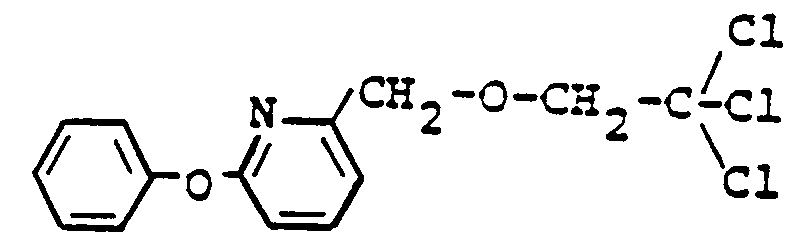
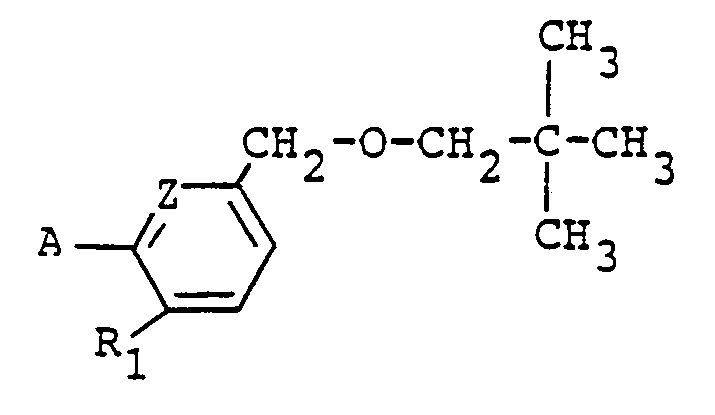
- ether compounds have the general formula: wherein X represents an oxygen sulfur atom; Z represents an oxygen atom or a methylene group; R, represents a halogen atom or an optionally substituted alkyl, alkenyl or aryl group and R 2 represents a halogen atom or an alkyl group, or R, and R 2 together with the carbon atom to which they are attached jointly represent an optionally substituted cycloalkyl group; R 3 represents a hydrogen or halogen atom or an alkyl group; R 4 represents a hydrogen atom or a cyano or alkenyl group; R 5 represents a hydrogen or halogen atom or an alkyl or alkoxy group; and n is 0, 1 or 2.
- the insecticidal properties of these ether compounds are not satisfactory.
- the technical problem underlying the present invention is to provide compounds having excellent insecticidal activity, in particular against insect pests resistant to organic phosphates or carbamates.
- n represent an integer of 1 to 4 and the sum of them is not more than 5;
- R 2 represents a methyl group or a chlorine atom; and
- R 3 represents a methyl group, a halogen atom (e.g. chlorine or bromine) or a methoxy group.
- the ether compounds of the present invention have (1) a high insecticidal effect and (2) their insecticidal effect on insect pests resistant to organic phosphates or carbamates is also excellent.
- insect pests to which the present compounds are particularly effective are Hemiptera such as planthoppers, leafhoppers, aphides, bugs, Lepidoptera such as rice stem borer (Chilo suppressalis), armyworms and cutworms, Diptera such as common mosquito (Culex pipiens pallens), housefly (Musca domestica), Dicyloptera such as German cockroach (Blattella germanica), Coleoptera, Orthoptera, mites such as carmine spider mite (Tetranychus cinnabarinus) and citrus red mite (Panonychus citri).
- the present compounds can be produced, for example, by the following methods.
- the above ether compounds can be produced by reacting the alcohol compounds represented by the foregoing general formula (IV) with a base (e.g. alkali metal hydride, alkali metal alkoxide, alkyl lithium, alkali metal carbonate or alkali metal hydroxide) in an inert organic solvent to produce the alkali metal salts thereof and then reacting the salts with the compounds represented by the general formula (III) at a temperature over 0°C for 1 to 72 hours.
- a base e.g. alkali metal hydride, alkali metal alkoxide, alkyl lithium, alkali metal carbonate or alkali metal hydroxide
- an inert organic solvent are aprotic polar solvents (e.g. dimethylformamide or dimethyl sulfoxide), ethers (e.g. tetrahydrofuran, 1,4-dioxane or ethylene glycol dimethyl ether) and aromatic hydrocarbons (e.g. benzene or to
- the above ether compounds wherein the substituent R 5 is a chlorine or bromine atom can be produced by reacting the compounds represented by the foregoing general formula (V) with compounds represented by the general formula (VII), wherein R 7 represents a chlorine or bromine atom, in an inert organic solvent from 1 to 12 hours at a temperature from -50°C to room temperature.
- the inert organic solvent are alcohols (e.g. methanol or ethanol), halogenated hydrocarbons (e.g. carbon tetrachloride or chloroform) and lower aliphatic carboxylic acids (e.g. acetic acid or propionic acid).
- the above ether compounds wherein the substituent R 5 is a methoxy group can be produced by reacting the compounds represented by the general formula (V) with methanol at a temperature from -10°C to room temperature for 1 to 12 hours in the presence of mercuric acetate and then with an alkali hydroxide at a temperature from 0°C to room temperature for 1 to 24 hours, and then reacting the resulting products with alkali borohydride at a temperature from 0°C to room temperature.
- the compounds represented by the general formula (V) can be produced, for example, through the following routes: wherein Z, R i , Y 1 , Y 2 , m, n and A have the same meanings as described above.
- the above ether compounds can be produced by reacting the compounds represented by the foregoing general formula (VIII) with a base (e.g. sodium hydroxide, potassium hydroxide, calcium hydroxide, sodium alkoxide or potassium carbonate) in an inert organic solvent for 1 to 72 hours at a temperature from room temperature to the boiling point of the solvent.
- a base e.g. sodium hydroxide, potassium hydroxide, calcium hydroxide, sodium alkoxide or potassium carbonate
- an inert organic solvent are alcohol solvents (e.g. methanol, ethanol), ether solvents (e.g. tetrahydrofuran, 1,2-dimethoxyethane, 1,4-dioxane), water and mixed solvents of water with the alcohol or ether solvent.
- the above ether compounds can also be produced by reacting the compounds represented by the general formula (VIII) with an acid (e.g. hydrochloric acid or sulfuric acid) in the presence or not of the inert organic solvent at a temperature from room temperature to 100°C for 1 to 48 hours.
- an acid e.g. hydrochloric acid or sulfuric acid
- the compounds represented by the general formula (VIII) can be produced, for example, through the following routes: wherein R 1 , Y 1 , Y 2 , m, n, R 2 , R 4 , R 5 , R 6 and A have the same meanings as described above.
- a method for producing the ether compounds represented by the general formula, wherein Z, R 1 , Y 1 , Y 2 , m and n have the same meanings as described above, by reacting compounds represented by the general formula (IX), wherein Z, R, and A have the same meanings as described above, with phenol derivatives represented by the general formula (X), wherein Y,, Y 2 , m and n have the same meanings as described above, in the presence of a base.
- the above ether compounds can be produced by reacting the compounds represented by the general formula (X) with the compounds represented by the general formula (IX) at 100° to 200°C for 1 to 48 hours with or without an inert solvent in the presence of a base (e.g. sodium hydride, potassium hydride, potassium tertbutoxide, potassium carbonate, sodium hydroxide or potassium hydroxide) and in the presence or absence of a copper catalyst (e.g. cuprous chloride, cuprous bromine, cuprous iodide, copper powder, copper acetate or cupric chloride).
- a base e.g. sodium hydride, potassium hydride, potassium tertbutoxide, potassium carbonate, sodium hydroxide or potassium hydroxide
- a copper catalyst e.g. cuprous chloride, cuprous bromine, cuprous iodide, copper powder, copper acetate or cupric chloride.
- This reaction is preferably carried out in an inert gas atmosphere (e.g. nitrogen gas).
- the inert solvent examples include aprotic polar solvents such as dimethylformaide, dimethylacetamide, dimethyl sulfoxide, hexamethylphosphoroamide, 1,3-dimethylimidazolidinone, etc.
- aprotic polar solvents such as dimethylformaide, dimethylacetamide, dimethyl sulfoxide, hexamethylphosphoroamide, 1,3-dimethylimidazolidinone, etc.
- the ether compounds When used as active ingredients for insecticidal and acaricidal compositions they may be used without adding any other ingredients. Generally, however, they are formulated into emulsifiable concentrates, wettable powders, dusts, granules, oil sprays, aerosols, heating fumigants (e.g. mosquito coils, electric mosquito mats), foggings, non-heating fumigants, poisonous baits, etc. by mixing with solid carriers, liquid carriers, gaseous carriers, surface active agents, other auxiliaries for formulation, baits, etc., or impregnating into bases such as mosquito coil carrier, mat, etc.
- fumigants e.g. mosquito coils, electric mosquito mats
- the solid carrier includes for example fine powders or granules or kaolin clay, attapulgite clay, bentonite, terra abla, pyrophyllite, talc, diatomaceous earth, calcite, corn stalk powder, walnut shell powder, urea, ammonium sulfate, synthetic hydrated silicon dioxide and the like.
- the liquid carrier includes for example aliphatic hydrocarbons (e.g.kerosene), aromatic hydrocarbons (e.g. toluene, xylene, methylnaphthalene), halogenated hydrocarbons (e.g. dichloroethane, trichloroethylene, carbon tetrachloride), alcohols (e.g.
- methanol, ethanol, isopropanol, ethylene glycol or cellosolve ketones (e.g. acetone, methyl ethyl ketone, cyclohexanone or isophorone), ethers (e.g. diethyl ether, dioxane or tetrahydrofuran), esters (e.g. ethyl acetate), nitriles (e.g. acetonitrile or isobutyronitrile), acid amides (e.g. dimethylformamide or dimethylacetamide), dimethyl sulfoxide, vegetable oils (e.g. soybean oil or cotton seed oil) and the like.
- ketones e.g. acetone, methyl ethyl ketone, cyclohexanone or isophorone
- ethers e.g. diethyl ether, dioxane or tetrahydrofuran
- esters e.g. eth
- the gaseous carrier includes for example freon gas, LPG (liquefied petroleum gas), dimethyl ether and the like.
- the surface active agent used for emulsification dispersion, wetting, etc. includes for example anionic surface active agents such as the salt of alkyl sulfates, alkyl(aryl) sulfonates, dialkyl sulfosuccinates, the salt of polyoxyethylene alkylaryl ether phosphoric acid ester, naphthalenesulfonic acid/formalin condensates, etc., and nonionic surface active agents such as polyoxyethylene alkyl ether, polyoxyethylene polyoxypropylene block copolymers, sorbitan fatty acid esters, polyoxyethylene sorbitan fatty acid esters, etc.
- the auxiliary for formulation such as sticking agents, dispersing agents, etc. includes for example lignosulfonates, alginates, polyvinyl alcohol, gum arabic, molasses, casein, gelatin, CMC (carboxymethyl cellulose), pin oil, agar, etc.
- the stabilizer includes for example alkyl phosphates [e.g. PAP (isopropyl acid phosphate), TCP (tricresyl phosphate)], vegetable oils, epoxidized oil, the foregoing surface active agents, antioxidants (e:g. BHT, BHA), fatty acid salts (e.g.
- sodium oleate or calcium stearate sodium oleate or calcium stearate, tatty acid esters (e.g. methyl oleate or methyl stearate) and the like.
- each of the ether compounds (2), (3) and (34), 1 part of synthetic hydrated silicon dioxide, 2 parts of calcium lignosulfonate, 30 parts of bentonite and 62 parts of kaolin clay are well pulverized and mixed thoroughly, kneaded well with water, granulated and then dried to obtain the granules of each compound.
- 0.05 Part of each of the ether compounds (1), (2) and (3), 0.2 parts of tetramethrin, 0.05 part of resmethrin, 7 parts of xylene and 32.7 parts of deodorized kerosene are well mixed into a solution.
- the solution is filled in an aerosol container, and after attaching a valve portion to the container, 60 parts of a propellant (liquefied petroleum gas) is charged therein through the valve under pressure to obtain the aerosol of each compound.
- a propellant liquefied petroleum gas
- each of the ether compounds (1), (2) and (3) and 0.3 g of the d-trans chrysanthemate of allethrin are dissolved in 20 ml of methanol.
- This solution and 99.4 g of a mosquito coil carrier which is a 3:5:1 mixture of Tabu powder, Pyrethrum marc and wood powder, are uniformly mixed with stirring.
- 150 ml of water is added to the residue, and the mixture is well kneaded, shaped and dried to obtain the mosquito coil of each compound.
- These preparations are used as it is or as diluted solutions with water. Also, they may be used in mixture with other insecticides, acaricides, nematocides, fungicides, herbicides, plant growth regulators, fertilizers, soil improvers and the like.
- ether compounds When used as insecticidal and acaricidal compositions, their dosage rate is generally 5 to 500 g per 10 areas. When emulsifiable concentrates, wettable powders, etc. are used as aqueous dilute solutions, the application concentration of the compounds is 10 to 1000 ppm. Dusts, granules, oil sprays, aerosols, etc. are used without dilution.
- the ether compounds are shown by the Compound No. in Table 1, and the compounds used as a control are shown by the Compound symbol in Table 2.
- the emulsifiable concentrates of the following ether compounds of the present invention and controls obtained according to Formulation example 2 were each diluted with water to a prescribed concentration, and a culm of a rice plant (about 12 cm in length) was dipped for 1 minute in the resulting aqueous dilute solutions. After air-drying, the culm was placed in test tube, and 10 adults of a resistant strain of green rice leafhopper (Nephotettix cincticeps) were liberated in the tube. After one day, the dead and alive of the adults were examined to obtain LC so (50% lethal concentration) (two replications).
- LC so 50% lethal concentration
- the emulsifiable concentrates of the following ether compounds and control obtained according to Formulation example 2 were each diluted with water to a prescribed concentration, and a culm of a rice plant (about 12 cm in length) was dipped for 1 minute in the resulting aqueous dilute solutions. After air-drying, the culm was placed in a test tube, and 10 adults of smaller brown planthopper (Laodelphax striatellus) were liberated in the tube. After one day, the dead and alive of the adults were examined to obtain LC 50 (50% lethal concentration) (two replications).
- LC 50 50% lethal concentration
- the emulsifiable concentrates of the following ether compounds and controls obtained according to Formulation example 2 were each diluted with water to a prescribed concentration, and a culm of a rice plant (about 12 cm in length) was dipped for 1 minute in the resulting aqueous dilute solutions. After air-drying, the culm was placed in test tube, and 10 adults of brown planthopper (Nilaparvata lugens) were liberated in the tube. After one day, the dead and alive of the adults were examined to obtain LC 50 (50% lethal concentration) (two replications).
- a test solution prepared by diluting the emulsifiable concentrates of the following ether compounds and a control prepared according to Formulation example 2 to a prescribed concentration with water, was added dropwise to the filter paper. Thirty milligrams of sucrose were uniformly placed on the filter paper as a bait. Thereafter, 10 housefly female adults (Musca domestica) were liberated in the cup which was then covered with a lid. After 48 hours, the dead and alive were examined to obtain LC 50 (50% lethal concentration) (two replications).
- the following ether compounds and controls were diluted with acetone, and the dilute solutions were each uniformly coated onto the bottom (bottom area, 78.5 cm 2 ) of an aluminum dish (inside diameter, 10 cm; height, 3 cm) so that the amount of the active ingredient was 73 mglm 2 .
- 10 German cockroach adults (5 males and 5 females) (Blattella germanica) were liberated in the dish and forced to contact with the treated bottom of the dish. After forced contact for 24 hours, the test insects were transformed to a new vessel and bred with water and bait. After 72 hours, the dead and alive were examined to obtain mortality (two replications).
Landscapes
- Life Sciences & Earth Sciences (AREA)
- Chemical & Material Sciences (AREA)
- Organic Chemistry (AREA)
- Dentistry (AREA)
- Wood Science & Technology (AREA)
- Plant Pathology (AREA)
- Health & Medical Sciences (AREA)
- Engineering & Computer Science (AREA)
- Agronomy & Crop Science (AREA)
- General Health & Medical Sciences (AREA)
- Pest Control & Pesticides (AREA)
- Zoology (AREA)
- Environmental Sciences (AREA)
- Organic Low-Molecular-Weight Compounds And Preparation Thereof (AREA)
- Pyridine Compounds (AREA)
- Low-Molecular Organic Synthesis Reactions Using Catalysts (AREA)
- Agricultural Chemicals And Associated Chemicals (AREA)
Claims (17)





Applications Claiming Priority (4)
| Application Number | Priority Date | Filing Date | Title |
|---|---|---|---|
| JP59199131A JPS6176462A (ja) | 1984-09-21 | 1984-09-21 | エーテル化合物およびそれを有効成分とする殺虫剤 |
| JP199131/84 | 1984-09-21 | ||
| JP13626985A JPH072664B2 (ja) | 1985-06-21 | 1985-06-21 | エーテル化合物およびそれを有効成分とする殺虫、殺ダニ剤 |
| JP136269/85 | 1985-06-21 |
Publications (3)
| Publication Number | Publication Date |
|---|---|
| EP0175377A2 EP0175377A2 (fr) | 1986-03-26 |
| EP0175377A3 EP0175377A3 (en) | 1988-07-06 |
| EP0175377B1 true EP0175377B1 (fr) | 1990-11-28 |
Family
ID=26469900
Family Applications (1)
| Application Number | Title | Priority Date | Filing Date |
|---|---|---|---|
| EP85111908A Expired - Lifetime EP0175377B1 (fr) | 1984-09-21 | 1985-09-20 | Ether, sa préparation et composition insecticide et acaricide le contenant comme ingrédient actif |
Country Status (7)
| Country | Link |
|---|---|
| US (1) | US4664698A (fr) |
| EP (1) | EP0175377B1 (fr) |
| KR (1) | KR930002275B1 (fr) |
| CA (1) | CA1268181A (fr) |
| DE (1) | DE3580731D1 (fr) |
| MY (1) | MY101380A (fr) |
| PH (1) | PH21003A (fr) |
Families Citing this family (6)
| Publication number | Priority date | Publication date | Assignee | Title |
|---|---|---|---|---|
| DE3602169A1 (de) * | 1986-01-22 | 1987-07-23 | Schering Ag | Neue alkan- und alkoxyalkanderivate, verfahren zu ihrer herstellung und diese verbindungen enthaltende insektizide und akarizide mittel |
| US4840971A (en) * | 1986-04-07 | 1989-06-20 | Sumitomo Chemical Company, Limited | Novel ether compound, a process for manufacturing the same, a composition containing the same and a use thereof |
| GB8624831D0 (en) * | 1986-10-16 | 1986-11-19 | Ici Plc | Insecticidal ethers |
| DE3712752A1 (de) * | 1987-04-15 | 1988-11-03 | Hoechst Ag | Heterocyclische neophananaloga, verfahren zu ihrer herstellung und ihre verwendung als schaedlingsbekaempfungsmittel |
| MY103631A (en) * | 1987-11-07 | 1993-08-28 | Sumitomo Chemical Co | Certain insecticidal 6-(phenoxy-2-pyridyl)-methyl-neo-phental ethers |
| US5590955A (en) * | 1993-08-27 | 1997-01-07 | Vari-Lite, Inc. | Variable light modifier |
Family Cites Families (5)
| Publication number | Priority date | Publication date | Assignee | Title |
|---|---|---|---|---|
| DE2502786A1 (de) * | 1975-01-24 | 1976-07-29 | Merck Patent Gmbh | Diphenylaether-derivate und verfahren zu ihrer herstellung |
| GB1570982A (en) * | 1976-03-05 | 1980-07-09 | Shell Int Research | Substituted benzyl ethers and thioethers |
| US4214086A (en) * | 1977-11-04 | 1980-07-22 | Ciba-Geigy Corporation | Process for producing hydroxydiaryl ethers |
| NZ192353A (en) * | 1978-12-22 | 1982-03-16 | Ici Australia Ltd | Diphenylamine derivatives herbicidal compositions |
| SE461790B (sv) * | 1982-10-19 | 1990-03-26 | Mitsui Toatsu Chemicals | Foerfarande foer framstaellning av 3-fenoxibensyl-2-(4-alkoxifenyl)-2-metylpropyletrar |
-
1985
- 1985-09-09 US US06/773,615 patent/US4664698A/en not_active Expired - Fee Related
- 1985-09-12 CA CA000490546A patent/CA1268181A/fr not_active Expired - Lifetime
- 1985-09-18 PH PH32799A patent/PH21003A/en unknown
- 1985-09-20 KR KR1019850006889A patent/KR930002275B1/ko not_active Expired - Fee Related
- 1985-09-20 DE DE8585111908T patent/DE3580731D1/de not_active Expired - Lifetime
- 1985-09-20 EP EP85111908A patent/EP0175377B1/fr not_active Expired - Lifetime
-
1987
- 1987-09-30 MY MYPI87002623A patent/MY101380A/en unknown
Also Published As
| Publication number | Publication date |
|---|---|
| CA1268181A (fr) | 1990-04-24 |
| MY101380A (en) | 1991-10-23 |
| KR930002275B1 (ko) | 1993-03-27 |
| EP0175377A2 (fr) | 1986-03-26 |
| KR860002469A (ko) | 1986-04-26 |
| DE3580731D1 (de) | 1991-01-10 |
| PH21003A (en) | 1987-06-23 |
| US4664698A (en) | 1987-05-12 |
| EP0175377A3 (en) | 1988-07-06 |
Similar Documents
| Publication | Publication Date | Title |
|---|---|---|
| EP0094085B1 (fr) | Composés d'éthers, leur préparation et une composition insecticide et/ou acaricide les contenant | |
| EP0132606B1 (fr) | Dérivés de benzimidazole, leur préparation et application | |
| CA1269999A (fr) | Derive difluorohalomethoxyphenyl et acaricide comportant ce produit comme ingredient actif | |
| US5591765A (en) | Insecticidal and synergistic miticidal compositions | |
| JPS6237023B2 (fr) | ||
| US4664698A (en) | Ether compound, and an insecticidal and acaricidal composition containing it as an active ingredient | |
| WO1986002072A1 (fr) | Composes de tetrazolyle utilises comme insecticides | |
| US4772633A (en) | 6-pyridyl- and 6-phenyl-3-phenyl-1-hexenes and -1-hexynes, composition containing them, and insecticidal and acaricidal method of using them | |
| US4840971A (en) | Novel ether compound, a process for manufacturing the same, a composition containing the same and a use thereof | |
| EP0341048A1 (fr) | Composé de pyrazole sa préparation et son utilisation | |
| EP0202500B1 (fr) | Esters d'acides carboxyliques, procédés pour leur production et insecticides les contenant comme agent actif | |
| EP0158448A2 (fr) | Azolylpropanols | |
| EP0315916B1 (fr) | Ether, procédé pour sa préparation, composition le contenant comme ingrédient actif et son utilisation | |
| US4668693A (en) | Bromodichloroimidazole insecticide | |
| EP0193189B1 (fr) | Composé, sa préparation ainsi que composition insecticide et acaricide contenant ledit composé comme ingrédient actif | |
| EP0315370A2 (fr) | Composés d'ethers et leur production et composition insecticides et/ou acaricides les contenant | |
| EP0291045B1 (fr) | Esters d'acides carboxyliques, procédé pour leur production et les insecticides les contenant comme ingrédient actif | |
| EP0218793B1 (fr) | Trihalo-imidazoles comme insecticides | |
| US4902697A (en) | Derivatives of 2,2-dimethyl-cyclopropanecarboxylic acid | |
| JPH072664B2 (ja) | エーテル化合物およびそれを有効成分とする殺虫、殺ダニ剤 | |
| JPS62273941A (ja) | トリアゼン誘導体、その製造法およびそれを有効成分とする農園芸用殺菌剤 | |
| JPH0471062B2 (fr) | ||
| JPH0517917B2 (fr) |
Legal Events
| Date | Code | Title | Description |
|---|---|---|---|
| PUAI | Public reference made under article 153(3) epc to a published international application that has entered the european phase |
Free format text: ORIGINAL CODE: 0009012 |
|
| AK | Designated contracting states |
Kind code of ref document: A2 Designated state(s): CH DE FR GB IT LI NL |
|
| PUAL | Search report despatched |
Free format text: ORIGINAL CODE: 0009013 |
|
| AK | Designated contracting states |
Kind code of ref document: A3 Designated state(s): CH DE FR GB IT LI NL |
|
| 17P | Request for examination filed |
Effective date: 19881125 |
|
| RAP3 | Party data changed (applicant data changed or rights of an application transferred) |
Owner name: SUMITOMO CHEMICAL COMPANY, LIMITED |
|
| 17Q | First examination report despatched |
Effective date: 19890426 |
|
| ITF | It: translation for a ep patent filed | ||
| GRAA | (expected) grant |
Free format text: ORIGINAL CODE: 0009210 |
|
| AK | Designated contracting states |
Kind code of ref document: B1 Designated state(s): CH DE FR GB IT LI NL |
|
| ET | Fr: translation filed | ||
| REF | Corresponds to: |
Ref document number: 3580731 Country of ref document: DE Date of ref document: 19910110 |
|
| PLBE | No opposition filed within time limit |
Free format text: ORIGINAL CODE: 0009261 |
|
| STAA | Information on the status of an ep patent application or granted ep patent |
Free format text: STATUS: NO OPPOSITION FILED WITHIN TIME LIMIT |
|
| 26N | No opposition filed | ||
| ITTA | It: last paid annual fee | ||
| PGFP | Annual fee paid to national office [announced via postgrant information from national office to epo] |
Ref country code: CH Payment date: 19940831 Year of fee payment: 10 |
|
| PGFP | Annual fee paid to national office [announced via postgrant information from national office to epo] |
Ref country code: NL Payment date: 19940930 Year of fee payment: 10 |
|
| PGFP | Annual fee paid to national office [announced via postgrant information from national office to epo] |
Ref country code: GB Payment date: 19950908 Year of fee payment: 11 |
|
| PGFP | Annual fee paid to national office [announced via postgrant information from national office to epo] |
Ref country code: FR Payment date: 19950929 Year of fee payment: 11 |
|
| PG25 | Lapsed in a contracting state [announced via postgrant information from national office to epo] |
Ref country code: LI Effective date: 19950930 Ref country code: CH Effective date: 19950930 |
|
| PGFP | Annual fee paid to national office [announced via postgrant information from national office to epo] |
Ref country code: DE Payment date: 19951129 Year of fee payment: 11 |
|
| PG25 | Lapsed in a contracting state [announced via postgrant information from national office to epo] |
Ref country code: NL Effective date: 19960401 |
|
| REG | Reference to a national code |
Ref country code: CH Ref legal event code: PL |
|
| NLV4 | Nl: lapsed or anulled due to non-payment of the annual fee |
Effective date: 19960401 |
|
| PG25 | Lapsed in a contracting state [announced via postgrant information from national office to epo] |
Ref country code: GB Effective date: 19960920 |
|
| PG25 | Lapsed in a contracting state [announced via postgrant information from national office to epo] |
Ref country code: FR Effective date: 19960930 |
|
| GBPC | Gb: european patent ceased through non-payment of renewal fee |
Effective date: 19960920 |
|
| PG25 | Lapsed in a contracting state [announced via postgrant information from national office to epo] |
Ref country code: DE Effective date: 19970603 |
|
| REG | Reference to a national code |
Ref country code: FR Ref legal event code: ST |
|
| REG | Reference to a national code |
Ref country code: FR Ref legal event code: ST |