EP0175879A2 - Verfahren zum Transport von zähflüssigen Rohölen - Google Patents
Verfahren zum Transport von zähflüssigen Rohölen Download PDFInfo
- Publication number
- EP0175879A2 EP0175879A2 EP85109481A EP85109481A EP0175879A2 EP 0175879 A2 EP0175879 A2 EP 0175879A2 EP 85109481 A EP85109481 A EP 85109481A EP 85109481 A EP85109481 A EP 85109481A EP 0175879 A2 EP0175879 A2 EP 0175879A2
- Authority
- EP
- European Patent Office
- Prior art keywords
- oil
- water
- emulsifier
- carboxymethylated
- degree
- Prior art date
- Legal status (The legal status is an assumption and is not a legal conclusion. Google has not performed a legal analysis and makes no representation as to the accuracy of the status listed.)
- Granted
Links
Classifications
-
- F—MECHANICAL ENGINEERING; LIGHTING; HEATING; WEAPONS; BLASTING
- F17—STORING OR DISTRIBUTING GASES OR LIQUIDS
- F17D—PIPE-LINE SYSTEMS; PIPE-LINES
- F17D1/00—Pipe-line systems
- F17D1/08—Pipe-line systems for liquids or viscous products
- F17D1/16—Facilitating the conveyance of liquids or effecting the conveyance of viscous products by modification of their viscosity
-
- C—CHEMISTRY; METALLURGY
- C10—PETROLEUM, GAS OR COKE INDUSTRIES; TECHNICAL GASES CONTAINING CARBON MONOXIDE; FUELS; LUBRICANTS; PEAT
- C10L—FUELS NOT OTHERWISE PROVIDED FOR; NATURAL GAS; SYNTHETIC NATURAL GAS OBTAINED BY PROCESSES NOT COVERED BY SUBCLASSES C10G OR C10K; LIQUIFIED PETROLEUM GAS; USE OF ADDITIVES TO FUELS OR FIRES; FIRE-LIGHTERS
- C10L1/00—Liquid carbonaceous fuels
- C10L1/32—Liquid carbonaceous fuels consisting of coal-oil suspensions or aqueous emulsions or oil emulsions
- C10L1/328—Oil emulsions containing water or any other hydrophilic phase
-
- Y—GENERAL TAGGING OF NEW TECHNOLOGICAL DEVELOPMENTS; GENERAL TAGGING OF CROSS-SECTIONAL TECHNOLOGIES SPANNING OVER SEVERAL SECTIONS OF THE IPC; TECHNICAL SUBJECTS COVERED BY FORMER USPC CROSS-REFERENCE ART COLLECTIONS [XRACs] AND DIGESTS
- Y10—TECHNICAL SUBJECTS COVERED BY FORMER USPC
- Y10T—TECHNICAL SUBJECTS COVERED BY FORMER US CLASSIFICATION
- Y10T137/00—Fluid handling
- Y10T137/0318—Processes
- Y10T137/0391—Affecting flow by the addition of material or energy
Definitions
- Heavy oils are difficult to transport in pipelines under conditions of usual outside temperatures due to their very high viscosity. In order to increase their mobility, they are therefore often ohölen with low-R or mixed refinery sections; such a procedure requires relatively high additives in order to achieve a noticeable improvement in flow. In addition, such a process is only possible where light oil fields exist at the same location or where a nearby refinery can supply low-viscosity gasoline fractions.
- Another method also used is to add heat to the heavy oil in order to lower its viscosity and accordingly improve its fluidity, which requires considerable amounts of heat. So it is z. B. necessary, a heavy oil of 10.3 ° API, its viscosity at 20 ° C 40 000 mPa. s is to heat to a temperature of approx. 95 C in order to achieve a viscosity of approx. 100 mPa. s to achieve a threshold value frequently required for oil transportation in pipelines (ML Chirinos et al, Rev. Tec. Intevep 3 (2), 103 (1983). This means an extreme cost for the equipment and the supply of the pipelines and a loss from 15 to 20% of crude oil, since the necessary amount of heat is usually obtained by burning crude oil.
- Another method of heavy oil transport consists in pumping the oil through the pipes in the form of a more or less easily liquid emulsion. Since the viscosity of emulsions is largely determined by that of the dispersing agent, this is an oil-in-water emulsion.
- the oil-in-water Emulsion is obtained by adding water and emulsifier to the oil using shear forces and then pumping this mixture into the pipeline. In a settling tank, e.g. B. prior to entering the refinery, the emulsion is again separated into oil and water and the separated oil, the R Affinerie supplied.
- the lowest possible concentration of the emulsifier should lead to a stable, slightly liquid oil-in-water emulsion with a very high oil content, which naturally places high demands on the emulsifiers to be used. High shear forces must also be avoided during emulsification, since there is a risk of inversion to a water-in-oil emulsion that is extremely highly viscous in heavy oils.
- the emulsions are also said to be stable both to higher salinities such as occur in many deposit systems and to higher temperatures. Despite the stability of the emulsions as they flow through the pipeline, they should be able to be separated again without any problems. Sulfur-containing emulsifiers are undesirable if they fail to be kept in the aqueous phase during the cleavage.
- carboxymethylated oxethylates of the formula are used as emulsifiers in which R is a linear or branched aliphatic radical having 6 to 20 carbon atoms, an alkyl or dialkyl aromatic radical having 5 to 16 carbon atoms per alkyl group, n is 1 to 40 and M is an alkali metal or alkaline earth metal ion or ammonium.
- the carboxymethylated oxethylates according to DE-PS 24 18 444 are advantageously prepared by reacting oxethylates of the formula with chloroacetic acid or a salt of chloroacetic acid in the presence of alkali hydroxide or alkaline earth hydroxide.
- R is preferably a saturated or unsaturated, straight-chain or branched alkyl radical having E to 18 C atoms or an alkylaryl radical having 5 to 16 C atoms in the alkyl group or a dialkyl radical having 3 to 16 C atoms per alkyl group.
- alcohols whose oxethylates are carboxymethylated, z. B.
- hexyl alcohol hexyl alcohol, octyl alcohol, 2-ethylhexyl alcohol, nonyl alcohol, isononyl alcohol, decyl and undecyl alcohol, lauryl, tridecyl, myristile, palmityl and stearyl alcohol, but also unsaturated, such as B. oleyl alcohol.
- alkylphenols such as B. Insert: P entylphenol, hexylphenol, octylphenol, nonylphenol, dodecylphenol, hexadecylphenol, and the corresponding D ialkylphenole.
- Alkyl cresols and xylenols are also suitable.
- the oxethylation can be carried out in the presence of catalytic amounts of alkali metal hydroxide, but it is known that other processes are also possible.
- the degree of oxyethylation can assume values between 1 and 40, preferably between 3 and 20.
- the cation in carboxymethylated oxyethylate with the formula can be sodium, potassium, lithium, ammonium, calcium, magnesium or hydrogen.
- the emulsifiers used are predominantly anionic, so that an unproblematic cleavage of the emulsion stabilized by them can be assumed.
- the compounds are thermally stable and, within extremely wide limits, are compatible with salt water (US Pat. No. 4,457,373).
- hydrophobic residue and the degree of oxyethylation they allow the emulsifier to be optimally adapted to the oil to be transported and the given salinity of the water conveyed from the deposit in most cases, which advantageously forms the aqueous phase of the emulsion to be transported.
- the carboxymethylated oxethylates can contain unreacted oxethylate. Accordingly, a degree of carboxymethylation can be defined.
- Mixtures with a degree of carboxymethylation between 85 and 100% are particularly effective. Such mixtures accordingly consist of anionic and nonionic surfactant and are considered as carboxymethylated oxethylates according to the invention.
- mixtures of anionic and nonionic surfactant described or the purely anionic compounds (emulsifier) are soluble or at least easily dispersible in conventional reservoir waters.
- the emulsifier to be used can be optimally adjusted to the existing heavy oil-water system according to its chemical structure.
- the surfactants (emulsifiers) of a homologous series (cf.Table A) are dissolved in the water in question and mixed with the heavy oil in question and, after briefly stirring with a paddle stirrer without using high shear forces, they are tested for their emulsifying action and the stability of the emulsion is determined. This assessment of the emulsion is repeated about 24 hours later and then the viscosity is measured as a function of the shear rate, if necessary. Since heavy oil emulsions are somewhat structurally viscous, a range between 1 0 and 100 sec 1 is selected for the shear rate, which corresponds approximately to the transport through pipelines.
- a surfactant is an optimal emulsifier if the amount necessary for emulsification is as small as possible.
- the amount is generally from 0.01 to 0.5, in particular from 0.03 to 0.2,% by weight, based on the amount of oil, which corresponds to 100 to 5000, preferably 300 to 2000, ppm.
- the emulsifier is either metered in as a melt or as an aqueous solution or as a dispersion of the oil-water mixture, or else it is added to the water, which is then mixed with the oil.
- Water here is understood to mean either a more or less saline water that is produced together with the heavy oil, or it can be a cheaply available surface water or, finally, a mixture of both waters. Since heavy oil fields are often exploited by steam flooding, the salinity of the water produced can fluctuate somewhat, which is not critical for the claimed process.
- the emulsifier can also be added to the heavy oil itself, especially since the surfactant class claimed here shows good oil solubility. It may be advantageous to use a small amount of a light hydrocarbon mixture as a solubilizer.
- the mixing of the three components to form the emulsion, namely oil, water and emulsifier, can take place either directly at the borehole or in or near a collection tank or at any other point in the piping system.
- the mixture ratio of oil to water can vary within wide limits between 10:90 and 90:10. For economic reasons, high oil contents should be aimed at, although it must be taken into account that very high oil contents usually also lead to relatively highly viscous oil / water emulsions.
- the economic optimum is between 70 and 85% oil.
- the emulsification is favored by mixing devices such as agitators, centrifugal pumps, static mixers, etc., which are used when necessary.
- the E multi- sion thus formed is conveyed through the pipe system, the which can contain intermediate stations and intermediate storage containers.
- the emulsion is split in a separator, it being advantageous to add one or more desmulsifiers.
- the crude oil dewatered in this way is drawn off and then either to the refinery or a possible further transport, e.g. B. supplied by ship.
- the effectiveness of the surfactant can be optimized by varying the chemical structure (change in the degree of EO).
- Carboxymethylated nonylphenol oxethylates with an EO degree of approx. 3.3 have the highest effectiveness here.
- the viscosity is around 100 mPa. s at 20 ° C - 100 mPa are required. s at 37.7 ° C - very low.
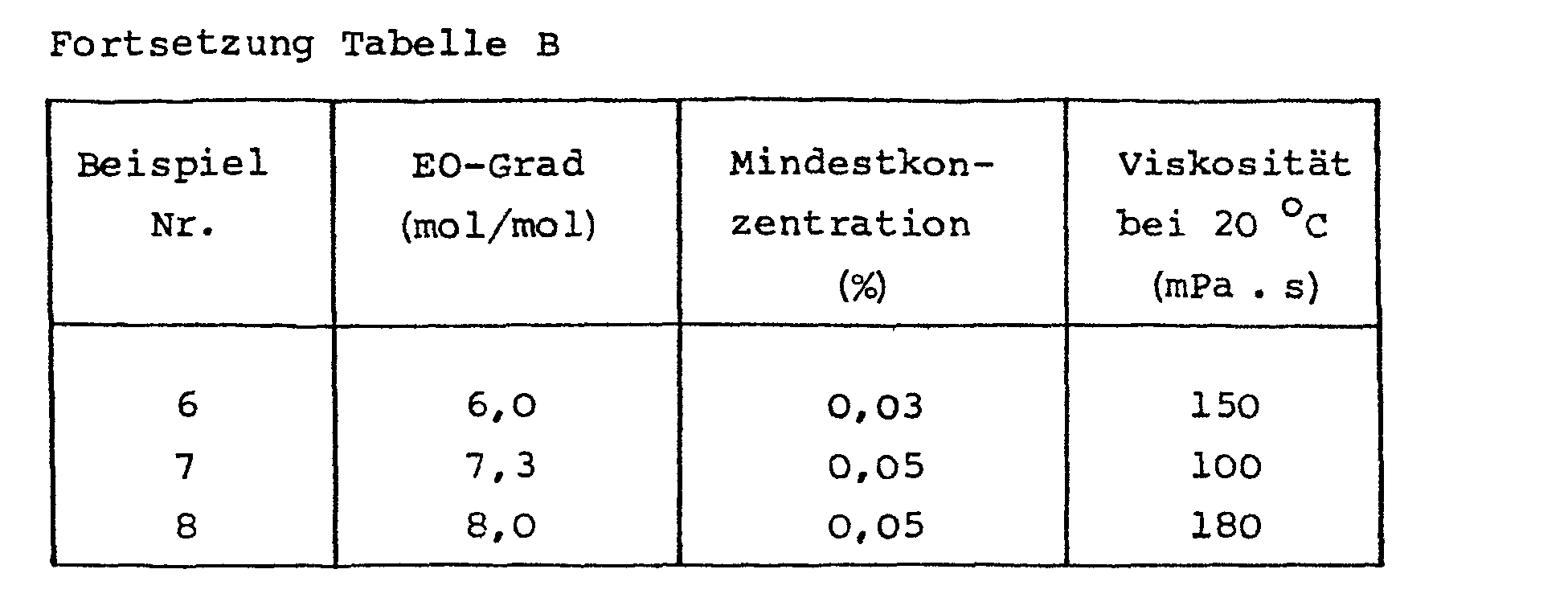
- Table B examines the effect of the same surfactants in the presence of high saline water (50,000 ppm NaCl).
- the EO grade of the most effective surfactants is between 5.5 and 6.0.
- the significantly increased effectiveness compared to the lower salinar conditions in Table A is surprising
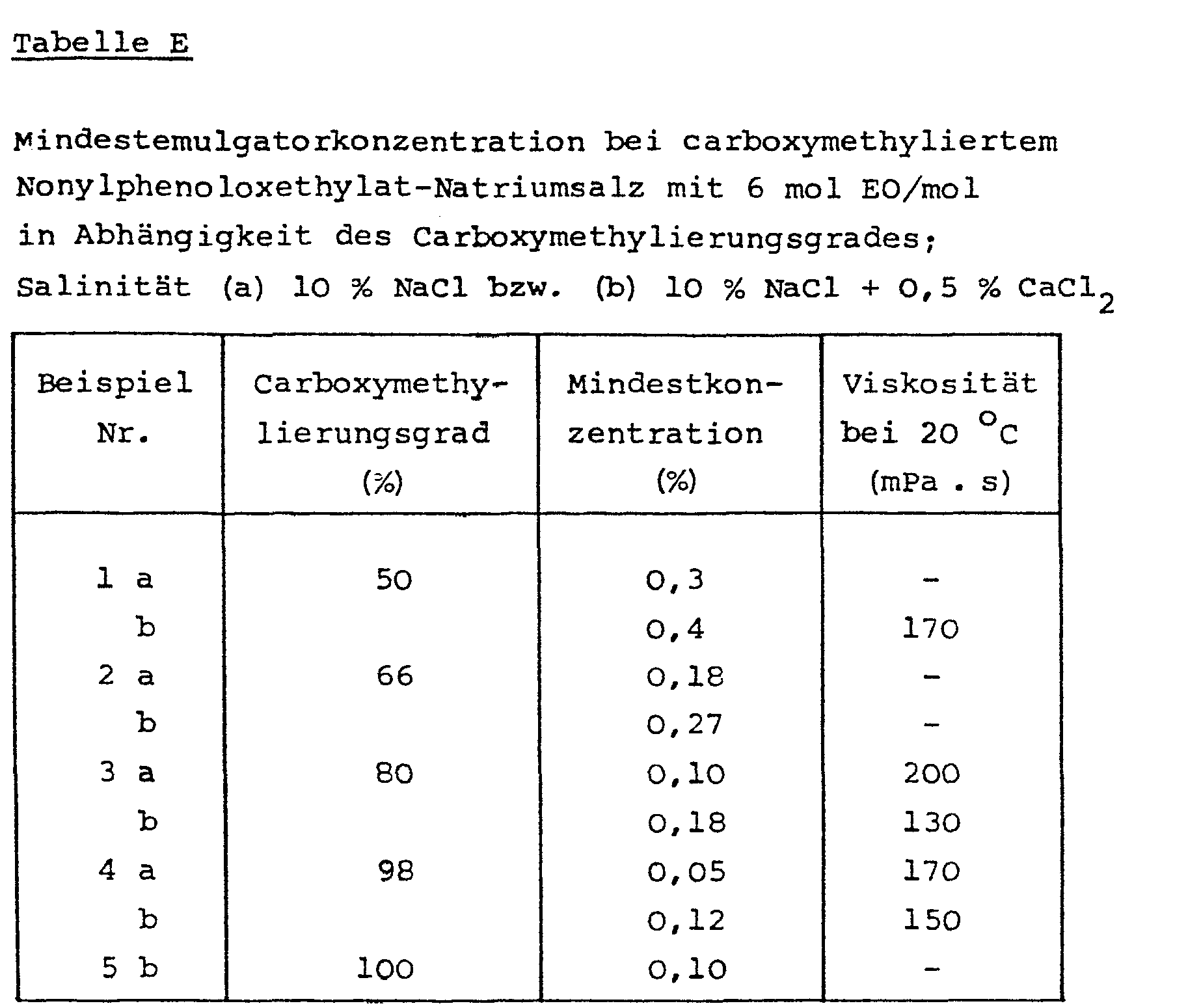
- Table E shows the dependence of the emulsifying activity in the case of a carboxymethylated nonylphenol oxethylate on the degree of carboxymethylation.
- the influence of alkaline earth ions is also examined. The effectiveness increases with increasing degree of carboxymethylation. This also applies in the presence of alkaline earth metal ions, which otherwise have a high emulsifying effect Reduce basic salinity more than additional alkali halides in the same concentration.
Landscapes
- Engineering & Computer Science (AREA)
- Chemical & Material Sciences (AREA)
- Oil, Petroleum & Natural Gas (AREA)
- Health & Medical Sciences (AREA)
- General Chemical & Material Sciences (AREA)
- Organic Chemistry (AREA)
- Chemical Kinetics & Catalysis (AREA)
- Public Health (AREA)
- Water Supply & Treatment (AREA)
- Mechanical Engineering (AREA)
- General Engineering & Computer Science (AREA)
- Emulsifying, Dispersing, Foam-Producing Or Wetting Agents (AREA)
- Liquid Carbonaceous Fuels (AREA)
- Colloid Chemistry (AREA)
Abstract

eingesetzt, in der R einen linearen oder verzweigten aliphatischen Rest mit 6 bis 20 Kohlenstoffatomen, einen alkyl- oder dialkylaromatischen Rest mit 5 bis 16 Kohlenstoffatomen pro Alkylgruppe darstellt, n den Wert 1 bis 40 und M ein Alkali-oder Erdalkali-Metallion oder Ammonium bedeuten.
Description
- Schweröle lassen sich unter Bedingungen üblicher Außentemperaturen infolge ihrer sehr hohen Viskosität nur schwierig in Rohrleitungen transportieren. Zur Erhöhung ihrer Mobilität werden sie daher vielfach mit niedrigviskosen Rohölen oder Raffinerieschnitten vermischt; eine solche Arbeitsweise erfordert relativ hohe Zusätze, um eine merkliche Fließverbesserung zu erreichen. Außerdem ist ein solches Verfahren nur dort möglich, wo Leichtölfelder am gleichen Ort existieren, oder eine nahegelegene Raffinerie niedrigviskose Benzinfraktionen zu liefern vermag.
- Eine andere ebenfalls angewendete Methode besteht darin, dem Schweröl Wärme zuzuführen, um seine Viskosität abzusenken und entsprechend sein Fließvermögen zu verbessern, wozu beträchtliche Wärmemengen aufgewendet werden müssen. So ist es z. B. notwendig, ein Schweröl von 10.3° API, dessen Viskosität bei 20 °C 40 000 mPa . s beträgt, auf eine Temperatur von ca. 95 C zu erhitzen, um eine Viskosität von ca. 100 mPa . s zu erreichen, einen für den Öltransport in Rohrleitungen häufig geforderten Schwellenwert (M. L. Chirinos et al, Rev. Tec. Intevep 3 (2), 103 (1983). Dies bedeutet einen extremen Kostenaufwand für die Ausstattung und die Versorgung der Rohrleitungen und einen Verlust von 15 bis 20 % an Rohöl, da üblicherweise die notwendige Wärmemenge durch Verbrennen von Rohöl gewonnen wird.
- Ein weiteres Verfahren des Schweröltransportes besteht darin, daß man das Öl in Form einer mehr oder minder leicht flüssigen Emulsion durch die Rohrleitungen pumpt. Da die Viskosität von Emulsionen ganz überwiegend von der des Dispersionsmittels bestimmt wird, handelt es sich hier um eine Öl-in-Wasser-Emulsion. Die Öl-in-Wasser-Emulsion wird erhalten, indem man dem Öl unter Anwendung von Scherkräften Wasser und Emulgator zusetzt und diese Mischung sodann in die Rohrleitung pumpt. In einew-Absetztank, z. B. vor dem Eintritt in die Raffinerie, wird die Emulsion wieder in Öl und Wasser getrennt und das abgetrennte Öl der Raffinerie zugeführt. Der Emulgator soll in möglichst geringer Konzentration zu einer stabilen, leicht flüssigen Öl-in-Wasser-Emulsion mit sehr hohem Ölanteil führen, was naturgemäß hohe Anforderungen an die einzusetzenden Emulgatoren stellt. Hohe Scherkräfte sind bei der Emulgierung ebenfalls zu vermeiden, da die Gefahr einer Inversion zu einer bei Schwerölen extrem hochviskosen Wasser-in-Öl-Emulsion besteht. Die Emulsionen sollen außerdem stabil sein sowohl gegenüber höheren Salinitäten, wie sie bei vielen Lagerstättensystemen auftreten, als auch gegenüber höheren Temperaturen. Trotz ausreichender Stabilität der Emulsionen beim Fluß durch die Rohrleitung sollen sie sich möglichst unproblematisch wieder trennen lassen. Unerwünscht sind schwefelhaltige Emulgatoren, wenn es nicht gelingt, sie bei der Spaltung in der wäßrigen Phase zu halten.
- Die bisher vorgeschlagenen Emulgatoren erfüllen die genannten Bedingungen - noch nicht hinreichend. In vielen Fällen (z. B. US-Patentschriften 4 285 356, 4 265 264, 4 249 554) werden Emulsionen mit Ölgehalten von nur 50 % genannt, was bedeutet, daß auf die Hälfte des Rohrleitungsvolumens verzichtet werden muß. In anderen Fällen (z. B. CA-Patentschriften 1 108 205, 1 113 529, 1 117 568 sowie US-Patentschrift 4 246 919) ist die mit dem Emulgatorzusatz erreichte Viskositätserniedrigung trotz des relativ geringen Ölanteils gering. Und schließlich werden vielfach unerwünschte Emulgatoren auf Schwefelbasis eingesetzt.
- Es bestand daher die Aufgabe, für die Emulgierung von Schweröl zum Schweröltransport in Rohrleitungen Emulgatoren zu finden, die die erwähnten Nachteile nicht besitzen, sondern im wesentlichen dem oben beschriebenen Eigenschaftskatalog entsprechen.
- Diese Aufgabe wird dadurch gelöst, daß man als Emulgatoren carboxymethylierte Oxethylate der Formel

in der R einen linearen oder verzweigten aliphatischen Rest mit 6 bis 20 Kohlenstoffatomen, einen alkyl- oder dialkylaromatischen Rest mit 5 bis 16 Kohlenstoffatomen pro Alkylgruppe, n 1 bis 40 und M ein Alkali- oder Erdalkali-Metallion oder Ammonium bedeuten, einsetzt. - Vorteilhaft stellt man die carboxymethylierten oxethylate nach DE-PS 24 18 444 durch Umsetzung von Oxethylaten der Formel

mit Chloressigsäure oder einem Salz der Chloressigsäure in Gegenwart von Alkalihydroxid oder Erdalkalihydroxid her. Aber auch andere Herstellungsverfahren sind geeignet. R bedeutet vorzugsweise einen gesättigten oder ungesättigten, geradkettigen oder verzweigten Alkylrest mit E bis 18 C-Atomen oder einen Alkylarylrest mit 5 bis 16 C-Atomen in der Alkylgruppe oder einen Dialkylrest mit 3 bis 16 C-Atomen pro Alkylgruppe. Als Alkohole, deren Oxethylate carboxymethyliert werden, lassen sich z. B. einsetzen: Hexylalkohol, Octylalkohol, 2-Ethylhexylalkohol, Nonylalkohol, Isononylalkohol, Decyl- und Undecylalkohol, Lauryl-, Tridecyl-, Myristil-, Palmityl- und Stearylalkohol, aber auch ungesättigte, wie z. B. Oleylalkohol. - Zweckmäßig können handelsübliche Gemische dieser Alkohole sein. Als Alkylphenole lassen sich z. B. einsetzen: Pentylphenol, Hexylphenol, Octylphenol, Nonylphenol, Dodecylphenol, Hexadecylphenol sowie die entsprechenden Dialkylphenole. Geeignet sind auch Alkylkresole und -Xylenole.
- Die Oxethylierung kann in Gegenwart katalytischer Mengen Alkalihydroxid durchgeführt werden, bekanntlich sind jedoch auch andere Verfahren möglich. Der Oxethylierungsgrad kann Werte zwischen 1 und 40, vorzugsweise zwischen 3 und 20, annehmen. Das Kation im carboxymethylierten Oxethylat mit der Formel

kann Natrium, Kalium, Lithium, Ammonium, Calcium, Magnesium oder Wasserstoff sein. - Die verwendeten Emulgatoren sind überwiegend anionisch, so daß eine unproblematische Spaltung der durch sie stabilisierten Emulsion angenommen werden kann. Die Verbindungen sind thermisch stabil und in extrem weiten Grenzen verträglich mit Salzwasser (US-PS 4 457 373) . Weiterhin gestatten sie durch Variation des hydrophoben Restes und des Oxethylierungsgrades eine optimale Anpassung des Emulgators an das zu transportierende Öl und die gegebene Salinität des in den meisten Fällen aus der Lägerstätte mitgeförderten Wassers, das zweckmäßigerweise die wäßrige Phase der zu transportierenden Emulsion bildet.
- Entsprechend ihrer Herstellung können die carboxymethylierten Oxethylate nicht umgesetztes Oxethylat enthalten. Demgemäß läßt sich ein Carboxymethylierungsgrad definieren. Die Formel

- bezeichnet daher ein Gemisch mit unterschiedlichen Mengen an nicht umgesetztem Oxethylat, sofern der Carboxymethylierungsgrad zwischen 40 und 100 %, vorzugsweise zwischen 50 und 100 %, liegt.
- Besonders wirksam sind Gemische mit einem Carboxymethylierungsgrad zwischen 85 und 100 %. Derartige Gemische bestehen demnach aus anionischem und nichtionischem Tensid und werden als carboxymethylierte Oxethylate gemäß der Erfindung betrachtet.
- Die beschriebenen Gemische aus anionischem und nichtionischem Tensid oder die rein anionischen Verbindungen (Emulgator) sind in üblichen Lagerstättenwässern löslich oder zumindest problemlos dispergierbar.
- In Vorversuchen kann der einzusetzende Emulgator entsprechend seiner chemischen Struktur auf das jeweils vorhandene Schweröl-Wasser-System optimal eingestellt werden.
- Die Tenside (Emulgatoren) einer homologen Reihe (vgl. Tabelle A) werden in dem betreffenden Wasser gelöst und mit dem betreffenden Schweröl vermischt und nach kurzzeitigem Rühren mit einem Flügelrührer ohne Anwendung hoher Scherkräfte auf ihre Emulgierwirkung geprüft und die Stabilität der Emulsion festgestellt. Diese Beurteilung der Emulsion wird ca. 24 Stunden später wiederholt und sodann gegebenenfalls die Viskosität in Abhängigkeit der Schergeschwindigkeit gemessen. Da Schwerölemulsionen etwas strukturviskos sind, wird für die Schergeschwindigkeit ein Bereich zwischen 10 und 100 sec 1 gewählt, wie er etwa dem Transport durch Rohrleitungen entspricht. Ein Tensid ist dann ein optimaler Emulgator, wenn die zur Emulgierung notwendige Menge möglichst gering ist.
- Die Menge liegt im allgemeinen bei 0,01 bis 0,5, insbesondere bei 0,03 bis 0,2 Gew.-%, bezogen auf die Ölmenge, das entspricht 100 bis 5000, vorzugsweise 300 bis 2000 ppm. Der Emulgator wird zur Schwerölverflüssigung entweder als Schmelze oder als wäßrige Lösung bzw. als Dispersion der Öl-Wasser-Mischung zudosiert, oder auch dem Wasser zugegeben, das dann mit dem Öl vermischt wird. Unter Wasser wird hier entweder ein mehr oder minder salzhaltiges Wasser verstanden, das gemeinsam mit dem Schweröl produziert wird, oder es kann ein wohlfeil zur Verfügung stehendes Oberflächenwasser oder schließlich auch ein Gemisch aus beiden Wässern sein. Da Schwerölfelder häufig durch Dampffluten ausgebeutet werden, kann die Salinität des produzierten Wassers etwas schwanken, was nicht kritisch ist für das beanspruchte Verfahren.
- Statt den Emulgator in das Wasser zu dosieren, kann er auch dem Schweröl selbst zugefügt werden, zumal die hier beanspruchte Tensidklasse eine gute Öllöslichkeit zeigt. Unter Umständen kann es vorteilhaft sein, eine kleine Menge leichtflüssiges Kohlenwasserstoffgemisch als Lösevermittler zu verwenden. Die Vermischung der drei Komponenten zur Bildung der Emulsion, nämlich Öl, Wasser und Emulgator, kann entweder unmittelbar am Bohrloch oder in bzw. nahe einem Sammeltank oder an irgendeinem anderen Punkt des Rohrleitungssystems erfolgen. Das Mischungsverhältnis Öl zu Wasser kann in weiten Grenzen zwischen 10 : 90 und 90 : 10 schwanken. Aus wirtschaftlichen Gründen sind hohe Ölgehalte anzustreben, wobei zu berücksichtigen ist, daß sehr hohe Ölgehalte meist auch zu relativ hochviskosen Öl/Wasser-Emulsionen führen. Das wirtschaftliche Optimum liegt daher je nach System bei einem Ölgehalt zwischen 70 und 85 %. Die Emulgierung wird bekanntlich begünstigt durch Mischvorrichtungen wie Rührwerke, Kreiselpumpen, Statikmixer usw., die im Bedarfsfall verwendet werden. Die derart gebildete Emul- sion wird durch das Rohrleitungssystem gefördert, das das Zwischenstationen und zwischengeschaltete Lagerbehälter enthalten kann. Am Rohrleitungsendpunkt wird die Emulsion in einem Separator gespalten, wobei es von Vorteil sein kann, einen oder mehrere Desmulgatoren zuzusetzen. Das so entwässerte Rohöl wird abgezogen und sodann entweder der Raffinerie oder einem eventuellen Weitertransport, z. B. per Schiff, zugeführt.
- In einem Glasgefäß oder Polyethylenbecher von ca. 200 ml Inhalt werden 75 g Boskan-Öl (ca. 10° API, Viskosität bei 20 °C ca. 180 000 mPa . s) und jeweils 25 g der genannten wäßrigen Tensidlösung, die außerdem noch Neutralelektrolyt enthält, bei Raumtemperatur mit einem einfachen Flügelrührer (ca. 100 Umdrehungen pro Minute) miteinander verrührt. Ist das hinzugefügte Tensid wirksam und seine Menge ausreichend, so ist eine einheitlich aussehende Emulsion entstanden. Sodann läßt man die Mischung ca. 24 Stunden bei Raumtemperatur stehen und untersucht erneut die Einheitlichkeit der Mischung, wobei - falls notwendig - etwas mit einem Glasstab gerührt wird. Hat sich eine leichtflüssige, einheitliche Emulsion gebildet, so wird die Viskosität - wie bereits geschildert - gemessen. Registriert wird die Mindestemulgatorkonzentration (Gewichtsprozent, bezogen auf die Ölmenge) des betreffenden Tensids, die zur Herstellung einer etwa stabilen Emulsion notwendig ist. "Etwas stabil" bedeutet hierbei, daß bereits geringfügiges Rühren mit dem Glasstab dazu ausreicht, die ursprüngliche Einheitlichkeit, falls diese überhaupt eingebüßt wurde, wieder herzustellen.
- Anhand der in den folgenden Tabellen zusammengefaßten Beispiele wird die allgemein hohe Wirksamkeit der carboxymethylierten Oxethylate als Schwerölemulgatoren demonstriert.
- Wie in Tabelle A am Beispiel eines niedersalinaren Wassers (1 500 ppm NaCl) gezeigt, läßt sich die Wirksamkeit des Tensides mittels Variation der chemischen Struktur (Veränderung des EO-Grades) optimieren. Carboxymethylierte Nonylphenoloxethylate mit einem EO-Grad von ca. 3,3 besitzen hier die höchste Wirksamkeit. Die Viskosität liegt mit ca. 100 mPa. s bei 20 °C - gefordert werden 100 mPa. s bei 37,7 °C - sehr niedrig.
- In Tabelle B wird die Wirkung der gleichen Tenside in Gegenwart eines hochsalinaren Wassers (50 000 ppm NaCl) untersucht. Der EO-Grad der effektivsten Tenside liegt hier zwischen 5,5 und 6,0. Es überrascht die erheblich gesteigerte Wirksamkeit gegenüber den niedersalinaren Verhältnissen in Tabelle A.
- Wie in Tabelle C im Vergleich zu Tabelle B gezeigt wird, ändert sich der EO-Grad der wirksamsten carboxymethylierten Oxethylate, wenn man den Nonylphenolrest durch Dodecylphenol ersetzt.
- Wie Tabelle D im Vergleich zu Tabelle A demonstriert, beeinflußt auch die Substitution des Kations (Wasserstoff statt Natrium) in starkem Maße die Emulgiereigenschaften des Tensides, wobei die Strukturvariable hier wieder der EO-Grad ist. Für das optimale Tensid liegt er hier wesentlich höher, obwohl die Erniedrigung der Salinität der wäßrigen Phase eigentlich auch eine Erniedrigung des EO-Grades zur Folge haben sollte.
- In Tabelle E wird die Abhängigkeit der Emulgierwirksamkeit bei einem carboxymethylierten Nonylphenoloxethylat vom Carboxymethylierungsgrad dargestellt. Hierbei wird auch der Einfluß von Erdalkaliionen untersucht. Die Wirksamkeit nimmt mit steigendem Carboxymethylierungsgrad stark zu. Dies gilt auch in Gegenwart von Erdalkaliionen, die im übrigen die Emulgierwirkung bei gegebener hoher Basissalinität stärker abschwächen als zusätzliche Alkalihalogenide in gleicher Konzentration.
- Da Schweröl häufig mittels Dampf- und Heißwasserfluten gewonnen wird, muß mit variabler Salinität gerechnet werden. In Tabelle F ist eine dementsprechende Verdünnungsreihe der Salinität dargestellt. Es wird gezeigt, daß das hier getestete carboxymethylierte Oxethylat in sehr geringen Konzentrationen über einen weiten Salinitätsbereich von 10,2 bis 1,2 % ein wirksamer Emulgator ist, der zu leichtflüssigen Emulsionen führt.
- Bekanntlich unterscheiden sich Schweröle stark in ihrer Zusammensetzung. Deshalb wurden Versuche analog zur Tabelle C mit einem weiteren Schweröl durchgeführt. Dieses besitzt eine Dichte von 120 API und enthält 30 % aromatische, 20 % napthenische sowie 50 % paraffinische Kohlenwasserstoffe. Die Viskosität bei 20 °C beträgt 70 000 mPa . s, Wie Tabelle G zeigt, lassen sich mit geringen Zugaben carboxymethylierter Oxethylate leicht-flüssige Öl-in-Wasser-Emulsionen herstellen. Der EO-Grad der carboxymethylierten Nonylphenole, die zu einem Minimum der notwendigen Fensidkonzentration führen, liegt hier wesentlich höher als bei dem in Tabelle C untersuchten Schweröl.
-






Claims (4)
dadurch gekennzeichnet,
daß als Emulgator carboxymethyliertes Oxethylat der Formel R- (O-CH2-CH2) n-O-CH2-COOM, in der R einen linearen oder verzweigten aliphatischen Rest mit 6 bis 20 Kohlenstoffatomen, einen alkyl- oder dialkylaromatischen Rest mit 5 bis 16 Kohlenstoffatomen pro Alkylgruppe, n 1 bis 40 und M ein Alkali-oder Erdalkali-Metallion oder Ammonium bedeuten, eingesetzt wird.
dadurch gekennzeichnet,
daß der Carboxymethylierungsgrad des carboxymethylierten Oxethylats 50 bis 100 % beträgt.
dadurch gekennzeichnet,
daß der Carboxymethylierungsgrad des carboxymethylierten Oxethylats 85 bis 100 % beträgt.
dadurch gekennzeichnet,
daß die Emulgatorkonzentration, bezogen auf die Ölmenge 0,01 bis 0,5 Gewichtsprozent (100 bis 5 000 ppm) beträgt.
Applications Claiming Priority (2)
| Application Number | Priority Date | Filing Date | Title |
|---|---|---|---|
| DE3435430 | 1984-09-27 | ||
| DE19843435430 DE3435430A1 (de) | 1984-09-27 | 1984-09-27 | Verfahren zum transport von zaehfluessigen rohoelen |
Publications (3)
| Publication Number | Publication Date |
|---|---|
| EP0175879A2 true EP0175879A2 (de) | 1986-04-02 |
| EP0175879A3 EP0175879A3 (en) | 1987-02-04 |
| EP0175879B1 EP0175879B1 (de) | 1989-02-22 |
Family
ID=6246476
Family Applications (1)
| Application Number | Title | Priority Date | Filing Date |
|---|---|---|---|
| EP19850109481 Expired EP0175879B1 (de) | 1984-09-27 | 1985-07-27 | Verfahren zum Transport von zähflüssigen Rohölen |
Country Status (4)
| Country | Link |
|---|---|
| US (1) | US4736764A (de) |
| EP (1) | EP0175879B1 (de) |
| CA (1) | CA1242952A (de) |
| DE (2) | DE3435430A1 (de) |
Cited By (6)
| Publication number | Priority date | Publication date | Assignee | Title |
|---|---|---|---|---|
| EP0270476A1 (de) * | 1986-11-24 | 1988-06-08 | Canadian Occidental Petroleum Ltd. | Verfahren zur Herstellung stabiler Emulsionen zum Transport von Rohöl |
| WO1988004311A1 (en) * | 1986-12-10 | 1988-06-16 | Dyno Industrier A/S | A method for upgrading of waxy oils to products that can be used as light fuel oils, diesel fuel and other upgraded oils, the products so obtained and an application of the products as substitutes |
| EP0235536A3 (en) * | 1986-03-05 | 1988-07-27 | Huls Aktiengesellschaft | Process for the transportation of heavy oils |
| EP0237724A3 (en) * | 1986-03-21 | 1988-09-21 | Huls Aktiengesellschaft | Process for the transportation of viscous oils |
| ES2038083A1 (es) * | 1991-08-19 | 1993-07-01 | Intevep Sa | Metodo para preparar una emulsion de hidrocarburo en agua que inhibe el envejecimiento. |
| WO1994003560A1 (en) * | 1992-08-05 | 1994-02-17 | Kao Corporation | Superheavy oil emulsion fuel and method for generating deteriorated oil-in-water superheavy oil emulsion fuel |
Families Citing this family (2)
| Publication number | Priority date | Publication date | Assignee | Title |
|---|---|---|---|---|
| IT1289189B1 (it) * | 1997-01-23 | 1998-09-29 | Agip Spa | Procedimento per movimentare greggi pesanti con acqua ad alto contenuto in sali |
| JP5132310B2 (ja) * | 2004-09-08 | 2013-01-30 | スパイナル・モデュレーション・インコーポレイテッド | 神経刺激の方法及びシステム |
Family Cites Families (11)
| Publication number | Priority date | Publication date | Assignee | Title |
|---|---|---|---|---|
| US2183853A (en) * | 1934-12-22 | 1939-12-19 | Ig Farbenindustrie Ag | Polyoxyalkylene ether acid compounds containing a higher aliphatic group |
| US3519006A (en) * | 1966-12-05 | 1970-07-07 | Ralph Simon | Pipelining oil/water mixtures |
| US3491835A (en) * | 1967-12-29 | 1970-01-27 | Phillips Petroleum Co | Recovering,desalting,and transporting heavy crude oils |
| US3467195A (en) * | 1968-04-25 | 1969-09-16 | Chevron Res | Pumping viscous crude |
| US4249554A (en) * | 1979-01-26 | 1981-02-10 | Conoco, Inc. | Method of transporting viscous hydrocarbons |
| CA1117568A (en) * | 1979-04-19 | 1982-02-02 | Thomas R. Sifferman | Method of transporting viscous hydrocarbons |
| US4265264A (en) * | 1979-04-30 | 1981-05-05 | Conoco, Inc. | Method of transporting viscous hydrocarbons |
| US4285356A (en) * | 1979-10-12 | 1981-08-25 | Conoco, Inc. | Method of transporting viscous hydrocarbons |
| EP0047370B1 (de) * | 1980-09-10 | 1983-08-17 | Hüls Aktiengesellschaft | Verfahren zur Gewinnung von Öl aus einer unterirdischen Lagerstätte |
| DE3105913C2 (de) * | 1981-02-18 | 1983-10-27 | Chemische Werke Hüls AG, 4370 Marl | Verfahren zur Gewinnung von Öl aus unterirdischen Lagerstätten durch Emulsionsfluten |
| DE3268795D1 (en) * | 1981-09-01 | 1986-03-13 | Huels Chemische Werke Ag | Process for recovery oil from a subterranean formation |
-
1984
- 1984-09-27 DE DE19843435430 patent/DE3435430A1/de not_active Withdrawn
-
1985
- 1985-07-27 EP EP19850109481 patent/EP0175879B1/de not_active Expired
- 1985-07-27 DE DE8585109481T patent/DE3568346D1/de not_active Expired
- 1985-09-25 CA CA000491508A patent/CA1242952A/en not_active Expired
- 1985-09-27 US US06/780,877 patent/US4736764A/en not_active Expired - Fee Related
Cited By (6)
| Publication number | Priority date | Publication date | Assignee | Title |
|---|---|---|---|---|
| EP0235536A3 (en) * | 1986-03-05 | 1988-07-27 | Huls Aktiengesellschaft | Process for the transportation of heavy oils |
| EP0237724A3 (en) * | 1986-03-21 | 1988-09-21 | Huls Aktiengesellschaft | Process for the transportation of viscous oils |
| EP0270476A1 (de) * | 1986-11-24 | 1988-06-08 | Canadian Occidental Petroleum Ltd. | Verfahren zur Herstellung stabiler Emulsionen zum Transport von Rohöl |
| WO1988004311A1 (en) * | 1986-12-10 | 1988-06-16 | Dyno Industrier A/S | A method for upgrading of waxy oils to products that can be used as light fuel oils, diesel fuel and other upgraded oils, the products so obtained and an application of the products as substitutes |
| ES2038083A1 (es) * | 1991-08-19 | 1993-07-01 | Intevep Sa | Metodo para preparar una emulsion de hidrocarburo en agua que inhibe el envejecimiento. |
| WO1994003560A1 (en) * | 1992-08-05 | 1994-02-17 | Kao Corporation | Superheavy oil emulsion fuel and method for generating deteriorated oil-in-water superheavy oil emulsion fuel |
Also Published As
| Publication number | Publication date |
|---|---|
| DE3568346D1 (en) | 1989-03-30 |
| EP0175879B1 (de) | 1989-02-22 |
| US4736764A (en) | 1988-04-12 |
| DE3435430A1 (de) | 1986-04-03 |
| CA1242952A (en) | 1988-10-11 |
| EP0175879A3 (en) | 1987-02-04 |
Similar Documents
| Publication | Publication Date | Title |
|---|---|---|
| DE1644874C3 (de) | Verfahren zum Befördern von zähflussigem Rohöl durch eine Rohrleitung | |
| DE2753091C2 (de) | Verfahren zur Sekundärgewinnung von Erdöl | |
| EP0073894B1 (de) | Verfahren zur Gewinnung von Öl aus einer unterirdischen Lagerstätte | |
| DE2609535A1 (de) | Anionisches netzmittelsystem | |
| EP0207312B1 (de) | Verfahren zur Gewinnung von Öl aus unterirdischem Speichergestein | |
| EP0237724A2 (de) | Verfahren zum Transport von zähflüssigen Ölen | |
| EP0117970B1 (de) | Verfahren zur Gewinnung von Öl aus Speichergestein | |
| DE2952244A1 (de) | Verfahren zur gewinnung von erdoel aus untertaegigen lagerstaetten | |
| DE3033927C2 (de) | Verfahren zur Gewinnung von weitgehend emulsionsfreiem Öl aus einer unterirdischen Lagerstätte | |
| EP0618995B1 (de) | Verwendung ausgewählter inhibitoren gegen die ausbildung fester inkrustationen auf organischer basis aus fliessfähigen kohlenwasserstoffgemischen | |
| EP0175879B1 (de) | Verfahren zum Transport von zähflüssigen Rohölen | |
| EP0235536B1 (de) | Verfahren zum Transport von Schwerölen | |
| DE3622240C2 (de) | Verfahren zur Ölgewinnung aus unterirdischen Lagerstätten | |
| DE3235705C2 (de) | ||
| DE3634644C2 (de) | ||
| DE69512812T2 (de) | Verfahren zum Transport von hoch visközen Petroleum Produkten | |
| EP0041626B1 (de) | Entschaümermischung aus Alkalisalzen von Sulfobernsteinsäuredialkylestern und höheren aliphatischen Alkoholen und Verwendung dieser Mischungen zum Entschäumen von mineralsauren Aufschlussmassen | |
| EP0272405A2 (de) | Verfahren zur Gewinnung von Erdöl aus einer unterirdischen Lagerstätte durch Tensidfluten | |
| EP0088206A2 (de) | Verfahren zur Gewinnung von Öl aus einer unterirdischen Lagerstätte | |
| DE69705491T2 (de) | Verfahren zur Förderung von schweren Rohölen mit salzreichem Wasser | |
| DE2744384C2 (de) | Verfahren zur Verbesserung der Ölverdrängung und Viskosität bei der tertiären Ölförderung | |
| AT226863B (de) | Verfahren zur Herstellung klarer selbstemulgierender Öle | |
| AT266014B (de) | Verfahren zur Erdölgewinnung | |
| DE60214687T2 (de) | Verfahren zur Verbrennung einer Dispersion von Schwerölrückständen in Wasser | |
| DE112022003437T5 (de) | Direktemulsionsbohrspülung |
Legal Events
| Date | Code | Title | Description |
|---|---|---|---|
| PUAI | Public reference made under article 153(3) epc to a published international application that has entered the european phase |
Free format text: ORIGINAL CODE: 0009012 |
|
| AK | Designated contracting states |
Kind code of ref document: A2 Designated state(s): DE FR IT NL |
|
| PUAL | Search report despatched |
Free format text: ORIGINAL CODE: 0009013 |
|
| AK | Designated contracting states |
Kind code of ref document: A3 Designated state(s): DE FR IT NL |
|
| 17P | Request for examination filed |
Effective date: 19870115 |
|
| 17Q | First examination report despatched |
Effective date: 19871223 |
|
| GRAA | (expected) grant |
Free format text: ORIGINAL CODE: 0009210 |
|
| AK | Designated contracting states |
Kind code of ref document: B1 Designated state(s): DE FR IT NL |
|
| REF | Corresponds to: |
Ref document number: 3568346 Country of ref document: DE Date of ref document: 19890330 |
|
| ITF | It: translation for a ep patent filed | ||
| ET | Fr: translation filed | ||
| PGFP | Annual fee paid to national office [announced via postgrant information from national office to epo] |
Ref country code: NL Payment date: 19890731 Year of fee payment: 5 |
|
| PLBE | No opposition filed within time limit |
Free format text: ORIGINAL CODE: 0009261 |
|
| STAA | Information on the status of an ep patent application or granted ep patent |
Free format text: STATUS: NO OPPOSITION FILED WITHIN TIME LIMIT |
|
| 26N | No opposition filed | ||
| PG25 | Lapsed in a contracting state [announced via postgrant information from national office to epo] |
Ref country code: FR Free format text: LAPSE BECAUSE OF NON-PAYMENT OF DUE FEES Effective date: 19900330 |
|
| REG | Reference to a national code |
Ref country code: FR Ref legal event code: ST |
|
| PG25 | Lapsed in a contracting state [announced via postgrant information from national office to epo] |
Ref country code: NL Effective date: 19910201 |
|
| NLV4 | Nl: lapsed or anulled due to non-payment of the annual fee | ||
| PGFP | Annual fee paid to national office [announced via postgrant information from national office to epo] |
Ref country code: DE Payment date: 19920713 Year of fee payment: 8 |
|
| PG25 | Lapsed in a contracting state [announced via postgrant information from national office to epo] |
Ref country code: DE Effective date: 19940401 |