EP0176181B1 - Cuir artificiel et son procédé de fabrication - Google Patents
Cuir artificiel et son procédé de fabrication Download PDFInfo
- Publication number
- EP0176181B1 EP0176181B1 EP19850305113 EP85305113A EP0176181B1 EP 0176181 B1 EP0176181 B1 EP 0176181B1 EP 19850305113 EP19850305113 EP 19850305113 EP 85305113 A EP85305113 A EP 85305113A EP 0176181 B1 EP0176181 B1 EP 0176181B1
- Authority
- EP
- European Patent Office
- Prior art keywords
- binder
- sheet
- artificial leather
- fibres
- fibre
- Prior art date
- Legal status (The legal status is an assumption and is not a legal conclusion. Google has not performed a legal analysis and makes no representation as to the accuracy of the status listed.)
- Expired - Lifetime
Links
- 239000002649 leather substitute Substances 0.000 title claims description 34
- 238000004519 manufacturing process Methods 0.000 title claims description 4
- 239000011230 binding agent Substances 0.000 claims abstract description 77
- 239000000835 fiber Substances 0.000 claims abstract description 53
- 238000000034 method Methods 0.000 claims abstract description 32
- 239000002131 composite material Substances 0.000 claims abstract description 31
- 239000012530 fluid Substances 0.000 claims abstract description 28
- 230000015271 coagulation Effects 0.000 claims abstract description 5
- 238000005345 coagulation Methods 0.000 claims abstract description 5
- XLYOFNOQVPJJNP-UHFFFAOYSA-N water Substances O XLYOFNOQVPJJNP-UHFFFAOYSA-N 0.000 claims description 37
- 229920001971 elastomer Polymers 0.000 claims description 5
- 239000000806 elastomer Substances 0.000 claims description 4
- 238000007711 solidification Methods 0.000 claims description 4
- 230000008023 solidification Effects 0.000 claims description 4
- 239000002245 particle Substances 0.000 claims description 2
- 238000007654 immersion Methods 0.000 claims 1
- 239000012634 fragment Substances 0.000 abstract description 14
- 239000010985 leather Substances 0.000 abstract description 4
- 238000011282 treatment Methods 0.000 description 27
- 239000004814 polyurethane Substances 0.000 description 23
- 229920002635 polyurethane Polymers 0.000 description 22
- ZMXDDKWLCZADIW-UHFFFAOYSA-N N,N-Dimethylformamide Chemical compound CN(C)C=O ZMXDDKWLCZADIW-UHFFFAOYSA-N 0.000 description 21
- 230000000052 comparative effect Effects 0.000 description 17
- 230000000694 effects Effects 0.000 description 9
- 239000004372 Polyvinyl alcohol Substances 0.000 description 8
- 229920002451 polyvinyl alcohol Polymers 0.000 description 8
- 239000004745 nonwoven fabric Substances 0.000 description 7
- 229920000139 polyethylene terephthalate Polymers 0.000 description 6
- 239000005020 polyethylene terephthalate Substances 0.000 description 6
- 239000000243 solution Substances 0.000 description 6
- 238000005470 impregnation Methods 0.000 description 5
- 238000002347 injection Methods 0.000 description 5
- 239000007924 injection Substances 0.000 description 5
- ISPYQTSUDJAMAB-UHFFFAOYSA-N 2-chlorophenol Chemical compound OC1=CC=CC=C1Cl ISPYQTSUDJAMAB-UHFFFAOYSA-N 0.000 description 4
- 238000005299 abrasion Methods 0.000 description 4
- 230000007423 decrease Effects 0.000 description 4
- 239000000986 disperse dye Substances 0.000 description 4
- 229920000728 polyester Polymers 0.000 description 4
- -1 polyethylene Polymers 0.000 description 4
- 239000007787 solid Substances 0.000 description 4
- MKYBYDHXWVHEJW-UHFFFAOYSA-N N-[1-oxo-1-(2,4,6,7-tetrahydrotriazolo[4,5-c]pyridin-5-yl)propan-2-yl]-2-[[3-(trifluoromethoxy)phenyl]methylamino]pyrimidine-5-carboxamide Chemical compound O=C(C(C)NC(=O)C=1C=NC(=NC=1)NCC1=CC(=CC=C1)OC(F)(F)F)N1CC2=C(CC1)NN=N2 MKYBYDHXWVHEJW-UHFFFAOYSA-N 0.000 description 3
- 239000004677 Nylon Substances 0.000 description 3
- XSTXAVWGXDQKEL-UHFFFAOYSA-N Trichloroethylene Chemical group ClC=C(Cl)Cl XSTXAVWGXDQKEL-UHFFFAOYSA-N 0.000 description 3
- 239000010410 layer Substances 0.000 description 3
- 239000000203 mixture Substances 0.000 description 3
- 229920001778 nylon Polymers 0.000 description 3
- 238000004080 punching Methods 0.000 description 3
- 238000011084 recovery Methods 0.000 description 3
- UBOXGVDOUJQMTN-UHFFFAOYSA-N trichloroethylene Natural products ClCC(Cl)Cl UBOXGVDOUJQMTN-UHFFFAOYSA-N 0.000 description 3
- GOXQRTZXKQZDDN-UHFFFAOYSA-N 2-Ethylhexyl acrylate Chemical compound CCCCC(CC)COC(=O)C=C GOXQRTZXKQZDDN-UHFFFAOYSA-N 0.000 description 2
- 239000004952 Polyamide Substances 0.000 description 2
- PPBRXRYQALVLMV-UHFFFAOYSA-N Styrene Chemical compound C=CC1=CC=CC=C1 PPBRXRYQALVLMV-UHFFFAOYSA-N 0.000 description 2
- 239000000654 additive Substances 0.000 description 2
- 238000006243 chemical reaction Methods 0.000 description 2
- 238000001035 drying Methods 0.000 description 2
- 238000004043 dyeing Methods 0.000 description 2
- 239000000839 emulsion Substances 0.000 description 2
- 239000012467 final product Substances 0.000 description 2
- 239000000463 material Substances 0.000 description 2
- 239000000049 pigment Substances 0.000 description 2
- 229920002647 polyamide Polymers 0.000 description 2
- 239000000047 product Substances 0.000 description 2
- 239000002344 surface layer Substances 0.000 description 2
- 229920002994 synthetic fiber Polymers 0.000 description 2
- QTBSBXVTEAMEQO-UHFFFAOYSA-M Acetate Chemical compound CC([O-])=O QTBSBXVTEAMEQO-UHFFFAOYSA-M 0.000 description 1
- 229920002972 Acrylic fiber Polymers 0.000 description 1
- 239000004604 Blowing Agent Substances 0.000 description 1
- 244000025254 Cannabis sativa Species 0.000 description 1
- 235000012766 Cannabis sativa ssp. sativa var. sativa Nutrition 0.000 description 1
- 235000012765 Cannabis sativa ssp. sativa var. spontanea Nutrition 0.000 description 1
- 229920002134 Carboxymethyl cellulose Polymers 0.000 description 1
- 229920000742 Cotton Polymers 0.000 description 1
- YCKRFDGAMUMZLT-UHFFFAOYSA-N Fluorine atom Chemical compound [F] YCKRFDGAMUMZLT-UHFFFAOYSA-N 0.000 description 1
- 244000043261 Hevea brasiliensis Species 0.000 description 1
- 229920000459 Nitrile rubber Polymers 0.000 description 1
- 239000004698 Polyethylene Substances 0.000 description 1
- 239000004743 Polypropylene Substances 0.000 description 1
- 239000004793 Polystyrene Substances 0.000 description 1
- 229920000297 Rayon Polymers 0.000 description 1
- 239000004902 Softening Agent Substances 0.000 description 1
- 239000000853 adhesive Substances 0.000 description 1
- 230000001070 adhesive effect Effects 0.000 description 1
- 239000002216 antistatic agent Substances 0.000 description 1
- 239000007864 aqueous solution Substances 0.000 description 1
- 238000007664 blowing Methods 0.000 description 1
- 229920005549 butyl rubber Polymers 0.000 description 1
- 235000009120 camo Nutrition 0.000 description 1
- 239000001768 carboxy methyl cellulose Substances 0.000 description 1
- 235000010948 carboxy methyl cellulose Nutrition 0.000 description 1
- 239000008112 carboxymethyl-cellulose Substances 0.000 description 1
- 235000005607 chanvre indien Nutrition 0.000 description 1
- 239000003795 chemical substances by application Substances 0.000 description 1
- 239000011248 coating agent Substances 0.000 description 1
- 238000000576 coating method Methods 0.000 description 1
- 239000000084 colloidal system Substances 0.000 description 1
- 238000007796 conventional method Methods 0.000 description 1
- 229920001577 copolymer Polymers 0.000 description 1
- 239000006185 dispersion Substances 0.000 description 1
- 238000004090 dissolution Methods 0.000 description 1
- 239000004744 fabric Substances 0.000 description 1
- 239000000706 filtrate Substances 0.000 description 1
- 238000001914 filtration Methods 0.000 description 1
- 229910052731 fluorine Inorganic materials 0.000 description 1
- 239000011737 fluorine Substances 0.000 description 1
- 239000011487 hemp Substances 0.000 description 1
- 239000004816 latex Substances 0.000 description 1
- 229920000126 latex Polymers 0.000 description 1
- 239000007788 liquid Substances 0.000 description 1
- 239000000314 lubricant Substances 0.000 description 1
- 238000005259 measurement Methods 0.000 description 1
- 239000000155 melt Substances 0.000 description 1
- 239000002184 metal Substances 0.000 description 1
- 238000001000 micrograph Methods 0.000 description 1
- 229920003052 natural elastomer Polymers 0.000 description 1
- 229920001194 natural rubber Polymers 0.000 description 1
- 230000000704 physical effect Effects 0.000 description 1
- 229920001084 poly(chloroprene) Polymers 0.000 description 1
- 229920002239 polyacrylonitrile Polymers 0.000 description 1
- 229920000573 polyethylene Polymers 0.000 description 1
- 229920000642 polymer Polymers 0.000 description 1
- 229920001155 polypropylene Polymers 0.000 description 1
- 229920002223 polystyrene Polymers 0.000 description 1
- 239000011527 polyurethane coating Substances 0.000 description 1
- 239000000843 powder Substances 0.000 description 1
- 238000002360 preparation method Methods 0.000 description 1
- 238000012545 processing Methods 0.000 description 1
- 239000005060 rubber Substances 0.000 description 1
- 229920002379 silicone rubber Polymers 0.000 description 1
- 239000004945 silicone rubber Substances 0.000 description 1
- 238000005507 spraying Methods 0.000 description 1
- 229920003048 styrene butadiene rubber Polymers 0.000 description 1
- 239000000725 suspension Substances 0.000 description 1
- 230000008961 swelling Effects 0.000 description 1
- 238000012360 testing method Methods 0.000 description 1
- 239000004753 textile Substances 0.000 description 1
- 229920003169 water-soluble polymer Polymers 0.000 description 1
- 238000002166 wet spinning Methods 0.000 description 1
- 210000002268 wool Anatomy 0.000 description 1
Images



Classifications
-
- D—TEXTILES; PAPER
- D04—BRAIDING; LACE-MAKING; KNITTING; TRIMMINGS; NON-WOVEN FABRICS
- D04H—MAKING TEXTILE FABRICS, e.g. FROM FIBRES OR FILAMENTARY MATERIAL; FABRICS MADE BY SUCH PROCESSES OR APPARATUS, e.g. FELTS, NON-WOVEN FABRICS; COTTON-WOOL; WADDING ; NON-WOVEN FABRICS FROM STAPLE FIBRES, FILAMENTS OR YARNS, BONDED WITH AT LEAST ONE WEB-LIKE MATERIAL DURING THEIR CONSOLIDATION
- D04H1/00—Non-woven fabrics formed wholly or mainly of staple fibres or like relatively short fibres
- D04H1/40—Non-woven fabrics formed wholly or mainly of staple fibres or like relatively short fibres from fleeces or layers composed of fibres without existing or potential cohesive properties
- D04H1/58—Non-woven fabrics formed wholly or mainly of staple fibres or like relatively short fibres from fleeces or layers composed of fibres without existing or potential cohesive properties by applying, incorporating or activating chemical or thermoplastic bonding agents, e.g. adhesives
- D04H1/60—Non-woven fabrics formed wholly or mainly of staple fibres or like relatively short fibres from fleeces or layers composed of fibres without existing or potential cohesive properties by applying, incorporating or activating chemical or thermoplastic bonding agents, e.g. adhesives the bonding agent being applied in dry state, e.g. thermo-activatable agents in solid or molten state, and heat being applied subsequently
-
- D—TEXTILES; PAPER
- D04—BRAIDING; LACE-MAKING; KNITTING; TRIMMINGS; NON-WOVEN FABRICS
- D04H—MAKING TEXTILE FABRICS, e.g. FROM FIBRES OR FILAMENTARY MATERIAL; FABRICS MADE BY SUCH PROCESSES OR APPARATUS, e.g. FELTS, NON-WOVEN FABRICS; COTTON-WOOL; WADDING ; NON-WOVEN FABRICS FROM STAPLE FIBRES, FILAMENTS OR YARNS, BONDED WITH AT LEAST ONE WEB-LIKE MATERIAL DURING THEIR CONSOLIDATION
- D04H1/00—Non-woven fabrics formed wholly or mainly of staple fibres or like relatively short fibres
- D04H1/40—Non-woven fabrics formed wholly or mainly of staple fibres or like relatively short fibres from fleeces or layers composed of fibres without existing or potential cohesive properties
- D04H1/58—Non-woven fabrics formed wholly or mainly of staple fibres or like relatively short fibres from fleeces or layers composed of fibres without existing or potential cohesive properties by applying, incorporating or activating chemical or thermoplastic bonding agents, e.g. adhesives
- D04H1/587—Non-woven fabrics formed wholly or mainly of staple fibres or like relatively short fibres from fleeces or layers composed of fibres without existing or potential cohesive properties by applying, incorporating or activating chemical or thermoplastic bonding agents, e.g. adhesives characterised by the bonding agents used
-
- Y—GENERAL TAGGING OF NEW TECHNOLOGICAL DEVELOPMENTS; GENERAL TAGGING OF CROSS-SECTIONAL TECHNOLOGIES SPANNING OVER SEVERAL SECTIONS OF THE IPC; TECHNICAL SUBJECTS COVERED BY FORMER USPC CROSS-REFERENCE ART COLLECTIONS [XRACs] AND DIGESTS
- Y10—TECHNICAL SUBJECTS COVERED BY FORMER USPC
- Y10S—TECHNICAL SUBJECTS COVERED BY FORMER USPC CROSS-REFERENCE ART COLLECTIONS [XRACs] AND DIGESTS
- Y10S428/00—Stock material or miscellaneous articles
- Y10S428/904—Artificial leather
-
- Y—GENERAL TAGGING OF NEW TECHNOLOGICAL DEVELOPMENTS; GENERAL TAGGING OF CROSS-SECTIONAL TECHNOLOGIES SPANNING OVER SEVERAL SECTIONS OF THE IPC; TECHNICAL SUBJECTS COVERED BY FORMER USPC CROSS-REFERENCE ART COLLECTIONS [XRACs] AND DIGESTS
- Y10—TECHNICAL SUBJECTS COVERED BY FORMER USPC
- Y10T—TECHNICAL SUBJECTS COVERED BY FORMER US CLASSIFICATION
- Y10T156/00—Adhesive bonding and miscellaneous chemical manufacture
- Y10T156/11—Methods of delaminating, per se; i.e., separating at bonding face
- Y10T156/1168—Gripping and pulling work apart during delaminating
-
- Y—GENERAL TAGGING OF NEW TECHNOLOGICAL DEVELOPMENTS; GENERAL TAGGING OF CROSS-SECTIONAL TECHNOLOGIES SPANNING OVER SEVERAL SECTIONS OF THE IPC; TECHNICAL SUBJECTS COVERED BY FORMER USPC CROSS-REFERENCE ART COLLECTIONS [XRACs] AND DIGESTS
- Y10—TECHNICAL SUBJECTS COVERED BY FORMER USPC
- Y10T—TECHNICAL SUBJECTS COVERED BY FORMER US CLASSIFICATION
- Y10T428/00—Stock material or miscellaneous articles
- Y10T428/23907—Pile or nap type surface or component
- Y10T428/2395—Nap type surface
-
- Y—GENERAL TAGGING OF NEW TECHNOLOGICAL DEVELOPMENTS; GENERAL TAGGING OF CROSS-SECTIONAL TECHNOLOGIES SPANNING OVER SEVERAL SECTIONS OF THE IPC; TECHNICAL SUBJECTS COVERED BY FORMER USPC CROSS-REFERENCE ART COLLECTIONS [XRACs] AND DIGESTS
- Y10—TECHNICAL SUBJECTS COVERED BY FORMER USPC
- Y10T—TECHNICAL SUBJECTS COVERED BY FORMER US CLASSIFICATION
- Y10T442/00—Fabric [woven, knitted, or nonwoven textile or cloth, etc.]
- Y10T442/20—Coated or impregnated woven, knit, or nonwoven fabric which is not [a] associated with another preformed layer or fiber layer or, [b] with respect to woven and knit, characterized, respectively, by a particular or differential weave or knit, wherein the coating or impregnation is neither a foamed material nor a free metal or alloy layer
- Y10T442/2352—Coating or impregnation functions to soften the feel of or improve the "hand" of the fabric
Definitions
- the present invention relates to an artificial leather and a method of producing it.
- US Patent No 3,544,357 discloses softening methods involving adding a softening agent or a blowing agent to a binder prior to impregnation.
- Japanese Patent publication No 45502/83 discloses softening methods involving adding lubricant or releasing agent to a fibre base prior to impregnation with a binder
- Japanese Patent Publication No 9315/66 discloses softening methods involving removing one component of a multi-core type composite fibre which constitute a fibre base after binder impregnation. Further, softening methods involving mechanical crumpling are also known.
- EP 0013589 relates to softening non-woven fabrics using water-jets to break fibre to fibre bonds.
- EP 0013589 is concerned with point bonded non-woven fabrics and the water-jet treatment aims to break the tack bonds between fibres inbetween the point bonded sites.
- This invention provides a new method for producing an artificial leather having improved softness. This method does not bring about a serious decrease of strength and can be applied together with a conventional softening method whilst maintaining both effects independently.
- an artificial leather comprising a multiplicity of flexible fibres dispersed in and adhered to a binder to form a sheet, said binder including a fragmentary layer comprising a multiplicity of separate independent binder pieces adhered to a multiplicity of said fibres, the pieces not being adhered to each other.
- a method for producing an artificial leather comprising the step of (a) applying a binder to a fibre base to form a sheet and (b) directing a fluid jet stream onto the fibre base to break up the binder to form a fragmentary layer comprising a multiplicity of separate independent binder pieces not adhered to each other but adhered to said fibres.
- the present invention provides a soft synthetic leather in which the binder adheres to the fibres in a fragmentary structure.
- the binder fragments are dispersed substantially discontinuously and independently from other binder fragments in the sheet.
- binder is distributed in a continuous structure.
- the binder structure can be determined by dissolving out the fibre component only from a composite sheet. With the composite sheet of this invention, the binder remaining after the fibre component has been dissolved out does not keep its sheet (film-like) structure but is in the from of many small fragments, namely, particles or powder.
- the amount and sizes of the small fragments can be determined by filtering for example with 10 - 60 mesh metallic filter. In this prefered embodiments of invention, the amount of small fragments (filtrate) of less than 10 mesh is at least 30%, preferably at least 50%.
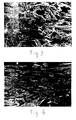
- Figures 1-3 are microphotographs (magnified at 140 times) of cross-section of composite sheet of the present invention in which a typical fragmentary binder structure is shown, and Fig. 4 is that of a conventional artificial leather in which a continuous binder structure is shown. It is impossible to give the fragmentary structure as shown in Fig. 1 with conventional materials.
- Figure 5 shows the drape coefficient versus jetting pressure of water stream.
- Figure 6 shows binders isolated from the composite sheet in which fragments smaller than 30 mesh were removed.
- Figure 7 shows the weight ratio of fragmentary binder versus jetting pressure of water stream.
- Figure 8 shows the drape coefficient versus blush abrasion resistance of the artificial leather of the present invention and of the prior art.
- the composite sheet of the present invention features the structure as stated, and a variety preparation methods may be used. Examples are as follows:
- the binder is divided into small fragments by physical treatments such as high speed fluid treatment, before, in the course of, or after the binder solution solidifies.
- a continuous binder structure in sheet is fragmented, making the sheet more flexible.
- the binder is caused, at least in the surface layer of the sheet, to adhere to the fibre in a fragmentary structure; preferably it is adhered fragmentarily to a depth more than 1/4 of the thickness of the sheet from the face and/or back.
- the depth of the fragmentary structure can be changed according to the degree of flexibility required. As the required flexibility becomes higher, the fragmentary structure is required to reach deeper inside the sheet.
- the fragmentary structure may be formed throughout the sheet, by which the sheet can be made highly flexible. When strength is important, it is preferable that at least some continuous binder structure is left in the sheet.
- the fragmentary structure is situated in the surface layer rather than in the interior of the sheet, and the continuous adhesion structure is most preferably formed in the interior of the sheet instead of the surface.
- the sheet becomes more flexible by situating the fragmentary structure in the interior of the sheet than by situating it in the surface.
- the composite sheet having such a structure may be processed into a suede type synthetic leather, grained surface type synthetic leather and a base sheet of fur-like material, which are extremely flexible and have excellent drapability.
- the binder at least in the surface region is divided into small fragments, buffing is easier for suede type synthetic leather, and dense crimps and creases can be given for the grained surface type synthetic leather.
- the present invention provides a lower decrease in strength relative to the increase of flexibility.
- Fibrous sheets suitable for use in the present invention include, but are not limited to the following: needle punched non-woven fabric, water jet punched non-woven fabric, a woven or knitted sheet interlocked with short fibre, pile sheet, spun-bonded non-woven fabric, woven sheets and knitted sheets.
- a non-woven fabric is particularly prefered for use in the present invention because it is rather hard due to the thickness and interlocking structure of the fibres.
- Fibre components constituting such sheets include, but are not limited to: synthetic fibres such as polyamide (nylon), polyester, polyacrylonitrile, polyethylene, polypropylene, etc., regenerated fibres such as viscose rayon, cupro, etc., semisynthetic fibres such as acetate, etc., and natural fibres such as wool, cotton and hemp. Synthetic fibre is most preferred because it can easily be made very fine; nylon and polyester are most preferable..
- a single yarn of the fibres is preferably less than 1 d from the viewpoint of flexibility, most preferably less than 0.3 d.
- Microfine fibres may be produced from the following multi-core composite fibres for example: islands-in-sea type fibres having fixed cross-section (Tokko-sho 44-18369) or variable cross-section (a blended spun fibre) (Tokko-sho 41-11632); and separable (by peeling mechanically or chemically, for example by swelling at least one component) type fibre (Tokko-sho 39-28005) comprising plural polymers incompatible with each other. Also included are microfine fibres such as an acrylic fibre obtained by wet spinning through a sintered metal fibre plate as a spinneret and successive drawing, polyester fibre obtained by the super drawing method and polyester fibre obtained by the melt blowing method.
- the conversion from the composite fibre into microfine fibres may be conducted in any stage of the process. In the present invention, it is most preferable to conduct the conversion before the fragmenting of the binder.
- the fibrous sheet may have any suiteble texture weight.
- a suitable value in usual is between 70 and 500 g/m2 in terms of the weight in the final product.
- a fibrous sheet before binder is applied may be shrunk or compressed, in order to give a dense feel to the synthetic leather.
- Water-soluble polymers such as polyvinyl alcohol, carboxymethyl cellulose, etc. may also be applied temporarily to the sheet in order to facilitate the subsequent process or to improve the hand of the final product.
- the binders which may be applied to the fibrous sheet include elastomers such as polyurethane, acrylonitrile-butadiene rubber, styrene-butadiene rubber, butyl rubber, neoprene, acryl rubber, silicone rubber, natural rubber, polyamide copolymer, fluorine type elastomers or mixtures thereof.
- elastomers such as polyurethane, acrylonitrile-butadiene rubber, styrene-butadiene rubber, butyl rubber, neoprene, acryl rubber, silicone rubber, natural rubber, polyamide copolymer, fluorine type elastomers or mixtures thereof.
- the range of binders which can be selected is wider than before, because the treatment of this invention makes it easy to soften the sheet. Thus, it becomes possible to use harder binders which have strong adhesive force.
- polyurethane is most preferred from standpoints of mechanical strength, hand and practical performance.
- the binder may be applied in any forms of solution type or dispersion type such as colloid, emulsion and latex, or suspension.
- a single binder or a mixture of two or more types may be used, and pigments or other additives may be added to the binder.
- Methods for applying the binder to the fibrous sheet may be any conventional method such as impregnation, coating, or spraying.
- the amount of the binder applied to the fibrous sheet may be selected according to the type of elastomer and final use of the product.
- the amount, as solid content, should be 5 to 150%, preferably between 10 to 100%, based on the weight of residual fibre.
- the fluid is preferably directed uniformly over the sheet so that the effective depth is at least 1/4 of the binder-adhering layer.
- the effective depth is the depth in the sheet up to which the directed fluid causes some structural changes in size of the binder. When the depth is too small, the softening effect decreases.
- the fluid jet is useally a high speed fluid jet.
- Any fluid may be used, as long as it does not markedly damage or dissolve the fibre or binder.
- columna streams of liquid preferably water are used, since their effects can reach deep into the composite sheet and they are economical and easy to handle.
- the fluid may, of course, be admixed with additives in order to prevent pressure loss and improve the injection effect.
- the fluid jet treatment of this invention may be applied in any stage, provided the treatment is conducted after the application of the binder.
- the treatment can be applied even before completing the solidification of the binder.
- the entanglement of the fibres or the entanglement of the fibres and the binder can be attained simultaneously with the coagulation of the binder and dividing the binder into fragments, together with an optional removal of a temporarily impregnated binder or a component of the composite fibre.
- the treatment before completion the solidification makes the composite sheet to be adhered and entangled more densely because the structure of the binder is not fixed at the time of treatment.
- a dense and soft composite sheet with relatively high strength can be obtained.
- the shape of the injection orifice is not limited in particular, and any shape may be adaptable, although a round shape is used in general.
- the round orifice preferably has a hole diameter of 0.05 to 3 mm, most preferably 0.1 to 1.0 mm.
- the injection pressure of the fluid may be adjusted according to the hole diameter of the orifice, distance between the orifice and the structure of the composite sheet to be treated, processing speed, texture weight, thickness and type, amount and adhesion condition of the binder and type of the fluid.
- the pressure is between 5 and 500 kg/cm2 in general, preferably between 10 and 300 kg/cm2 when the fluid is water.
- a row of a plurality of orifices is arranged in widthwise direction of the sheet, and designed to oscillate in a widthwise direction.
- the oscillating is done not only in the widthwise direction but also in the lengthwise direction of the sheet.
- the angle to the sheet of the high speed fluid may be variable; it is usually 90° ⁇ 45° with respect to the sheet surface.
- the flued jet treatment of the sheet by the high speed fluid may be directed on one or both sides of the sheet.
- the treatment may be conducted after the sheet is sliced into a plurality of sheets.
- the softened sheet of this invention may be subjected to buffing, followed by dyeing, or further to, e.g., an polyurethane coating.
- the sheet may be made into an artificial leather such as a suede type or a grained surface type which has a more soft touch, improved drapability and is elegant in appearance.
- the fluid treatment may be applied to a sheet before buffing and/or dyeing.
- the treatment can have an effect of napping by properly adjusting the force or angle of the fluid jets.
- the present invention has the following effects.
- the present method is illustrated by the following examples and comparative examples. Measurements of properties were based on the following methods.
- a web having a weight of 510 g/m2 was produced by passing an lslands-in-sea type composite fibre through a card and cross lapper.
- the composite fibre consists of polyethylene terephthalate (PET) as island component and copolymer of styrene and 2-ethyl-hexylacrylate (weight ratio: 78/22) as sea component in the weight ratio of 60/40 and having a size of 3.0 denier, 36 islands, a length of 51 mm and 15 to 18 crimp/inch.
- PET polyethylene terephthalate
- 2-ethyl-hexylacrylate weight ratio: 78/22
- the web was subjected to needle punching at a needle density of 3000 needles/cm2 and needle punched sheet having a weight of 525 g/cm2 and apparent density of 0.212 g/cm3 was obtained.
- the needle punched sheet was allowed to shrink by passing it through hot water at 80°C. The area shrinkage was 24.1%.
- the shrunken sheet was impregnated with a 12% aqueous solution of polyvinyl alcohol so that polyvinyl alcohol (PVA) as solid content be impregnated by 17.2% based on the fibre base.
- the sheet was repeatedly dipped and squeezed in trichlene (trichloroethylene) so that the sea component of the composite fibre was removed and the composite fibre was converted into ultrafine fibre bundle.
- the sheet was repeatedly immersed and squeezed in a 12% polyurethane (PU) solution in dimethylformamide (DMF). Just after that, the sheet was immersed in water at 30°C for 5 min to partly coagulate the impregnated PU, and then the both surfaces of the PU impregnated sheet were subjected to high speed fluid treatment.
- the high speed fluid treatment was conducted under the following conditions:
- the sheet was introduced into water at 30°C to complete coagulation and further washed in hot water for the removal of PVA and DMF.
- the amount of PU is 35-40 Wt% based on the weight of the PET fibre.
- the sheet was sliced into halves and both surfaces of the sliced sheet were subjected to a buffing machine to form naps.
- the buffed sheet was dyed with a disperse dye at 120°C, for 60 minutes using a jet type dying machine and finished. Thus a suede type artificial leather was obtained.
- Example 1 was repeated exactly but the water jet process was omitted.
- These finished sheet had thicknesses of 0.76, 0.75, 0.82, 0.85 and 0.72 mm, weights of 209, 207, 220, 213, 215 g/m2 and apparent densities of 0.275, 0.276, 0.268, 0.251, 0.299 g/cm3, respectively.
- Each suede was cut into 1cm x 1cm piece and immersed into sufficient amount of o-chlorophenol (OCP) for 24 hrs at room temperature to dissolve out the PET fibre component selectively leaving the PU undissolved. After the dissolution, by slight shaking, all of the PU of the suedes of Example 2-4 were dispersed as small fragments and no sheet-like structure remained. The PU of the suede of Example 1 was remained mostly as relatively large fragments and partly as small fragments, though they were slightly swelled. The PU of the suede of Comparative Example 1 remained keeping substantially the original sheet structure.
- OCP o-chlorophenol
- each PU/OCP mixture was filtered with 30 mesh metallic wire-mesh.
- PU residues were washed with OCP sufficiently and dried. They are shown in Figure 6.
- the relation of the amount of PU residue versus water pressure is shown in Figure 7. From Figure 7, by the fluid jet treatment, the continuous binder structure of PU can be broken into a fragmentary structure and the fragmentary structure brings about an artificial leather excellent drapability.
- Example 1 The sea component removed sheets of Example 1 were impregnated with PU solutions in DMF.
- concentrations of PU were 10% (Example 5), 12% (Example 6), 14% (Example 7) and 16% (Example 8).
- the sheets were immersed in 30°C water for 5 minutes to partly coagulate the impregnated PU, taken out and subjected to water jet treatment on both surfaces.
- the water pressure was 50 kg/cm2, and other conditions were the same as Example 1-4.
- Comparative Examples 2-5 were also conducted according to Example 5-8 respectively, but omitting the water jet treatment. After that, the coagulation of PU was completed in 30°C water, and the PVA and the DMF were removed in hot water.
- the resulting sheets were sliced into halves and both surfaces of the sliced sheets were subjected to a buffing machine to form naps.
- the buffed sheets were dyed with disperse dye at 120°C, for 60 minutes using a jet dying machine.
- the dyed sheets were finished and artificial suede were obtained.
- the relation between drape coefficient and abrasion resistance of the resultany artificial suede are shown in Figure 8. From the results, it is apparent that, by the water jet treatment, a soft and strong composite sheet can be made and that the softening effects are larger than can be attained only by controlling the amount of binder.
- a web was produced through a card and a crosslapper using an islands-in-sea type composite fibre consisting of copolymerized polystyrene with 2-ethyl-hexylacrylate as sea component and polyethyleneterephthalate as island component under the conditions: islands-in-sea ratio: 50/50; number of island: 36; denier of the composite fibre: 3 d; fibre length: 51 mm; number of crimp: 15 crimps/inch.
- a needle-punched sheet of 550 g/m2 was obtained after being subjected to needle punching at 3000 needles/cm2. The needle-punched sheet had a weight of 716 g/m2 after being shrunk in hot water at 85°C.
- the shrunken sheet was impregnated with 10% aqueous PVA solution in an amount of 17.5 wt% as solid content based on the composite fibre, and after drying, the sea component was removed with trichloroethylene, to convert the composite fibre into microfine fibre bundle.
- the sheet with the sea component removed was impregnated with 12.5% PU and 1.0% black pigment paste solution in DMF and the PU was solidified in water bath.
- the PVA and DMF were removed while the sheet was immersed in hot water and squeezed repeatedly.
- the amount of polyurethane adhered to the fibre was 40 wt% based on the weight of PET fibre.
- the sheet has a weight of 500 g/m2 and thickness of 1.76 mm.
- the sheet was subjected to a high speed water jet treatment by passing it once each for both surfaces through a high speed water jet apparatus in which orifices of 0.25 mm diameter were arranged straight in an interval of 2.5 mm in the widthwise direction of the process line, under the following conditions.
- a high speed water jet apparatus in which orifices of 0.25 mm diameter were arranged straight in an interval of 2.5 mm in the widthwise direction of the process line, under the following conditions.
- Comparative Example 6 the same treatment as Example 9 was conducted but omitted the high speed water stream treatment.
- Example 9 The sheet obtained in Example 9, followed by drying, was found to shrink slightly in the lengthwise direction but was of excellent flexibility. In contrast, the sheet obtained in Comparative Example 6 was found to be hard and had a conspicuous rubber-like elasticity.
- the sheets were sliced into halves and both surface of the sliced sheets were subjected to buffing by a buffing machine provided with a sandpaper of 150 mesh.
- the resulting sheet was dyed using disperse dye at 120°C for 50 min and finished through reduction clearing and addition of anti-static agent.
- the sheet obtained in the Example was a leather-like sheet having a high flexibility, good drapability and good hand closely resembling natural suede.
- the sheet obtained in the Comparative Example was a leather-like sheet having a hard hand.
- the physical properties of the leather-like sheets are shown Table 1.
- Example 9 Comparative Example 6 Water pressure 100 kg/cm2 Water pressure 50 kg/cm2 Weight (g/m2) 215 212 210 Thickness (mm) 0.67 0.64 0.62 Flex Rigidity (mm) Length 27 31 46 Width 25 27 35 Drape coefficient 0.25 0.29 0.40 Tensile strength (kg/cm2) length 8.1 7.4 7.5 width 6.0 5.9 6.1 Tensile elongation (%) length 101 95 86 width 120 122 117
- Example 1 The needle-punched sheet of Example 1 was shrunk in 80°C hot water. The area shrinkage was 23.8%.
- the shrunken sheet was impregnated 20% aqueous emulsion of PU as a binder and dryed at 100°C, for 20 minutes in hot flue dryer. The amount of the binder was 25.4 wt% as solid based on the fibre base.
- the dryed sheet was repeatedly immersed in trichloroethylene and squeezed to remove the sea component and heat treated at 150°C, for 5 minutes. Then both surfaces of the heat treated sheet were treated once each with high pressure water jets of 100 kg/cm2. Other conditions of water jet treatment was substantially the same as Example 1-4.
- Comparative Example 7 was conducted under the same conditions as Example 10, but the Water jet treatment was omitted.
- the sheets of Example 10 and Comparative Example 7 had weights of 588 and 593 g/m2, thickness of 2.35 and 2.28 mm, apparent densities of 0.250 and 0.260 g/cm2, respectively.
- the two sheets were sliced into halves and both surfaces of the each sliced sheet was buffed with buffing machine. And the buffed sheets were dyed with disperse dye using a jet dying machine and finished.
- the artificial suede of Example 10 was very soft and covered with dense naps. In contrast, the artificial suede of Comparative Example 7 was hard.
Landscapes
- Engineering & Computer Science (AREA)
- Textile Engineering (AREA)
- Synthetic Leather, Interior Materials Or Flexible Sheet Materials (AREA)
- Treatment And Processing Of Natural Fur Or Leather (AREA)
- Laminated Bodies (AREA)
Claims (18)
- Cuir artificiel comprenant une multiplicité de fibres souples dispersées dans un liant et y adhérant pour former une feuille, ledit liant comportant une couche fragmentaire comprenant une multiplicité de morceaux de liant séparés et indépendants adhérant à une multiplicité desdites fibres, les morceaux n'étant pas adhérents entre eux.
- Cuir artificiel selon la revendication 1, dans lequel au moins une face de ladite feuille composite est couverte de poils.
- Cuir artificiel selon la revendication 1 ou 2, dans lesquel lesdites fibres ont une finesse moyenne plus fine que 0,5 denier.
- Cuir artificiel selon l'une quelconque des revendications 1 à 3, dans lequel ledit liant est un élastomère du type polyuréthane.
- Cuir artificiel selon l'une quelconque des revendications 1 à 4, dans lequel plus de 30% en poids desdits morceaux de liant ont une taille de particule inférieure à la maille 10, de préférence inférieure à la maille 30, et plus préférablement inférieure à la maille 50.
- Cuir artificiel selon l'une quelconque des revendications 1 à 5, dans lequel ladite feuille est une feuille du type non-tissé, de préférence une feuille aiguilletée.
- Cuir artificiel selon l'une quelconque des revendications 1 à 6, dans lequel au moins une face de ladite feuille composite est couverte d'une surface grainée.
- Cuir artificiel selon l'une quelconque des revendications précédentes, dans lequel la couche fragmentaire a une profondeur effective d'au moins 1/4 de la feuille.
- Cuir artificiel selon la revendication 8, dans lequel la couche fragmentaire s'étend dans toute la feuille.
- Cuir artificiel selon l'une quelconque des revendications précédentes, dans lequel le liant est un liant coagulé dans l'eau.
- Procédé de fabrication d'un cuir artificiel comprenant les opérations suivantes :a) application d'un liant à une base de fibres pour former une feuille, etb) projection d'un courant de jets de fluide sur la base de fibres afin de morceler le liant pour former une couche fragmentaire comprenant une multiplicité de morceaux de liant séparés et indépendants n'adhérant pas entre eux mais adhérant auxdites fibres.
- Procédé selon la revendication 11, dans lequel au moins une face de ladite feuille est traitée pour former des poils.
- Procédé selon la revendication 11 ou 12, dans lequel la base de fibres est formée de fibres ayant une finesse moyenne plus fine que 0,5 denier.
- Procédé selon l'une quelconque des revendications 11 à 13, dans lequel un liant de type polyuréthane est appliqué à la base de fibres.
- Procédé selon l'une quelconque des revendications 11 à 14, dans lequel ledit fluide est de l'eau.
- Procédé selon l'une quelconque des revendications 11 à 15, dans lequel ledit courant de jets de fluide est appliqué avant l'achèvement de la solidification dudit liant.
- Procédé selon l'une quelconque des revendications 11 à 15, dans lequel ledit liant est solidifié avant l'application dudit courant de jets de fluide à la base de fibres.
- Procédé selon l'une quelconque des revendications 11 à 16, dans lequel la coagulation du liant est réalisée par immersion dans l'eau.
Priority Applications (1)
| Application Number | Priority Date | Filing Date | Title |
|---|---|---|---|
| AT85305113T ATE84330T1 (de) | 1984-07-23 | 1985-07-18 | Kunstleder und verfahren zu seiner herstellung. |
Applications Claiming Priority (6)
| Application Number | Priority Date | Filing Date | Title |
|---|---|---|---|
| JP151337/84 | 1984-07-23 | ||
| JP15133784A JPS6134286A (ja) | 1984-07-23 | 1984-07-23 | 人工皮革シ−トの製造方法 |
| JP15310884A JPS6134287A (ja) | 1984-07-25 | 1984-07-25 | 柔軟な立毛調皮革様シートの製造法 |
| JP153108/84 | 1984-07-25 | ||
| JP21909884A JPS6197482A (ja) | 1984-10-18 | 1984-10-18 | 人工皮革シ−ト |
| JP219098/84 | 1984-10-18 |
Publications (3)
| Publication Number | Publication Date |
|---|---|
| EP0176181A2 EP0176181A2 (fr) | 1986-04-02 |
| EP0176181A3 EP0176181A3 (en) | 1989-05-03 |
| EP0176181B1 true EP0176181B1 (fr) | 1993-01-07 |
Family
ID=27320091
Family Applications (1)
| Application Number | Title | Priority Date | Filing Date |
|---|---|---|---|
| EP19850305113 Expired - Lifetime EP0176181B1 (fr) | 1984-07-23 | 1985-07-18 | Cuir artificiel et son procédé de fabrication |
Country Status (5)
| Country | Link |
|---|---|
| US (1) | US4741075A (fr) |
| EP (1) | EP0176181B1 (fr) |
| AT (1) | ATE84330T1 (fr) |
| CA (1) | CA1240885A (fr) |
| DE (1) | DE3586958T2 (fr) |
Cited By (1)
| Publication number | Priority date | Publication date | Assignee | Title |
|---|---|---|---|---|
| CN102439221A (zh) * | 2008-12-31 | 2012-05-02 | 可隆工业株式会社 | 人造革及其制造方法 |
Families Citing this family (11)
| Publication number | Priority date | Publication date | Assignee | Title |
|---|---|---|---|---|
| US5217796A (en) * | 1985-02-19 | 1993-06-08 | Nitto Boseki Co., Ltd. | Woven material of inorganic fiber and process for making the same |
| US4987664A (en) * | 1989-04-27 | 1991-01-29 | The Dow Chemical Company | Process for forming an interlocked batting of carbonaceous fibers |
| FI110326B (fi) * | 1995-06-06 | 2002-12-31 | Bki Holding Corp | Menetelmä kuitukankaan valmistamiseksi |
| US5870807A (en) * | 1995-11-17 | 1999-02-16 | Bba Nonwovens Simpsonville, Inc. | Uniformity and product improvement in lyocell garments with hydraulic fluid treatment |
| US5740971A (en) * | 1995-11-17 | 1998-04-21 | Hsu; Wu-Heng | Apparatus for recycling synthetic leather |
| US6022447A (en) * | 1996-08-30 | 2000-02-08 | Kimberly-Clark Corp. | Process for treating a fibrous material and article thereof |
| US7091140B1 (en) * | 1999-04-07 | 2006-08-15 | Polymer Group, Inc. | Hydroentanglement of continuous polymer filaments |
| US6475562B1 (en) * | 2000-06-23 | 2002-11-05 | Milliken & Company | Textile-lastomer composite preferable for transfer on film coating and method of making said composite |
| US6668435B2 (en) | 2001-01-09 | 2003-12-30 | Milliken & Company | Loop pile fabrics and methods for making same |
| US20060008631A1 (en) * | 2002-08-22 | 2006-01-12 | Naohiko Takeyama | Leather-like sheet and process for production thereof |
| CN102312353B (zh) * | 2010-07-07 | 2014-09-10 | 稳健实业(深圳)有限公司 | 一种服装用水刺非织造布、其生产方法及设备 |
Family Cites Families (7)
| Publication number | Priority date | Publication date | Assignee | Title |
|---|---|---|---|---|
| US2972554A (en) * | 1955-05-23 | 1961-02-21 | Fiber Bond Corp | Pad and method of making same |
| US3329556A (en) * | 1963-10-23 | 1967-07-04 | Clupak Inc | Non-woven fabric and method of mechanically working same |
| US3408709A (en) * | 1964-12-29 | 1968-11-05 | Du Pont | Method for softening fibrous sheet material |
| US3406033A (en) * | 1965-03-01 | 1968-10-15 | Du Pont | Method for treatment of film-fibril sheets |
| US3932687A (en) * | 1966-10-17 | 1976-01-13 | Toray Industries, Inc. | Fibrous configuration composed of a plurality of mutually entangled bundles of fine fibers |
| US4329763A (en) * | 1979-01-04 | 1982-05-18 | Monsanto Company | Process for softening nonwoven fabrics |
| DE3381143D1 (de) * | 1982-03-31 | 1990-03-01 | Toray Industries | Vlies aus ultra feinen verwirrten fasern, und verfahren zur herstellung desselben. |
-
1985
- 1985-07-15 US US06/755,072 patent/US4741075A/en not_active Expired - Fee Related
- 1985-07-18 AT AT85305113T patent/ATE84330T1/de not_active IP Right Cessation
- 1985-07-18 DE DE8585305113T patent/DE3586958T2/de not_active Expired - Fee Related
- 1985-07-18 EP EP19850305113 patent/EP0176181B1/fr not_active Expired - Lifetime
- 1985-07-22 CA CA000487192A patent/CA1240885A/fr not_active Expired
Cited By (2)
| Publication number | Priority date | Publication date | Assignee | Title |
|---|---|---|---|---|
| CN102439221A (zh) * | 2008-12-31 | 2012-05-02 | 可隆工业株式会社 | 人造革及其制造方法 |
| US9074317B2 (en) | 2008-12-31 | 2015-07-07 | Kolon Industries, Inc. | Artificial leather and method for manufacturing the same |
Also Published As
| Publication number | Publication date |
|---|---|
| ATE84330T1 (de) | 1993-01-15 |
| EP0176181A3 (en) | 1989-05-03 |
| EP0176181A2 (fr) | 1986-04-02 |
| US4741075A (en) | 1988-05-03 |
| DE3586958D1 (de) | 1993-02-18 |
| DE3586958T2 (de) | 1993-05-06 |
| CA1240885A (fr) | 1988-08-23 |
Similar Documents
| Publication | Publication Date | Title |
|---|---|---|
| CA1207996A (fr) | Feuille faite de fibres ultra-fines enchevetrees, et sa fabrication | |
| US4368227A (en) | Suede-like sheet materials of ultrafine fibers | |
| US4612228A (en) | Ultrafine fiber entangled sheet | |
| USRE31601E (en) | Composite fabric combining entangled fabric of microfibers and knitted or woven fabric and process for producing same | |
| US4426421A (en) | Multilayer composite sheet useful as a substrate for artificial leather | |
| EP0216520A2 (fr) | Etoffe non tissée et procédé pour la fabriquer | |
| EP0176181B1 (fr) | Cuir artificiel et son procédé de fabrication | |
| EP0321237A2 (fr) | Etoffe non tissée ayant une résistance élevée, préparée par voie humide et son procédé de fabrication | |
| JP7249352B2 (ja) | 人工皮革基材、その製造方法及び立毛人工皮革 | |
| JP3128333B2 (ja) | 柔軟なスエード調人工皮革及びその製造方法 | |
| JP3103434B2 (ja) | 柔軟なスエード調人工皮革及び製造方法 | |
| JPH0316427B2 (fr) | ||
| DE19944441A1 (de) | Verfahren zur Herstellung eines synthetischen Leders | |
| JP3215739B2 (ja) | 極細繊維シートの起毛方法 | |
| JP3109793B2 (ja) | スエード調人工皮革 | |
| JPH0253540B2 (fr) | ||
| JPH10331075A (ja) | 人工皮革 | |
| JPS6134287A (ja) | 柔軟な立毛調皮革様シートの製造法 | |
| KR0125111B1 (ko) | 은면조 인공피혁의 제조방법 | |
| KR0185763B1 (ko) | 인공피혁의 제조방법 | |
| JPS6157433B2 (fr) | ||
| JP2989249B2 (ja) | 高強度極細繊維不織布とその製造方法 | |
| JPS6252076B2 (fr) | ||
| JPH0140151B2 (fr) | ||
| JPH0478741B2 (fr) |
Legal Events
| Date | Code | Title | Description |
|---|---|---|---|
| PUAI | Public reference made under article 153(3) epc to a published international application that has entered the european phase |
Free format text: ORIGINAL CODE: 0009012 |
|
| AK | Designated contracting states |
Kind code of ref document: A2 Designated state(s): AT BE CH DE FR GB IT LI LU NL SE |
|
| PUAL | Search report despatched |
Free format text: ORIGINAL CODE: 0009013 |
|
| AK | Designated contracting states |
Kind code of ref document: A3 Designated state(s): AT BE CH DE FR GB IT LI LU NL SE |
|
| 17P | Request for examination filed |
Effective date: 19891020 |
|
| 17Q | First examination report despatched |
Effective date: 19910712 |
|
| GRAA | (expected) grant |
Free format text: ORIGINAL CODE: 0009210 |
|
| AK | Designated contracting states |
Kind code of ref document: B1 Designated state(s): AT BE CH DE FR GB IT LI LU NL SE |
|
| PG25 | Lapsed in a contracting state [announced via postgrant information from national office to epo] |
Ref country code: SE Effective date: 19930107 Ref country code: NL Effective date: 19930107 Ref country code: LI Effective date: 19930107 Ref country code: CH Effective date: 19930107 Ref country code: BE Effective date: 19930107 Ref country code: AT Effective date: 19930107 |
|
| REF | Corresponds to: |
Ref document number: 84330 Country of ref document: AT Date of ref document: 19930115 Kind code of ref document: T |
|
| ITF | It: translation for a ep patent filed | ||
| REF | Corresponds to: |
Ref document number: 3586958 Country of ref document: DE Date of ref document: 19930218 |
|
| ET | Fr: translation filed | ||
| REG | Reference to a national code |
Ref country code: CH Ref legal event code: PL |
|
| NLV1 | Nl: lapsed or annulled due to failure to fulfill the requirements of art. 29p and 29m of the patents act | ||
| PG25 | Lapsed in a contracting state [announced via postgrant information from national office to epo] |
Ref country code: LU Free format text: LAPSE BECAUSE OF NON-PAYMENT OF DUE FEES Effective date: 19930731 |
|
| PLBE | No opposition filed within time limit |
Free format text: ORIGINAL CODE: 0009261 |
|
| STAA | Information on the status of an ep patent application or granted ep patent |
Free format text: STATUS: NO OPPOSITION FILED WITHIN TIME LIMIT |
|
| 26N | No opposition filed | ||
| PGFP | Annual fee paid to national office [announced via postgrant information from national office to epo] |
Ref country code: GB Payment date: 19940708 Year of fee payment: 10 Ref country code: DE Payment date: 19940708 Year of fee payment: 10 |
|
| PGFP | Annual fee paid to national office [announced via postgrant information from national office to epo] |
Ref country code: FR Payment date: 19940711 Year of fee payment: 10 |
|
| PG25 | Lapsed in a contracting state [announced via postgrant information from national office to epo] |
Ref country code: GB Effective date: 19950718 |
|
| GBPC | Gb: european patent ceased through non-payment of renewal fee |
Effective date: 19950718 |
|
| PG25 | Lapsed in a contracting state [announced via postgrant information from national office to epo] |
Ref country code: DE Effective date: 19960402 |
|
| PG25 | Lapsed in a contracting state [announced via postgrant information from national office to epo] |
Ref country code: FR Effective date: 19960430 |
|
| REG | Reference to a national code |
Ref country code: FR Ref legal event code: ST |
|
| REG | Reference to a national code |
Ref country code: FR Ref legal event code: ST |
|
| REG | Reference to a national code |
Ref country code: FR Ref legal event code: ST |