EP0176205A2 - Verschlusskappe - Google Patents
Verschlusskappe Download PDFInfo
- Publication number
- EP0176205A2 EP0176205A2 EP85305709A EP85305709A EP0176205A2 EP 0176205 A2 EP0176205 A2 EP 0176205A2 EP 85305709 A EP85305709 A EP 85305709A EP 85305709 A EP85305709 A EP 85305709A EP 0176205 A2 EP0176205 A2 EP 0176205A2
- Authority
- EP
- European Patent Office
- Prior art keywords
- closure cap
- sealing flanges
- container
- sealing
- flanges
- Prior art date
- Legal status (The legal status is an assumption and is not a legal conclusion. Google has not performed a legal analysis and makes no representation as to the accuracy of the status listed.)
- Withdrawn
Links
Images
Classifications
-
- B—PERFORMING OPERATIONS; TRANSPORTING
- B65—CONVEYING; PACKING; STORING; HANDLING THIN OR FILAMENTARY MATERIAL
- B65D—CONTAINERS FOR STORAGE OR TRANSPORT OF ARTICLES OR MATERIALS, e.g. BAGS, BARRELS, BOTTLES, BOXES, CANS, CARTONS, CRATES, DRUMS, JARS, TANKS, HOPPERS, FORWARDING CONTAINERS; ACCESSORIES, CLOSURES, OR FITTINGS THEREFOR; PACKAGING ELEMENTS; PACKAGES
- B65D51/00—Closures not otherwise provided for
- B65D51/16—Closures not otherwise provided for with means for venting air or gas
- B65D51/1672—Closures not otherwise provided for with means for venting air or gas whereby venting occurs by manual actuation of the closure or other element
- B65D51/1688—Venting occurring during initial closing or opening of the container, by means of a passage for the escape of gas between the closure and the lip of the container mouth, e.g. interrupted threads
-
- B—PERFORMING OPERATIONS; TRANSPORTING
- B65—CONVEYING; PACKING; STORING; HANDLING THIN OR FILAMENTARY MATERIAL
- B65D—CONTAINERS FOR STORAGE OR TRANSPORT OF ARTICLES OR MATERIALS, e.g. BAGS, BARRELS, BOTTLES, BOXES, CANS, CARTONS, CRATES, DRUMS, JARS, TANKS, HOPPERS, FORWARDING CONTAINERS; ACCESSORIES, CLOSURES, OR FITTINGS THEREFOR; PACKAGING ELEMENTS; PACKAGES
- B65D41/00—Caps, e.g. crown caps or crown seals, i.e. members having parts arranged for engagement with the external periphery of a neck or wall defining a pouring opening or discharge aperture; Protective cap-like covers for closure members, e.g. decorative covers of metal foil or paper
- B65D41/02—Caps or cap-like covers without lines of weakness, tearing strips, tags, or like opening or removal devices
- B65D41/04—Threaded or like caps or cap-like covers secured by rotation
- B65D41/0407—Threaded or like caps or cap-like covers secured by rotation with integral sealing means
- B65D41/0414—Threaded or like caps or cap-like covers secured by rotation with integral sealing means formed by a plug, collar, flange, rib or the like contacting the internal surface of a container neck
- B65D41/0421—Threaded or like caps or cap-like covers secured by rotation with integral sealing means formed by a plug, collar, flange, rib or the like contacting the internal surface of a container neck and combined with integral sealing means contacting other surfaces of a container neck
-
- Y—GENERAL TAGGING OF NEW TECHNOLOGICAL DEVELOPMENTS; GENERAL TAGGING OF CROSS-SECTIONAL TECHNOLOGIES SPANNING OVER SEVERAL SECTIONS OF THE IPC; TECHNICAL SUBJECTS COVERED BY FORMER USPC CROSS-REFERENCE ART COLLECTIONS [XRACs] AND DIGESTS
- Y10—TECHNICAL SUBJECTS COVERED BY FORMER USPC
- Y10S—TECHNICAL SUBJECTS COVERED BY FORMER USPC CROSS-REFERENCE ART COLLECTIONS [XRACs] AND DIGESTS
- Y10S215/00—Bottles and jars
- Y10S215/01—Fins
Definitions
- This invention relates to a closure cap and more particularly to a linerless closure cap formed of plastics material.
- a closure cap is provided which is especially suitable for use with containers containing pressurised fluid, for example, carbonated beverages.
- US A 4143785 and European Patent 14206 discloses a closure cap for use with a container, comprising a generally circular cap top having an outer surface and an inner surface, a generally cylindrical side wall joined at a first end to a peripheral portion of said cap top and including means for securing said closure cap to a container, a pair of spaced inner and outer downwardly extending sealing flanges, each of said sealing flanges being joined at a first end to said inner surface of said cap top, said inner and outer sealing flanges each having a free end with said free ends being spaced from each other at a distance greater than the spacing of said first ends of said sealing flanges.
- the inner and outer surfaces of the closure cap top are generally planar.
- the inner and outer sealing flanges sealingly engage the inner and outer rim edges of the container neck finish when the closure is placed on the bottle and screwed down.
- Closures of this general type have been found to be especially satisfactory in closing containers whose interiors are at neutral pressure or are under a vacuum. It has been necessary to develop the closure cap of the embodiments herein for use with containers which require a very tight seal such as in pressurised package containers, e.g. containers for carbonated beverages. It would appear that one of the causes of seal leakage with the prior proposal has been due to seal flange deflection caused by the pressure of the contents.
- seal engaging abutments such as may be seen in US A 4,442,947 to Banich. While the provision of seal flange engaging abutments has increased the effectiveness of the seal, problems of seal failure and leakage have not been completely eliminated. Moreover, it should be noted that in US A 4,442,947 the inner surface of the cap is not planar and the inner and outer surfaces of each flange do not join the inner cap surface at the same plane, but rather they join said surface along arcuate lines which are spaced axially. Furthermore, Banich provides inner and outer sealing flange back up abutment surfaces which contact the sealing flanges at their mid-points.
- Embodiments herein will also address another cause of seal failures in various container closure applications, namely sealing flange deflection caused by top loading of the closure cap.
- Design criteria promulgated by various users of plastic linerless closure caps specify that the closure must be able to withstand a top load of between 60 and 100 pounds without loss of container seal integrity.
- Such requirements have, in the prior art, been met by the use of thicker sealing flanges or integral flange reinforcing members.
- Such approaches have not been particularly successful since they have adversely affected the ability of the sealing flanges to properly contact the container neck finish and form a proper seal.
- the sealing flanges must have sufficient flexibility to be able to form a good seal with the container.
- the closure must have sufficient stiffness or strength to be able to withstand the specificed top loading. Thus, it has been difficult to satisfactorily provide a .closure cap having sufficient strength and the requisite sealing flange flexibility.
- the sealing flanges shown in the prior art closure caps are continuous along their peripheries. While this has promoted positive sealing, it has also resulted in a sudden release of high pressure, when the closure is being used with a pressurised container, as the closure is removed. This sudden release of pressure can, under certain conditions, be sufficient to cause the container closure cap to be propelled away from the container with sufficient force to possibly cause an injury to the person opening the container. In a less severe situation, the sudden, rapid release of pressurisation can cause the contents of the container to flow out of the container thereby wasting some of the contents and creating a spillage that must be cleaned up. Thus a need exists for a closure having sealing flanges which will operate (on opening the container) to provide a gentle, gradual release of the high internal pressure in a pressurised container on which the closure may be secured.
- a closure cap for use with a container, comprising a generally circular cap top have an outer surface and an inner surface, a generally cylindrical side wall joined at a first end to a peripheral portion of said cap top and including means for securing said closure cap to a container, a pair.of spaced inner and outer downwardly extending sealing flanges, each of said sealing flanges being joined at a first end to said inner surface of said cap top, said inner and outer sealing flanges each having a free end with said free ends being spaced from each other at a distance greater than the spacing of said first ends of said sealing flanges, inner and outer sealing flange back abutment surfaces, wherein said inner and outer abutment surfaces are engageable by said free ends of said inner and outer sealing flanges, respectively to limit deflection of said inner and outer sealing flanges when said closure cap is secured to a container, and wherein said inner surface of said cap top is generally planar.
- these sealing flanges are deflected outwardly and are forced away from each other by the mouth of the container.
- the sealing flange back-up abutments are spaced from the sealing flanges and are contacted by the free ends of the sealing flanges as they are forced outwardly. This engagement of the free end of each sealing flange with the back-up abutments limits the outward deflection of the sealing flanges and causes the sealing flanges to wrap around the edges of the container mouth to thereby ensure a good surface contact between the inner surfaces of the sealing flanges and the container's neck finish areas without unduly restricting seal flexibility.
- the closure cap further comprises a load stop ring, said load stop ring being positioned on said inner surface of said cap top intermediate and spaced from said inner and outer sealing flanges and extending downwardly therebetween.
- this load stop ring engages the upper surface of the container neck finish when the closure cap is securely applied to the container.
- the load stop ring thus provides a solid contact between the closure cap and the container so that the top loading applied to the closure cap will not function to force the cap down further on the bottle, possibly disrupting the sealing flange and neck finish engagement. Placement of the load stop ring between, but spaced from the sealing flanges, allows the ring to properly perform its intended function without having a detrimental effect on sealing flange flexibility.
- the load stop ring is formed integrally with said inner surface of said closure cap top.
- the load stop ring may include a planar surface engageable with a container mouth when said closure cap is secured to a container.
- sealing flanges As the diameters of the sealing flanges increase, as is the situation when the size of the cap is increased to accommodate larger mouthed containers, the flexibility of the sealing flanges themselves increase, especially where sealing flange thicknesses remain constant. This increase in sealing flange flexibility causes less satisfactory seal performance as cap size is increased unless the sealing area is also increased.
- this problem is overcome by properly stucturing the closure cap (within a range of closure caps of increasing size) so that the horizontal seal interference distance is increased as the diameter of the closure cap increases.
- This increased horizontal seal interference distance compensates for increased sealing flange flexibility and provides a proper sealing effect as the cap size varies.
- vent slots or cut-outs along each sealing flange preferably at its lower, free end. These may be regularly spaced about the peripheries of the flanges.
- each vent slot on one of the sealing flanges is aligned with a co-operating vent slot on the other of the sealing flanges.
- the vent slots allow partial release of the container's high internal pressure before the closure has been completely removed. This slower, more gradual pressure release is much safer than the more rapid and violent pressure release produced by the prior art devices thereby rendering this closure cap safer when used on pressurised containers.
- the gradual pressure release afforded by the closure cap herein is also less apt to cause agitation of the bottle's contents.
- the preferred length of the vent slots is generally about one third of the length of the respective sealing flange.
- closure cap provides a screw threaded closure structured to form a tight dependable seal when applied to any container and a seal which is well suited for use with carbonated beverage containers. It provides sealing flanges and co-operating back-up abutment surfaces that ensure a good wrap around seal contact area without restricting seal flexibility.
- a top load support ring provides the requisite top load support strength without compromising sealing flange flexibility.
- the sealing flanges are structured and sized to compensate for variations in sealing flange flexibility caused by cap size changes, and the flanges are further provided with vent slots which aid in the gradual release of high internal pressure when the closure caps are used with pressurised containers. This plastic closure cap is effective and efficient while remaining relatively simply and uncomplicated in structure.
- Plastic closure cap 10 is formed or moulded from any suitable plastic composition and has a flat circular top 12 and a downwardly depending, cylindrical side wall 14.
- the inner surface 16 of sidewall 14 may be provided with suitable internal screw threads 18.
- Suitable co-operating external screw threads 20 are formed on the outer peripheral surface 22 of a container neck 24 which terminates in an open mouth 26 defined by an upper, somewhat rounded neck finish surface 28.
- the container may. be made of glass, plastic, or other suitable material and may be designed to hold a carbonated beverage.
- these sealing flanges are flaired slightly outwardly at an angle of generally about 10 0 from vertical and are therefore generally in the shape of a truncated cone.
- Each of these sealing flanges is also preferably slightly tapered in thickness and in the preferred embodiment has a thickness of generally about 0.030" at its point of attachment to the undersurface 34 of closure cap top 12, and a thickness of generally about 0.025" at a free end 36. It will be understood that these above recited dimensions as well as those to be set forth subsequently are given primarily for illustrative purposes and are subject to normal manufacturing tolerances which may be generally in the range of +/- 0.010" and +/- 5 °.
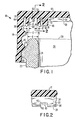
- a horizontal seal interference distance A or B is shown as the horizontal spacing or offset between the point of attachment of the sealing surface side of each sealing flange 30 and 32 to surface 34 and the inner or outer surface of the container neck 24. Variation of this horizontal seal interference width or spacing is accomplished by moving the sealing flanges 30 and 32 toward or away from each other. Since the thickness of the container neck 24 remains constant over a range of bottle mouth sizes, movement of the sealing flanges 30 and 32 toward each other will increase the horizontal seal interference widths A and B. Conversely, moving the sealing flanges away from each other will reduce widths A and B.
- the container neck 24 has a width indicated at E.
- the closure cap's sealing flanges terminate in tapered free ends 36, each of which tapers to an edge 38.
- the spacing between these free edges 38 can be seen at C and can be referred to as the maximum throat width of the seal flanges.
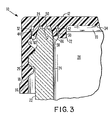
- Width C must be greater than container neck thickness E for the sealing flanges to be properly positioned on both sides of the neck finish 28, as seen in Figure 3.
- a minimum throat width is shown at D and is the spacing between the two seal flanges 30 and 32 at their points of attachment to inner surface 34 of closure cap top 12.
- the minimum throat width D must be less than width E for the sealing flanges to be deflected outwardly during seal formation. It is this spacing D which determines the horizontal seal interference distance A and B. It will be seen that the sum of A, B and D equals width E.
- An inner seal back-up flange is shown generally at 40 and is in the shape of a downwardly depending flange positioned radially interiorly of inner seal flange 30 on surface 34 of closure cap top 12.
- This inner seal back-up flange 40 is thicker than inner seal flange 30 and, in the preferred embodiment, has a thickness of generally about 0.035" and a length in the range of generally 0.10".
- An abutment surface 42 is formed on inner seal back-up flange 40 as the outer vertical peripheral surface of back-up flange 40. This abutment surface 42 is spaced radially inwardly of the radial inner surface of free end 36 of inner sealing flange 30 a distance of generally about 0.025".
- An outer back-up abutment surface 44 is formed as a thickened wall portion of closure cap side wall 14.
- the spacing between abutment surface 44 and the radially outer free end 36 of outer sealing flange 32 in the non-distorted mode seen in Figure 1 is similar to that of inner seal flange 30 from inner seal flange abutment surface 42 and is also generally about 0.025". While the inner and outer seal flanges 30 and 32, respectively taper generally outwardly from their points of contact with inner surface 34 of cap top 12, the inner seal flange abutment surface 42 and the outer seal abutment surface 44 are generally vertical. Thus the spacing between surfaces 42 and 44 and inner and outer sealing flanges 30 and 32 decreases as the distances away from cap inner surface 34 increases.
- the container neck finish 28 is positioned between the sealing flanges 30 and 32 thereby causing them to deflect.
- the sealing flanges 30 and 32 are again directed downwardly due to contact of their free ends 36 with abutment surfaces 42 and 44. It should be noted that it is the free ends 36 of inner and outer sealing flanges 30 and 32, respectively which contact their respective abutment surfaces 42 and 44. This contact positioning maximises the wrap around effect between the seal flanges and the container neck finish 28, as may be seen in Figure 3.
- the sealing flanges are allowed to deflect in a manner which provides a maximum of seal contact surface.
- the sealing flange abutment surfaces 42, 44 the sealing flanges 30, 32 would be free to be deflected by the container neck finish 28 in a manner which would result in only a line contact.
- the maximisation of seal contact areas is of substantial importance.
- the co-operation of the sealing flange free ends 36 with the seal flange abutment surfaces 42 and 44 provides this maximum surface area sealing flange to container neck finish contact.
- a load stop ring, generally at 50 may be seen in Figure 1 and 3.
- Load stop ring 50 is formed integrally with inner surface 34 of closure cap top 12, and is located between, and separate from inner and outer seal flanges 30 and 32 respectively.
- load stop ring 50 has a height of generally about 0.020" to 0.025".
- a lower, planar surface 52 of load stop ring 50 abuts the upper surface of container neck finish 28.
- the load stop ring 50 prevents a top load imposed on the cap 10 from moving the cap downwardly and thereby interfering with the function of the sealing flanges 30 and 32.
- load stop ring 50 were omitted and with the minimum throat width D being less than container neck finish thickness E, an excessive top load applied to cap 10 could cause over deflection of the sealing flanges and seal malfunction.
- the load stop ring 50 prevents this.
- Load stop ring 50 is made separate from inner and outer sealing flanges 30 and 32 and thus does not hinder the flexibility of these sealing flanges. If the load stop ring 50 extended completely between the sealing flanges, it could compromise the ability of the sealing flanges to deflect thereby reducing the sealing surface area. Load stop ring 50 is given sufficient width to perform its intended function without interfering with the functioning of the sealing flanges.
- each sealing flange 30 and 32 is provided with a plurality of vent slots 60 formed generally at the free end 36 of each of the sealing flanges.
- the width and spacing of these vent slots 60 may be varied in accordance with the degree of venting required.
- the vent slots 60 have a height, in the preferred embodiment, of generally about one-third of the height of the sealing flange. While this height can also be varied, it must not be great enough to unduly increase the flexibility of the sealing flanges or to interfere with the proper contact of the sealing flanges with the container neck finish.
- vent slots 60 which are preferably located opposite each other on the inner and outer sealing flanges 30, 32 will provide a path for the passage of high pressure gases out of a pressurised container, to which the closure cap may be applied, as the closure cap is being removed. This will allow the pressure in the container to start to be released before the closure screw threads have become completely separated from the container's screw threads.
- the vent slots 60 provide a safer, more gradual pressure release which is also effective in reducing the tendency of carbonated beverages in containers to overflow when the closure cap is removed.
- a plurality of anti-doming ribs 70 are also formed on the inner surface 34 of closure cap 12. These anti-doming rib 70 prevent the pressure of a carbonated beverage or the like, in a container to which the closure may be applied, from causing the cap top 12 to bulge or dome outwardly into a convex shape.
- these anti-doming ribs 70 have a height of up to 0.060" and extend radially outwardly from the centre of cap top 12 in a manner similar to the spokes on a wheel.
- Each such anti-doming rib 70 extends radially outwardly until it abuts an inner surface 72 of inner seal back-up flange 40. As such these anti-doming ribs 70 also function to reinforce the inner seal back-up flange 40 and stiffen it.
- the plastic container closure cap of this embodiment provides several features which render the cap particularly useful in forming a tight, reliable seal.
- Increase of the horizontal seal interference width with increased cap size compensates for increased seal flange flexibility as the cap size increases and ensures sufficient seal flange contact area over varying cap sizes.
- the use of the seal back-up abutment surfaces which are contacted by the free ends of the sealing flanges, and which limit the outward deformation of the seal flanges, ensure that the sealing flanges wrap around the container mouth and have more than a mere line contact with the container neck finish.
- the load stop ring allows the closure cap to support the top loading required by bottlers without seal failure.
- vent slots in the seal flanges add a safety and convenience feature and the anti-doming ribs prevent the cap from bulging outwardly.
Landscapes
- Engineering & Computer Science (AREA)
- Mechanical Engineering (AREA)
- Closures For Containers (AREA)
Applications Claiming Priority (2)
| Application Number | Priority Date | Filing Date | Title |
|---|---|---|---|
| US06/654,084 US4560077A (en) | 1984-09-25 | 1984-09-25 | Plastic closure cap |
| US654084 | 1984-09-25 |
Publications (2)
| Publication Number | Publication Date |
|---|---|
| EP0176205A2 true EP0176205A2 (de) | 1986-04-02 |
| EP0176205A3 EP0176205A3 (de) | 1988-05-04 |
Family
ID=24623376
Family Applications (1)
| Application Number | Title | Priority Date | Filing Date |
|---|---|---|---|
| EP85305709A Withdrawn EP0176205A3 (de) | 1984-09-25 | 1985-08-12 | Verschlusskappe |
Country Status (3)
| Country | Link |
|---|---|
| US (1) | US4560077A (de) |
| EP (1) | EP0176205A3 (de) |
| AU (1) | AU4611385A (de) |
Cited By (10)
| Publication number | Priority date | Publication date | Assignee | Title |
|---|---|---|---|---|
| GB2264108A (en) * | 1992-01-24 | 1993-08-18 | Beeson & Sons Ltd | A container and a closure therefor |
| EP0587325A1 (de) * | 1992-09-11 | 1994-03-16 | Kraft Foods, Inc. | Dichter Behälter |
| US6257432B1 (en) | 1999-12-29 | 2001-07-10 | Phoenix Closures, Inc. | Cap and container assembly |
| US6260722B1 (en) | 1999-12-29 | 2001-07-17 | Phoenix Closures, Inc. | Cap and container assembly |
| USD445690S1 (en) | 1999-12-29 | 2001-07-31 | Phoenix Closures, Inc. | Cap and container assembly |
| WO2004110888A1 (ja) * | 2003-06-10 | 2004-12-23 | Alcoa Closure Systems Japan, Limited | 合成樹脂製キャップ、閉止装置、および容器詰め飲料 |
| FR2863589A1 (fr) | 2003-12-12 | 2005-06-17 | Bericap | Bouchon comportant une levre interieure et une levre exterieure d'etancheite |
| KR100654008B1 (ko) | 2005-09-07 | 2006-12-05 | 주식회사 두산 | 누수방지 기능을 강화한 용기 뚜껑 |
| EP1985549A1 (de) | 2004-09-01 | 2008-10-29 | Creanova Universal Closures Ltd. | Dichtungsmittel für einen Verschluss, Verschluss und Verfahren |
| US8393483B2 (en) | 2004-09-01 | 2013-03-12 | Creanova Universal Closure Ltd. | Sealing means for closure with multiple sealing areas |
Families Citing this family (67)
| Publication number | Priority date | Publication date | Assignee | Title |
|---|---|---|---|---|
| GB2189228A (en) * | 1986-04-18 | 1987-10-21 | John Stewart Hamilton | Screw threaded aseptic closure |
| FR2597440B1 (fr) * | 1986-04-18 | 1989-04-28 | Seiwerling Robert | Recipient a fermeture rapide |
| US4905852A (en) * | 1989-05-26 | 1990-03-06 | Zapata Industries, Inc. | Plastic closure with improved seal |
| US5101993A (en) * | 1990-05-10 | 1992-04-07 | Phoenix Closures, Inc. | Closure seal |
| DE4128474A1 (de) † | 1991-08-28 | 1993-03-04 | Berg Jacob Gmbh Co Kg | Kunststoffschraubverschluss fuer unter druck stehende flaschen |
| US5297688A (en) * | 1992-03-03 | 1994-03-29 | Creative Packaging Corp. | Closure for sealing a container rim |
| US5320236A (en) * | 1992-04-27 | 1994-06-14 | Owens-Illinois Closure Inc. | Plastic container package with linerless sealing closure system |
| ES2119132T3 (es) * | 1993-12-23 | 1998-10-01 | Crown Cork Ag | Caperuza de cierre de material sintetico con junta interior con ventilacion precoz. |
| US5785196A (en) * | 1995-05-31 | 1998-07-28 | Rexam Closures Inc. | Closure for a pressurized container |
| US20040173556A1 (en) * | 1997-09-19 | 2004-09-09 | Smolko Daniel D. | Vented closures for containers |
| US7107783B2 (en) * | 1997-09-19 | 2006-09-19 | Advanced Porcus Technologies, Llc | Self-cooling containers for liquids |
| JP2001520968A (ja) * | 1997-10-25 | 2001-11-06 | セイフティー キャップ システム アクチエンゲゼルシャフト | ボトル又は類似のものを密閉するためのプラスチック製のねじキャップ |
| US6477823B1 (en) * | 1998-07-30 | 2002-11-12 | Kerr Group, Inc. | Closure and container system for hot filled containers |
| EP0987191A1 (de) * | 1998-09-14 | 2000-03-22 | Crown Cork & Seal Technologies Corporation | Verschlusskappe |
| EP0987190A1 (de) * | 1998-09-14 | 2000-03-22 | Crown Cork & Seal Technologies Corporation | Verschlusskappe |
| US6202870B1 (en) * | 1999-03-29 | 2001-03-20 | Woodrow W. Pearce | Venting cap |
| KR20010096600A (ko) * | 2000-03-13 | 2001-11-07 | 도케 케이시 | 합성수지제 용기뚜껑 |
| US6382445B1 (en) | 2000-06-23 | 2002-05-07 | Alcoa Closure Systems International | Linerless closure with pressure seal holding feature |
| US6491175B1 (en) | 2000-06-28 | 2002-12-10 | Saad Taha | Single piece closure for a pressurized container |
| GB2369114B (en) * | 2000-11-21 | 2004-05-05 | Beeson & Sons Ltd | Plug seals for user-friendly cap assemblies |
| ATE267747T1 (de) * | 2000-12-22 | 2004-06-15 | Prispa Holding Sa | Verschluss für behälter flüssiger produkte |
| US7503468B2 (en) * | 2001-09-10 | 2009-03-17 | Closures And Packaging Services Limited | Linerless bore seal closure |
| GB2407561B (en) * | 2001-09-10 | 2006-03-08 | Closures & Packaging Serv Ltd | Linerless bore seal closure |
| US6802428B2 (en) * | 2002-02-15 | 2004-10-12 | Phoenix Closures, Inc. | Apparatus and method allowing gas flowing into and/or out of container |
| US20030161980A1 (en) * | 2002-02-27 | 2003-08-28 | Nelson Brent S. | Plastic container |
| GB0210593D0 (en) * | 2002-05-09 | 2002-06-19 | Ici Plc | A large can for a brushable coating composition which is sealingly closeable by a screw-thread lid |
| US20040188375A1 (en) * | 2002-07-03 | 2004-09-30 | Fabricas Monterrey, S.A. De C.V. | Linerless plastic closure with a sealing lip |
| US6997354B2 (en) * | 2002-07-19 | 2006-02-14 | Rieke Corporation | Sealing mechanisms for use in liquid-storage containers |
| DE10245595A1 (de) * | 2002-09-30 | 2004-04-08 | Bericap Gmbh & Co. Kg | Schraubkappe für unter Druck stehende Behälter |
| CA2540734C (en) * | 2003-10-01 | 2011-12-13 | Obrist Closures Switzerland Gmbh | A closure |
| JP4423937B2 (ja) * | 2003-11-19 | 2010-03-03 | 株式会社吉野工業所 | レフィル容器 |
| US7527159B2 (en) | 2004-03-11 | 2009-05-05 | Rexam Closure Systems Inc. | Threaded child-resistant package having linerless closure |
| US7819264B2 (en) * | 2003-12-03 | 2010-10-26 | Rexam Closure Systems Inc. | Child-resistant closure, container and package |
| JP4769433B2 (ja) * | 2004-06-09 | 2011-09-07 | 東洋製罐株式会社 | プラスチックキャップ |
| DE602004006255T2 (de) * | 2004-08-17 | 2008-01-03 | Packsys Global (Switzerland) Ltd. | Schraubverschluss für Behälter |
| EP2065314A3 (de) * | 2004-09-01 | 2009-09-16 | Creanova Universal Closures Ltd. | Verschluss |
| EP1679267B1 (de) * | 2004-12-16 | 2011-03-30 | Japan Crown Cork Co. Ltd. | Plastikverschluss mit hervorragenden Dichtungs- und Entlüftungseigenschaften |
| US7651004B2 (en) * | 2005-05-12 | 2010-01-26 | Rexam Closure Systems Inc. | Linerless closure and package |
| GB2432360A (en) * | 2005-11-25 | 2007-05-23 | Beeson & Sons Ltd | Jaw seals for container closure assemblies |
| US8181819B2 (en) | 2006-02-23 | 2012-05-22 | Bway Corporation | Lid and container |
| US7963419B2 (en) * | 2006-02-23 | 2011-06-21 | Bway Corporation | Lid and container |
| NZ574166A (en) * | 2006-06-19 | 2012-02-24 | Amcor Ltd | A bottle closure that includes an top flange on the bottle neck that is deflected downwardly when load is applied by closing the treaded closure |
| US20080110851A1 (en) * | 2006-10-13 | 2008-05-15 | Owens-Illinois Closure Inc. | Dual seal closure and package |
| US7891512B2 (en) * | 2006-12-06 | 2011-02-22 | Reckitt Benckiser Inc. | Linerless closure for a container |
| US7712624B2 (en) * | 2006-12-27 | 2010-05-11 | Kraft Foods Holdings, Inc. | Plastic coffee container with top load support by particulate product |
| US8056744B2 (en) * | 2007-01-12 | 2011-11-15 | Phoenix Closures, Inc. | Closure with ring ribs |
| CA2577886C (fr) * | 2007-02-13 | 2015-09-08 | Crealise Conditionnement Inc. | Bouchon sans joint rapporte |
| JP3142618U (ja) * | 2008-04-08 | 2008-06-19 | ロート製薬株式会社 | 液体用容器 |
| US20090294322A1 (en) * | 2008-06-02 | 2009-12-03 | Baltz Kyle L | Pail with skirt and lid |
| US7922028B2 (en) * | 2009-02-25 | 2011-04-12 | Rehrig Pacific Company | Pail with lid and flashed lip |
| AU2011203587A1 (en) * | 2010-01-06 | 2012-08-09 | Daniel P. Soehnlen | Combined lip and shoulder seal for threaded cap |
| PL2800710T3 (pl) | 2012-01-06 | 2016-12-30 | Zamknięcie bezpodkładkowe | |
| AT13725U1 (de) * | 2012-09-19 | 2014-07-15 | Vetropack Austria Gmbh | Drehkronkorkenmündung mit Absplitterungsschutz |
| PL2897873T3 (pl) | 2012-09-19 | 2020-05-18 | Vetropack Holding Ag | Ustnik do butelki dla korków obrotowych koronowych i z zabezpieczeniem przed odłamywaniem |
| ITMO20120253A1 (it) | 2012-10-18 | 2014-04-19 | Sacmi | Tappo per contenitori. |
| US9428292B2 (en) | 2013-03-13 | 2016-08-30 | Silgan White Cap LLC | Fluid injection system and method for supporting container walls |
| USD712703S1 (en) | 2013-09-06 | 2014-09-09 | Kraft Foods Group Brands Llc | Container for food product |
| JPWO2015151286A1 (ja) * | 2014-04-04 | 2017-04-13 | サントリーホールディングス株式会社 | 樹脂製キャップ |
| JP6088118B1 (ja) * | 2016-01-04 | 2017-03-01 | 株式会社メガハウス | ボトルキャップ |
| US20200354116A1 (en) * | 2017-11-03 | 2020-11-12 | Container International, Inc. | Seal for container lids and container lids and container assemblies having same |
| US10407225B2 (en) * | 2017-11-07 | 2019-09-10 | Closure Systems International Inc. | Closure and package that vents at high pressure |
| CN111954631B (zh) | 2018-01-10 | 2022-12-20 | 碧威公司 | 具有内置盐水盘的容器盖和容器 |
| USD894510S1 (en) | 2019-01-10 | 2020-08-25 | Bway Corporation | Container |
| USD928555S1 (en) | 2019-01-10 | 2021-08-24 | Bway Corporation | Container lid |
| CN114174185B (zh) * | 2019-07-16 | 2025-05-16 | 安珍姬 | 容器盖及与其结合的容器 |
| KR102611394B1 (ko) * | 2020-03-12 | 2023-12-08 | 주식회사 아워홈 | 발효식품 저장용기용 캡부 및 이를 갖는 발효식품 저장용기 |
| CA3265738A1 (en) * | 2022-08-29 | 2024-03-07 | Bway Corporation | CONTAINER AND SEAL ASSEMBLY |
Family Cites Families (11)
| Publication number | Priority date | Publication date | Assignee | Title |
|---|---|---|---|---|
| GB854571A (en) * | 1957-11-07 | 1960-11-23 | Fenwal Lab Inc | Improvements in or relating to a container closure system |
| US2927709A (en) * | 1959-07-07 | 1960-03-08 | Faultless Rubber Co | Bottle stopple |
| US3255907A (en) * | 1964-01-13 | 1966-06-14 | Wheeling Stamping Co | Linerless screw closure for containers |
| US3215297A (en) * | 1964-03-25 | 1965-11-02 | Anchor Hocking Glass Corp | Closure cap |
| US3463340A (en) * | 1966-09-28 | 1969-08-26 | Alrik Civer Lindstrom | Screw cap with locking means |
| US3944104A (en) * | 1974-11-25 | 1976-03-16 | Consumers Glass Company Limited | Threaded wine bottle stopper |
| US4143785A (en) * | 1978-03-16 | 1979-03-13 | Sun Coast Plastic Closures, Inc. | Plastic vacuum sealing cap |
| JPS5746766A (en) * | 1980-09-02 | 1982-03-17 | Crown Cork Japan | Vessel cover with improved liner |
| US4346812A (en) * | 1981-03-10 | 1982-08-31 | The Continental Group, Inc. | Plastic closure with reinforced central panel |
| US4429802A (en) * | 1982-05-28 | 1984-02-07 | Anchor Hocking Corporation | Linerless closure cap |
| US4442947A (en) * | 1983-01-18 | 1984-04-17 | Continental White Cap, Inc. | Plastic closure with sealing flaps |
-
1984
- 1984-09-25 US US06/654,084 patent/US4560077A/en not_active Expired - Lifetime
-
1985
- 1985-08-12 AU AU46113/85A patent/AU4611385A/en not_active Abandoned
- 1985-08-12 EP EP85305709A patent/EP0176205A3/de not_active Withdrawn
Cited By (16)
| Publication number | Priority date | Publication date | Assignee | Title |
|---|---|---|---|---|
| GB2264108A (en) * | 1992-01-24 | 1993-08-18 | Beeson & Sons Ltd | A container and a closure therefor |
| GB2264108B (en) * | 1992-01-24 | 1995-11-15 | Beeson & Sons Ltd | A container closure assembly |
| EP0587325A1 (de) * | 1992-09-11 | 1994-03-16 | Kraft Foods, Inc. | Dichter Behälter |
| US5383558A (en) * | 1992-09-11 | 1995-01-24 | Kraft General Foods, Inc. | Sealed container |
| US5931323A (en) * | 1992-09-11 | 1999-08-03 | Kraft Foods, Inc. | Sealed container |
| US6257432B1 (en) | 1999-12-29 | 2001-07-10 | Phoenix Closures, Inc. | Cap and container assembly |
| US6260722B1 (en) | 1999-12-29 | 2001-07-17 | Phoenix Closures, Inc. | Cap and container assembly |
| USD445690S1 (en) | 1999-12-29 | 2001-07-31 | Phoenix Closures, Inc. | Cap and container assembly |
| WO2004110888A1 (ja) * | 2003-06-10 | 2004-12-23 | Alcoa Closure Systems Japan, Limited | 合成樹脂製キャップ、閉止装置、および容器詰め飲料 |
| EP1634818A4 (de) * | 2003-06-10 | 2007-06-06 | Alcoa Closure Systems Japan | Kunstharzkappe, schliessvorrichtung und behälterverpacktes getränk |
| AU2003244106B2 (en) * | 2003-06-10 | 2008-03-20 | Alcoa Closure Systems Japan, Limited | Synthetic resin cap, closing device, and container-packed beverage |
| AU2003244106B9 (en) * | 2003-06-10 | 2008-07-24 | Alcoa Closure Systems Japan, Limited | Synthetic resin cap, closing device, and container-packed beverage |
| FR2863589A1 (fr) | 2003-12-12 | 2005-06-17 | Bericap | Bouchon comportant une levre interieure et une levre exterieure d'etancheite |
| EP1985549A1 (de) | 2004-09-01 | 2008-10-29 | Creanova Universal Closures Ltd. | Dichtungsmittel für einen Verschluss, Verschluss und Verfahren |
| US8393483B2 (en) | 2004-09-01 | 2013-03-12 | Creanova Universal Closure Ltd. | Sealing means for closure with multiple sealing areas |
| KR100654008B1 (ko) | 2005-09-07 | 2006-12-05 | 주식회사 두산 | 누수방지 기능을 강화한 용기 뚜껑 |
Also Published As
| Publication number | Publication date |
|---|---|
| US4560077A (en) | 1985-12-24 |
| EP0176205A3 (de) | 1988-05-04 |
| AU4611385A (en) | 1986-04-10 |
Similar Documents
| Publication | Publication Date | Title |
|---|---|---|
| US4560077A (en) | Plastic closure cap | |
| CA1163234A (en) | Container-closure arrangement | |
| US4564117A (en) | Bottle closure | |
| US5782369A (en) | Linerless closure for container | |
| US5836466A (en) | Safety closure and container assembly | |
| US5785196A (en) | Closure for a pressurized container | |
| US4079857A (en) | Containers and closures | |
| US3189072A (en) | Container outlet and closure therefor | |
| US5259522A (en) | Linerless closure | |
| US3907146A (en) | Primary closure | |
| US3117702A (en) | Pouring nozzle with captive cap | |
| US6382445B1 (en) | Linerless closure with pressure seal holding feature | |
| EP0114127A2 (de) | Verschluss aus plastischem Material mit Dichtlippen | |
| US6126027A (en) | Self-centering container closure | |
| US3369694A (en) | Container with lid closure | |
| EP0119788A2 (de) | Verschluss | |
| US6044994A (en) | Sealing arrangement for closure caps having liners | |
| GB2068914A (en) | Side seal closure | |
| JPH0848357A (ja) | 溶接リング付スクリューキャップ | |
| JPH0440268B2 (de) | ||
| US3814274A (en) | Linerless closure for a container | |
| US3994410A (en) | Plastic bottle cap | |
| EP0072252B1 (de) | Verschluss und Öffnungskragen dafür | |
| EP4136035B1 (de) | Schraubverschlusskappe | |
| US4421247A (en) | Two-piece quad-seal closure with plug shock absorbing end panel |
Legal Events
| Date | Code | Title | Description |
|---|---|---|---|
| PUAI | Public reference made under article 153(3) epc to a published international application that has entered the european phase |
Free format text: ORIGINAL CODE: 0009012 |
|
| AK | Designated contracting states |
Kind code of ref document: A2 Designated state(s): AT BE CH DE FR GB IT LI LU NL SE |
|
| PUAL | Search report despatched |
Free format text: ORIGINAL CODE: 0009013 |
|
| AK | Designated contracting states |
Kind code of ref document: A3 Designated state(s): AT BE CH DE FR GB IT LI LU NL SE |
|
| STAA | Information on the status of an ep patent application or granted ep patent |
Free format text: STATUS: THE APPLICATION IS DEEMED TO BE WITHDRAWN |
|
| 18D | Application deemed to be withdrawn |
Effective date: 19880228 |
|
| RIN1 | Information on inventor provided before grant (corrected) |
Inventor name: DUTT, HERBERT VINCENT |