EP0176247A1 - Korrosionsgeschützte, viellagige Brennstoffzellenzwischenschicht - Google Patents
Korrosionsgeschützte, viellagige Brennstoffzellenzwischenschicht Download PDFInfo
- Publication number
- EP0176247A1 EP0176247A1 EP85306023A EP85306023A EP0176247A1 EP 0176247 A1 EP0176247 A1 EP 0176247A1 EP 85306023 A EP85306023 A EP 85306023A EP 85306023 A EP85306023 A EP 85306023A EP 0176247 A1 EP0176247 A1 EP 0176247A1
- Authority
- EP
- European Patent Office
- Prior art keywords
- elements
- fuel cell
- conductive layer
- metal
- cell stack
- Prior art date
- Legal status (The legal status is an assumption and is not a legal conclusion. Google has not performed a legal analysis and makes no representation as to the accuracy of the status listed.)
- Withdrawn
Links
- 239000000446 fuel Substances 0.000 title claims abstract description 52
- 238000005260 corrosion Methods 0.000 title claims abstract description 30
- 230000007797 corrosion Effects 0.000 title claims abstract description 30
- 229910052751 metal Inorganic materials 0.000 claims abstract description 28
- 239000002184 metal Substances 0.000 claims abstract description 27
- 239000011347 resin Substances 0.000 claims abstract description 18
- 229920005989 resin Polymers 0.000 claims abstract description 18
- 238000007731 hot pressing Methods 0.000 claims abstract description 7
- 238000009826 distribution Methods 0.000 claims description 36
- 238000001816 cooling Methods 0.000 claims description 33
- OKTJSMMVPCPJKN-UHFFFAOYSA-N Carbon Chemical compound [C] OKTJSMMVPCPJKN-UHFFFAOYSA-N 0.000 claims description 23
- 229910052799 carbon Inorganic materials 0.000 claims description 20
- 238000000576 coating method Methods 0.000 claims description 13
- 238000000034 method Methods 0.000 claims description 13
- 239000011248 coating agent Substances 0.000 claims description 10
- 229920002313 fluoropolymer Polymers 0.000 claims description 9
- 239000011148 porous material Substances 0.000 claims description 9
- BQCADISMDOOEFD-UHFFFAOYSA-N Silver Chemical compound [Ag] BQCADISMDOOEFD-UHFFFAOYSA-N 0.000 claims description 8
- 239000012530 fluid Substances 0.000 claims description 8
- 239000004811 fluoropolymer Substances 0.000 claims description 8
- 229910052709 silver Inorganic materials 0.000 claims description 8
- 239000004332 silver Substances 0.000 claims description 8
- 239000004695 Polyether sulfone Substances 0.000 claims description 5
- KJTLSVCANCCWHF-UHFFFAOYSA-N Ruthenium Chemical compound [Ru] KJTLSVCANCCWHF-UHFFFAOYSA-N 0.000 claims description 5
- PCHJSUWPFVWCPO-UHFFFAOYSA-N gold Chemical compound [Au] PCHJSUWPFVWCPO-UHFFFAOYSA-N 0.000 claims description 5
- 229910052737 gold Inorganic materials 0.000 claims description 5
- 239000010931 gold Substances 0.000 claims description 5
- 229920006393 polyether sulfone Polymers 0.000 claims description 5
- 229910052707 ruthenium Inorganic materials 0.000 claims description 5
- 229910052759 nickel Inorganic materials 0.000 claims description 4
- PXHVJJICTQNCMI-UHFFFAOYSA-N nickel Substances [Ni] PXHVJJICTQNCMI-UHFFFAOYSA-N 0.000 claims description 4
- DEPMYWCZAIMWCR-UHFFFAOYSA-N nickel ruthenium Chemical compound [Ni].[Ru] DEPMYWCZAIMWCR-UHFFFAOYSA-N 0.000 claims description 4
- 239000003792 electrolyte Substances 0.000 abstract description 23
- 239000007788 liquid Substances 0.000 abstract description 4
- 239000007789 gas Substances 0.000 description 30
- UFHFLCQGNIYNRP-UHFFFAOYSA-N Hydrogen Chemical compound [H][H] UFHFLCQGNIYNRP-UHFFFAOYSA-N 0.000 description 15
- QVGXLLKOCUKJST-UHFFFAOYSA-N atomic oxygen Chemical compound [O] QVGXLLKOCUKJST-UHFFFAOYSA-N 0.000 description 14
- 239000001301 oxygen Substances 0.000 description 14
- 229910052760 oxygen Inorganic materials 0.000 description 14
- 239000003054 catalyst Substances 0.000 description 13
- 239000000463 material Substances 0.000 description 12
- 239000002253 acid Substances 0.000 description 11
- NBIIXXVUZAFLBC-UHFFFAOYSA-N Phosphoric acid Chemical compound OP(O)(O)=O NBIIXXVUZAFLBC-UHFFFAOYSA-N 0.000 description 6
- BASFCYQUMIYNBI-UHFFFAOYSA-N platinum Chemical compound [Pt] BASFCYQUMIYNBI-UHFFFAOYSA-N 0.000 description 6
- RYGMFSIKBFXOCR-UHFFFAOYSA-N Copper Chemical compound [Cu] RYGMFSIKBFXOCR-UHFFFAOYSA-N 0.000 description 5
- 229910052802 copper Inorganic materials 0.000 description 5
- 239000010949 copper Substances 0.000 description 5
- 239000001257 hydrogen Substances 0.000 description 5
- 229910052739 hydrogen Inorganic materials 0.000 description 5
- 239000000376 reactant Substances 0.000 description 4
- 239000004809 Teflon Substances 0.000 description 3
- 229920006362 Teflon® Polymers 0.000 description 3
- 229910052782 aluminium Inorganic materials 0.000 description 3
- XAGFODPZIPBFFR-UHFFFAOYSA-N aluminium Chemical compound [Al] XAGFODPZIPBFFR-UHFFFAOYSA-N 0.000 description 3
- 229910000147 aluminium phosphate Inorganic materials 0.000 description 3
- 239000003575 carbonaceous material Substances 0.000 description 3
- 229910052697 platinum Inorganic materials 0.000 description 3
- MYMOFIZGZYHOMD-UHFFFAOYSA-N Dioxygen Chemical compound O=O MYMOFIZGZYHOMD-UHFFFAOYSA-N 0.000 description 2
- 238000005516 engineering process Methods 0.000 description 2
- 239000011159 matrix material Substances 0.000 description 2
- 239000000203 mixture Substances 0.000 description 2
- 239000003921 oil Substances 0.000 description 2
- 239000002245 particle Substances 0.000 description 2
- 239000002574 poison Substances 0.000 description 2
- 231100000614 poison Toxicity 0.000 description 2
- 229920001343 polytetrafluoroethylene Polymers 0.000 description 2
- 239000004810 polytetrafluoroethylene Substances 0.000 description 2
- -1 polytetrafluoroethylene Polymers 0.000 description 2
- 238000012360 testing method Methods 0.000 description 2
- 229920000049 Carbon (fiber) Polymers 0.000 description 1
- 239000004812 Fluorinated ethylene propylene Substances 0.000 description 1
- 229920000491 Polyphenylsulfone Polymers 0.000 description 1
- 230000002411 adverse Effects 0.000 description 1
- 239000003570 air Substances 0.000 description 1
- 238000004458 analytical method Methods 0.000 description 1
- 239000004917 carbon fiber Substances 0.000 description 1
- 229920001688 coating polymer Polymers 0.000 description 1
- 239000002131 composite material Substances 0.000 description 1
- 239000004020 conductor Substances 0.000 description 1
- 239000012809 cooling fluid Substances 0.000 description 1
- 229910001882 dioxygen Inorganic materials 0.000 description 1
- 238000007599 discharging Methods 0.000 description 1
- 238000009713 electroplating Methods 0.000 description 1
- 230000007613 environmental effect Effects 0.000 description 1
- HQQADJVZYDDRJT-UHFFFAOYSA-N ethene;prop-1-ene Chemical group C=C.CC=C HQQADJVZYDDRJT-UHFFFAOYSA-N 0.000 description 1
- 239000002657 fibrous material Substances 0.000 description 1
- 239000011888 foil Substances 0.000 description 1
- 239000002737 fuel gas Substances 0.000 description 1
- 229910021397 glassy carbon Inorganic materials 0.000 description 1
- 230000017525 heat dissipation Effects 0.000 description 1
- 229910052741 iridium Inorganic materials 0.000 description 1
- GKOZUEZYRPOHIO-UHFFFAOYSA-N iridium atom Chemical compound [Ir] GKOZUEZYRPOHIO-UHFFFAOYSA-N 0.000 description 1
- 230000007774 longterm Effects 0.000 description 1
- 238000012423 maintenance Methods 0.000 description 1
- 238000004519 manufacturing process Methods 0.000 description 1
- 150000002739 metals Chemical class 0.000 description 1
- VNWKTOKETHGBQD-UHFFFAOYSA-N methane Chemical compound C VNWKTOKETHGBQD-UHFFFAOYSA-N 0.000 description 1
- 238000013508 migration Methods 0.000 description 1
- 230000005012 migration Effects 0.000 description 1
- 229910000510 noble metal Inorganic materials 0.000 description 1
- 229920009441 perflouroethylene propylene Polymers 0.000 description 1
- 231100000572 poisoning Toxicity 0.000 description 1
- 230000000607 poisoning effect Effects 0.000 description 1
- 229920000642 polymer Polymers 0.000 description 1
- 230000003134 recirculating effect Effects 0.000 description 1
- 239000012260 resinous material Substances 0.000 description 1
- 229910052703 rhodium Inorganic materials 0.000 description 1
- 239000010948 rhodium Substances 0.000 description 1
- MHOVAHRLVXNVSD-UHFFFAOYSA-N rhodium atom Chemical compound [Rh] MHOVAHRLVXNVSD-UHFFFAOYSA-N 0.000 description 1
- HBMJWWWQQXIZIP-UHFFFAOYSA-N silicon carbide Chemical compound [Si+]#[C-] HBMJWWWQQXIZIP-UHFFFAOYSA-N 0.000 description 1
- 229910010271 silicon carbide Inorganic materials 0.000 description 1
- 238000003860 storage Methods 0.000 description 1
- 239000012815 thermoplastic material Substances 0.000 description 1
- 238000009736 wetting Methods 0.000 description 1
Images

Classifications
-
- H—ELECTRICITY
- H01—ELECTRIC ELEMENTS
- H01M—PROCESSES OR MEANS, e.g. BATTERIES, FOR THE DIRECT CONVERSION OF CHEMICAL ENERGY INTO ELECTRICAL ENERGY
- H01M8/00—Fuel cells; Manufacture thereof
- H01M8/02—Details
- H01M8/0297—Arrangements for joining electrodes, reservoir layers, heat exchange units or bipolar separators to each other
-
- H—ELECTRICITY
- H01—ELECTRIC ELEMENTS
- H01M—PROCESSES OR MEANS, e.g. BATTERIES, FOR THE DIRECT CONVERSION OF CHEMICAL ENERGY INTO ELECTRICAL ENERGY
- H01M8/00—Fuel cells; Manufacture thereof
- H01M8/02—Details
- H01M8/0202—Collectors; Separators, e.g. bipolar separators; Interconnectors
- H01M8/0258—Collectors; Separators, e.g. bipolar separators; Interconnectors characterised by the configuration of channels, e.g. by the flow field of the reactant or coolant
- H01M8/0263—Collectors; Separators, e.g. bipolar separators; Interconnectors characterised by the configuration of channels, e.g. by the flow field of the reactant or coolant having meandering or serpentine paths
-
- H—ELECTRICITY
- H01—ELECTRIC ELEMENTS
- H01M—PROCESSES OR MEANS, e.g. BATTERIES, FOR THE DIRECT CONVERSION OF CHEMICAL ENERGY INTO ELECTRICAL ENERGY
- H01M8/00—Fuel cells; Manufacture thereof
- H01M8/02—Details
- H01M8/0202—Collectors; Separators, e.g. bipolar separators; Interconnectors
- H01M8/0267—Collectors; Separators, e.g. bipolar separators; Interconnectors having heating or cooling means, e.g. heaters or coolant flow channels
-
- H—ELECTRICITY
- H01—ELECTRIC ELEMENTS
- H01M—PROCESSES OR MEANS, e.g. BATTERIES, FOR THE DIRECT CONVERSION OF CHEMICAL ENERGY INTO ELECTRICAL ENERGY
- H01M8/00—Fuel cells; Manufacture thereof
- H01M8/24—Grouping of fuel cells, e.g. stacking of fuel cells
- H01M8/2465—Details of groupings of fuel cells
- H01M8/2484—Details of groupings of fuel cells characterised by external manifolds
-
- Y—GENERAL TAGGING OF NEW TECHNOLOGICAL DEVELOPMENTS; GENERAL TAGGING OF CROSS-SECTIONAL TECHNOLOGIES SPANNING OVER SEVERAL SECTIONS OF THE IPC; TECHNICAL SUBJECTS COVERED BY FORMER USPC CROSS-REFERENCE ART COLLECTIONS [XRACs] AND DIGESTS
- Y02—TECHNOLOGIES OR APPLICATIONS FOR MITIGATION OR ADAPTATION AGAINST CLIMATE CHANGE
- Y02E—REDUCTION OF GREENHOUSE GAS [GHG] EMISSIONS, RELATED TO ENERGY GENERATION, TRANSMISSION OR DISTRIBUTION
- Y02E60/00—Enabling technologies; Technologies with a potential or indirect contribution to GHG emissions mitigation
- Y02E60/30—Hydrogen technology
- Y02E60/50—Fuel cells
-
- Y—GENERAL TAGGING OF NEW TECHNOLOGICAL DEVELOPMENTS; GENERAL TAGGING OF CROSS-SECTIONAL TECHNOLOGIES SPANNING OVER SEVERAL SECTIONS OF THE IPC; TECHNICAL SUBJECTS COVERED BY FORMER USPC CROSS-REFERENCE ART COLLECTIONS [XRACs] AND DIGESTS
- Y10—TECHNICAL SUBJECTS COVERED BY FORMER USPC
- Y10T—TECHNICAL SUBJECTS COVERED BY FORMER US CLASSIFICATION
- Y10T29/00—Metal working
- Y10T29/49—Method of mechanical manufacture
- Y10T29/49002—Electrical device making
- Y10T29/49108—Electric battery cell making
-
- Y—GENERAL TAGGING OF NEW TECHNOLOGICAL DEVELOPMENTS; GENERAL TAGGING OF CROSS-SECTIONAL TECHNOLOGIES SPANNING OVER SEVERAL SECTIONS OF THE IPC; TECHNICAL SUBJECTS COVERED BY FORMER USPC CROSS-REFERENCE ART COLLECTIONS [XRACs] AND DIGESTS
- Y10—TECHNICAL SUBJECTS COVERED BY FORMER USPC
- Y10T—TECHNICAL SUBJECTS COVERED BY FORMER US CLASSIFICATION
- Y10T29/00—Metal working
- Y10T29/49—Method of mechanical manufacture
- Y10T29/49002—Electrical device making
- Y10T29/49108—Electric battery cell making
- Y10T29/4911—Electric battery cell making including sealing
Definitions
- the present invention relates to improved elements for use in fuel cell stacks, and more particularly, to a stack having a corrosion resistant, electrically conductive, fluid impervious interface member therein.
- U.S. Patent 3,709,736, assigned to the assignee of the present invention describes a fuel cell system which includes a stacked configuration comprising alternating fuel cell laminates and electrically and thermally conductive impervious cell plates.
- the laminates include fuel and oxygen electrodes on either side of an electrolyte comprising an immobilized acid electrolyte.
- U.S. Patent 3,453,149, assigned to the assignee of this invention is illustrative of such an immobilized acid electrolyte.
- gas distribution plates include a plurality of gas flow channels or grooves, with the grooves for the hydrogen gas distribution being arranged orthogonally relative to the grooves for the oxygen distribution.
- the gas distribution plates themselves, whether they are individual termination plates for one or the other of the gases, or bi-polar plates for distributing both gases in accordance with this disclosure, are formed of an electrically conductive impervious material.
- cooling cells have been employed in the stack to maintain the thermal balance of the stack. These cooling cells have frequently been made of a metal such as aluminum. Metal plates have also been utilized for the current collection element in fuel cell stacks.
- an interface layer comprising a conductive carbon layer, such as Grafoil (manufactured by Union Carbide Corporation), and a copper screen arranged between the cooling or current collecting plate and the next termination plate.
- the interface layer can be a highly rolled, densely-packed, carbon, fibrous material which is at least partially resistant to acid attack.
- the interface layer comprises two conducting layers, one of which is perforated, bonded together and to the metal element by resin hot-pressed between the two conducting layers.
- this invention provides an improved interface configuration between elements of a fuel cell stack.
- the interface configuration is impervious to * See US-A-4,526,843
- a fuel cell stack which includes at least one of said improved interface configurations.
- a process for making the improved interface configuration and fuel cell stack as above is also provided.
- an improved interface configuration for use between elements of a fuel cell stack.
- the interface configuration is gas and liquid impervious to resist migration of the acid electrolyte used in the cell which could cause corrosion. Corrosion products can communicate back to and impair the operation of or poison the catalyst at the fuel cell electrodes. It is also essential that the various elements in the fuel cell stack be electrically interconnected to provide bridging electrical contact between adjacent elements.
- the interface configuration in accordance with this invention, is useful between a gas distribution plate and an adjacent current collecting plate or between a gas distribution plate and an adjacent cooling plate.
- a fuel cell stack having a plurality of stacked elements wherein at least one corrosion resistant electrically conductive interface is arranged between two of said elements which are adjacent to one another.
- the interface comprises a non-cupreous metal coating formed on at least one of the two elements and a conductive layer bonded thereto by a hot-pressed resin.
- the conductive layer and the resin are arranged to provide bridging electrical contact between a gas distribution plate G nd a current collecting plate or cooling plate, the resin filling substantially any pores in the conductive layer.
- the process for forming the interface configuration between adjacent elements of the fuel cell stack comprises forming a metal coating on a current collecting plate or a cooling plate, and arranging between the current collecting plate or cooling plate and a gas distribution plate a conductive layer and a resin layer between the conductive layer and the metal-coated plate.
- This composite is hot-pressed together thereby causing the resin to flow into the pores in the conductive layer without adversely affecting electrical conductivity of the layer.
- Hydrogen gas input manifolds 12 are arranged along one side of the stack assembly 10. While a plurality of manifolds 12 are shown for each group of fuel cells 11, if desired, a single manifold arrangement could be used.
- the manifolds 12 are connected to a source of hydrogen gaf 14.
- Hydrogen gas collecting manifolds 15 are arranged along the opposing stack side in correspondence with the gas input manifolds 12.
- the collecting manifolds 15 are, in turn, connected to a hydrogen gas discharging system 17.
- the hydrogen gas from the input manifolds 12 flows through gas distribution plates 18 to the collecting manifolds 15.
- a plurality of oxygen or air input manifolds are arranged along the stack side (not shown) connecting the one stack side and the opposing stack side.
- the oxygen manifolds are connected to an oxygen source 19.
- the oxygen may be supplied in the form of air rather than pure oxygen if desired.
- a plurality of collecting manifolds are arranged along the stack side (not shown) opposing the stack side having the oxygen input manifolds and connecting the respective one stack side and opposing stack side. These manifolds would also be connected to an oxygen storage or recirculating system (not shown).
- the oxygen or air from the input manifolds (not shown) flows through the oxygen gas distribution plates 20 to the respective collecting manifolds (not shown).
- cooling plates 21 are arranged periodically between adjacent fuel cells 11. Three cooling plates 21 are shown arranged intermediate each four cell 11 array.
- the cooling fluid flo ing through the cooling plates 21 is preferably a dielectric fluid, such as a high temperature oil, such an oil being manufactured by Monsanto under the trade name, Th erminol.
- a pump 22 circul: tes the dielectric fluid via conduit 23 and input manifold 24 into the respective cooling plates 21.
- the dielectric fluid then flows into collecting manifold 25 which is connected to a heat exchanger 26 for reducing the temperature of the dielectric fluid to the desired input temperature.
- a conduit 27 then connects the heat exchanger back to the pump 22 so that the fluid can be recirculated through the respective cooling plates 21.
- the fuel cells 11 and the cooling plates 21 are electrically conductive so that when they are stacked as shown, the fuel cells 11 are being connected in series.
- current collecting plates 28 are employed at the respective ends of the stack assembly 10.
- Positive terminal 29 and negative terminal 30 are connected to the current connecting plates 28 as shown and may be connected to the desired electrical load by any conventional means.
- Each fuel cell 11 is made up of a plurality of elements and includes a hydrogen gas distribution plate 18 and an oxygen or air distribution plate 20. Arranged intermediate the respective gas distribution plates 18 and 20 are the following elements starting from the hydrogen gas distribution plate 18: anode 31, anode catalyst 32, electrolyte 33, cathode catalyst 34 and cathode 35. These elements 31-35 of the fuel cell 11 may be formed of any suitable material in accordance with conventional practice.
- the hydrogen gas distribution plate 18 is arranged in contact with anode 31.
- the anode comprises a carbon material having pores which allow the hydrogen fuel gas to pass through the anode to the anode catalyst 32.
- the anode 31 is preferably treated with Teflon (polytetrafluoroethylene) to prevent the electrolyte 33, which is preferably an immobilized acid, from flooding back into the area of the anode. If flooding were allowed to occur, the electrolyte would plug up the pores in the anode 31 and lessen the flow of hydrogen fuel through the cell 11.
- the anode catalyst 32 is preferably a platinum containing catalyst.
- the cell 11 is formed of an electrically conductive material, such as a carbon based material, except for the immobilized acid electrolyte layer which does not conduct electrons but does conduct hydrogen ions.
- the various elements, 18, 31-35, and 20 are compressed together under a positive pressure.
- the electrolyte 33 such as phosphoric acid, is immobilized by being dispersed in a gel or paste matrix so that the acid is not a free liquid.
- An exemplary electrolyte matrix could comprise a mixture of phosphoric acid, silicon carbide particles and Teflon particles.
- the cathode catalyst 34 and the cathode 35 are formed of the same types of materials as the respective anode catalyst 32 and anode 31. Therefore, the anode 31 and the cathode 35 comprise porous carbon and the anode catalyst 32 and cathode catalyst 34 can comprise a platinum containing catalyst.
- the cathode 35 can also be treated with Teflon to prevent the electrolyte from flooding back into the porous carbon comprising the cathode.
- bi-polar asembly 36 is used to connect together adjacent fuel cells 11.
- a bi-polar assembly 36 is comprised of a hydrogen gas distribution plate 18 and an oxygen or air distribution plate 20 with an impervious interface layer or plate 37 arranged between them. Therefore, a bi-polar assembly 36 is comprised of the hydrogen gas distribution plate 18 of one cell 11 and the oxygen or air gas distribution plate 20 of the next adjacent cell 11.
- the interface layer or plate 37 may comprise an impervious carbon plate or any other conventional interface as may be desired.
- the respective plates 18 and 20, having the interface 37 therebetween are securely connected together as a unit so as to have good electrical conductivity.
- respective channels or grooves 38 or 39 are employed.
- the grooves 38 in the hydrogen gas distribution plate 18 are arranged orthogonally or perpendicularly to the grooves 39 in the oxygen or air gas distribution plate 20. This allows the grooves to be easily connected to respective input and output manifolds 12 and 15, for example, on different sides of the cell stack assembly 10.
- grooves within a particular plate such as plates 18 or 19, are shown as extending in a unidirectional manner in Figure 2, there can be cross-channels made between these grooves to aid in the distribution of the fluidic reactants.
- cross-channels When such cross-channels are utilized, the primary flow of reactants is still in the direction of the grooves 38 and 39 as shown in Figure 2; that is, in the direction that the reactants flow between the reactant input and collecting manifolds.
- the gas distribution plates 18 and 20 supply the respective hydrogen and oxygen or air gases to the surfaces of their respective anode 31 or cathode 35.
- the gas distribution plates 18 and 20 are preferably formed of a porous carbon material. This allows the respective gases to flow through the pores of the plates 18 and 20 between the respective channels 38 or 39 to provide more uniform gas distribution over the face of the respective anode 31 or cathode 35.
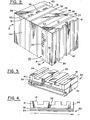
- the current collecting plate 28 can be combined in an assembly 40 with a gas distribution plate 18, as shown in Figure 2. Since the current collecting plate 28 is normally formed of an impervious material, such as aluminum, the purpose of the layer or plate 60 is to prevent corrosion of the plate 28.
- a cooling plate assembly, shown as 21 in Figure 1, can be made in a similar manner comprising a gas distribution plate and a cooling plate with an interface layer or plate therebetween.
- Interface layers 60 are typically employed between gas distribution plates 18 or 20 and cooling plates 21 or current collecting plates 28.
- the cooling plates and current collecting plates are generally formed of metal which is subject to corrosion by the acid of electrolyte 33.
- a new improved interface layer configuration 60 for use intermediate gas distribution plates 18 or 20 and cooling plates 21 or current collecting plate 28 in a fuel cell stack 10 serves to prevent corrosion by the acid of the electrolyte 33.
- electrical conduction through the interface 60 is preserved and poisoning of the catalyst layers 32 or 34 by corrosion products is avoided.
- the improved interface layer 60 comprises a conductive layer 52 preferably comprising porou: carbon fiber paper, most preferably comprising a fluoropolymer-treated carbon paper.
- the cooling plate 21 or current collecting plate 28 is provided with a non-cupreous metal coating (not shown), advantageously ranging in thickness from about 0.1 mil to about 1.0 mil.
- the metal is preferably one selected from the group consisting of silver, gold, ruthenium, platinum, rhodium, iridium, ruthenium-nickel or palladium-nickel or a mixture thereof.
- the non-cupreous metal coating is formed on the cooling plate 21 or current collecting plate 28 by any convenient technique, such as by electroplating and the like.
- a layer of resin material 54 is Intermediate the conductive layer 52 .
- the assembly is then hot-pressed onto the metal-coated cooling plate 21 or the metal-coated current collecting plate 28.
- the resin material 54 will have filled substantially any pores in the carbon paper. This process prevents access of the electrolyte 33 - or of air to the interfacial zone. In this manner, electrical conduction is achieved while corrosion is inhibited or prevented.
- a preferred resin material comprises polyethersulfone and the hot pressing is preferably carried out at from about 100 to about 300 psi and from about 500 degrees to about 750 degrees F.
- the resultant structure is as shown in Figure 3 wherein the carbon paper is securely bonded and electrically connected to the cooling plate 21 and compressed against the gas distribution plate 18.
- metal coatings were evaluated for their corrosion resistance; the metals were silver, gold, ruthenium, ruthenium-nickel and palladium-nickel. All of these coatings showed better corrosion resistance as compared to copper (used in the prior art). However, in order to ensure an endurance such as in the range of five years or more, additional corrosion protection is achieved by providing an additional layer of fluoropolymer-treated carbon paper. The fluoropolymer prevents or inhibits the wetting of the carbon paper by the corrosive electrolyte, thus limiting the possibility of contact between the metallic part and the electrolyte.
- the fluoropolymer-treated carbon paper is bonded to the metallic part (cooling plate 21 or current collector plate 28) which has been precoated with one of the above-mentioned metal coatings via the film bonding process described above.
- An example of such process conditions includes hot pressing at 700 degrees F for 45 minutes at a pressure of about 200 psi, followed by cooling to 400 degrees F at the same pressure and further cooling to room temperature without pressure.
- the copper screen used in the prior art is not necessary and may be eliminated.
- the reason for this is that silver and other noble metals do not normally form an electrically insulating film on their surface, as do copper or aluminum under many environmental conditions. Since the function of the screen was in part at least, to break through the insulating film, the screen is no longer needed. This in turn removes a target for corrosion and also results in a less vulnerable seal against the acid electrolyte.
- the excess resin is being compressed according to this invention directly into the pores of the treated carbon paper, thus further reducing its porosity and limiting the possibility of contact between the electrolyte and the metallic part.
- Silver is advantageously employed as the metal coating due to its relatively low price. Samples prepared utilizing silver coating and fluoropolymer-treated paper showed the lowest corrosion current when compared to a sample utilizing copper eating and fluoropolymer-treated carbon paper. Ruthenium is also preferred, in view of its relatively low cost and the potential of superior corrosion protection observed in the tests.
- a current collector 2 ft 2 was prepared according to this invention.
- the collector was provided with an electroplated metal coating of silver having a thickness of 0.25 mils.
- Fluoropolymer-treated carbon paper was bonded to the collector using polyethersulfone as the resin, employing hot pressing. The same conditions and parameters for hot pressing as descussed above were used.
- the current collector and interface were incorporated into a fuel cell stack and tested for 1500 hours. The current collector was re-examined after the conclusion of this test. No corrosion was detected.
Landscapes
- Life Sciences & Earth Sciences (AREA)
- Engineering & Computer Science (AREA)
- Manufacturing & Machinery (AREA)
- Sustainable Development (AREA)
- Sustainable Energy (AREA)
- Chemical & Material Sciences (AREA)
- Chemical Kinetics & Catalysis (AREA)
- Electrochemistry (AREA)
- General Chemical & Material Sciences (AREA)
- Fuel Cell (AREA)
Applications Claiming Priority (2)
| Application Number | Priority Date | Filing Date | Title |
|---|---|---|---|
| US06/644,822 US4605602A (en) | 1984-08-27 | 1984-08-27 | Corrosion protected, multi-layer fuel cell interface |
| US644822 | 1984-08-27 |
Publications (1)
| Publication Number | Publication Date |
|---|---|
| EP0176247A1 true EP0176247A1 (de) | 1986-04-02 |
Family
ID=24586479
Family Applications (1)
| Application Number | Title | Priority Date | Filing Date |
|---|---|---|---|
| EP85306023A Withdrawn EP0176247A1 (de) | 1984-08-27 | 1985-08-23 | Korrosionsgeschützte, viellagige Brennstoffzellenzwischenschicht |
Country Status (4)
| Country | Link |
|---|---|
| US (1) | US4605602A (de) |
| EP (1) | EP0176247A1 (de) |
| JP (1) | JPH0654672B2 (de) |
| CA (1) | CA1250016A (de) |
Cited By (3)
| Publication number | Priority date | Publication date | Assignee | Title |
|---|---|---|---|---|
| US4913706A (en) * | 1988-09-19 | 1990-04-03 | International Fuel Cells Corporation | Method for making a seal structure for an electrochemical cell assembly |
| EP0330124A3 (de) * | 1988-02-24 | 1991-06-12 | Toray Industries, Inc. | Elektroleitendes integriertes Substrat und Verfahren zu seiner Herstellung |
| DE19640805C1 (de) * | 1996-10-02 | 1998-06-18 | Siemens Ag | Verfahren zum Herstellen eines Hochtemperatur-Brennstoffzellenstapels |
Families Citing this family (12)
| Publication number | Priority date | Publication date | Assignee | Title |
|---|---|---|---|---|
| JPH0626126B2 (ja) * | 1986-06-13 | 1994-04-06 | 株式会社日立製作所 | 燃料電池 |
| JP3028488B2 (ja) * | 1989-11-20 | 2000-04-04 | トヨクニ電線株式会社 | 応急用通信の設置方法および応急用通信ケーブル |
| US5478676A (en) * | 1994-08-02 | 1995-12-26 | Rexam Graphics | Current collector having a conductive primer layer |
| JP4366872B2 (ja) * | 2000-03-13 | 2009-11-18 | トヨタ自動車株式会社 | 燃料電池用ガスセパレータおよび該燃料電池用セパレータの製造方法並びに燃料電池 |
| US7258941B2 (en) * | 2001-05-08 | 2007-08-21 | Ube Industries, Ltd. | Polymer electrolyte for solid polymer type fuel cell and fuel cell |
| WO2003034515A2 (en) * | 2001-10-17 | 2003-04-24 | Trustees Of Boston University | One-step consolidation process for manufacturing solid oxide fuel cells |
| DE10158771C2 (de) * | 2001-11-23 | 2003-09-18 | Reinz Dichtungs Gmbh & Co Kg | Brennstoffzellensystem |
| CN1802769A (zh) * | 2003-06-09 | 2006-07-12 | 圣戈本陶瓷及塑料股份有限公司 | 堆叠支撑的固态氧化物燃料电池 |
| WO2007082209A2 (en) * | 2006-01-09 | 2007-07-19 | Saint-Gobain Ceramics & Plastics, Inc. | Fuel cell components having porous electrodes |
| CA2647414C (en) * | 2006-04-05 | 2012-10-30 | Saint-Gobain Ceramics & Plastics, Inc. | A sofc stack having a high temperature bonded ceramic interconnect and method for making same |
| CN103633285B (zh) | 2007-10-26 | 2017-07-07 | 赛昂能源有限公司 | 用于电池电极的底涂料 |
| FR3040240B1 (fr) * | 2015-08-19 | 2017-08-04 | Commissariat Energie Atomique | Pile a combustible a couche de gestion d’eau integree et son procede de realisation. |
Citations (4)
| Publication number | Priority date | Publication date | Assignee | Title |
|---|---|---|---|---|
| DE2250187A1 (de) * | 1972-10-13 | 1974-04-25 | Varta Batterie | Bleiakkumulator mit bipolaren elektroden |
| US4115627A (en) * | 1977-08-15 | 1978-09-19 | United Technologies Corporation | Electrochemical cell comprising a ribbed electrode substrate |
| EP0106603A1 (de) * | 1982-09-30 | 1984-04-25 | Engelhard Corporation | Getrennte Anordnung von durch einen Film verbundene Brennstoffzellen |
| EP0122150A2 (de) * | 1983-04-11 | 1984-10-17 | Engelhard Corporation | Integrierte Gasdichtung für die Gasverteilungsanordung einer Brennstoffzelle und Verfahren zu deren Herstellung |
Family Cites Families (1)
| Publication number | Priority date | Publication date | Assignee | Title |
|---|---|---|---|---|
| US4526843A (en) * | 1982-09-30 | 1985-07-02 | Engelhard Corporation | Film bonded fuel cell interface configuration |
-
1984
- 1984-08-27 US US06/644,822 patent/US4605602A/en not_active Expired - Lifetime
-
1985
- 1985-08-23 EP EP85306023A patent/EP0176247A1/de not_active Withdrawn
- 1985-08-26 JP JP60185958A patent/JPH0654672B2/ja not_active Expired - Lifetime
- 1985-08-26 CA CA000489388A patent/CA1250016A/en not_active Expired
Patent Citations (4)
| Publication number | Priority date | Publication date | Assignee | Title |
|---|---|---|---|---|
| DE2250187A1 (de) * | 1972-10-13 | 1974-04-25 | Varta Batterie | Bleiakkumulator mit bipolaren elektroden |
| US4115627A (en) * | 1977-08-15 | 1978-09-19 | United Technologies Corporation | Electrochemical cell comprising a ribbed electrode substrate |
| EP0106603A1 (de) * | 1982-09-30 | 1984-04-25 | Engelhard Corporation | Getrennte Anordnung von durch einen Film verbundene Brennstoffzellen |
| EP0122150A2 (de) * | 1983-04-11 | 1984-10-17 | Engelhard Corporation | Integrierte Gasdichtung für die Gasverteilungsanordung einer Brennstoffzelle und Verfahren zu deren Herstellung |
Cited By (3)
| Publication number | Priority date | Publication date | Assignee | Title |
|---|---|---|---|---|
| EP0330124A3 (de) * | 1988-02-24 | 1991-06-12 | Toray Industries, Inc. | Elektroleitendes integriertes Substrat und Verfahren zu seiner Herstellung |
| US4913706A (en) * | 1988-09-19 | 1990-04-03 | International Fuel Cells Corporation | Method for making a seal structure for an electrochemical cell assembly |
| DE19640805C1 (de) * | 1996-10-02 | 1998-06-18 | Siemens Ag | Verfahren zum Herstellen eines Hochtemperatur-Brennstoffzellenstapels |
Also Published As
| Publication number | Publication date |
|---|---|
| JPH0654672B2 (ja) | 1994-07-20 |
| JPS61114477A (ja) | 1986-06-02 |
| US4605602A (en) | 1986-08-12 |
| CA1250016A (en) | 1989-02-14 |
Similar Documents
| Publication | Publication Date | Title |
|---|---|---|
| US4605602A (en) | Corrosion protected, multi-layer fuel cell interface | |
| US4505992A (en) | Integral gas seal for fuel cell gas distribution assemblies and method of fabrication | |
| EP0174762B1 (de) | Herstellung von gasundurchlässigen Kantenabdichtungen für eine bipolare Gasverteilungsanordnung zur Verwendung in einer Brennstoffzelle | |
| US5707755A (en) | PEM/SPE fuel cell | |
| US7390586B2 (en) | Fuel cell stacks of alternating polarity membrane electrode assemblies | |
| EP0750798B1 (de) | Festoxid-brennstoffzellenstapel | |
| CA1065395A (en) | Fuel cell cooling system | |
| US7858262B2 (en) | Fuel cell comprising a plurality of individual cells connected in series by current collectors | |
| US5776624A (en) | Brazed bipolar plates for PEM fuel cells | |
| US4732637A (en) | Method of fabricating an integral gas seal for fuel cell gas distribution assemblies | |
| JP2000173631A (ja) | 陽子交換膜燃料電池のための接着プレ―ト | |
| EP1298755B1 (de) | Brennstoffzellenstapel mit Metallfolie-Interkonnektoren und laminierten Abstandhaltern | |
| US3575718A (en) | Composite electrolyte member for fuel cell | |
| CA2203015A1 (en) | Cathode reactant flow field component for a fuel cell stack | |
| CN101087030A (zh) | 为双极板在低级不锈钢/合金上制造亲水性抗腐蚀涂层的方法 | |
| US4526843A (en) | Film bonded fuel cell interface configuration | |
| US4938833A (en) | Process for making film-bonded fuel cell interfaces | |
| CA1202064A (en) | Film bonded fuel cell interface configuration | |
| DE102007022202B4 (de) | Brennstoffzellenstapel mit einer nichtpermeablen Beilage mit niedrigem Kontaktwiderstand | |
| US4826716A (en) | Film bonded fuel cell interface configuration | |
| US4461813A (en) | Electrochemical power generator | |
| Pigeaud et al. | Coating applications for the molten carbonate fuel cell | |
| JPS60167274A (ja) | 燃料電池 |
Legal Events
| Date | Code | Title | Description |
|---|---|---|---|
| PUAI | Public reference made under article 153(3) epc to a published international application that has entered the european phase |
Free format text: ORIGINAL CODE: 0009012 |
|
| AK | Designated contracting states |
Kind code of ref document: A1 Designated state(s): AT BE CH DE FR GB IT LI LU NL SE |
|
| STAA | Information on the status of an ep patent application or granted ep patent |
Free format text: STATUS: THE APPLICATION IS DEEMED TO BE WITHDRAWN |
|
| 18D | Application deemed to be withdrawn |
Effective date: 19861003 |
|
| RIN1 | Information on inventor provided before grant (corrected) |
Inventor name: WANG, CHIU LING Inventor name: FEIGENBAUM, HAIM Inventor name: PUDICK, SHELDON |